A complete issue · 36 pages · 1931
Judge — September 5, 1931
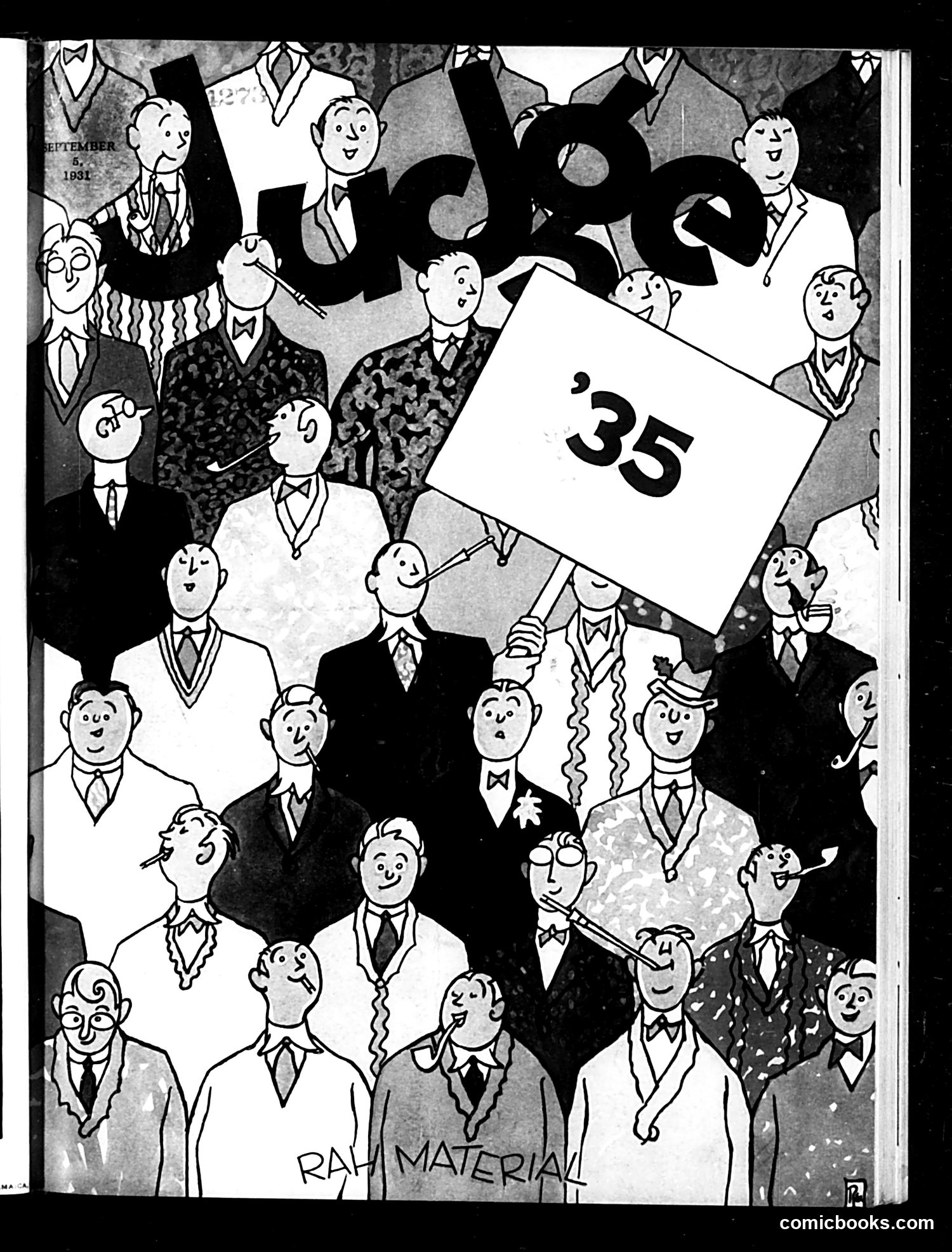
# Analysis of Judge Magazine Page (September 1931) This satirical cartoon depicts a crowd of men celebrating around large numbers "1931" and "'35" with a sign reading "RAH MATERIAL." The context appears to be economic commentary from September 1931—shortly after the October 1929 stock market crash that triggered the Great Depression. The "RAH MATERIAL" likely refers to cheering or enthusiasm for economic recovery prospects. The "35" may reference optimism about conditions improving by 1935, or possibly reference to a specific economic plan or prediction circulating at that time. The caricatured, cheerful faces suggest satirical mockery—the cartoon appears to be ridiculing unfounded optimism about economic recovery during genuine economic hardship, a common Judge magazine theme during the Depression era.
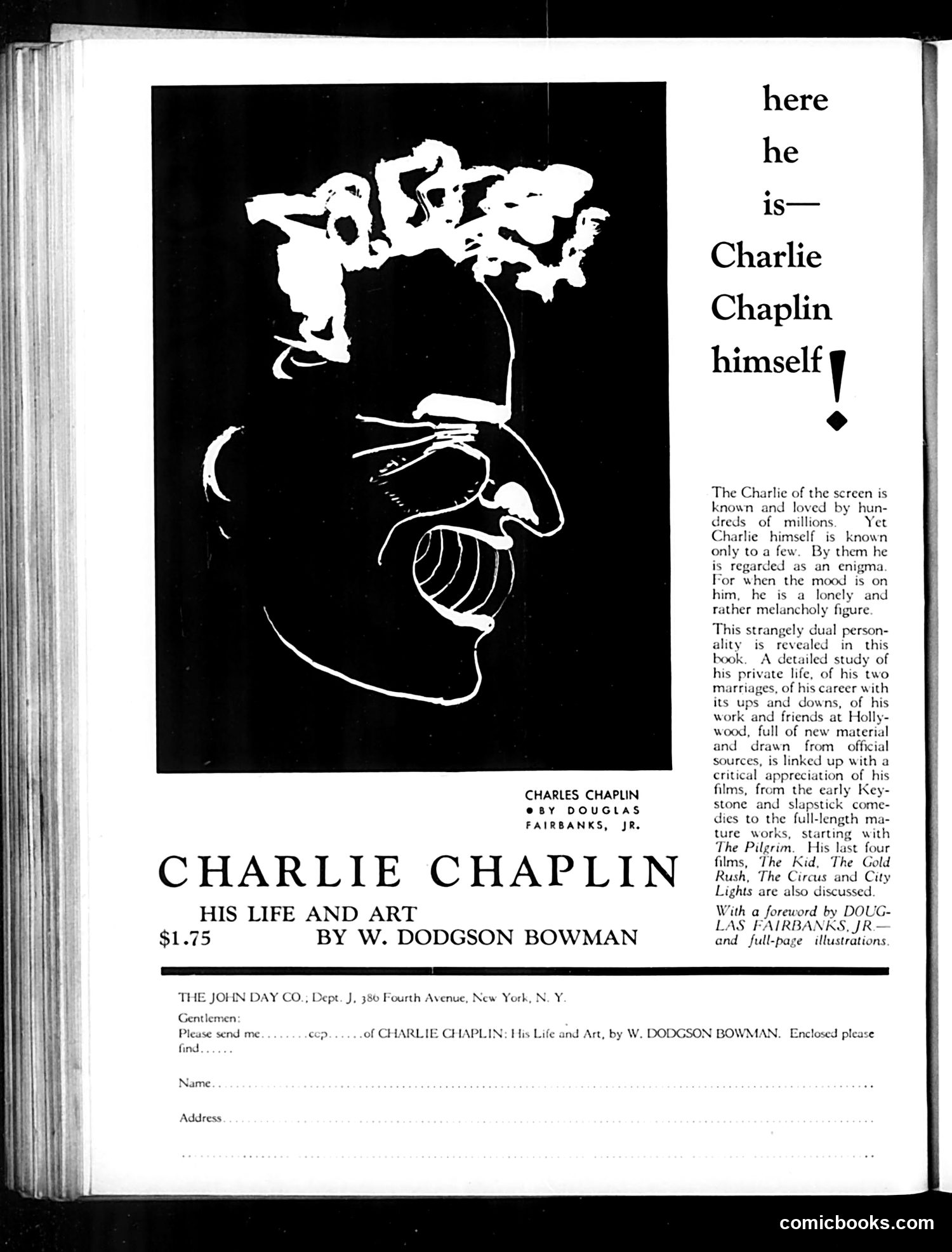
# Analysis This page is primarily **advertising** for a biography book rather than satirical content. It promotes "Charlie Chaplin: His Life and Art" by W. Dodgson Bowman, published by John Day Company for $1.75. The illustration is a stylized portrait of Charlie Chaplin's iconic character—the "Tramp"—rendered in stark white lines against black, showing the bowler hat, cane, and baggy suit silhouette he famously wore. The accompanying text describes the contrast between Chaplin's screen persona (beloved by millions) and his private life (known only to few), portraying him as an "enigma"—a "lonely and rather melancholy figure." The book promises detailed coverage of his personal life, two marriages, Hollywood career, and film analysis from his Keystone comedies through full-length features like "The Pilgrim."
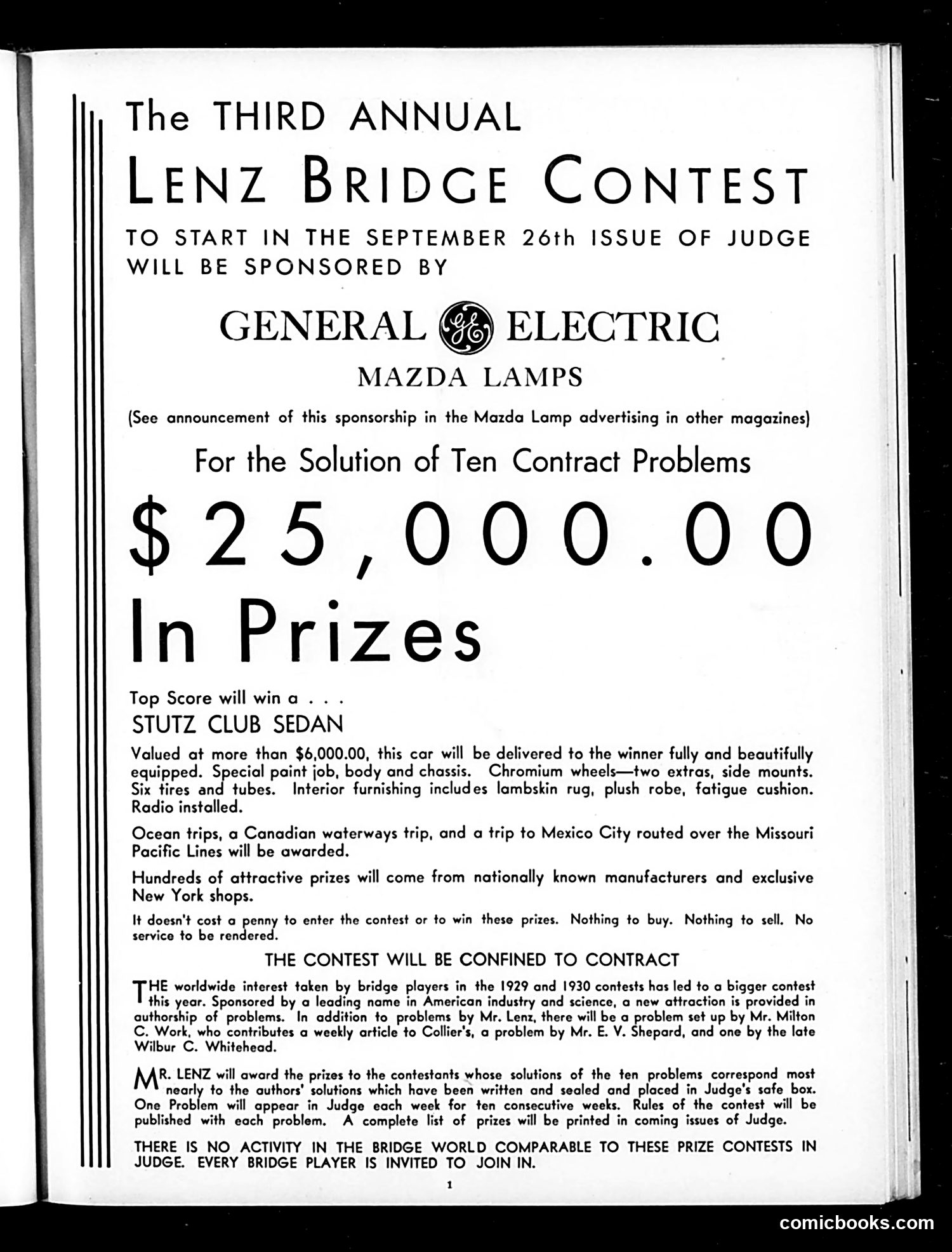
This page is primarily **advertising copy**, not satirical content. It announces the Third Annual Lenz Bridge Contest, sponsored by General Electric's Mazda Lamps division. The contest offers $25,000 in prizes for solving ten contract bridge problems. The grand prize is a Stutz Club Sedan (valued over $6,000), plus ocean trips and a Mexico City journey. Additional prizes come from "nationally known manufacturers and exclusive New York shops." The text emphasizes the contest requires "Nothing to buy. Nothing to sell. No service to be rendered" and is "confined to contract" bridge—indicating this targets the serious bridge-playing community. The contest appears designed to generate brand awareness for both Mazda Lamps and the Lenz bridge problem-setting tradition among educated, affluent Americans.
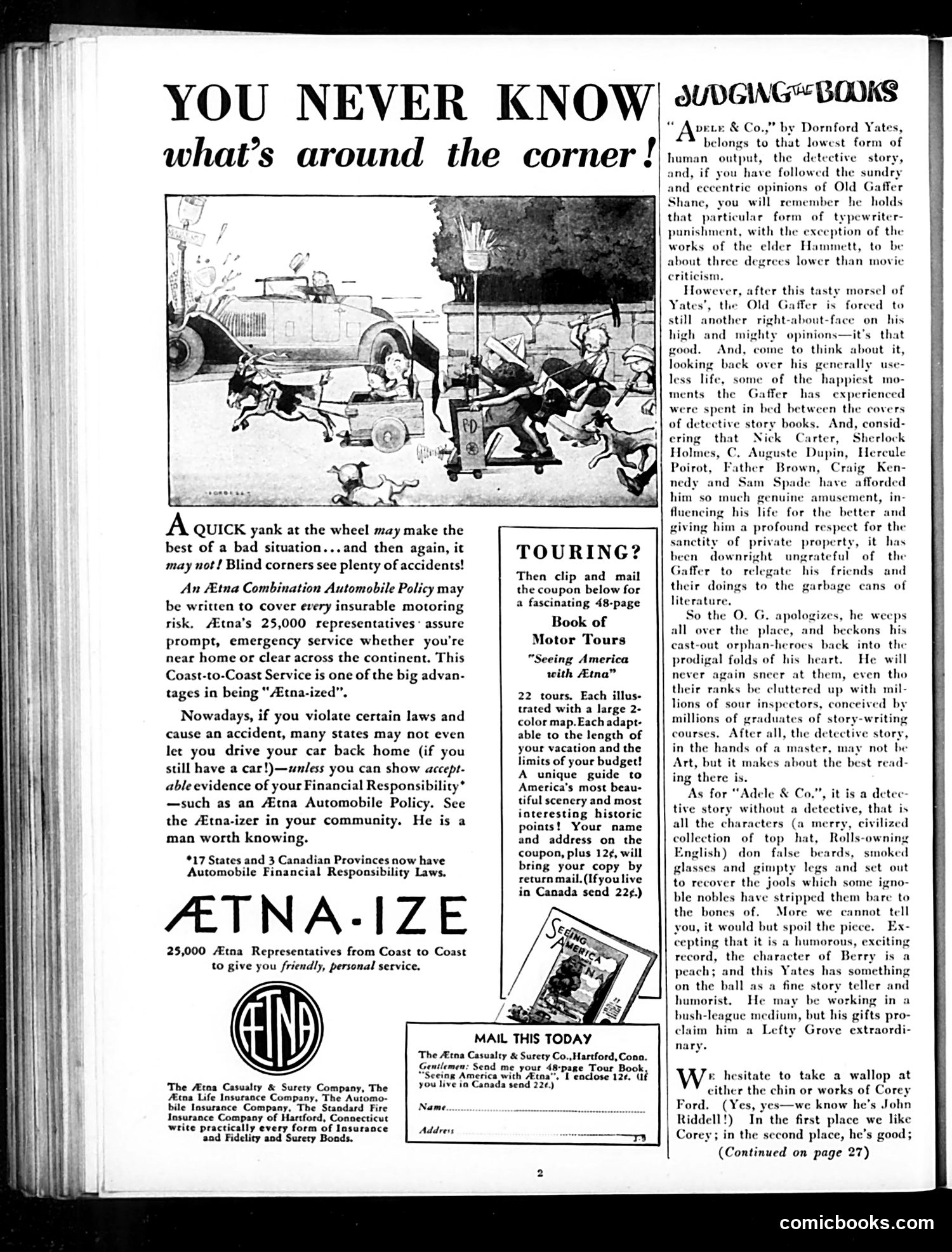
# "You Never Know What's Around the Corner" This page is primarily an **Ætna insurance advertisement** disguised as editorial content. The cartoon depicts a chaotic car accident with multiple vehicles colliding and people flying through the air, illustrating the unpredictability of traffic dangers. The ad's message: reckless driving causes accidents, and many states now legally require drivers to prove "Financial Responsibility" through insurance. Ætna positions itself as essential protection, offering 25,000 representatives nationwide for emergency service. The right column reviews "Adèle & Co." by Dornford Yates—a detective story. The reviewer humorously dismisses it as forgettable genre fiction, though praising Yates's storytelling skill. **Bottom line:** This is advertising-as-content, using fear of accidents to sell liability insurance to motorists.
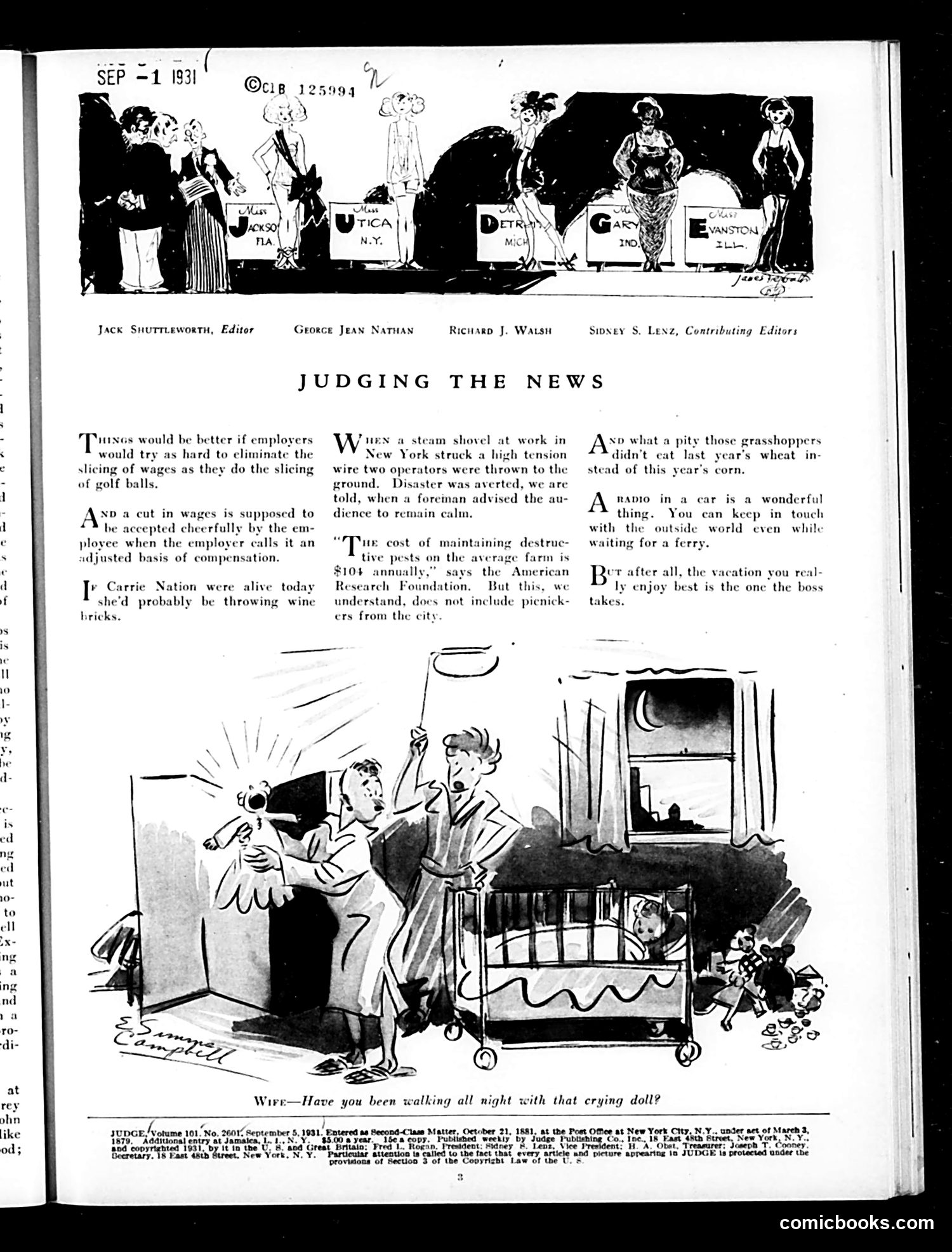
# "Judging the News" - September 1, 1931 This page satirizes contemporary social and economic issues during the Great Depression era. The editorial commentary addresses: **Labor disputes**: A steam shovel accident in New York where workers were injured, critiquing management's response. **Agricultural hardship**: Grasshoppers destroying wheat crops, blamed on farm practices. **Modern conveniences**: Radio technology enabling people to stay connected while traveling. **Vacation dynamics**: A humorous observation about workplace hierarchy and leisure time. The main cartoon depicts a domestic scene where a husband, reading a newspaper, asks his wife if she's been "walking all night with that crying doll"—suggesting marital tension over her nighttime caregiving of their infant. The satire reflects 1930s anxieties about economic hardship affecting family life and domestic arrangements.
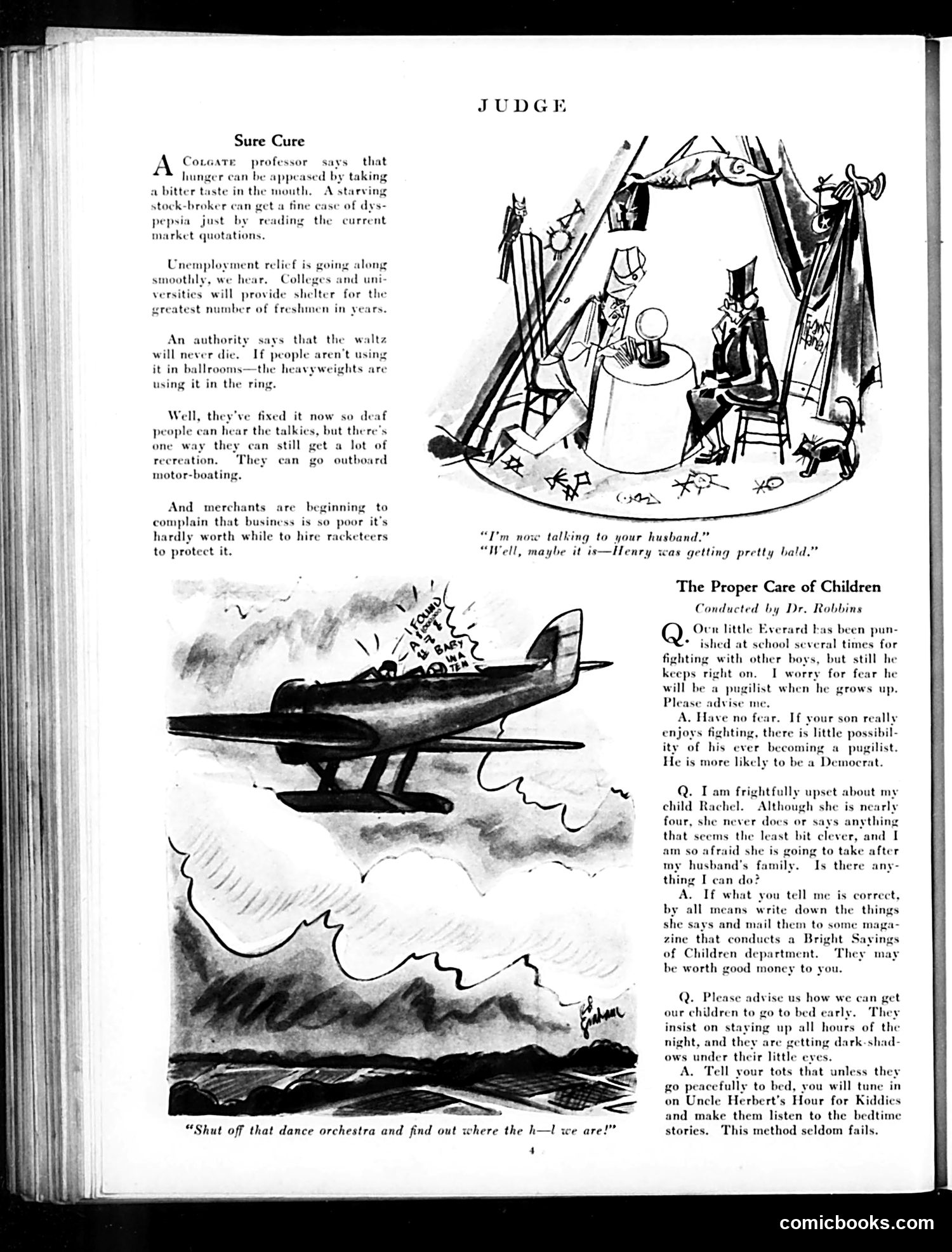
# Judge Magazine Page Analysis This page contains two distinct sections: **"Sure Cure" Column (top left):** Satirical quips about Depression-era problems—hunger, unemployment, dyspepsia, and the "waltz" (possibly radio broadcasts). The humor relies on absurd "solutions" (tasting butter for hunger, reading market quotes for indigestion). **Political Cartoon (center-left):** An airplane crashes into turbulent waves with the caption "Shut off that dance orchestra and find out where the h—l we are!" This appears to mock someone relying on radio entertainment while losing situational awareness—likely satirizing government or business leaders ignoring economic warning signs during the Depression. **"The Proper Care of Children" (right):** An advice column by Dr. Robbins addressing parental concerns about children's behavior—fighting, shyness, and bedtime resistance. The responses offer practical guidance, reflecting period parenting advice. The page blends political satire with practical domestic advice.
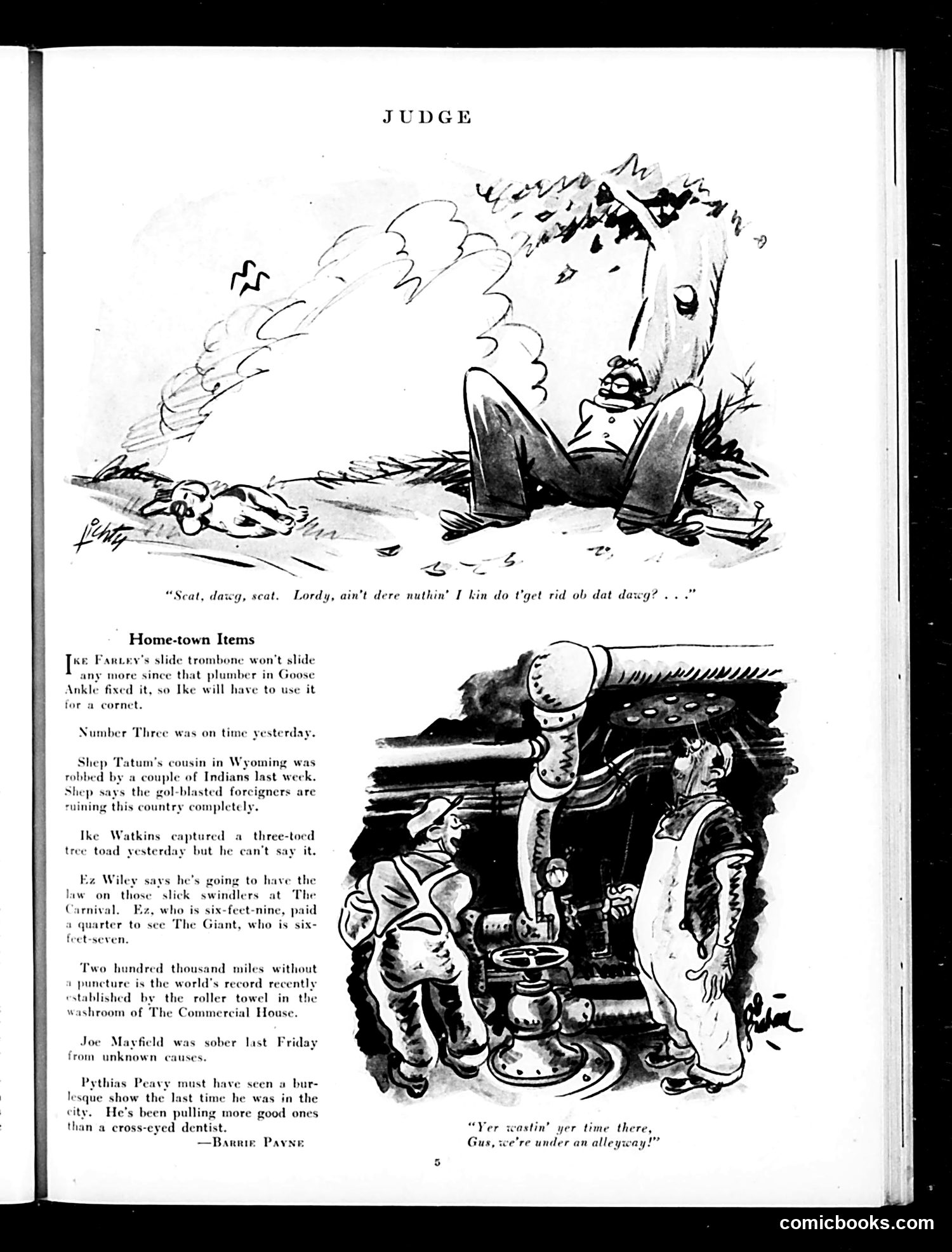
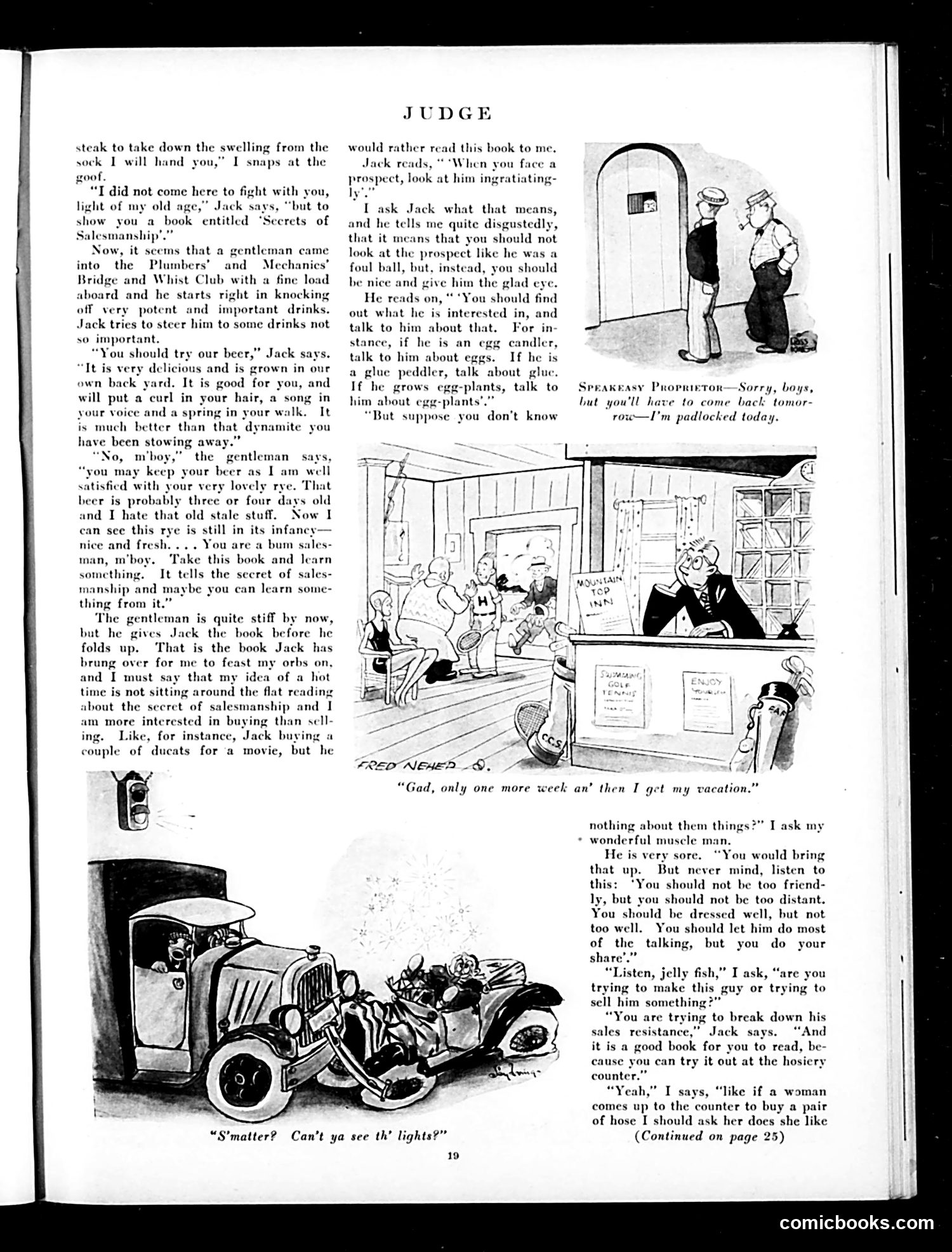
# Analysis of Judge Page **Top Cartoon ("Scat, dawg, scat"):** A judge sits elevated, apparently being pestered by a dog. The caption suggests the judge is frustrated with persistent legal matters—likely representing how trivial cases clutter the court docket. The dog represents nuisance lawsuits or frivolous complaints. **"Home-town Items" Section:** This column of local gossip includes anecdotes about townspeople: a broken trombone, a punctual train, a stolen sheep, a tree toad sighting, and various character sketches. These are humorous small-town stereotypes. **Bottom Cartoon ("Yer wastin' yer time there"):** Unclear from context alone, but appears to depict workers or mechanics in an industrial setting, with dialogue suggesting someone is wasting time on an impossible or futile task. The page blends judicial satire with Americana humor typical of Judge magazine's early 20th-century sensibility.
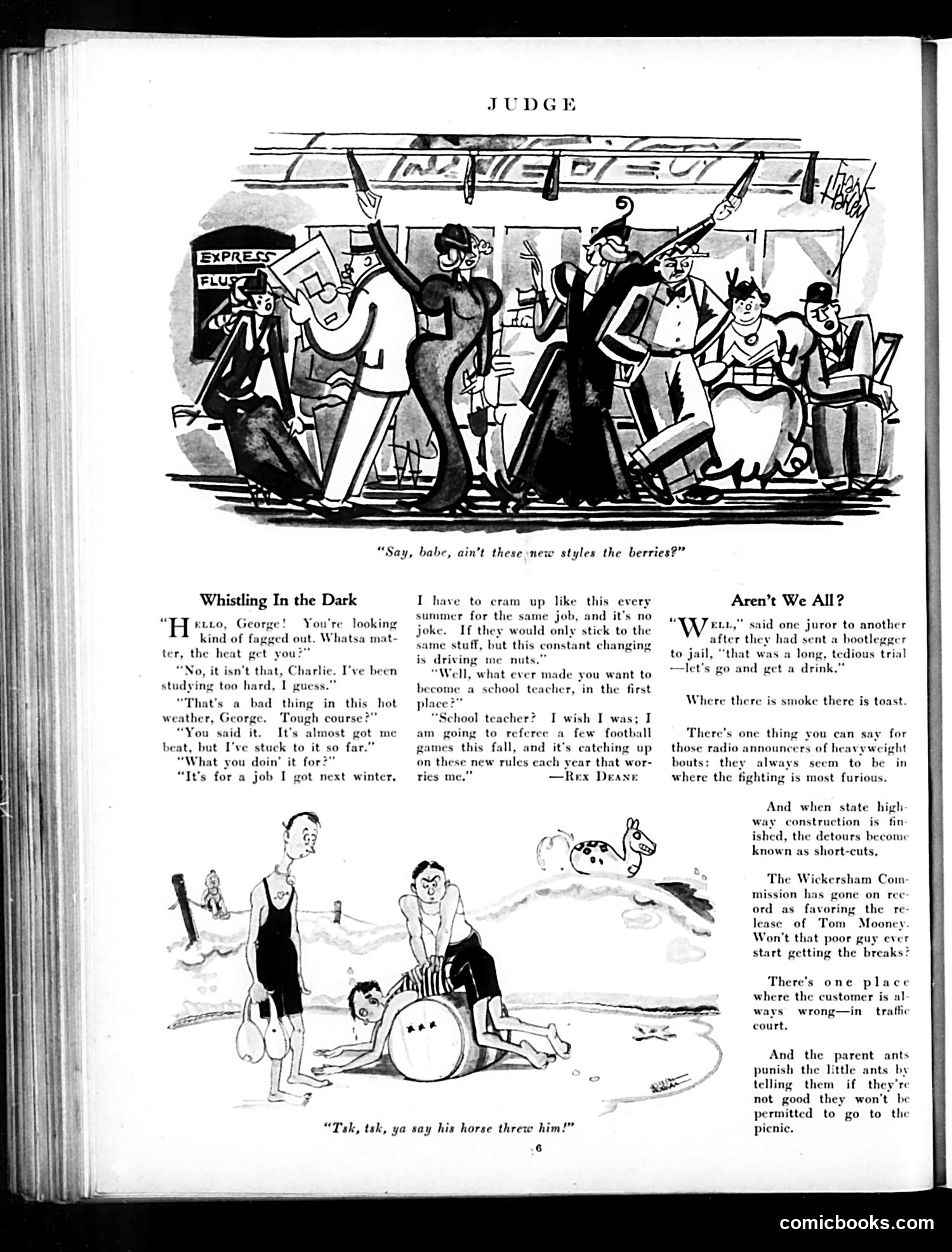
# Judge Magazine Page Analysis This page contains three separate humorous pieces satirizing American life and institutions: **"Whistling in the Dark"** depicts a conversation between two men during a heat wave, where one complains about his repetitive summer job and considers becoming a school teacher—only to be warned by his friend that teaching involves constant rule changes that "drive me nuts." **"Aren't We All?"** makes a brief joke about jurors wanting to escape jury duty to get a drink instead. **The bottom cartoon** shows children at a beach, with the caption "Tsk, tsk, ya say his horse threw him!"—appearing to humorously reference some incident involving a horse. The satire targets workplace monotony, institutional frustration (teaching), and judicial evasion. The pieces reflect early-20th-century American social concerns about labor and civic duty.
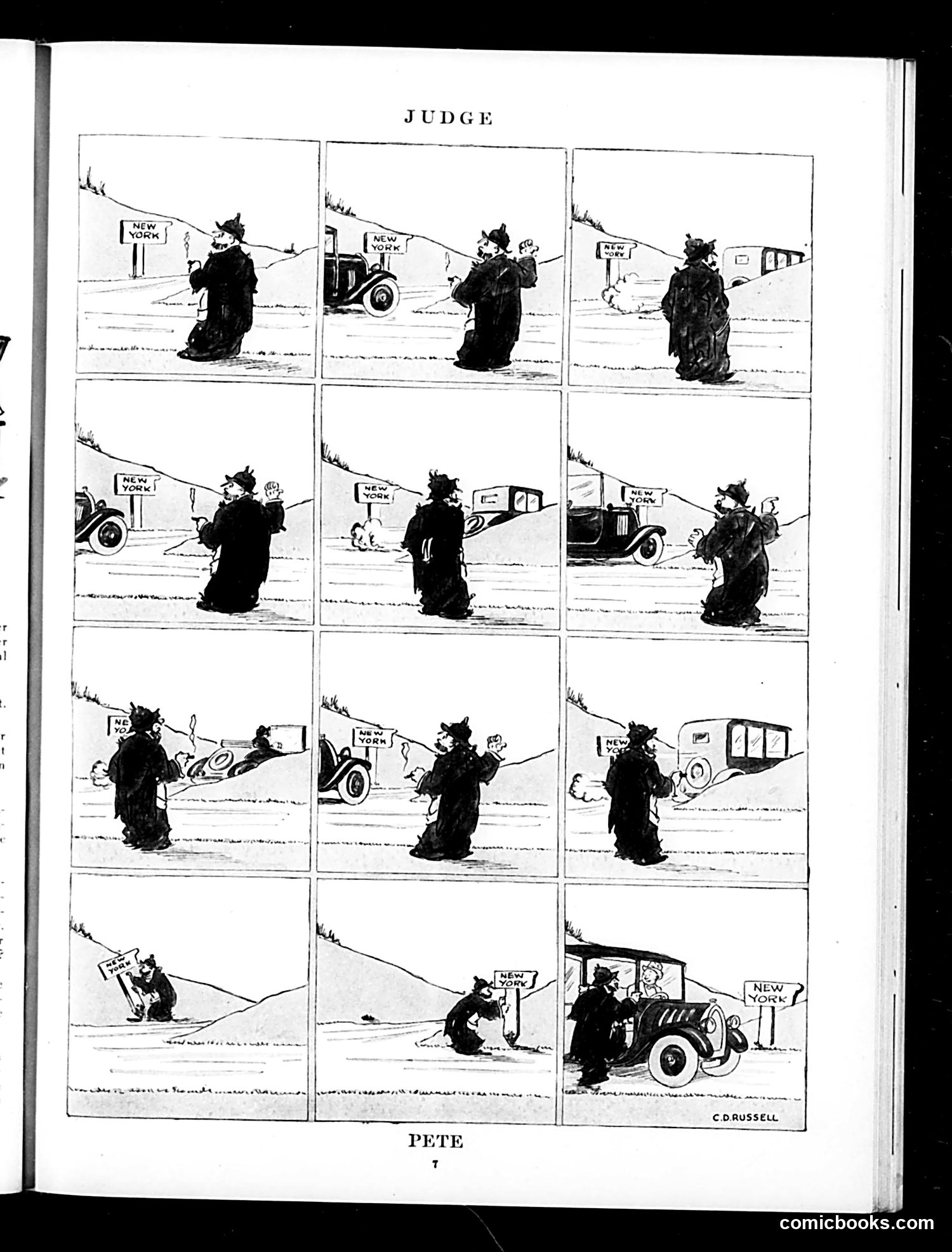
# "Judge" Comic: "Judge" and "Pete" This is a sequential comic strip by C.O. Russell showing a character (presumably "Judge," the titular figure) repeatedly encountering a "New York" sign while attempting to hitchhike or travel. The strip progresses through twelve panels as Judge encounters various vehicles and situations along a roadside. The satire appears to mock someone's futile attempts to reach or leave New York, with each panel showing fresh frustration or comedic setback. The "New York" signs function as visual anchors emphasizing the location's significance or the character's stuck situation. Without additional context about the specific historical moment Judge magazine published this, the exact political target remains unclear, though it likely satirizes contemporary travel difficulties, urban congestion, or perhaps specific New York City politics or characters recognizable to 1920s-1930s readers.
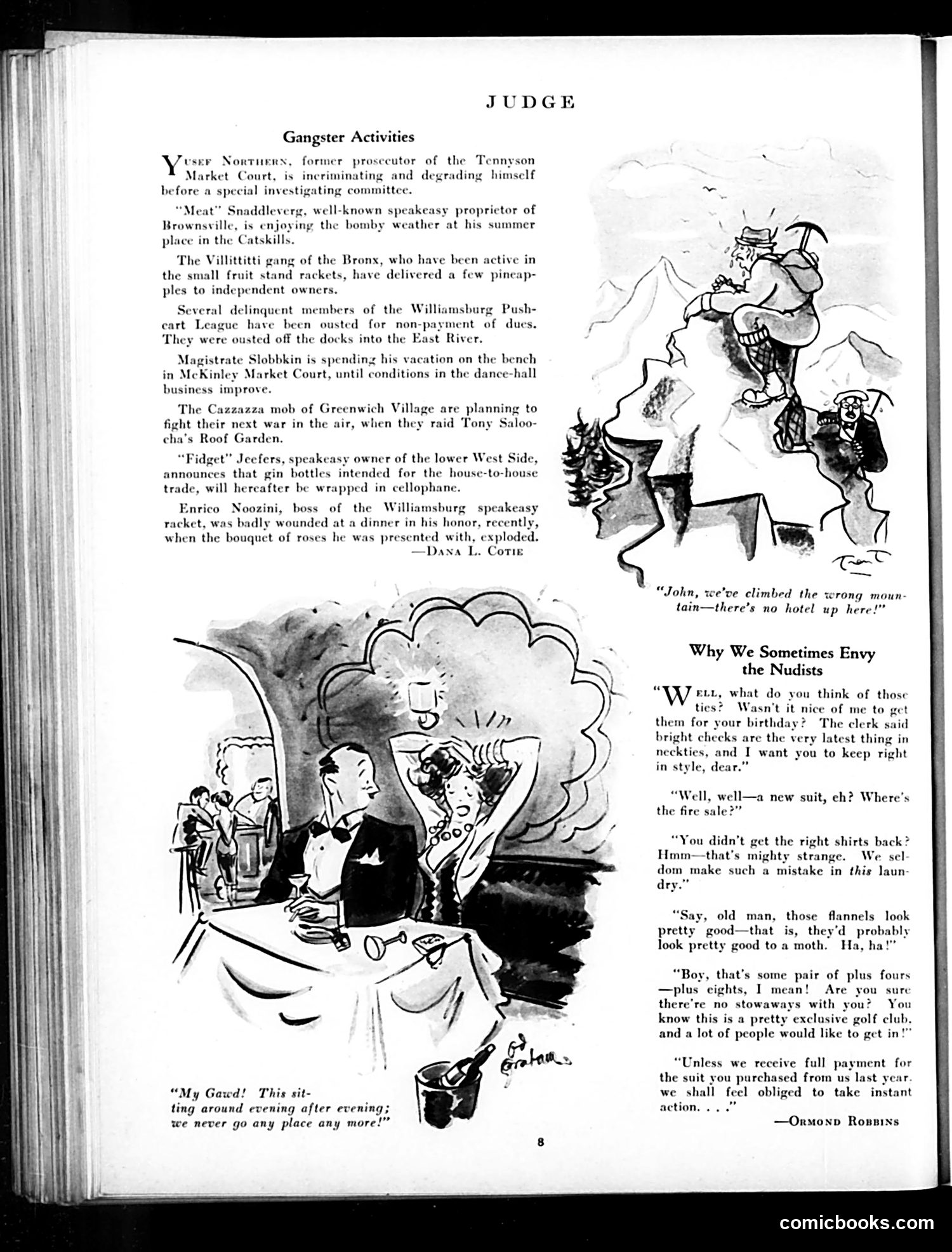
# Judge Magazine Page Analysis This page contains two distinct satirical pieces: **"Gangster Activities"** (top): A mock crime report listing New York organized crime figures and their recent exploits—speakeasy operators, fruit-stand racketeers, pushcart league members. The humor relies on treating brutal criminal activity (murder, extortion, dumping bodies in rivers) with deadpan bureaucratic tone, as if reporting minor business infractions. This satirizes Prohibition-era gangsterism that was rampant in 1920s New York. **"Why We Sometimes Envy the Nudists"** (bottom): A series of domestic complaints about clothing—bad laundry service, unfashionable gifts, weight gain, exclusive clubs, unpaid bills. The joke is that nudists avoid all these clothing-related marital and social annoyances. This pokes fun at middle-class anxieties about fashion, status, and domestic friction in the Jazz Age. Both pieces use exaggerated scenarios to satirize contemporary urban life—one targeting organized crime, the other consumer culture and social pretension.
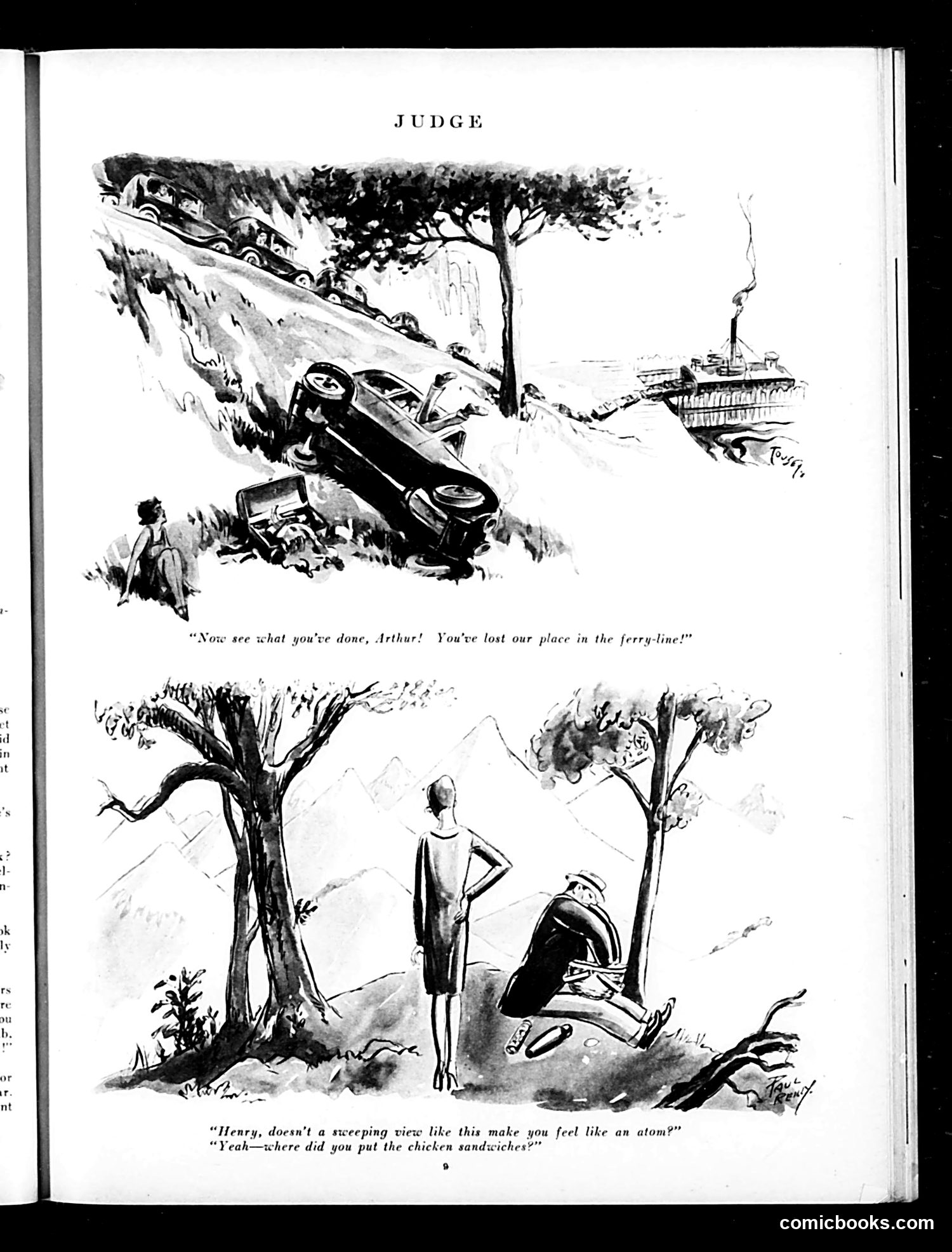
# Judge Page Analysis This page contains two satirical comic panels about American leisure and romance, likely from the early-to-mid 20th century. **Top panel:** A car has crashed down a cliff near a ferry dock. The caption mocks a couple's outing gone wrong—they've lost their place in the ferry queue due to the accident, treating the disaster as merely an inconvenience to their travel plans. **Bottom panel:** A man attempts romantic philosophy ("doesn't a sweeping view make you feel like an atom?"), but his female companion dismisses his poetic sentiment, responding pragmatically about the chicken sandwiches. Both cartoons satirize the gap between romantic ideals and mundane reality—the disconnect between what people claim to value (scenic beauty, emotional connection) versus their actual priorities (schedules, food). The humor targets middle-class aspirations and the failure of romance in everyday American life.
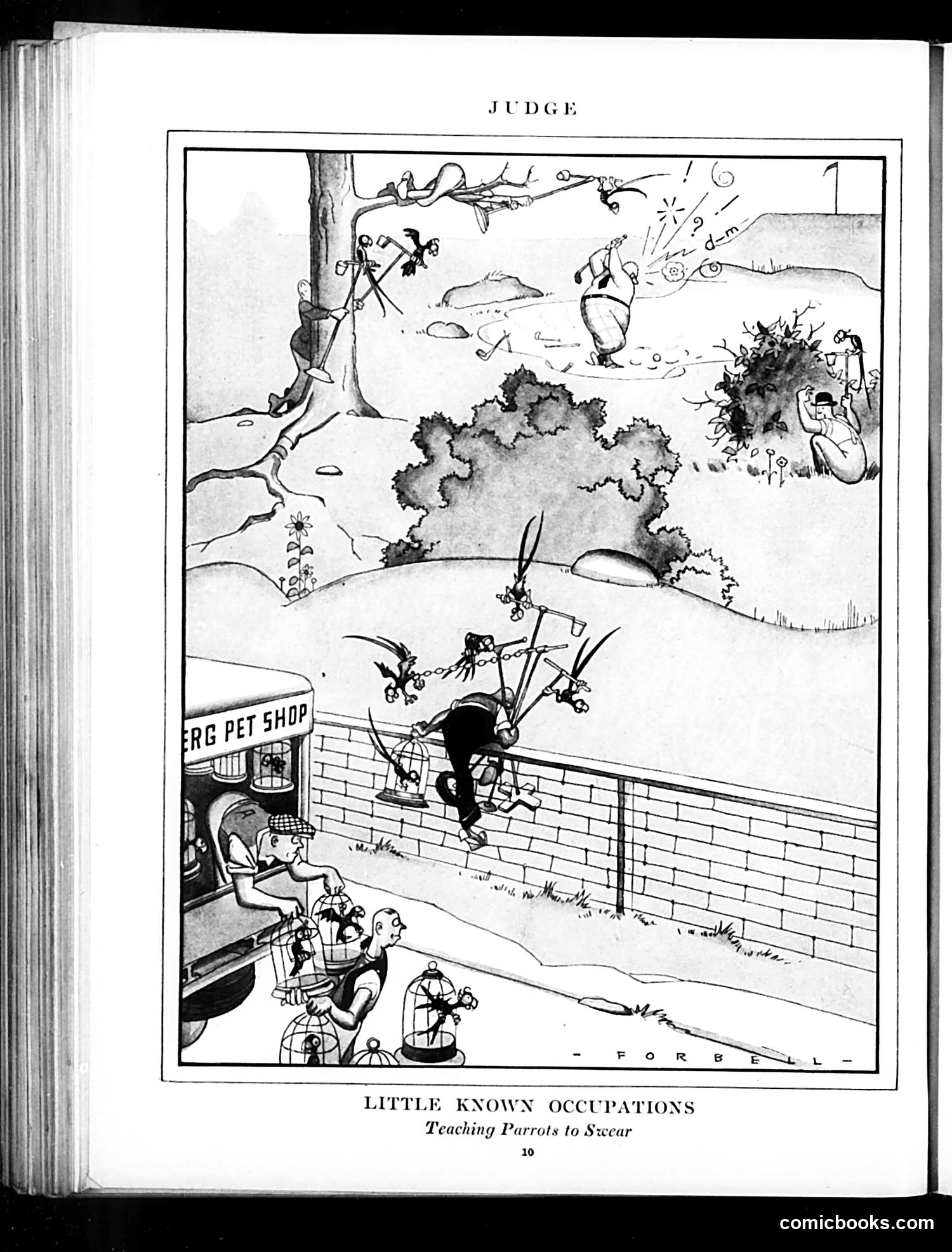
# Analysis This satirical cartoon depicts an absurd "little-known occupation": teaching parrots to swear. The scene shows a pet shop operator perched on a fence near a brick wall, apparently instructing parrots (visible in cages at ground level) in profanity. The image is surreal—featuring flying figures and exaggerated gestures suggesting chaotic instruction. The humor lies in the contradiction: parrots naturally mimic sounds, so "teaching" them to swear inverts the normal relationship between teacher and student, making the occupation ridiculous. This appears to be gentle, observational humor about odd professions rather than pointed political satire. The cartoon mocks the mundane absurdity of specialized, impractical work.