
Judge, 1931-09-05 · page 18 of 36
Judge — September 5, 1931 — page 18: what you’re looking at
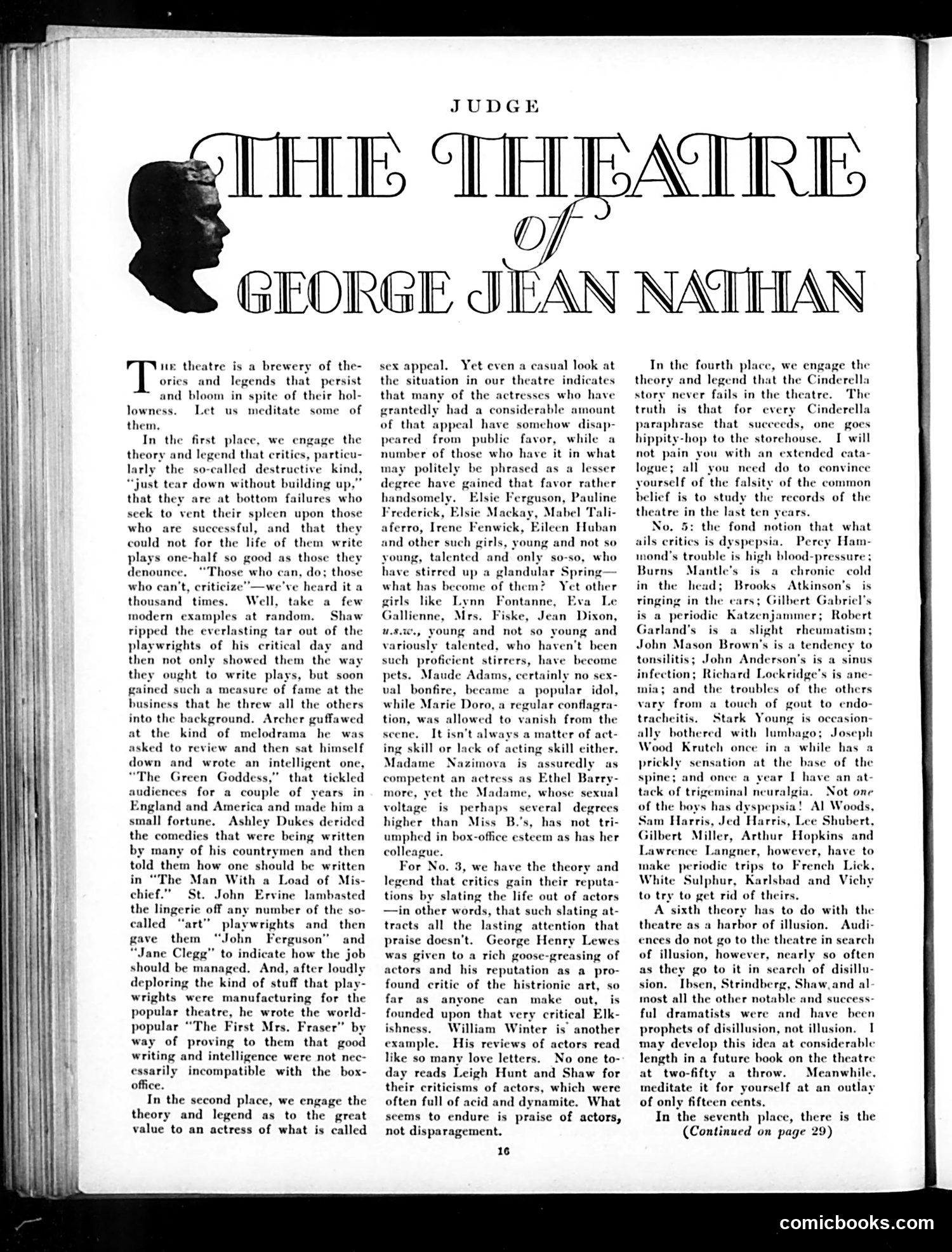
A restored page from Judge, 1931-09-05. Page through the whole issue in the reader above.
📄 Transcribed text from this page (OCR, searchable)
Machine-transcribed from the original scan — historical spelling and the odd misread are preserved.
ue theatre is a brewery of the- ories and legends that persist and bloom in spite of their hol- lowness. Let us meditate some of them, In the first place, we engage the d legend that critics, particu- so-called destructive kind, r down without building up,” are at bottom failures who seek to vent their spleen upon those who are successful, and that they could not for the life of them write plays one-half so good as those they larly” the denounce. “Those who can’t, criticize a thousand times. Well, take a few modern examples at random. Shaw ripped the everlasting tar out of the playwrights of his critical day and then not only showed them the way they ought to write plays, but soon ained such a measure of fame at the business that he threw all the others into the background. Archer guffawed at the kind of melodrama he was asked to review and then sat himself down and wrote an intelligent one, “The Green Goddess,” that tickled audiences for a couple of years in England and America and made him a small fortune. Ashley Dukes derided the comedies that were being written by many of his countrymen and then told them how one should be written in “The Man With a Load of Mis- St. John Ervine lambasted the lingerie off any number of the so- called “art” playwrights and then gave them “John Ferguson” and “Jane Clegg” to indicate how the job should be managed. And, after loudly deploring the kind of stuff that play- wrights were manufacturing for the popular theatre, he wrote the world- popular “The First Mrs. Fraser” by way of proving to them that good writing and intelligence were not nec- essarily incompatible with the box- office. In the second place, we engage the theory and legend as to the great value to an actress of what is called JUDGE sex appeal. Yet even a casual look at the situation in our theatre indic that many of the actresses who have tedly had a considerable amount of that appeal have somehow disap- peared from public favor, while a number of those who have it in what may politely be phrased « degree have gained that fa handsomely. Elsie Ferguson, Pauline Frederick, Elsie Mack: , Mabel Tali- aferro, Irene een Huban and other such , Young and not so young, talented and only so-so, who have stirred up a glandular Spring— what has become of them? Yet other girls like Lynn Fontanne, Eva Le Gallienne, Mrs. Fiske, Jean Dixon, u.s.zc., young and not so young and variously talented, who haven't been such proficient stirrers, have become pets. Maude Adams, certainly no sex- val bonfire, became a popular idol, while Marie Doro, a regular conflagra- tion, was allowed to vanish from the scene, It isn’t alws matter of act- ing skill or lack of acting skill either. Madame imova is assuredly as competent an actress as Ethel Ba more, yet the M me, whose sex! voltage is perhaps several degrees higher than Miss B.'s, has not. tri- umphed in box-office esteem as has her colleague. For No. 3, we have the theory and legend that critics gain their reputa- tions by slating the life out of actors —in other words, that such slating at- tracts all the lasting attention that praise doesn't. George Henry Lewes given to a rich goose-greasing of ctors and his reputation as a pro- found critic of the histrionic art, so far as anyone can make out, is founded upon that very critical Elk- ishness. William Winter is’ another example. His reviews of actors read like so many love letters. No one to- day reads Leigh Hunt and Shaw for their criticisms of actors, which were often full of acid and dynamite. What seems to endure is praise of actors, not disparagement. 16 tes = ALI TA ACTOR Es GEORGE JEAN NAGIHAN In the fourth place, we engage the theory and legend that the Cinderella story never fails in the theatre. ‘The truth is that for every Cinderella paraphrase that succeeds, one hippity-hop to the storehouse. I will not pain you with an extended cata- logue; ali you need do to convince yourself of the falsity of the common belief is to study the records of the goes theatre in the last ten years. o. 5: the fond notion that what ails critics is dyspepsia. Perey Ham- mond’s trouble is high blood-pressure ; Burns Mantle’s is in th Brooks nic cold nson’s is ch At ring Ibert Gabriel's is a periodi mmer; Robert Garland’s a slight rheumatism; John Mason Brown's is a tendency to itis; John Anderson's is a sinus ion; Richard Lockridge’s is ane- ; and the troubles of the others vary from a touch of gout to endo- tracheitis. Stark Young is oceasion- ally bothered with lumbago; Joseph Wood Krutch once in a while has a prickly sensation at the base of the spine ave an at- tack of trigemin Not one of the boys Sam Harris vrence Langner, however, have to © periodic trips to French Lick. Sulphur, Karlsbad and Vichy to try to get rid of theirs. A sixth theory has to do with the theatre as a harbor of illusion. Audi- ences do not go to the theatre in search of illusion, however, nearly so often as they go to it in search of disillu- sion. Ibsen, Strindberg, Shaw,and al most all the other notable and success- ful dramatists were and have been prophets of disillusion, not illusion. 1 may develop this idea at conside length in a future book on the th at two-fifty a throw. Meanwhile, meditate it for yourself at an outlay of only fifteen cents, In the seventh place, there is the (Continued on page 29) comicbooks.com ae ET OI eM