A complete issue · 36 pages · 1931
Judge — January 10, 1931
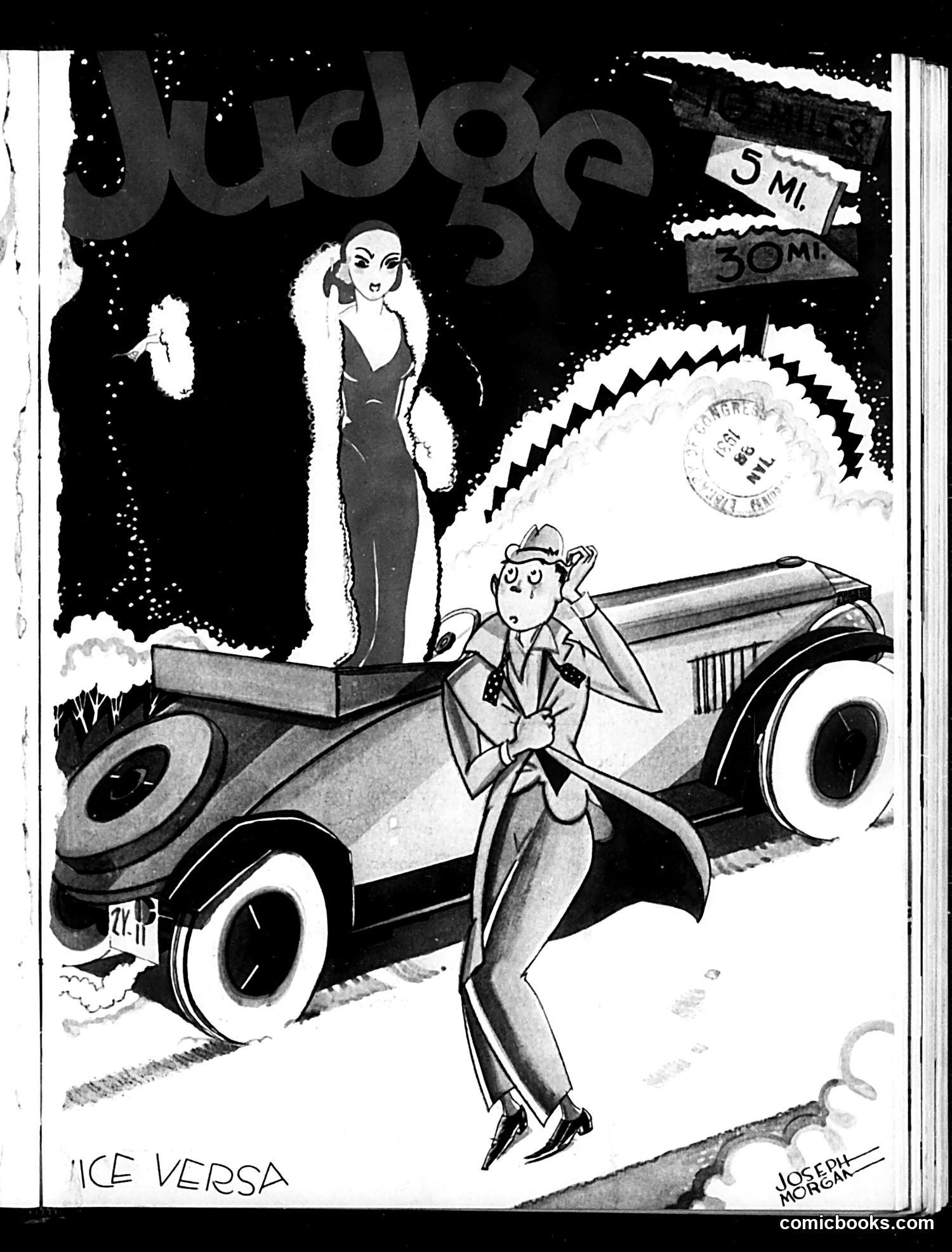
# Judge Magazine Page Analysis This appears to be a cover or feature page from *Judge* magazine titled "Ice Versa" (a pun on *vice versa*). The illustration shows a wealthy man in a suit reacting with shock beside a luxury automobile, while an elegant woman in a fur coat and formal dress stands dominantly in the background. The satire likely plays on gender role reversals—the title "Ice Versa" suggests the typical social dynamics are inverted. The man's surprised expression and subordinate posture contrast with the woman's commanding presence and association with luxury goods, satirizing either changing social conventions or anxieties about female independence and economic power during the early-to-mid 20th century when *Judge* was active. The exact historical moment remains unclear without additional context.
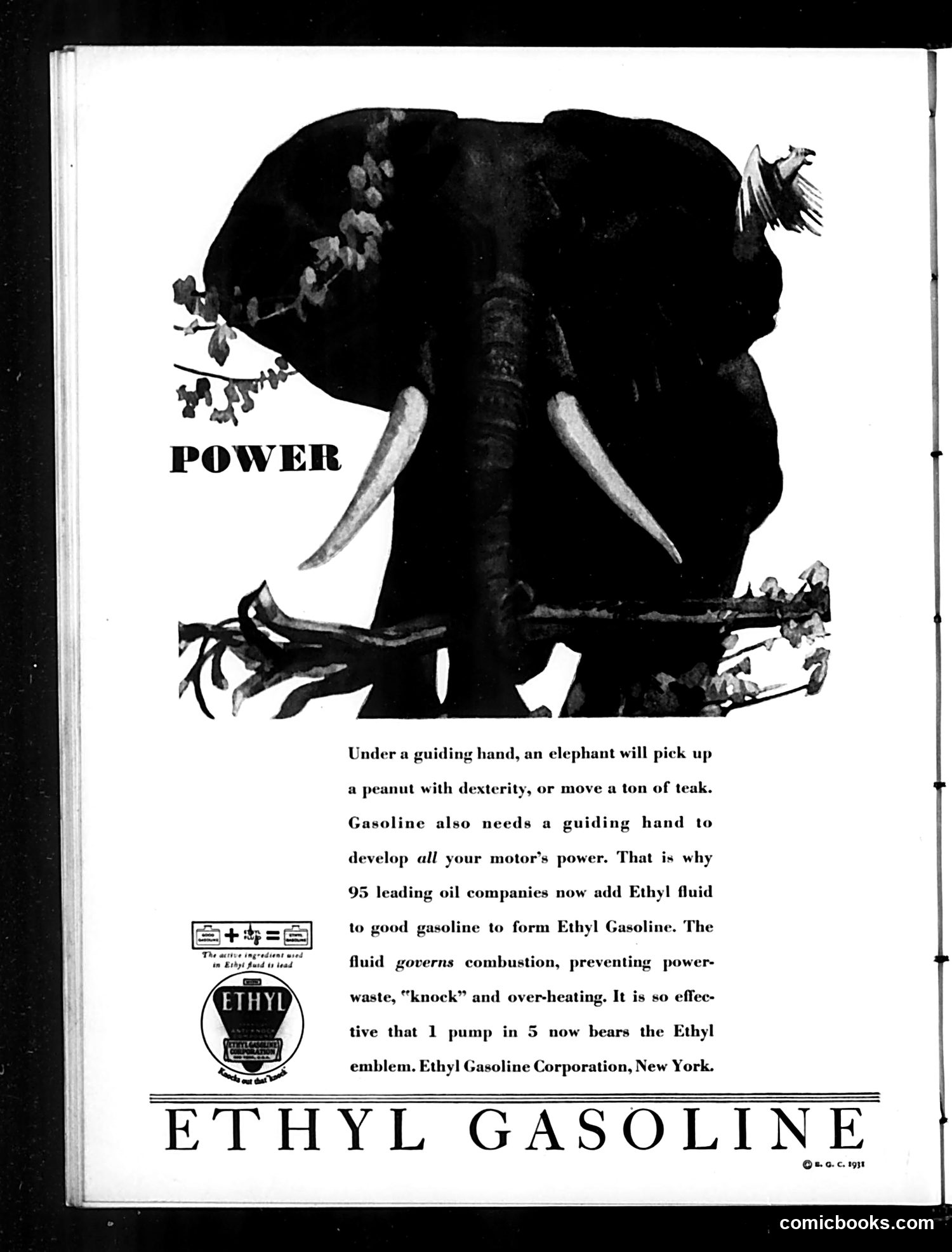
# Analysis This is primarily **advertising**, not political satire. The page promotes Ethyl Gasoline, a brand that added tetraethyl lead to fuel (later recognized as toxic). The elephant functions as a metaphor for **power and control**: just as an elephant requires a "guiding hand" to direct its considerable strength—whether delicate tasks or heavy work—gasoline requires Ethyl fluid's additive to "guide" its combustion, maximizing engine power while preventing "knock" and overheating. The ad claims 95 oil companies now use Ethyl Gasoline, and that "1 pump in 5 now bears the Ethyl emblem." This reflects genuine 1920s-30s marketing, when leaded gasoline was promoted as scientifically superior before its neurological dangers became widely known. The satire here, if any exists, is unintentional—presenting a harmful product as a beneficial innovation.
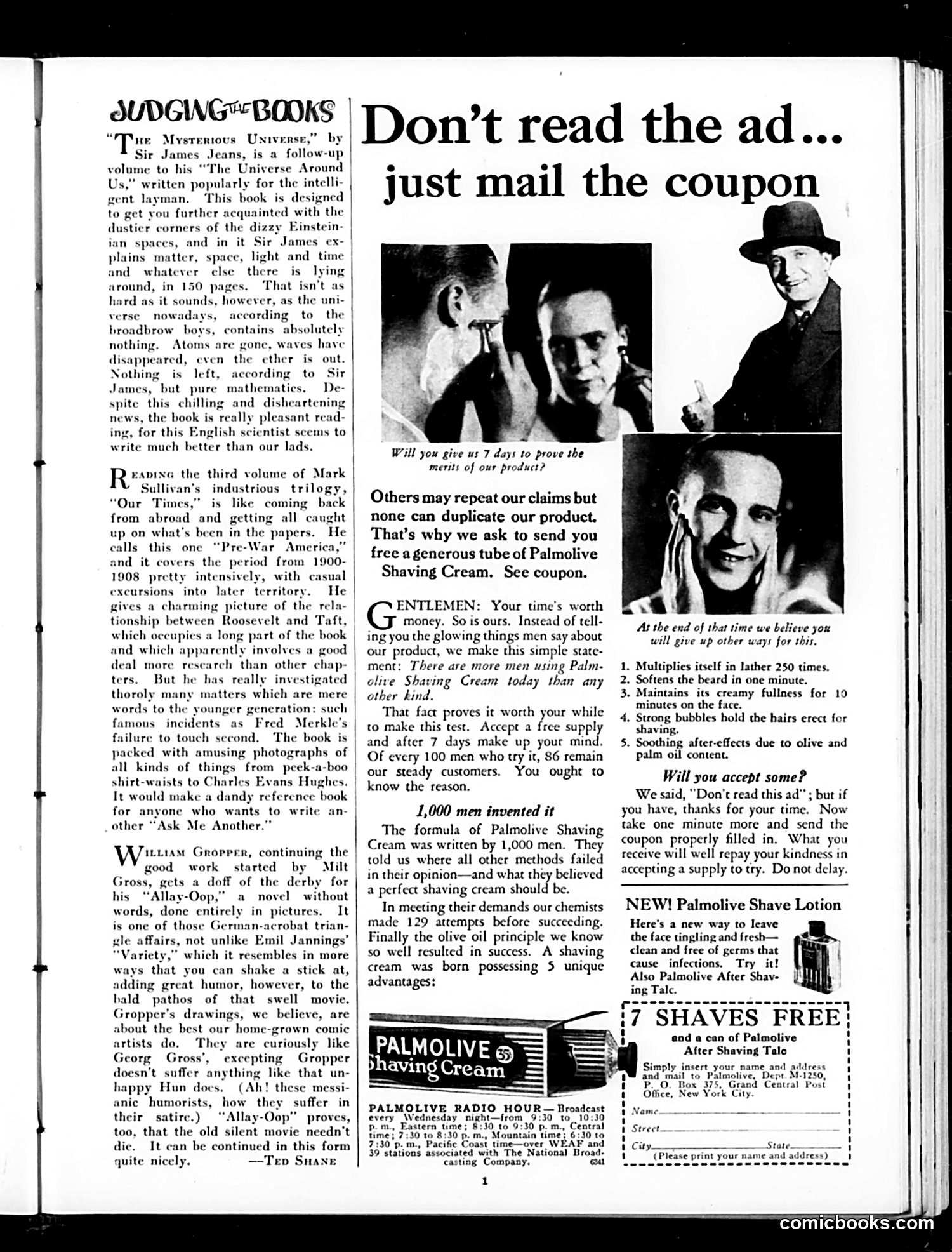
# Page Analysis This page is primarily **advertising for Palmolive Shaving Cream**, not political satire. The large advertisement occupies the right half, featuring photographs of men and a coupon offer for "7 shaves free." The left side contains **book reviews** ("Judging the Books") by what appears to be a regular Judge magazine columnist, discussing three new volumes: Jeans's "The Mysterious Universe," Sullivan's "Our Times," and Groppenian's "Allay-Oop." The Palmolive ad's headline—"Don't read the ad, just mail the coupon"—is a **tongue-in-cheek marketing appeal** that ironically acknowledges reader reluctance to engage with advertisements, while still encouraging participation through a free sample offer. This reflects early-20th-century advertising strategies that mixed humor with direct sales pitches. No political cartoon or satire is present on this page.
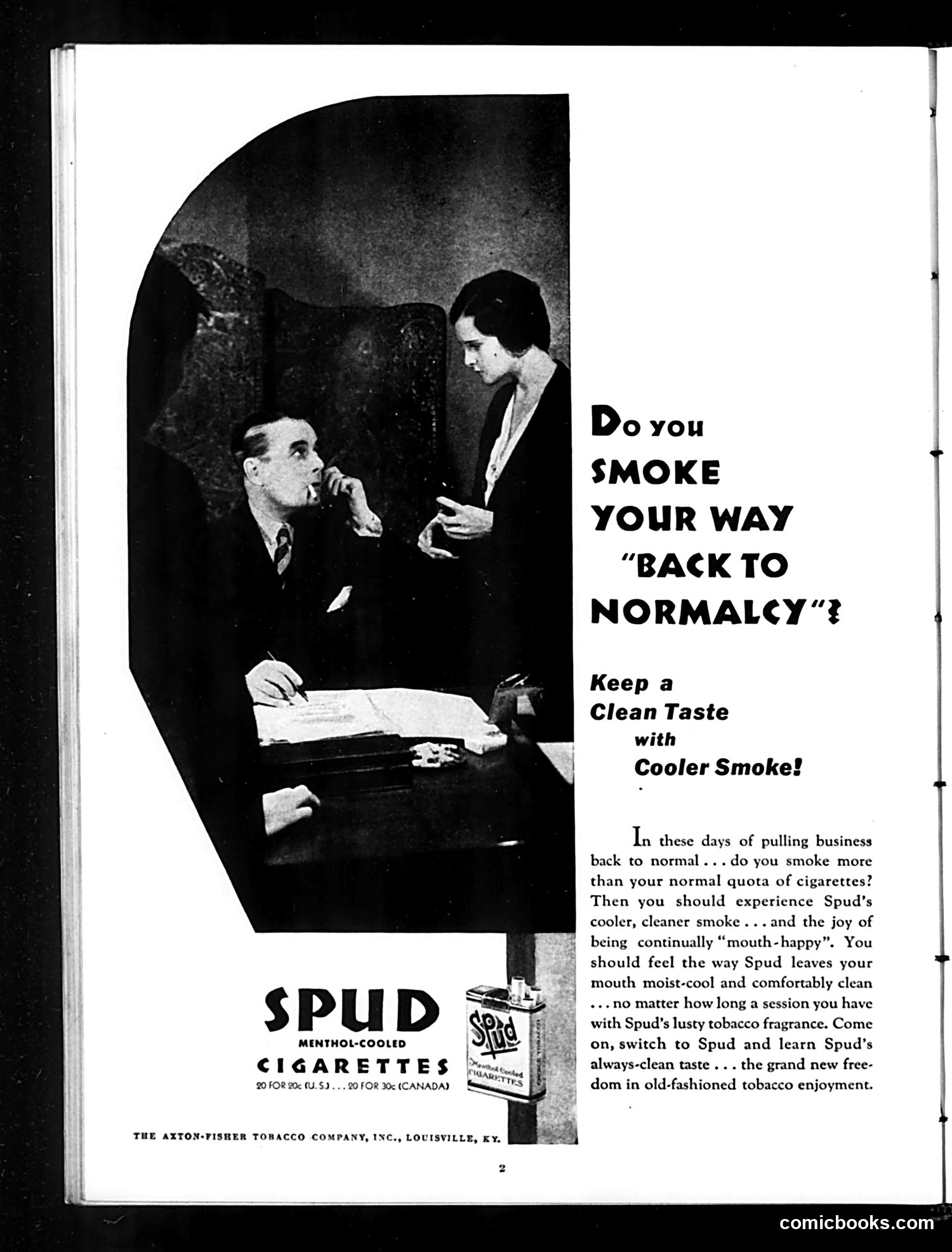
# Analysis This page is **primarily a cigarette advertisement**, not satire or political commentary. It's a Spud menthol cigarettes ad from the Axton-Fisher Tobacco Company (Louisville, Kentucky). The advertisement uses a business office scene showing a man at a desk with a woman standing nearby. The tagline "Do you smoke your way 'back to normalcy'?" appears to reference the post-WWI period when "return to normalcy" was a common phrase. The ad's pitch: during busy times returning business to normal, smokers consume more cigarettes than usual. Spud's menthol cooling supposedly keeps your mouth fresh despite increased smoking. The ad emphasizes "clean taste" and "moist-cool" sensation. This reflects early-to-mid 20th century cigarette marketing before health warnings, when smoking was normalized in professional settings.
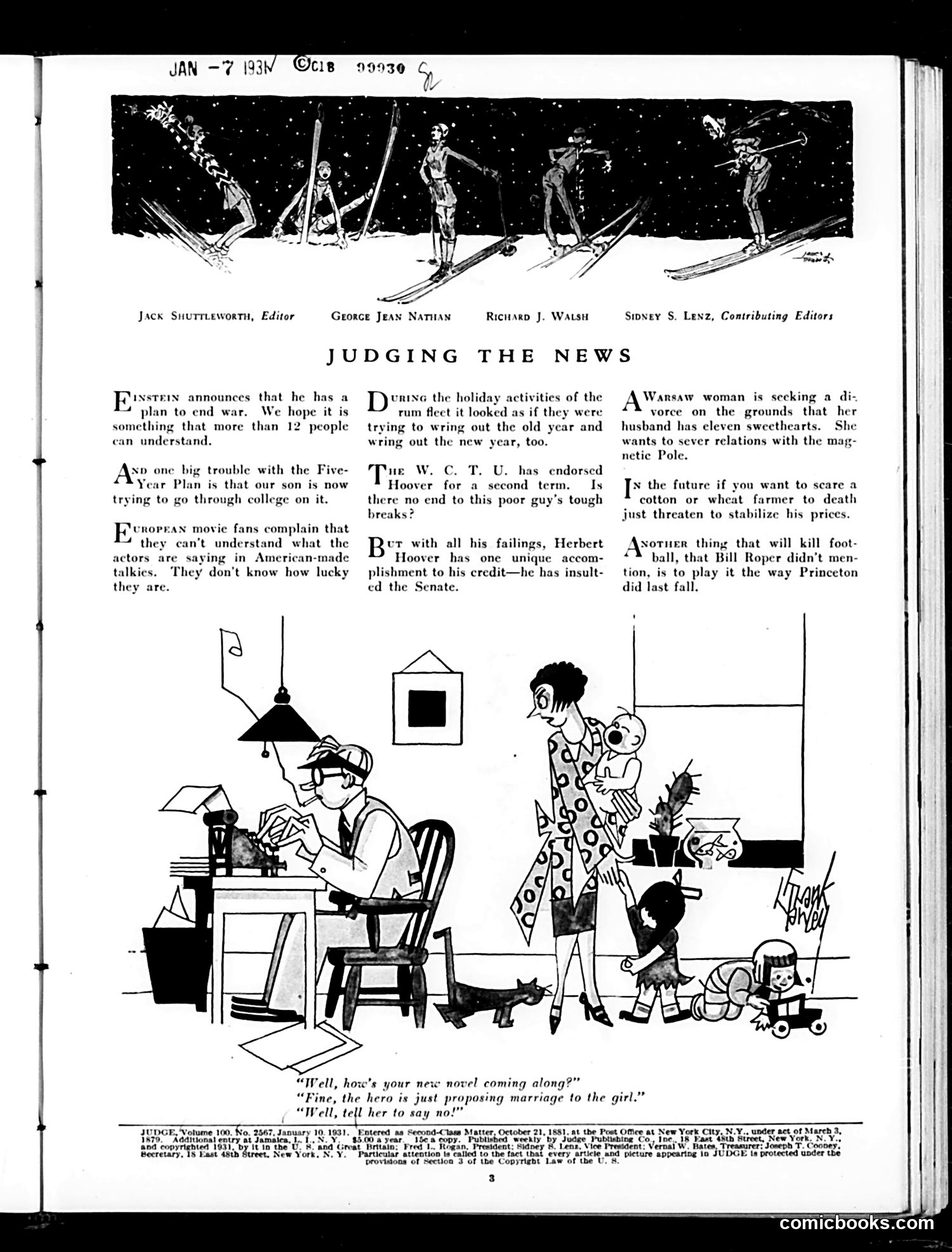
# "Judging the News" - January 10, 1931 This satirical column comments on contemporary events through brief jabs: **Einstein's "plan to end war"** is mocked as too complicated for ordinary people to grasp. **The Five-Year Plan** (likely referring to Soviet economic policy) is criticized as impractical for American college tuition. **American film dialogue** is ridiculed as incomprehensible—audiences don't understand actors' speech patterns. **Herbert Hoover's endorsement** for a second term is sarcastically praised, with the jab that his "unique accomplishment" was insulting the Senate. **The main cartoon** shows a writer struggling to finish his novel while juggling domestic chaos (children, pets, interruptions). The joke: his hero is proposing marriage, but the writer's wife says "tell her to say no!"—implying married life is miserable, so the character should avoid it. The overall tone reflects Depression-era cynicism about politics and American life.
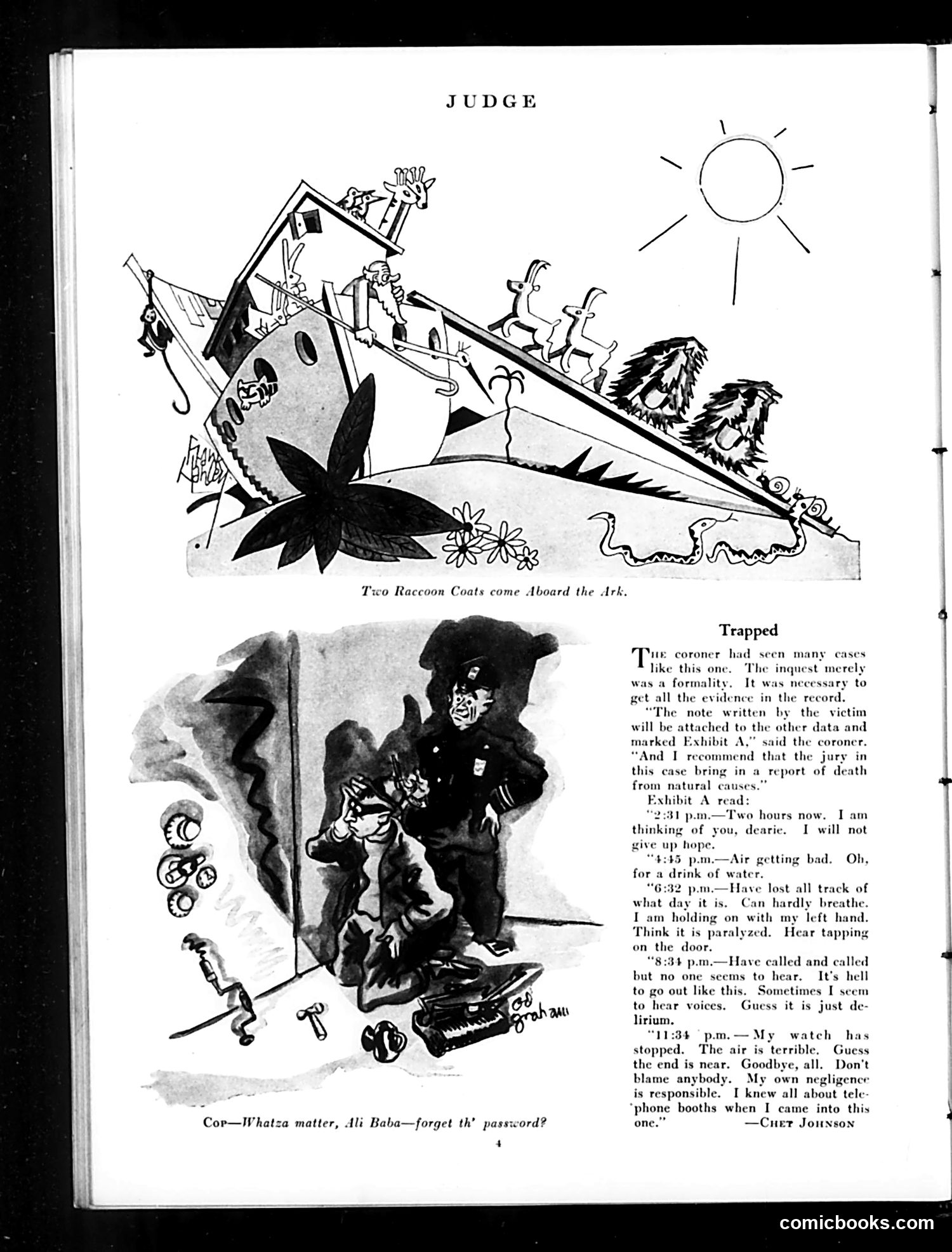
# Analysis of Judge Page **Top Cartoon:** "Two Raccoon Coats come Aboard the Ark" satirizes wealthy passengers, likely on a ship or during a social event. The raccoon coat—a status symbol of the 1920s-30s—marks these figures as frivolous socialites. The "ark" reference suggests either a voyage narrative or metaphorical commentary on class dynamics during crisis (possibly the Depression era). **Bottom Section ("Trapped"):** Features a coroner's case involving timestamps of a victim's final hours (2:31 p.m. through 11:34 p.m.). The accompanying illustration shows an elderly figure with small characters, possibly depicting Ali Baba or a fairy-tale reference. The caption "Whatza matter, Ali Baba—forget th' password?" suggests confusion or memory loss, possibly satirizing legal proceedings or the victim's circumstances. The overall piece appears to critique investigative procedures or society's indifference to tragedy.
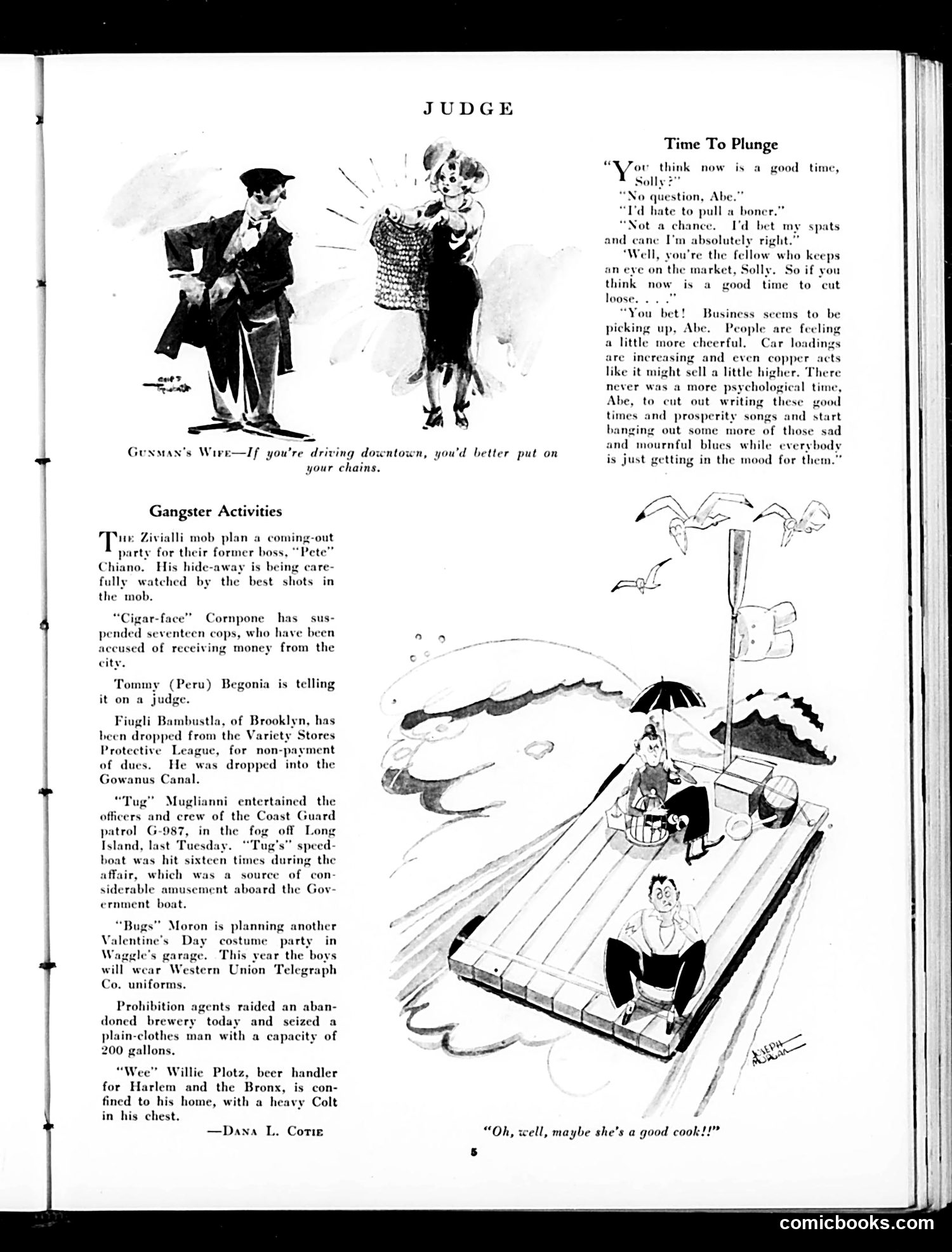
# Analysis: Judge Magazine Page This page contains two distinct sections: **Top cartoon** ("Gunman's Wife"): A woman warns her husband about driving downtown without chains on his tires during winter—a practical safety joke unrelated to satire. **"Gangster Activities" section**: A column by Dana L. Cotie reporting on organized crime figures and Prohibition enforcement. It references actual underworld nicknames ("Cigar-face" Corpone) and real incidents—police suspensions, Coast Guard patrols, and raids on illegal breweries. The tone is tongue-in-cheek, treating gangster exploits as gossip column material. **Bottom cartoon** ("Oh, well, maybe she's a good cook!"): A husband in a small boat observes his wife's poor navigation skills, suggesting her only value is domestic cooking—a dated gender-stereotype joke. The page reflects 1920s Prohibition-era concerns, mixing crime reporting with domestic humor.
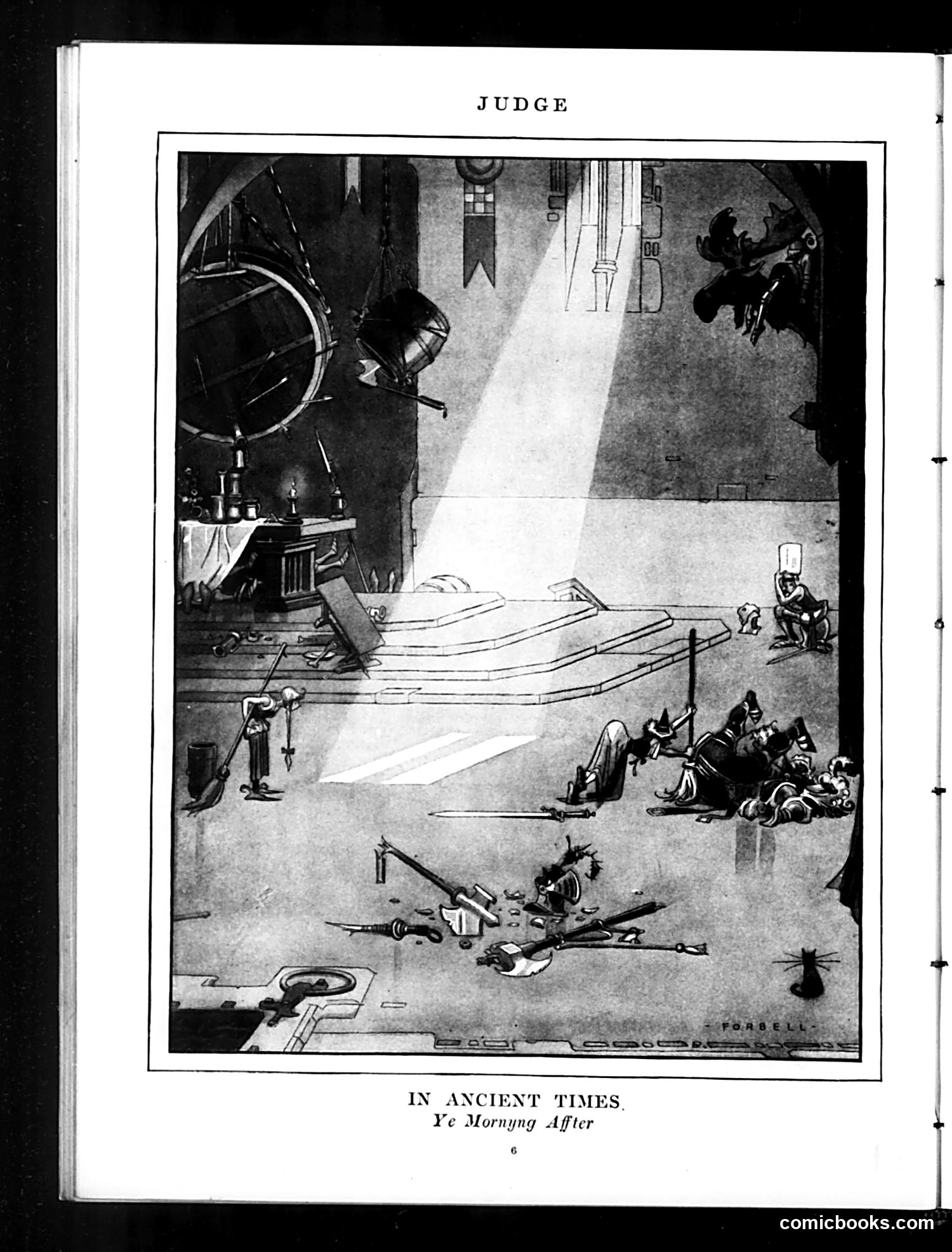
# Analysis of Judge Page: "In Ancient Times. Ye Morning After" This satirical cartoon depicts a courtroom scene titled "In Ancient Times. Ye Morning After," suggesting a humorous look at ancient justice proceedings. The image shows what appears to be a judge's chamber or court with various figures scattered about—some appearing disheveled or in disarray, with weapons and objects strewn across the floor. The "morning after" subtitle implies this is depicting the aftermath of some tumultuous event or trial. The satire likely mocks either archaic legal processes or the chaotic nature of ancient justice systems, presenting them as crude and disorganized compared to contemporary (presumably more civilized) methods. The specific figures and exact historical reference remain unclear without additional context about Judge magazine's publication date and concurrent events.
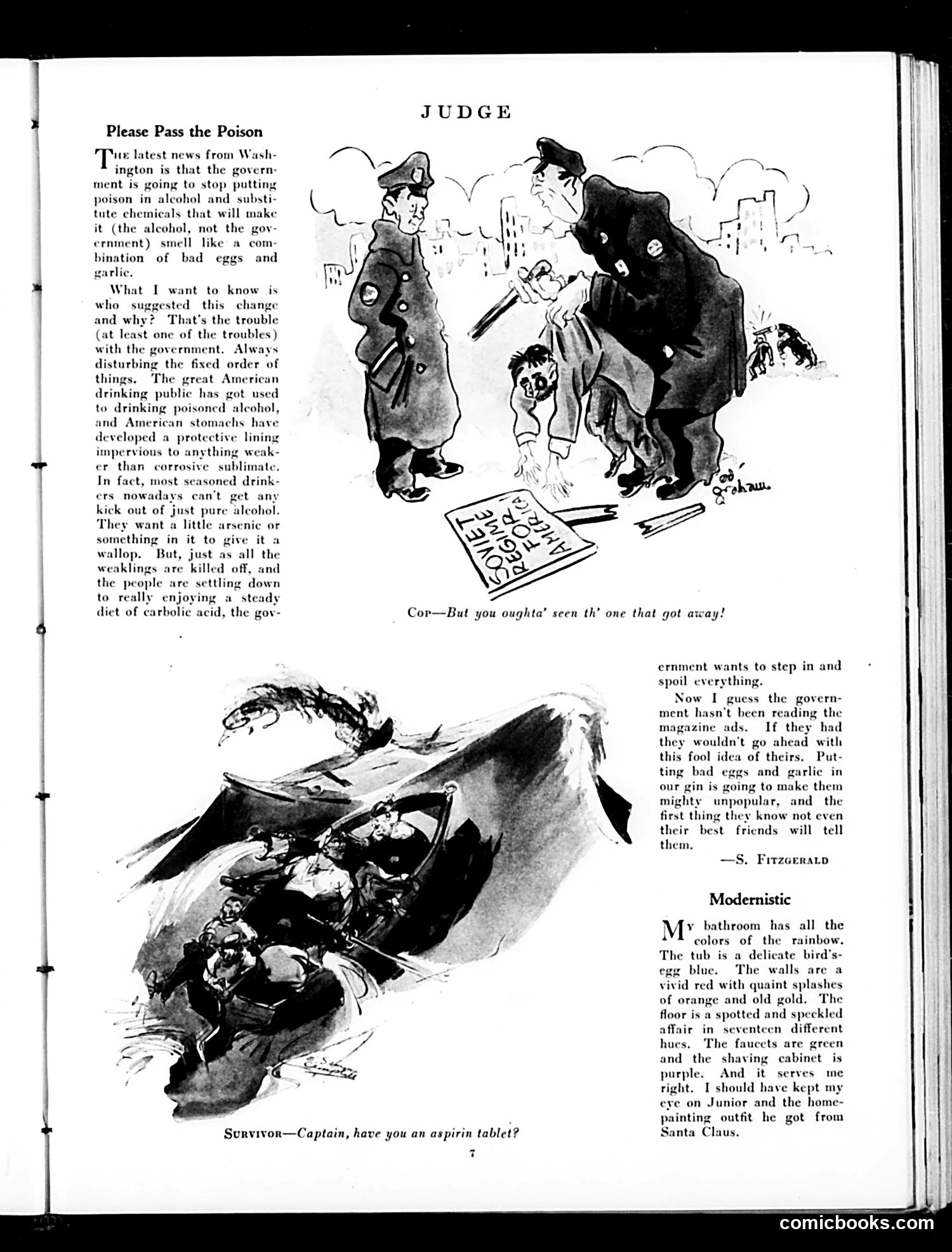
# Political Satire from Judge Magazine This page contains two satirical pieces from the Prohibition era (when alcohol sales were banned in the U.S.). **"Please Pass the Poison"** mocks the government's plan to add foul-smelling chemicals to alcohol to deter drinking. The satire argues that American drinkers have become so accustomed to poisoned bootleg alcohol that they now *require* toxins for a "kick"—making the government's intervention counterproductive and unpopular. The cartoon shows police officers discovering a bottle, illustrating enforcement efforts. **"Modernistic"** is a lighter domestic humor piece about a bathroom painted in garish, mismatched colors—the result of letting a child loose with paint supplies from a Christmas gift. It's unrelated to the political content above. The author (S. Fitzgerald) uses exaggeration to critique government overreach during Prohibition, suggesting Washington doesn't understand American drinking culture and will only succeed in making alcohol worse, not better.
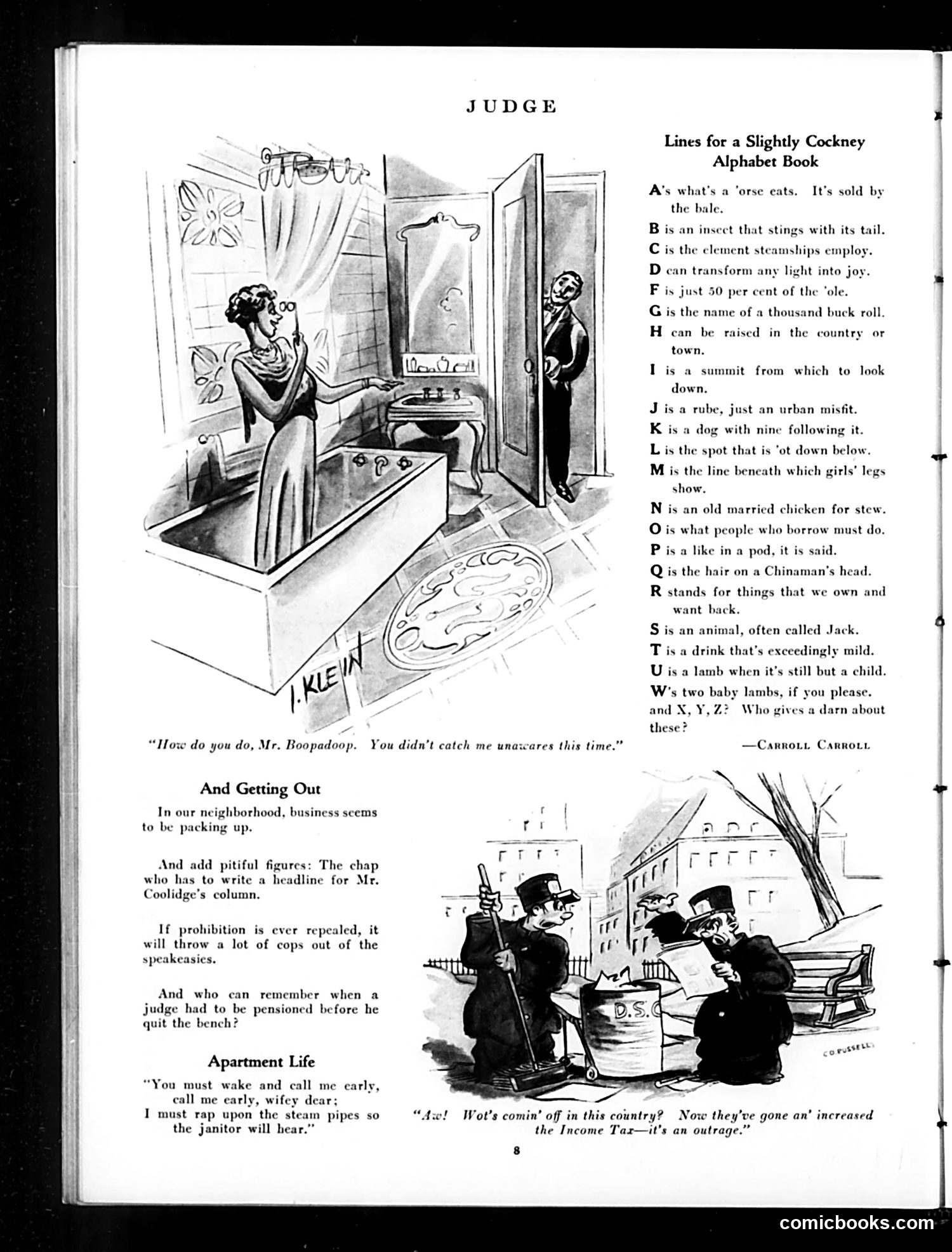
# Content Analysis: Judge Magazine Page This page contains three distinct satirical pieces about 1920s American life: **"Lines for a Slightly Cockney Alphabet Book"** is a humorous alphabet rhyme in working-class British dialect, poking fun at slang and common expressions. The crude drawings accompanying it suggest urban lower-class humor. **"And Getting Out"** offers brief social commentary on Prohibition's effects (suggesting police would lose speakeasy raid opportunities if repealed), judicial corruption, and business decline in the neighborhood—likely referencing 1920s economic anxieties. **"Apartment Life"** features two cartoons mocking tenement living: one about a wife demanding early waking so sounds travel through steam pipes to alert the janitor, and another where working-class men complain about increased income taxes. The second figure appears labeled "D.S." (unclear significance). The overall tone satirizes working-class and urban concerns: poverty, housing conditions, and taxation—typical Judge magazine fare targeting middle-class readers with humor about "the lower orders."
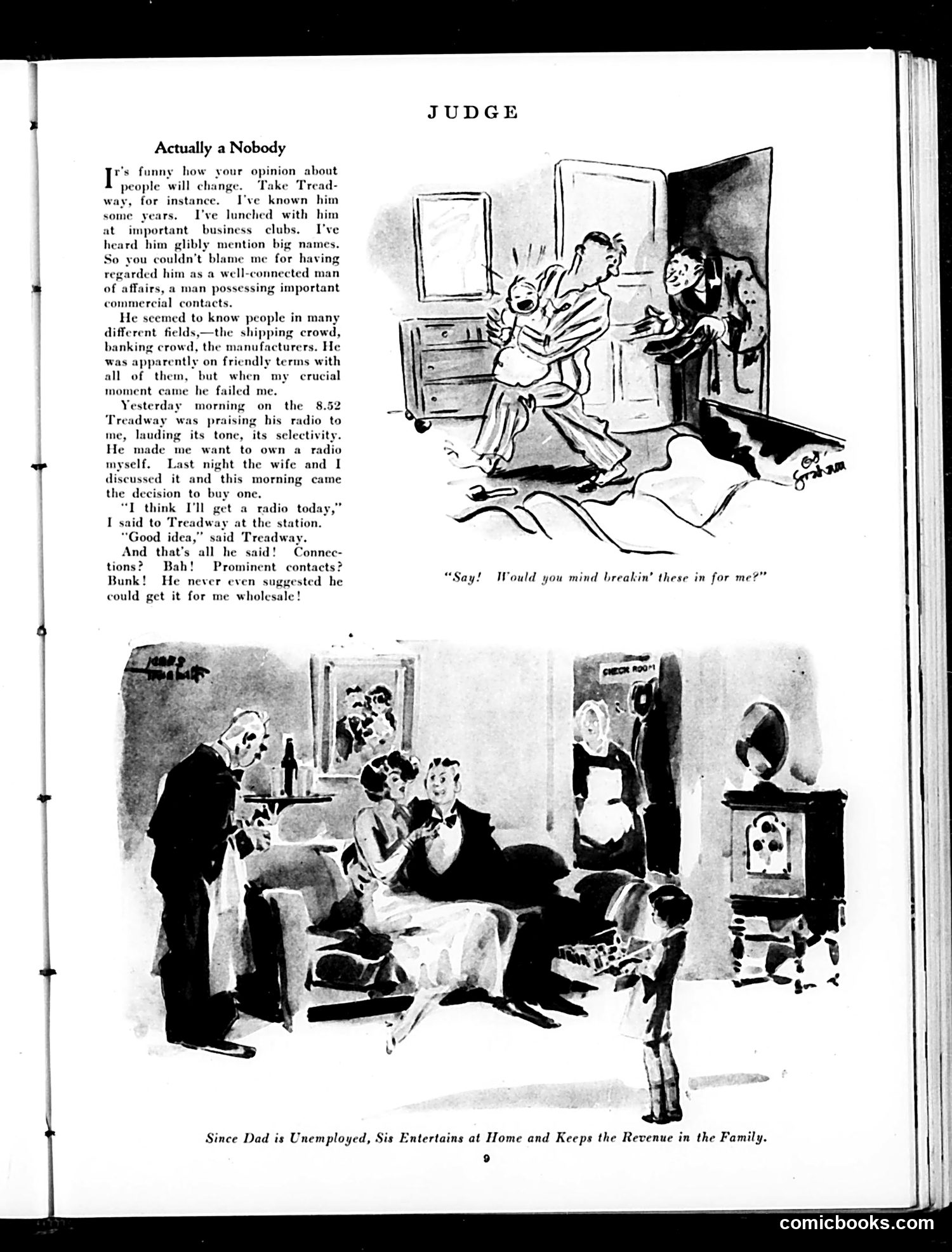
# "Actually a Nobody" — Judge Magazine Satire This page satirizes the hollowness of social networking and false prestige. The narrator describes a man named Treadway whom he's known for years, believing him to be well-connected in shipping, banking, and manufacturing—someone with "important commercial contacts" worth cultivating. The joke's punchline: when the narrator decides to buy a radio and mentions it to Treadway, Treadway cannot (or will not) use his supposed wholesale connections to get him a discount. This single failure exposes Treadway's entire reputation as fraudulent. The narrator's realization—that Treadway is "actually a nobody" despite appearing important—mocks both the man's fakeness and the narrator's gullibility in being impressed by mere social association. The lower cartoon shows a family entertaining themselves with various radios and entertainment devices while unemployed ("Since Dad is Unemployed, Sir Entertains at Home"), likely satirizing Depression-era leisure or ironic domesticity.
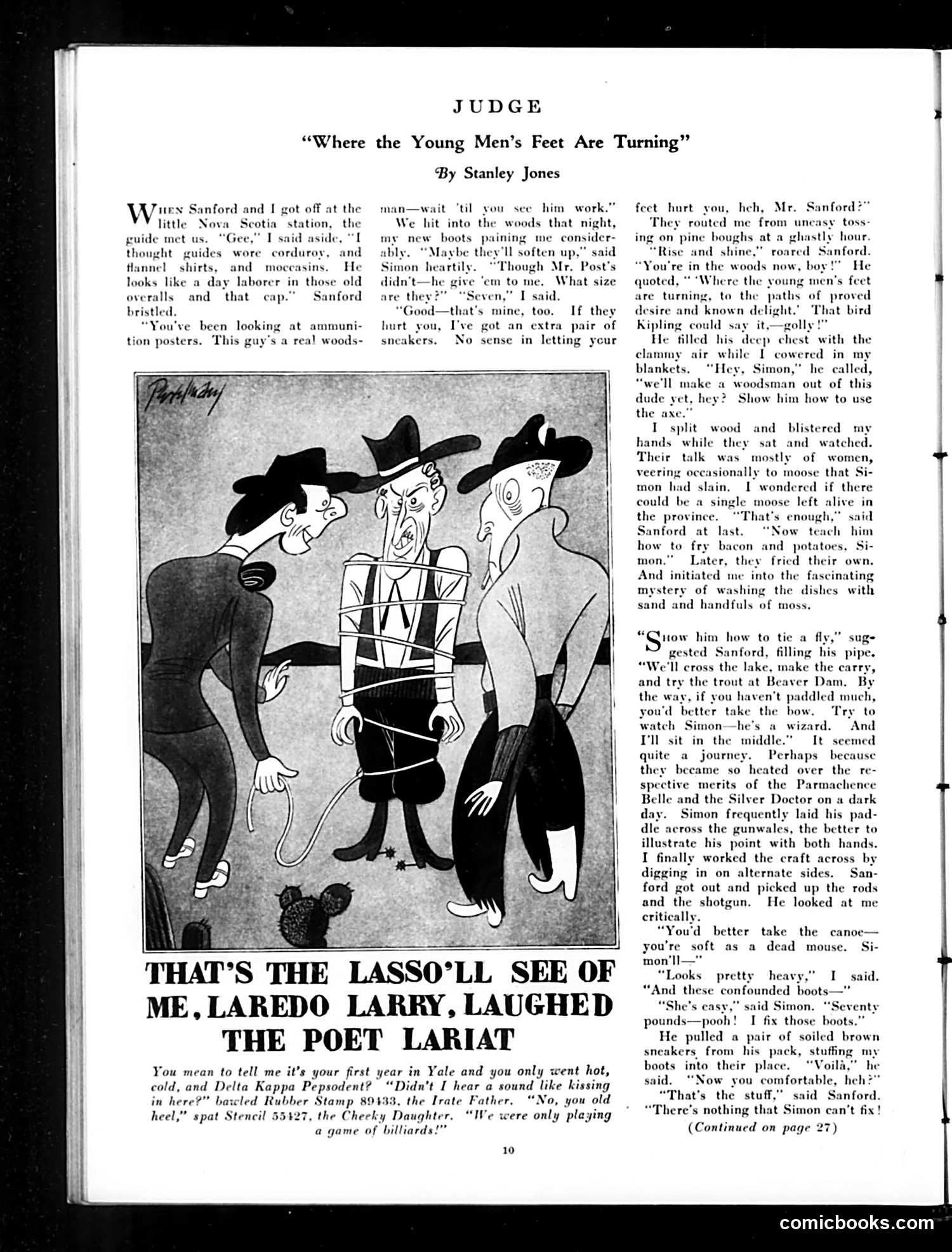
# "Where the Young Men's Feet Are Turning" This page presents a short story by Stanley Jones about a city narrator taken on a wilderness hunting trip to Nova Scotia by his friend Sanford and their guide Simon. The cartoon illustration shows three men in outdated or mismatched clothing—likely meant to humorously depict the contrast between civilized and wilderness life. The narrative satirizes the narrator's urban inexperience and discomfort in nature. Sanford and Simon patronizingly "educate" him in woodsman skills (splitting wood, cooking, tying fishing flies, paddling), while the narrator suffers through blistered hands, uncomfortable boots, and cold nights. The humor derives from his fish-out-of-water predicament and the guides' patient condescension toward the soft city dweller. The title references a Rudyard Kipling poem, suggesting themes of masculine adventure and testing one's mettle in nature—tropes Judge's readers would recognize and find amusing when applied to this bumbling urbanite.