
Judge, 1931-01-10 · page 15 of 36
Judge — January 10, 1931 — page 15: what you’re looking at
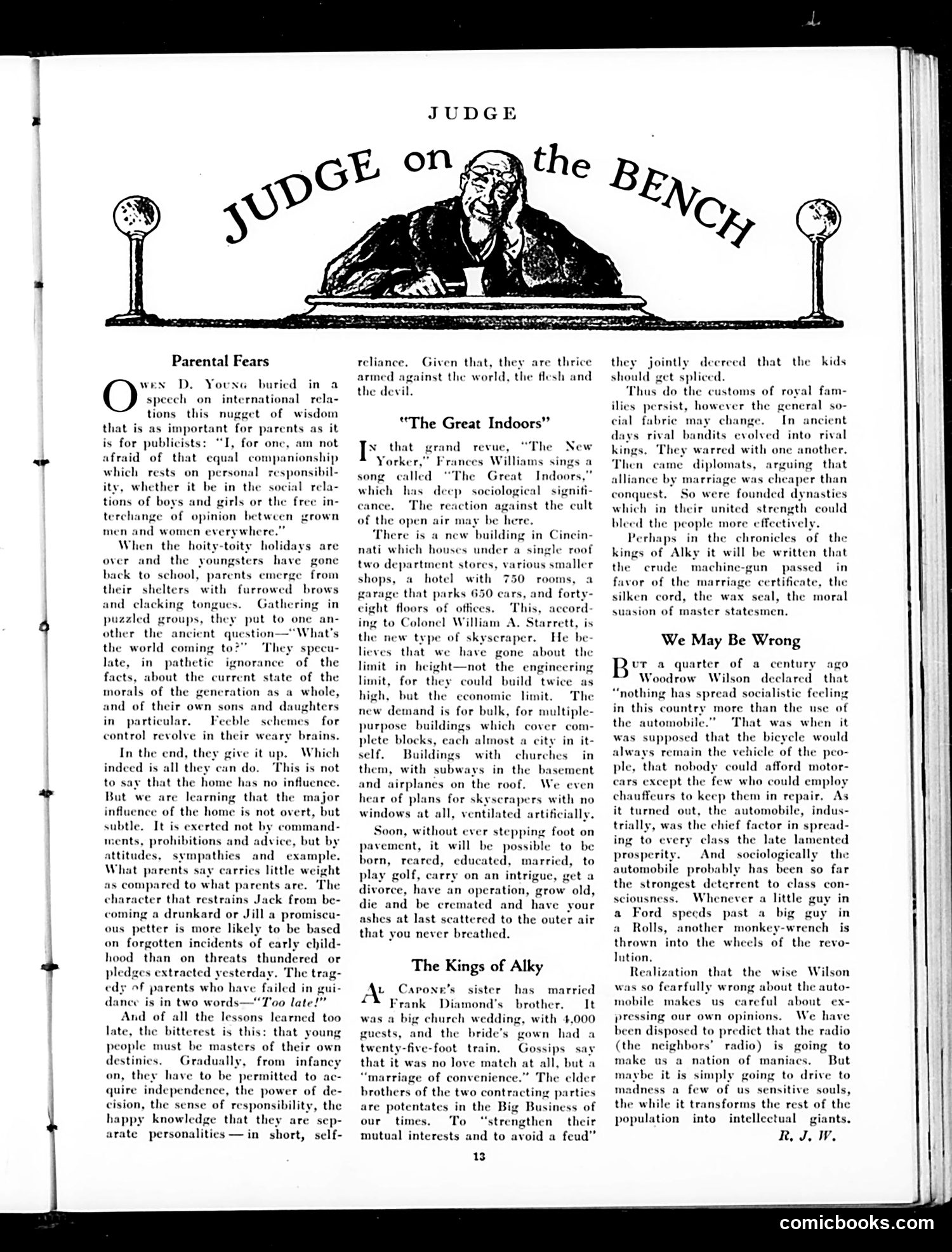
A restored page from Judge, 1931-01-10. Page through the whole issue in the reader above.
📄 Transcribed text from this page (OCR, searchable)
Machine-transcribed from the original scan — historical spelling and the odd misread are preserved.
JUDGE Parental Fears wen D. Youna buried in a O specch on international rela- tions this nugget of wisdom that is as important for parents as it is for publicists: “I, for one, am not afraid of that equal companionship which rests on personal responsibil- ity, whether it be in the social rela- tions of boys and girls or the free in- terchange of opinion between grown men and women everywhere.” When the hoity-toity holid over and the youngsters have gone back to school, parents emerge from their shelters with furrowed brows and clacking tongues. Gathering in puzzled groups, they put to one an- other the ancient question—"WI the world coming to?” They specu- te, in pathetic ignorance of the facts, about the current state of the morals of the generation as a whole, and of their own sons and daughters in particular. t's Feeble schemes for control revolve their weary brains. In the end, the ve it up. Which indeed is all they can do. This is not to say that the home has no influence. But we are learning that the major influence of the home is not overt, but subtle. It is exerted not by command- ments, prohibitions and advice, but by attitudes, sympathies and example. What parents say carries little weight as compared to what parents are. The character that restrains Jack from be- coming a drunkard or Jill a promiscu- ous petter is more likely to be based on forgotten incidents of early child- hood than on threats thundered or pledges extracted yesterday, The trag rents who have failed in gui- a two words—‘T'00 late!” And of all the lessons learned too late, the bitterest is this: that young people must be masters of their own destinies. Gradually, from infancy on, they have to be permitted to ac » independence, the power of de- ion, the sense of responsibility, the »py knowledge that they are sep- arate personalities —in short, self- Given that, they are thrice inst the world, the flesh and reliance. armed the dev “The Great Indoors” [X.that grand “The New Yorker,” Frances Williams sing song called “The Great which has deep sociologi cance. The reaction of the open air may be here. There is a new building in Cincin- nati which houses under a single roof two department stores, various smaller shops, a hotel with 750 rooms, a garage that parks 650 cars, and forty- ight floors of offices. This, accord- ing to Colonel William A. Starrett, is the new type of skyscraper. He be- lieves that we have gone about the limit in height—not the engine limit, for they could build twic high, but the economic limi! he new demand is for bulk, for multiple- purpose buildings which cover com- plete blocks, each almost a city in it- self. Buildings with churches in them, with subways in the basement and airplanes on the roof, We even hear of plans for skyscrapers with no windows at all, ventilated artificially. Soon, without ever stepping foot on pavement, it will be possible to be born, reared, educated, married, to play golf, carry on an intrigue, get a divorce, have an opcration, grow old, die and be cremated and have your ashes at last scattered to the outer air that you never breathed. a Indoors,” ral signifi- nst the cult ring The Kings of Alky At Caprone’s sister has married £% Frank Diamond's brother. It 1 big church wedding, with 4,000 guests, and the bride’s gown had a twenty-five-foot train. Gossips say that it was no love match all, but a “marriage of convenience.” The elder brothers of the two contracting parties are potentates in the Big Business of our times. To “strengthen their mutual interests and to avoid a feud” 13 ws they jointly deereed that the kids should get spliced. Thus do the customs of royal fam- ilies persist, howe cial fabrie may c days rival bandits kings. T' er the general so- In ancient alliance by marriage was cheaper than conquest. So were founded dynasties which in their united strength could bleed the people more effcetively. Perhs in the chronicles of the the crude 1 passed in favor of the m ate, the silken cord, the wax seal, the moral suasion of master statesmen. We May Be Wrong I ut a quarter of a ce Woodrow Wilson declared the “nothing has spread socialistic feeling in this country more than the use of the automobile.” That was when it was supposed that the bicycle would n the vehicle of the pe at nobody could afford motor- except the few who could employ iffeurs to keep them in repair. As it turned out, the automobile, indus- was the chief f ing to every class. the ctor in spread- ate lamented prosperity. And sociologically the automobile probably has been so fs the strongest deterrent to class con- Whenever a little guy in a Ford specds past a big guy in a Rolls, another monkey-wrench is thrown into the wheels of the revo- lution, Realization that the wise Wilson was so fearfully wrong about the auto- ile makes us careful about ex- pressing our own opinions. We have been disposed to predict that the radio (the neighbors’ radio) is going to make us a nation of maniacs. But aybe it is simply going to drive to madness a few of us sensitive souls, the while it transforms the rest of the population into intellectual giants. RJ. W. sciousness. comicbooks.com