
Judge, 1931-01-10 · page 18 of 36
Judge — January 10, 1931 — page 18: what you’re looking at
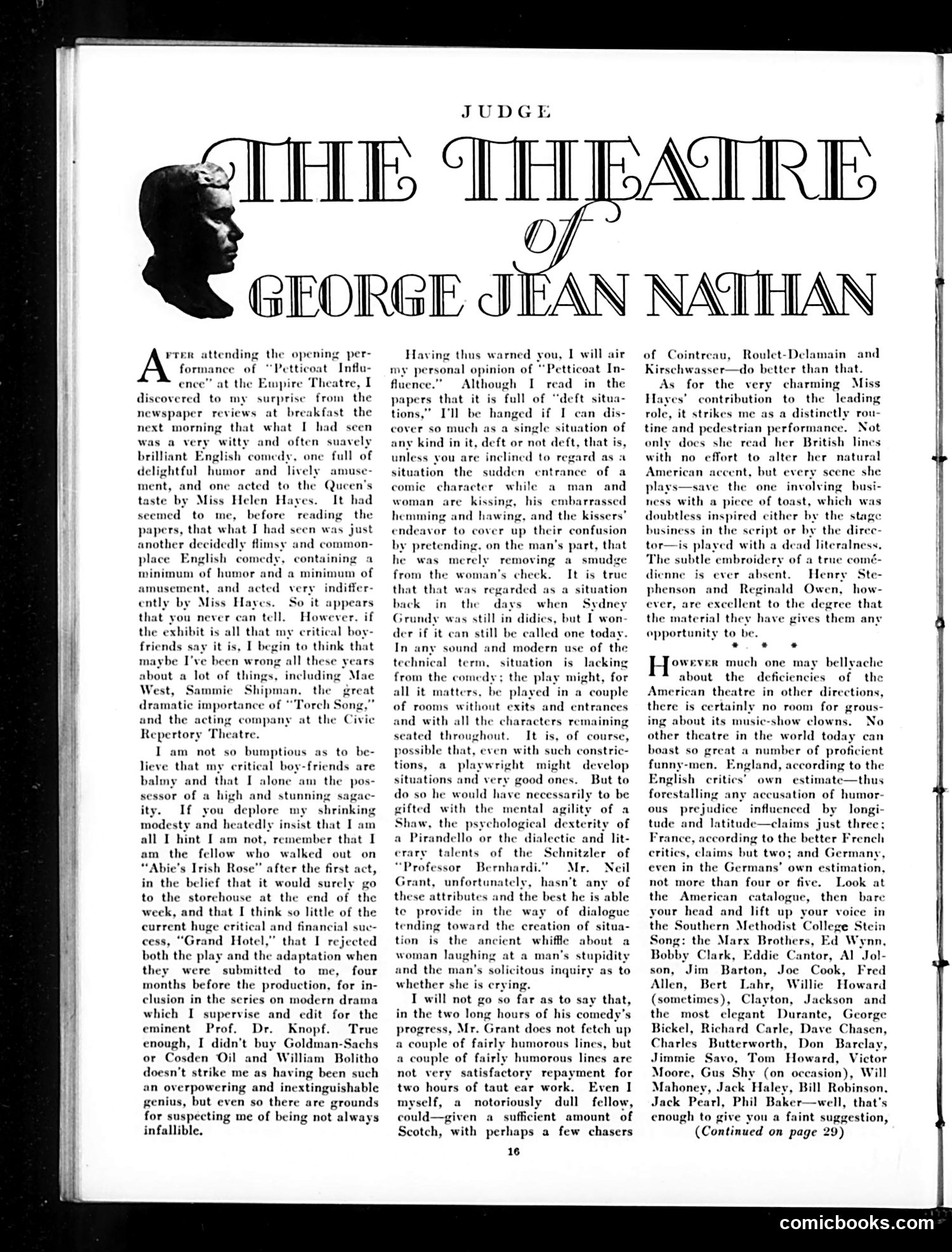
A restored page from Judge, 1931-01-10. Page through the whole issue in the reader above.
📄 Transcribed text from this page (OCR, searchable)
Machine-transcribed from the original scan — historical spelling and the odd misread are preserved.
JUDGE O RGE J rrer attending the opening per- formance of “Petticoat Influ- ence” at the Empire Theatre, I discovered to my surprise from the newspaper reviews at breakfast the next morning that what I had seen was a very witty and often suavely brilliant English comedy, one full of delightful humor and lively amuse- ment, and one acted to the Queen's taste by Miss Helen Hayes. It had seemed to me, before ‘reading the papers, that what I had seen was just another decidedly flimsy and common- place English comedy, containing a minimum of humor and a pum of amusement, and acted very indiffer- ently by Miss Hayes. So it appears that you never can tell. However. if the exhibit is all that my criti ; friends say it is, I begin to think that maybe I've been wrong all these ye about a lot of thir West, Sammic dramatic importance of and the acting company at the Civie Repertory Theatre. min I am not so bumptious as to be- lieve that my critical boy-friends are balmy and that I alone am the sessor of a high and stunning s y. If you deplore my shrinking modesty and heatedly insist that I am all I hint I am not, remember t I m the fellow who walked out on “Abie's Irish Rose” after the first act, in the belief that it would surely go to the storehouse at the end of the week, and that I think so little of the current huge critical and financial sue- cess, “Grand Hotel,” that I rejected both the play and the adaptation when they were submitted to me, four months before the production, for in- clusion in the series on modern drama which I supervise and edit for the eminent Prof. Dr. Knopf. True enough, I didn’t buy Goldman-Sachs or Cosden Oil and William Bolitho doesn’t strike me as having been such an overpowering and inextinguishable genius, but even so there are grounds for suspecting me of being not always infallible. Having thus warned you, I will air my personal opinion of ‘Petticoat In- fluence.” Although I read in’ the papers that it is full of “deft situa- tions,” I'll be hanged if I can dis- cover so much as a single situation of any kind in it, deft or not deft, that is, unless you are inclined to r situation the comic rd asa sudden entrance of a character while a man and woman are kissing, his embarrassed hemming and hawing, and the kissers’ endeavor to cover up their confusion by pretending, on the man’s part, that he was merely removing a smudge from the woman's check. It is true that that was regarded as a situation in the days when Sydney Grundy was still in didies, but I won der if it can still be called one today In any sound and modern use of th techni term, situation is lacking from the comedy; the play might, for all it matters, be played in a couple of rooms without exits and entrances and with all the characters remaining seated throughout. It is, of course, possible that, even with such constric- tions, a playwright might develop situations and very good ones. But to do so he would have necessarily to be gifted with the mental agility of a Shaw, the psychological dexterity of a Pirandello or the dialectic and lit- ary talents of the Schnitzler of “Professor Bernhard Mr. Neil Grant, unfortunately, hasn't of these attributes and the best he is able te provide in the way of dialogue tending toward the creation of situa- tion is the ancient whiffle about a woman laughing at a man’s stupidity and the man's solicitous whether she is crying. I will not go so far as to say that, in the two long hours of his comedy’s progress, Mr. Grant does not fetch up a couple of fairly humorous lines, but a couple of fairly humorous lines are not very satisfactory repayment for two hours of taut ear work. Even I myself, a notoriously dull fellow, could—given a sufficient amount of Scotch, with perhaps a few chasers 16 quiry as to ARE NACTHIAN of Cointreau, Roulet-Delamain and Kirschwasser—do better than that. As for the very charming Miss Hayes’ contribution to the leading role, it strikes me as a distinctly rou- tine and pedestrian performance. Not only docs she read her British lines with no effort to alter her natural American accent, but every scene she plays—save the one invol busi- ness with a piece of toast, which was doubtless inspired cither by the stage business in the script or by the direc- tor—is played with a dead literalness. The subtle embroidery of a true comé dienne is ever absent. Henry Ste- phenson and Reginald Owen, how- ever, are excellent to the d that the material they have gives them any opportunity to be. * 8 « However much one 1 bellyache about the deficiencies of the American theatre in other directions, there is certainly no room for grous- ing about its music-show clowns. No other theatre in the world today can boast so great a number of proficient funny-men, England, according to the English critics’ own estimate—thus forestalling any accusation of humor- ous i tude rree rding to the better French critics, claims but two; and Germany, even in the Germans’ own estimation, not more than four or five. Look the Americs alogue, then your head and lift up your voice in the Southern Methodist College Song: the Marx Brothers, Ed Wynn, Bobby Clark, Eddie Cantor, Al Jol- son, Jim Barton, Joe Cook, Allen, Bert Lahr, Willie (sometimes), Clayton, the most elegant Durante, George Bickel, Richard Carle, Dave Chasen, Charles Butterworth, Don Barclay, Jimmie Savo, Tom Howard, Victor Moore, Gus Shy (on occasion), Will Mahoney, Jack Haley, Bill Robinson, Jack Pearl, Phil Baker—well, that's enough to give you a faint suggestion, (Continued on page 29) Fred Howard Jackson and comicbooks.com