A complete issue · 36 pages · 1930
Judge — November 22, 1930
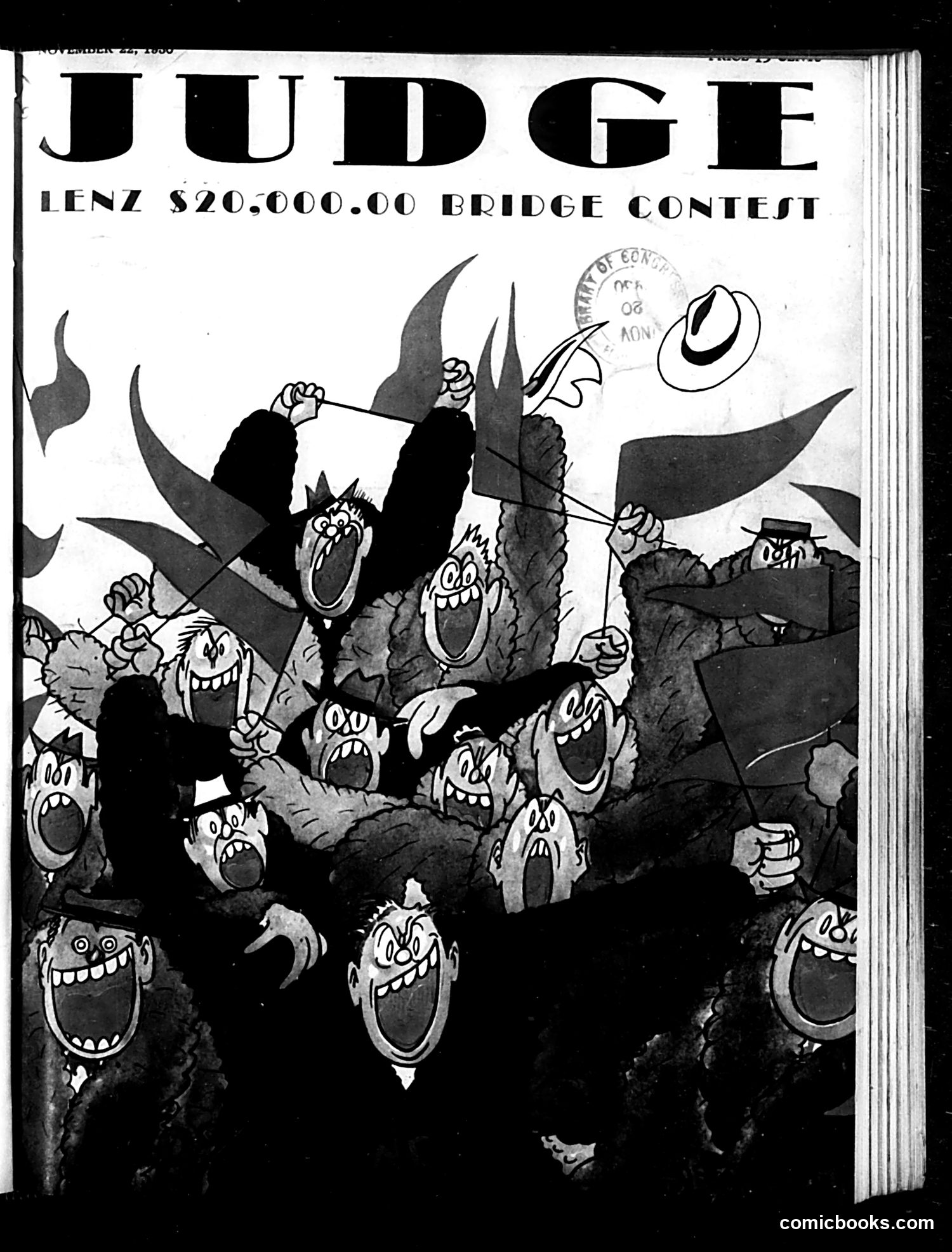
# Analysis This appears to be a Judge magazine cover from November 22, 1930, featuring a "$20,000 Bridge Contest." The cartoon depicts demonic or grotesque figures with exaggerated features swarming around what appears to be a bridge structure, with horned creatures emerging from below. The silhouetted figures above seem to be judges or officials overseeing the chaos. The satire likely references the bridge-building contest itself—possibly mocking either the competition's participants, the judges' selection process, or broader economic concerns during the Great Depression. The devilish imagery suggests the contest was viewed as chaotic, corrupt, or absurdly managed. Without additional context about the specific 1930 bridge competition referenced, I cannot identify the exact target of ridicule, though the exaggerated pandemonium and infernal theme suggest Judge was casting aspersions on those involved.
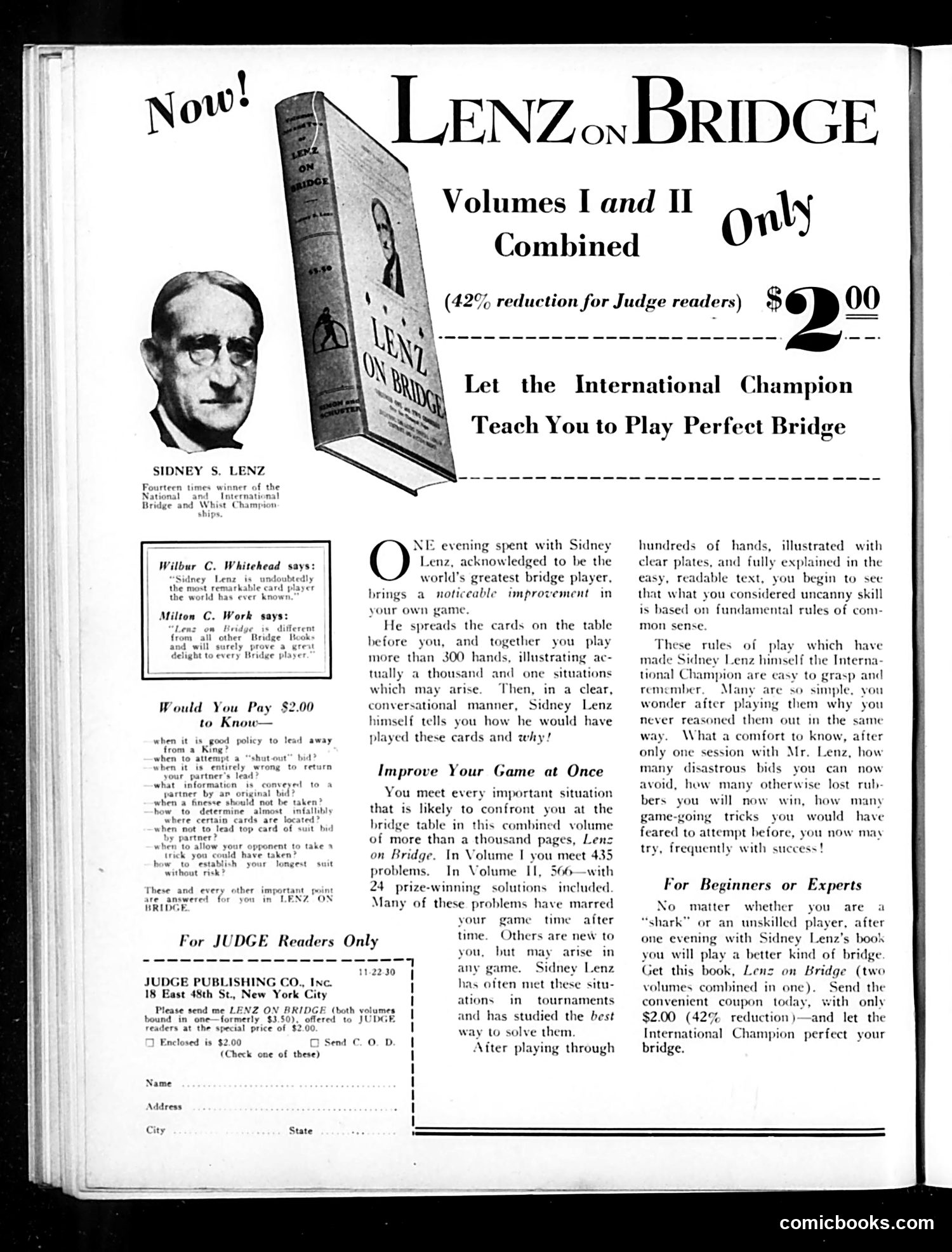
# Analysis: Judge Magazine Advertisement Page This page is **primarily an advertisement**, not satirical content. It promotes "Lenz on Bridge," a two-volume instructional book by Sidney S. Lenz, identified as a fourteen-time winner of national and international bridge championships. The ad features Lenz's photograph and testimonials from bridge experts (Wilbur C. Whitehead and Milton C. Work), claiming his book teaches "perfect bridge" through analysis of hundreds of hands and situations. The offer targets "Judge readers" specifically with a 42% discount: $2.00 for both volumes combined. There is no political satire or social commentary here—this is a straightforward commercial pitch appearing in a magazine known for humor, using the publication's credibility to sell instructional materials to its educated, affluent readership interested in card games.
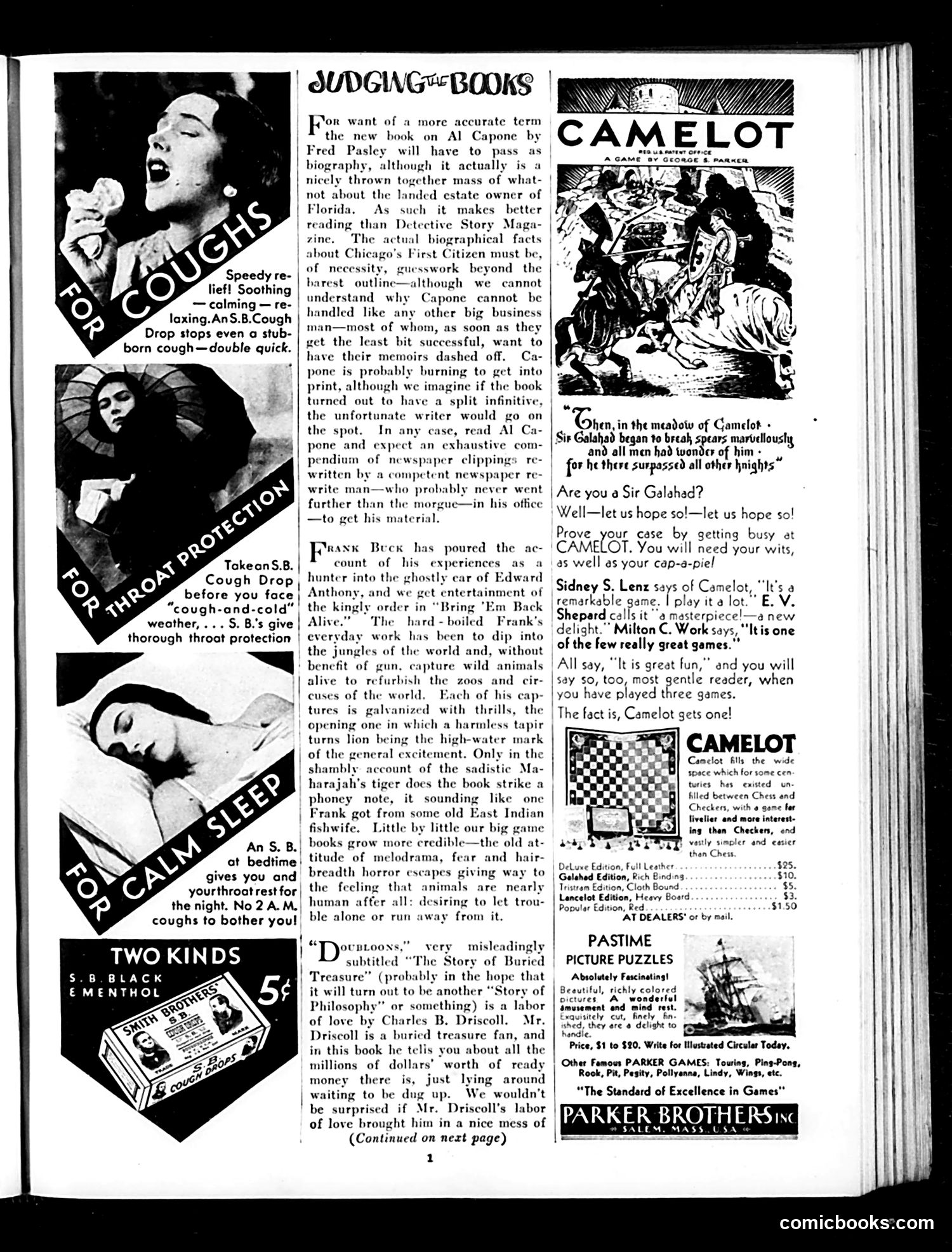
# Page Analysis: Judge Magazine This page is primarily **advertising and book reviews** rather than political satire. The left side features product ads (cough drops, sleeping aids, mentholyptus products) using glamorous female faces—typical 1920s-30s marketing targeting health-conscious consumers. The main content is "Judging the Books," a review section critiquing recent publications. The reviewer discusses Al Capone biographies (noting the gangster's unavoidable notoriety), Frank Buck's animal adventure narratives, and Charles B. Driscoll's "Dormloons" (apparently a humorous campus story). The right side advertises **Camelot**, a board game, with period-appropriate chess-themed imagery. The tone is light entertainment rather than political commentary, reflecting the magazine's shift toward lifestyle content and consumer culture by this era.
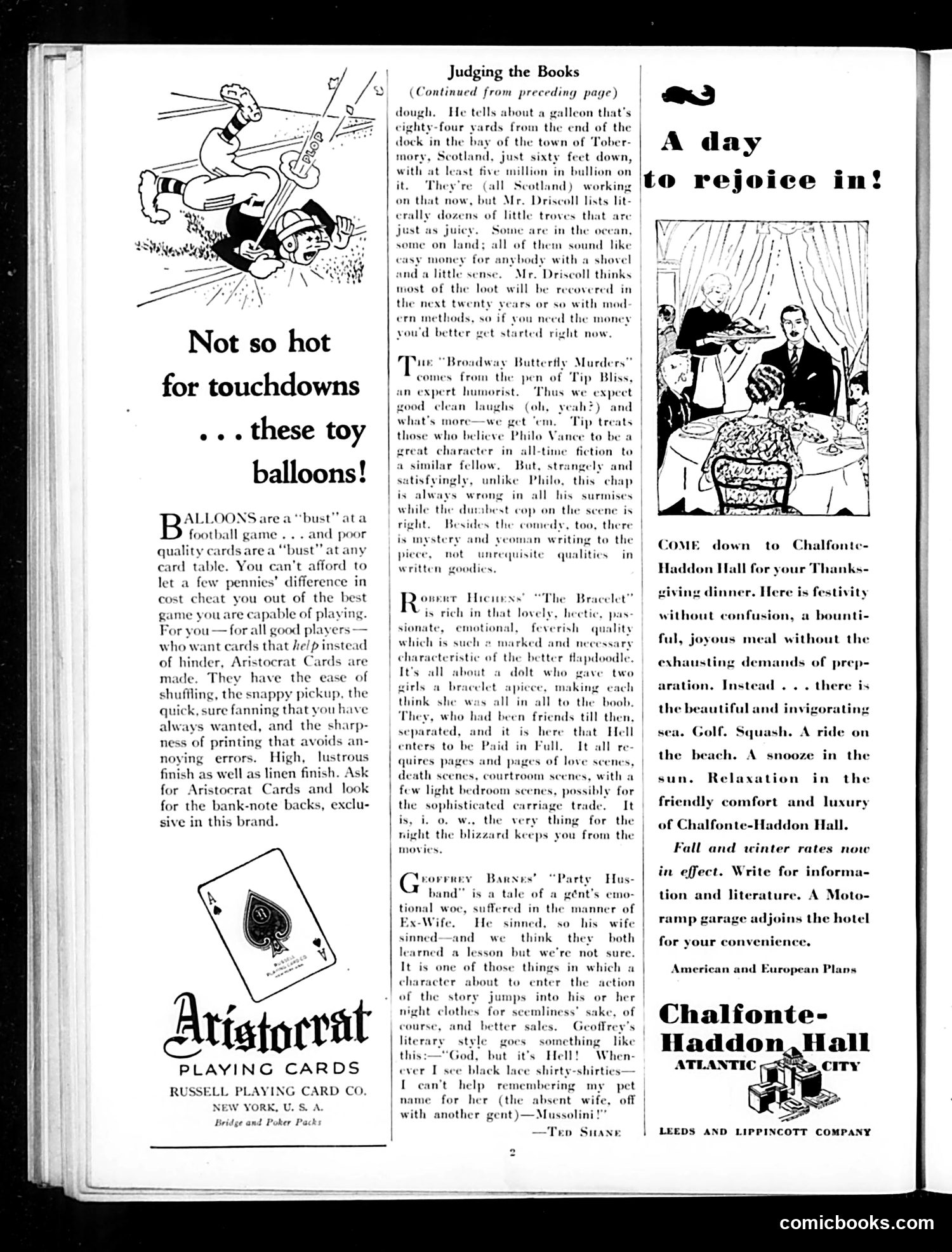
# "Judging the Books" Page Analysis This page is primarily **book reviews and advertisements** rather than political satire. The main content reviews several novels including "The Bracelet" by Robert Hichens and "Party Husband" by Geoffrey Barnes, critiquing their literary merit and romantic plots. The cartoon "Not so hot for touchdowns" features a football player being tackled, advertising Aristocrat Playing Cards. The joke is that while balloons might be unreliable for serious football, the cards themselves are dependable—a lighthearted product endorsement unrelated to politics. The page concludes with a hotel advertisement for Chalfonte-Haddon Hall in Atlantic City, promoting leisure travel and relaxation. No significant political commentary or social satire appears on this page.
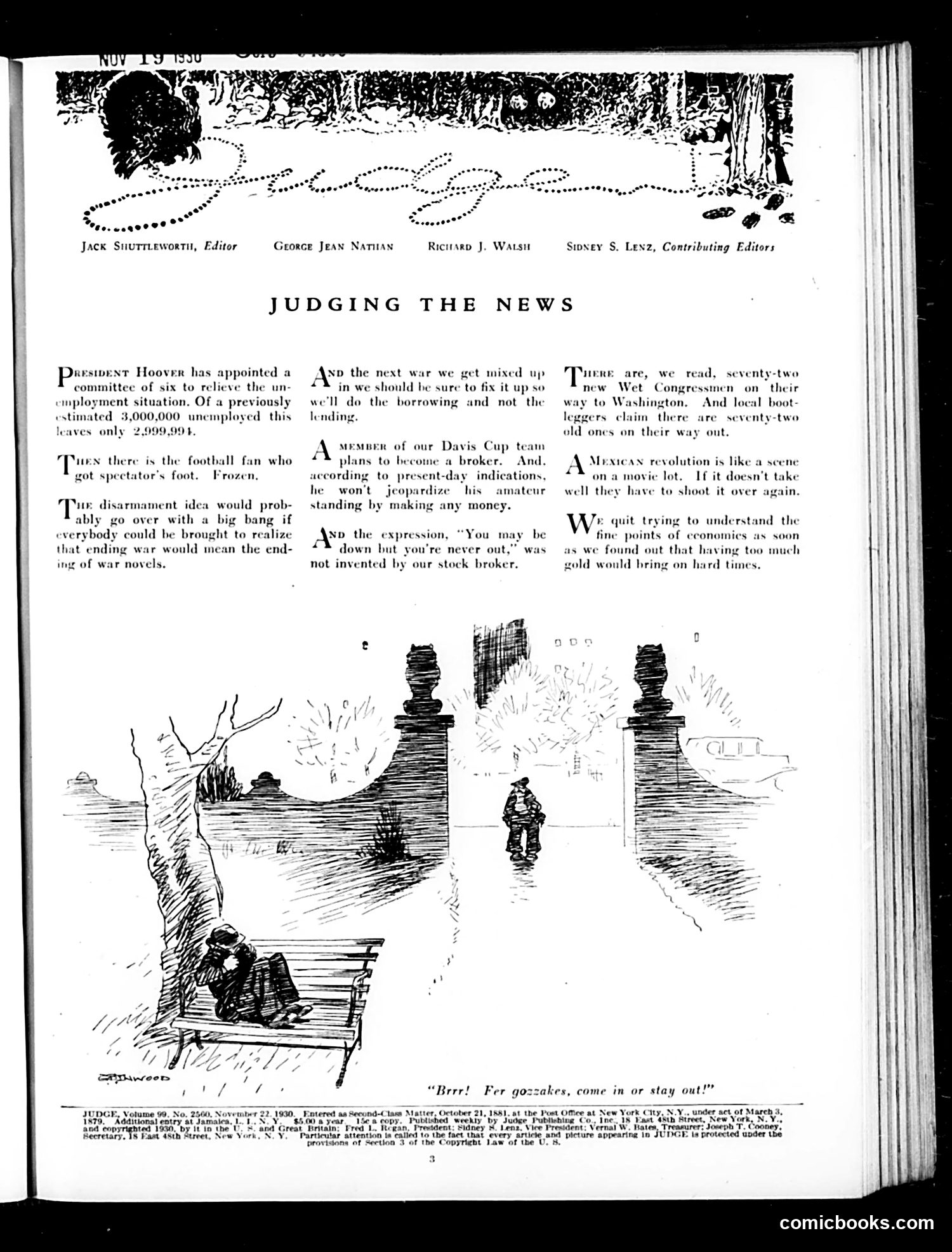
# "Judging the News" - November 22, 1930 This satirical column presents brief commentary on current events. Key items include: - **President Hoover's unemployment committee**: Criticism of the administration's response to joblessness during the Great Depression, noting previous estimates proved vastly underestimated. - **Football fan joke**: A brief gag about a spectator with "frozen" foot. - **Disarmament criticism**: Skepticism that war could end through disarmament treaties alone. - **Davis Cup tennis reference**: A joke about a team member becoming a "broker" (likely financial ruin). - **Mexico's revolution**: Compared to chaotic movie production. - **Economics commentary**: Dismissal of abstract economic theory when facing economic hardship and gold hoarding. The illustration shows figures contemplating an ominous landscape with towers, possibly representing economic uncertainty or societal worry during the Depression era.
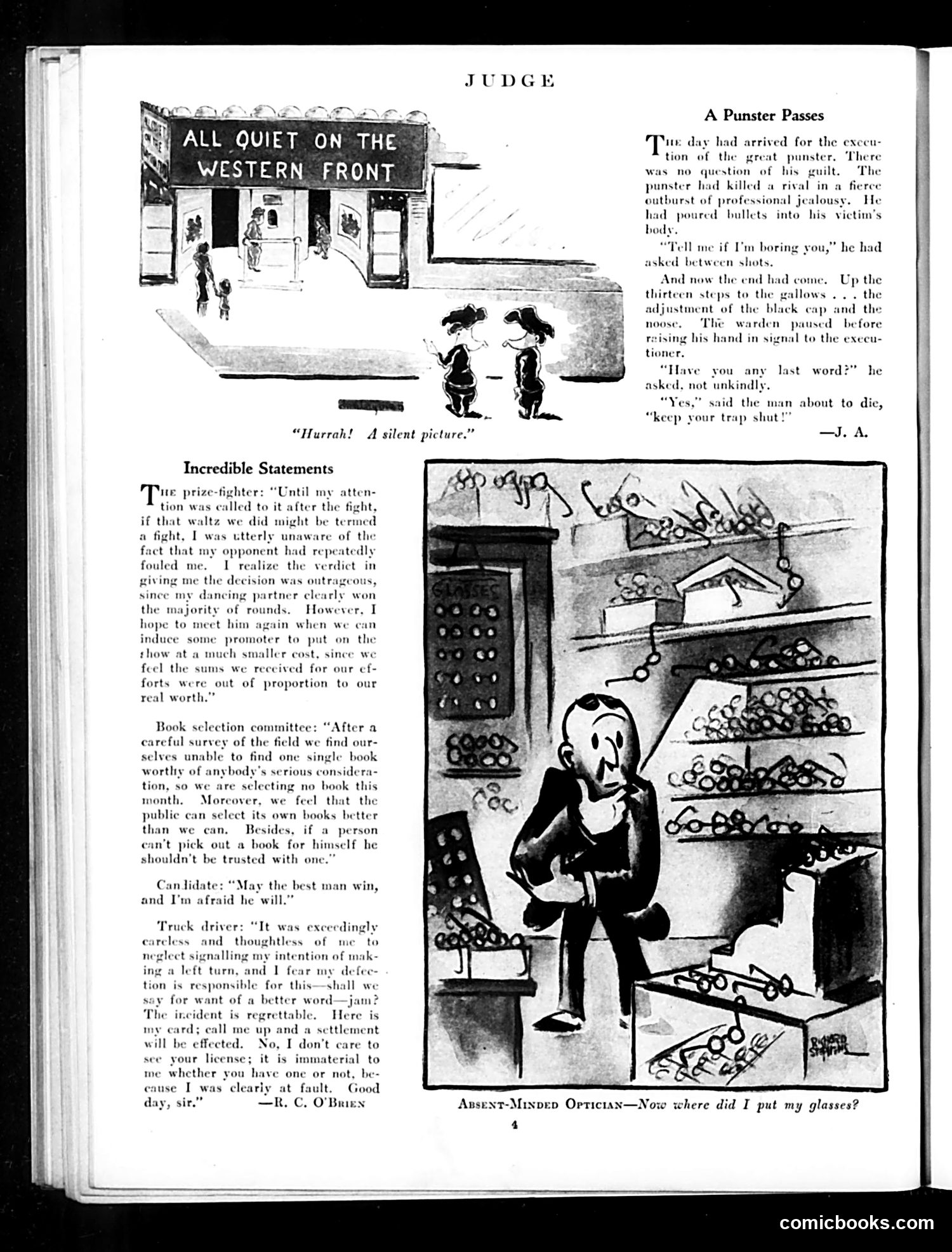
# Analysis This page contains three satirical pieces from Judge magazine: 1. **"All Quiet on the Western Front"** (top): A silent-film reference mocking WWI's brutality through the contrast between the lighthearted theater marquee and two soldiers' grim conversation about execution. 2. **"Incredible Statements"** (middle): A section collecting absurd quotes from public figures, including a prize-fighter claiming ignorance of a fight he participated in, and a truck driver making an elaborate excuse for a traffic violation. 3. **"Absent-Minded Optician"** (bottom cartoon): Shows a befuddled eye doctor surrounded by eyeglasses on shelves, having lost his own glasses—a visual gag about professional irony. The page satirizes human folly across entertainment, society, and everyday life, typical of Judge's early 20th-century humor style.
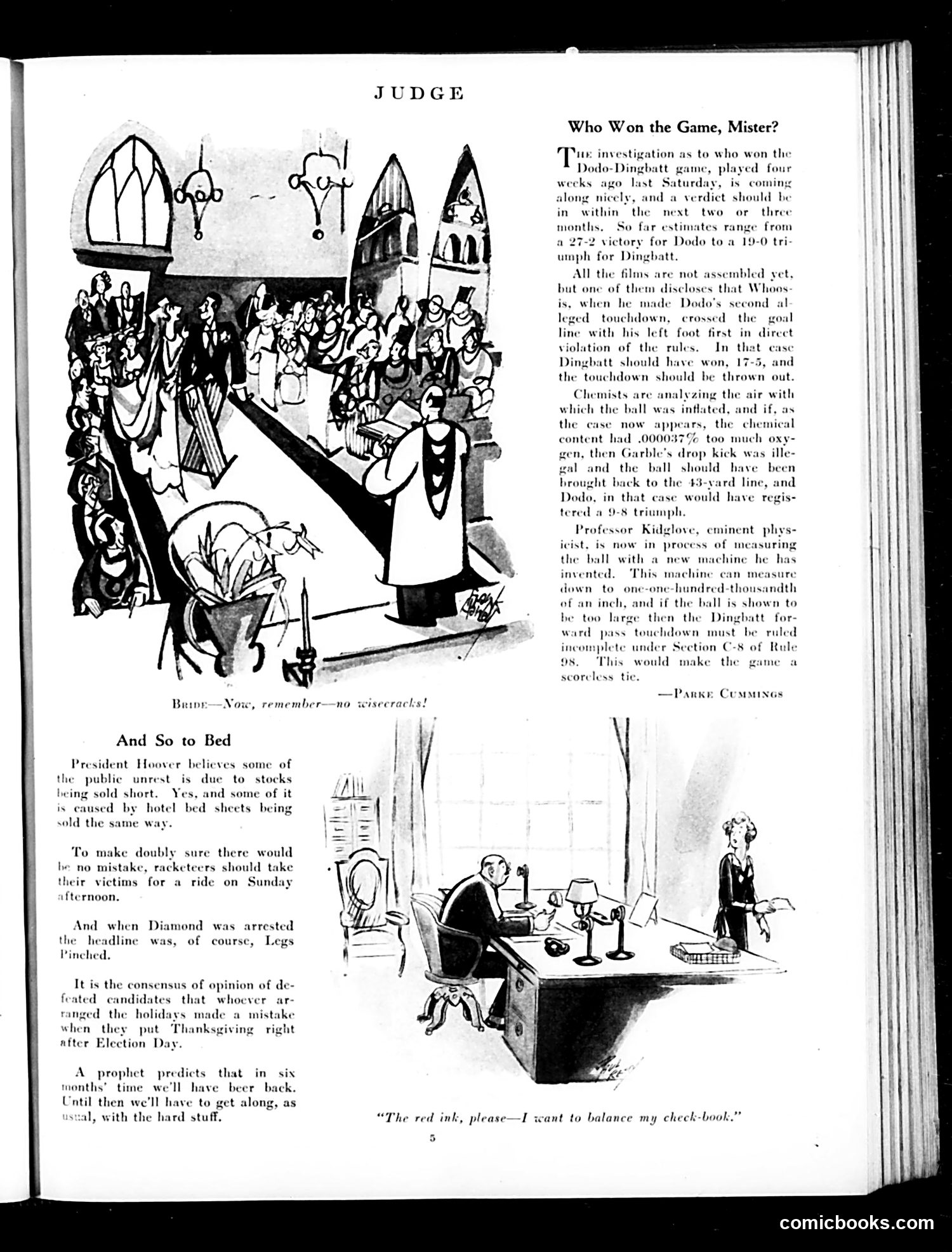
# Judge Magazine Page Analysis This page contains two satirical pieces: **"Who Won the Game, Mister?"** addresses a disputed football outcome from the "Dodo-Dingbatt game" four weeks prior. The large illustration shows a chaotic scene at what appears to be a cathedral or formal venue, with the caption "Bride—*Now, remember—no wisecracks!*" The satire mocks ongoing disputes over the game's result, referencing chemistry analysis of the football's air content and technical rule interpretations. Attribution to Parker Cummings suggests this pokes fun at how people obsess over settling trivial disputes. **"And So to Bed"** satirizes President Hoover's economic policies, referencing public unrest, stock market short-selling, and the timing of Thanksgiving after Election Day. The smaller cartoon shows a man at a desk with the caption about balancing his checkbook, likely commentary on widespread financial anxiety during this period.
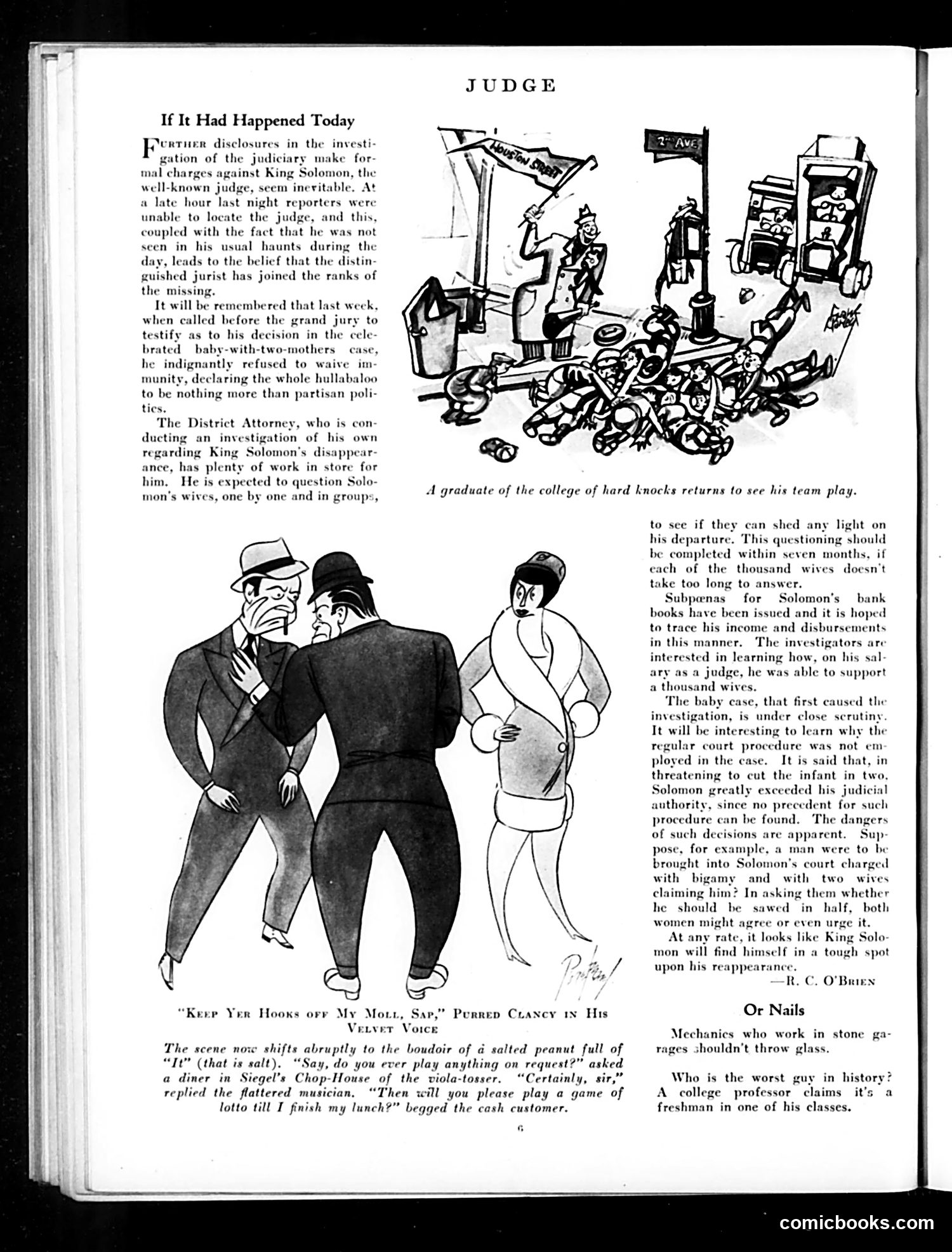
# Explanation for Modern Readers This Judge magazine page satirizes the scandal involving King Solomon (a judge), who apparently disappeared under suspicious circumstances. The main cartoon depicts journalists and investigators swarming around a chaotic crime scene, mocking the sensational media coverage. The text reveals Solomon faces serious allegations: he indignantly refused to waive immunity in a baby case involving bigamy, and investigators are questioning his wives about his financial support. The satire criticizes Solomon for abusing judicial authority—threatening to cut an infant in half exceeded legal precedent. The lower cartoon depicts two detectives and a woman, captioning a scene about keeping "hooks off my moll," suggesting criminal underworld connections. The satire targets Solomon's apparent corruption, misconduct, and the spectacle surrounding his investigation.
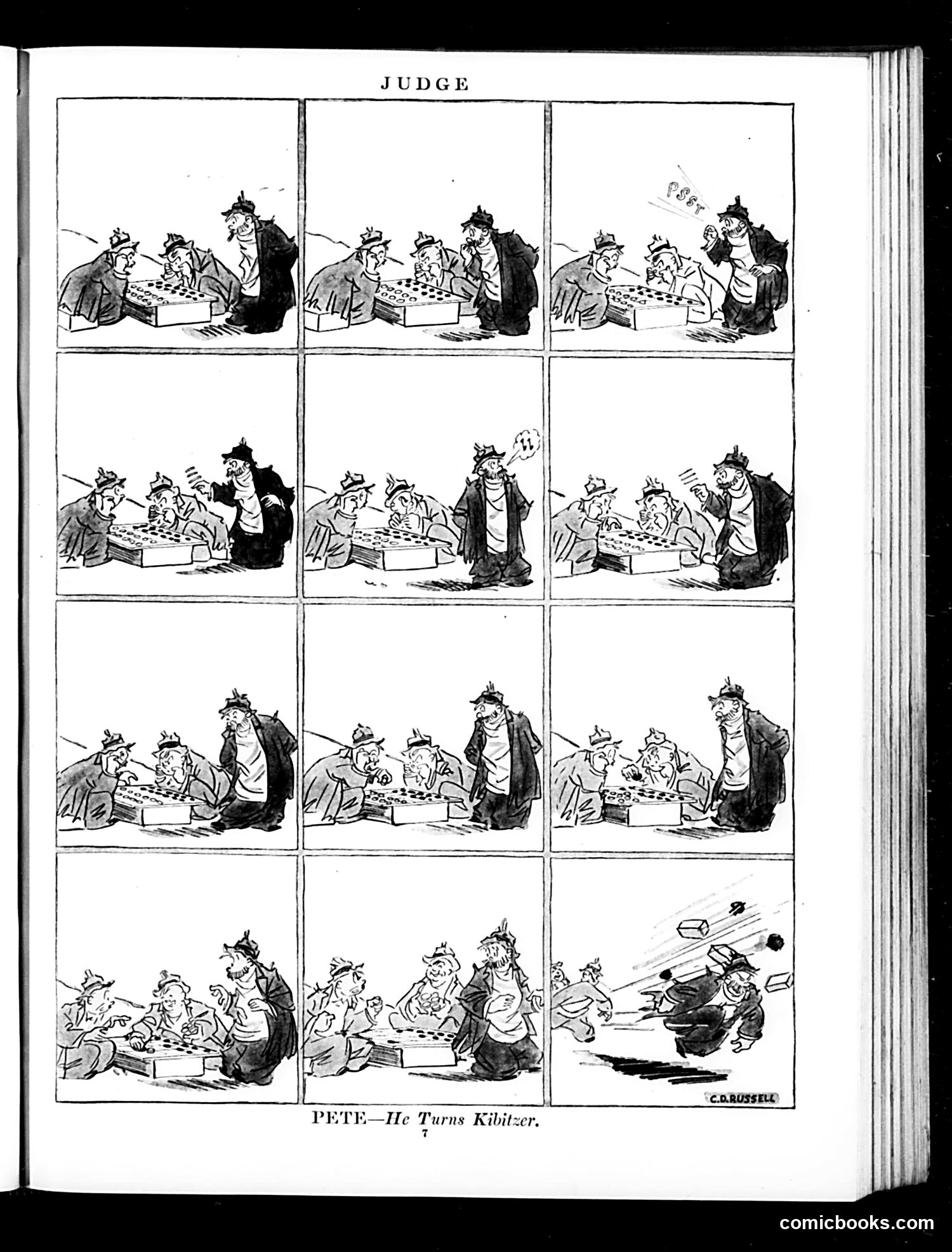
# "Pete—He Turns Kibitzer" This comic strip from *Judge* magazine depicts a chess game between two men wearing crowns (likely political figures or rulers) while a third figure—"Pete," identified by the caption—stands nearby offering unsolicited commentary ("kibitzer" means a backseat commentator). The twelve-panel sequence shows Pete increasingly animated and disruptive, eventually flipping over the chessboard in the final panel, scattering pieces everywhere. The satire likely criticizes interference in political or diplomatic matters—Pete represents someone meddling in affairs beyond his authority. The chess metaphor suggests high-stakes governmental strategy, while Pete's escalating disruption mocks those who presume to advise or interrupt important negotiations. Without clearer historical context or date, the specific political figures remain unclear.
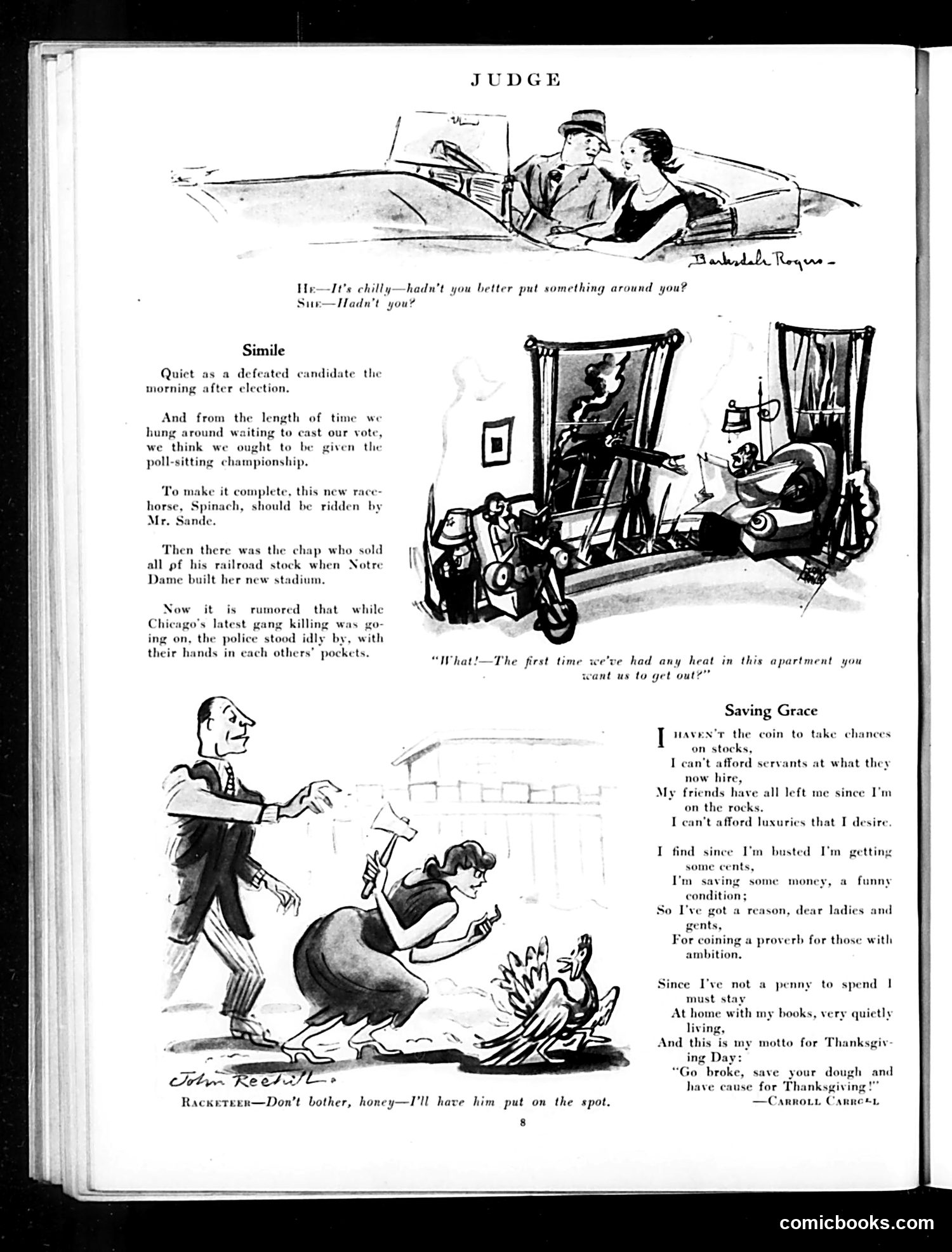
# Judge Magazine Page Analysis This page contains multiple satirical pieces typical of Judge's style: **Top cartoon ("Judge")**: Shows a couple in a sinking boat. The man suggests the woman put "something around" herself; she retorts he should do the same. This is a visual pun on marital discord—likely satirizing post-election tensions (the "defeated candidate" reference suggests a recent election where the couple disagreed politically). **Middle section ("Simile")**: Brief humorous observations about voting, a racehorse named Spinach, and—notably—**Chicago police corruption**. The final item mocks police inaction during a gang killing, sardonically noting they stood idle "with their hands in each others' pockets" (implying bribery). This reflects 1920s-era Chicago's notorious organized crime and police graft. **Bottom cartoon ("Racketeer")**: A man threatens a woman he'll "put [someone] on the spot"—a period slang term for murder. Satirizes organized crime threats. **"Saving Grace" poem**: Humorous verse by Carroll Carroll about financial hardship during economic downturn, urging frugality for Thanksgiving. The page collectively satirizes post-election malaise, corruption, and economic hardship—likely from the early 1920s.
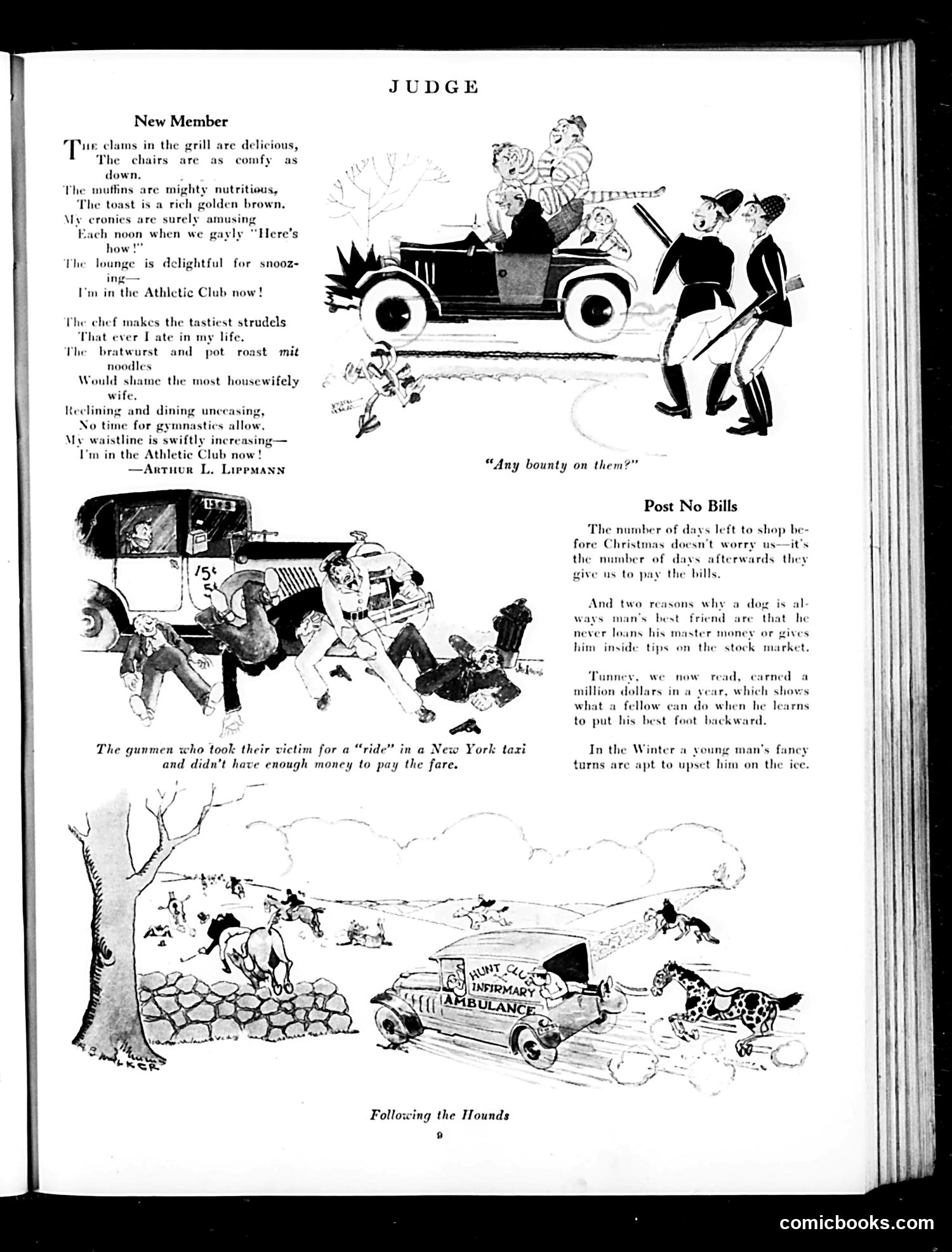
# Analysis for Modern Readers This page from Judge magazine contains several satirical pieces: **"New Member"** (poem by Arthur L. Lippmann): Satirizes a newly wealthy club member whose lifestyle has become sedentary and indulgent. He boasts about fine dining and leisure while noting his waistline is "swiftly increasing"—mocking nouveau riche materialism and the physical consequences of excessive comfort. **Top cartoon** ("Any bounty on them?"): References organized crime "rides" (execution-style killings). The joke: gunmen who kidnapped someone couldn't afford the taxi fare—satirizing criminals' incompetence or desperation. **"Post No Bills"**: Brief jokes about Christmas shopping debt and dogs' loyalty (they don't gamble on stocks or loan money). **Bottom cartoon** ("Following the Hounds"): An ambulance chasing after a fox hunt, suggesting the hunt causes accidents. The satire appears to mock the dangers or chaos of this aristocratic pastime. The overall tone reflects early 20th-century American humor targeting wealth, crime, and leisure activities.
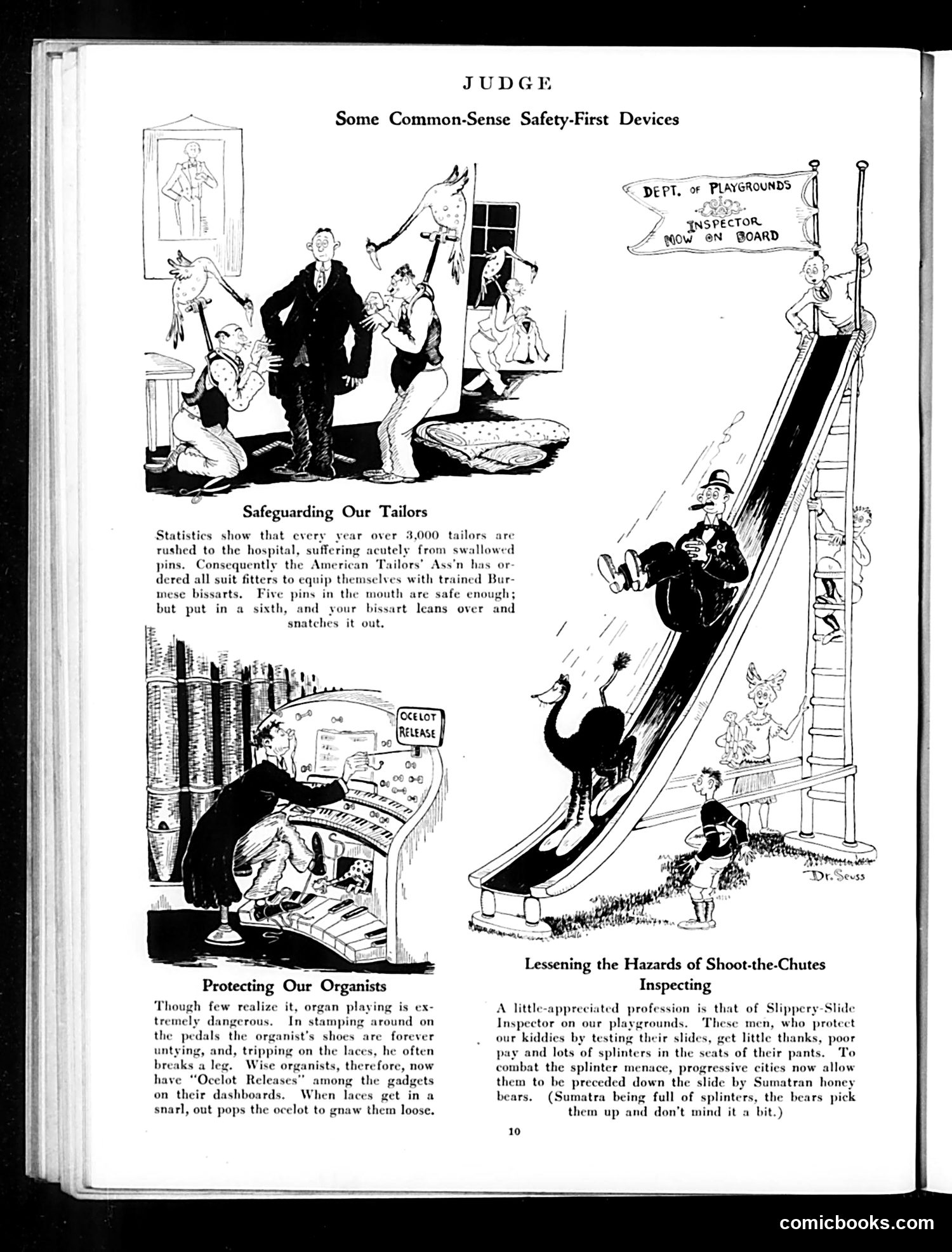
# Explanation for Modern Readers This Judge magazine page presents absurdist satire mocking workplace safety regulations—likely responding to early 20th-century "Safety First" industrial campaigns. Each cartoon proposes ridiculous "safety devices" to solve genuine hazards: 1. **"Safeguarding Our Tailors"**: Tailors swallowing pins while working inspired the American Tailors' Association to equip workers with trained Burmese "bissarts" (likely fictional animals) to retrieve swallowed pins—a nonsensical solution to a real occupational danger. 2. **"Protecting Our Organists"**: Organ players who stamp on pedals risk leg injuries, so the cartoon suggests "Ocelot Releases"—mechanical ocelots mounted on dashboards to untangle shoelaces. 3. **"Lessening the Hazards of Shoot-the-Chutes"**: Playground slide inspectors get splinters, solved by sending Sumatran honey bears down first, since bears supposedly don't mind splinters. The satire mocks both the era's earnest safety obsession and the inadequacy of proposed solutions, using Dr. Seuss-style drawings to heighten the absurdity.