
Judge, 1930-11-22 · page 15 of 36
Judge — November 22, 1930 — page 15: what you’re looking at
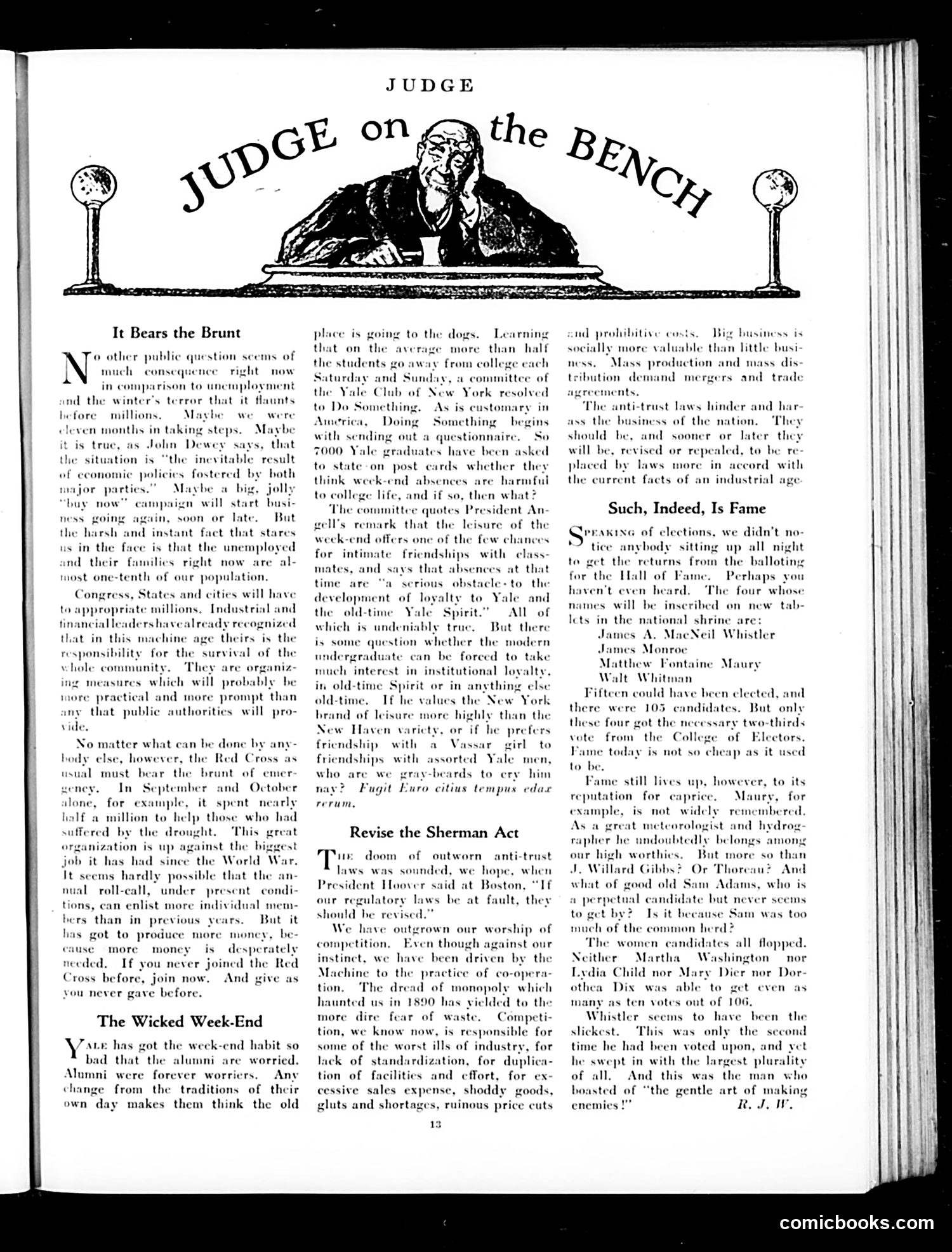
A restored page from Judge, 1930-11-22. Page through the whole issue in the reader above.
📄 Transcribed text from this page (OCR, searchable)
Machine-transcribed from the original scan — historical spelling and the odd misread are preserved.
It Bears the Brunt o other public question scems of N much consequence right now in comparison to unemployment ind the winter's terror that it flaunts millions. Maybe we we steps. Mayl wey says, that the situation is “the inevitable result of economic policies fostered by both or parties.” Maybe a big, jolly will start busi- before eleven months in tak it is true, as John 1 “buy now” ¢ ness ie ag . soonoor late. But the harsh us in the face is that the un nd their families right now most one-tenth of our population, States and cities will have millions, Industrial and financial leaders hav Congress to appropri: y recognized theirs iy the nsibility for the survival of the They a niz- ing measures which will proba that in this machine whole community. ly be ore practical and more prompt than iny that public authorities will pro- vide, No matter what ean be done by any- hody else, however, the Red Cross as usual must bear the brant. ¢ y. In September and October lone, for example, it spent nearly half a million to help those who had suffered by the dre ra tion is up emer gen J it has had sir It seems hardly possible that the an- nual roll-eall, under present condi- tions, can enlist more individual mem- bers than in previous y But it has got to produce more money, be- cause more money is desperately needed. If you never joined the Red Cross before, join now. And give as you never gave before. The Wicked Week-End 7 are has got the week-end habit so bad that the alumni are worried. Mumni were forever worriers. Any ze from the traditions of their own day makes them think the old Learning n half each place is going to the d that on th more th the students go away from coll Saturday and Sunday, a committee of the Yale Club of New York resolved to Dos As is customary in Amer Something | with sending out a questionnaire. So 7000 Yale graduates have been asked to state-on post cards whether they think week-end to college li orag omething. vty, Doing nd if se es are harmful then what? ‘The committee quotes President An gell’s remark that the leisure of the week-end offers one of the few chances for intimate friendships with class- mates, and says that absences at that time are “a serious obstacle: to the development of loyalty to Y and the old-time Yale Spirit.” All of which is undeniably truc. But there is some question whether the modern undergraduate can be forced to take much interest in institutional loyalty, in old-time Spirit or in anything else old-time. If he values the New York brand of leisure more highly than the w Haven varicty, or if he prefers friendship with a Vassar girl to friendships with asserted Yale men, who are we gray-beards to ery him > Fugit Euro citius tempus edac rerum, Revise the Sherman Act TT doom of outworn anti-trust laws was sounded, we hope, when President Hoover said at Boston, “If our regulatory laws be at fault, they should be revised.” We have ou competition, ‘own our worship of en though against our instinct, we have been driven by the Machine to the practice of co-opera- tion. The dread of monopoly which haunted us in 1890 has yielded to the more dire fear of waste. Competi- tion, we know now, is responsible for some of the worst ills of industry, for lack of standardization, for duplica- tion of facilities and effort, for ex- cessive sales expense, shoddy goods, gluts and shortages, ruinous price cuts 13 socially more valuable than little busi Mass production and mass dis- ness. tribution demand mergers and trade coments, Th ass the business of the nation. anti-trust laws hinder and har They should be, and sooner or later they will be, revised or repealed, to be re placed by laws mo ord with the current facts of industrial age Such, Indeed, Is Fame PEAKING of elections, we didn’t no- tice anybody sitting up all night to get the from the balloting for the Hall of Fame. Perhaps 4 haven't even heard, The four whose names will be inscribed on new tab- lets in the national shrine are: ames A. MacNeil Whistler James Monroe Matthew Fontaine Maury Walt) Whitman Fifteen could have been elected, and there were 105 ndidates. But only these four got the necessary two-thirds vote from the retu me Blectors. s it used College of Fame today is not so cheap to be. Fame still lives up, however, to its reputation for caprice. Maury, for example, is not widely remembered. teorologist btedly belo: mong our high worthics. But more so than J. Willard Gibbs? Or Thoreau? And what of good old Sam Adams, who is a perpetual candidate but never scems to get by Is it because much of the common here nd hydro rapher he unde ain was too The women candidates all flopped. Neither Martha Washington — nor Lydia Child nor Mary Dier nor Dor- othea Dix was able to get even as many as ten votes out of 101 Whistler seems to have been the slickest. This was only the second time he had been voted upon, and yct he swept in with the largest plurality of all. And this was the man who boasted of “the t of making enemies !” RoI. W, comicbooks.com