
Judge, 1930-11-22 · page 18 of 36
Judge — November 22, 1930 — page 18: what you’re looking at
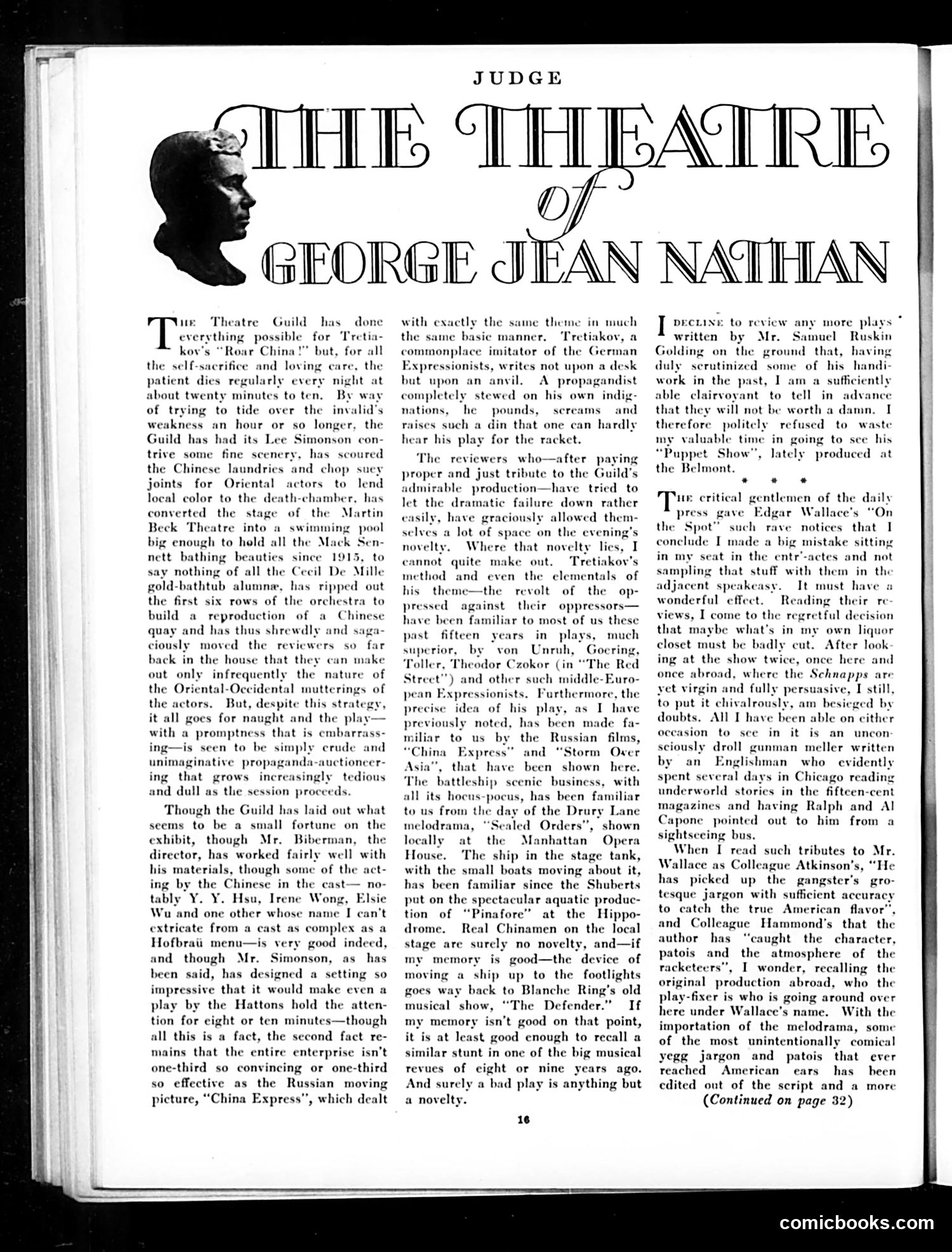
A restored page from Judge, 1930-11-22. Page through the whole issue in the reader above.
📄 Transcribed text from this page (OCR, searchable)
Machine-transcribed from the original scan — historical spelling and the odd misread are preserved.
) | i | } | | h, mit ur Theatre Guild has done "[ este possible for ‘T'retia- kov's “Roar China!” but, for all the self-sacrifice and loving care, the patient dies regularly every night at about twenty minutes to ten, By way of trying to tide over the invalid’s weakness an hour or so longer, the Guild has had its Lee Simonson con- trive some fine scenery, has scoured the Chinese laundries and chop suey joints for Oriental actors to lend local color to the death-chamber, has converted the stage of the Martin Beck Theatre into a swimming pool big enough to hold all the Mack Sen- nett bathing beauties since 1915, to say nothing of all the Cecil De Mille gold-bathtub alumna, has ripped out the first six rows of the orchestra to build a reproduction of a Chinese quay and has thus shrewdly and saga- ciously moved the reviewers so far back in the house that they can make out only infrequently the nature of the Oriental-Occidental mutterings of the actors, But, despite this strate it all goes for naught and the play with a promptness that is embarrass- ing—is seen to be simply crude and unimaginative propaganda-auctioneer- ing that grows increasingly tedious and dull as the session proceeds. Though the Guild has laid out what to be a small fortune on the exhibit, though Mr. Biberman, the director, has worked fairly well with his materials, though some of the act- g by the Chinese in the cast— no- tably Y. Y. Hsu, Irene Wong, Elsie Wu and one other whose name I rt extricate from a cast as complex as a Hofbraii menu—is very good indeed, d though Mr. Simonson, as has been said, has designed a setting so impressive that it would make even a play by the Hattons hold the atten- tion for eight or ten minutes—though all this is a fact, the second fact re- mains that the entire enterprise isn’t one-third so convincing or one-third so effective as the Russian moving picture, “China Express”, which dealt JUDGE © GEORGE J with exactly the same theme in much the same basic manner, Tretiakov, a commonplace imitator of the German Expressionists, writes not upon a desk but upon an anvil. A propaga completely stewed on his own ind nations, he pounds, ser raises such a din that one hear his play for the racket. The reviewers who—after paying proper and just tribute to the Guild’s admirable production—have tried to tic failure down rather jously allowed them- 1 lot of space on the evening's novelty, Where t novelty ,1 cannot quite make out. Tretiakov’s method and even the elementals of his theme—the revolt of the op- pressed nst their oppressors— have been familiar to most of us these past fifteen years in’ plays, much superior, by von Unruh, Goering, Toller, Theodor Czokor (in “The Red Street’) and other such middle-Euro- pean Expressionists. Furthermore, the precise idea of his pl previously noted, has been made fa- r to us by the Russian films, Express” and “Storm Over that have been shown here. ne battleship scenic business, with all its hoeus-pocus, has been familiar to us from the day of the Drury Lane melodrama, “Sealed Orders”, shown locally at the Manhattan Opera House. The ship in the stage tank, with the small boats moving about i has been familiar since the Shuberts put on the spectacular aquatic produc- tion of “Pinafore” at the Hippo- drome. Real Chinamen on the local stage are surely no novelty, and—if my memory is good—the device of moving a ship up to the footlights goes way back to Blanche Ring's old musical show, “The Defender.” If isn’t good on that point, it is at least good enough to recall a similar stunt in one of the big musical Asia", my memory revues of eight or nine years ago. And surely a bad play a novelty. is anything but 16 NATHAN DECLINE to review written by Mr. Samuel Ruskin Golding on the ground that, having duly scrutinized some of his work in the past, I am a sufficiently able clairvoyant to tell in advance that they will not be worth a damn, I therefore politely refused to waste my valuable time in going to see his “Puppet Show", lately produced at the Belmont. * # « TT critical gentlemen of the daily press gave Edgar Wallace's “On the Spot’ such rave notices that I conclude I made a big mistake sitting in my seat in the entr’-actes and not sampling that stuff with them in the adjacent speakeasy. It must have a wonderful effect. Reading their re views, I come to the regretful decision that maybe what's in my own liquor closet must be badly cut. After look ing at the show tv once here and once abroad, where the Schnapps are yet virgin and fully persuasive, I still, to put it chivalrously doubts. All I have be 0c am besieged by le on cither asion to see in it is an uncon sciously droll gunman meller written by an Englishman who evidently spent several days in Chicago readir underworld stories in the fifteen-cent zines and having Ralph and Al apone pointed out to him from a sightseeing bus. When I read such tributes to Mr. Wallace as Colleague Atkinson's, “He has picked up the gangste: tesque jargon with suff to catch the true American flavor’. and Colleague Hammond's that the author has “caught the character, patois and the atmosphere of the racketeers”, I wonder, recalling the 1 production abroad, who the play-fixer is who is going around over here under Wallace's name. With the importation of the melodrama, some of the most unintentionally comical yegg jargon and patois that ever reached American ears has been edited out of the script and a more (Continued on page 32) more plays * ACTIRIE | comicbooks.com