A complete issue · 36 pages · 1930
Judge — August 9, 1930
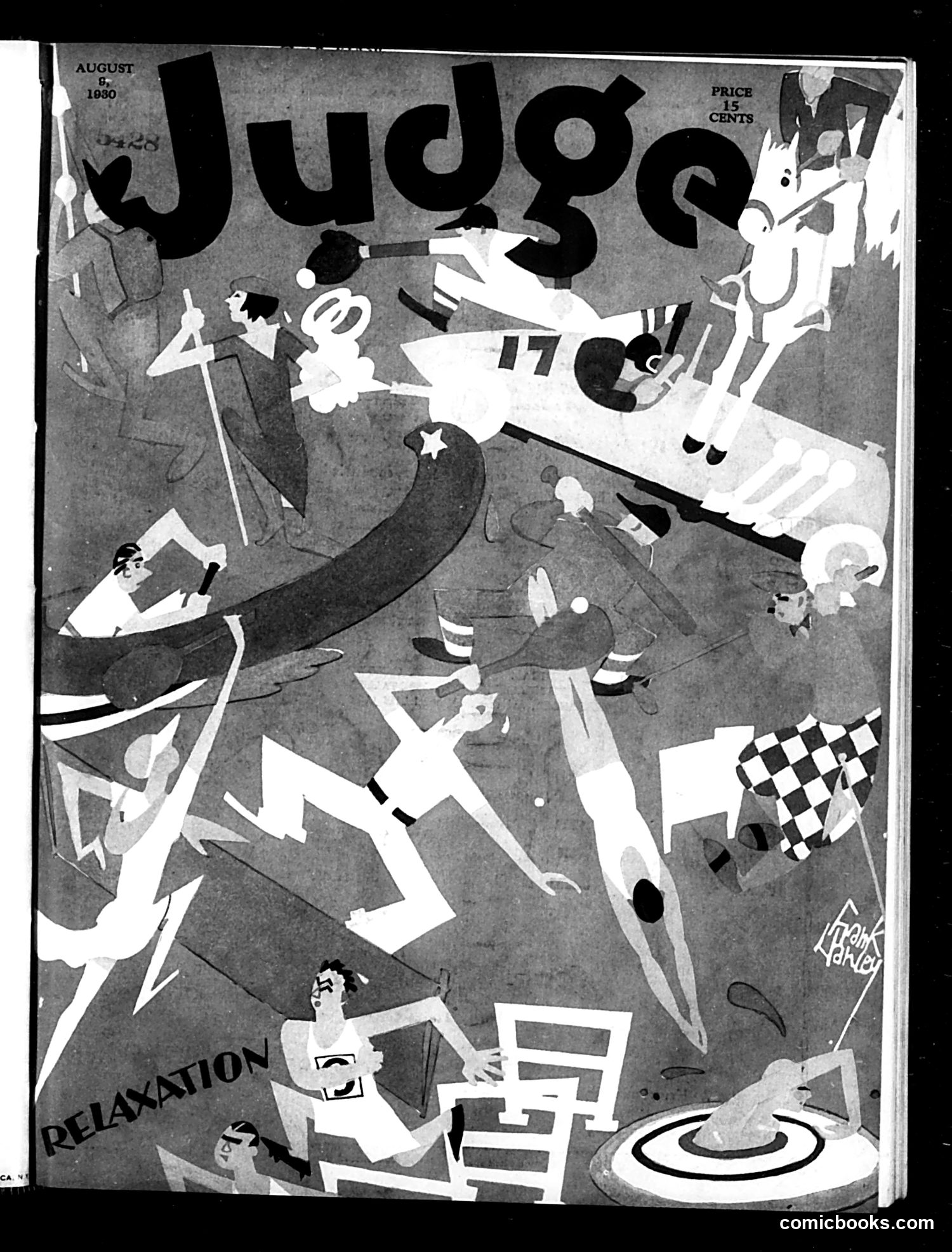
# Judge Magazine Cover Analysis - August 15, 1890 This cover illustrates the theme of "Relaxation" during summer leisure time. The dynamic Art Deco-style composition depicts various figures engaged in recreational activities: bathing, boating, playing sports, and lounging. The artistic style—with its geometric forms, dramatic angles, and stylized human figures—is characteristic of 1890s modernist illustration. The satire appears gentle rather than pointed, celebrating upper-class summer pastimes. The checkered flag and competitive sporting imagery suggest racing or athletic competition as popular diversions. The price of 15 cents indicates this was a mass-market publication for educated, affluent readers seeking sophisticated humor and social commentary through visual art and illustration rather than explicit political critique.
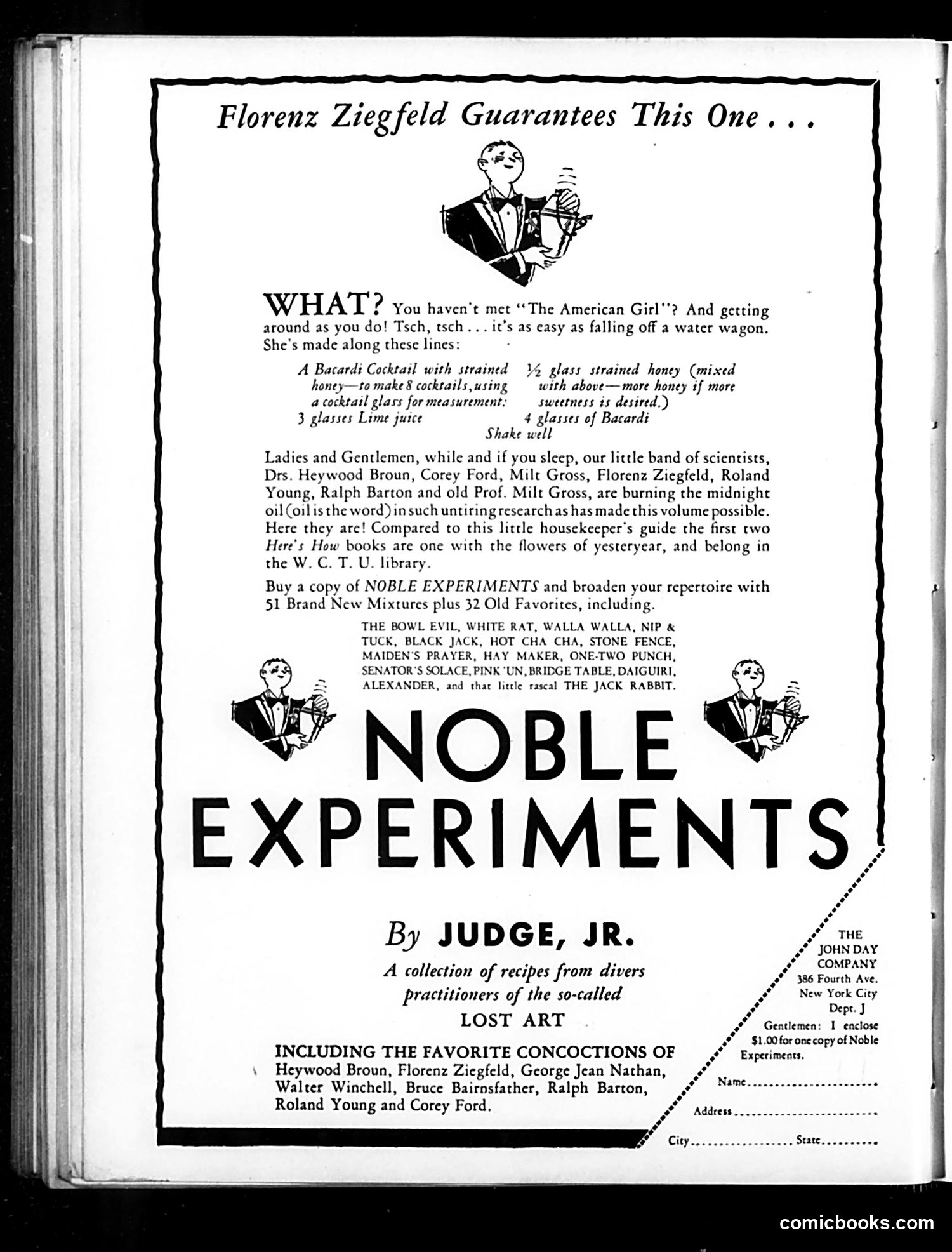
# Analysis This page is primarily **advertising copy**, not political satire. It promotes "Noble Experiments," a cocktail recipe book by Judge Jr., published by The John Day Company. The advertisement features a man in formal attire (likely representing the author or a typical reader) holding a cocktail—a visual association between sophisticated drinking and "noble" pursuits. The repeated images and enthusiastic tone suggest this is tongue-in-cheek marketing. The phrase "noble experiments" appears to reference Prohibition-era speakeasies and homemade cocktails created during the "lost art" of mixology. The book promises 51 brand-new drink recipes plus 32 old favorites with evocative names (many listed in the ad). This is commercial content using humor and wordplay to sell a product to Judge magazine's affluent, cocktail-drinking readership during the Prohibition period.
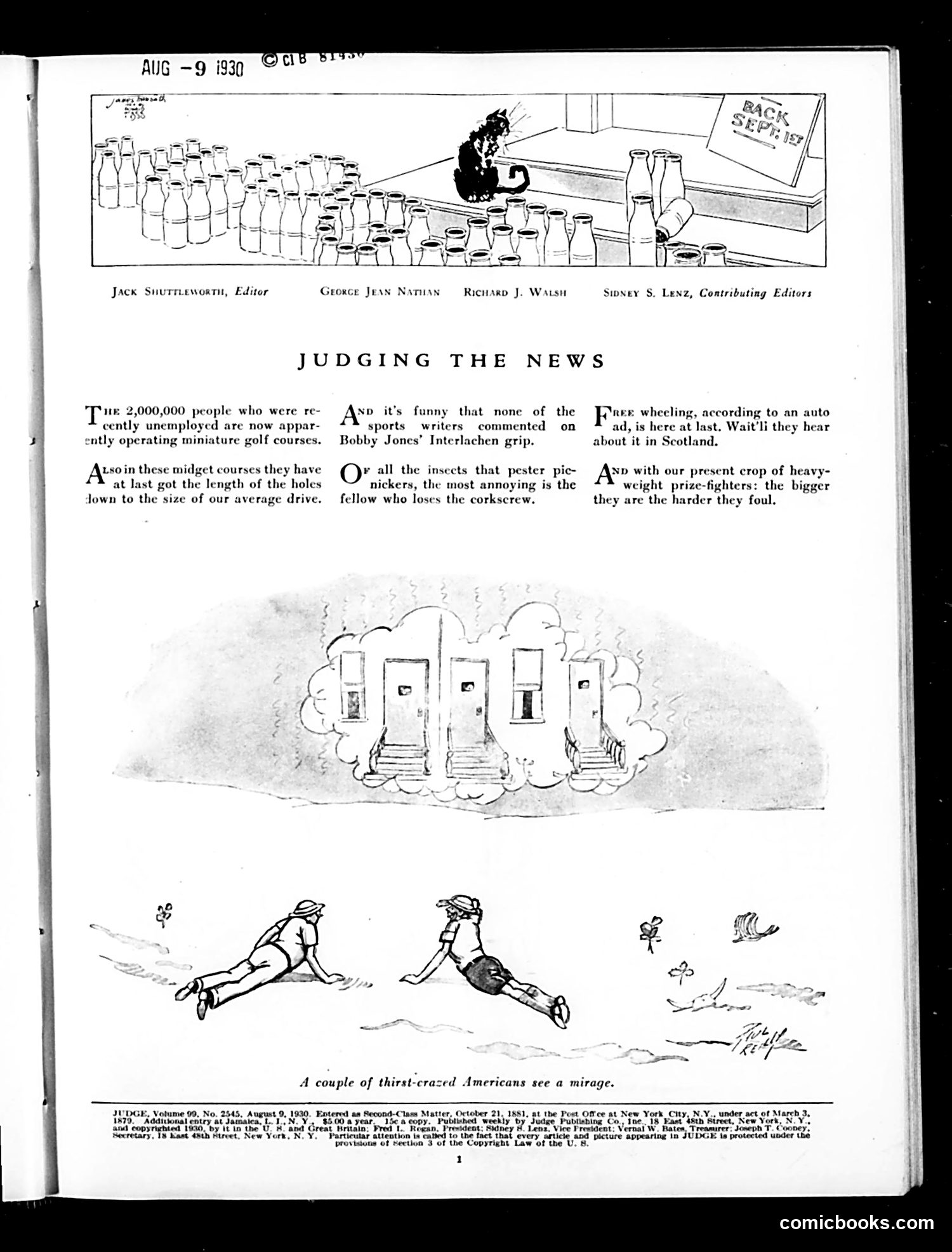
# "Judging the News" - August 9, 1930 This satirical commentary page uses humor to comment on contemporary issues. The top cartoon shows a man examining numerous bottles, likely referencing Prohibition-era bootlegging or counterfeit alcohol distribution—a major crime issue of 1930. The section headings mock various news stories: unemployment (2 million jobless), miniature golf courses' popularity, sports commentary, and pest control frustrations. The bottom cartoon depicts two dehydrated people hallucinating a mirage of public restrooms—titled "A couple of thirst-crazed Americans see a mirage." This likely satirizes either Prohibition's effects (difficulty obtaining legal beverages) or the lack of public facilities in Depression-era America. The overall page exemplifies Judge's approach: condensing weekly news into brief, illustrated jokes targeting contemporary social concerns and consumer frustrations.
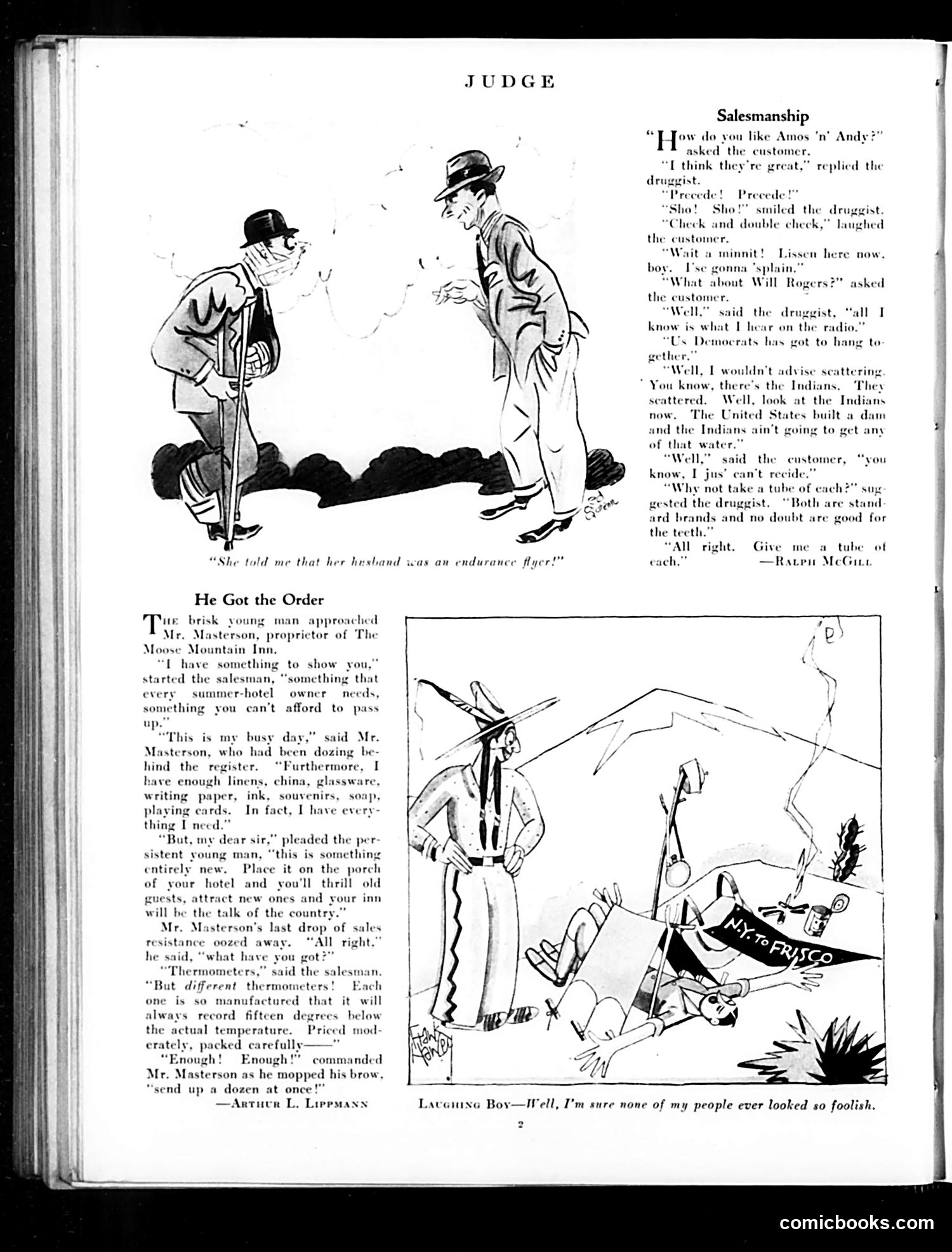
# Analysis of Judge Magazine Page The page contains two satirical pieces: **"Salesmanship" (top):** A drugstore clerk discusses politics with a customer, joking about Will Rogers, Democrats, and Native Americans building dams. The humor relies on contemporary political references (likely 1920s-30s New Deal era) that are now obscure. **"He Got the Order" (bottom):** A salesman pitches novelty thermometers to a hotel proprietor, Mr. Masterson. The joke centers on the thermometers' usefulness for attracting guests—satirizing aggressive sales tactics and the absurdity of marketing gimmicks to innkeepers. Both pieces mock American business culture and contemporary politics through dialogue-driven humor. The cartoons' specific references to politics and consumer goods reflect Depression-era anxieties about commerce and government spending, though precise historical context would require additional research.
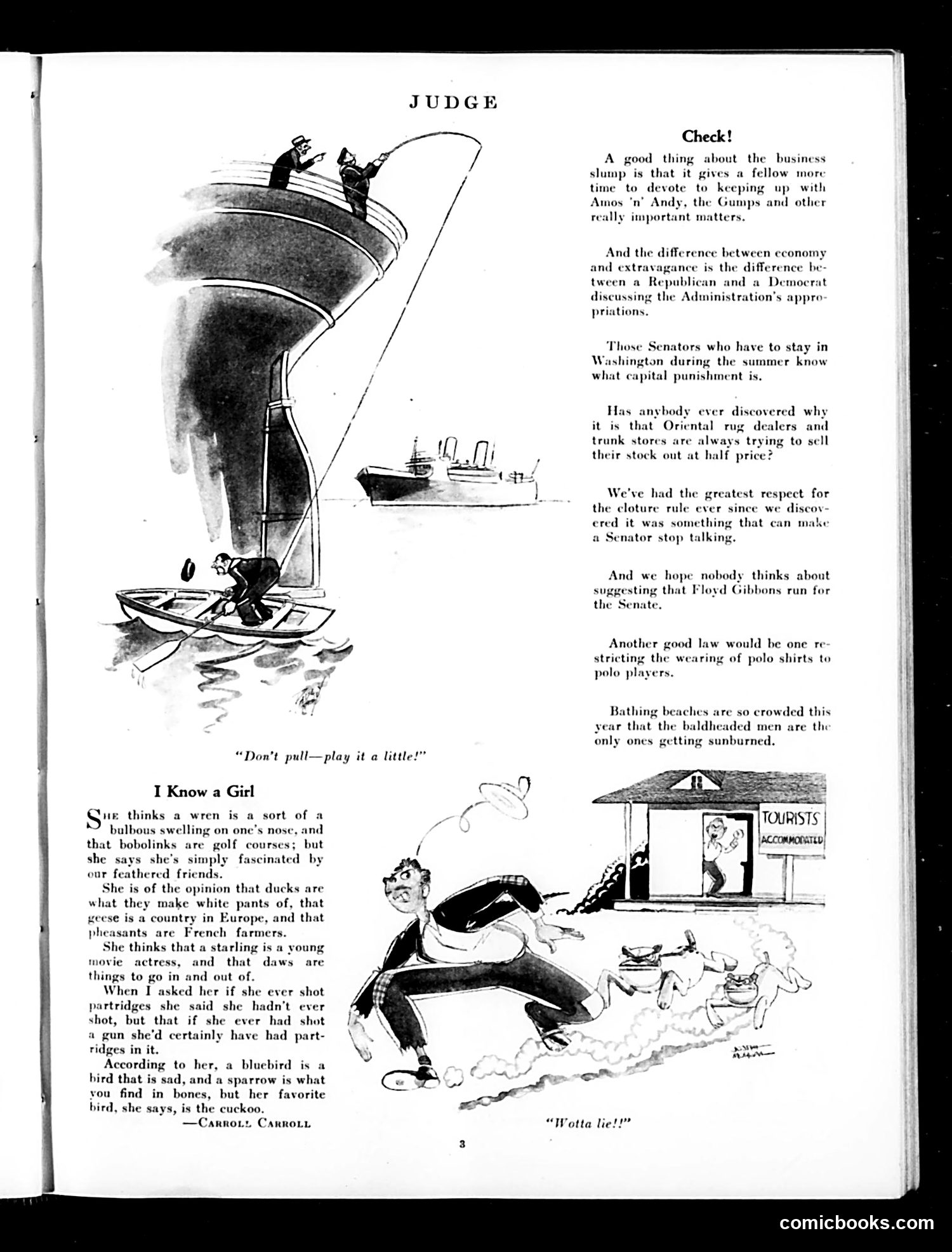
# Analysis of Judge Magazine Page The top cartoon titled "Judge" (captioned "Don't pull—play it a little!") depicts two figures fishing from a large funnel or tornado-like structure, with a ship below. This appears to be political satire about judicial or governmental overreach, warning against excessive "pulling" or aggressive action—perhaps referencing court decisions or political maneuvering of the era. Below, "I Know a Girl" by Carroll Carroll is a humorous piece about a woman's absurd misconceptions about birds and animals, presented as a lighthearted joke column. The bottom cartoon "Wotta lie!" shows a man being chased by children near a "Tourists Accommodated" sign, satirizing overcrowded beach conditions and sunburned bathers—referencing the tourism boom and beach culture of the period.
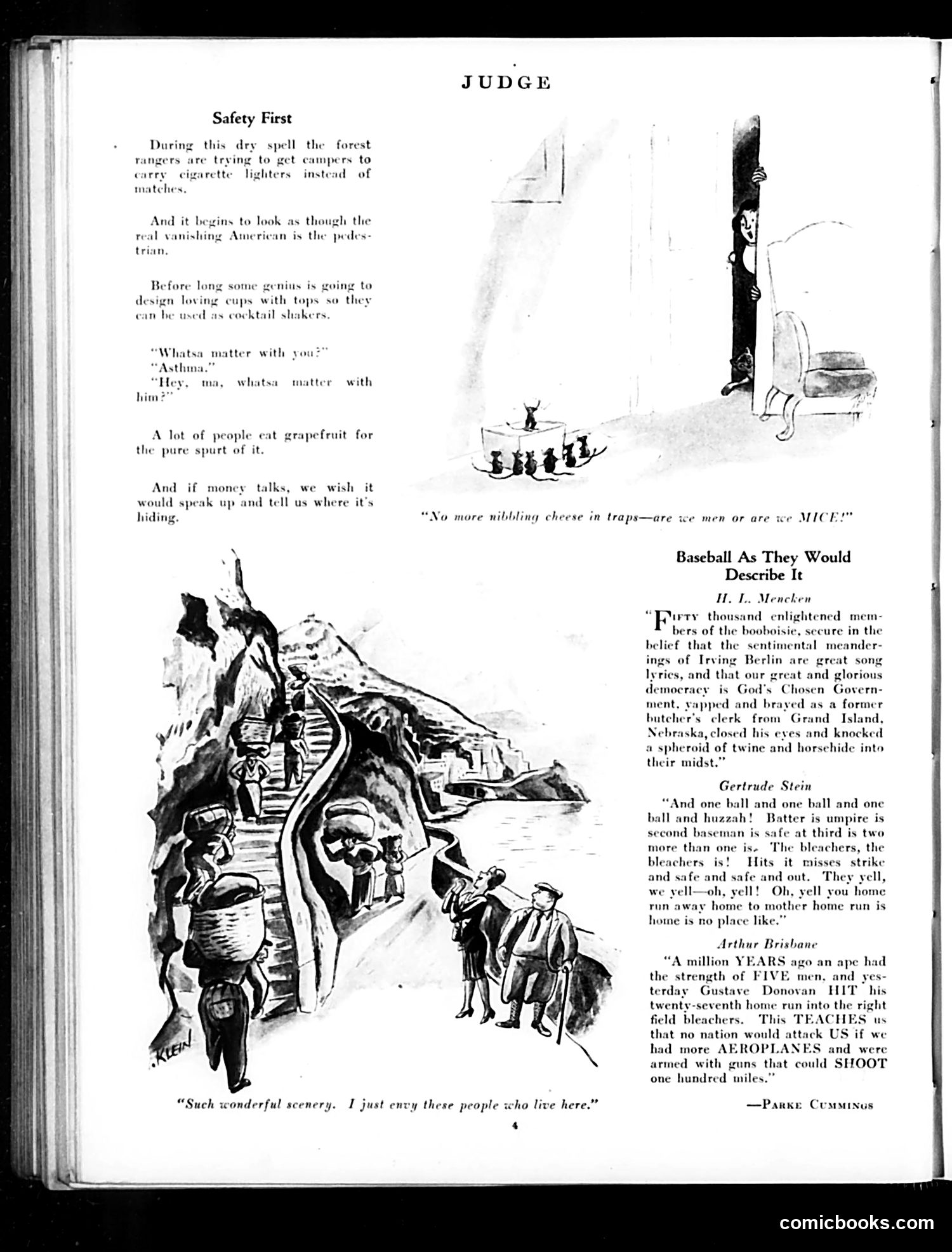
# Analysis of Judge Magazine Page This page contains three distinct pieces of satire: **"Safety First"** (top): A brief commentary mocking the declining "real vanishing American" pedestrian—suggesting Americans are becoming extinct. Jokes follow about designers creating loving cups as cocktail shakers and people eating grapefruit for enjoyment rather than nutrition, satirizing frivolous consumer culture. **"No more nibbling cheese in traps"** (center): A cartoon showing mice in a trap, likely commenting on workplace or social entrapment, though the specific reference is unclear. **"Baseball As They Would Describe It"** (bottom): Humorous literary descriptions of baseball by famous authors (H.L. Mencken, Gertrude Stein, Arthur Brisbane, Parke Cummins), parodying their distinctive writing styles by applying them to the sport—a recurring Judge feature mocking pretentious literature.
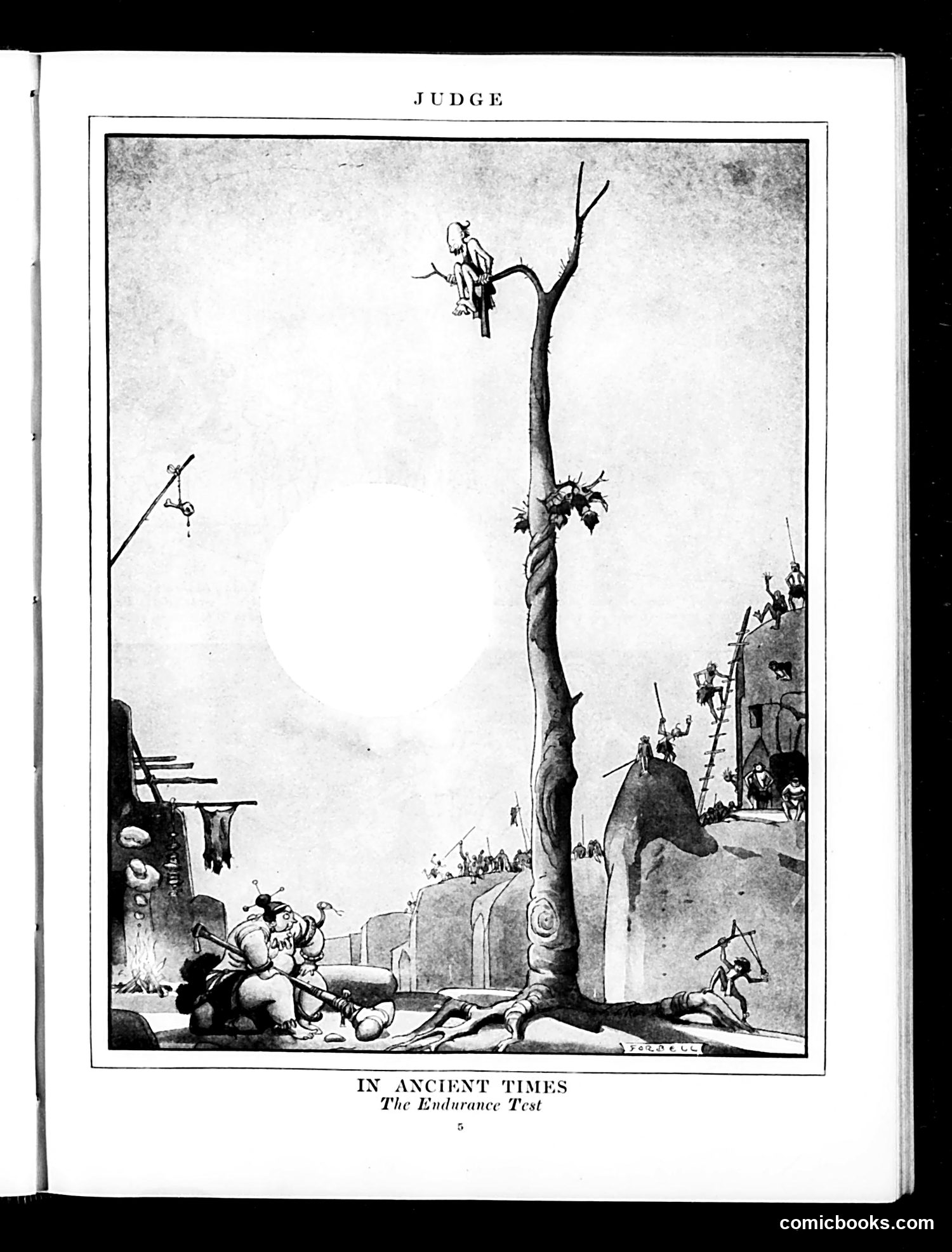
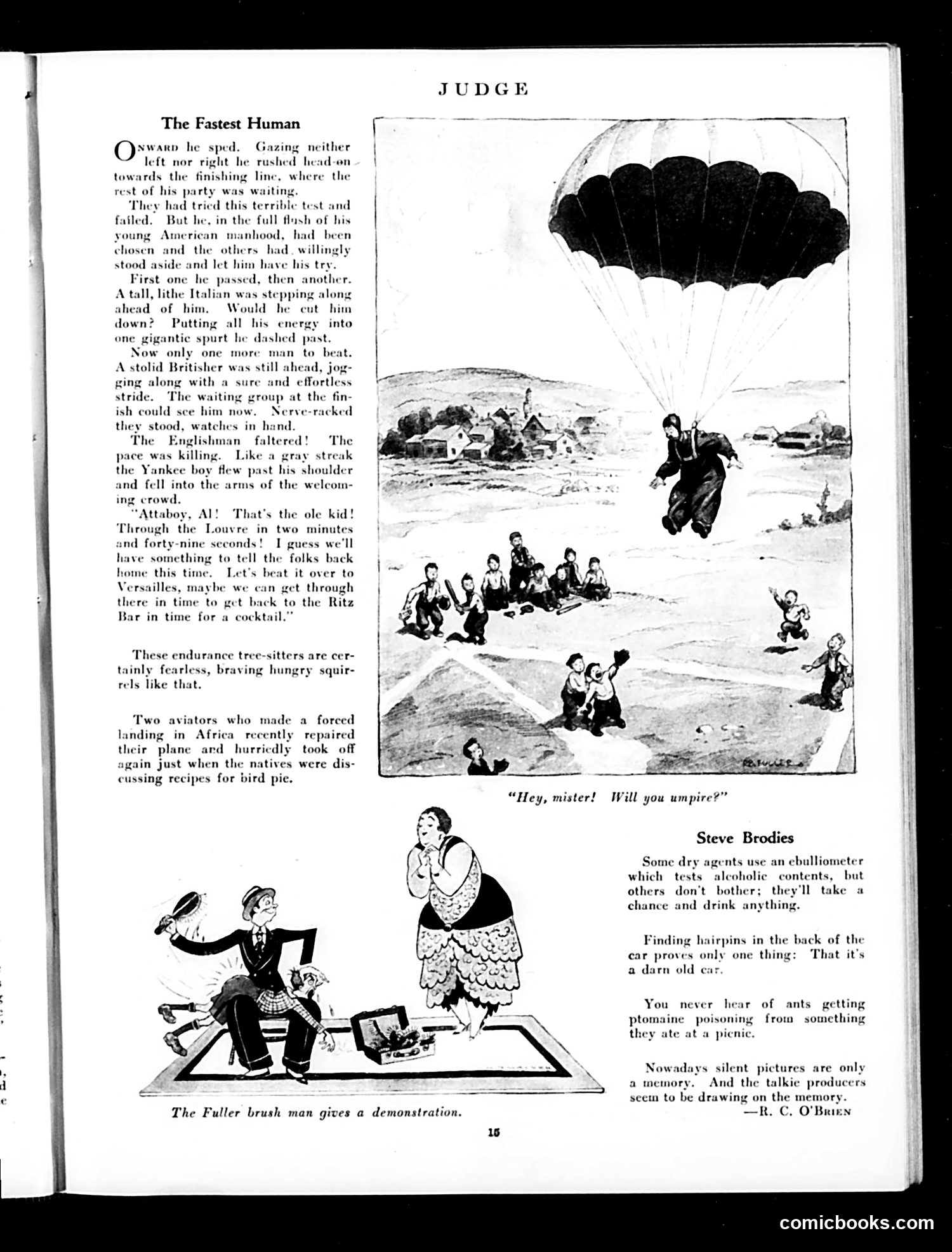
# "The Endurance Test" - Judge Magazine Cartoon This satirical cartoon depicts "In Ancient Times: The Endurance Test," showing what appears to be a brutal public spectacle. Multiple figures are positioned on a tall wooden pole or structure, while crowds gather on fortified structures around them. The scene references ancient Roman or gladiatorial entertainment practices. The satire likely critiques contemporary American practices by comparing them to ancient barbarism—suggesting that modern society's own "tests" (possibly labor practices, political trials, or public spectacles) are equally primitive and cruel. The cartoon's title emphasizes endurance, implying suffering inflicted for public entertainment or institutional purposes. The crowded observers suggest societal complicity in witnessing such brutality, a common Judge magazine theme mocking both specific practices and collective moral failings.
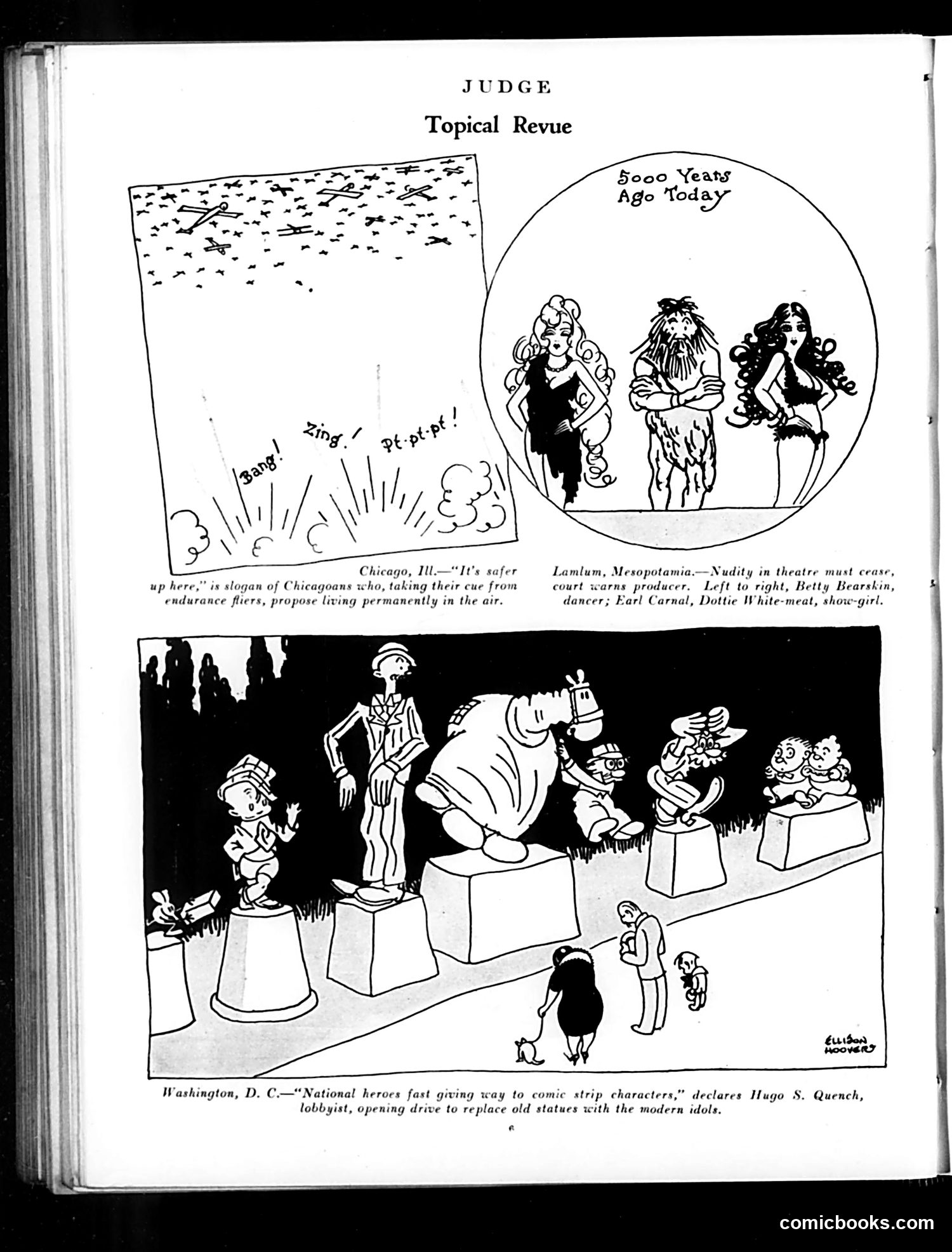
# Topical Revue - Judge Magazine Satire This page contains three cartoons satirizing contemporary American culture: 1. **Chicago aerial traffic**: Mocks Chicago residents' proposal to live permanently on "endurance piers" (observation towers), with planes creating noise ("Bang! Zing! Pt-pt-pt!"). 2. **Ancient Mesopotamia nudity**: A circular panel jokes that ancient theater nudity would violate modern court standards—naming performers Betty Bearskin, Earl Carnal, and Dotlie White-meat as stand-ins. 3. **Washington monument replacement**: Hugo S. Quench proposes replacing historical statues with "modern idols" (comic strip characters), shown here as oversized cartoon figures on pedestals replacing traditional heroes. This satirizes shifting cultural values and the modernization of American iconography. All three mock contemporary anxieties about progress, morality, and changing traditions.
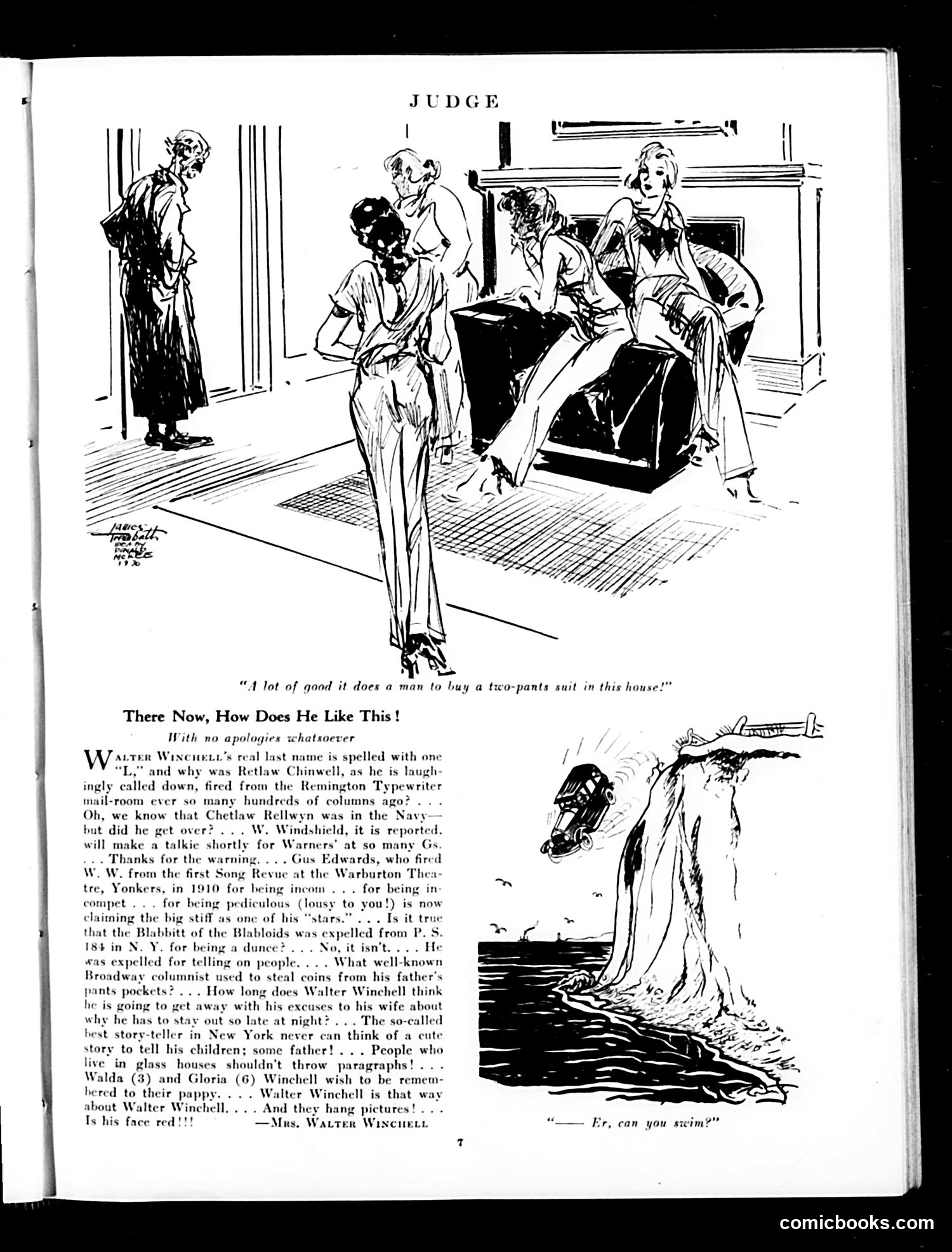
# Judge Magazine Cartoon Analysis This page satirizes **Walter Winchell**, the famous Broadway gossip columnist and entertainer. The top cartoon shows a judge's courtroom where a woman complains about her husband buying a two-pants suit—likely mocking marital disputes or consumer culture. The main text is a scathing attack on Winchell, presented as a letter from "Mrs. Walter Winchell." It ridicules him through wordplay and deliberate name-mangling (spelling his name differently repeatedly), suggesting he's a fraud. The critique covers: - His dubious firing from a typewriter company mail-room - Questions about his actual theatrical credentials - Accusations he steals credit for discovering talent - Claims he plagiarizes stories from columnists - Implies he's unfaithful to his wife and uses transparent excuses - Suggests he can't even tell stories to his own children The illustration shows a dramatic cliff scene with the caption "Er, can you swim?"—implying Winchell should jump. This represents Judge magazine's hostile satire of a prominent public figure, exposing what it viewed as his pretensions and moral failings.
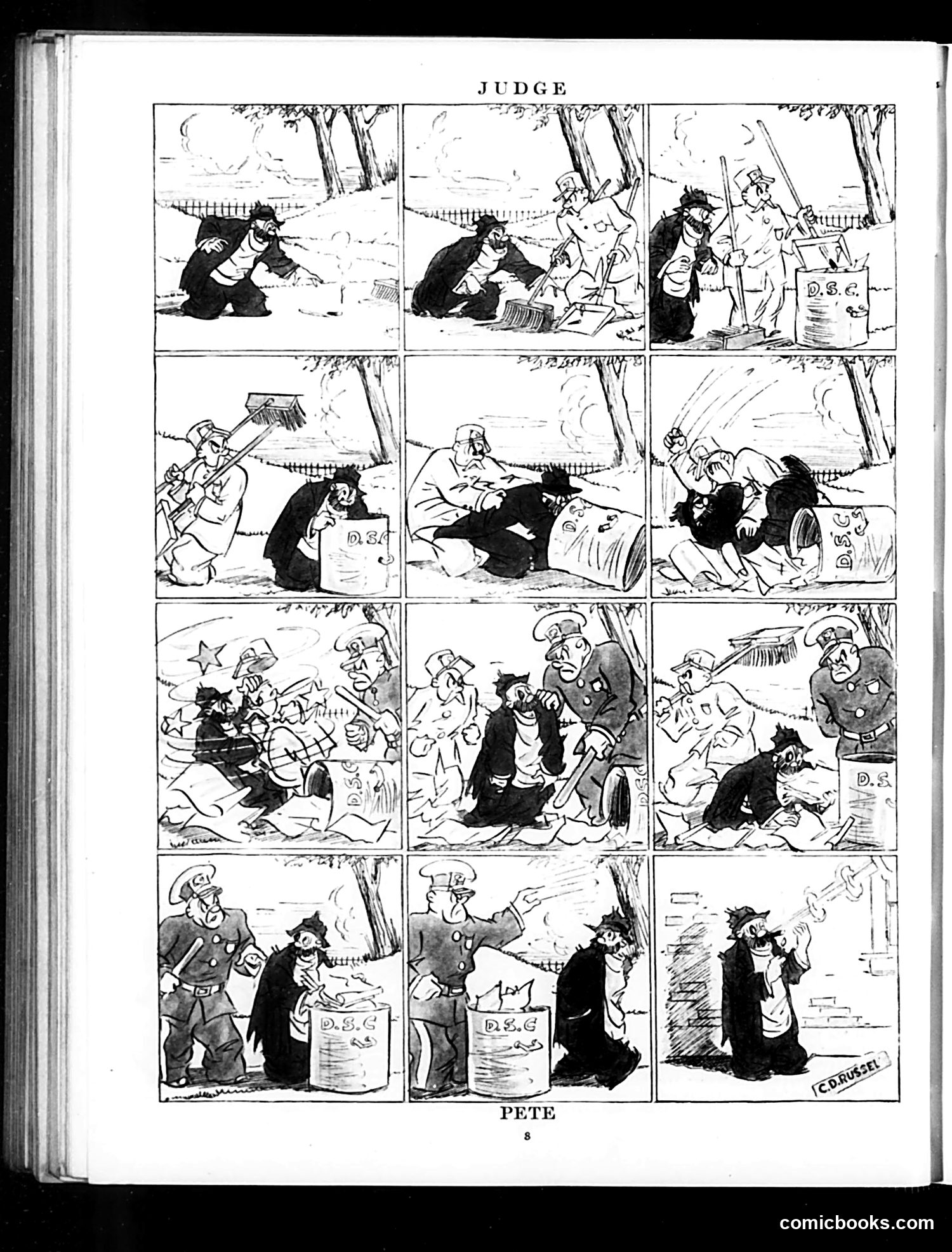
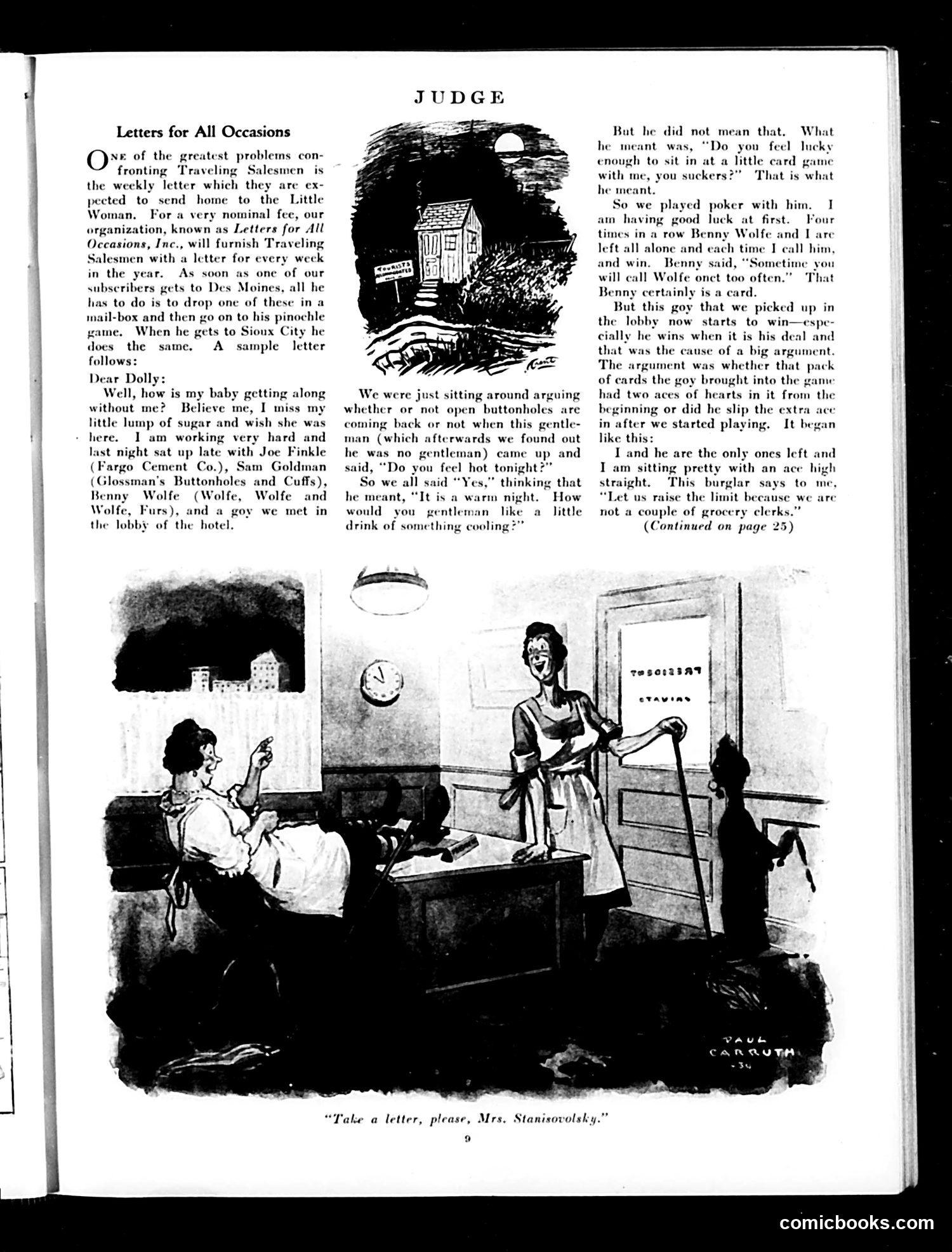
# Judge Magazine Satire Analysis This page satirizes **traveling salesmen** and their domestic deceptions. The main article mocks a fictional service called "Letters for All Occasions, Inc." that supplies pre-written letters for salesmen to mail home, allowing them to neglect actual correspondence while pursuing leisure activities. The sample letter reveals the hypocrisy: the salesman claims to miss his wife ("Little Woman") while detailing his evening playing cards and poker with dubious companions. The story culminates in a rigged card game where a con artist ("the goy") exploits the salesmen, suggesting their own moral compromises make them easy marks. The accompanying cartoon depicts a secretary typing correspondence for clients—visualizing the service's absurdity. The satire targets male infidelity, negligent husbands, and the rationalization of dishonest behavior, presented with Judge magazine's characteristic cynical humor about American business culture and domestic life.
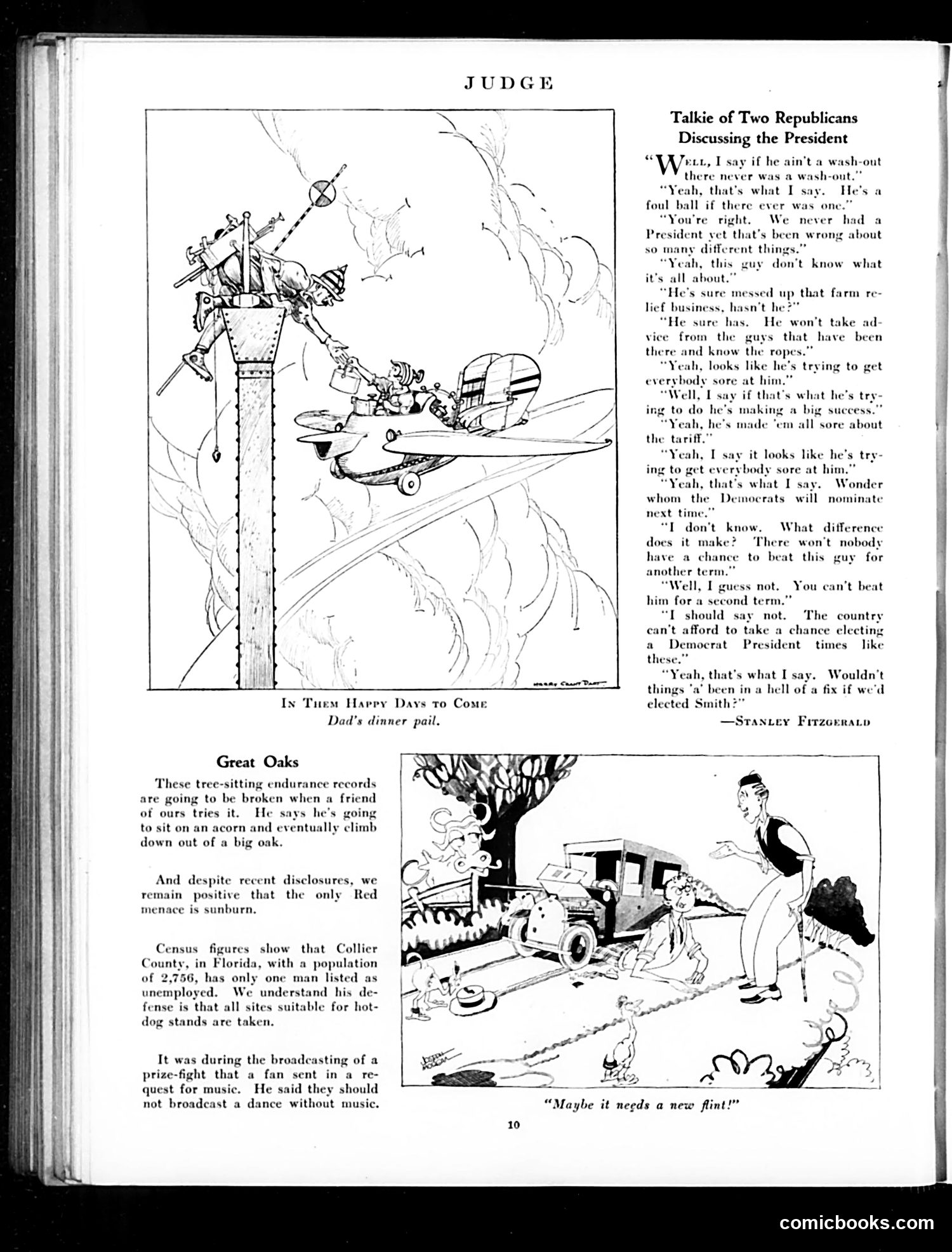
# Political Satire from Judge Magazine This page contains a dialogue between two Republicans discussing the incumbent President (likely Herbert Hoover, given references to farm relief and tariff failures during the Great Depression era). **The Main Cartoon:** Two ordinary citizens complain that the President is incompetent—he's "messed up" farm relief, won't listen to experienced advisors, and has angered everyone with his tariff policies. Yet they conclude he's still unbeatable because Democrats might nominate someone worse (possibly Al Smith, explicitly mentioned). The satire mocks Republicans' loyalty despite acknowledging their leader's failures. **The Subtext:** Judge is satirizing how voters can be trapped supporting a failed leader simply out of partisan fear of the opposition—a common political predicament. **Other Items:** Minor humor pieces about tree-sitting endurance records and unemployment statistics in Florida serve as filler content typical of satirical magazines of the era.