
Judge, 1930-08-09 · page 27 of 36
Judge — August 9, 1930 — page 27: what you’re looking at
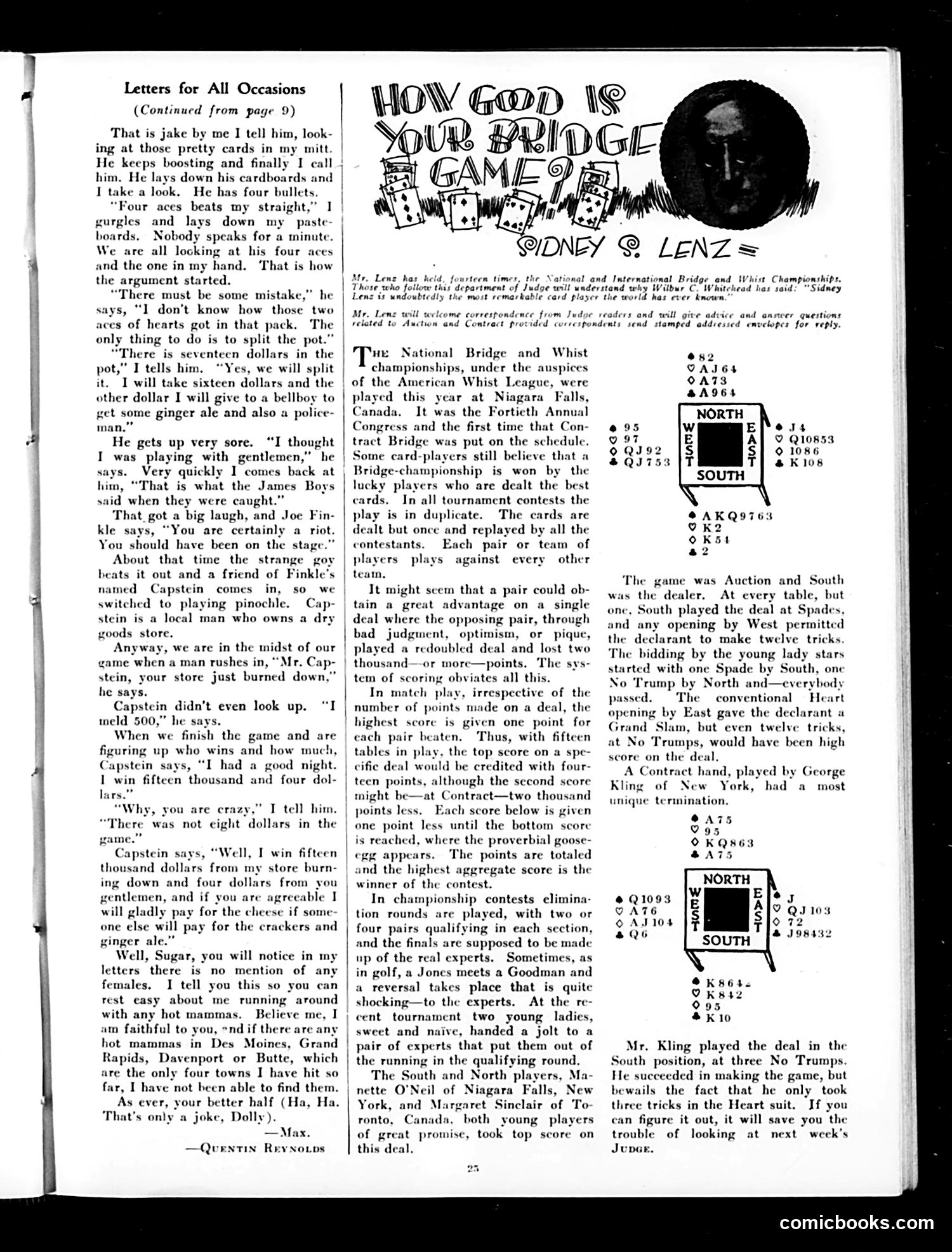
A restored page from Judge, 1930-08-09. Page through the whole issue in the reader above.
📄 Transcribed text from this page (OCR, searchable)
Machine-transcribed from the original scan — historical spelling and the odd misread are preserved.
Letters for All Occasions (Continued from page 9) That is jake by me I tell him, lo ing at those pretty cards in my mitt He keeps boosting and finally I call 5 him. He lays down his cardboards and I take a look. He has four bullets. “Four aces beats my straight,” I gurgles and Jays down my paste boards. Nobody speaks for a minute. We are all locking at his four aces and the one in my hand. That is how the argument started. “There must be some mistake,” he says, “I don’t know how those two °s of hearts got in that pack. The only thing to do is to split the pot.” “There is seventeen dollars in the pot,” I tells him. “Yes, we will split it. I will take sixteen dollars and the other dollar I will give to a bellboy t get some ginger ale and also a poli man.” He gets up very sore. “I thought I was playing with gentlemen,” he says. Very quickly I comes back at him, “That is what the James Boys said when they were caught.” That_got a big laugh, and Joe Fin- kle says, “You are certainly a riot You should have been on the stag About that time the strange goy beats it out and a friend of Finkle’s named Capstein comes in, so we switched to playing pinochle. Cap- stein is a local man who owns a dry goods store, Any we are in the midst of our game when a man rushes in, “Mr. Cay stein, your store just burned down,” he says. Capstein didn’t even look up. “I meld 500,” he When we finish the game and are figuring up who wins and how much, Capstein says, “I had a good night. 1 win fifteen thousand and four dol- la I tell him. ars in the Why, you are crazy,” “There was not eight do! game.” Capstein says, “Well, thousand dollars from m ing down and four dollars from you gentlemen, and if you are agreeable I will gladly pay for the cheese if some- one else will pay for the crackers and ginger ale.” Well, Sugar, you will notice in my letters there is no mention of any I tell you this so you about me running around with any hot mammas. Believe me, I am faithful to you, ond if there are any hot mammas in Des Moines, Grand Rapids, Davenport or Butte, which are the only four towns I have hit so far, I have not been able to find them. As ever, your better half (Ha, Ha. That's only a joke, Dolly). —Max. ENTIN REYNOLDS I win fifteen store burn- —Q 2 GAME Eom Mr. Lene has hel Those who fotton Lenz is undoubtedly Mr. Lenz related to teen times, the Nati partment of Judge will National Bridge and Whist championships, under the auspices of the American Whist League, were played this year at Niagara Falls, Canada. It was the Fortieth Annual Congress and the first time that Con- tract Bridge put on the schedule. Some card-} rs still believe that a Bridge-championship is won by the lucky players who are dealt the best cards. In all tournament contests the play is in duplicate. The cards are dealt but once and replayed by all the contestants. Each pair or team of players plays against every other | team, It might seem that a pair could ob- tain a great advantage on a single | deal where the opposing pair, through bad judgment, optimism, or pique, played a redoubled deal and lost two thousand—or more—points. The sys- tem of scoring obviates all this. In match play, irrespective of the number of points made on a deal, the highest score is given one point for cach pair beaten. Thus, with fifteen tables in play, the top score on a spe- cific deal would be credited with four- | teen points, although the second score might be—at Contract—two thousand points less. Each score below is given one point less until the bottom score is reached, where the proverbial goose- egg appears. The points are totaled and the highest aggregate score is the winner of the contest. In championship contests elimina- tion rounds are played, with two or four pairs qualifying in each section, and the finals are supposed to be made up of the real experts. Sometimes, as in golf, a Jones meets a Goodman and a reversal takes place that is quite shocking—to the experts. At the re- cent tournament two young ladies, sweet and naive, handed a jolt to a pair of experts that put them out of the running in the qualifying round, The South and North players, Ma- nette O'Neil of Niagara Falls, New York, and Margaret Sinclair of To- ronto, Canada, both young players of great promise, took top score on this deal. WOW GwD Ie UR RIDGE SDNEY Q LENZ = ome correspondence from Judge readers and will give ads Auction and Contract provided correspondents send stamped addressed envelopes for reply. al and International Bridge and Whist Championships. derstand why Wilbur C. ‘most remarkable card player the world has ever known,” Whitehead has said: “Sidney and answer questions @2 GAI6S OAT3 aA06s @95 997 9 QJ92 $Q5753 KQ9763 C2 C54 The game was Auction and South was the dealer, At every table, but one, South played the deal at Spades, and any opening by West permitted the declarant to make twelve tricks. The bidding by the young lady stars started with one Spade by South, one No Trump by North and— passed. The convention opening by East gave the declarant a Grand Slam, but even twelve tricks, at No Trumps, would have been high score on the deal, A Contract hand, played by George Kling of New York, had a most unique termination, @ ATS 995 OKQS63 aAT5 @ Q1093 9 ATE Oo AJ104 aQe Mr. Kling played the deal in the South position, at three No Trumps. He succeeded in making the game, but bewails the fact that he only took three tricks in the Heart suit. If you can figure it out, it will save you the trouble of looking at next week's Jupor. comicbooks.com