A complete issue · 36 pages · 1930
Judge — April 12, 1930
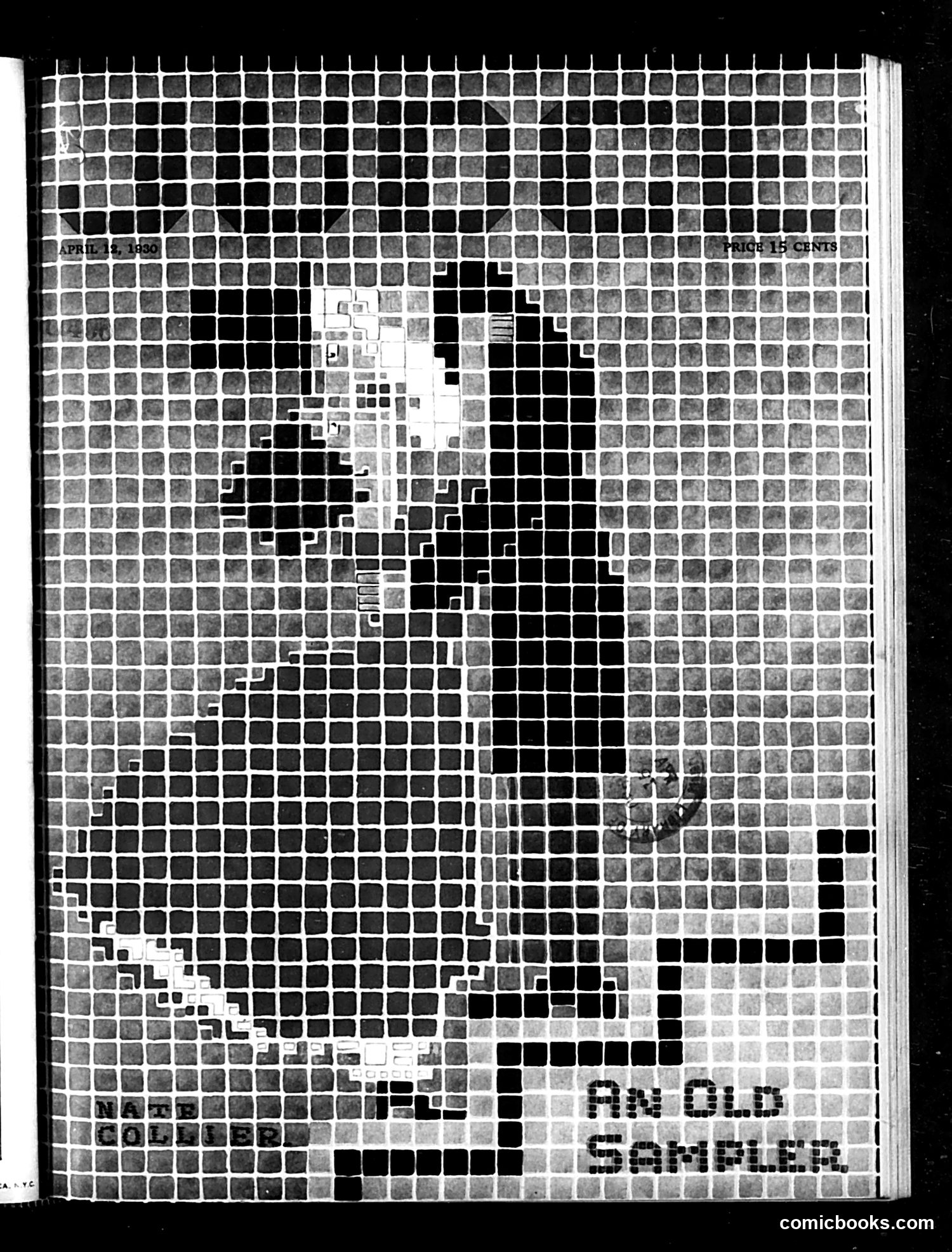
I can see this is a page from *Judge* magazine with "AN OLD SAMPLER" printed at the bottom, but the image quality and pixelation make it difficult to read the OCR text clearly or identify specific figures with certainty. The page appears to be a grid-based illustration or comic, possibly using a sampler or needlepoint aesthetic (suggested by the title), with black, white, and gray squares creating a pattern or image. However, without legible text or clearer details, I cannot confidently identify which political figures, events, or social commentary this satire references. To provide accurate historical analysis, I would need either a higher-resolution image or clearer OCR text. I'd rather acknowledge these limitations than speculate.
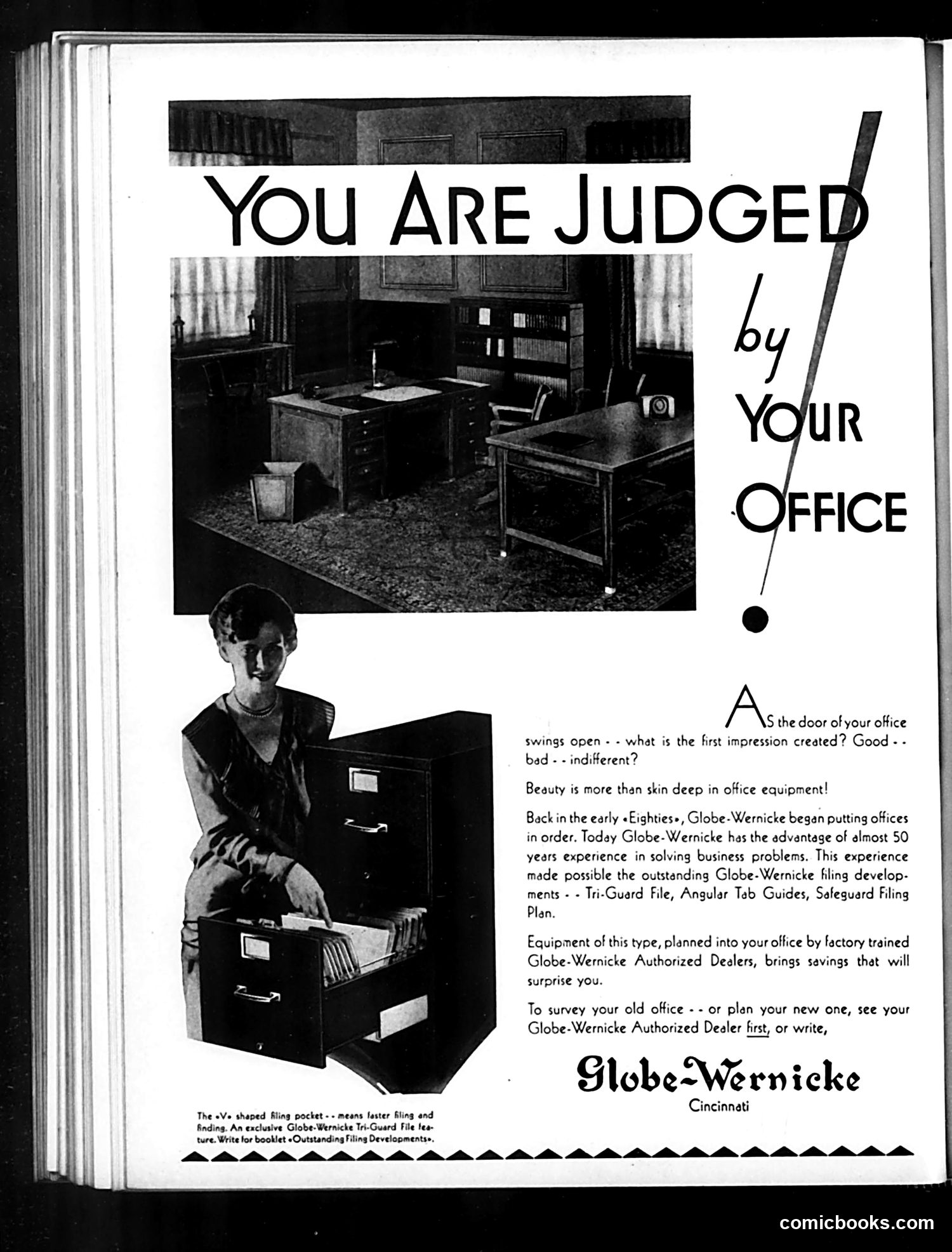
# Analysis This is primarily a **Globe-Wernicke office furniture advertisement**, not political satire. The headline "YOU ARE JUDGED BY YOUR OFFICE!" plays on workplace anxieties common in 1920s-30s America, when modern office culture was expanding. The ad argues that office appearance reflects professional competence and character. It features a filing cabinet and office interior, positioning Globe-Wernicke's products (particularly their Tri-Guard File system) as solutions for creating a respectable workspace. The satirical angle—implicit rather than explicit—mocks how businessmen's social standing depends on superficial office aesthetics: "Beauty is more than skin deep in office equipment!" The ad exploits white-collar workers' status anxiety to sell furniture, a common advertising tactic of the era. This is **advertising content**, not editorial political cartoon.
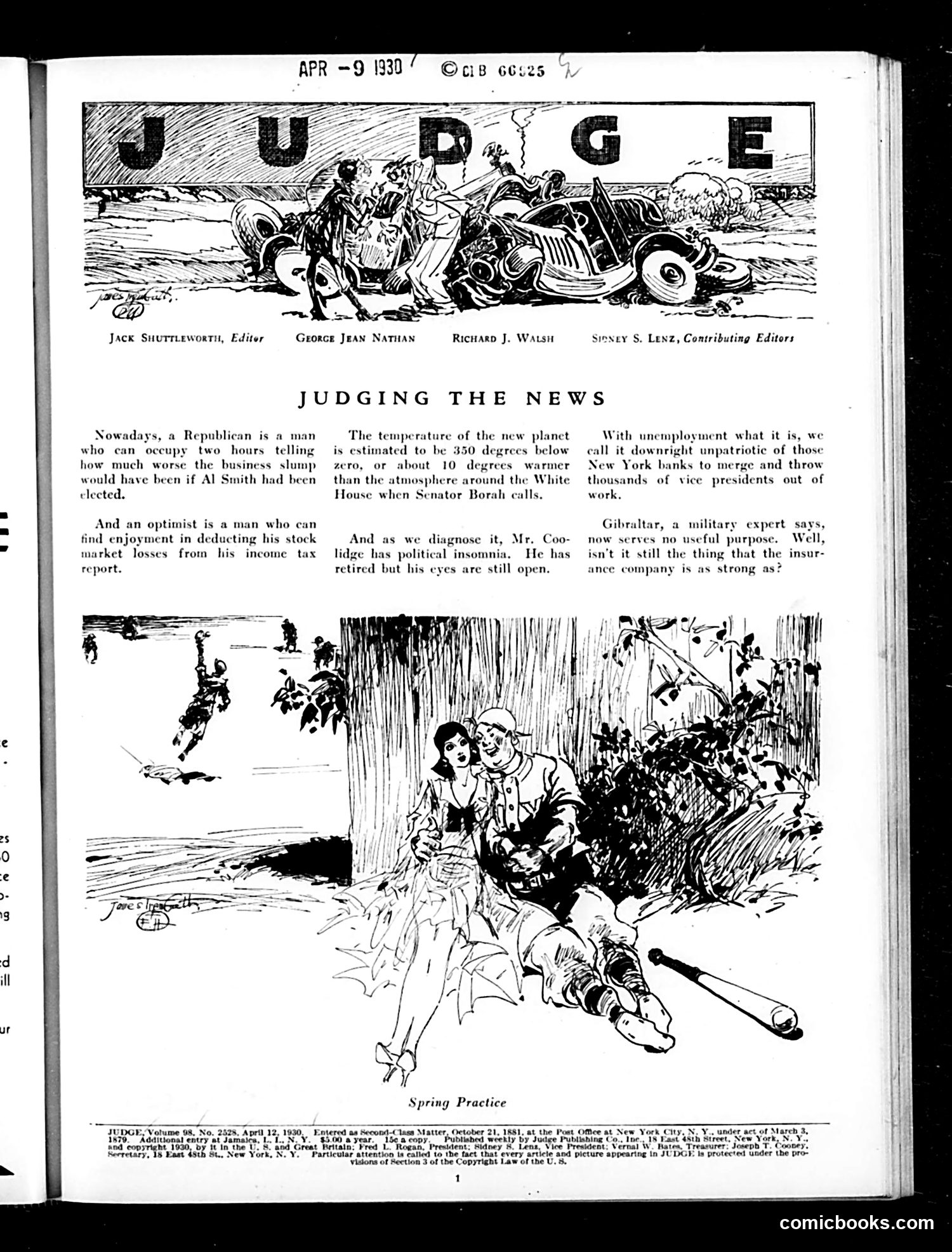
# Judge Magazine - April 9, 1930 **"Judging the News" Section:** This satirical commentary page contains three brief political jokes: 1. **Republican hypocrisy**: A jab at Republicans who talk extensively about business while claiming it would have fared better under Al Smith (the 1928 Democratic presidential candidate). 2. **Optimism about stocks**: Mocking optimists who find silver linings in stock market losses by deducting them as tax write-offs. 3. **Senator Borah and planetary discovery**: References Senator William Borah, apparently commenting on a newly discovered planet with extreme temperatures—the joke being Borah's "political insomnia" keeps his eyes open despite such news. **"Spring Practice" cartoon** (lower image): Shows young people in romantic/recreational activities, likely commenting on seasonal courtship traditions. The page reflects Depression-era skepticism about political and financial rhetoric.
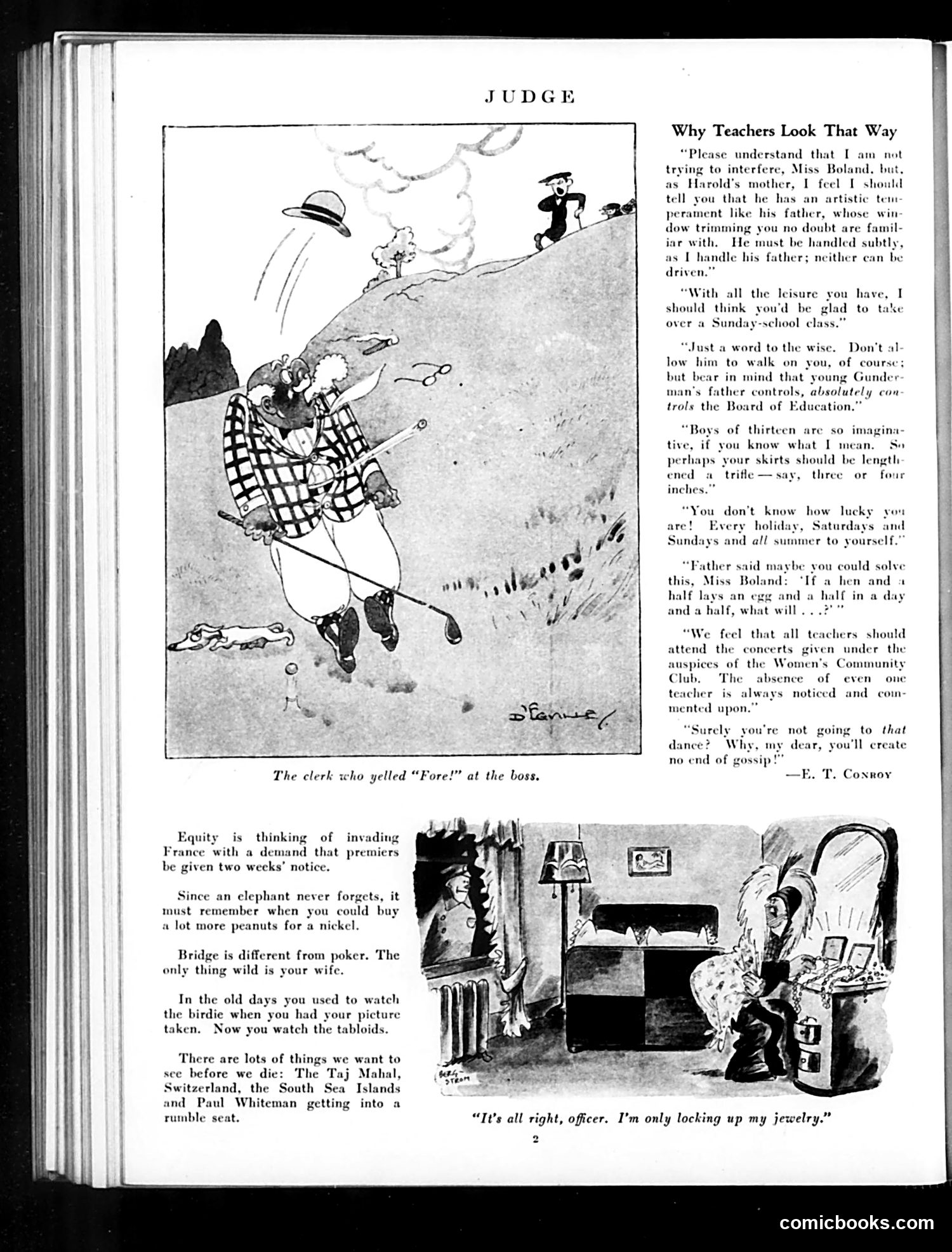
# Judge Page Analysis This page contains two separate cartoon commentaries: **Top cartoon ("Why Teachers Look That Way")**: Satirizes teacher discipline through a golf scene where a woman golfer has struck a ball wildly. The accompanying text presents complaints from a parent (Miss Boland) defending her son Harold's behavior and "artistic temperament," while criticizing teachers for being too strict. The joke mocks overindulgent parents who blame teachers rather than disciplining their own children—the wild golf swing visualizes the chaos of undisciplined youth. **Bottom cartoon ("It's all right, officer")**: Shows a woman telling a police officer she's "only locking up my jewelry," implying marital suspicion or infidelity concerns. This is a domestic humor gag about trust in marriage. Both target social anxieties about authority, parenting, and relationships circa early 20th century.
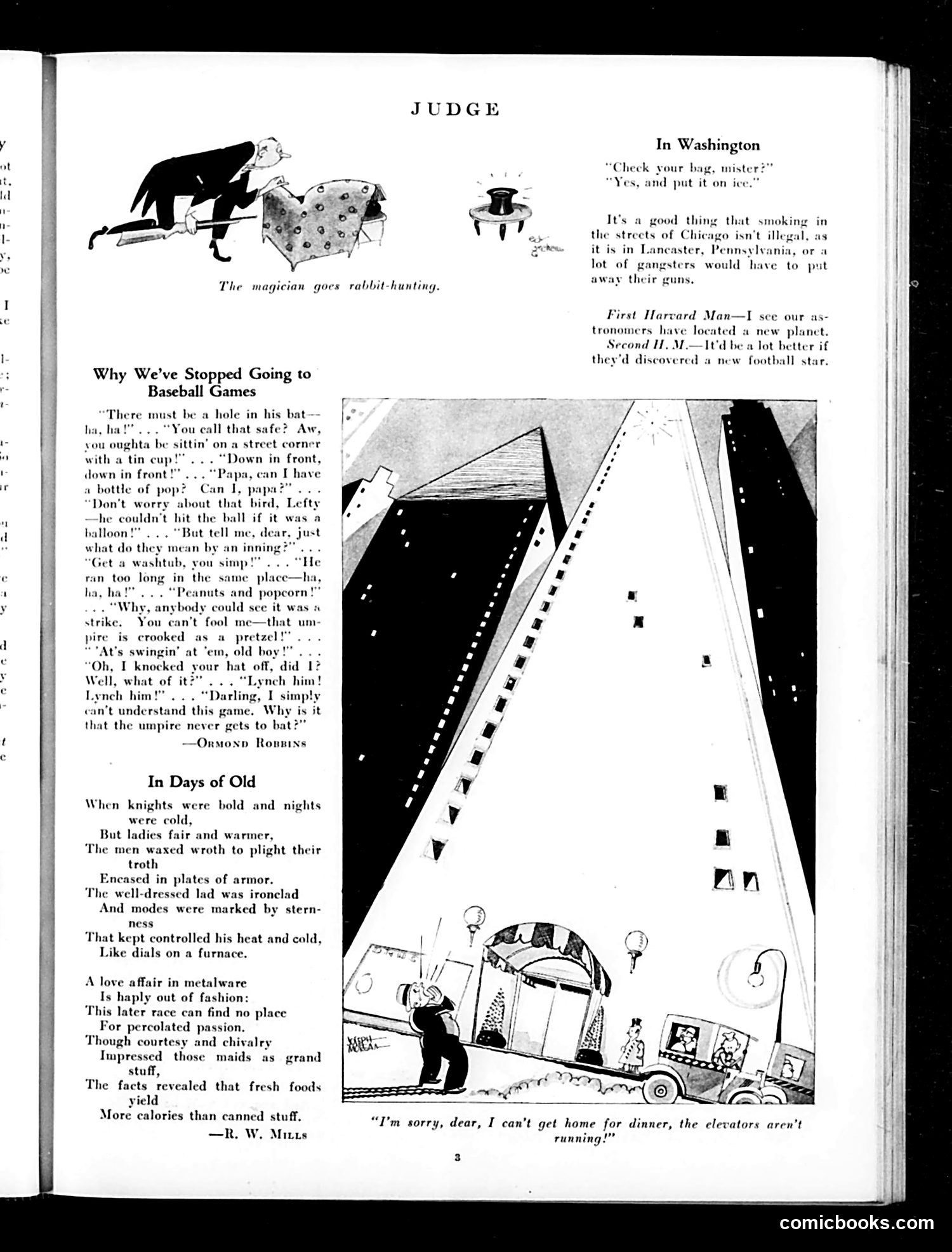
# Analysis of This Judge Magazine Page **Top cartoon ("The magician goes rabbit-hunting"):** A magician pulls a rabbit from a hat, satirizing sleight-of-hand deception—likely commenting on political or social illusions of the era. **"Why We've Stopped Going to Baseball Games":** Quotes the chaotic experience of attending games—fans shouting contradictory demands ("hole in bat," "tin cup," "get a washtub"), umpires making questionable calls. The satire mocks the rowdy, argumentative nature of baseball crowds and the sport's disputes. **"In Days of Old":** A romantic poem by R.W. Mills contrasting medieval knights in armor with modern fashion and courtship, suggesting nostalgia for older social codes. **Bottom cartoon:** A man tells his wife he can't come home for dinner because "the elevators aren't running"—satirizing modern urban dependency on technology and infrastructure.
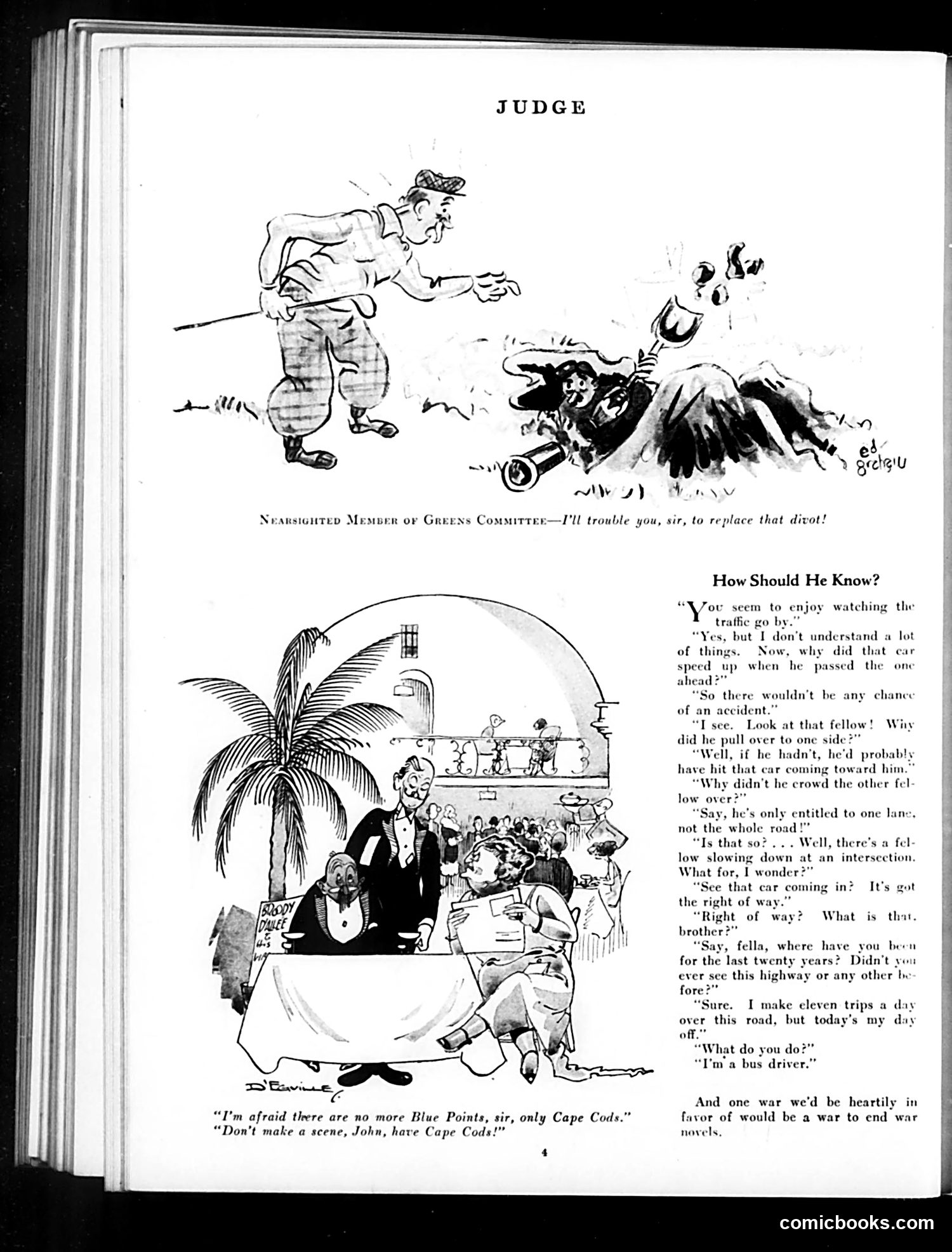
# Analysis of This Judge Magazine Page **Top Cartoon:** A man labeled "Nearsighted Member of Greens Committee" swings a golf club wildly, hitting what appears to be a small animal or object instead of a golf ball. The caption reads, "I'll trouble you, sir, to replace that divot!"—a joke about his poor eyesight causing him to strike the wrong target entirely. **Bottom Cartoon & Article:** Titled "How Should He Know?", this depicts a waiter at what appears to be a fancy restaurant or hotel. The dialogue satirizes traffic rules and right-of-way disputes, ultimately revealing the man is a bus driver unfamiliar with driving rules despite his profession. It's social satire about incompetence in public service roles. Both pieces use humor about ordinary incompetence and professional negligence.
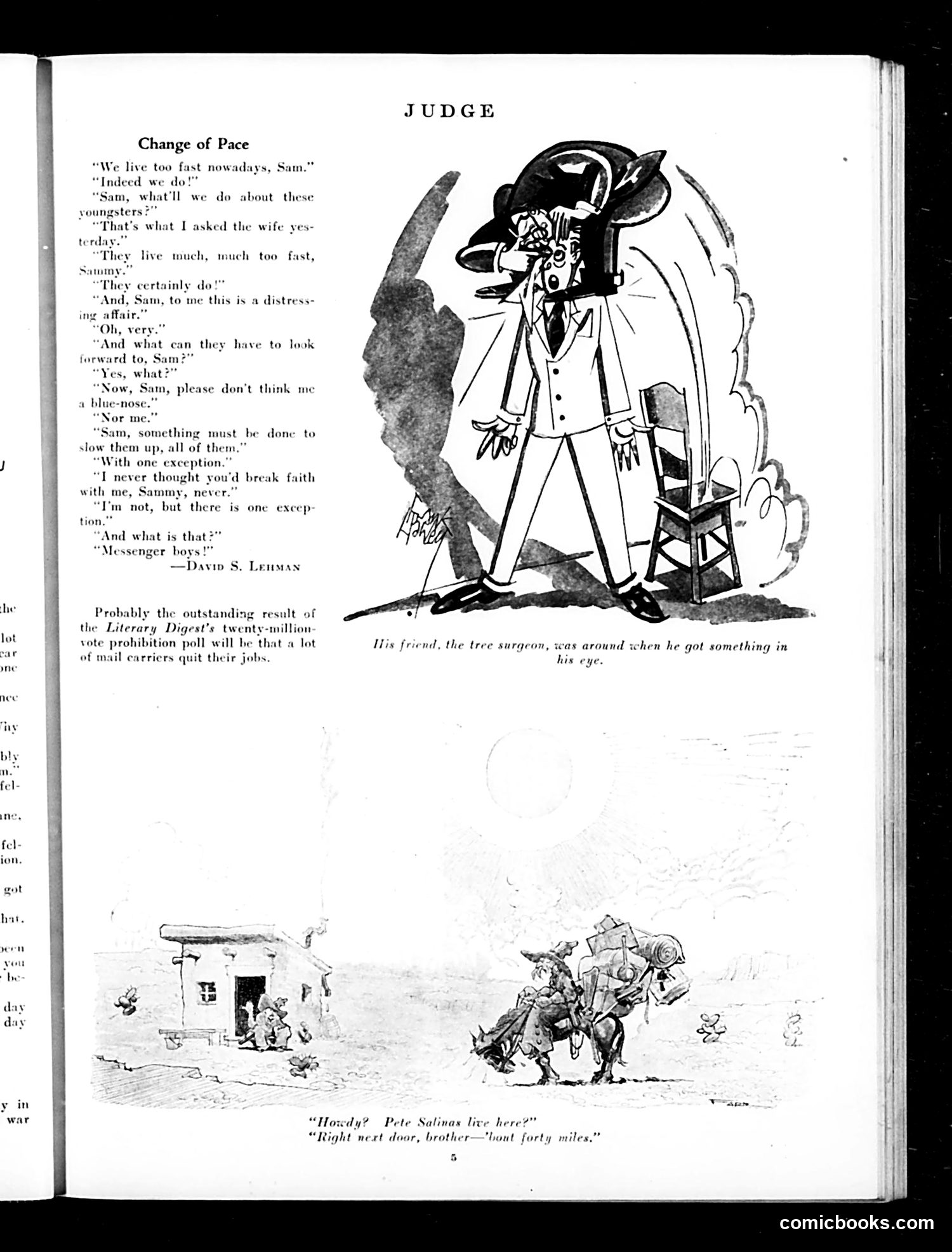
# Analysis of Judge Magazine Page This page satirizes modern youth culture and speed obsession through a dialogue titled "Change of Pace." An older man (Sam) complains to his wife that young people "live much, much too fast," calling it "a distressing affair." His wife responds pragmatically that something must be done to slow them down. The top cartoon depicts a caricatured figure (likely representing a "messenger boy" or young delivery worker) operating at frantic speed, suggesting the frenetic pace of urban youth life—possibly referencing telegraph messengers or similar rapid-transit workers common in early 20th-century cities. The bottom illustration shows a rural scene, possibly illustrating the "slower pace" alternative the dialogue proposes. The satire critiques generational anxiety about modernization and accelerating urban lifestyles.
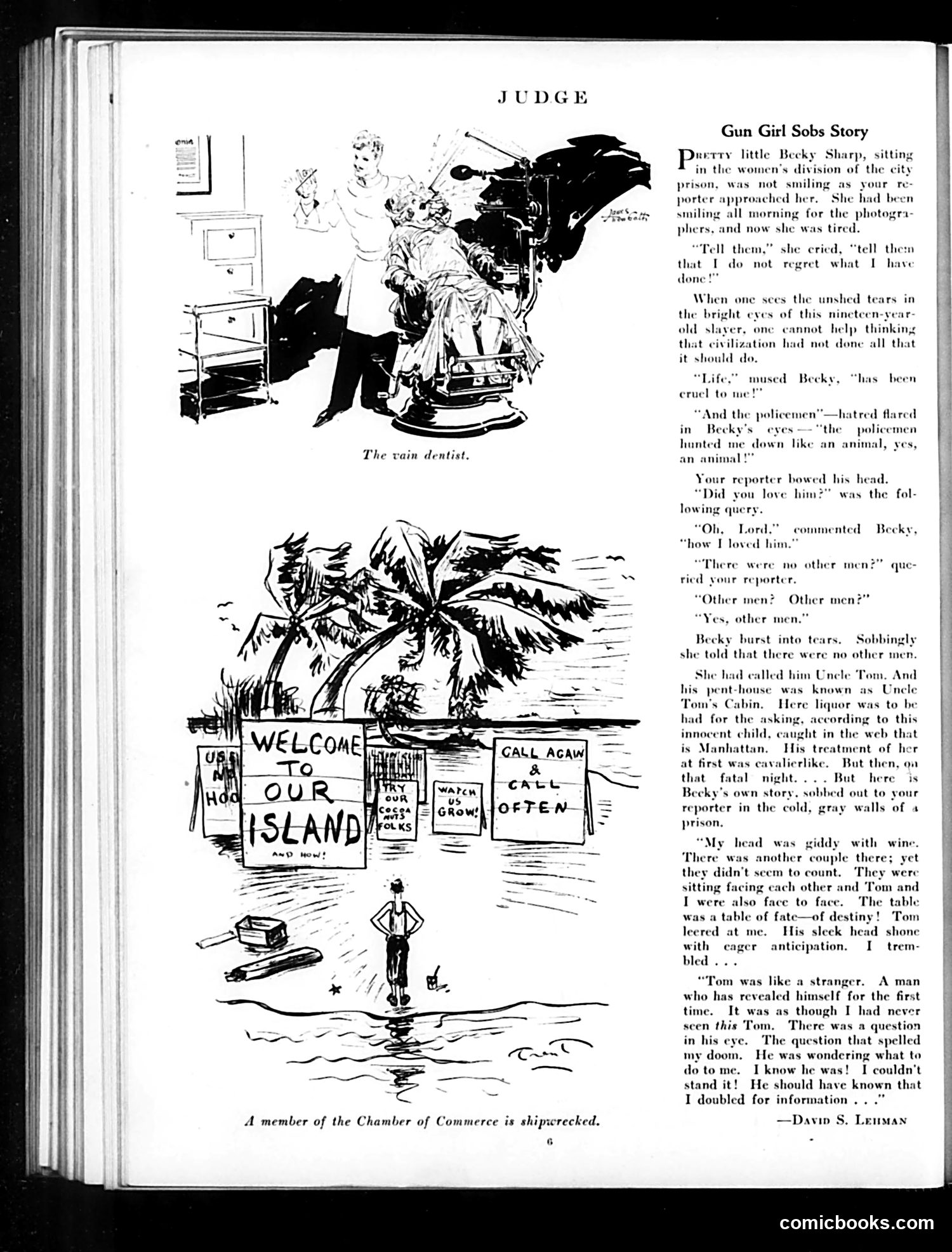
# "Gun Girl Sobs Story" — Judge Magazine This page presents a first-person narrative by "Becky Sharp," a 19-year-old woman imprisoned in the city jail, reflecting on her life choices. The accompanying illustrations satirize her situation: one shows a dentist (labeled "The vain dentist"), another depicts a tropical island welcome sign with shipwrecked figures. Becky's account reveals she had a relationship with "Uncle Tom" at "Uncle Tom's Cabin" (a brothel), describing him as the only man she loved. She mentions drinking, other couples present, and Tom's mysterious, questioning nature that troubled her. The satire critiques urban vice, moral corruption of youth, and likely contemporary social anxieties about prostitution and criminality. The "Gun Girl" reference suggests she may have committed armed crime. The story employs sentimental confession to mock sensationalism around fallen women.
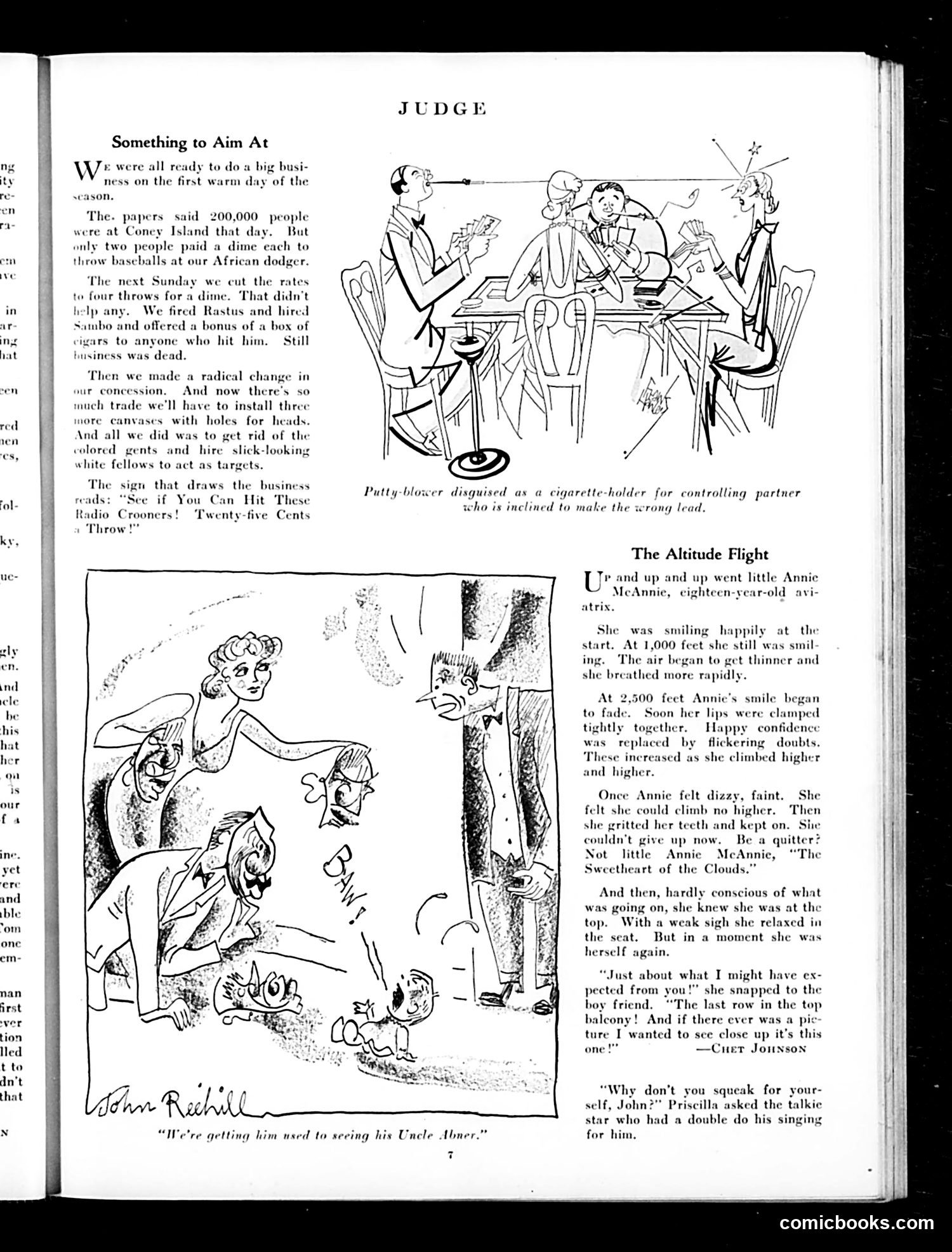
# Judge Magazine Page Analysis This page contains two distinct pieces of early 20th-century satirical content: **"Something to Aim At"** (top): A carnival operator describes a racist shooting gallery attraction. Originally featuring Black men ("African dodger," "Rastus," "Sambo") as targets, business was poor. The operator then replaced the Black workers with "sick-looking white fellows" and business boomed—the joke being that audiences preferred shooting at white targets. The satire appears to mock both the racist premise of such attractions and American attitudes about who was considered acceptable to harm for entertainment. **"The Altitude Flight"** (bottom): A brief story about Annie McAnnie, an eighteen-year-old female aviator, enduring altitude sickness during a high-altitude flight. The narrative celebrates her perseverance despite physical distress, presenting her as brave ("Sweetheart of the Clouds"). This appears genuinely admiring rather than satirical, reflecting early aviation-era fascination with pioneering female pilots. Both pieces reflect early 1900s American attitudes and entertainment practices now recognized as deeply offensive.
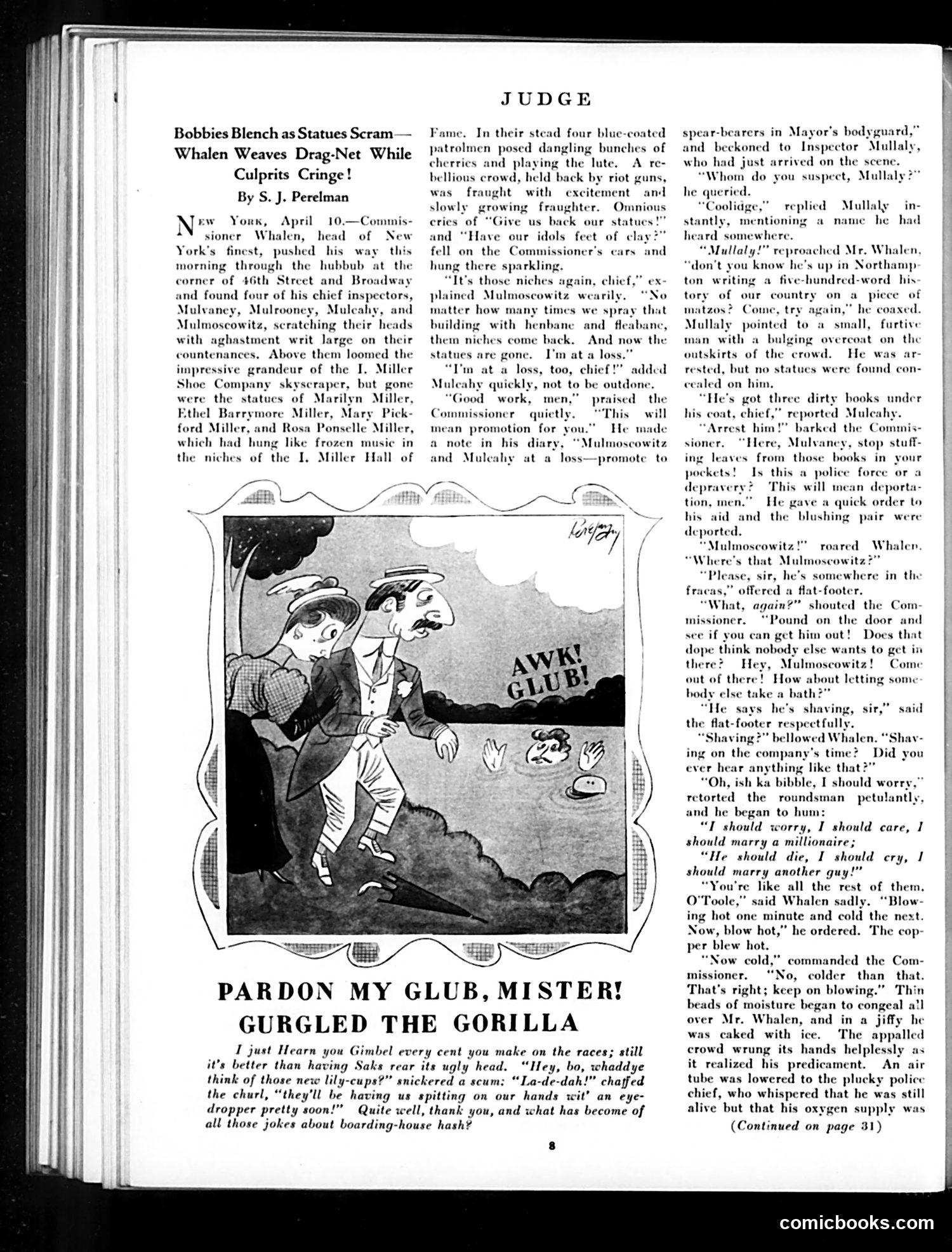
# Explanation for Modern Readers This Judge magazine page satirizes NYC Police Commissioner Whalen's crime-fighting efforts through absurdist humor. The main cartoon depicts four inspectors (Irish-named characters like Mulvaney, Mulroon, Mulcahy, Mulmoscowitz) baffled by stolen statues from the I. Miller building—a real 1920s Broadway landmark. The satire mocks incompetent police work: the inspectors are promoted despite finding nothing, and officers follow nonsensical orders to blow air hot then cold. The humor relies on ethnic stereotyping (the Irish officers with exaggerated names) and slapstick bureaucratic absurdity typical of 1920s comedy. The lower section's references to "Gimbel" and "Saks" (department stores) and "boarding-house hash" appear to be separate comedic vignettes using period slang and working-class humor, though context is unclear without fuller text.
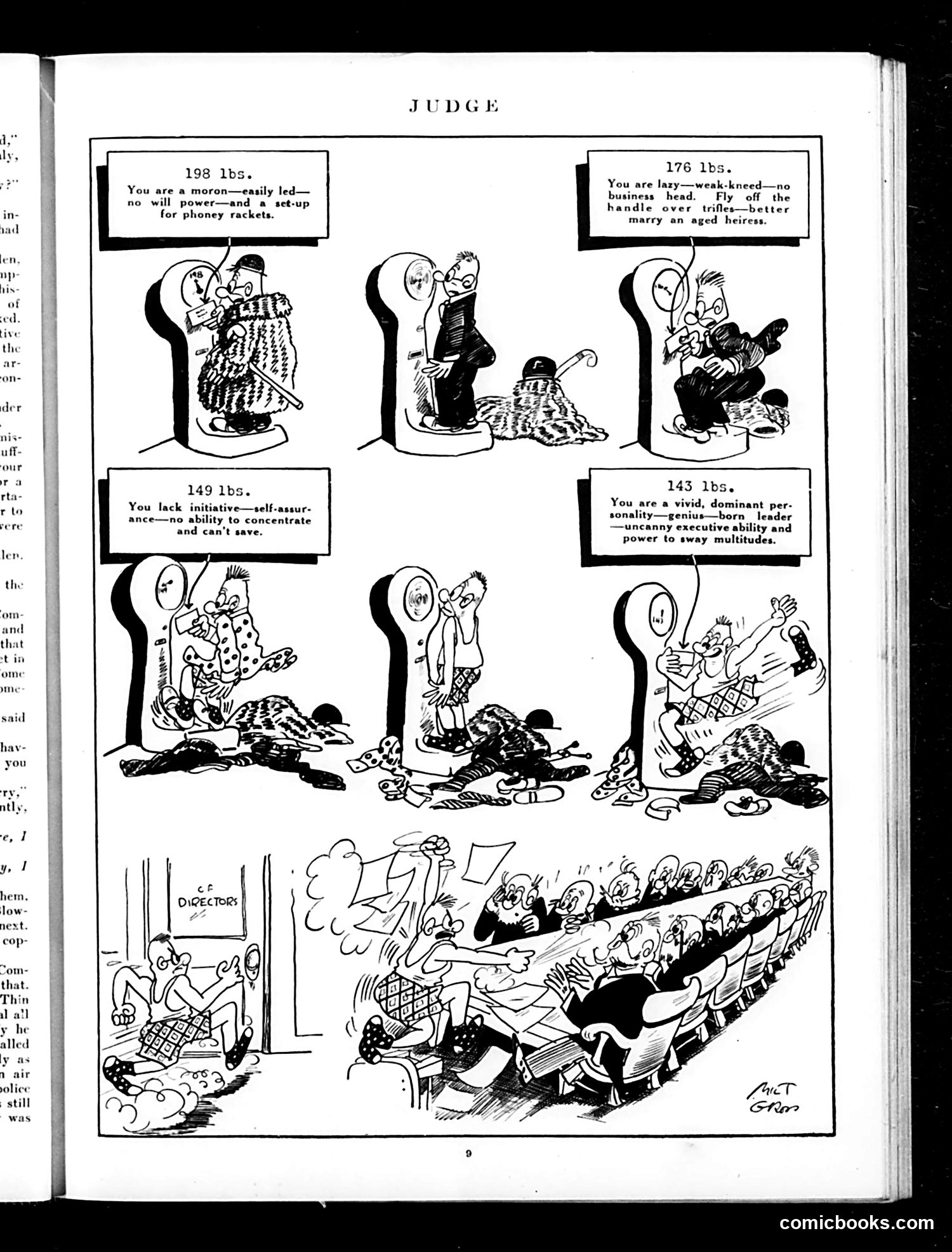
# "Judge" Magazine Weight Satire This page satirizes pseudoscientific weight-based character assessment, likely popular in early-to-mid 20th century. The cartoon shows a scale-wielding "judge" (authority figure) making wildly different personality evaluations based solely on a person's weight—198 lbs earns insults (moron, gullible), 176 lbs gets mild criticism (lazy, weak), while 143 lbs produces effusive praise (genius leader). The bottom panel shows the absurd result: the heaviest people are dismissed as failures while lighter ones are celebrated as natural leaders, despite presumably identical individuals. The satire mocks both the pseudoscience of physiognomy/somatotyping and the arbitrary prejudices that reduce human character to physical measurements. The joke exposes how such "scientific" judgments were actually baseless superstition dressed in authority.
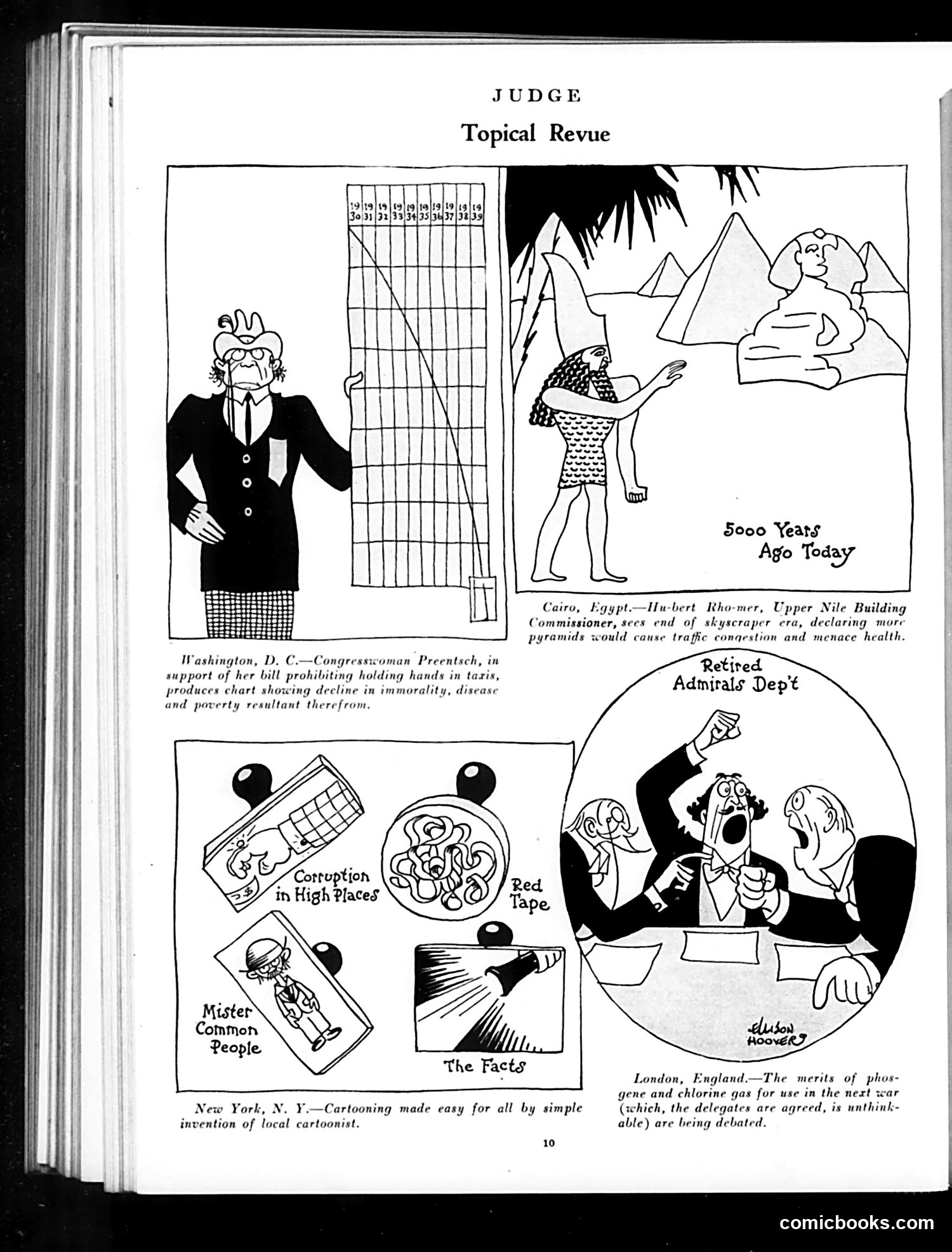
# Judge Magazine: "Topical Revue" This page satirizes contemporary absurdities through four cartoons: 1. **Washington taxi bill**: A congresswoman proposes prohibiting hand-holding in taxis, claiming it reduces immorality and poverty—mocking legislative overreach and naive social engineering. 2. **Egyptian bureaucrat**: An official declares pyramids should stop being built due to traffic concerns, humorously suggesting modern bureaucratic thinking applied to ancient monuments. 3. **Simple cartooning template**: A New York cartoonist's invention showing interchangeable symbols (corruption, red tape, common people, "the facts") lampoons mass-produced editorial cartooning and formulaic satire. 4. **London gas debate**: British diplomats debate chemical weapons for a future war they claim is "unthinkable"—sharp irony about post-WWI disarmament conferences that simultaneously planned for the next conflict. The page overall mocks political hypocrisy, bureaucratic absurdity, and the arms race mentality of the interwar period.