
Judge, 1930-04-12 · page 15 of 36
Judge — April 12, 1930 — page 15: what you’re looking at
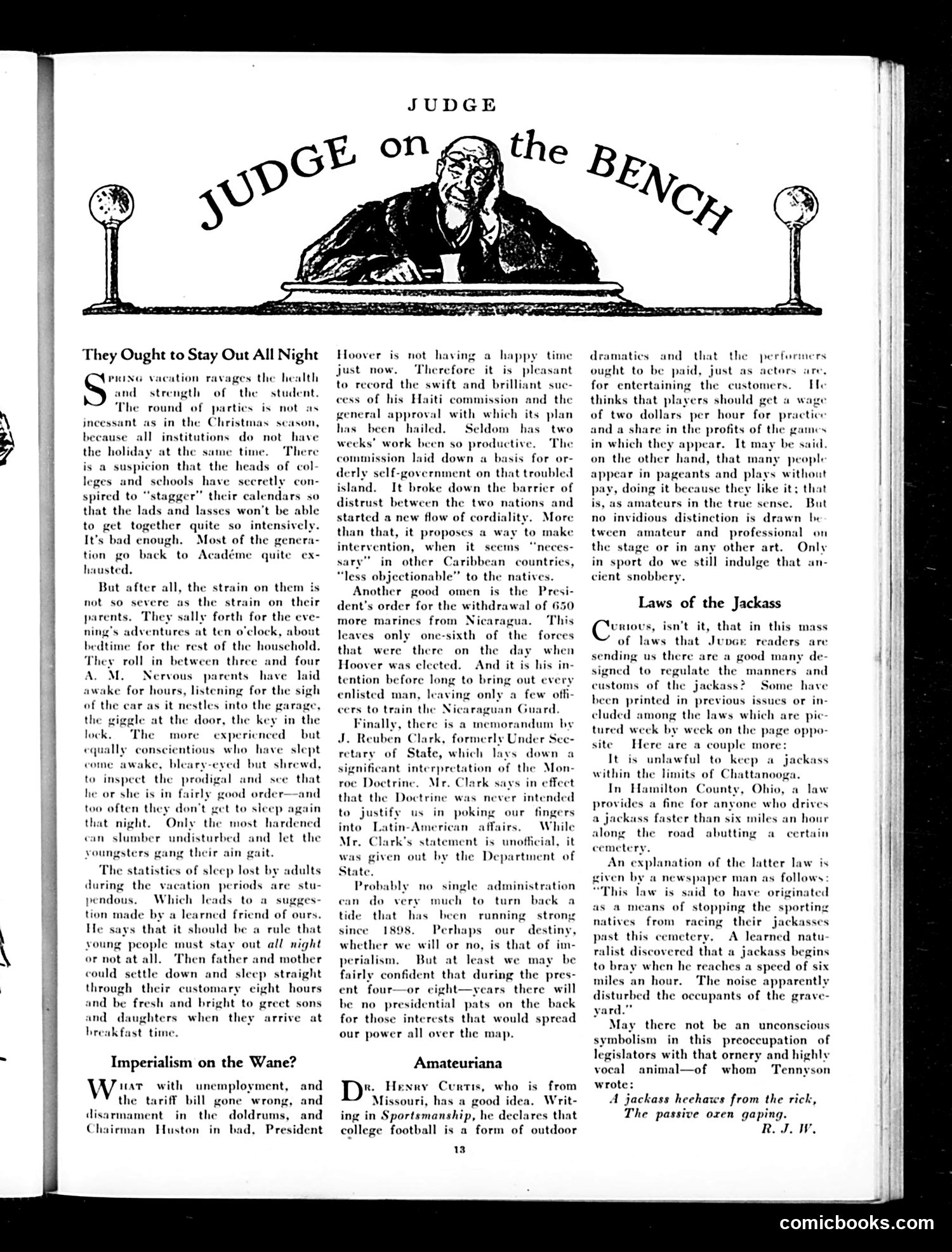
A restored page from Judge, 1930-04-12. Page through the whole issue in the reader above.
📄 Transcribed text from this page (OCR, searchable)
Machine-transcribed from the original scan — historical spelling and the odd misread are preserved.
They Ought to Stay Out All Night PRING vacation ravages the health and strength of the student, The round of parties is not as incessant in the Christmas season, because all institutions do not have the holiday at the same ti is a sus n that the he leges and schools have secretly con- spired to “stagger” their calendars so that the lads and lasses won't be able to get together quite so intensively. It's bad enough. Most of the gene go back to Académe quite ex- hausted. tion But after all, the strain on them is not so severe as the strain on their parents, They sally forth for the eve- ning’s adventures at ten o'clock, about bedtime for the rest of the household. They roll in between three and four A.M. Nervous parents have laid awake for hours, listening for the sigh the car as it nestles into the garage, the giggle the door, the key in the lock. ‘The more experienced — but equally conscientious who have slept come awake, bleary-eyed but shrewd, to inspect the prodigal and sce that he or she is in fairly good order—and too often they don't get to sleep that night. Only the most hardened can slumber undisturbed and let the youngsters gang their ain The s istics of sleep lost by adults during the ation periods are stu- pendous. Which leads to a sugges- tion made by a learned friend of ours. He says that it should be a rule that young people must stay out all night or not at all. Then father and mother could settle down and sleep straight through their customary eight hours and be fresh and bright to greet sons and daughters when they arrive at breakfast time. Imperialism on the Wane? Wier with unemployment, and the tariff bill gone wrong, and mament in the doldrums, and Chairman Huston in bad, President Hoover is not having a happy time just now. Therefore it is pleasant to record the swift and brilliant suc- 1 and the cess of his Haiti commissi general approval with which its plan has been hailed. Seldom has two weeks’ work been so productive. The commission laid down a basis for or- derly self-government on that troubled island. It broke down the barrier of distrust between the two nations and started a new flow of cordiality. More than that, it proposes a way to make intervention, when it seems sary” in other Caribbean countries, “less objectionable” to the natives. Another good omen is the Presi- dent's order for the withdrawal of 650 more marines from Nicaragua. This leaves only one-sixth of the forces that were there on the day when Hoover was elected. And it is his in- tention before long to bring out every enlisted man, leav 1 few ofh- cers to train the Nicaraguan Guard lly, there is a memorandum by ruben Clark, formerly Under See- of State, which lays down a nt interpretation of the Mon- roe Doctrine. Mr. Clark says in effect that the Doctrine was never intended to justify us in pok our fingers into Latin-American affairs. While Mr. Clark's statement is unofficial, it was given out by the Department of State, Probably no single administration much to back a “neces- can do. very turn tide that has been running stron, since 1898. Perhaps our destir whether we will or no, is that of im- perialism, But at least we may be fairly confident that during the pres- ent four—or cight—years there will be no presidential pats on the back for those interests that would spread our power all over the map. Amateuriana D*. Henry Curtis, who is from Missouri, has a good idea. Writ- ing in Sportsmanship, he declares that college football is a form of outdoor 13 dramatics and that the ought to be paid, just as a for entertaining the thinks that players should get a \ of two dollars per hour for practic: share in the profits of the in which they appear. It may be said. on the other hand, that many people appear in pageants and plays without pay, doing it because they like it; that i iteurs in the true sense. But no invidious distinction is drawn be tween amateur and professional on the stage or in any other art. Only in sport do we still indulge that an- cient snobbery. Laws of the Jackass Corrie, isn't it, that in this mass of laws that Jupce rea sending us there are signed to regulate the customs of the jac been printed in pre performers stars customers. and » have ious issues or in- cluded among the laws which are pic tured week by week on the page oppo- ite Here are a couple more: It is unlawful to keep a jackass within the limits of Chattanoog: In Hamilton County, Oh provides a fine for an a jackass faster than six miles an hour along the road abutting a cemetery. An explanation of the latter law is iven by a newspaper man as follows This law is said to have originated as a means of stopping the sporting natives from racing their jackasses A learned natu- ralist discovered that a jackass begins to bray when he reaches a speed of six The noise apparently disturbed the occupants of the grave- yard.” May there not be an unconscious symbolism in this preoccupation of legislators with that ornery and highly vocal animal—of whom Tennyson wrote: A jackass heehaws from the rick, The passive oxen gaping. R.JLW, , a law one who drives certain past this cemetery, miles an hour. comicbooks.com