
Judge, 1930-04-12 · page 20 of 36
Judge — April 12, 1930 — page 20: what you’re looking at
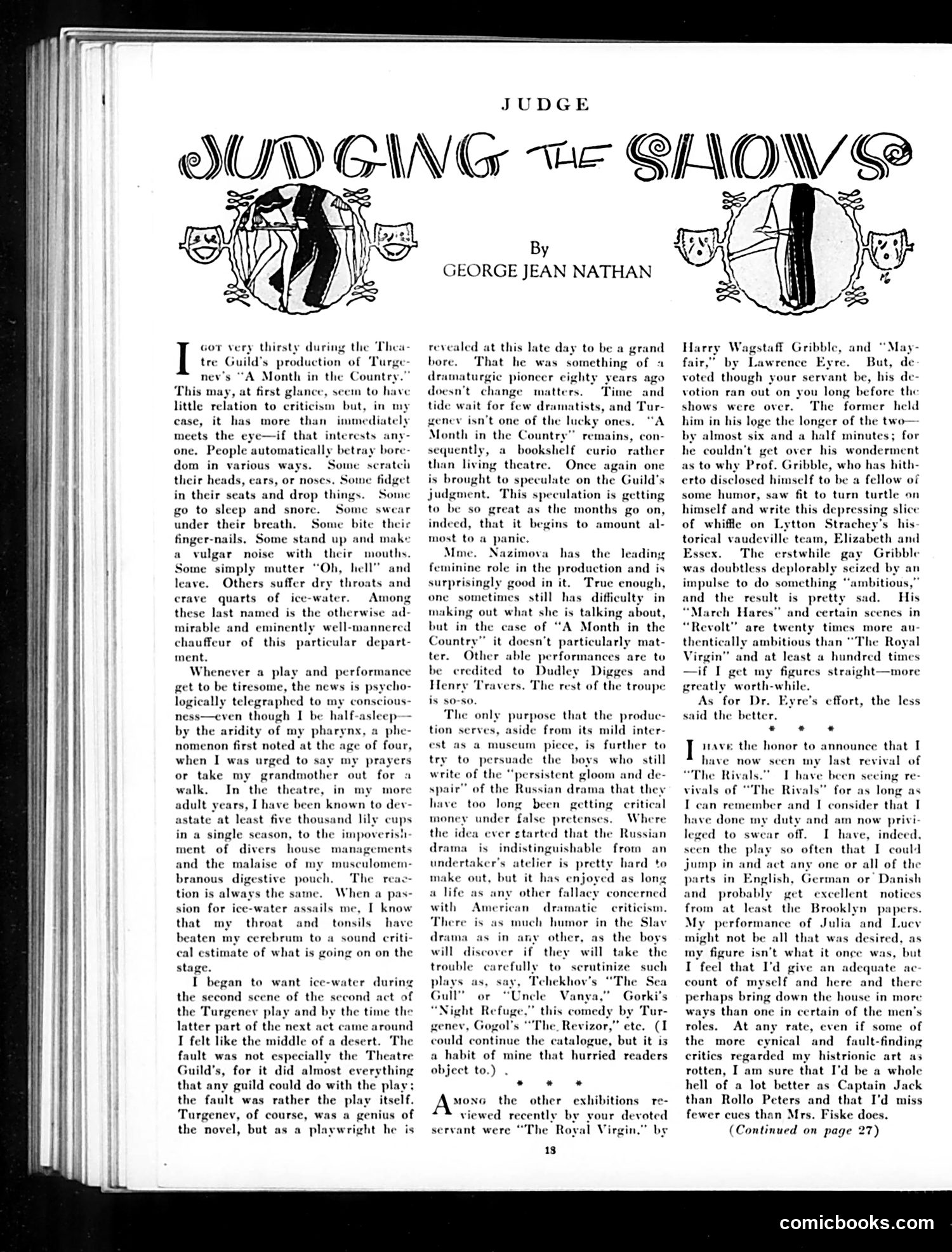
A restored page from Judge, 1930-04-12. Page through the whole issue in the reader above.
📄 Transcribed text from this page (OCR, searchable)
Machine-transcribed from the original scan — historical spelling and the odd misread are preserved.
| Gor very thirsty during the Thea- tre Guild's production of ‘Turge- nev's “A Month in the Country.” This may, at first glance, seem to have little relat ion to criticism but, case, it has more than immed meets the e one. People autom 3 dom in various w Some scratch their heads, ears, or noses. Some fidget in their seats and drop things. go to sleep and snore. Some swear under their breath. Some bite their finger-nails. Some stand up and make a vulgar noise with their mouths. Some simply mutter “Oh, hell” and le Others suffer dry throats and crave quarts of ice-water. Among these last named is the otherwise ad- mirable and eminently well-mannered chauffeur of this particular depart- ment. Whenever a play and performance get to be tiresome, the news is psycho- logically telegraphed to my cons ness—even though I be half-asleep— by the aridity of my pharynx, a phe- nomenon first noted at the age of four, when I was urged to say my prayers or take my grandmother out for a walk. In the theatre, in my more adult years, Ihave been known to dev- astate at least five thousand lily cups in a single season, to the impoverish ment of house mz and the of my branous digestive pouch. tion is always the same. sion for er assails me, that my throat and tonsils have beaten my cerebrum to a sound criti- cal estimate of what is going on on the stage. I began to want ice-water during the second scene of the second act of the Turgenev play and by the time the latter part of the next act came around I felt like the middle of a desert. The fault was not especially the Theatre Guild’s, for it did almost everythin, that any guild could do with the play: the fault was rather the play itself. Turgenev, of course, was a genius of the novel, but as a playwright he is divers ments malaise When a p: I know JUDGE By GEORGE JEAN NATHAN revealed at this late day to be a grand bor That he was something of a dramaturgic pionecr eighty years ago doesn’t change matters. Time and tide wait for few dramatists, and Tur- eney isn’t one of the lucky ones. “A Month in the Country” remains, con- sequently, a bookshelf curio rather than living theatre. Once is brought to speculate on the Guild's judgment. This speculation is getting to be so great as the months go on, indeed, that it begins to amount al- most to a panic. Mme. Nazimova has the feminine role in the production surprisingly good in it. True enough, sometimes still has diffi making out what she is talking about, but in the case of “A Month in the Country” it doesn’t particularly mat- one ter. Other able performances are to be credited to Dudley Digges and Henry Travers. The rest of the troupe is so-so. The only purpose that the produc- from its mild inter- est as a museum pic is further to try to persuade the boys who still write of the “persistent gloom and de “of the Russian drama that tl been getting critical - under false pretenses. Where idea ever started that the Russian is indistinguishable from an undertaker’s atelier is pretty hard to make out, but it has enjoyed as long a life as any other tion serves, aside spair’ have too long mone the drama concerned with Av criticism. There is as much humor in the Slav drama as in other, as the boys will discover if, they will take the trouble carefully to scrutinize such plays as, say, Tchekhov’s “The Si C or ‘le Vanya,” Gorki’s Night Refuge,” this comedy by Tur- genev, Gogol’s “The. Revizor,” ete. (I could continue th a habit of mine tl object to.) . - * « Av the other exhibitions re- viewed recently by your devoted servant were “The Royal V be 13 alogue, but it is t hurried readers MUVYCGING t= GAOWS Harry Wagstaff Gribble, and “May- fair,” by Lawrence Eyre. But, de voted though your servant be, his de- votion ran out on you long before the shows were over. The former held him in his loge the longer of the two— by almost six and a half minutes; for he couldn't get over his wonderment clf to be a fellow of some humor, saw fit to turn turtle on himself and write this depressing slice of while on Lytton Stra torical vaudeville team, Essex. The erstwhile ga was doubtless deplorably se impulse to do something “ambitious,” and the result is pretty sad. His “March Hares” and certain scenes in “Revolt” are twenty times more au- thentically ambitious than “The Royal Virgin” and at least a hundred times I get my figures straight—more greatly worth-while. As for Dr. Eyre’s effort, the less said the better. . 8 * Ti ave the honor te ave now seen my Th » Rivals” "s his hand Gribble d by an nnounce that I Jast revival of been seeing re- for as long as nsider that I n now p I have, indeed. seen the play so often that I could jump in and act any one or all of the rts in English, and probably get from at least the Brookl My performance of Juli might not be all th my figure isn’t wh: I feel that I'd g an adequate ac count of myself and here and there perhaps bring down the house in more ways than one in certain of the men’s roles. At any rate, even if some of the more cynical and fault-finding critics regarded my histrionic art as rotten, I am sure that I'd be a whole hell of a lot better as Captain Ja than Rollo Peters and that I'd miss fewer cues than Mrs. Fiske does. (Continued on page 27) German or Danish excellent 1 papers. Luev notices and t was desir once was, but comicbooks.com