A complete issue · 36 pages · 1930
Judge — February 1, 1930
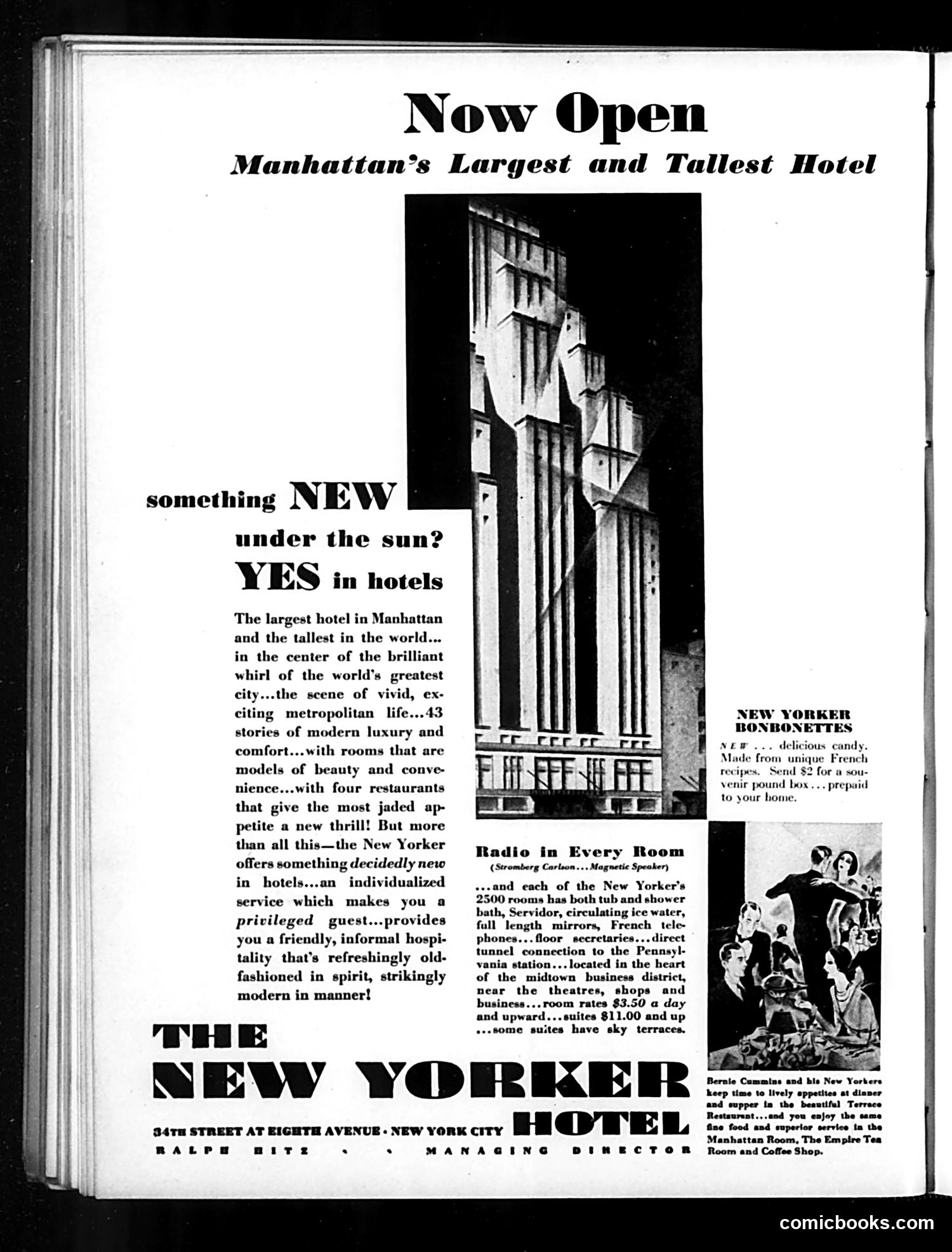
# The New Yorker Hotel Advertisement This page is **primarily a hotel advertisement**, not a political cartoon. It announces the opening of the New Yorker Hotel on 34th Street at Eighth Avenue in New York City, marketed as "Manhattan's Largest and Tallest Hotel." The ad emphasizes luxury amenities: 43 stories, four restaurants, 2,500 rooms with modern conveniences (radios, full mirrors, French telephones, circulating ice water), and competitive pricing ($3.50 and up daily). It highlights the hotel's convenient location near theaters, shops, and Penn Station. The page includes supplementary advertisements for New Yorker Bonbonettes candy and what appears to be evening entertainment, but these are minor elements within a primarily commercial advertisement.
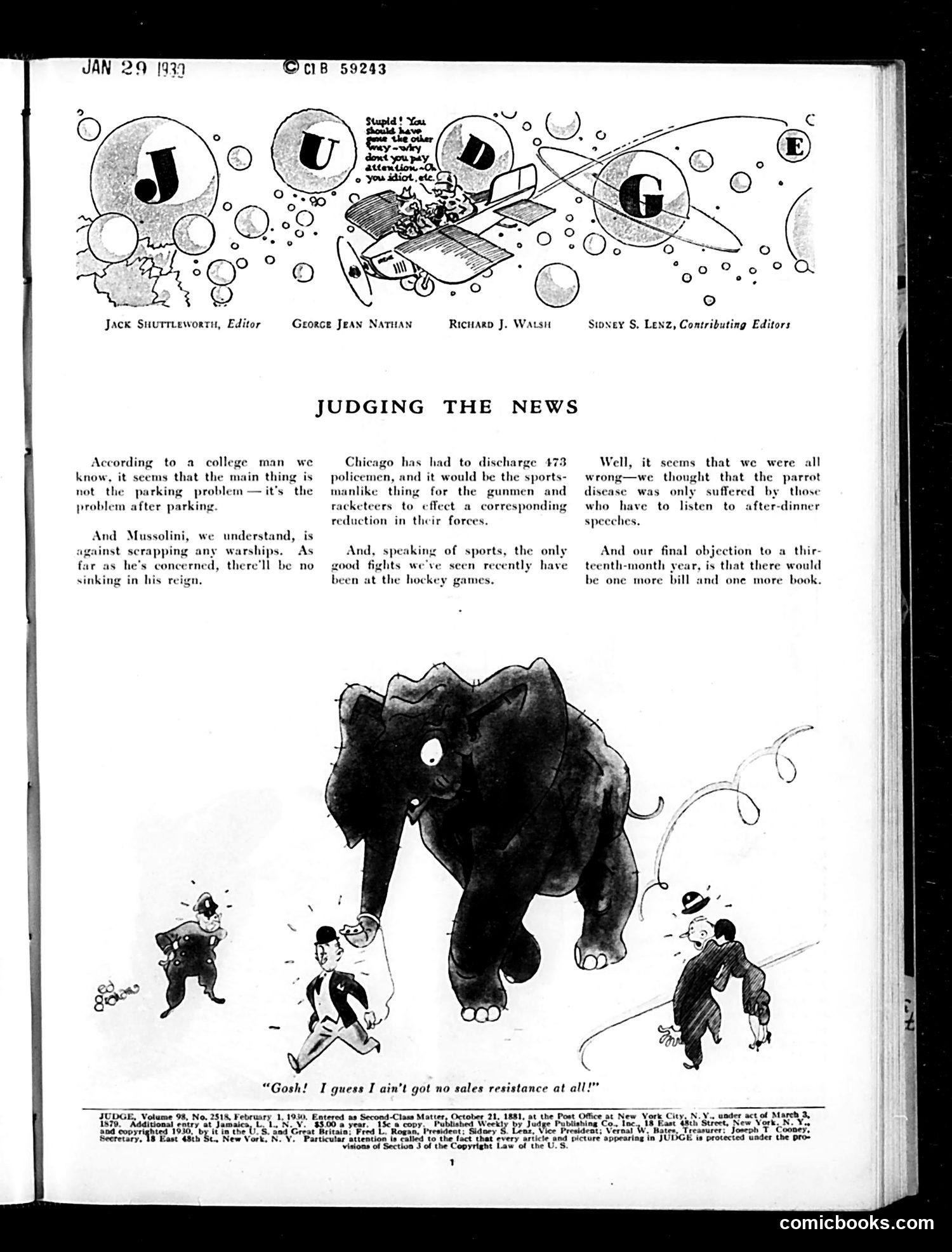
# Explanation of "Judging the News" (January 29, 1933) This satirical page comments on contemporary news events through brief quips and a political cartoon. The text references: - **Parking problems** as America's main issue - **Mussolini** and warship-scrapping (likely referencing 1930s disarmament discussions) - **Chicago police discharging 173 officers**, which the editors sarcastically suggest gangsters should match - **Hockey games** as the only good recent fights - A complaint about having "one more bill" in a thirteen-month year The main cartoon depicts an elephant (the Republican party symbol) as an uncontrollable force, with small men struggling to restrain it via a rope. The caption "Gosh! I guess I ain't got no sales resistance at all!" suggests the GOP cannot resist spending or political pressure—likely satirizing Republican inability to control government expenditure during the Depression era.
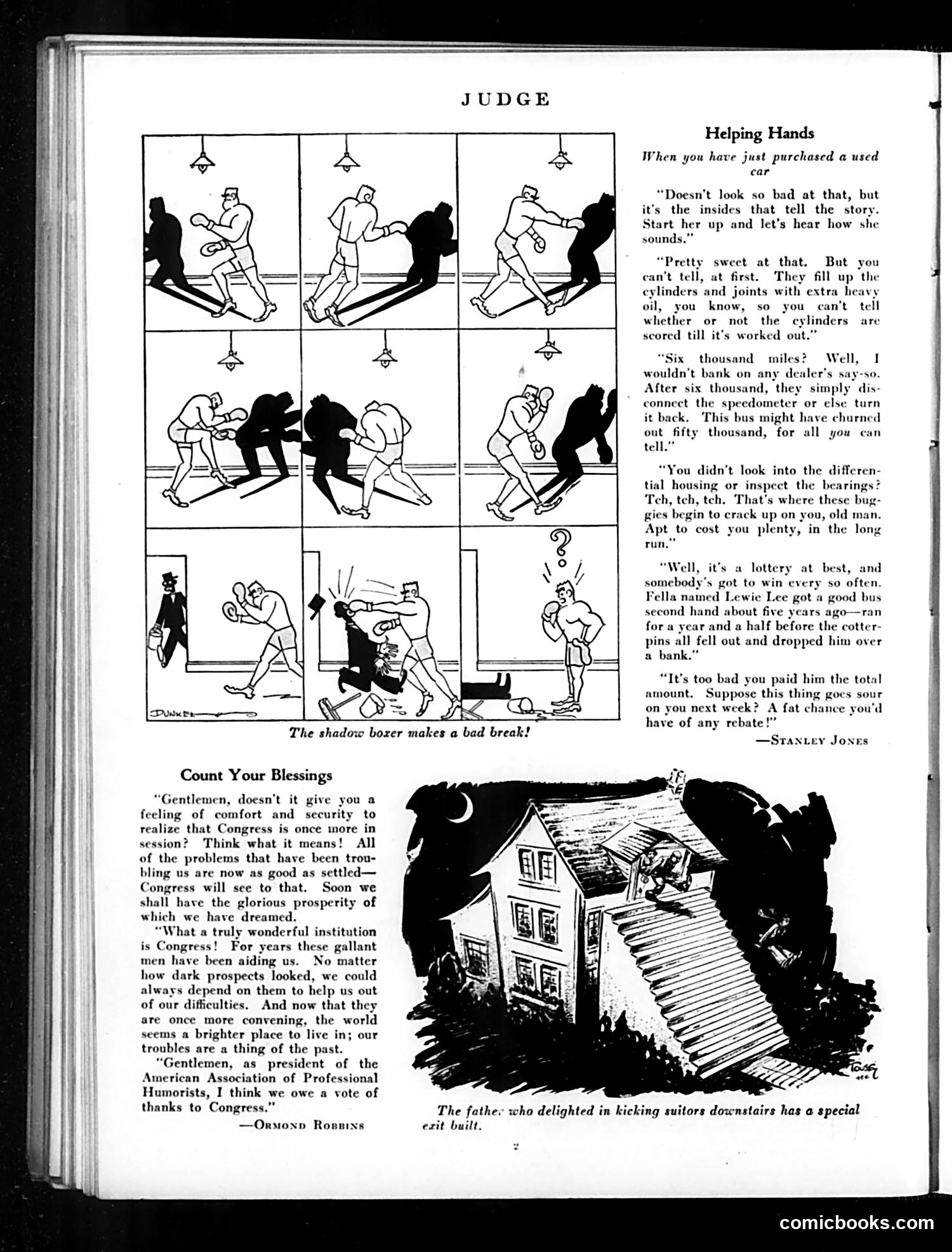
# Analysis **Top Comic Strip** ("The shadow boxer makes a bad break!"): Satirizes used-car buying. A buyer and seller (shown as black silhouettes, a period convention for anonymous figures) engage in a sparring match over a vehicle's true condition. The buyer discovers hidden mechanical problems—burned-out cylinders, faulty bearings, disconnected speedometer—after purchase. The joke: inspecting a used car is like boxing in the dark; you only discover damage after you've already been "hit." The advice column warns buyers that dealers exploit ignorance about mechanical condition and past mileage. **Bottom Section** ("Count Your Blessings"): A political speech praising Congress for solving economic troubles. The accompanying illustration shows a father gleefully kicking servants downstairs—a darkly humorous commentary on how prosperity benefits the wealthy while working people remain exploited.
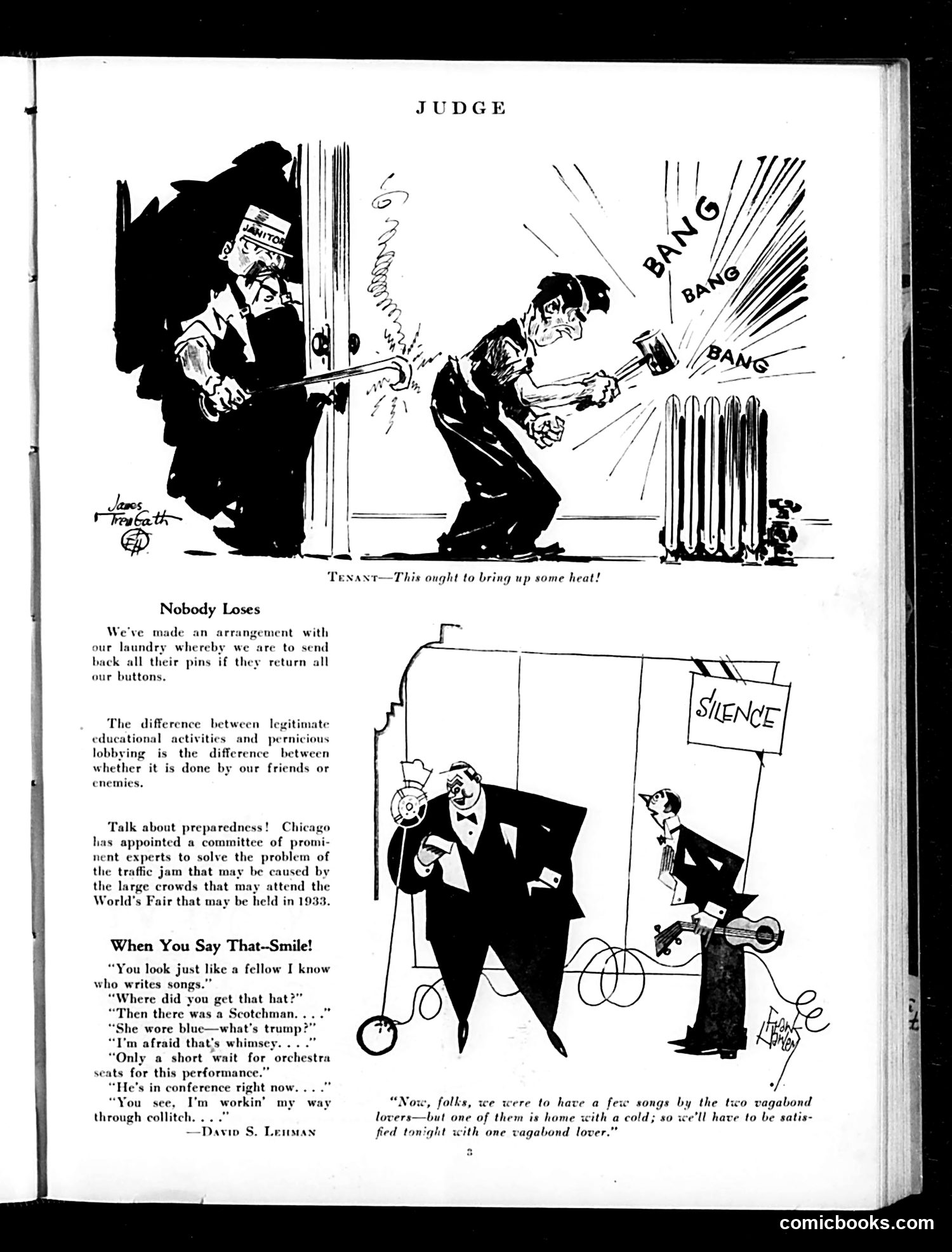
# Political Cartoon Analysis: Judge Magazine The top cartoon depicts a Judge (likely a court official) confronting a Tenant about heating. The tenant complains "This ought to bring up some heat!"—a pun on the radiator's literal function and his demand for adequate warmth. The Judge's stern demeanor suggests this reflects contemporary tenant-landlord disputes over heating obligations. The lower cartoon appears to reference Chicago's preparations for a 1933 World's Fair, showing officials (one marked "SILENCE") dealing with traffic and crowd control problems. The vagabond performers' dialogue jokes about compensating with fewer musicians due to illness, an unrelated vaudeville gag. The miscellaneous text items—about laundry arrangements, lobbying definitions, and song-writing anecdotes—fill the page as filler content typical of Judge's mixed satirical format.
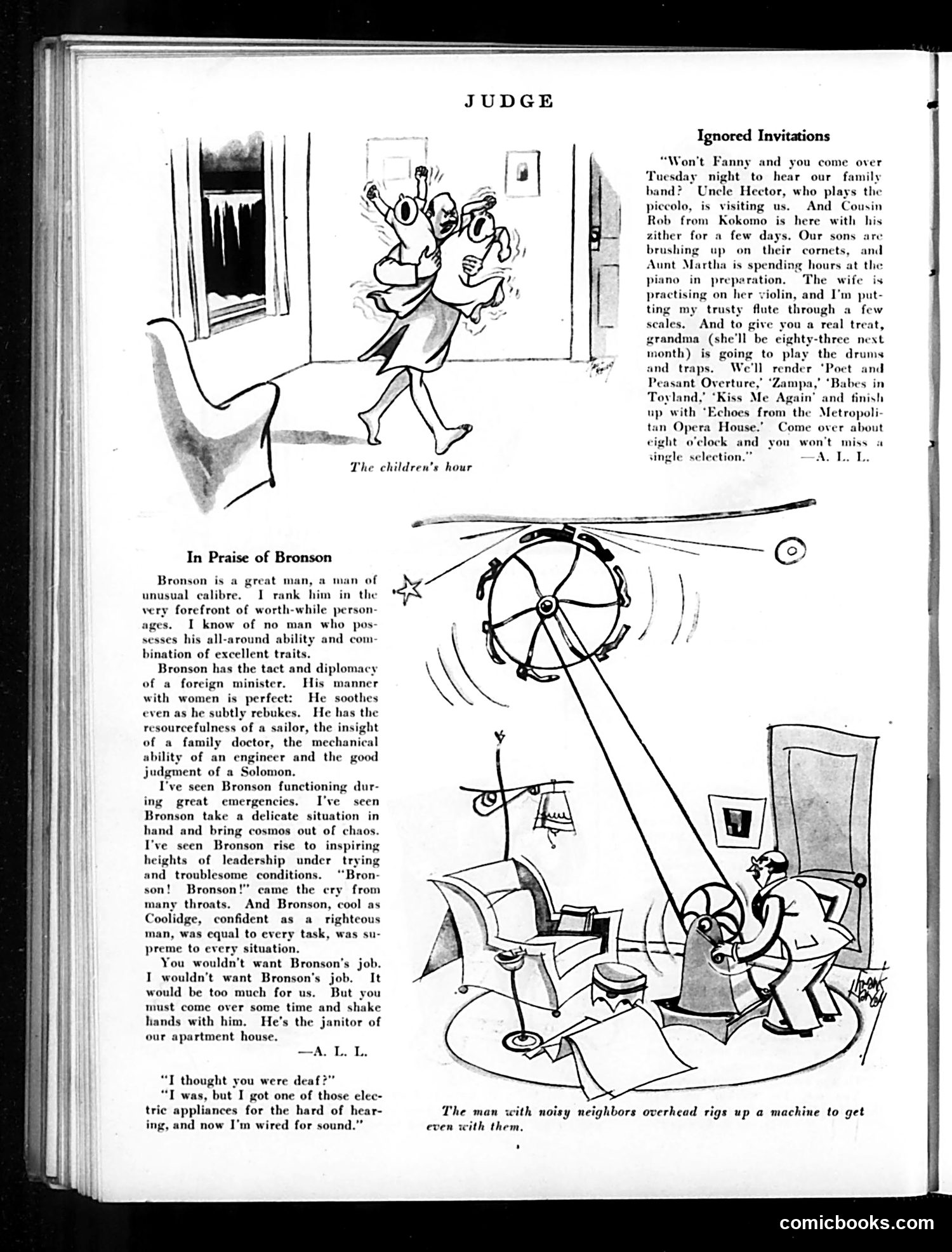
# Judge Magazine Page Analysis This page contains three distinct pieces of humor: 1. **"The children's hour"** (top): A cartoon showing children enthusiastically greeting an arriving guest—typical domestic humor about chaotic family welcomes. 2. **"In Praise of Bronson"** (left): A testimonial praising someone named Bronson as an exceptionally talented diplomat and problem-solver. The author notes Bronson excels at difficult situations and difficult people, but warns that his job is so demanding ("You wouldn't want Bronson's job") that one should occasionally offer him rest and companionship. 3. **"The man with noisy neighbors"** (bottom right): A cartoon showing an elaborate mechanical contraption—apparently a humorous solution for dealing with noisy neighbors. The caption suggests he built this machine to "get even with them." The page mixes domestic comedy with professional praise and neighbor conflict humor typical of early-20th-century American satire.
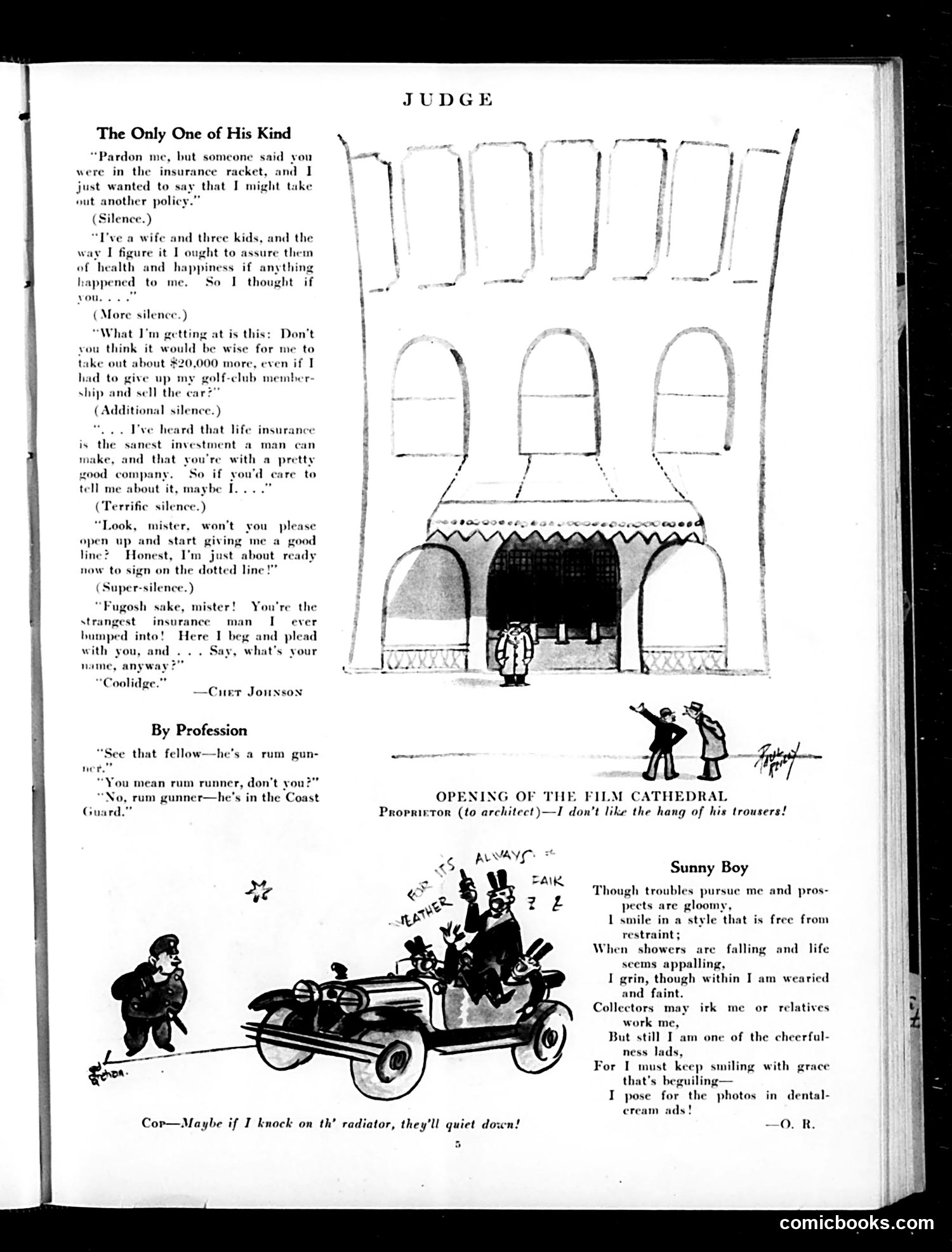
# Judge Magazine Page Analysis This page contains early 20th-century humor pieces addressing insurance and professional matters: **"The Only One of His Kind"** satirizes an overly cautious insurance salesman pressuring a client to buy excessive life insurance policies. The humor relies on the salesman's persistence despite the client's clear reluctance—a commentary on aggressive sales tactics common in that era. **"By Profession"** is a brief joke about terminology: a "rum gunner" (bootlegger) versus a "rum runner" (Coast Guard officer), reflecting Prohibition-era anxieties. **"Opening of the Film Cathedral"** mocks an architect's concern about film projection equipment affecting his building's appearance. The page primarily demonstrates Judge's focus on middle-class anxieties, sales culture, and contemporary professions rather than direct political satire.
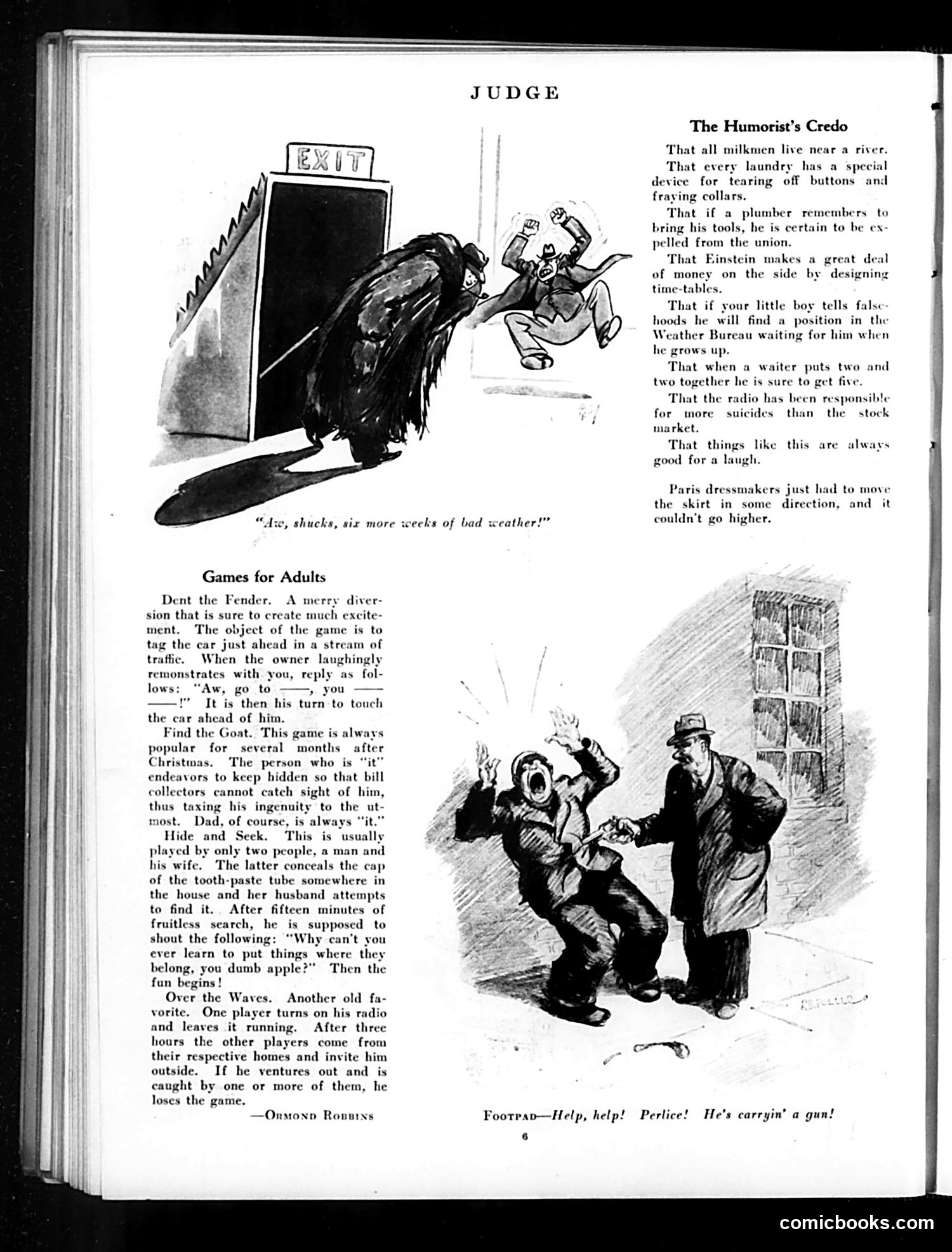
# Page Analysis: Judge Magazine This page contains two distinct sections: **Top Cartoon ("Exit"):** Shows a disheveled man being forcibly ejected from what appears to be a theater or establishment, with the caption "Six, shucks, six more weeks of bad weather!" The joke references Groundhog Day folklore—the tradition that if a groundhog sees its shadow on February 2nd, six more weeks of winter follow. The cartoon satirizes how people blame this superstition for prolonged bad weather. **Lower Section:** "Games for Adults" by Osmond Robbins describes humorous pranks and party games, including "Dent the Fender" and "Find the Goat." These appear to be satirical suggestions mocking foolish adult behavior disguised as entertainment. **Right Column:** "The Humorist's Credo" lists satirical observations about modern life, including jabs at laundries, plumbers, Einstein, weather forecasting, and fashion trends.
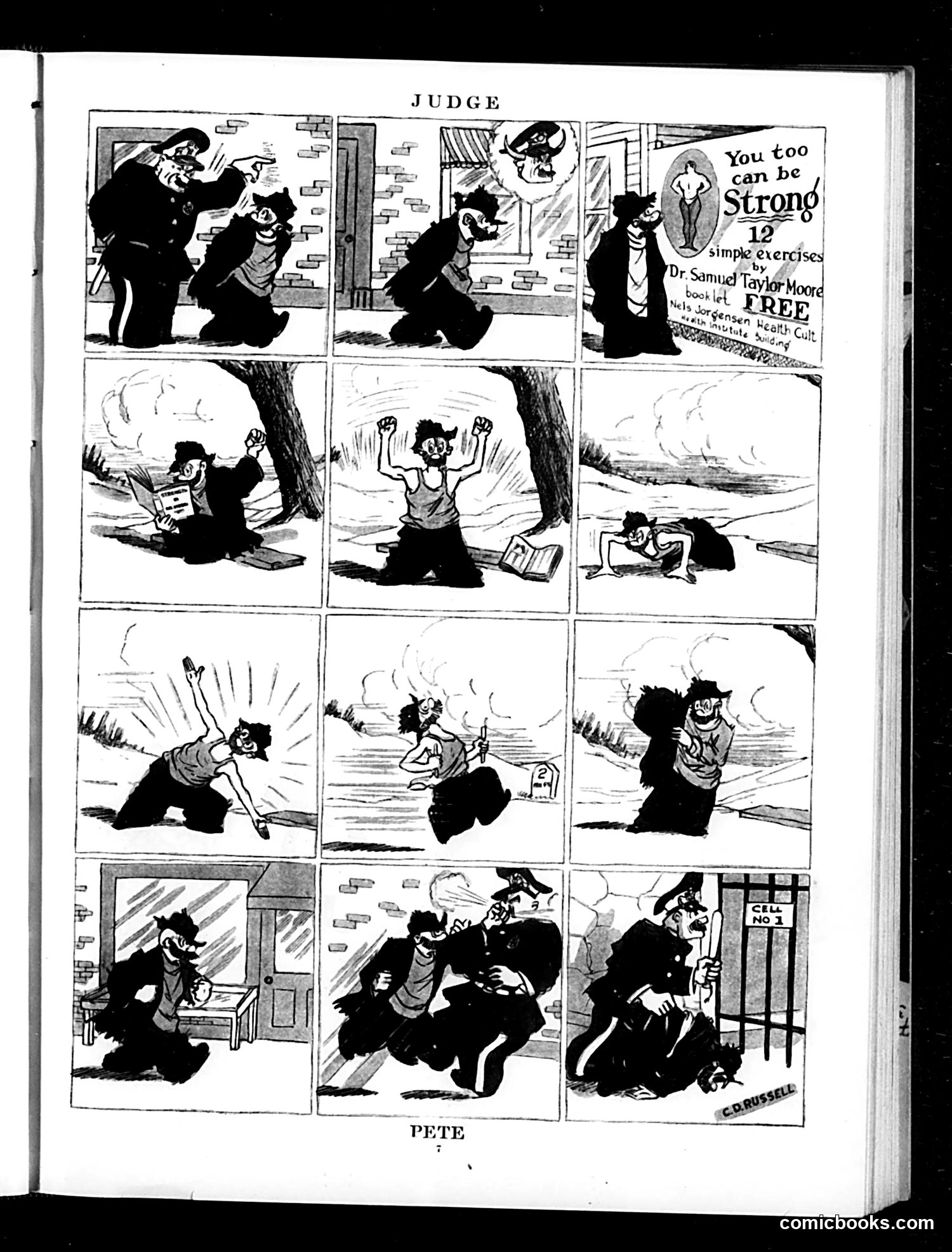
# Analysis of Judge Magazine Page This page contains two comic strips. The top strip, "Judge," shows a man being arrested and taken to jail—likely satirizing law enforcement or the legal system through physical comedy and exaggeration. The bottom strip, "Pete," depicts a character performing outdoor exercises before a natural backdrop, which connects to the adjacent advertisement promoting "You too can be Strong"—a booklet offering "12 simple exercises" by Dr. Samuel Taylor Moore, marketed as a free health publication. The juxtaposition suggests this page combines entertainment with product promotion common to Judge magazine. The specific social satire or political references remain unclear without additional historical context about the characters or time period.
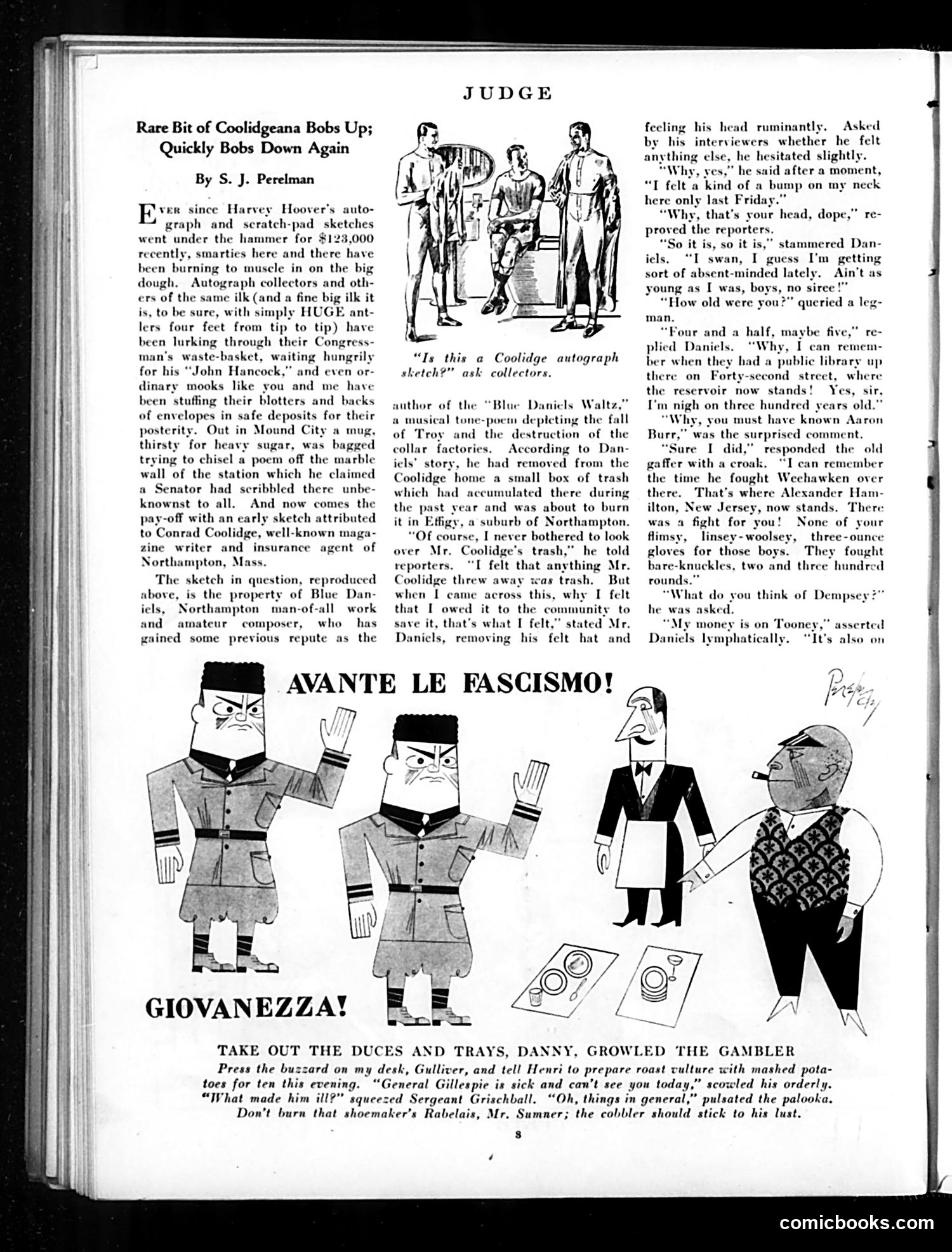
# Explanation for Modern Readers This Judge magazine page contains two distinct pieces of satirical content: **Top Article: "Coolidgeana"** by S.J. Perelman mocks the craze for celebrity autographs following Harvey Hoover's $123,000 auction. It lampoons a Massachusetts man claiming to possess a poem by President Calvin Coolidge (humorously called "Conrad Coolidge"), which he found in Coolidge's trash. The article satirizes both autograph-collecting mania and the dubious authenticity of such discoveries, with the man's increasingly absurd claims (being 300 years old, knowing Aaron Burr) highlighting the ridiculous nature of the scheme. **Bottom Cartoon: "Avante le Fascismo!"** depicts two militaristic fascist figures with the Italian phrase ("Down with Fascism!"), alongside a well-dressed man and what appears to be a portly figure. The caption references removing "duces and trays"—likely satirizing fascist leadership. This reflects 1920s-30s American concern about European fascism, presenting it as absurd and contemptible through caricature.
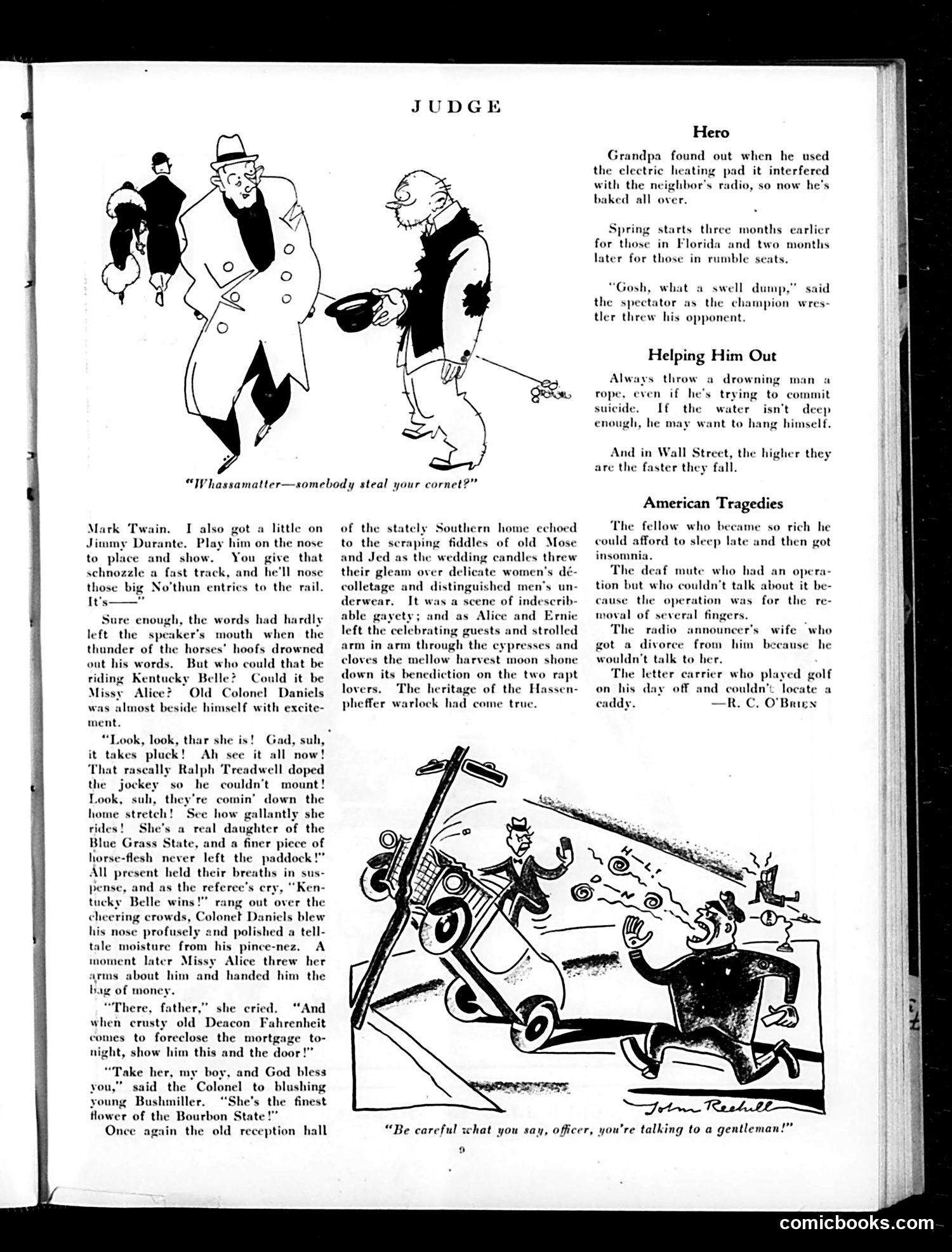
# Judge Magazine Page Analysis This page contains two distinct satirical pieces: **Top cartoon**: Shows a man confronting another about a stolen cornet, attributed to Mark Twain. The accompanying story is a melodramatic parody of Southern plantation fiction—complete with a resourceful young woman (Missy Alice) who rides a horse in a race to save her father's home from foreclosure, then marries a young man and receives blessing from "Colonel Daniels." It mocks the overwrought romance and honor-obsessed narratives of popular Southern literature of the era. **Bottom cartoon & text sections**: Includes quips about modern inconveniences (electric heating pads interfering with radios, rumble seats), observations about wealth and Wall Street speculation, and a final cartoon showing a police officer being corrected by a man claiming gentlemanly status—satirizing class pretension and how social position supposedly shields one from ordinary accountability. The page represents Judge's typical blend of literary parody, social commentary on contemporary technology and class, and visual humor targeting American pretensions.
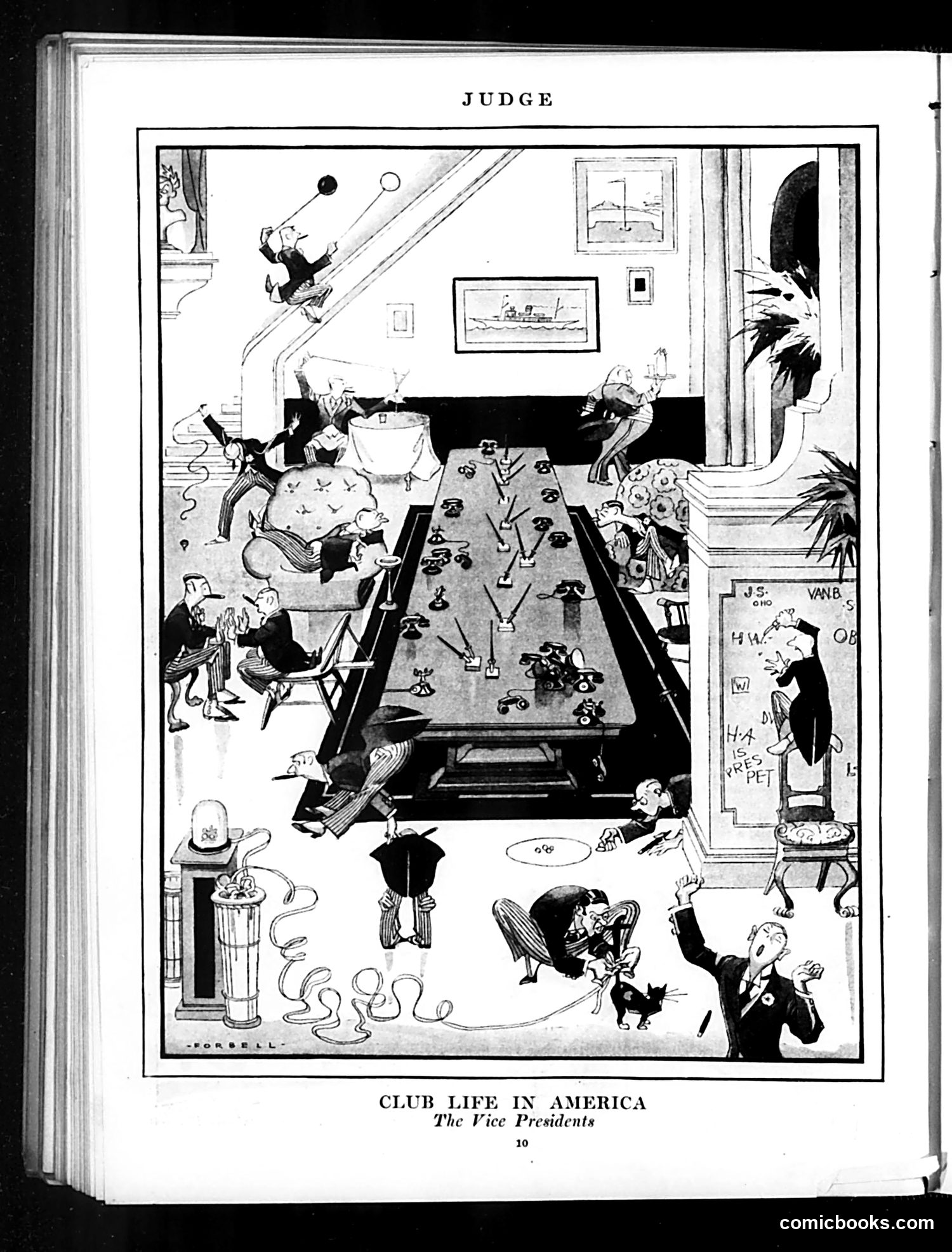
# Analysis of "Judge" Page: "Club Life in America - The Vice Presidents" This cartoon satirizes the leisure activities of American Vice Presidents through an elaborate club scene. The illustration depicts various figures engaged in frivolous pursuits—juggling, lounging, playing billiards, and socializing—within an ornate indoor setting with artwork and furnishings. The satire's point: Vice Presidents are portrayed as idle, ineffectual office-holders with nothing substantive to do but entertain themselves in exclusive clubs. This reflects a historical perception of the Vice Presidency as a ceremonial, powerless position unworthy of serious men. The cartoon mocks both the office itself and the type of privileged gentlemen who held it. The artist is signed "Forbel" (or similar). Without specific dates or identified individuals visible, the cartoon likely targets late-19th or early-20th-century Vice Presidents generally, rather than one particular administration.