
Judge, 1930-02-01 · page 15 of 36
Judge — February 1, 1930 — page 15: what you’re looking at
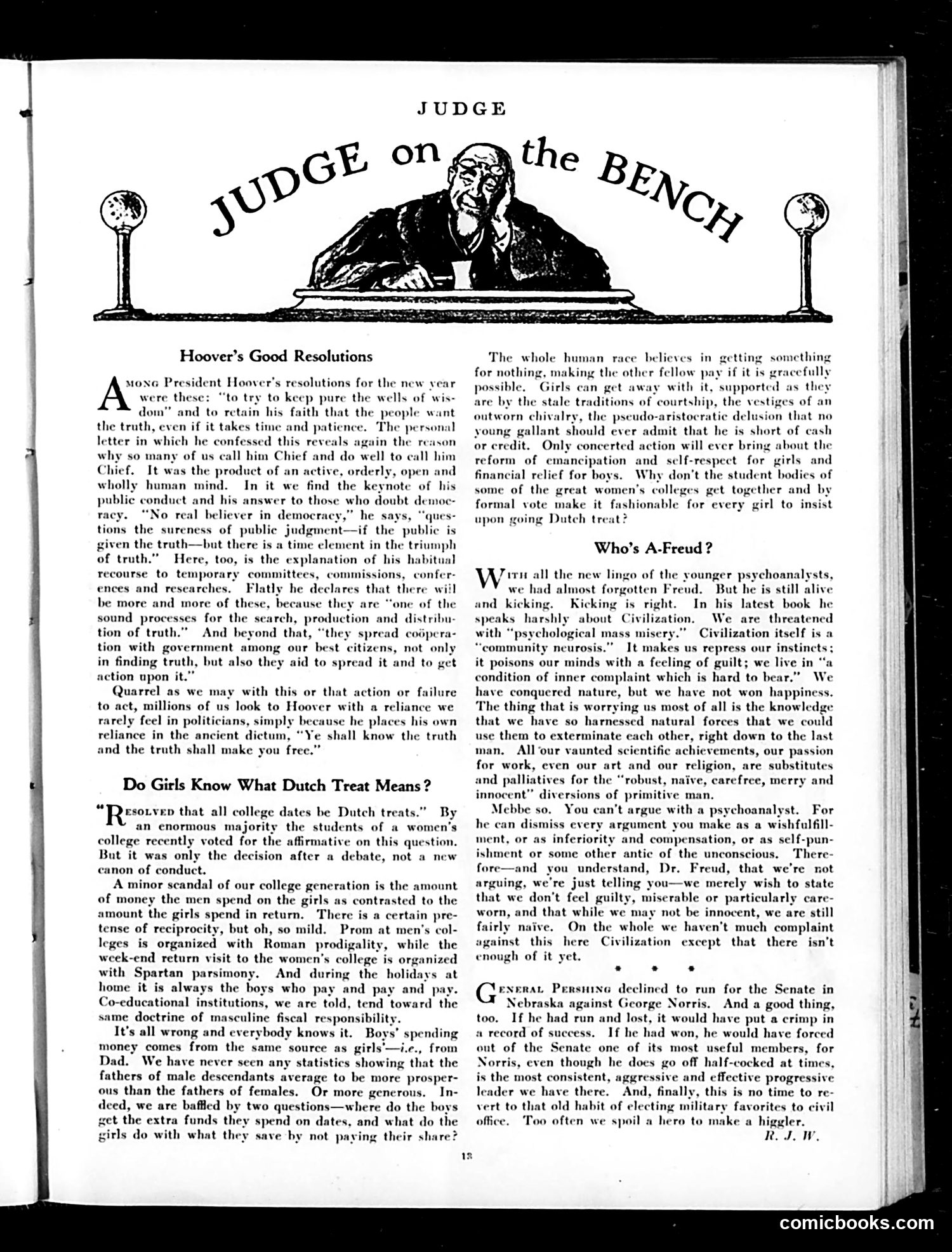
A restored page from Judge, 1930-02-01. Page through the whole issue in the reader above.
📄 Transcribed text from this page (OCR, searchable)
Machine-transcribed from the original scan — historical spelling and the odd misread are preserved.
i i Hoover’s Good Resolutions MONG President Hoover's resolutions for the new year A were these: “to try to keep pure the wells of wis- dom” and to retain his faith that the people want the truth, even if it takes time and patience. The personal letter in which he confessed this reveals again the re why so many of us call him Chief and do well to call | Chief. It was the product of an active, orderly, ope wholly human mind. public ¢ and In it we find the keynote of his nduct and his answer to those who doubt democ- . real believer in democracy,” he says, “ques- tions the sureness of public judgment—if the public is given the truth—but there is « nt in the triumph of truth.” Here, too, is the explanation of his habitual recourse to temporary committees, commissions, confer- Flatly he deel there will be more and more of these, because they one of the sound processes for the search, production and distribu- tion of truth.” And beyond that, “they spread codpera tion with government among our best citizens, not only in finding truth, but also they aid to spread it and to get action upon i Quarrel as we may with this or that action or failure to act, millions of us look to Hoover with a reliance we feel in politicians, simply because he places his own reliance in the ancient dictum, “Ye shall know the truth and the truth shall make you free.” ences and researches. Do Girls Know What Dutch Treat Means ? “R soLveD that all college dates be Dutch treats.” By an enormous majority the students of a women’s college recently voted for the affirmative on this question. But it was only the decision after a debate, not a new canon of conduct. A minor scandal of our college generation is the amount of money the men spend on the girls as contrasted to the amount the girls spend in return. There is a certain pre- tense of reciprocity, but oh, so mild. Prom at men’s col- leges is organized with Roman prodigality, while the week-end return visit to the women’s college is organized with Spartan parsimony. And during the holidays at home it is always the boys who pay and pay and p: Co-educational institutions, we are told, tend toward the same doctrine of masculine fiscal responsibilit It’s all wrong and everybody knows it. Boys’ spending money comes from the same source as girls'—i.e., from Dad. We have never seen any statistics showing that the fathers of male descendants average to be more prosper- ous than the fathers of females. Or more generous. In- deed, we are baffled by two questions—where do the boys get the extra funds they spend on dates, and what do th girls do with what they save by not paying their share? The whole human ri lieves in getting something for nothing, making the other fellow pay if it is gracefully possible. Girls can get away with it, supported : are by the stale traditions of courtship, the vestig outworn chivalry, the pseudo-aristocratic delusion that no young gallant should ever admit that he is short of cash or credit. Only concerted action will ever bring about the reform of emancipation and self-respect for girls and financial relief for boys. Why don’t the student bodies of some of the great women’s colleges get together and by formal vote make it fashionable for every girl to insist upon going Duteh treat? Who's A-Freud ? Jiri all the new lingo of the younger psychoanalysts, we had almost forgotten Freud. But he is still alive and kicking. Kicking is right. In his latest book he speaks harshly about Civili We are threatened with “psychological mass misery.” Civilization itself is a “community neurosis.” It makes us repress our instincts it poisons our minds with a feeling of guilt; we live in condition of inner complaint which is hard to bear.” We have conquered nature, but we have not won happiness. ‘The thing that is worrying us most of all is the knowledge that we have so harnessed natural forces that we could use them to exterminate each other, right down to the last man. All ‘our vaunted scientific achievements, our passion for work, even our art igion, are substitutes nd palliatives for the , carefree, merry and nocent” diversions of primitive man, Mebbe so. You can't argue with a psychoanalyst. For he can dismiss every argument you make as a wishfulfill- ment, or as inferiority and compensation, or a If-pun- ishment or some other antic of the unconscior There- fore—and you understand, Dr. Freud, that we're not arguing, we're just telling you—we merely wish to state that we don’t feel guilty, miserable or particularly ca: worn, and that while we may not be innocent, we are still fairly naive. On the whole we haven't much complaint ainst this here Civilization except that there isn’t enough of it yet. G erat Persuino declined to run for the Senate in Nebraska against George Norris. And a good thing, too. If he had run and lost, it would have put a crimp in a record of success. If he had won, he would have forced out of the Senate one of its most useful members, for Norris, even though he docs go off half-cocked at times, is the most consistent, aggressive and effective progres der we have there. And, finally, this is no time to re- vert to that old habit of electing military favorites to il office. Too often we spoil a hero to make a higgler. RILW. * . . Se woe comicbooks.com