
Judge, 1930-02-01 · page 18 of 36
Judge — February 1, 1930 — page 18: what you’re looking at
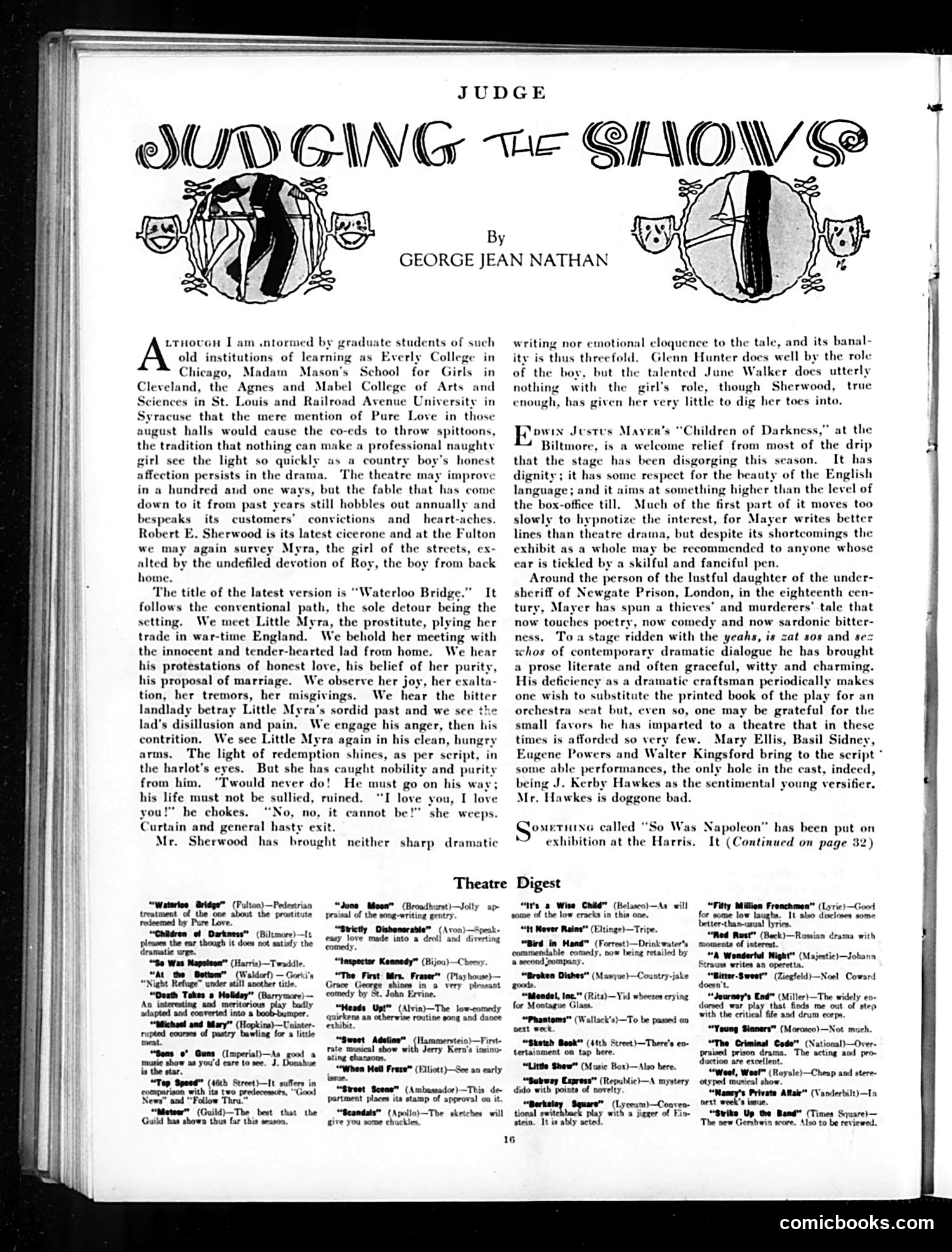
A restored page from Judge, 1930-02-01. Page through the whole issue in the reader above.
📄 Transcribed text from this page (OCR, searchable)
Machine-transcribed from the original scan — historical spelling and the odd misread are preserved.
SUD JUD By Hoven I am .ntormed by graduate students of such old institutions of learning as Everly College in Chicago, Madam Mason’s School for Girls in nd, the Agnes and Mabel College of Arts and Sciences in St. Louis and Railroad Avenue Uni ty in Syracuse that the mere mention of Pure Love in those august halls would cause the co-eds to throw spittoons, the tradition that nothing can make a professional naughty girl see the light so quickly as a country boy’s honest affection persists in the drama, The theatre may improve in a hundred and one ways, but the fable that has come down to it from past years still hobbles out annually and bespeaks its customers’ convictions and heart-aches. Robert E. Sherwood is its latest cicerone and at the Fulton we may again survey Myra, the girl of the streets, e3 alted by the undefiled devotion of Roy, the boy from back hom. The title of the latest version is “Waterloo Bridge.” It follows the conventional path, the sole detour being the setting. We meet Little Myra, the prostitute, plying her trade in war-time England. We behold her meeting with the innocent and tender-hearted lad from home. We hear his protestations of honest love, his belief of her purit his proposal of marriage. We observe her joy, her exalt: tion, her tremors, her misgivings. We hear the bitter landlady betray Little Myra’s sordid past and we see ¢? We engage his anger, then his contrition. We see Little Myra again in his clean, hungry arms. The light of redemption shines, as per script, in the harlot’s eyes. But she has caught nobility and purity from him. "Twould never do! He must go on his way his life must not be sullied, ruined. “I love you, I love you!” he chokes. “No, no, it cannot be!" she weeps. Curtain and general hasty exit. Mr. Sherwood has brought neither sharp dramatic Theatre “dune Meee” (Broadhurst) —Jolly ap- “Watertoe Bridge” (Pulton)—Pedestrian Praisal of the song-writing gentry. treatment of the coe about the prostitute deemed by Pure bey wis ts - ty _“Stlethy Dishonorabie” (A vo0)—Speak- “Chlidren of Darkness” (Biltmore)—It easy love made into a droll and diverting pleases the ear though it does not satisfy the f° 4° ‘dramatic urge. noe “$e Was Napoleon” (Harris)—Twaddle “Aaspector Kennedy” (Bijou) —Cheesy. SAL, Se Botte” (Waldo) —Gork's Tha Fist Mra. Fraser (Phyo “Night Refuge” under still another title. Grace George shines in a very pleasant comedy by St. John Ervine. Barrymore As Interesting snd meritarious badly “Heads Upt” (Alvin)—The low-comety slapted and converted into a mayer. quickens an Servier routine gong and dance “Michael and Mary" (Hopkins) —Uniater- exhibit rupted coors of pastry bavling for a title “a ; Be bias e musical show with Jerry Kern's insinu- tose of Gone (mperiat)—As good aT music show as you'd care to see. J. Donahue “ing chansons. is the star. _ “When Hell Frere” (Elliott)—See an early “Top Speed” (46th Street)—It suffers in commatonn mith is two peplecomts, Cont “$¥eet Scene (Ambawador)—This de News” aad “Follow Thru.” partment places its stamp of approval on it. “teteer” (Guild)—The best that the “Beandals” (Apollo)—The sketches will Guild bas shown thus far this season. sive you some chuckles, NG we GAOWS GEORGE JEAN NATHAN GE writing nor emotional eloquence to the tale, and its banal- ity is thus thre jd. Glenn Hunter does well by the role of the boy, but the talented June Walker does utterly nothing with the girl's role, though Sherwood, true enough, has given her very little to dig her toes into. GYpwin Justus Mayer’s “Children of Darkness,” at the Biltmore, is a welcome relief from most of the drip that the stage has been disgorging this season, It has dignity; it has some respect for the beauty of the English language; and it aims at something higher than the level of the box-office till. Much of the first part of it moves too slowly to hypnotize the interest, for Mayer writes better lines than theatre drama, but despite its shortcomings the exhibit as a whole may be recommended to anyone whose ear is tickled by a skilful and fanciful p Around the person of the lustful daughter of the under- sheriff of Newgate Prison, London, in the eighteenth cen- tury, Mayer has spun a thieves’ and murderers’ tale that now touches poetry, now comedy and now sardonic bitter- ness. To a stage ridden with the yeahs, is zat sos and sez whos of contemporary dramatic dialogue he has brought a prose literate and often graceful, witty and charming. His deficiency as a dramatic craftsman periodically makes one wish to substitute the printed book of the play for an orchestra seat but, even so, one may be grateful for the small favors he has imparted to a theatre that in these times is afforded so very fe Mary Ellis, Basil Sidney, Eugene Powers and Walter Kingsford bring to the script * some able performances, the only hole in the cast, indeed, being J. Kerby Hawkes as the sentimental young versifier. Mr. Hawkes is doggone bad. Goueritxe called “So Was Napoleon” exhibition at the Harris. has been put on It (Continued on page 32) Digest 16 “I's a Wise Child” (Belusco)—As will some of the low cracks in this one. “tt Never Rains” (Eltinge)—Tripe. “Bird in Hand” (Forrest) —Drink water's commendable comedy, now being retailed by 18 second jeompany. “Broken Dishes” (Mawyue)—Country-jake foots, “Mendel, tne.” (Rits)—Yid wheezes crying for Montague Glass. “Phantoms” (Wallack’s)—To be passed oo vert weck “Skated Book” (41th Street) —There’s en- tertainment on tap bere. “Little Show™ (Music Bor)— Also here. “Subway Express” (Republic)—\ mystery dido with points of novelty (Lyceum)—Coavea- tional switehback play with a figeer of Fine stein. Tris ably acted. “Fitty Million Freachmen” (Lyrie}—Goot for some low laughs. It also discloses some better-than-asual lyrics. “Red Rast” (Beck)—Rossian drama with moments of interest. “A Wondertl Might” (Majestie)—Jobana Strauss writes an operetta. ‘“Bitter-Sweet” (Ziegfeld)—Noel Coward doesn't. “Journey's End” (Miller)—The widely en- domed war play that finds me out of step with the critical fife and drum corps. “Young Sinners” (Morceco)—Not much. “The Criminal Code” (National)—Over- praised prison drama. The acting and pro- duction are excellent. “weet, Wor 1 (Rarele)—Cheap and stere- ryed, musical vires ‘Aftaie™ (Vanderbilt) In next week's isue. “Svike Up the Band” (Times Square)— ‘The new Gershwin scare. Also to be reviewed. comicbooks.com