
Judge, 1930-02-01 · page 27 of 36
Judge — February 1, 1930 — page 27: what you’re looking at
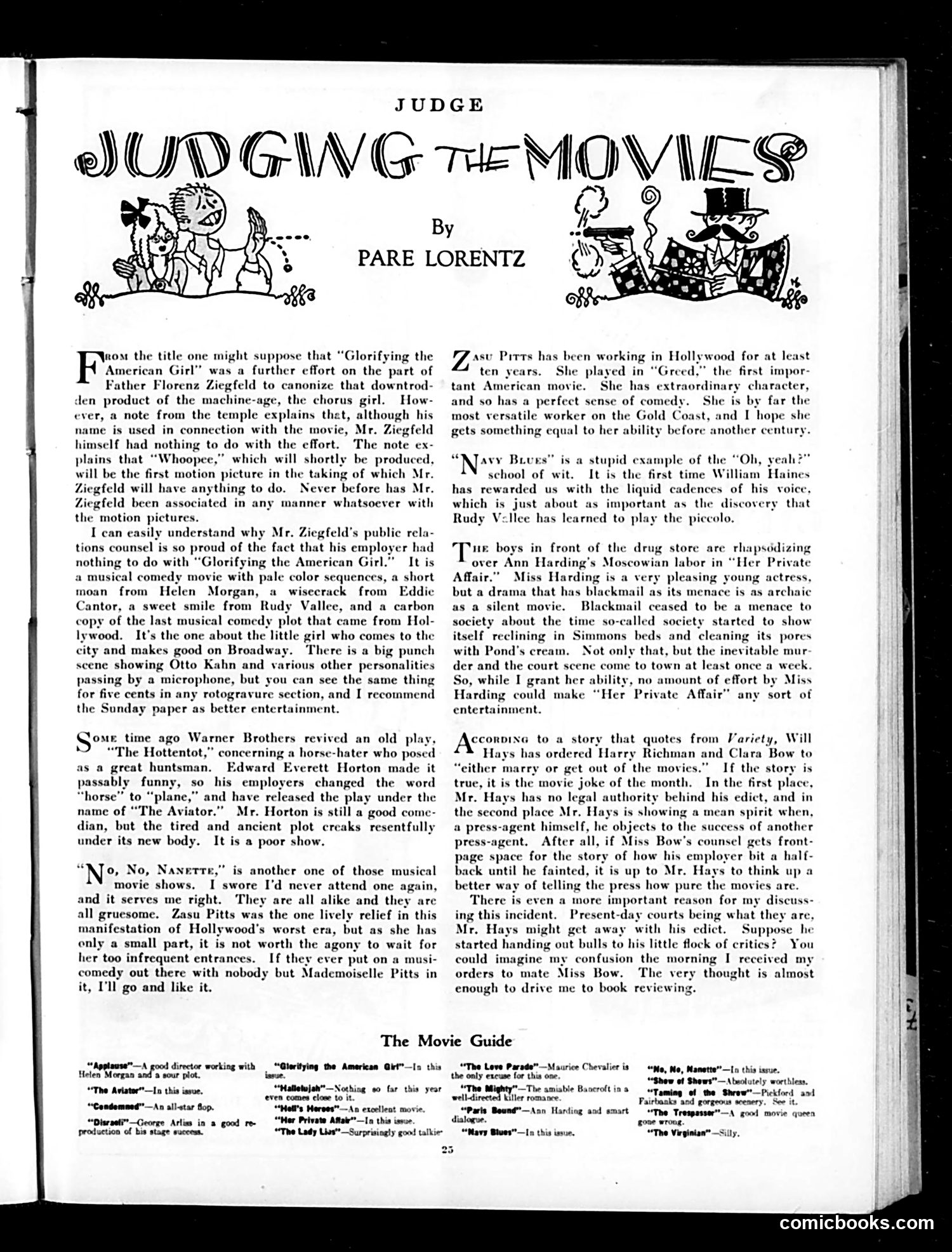
A restored page from Judge, 1930-02-01. Page through the whole issue in the reader above.
📄 Transcribed text from this page (OCR, searchable)
Machine-transcribed from the original scan — historical spelling and the odd misread are preserved.
JUDGE JUVGWG THe MOY L$ By PARE LORENTZ nom the title one might suppose that “Glorifying the American Girl” was a further effort on the part of ‘ather Florenz Ziegfeld to canonize that downtrod- den product of the machine-age, the chorus girl. How- a note from the temple explains thet, although his » is used in conn th the movie, Mr. Ziegfeld himself had nothing to do with the effort. The note ex- ns that “Whoopee,” which will shortly be produced, l be the first motion picture in the taking of which Mr. egfeld will have any: thing to do. Never before has Mr. Ziegfeld been associated in any manner whatsoever with the motion pictures. I can easily understand wh tions counsel is so proud of the fact that his employer had nothing to do with “Glorifying the American Girl.” It is a musical comedy movie with pale color sequences, a short moan from Helen Morgan, a wisecrack from Eddie Cantor, a sweet smile from Rudy Vallee, and a carbon copy of the last musical comedy plot that came from Hol- lywood. It's the one about the little girl who comes to the city and makes good on Broadway. There is a big punch scene showing Otto Kahn and various other personalities passing by a microphone, but you can see the same thing for five cents in any rotogravure section, and I recommend the Sunday paper as better entertainment. Mr. Ziegfeld’s public rela- ed an old pl concerning a horse-hater who posc« Edward Everett Horton made it passably funny, his employers changed the word “horse” to “plane,” and have released the play under the name of “The Aviator.” Mr. Horton is still a good come- dian, but the tired and ancient plot creaks resentfully under its new body. It is a poor show. “N » No, Nanette,” is another one of those musical movie shows. I swore I'd never attend one again, and it serves me right. They are all alike and th all gruesome. Zasu Pitts was the one lively relief in this manifestation of Hollywood's worst era, but as she has only a small part, it is not worth the agony to wait for her too infrequent entrances. If they ever put on a musi- comedy out there with nobody but Mademoiselle Pitts in it, I'll go and like it. Some time ago Warner Brothers revi “The Hottentot,” as a great huntsman. 17,440 Prers has heen working in Hollywood for at least ten years. She played in “Greed,” the first. impor- tant American movie. She has extraordinary character, and so has a perfect sense of comedy. She is by far the most versatile worker on the Gold Coast, and I hope she gets something equal to her ability before another century. “Navy Buves” is a stupid example of the “Oh, yeah?” school of wit. It is the first time William Haines has rewarded us with the liquid cadences of his voice, which is just about as important as the discovery that Rudy Vellee has learned to play the piccolo. Mie boys in front of the drug store are rhapsodiz over Ann Harding's Moscowian labor in “Her Priv: Affair.” Miss Hardin very pleasing young actress, but a drama that has blac as its menace is as arc as a silent movie. Blackmail ceased to be a menace to society about the time so-called society started to show itself reclining in Simmons beds and cleaning its pores with Pond’s cream. Not only that, but the inevitable mur der and the court scene come to town at least once a week. So, while I grant her ability, no amount of effort by Miss Harding could 1 “Her Private Affair” any sort of entertainment. Ascoreixe to a story that quotes from Variety, Will Hays has ordered Harry Richman and Clara Bow to “either marry or get out of the movies.” If the story is true, it is the movie joke of the mont In the first | Mr. Hays has no legal authority behind his edict, and in the second place Mr. Hays is showing a mean spirit when, a press-agent himself, he objects to the success of another press-agent. After all, if Miss Bow's counsel gets front- page space for the story of how his employer bit a half- back until he fainted, it is up to Mr. Hays to think up a better way of telling the press how pure the movies are. There is even a more important reason for my discuss- ing this incident. Present-day courts being whs at they are, Mr. Hays might get away with his edict. Suppose he started handing out bulls to his little flock of critics? could imagine my confusion the morning I received my orders to mate Miss Bow. The very thought is almost enough to drive me to book reviewing. The Movie Guide director working with inlertrion the American Girt”—In this “The Love Parade” —M surice Chevalier is “Applause” — Heten Morgan and a sour plot. the only excuse for thia o: “The Avister”—In this inoue. Foie oe so far this year ‘The 2 even comes close to it “Condemned” —An all-star flop. “Hell's Herees”—An excellent movie. “Disraeli” —George Arliss in a good re “Her Private Aftair”—In this insur. production of bis stage success. “The Lady Lise” —Surprisingly good talkie “Me, Me, Manette” —In this issue. “Show of Shows” —Abwolutely worthless. —The amiable Bancroft ina « Shrew” —Pickfo well-direeted killer romance Paitanks nod gorgeous wemery Ber ts “Paris Beund”—Ann Harting aod smart — “The Trespasser”—A good movie queen dialogue. gone wrong. “Mary Blues” —Io this issue. “The Vieginian” —Silly. comicbooks.com