A complete issue · 36 pages · 1930
Judge — January 18, 1930
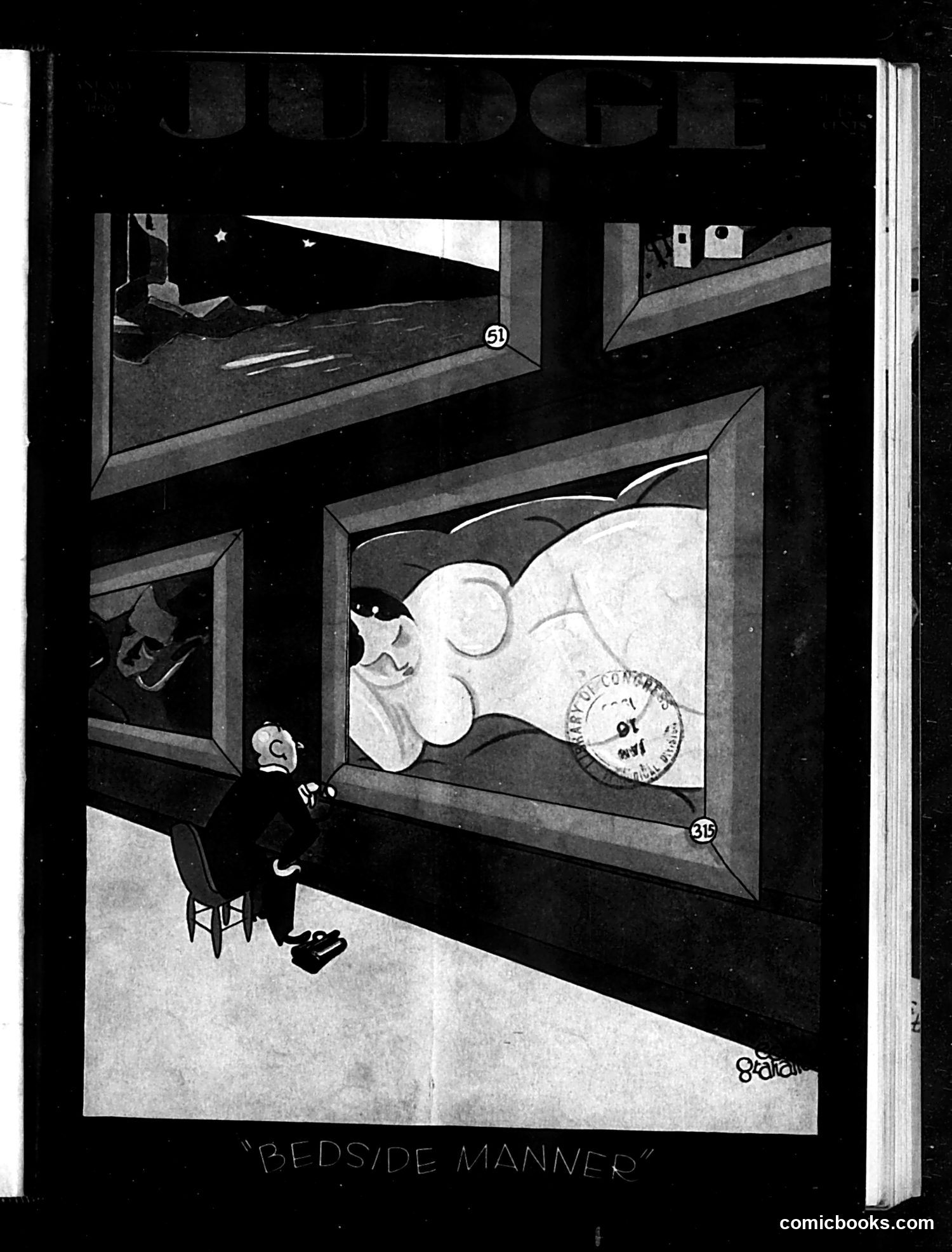
# "Bedside Manner" This cartoon satirizes medical theater and public spectacle in early 20th-century America. A well-dressed man sits observing a large framed display of what appears to be a medical procedure or patient examination. The theatrical staging—with dramatic lighting, an audience setup, and the formal framing—suggests doctors were treating medical cases as public entertainment rather than private professional matters. The title "Bedside Manner" is ironic: traditionally this phrase means a physician's professional demeanor toward patients, implying sensitivity and care. Here, the satire critiques physicians who prioritized public attention and sensationalism over patient privacy and genuine medical ethics. The cartoon mocks the era's tendency toward medical exhibitions and celebrity doctors performing for crowds.
# The New Marmon Big Eight This page is primarily an **advertisement for the Marmon Motor Car Company's Big Eight automobile**. The text emphasizes the vehicle's performance features: power at all speeds, "Spacious Inside" with extra-wide seating, and fine engineering details. The dramatic black-and-white photograph shows the car's distinctive dual exhaust pipes photographed from above, highlighting the vehicle's mechanical sophistication and power. The styling and layout suggest this is a **luxury car advertisement positioned as a prestige product** for affluent consumers. This is not political satire but rather a **high-end automotive advertisement** using Judge magazine's premium advertising space to reach its educated, wealthy readership during the automobile boom era (appears to be 1920s-1930s based on styling).
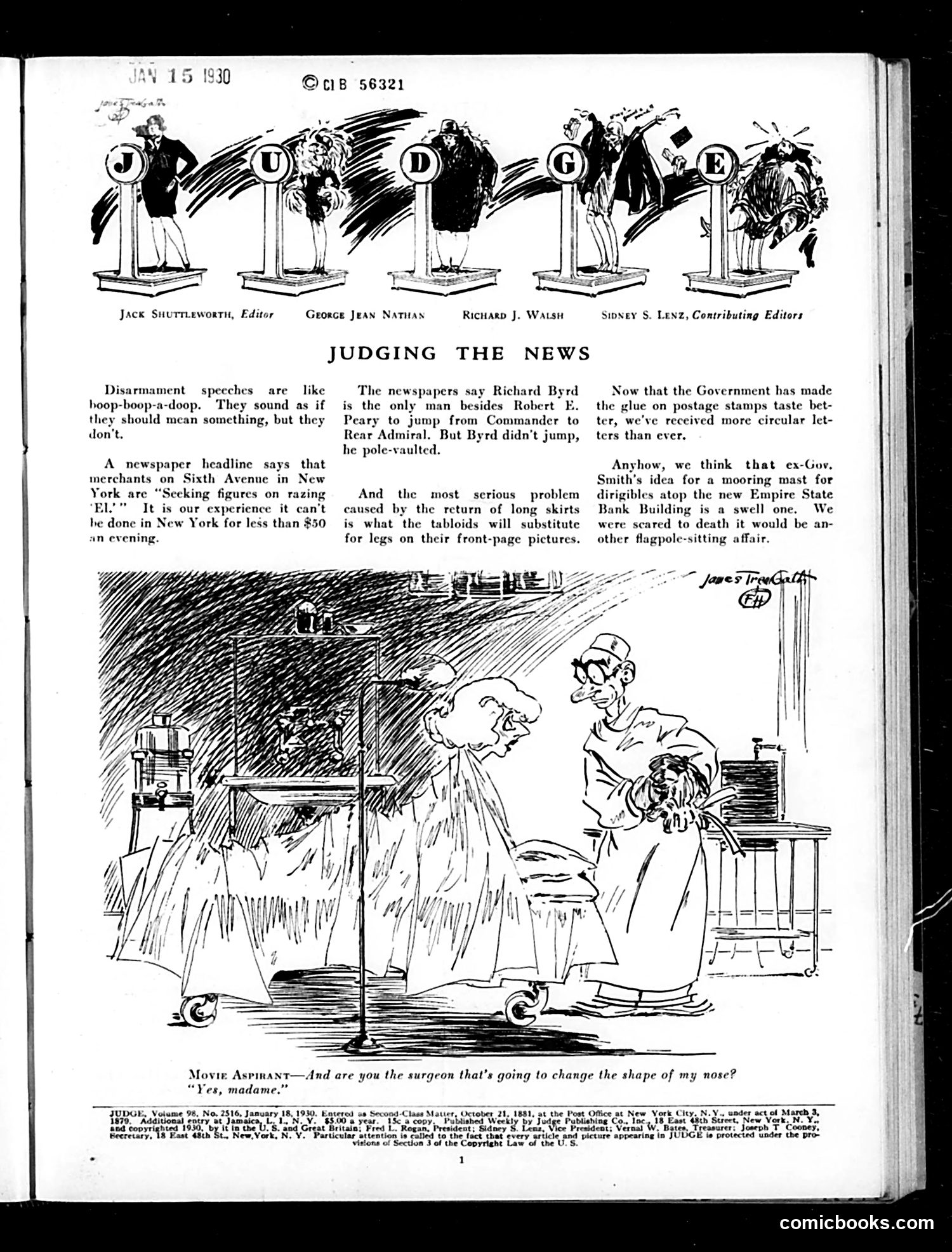
# Analysis of Judge Magazine Page (January 15, 1930) The page's main cartoon depicts a "Movie Aspirant" asking a surgeon: "And are you the surgeon that's going to change the shape of my nose?" This satirizes 1930s Hollywood culture, where aspiring actresses pursued cosmetic surgery to achieve fashionable looks—reflecting both the industry's appearance obsession and the emerging cosmetic surgery industry. The upper section, titled "Judging the News," contains brief editorial commentaries mocking various current events: disarmament speeches, merchant pricing on Sixth Avenue, Richard Byrd's Antarctic expedition, long skirts returning to fashion, and proposed public works projects like a mooring mast for airships near the Empire State Building. The magazine lampoons contemporary news and cultural trends through satirical humor.
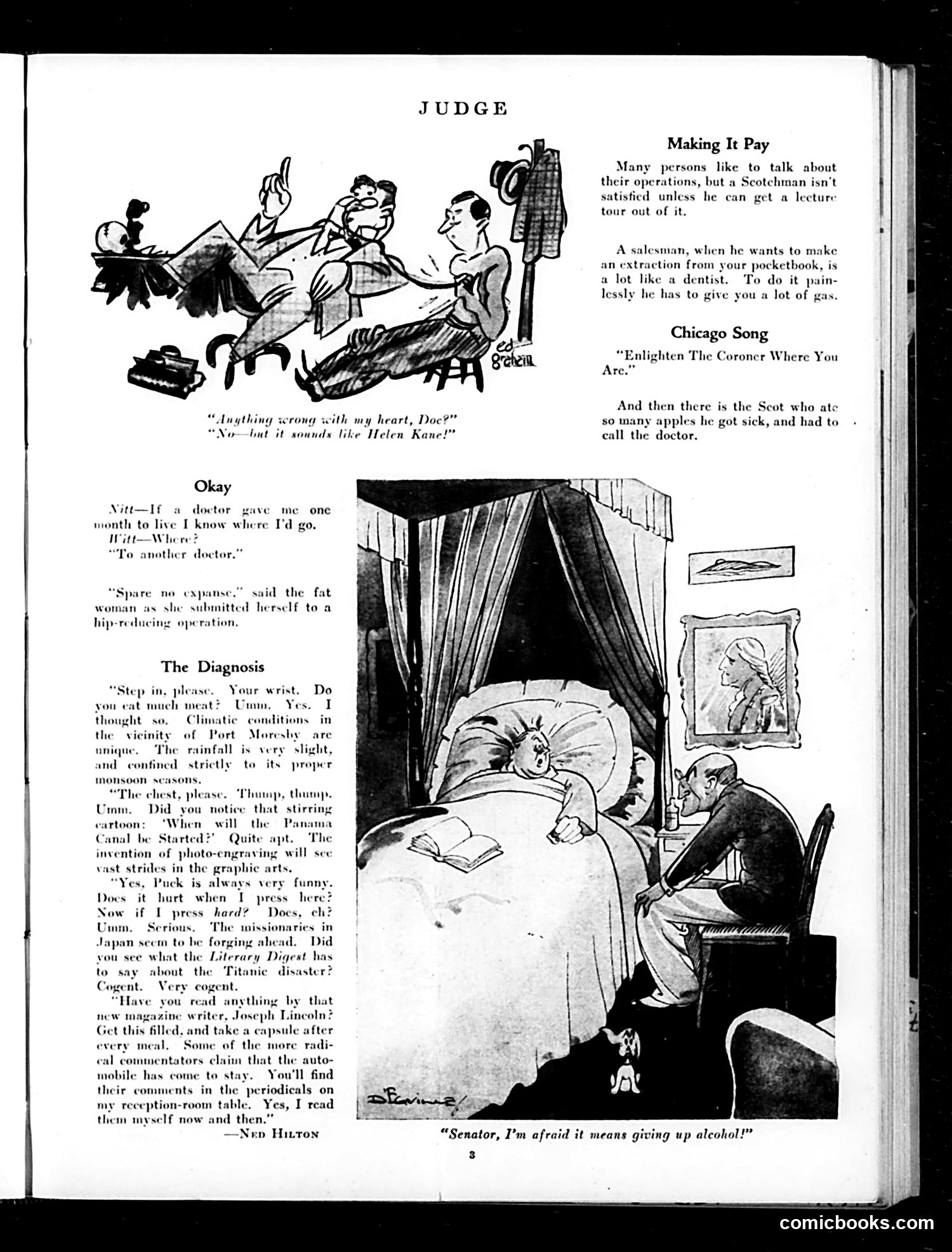
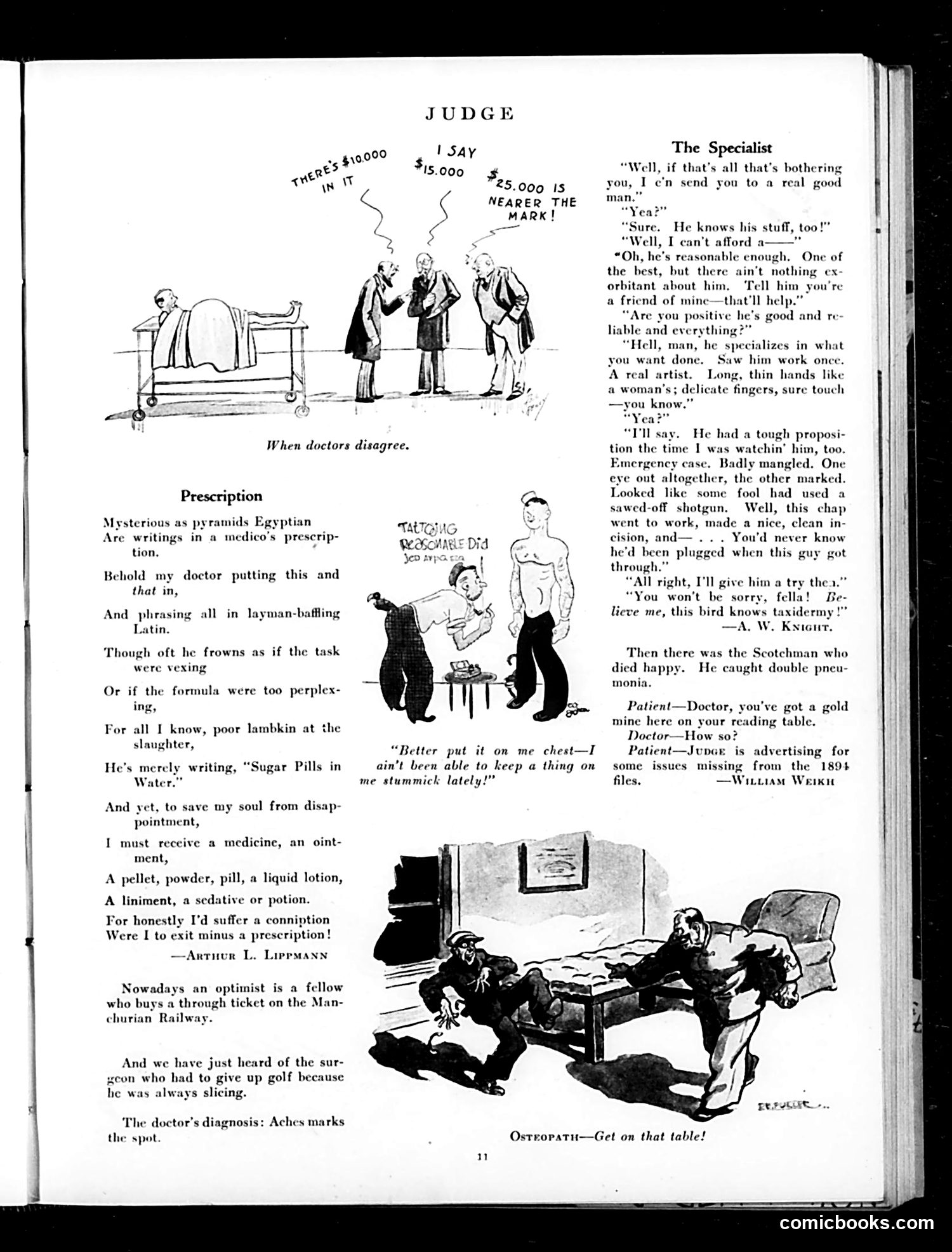
# Analysis of Judge Magazine Page This page contains three separate humor sections satirizing doctors and medical practice. **Top cartoon**: Shows a patient complaining to a doctor about heart problems, with the doctor suggesting the patient resembles "Helen Kane"—likely referencing the 1920s "Boop-Boop-a-Doop" singer. The joke plays on the patient's physical appearance. **"Okay" section**: Satirizes doctors' financial motivations, showing a patient asking where to go if dissatisfied—the punchline being "another doctor," suggesting doctors primarily care about fees. **"The Diagnosis" section**: Features a lengthy monologue from a doctor examining a patient, showcasing medical jargon and pretentious name-dropping (Literary Digest, Titanic disaster, Joseph Lincoln). The accompanying illustration shows a senator in a patient's bed, with the caption "Senator, I'm afraid it means giving up alcohol!"—satirizing politicians' fondness for drinking during Prohibition.
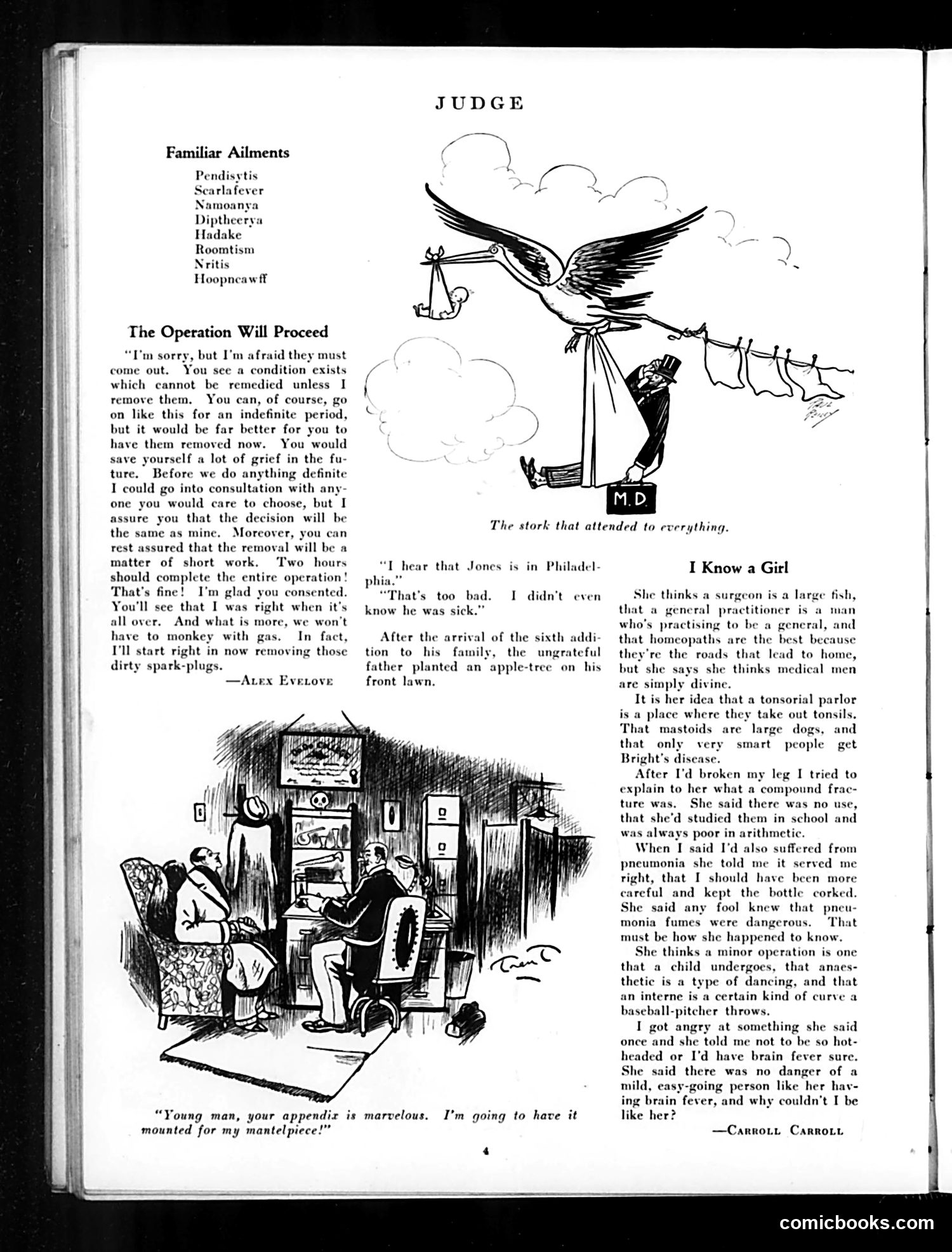
# Analysis of Judge Magazine Page This page contains three separate pieces: 1. **"Judge" (top)**: A stork cartoon delivering a baby to a doctor marked "M.D." — a visual pun on doctors "delivering" babies, mocking medical professionals. 2. **"The Operation Will Proceed"**: A medical consultation scene where Dr. Alex Evelove advises a patient about surgery. The satire targets both doctors' authority and patients' blind trust in medical expertise. The joke centers on removing "dirty spark-plugs" — treating the human body mechanically rather than medically. 3. **"I Know a Girl"**: Carroll Carroll's humorous piece about a woman with absurd misconceptions about medicine — confusing surgeons with fish, thinking tonsils are large dogs, misunderstanding fractures and pneumonia. It satirizes public medical ignorance of the era. All three pieces mock both medical professionals and public understanding of medicine.
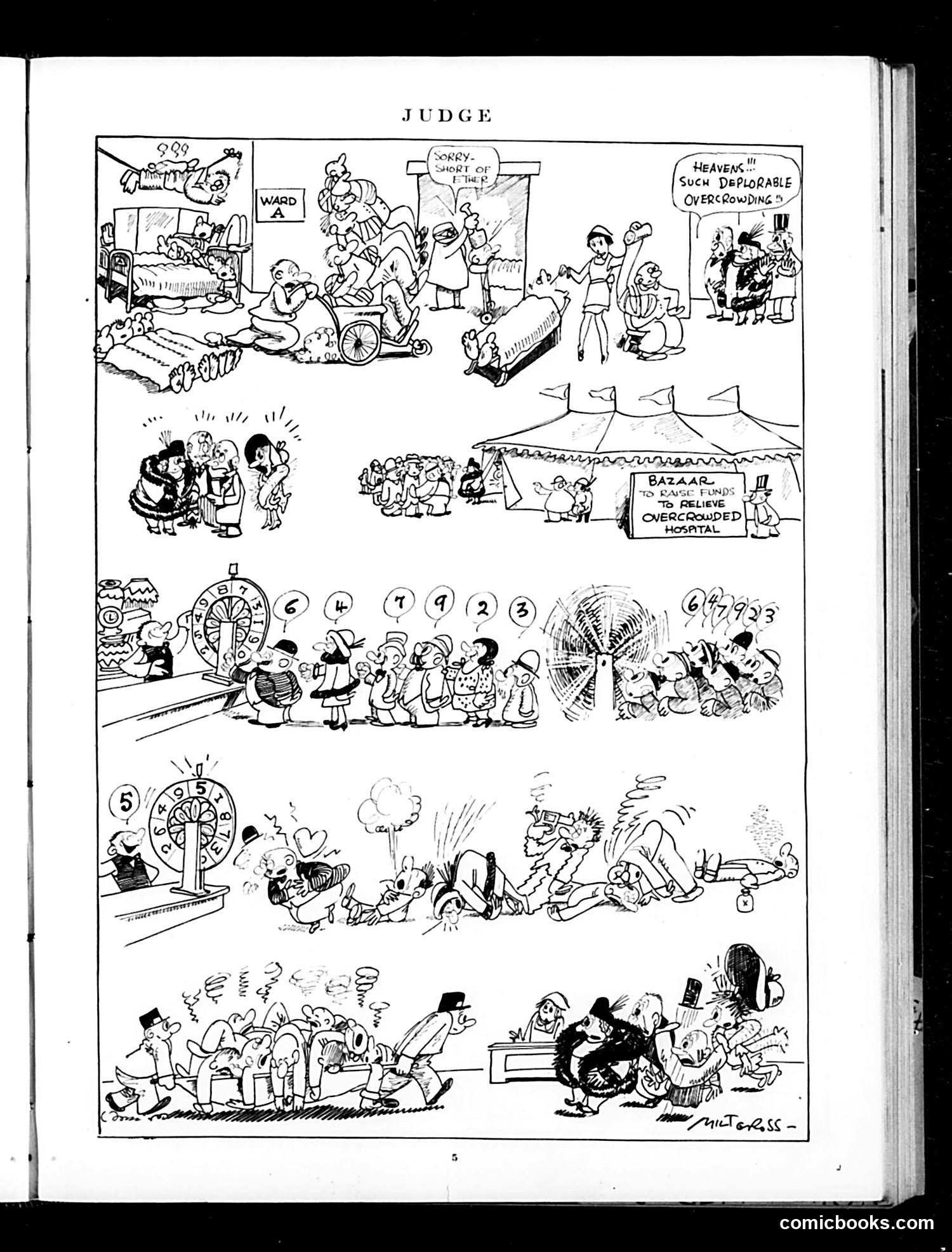
# Political Cartoon Analysis: "Judge" Page - Hospital Overcrowding This satirical page critiques severe hospital overcrowding in early 20th-century America. The top panel shows a chaotic ward and a bazaar fundraiser "to relieve overcrowded hospital," suggesting charitable efforts were inadequate to address the crisis. The numbered sequences below depict people literally being processed through a wheel-like apparatus and dispensed like products, visual metaphors for hospital inefficiency. One panel shows a fan creating chaos among patients—perhaps commenting on inadequate ventilation or poor facility conditions. The final panel depicts patients and staff in disarray, emphasizing administrative breakdown. The overall message satirizes how overcrowded hospitals dehumanized patients, treating them as objects rather than individuals requiring care. The cartoon advocates for better hospital infrastructure and capacity.
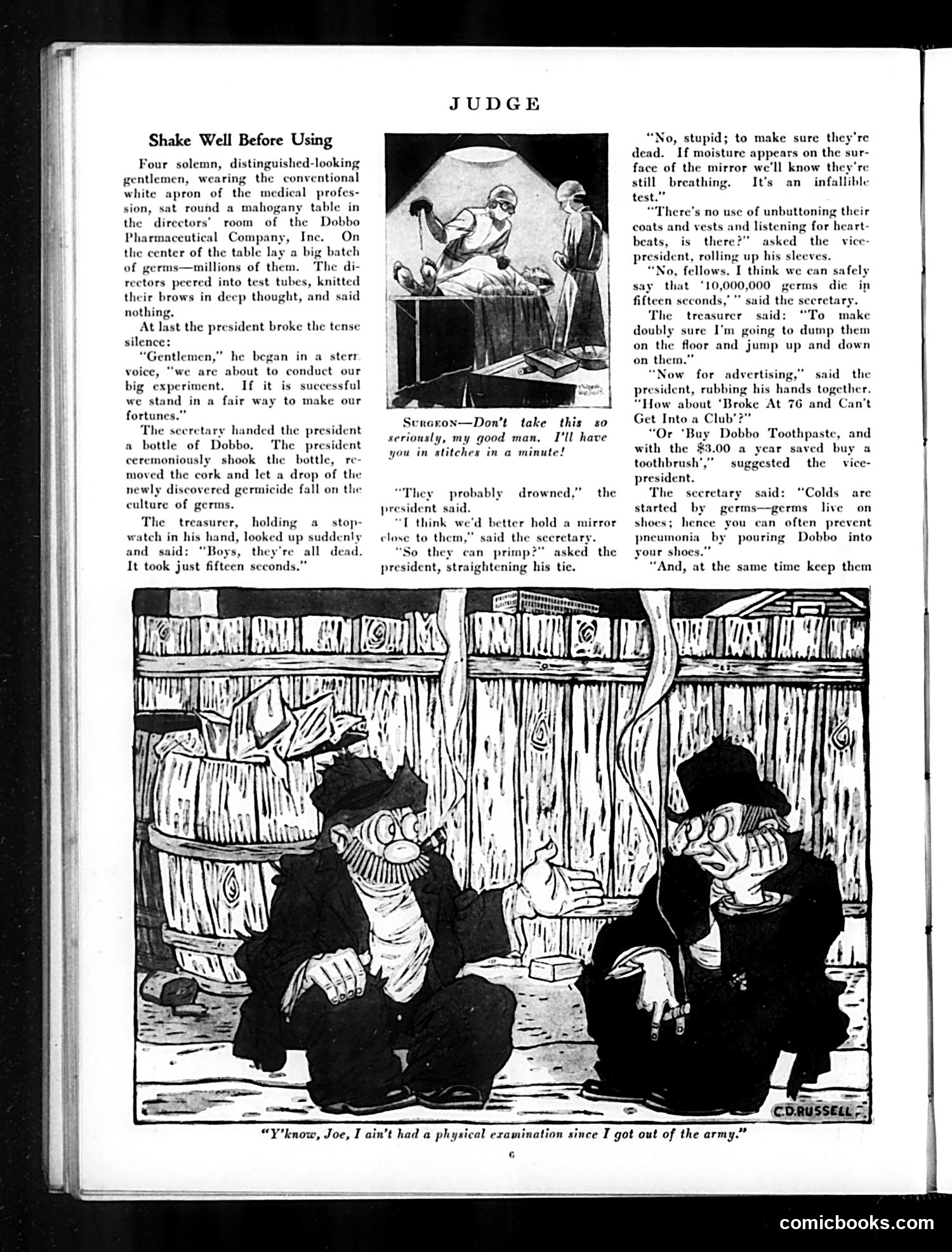
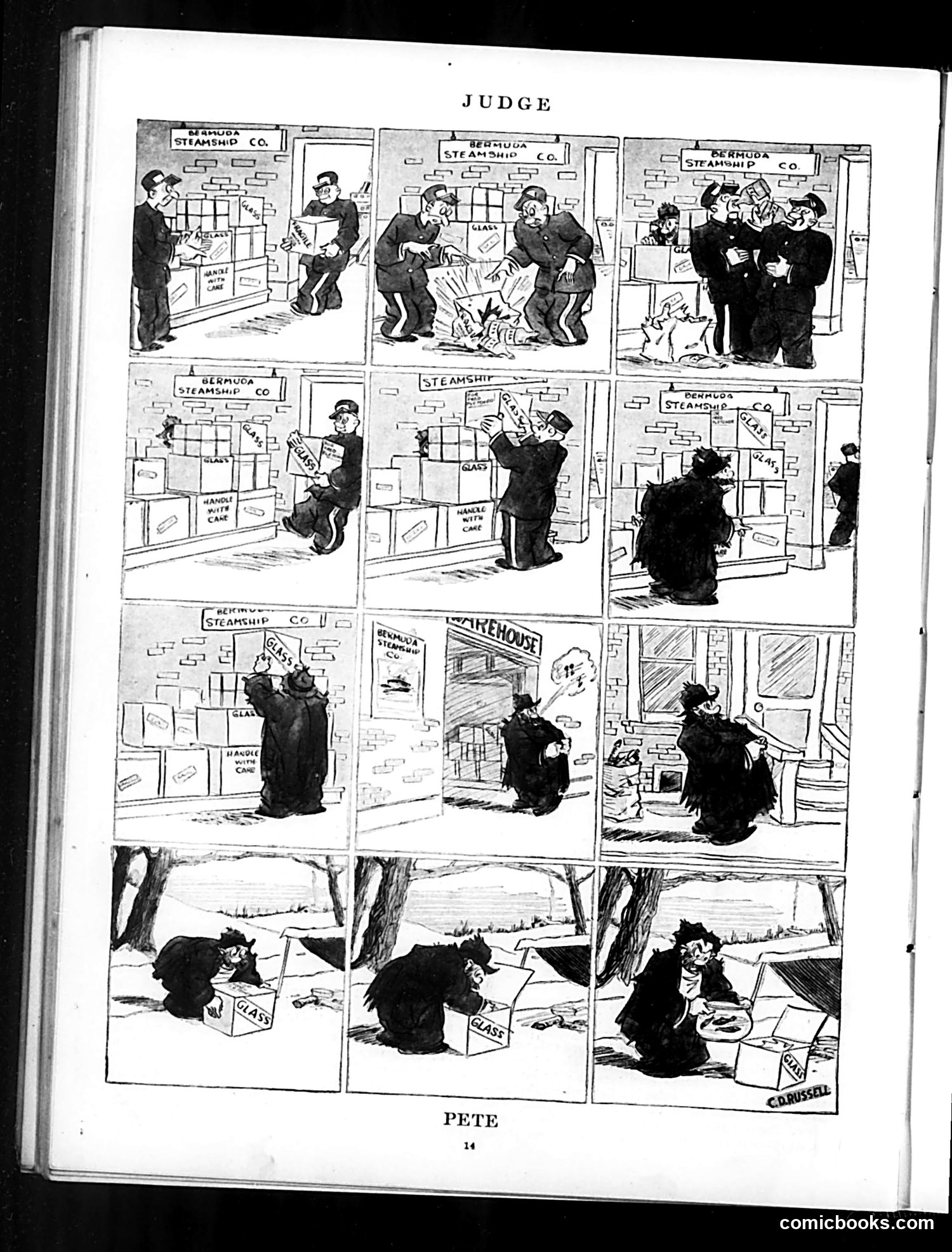
# Judge Magazine Page Analysis This page satirizes early 20th-century anxieties about germs and hygiene products. The top cartoon depicts executives of the Dobbo Pharmaceutical Company conducting a bizarre experiment with a culture of germs, appearing to test whether germs can survive various treatments. The humor relies on the absurdity of treating this dangerous experiment as a casual business meeting. The bottom cartoon, credited to C.D. Russell, shows two men in what appears to be a basement or warehouse, with the caption "Y'know, Joe, I ain't had a physical examination since I got out of the army." This jokes about poor hygiene and lack of medical care among working-class or vagrant men, reflecting Depression-era concerns about public health and economic hardship.
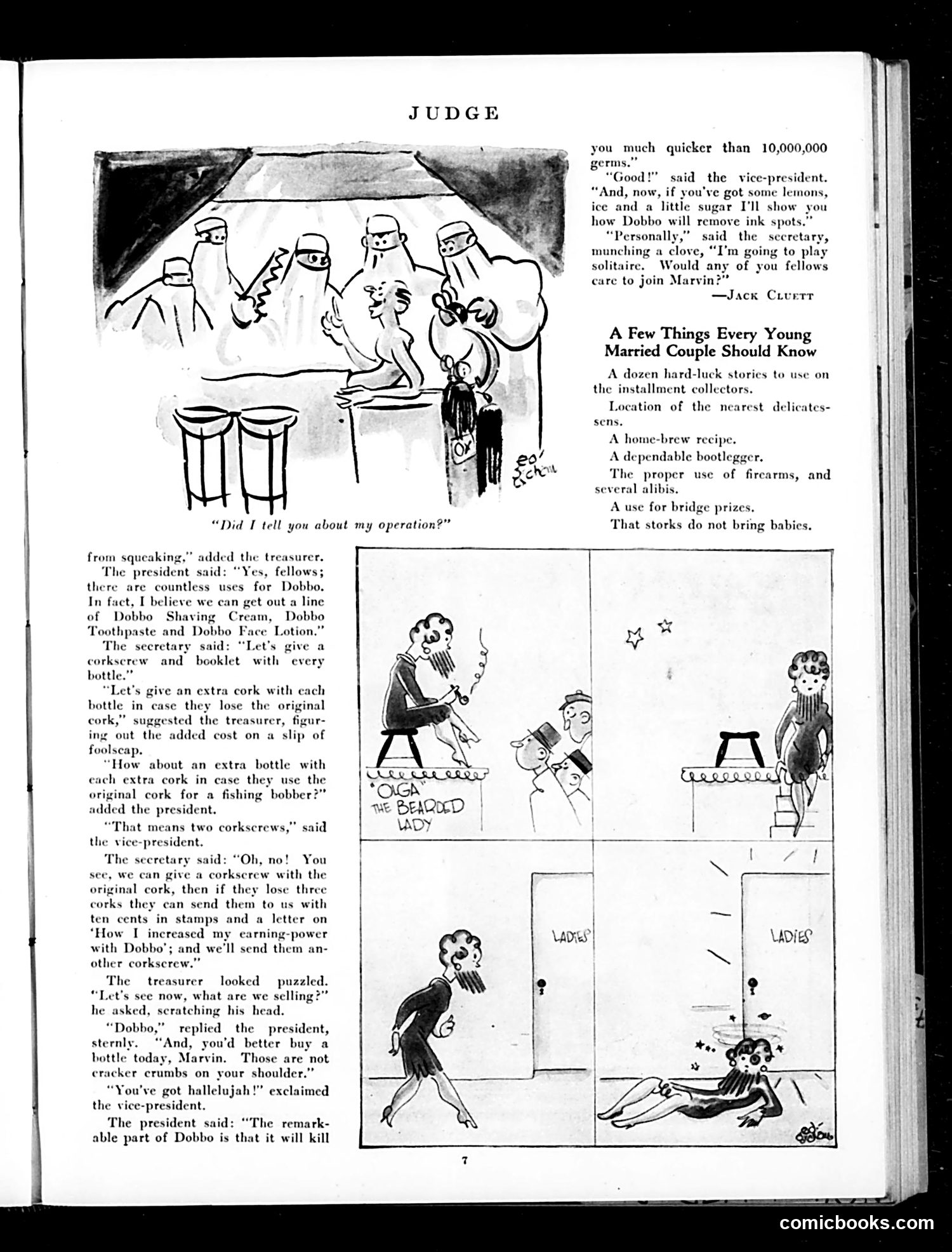
# Satire Explanation for Modern Readers This page satirizes corporate marketing excess during Prohibition-era America (1920s-30s). The top cartoon mocks a fictional product called "Dobbo"—a cure-all cleaner. Company executives obsess over increasingly absurd marketing schemes: bundling corks, offering extra bottles, creating promotional contests around trivial uses. The joke exposes how corporations manufacture artificial "added value" to justify inflated prices. The lower comic strip, "A Few Things Every Young Married Couple Should Know," darkly satirizes 1920s marriage realities: dealing with debt collectors, home-brewed alcohol (illegal under Prohibition), bootleggers, firearms, and alibis. The punchline—that "storks do not bring babies"—suggests young couples need practical sex education, a scandalous topic for the era. Both items mock commercial manipulation and social hypocrisy during Prohibition's reign.
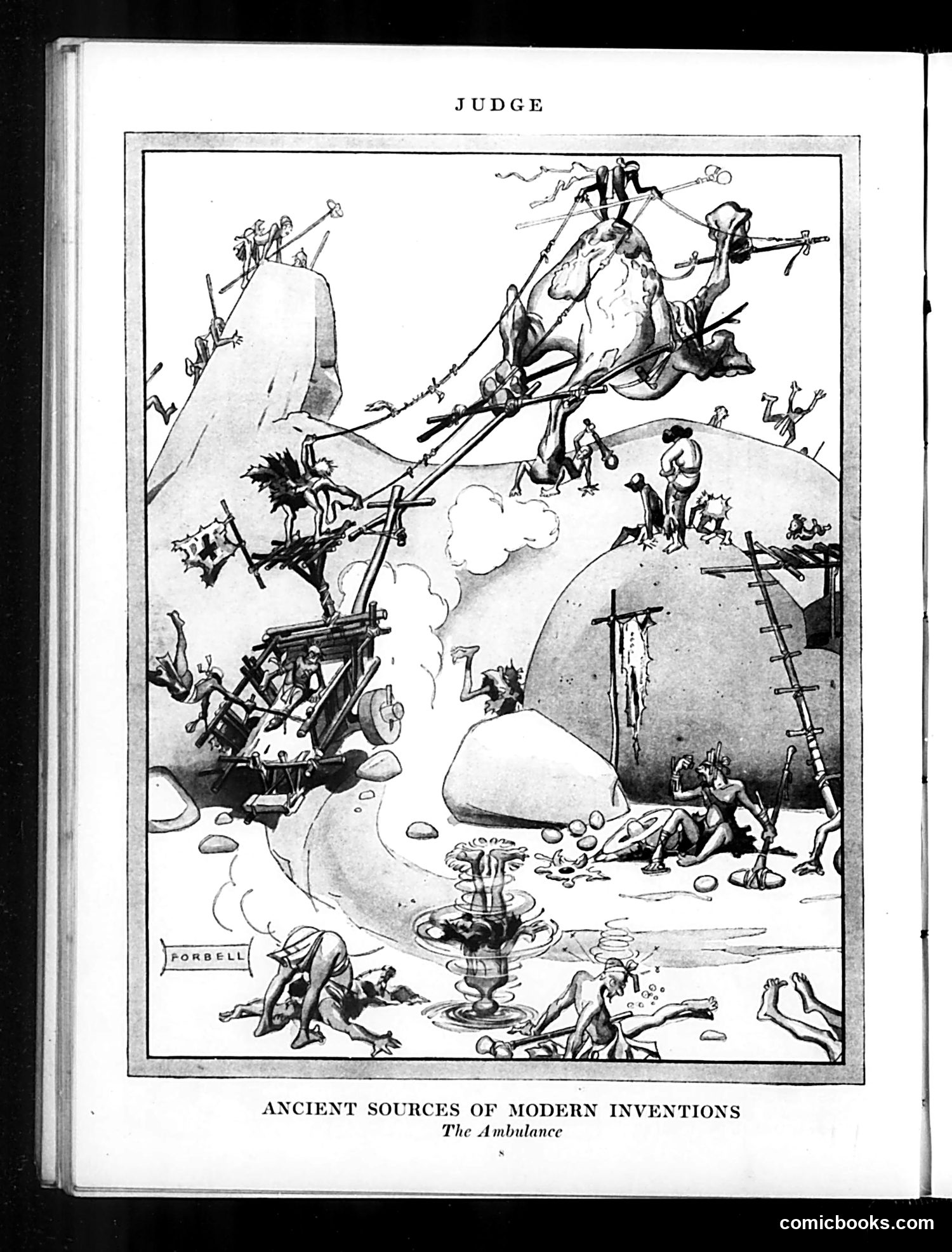
# Analysis This cartoon satirizes the ambulance as a "modern invention" by tracing its concept back to ancient times. The central image depicts a chaotic scene with tiny figures operating various primitive contraptions and mechanisms across surreal, boulder-like landscapes. The satire suggests that ambulances—seemingly modern medical vehicles—actually derive from ancient, crude methods of transporting the injured or sick. The elaborate mechanical devices, pulleys, and makeshift stretchers shown humorously illustrate how people have always improvised ways to move patients, whether through sophisticated modern means or primitive ancestral methods. The cartoonist (signed "Forbell") uses exaggeration and absurdist imagery to make a pointed joke: there's nothing truly new under the sun—we're simply refinishing old ideas.
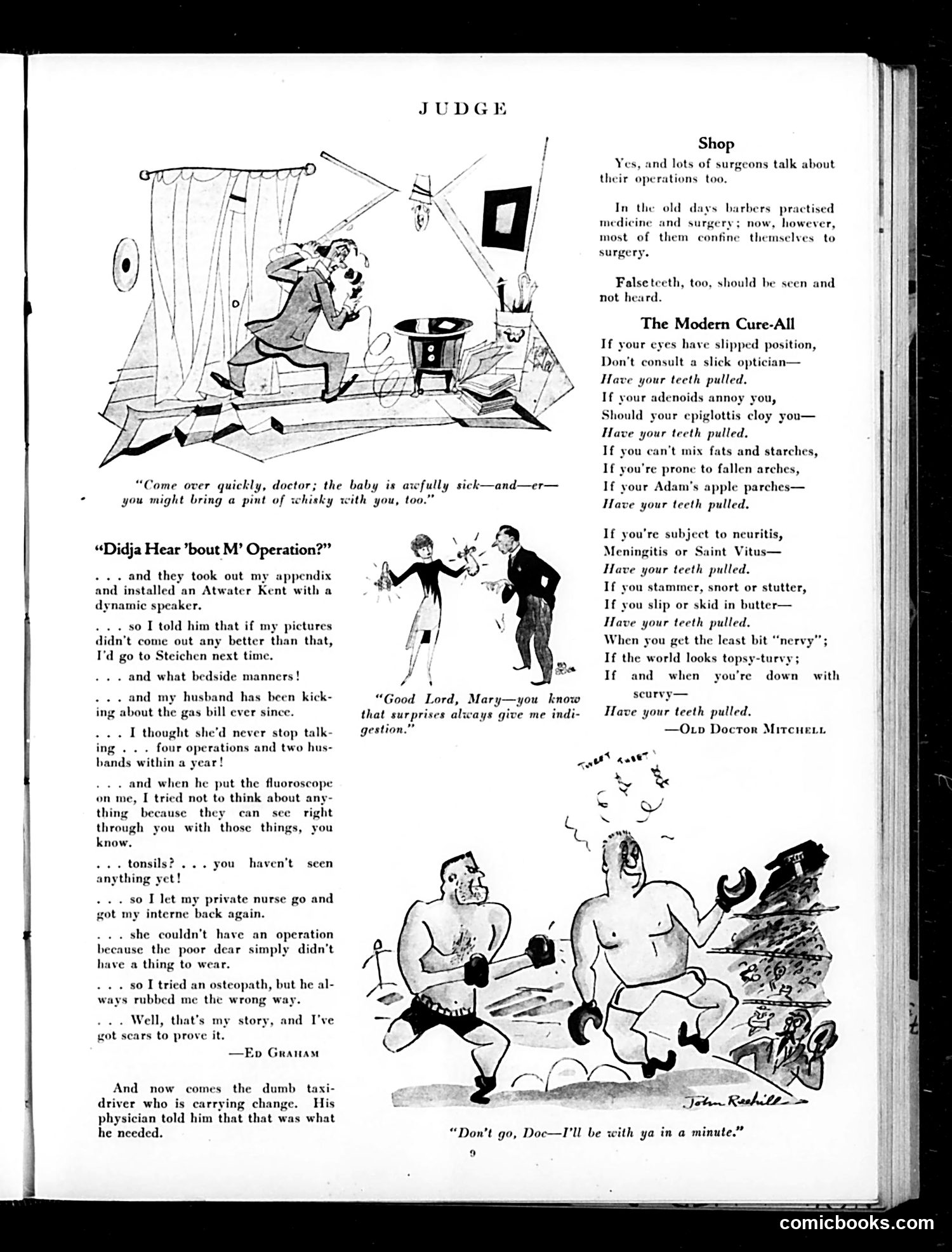
# Judge Magazine Satire Analysis This page satirizes the 1920s-30s American obsession with medical procedures, particularly tooth extraction as a supposed cure-all remedy. **The Main Cartoons:** The top cartoon mocks patients who casually ask doctors to bring alcohol while making house calls—a dig at Prohibition-era hypocrisy. The middle section features monologues from patients boasting about surgeries, with absurd claims (like having an Atwater Kent radio installed during appendix removal), satirizing how people competed to discuss their medical procedures as status symbols. **"The Modern Cure-All" poem** is the page's central satire: it ridicules the era's genuine medical trend of extracting teeth to treat completely unrelated ailments—neuritis, stuttering, fallen arches, even nervousness. Dentists and physicians actually practiced this, believing focal infections caused systemic disease. The bottom cartoon shows two men boxing over a woman, with one saying he'll be ready "in a minute"—a non-sequitur suggesting the absurdity continues throughout. The page mocks both medical fads and patients' eager participation in them.
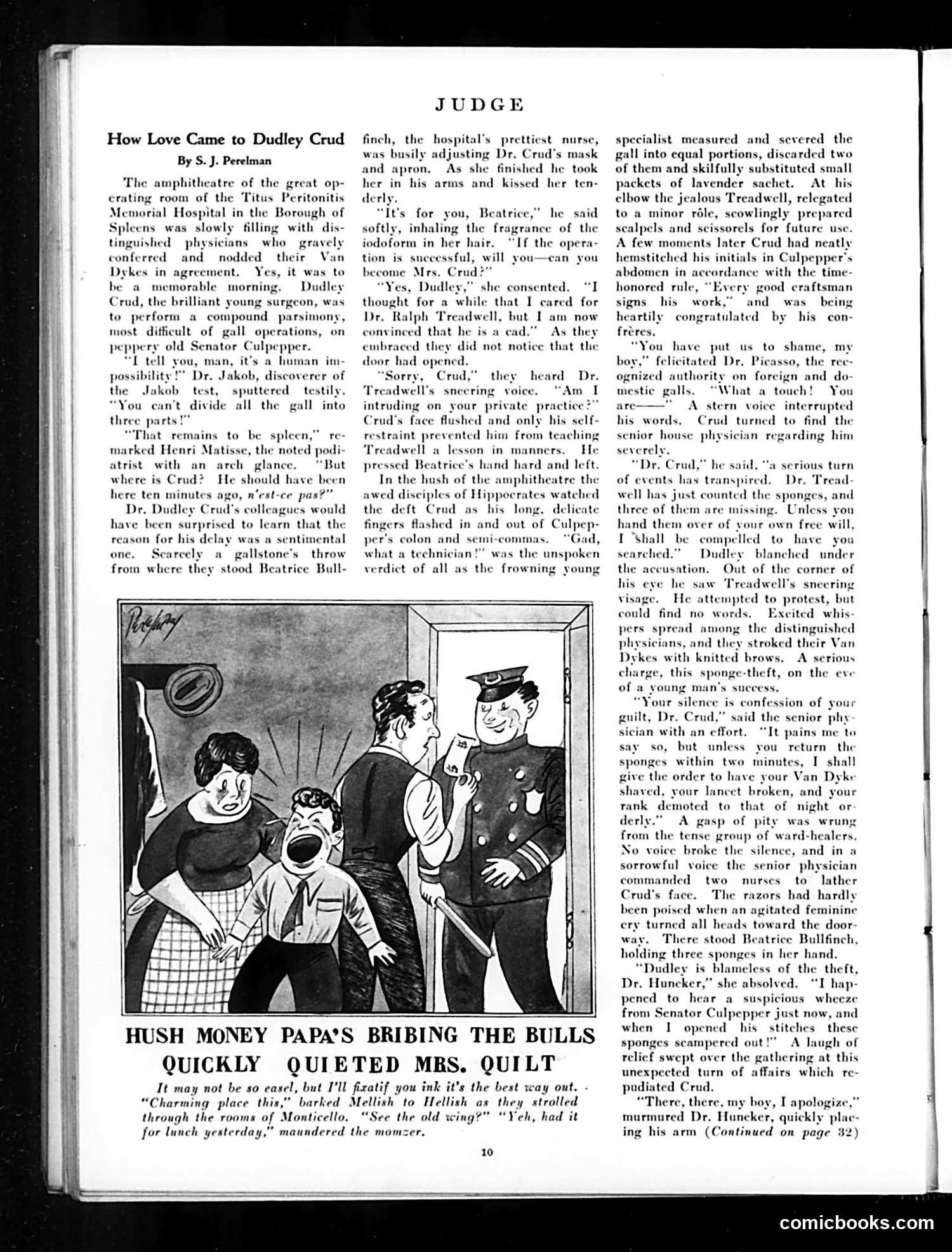
# Understanding This Judge Magazine Page This S. J. Perelman satirical story spoofs medical melodrama and professional jealousy. The plot follows surgeon Dudley Crud performing complex gall bladder surgery on Senator Culpepper while romantically entangled with nurse Beatrice Bullfinch. His rival, Dr. Treadwell, witnesses Crud kissing Beatrice and, motivated by jealousy, frames Crud by allegedly "misplacing" surgical sponges—a serious breach of operating room protocol. The cartoon illustration shows hospital staff and the bribery subplot referenced in its caption: "Hush Money Papa's Bribing the Bulls Quickly Quieted Mrs. Quilt," suggesting corruption occurs alongside the medical drama. Perelman uses medical jargon and absurdist humor ("compound parsimony," "semi-commas," "hemstitched his initials") to mock both pretentious medical professionals and overwrought romance narratives. The satire targets early 20th-century sensationalism and professional pomposity in medical circles.