
Judge, 1930-01-18 · page 18 of 36
Judge — January 18, 1930 — page 18: what you’re looking at
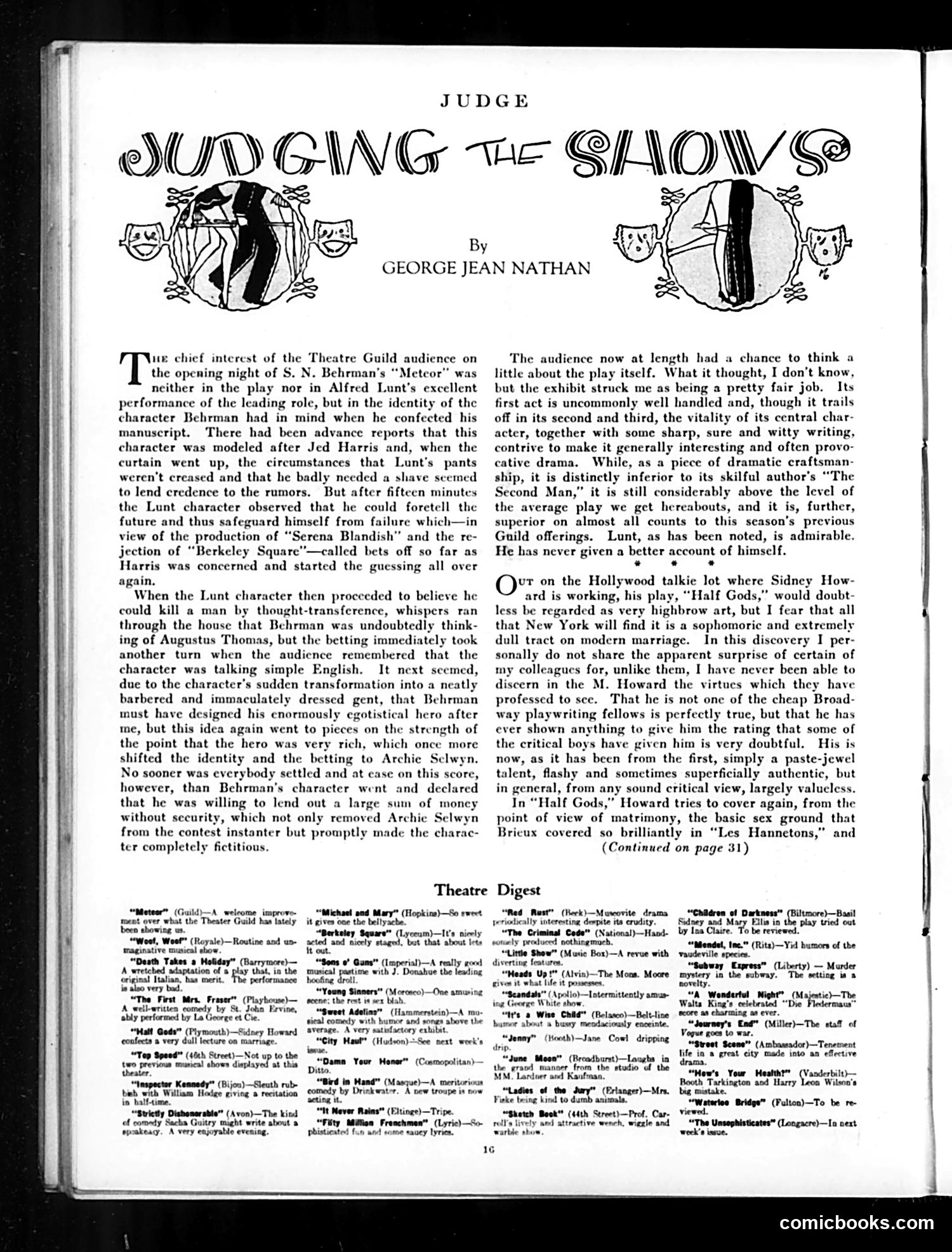
A restored page from Judge, 1930-01-18. Page through the whole issue in the reader above.
📄 Transcribed text from this page (OCR, searchable)
Machine-transcribed from the original scan — historical spelling and the odd misread are preserved.
| ue chief interest of the Theatre Guild audience on the opening night of S. N. Behrman’s “Meteor” was neither in the play nor in Alfred Lunt’s excellent performance of the leading role, but in the identity of the character Behrman had in mind when he confected his manuscript. There had been advance reports that this character was modeled after Jed Har and, when the curtain went up, the circumstances that Lunt’s pants weren't creased and that he badly needed a shave seemed to lend credence to the rumors. But after fifteen minutes the Lunt character observed that he could foretell the future and thus safeguard himself from failure which—in view of the production of “Serena Blandish” and the re- jection of “Berkeley Square’’—called bets off so far as Harris was concerned and started the guessing all over again, When the Lunt character then procceded to believe he could kill a man by thought-transference, whispers ran through the house that Behrman was undoubtedly think- ing of Augustus Thomas, but the betting immediately took another turn when the audicnce remembered that the character was talking simple English. It next seemed, due to the character's sudden transformation into a neatly barbered and immaculately dressed gent, that Behrman must have designed enormously egotistical hero after me, but this idea again went to pieces on the strength of the point that the hero was very rich, which once more shifted the identity and the betting to Archie Selwyn. No sooner was everybody settled and at ease on this score, however, than Behrman’s character went and declared that he was willing to lend out a large sum of money without security, which not only removed Archie Sel from the contest instanter but promptly made the charac- ter completely fictitious. Theatre “Beteer” ( welcome improve. “Michael and Mary” (Hopkine)—So sweet rocnt over what the Thester Gud han lately it gives one the bellyache. ‘been showing «s. “Berkeley Square” (Lyceuin)—It's nicely JUDGE oe NG 7 GAOWS By oS Ga GEORGE JEAN NATHAN % The audience now at length had a chance to think a little about the play itself. What it thought, I don’t know, but the exhibit struck me as being a pretty fair job. Its first act is uncommonly well handled and, though it trails off in its second and third, the vitality of its central char- acter, together with some sharp, sure and witty writing, contrive to make it generally interesting and often provo- cative drama. While, as a piece of dramatic crafts ship, it is distinctly inferior to its skilful author’ Second Man,” it is still considerably above the level of the average play we get hereabouts, and it is, further, superior on almost all counts to this season's previous Guild offerings. Lunt, as has been noted, is admirable. He has never given a better account of himself. * * * Ot on the Hollywood talkie lot where Sidney How- ard is working, his play, “Half Gods,” would doubt- less be regarded as very highbrow art, but I fear that all that New York will find it is a sophomoric and extremely dull tract on modern marriage. In this discovery I per- sonally do not share the apparent surprise of certain of my colleagues for, unlike them, I have never been able to discern in the M. Howard the virtues which they have professed to sce. That he is not one of the cheap Broad- way playwriting fellows is perfectly true, but that he has ever shown anything to give him the rating that some of the critical boys have given him is very doubtful. His is now, as it has been from the first, simply a paste-jewel talent, flashy and sometimes superficially authentic, but in general, from any sound critical view, largely valueless. In “Half Gods,” Howard tries to cover again, from the point of view of matrimony, the basic sex ground that Bricux covered so brilliantly in “Les Hannetons,” and (Continued on page 31) Digest “Red Rest” (Vert) —Moseorite rama “Chidren of Dartnens® (Biltmore) Basil terialially totereting deeite Ws erodity, Sidney and Mary Ellis in the play tried oat “The Criminal Code" (National)—Hand- by Ina Claire. To be reviewed. “Weel, Wet” (Royale)—Routine and us maginative ren) how. “Death Takes a Holiday” (Barrymore)— A srerbel nation of ay tn original Italian, has merit formanee in also very bad. “The First Mrs. Fraser” (Playbouse)— A well-written comedy by St. John Ervine, ably performed by La George et Cie. “Halt Gods” (Piymouth)—Sidney Howard confects a very dull lecture on marriage. “Top Speed” (40ch Street)—Not up to the two previous musical shows displayed at this theater. “Inspector Kennedy” (Bijoo)—Sleuth rub- bib with William Hodge giving a recitation in half-time. “Stietly Dishonersble” (Avon)—The kind ef comedy Sacha Guitry might write about 2 spoakeagy. A very enjoyable evening. acted and nicely staged, but that about lets ‘it out. “Sons of Guns” (Ieaperial)—A really good tmusical pastime with J- Dotabe the leading hoofing droll. “Young Sinners” (M cronco)—One amwing scene: the rest is sex bah. “Sweet Adeline” (Hammerstein) —A mo- tical comedy with humor and songs above the average. A very satisfactory exhibit “City Haut” (Hudson) See next work's ie. “Dama Your Hener™ (Cosmopolitan)— Ditto. “Bird io Hand” (Masque)—A meritorious comedy by Drinkwater. A new troupe is tow seting it. Ht Mever Rains” (Eltinge)—Tripe. “Fity Million Frenchmen” (Lyric) —So- phistieated fun and some sauey lyries. ouely produced nothingmuch. “Little Show” (Music Bor)—A revue with diverting features. “Heads Up!” fAbrial— ‘The Mons. Moore ie estes Lio)—Tntermittently amas ise Child” (Relasco)—Belt-line a busy mesdaciously enceinte. “denmy” (Hooth)—Jane Cowl dripping drip. “June Mees” (Broadburst)—Laoghs in the grand manner from the studio of the MM. Lardner and Kaufman, “tadies of the dury” (Prianger}—Mrs. Vieke being kind to dumb animals. “Sketch Beck” (44th Street)—Prof. Car- rell’s lively and attractive wench, wiggle and ‘warble shen “adel, te" (Rit) Vit burrs ofthe weokevile specie. yeay Express™ (Liberty) — Murder myuay Ib (us oebeay, Tis eating bs novelty. “A Wendertul Night” (Majestic)—The Walts King’s celebrated “Die Fledermaus score as charming as ever. “Journey's End (Miller)—The staf of Vogue goes to war. “Street Scone” (Ambaseador)—Tenement life in a great city made into an effective “How's Your Hesttht” (Vanderbilt) — Booth Tarkington and Harry Leon Wilson's big mistake. “Waterloe Bridge” (Fulton)—To be re- viewed. “The Unsephisticates” (Longacre)—In next week's issve. comicbooks.com