
Judge, 1930-01-18 · page 25 of 36
Judge — January 18, 1930 — page 25: what you’re looking at
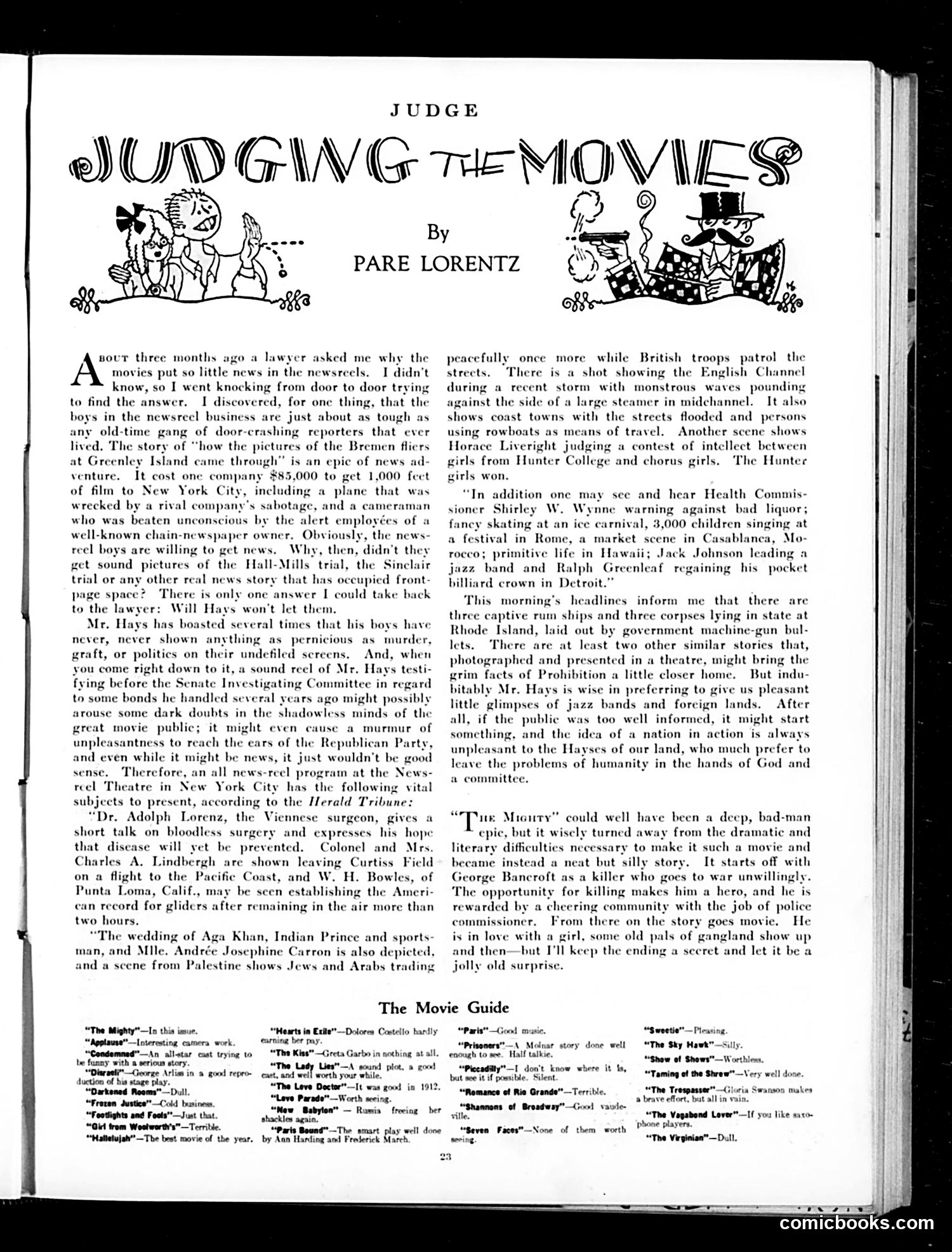
A restored page from Judge, 1930-01-18. Page through the whole issue in the reader above.
📄 Transcribed text from this page (OCR, searchable)
Machine-transcribed from the original scan — historical spelling and the odd misread are preserved.
JUDGE JUDGING T=“MOVIES nour three months ago a lawyer asked me why the A movies put so little news in the newsreels, I didn’t know, so I went knocking from door to door trying to find the answer. I discovered, for one thing, that the boys in the newsreel business are just about as toug any old-time gang of door-crashing reporters that ever lived. The story of “how the pictures of the Bremen fliers at Greenley Island came through” is an epic of news ad- venture. It cost one compa $85,000 to get 1,000 feet of film to New York City, includi wrecked by a rival company’s sabc who was be: ten unconscious by the alert employées of well-known chain-newspaper owner, Obviously, the news- reel boys are willing to get news. Why, then, didn’t they get sound pictures of the Hall-Mills trial, the Sinclair trial or any other real news story that has occupied front- page space? There is only one answer I could take back to the lawyer: Will Hays won't let them, Mr. Hays has boasted several times that his boys have never, never shown anything as pernicious as murder, graft, or politics on their undefiled screens, And, when you come right down to it, a sound reel of Mr, Hays testi- fying before the Senate Investigating Committee in regard to some bonds he handled several years ago might possibly arouse some dark doubts in the shadowless minds of the great movie public; it m murmur of unpleasantness to reach the ears of the Republican Party, and even while it might be news, it just wouldn't be good n all news-reel program at the News- e in New York City has the following vital subjects to present, according to the Herald Tribune: “Dr. Adolph Lorenz, the Viennese surgeon, gives a short talk on bloodless surgery and expresses his hope that disease will yet be prevented. Colonel and Mrs. Charles A. Lindbergh are shown leaving Curtiss Field on a flight to the Pacific Coast, and W. H. Bowles, of Punta Loma, Calif., may be seen establishing the Ameri- can record for gliders after remaining in the air more than two hours, “The wedding of Aga Khan, Indian Prince and sports- man, and Mile, Andrée Josephine Carron is also depicted, and a scene from Palestine shows Jews and Arabs trading ht even cause By 6? peacefully once more while British troops patrol the streets. There is a shot showing the English Channel during a recent storm with monstrous waves poundin inst the side of a large steamer in midchannel. It also shows coast towns with the streets flooded and persons using rowbo: ns of trd Horace Liveright judgin sirls from Hunter College girls won. el. Another scene shows contest of intellect between and chorus girls. The Hunter “In addition one may see and hear Health Commis- sioner Shirley W. Wynne warning against bad li fancy skating at an ice carnival, 3,000 children singing at a festival in Rome, a market sc 3 primitive life in Haw band and Ralph Greenle billiard crown in Detroit.” uor; ling a his morning's headlines inform me that there three captive rum ships and three corpses lying in state at Rhode Island, laid out by government machine-gun bul- lets. There are at least two other similar stories that, photographed and presented in a theatre, might bring the grim facts of Prohibition a little closer home. But indu- hitably Mr. Hays is wise in preferring to give us pleasant little glimpses of jazz bands and foreign lands. After all, if the public was too well informed, it might start something, and the idea of a nation in action is alway unpleasant to the Hayses of our land, who much prefer to leave the problems of humanity in the hands of God and a committee. “T! Miauty” could well have been a deep, bad-man epic, but it wisely turned away from the dramatic and literary difficulties necessary to make it such a movie and became instead a neat but silly story. It starts off with George Bancroft as a killer who goes to war unwilling The opportunity for killing makes him a hero, and he is rewarded by a cheering community with the job of police commissioner. From there on the story goes movie. He is in love with a girl, some old pals of gangland show up and then—but I'll keep the ending a secret and let it be a jolly old surprise. re ye The Movie Guide “Hearts in Exi earning ber pay “The Mighty”—In this issue. Dolores Castello hanily ‘Applause”—Interesting camera work. “Condemned”—An all<tar cast trying to “The Kiss” —Greta Garbo in nothing at all be fy eh 5 ooromn store oe ees | Drat—Ororse Minin gol reir et antl whee ca of hi age Bay. - a ee The Love Dector”™—It was goo! in 1912. “Love Parade” —Worth seeing. “Freten dusts” —Cold busines 2 “Foottights and Fools” —Just that eee | ee le “Okt trom Westwert's”— Terrible. “Paris Bound” —The smart play well done “Hallelujah” —The best movie of the year. by Ann Handing and Frederick March cod matic. “Sweetie” Pleasing “Prisoners” —\ Molnar story done well “The Sty Hawk” —Silly eoaough to sce. Half talkie Bee eae bt Ee tien “hte MY etaming of te Shrew’? —Very well done, “namance of Rie Grande”—Terribe. “The Trespasser”— brave effort, but all in “$nannons of Broadway” —Gool vavie- * : ville. “The Vagabond Lover”—If you like saxo “Seven Faces"—None of them worth Phone Players. seving. The Virginian” —Dull. ah See ee Be comicbooks.com