A complete issue · 36 pages · 1929
Judge — November 23, 1929
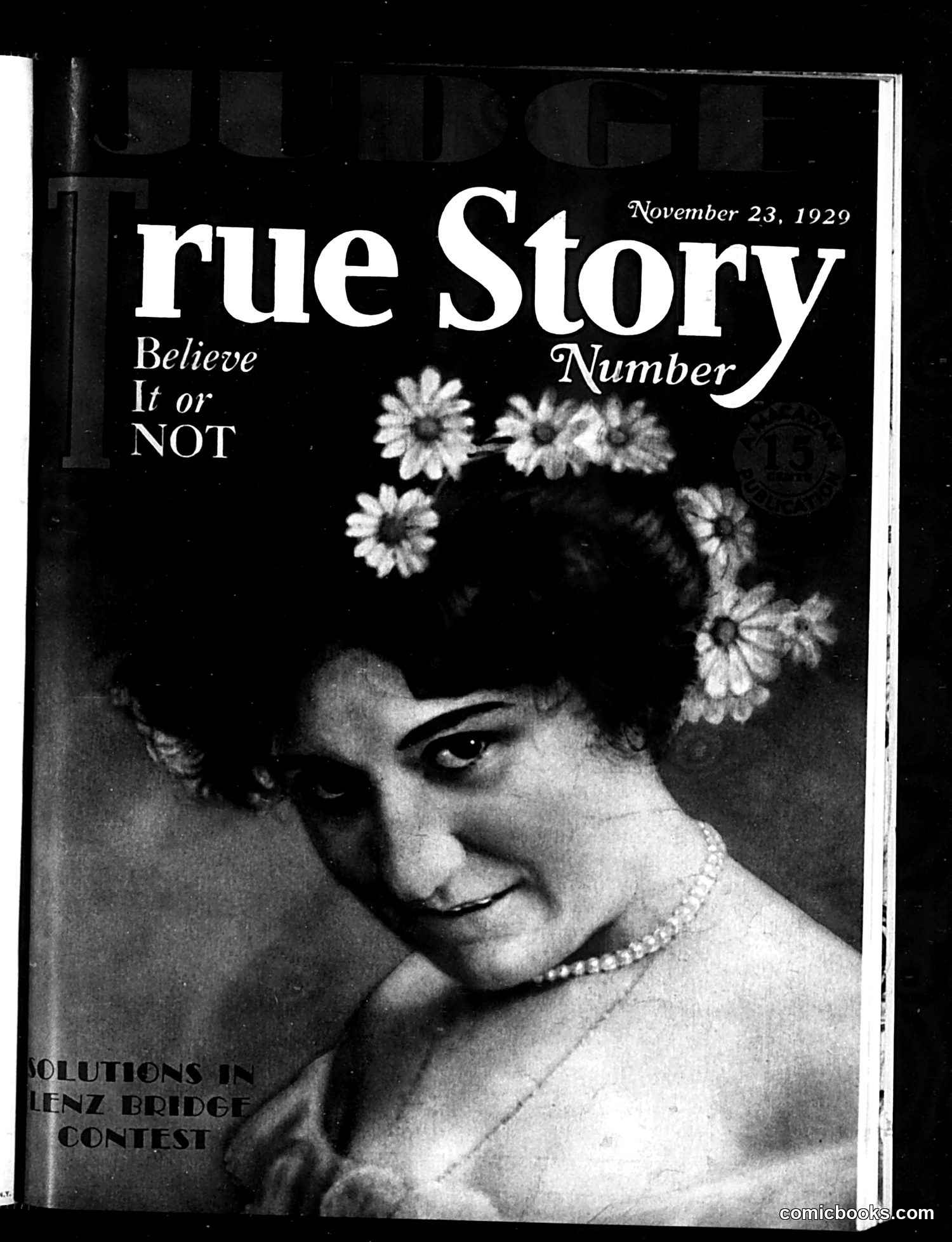
# True Story Magazine Cover Analysis This is a cover for *True Story* magazine (November 23, 1929), not Judge. The tagline "Believe It or NOT" references the popular "Ripley's Believe It or Not!" feature. The cover features a glamorous woman with flowers in her hair and pearl necklace—typical of 1920s beauty standards. The mention of "Solutions in Lenz Bridge Contest" at the bottom likely refers to a reader-participation puzzle or game, common in magazines of this era. The "Believe It or NOT" framing suggests the issue contains sensational or unusual human-interest stories—*True Story*'s specialty. There's no obvious political satire here; this appears to be mainstream entertainment/lifestyle content aimed at the general public.
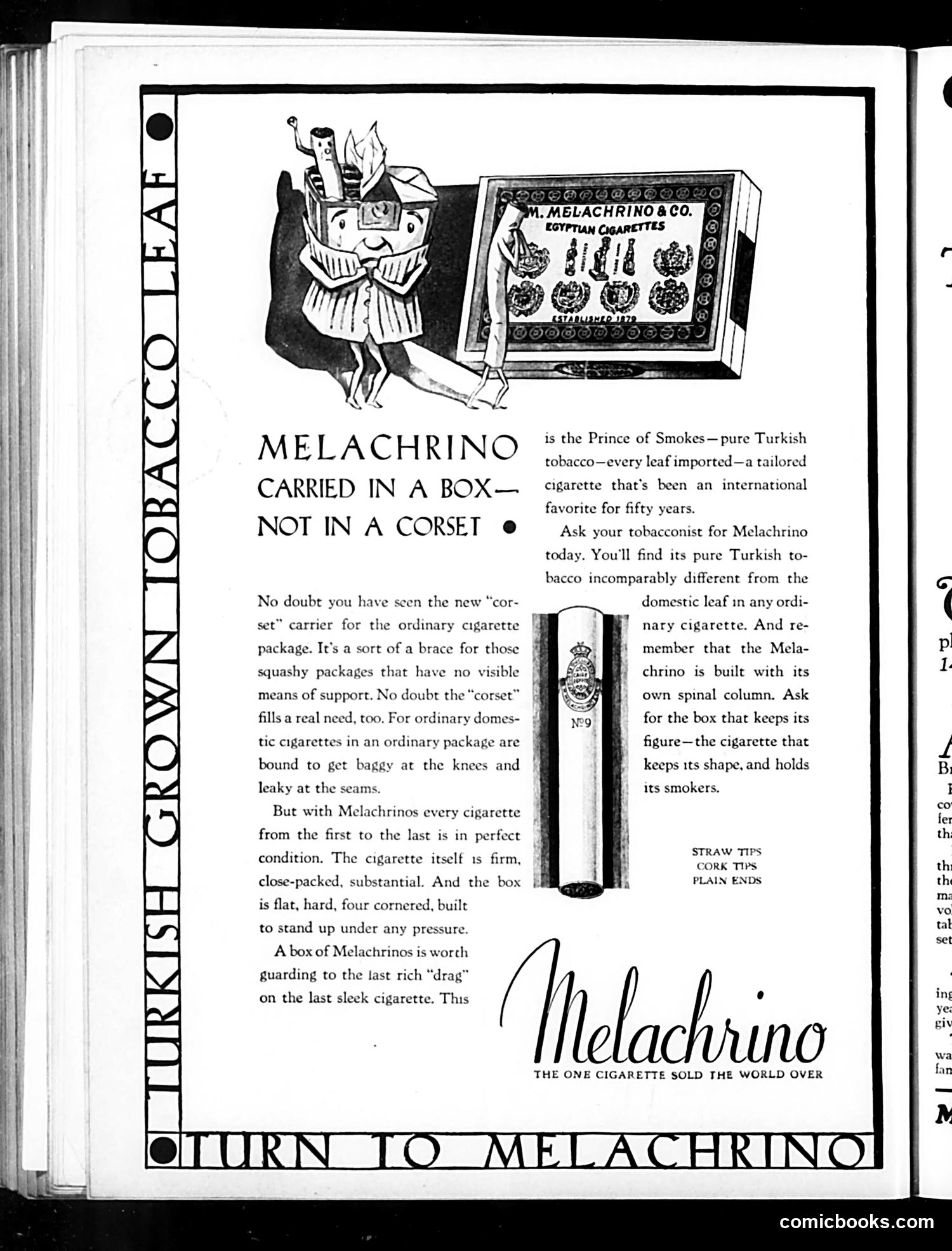
# Analysis This page is **primarily an advertisement**, not satirical content. It promotes Melachrino cigarettes, a Turkish tobacco brand that had been popular for fifty years. The ad employs light humor rather than political satire. The cartoon shows a woman struggling to carry an oversized cigarette box, playfully contrasting old packaging (depicted as a restrictive "corset") with Melachrino's new rigid box design. The joke is that ordinary cigarettes get crushed in flimsy packages, while Melachrino's sturdy box keeps cigarettes in perfect condition. The advertisement emphasizes the product's superiority through this visual gag—positioning the box as protective rather than cumbersome. There is no political or social satire present; this is straightforward commercial messaging using comedic illustration to sell premium cigarettes.
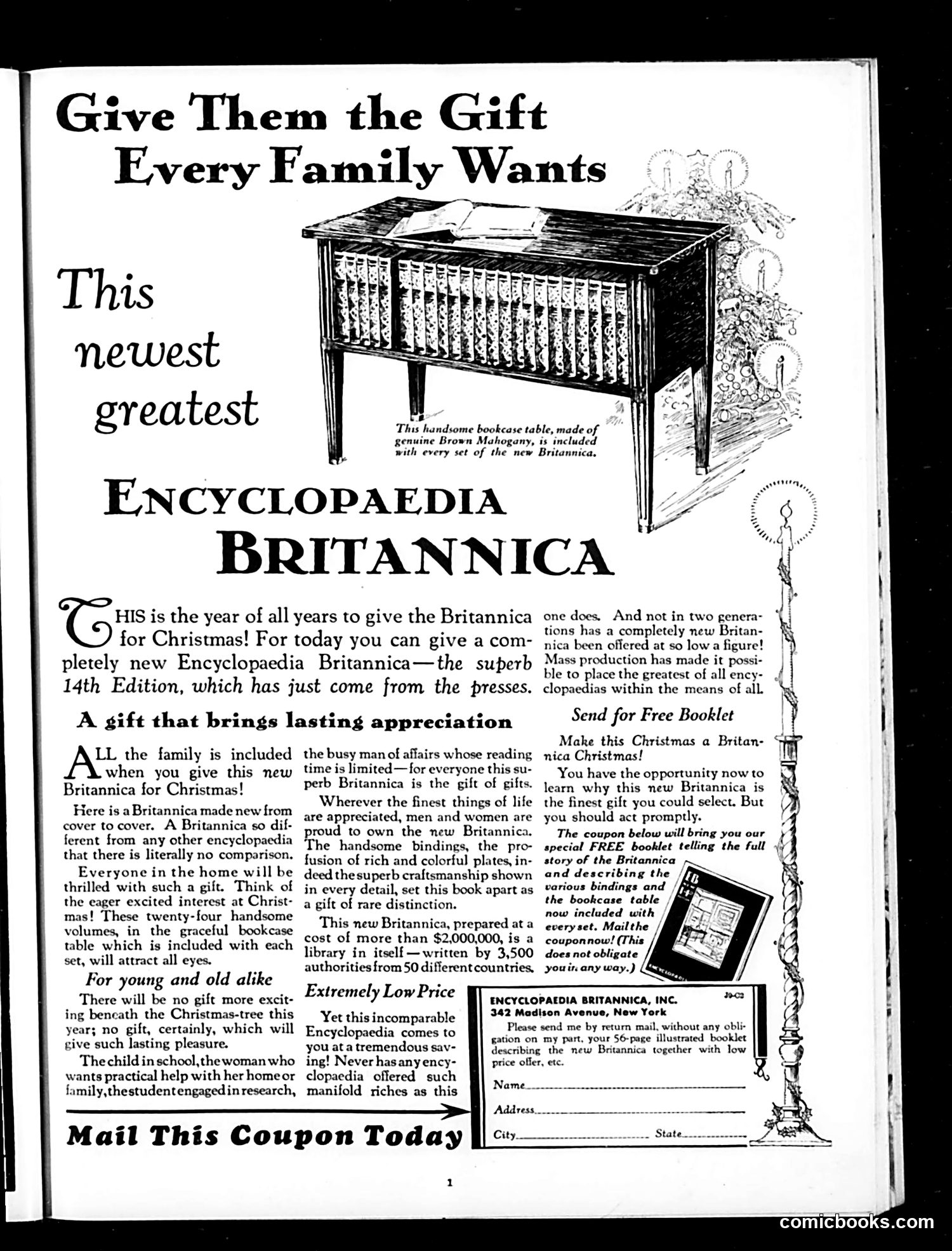
# Analysis This is **not a political cartoon or satire**—it's a full-page advertisement for the Encyclopedia Britannica's 14th Edition, appearing in Judge magazine. The ad promotes the encyclopedia as an ideal Christmas gift, emphasizing its comprehensiveness (written by 3,500 authorities from 50 countries) and appeal to the entire family. A key selling point is the included "handsome bookccase table, made of genuine Brown Mahogany." The ad employs typical early 20th-century marketing language: appeals to family values, educational benefits, and social status ("gift of rare distinction"). The prominent coupon and "Mail This Coupon Today" encourages immediate action. This represents Judge's revenue model—advertising revenue alongside editorial content—rather than satirical commentary.
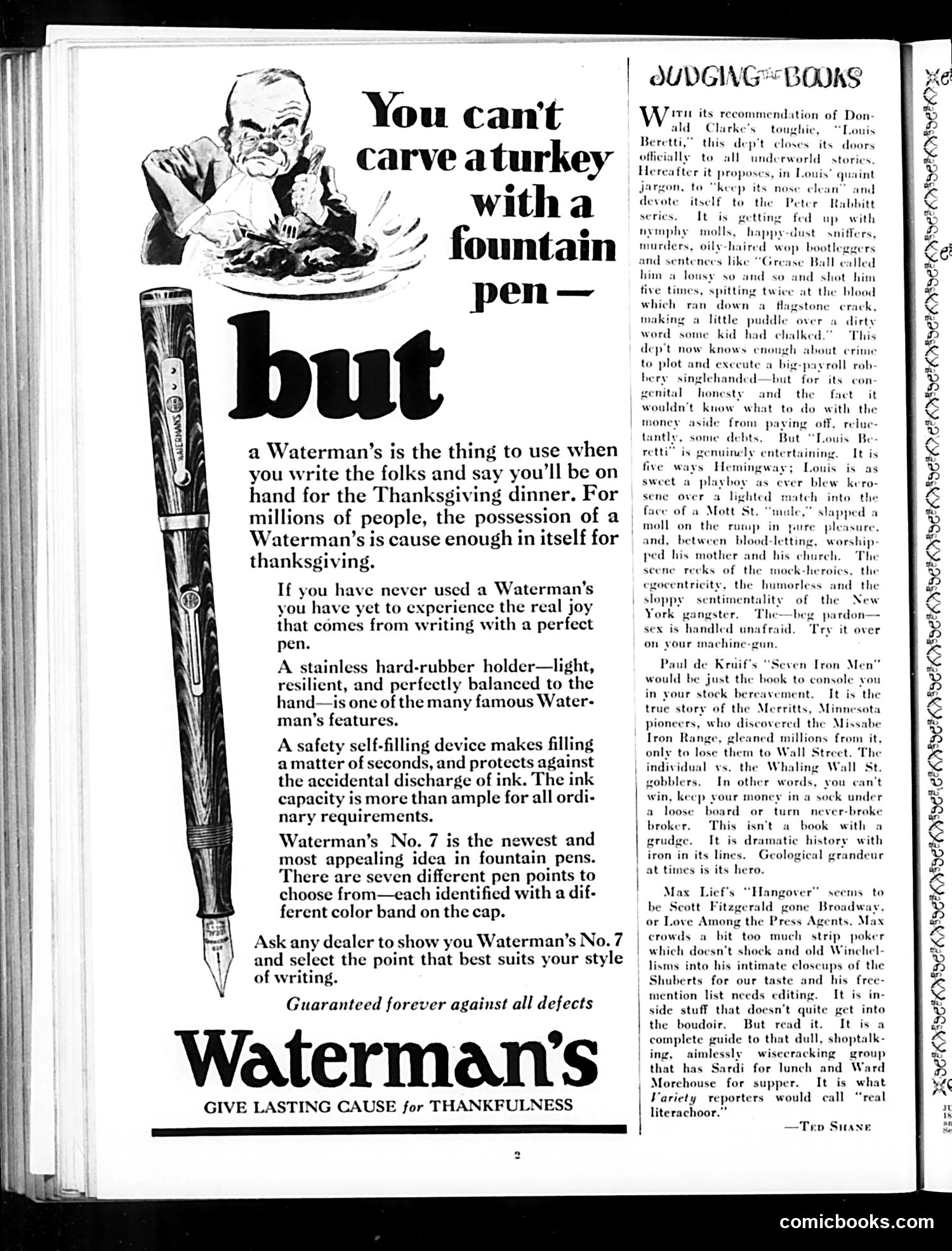
# Analysis This page is primarily a **Waterman's fountain pen advertisement**, not political satire. The main image shows a caricatured man carving a turkey, illustrating the ad's central joke: "You can't carve a turkey with a fountain pen—but a Waterman's is the thing to use when you write the folks and say you'll be on hand for the Thanksgiving dinner." The advertisement emphasizes Waterman's practical features: a self-filling mechanism, safety against ink leakage, and seven interchangeable pen points. It targets middle-class consumers by suggesting the pen is an appropriate Thanksgiving gift symbolizing reliability and gratitude. The right column contains a book review ("Judging the Books") unrelated to the pen ad. This is typical Judge magazine layout: advertising mixed with editorial content.
# Judge Magazine Analysis: "You Can't Have Your Coke and Eat It" This is a satirical advice column by "Bare Macadam" addressing women's romantic expectations. The title is a play on the phrase "you can't have your cake and eat it too," substituting "Coke" (likely referring to Coca-Cola, a popular social beverage of the era). The satire mocks women who fantasize about glamorous romantic encounters in upscale settings while ignoring their actual circumstances. The author ridicules unrealistic dreams of meeting wealthy suitors ("gallant young Galahad"), advising instead on practical self-improvement through diet, exercise, and hygiene. The piece satirizes both women's romantic daydreams and the advertising culture promising transformation through consumption—whether fancy nightclubs or beauty products. It's fundamentally commentary on class aspirations and the gap between fantasy and reality.
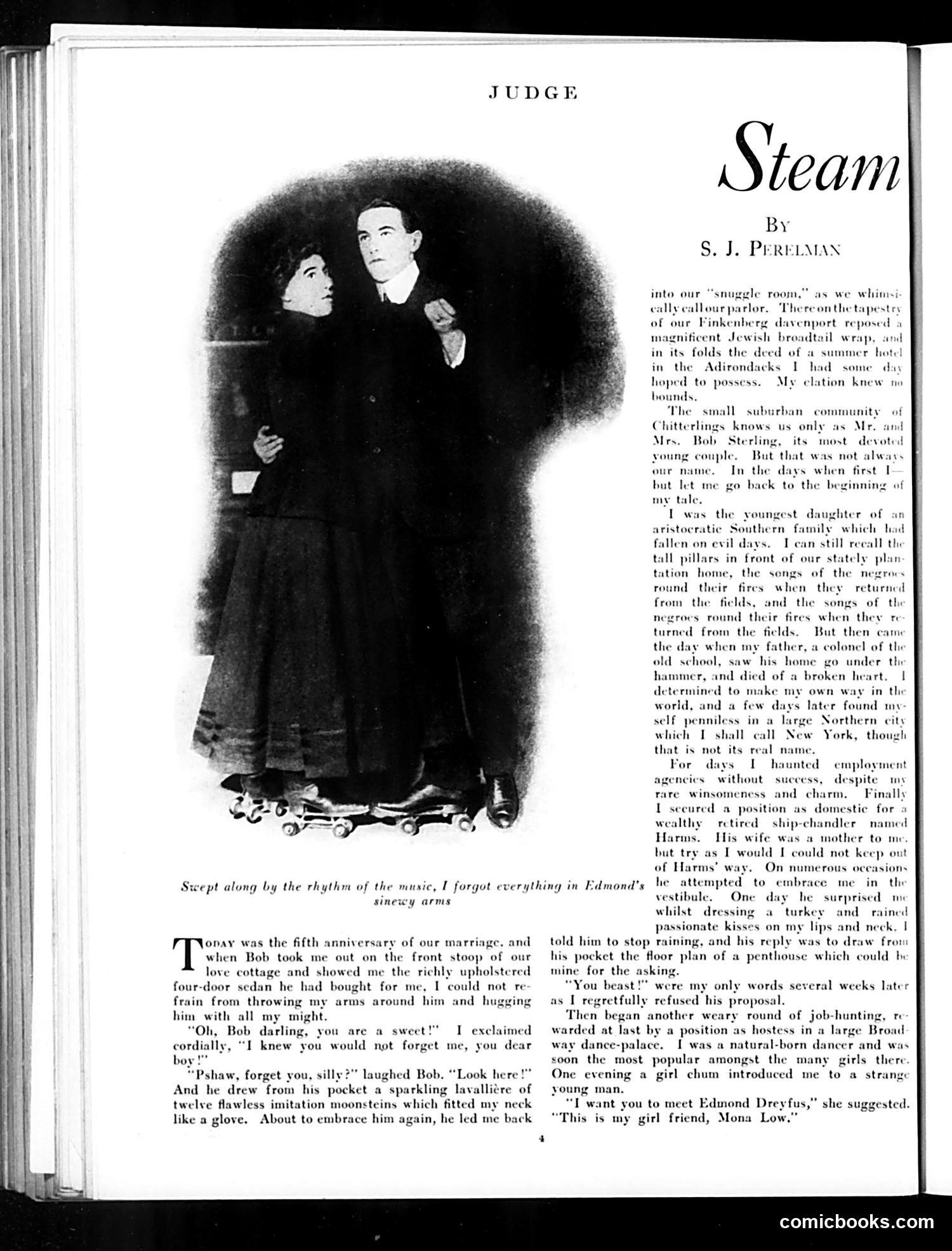
# "Steam" by S.J. Perelman This page contains the opening of a short story rather than political satire. The illustration shows two figures in an intimate embrace, captioned "Swept along by the rhythm of the music, I forgot everything in Edmond's sineway arms." The narrative is a romantic comedy about a woman recounting how she met her husband Bob at their fifth wedding anniversary, contrasting their current comfortable married life with her earlier struggles. A wealthy retired ship-chandler named Harris attempted to seduce her with lavish gifts (a turkey, imitation moonstones), but she rejected him. She then met the charming Edmond Dreyfus through a friend named Mona Low. This appears to be light domestic humor typical of Judge magazine's fiction content, not political commentary.
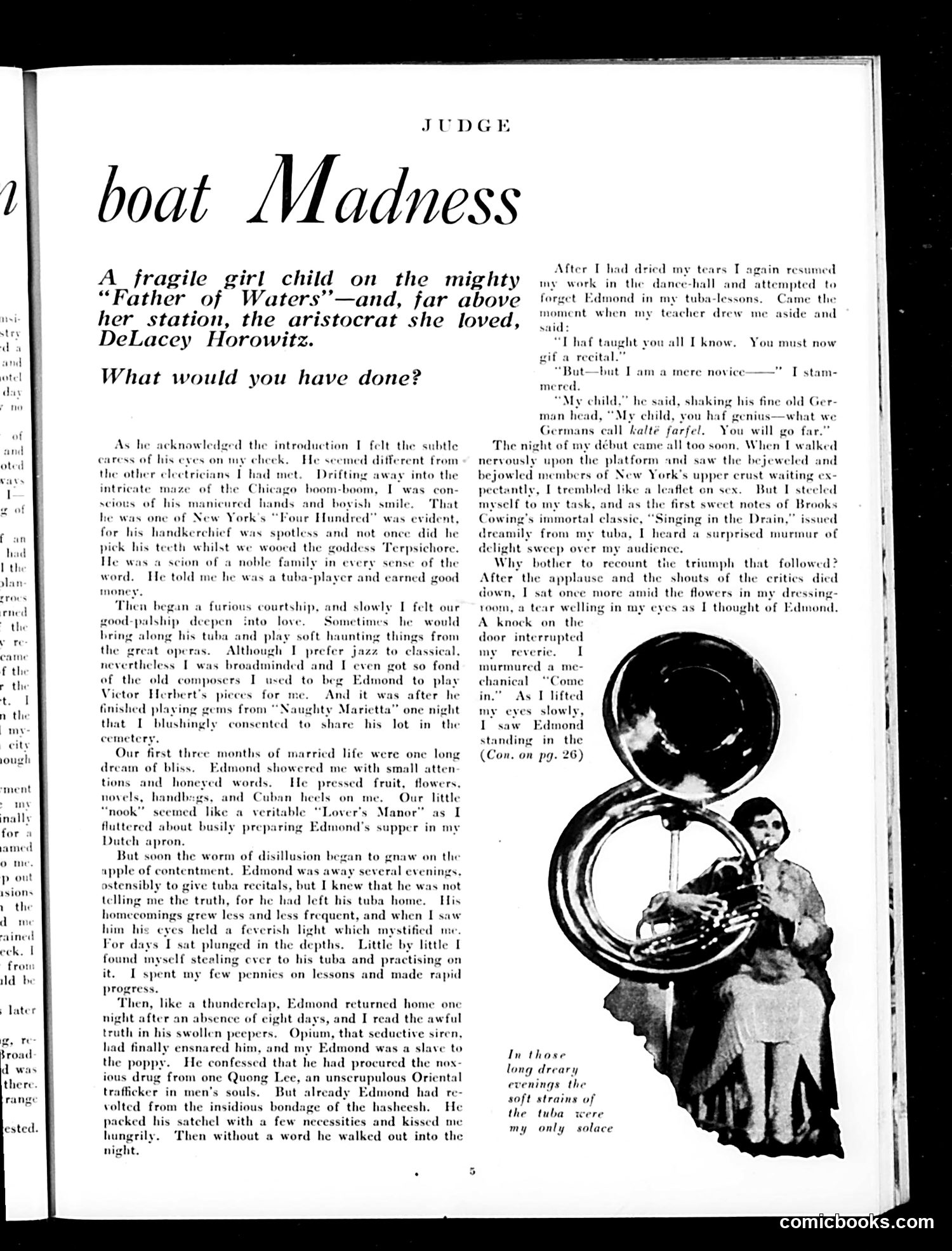
# "Boat Madness" - Judge Magazine This page presents a serialized story titled "Boat Madness" about a young woman named DeLacey Horowitz who abandons her aristocratic station for love. The narrative describes her marriage to Edmund, a musician with a tuba who initially showers her with affection but later becomes distant, revealing himself as an opium addict involved with "Oriental traffickers." The accompanying illustration shows a woman gazing dreamily at a large tuba, with a small male figure visible within or beside it—a visual metaphor for her romantic obsession. This appears to be melodramatic fiction rather than political satire, reflecting early 20th-century Judge magazine's mix of humor and serialized stories exploring themes of class conflict, substance abuse, and romantic disillusionment.
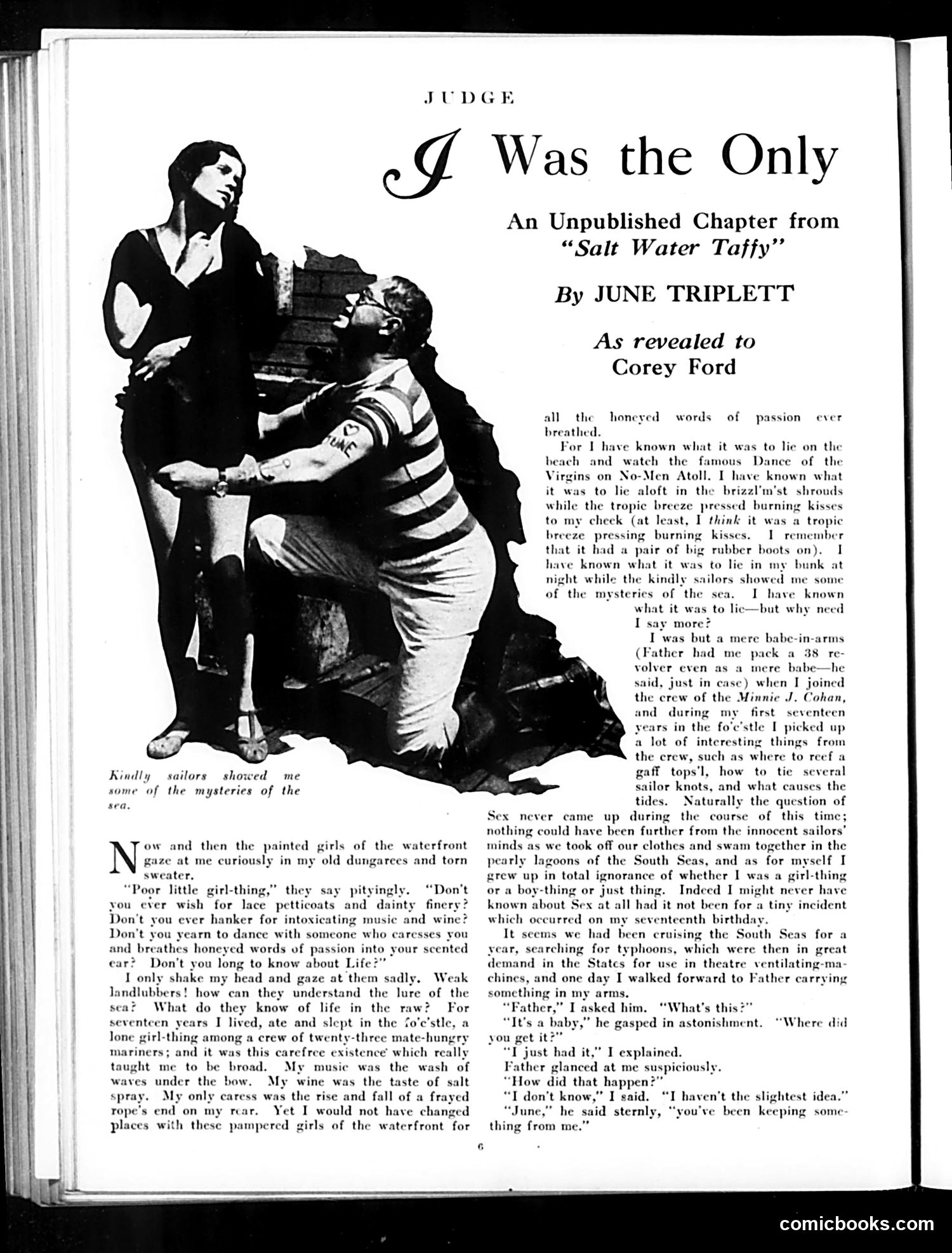
# Analysis of Judge Magazine Page This page features an unpublished chapter from June Triplett's "Salt Water Taffy," presented to Corey Ford. The illustration shows a woman and man in what appears to be a romantic or dramatic scene aboard a ship. The text is a first-person narrative by a female character recounting her experiences as a girl-thing (young woman) working on a ship, the *Minnie J. Cohan*. She describes innocent shipboard life among sailors, emphasizing her naiveté about romance and sexuality. The humor derives from her frank, deadpan recounting of living in close quarters with male sailors while remaining ignorant of "life" and "sex." This appears to be light satirical fiction rather than political commentary—satire aimed at the contrast between her sheltered upbringing and her unconventional maritime experiences.
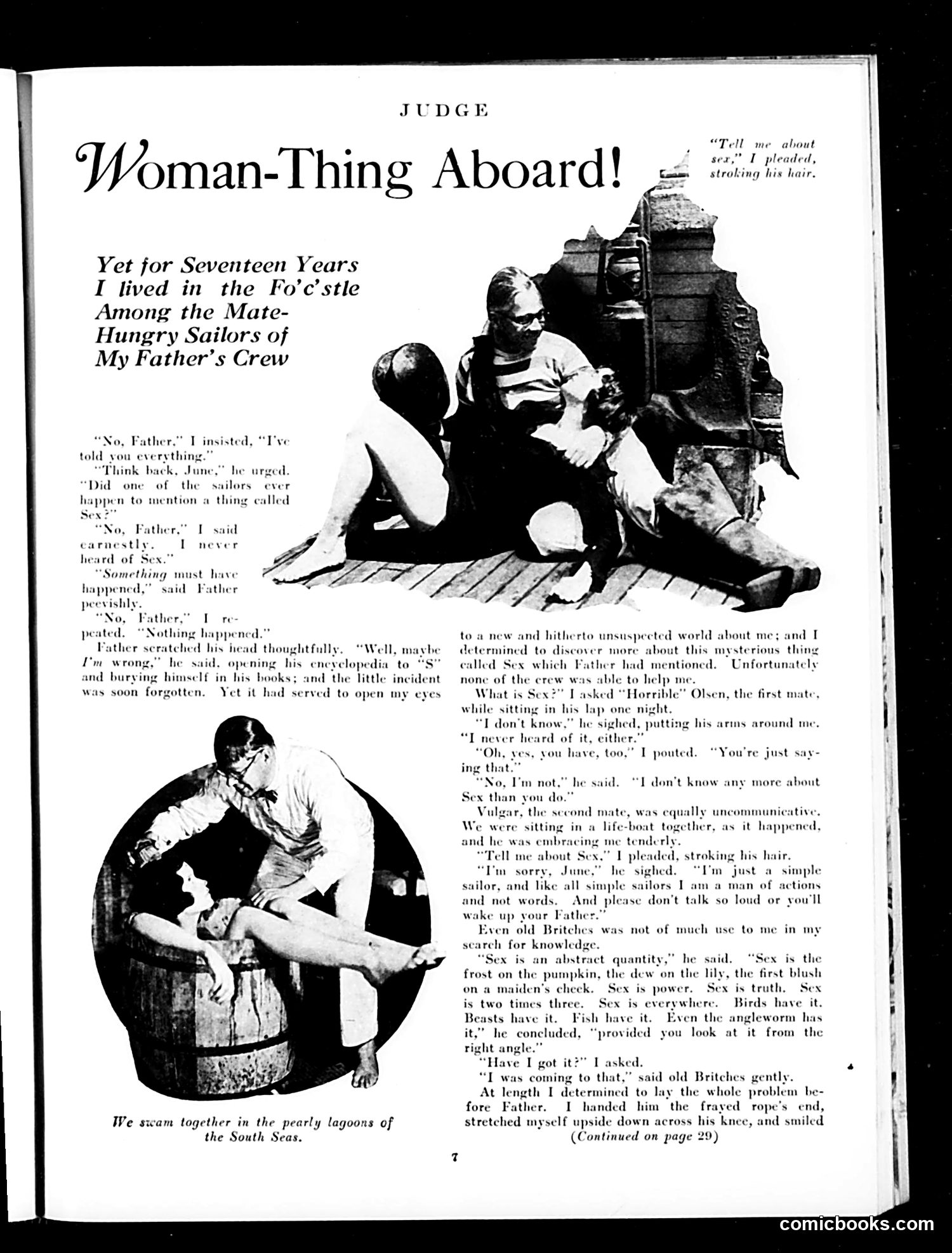
# "Woman-Thing Aboard!" - Judge Magazine Satire This is a satirical story about a young woman raised among sailors who has reached adulthood without understanding sex. The humor relies on the contrast between her innocent naïveté and the crude maritime setting. The narrative mocks both Victorian prudishness (her father's embarrassed avoidance of the topic, consulting an encyclopedia under "S") and male incompetence—multiple sailors ("Horrible" Olsen, "Vulgar," old Britches) are equally unable or unwilling to explain sex, offering only vague, contradictory definitions ("abstract quantity," "frost on the pumpkin," "everywhere"). The illustrations show intimate moments between the narrator and crew members in suggestive poses. The joke satirizes outdated sexual attitudes and education taboos of the era, presenting the situation as absurdly comic—that a woman could reach adulthood in such ignorance, and that grown men would be equally flustered by basic questions. The tone is lighthearted social commentary on repression and awkwardness around sexuality.
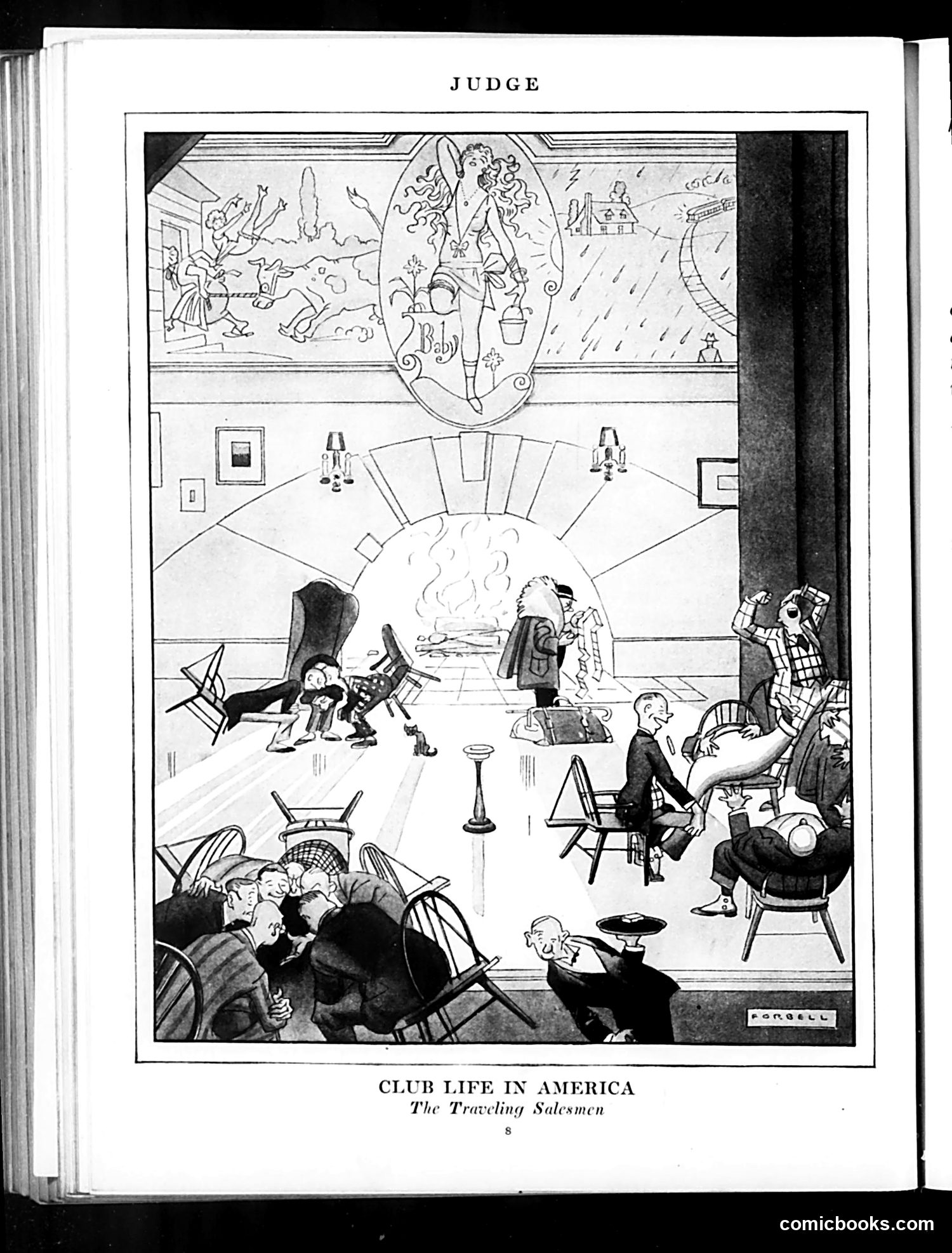
# "Club Life in America: The Traveling Salesmen" This Judge cartoon satirizes the social world of traveling salesmen in early 20th-century America. The scene depicts what appears to be an exclusive club where traveling salesmen gather for leisure and entertainment. The cartoon mocks the pretensions of these traveling businessmen, showing them attempting to adopt genteel club life—complete with formal dress, leisure activities, and what seems to be sophisticated entertainment (the murals above suggest aspirational decor). The composition suggests contrast between their actual status and their desired social position. The humor likely derives from portraying these mobile, lower-middle-class workers as comically out of place attempting upper-class leisure culture. This reflects period anxieties about social climbing and the growing commercial class of traveling salesmen in American society.
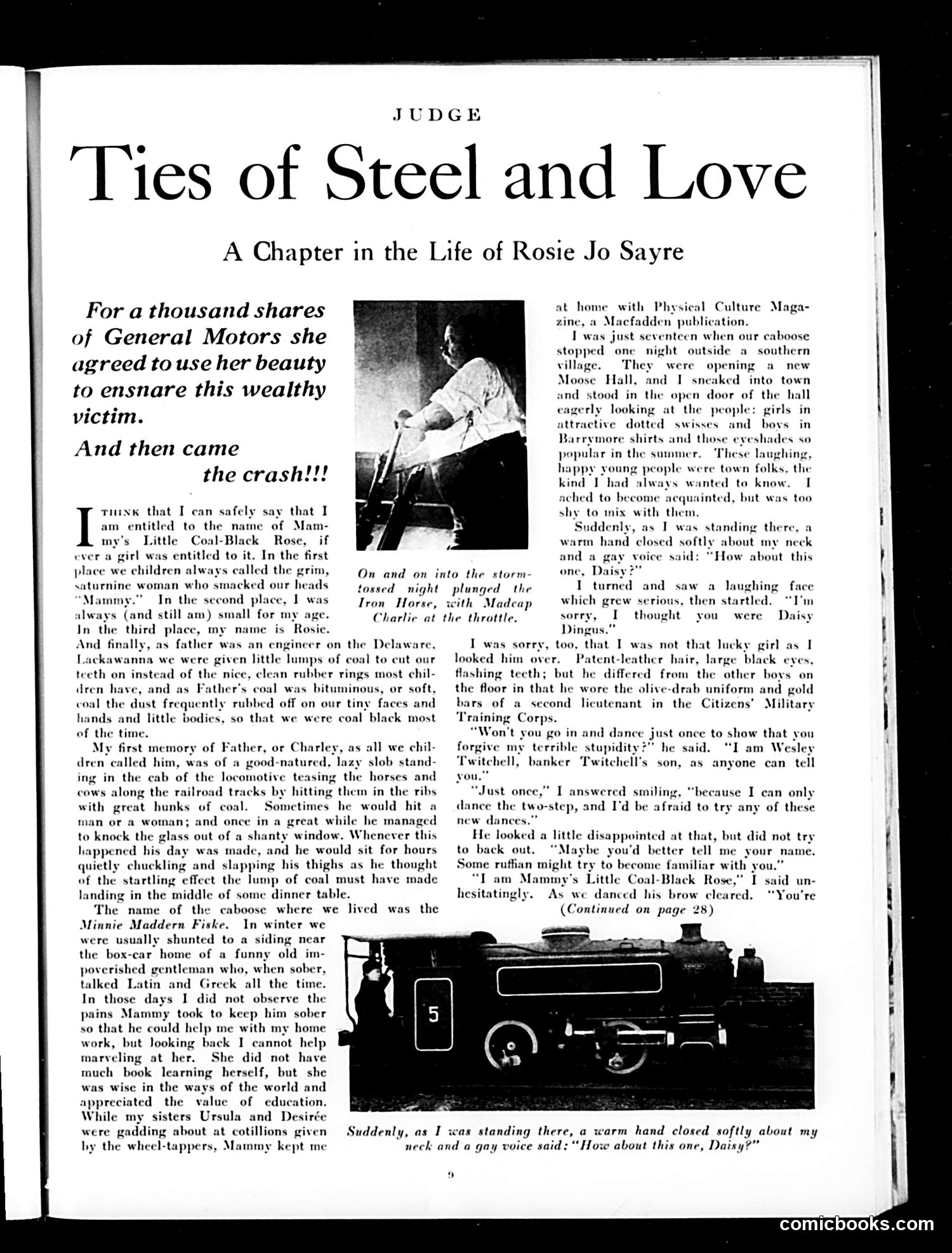
# "Ties of Steel and Love": A Story of Gold-Digging and Market Collapse This is a serialized romantic story rather than political satire. The headline promises scandal: a woman named Rosie Jo Sayre agreed to use her beauty to seduce a wealthy man for a thousand General Motors shares—then "came the crash," likely referencing the 1929 stock market collapse. The narrative, told in first person, establishes Rosie's humble background (daughter of a railroad engineer, raised in a caboose, nicknamed "Little Coal-Black Rose"). It then depicts a chance encounter at a dance where a second lieutenant named Wesley Twitchell approaches her. The story appears to be a morality tale about class mobility and the dangers of financial schemes, set against the backdrop of economic catastrophe. The two photographs show a woman at what appears to be a locomotive and a steam engine, illustrating the working-class setting.
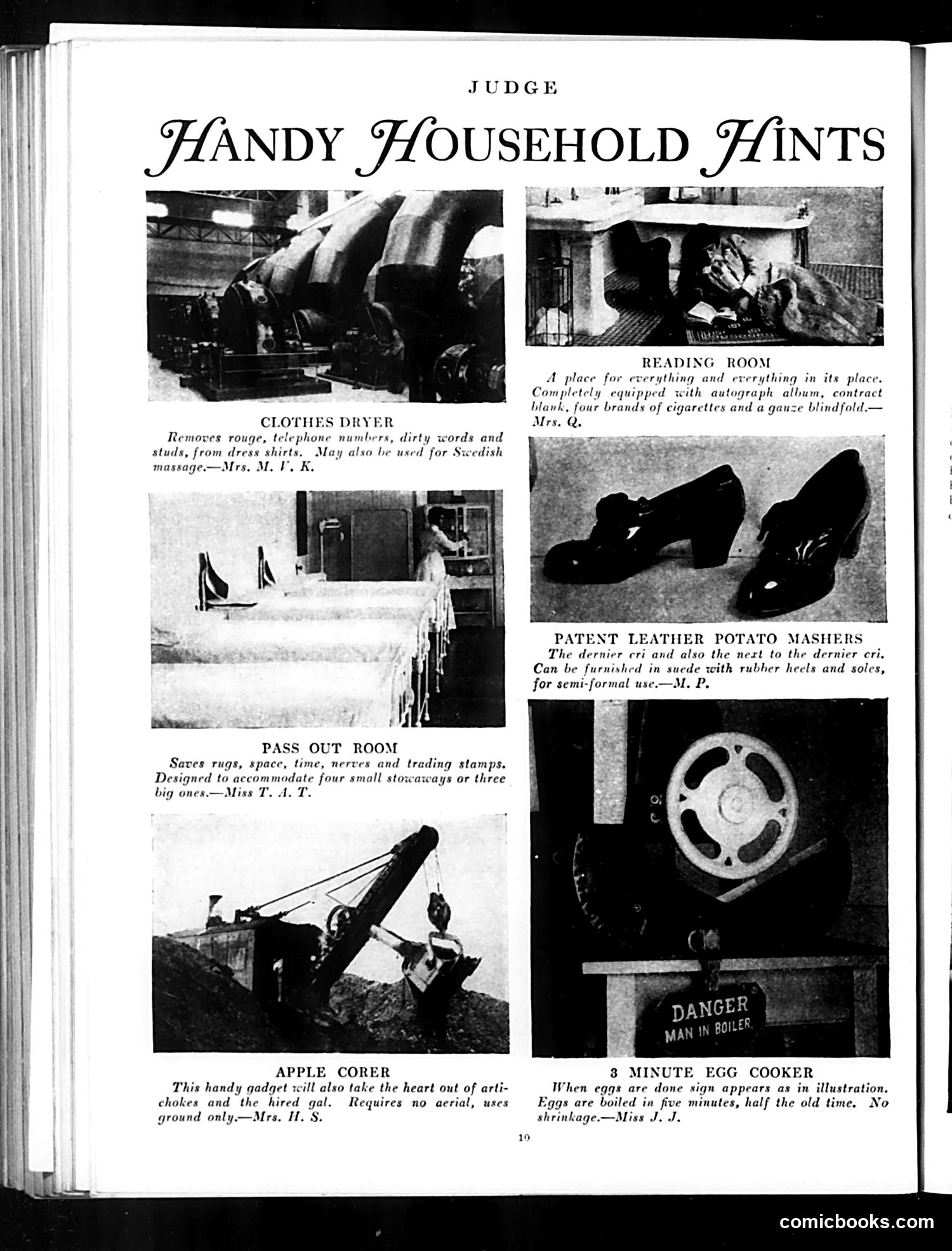
# Judge's "Handy Household Hints" - Satirical Gadgets This page presents **fake, absurd household inventions** as satirical commentary on consumer culture and modern domesticity. Each "hint" mocks both pointless gadget proliferation and social pretensions of the era. Notable examples: A "clothes dryer" that removes "rouge, telephone numbers, dirty words"—mocking women's cosmetics and infidelity anxieties. "Patent leather potato mashers" in formal wear styles satirize status-conscious overconsumption. A "reading room" equipped with "gauze blindfold" jokes darkly about willful ignorance. The "pass out room" for "stowaways" appears to reference Prohibition-era drinking culture. The "apple corer" cutting out the "heart" of "hired gal[s]" contains sharp class commentary—dehumanizing domestic workers as mere labor to be mechanized. These aren't sincere product advertisements but **biting satire of American consumer excess and domestic absurdity**, typical of Judge magazine's social criticism.