
Judge, 1929-11-23 · page 25 of 36
Judge — November 23, 1929 — page 25: what you’re looking at
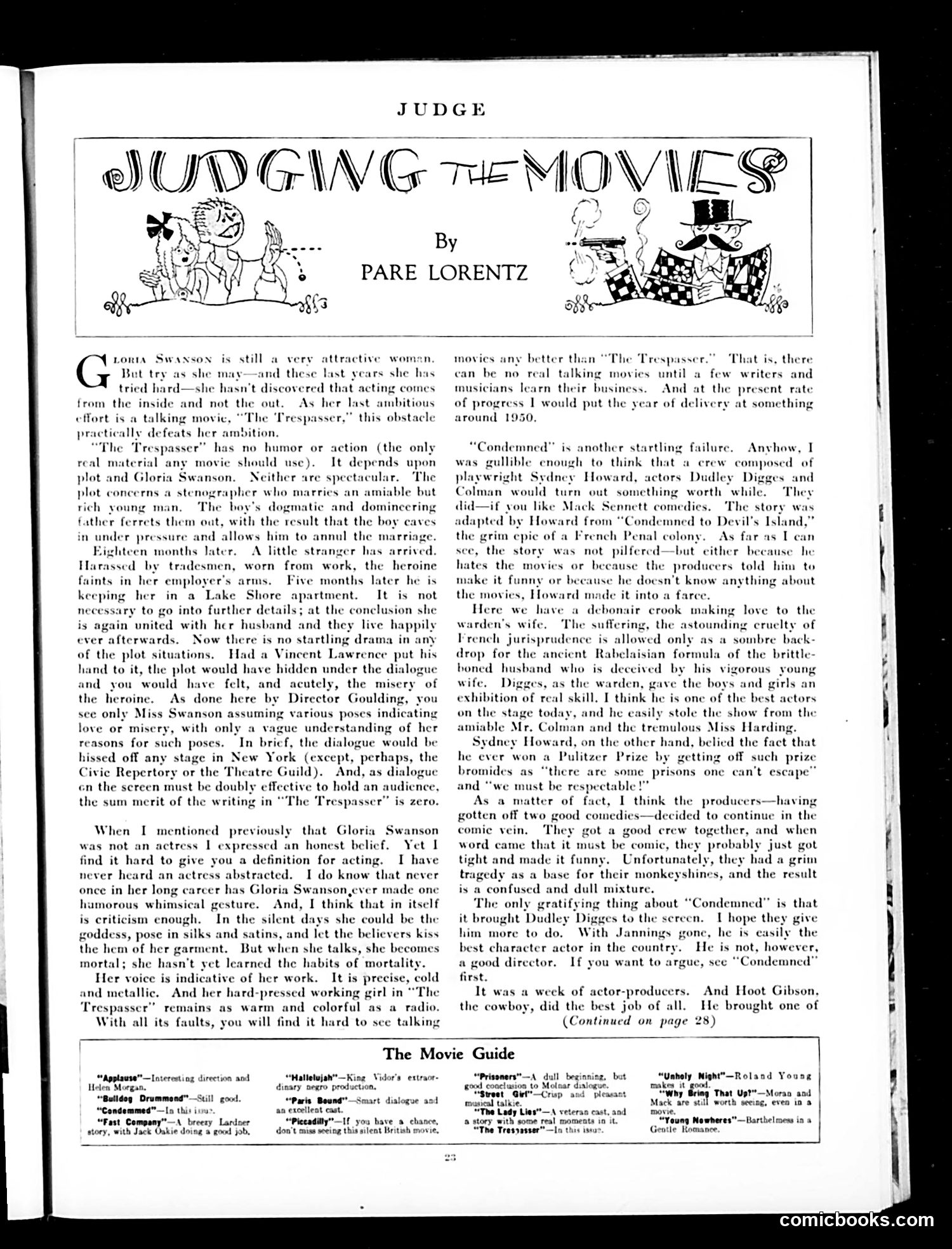
A restored page from Judge, 1929-11-23. Page through the whole issue in the reader above.
📄 Transcribed text from this page (OCR, searchable)
Machine-transcribed from the original scan — historical spelling and the odd misread are preserved.
JUDGE JUDGING Tue MOV’ Ee By Lonta Swanson is still a very attractive women. G But try as she may—and these last years she has tried hard—she hasn't discovered that acting comes from the inside and not the out. As her last ambitious effort is a talking movie, “The ‘Trespasser,” this obstacle eth defeats her ambition. “The Trespasser” has no humor or action (the only real material any movie should use). It depends upon plot and Gloria Swanson. Neither are spectacular. The plot concerns a stenographer who marries an amiable but rich young man. The boy's dog father ferrets them oat, with the result that the boy caves in under pressure and allows him to annul the marr Eighteen months later. A little stranger Harassed by tradesmen, worn from work, the heroine faints in her employer's arms. Five months later he is keeping her in a Lake Shore apartment. It is not necessary to go into further details; at the conclusion she is again united with her husband and they live happily ever afterwards. Now there is no startling drama in any of the plot situations. Had a Vincent Lawrence put his hand to it, the plot would have hidden under the dialogue and you would | felt, and acutely, the misery of the Heroine. As done here by Director Goulding, you sce only Miss Swanson assuming various poses indicating love or misery, with only a vague understanding of her reasons for such poses. In brief, the dialogue would be hissed off any stage in New York (except, perhaps, the Civie Repertory or the Theatre Guild). And, as dialogue en the sereen must be doubly effective to hold an audience, the sum merit of the writing in “The Trespasser” is zero. When I mentioned previously that Gloria Swanson was not an actress I expressed an honest belief. Yet I find it hard to give you a definition for acting. I have never heard an actress abstracted. I do know that never once in her long carcer has Gloria Swanson,cver made one hamorous whimsical gesture. And, I think that in itself is criticism enough. In the silent days she could be the goddess, pose in silks and satins, and let the believers kiss the hem of her garment. But when she talks, she becomes mortal; she hasn't yet learned the habits of mortality. Her voice is indicative of her work. It is precise, cold and metallic. And her hard-pressed working girl in “The Trespasser” remains as warm and colorful as a radio. With all its faults, you will find it hard to see talking movies any better than respasser.” That is, there can be no real talking movies until a few writers and musicians learn their business. And at the present progress 1 would put the year of delivery at something ound 1950, “Condemned” is another startling failure. Anyhow, I was gullible enough to think that a crew composed of playwright Sydney Howard, actors Dudley Digges and olman would turn out something worth while. They did—if you like Mack Sennett comedies. The story w adapted by Howard from “Condemned to Devil's Island,” the grim epic of a French Penal colony. As far as T can sce, the story was not pilfered—but either because he hates the movies or because the producers told him to make it funny or because he doesn't know anything about the movies, Howard made it into a farce. Here we have a debonair crook making love to the warden’s wife. The suffering, the astounding cruelty of French jurisprudence is allowed only as a sombre back- drop for the ancient Rabelaisian formula of the brittle boned husband who is deceived by his vigorous young ». Digges, as the warden, gave the boys and girls an exhibition of real skill. I think he is one of the best actors on the stage today, and he easily stole the show from the amiable Mr. Colman and the tremulous Miss Harding. Sydney Howard, on the other hand, belied the fact that he ever won a Pulitzer Prize by getting off such prize bromides as “there are some prisons one can’t escape” and “we must be respectable!” As a matter of fact, I think the producers—having gotten off two good comedies—decided to continue in the comic vein. They got a good crew together, and when word came that it must be comic, they probably just got le it funny. Unfortunately, they had a grim sa base for their monkeyshines, and the result confused and dull mixture The only gratifying thing about “Condemned” is that t Dudley Digges to the sereen. I hope they give © to do. With Jannings gone, he is easily the acter actor in the country. He is not, however, a good director. If you want to argue, sce “Condemned” first. It was a week of actor-producers. And Hoot Gibson, the cowboy, did the best job of all. He brought one of (Continued on page 28) The Movie Guide | “Applause” —Lnteresting direction and “Hallelujah —K ors extraor- Helen Morgan, dinary negro production, “Bulldog Drummond” —Still got. “Paris Bound” “Condemmed”—In this ivvu> an excellent cast. “Fast Company”—A breety Lardner “Pieeadilly”—If you have a chance, story, with Jack Oakie doing a good job. don't miss seeing this silent British movie, Smart dialogue and wanes Mint”—Rolaod Young | tWhy ring That Upt*—Moran and Mack are still worth seeing, even in a “The Lady Lies”—A veteran cast.and movie. a story with some real moments in it. “Young Nowheres” Imes in a “The Trespasser™—In this Gentle Romance. comicbooks.com