
Judge, 1929-11-23 · page 22 of 36
Judge — November 23, 1929 — page 22: what you’re looking at
A restored page from Judge, 1929-11-23. Page through the whole issue in the reader above.
📄 Transcribed text from this page (OCR, searchable)
Machine-transcribed from the original scan — historical spelling and the odd misread are preserved.
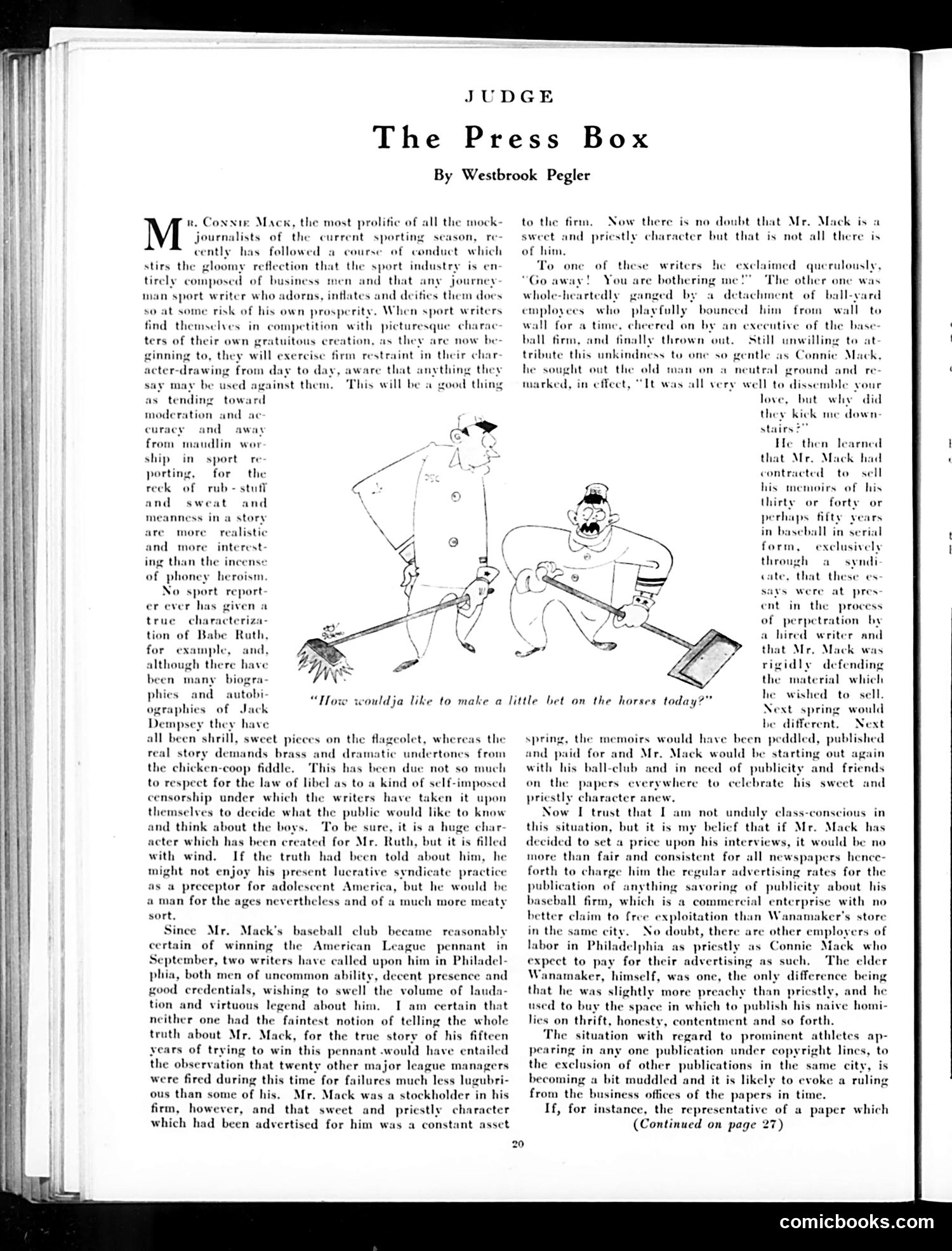
JUDGE The Press Box By Westbrook Pegler Connie Mack, the most prolific of all the mock- ournalists of the current sporting season, re cently has followed a course of conduct which stirs thi gloomy reflection that the sport industry is en tirely composed of business men and that any journey man sport writer who adorns, inflates and deities them docs so at some risk of his own prosperity. When sport writers find themselves in competition with picturesque charac ters of their own gratuitous creation, as they are now be- ginning to, they will exercise firm restraint in their char acter-drawing from day to day, aware that anything they y may be used ¢ nst them. This will be a good thing dd s tending tows moderation and ac f curacy and away ed from maudlin wor - e ship in’ sport re porting, for the reck of rub - stuff and sweat and meanness in a story are more realistic and more interest ing than the incense of phoney heroism No sport report ver | iven tr characteriz tion of Babe Ruth, for example, and, although there have been many biogr: phies and autobi ographies of Jack Dempsey they have all been shrill, sweet pieces on the flageolet, whereas the real story demands brass and dramatic undertones from the chicken-coop fiddle. This has been due not so much to respect for the law of libel as to a kind of self-imposed censorship under which the writers have taken it upon themselves to decide what the public would like to know and think about the boys. o be sure, it is a huge char acter which has been ¢ 1 for Mr. Ruth, but it is filled with wind. If the truth had been told about him, he might not enjoy his present lucrative syndicate practice 1 preceptor for adolescent America, but he would be n for the ages nevertheless and of a much more meaty sort. Since Mr. Mack's baseball club be certain of winning the Americ 6 September, two writers have called upon him in Philadel- phia, both men of uncommon ability, decent presence and good credentials, wishing to swell the volume of tion and virtuous legend about him. I am certain that neither one had the faintest notion of telling the whole truth about Mr. Mack, for the true story of his fift years of trying to win this pennant .would have the observation that twenty other major league man were fired during this time for failures much less lugubri- ous than some of his. Mr. Mack a stockholder in his firm, however, and that sweet and priestly cha which had been advertised for him me reasonably e pennant in “How wouldja like to make a little bet on the horses today?” to the firm. Now there is no doubt that Mr. Mack is a sweet and priestly character but that is not all there is of him, To one of these writers he exe “Go away! You are bothering m whole-heartedly employees who pl: wall for a time rv executive of the base ball firm, and finally thrown out. Still unwilling tribute this unkindness to one so gentle as Connie Mack. he sought out the old man on a neutral ground and re marked, in effect, “It was all very well to dissemble your aimed querulously, ! ‘The other one was nged by a detachment of ball-yard fully unced him from wall to veered on by 4 love, but) why did they kick me down stairs?” He then learned that Mr. Mack had contracted his memoirs of his thirty or forty or perhaps fifty v in baseball in se ars. ial form, exclusively throu hoa syndi cate, that these es says were at pres ent in’ the process of perpetration by a hired writer and that Mr. Mack was rigidly defending the erial which he wished to. sell. Next spring would be different, Next the memoirs would have been peddled, published and paid for and Mr. Mack would be starting out again with his ball-club and in need of publicity and friends on the papers everywhere to celebrate his sweet and priestly character anew, Now I trust th sprin t Iam not unduly class-conscious in this situation, but it is my belief that if Mr. M has decided to set a price upon his interviews, it would be no more than fair and consistent for all newspapers hence- forth to charge him the regular advertising rates for the publication of anything savoring of publicity about his baseball firm, which is a commercial enterprise with no better claim to free exploitation than Wd y. No doubt, there are other employers of delphia as priestly as Connie Mack who expect to pay for their advertising as such, The elder Wanamaker, himself, was one, the only difference being that he was slightly more preachy than priestly, and he used to buy the space in which to publish his naive homi- lies on thrift, honesty, contentment and so forth. The sit n with regard to prominent athletes ap- pearing in any one publication under copyright lines, to the exclusion of other publications in the same city, is becoming a bit muddled and it is likely to evoke a ruling from the business offices of the papers in time. If, for instance, the representative of a paper which (Continued on page 27) amaker’s store in the same c labor in Phi comicbooks.com