
Judge, 1929-11-23 · page 7 of 36
Judge — November 23, 1929 — page 7: what you’re looking at
What you’re looking at
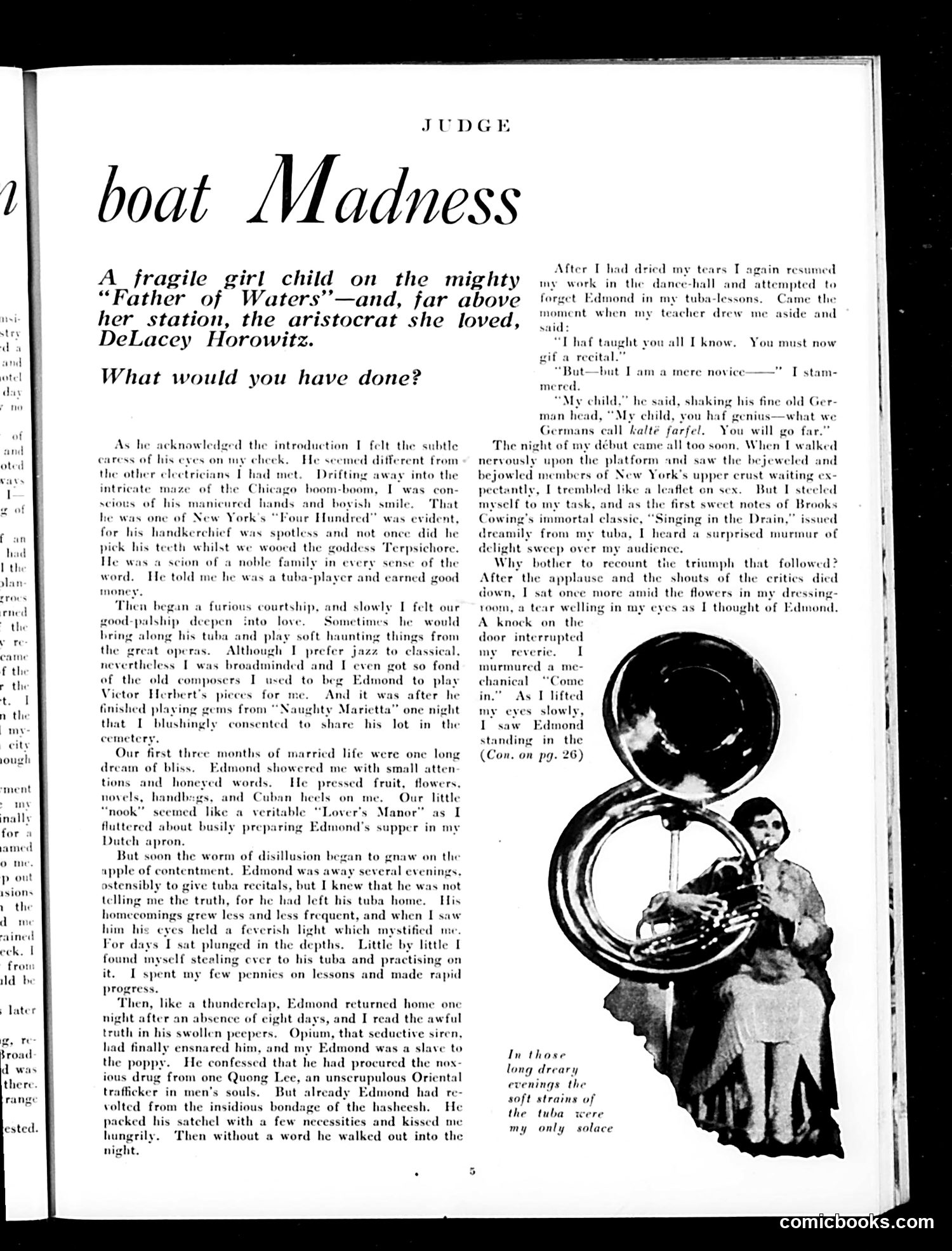
# "Boat Madness" - Judge Magazine This page presents a serialized story titled "Boat Madness" about a young woman named DeLacey Horowitz who abandons her aristocratic station for love. The narrative describes her marriage to Edmund, a musician with a tuba who initially showers her with affection but later becomes distant, revealing himself as an opium addict involved with "Oriental traffickers." The accompanying illustration shows a woman gazing dreamily at a large tuba, with a small male figure visible within or beside it—a visual metaphor for her romantic obsession. This appears to be melodramatic fiction rather than political satire, reflecting early 20th-century Judge magazine's mix of humor and serialized stories exploring themes of class conflict, substance abuse, and romantic disillusionment.
📄 Transcribed text from this page (OCR, searchable)
Machine-transcribed from the original scan — historical spelling and the odd misread are preserved.
ment my amed mic p out isions the dome fro ld be slater ig. Te Broad id was there JUDGE boat Madness A_fragile girl child on the mighty “Father of Waters’’—and, far above “ her station, the aristocrat she loved, DeLacey Horowitz. What would you have done? As he acknowledged the introduction [ felt the subtle caress of his eyes on my cheek. He seemed different from the other cleetricians Thad me Drifti intricate maze of the Chicag iway into the boom-boom, I was con- of his manicured hands and boyish smile. That he was one of New York's “Four Hundred” was evident, for his handkerchief was spotless and not once did he pick his teeth whilst we wooed the goddess Terpsichore. He was a scion of a noble family in every sense of the word. He told me he was a tuba-player and earned good money. Then began a furious courtship, and slowly I felt our p deepen into love. Sometimes he would his tuba and play soft haun operas. Although I prefer j nevertheless [was broadminded a © things from to classical, ot so fond of the old composers Tu Edmond to play Victor Herbert's pieces for And it was after he finished playing gems from “N y Mariet one night that I blushingly consented to share his lot in’ the cemetery. Our first three months of marricd life were one long dream of bliss. Edmond showered me with small atten tions and honeyed words. He pressed fruit, flowers. novels, handb:gs, and Cuban heels on me. Our little “nook” scemed like a veritable “Lover's Manor” as I fluttered about busily preparing Edmond’s supper in my Dutch apron. But soon the worm of disillusion | n to gnaw on the apple of contentment. Edmond was several evenings. ostensibly to give tuba recitals, but I knew that he was not telling me the truth, for he had left his tuba home. His homecomings grew less and less frequent, and when I saw him his eyes held a feverish light which mystified me For days T sat plunged in the depths. Little by little I found inyself stealing ever to his tuba and practising on it. I spent my few pennies on lessons and made rapid pr s Then, like a thunderclap, Edmond returned home onc night after an absence of eight days, and I read the awful truth in his swollen peepers. Opium, that seductive siren, had finally ensnared him, and my Edmond was a slave to the poppy. He confessed that he had procured the nox- ious drug from one Quong Lee, an unscrupulous Oriental trafficker in men’s souls. But already Edmond had re- volted from the insidious bondage of the hasheesh. He packed his satchel with a few necessities and kissed me hungrily. ‘Then without a word he walked out into the night. After T had dried my tears T again resumed my work in the dance-hall and attempted to t Edmond in my tuba-lessons, Came the moment when my teacher drew me aside and said: “Lhaf taught you all TL know. You must now gif ar “But—but Iam a mere novice T stam- mered. “My child,” he said, shaking his fine old Ger- man head, “My child, you haf genius—what we Germans call kalté farfel. You will go far.” The night of my début came all too soon, When T walked nervously upon the platform and saw the bejeweled and bejowled members of New York's upper crust waiting ex- pectantly, [trembled like a leaflet on sex. But T steeled myself to my task, and as the first sweet notes of Brooks Cowing’s immortal classic, “Singing in the Drain,” issued dreamily from my tuba, I heard a surprised murmur of delight sweep over my audience. Why bother to recount the triumph that followed? After the applause and the shouts of the crities died down, I sat once more amid the flowers in my dressing- room, a tear welling in my eyes as I thought of Edmond. A knock on the door interrupted my reverie. I murmured a me- chanical “Come in.” As I lifted my eyes slowly, I saw Edmond standing in’ the (Con. on pg. 26) In those long dreary evenings the soft strains of the tuba were my only solace comicbooks.com