
Judge, 1929-11-23 · page 17 of 36
Judge — November 23, 1929 — page 17: what you’re looking at
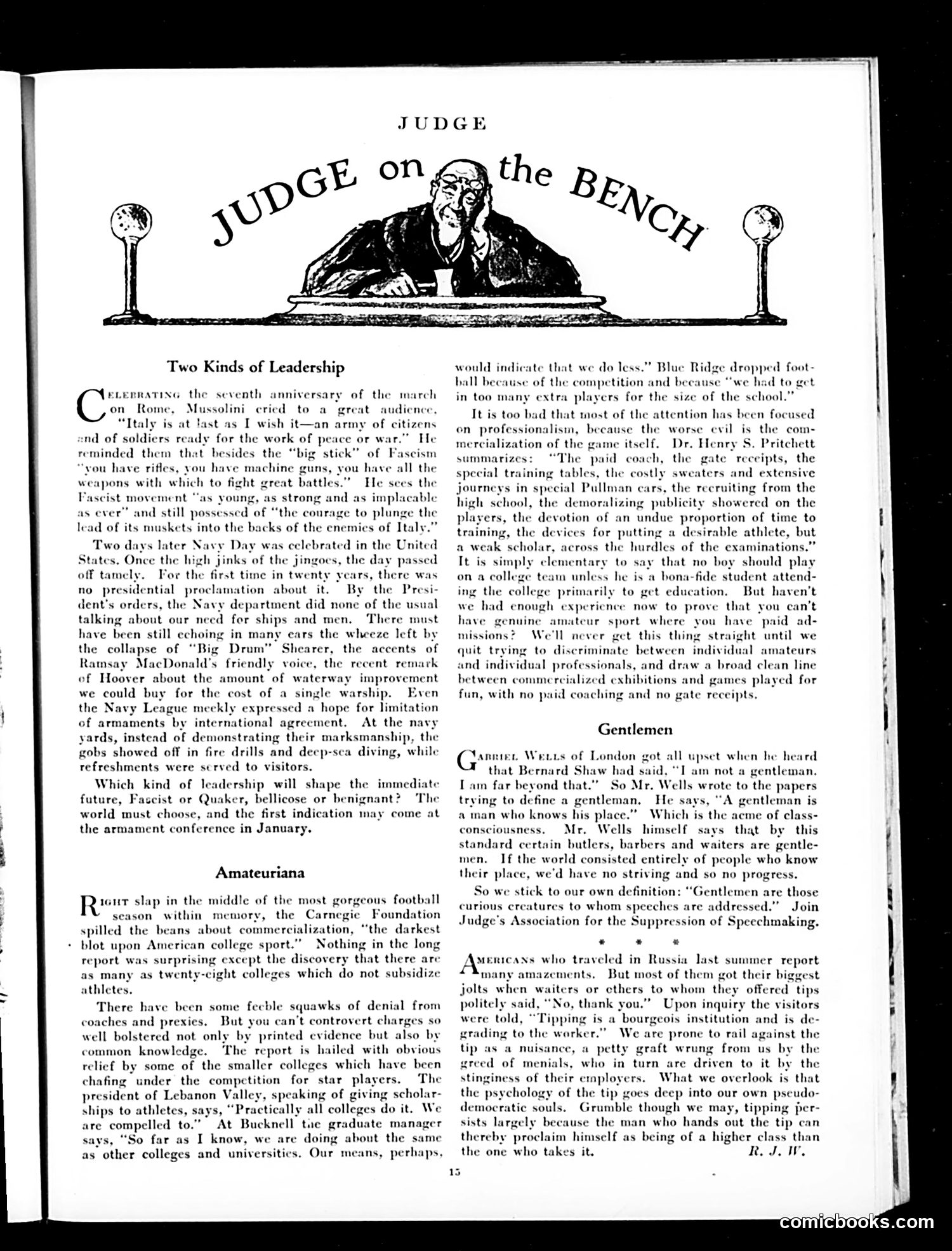
A restored page from Judge, 1929-11-23. Page through the whole issue in the reader above.
📄 Transcribed text from this page (OCR, searchable)
Machine-transcribed from the original scan — historical spelling and the odd misread are preserved.
JUDGE Two Kinds of Leadership eLerratine the seventh on Rome, Mussolini “Italy is stas I wish it—an army of citizens nd of soldiers ready for the work of peace reminded them that besides the stick” ‘you have rifles, you have machine guns, you have all the rons with which to fight great battles.” He sees the Fascist movement * strong and as implacable and still possessed of “the courage to plun lead of its muskets into the backs of the enemies of Its Two days later N of tl great audience, anniversary march cried to a or war.” He of Fascism “as young, as eve vy Day was celebrated in the U States. Once the high jinks of the jingoes, the day passed off tamely. For the first tine in twenty years, there was no presidential proclamation about it. By the Presi- dent's orders, the Navy department did none of the usual talking about our need for ships and men, There must have been still echoing in many ears the wheeze left by the collapse of “Big Drum” Shearer, the accents of Ramsay MacDonald's friendly voice, the recent remark of Hoover about the amount of waterway improvement we could buy for the cost of warship. Even the Navy League meekly expressed a hope for limitation of armaments by international agreement. At the yards, instead of demonstrating their marksmanship, the gobs showed off in fire drills and deep-sea diving, while refreshments were served to visitors. Which kind of leadership will shape the future, Fascist or Quaker, bellicose or be world must choose, and the first indi the armament conference in January. immedi ignant? jon may come a Amateuriana Ret slap in the middle of the most gorgeous football Foundation ation, “the darkest season within memory, the Carne, spilled the beans about commercializ blot upon American college sport.” Nothing in the long report was surprising except the discovery that there are as many as twenty-cight colleges which do not subsidize athletes, There have been some feeble squawks of denial from coaches and prexies, But you can’t controvert charges so well bolstered not only by printed evidence but also by common knowledge. The report is hailed with obvious relief by some of the smaller colleges which have t chafing under the competition for star players, The president of Lebanon Valley, speaking of giving scholar- ships to athletes, s, “Practically s do it. We are compelled to.” At Bucknell tae gradu manager says, “So far as I know, we are doing about the as other colleges and universities. Our means, perh: would indicate that we do less.” Blue Ridge dropped foot- ball because of the competition and because “we had to get in too many extra players for the size of the school. It is too bad that most of the attention has been focused on professionalism, because the worse evil is the mercialization of the game itself. Dr. Henry S. “The paid coach, the receipts, the special tr ining tables, the costly sweaters and extensive journeys in special Pullman cars, the recruiting from the high school, the demoralizing publicity showered on the vers, the devotion of an undue proportion of time to i the devices for putting a de ple athlete, but eak schol r, across the hurdles of the examinations.” It is simply clementary to say that no boy should play team unless he is a bona-fide student attend- lege primarily to get education. But hi we had enough experience now to prove that you can’t have genuine amateur sport where you have paid ad- We'll t this thing straight until we quit trying to discriminate between individual amateurs and individual professionals, and draw a broad clean line between commercialized exhibitions and games played for fun, with no paid coaching and no gate ree com- Pritchett gate ing the ¢ missions ? never ipts. Gentlemen Games Wents of London all upset when he hes that Bernard Shaw had said, “I am not a gentleman, I am far beyond that.” So Mr. Wells wrote to the papers trying to define a gentleman. He says, “A gentleman is aman who knows his pla Which is the acme of class- consciousness. Mr. Wells himself says that by this standard certain butlers, bers and waiters are gentle- men. If the world consisted entirely of people who know their place, we'd have no striving and so no progress. So we stick to our own definition: “Gentlemen are those curious creatures to whom speeches are addressed.” Join Judge's Association for the Suppression of Speechmaking. . * * entcans who traveled in Russia last summer report many amazements. But most of them got their biggest jolts when waiters or cthers to whom they offered tips politely said, “No, thank you.” Upon inquiry the visitors were told, “Tipping is a bourgeois institution and is d - worker.” We are prone to rail against the from us by the driven to it by the What we overlook is that es deep into our own pseudo- Grumble though we may, tipping per- r use the man who hands out the tip thereby proclaim himself as being of a higher the one who takes it. . who in turn are giness of their employers. the psychology of the tip democratic souls. icbooks.com