A complete issue · 36 pages · 1929
Judge — November 9, 1929
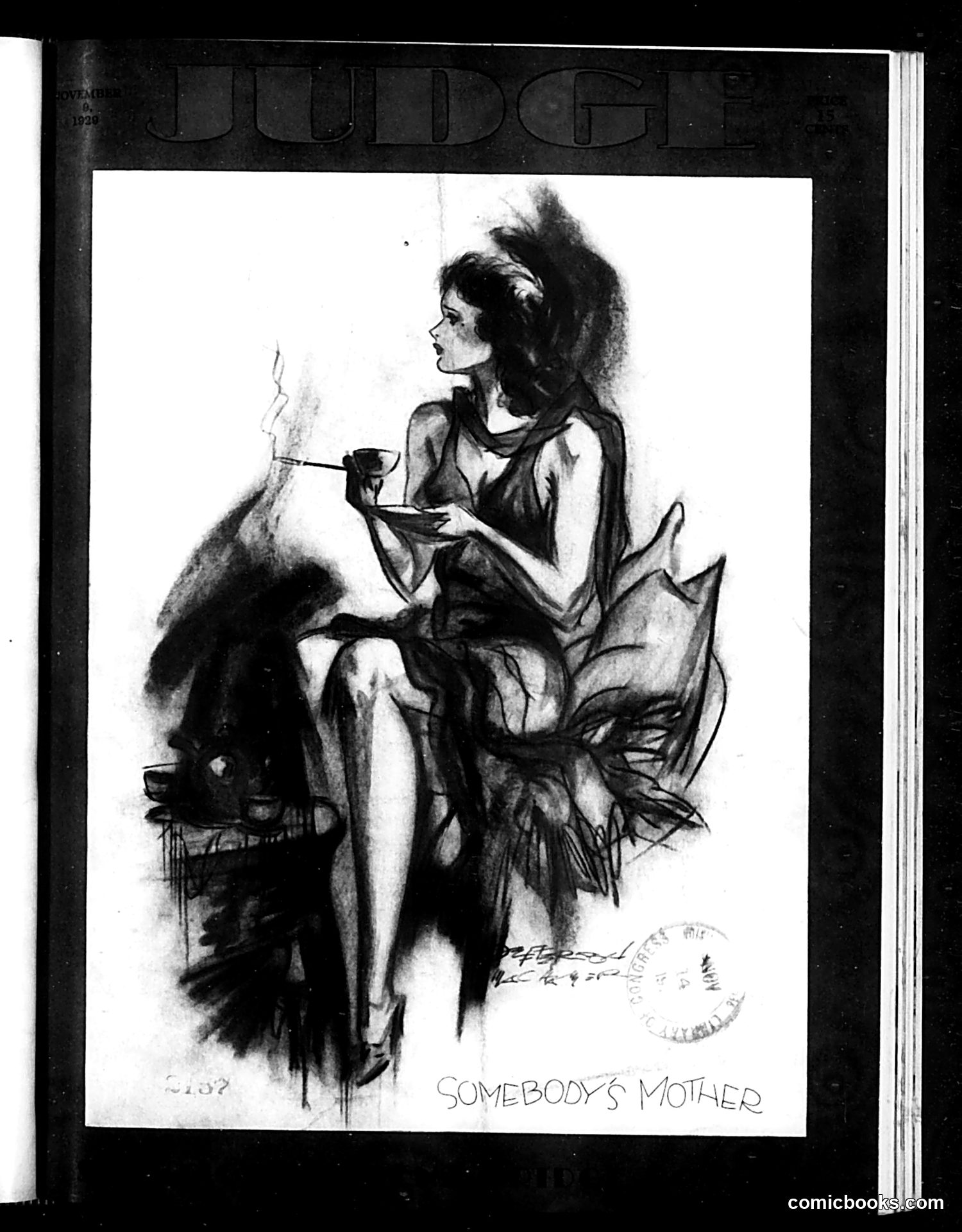
# "Somebody's Mother" — Judge Magazine Cartoon This sketch depicts a woman in a revealing dress, smoking a cigarette and holding a drink. The title "Somebody's Mother" appears to be satirical commentary on changing social norms, likely from the 1920s Jazz Age era based on the style and Judge's publication timeline. The cartoon likely critiques anxieties about modern women's behavior and independence—specifically the "flapper" phenomenon. The sardonic title suggests society's discomfort with mothers (or women generally) adopting supposedly "immoral" behaviors like smoking and drinking publicly, which were controversial and associated with moral decline among early 20th-century conservatives. The sketch employs Judge's typical approach of using exaggeration and irony to mock social hypocrisy or generational conflict.
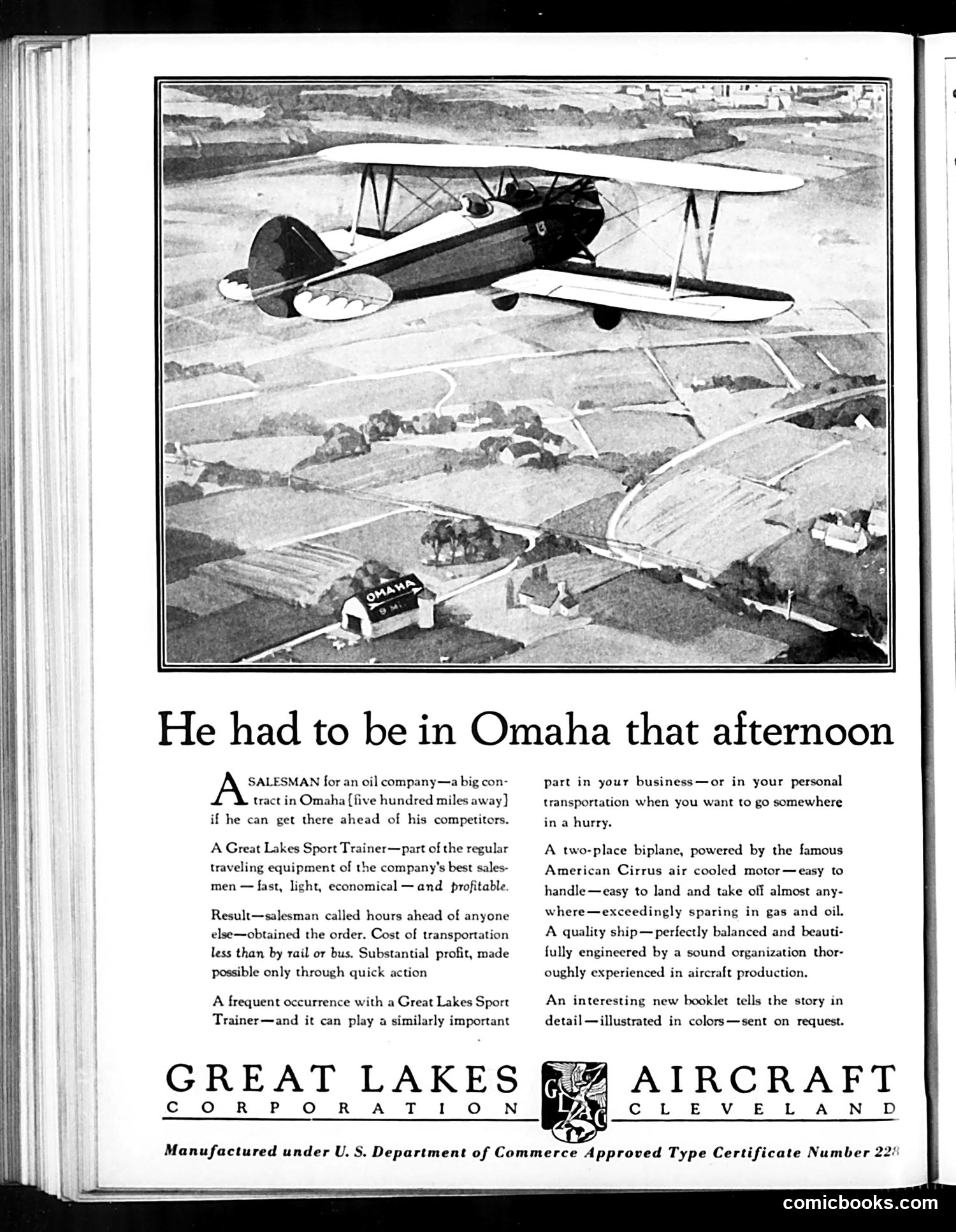
# Analysis This is **not a satirical cartoon** but rather a **commercial advertisement** for Great Lakes Aircraft Corporation of Cleveland. The page depicts a two-seater biplane (a "Great Lakes Sport Trainer") flying over rural farmland above an Omaha building. The accompanying text presents a business scenario: a salesman needs to reach Omaha quickly to close a contract ahead of competitors. The aircraft enables this speed advantage. This advertisement targets businessmen, emphasizing practical benefits—fast transportation, economical operation, and quick turnaround for sales. The "Sport Trainer" plane is positioned as a legitimate business tool, not a novelty. The page reflects 1920s-30s optimism about aviation as a transformative commercial technology. There is no satire present; Judge magazine apparently accepted advertisements alongside satirical content.
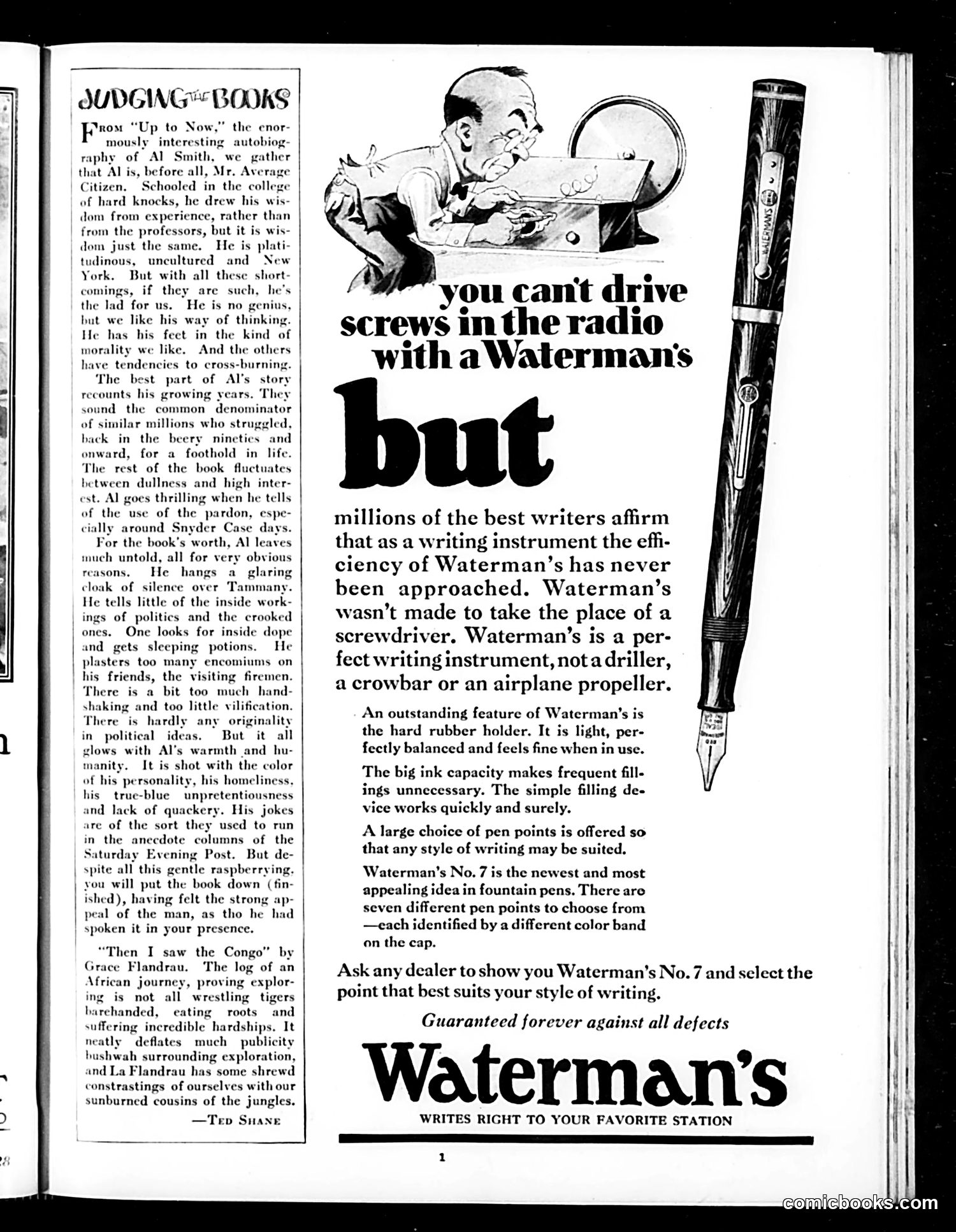
# Analysis of Judge Magazine Page This page is primarily a **Waterman's fountain pen advertisement**, not political satire. The ad occupies most of the space, featuring a caricatured man struggling to use a screwdriver in a radio, with the humorous headline "you can't drive screws in the radio with a Waterman's but..." The left column contains a book review titled "Judging the Books," discussing Al Smith's autobiography "Up to Now." The reviewer praises Smith as an "average citizen" with practical wisdom gained through experience rather than academia, though notes he lacks originality in political thinking. The advertisement emphasizes Waterman's pen superiority for writing over improvised tools, promoting their No. 7 model with multiple interchangeable points. This is straightforward commercial messaging rather than satirical commentary.
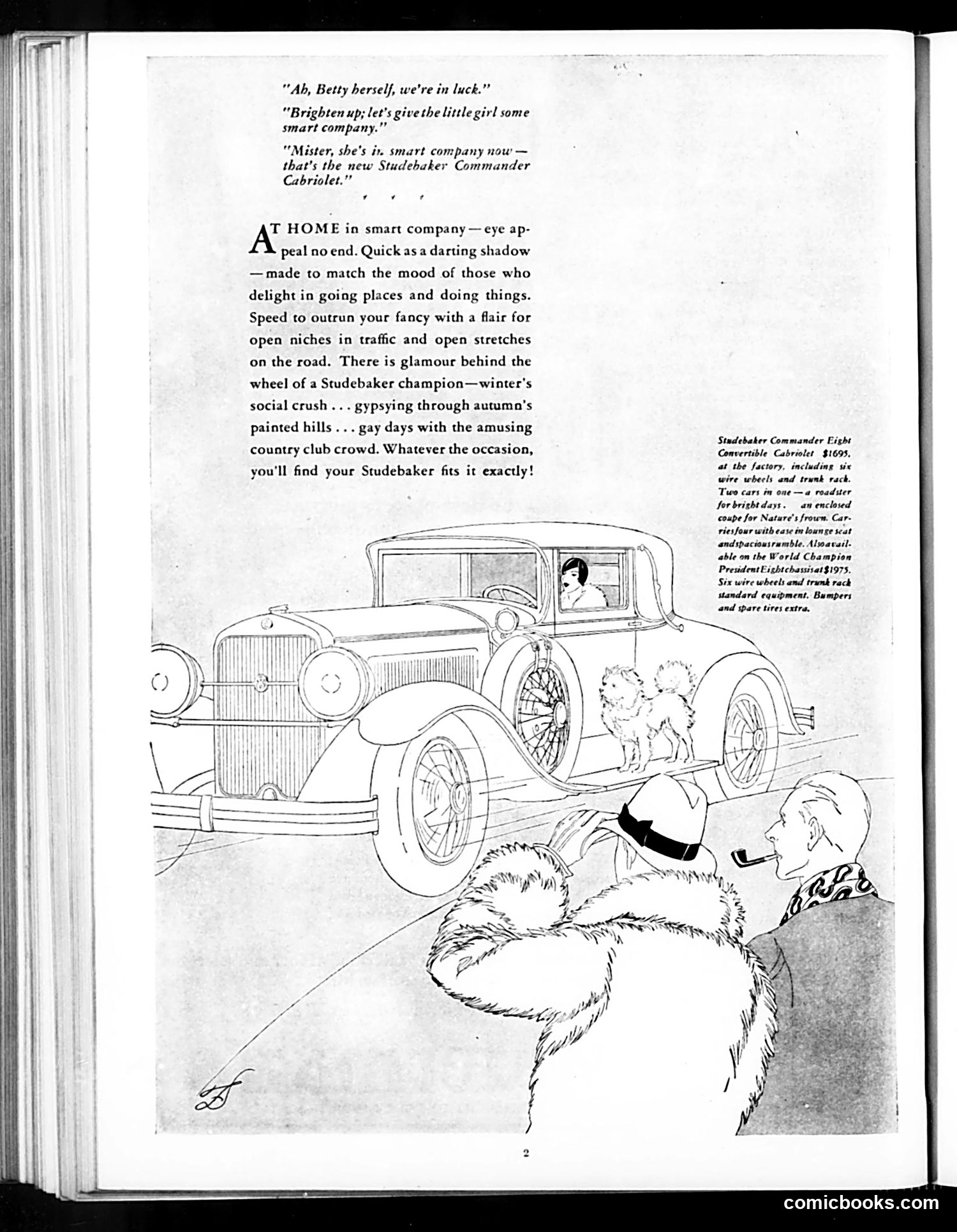
# Analysis This page is primarily an **advertisement** for the Studebaker Commander Eight Convertible Cabriolet automobile, priced at $1,695. The illustration shows a stylish car with two fashionably-dressed figures observing it from the foreground. The accompanying text uses aspirational language about "smart company" and social prestige, emphasizing the car's speed, glamour, and suitability for upscale activities—"winter's social crush," "country club crowd," and leisurely driving through scenic landscapes. The dialogue at the top presents the car as a status symbol that signals sophistication and style to onlookers. This is typical 1920s-30s automotive advertising that conflates car ownership with social standing and leisure-class identity. The art style and messaging are characteristic of Judge magazine's brand of upscale humor and consumer culture promotion.
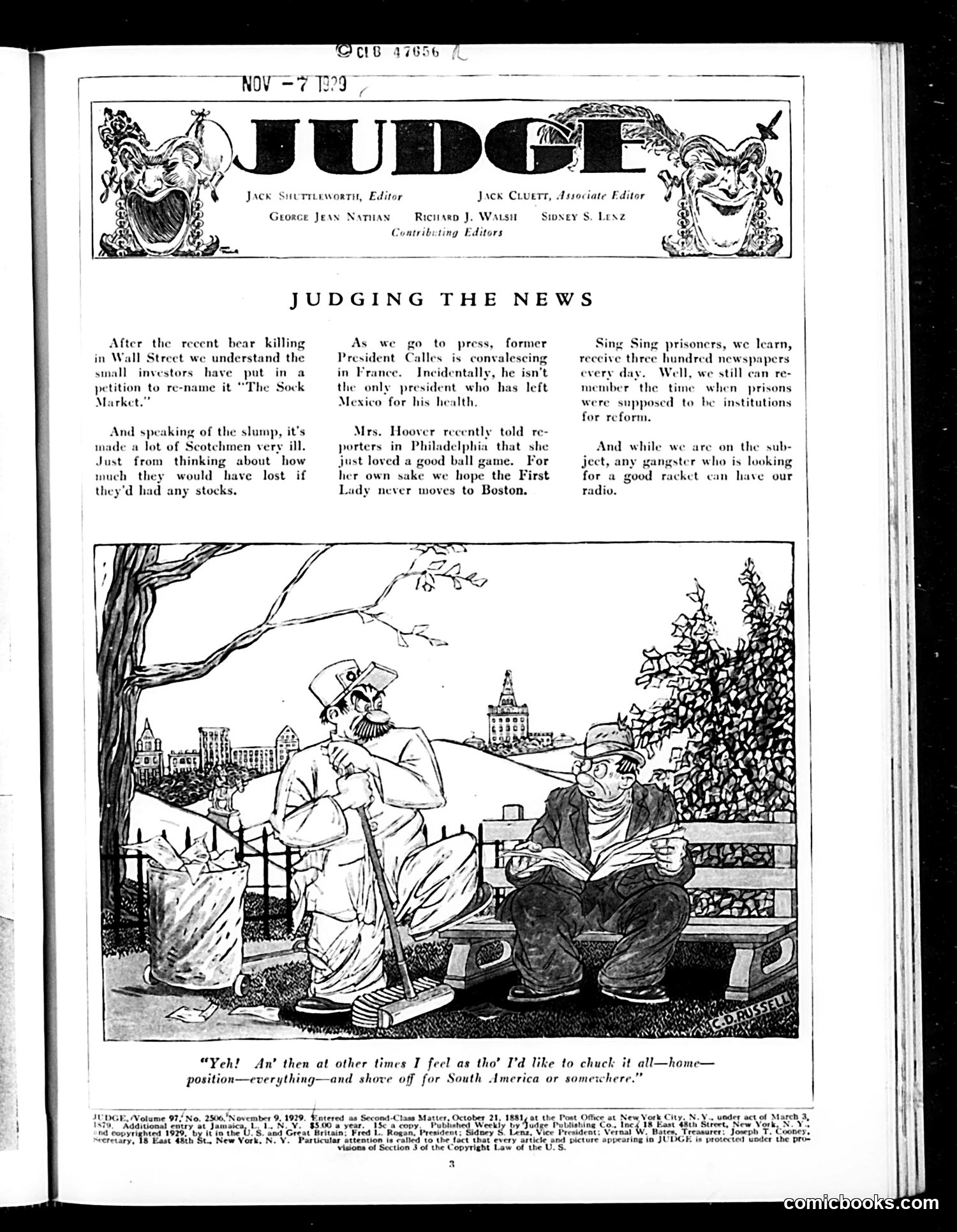
# Judge Magazine Cartoon Analysis This 1929 cartoon satirizes economic anxiety following the recent stock market crash. The column "Judging the News" references Wall Street's "bear killing," small investors' losses in "The Stock Market," and Scottish investors being hit hard by the slump. The main cartoon depicts two men: one appears to be Uncle Sam (identifiable by his hat), speaking to another figure on a park bench. Uncle Sam expresses desire to "chuck it all—home position—everything—and shore off for South America or somewhere," suggesting even American leadership feels despair about the economic crisis. The satire mocks how severe the financial panic was—even symbols of American stability contemplate abandoning the country entirely.
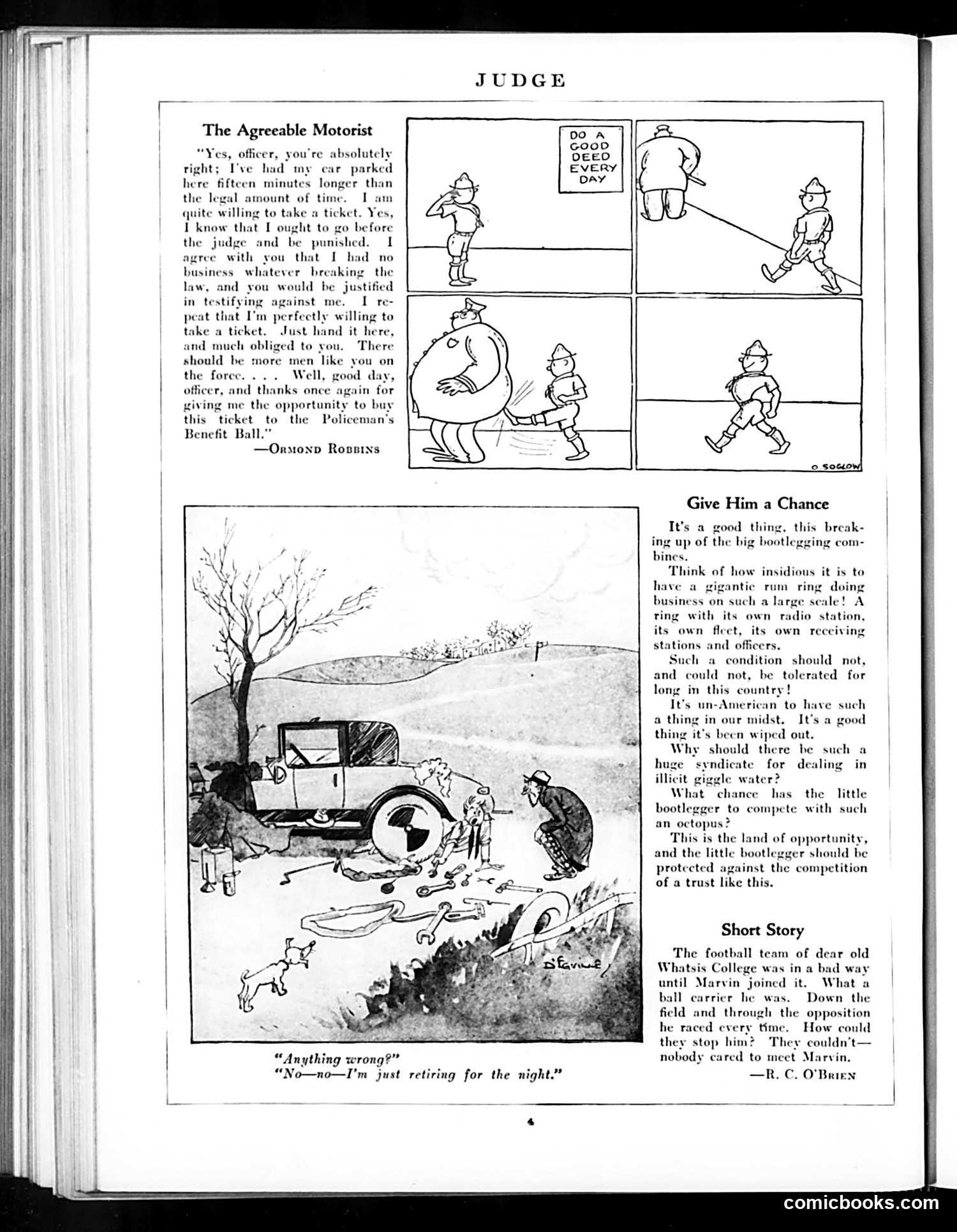
# "The Agreeable Motorist" and Related Content **Top Comic:** A motorist caught parking illegally offers the officer a bribe—a ticket to a "Policeman's Benefit Ball"—rather than accept a fine. The joke satirizes motorists' expectation that they can buy their way out of traffic violations through charm and small gifts. **Middle Cartoon:** Depicts a broken-down car and a woman saying "Anything wrong?" with the response "No—no—I'm just retiring for the night." This appears to mock mechanical failures in early automobiles. **"Give Him a Chance":** An editorial piece criticizing large bootlegging syndicates and advocating protection for small-scale illegal alcohol producers—satirizing Prohibition-era enforcement disparities and the competitive disadvantage faced by independent bootleggers against organized crime operations.
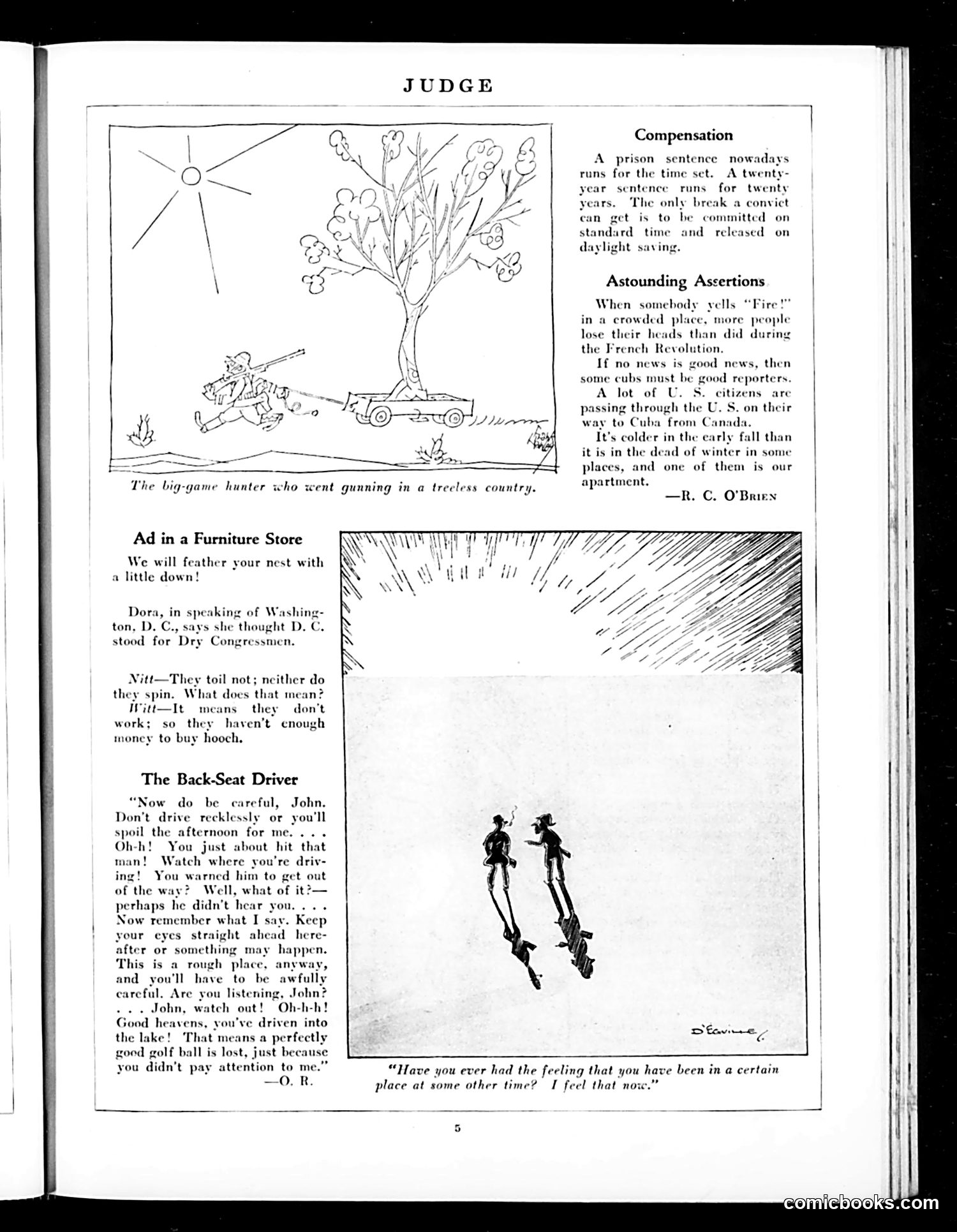
# Page Analysis: Judge Magazine Satirical Content This page contains several unrelated humor pieces rather than a unified political cartoon: 1. **"The log-game hunter who went gunning in a treeless country"** — A visual joke about poor planning; the illustration shows someone attempting to hunt in an obviously unsuitable landscape. 2. **"Ad in a Furniture Store"** — A wordplay joke about "D.C." (Washington, D.C.) standing for "Dry Congressmen," implying members of Congress don't work and lack funds. 3. **"The Back-Seat Driver"** — A domestic humor piece where a passenger critiques the driver's golf game through backseat driving metaphors, ending with them accidentally driving into a lake. These are typical Judge magazine filler pieces mixing political jabs with general domestic humor, rather than hard-hitting satire.
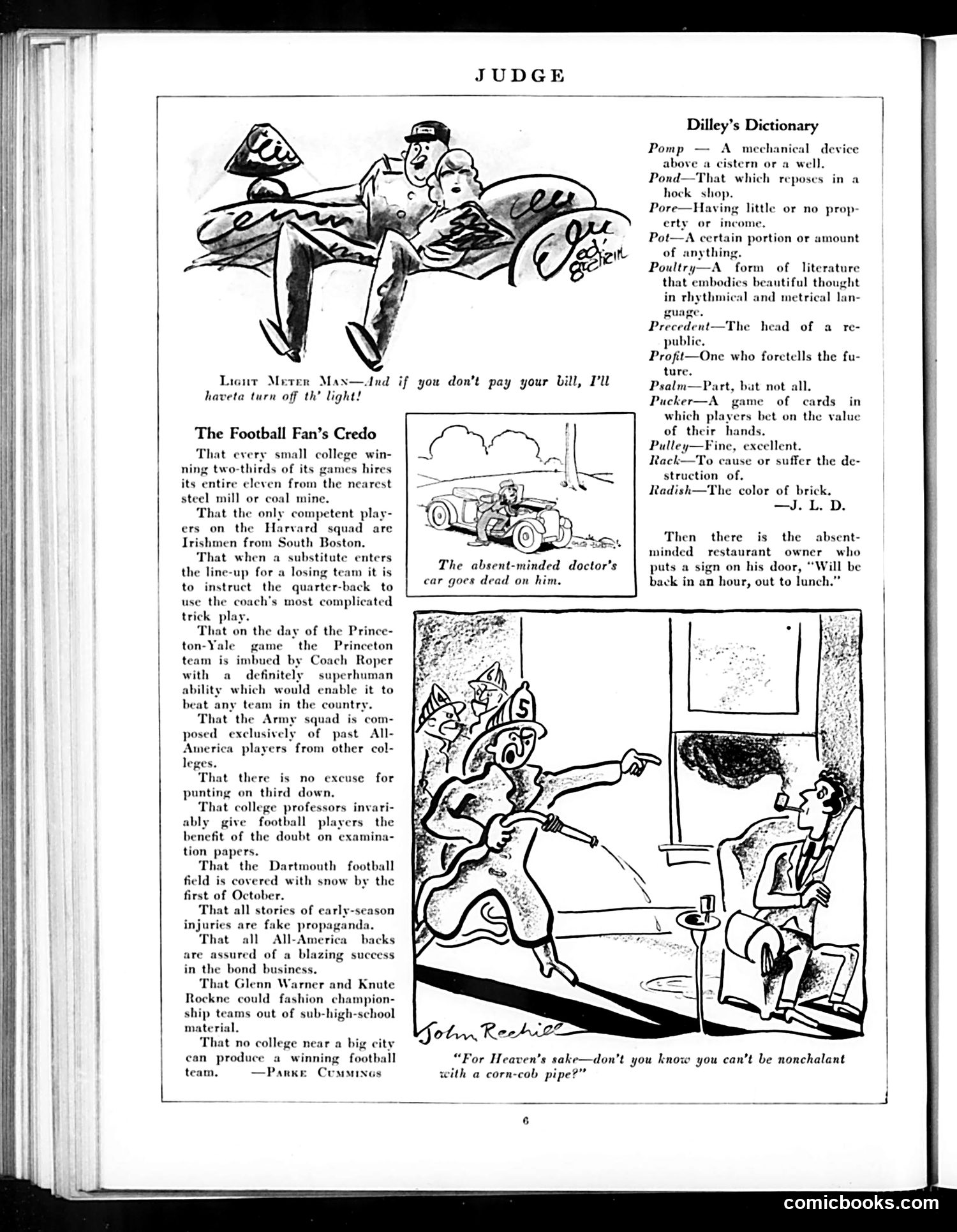
# Analysis of Judge Magazine Page This page contains satirical content about early 20th-century American life: **Top cartoon** ("Light Meter Man"): A utility company worker threatens to cut off electricity for non-payment—satirizing aggressive debt collection by monopolistic utilities. **"Football Fan's Creed"**: A humorous mock-serious poem mocking college football culture, its recruiting practices, coaching mythology, and the absurd reverence fans and schools place on the sport. **Middle cartoon** ("The absent-minded doctor's car"): Visual gag about a distracted physician whose vehicle breaks down, forcing him to walk. **Bottom cartoon** (John Rockhife): A man smoking a corn-cob pipe tells another he's "nonchalant"—likely mocking pretentious social posturing or the affectation of casualness. The page reflects early 1900s American concerns: utility monopolies, college sports excess, and social pretension.
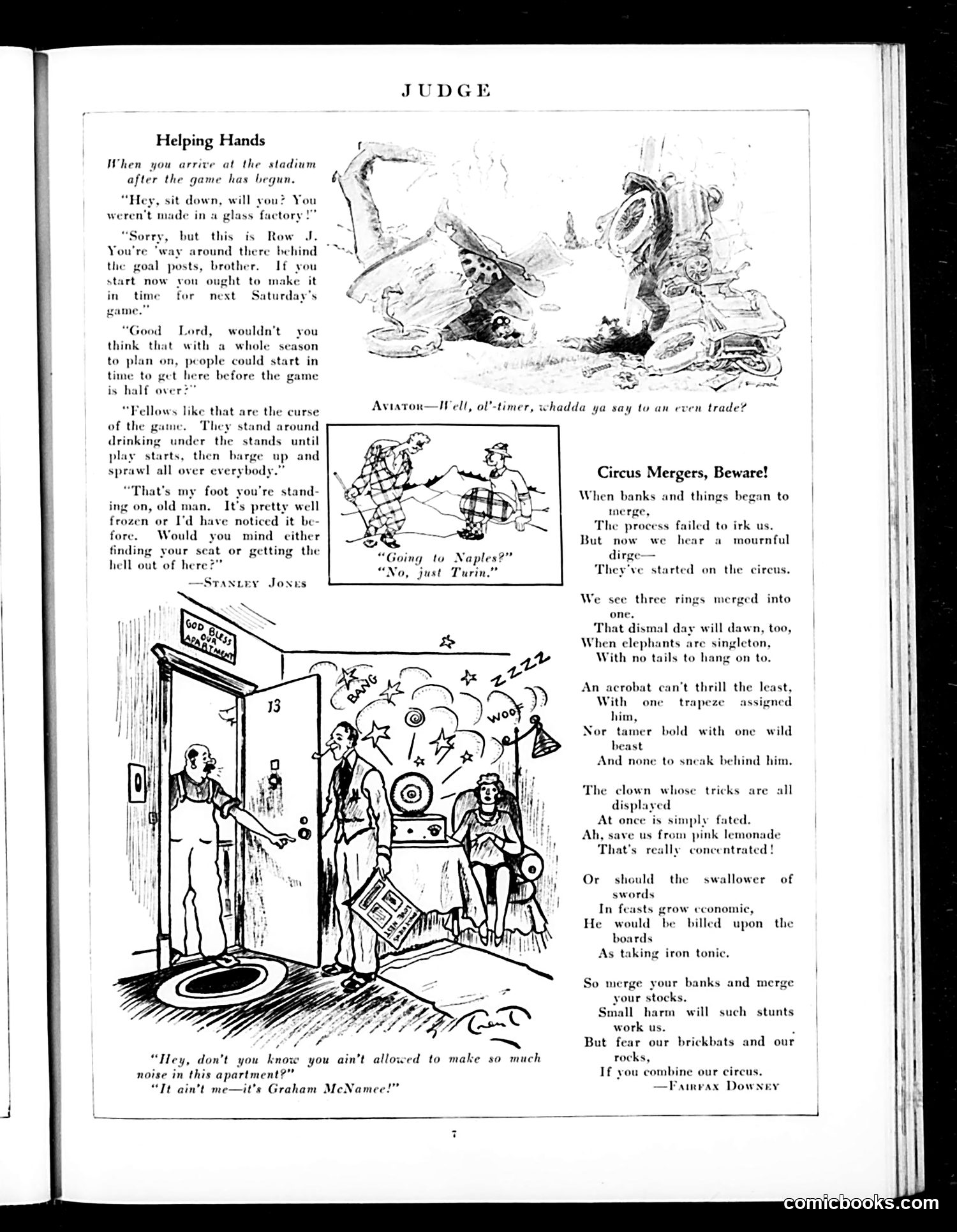
# Judge Magazine Page Analysis This page from *Judge* contains two separate satirical pieces: **"Helping Hands"** mocks inconsiderate sports fans. The cartoons show stadium-goers arriving late, blocking others' views, standing on feet, and causing general disruption. The humor targets the social rudeness of those who arrive after games begin—particularly those drinking under the stands before stumbling to their seats. The final cartoon references "Graham McNamee," likely a famous radio broadcaster of the era, joking that apartment noise complaints stem from his broadcast volume rather than residents. **"Circus Mergers, Beware!"** satirizes the 1920s wave of business consolidations and bank mergers. The poem uses circus imagery to mock corporate consolidation trends: merged rings lose their appeal, animals lose distinctiveness, acts become economically inefficient. The satire warns that while business mergers might seem acceptable in finance, combining entertainment—the circus—would destroy its magic. It's a lighthearted critique of unchecked corporate consolidation. Both pieces target contemporary social irritations and economic trends through humor.
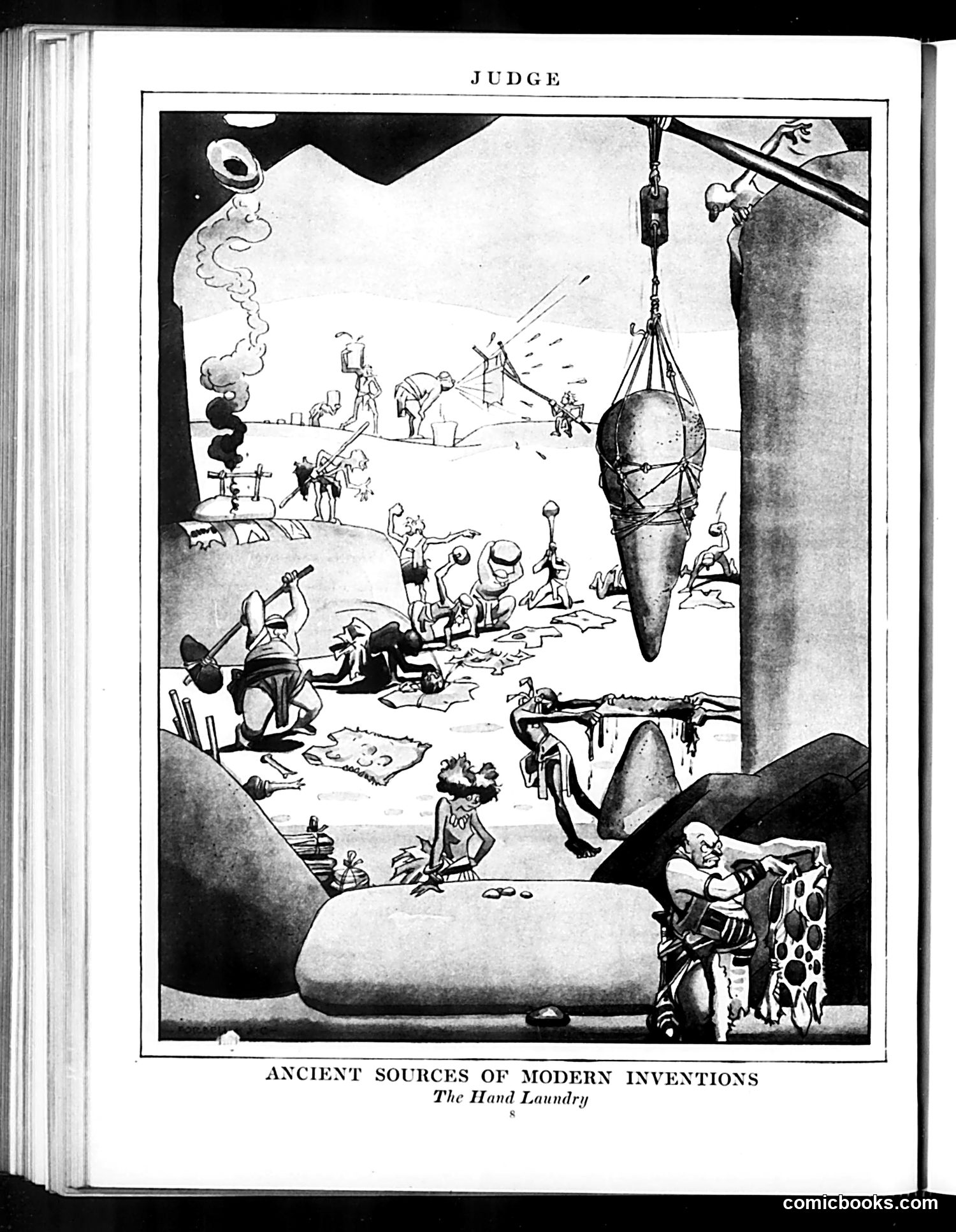
# Analysis This satirical cartoon from *Judge* magazine depicts "The Hand Laundry" as an "ancient source of modern inventions." The illustration shows a surreal, underground or cavernous workshop where small figures operate various contraptions and machinery to wash clothes by hand. The satire appears to mock the industrial laundering process by presenting it as primitive, chaotic labor—suggesting that despite modern technological advancement, commercial laundries still rely on fundamental hand-washing methods rather than true mechanization. The fantastical, overcomplicated apparatus surrounding the workers emphasizes the absurdity: all this elaborate machinery essentially reduces to manual labor anyway. The cartoon criticizes either the inefficiency of contemporary laundry services or satirizes claims about modern "progress" when basic work remains fundamentally unchanged.
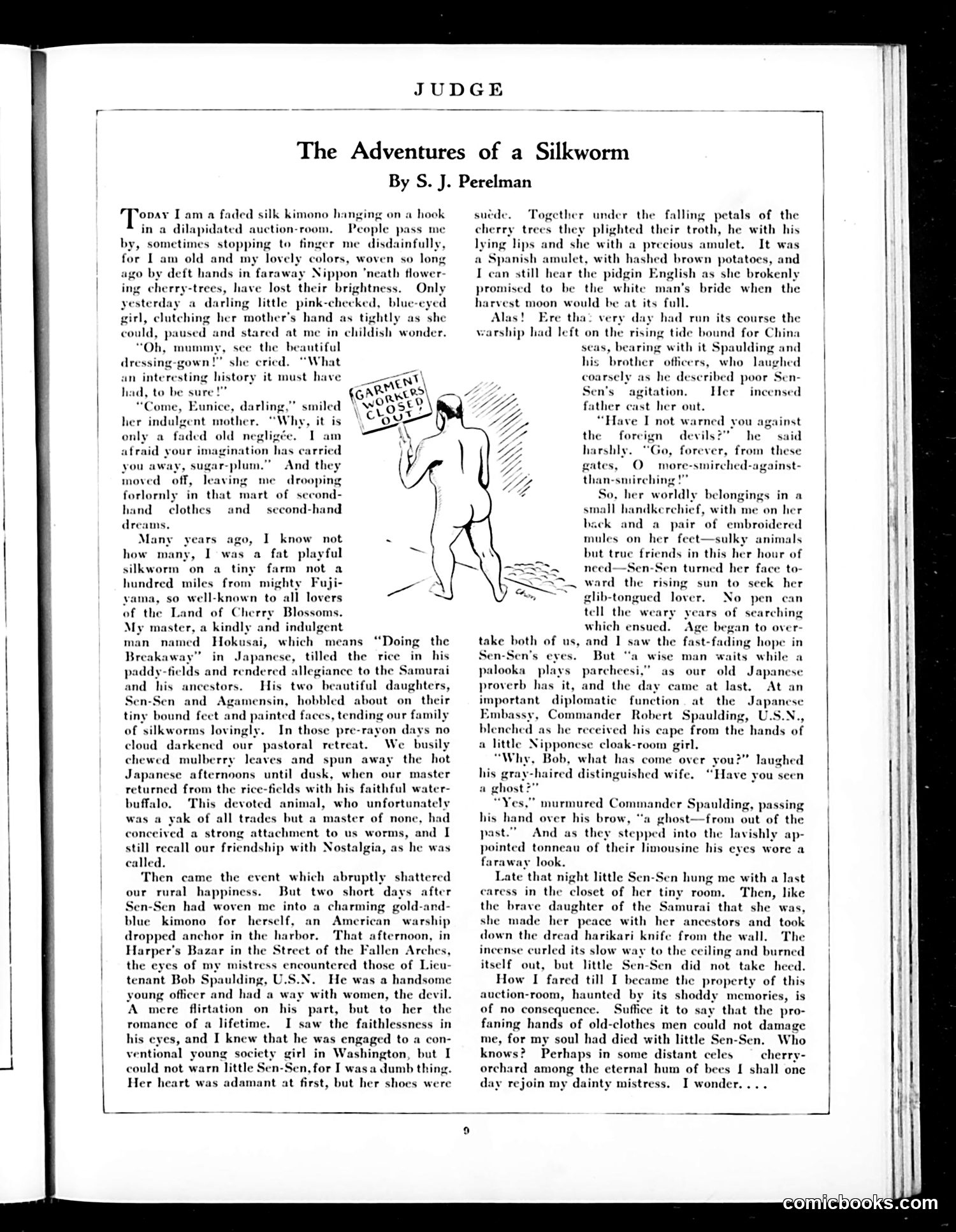
# "The Adventures of a Silkworm" by S. J. Perelman This is a satirical short story (not primarily a political cartoon), published in *Judge* magazine. The narrative frames a faded kimono in an auction room recounting its journey from a Japanese silk farm. The story parodies melodramatic Orientalist fiction popular in early 20th-century America. Key elements include: exoticized Japanese imagery (Mt. Fuji, cherry blossoms, samurai ancestors), stereotypical character names ("Sen-Sen"), and a predictable tragic plot—a naive Japanese girl falls for a deceitful American naval officer who abandons her. The illustration shows a humorous nude figure labeled "Garment Exposed" examining the kimono. Perelman mocks both the sentimental romanticization of Japan and the trope of the tragically wronged Asian woman. The satire targets American readers' appetite for exotic, melodramatic tales and their casual racism toward non-Western cultures.
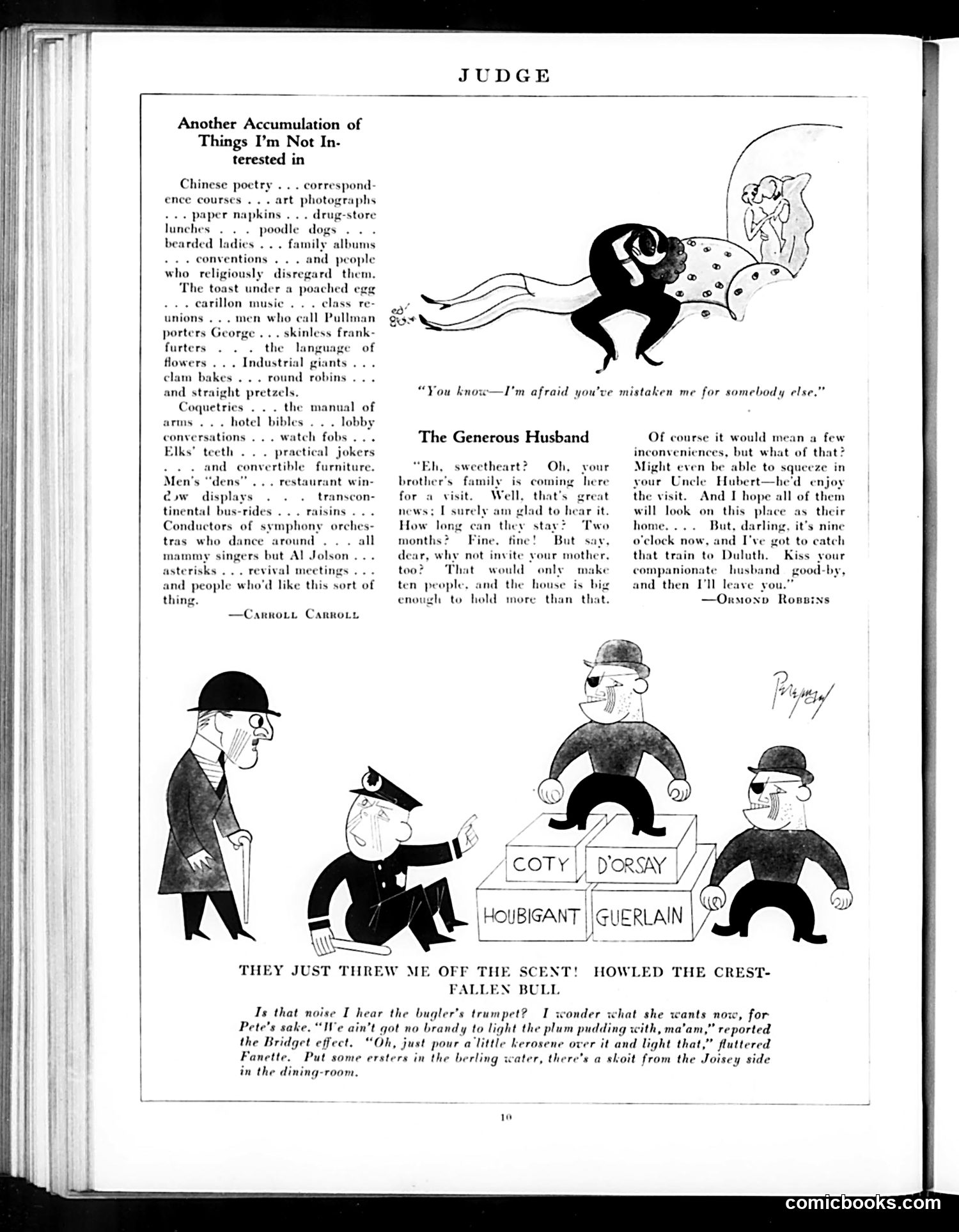
# Judge Magazine Page Analysis This page from the satirical magazine *Judge* contains three distinct pieces of humor: **"Another Accumulation of Things I'm Not Interested in"** (by Carroll Carroll) is a humorous list-essay mocking tedious social conventions and consumer products of the era—Chinese poetry, correspondence courses, poodle dogs, conventions, and people who ignore etiquette. It's genteel complaint masquerading as cultural commentary. **"The Generous Husband"** satirizes domestic hypocrisy. A husband enthusiastically encourages his wife to invite her brother's family for a two-month visit, then her mother, and uncle—appearing magnanimous—only to reveal he's catching a train to Duluth and leaving immediately. The joke exposes how easily men avoided domestic inconvenience while posturing as selfless. **"They Just Threw Me Off the Scent"** (bottom) appears to reference fragrance brands (Coty, Dorsay, Houbigant, Guerlain visible on blocks) in a visual gag about perfume, though the complete context is unclear from this page. The humor targets bourgeois pretension, marital dynamics, and consumer culture typical of early 20th-century American satire.
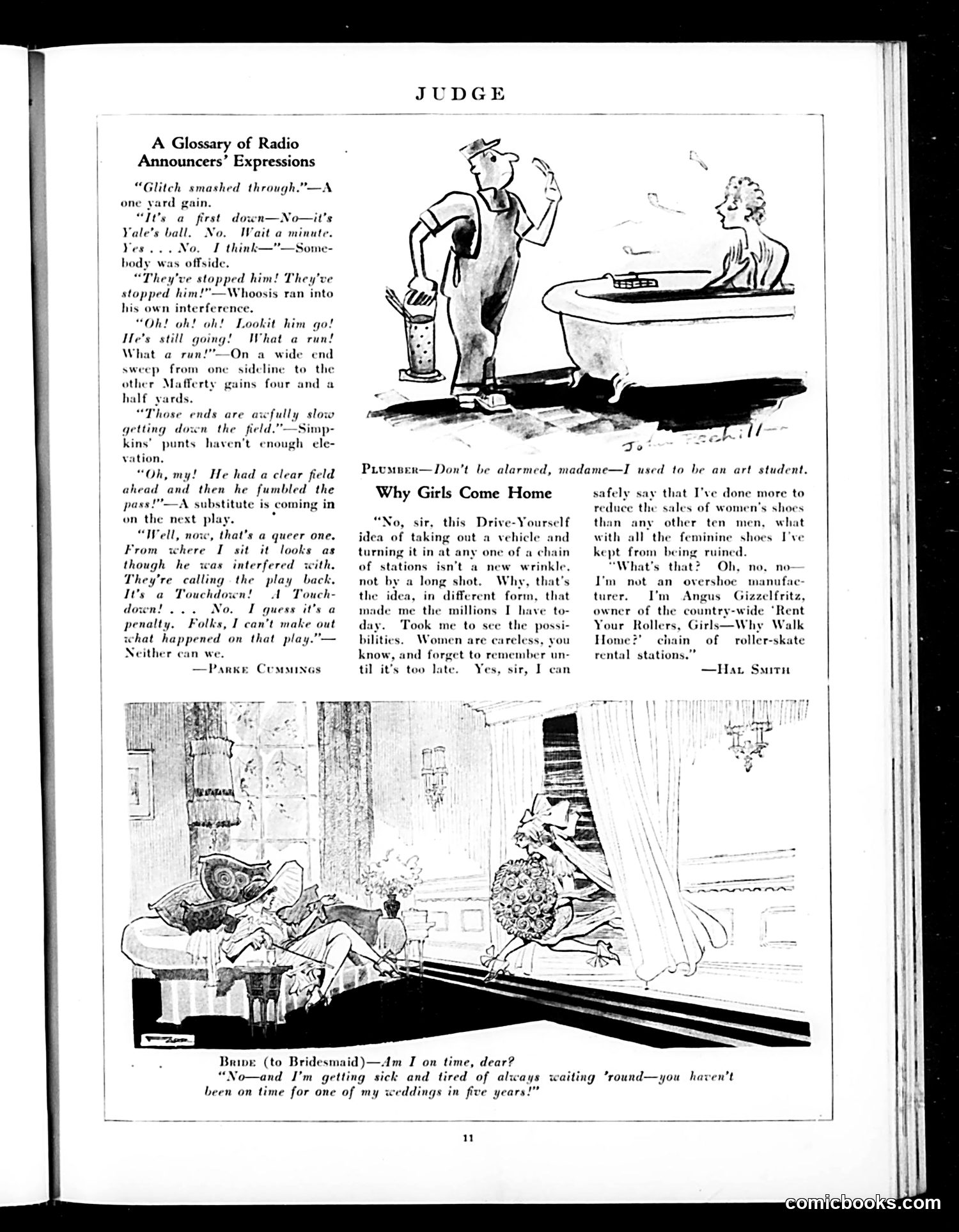
# Analysis of Judge Magazine Page This page satirizes **radio sports announcers** and contains social humor about gender roles. **Top Section:** "A Glossary of Radio Announcers' Expressions" mocks the breathless, often confused commentary of live football broadcasters. The humor lies in announcers making dramatic declarations ("Oh! oh! oh! Lookit him go!") for minimal gains (four and a half yards), or contradicting themselves repeatedly about basic facts. Parker Cummings highlights how radio announcers obscure rather than clarify action. **Bottom Section:** Two separate humor pieces—one about a plumber who claims his business thrives because women drivers rent vehicles and ruin their shoes, and a bride chronically late to her own weddings. The joke assumes female drivers are reckless and that women are perpetually tardy—typical 1920s-30s gender stereotypes presented as comic fact. The page reflects an era when radio sports commentary was new, exciting, and often amateurish.