
Judge, 1929-11-09 · page 11 of 36
Judge — November 9, 1929 — page 11: what you’re looking at
What you’re looking at
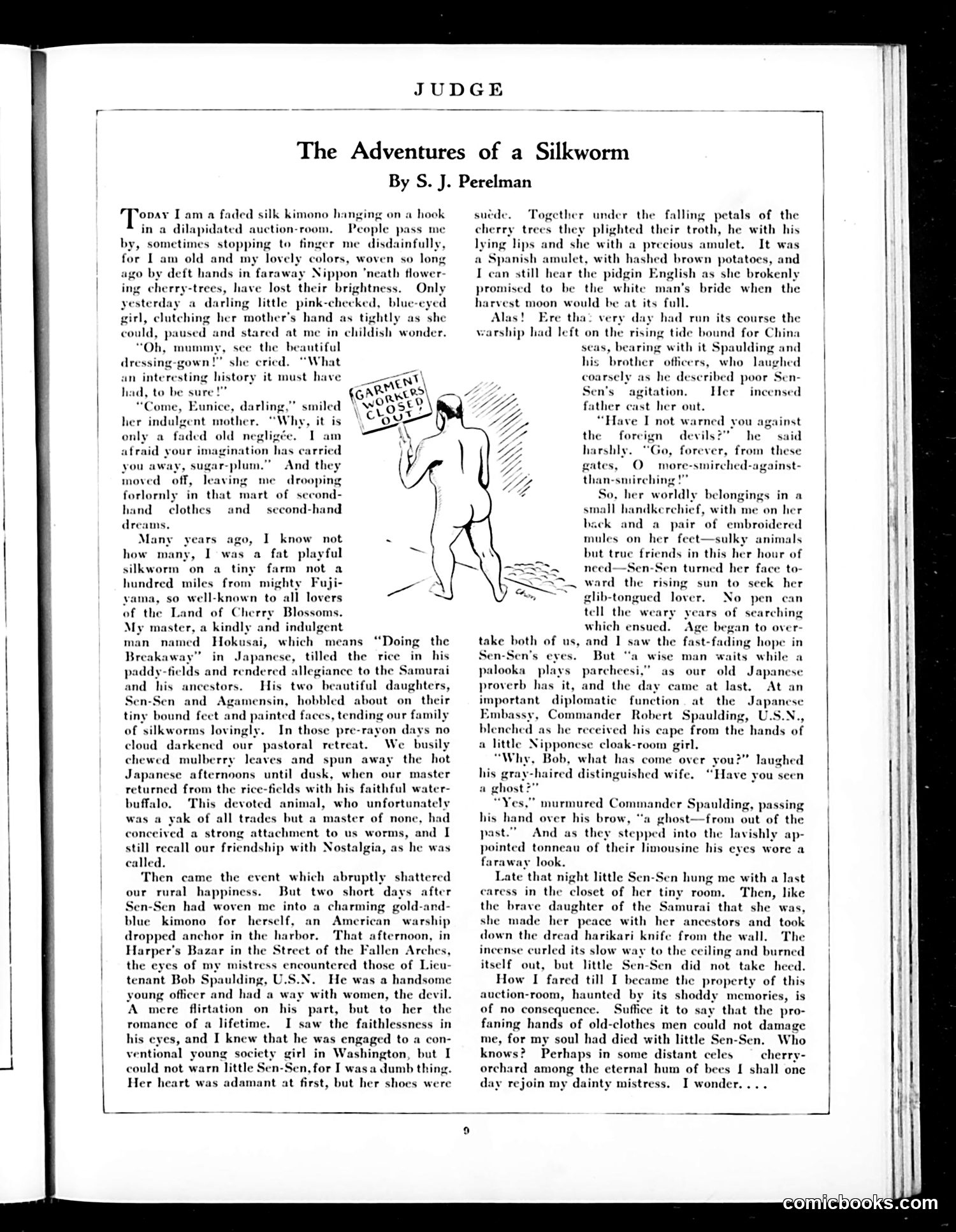
# "The Adventures of a Silkworm" by S. J. Perelman This is a satirical short story (not primarily a political cartoon), published in *Judge* magazine. The narrative frames a faded kimono in an auction room recounting its journey from a Japanese silk farm. The story parodies melodramatic Orientalist fiction popular in early 20th-century America. Key elements include: exoticized Japanese imagery (Mt. Fuji, cherry blossoms, samurai ancestors), stereotypical character names ("Sen-Sen"), and a predictable tragic plot—a naive Japanese girl falls for a deceitful American naval officer who abandons her. The illustration shows a humorous nude figure labeled "Garment Exposed" examining the kimono. Perelman mocks both the sentimental romanticization of Japan and the trope of the tragically wronged Asian woman. The satire targets American readers' appetite for exotic, melodramatic tales and their casual racism toward non-Western cultures.
📄 Transcribed text from this page (OCR, searchable)
Machine-transcribed from the original scan — historical spelling and the odd misread are preserved.
JUDGE The Adventures of a Silkworm By S. J. Perelman opay I ama faded silk kimono hanging on a hook in a dilapidated auction-room, People pass me by, sometimes stopping to finger me disdainfully, for I am old and my lovely colors, woven so long ago by deft hands ay Nippon * neath flower- ¢ cherry-trees, have lost their brightness. Only yesterday a darling little pink-checked, blue-eyed girl, clutching her mother’s hand as tightly as she could, paused and stared at me in childish wonder. “Oh, mummy, see the utiful dressing-gown!” she cried. “What an interesting bistory it must have had, to be sure “Come, Eunice, darling,” smiled her indulgent mother. yy it is only a faded old neg 1 am afraid your ima ination has carried you away, sugar-plum.” And they moved off, leaving me drooping forlornly in that mart of second- hand clothes and — second-hand dreams, Ma a 1 know not how many, I was a fat playful silkworm on a tiny farm not a hundred miles from mighty Fuji- ama, so well-known to ¢ iy years 1 lovers of the Land of Cherry Blossoms. ter, a kindly and indulgent med Hokusai, which means “Doing the ay” in Japanese, tilled the rice in_ his paddy-fields and rendered allegiance to the Samurai and his ancestors. His two beautiful daughters, Sen-Sen and Agamensin, hobbled about on th tiny bound fect and painted faces, tending our fs of silkworms lovingly. In those pre-rayon days no cloud darkened our pastoral retreat. We busily chewed mulberry leaves and spun away the hot Japanese afternoons until dusk, when our master returned from the rice-fields with his faithful water- buffalo. This devoted animal, who unfortunately was a yak of all trades but a master of none, had conceived a strong attachment to us worms, and I still recall our friendship with Nostalgia, as he was called. Then came the event which abruptly shattered our rural happiness. But two short days after Sen-Sen had woven me into a charming gold-and- blue kimono for herself, an American” warship dropped anchor in the harbor. ‘That afternoon, in Harper's Bazar in the Street of the Fallen Arches, the eyes of my mistress encountered those of L. tenant Bob Spaulding, U.S.N. He was a handsome young officer and had a way with women, the devil. A mere flirtation on his part, but to her the romance of a lifetime. I saw the faithlessness in his eyes, and I knew that he was engaged to a con- ventional young soci girl in Washington, but I could not warn little Sen-Sen, for I was a dumb thing. Her heart was adamant at first, but her shoes were suede. Together under the falling petals of the cherry trees they plighted their troth, he with his lying lips and she with a precious amulet. It was vanish amulet, with hashed brown potatoes, and still hear the pidgin English as she brokenly promised to be the white man’s bride when the harvest moon would be at its full. Alas! Ere tha: very day had run its course the warship had left on the rising tide bound for Chin: seas, bearing with it Spaulding and brother officers, who as he described poor Sen- ation, Her incensed father cast her out. “Have I not warned you against the foreign devils? he said harshly. “Go, forever, from these s, O- more-smirchec than-smirehing !” So, her worldly belongings in a I handkereh with me on her and a pair of embroidered mules on her fect—sulky animals but true friends in this her hour of need—Sen-Sen turned her face to- ward the rising sun to seek her glib-tongued lover. No pen can tell the weary years of searching which ensued. Age began to over- take both of us, and I saw the Sen's eyes. But palooka plays parchee proverb has it, and the day came at last. At an important diplomatic function at the Japs Embassy, Commander Robert Spaulding, U.S.N., blenchee he received his cape from the hands of a little Nipponese cloak-room girl. “Why, Bob, what has come over you ired distinguished wi against- st-fading hope in wise man waits while a as our old Japanese ese laughed “Have you seen es,” murmured Con his hand over his brow, ps ander Spaulding, passing ghost—from out of the tc And as they stepped into the ue vishly night little Sen-Sen hung me with a last caress in the closet of her tiny room. Then, like the brave daughter of the Samurai that she was, she made her peace with her ancestors and took down the dread harikari knife from the wall. The incense curled its slow way to the ceiling and burned itself out, but little Sen-Sen did not take heed. How I fared till I became the property of this auction-room, haunted by its shoddy memories, is of no consequence. Suffice it to say that the pro- faning hands of old-clothes men could not damage me, for my soul had died with little Sen-Sen. Who knows? Perhaps in some distant celes cherry- orchard among the eternal hum of bees I shall one day rejoin my dainty mistress. I wonder. . is =