
Judge, 1929-11-09 · page 25 of 36
Judge — November 9, 1929 — page 25: what you’re looking at
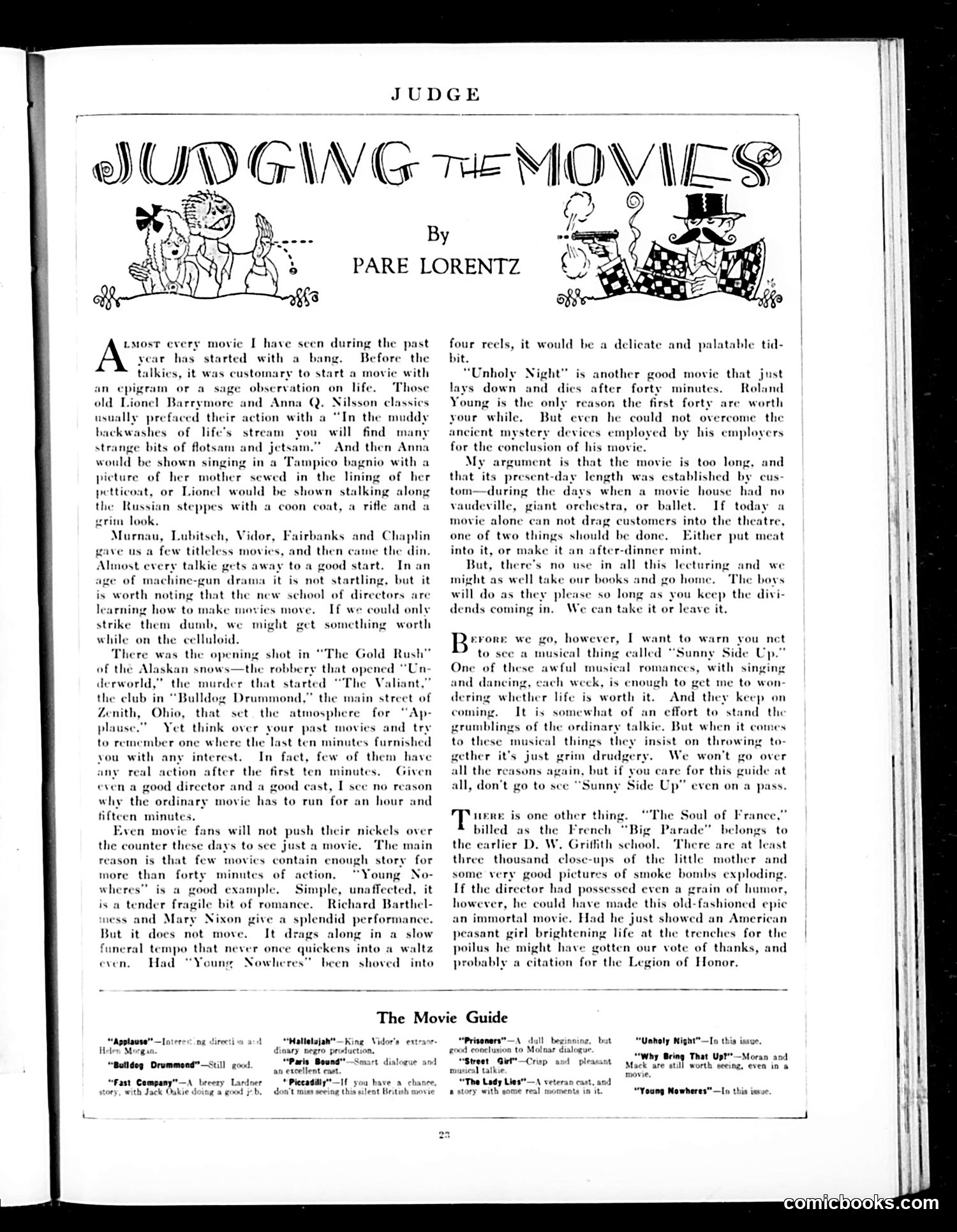
A restored page from Judge, 1929-11-09. Page through the whole issue in the reader above.
📄 Transcribed text from this page (OCR, searchable)
Machine-transcribed from the original scan — historical spelling and the odd misread are preserved.
Lost every movie I have seen during the past A year has started with a bang. Before the talkies, it was custotnary to start a movie with an epigram or a sage observation on life. ‘Those old Lionel Barrymore and Anna Q. Nilsson classics usually prefaced their action with a “In the muddy backwashes of life's stream you will find ms strange bits of flotsam um.” And then Ant would be shown singing in npico bagnio with a picture of her mother sewed in the lining of her petticoat, or Lionel would be shown stalking along » Russian steppes with a coon coat, a rifle and a grim loc Murnau, Lubitsch, Vidor, Fairbanks and Chaplin gave us a few titleless movies, and then came the din. ny Almost every talkie gets away to a good start. In an age of machine-gun drama it is not startli but it is worth noting that the learning how to make m strike them dumb, we while on the celluloid. There was the opening shot in “The Gold Rush” of the Alaskan snows—the robbery that opened “Un derworld,” the murder that started “The Valiant,” the club in “Bulldog Drummond,” the main street of Zenith, Ohio, that the atmosphere for “Ap- plause.” Yet think over your past movies and try to remember one where the last ten minutes furnished you with any interest. In fact, few of them have any action after the first ten minutes. Given even a good director and a good cast, I see no reason why the ordinary movie has to run for an hour and fifteen minutes. Even movie the counter these days to see just a movie. red new school of directors are es mov If we could only might get someth worth set real ans will not push their nickels over The main on is that few movies contain enough story for action, “Young No- more than forty minutes of wheres” is a good example. Simple, unaffected, is a tender fragile bit of romance. Richard Barthel- ness and Mary Nixon give a splendid performance. But it does not move. It drags along in a slow funeral tempo that never once quickens into a waltz Had “Young Nowheres” been shoved into even, JUDGE ING T=MOVIES By PARE LORENTZ bys — four reels, it would be bit. “Unholy Night” is another good movie that just lays down and dics after forty minutes. I delice and pa Young is the only reason the first forty are worth your while, But even he could not overcome the ancient mystery devices employed by his employers for the conclusion of his movie. My argum is that the movie is too long, and that its present-day length was established by cus- tom—during the days when a movie house had no vaudeville, giant orchestra, or ballet. If today a movie alone can not drag customers into the theatre, one of two things should be done. Either put meat into it, or make it an after-dinner mint. But, there's no use in all this lecturing and we might as well take our books and go home. ‘The boys y please so long as you keep the divi- dends coming in. We can take it or leave it. Brrore we go, however, I want to warn you net to sce a musical thing called “Sunny Side Up.” One of these awful musical rot with singing and dancing, cach week, is enough to get me to won- dering whether life is worth it. And they keep on coming. It is somew n effort to stand the grumblings of the ordinary talkie. But when it © to these musical things they insist on throwing to- gether it’s just grim drudge We won't go over all the reasons again, but if y are for this guide at all, don't go to see “Sunny Side Up" even on a pass. Tene is one other thing. “The Soul of France,” ied as the French “Big Parade” belongs to the earlier D. W. Griffith school. There are at least three thousand close-ups of the little mother and some very good pictures of smoke bombs exploding. If the director had possessed even a grain of humor, however, he could have made this old-fs an immortal movie. Had he just showed an American peasant girl brightening life at the trenches for the | poilus he might have gotten our vote of thanks, and probably a citation for the Legion of Honor. hioned epic ng directis ad “Hallelujah” —King dinary pegro “Paris Bound” —S: an etcellent east Piceadilly"—If you have a chanee, n't miss seeing this sileat British movie Vide om and disloeue “Bulléeg Drummend”—Still good meery Lardner tea good yb. ¢ “Fast Company”—\ story, with Jack Oukie d # story with eome real “Unholy Might”—In this issue, “Why Bring That Up?" —Moran and Mack are still worth seeing, even in movie. “The Lady Lies —\ vet “Young Nowher