A complete issue · 36 pages · 1929
Judge — October 19, 1929
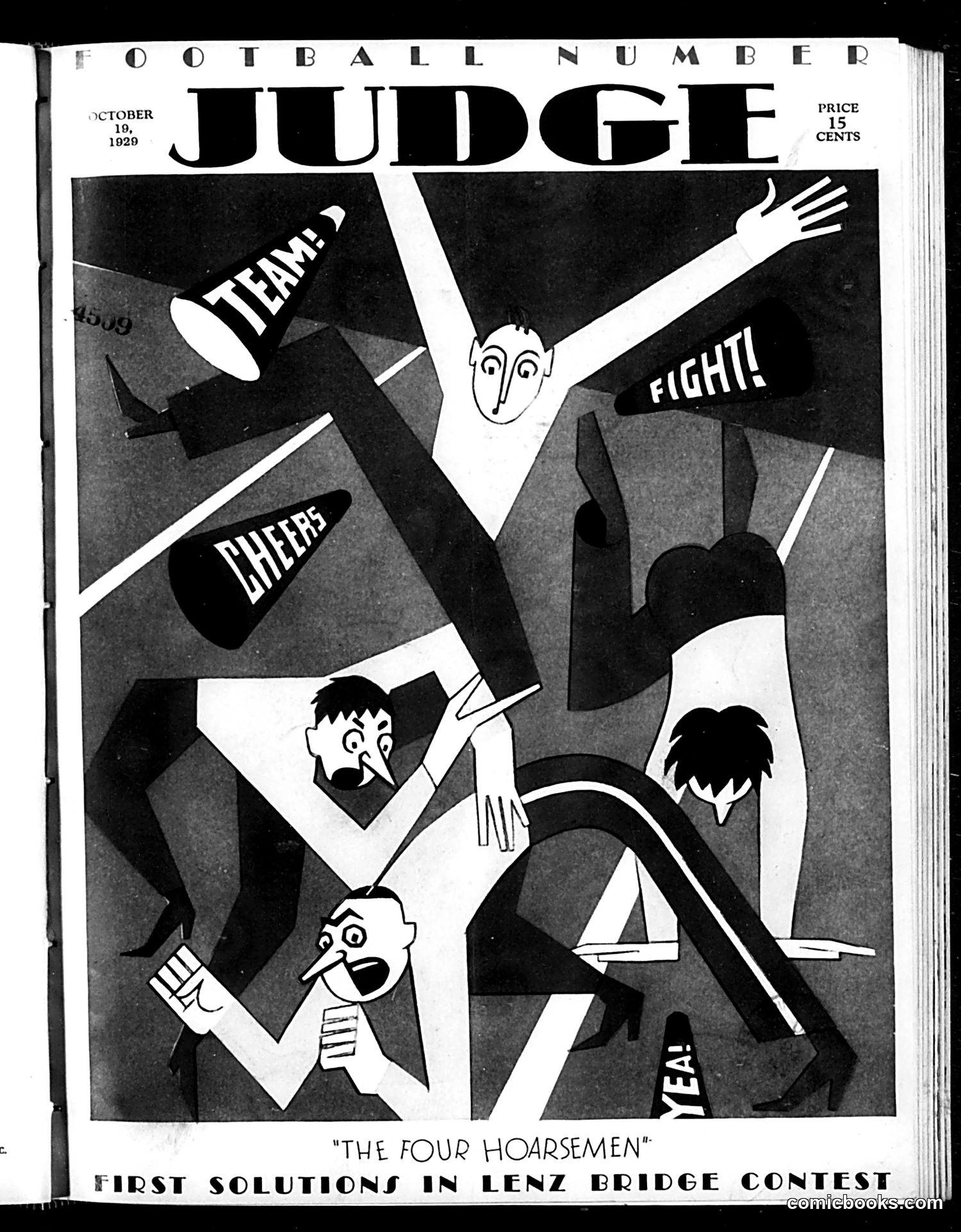
# Analysis of Judge Magazine Cover, October 19, 1929 This satirical cover depicts "The Four Horsemen" confronting chaos labeled "TEAM," "FIGHT," "CHEERS," and "YEAH"—likely representing competing factions or interests in American society during a turbulent moment. The central figure with raised arm appears triumphant or commanding, while the lower figures show distressed reactions with exaggerated facial expressions characteristic of 1920s comic style. Published October 19, 1929, this appeared just days after the stock market crash (October 24-29), though the exact sociopolitical reference remains unclear. The "Lenz Bridge Contest" subtitle suggests a specific contemporary event, but without additional context, the precise target of this satire cannot be definitively identified. The chaotic composition and frantic energy likely comment on American social or political upheaval of that moment.
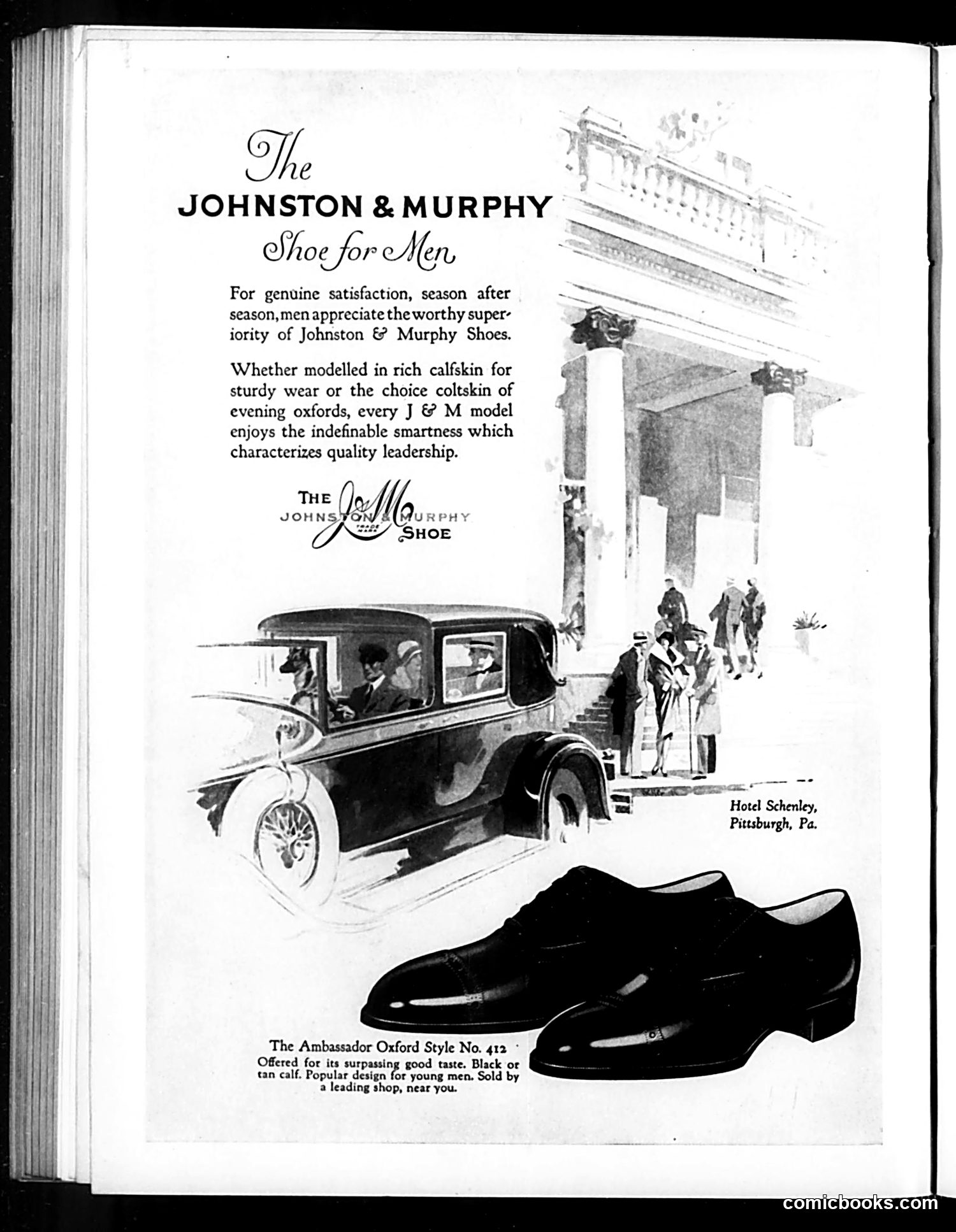
# Analysis This page is **not a cartoon or satire** — it's a **vintage advertisement** for Johnston & Murphy shoes, likely from the 1920s based on the automobile style shown. The ad uses aspirational imagery common to the era: a luxurious hotel (Hotel Schenley, Pittsburgh), well-dressed travelers arriving by car, and a displayed Oxford shoe ("The Ambassador Oxford Style No. 412"). The text emphasizes "quality leadership" and appeals to men's desire for sophistication and status through footwear. There is no political satire here. Judge magazine ran paid advertisements alongside its satirical content. This represents the commercial messaging of the period, positioning Johnston & Murphy as a premium brand for discerning gentlemen.
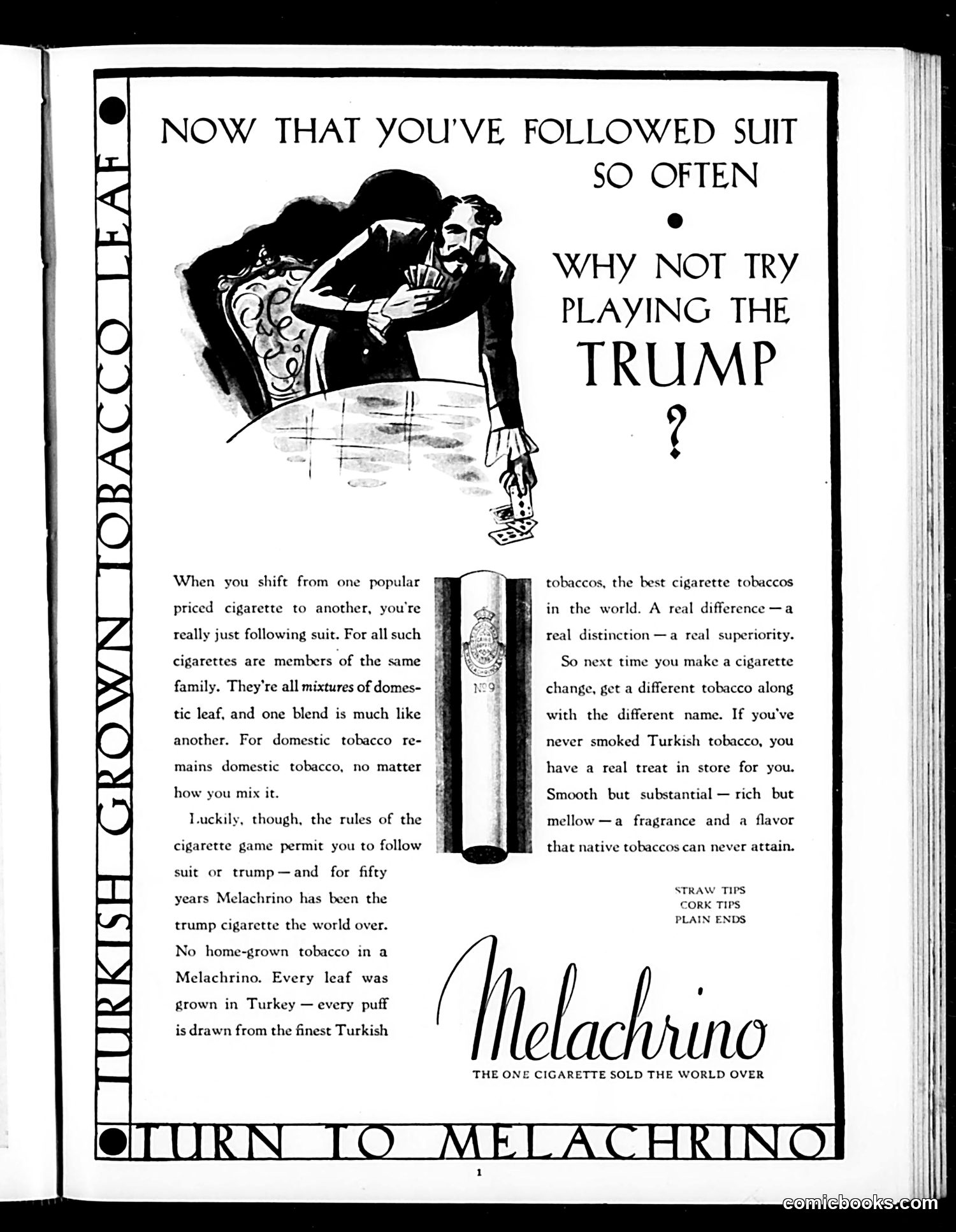
This is primarily a **cigarette advertisement** for Melachrino, framed as satirical commentary. The illustration depicts a man playing cards, with text addressing cigarette smokers who frequently switch brands. The ad's humor plays on a card game metaphor: "following suit" versus "playing the trump." It argues that switching between popular domestic cigarette brands is meaningless—they're all similar blends. However, Melachrino represents the "trump card": a Turkish tobacco cigarette offering genuine distinction. The satire mocks brand loyalty and switching habits among smokers, while positioning Melachrino as superior due to its Turkish tobacco origins. The ad claims fifty years of success and promises qualities domestic tobacco cannot achieve: smoothness, richness, and authentic flavor. This is vintage tobacco advertising using humor to encourage brand switching.
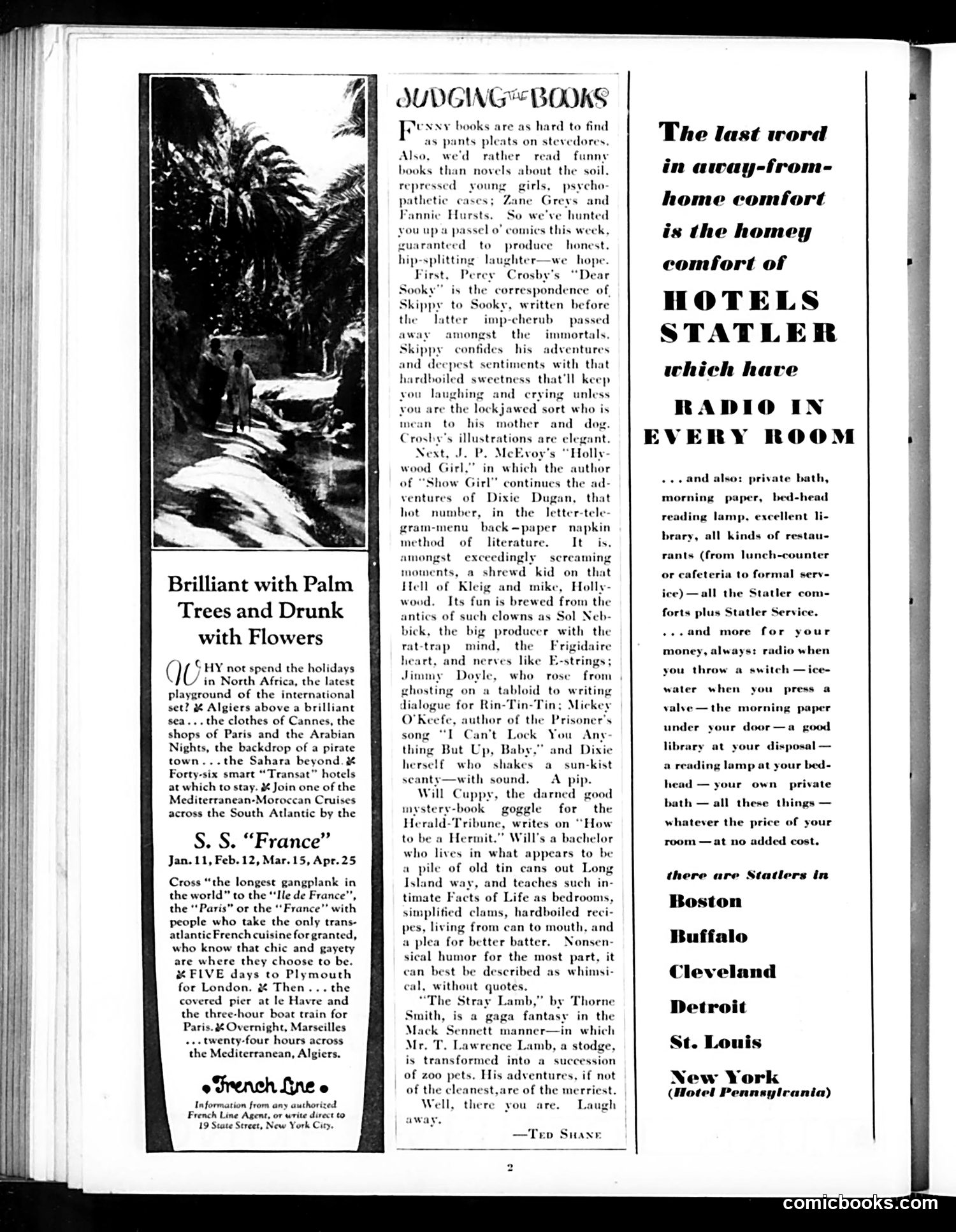
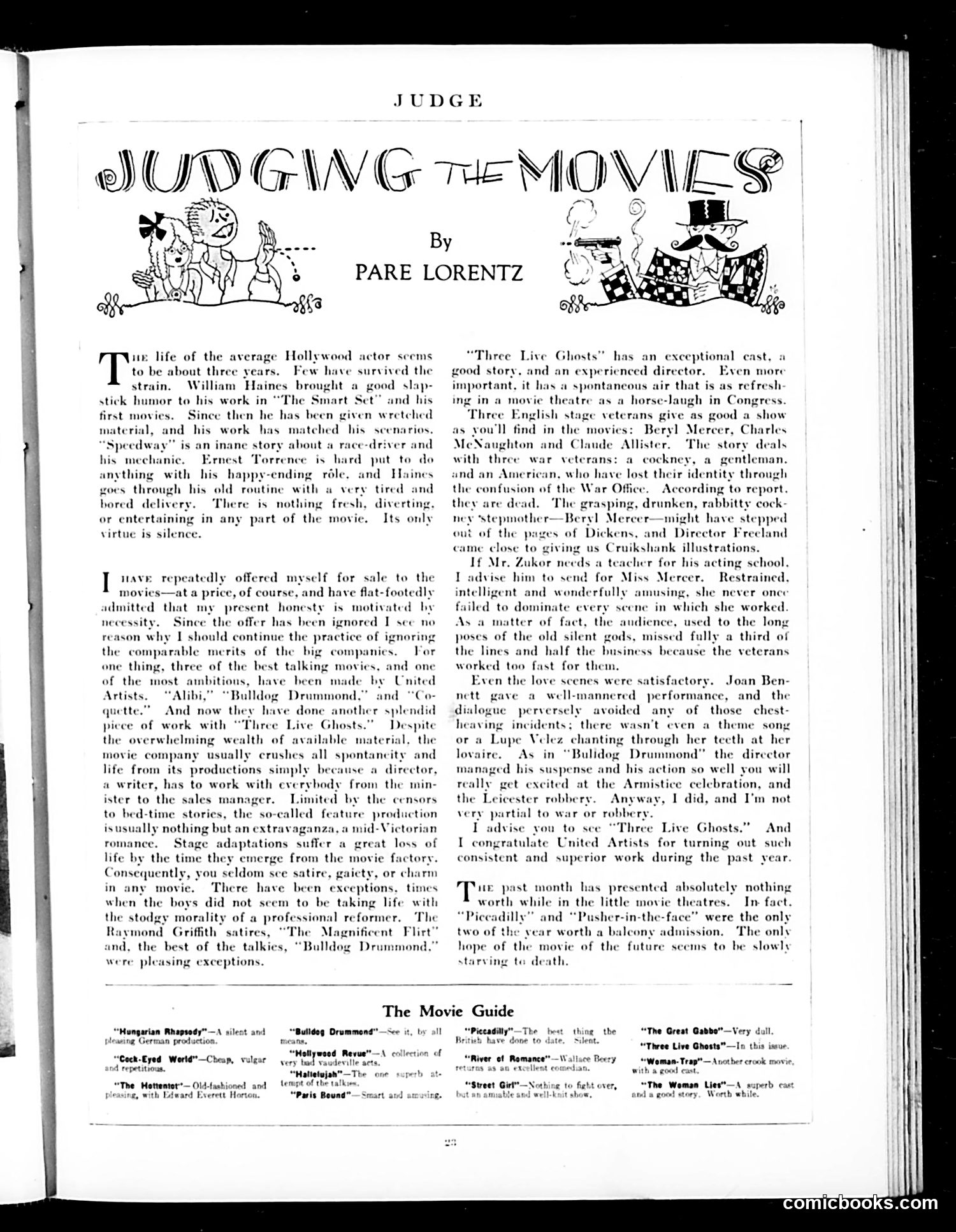
# Analysis of Judge Magazine Page This page contains primarily **book reviews and advertising**, not political cartoons. The main content is "Judging the Books," a humor column reviewing recently published comics and novels. The reviews mention titles like Percy Crosby's "Dear Snoopy" and J.P. McEvoy's "Hollyywood Girl," critiquing them for entertainment value rather than literary merit. The left sidebar advertises the S.S. "France" cruise ship and a French Line travel service. The right side promotes **Hotels Statler**, emphasizing amenities like radios in every room—a significant selling point in this era when radio was still relatively novel technology. The ad lists Statler locations in major cities. There is **no political satire or social commentary** evident on this page.
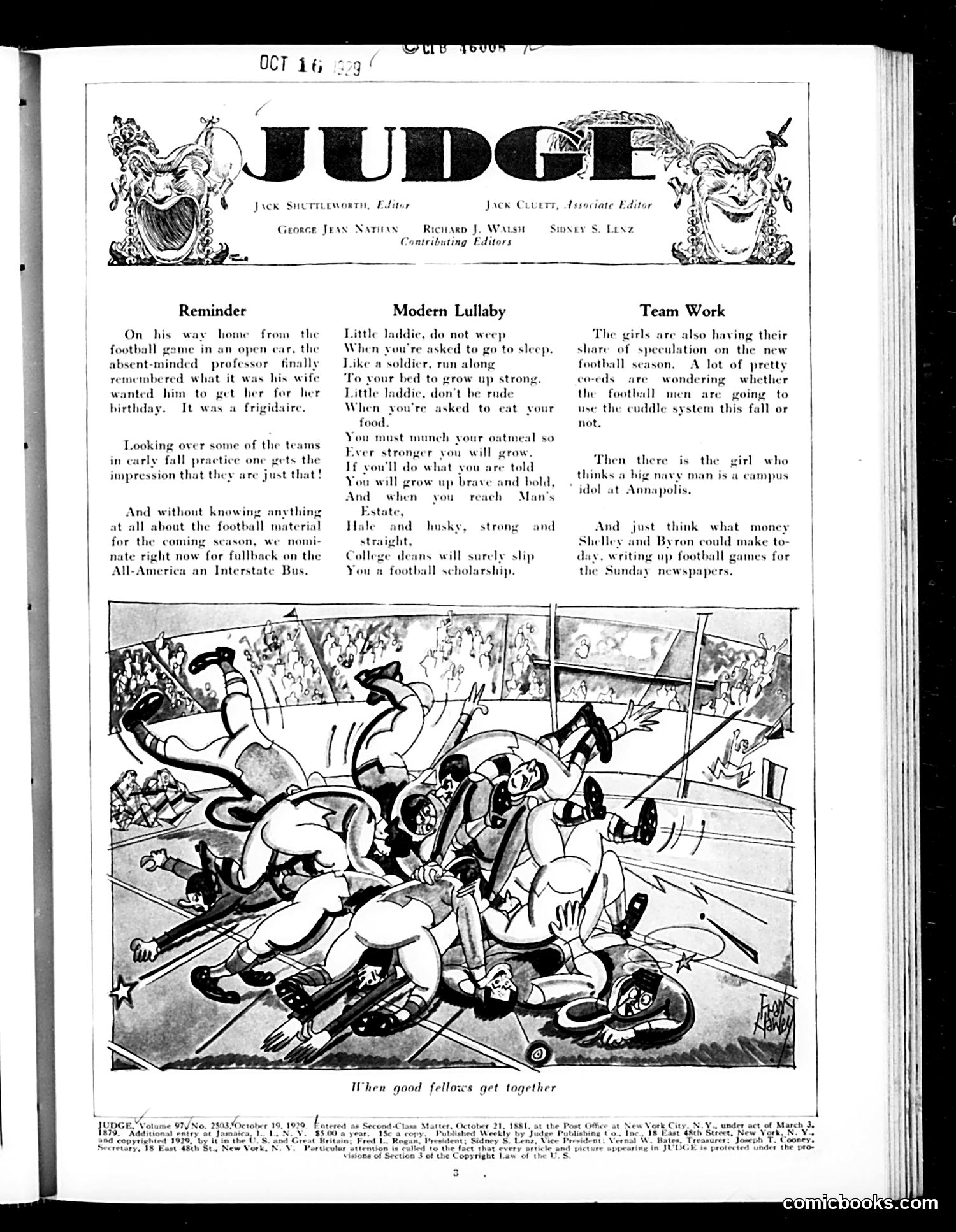
# Judge Magazine Commentary - October 16, 1928 This page satirizes early 1920s college culture and gender dynamics. The three text columns mock: 1. **"Reminder"**: An absent-minded professor finally remembering his student's birthday request 2. **"Modern Lullaby"**: A parody poem about raising children, emphasizing strength and obedience 3. **"Team Work"**: Commentary on college women's newfound roles, including girls' football and a reference to a woman who idolizes a "big navy man" at Annapolis The large cartoon below depicts a chaotic football scene with players flying through the air, labeled "When good fellows get together." This appears to satirize the rough, comedic nature of college football and male camaraderie during this era. The humor relies on exaggeration and physical slapstick typical of 1920s sports commentary.
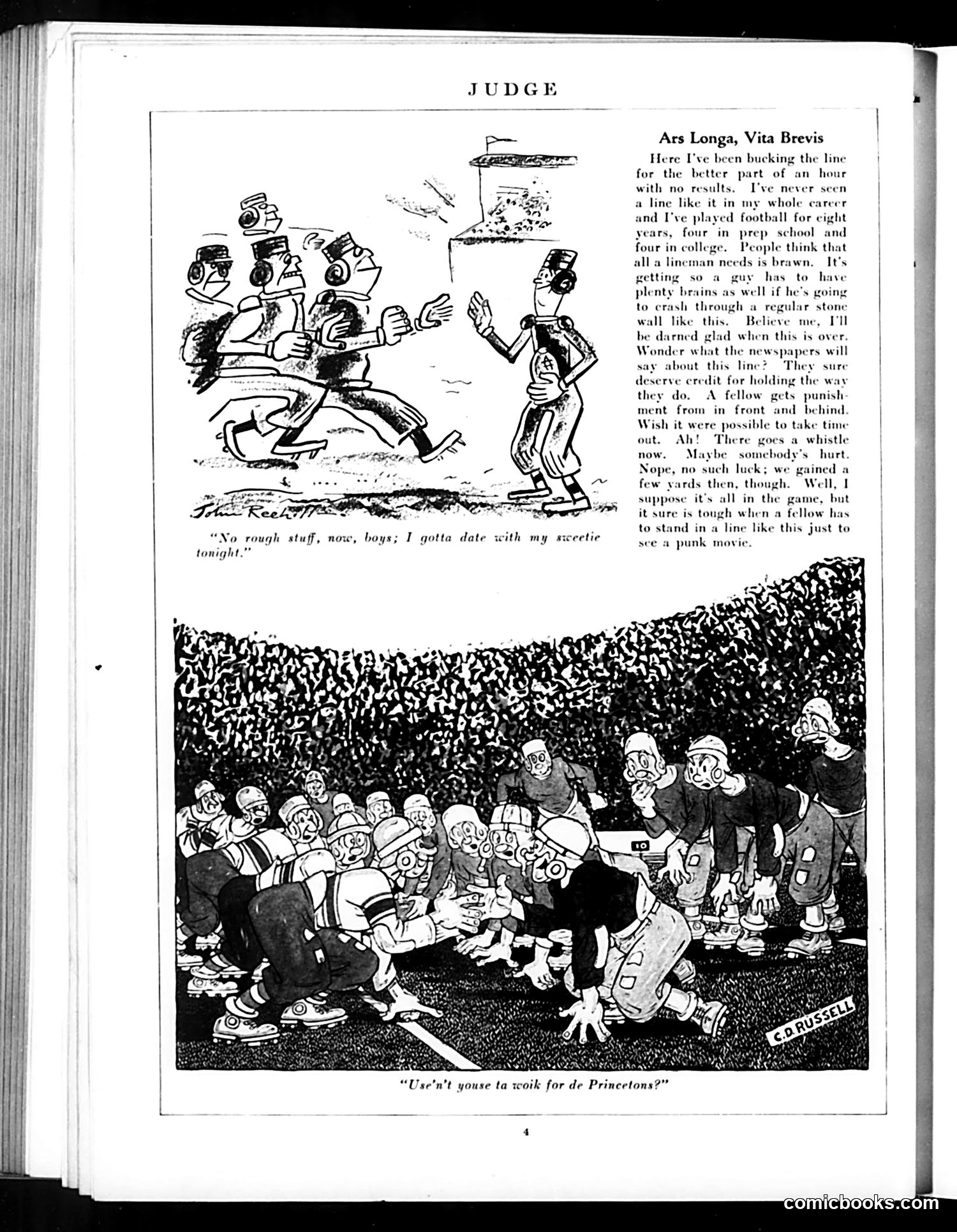
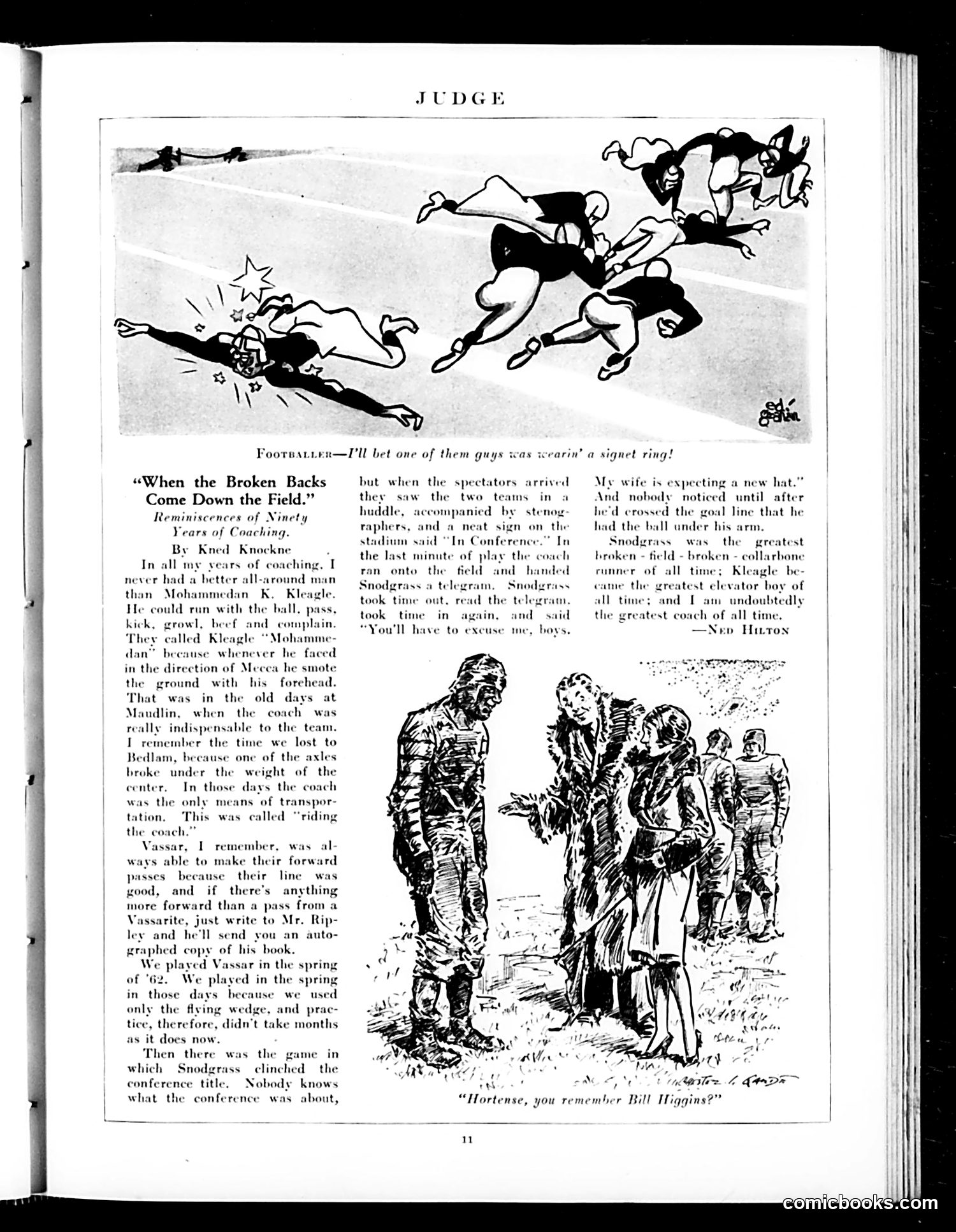
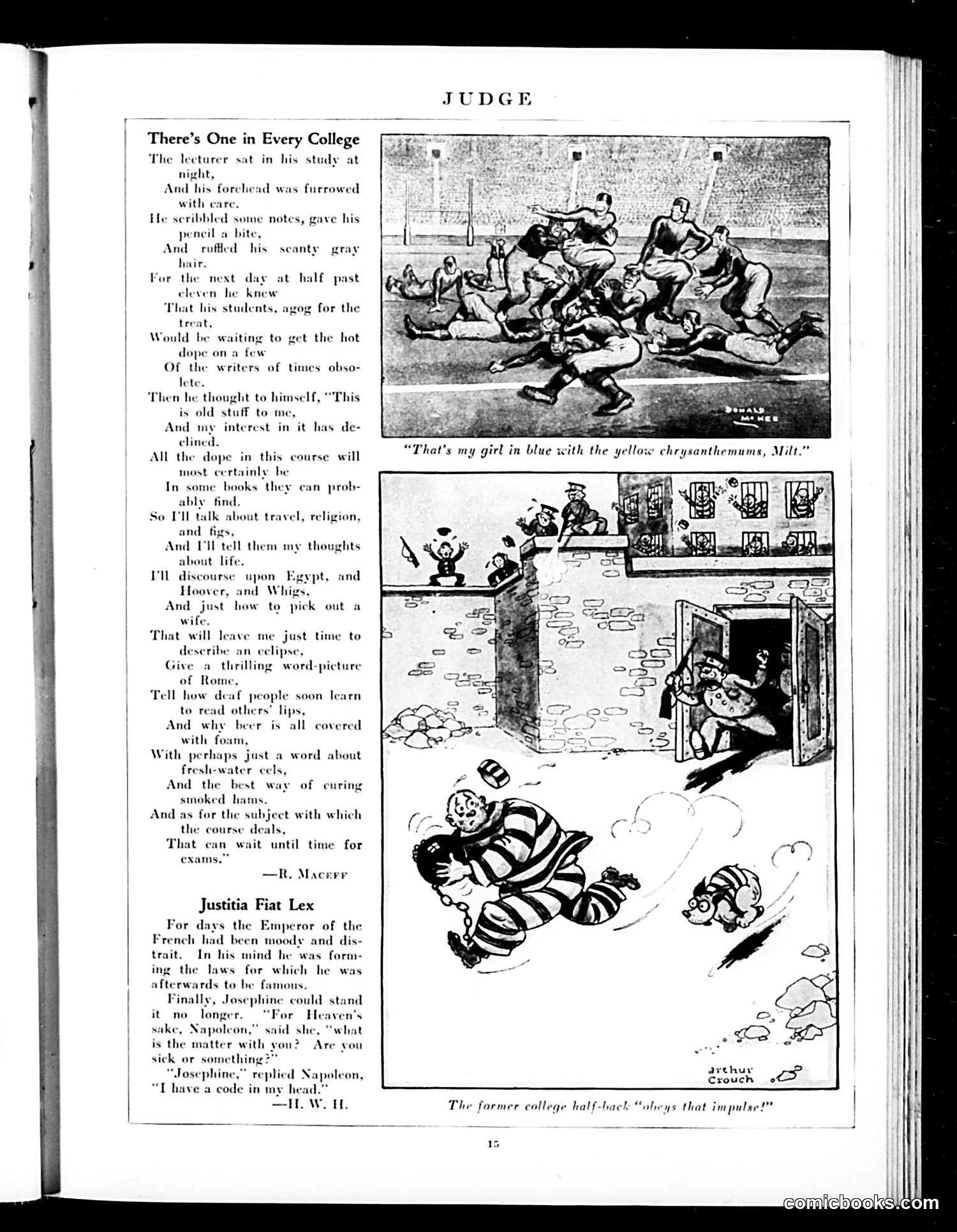
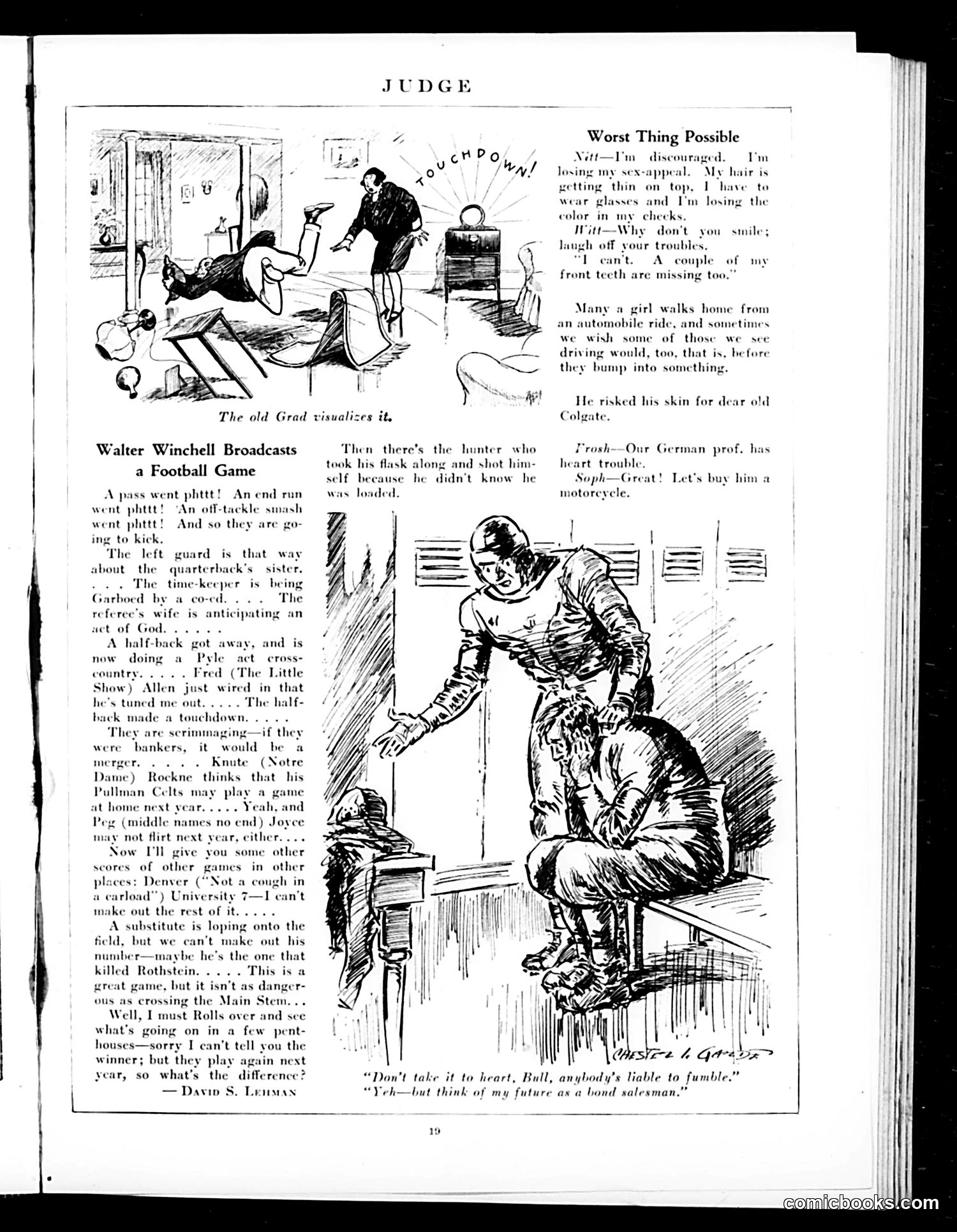
# Analysis of Judge Magazine Page **Top Cartoon:** Shows a football player boasting to a woman ("No rough stuff, nose, boys; I gotta date with my sweetie tonight"). The accompanying monologue reveals the irony—the lineman complains about being repeatedly injured despite playing football for years. The joke satirizes the contradiction between athletic bravado and the physical toll of the sport, particularly football's brutal nature. **Bottom Cartoon:** Depicts what appears to be a college football huddle or team gathering, with the caption "Ue'n goose to work for de Princetone?" This likely mocks either Princeton's football program or wealthy college athletics generally, possibly satirizing class dynamics or the commercialization of college sports in that era. Both cartoons criticize football's violence and its social implications.
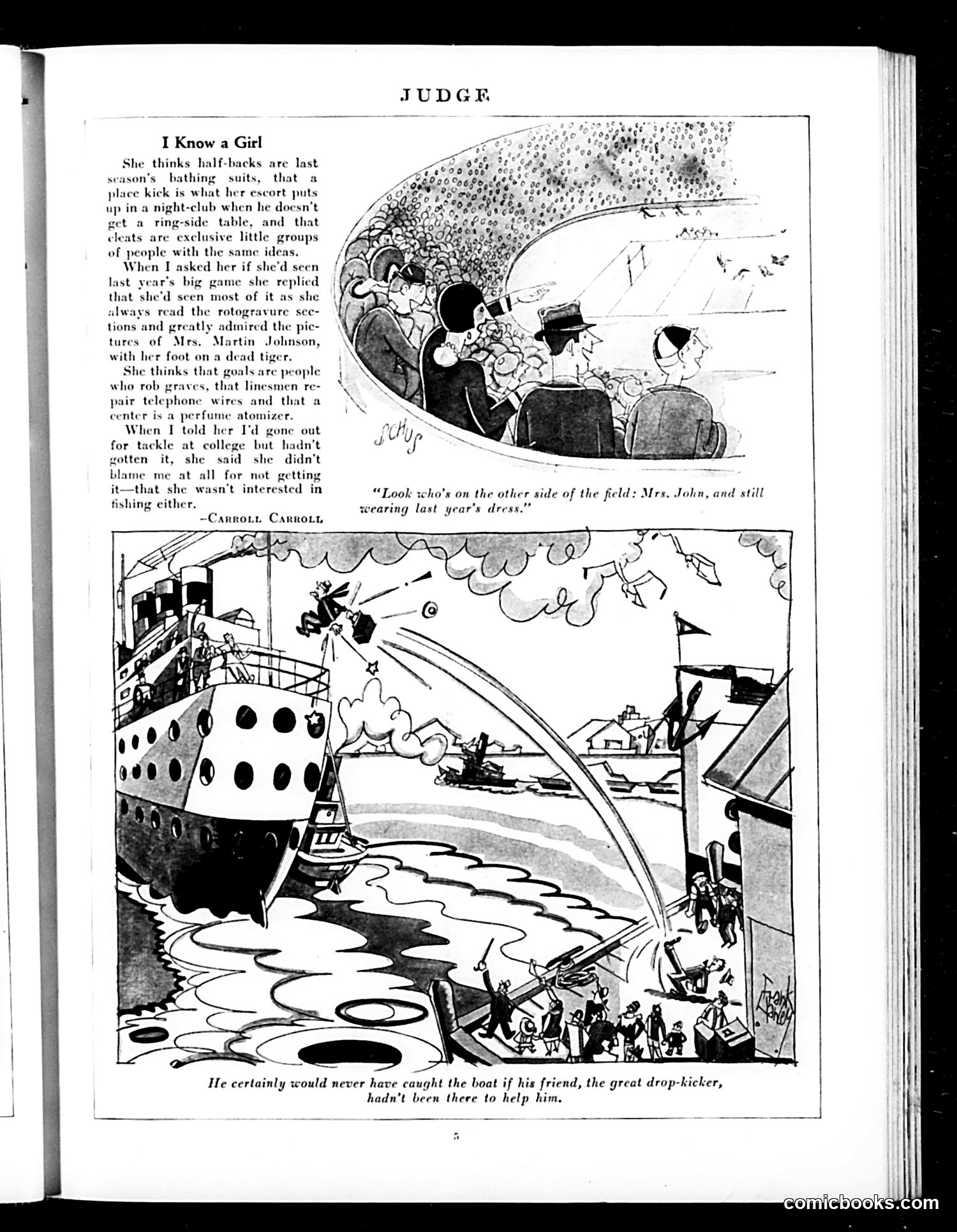
# Analysis of Judge Magazine Page **Top Section ("I Know a Girl"):** Carroll Carroll's humorous essay describes a woman interested in elite social activities—exclusive nightclubs, ringside tables at boxing matches—but not in fishing. The piece satirizes how certain women pursue high-society status symbols while dismissing traditionally masculine pastimes. **Bottom Cartoon:** Depicts a man fishing from a dock while a large ship passes dangerously close. The caption references "the great drop-kicker," suggesting the ship's near-miss represents interference from a friend's dramatic intervention. The cartoon satirizes poor decision-making and how well-intentioned help can backfire spectacularly, turning a simple fishing trip into chaos. Both sections target social pretension and the folly of human priorities through gentle satire typical of Judge's style.
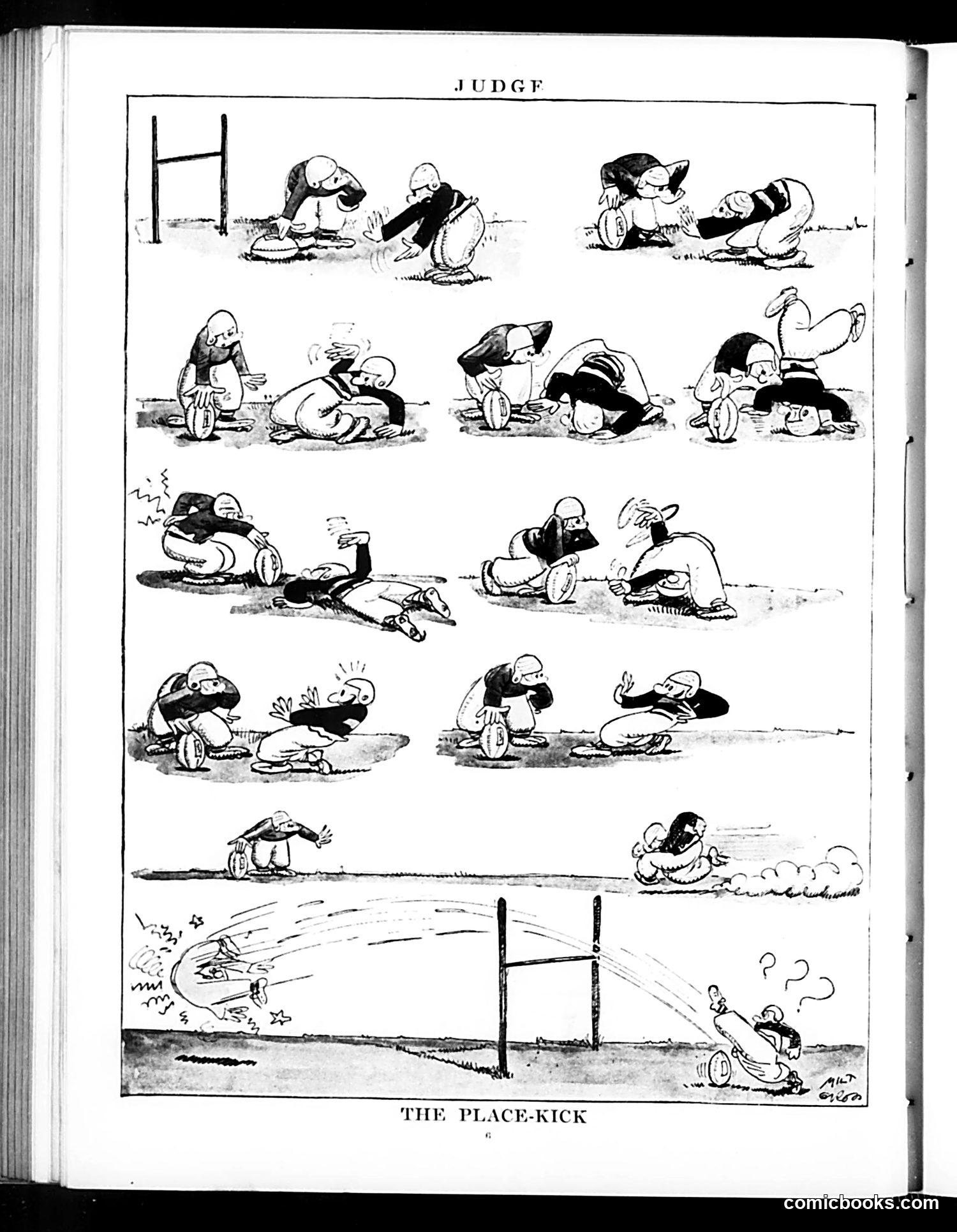
# "The Place-Kick" - Judge Magazine This is a humorous instructional comic showing the sequential steps of executing a place-kick in American football. The page depicts a rotund figure (likely representing an everyman or typical football player) attempting a place-kick, progressing through multiple panels showing the approach, positioning, the kick itself, and the consequences—culminating in the kicker being launched backward by the force of the kick while the ball travels toward the goalpost. The satire appears to mock the difficulty and physical comedy of the place-kick technique, exaggerating the violent recoil experienced by the kicker. As an 1890s-era Judge cartoon, it reflects early American football's still-developing techniques and the magazine's use of slapstick humor to comment on popular sports.
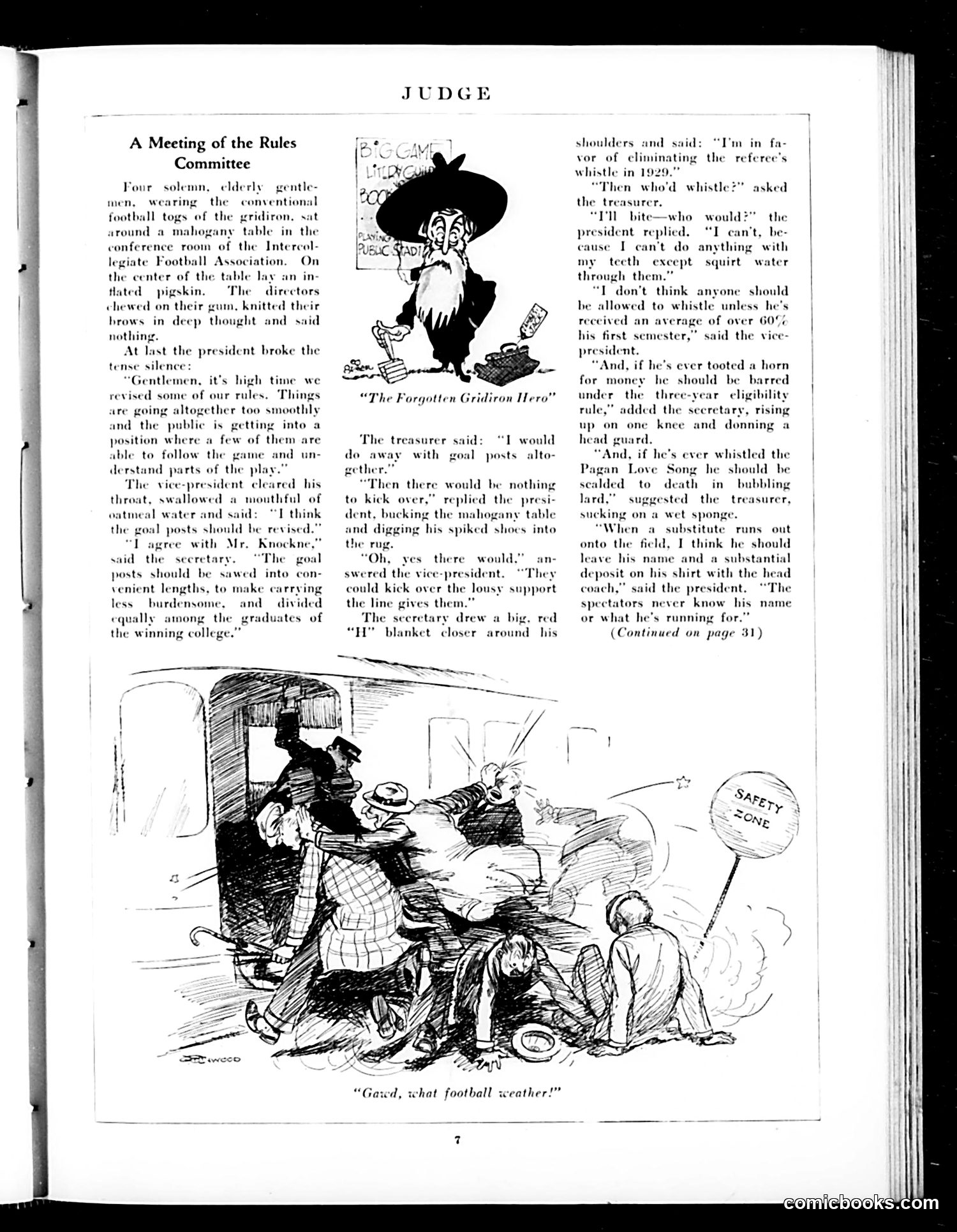
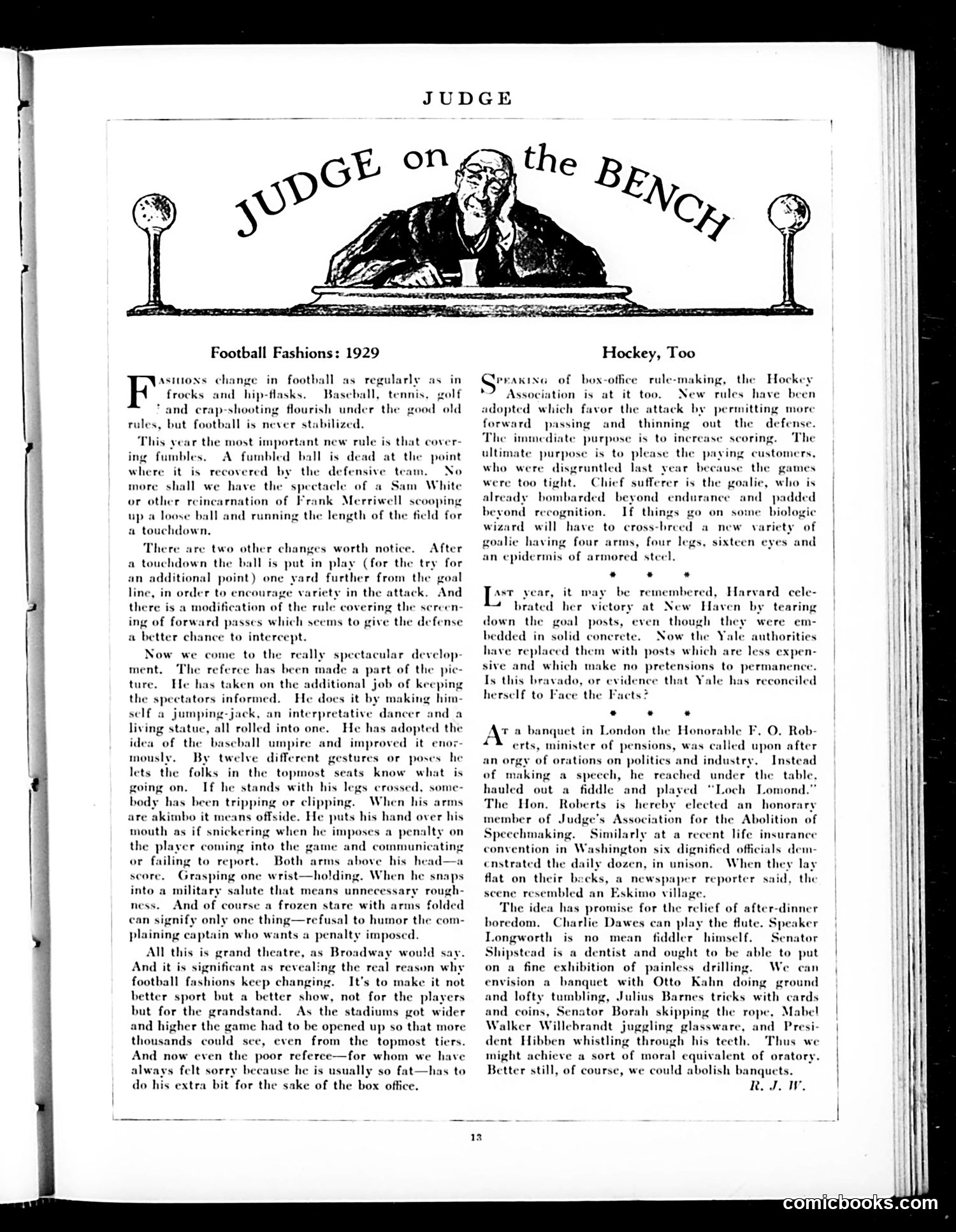
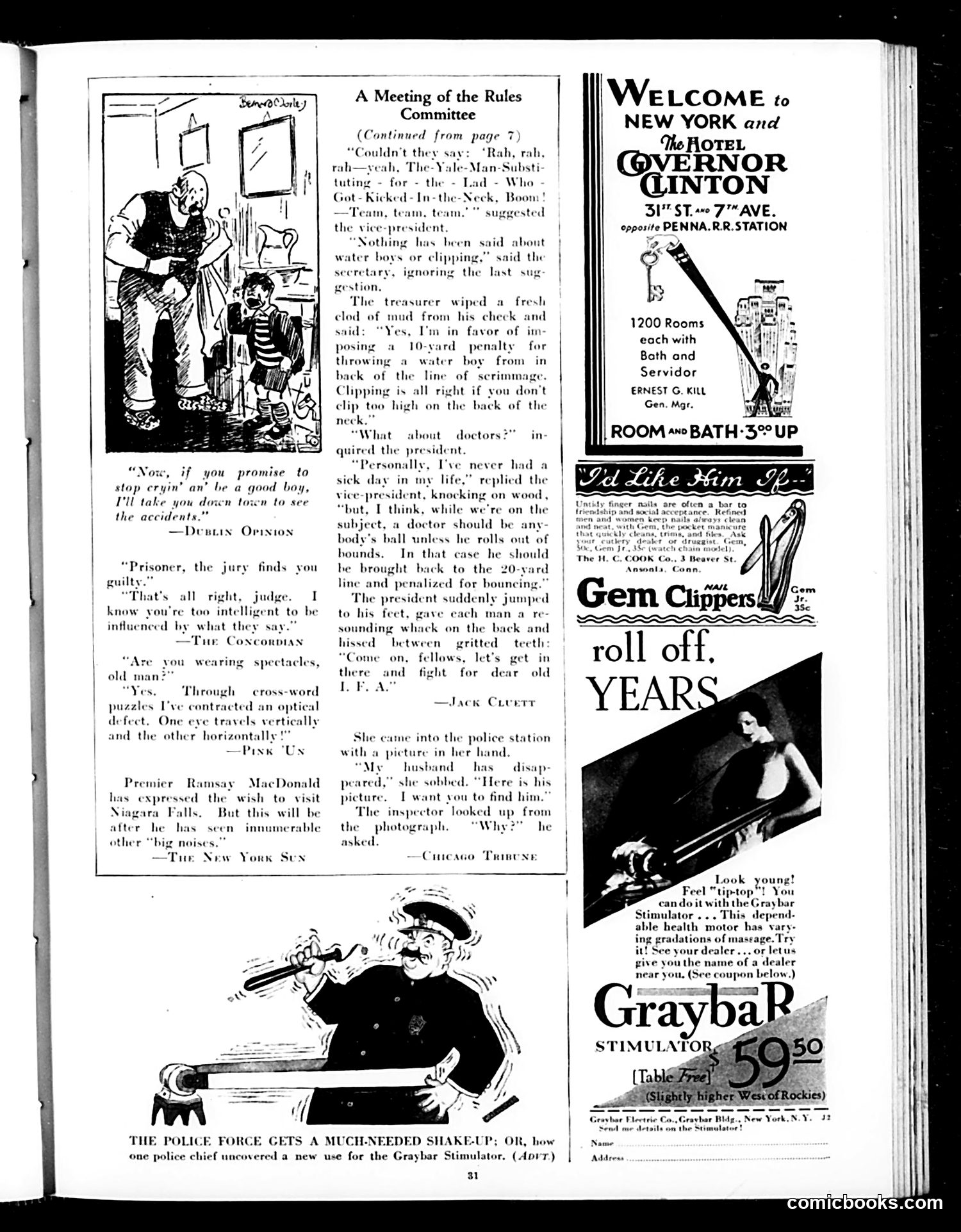
# Analysis: "A Meeting of the Rules Committee" This satirical piece mocks the Intercollegiate Football Association's endless rule-making. Four stodgy officials debate absurd "reforms"—removing goal posts, eliminating referees' whistles, imposing eligibility rules on whistlers (requiring 60% grades, banning those who've tooted horns for money), and scalding anyone who whistles "Pagan Love Song." The joke targets two things: (1) **administrative overcomplication**—well-meaning officials creating byzantine rules that make the game less, not more, sensible; (2) **the disconnect between rule-makers and players/spectators**, exemplified by the demand that substitute players leave deposits on their uniforms since officials don't know who they are. The cartoons show the officials' pretentious self-importance and the chaos their rules create. The satire suggests that college football governance had become increasingly byzantine and removed from practical reality—a recognizable critique of institutional bureaucracy.
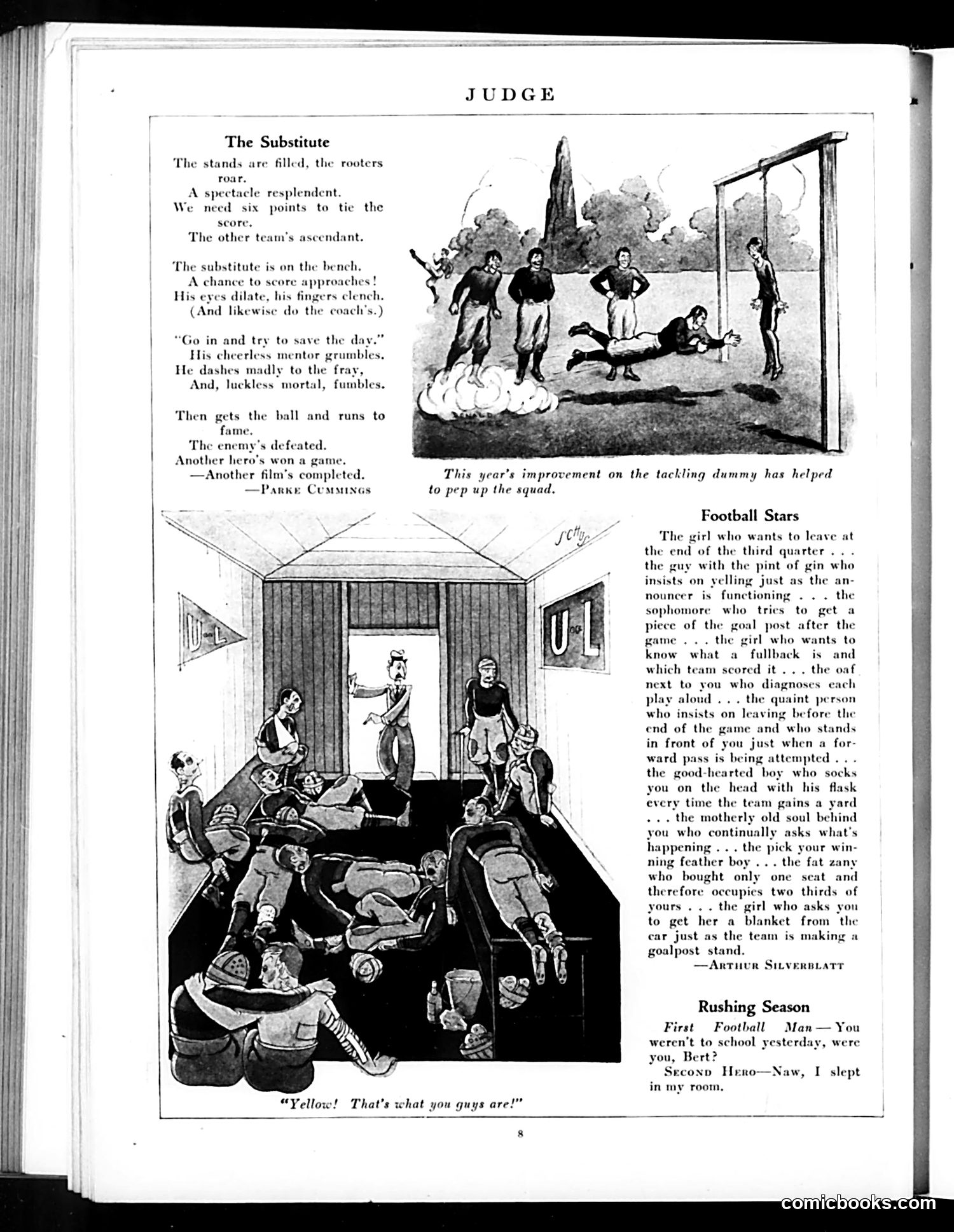
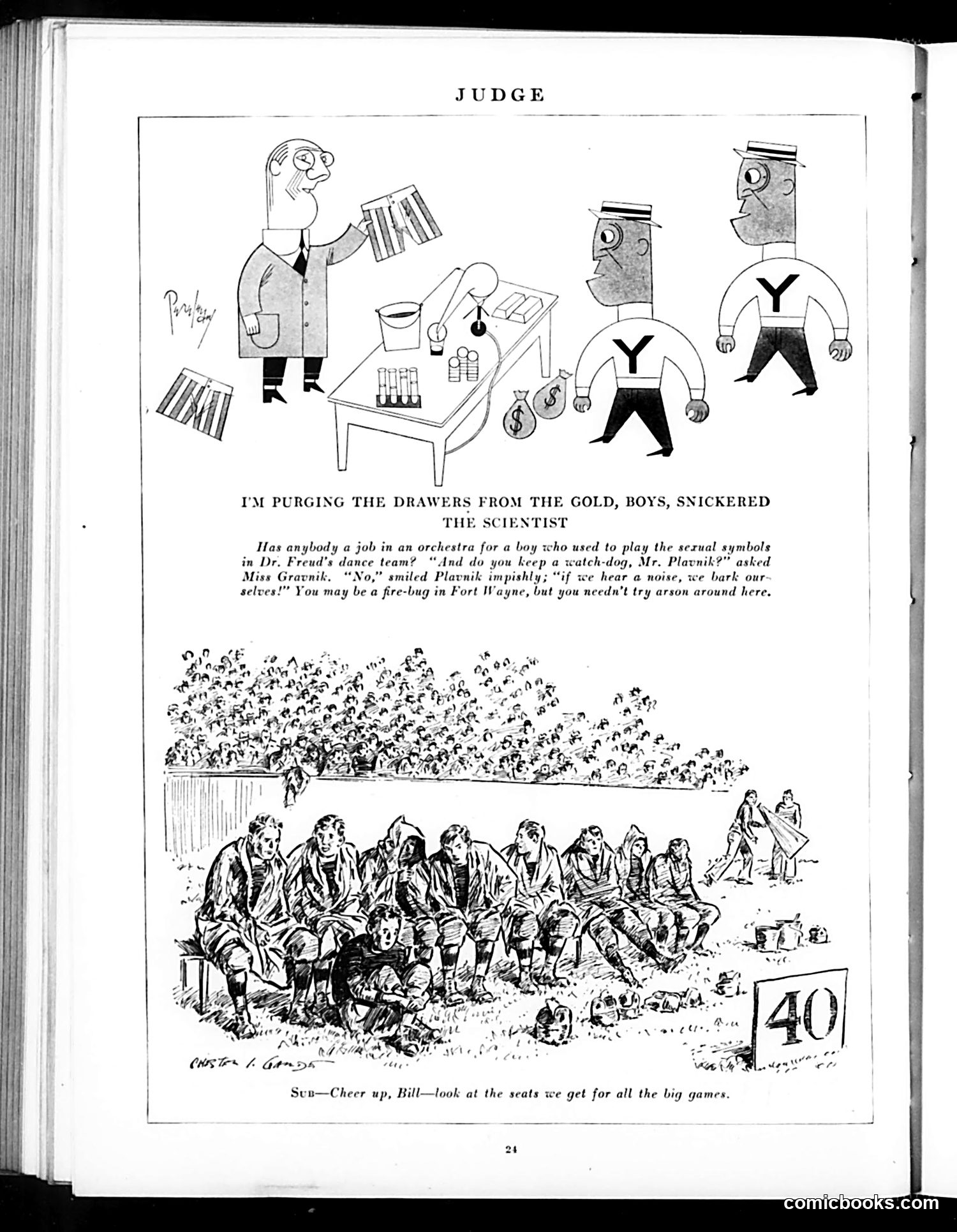
# "The Substitute" and Football Culture in Judge Magazine This page contains two football-themed pieces satirizing early 20th-century college sports culture. **"The Substitute"** is a humorous poem (illustrated above) about a benchwarmer who finally gets his chance to play. Despite initial fumbling, he scores the winning touchdown—a classic underdog-makes-good narrative. The satire appears directed at movie serials and sports cinema, with the concluding line "Another film's completed" suggesting this plot was already a tired Hollywood cliché. **"Football Stars"** is a lengthy satirical list of annoying spectator types at games—the girlfriend wanting to leave early, the drunk with a flask, the know-it-all commentator, the person blocking your view, the girl asking favors at crucial moments. It's social satire mocking both nouveau riche fans and dating culture anxieties. **"Rushing Season"** (bottom) is a brief joke about a student claiming he "slept in [his] room" to avoid school, likely implying hangover or laziness around football season. The overall message critiques how football had become embedded in American popular culture—both on screen and in social behavior.
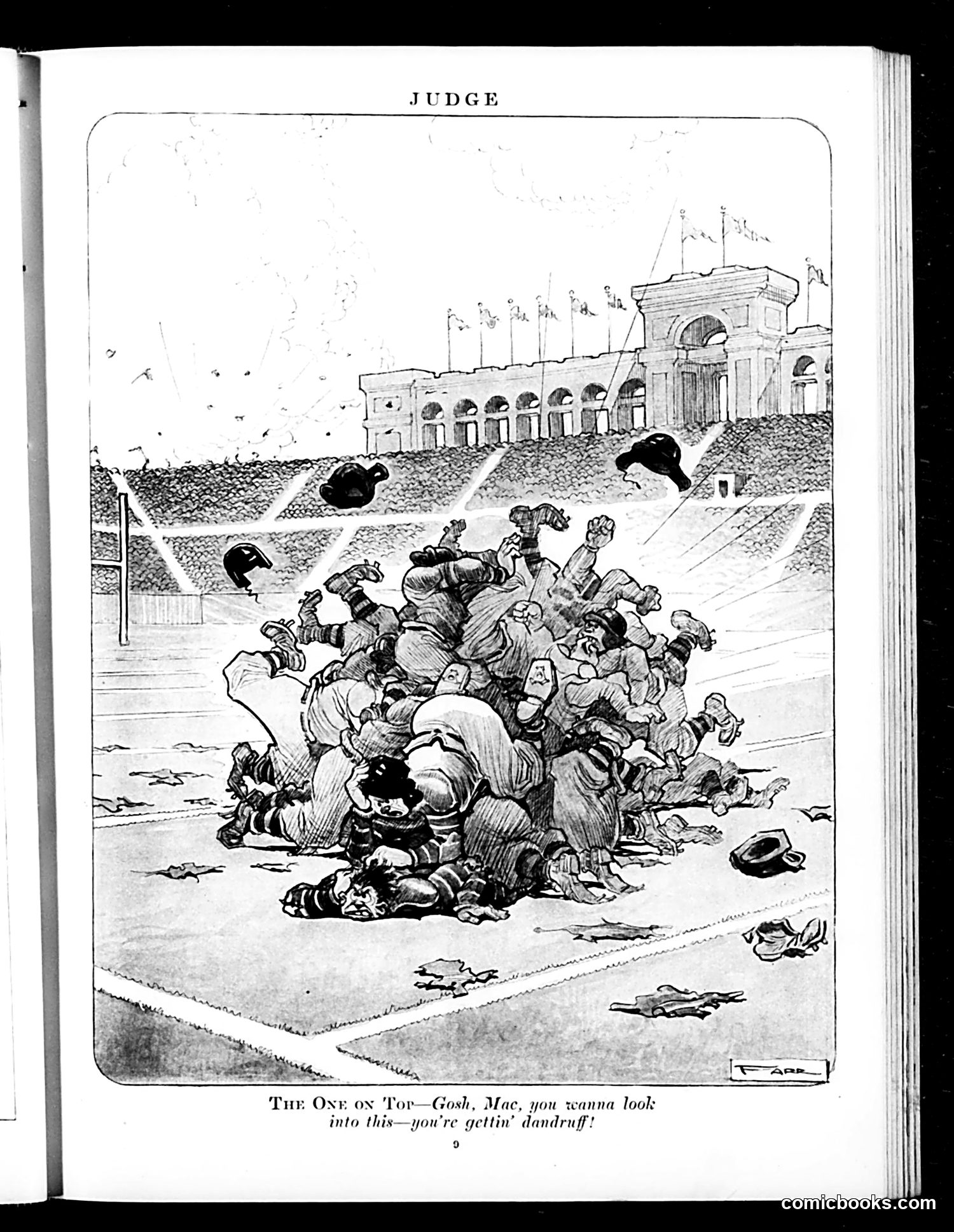
This cartoon depicts a chaotic pile-up of people in what appears to be a Roman amphitheater or arena setting. The caption's dialogue—"Gosh, Mac, you wanna look into this—you're gettin' dandruff!"—uses "dandruff" as slang for the scattered debris and disorder visible around the heap of bodies. The satire likely critiques a specific political or social situation involving confusion, mismanagement, or collapsing order, with the arena setting suggesting themes of public spectacle or judgment (fitting the magazine's title "JUDGE"). The casual, dismissive tone of the caption contrasts darkly with the chaotic scene, mocking those in authority for ignoring or minimizing obvious problems. Without additional context about the publication date, the specific figures referenced remain unclear.
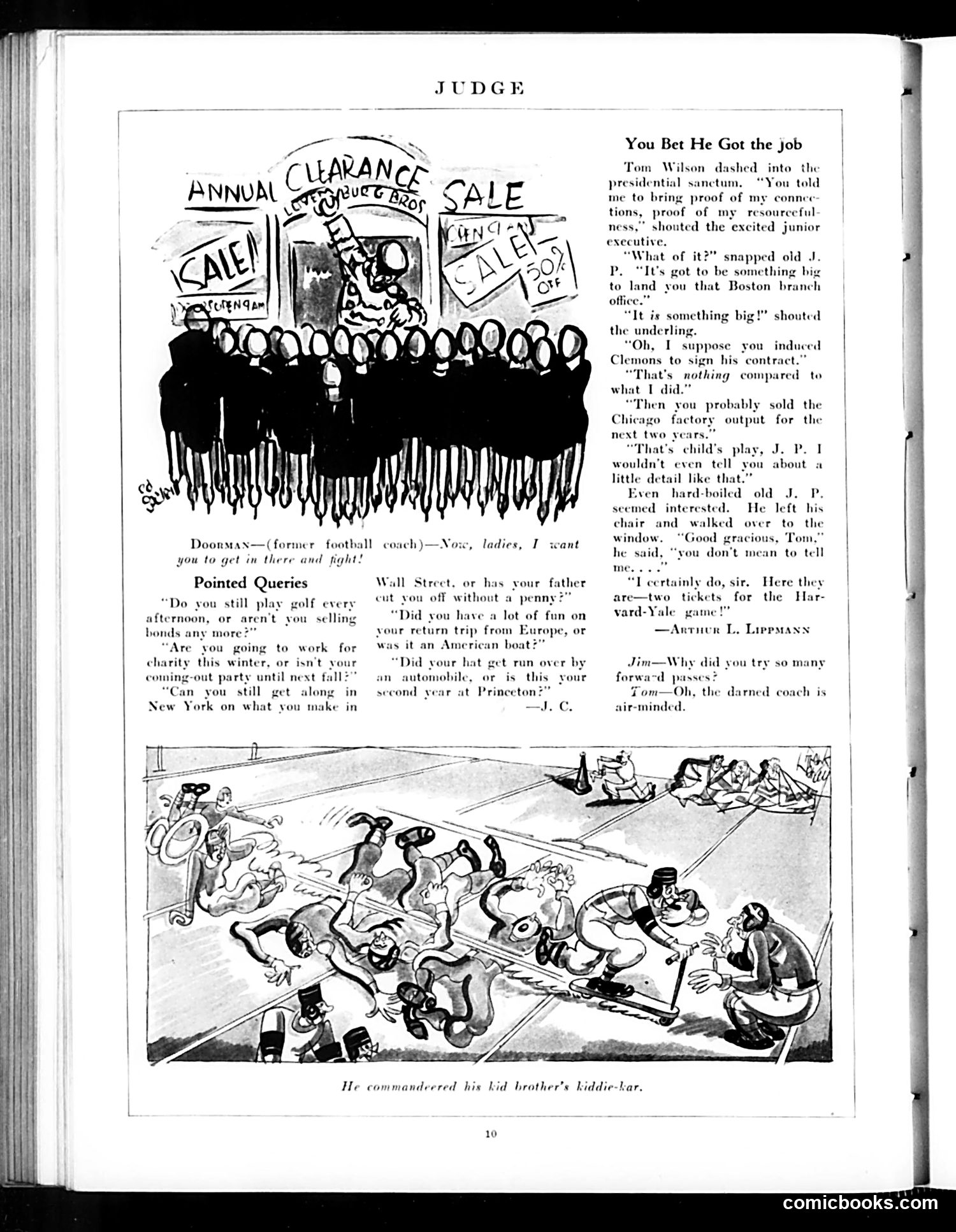
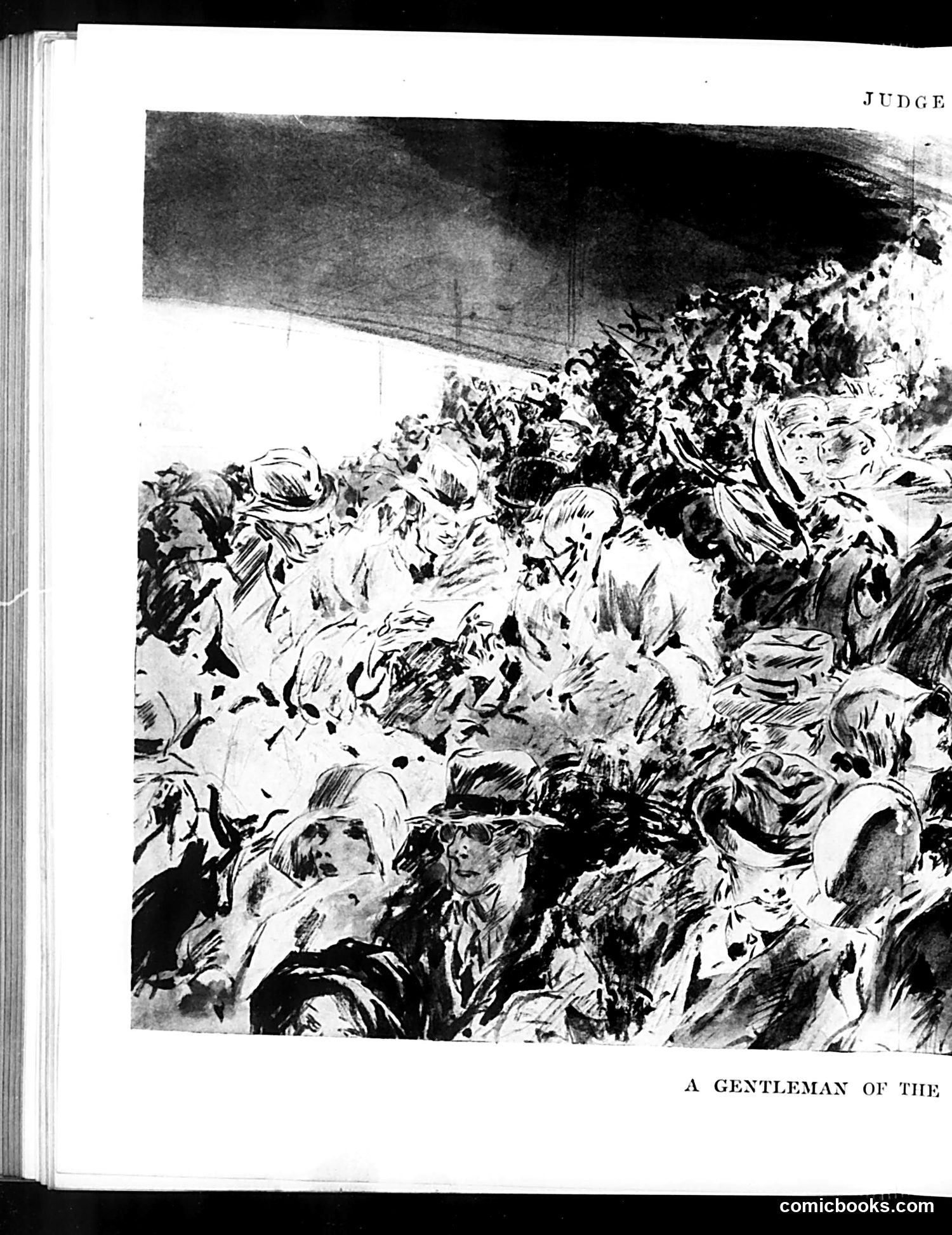
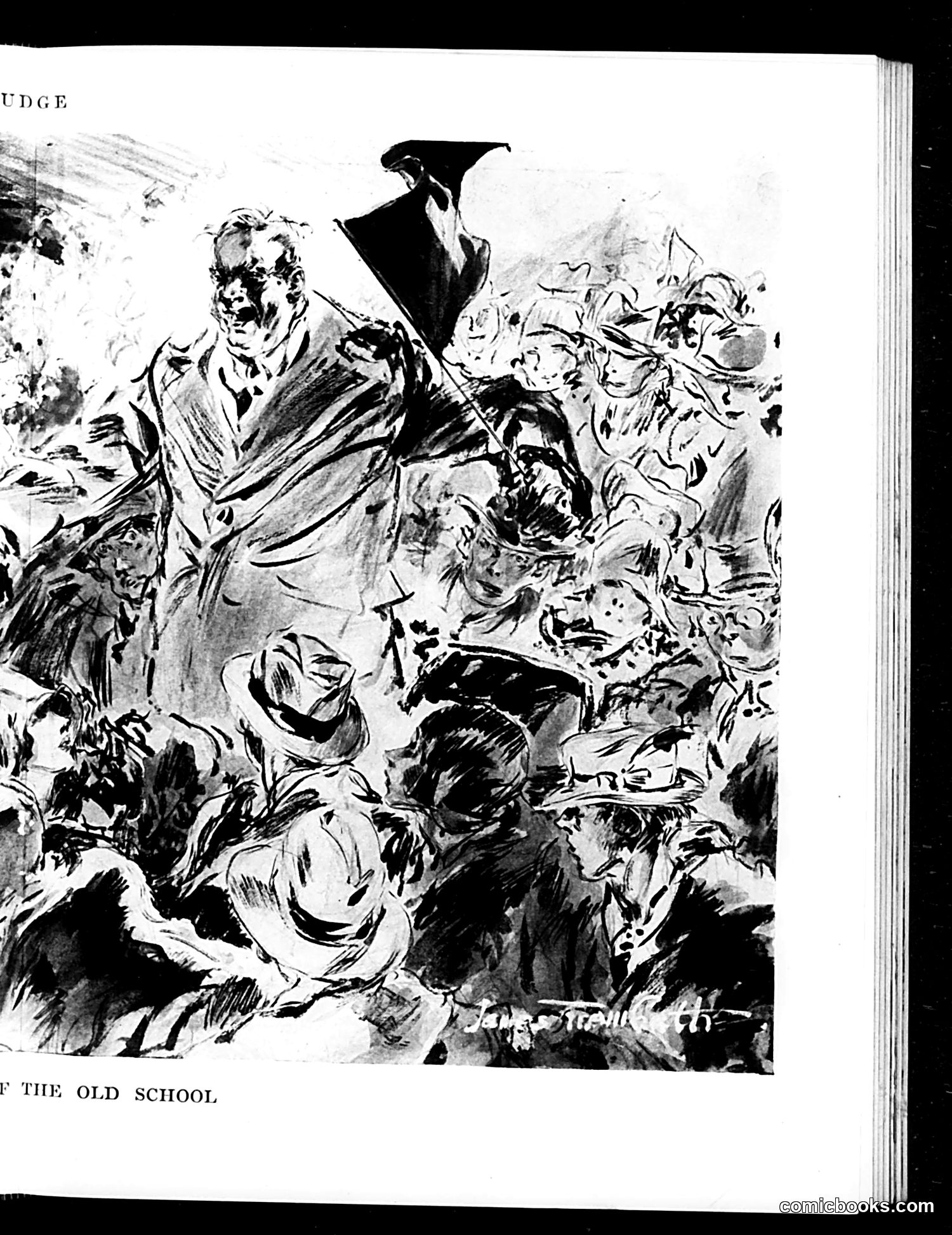
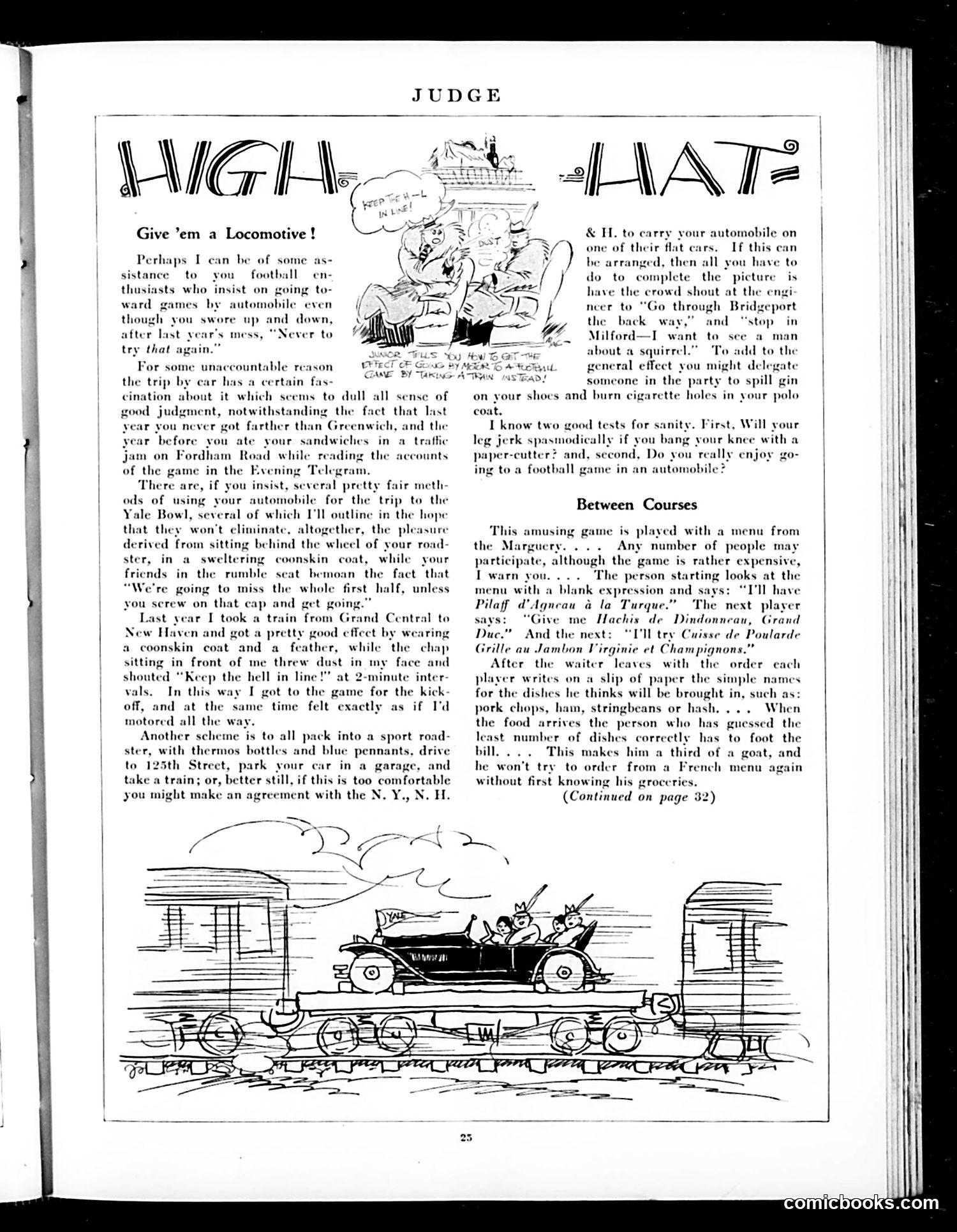
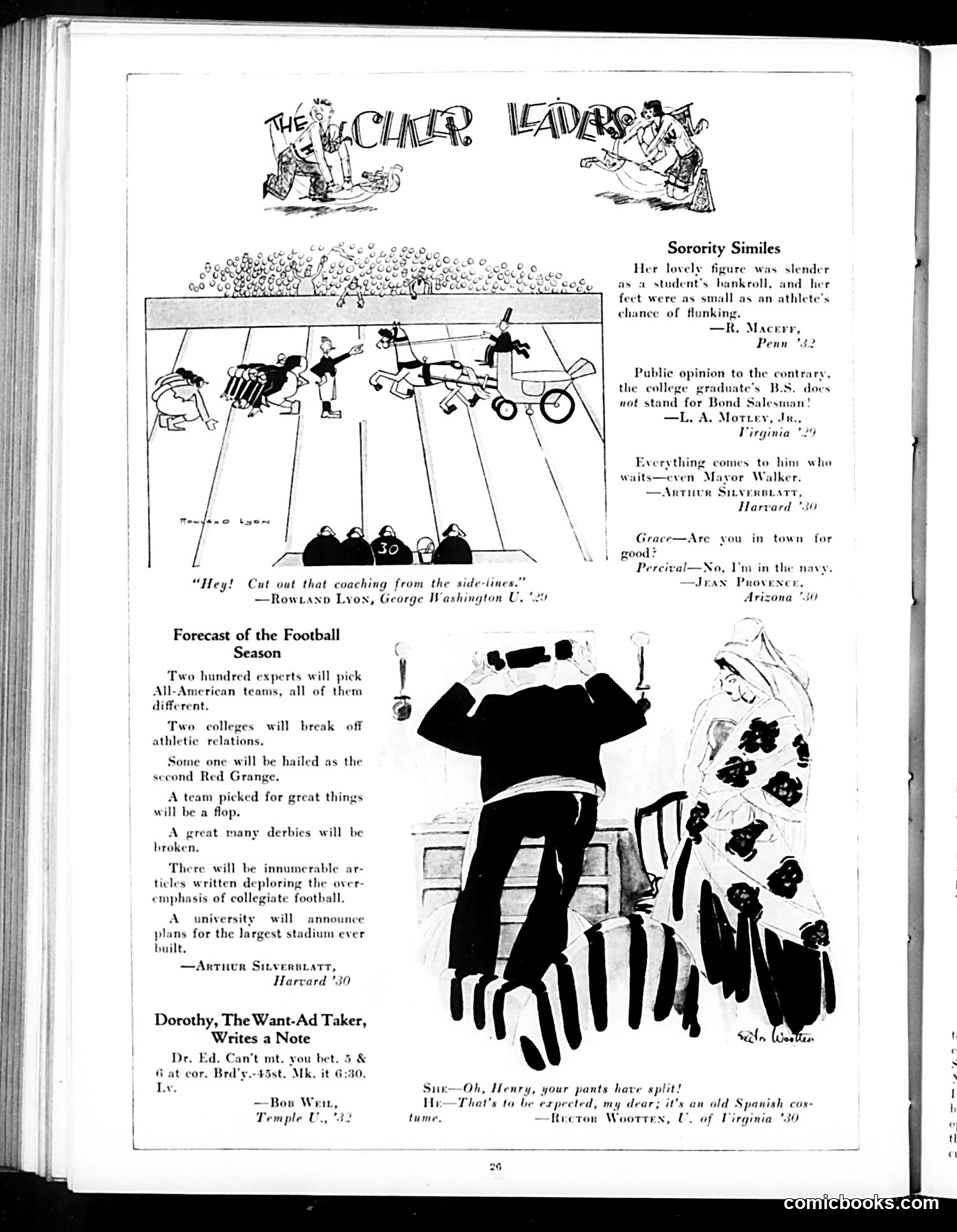
# Analysis of Judge Magazine Page **Top Cartoon:** A doorman (labeled as "former football coach") exhorts a group of well-dressed women to "get in there and fight!" The satire mocks the absurdity of applying aggressive sports language to genteel society women, likely commenting on post-WWI efforts to mobilize women for charitable or civic work using masculine rhetoric. **"Pointed Queries":** A satirical column poking fun at wealthy New Yorkers—their leisure activities (golf, European travel), their dependence on Wall Street income or paternal allowances, and their social pretensions (Princeton attendance, coming-out parties). The questions highlight the idle, privileged lifestyle of the upper class. **"You Bet He Got the Job":** An aspiring executive impresses his boss by securing two tickets to the Harvard-Yale football game—a prestigious social prize that outweighs actual business accomplishments. The joke satirizes how social connections and sports access matter more than real competence in business advancement. **Bottom Cartoon:** A child commandeers his younger brother's kiddie-car, illustrating sibling rivalry with comedic exaggeration. The page overall mocks wealthy elites and their shallow values.