A complete issue · 36 pages · 1929
Judge — September 21, 1929
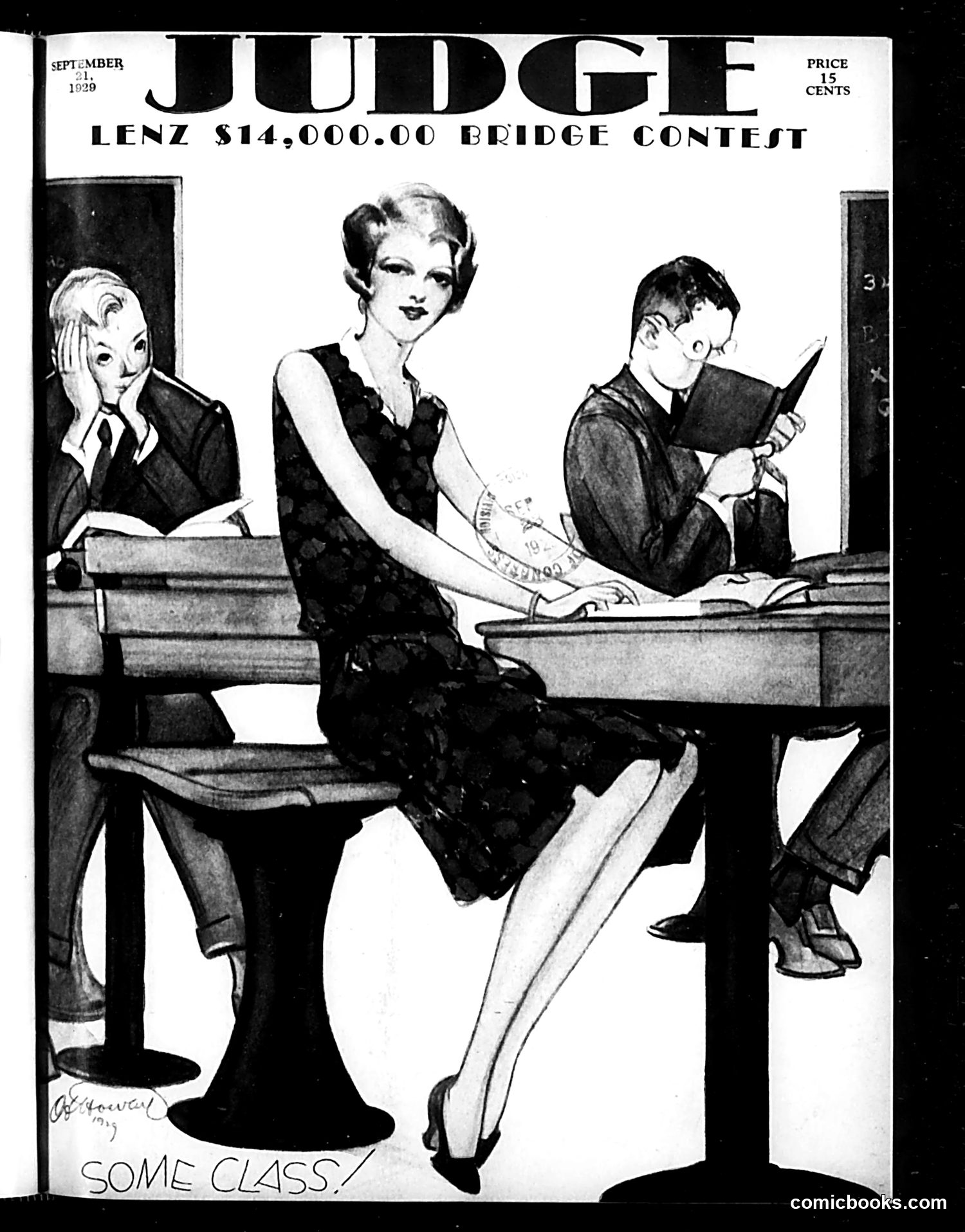
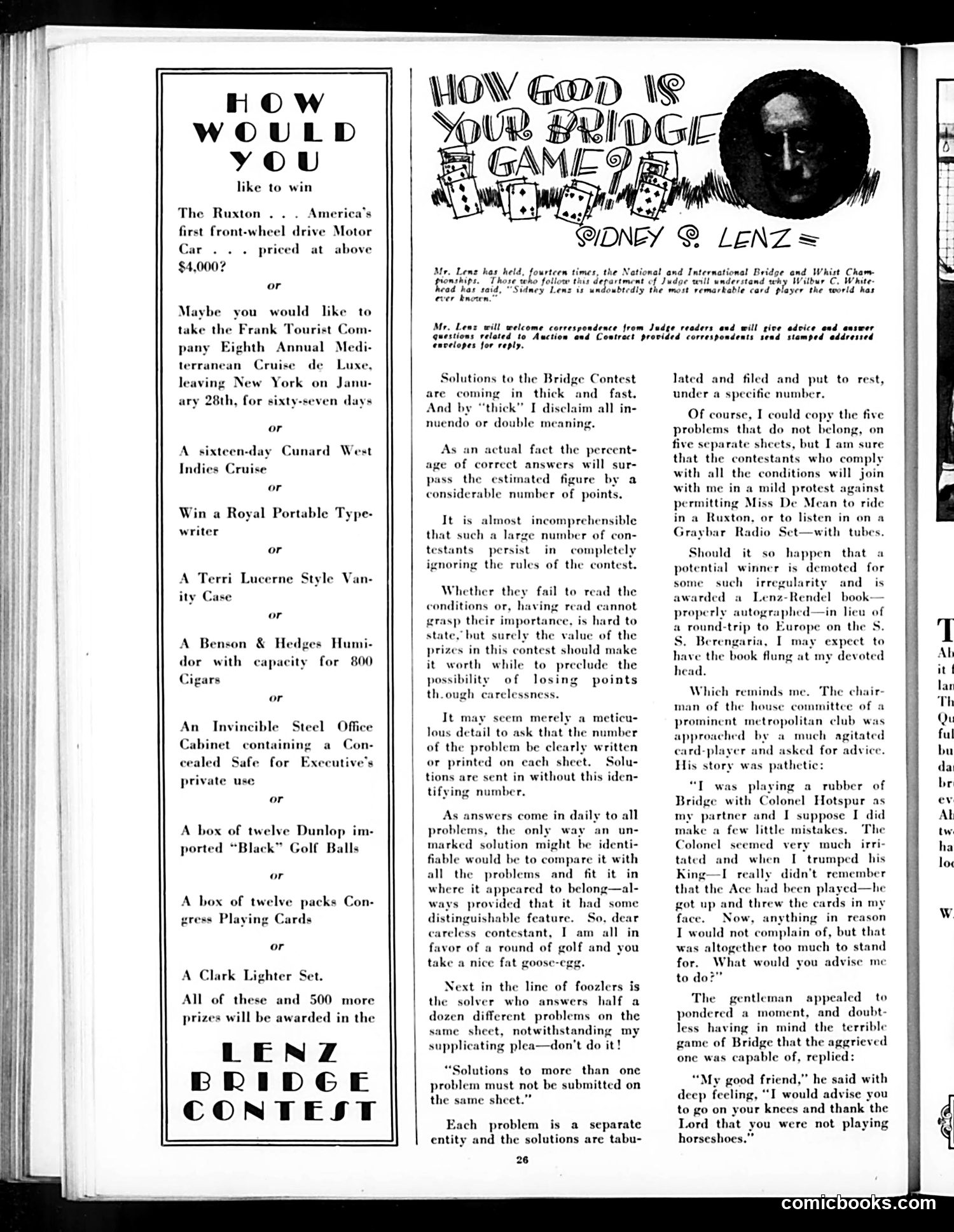
# Judge Magazine, September 21, 1929 This is a satirical cartoon about bridge, the popular card game of the era. The title "Lenz $14,000.00 Bridge Contest" likely references a famous 1929 bridge competition involving Harold Vanderbilt and Ely Culbertson—major figures in bridge's early competitive history. The cartoon depicts three people playing bridge at a table, with the caption "SOME CLASS!" The satire appears to mock the pretentiousness and social aspirations surrounding competitive bridge among the wealthy. The elegantly dressed woman in the center represents the game's glamorous appeal to high society, while the composition suggests the ostentatious nature of high-stakes bridge tournaments that captured public attention during this period. The joke targets bridge's status as an elite social pastime.

# College Inn Tomato Juice Cocktail Advertisement This is a **straightforward product advertisement**, not political satire. The page promotes College Inn brand tomato juice cocktail from Chicago, marketed as a health beverage containing "precious vitamins" from tomatoes with lemon and spices. The ad emphasizes health benefits—suitable for adults and children, aids weight management ("keeping figures slim"), and serves as a "body-conditioner." It notes the drink is "nutritious but non-fattening," reflecting early-20th-century wellness marketing that emphasized vitamins and health tonics. The advertisement lists other College Inn food products (soups, prepared meats) and includes a prominent bottle illustration with the company's branding. This represents typical vintage advertising rhetoric connecting commercial products to personal health and wellbeing.
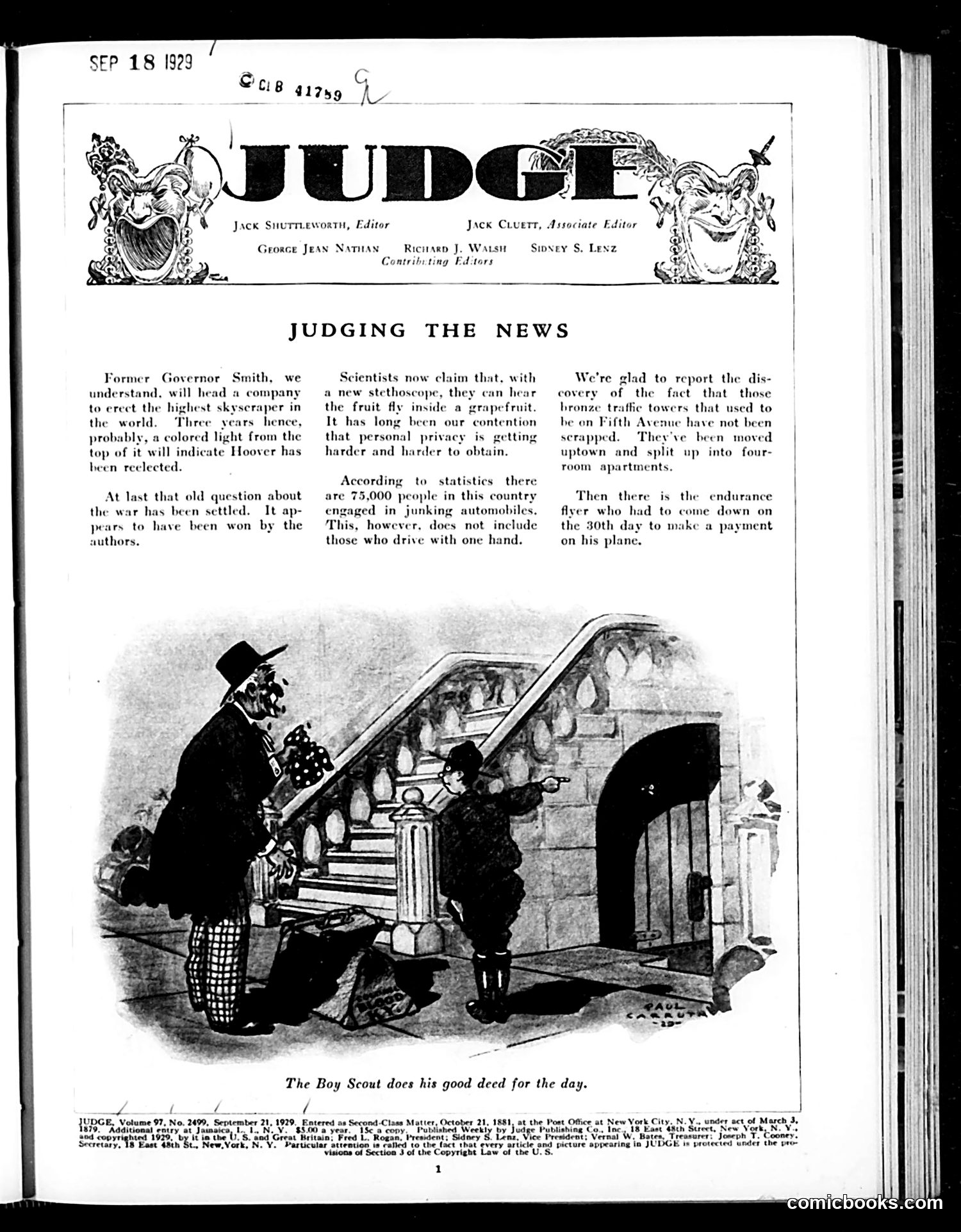
# Judge Magazine, September 18, 1929 The main cartoon depicts a Boy Scout helping an elderly man down stairs, captioned "The Boy Scout does his good deed for the day." This appears to be straightforward, sentimental content rather than satire—celebrating Scout virtues through a wholesome scene. The "Judging the News" section contains brief commentary items, including humor about Governor Smith leading a chocolate company, a joke about 73,000 people jinxing automobiles, and a quip about bronze profile busts on Fifth Avenue being moved to apartments. The items are typical light satirical observations on contemporary news rather than pointed political commentary. This issue predates the stock market crash by just six weeks.
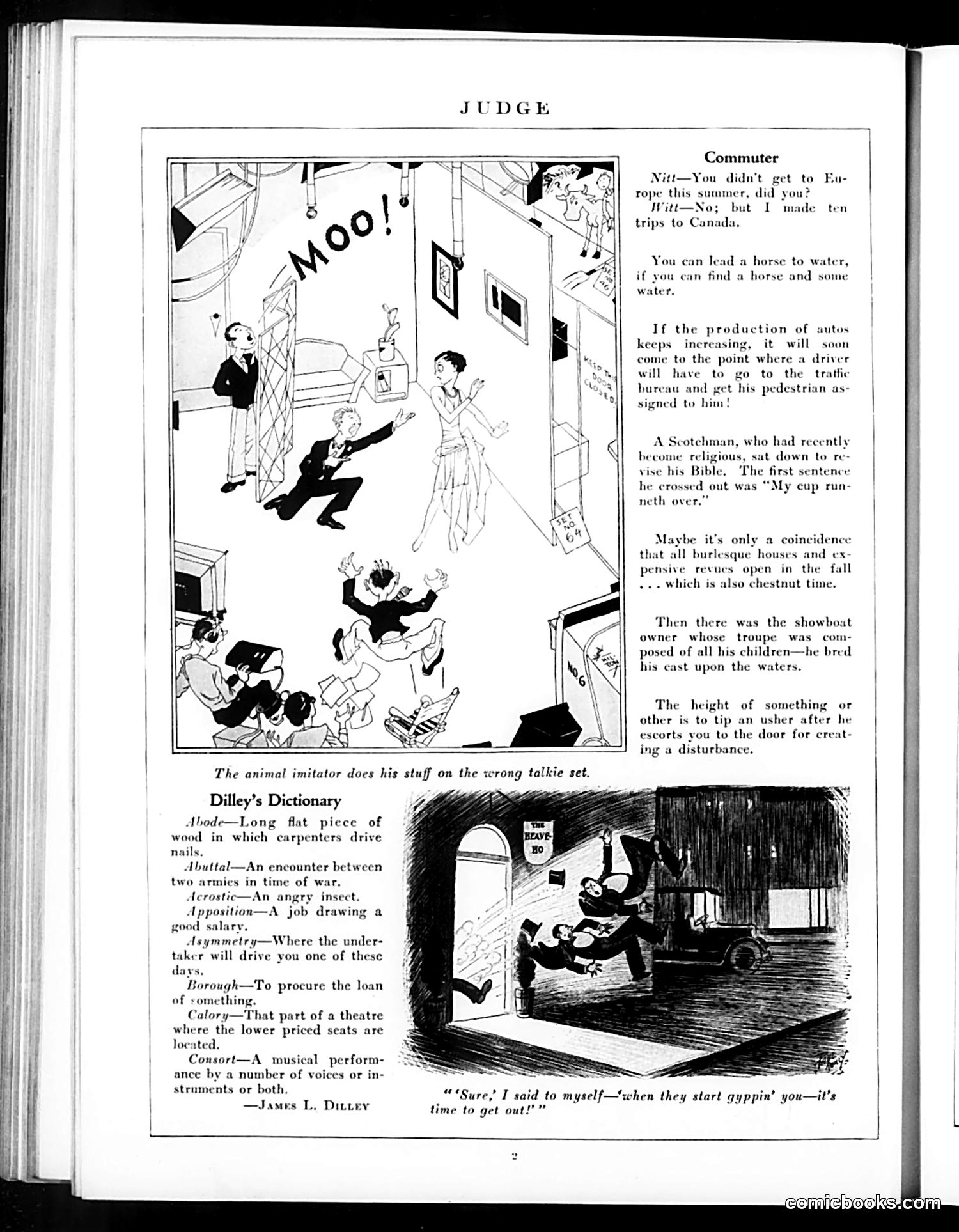
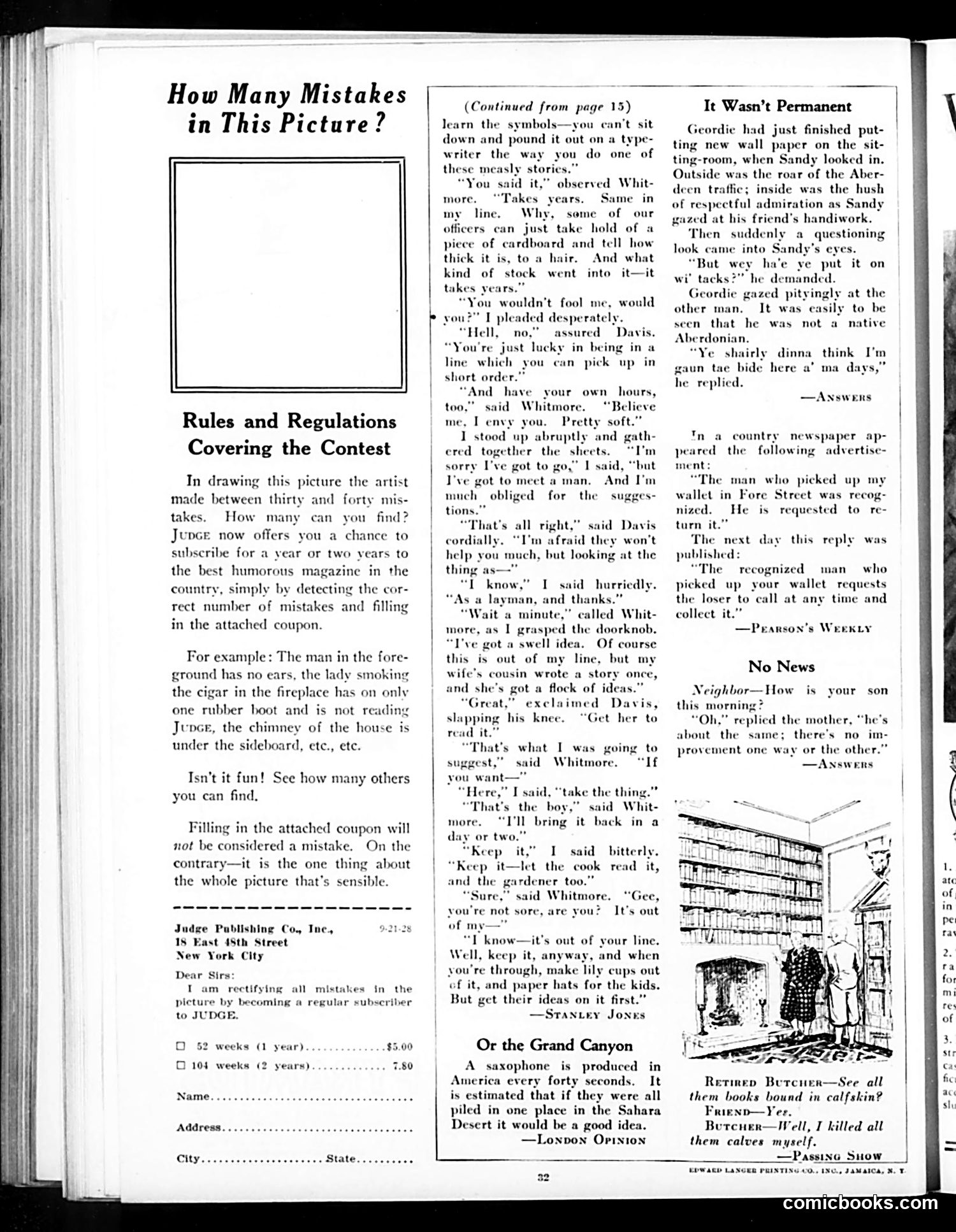
# Analysis of Judge Magazine Page The main cartoon depicts chaos on a theater "talkie" (sound film) set—a cow loudly moos, causing pandemonium among actors and crew. The satire targets early sound-film technology's unpredictability: unlike silent films, live sound recordings captured unexpected noises that ruined takes. The joke's timing suggests this is from the late 1920s when "talkies" were revolutionary but technically unreliable. The lower cartoon shows someone being ejected from what appears to be a theater or venue, with the caption about "yapping"—likely commenting on disruptive audience behavior during sound films. The "Commuter" jokes and "Dilley's Dictionary" are unrelated satirical commentary on contemporary life and language, typical of Judge magazine's format mixing multiple humor segments per page.
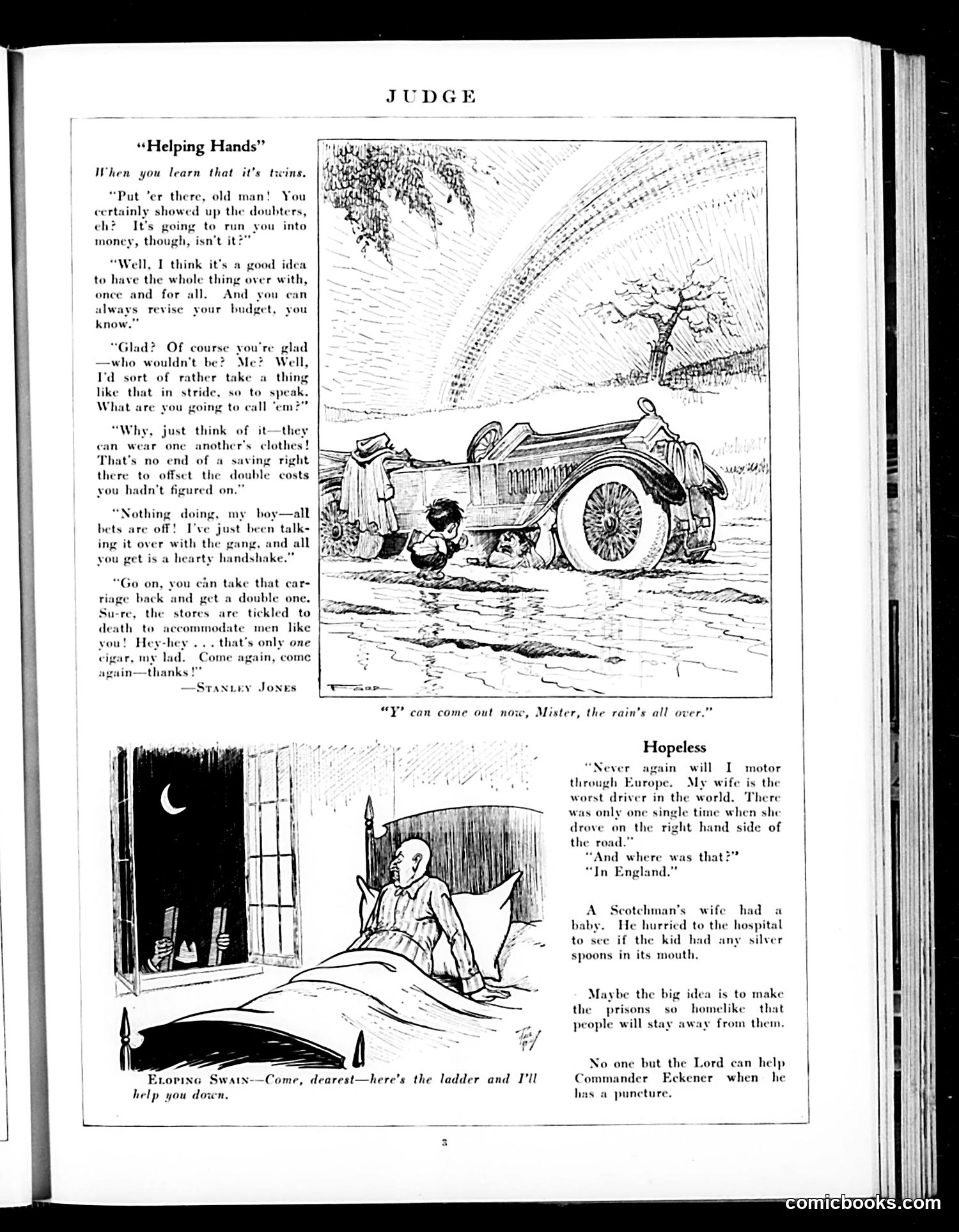
# "Helping Hands" and "Hopeless" **"Helping Hands"** satirizes the financial burden of twins. Two men discuss how twins will "run you into money," debating whether pooling expenses (sharing clothes, combining costs) makes economic sense. The cartoon shows a broken-down car, illustrating the financial strain. The humor targets middle-class anxieties about child-rearing expenses during an era when large families strained household budgets. **"Hopeless"** contains two brief anecdotes mocking wives as poor drivers—one English woman who drove on the wrong side of the road, another Scottish woman who brought a baby to the hospital fearing silver spoons in its mouth. The final quip about prisons and Commander Eckener (airship pioneer) is unclear without additional context. The satire relies on period stereotypes about women drivers.
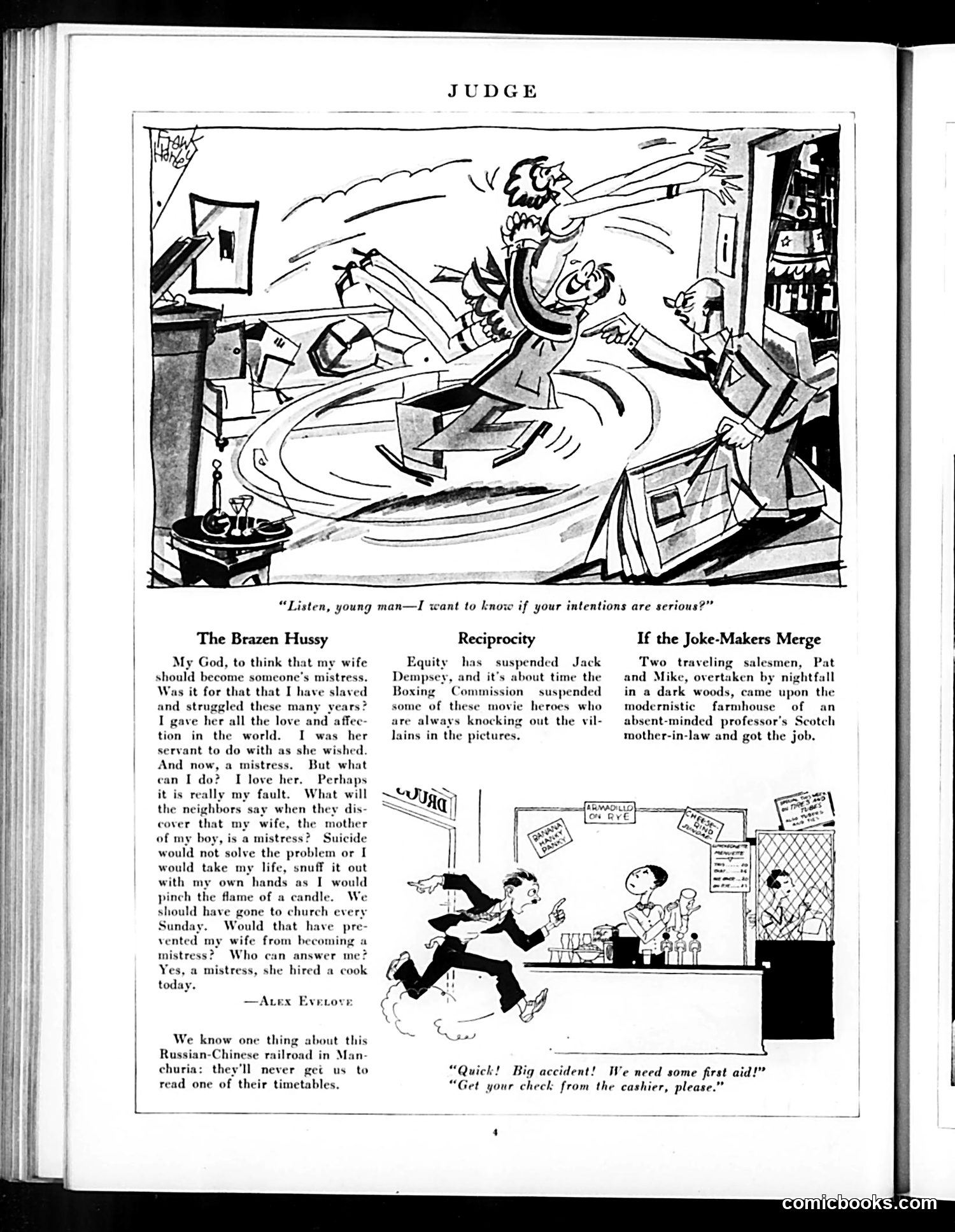
# Analysis of Judge Magazine Page **Top Cartoon:** A chaotic office scene depicts a man being ejected violently by an angry figure, with papers flying. The caption asks "Listen, young man—I want to know if your intentions are serious?" This appears to satirize workplace or social encounters where intentions are questioned amid physical chaos—likely commenting on business disputes or romantic/social awkwardness during the period. **Text Sections:** "The Brazen Hussy" presents a husband's complaint about his wife becoming a mistress, expressing moral anxiety. "Reciprocity" jokes about boxing commission suspensions. "If the Joke-Makers Merge" humorously imagines traveling salesmen meeting a Scottish professor's mother-in-law. **Bottom Cartoon:** A man slips on a cloud while office workers react, captioned about a "big accident" requiring first aid and a cashier's check—satirizing insurance claims or workplace accidents. The page blends domestic satire with workplace humor typical of early 20th-century Judge content.
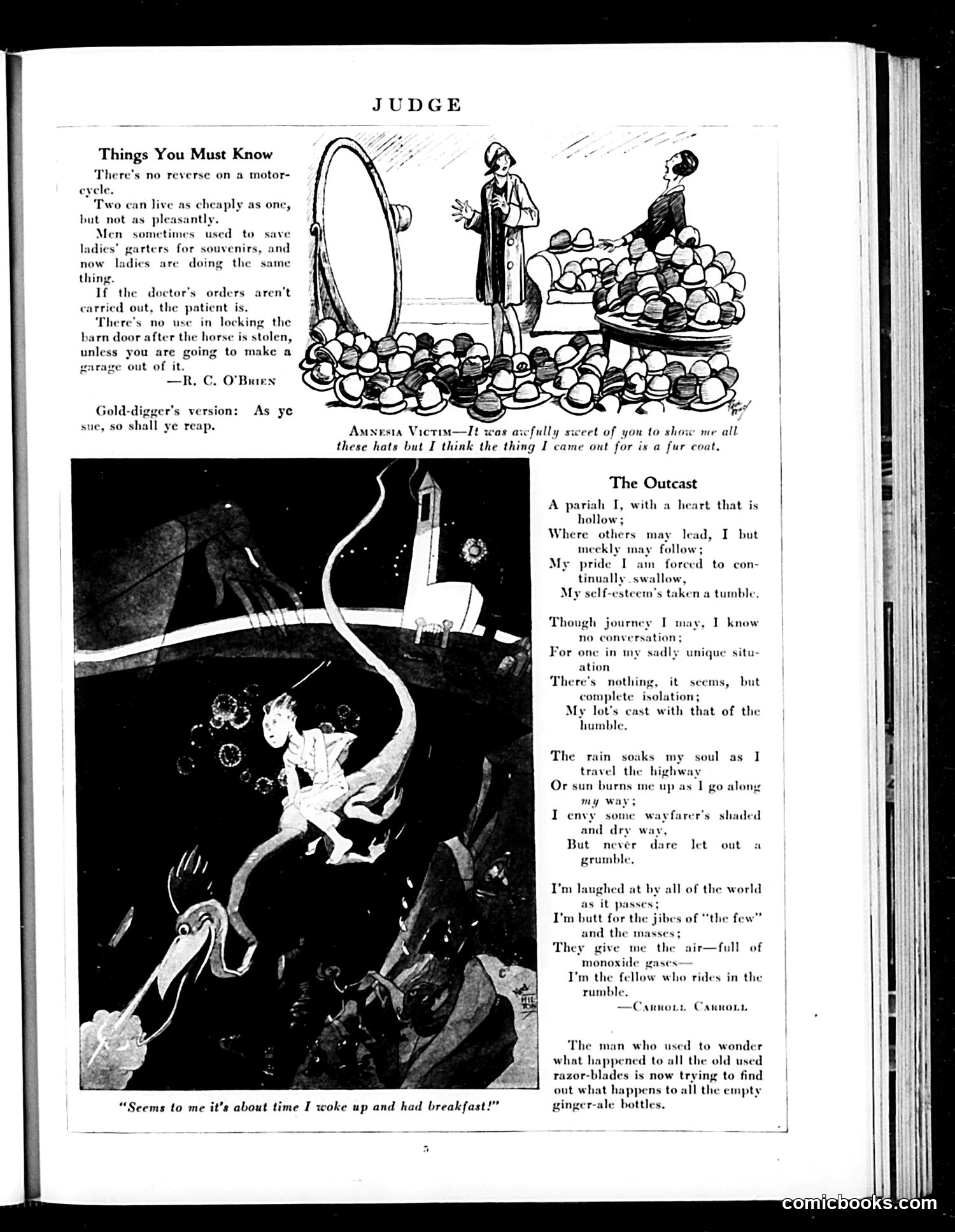
# Analysis of Judge Magazine Page The top cartoon satirizes material excess during economic hardship. Two figures stand amid enormous piles of hats, with one remarking about acquiring a fur coat. The caption "Amnesia Victim" suggests someone has forgotten their previous poverty or wartime rationing, now wastefully accumulating luxury goods. Below, "The Outcast" poem by Carroll Carroll personifies a social pariah—someone cast out and isolated, traveling alone while others enjoy community. References to "monoxide gases" and riding "in the rumble" suggest Depression-era homelessness or vagrancy. The bottom item jokes about recycling: a man who previously discarded old razor blades now searches for empty ginger-ale bottles, implying economic desperation has forced people to salvage trash for resale or reuse. The page overall critiques 1920s-30s economic inequality and waste.
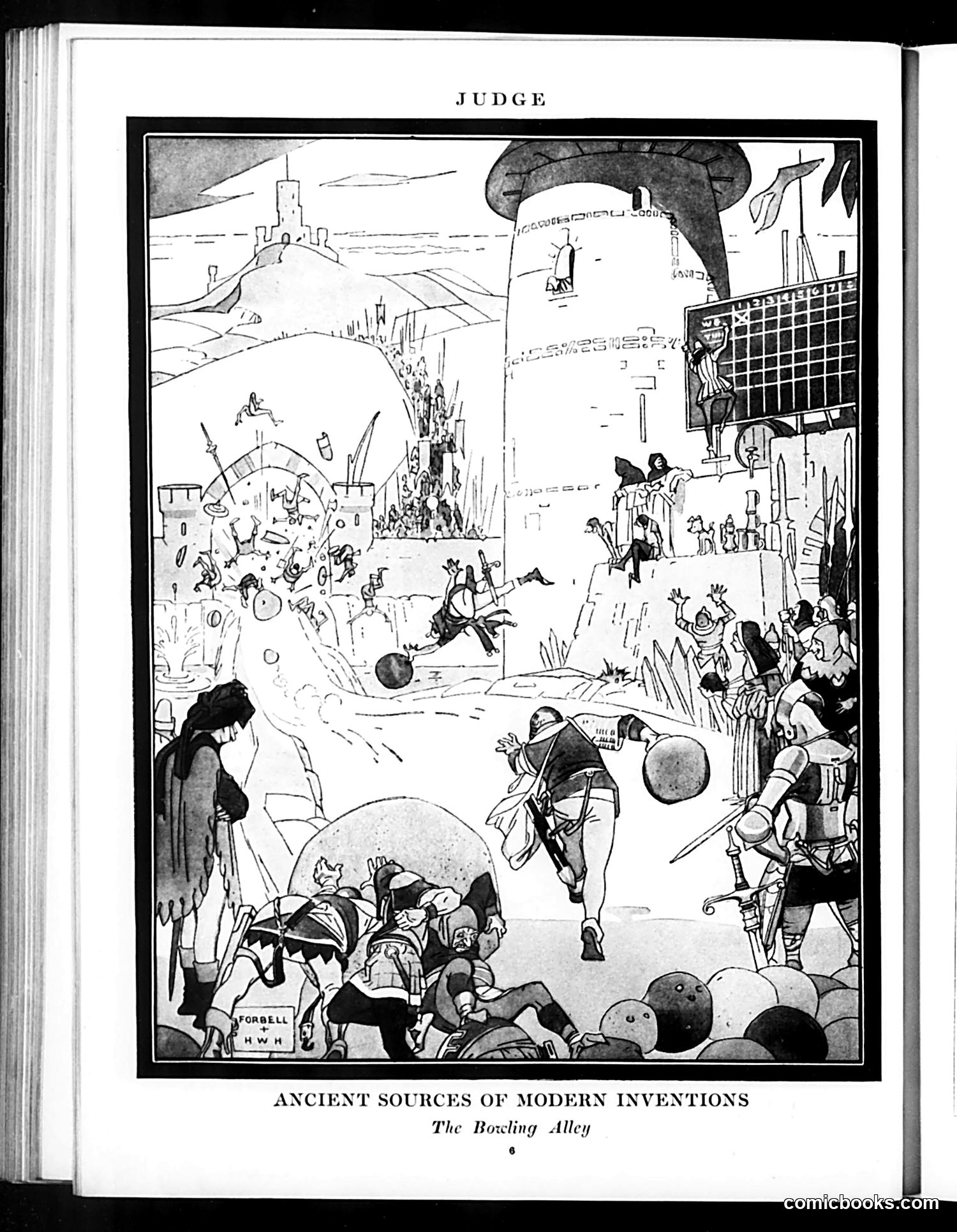
# "The Bowling Alley": Ancient Sources of Modern Inventions This Judge cartoon uses a medieval setting to satirize bowling as an ancient pastime with modern relevance. The elaborate illustration depicts a castle-based "bowling alley" where armored knights and medieval figures engage in what appears to be an early form of bowling, complete with balls and pins. The satire's point: bowling, presented as a modern recreation, actually has deep historical roots. By depicting medieval nobles and soldiers bowling in an anachronistic castle scene, the cartoon humorously suggests that supposedly "modern inventions" often have precedents in history. The detailed architectural fantasy setting reinforces this comparative commentary on recreational activities across time periods.
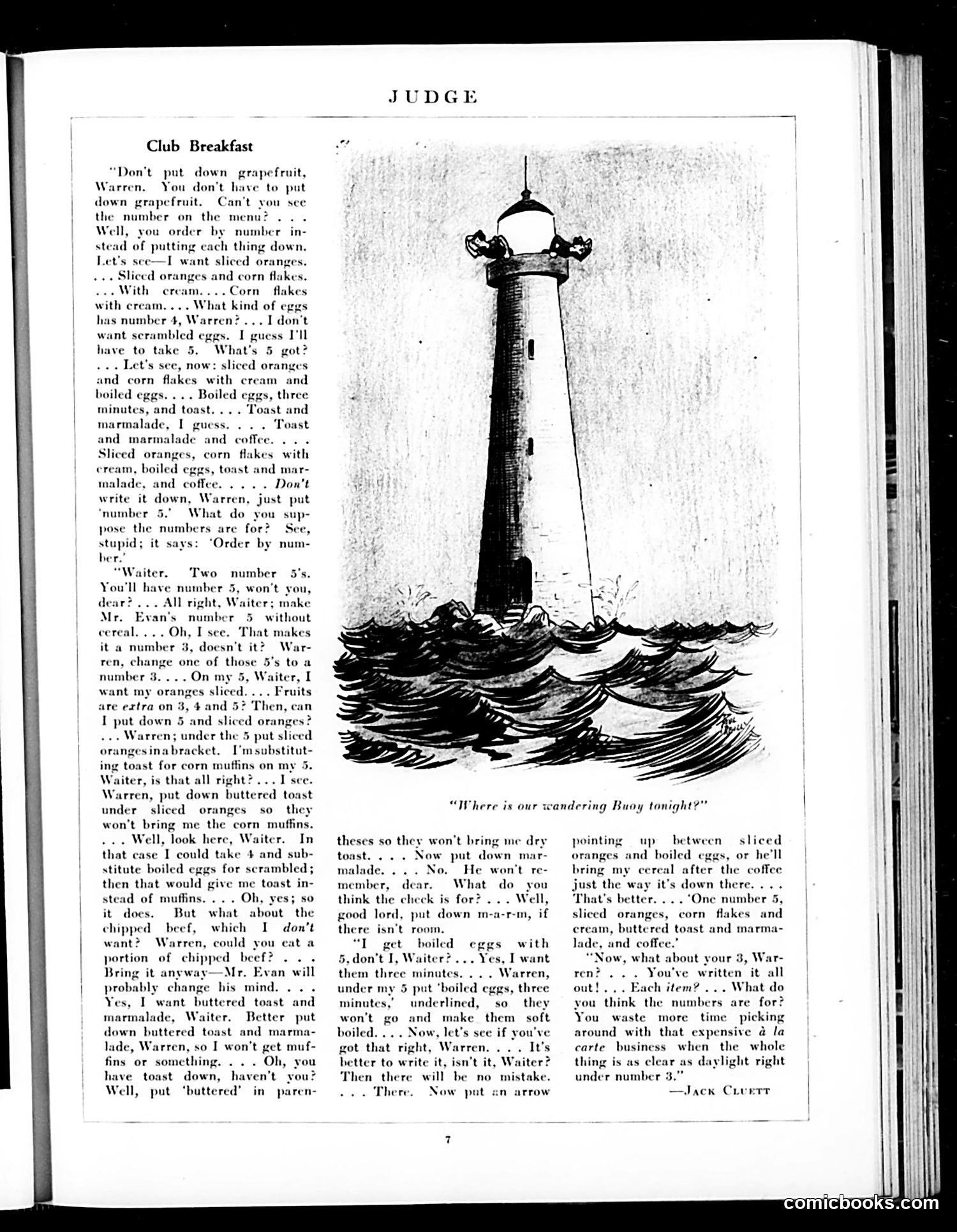
# "Club Breakfast" by Jack Cluett This is a humorous complaint about restaurant ordering inefficiency. A diner attempts to order from a numbered menu (e.g., "Number 5"), but insists on customizing nearly every element—substituting items, adding extras, requesting specific preparations. The waiter and companion repeatedly note that these modifications defeat the purpose of the numbered system, which exists precisely to avoid such complications. The satire targets customer indecision and the false economy of "à la carte business"—the irony being that ordering by number should save time, yet the diner spends even more time negotiating substitutions than simply ordering individual items would take. The illustration of a lighthouse in stormy seas reinforces the caption "Where is our wandering Buoy tonight?"—a visual pun suggesting the diner's meandering, directionless ordering process.
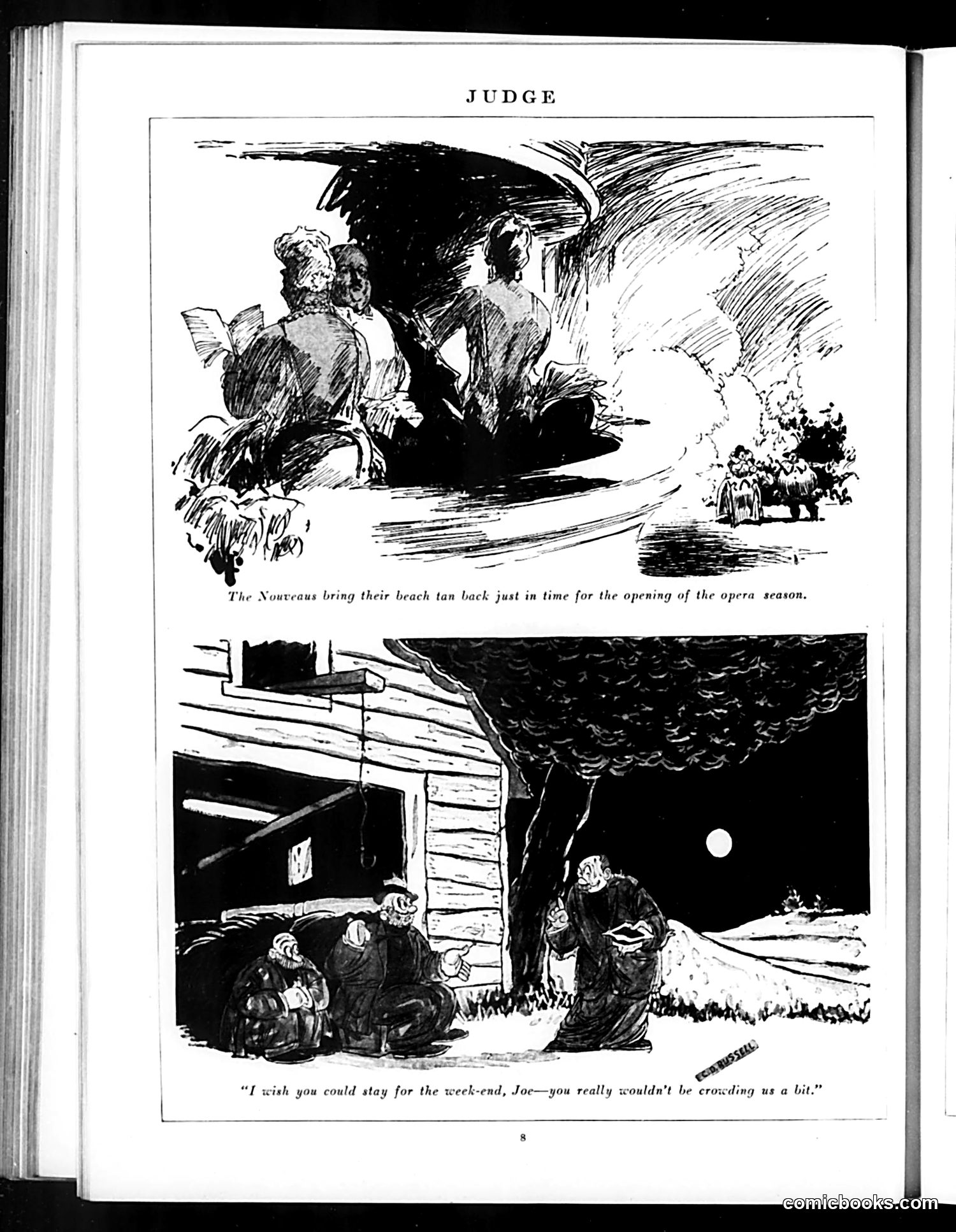
# Analysis of Judge Magazine Page This page contains two satirical cartoons: **Top cartoon:** Shows wealthy socialites ("The Nouveaus") returning from summer leisure with tanned skin, timed for the opera season's opening. The satire mocks the nouveau riche—newly wealthy people displaying their status through fashionable pursuits and sun-tanned complexions (which signaled leisure and vacation travel). **Bottom cartoon:** Depicts a rural scene where someone named Joe is asked to stay for the weekend. The speaker notes this wouldn't inconvenience them much—likely satirizing either working-class hospitality or the economic strain of Depression-era visits. The nighttime farmhouse setting emphasizes rural simplicity contrasted with casual social assumptions. Both cartoons use humor to critique class dynamics and social pretension in early 20th-century America.
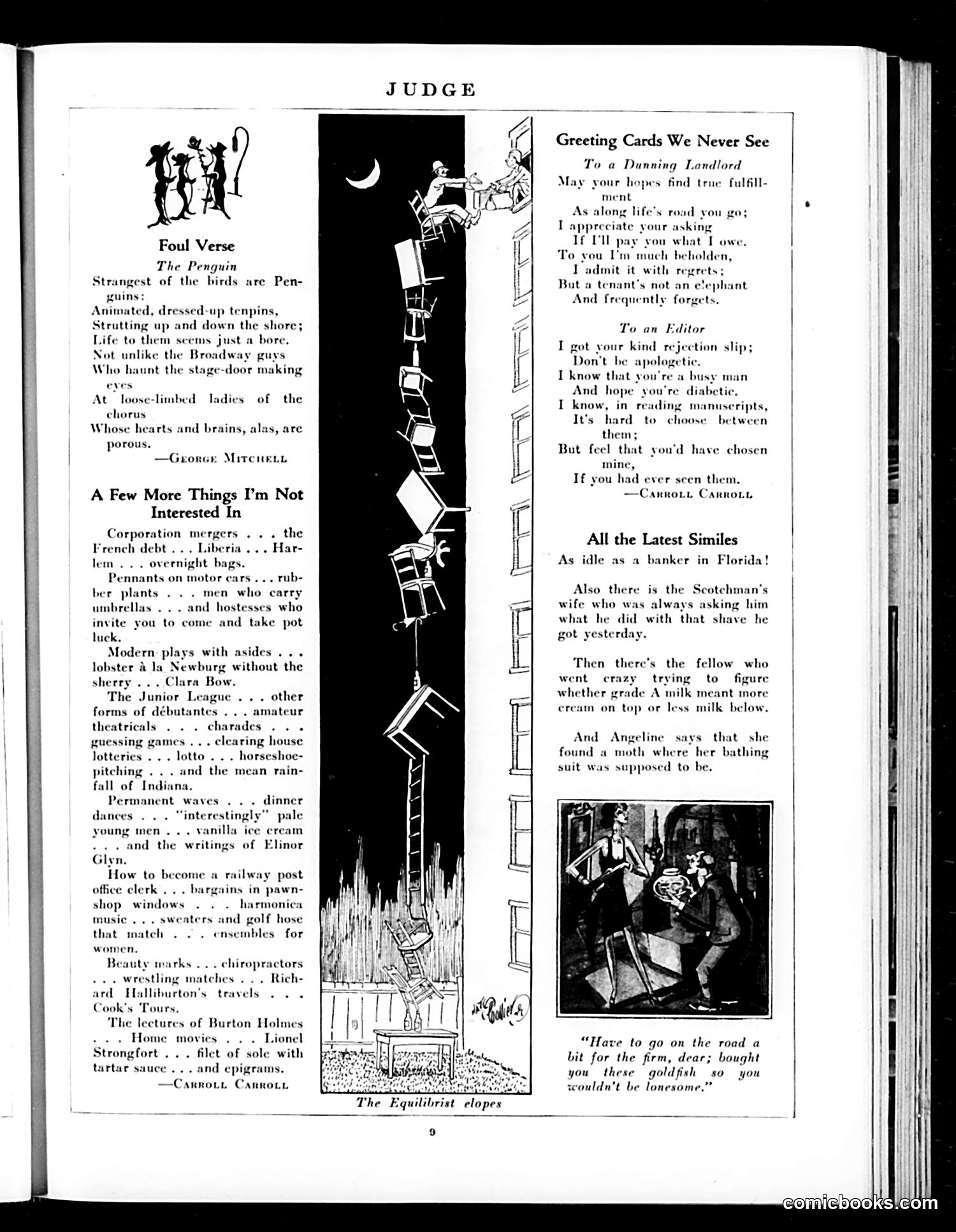
# Judge Magazine Page Analysis This page from Judge magazine (appears to be 1920s-1930s era) contains satirical humor pieces targeting contemporary society: **"Foul Verse: The Penguin"** compares penguins to Broadway chorus girls—both described as animated but hollow, suggesting chorus performers lacked intelligence or substance. **"A Few More Things I'm Not Interested In"** is a humorous list mocking current trends and celebrities: corporate mergers, French war debts, Harlem culture, Clara Bow (silent film star), Junior League debutantes, and author Elinor Glyn. It reflects upper-class dismissiveness toward modern innovations and social changes. **"Greeting Cards We Never See"** offers satirical fake greeting cards—one to a landlord (sarcastically grateful for dunning notices), another to an editor rejecting manuscripts. These parody sentimental greeting card conventions. **"All the Latest Similes"** presents contemporary jokes, including one about a Scotsman and lost shaving cream, and one about milk grades—topical humor now obscure. The illustration shows figures on a building facade, likely satirizing urban or theatrical subjects. Overall, the page reflects Judge's satirical commentary on 1920s-30s social pretension and modern life.
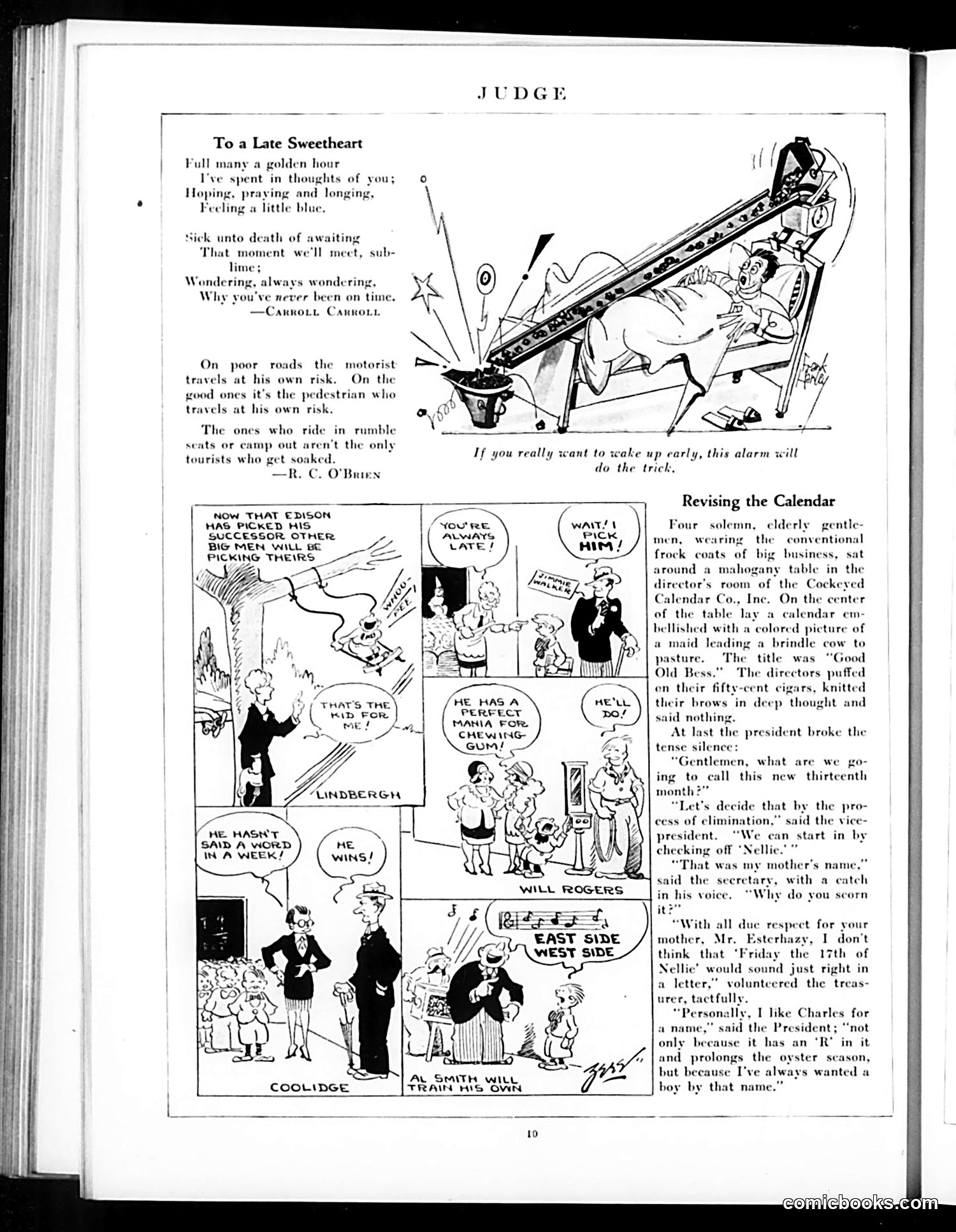
# Explanation for Modern Readers This Judge magazine page contains three distinct pieces of satire: **Top cartoon ("If you really want to wake up early...")**: A visual joke about an overly elaborate, dangerous alarm clock that launches people violently out of bed—satirizing impractical modern gadgetry. **Middle comic strip**: References contemporary political figures. "Edison has picked his successor" alludes to Thomas Edison's influence. The strip appears to mock prominent men of the era (names visible: Lindbergh, Coolidge, Will Rogers, Al Smith) and their habits or quirks—suggesting these powerful figures are being satirized for their mannerisms or public personas. The "East Side/West Side" reference likely evokes New York social divisions. **Bottom story ("Revising the Calendar")**: A boardroom satire where executives of a calendar company debate naming a newly-created thirteenth month. The humor lies in their absurd elimination process: rejecting "Nellie" because it sounds unrefined, and finally proposing "Charles" for arbitrary reasons (it has an "R," extends oyster season). This mocks corporate decision-making as fundamentally irrational despite pretensions of seriousness.
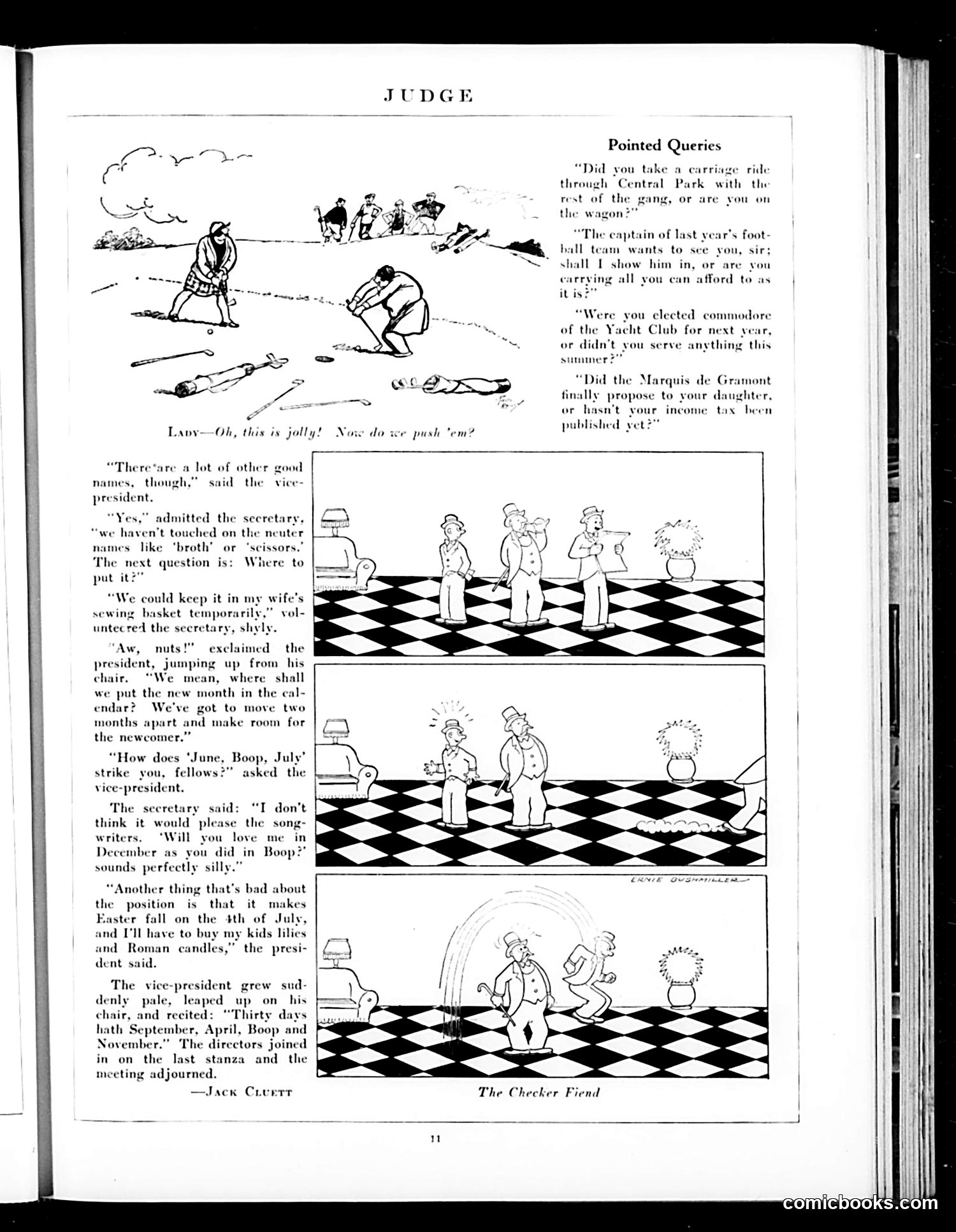
# Analysis This page contains two distinct satirical pieces from Judge magazine: **"The Checker Fiend"** (bottom comic strip): Office bureaucrats debate naming a new month ("Boop") and where to insert it in the calendar. The satire mocks organizational inefficiency and absurd problem-solving—they seriously discuss the ramifications (Easter falling on July 4th, songwriting complications, calendar disruptions) for what appears to be a trivial or nonsensical proposal. It's humor derived from taking ridiculous premises seriously. **"Pointed Queries"** (right column): A list of sarcastic "questions" poking fun at high society's pretensions. Each query sarcastically suggests alternative embarrassing explanations for social activities—implying wealthy people either flaunt their money ostentatiously or hide financial/romantic failures behind polite society. References include Central Park social outings, yacht club positions, and the Marquis de Gramont (a French nobleman), targeting old-money elite's hypocrisy and status-consciousness. Both pieces use exaggeration to critique institutional absurdity and social pretension typical of early 20th-century American humor.