
Judge, 1929-09-21 · page 15 of 36
Judge — September 21, 1929 — page 15: what you’re looking at
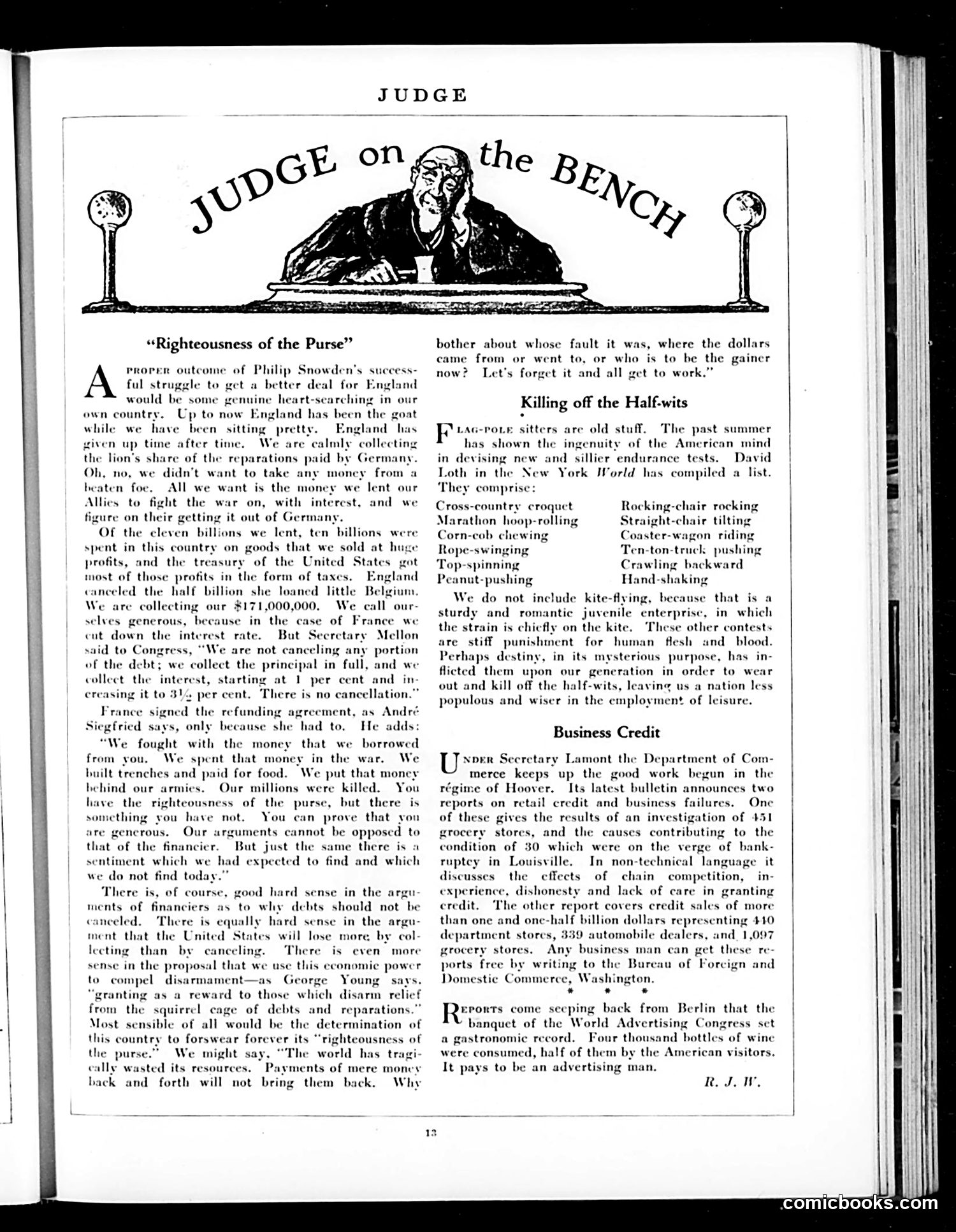
A restored page from Judge, 1929-09-21. Page through the whole issue in the reader above.
📄 Transcribed text from this page (OCR, searchable)
Machine-transcribed from the original scan — historical spelling and the odd misread are preserved.
“Righteousness of the Purse” A Proven outcome of Philip Snowden’s success ful struggle to get a better deal for England would be some genuine heart-searching in our own country. Up to now England has been the goat while we have been sitting pretty. England has given up tine after time, We are calmly collec the lion’s share of the reparations paid by Germany. Oh, no, we didn’t nt to take any money from a beaten foe. All we want is the money we lent our Allies to fight the war on, with interest, and we gure on their getting it out of Germa Of the cleven billions we lent, ten billions were spent in this country on goods that we sold at huge profits, and the treasury of the United States got most of those profits in the form of taxes. E nd eeled the half billion she loaned little Belgium. are collecting our $171,000,000. We selves generous, because in the cut down the interest rate. But id to Congress, “We are neeling any portion of the debt; we collect the principal in full, and we collect the interest, starting at 1 per cent and in- creasing it to 314 per cent. There is no cancel all our- ase of France we erctary Mellon France signed the refund André fried says, only because she ‘had to. | He adds: ng ement, “We fought with the money that we borrowed from you. We spent that money in the war. We built trenches and paid for food. We put that money behind our armies. Our millions were killed. You have the righteousness of the purse, but there is something you have not. You can prove that you re gencrous. Our arguments cannot be opposed to that of the financier. But just the same there is a sentiment which we had expected to find and which we do not find today.” There is, of course, good hard sense in the argu ments of financiers as to why debts should not be canceled. There is equally hard sense in the argu- ment that the United States will lose more by col lecting than by canceling There is even) more sense in the proposal that we use this economic power to compel disarmament—as George Young. says. “granting as a reward to those which disarm relief from the squirrel cage of debts and reparations.” Most sensible of all would be the determina this country to forswear forever ity “righteousness of the purse.” We might say, “The world has tra cally wasted its resources. yments of mere money back and forth will not bring them back. Why ion of bother about whose fault it was, where the dollars came from or went to, or who is to be the gainer now? Let's forget it and all get to work.” Killing off the Half-wits Fs re old stuff. The past summer has shown the enuity of the American mind in devising new and sill endurance tests. David Loth in the New York World has compiled a list. They comprise: Cross-country croque' Marathon hoop-rolling POLE sitters a Rocking-chair rocking traight-chair tilting Corn-cob chewing Coaster-wagon riding Rope-swinging Ten-ton-teuck pushing Top-spinning Cc Hand-sh We do not include kite-flying, because that is a sturdy and romantic juvenile enterprise, in which the strain is chiefly on the kite. These other contests are stiff punishment for human flesh and blood. Perhaps destiny, in its mysterious purpose, has in- flicted them upon our generation in order to wear out and kill off the half-wits, leaving us a nation less populous and wiser in the employment of leisure. Peanut-pushing Business Credit ‘per Seerctary Lamont the Department of Com- merce keeps up the good work begun in the ime of Hoover. Its latest bulletin announces two reports on retail credit and business failures. One of these gives the results of an investigation of 451 grocery stores, and the causes contributing to the condition of 30 which were on the verge of bank- ruptey in Louisville. In non-technical language it discusses the effects of chain competition, | in- experience, dishonesty and lack of care in granting credit. The other report covers credit sales of more than one and one-half billion dollars representing 440 department stores, 339 automobile dealers, and. 1,097 grocery stores. Any business man can get these re- ports free by writing to the Bureau of Foreign and Domestic Commerce, Washington. * * * Rrreers come secping back from Berlin that the banquet of the World Advertising Congress set a gastronomic record. Four thousand bottles of wine were consumed, half of them by the American visitors. It pays to be an advertising man. R.JW. comicbooks.com