
Judge, 1929-09-21 · page 20 of 36
Judge — September 21, 1929 — page 20: what you’re looking at
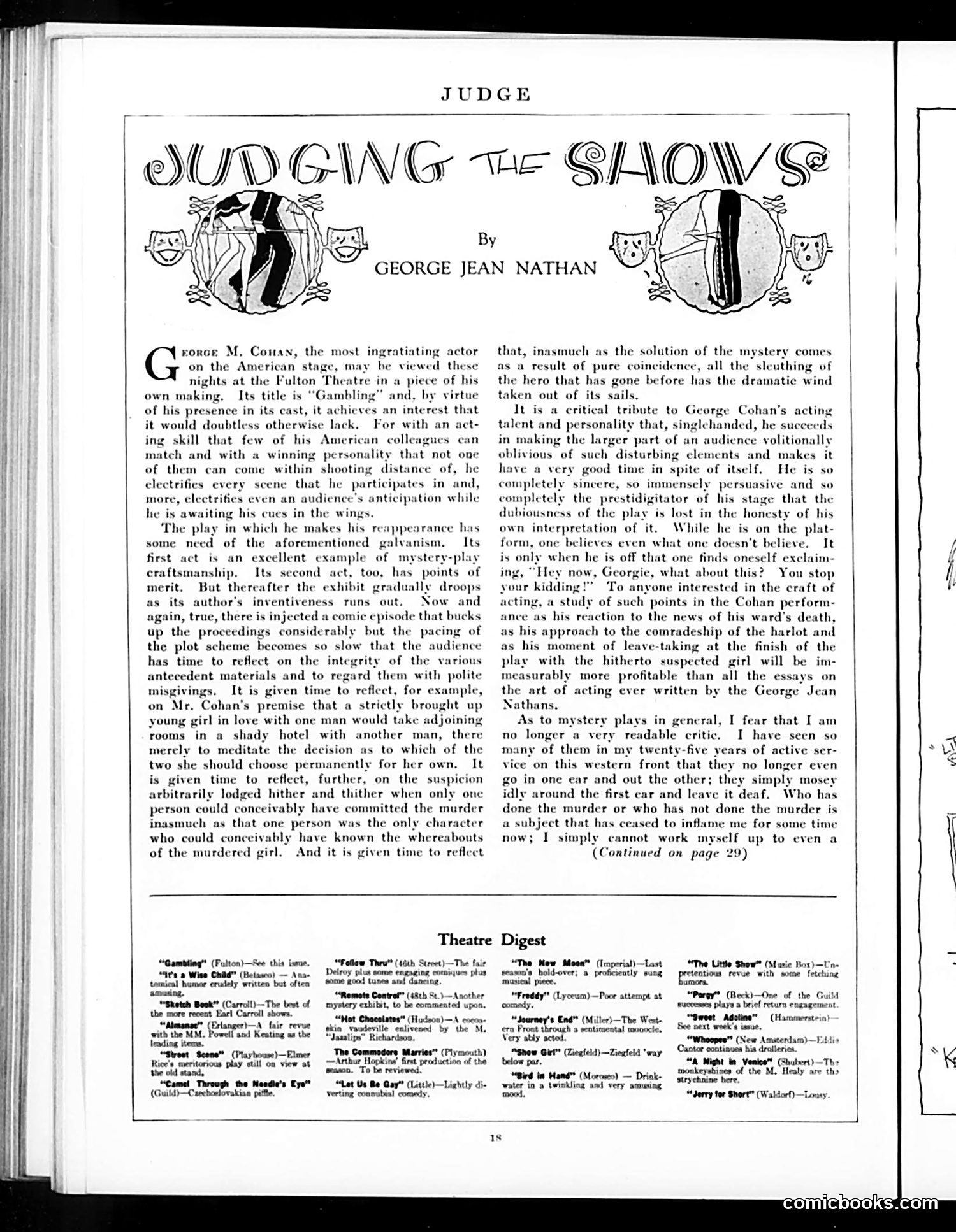
A restored page from Judge, 1929-09-21. Page through the whole issue in the reader above.
📄 Transcribed text from this page (OCR, searchable)
Machine-transcribed from the original scan — historical spelling and the odd misread are preserved.
JUDGE rorork M. Conan, the most ingratiat on the Americ s 4 . nights at the Fultoi own making, Its title is of his presence in its cast it would doubtless otherw ge, may be viewed these Theatre in a piece of his mbling” and, by virtue it achieves an interest that ce lack. For with an act- ing skill that few of his Amer ues can match and with a winning personality that not one of them can come within shooting distance of, he electrifies every scene that he parti more, electrifies even an audie! aiting his cues in the wings. y in which he makes his reappe some need of the aforementioned he is a The p es in and, ticipation while ance has galvanism, — Its first act is an excellent example of mystery-play craftsmanship. Its second act, too, has points of again, true, there up the proc But thereafter the exhibit gradually droops its author's inventiveness runs out. Now injected a comic episode th ngs considerably but the the plot scheme becomes so slow that the ing of udience has time to reflect on the integrity of the various antecedent mate misgivings. It is young girl given time to reflect, for on Mr. Cohan’s premise that a strictly broug love with one man would take adjoi rooms in a shady hotel with another m: urd them with polite mple, two she should choose permanently for her own. It is given time to reflect, arbitrarily lodged hither further, on the suspicion and thither when only one person could conceivably have committed the murder inasmuch as that one person was the only ch ly have known the where: who could cone of the murdered girl. And it is given time to reflect MUDGING t= SLOWS By that, inasmuch as the solution of the mystery comes as a result of pure coincidence, all the sleuthing of the hero that has gone before has the dramatic wind taken out of its sails. | It is a critical tribute to Gee talent and personality that, singleh in making the larger part of an audience volitionally oblivious of such disturbing elements and makes it have a very good time in spite of itself. He is so completely sincere, so immensely persuasive and so completely the prestidigitator of hiss that the dubiousness of the play is lost in the honesty of his own interpretation of it. While he is on the plat- form, one believes even what one doesn't believe. It is only when he is off that one finds oneself exclaim- ing, “Hey now, Georgie, what about this? You stop your kidding To anyone interested in the craft of acting, a study of such points in the Cohan perform- i tion to the news of his ward's death, his approach to the comradeship of the harlot and his moment of leave-taking at the finish of the with the hitherto suspected girl will be im- measurably more profitable than all the ess: on the art of acting ever written by the George Jean Nathans, As to mystery plays in general, I fear that I am no longer a very readable critic. I have seen so many of them in my twenty-five ye: vice on this western front that the go in one ear and out the other ‘y simply mosey idly around the first ear and leave it deaf. Who done the murder or who has not done the murder is a subject that has ceased to inflame me for some time now; I simply cannot work myself up to ev (Continued on page 29) ve ser- er even “Gambling” (Fulton)—See this isrue. “It's a Wise Child” (Belasco) — Ana- tomical humor crudely written but often amusing. “Shetch Book” (Carroll) —The best of the more recent Earl Carroll shows. “Almanac” (Erlanger)—A fair revue with the MM. Powell and Keating as the leading items. “Street Scene” (Playhouse)—Elmer Rice's meritorious play still oa view at tthe old stand, “Camel Through the Needie’s Eye” (Guild)—Coreborlovakian pitfe. Theatre “Fellow Thru” (46th Street) —The fair Delroy plus some engaging comijues plus some good tunes and dancing. “Remote Control” (48th St.)—Another mystery exhibit, to be commented upoa. “Hot Chocolates” (Hudson)—A coco ekin vaudeville enlivened by the M. “Jasalipn” Richardsoo. ‘The Commodore Marries” (Plymouth) —Artbur Hopkins’ first production of the season. To be reviewed. “Let Us Be Gay’ (Little}—Lightly di- ‘verting consubial comedy. Digest “The New Moon” (Imperial)—Last “The Little Show” (Music Bot)—Un- feason's hold-over; a proficieatly sung tious revue with some fetching — | ‘musical piece. yamors, “Freddy” (Lyceum)—Poor attempt at “Porgy (Beck)—One of the G: comedy. muccswes plays a brief return engagement # "8 End” (Miller)—The West- “Sweet Adaline” = (Hammerstein) era Proms Soroegh asentimental mooocie, See next week's issue, Very ably acted. “Whaopee” (New Amsterdam)—Eilie shew Git” (Ziegfeld) —Ziegleld ‘way Castor continues his drolleries below par. “A Wight in Venice” (Shubert}—Th> ed In Mand (Moros) — Drinks moray of the M. Healy ar th> water in a twinkling and very amusing aaiee bee: mood. “Jerry tor Short” (Waldorf) —Louy — on —_