
Judge, 1929-09-21 · page 23 of 36
Judge — September 21, 1929 — page 23: what you’re looking at
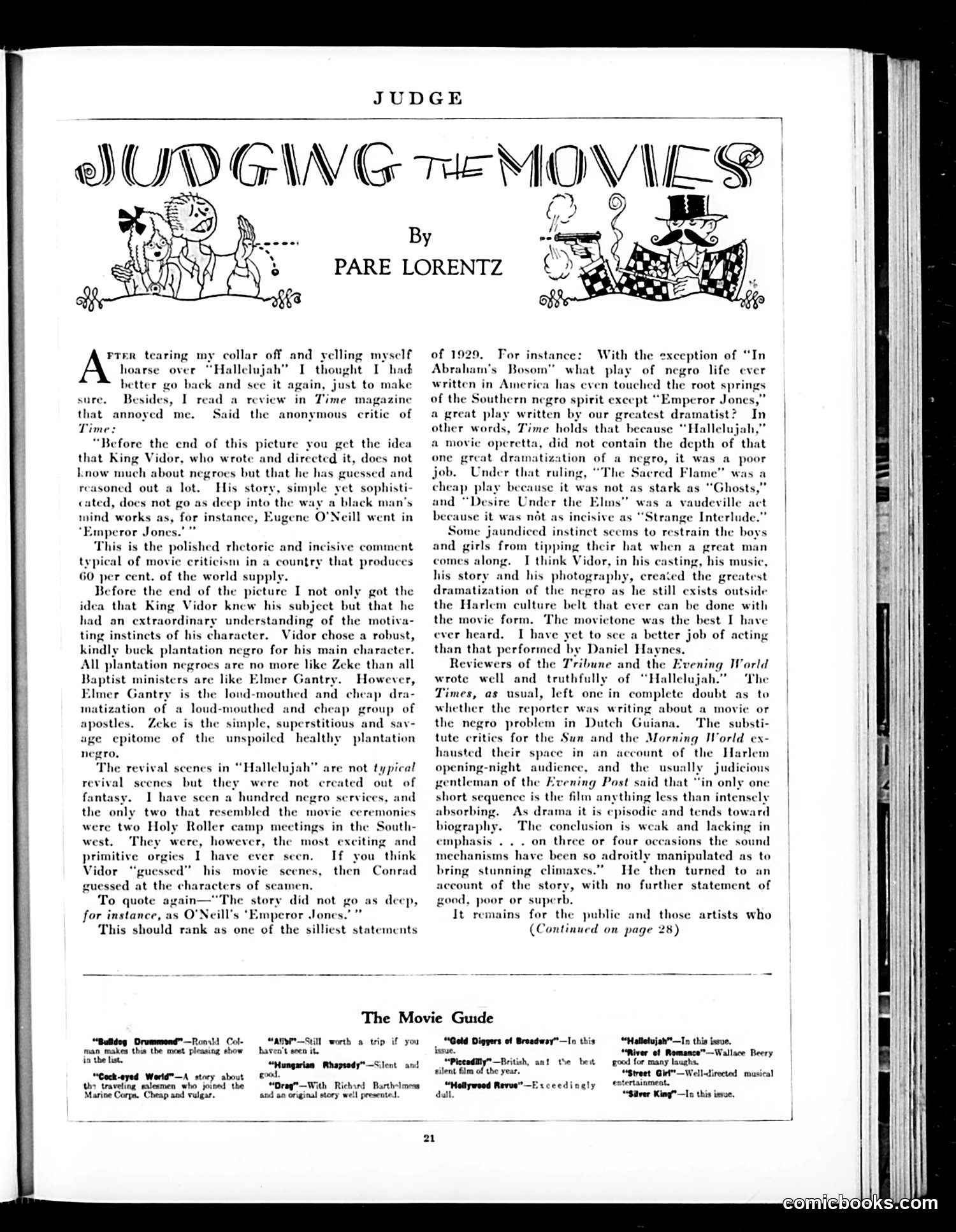
A restored page from Judge, 1929-09-21. Page through the whole issue in the reader above.
📄 Transcribed text from this page (OCR, searchable)
Machine-transcribed from the original scan — historical spelling and the odd misread are preserved.
JUDGE Fren tearing my collar off and yelling myself A hoarse over “Hallelujah” I thought I had better go back and see it again, just to make Besides, I read a review in Time magazine annoyed me. Said the anonymous critic of Time: “Before the end of this picture you get the idea that King Vidor, who wrote and directed it, does not now much about negroes but that he has guessed and reasoned out a lot. His story, simple yet sophisti- cated, docs not go as deep into the way a black man’s mind works as, for instance, Eugene O'Neill went in ‘Emperor Jones.’ ” This is the polished rhetoric and incisive comment s of movie criticism in a country that produces 60 per ce! Bt of the world supply. Before of the picture I not only got the idea that ¥ Vidor knew his subject but that he had on extraordinary understanding of the motiva- instincts of his character. Vidor chose a robust, kindly buck plantation negro for his main character. All plantation negroes are no more like Zeke than all Baptist ministers are like Elmer Gantry. However, Elmer Gantry is the lond-mouthed and cheap dra- matization of a loud-mouthed and cheap group of apostles. Zeke is the simple, superstitious and age epitome of the unspoiled healthy plan negro. sure. ation The revival scenes in “Halleluj © not typical revival scenes but they were not created out of fantasy. I have scen a hundred negro services, and the only two that resembled the movie ceremonies were two Holy Roller camp mectings in the South- west. They were, however, the most exciting and primitive orgies I have ever seen. If you think Vidor “guessed” his movie then Conrad guessed at the characters of sea To quote again scenes, men, ‘The story did not go as deep, for instance, as O'Neill's ‘Emperor Jones.’ ’ This should rank as one of the silliest statements For instance: of 1929, With the exception of “In Bosom" Abraham's what play of negro life ever written in America has even touched the root springs of the Southern negro spirit except “Emperor Jones,” a great play written by our greatest dramatist? In other words, Time holds that because “Hallelujah,” a movie operetta, did not contain the depth of that one great dramatization job. Under that ruling, cheap play because it was not as stark as and “Desire Under the Elis” was because it was not as incisive as poor was a ihosts,” a vaudeville act s Interlude.” Some jaundiced instinct secms to restrain the bo and girls from tipping their when a great mi comes along. I think Vidor, in his casting, his music, his story and his photography, created the greatest dramatization of the negro as he still exists outside the Harlem culture belt that ever can be done with the movie form. The movietone was the best I have ever heard. I have yet to see a better job of acting than that performed by Daniel Haynes. Reviewers of the Tribune and the Evening World wrote well and truthfully of “Hallelujah.” The Times, as usual, left one in complete doubt as to whether the reporter was writing about the negro problem in Dutch Guiana, tute critics for the Sun and the hausted their space in an account of the Harle ing-night audience, and the usually jud n of the Evening Post said that “in a movie or The substi- Morning World ex- absorbing. biography. emphasis . . As drama it is episodic The conclusion is weak and lacking in . on three or four o pns the sound Jroitly manipulated as to bring stunning climaxes.” He then turned to an account of the story, with no further statement of pod, poor or superb, It remains for the public and those (Continued on page 28) artists who The Movie Guide “Bulldog Drommond™—Ronild Col- man makes this the most pleasing ebow in the list, “Cock-ayed Werld”—A story about ‘the traveling mileemen who joined the Marine Corps, Cheap and vulgar. “ANYe—Still worth a trip if you haven't seen it, “Hungarian Rhapsody” —Silent and good, “Drag”—With Richund Barth-lmess and an original story well presented. “Geld Diggers of Broadwey”—In this issue. “Hallelujah” —In this issue. “River ef Romance”—Wallace Beery good for many laughs. “Street Gie™—Well-lirected musical entertainment. “Saver King” —Is this invoe. ‘PiceadMy”—British, ant the bet silent film of the year. Revue”—Exceediogly dull.