A complete issue · 36 pages · 1929
Judge — August 10, 1929
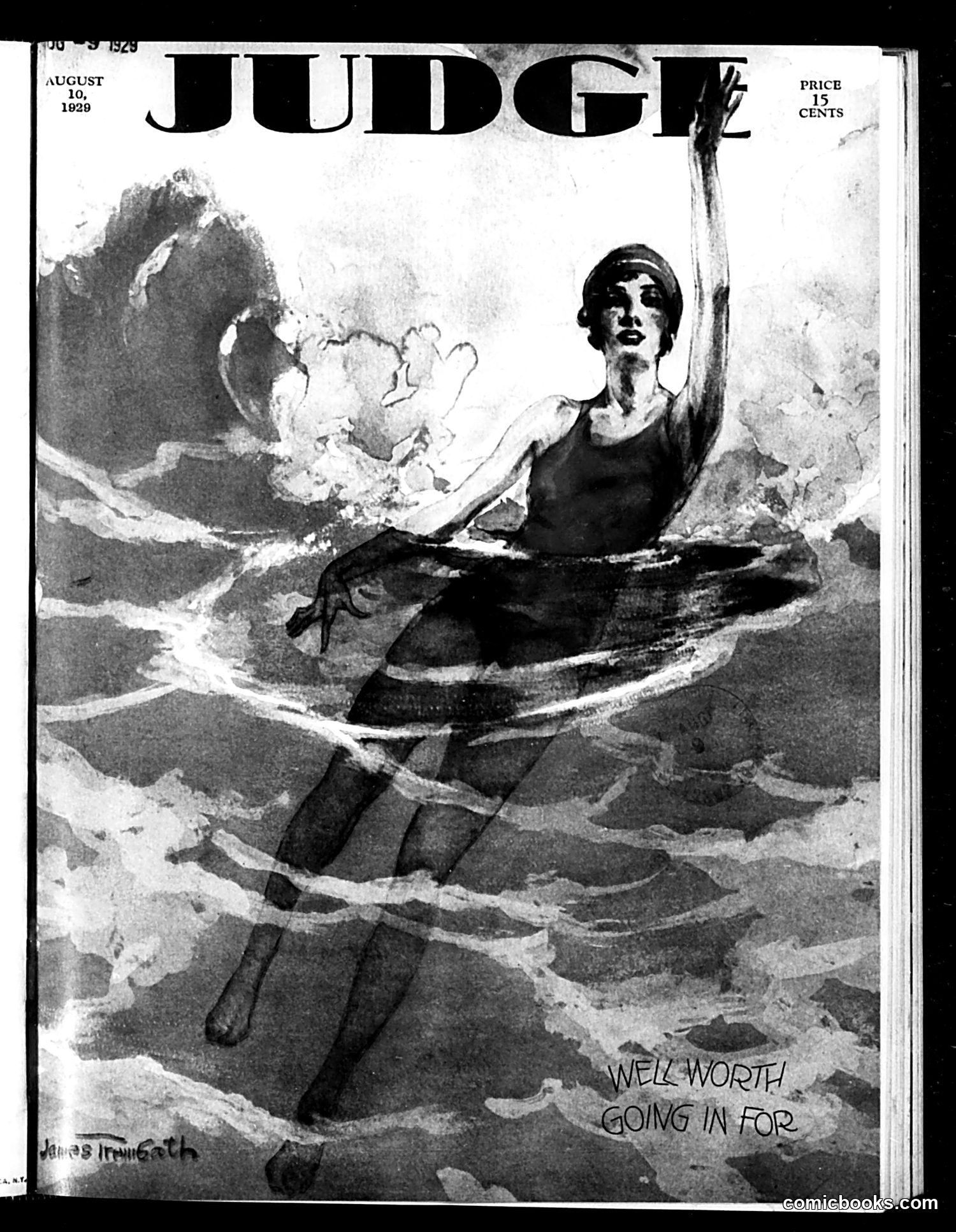
# Analysis of Judge Magazine Cover, August 10, 1929 This cover depicts a woman in a bathing suit diving or plunging into turbulent water, with the caption "Well Worth Going In For." The artwork is credited to James Montgomery Flagg, a prominent illustrator of the era. Given the August 1929 date—just weeks before the stock market crash—this appears to be satirical commentary on the economic optimism of the late 1920s. The woman's confident plunge into dramatic waves likely represents investors or the public eagerly entering the market despite warning signs. The "well worth going in for" caption suggests blind faith in financial returns, making this prescient commentary on the recklessness preceding the Great Depression.

# Analysis This page is **primarily a product advertisement**, not satire or political commentary. It promotes Dentyne chewing gum, specifically emphasizing teeth whitening. The image shows a smiling man wearing a hat and casual shirt. The advertisement uses the appeal of a bright, confident smile to sell the product. The tagline "Keeps Teeth White" and "Chew Dentyne and smile!" are straightforward marketing claims. The text emphasizes that white teeth signal personality and charm, and that Dentyne's unique flavor and quality make it the superior gum choice. This represents typical early-to-mid 20th century advertising strategy: linking consumer products to personal attractiveness and social success. There is no political satire present on this page—it is purely commercial messaging.
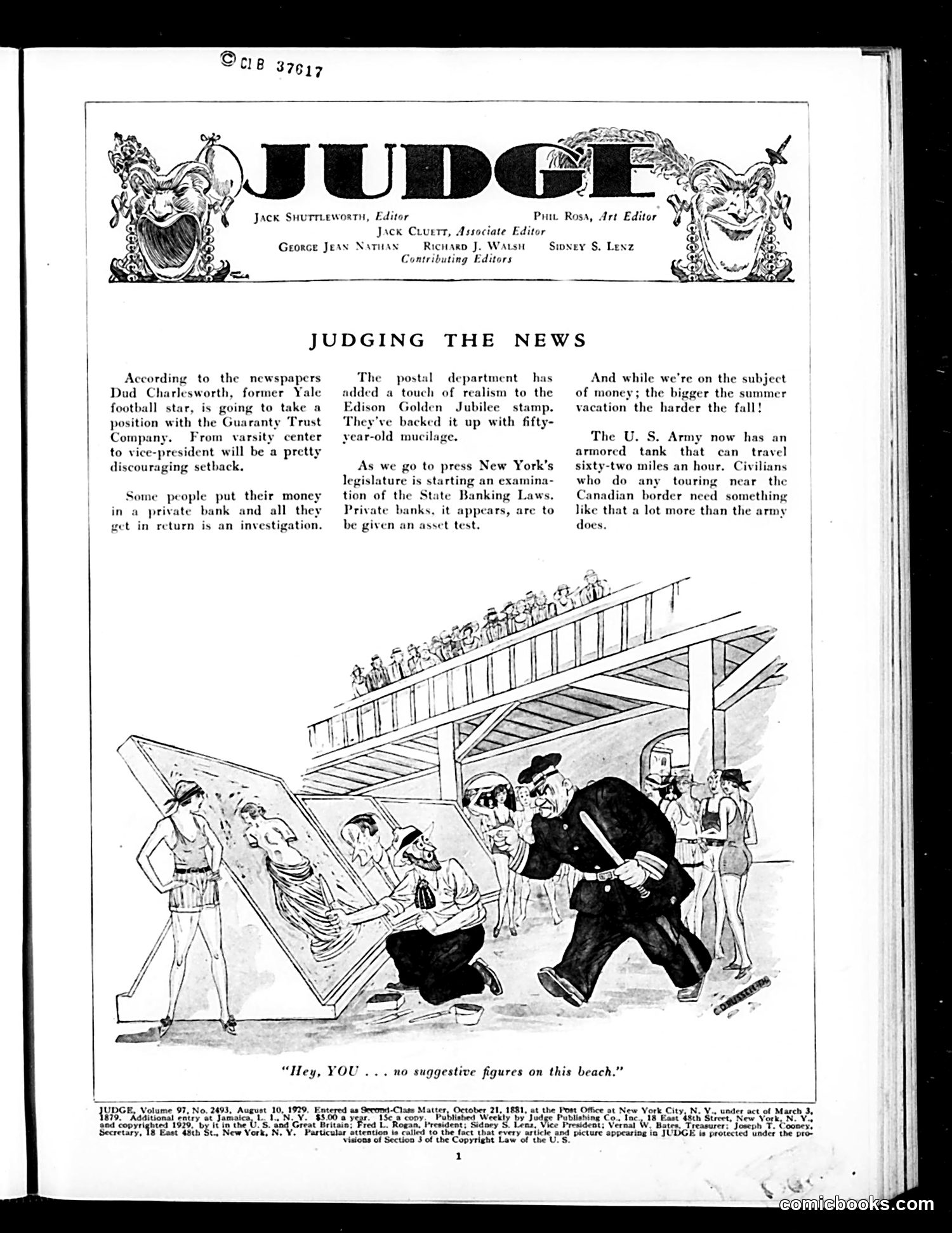
# Analysis of Judge Magazine Page (August 10, 1929) The main cartoon satirizes beach conduct. A uniformed official confronts two men displaying what appears to be suggestive artwork or figures to beachgoers (visible on the pier above). The caption—"Hey, YOU . . . no suggestive figures on this beach"—is ironic: the official himself is rendered in an exaggerated, almost caricatured manner that could be read as equally "suggestive." The "Judging the News" section contains brief satirical comments on current events, including references to banker Dud Charlesworth, banking regulations under examination in New York legislature, and U.S. military technology (an armored tank). The overall tone reflects 1920s anxieties about morality enforcement and financial regulation during the pre-Depression era.
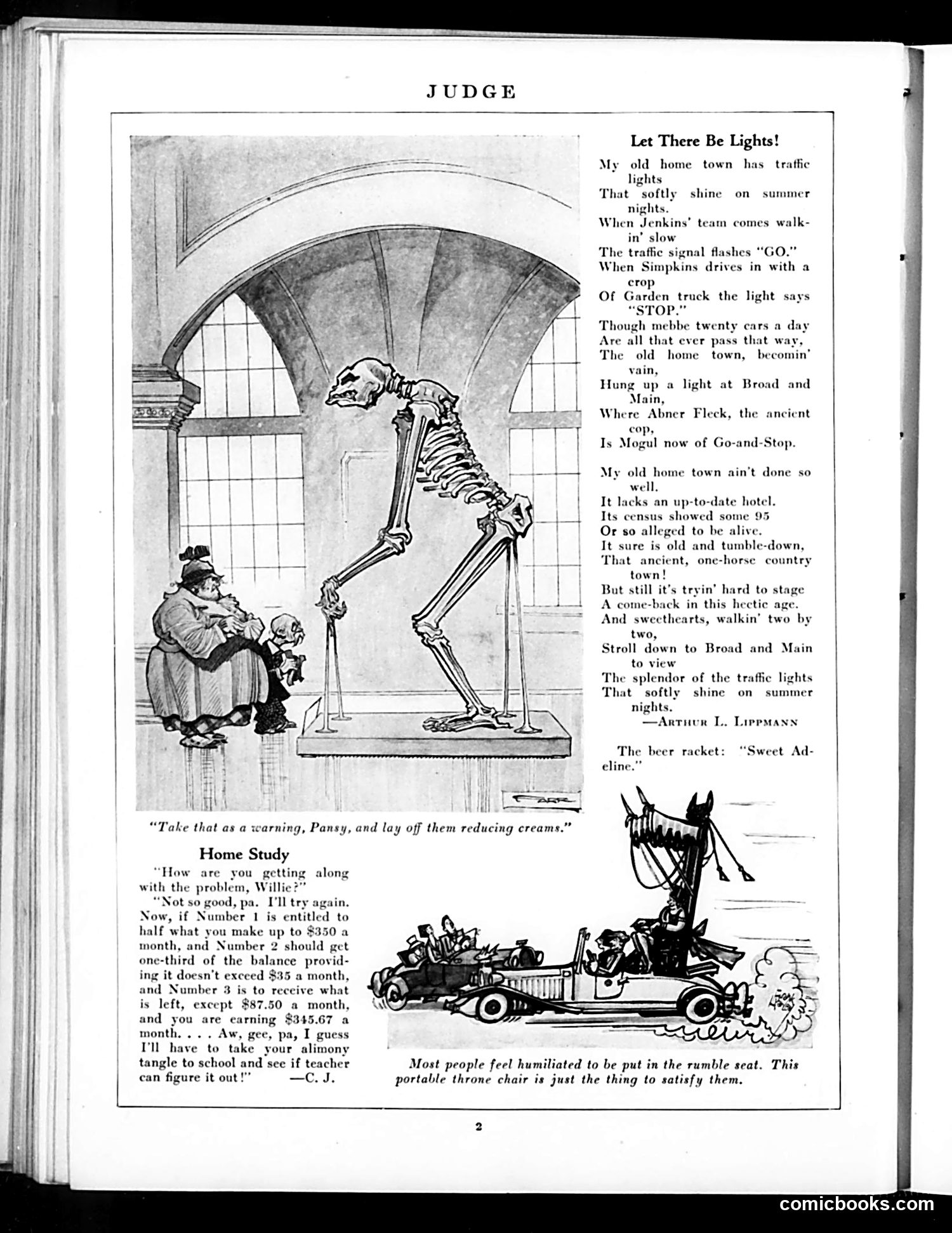
# Analysis of Judge Page This page contains two satirical pieces from an early 20th-century American magazine. **"Let There Be Lights!"** (top): A poem by Arthur L. Lippmann mocks a small town's attempts at modernization. It references a dying "one-horse country town" trying to attract visitors by installing traffic lights at Broad and Main streets—an anachronistic detail suggesting the town's decline despite cosmetic improvements. The skeleton illustration emphasizes the town is essentially dead, merely going through motions of progress. **"Home Study"** (bottom): A dialogue satirizes financial hardship, likely during economic depression. A father struggles with an alimony/support payment formula (referencing Numbers 1 from what appears to be a legal document), unable to make ends meet. The portable throne chair illustration jokes grimly that humiliation is a luxury for the desperate. Both pieces reflect anxieties about economic struggle and failed modernization in early 20th-century America.
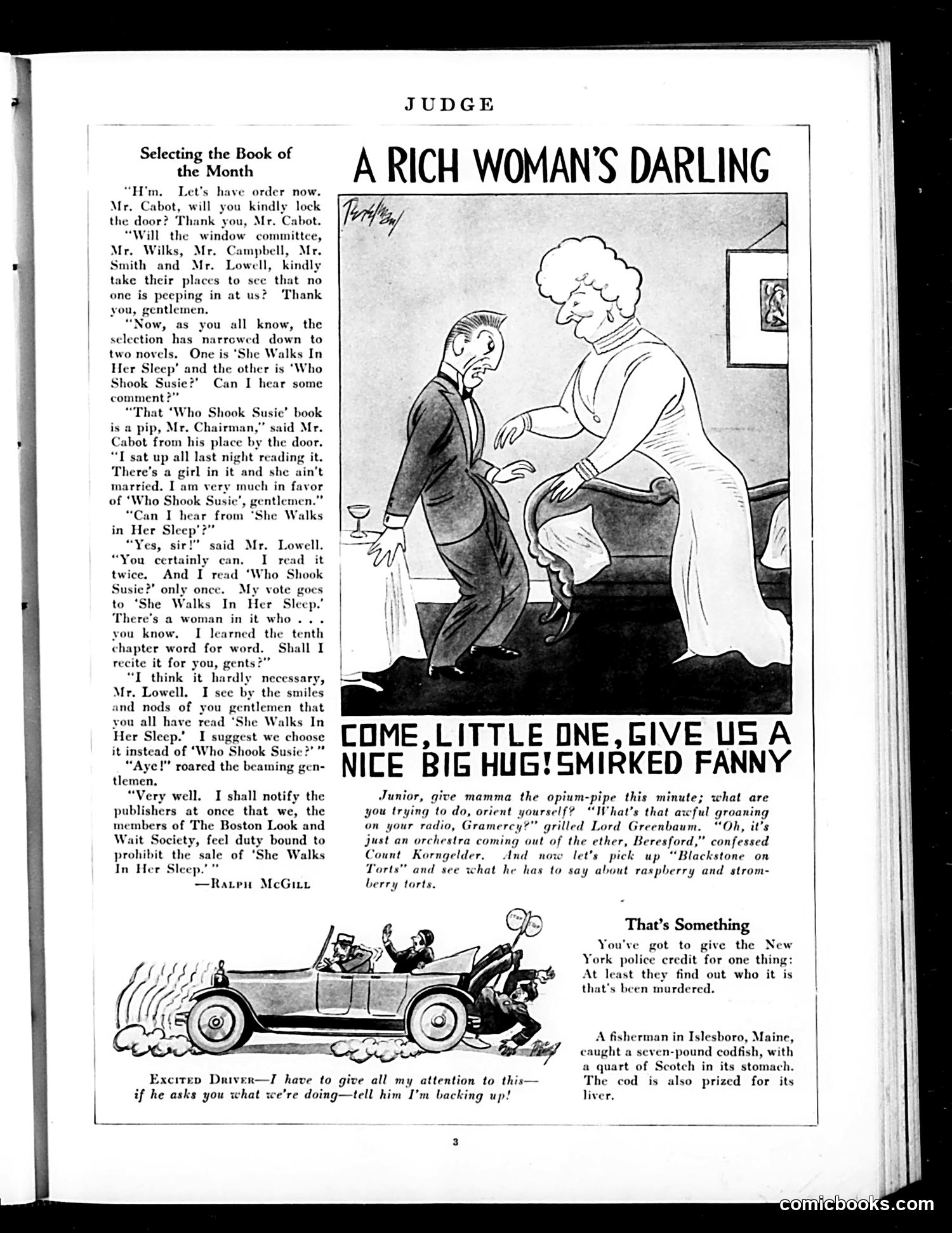
# "A Rich Woman's Darling" - Judge Magazine Cartoon Analysis This page satirizes wealthy women's indulgence of young men. The main cartoon shows an older, affluent woman embracing a smaller man in her lap, with the caption "Come, little one, give us a nice big hug! Smirked Fanny." The accompanying dialogue mocks the scenario: a woman supposedly gives her young companion an "opium-pipe," suggesting moral corruption and questionable relationships between rich widows/divorcées and their male companions. The satire targets the social phenomenon of wealthy women financially supporting younger men as romantic interests—a practice Judge's editors viewed as ridiculous and socially corrupting. The exaggerated size difference emphasizes the power imbalance and childlike dependency. The page also includes unrelated jokes about careless driving and a fish story, typical of Judge's mixed-content format.
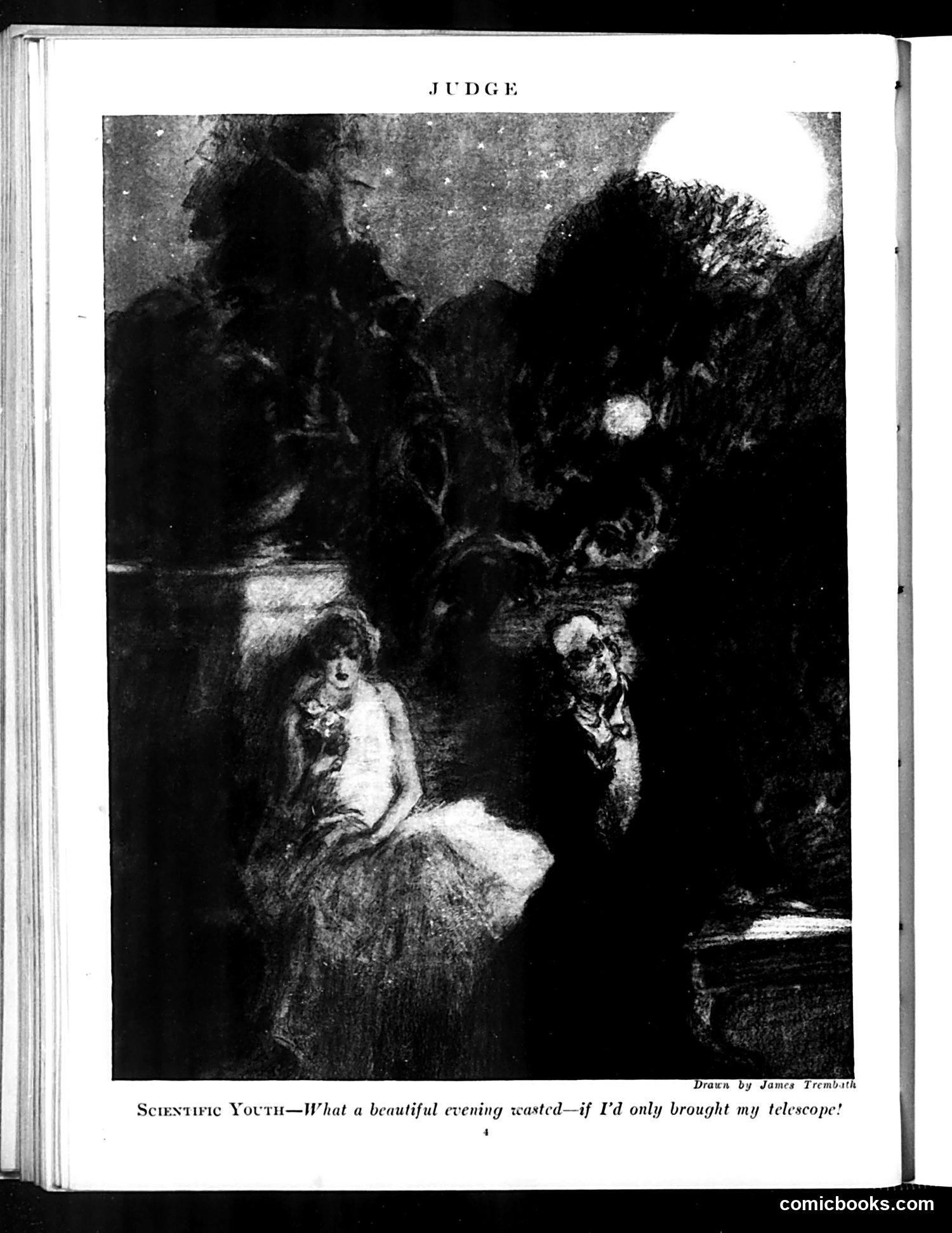
# Explanation for Modern Readers This Judge magazine cartoon depicts a young man with a telescope observing the night sky, surrounded by figures in darkness. The caption reads: "Scientific Youth—What a beautiful evening wasted—if I'd only brought my telescope!" The satire mocks a young man so obsessed with scientific pursuits (stargazing) that he fails to appreciate an evening's social opportunity—likely a romantic or social gathering suggested by the crowd around him. The joke plays on the tension between intellectual pursuits and social engagement, suggesting the "scientific youth" is so focused on his hobby that he misses life happening around him. The cartoon critiques single-minded devotion to hobbies at the expense of human connection and social participation.
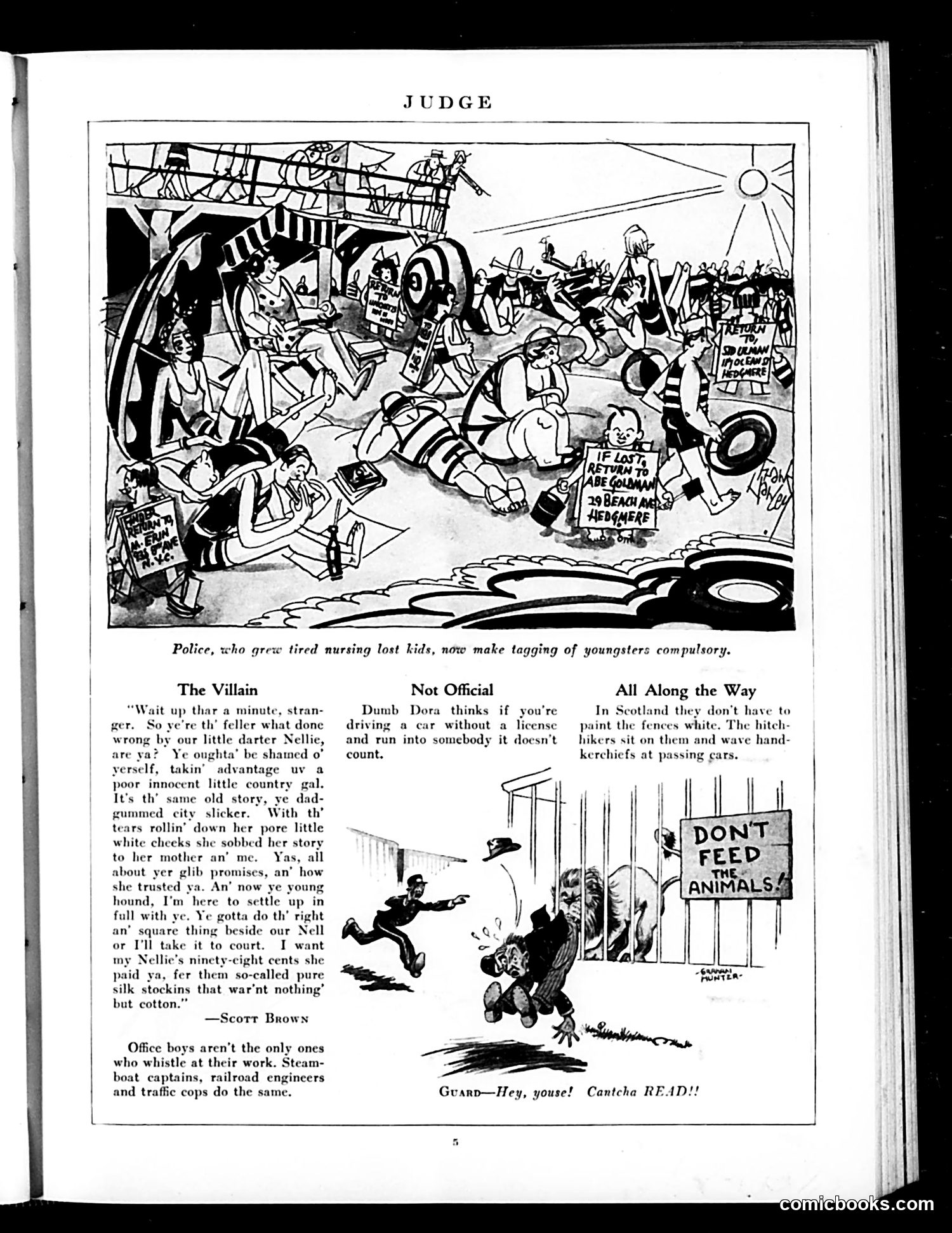
# Analysis of Judge Magazine Page This page presents social satire through multiple cartoons critiquing early 20th-century American behavior: **Top cartoon:** Shows chaotic urban activity with police and crowds, satirizing how police who "grew tired nursing lost kids, now make tagging of youngsters compulsory"—mocking aggressive policing of youth. **"The Villain":** Scott Brown's story about a country girl wronged by city slicker "Nellie," satirizing seduction narratives and moral hypocrisy of the era. **"Not Official":** Mocks unlicensed driving, with "Dumb Dora" representing a stereotypical scatterbrained woman driver ignoring regulations. **"All Along the Way":** Social observation about Scottish fence painting and "Don't Feed Animals" signs at parks, depicting ordinary life ironies. The page overall reflects Progressive-era concerns: law enforcement overreach, gender stereotypes, automobile culture's growing pains, and public behavior management.
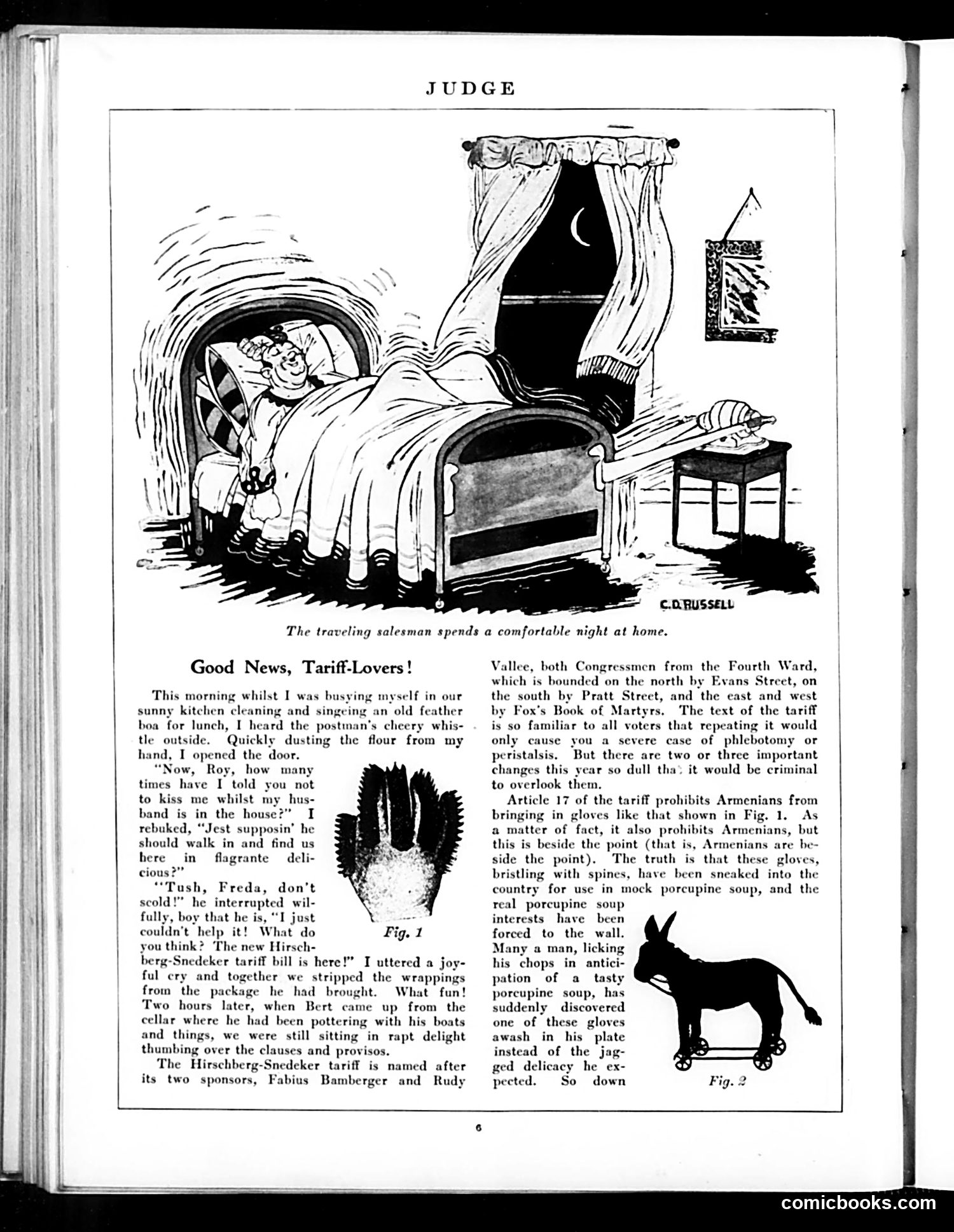
# Explanation for Modern Readers This political satire from *Judge* magazine ridicules the **Hirschberg-Snedeker tariff bill**. The top cartoon shows a traveling salesman enjoying home comforts—satirizing how tariff protections benefit certain businessmen. The main article, titled "Good News, Tariff-Lovers!" uses humor to mock tariff supporters. It describes discovering Armenian gloves (Fig. 1) smuggled into the country despite Article 17 of the tariff allegedly prohibiting them. The joke mocks the tariff's ineffectiveness—spined gloves meant for "mock porcupine soup" somehow evaded customs. The satire suggests the tariff bill, sponsored by Congressmen Vallee and named after sponsors Bamberger and Rudy, fails at its stated purpose while claiming to protect American interests. The piece exposes the gap between protectionist rhetoric and reality.
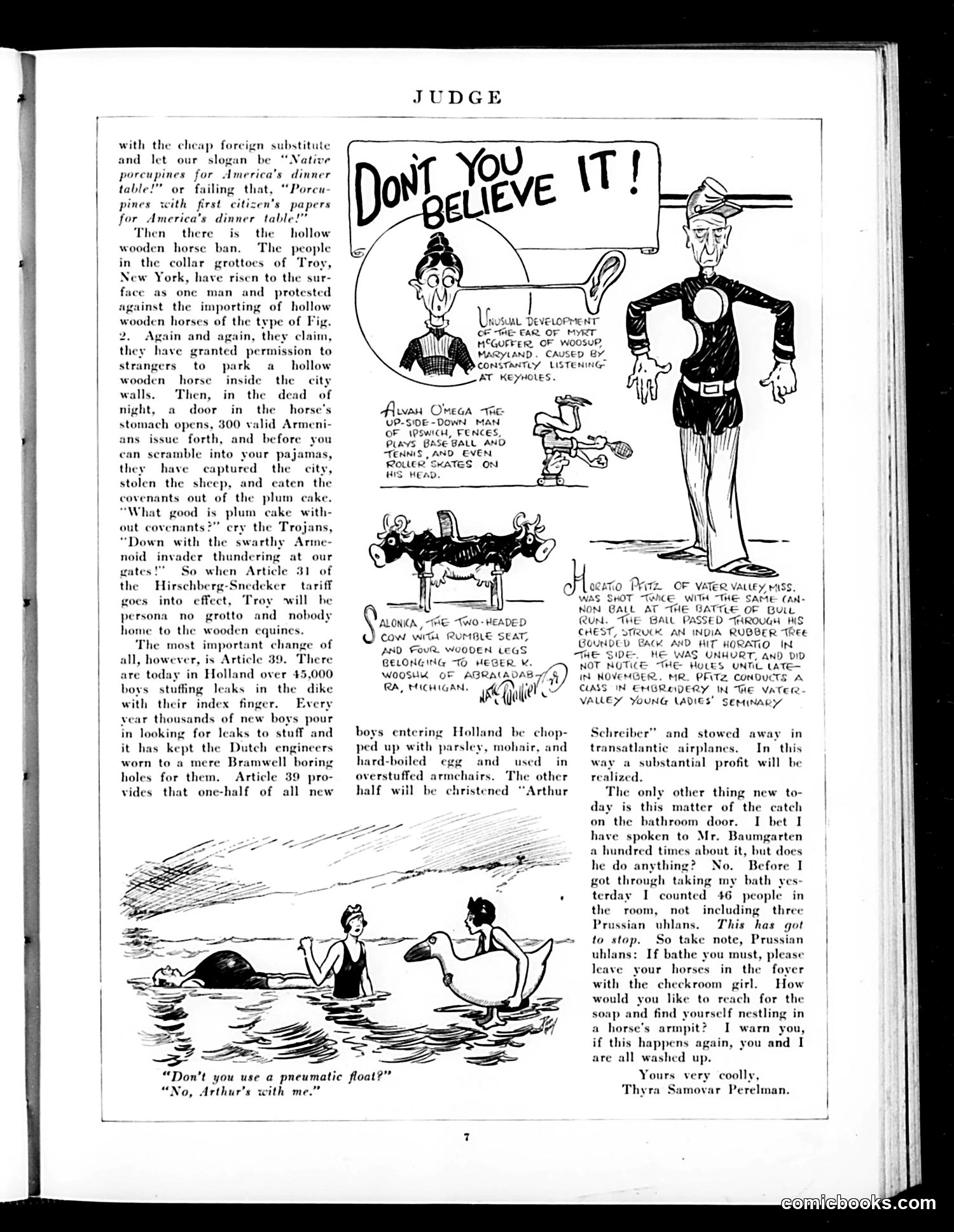
# Judge Magazine Satire Analysis This page satirizes American protectionist tariff policy (likely the Fordney-McCumber Tariff era of the 1920s). The main text mock-seriously proposes absurd trade restrictions: banning imported porcupines and hollow wooden horses, and flooding Holland with American boys to plug dike leaks—all framed as economic solutions protecting American workers. The "Don't You Believe It!" cartoon mocks credulous citizens accepting outlandish claims about tariff benefits. The accompanying sketches present bizarre "improvements" from the tariff: an upside-down man, a two-headed cow, and a horse that survived cannon fire—visual nonsense suggesting the policy produces only ridiculous results. The final letter from "Thyra Samovar Perelman" shifts tone, humorously complaining about bathroom overcrowding, with a dig at "Prussian uhlans" (cavalry soldiers), likely referencing post-WWI anxieties about foreign presence. The satire targets protectionist economic policies as economically irrational while playing on period xenophobia.
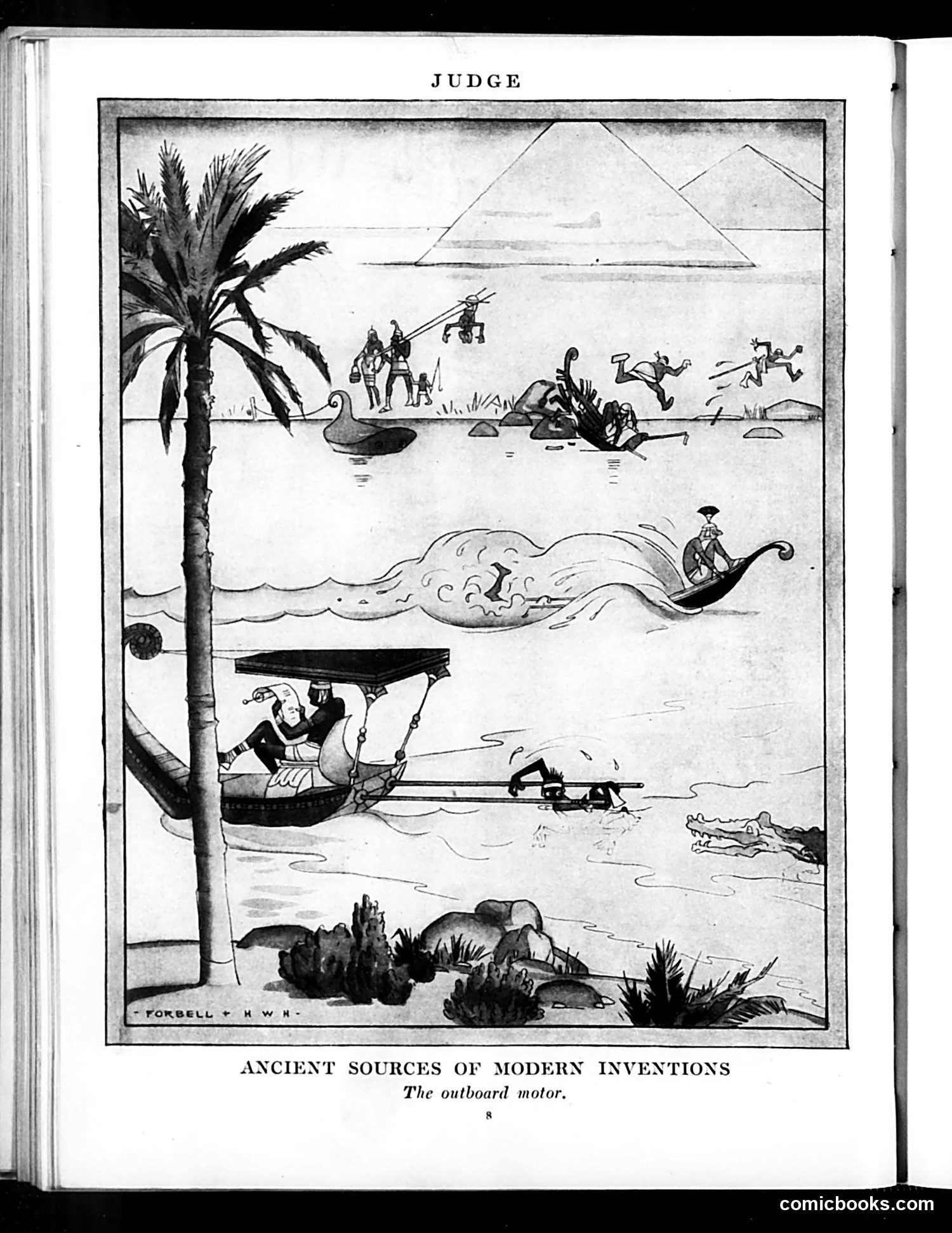
# Analysis This is a humorous illustration satirizing the "outboard motor" as supposedly derived from ancient sources. The cartoon depicts an Egyptian or ancient riverside scene with a palm tree, pyramids, and various figures in boats and on shore. The joke appears to be visual wordplay: ancient Egyptians are shown using human-powered propulsion methods—people rowing, swimming, and paddling boats—which the caption mockingly suggests are the "ancient sources" of the modern outboard motor invention. The satire works by treating primitive human locomotion as the historical precedent for motorized boat propulsion, a tongue-in-cheek commentary on either the obviousness of mechanical innovation or possibly poking fun at pseudo-scientific claims about ancient technological sophistication that were popular in the era.
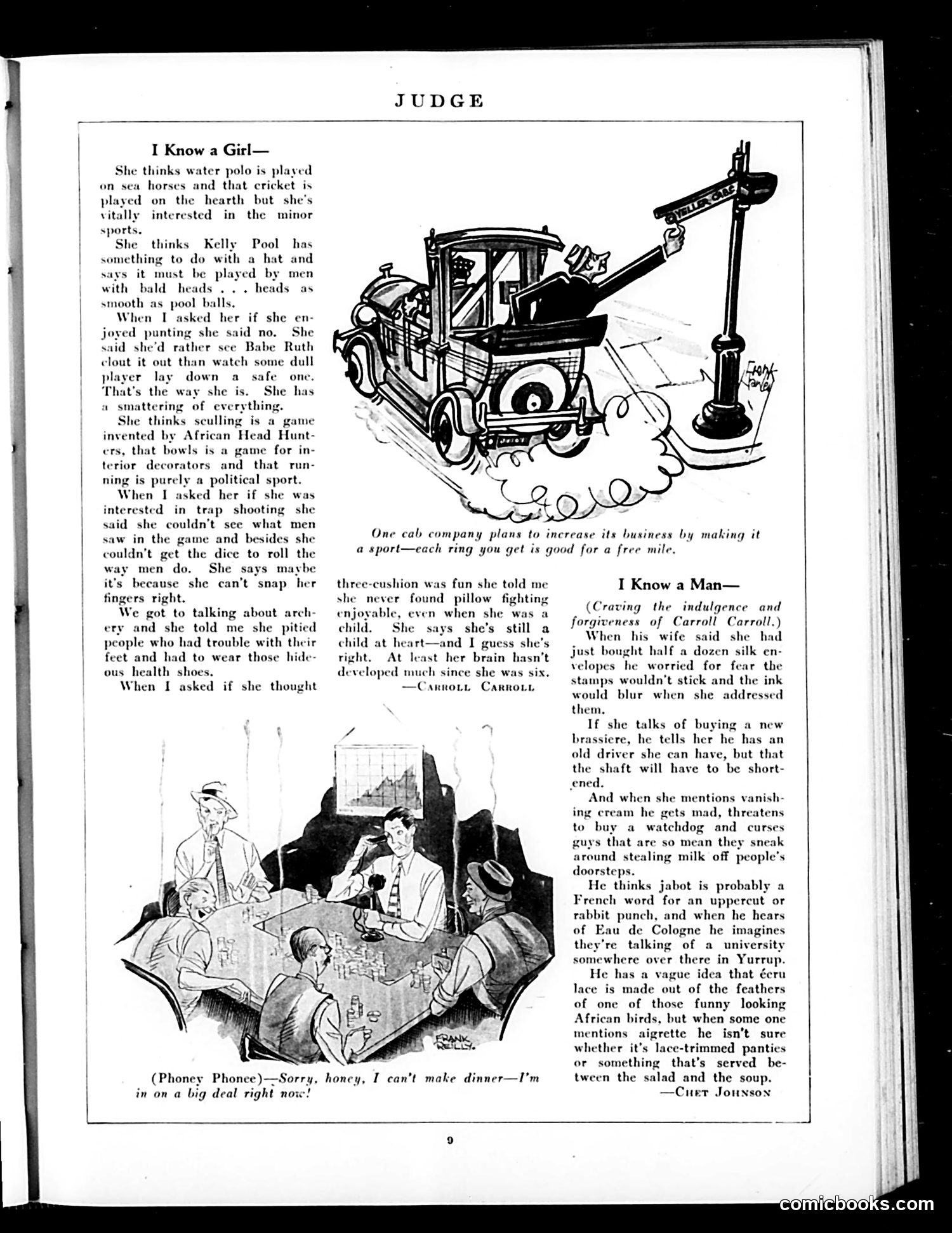
# Judge Magazine Page Analysis This page contains two humorous character sketches satirizing gender stereotypes through deliberate misunderstandings: **"I Know a Girl"** mocks women's supposed athletic ignorance. The unnamed woman confuses sports terminology—thinking "water polo" involves sea horses, "bowling" is interior decoration, and "sculling" is an African hunting game. She conflates unrelated activities (pillow fighting with billiards). The satire targets the dismissal of women from serious sports engagement. **"I Know a Man"** reverses this, depicting a husband who mangles traditionally feminine terms. He misinterprets "silk envelopes," "brassiere," "vanishing cream," and French fashion words ("jabot," "Eau de Cologne," "écru," "aigrette") as masculine or nonsensical concepts. He imagines "Yurrup" (Europe) vaguely and suspects milk theft. Both sketches use willful incomprehension as comedy, but the man's confusion seems more absurd—he actively resists understanding female interests. The cartoons likely satirize rigid gender roles and mutual incomprehension between spouses in 1920s-era relationships.
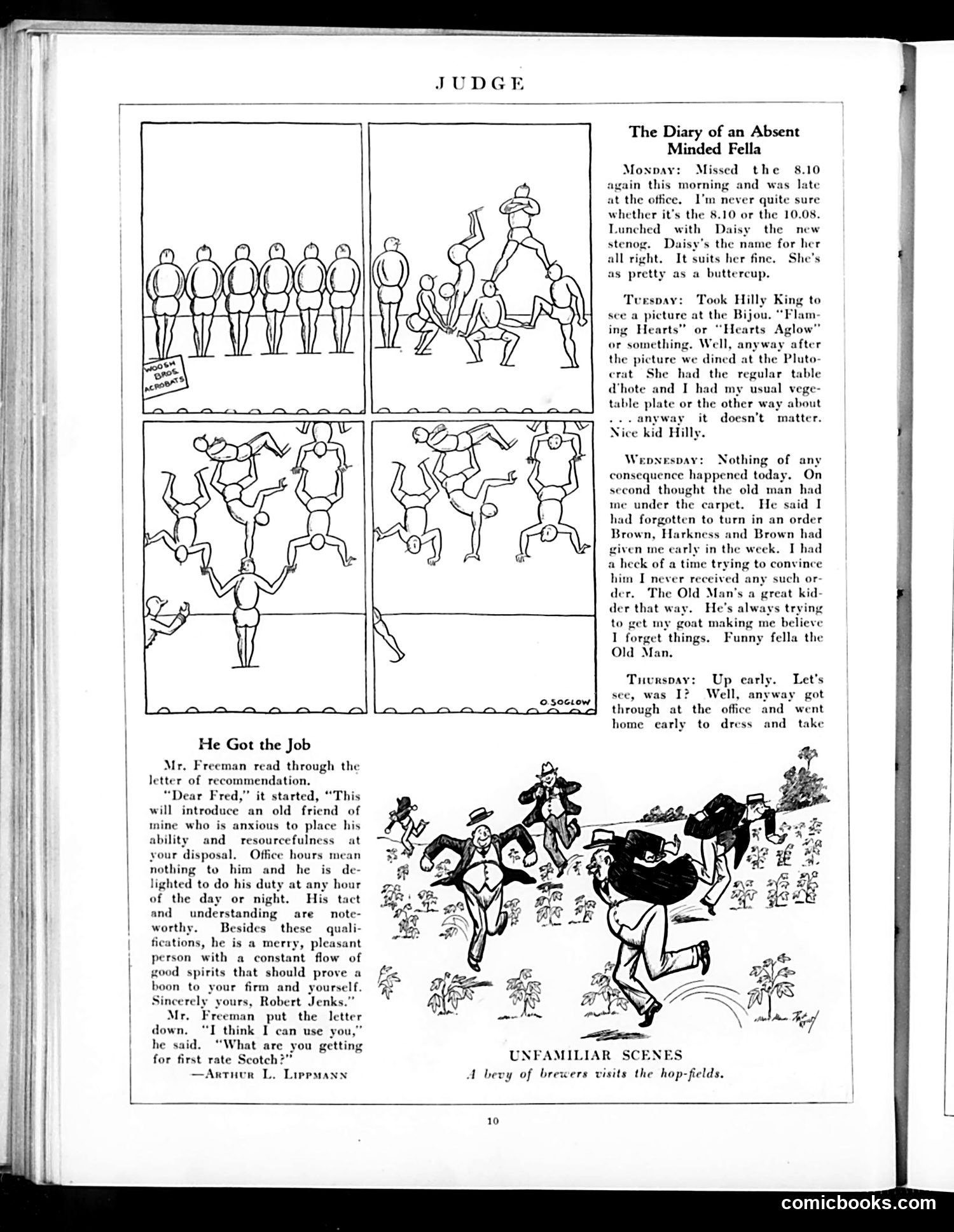
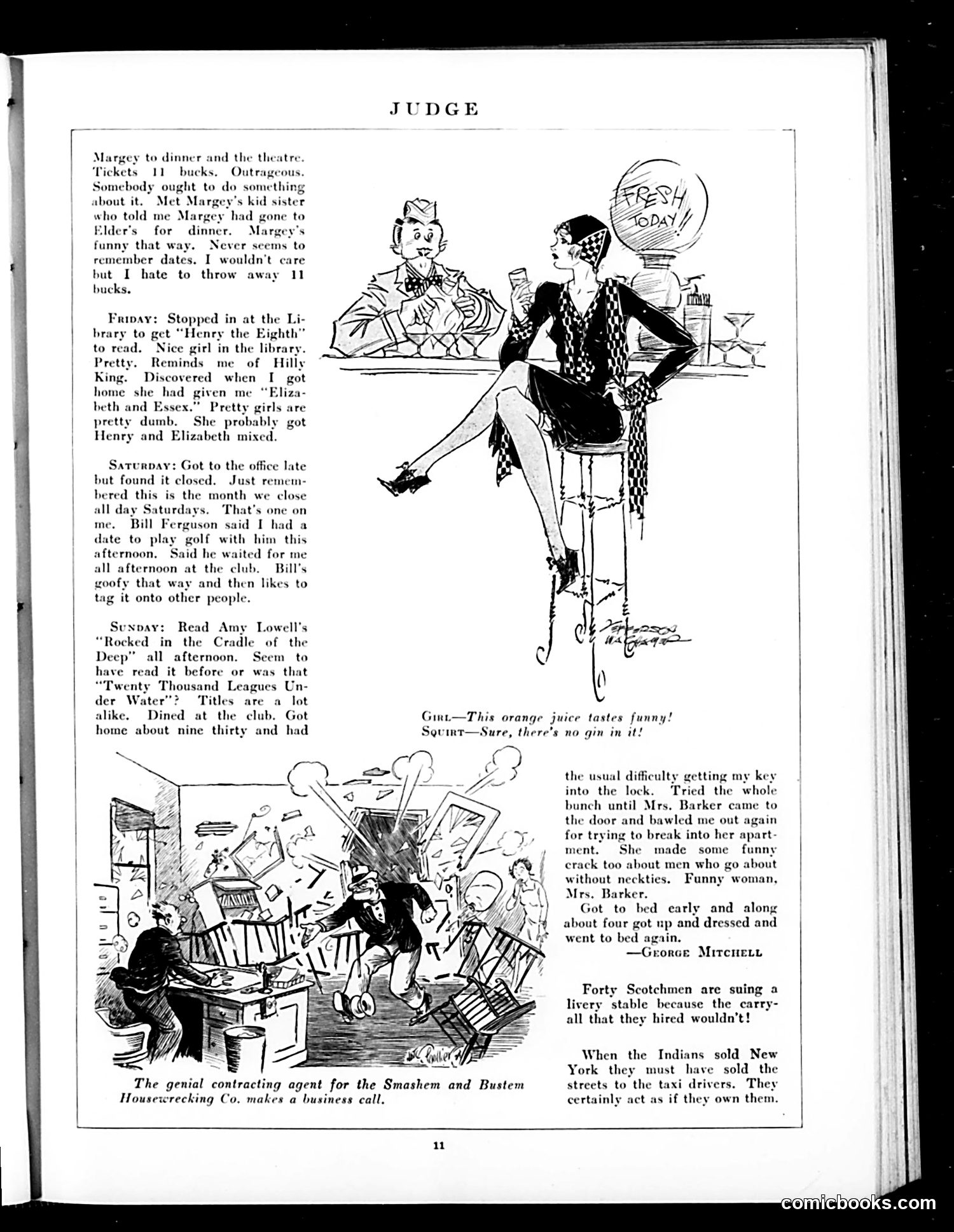
# Analysis of Judge Magazine Page This page contains three distinct pieces of humor typical of early 20th-century Judge magazine: **"The Diary of an Absent Minded Fella"** satirizes workplace incompetence—a man constantly late, forgetful about orders, easily distracted by a new stenographer named Daisy. The humor relies on relatable office frustrations. **"He Got the Job"** mocks dishonest job recommendations. A letter of introduction grotesquely exaggerates an applicant's virtues (never minded about office hours, always cheerful), when the real qualification appears to be ability to obtain "first rate Scotch"—suggesting either bribery or that the employer prioritizes drinking over actual work competence. The satire targets both workplace ethics and Prohibition-era hypocrisy. **"Unfamiliar Scenes"** shows brewers visiting hop-fields, likely a Prohibition-era joke about the illegal beer industry continuing despite the law. The four-panel cartoon at top-left illustrates the absent-minded protagonist's disorganized nature through stick-figure visual gags.