
A complete issue · 36 pages · 1929
Judge — March 30, 1929
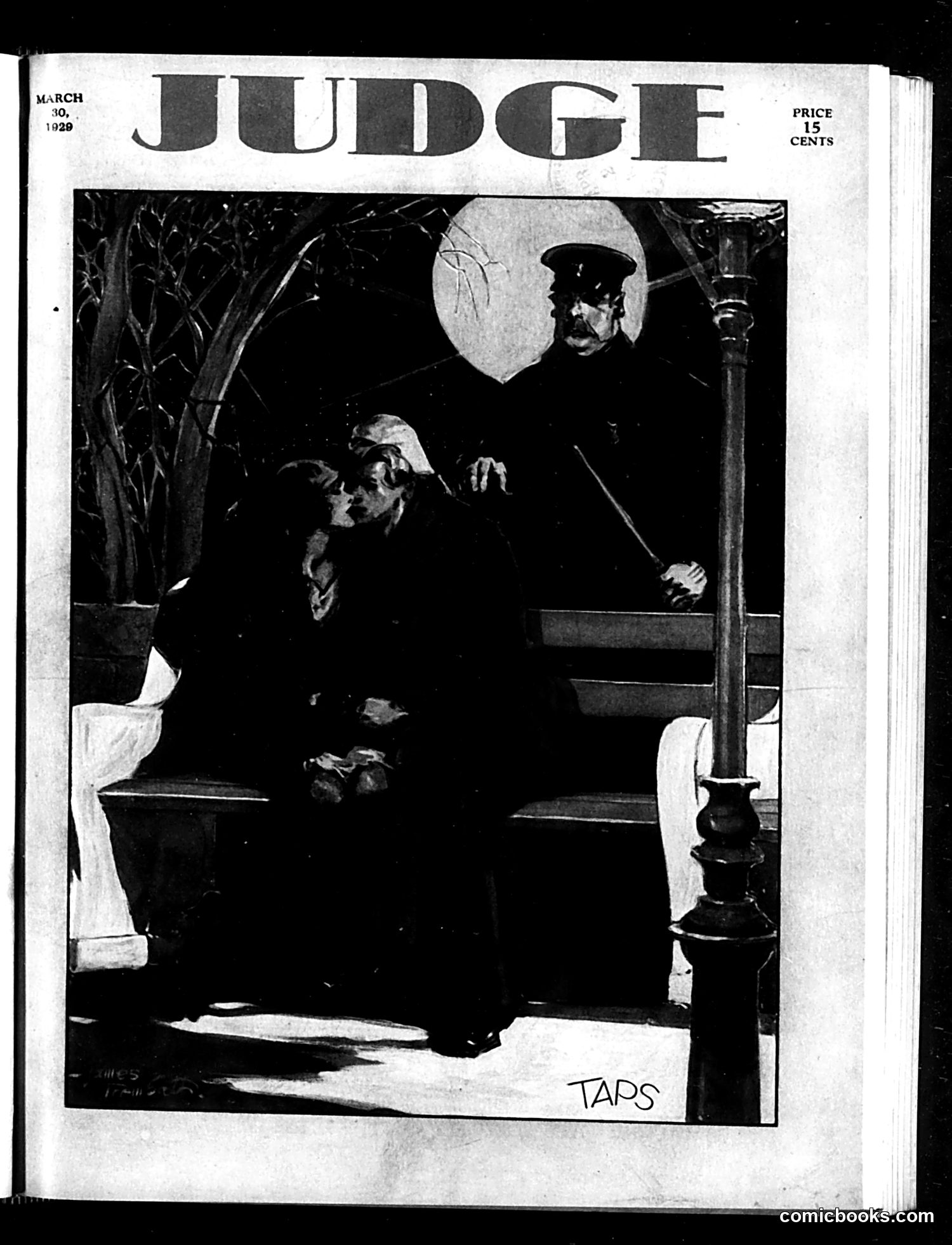
This cover illustration by Taps depicts a nighttime street scene with a police officer confronting what appears to be a woman of questionable character near a lamppost and storefront. The composition and shadowy style suggest this satirizes **Prohibition-era law enforcement** and the sexual/moral dimension of 1920s urban crime. The scene likely comments on police enforcement against prostitution or related vices during Prohibition (1920-1933), when speakeasies and associated criminal activity flourished. The officer's stern authority versus the woman's apparent defiance or resignation creates tension around law enforcement effectiveness and public morality debates of the period. The specific context—whether referencing a particular scandal or general social commentary—remains unclear without additional text.
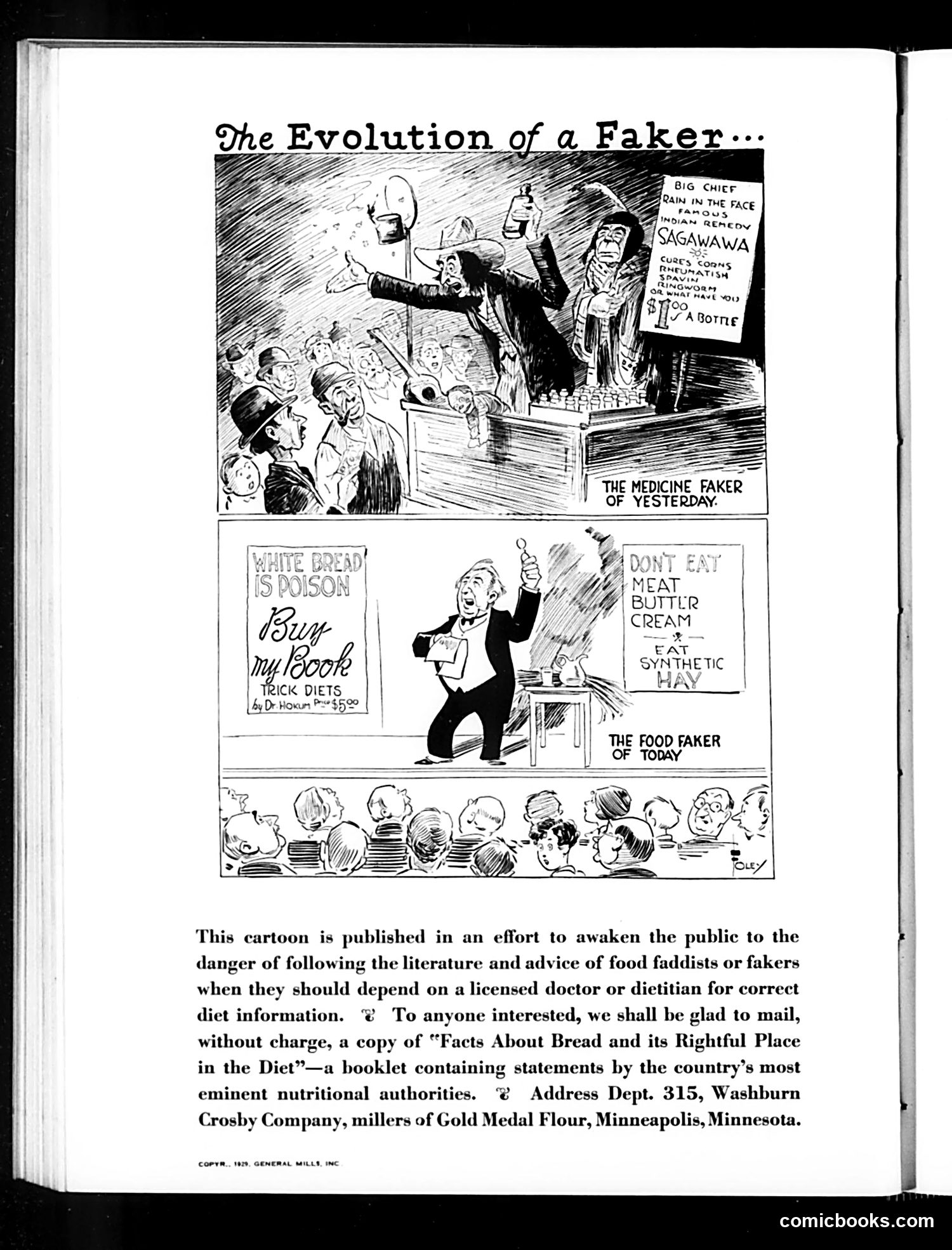
This is an advertisement/editorial cartoon by General Mills (Gold Medal Flour) attacking food faddists and alternative health claims. The three panels show: 1. **Top**: A medicine faker of the past hawking dubious remedies (with Native American imagery and bottles) to gullible crowds 2. **Middle**: A modern food faker promoting pseudoscientific diet books and false dietary claims 3. **Bottom**: Contemporary audience susceptible to misinformation The cartoon argues that while medicine fraud evolved, food quackery persists in modern guise—people still follow unproven dietary advice instead of consulting licensed doctors or dietitians. The advertisement then directs readers to request factual nutritional information from General Mills, positioning the company as a trustworthy authority against charlatans.
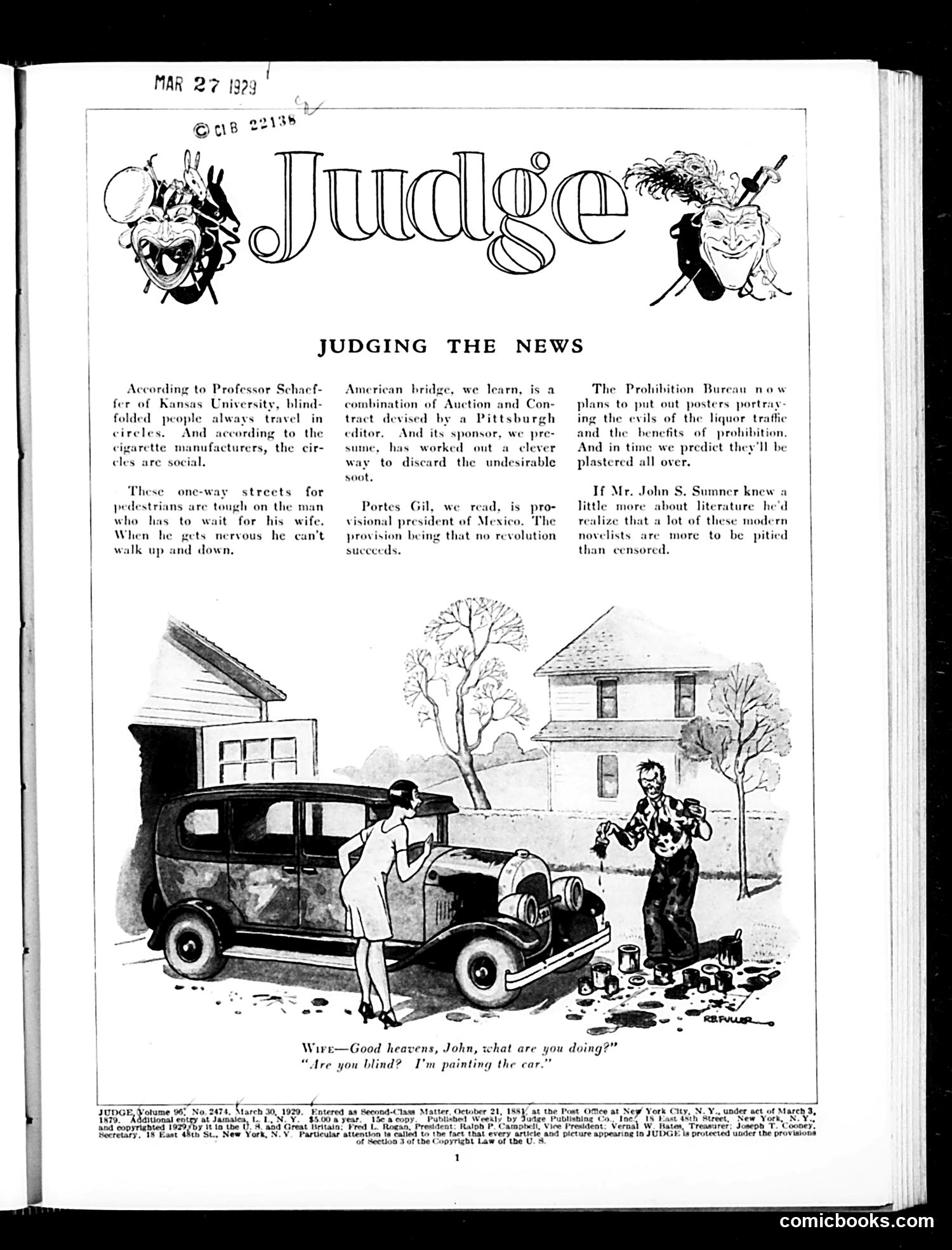
This page contains editorial commentary ("Judging the News") and one main cartoon. The cartoon depicts a domestic scene: a wife catches her husband painting their car rather than working. Her exasperated question—"Good heavens, John, what are you doing?" and his reply "Are you blind? I'm painting the car"—satirizes the absurdity of Depression-era priorities and misplaced focus on appearances over financial responsibility. The accompanying editorial snippets mock contemporary figures like Portes Gil (Mexico's president) and critique 1920s social issues: one-way streets for pedestrians, and literature censorship. The overall tone suggests Judge was critiquing frivolous spending habits and social absurdities during the pre-crash economic period of 1929.
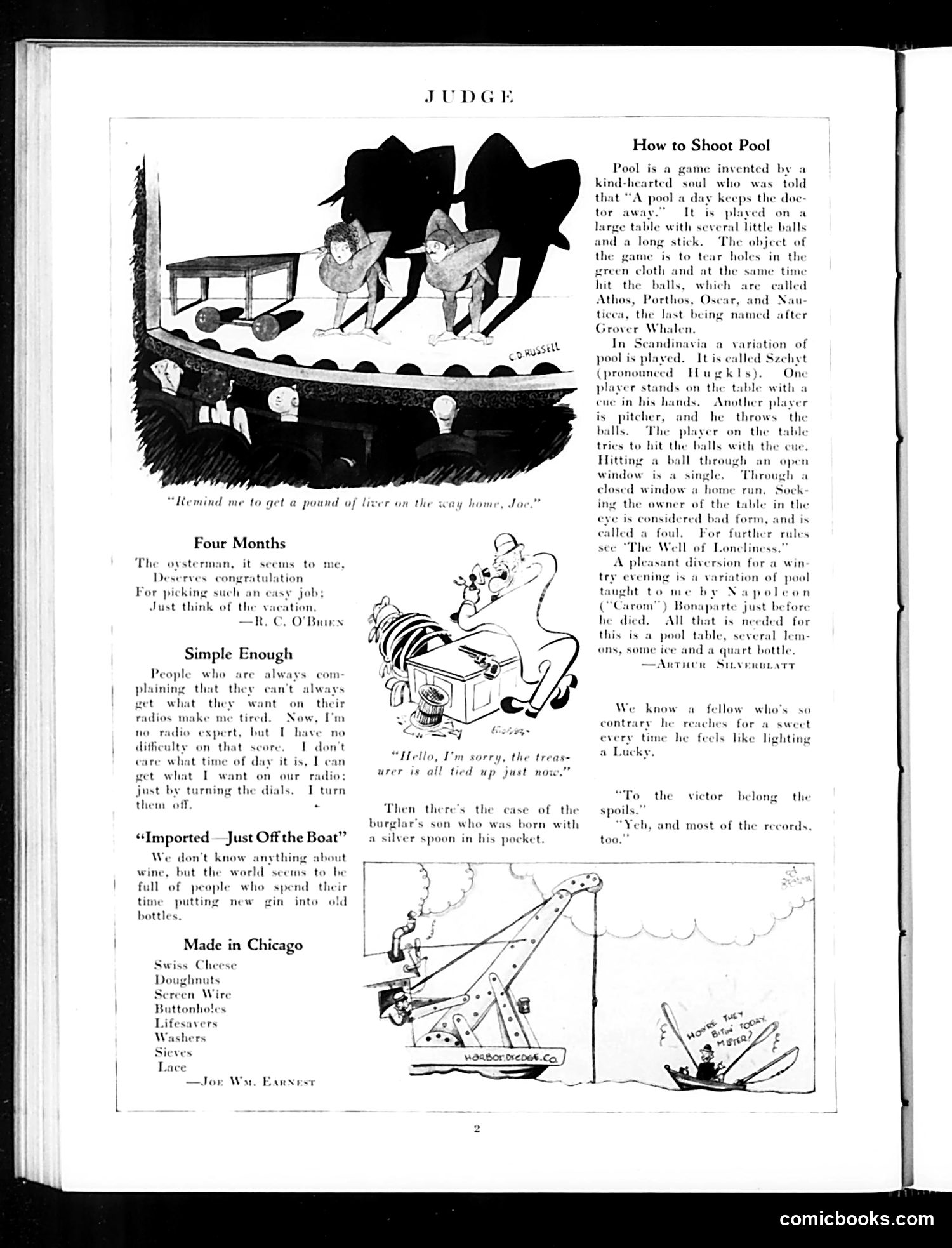
This page contains mixed content: humorous articles, poetry, and cartoons typical of Judge magazine's satirical format. The main cartoon at top shows two figures in silhouette playing pool, captioned "Remind me to get a pound of liver on the way home, Joe." The humor relies on the absurdity of casually requesting organ meat during a game—a non-sequitur joke. Below are several short humorous pieces: "Four Months" (a quip about oysters), "Simple Enough" (about radio dials), and "Imported—Just Off the Boat" (about gin in old bottles). The bottom cartoons appear to show slapstick mishaps with construction equipment or machinery. The page also lists Chicago-manufactured items, suggesting local advertising. Overall, this represents Judge's typical mix of gentle domestic humor, puns, and visual gags rather than pointed political satire.
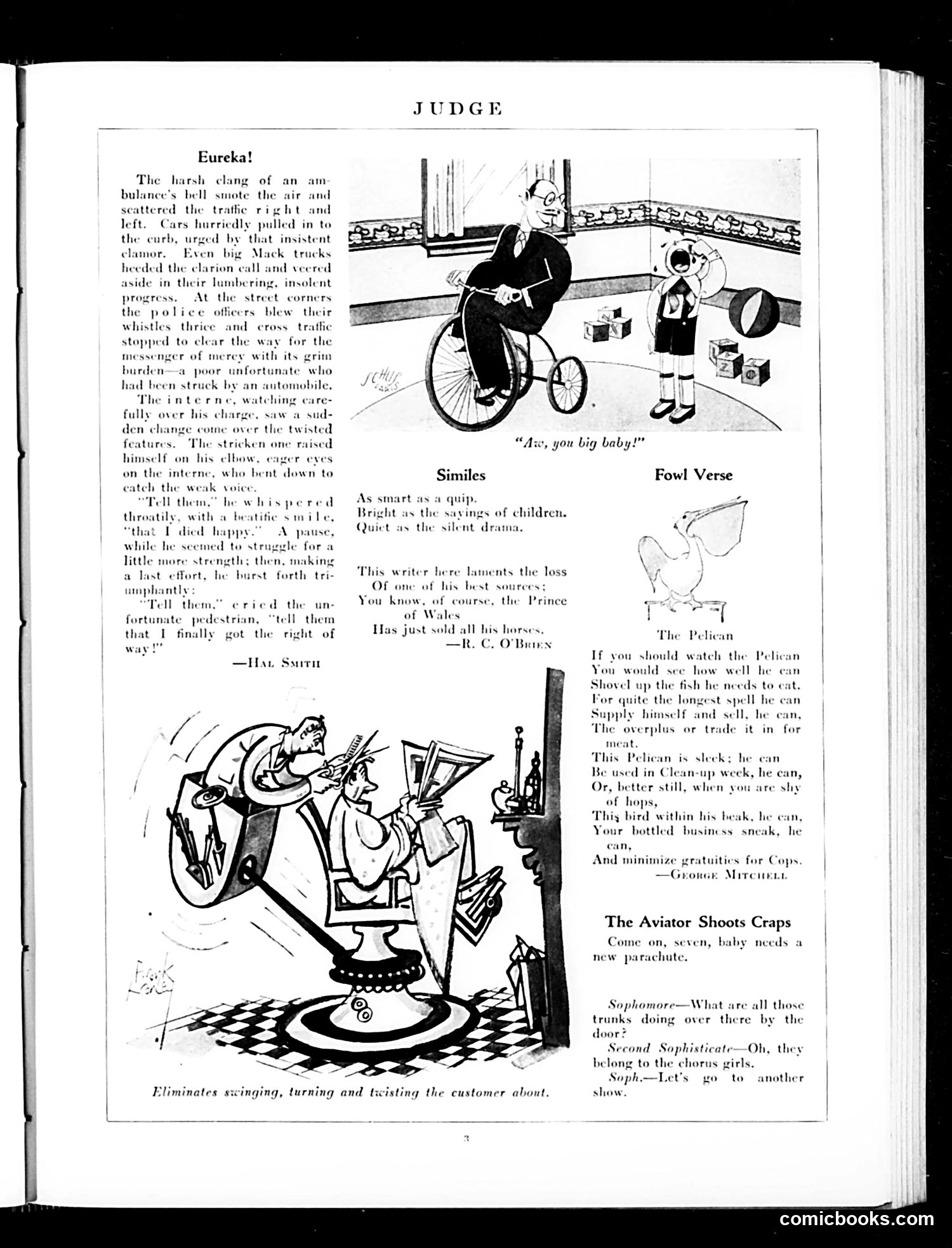
This satirical piece by Hal Smith depicts an ambulance accident causing urban chaos—overturned cars, scattered cargo, and police struggling to manage traffic. The cartoon mocks the irony of an ambulance (meant to help) causing the very emergency it's designed to respond to. The interne (intern) inside experiences a sudden realization ("Eureka!"), discovering he's been struck by his own vehicle. Smith's satire targets the inefficiency and unintended consequences of urban emergency services, particularly the danger posed by rapid ambulance movement through crowded streets. The accompanying verses ("Simples," "Fowl Verse," "The Aviator Shoots Craps") are unrelated humorous poems typical of Judge's miscellaneous content format.
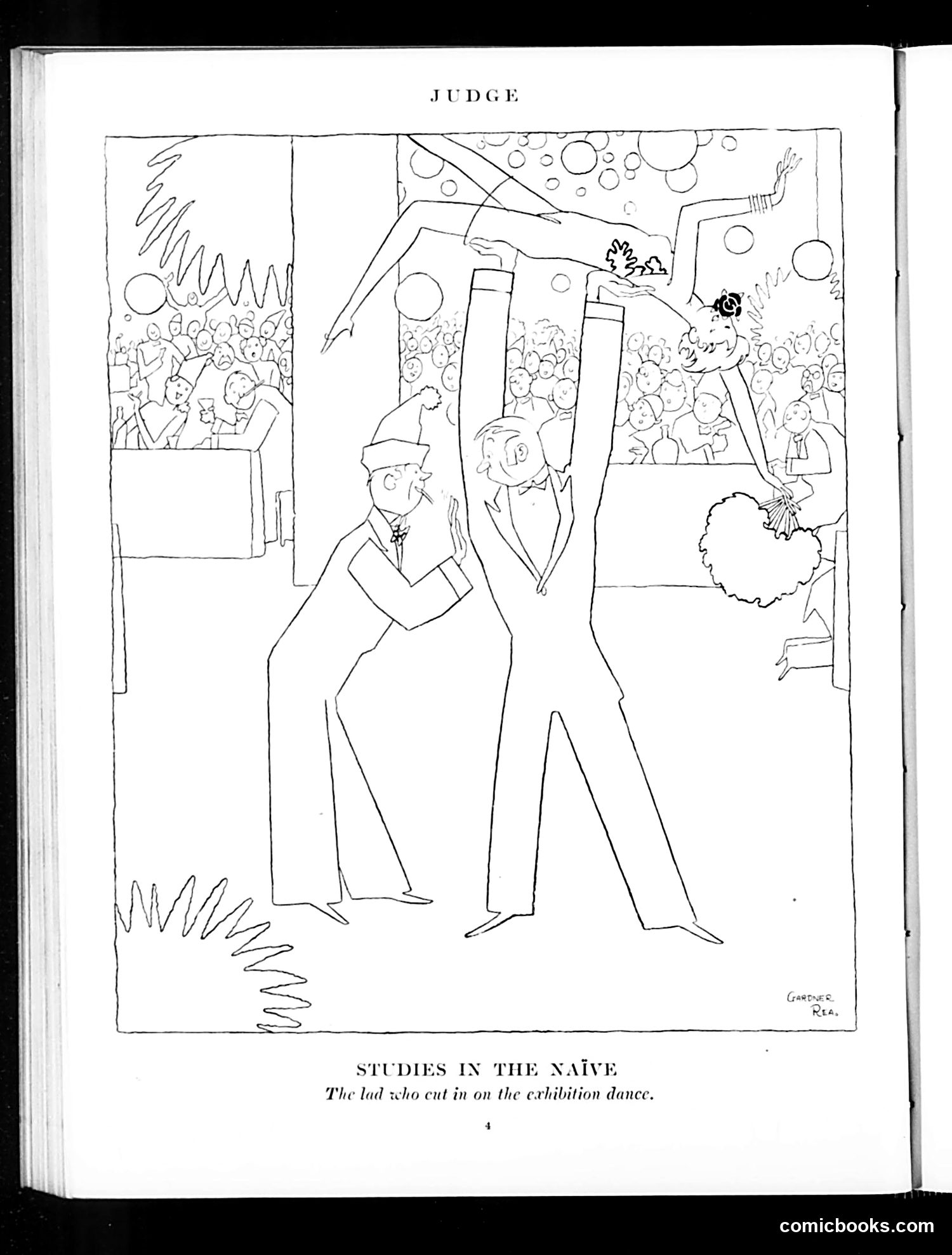
This satirical cartoon depicts a social scene at what appears to be a formal dance or exhibition event. The central figure—a young man in formal attire with a distinctive hat—has literally "cut in" by physically interrupting the dance, comically positioning himself between two other dancers with exaggerated bodily contortions. The joke plays on the social etiquette of "cutting in" (politely interrupting a dance partner). This figure takes the phrase literally rather than following proper ballroom protocol. The crowd watching from bleachers suggests this is a public, competitive event. The satire likely mocks social pretension, awkward social climbers, or those who misunderstand proper behavior at formal occasions—a common "Judge" magazine theme targeting the newly wealthy or socially uncertain middle class of the era.
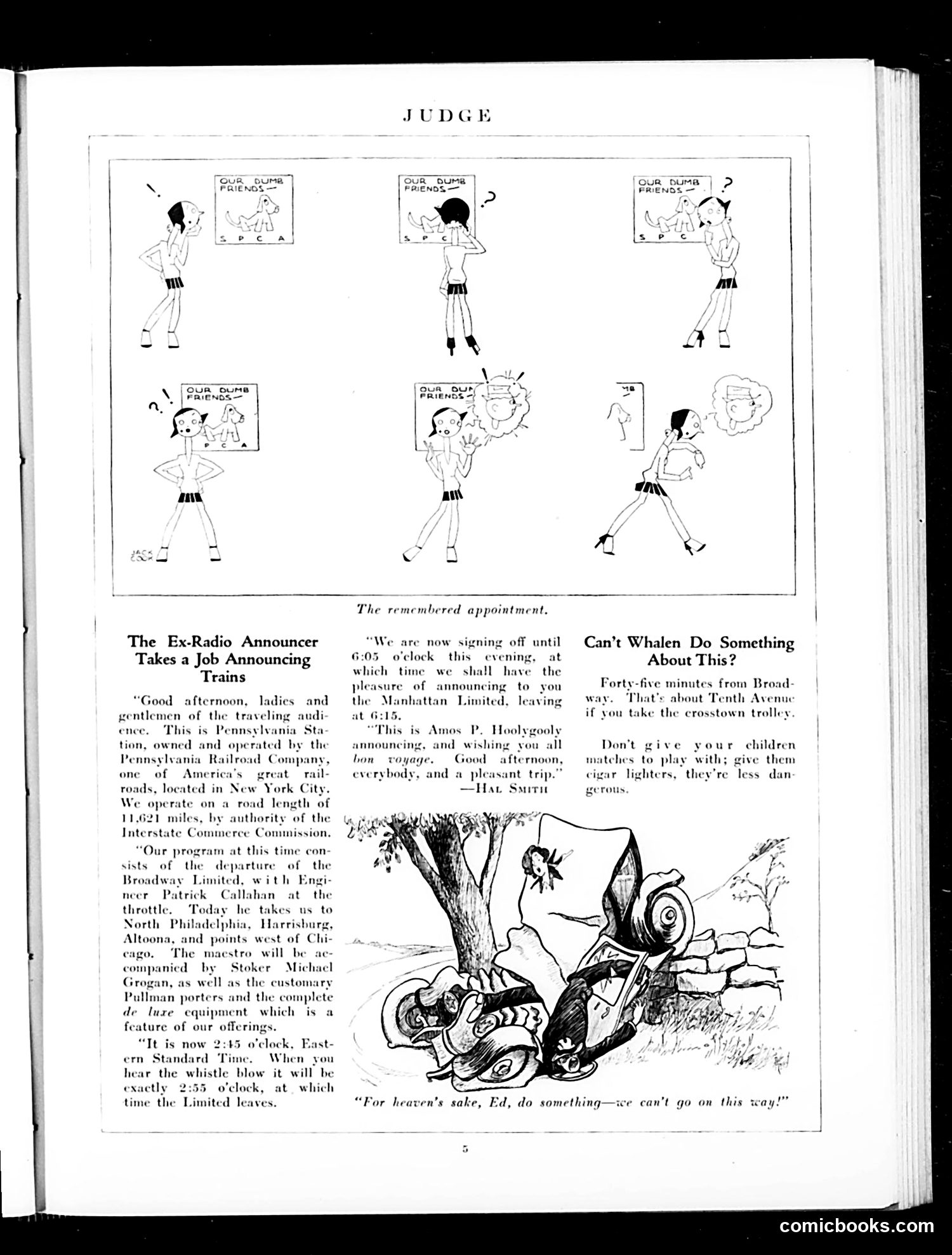
The top comic strip titled "The remembered appointment" depicts a woman repeatedly checking a card labeled "OUR DUMB FRIENDS" and becoming increasingly frantic—suggesting she's forgotten a social engagement with friends and is scrambling to remember or reschedule. The lower section contains three separate pieces: an article about a Pennsylvania Railroad announcer, a brief item about Manhattan Limited train schedules, and a safety advisory warning parents against giving children matches. The cartoon illustration shows someone crashed under a tree with a bicycle, captioned "For heaven's sake, Ed, do something—we can't go on this way!" This appears to be darkly humorous commentary on automobile/bicycle safety hazards of the era. The page mixes domestic humor with public safety messaging typical of early 20th-century Judge content.
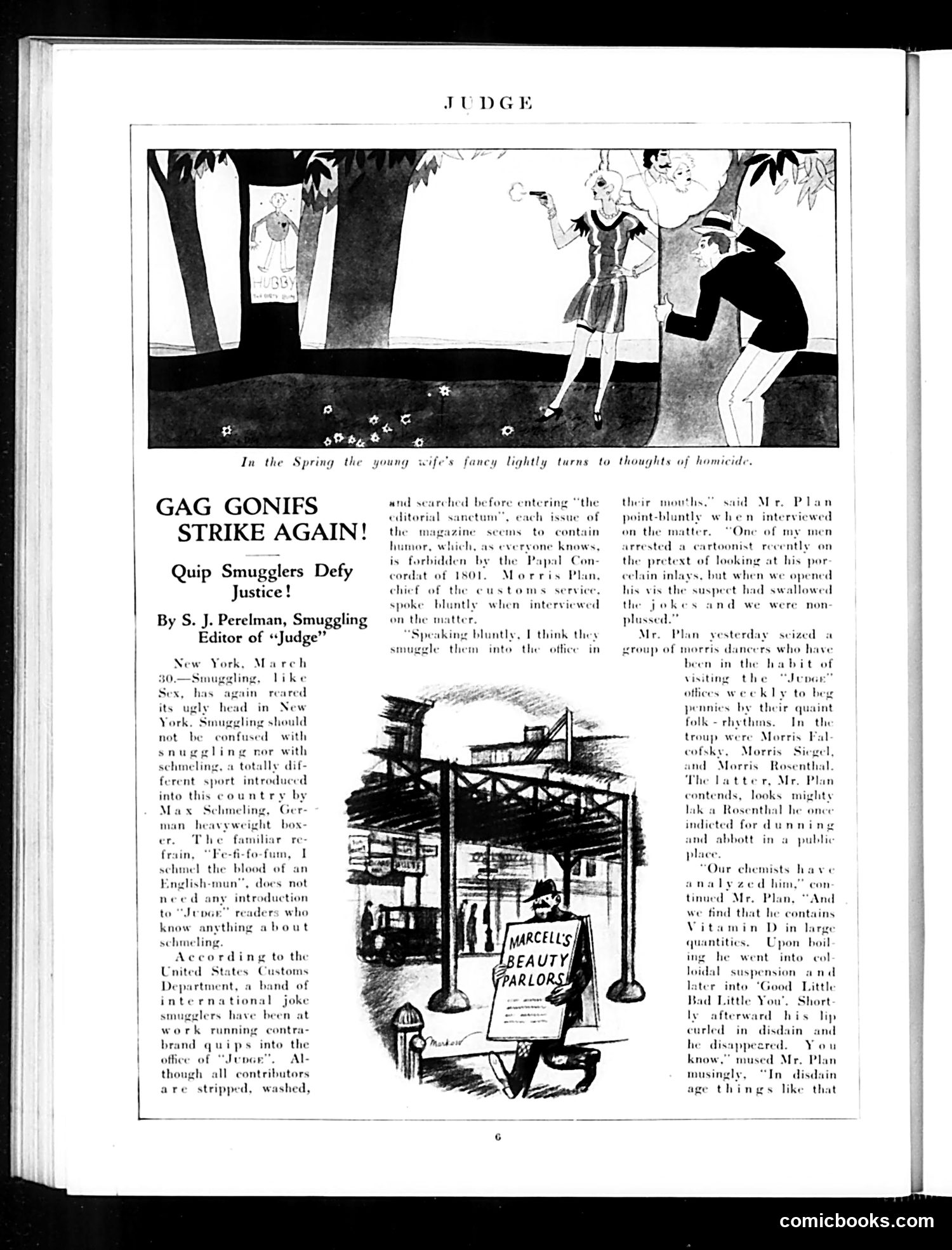
**Top Cartoon:** Depicts a spring scene where a young wife's thoughts turn to "homicide"—satirizing domestic tension, likely during post-WWI era when marriage strain was a magazine staple. **Main Article:** "Gag Gonifs Strike Again!" by S.J. Perelman, satirizing smugglers ("gonifs" is Yiddish slang for thieves). The piece mocks a smuggling ring operating through the "Judge" office, with references to "Morris Plan" (a lending company) and chemists analyzing suspicious items. The humor targets both actual smuggling operations and the magazine's editorial chaos. **Bottom Illustration:** Shows "Marcell's Beauty Parlors"—likely satirizing the beauty industry boom of the 1920s-30s, possibly mocking beauty treatments or quack cosmetics marketed to women. The overall tone is typical Judge satire: urban, cynical, and socially observant.
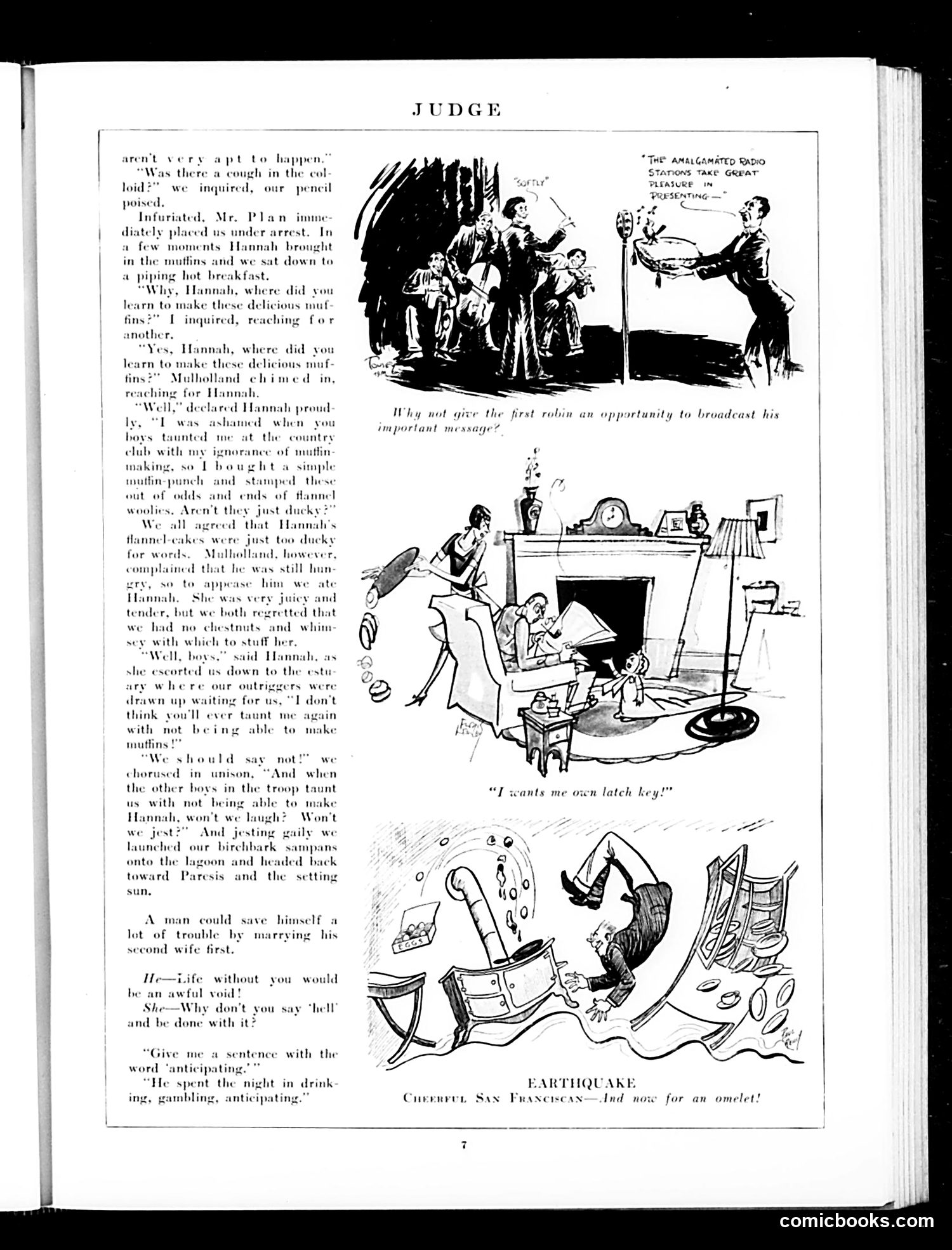
This page contains multiple satirical pieces typical of Judge magazine's humor. **Top cartoon:** Mocks radio broadcasting's pretensions. "The Amalgamated Radio Stations" dramatically present what appears to be a mundane domestic scene—likely poking fun at early radio's tendency to sensationalize ordinary events or treat trivial announcements as momentous news. **Middle cartoon:** Illustrates a chaotic radio broadcast studio, with the caption "I wants me own latch key!"—satirizing radio programming's focus on domestic comedy and family situations, while depicting the backstage chaos required to produce these supposedly polished broadcasts. **Bottom cartoon:** Titled "EARTHQUAKE—Chirrpel San Francisco—And now for an omelet!" This appears to reference San Francisco's earthquake vulnerability, darkly joking that disaster reporting would be interrupted by mundane program scheduling. The page also includes joke fragments about marriage, anticipation, and other topics—typical of Judge's format combining visual and textual humor targeting radio broadcasting and domestic life trends of the era.
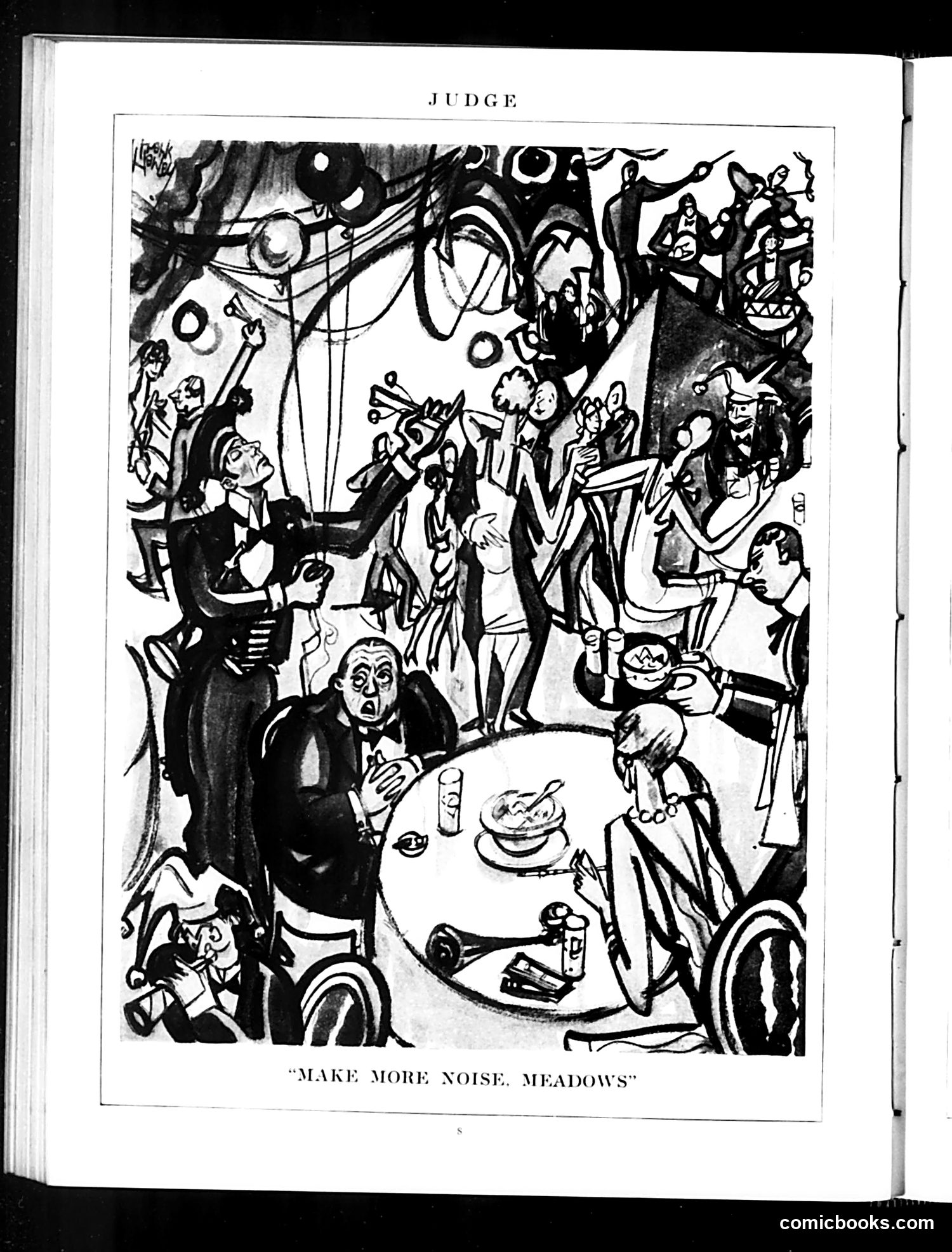
This Judge cartoon satirizes someone named Meadows, depicted as a formally-dressed man at the center of a chaotic party scene. The caption's imperative—"Make More Noise, Meadows"—suggests he's being mocked for either being too quiet at social gatherings or failing to create sufficient disturbance/attention. The crowded, energetic scene around him features musicians, dancers, and revelers in 1920s-style dress, emphasizing the contrast between the subdued central figure and the surrounding pandemonium. The satire likely targets a public figure or type—possibly a politician or social personality—for insufficient boldness or visibility during a significant period. Without additional context about who "Meadows" refers to specifically, the broader point appears to be mockery of someone expected to be more prominent or vocal.
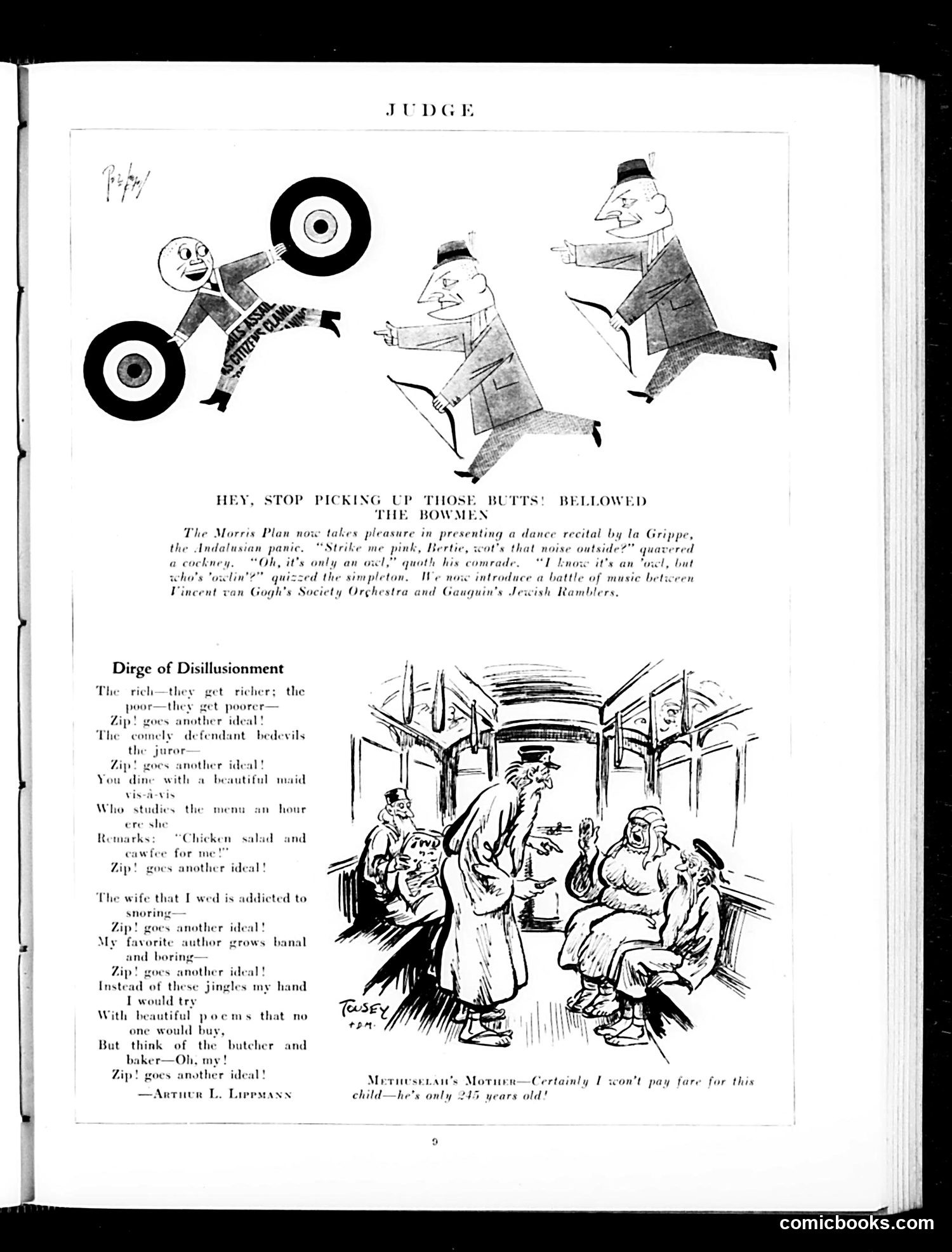
This page contains two satirical pieces from *Judge*, an American humor magazine. **Top cartoon**: "Hey, Stop Picking Up Those Butts! Bellowed the Bowmen" mocks the pretentious artistic world. The figures appear to be caricatures of famous artists (references to Van Gogh and Gauguin in the text suggest art-world satire). The absurdist humor—a cockney mistaking "la Grippe" (influenza personified) for an "Andalusian panic," competing orchestras with ethnic stereotyping—ridicules both artistic pretension and wartime anxiety. "The Morris Plan" likely references contemporary financial schemes. **Bottom cartoon & poem**: "Dirge of Disillusionment" by Arthur L. Liepmans satirizes lost ideals through everyday disappointments: wealth inequality ("the rich get richer"), romantic letdowns (the woman ordering cheap food), marital disillusionment (a snoring wife), and artistic compromise (wanting to write poetry but needing butcher/baker money). Each disappointment ends with "Zip! goes another ideal!"—mocking youthful optimism destroyed by reality. The second cartoon shows a streetcar scene with the caption mocking a 245-year-old child—likely absurdist humor about fare-dodging or welfare fraud.
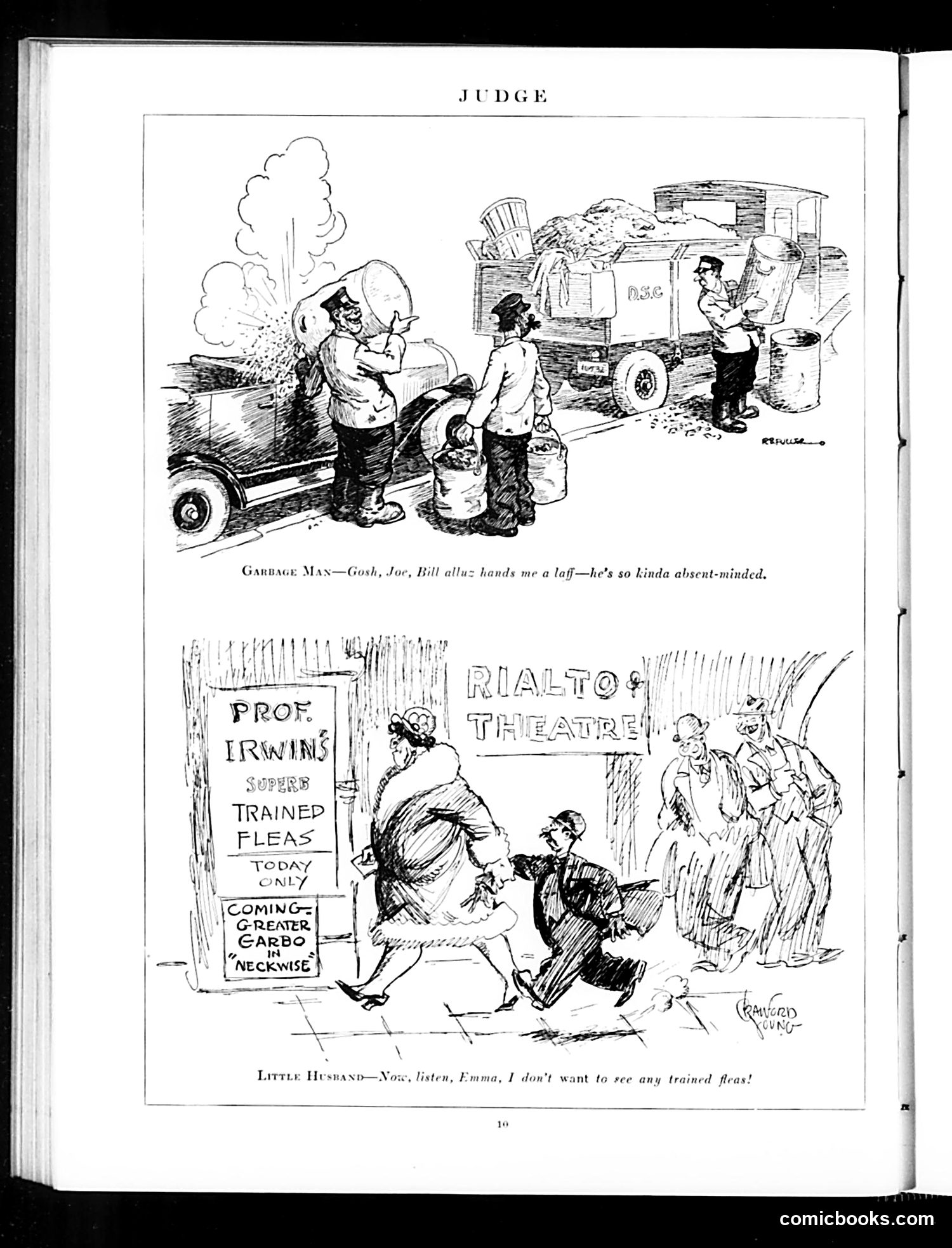
This page contains two satirical cartoons mocking absent-mindedness and marital dynamics. **Top cartoon ("Garbage Man"):** Three workers stand confused while a garbage truck dumps waste. The joke is that one man is so distracted he hands the garbage collector a laff (laugh)—apparently a written joke or comic—instead of garbage, showing comic absent-mindedness. **Bottom cartoon ("Little Husband"):** A man drags his reluctant wife past a theater advertising "Prof. Irwin's Trained Fleas" and "Coming: Greater Marvels in Necromise" (likely a misspelling). The wife protests wanting to see the flea circus, but he refuses—a domestic comedy about conflicting entertainment preferences. The satire gently mocks both the husband's dismissal of his wife's interests and the era's fascination with novelty acts like trained-flea circuses, which were genuine popular attractions in early 20th-century America.
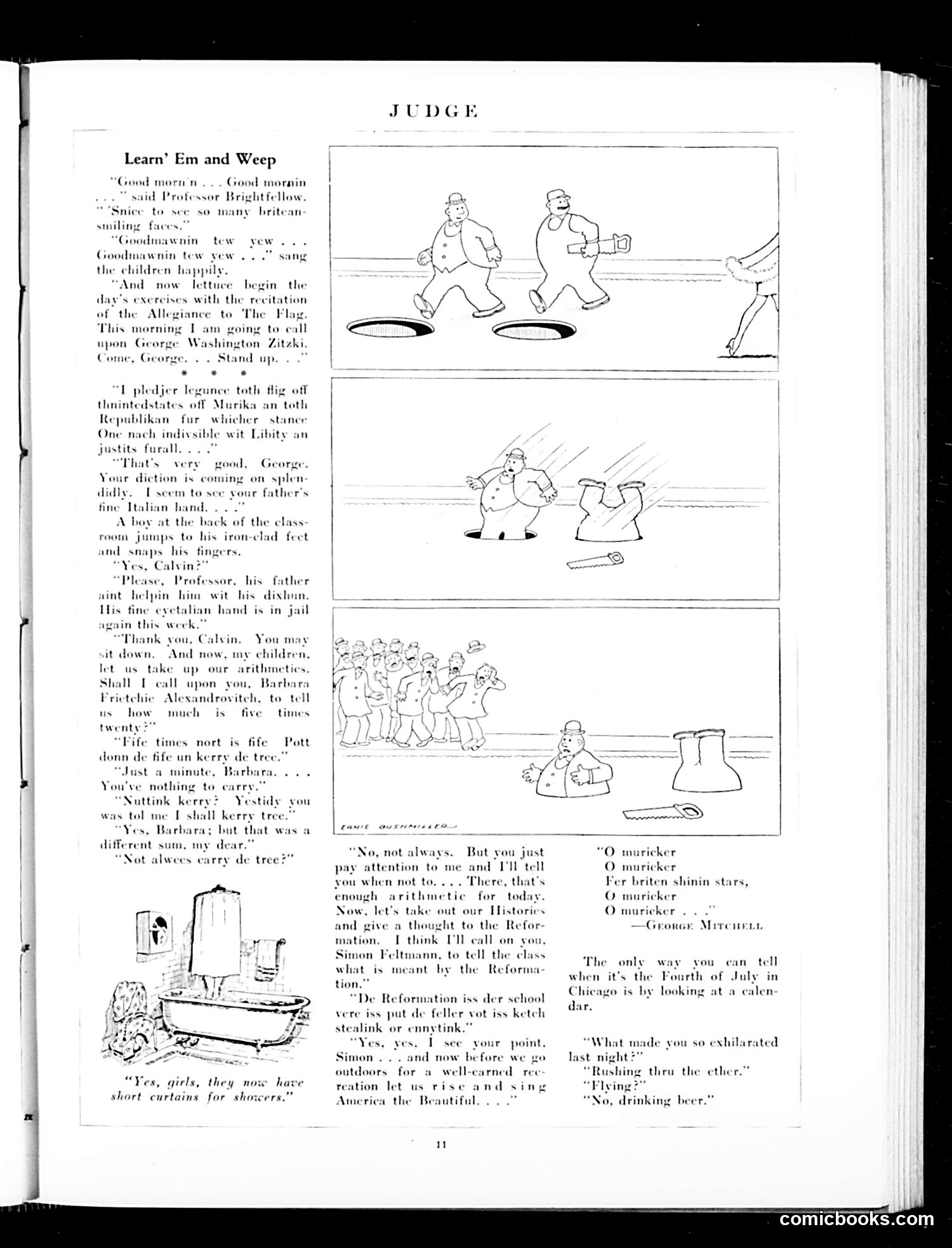
This satire mocks early-20th-century American education through a classroom scene where immigrant children and their parents struggle with English diction and civics concepts. **The Satire:** Professor Brightfellow teaches a mixed class where students display heavy ethnic accents (Italian, German) while reciting patriotic material—the Pledge of Allegiance and "America the Beautiful." The humor derives from the contrast between lofty American ideals and the linguistic reality of immigrant assimilation. **Key Jokes:** - A boy named Calvin reveals his father's "fine Italian hand" is literally in jail—a play on the phrase meaning artistic skill - Barbara misunderstands arithmetic ("always carry the tree") - Simon defines "Reformation" as a school for catching thieves - The final exchange about Chicago patriotism being detectable only on the Fourth of July suggests immigrants don't fully embrace American values **Context:** This reflects contemporary anxieties about immigrant assimilation and education circa 1910s-1920s. The satire gently mocks both the students' struggles and the naive assumption that patriotic recitation ensures Americanization.
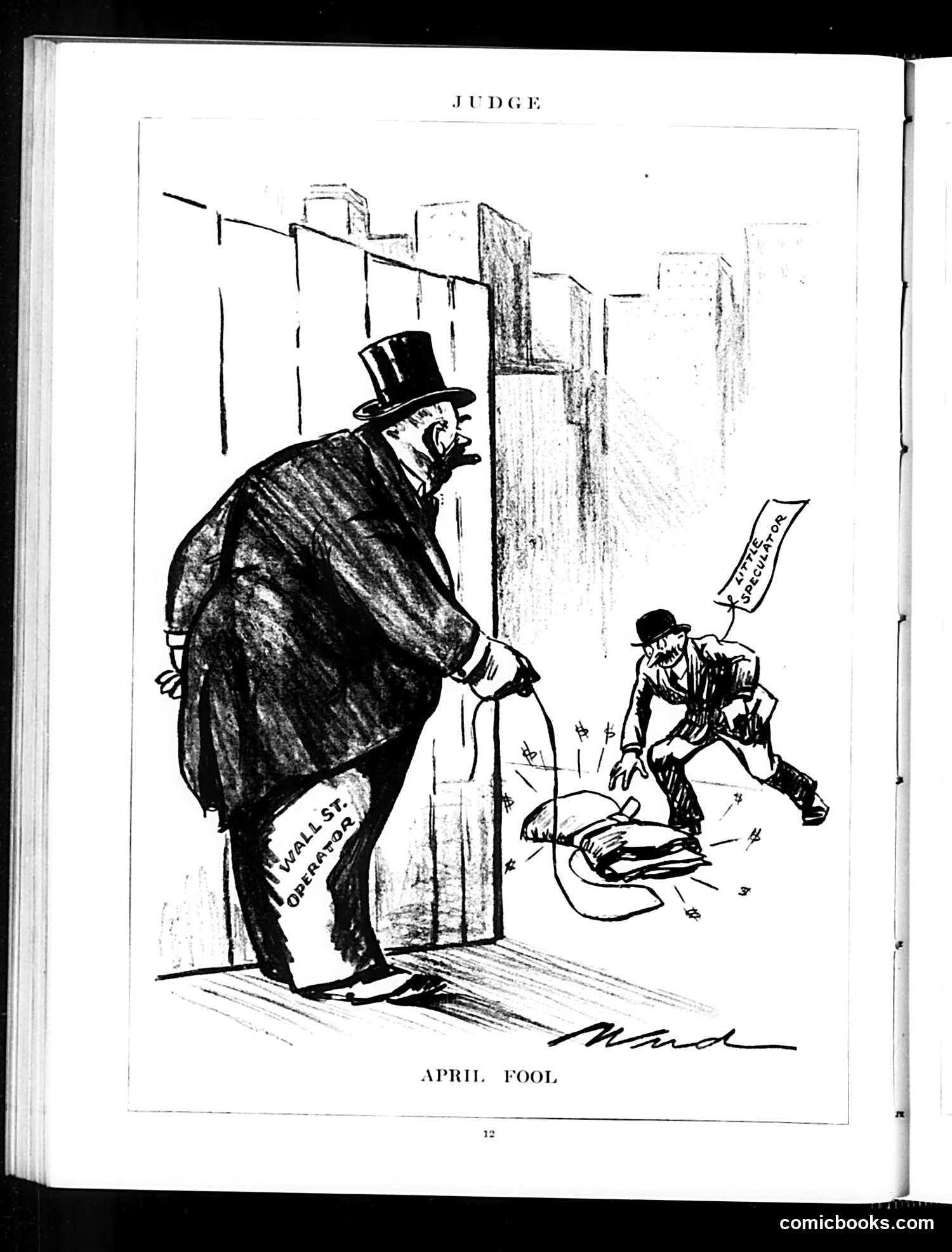
This political cartoon depicts a large, well-dressed judge or authority figure (labeled "WALLIS OPERATION" on his clothing) leaning over to observe a smaller man holding what appears to be a petition or complaint document. The title "April Fool" suggests the cartoon is satirizing someone or some policy as foolish or ridiculous. The specific "Wallis Operation" reference and the hierarchical composition—with the authority figure looming over the petitioner—suggests this mocks a judicial or legal proceeding being treated as an April Fools' joke. Without clearer historical context about which specific operation or case "Wallis" references, the exact target remains unclear, though the satire clearly ridicules the disparity in power between judge and petitioner.
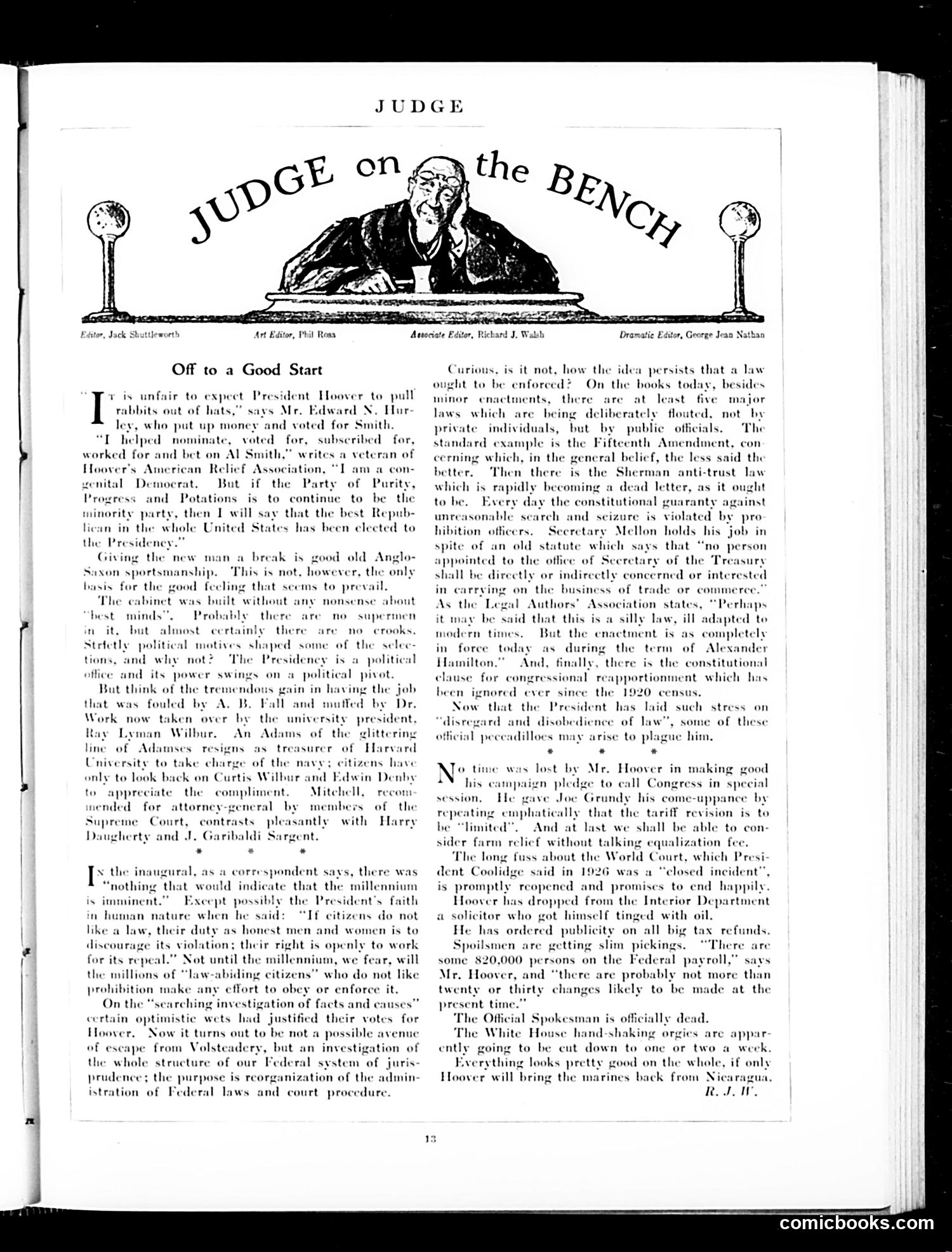
This page celebrates President Herbert Hoover's early cabinet appointments (1929). The illustrated "Judge on the Bench" header presents the magazine as impartial political commentary. The text defends Hoover against criticism, noting even a Smith supporter acknowledges he's "the best Republican in the w[hole] United States." Key appointments praised include Ray Lyman Wilbur (Navy Secretary, replacing the scandal-tainted Edwin Denby) and Mitchell (Attorney-General, contrasted favorably with Hoover's corrupt predecessor Harry Daugherty). The right column sardonically addresses Prohibition enforcement. It mocks the gap between law and practice—citing unenforced Prohibition, the Sherman Anti-Trust Act becoming "a dead letter," and the Fifteenth Amendment treated as unenforceable. Secretary Mellon's appointment despite holding business interests violates his own statutory restrictions. The satire suggests ambitious talk of "reorganization" masks deeper systemic corruption.
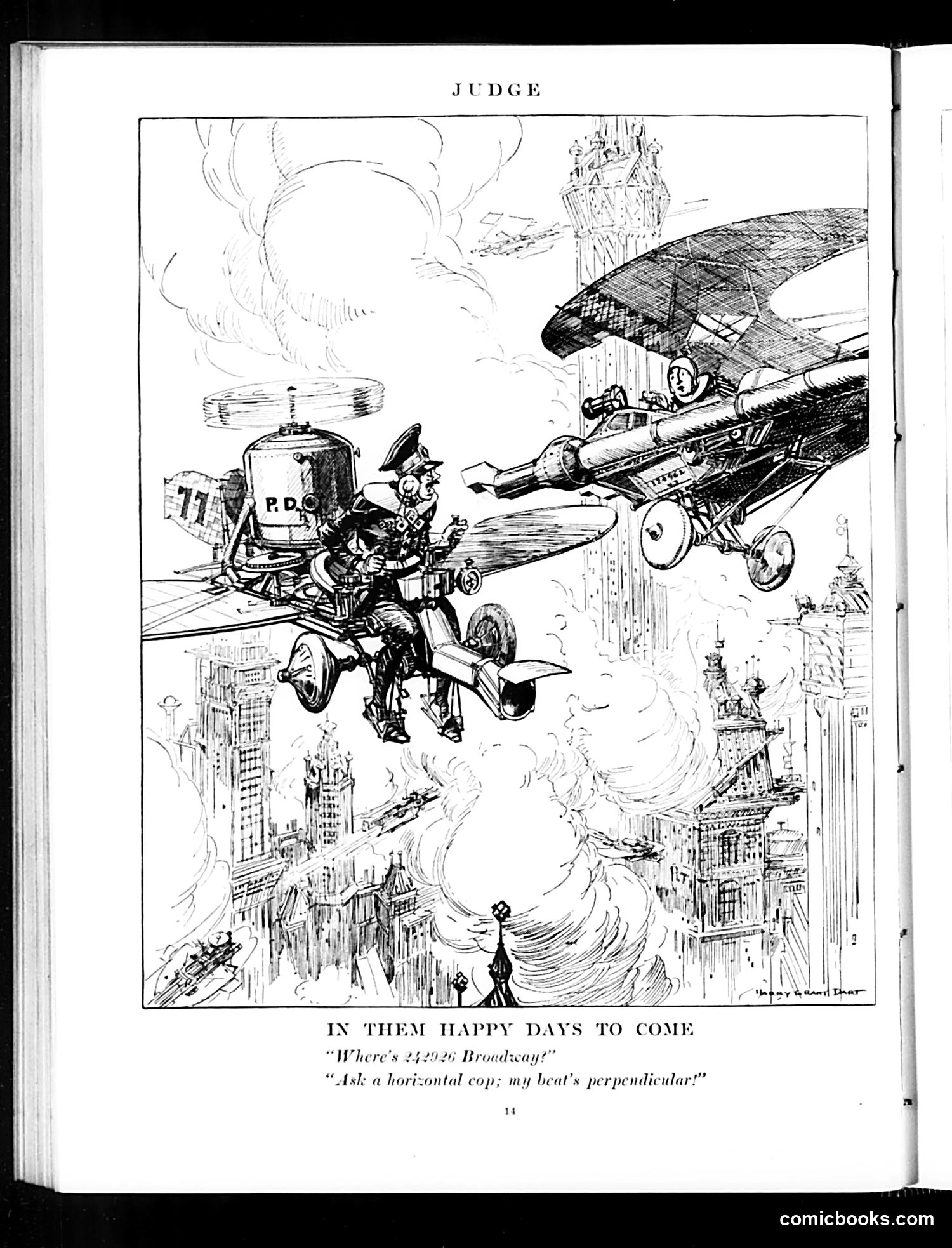
This is a satirical cartoon about future air traffic in cities. It depicts a chaotic scene of aircraft flying at various angles around tall buildings, with a confused police officer on the ground unable to direct traffic because aerial navigation occurs in three dimensions rather than the two-dimensional streets he patrols. The humor centers on this collision of old and new: a traditional "horizontal cop" (walking city streets) becomes obsolete when vehicles operate "perpendicular" to ground level. The P.D. (Police Department) insignia on equipment and the bewildered officer's uniform emphasize institutional unpreparedness for technological change. The title "In Them Happy Days to Come" suggests optimistic futurism, though the chaotic imagery ironically questions whether this future is actually desirable. This likely reflects 1920s anxieties about rapid aviation advancement and urban modernization outpacing regulatory infrastructure.
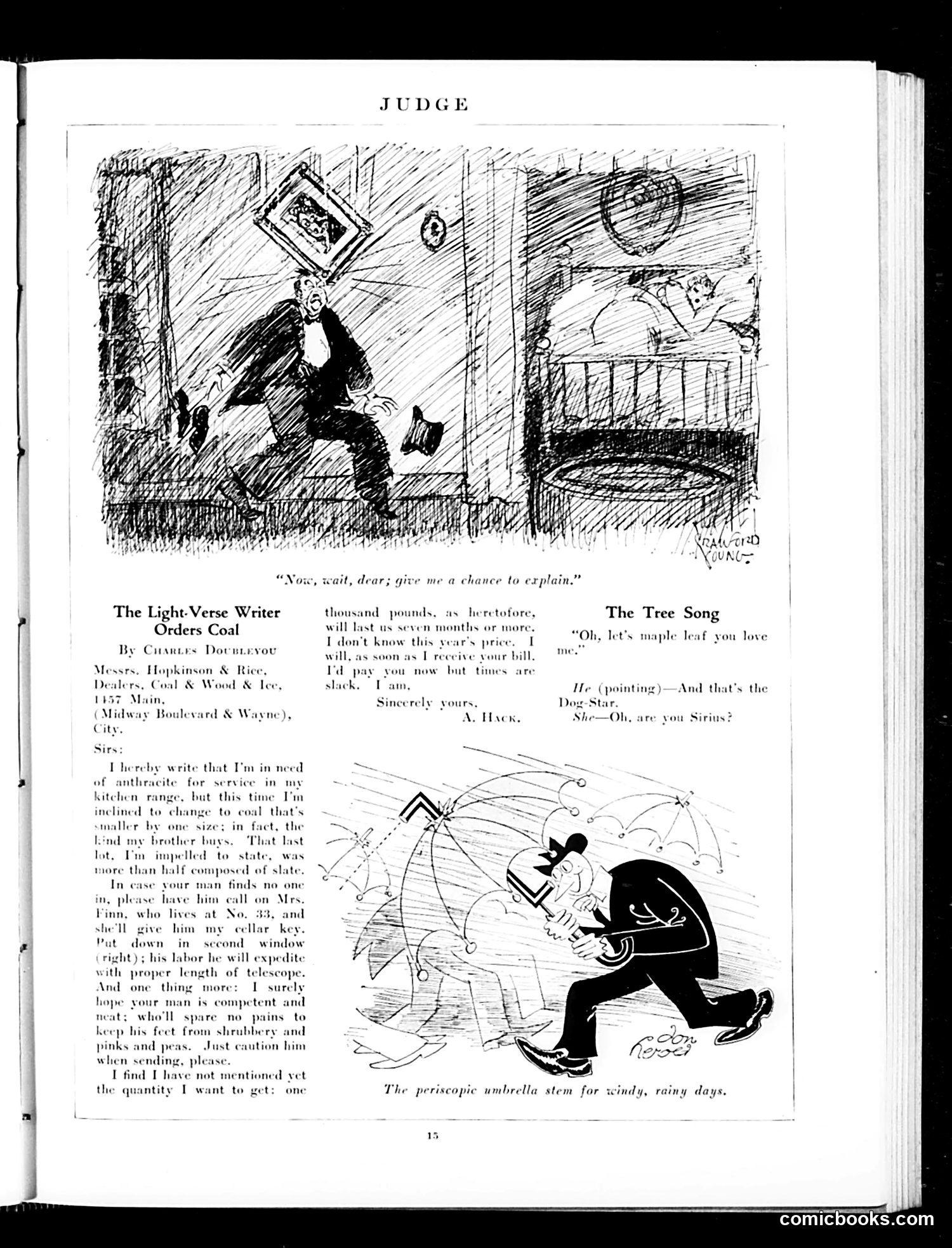
This page contains three satirical pieces from *Judge* magazine: 1. **"The Light-Verse Writer Orders Coal"**: A humorous letter mocking verbose, overly-elaborate correspondence. A customer writes an absurdly long, pedantic letter to a coal dealer that could be summarized in one sentence. The satire targets pretentious writing styles and bureaucratic pomposity. 2. **"The Tree Song"**: A brief dialogue playing on the double meaning of "Sirius"—the Dog Star (astronomy) versus the name "Sirius" (sounding like "serious"). She misinterprets his celestial reference as a pun. 3. **Top cartoon**: Depicts a man being violently knocked backward indoors, captioned "Now, wait dear; give me a chance to explain"—likely satirizing domestic disputes or marital arguments. 4. **Bottom cartoon**: Shows a man struggling with an elaborate "periscopic umbrella stem" in wind and rain—mocking overly-complicated or impractical inventions, a recurring *Judge* theme. The magazine primarily targets pretension, incompetence, and absurd modern inventions.
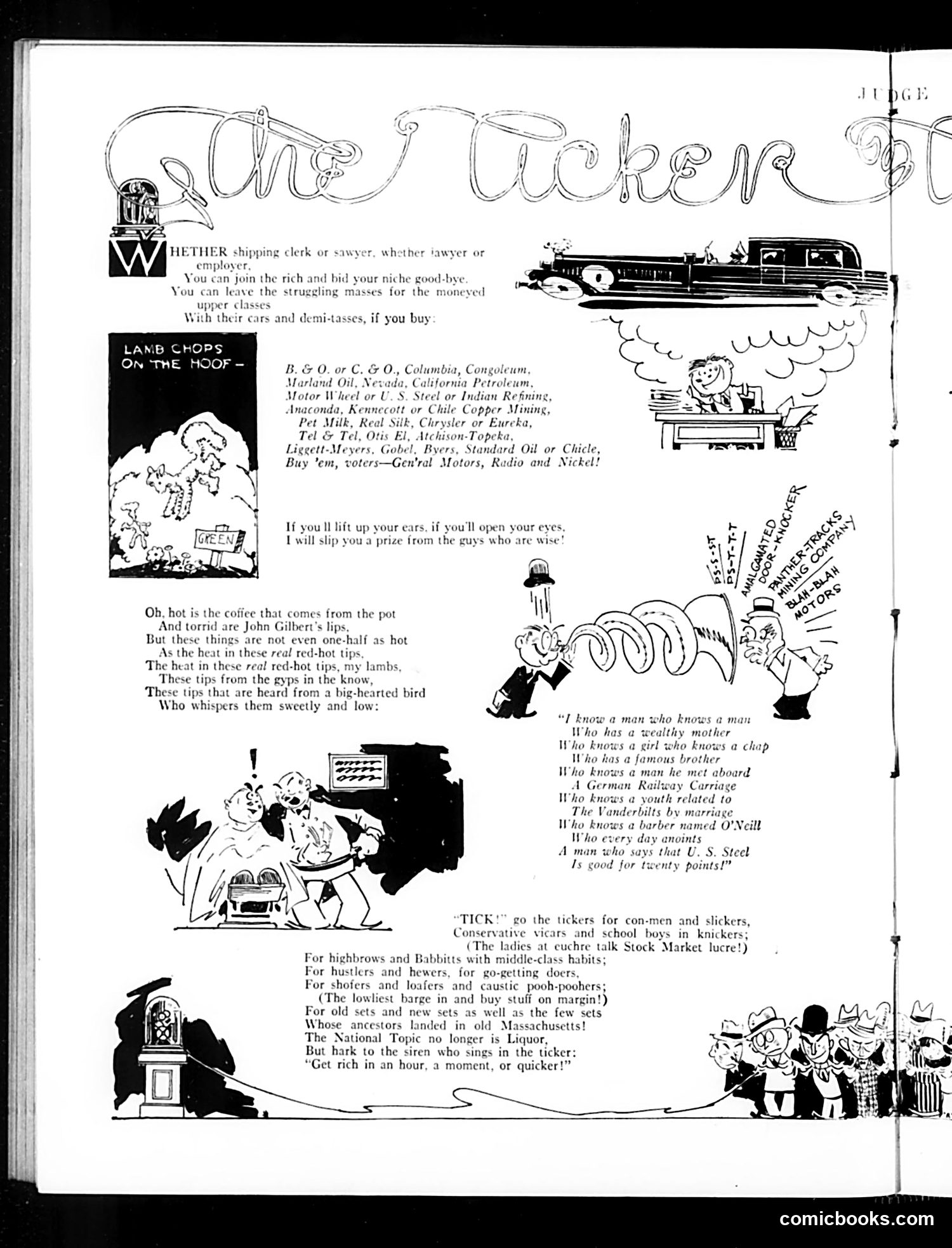
This page satirizes 1920s stock market mania and get-rich-quick schemes. The central joke: everyone from shipping clerks to society ladies is obsessed with buying stocks, particularly in industrial companies (Steel, Motors, Oil, etc.) listed throughout. The "lamb chops on the hoof" headline mockingly suggests ordinary people are being led like sheep to slaughter by stock tips. The cartoon ridicules the absurd chain of insider information ("a man who knows a man...") that supposedly leads to investment wisdom. The satire targets the democratic delusion that anyone can join the wealthy class through stock purchases, while attacking both working-class ambition and upper-class participation in speculation. The final section notes that stock-trading has replaced alcohol as America's national obsession—a pointed reference to Prohibition. The overall message: uncritical mass participation in the stock market represents dangerous financial herd behavior, not genuine wealth-building.
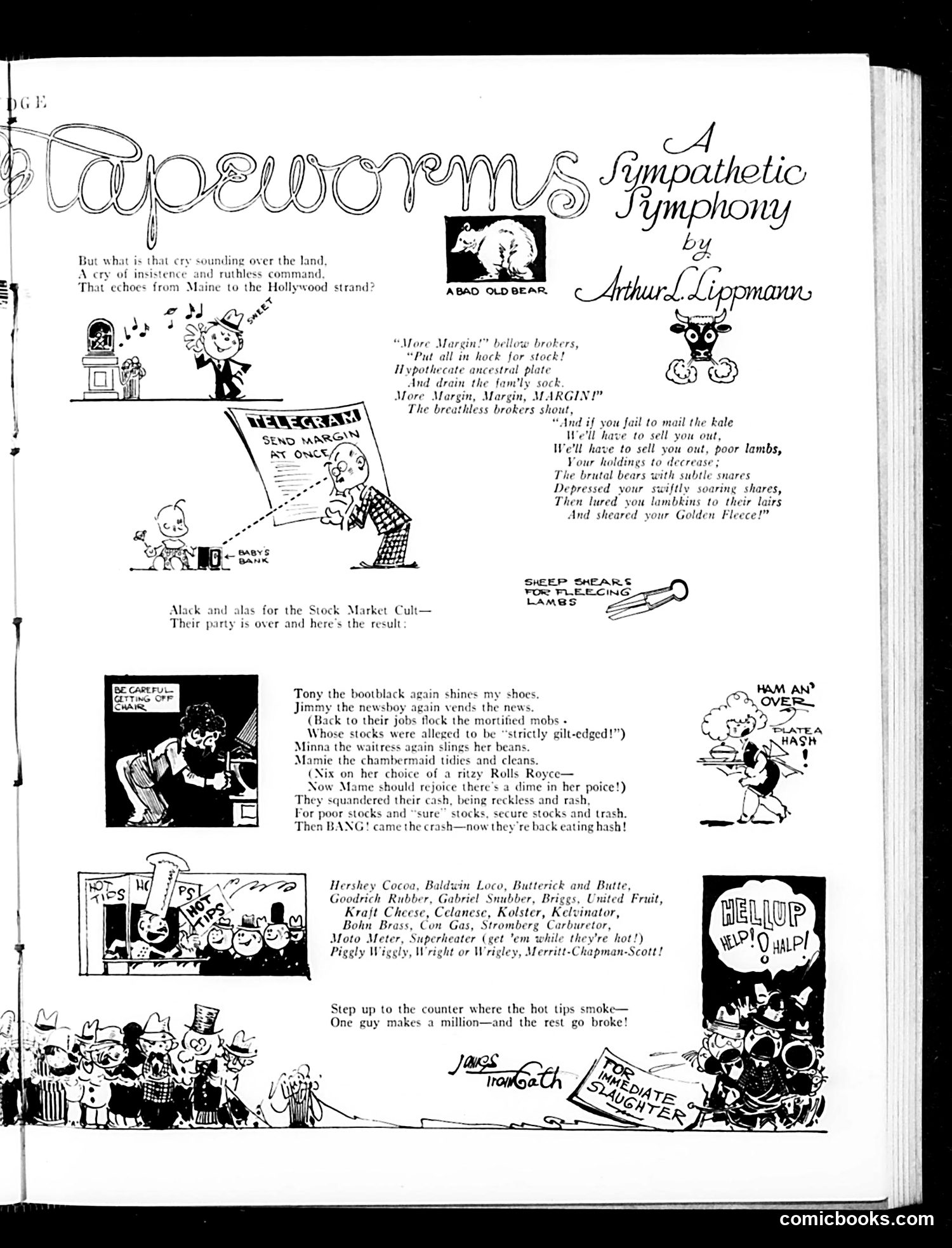
This satirical piece mocks the 1920s stock market speculation craze and its devastating aftermath—likely the 1929 crash. The cartoon traces how ordinary working people (bootblacks, newsboys, waitresses, chambermaids) were seduced by "hot tips" and promises of quick wealth through stock speculation, encouraged by brokers shouting "More Margin!" The satire depicts these "lambs" being systematically fleeced by "brutal bears" (market manipulators) who drove down stocks, ruining ordinary citizens. The poem catalogs real 1920s companies—Hershey, Goodrich, Kraft—that collapsed or crashed. The moral: working-class people abandoned their modest but stable jobs, risked everything on reckless stock speculation, and lost everything when the market crashed. The "sympathetic symphony" is sardonic—Lippmann mocks both the gullible speculators and the brokers who exploited them, showing how the stock market promised democracy but delivered only devastation.
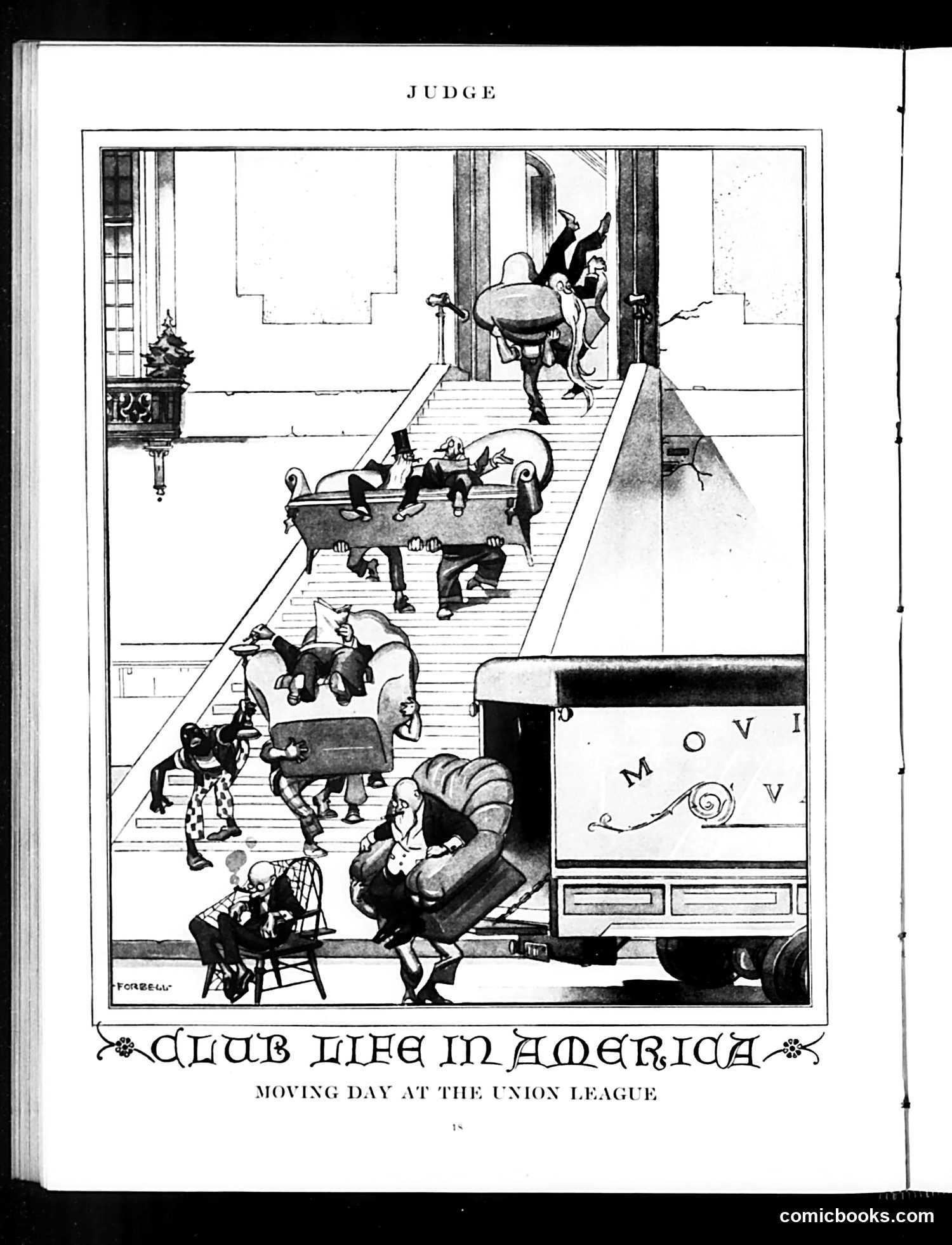
This satirical cartoon depicts chaos at the Union League, a prominent New York club for wealthy, educated men. The illustration shows multiple moving trucks and furniture being transported up stairs while well-dressed figures struggle amid the confusion—some carrying belongings, others appearing flustered or falling. The satire likely mocks either the Union League's relocation to new premises or ridicules its members' pretensions during a move. The exaggerated pandemonium—with figures tumbling downstairs and furniture askew—suggests incompetence among the club's elite members when faced with practical tasks. Without the publication date visible, the specific historical context remains unclear, but the cartoon's humor derives from the contrast between the Union League's prestigious reputation and its members' apparent inability to manage even a simple move competently.
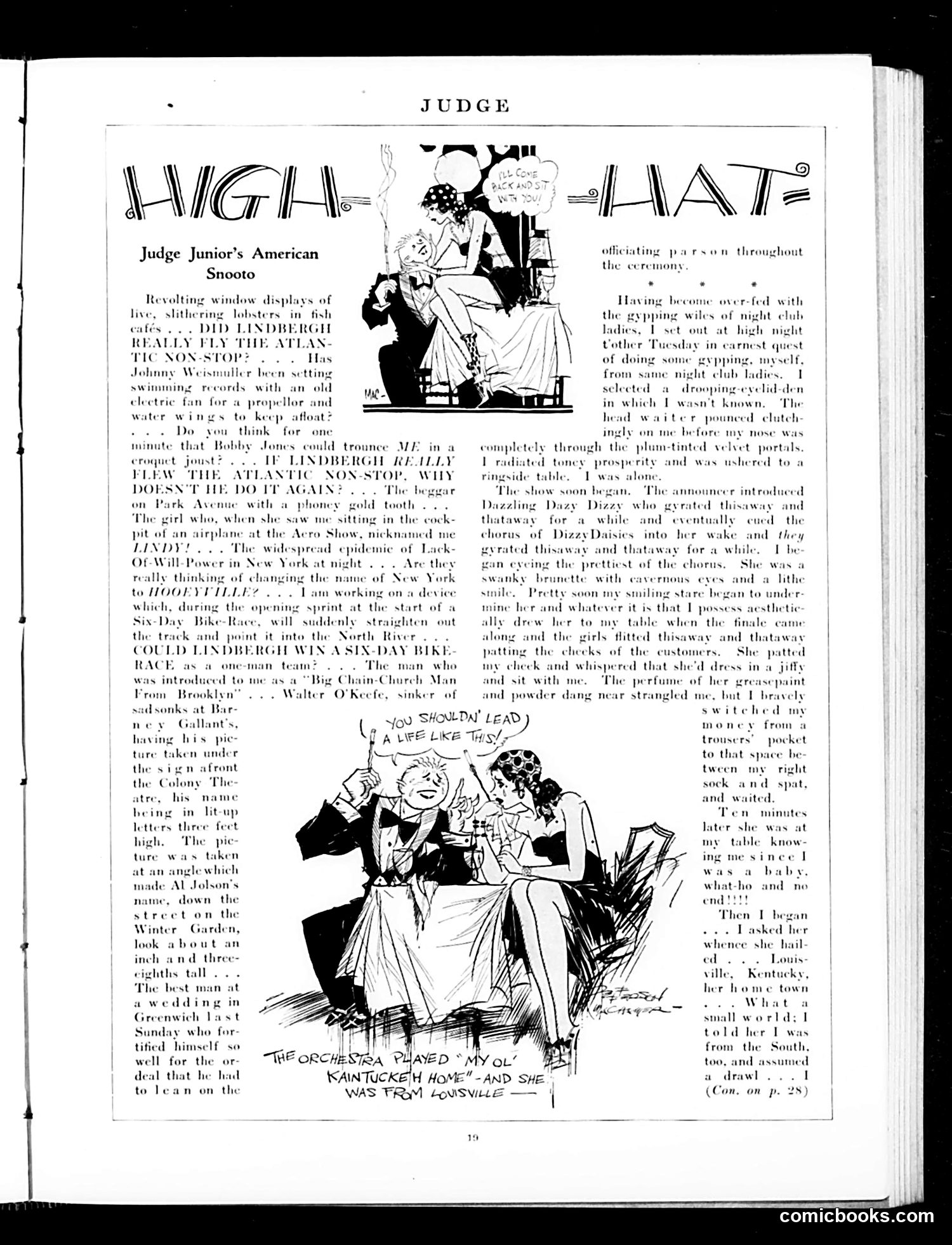
This page satirizes 1920s celebrity culture and social pretension. The main text mocks excessive public fascination with Charles Lindbergh's 1927 Atlantic crossing, sarcastically asking why he doesn't repeat it constantly. It ridicules how New Yorkers obsess over celebrities like swimmer Johnny Weismuller and golfer Bobby Jones. The central cartoon illustrates a night club encounter where the narrator—a social climber—attempts to impress a chorus girl by pretending sophistication. The girl turns out to be from his Kentucky hometown, deflating his "high hat" (pretentious) persona. She says the orchestra played "My Old Kentucky Home"—a sentimental touch revealing his attempts at cosmopolitan urbanity are hollow. The satire targets 1920s urban snobbery: people adopting affected manners to seem sophisticated while remaining fundamentally unchanged. The "high hat" metaphor suggests wearing formal appearance without substance.
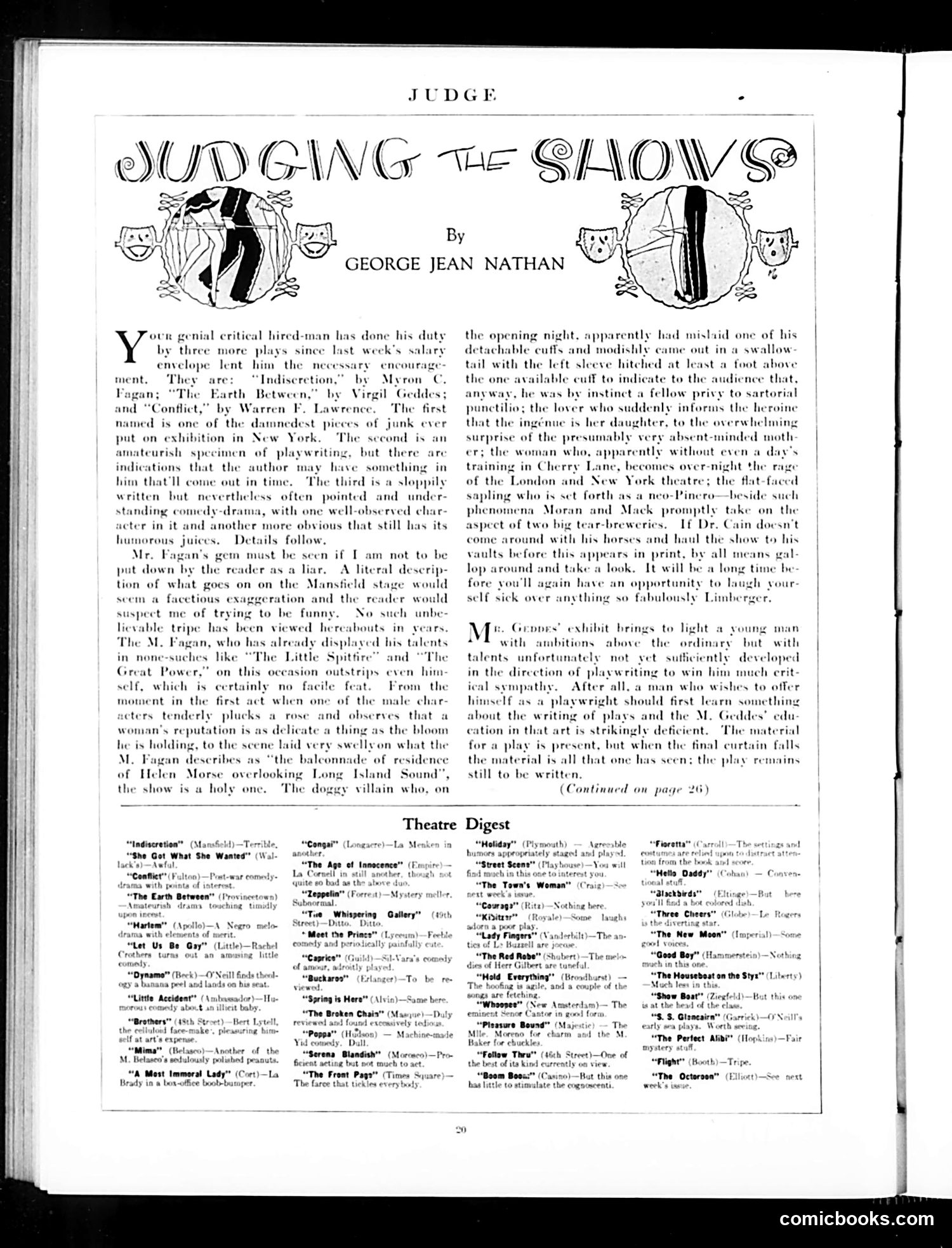
This is a theater critic's column reviewing three Broadway plays: "Indiscretion" by Myron C. Fagan, "The Earth Between" by Virgil Geddes, and "Conflict" by Warren F. Lawrence. Nathan savagely dismisses Fagan's play as "junk" and "unbelievable tripe," describing its plot mockingly—including absurd character moments like a man with a detached cuff and a convenient revelation that the ingénue is actually the heroine's daughter. He compares farcical crying scenes to "tear-breweries," possibly referencing the comedy duo Moran and Mack. He's somewhat kinder to Lawrence's "Conflict," calling it "pointed and understanding" despite sloppy writing. For Geddes, Nathan acknowledges ambition but criticizes underdeveloped playwriting skills, arguing the material exists but the actual *play* remains unwritten. The "Theatre Digest" section lists brief one-line reviews of other productions, maintaining Nathan's acerbic tone throughout.
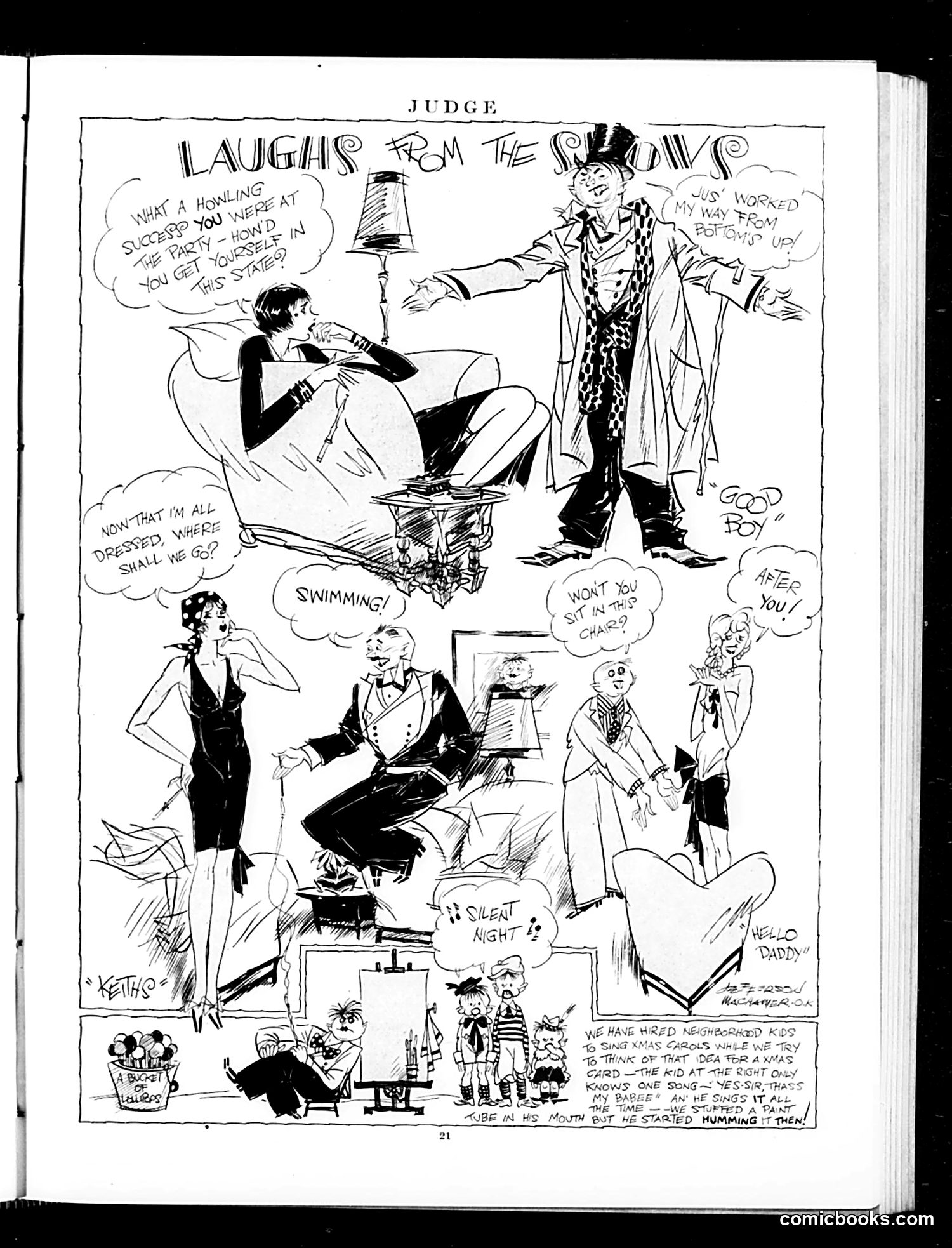
This cartoon satirizes holiday social gatherings and domestic life. The central figure appears to be a host entertaining guests at what looks like a Christmas party. The various vignettes mock typical party scenarios: awkward conversations ("What a howling success!"), uncomfortable seating arrangements, and failed entertainment attempts. The bottom panel's narrative about hiring neighborhood children to sing Christmas carols—but one child only knows one song and starts humming—satirizes middle-class attempts at genteel holiday traditions that inevitably go awry. The humor lies in the gap between aspirational entertaining and messy reality. The cartoon captures early-to-mid 20th-century domestic comedy, poking fun at social pretensions and family holiday chaos—themes *Judge* magazine regularly explored.
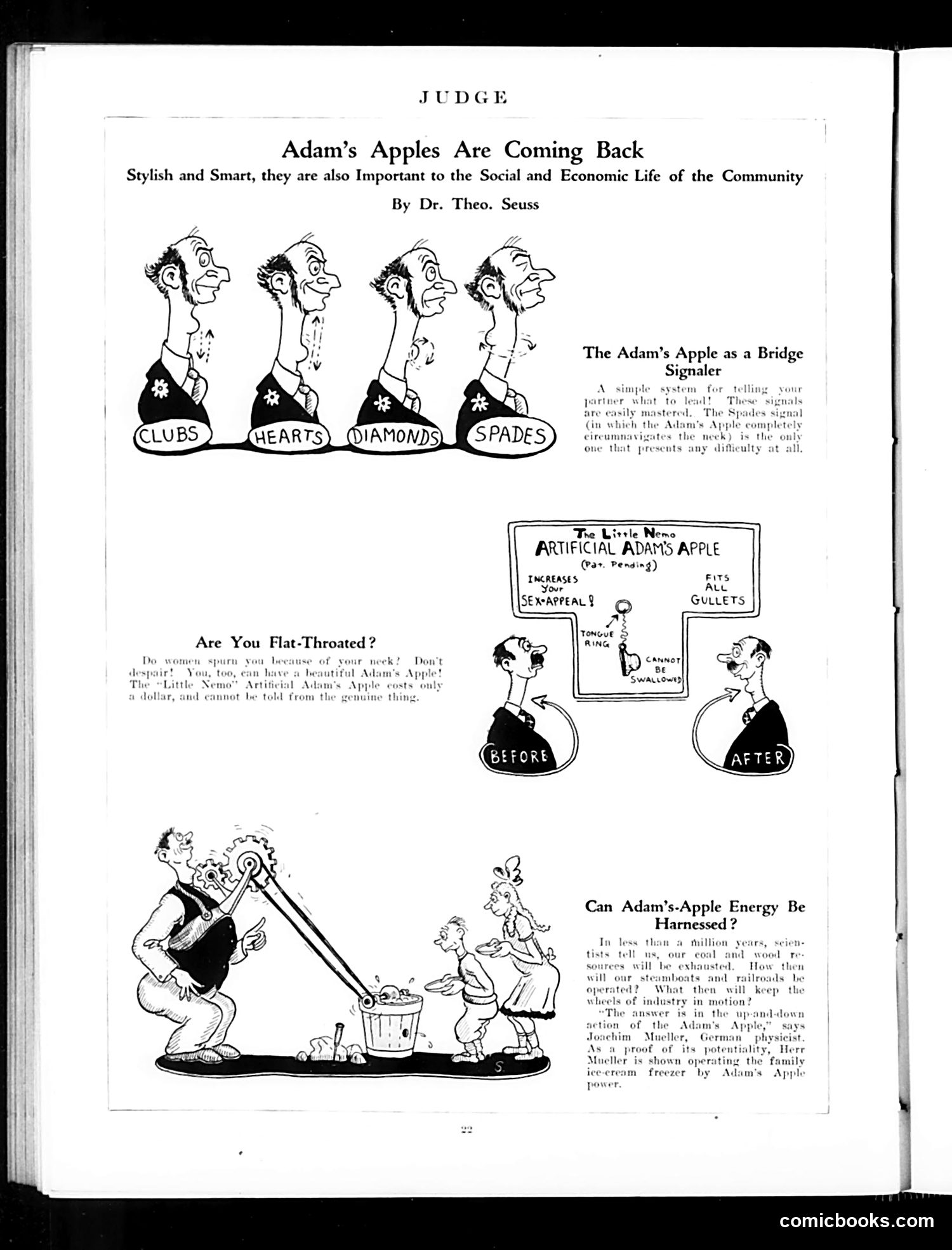
This is a satirical piece by Dr. Seuss (Theodor Geisel) mocking a fictional product: artificial Adam's apples. The humor works on multiple levels: **The Setup:** The piece presents "Adam's Apples" as socially and economically important, using mock-serious language about bridge signaling in card games and energy harnessing. **The Satire:** The central joke targets early 20th-century cosmetic/medical quackery and pseudoscience. The "Before/After" section mocks deceptive advertising promising to cure "flat-throatedness" and increase "sex appeal"—typical exaggerated claims of dubious products from that era. **The Figures:** Appear to be generic caricatured men; the reference to "Joachim Mueller, German physicist" as supposed scientific proof is likely fabricated to parody false endorsements. **The Point:** Seuss ridicules both the gullibility of consumers and fraudulent marketers who sold dubious solutions to invented problems, using absurdist humor typical of Judge magazine's satirical approach.
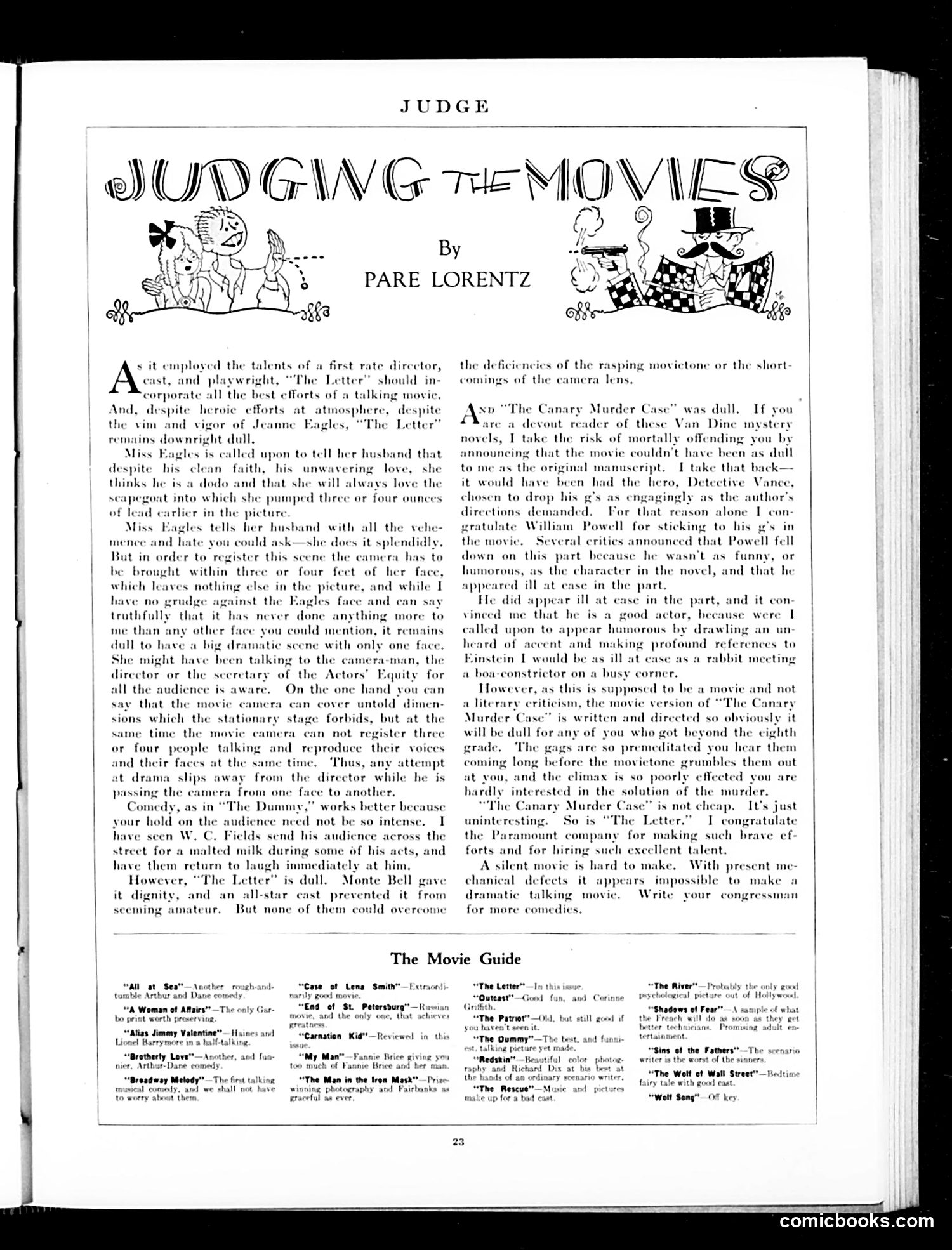
This is a film criticism column reviewing recent movies. Lorentz critiques three films: "The Letter" (starring Jeanne Eagles), "The Canary Murder Case" (with William Powell as detective Philo Vance), and "The Dummy." **The satire:** Lorentz argues that early talking pictures face technical limitations—the camera cannot simultaneously capture actors' faces, voices, and emotions from more than a few feet away. This forces dull, static staging. He praises comedies like W.C. Fields' work, where dialogue intensity matters less, but condemns dramatic films for boring audiences. **The broader point:** This is *not* political satire but industry criticism. Lorentz laments that Hollywood, despite hiring first-rate directors and all-star casts, produces tedious talkies because the technology itself is inadequate. He concludes with mock advice: write congressmen demanding Hollywood make only comedies until the medium improves. The piece reflects anxieties during cinema's transition from silent to sound film (late 1920s).
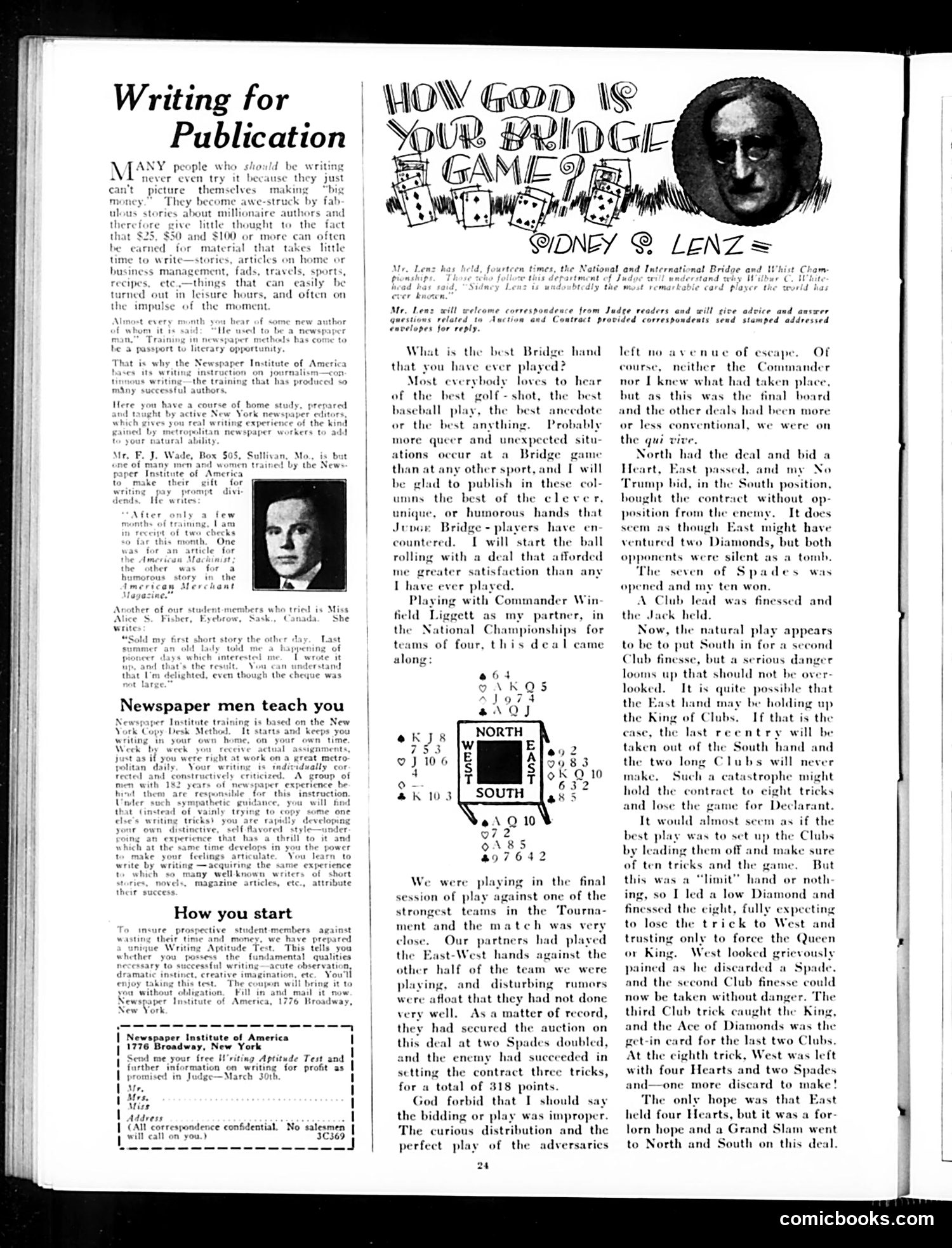
This page is primarily **instructional content**, not satire. It contains: 1. **"Writing for Publication"** - an advertisement for the Newspaper Institute of America's writing course, promising amateur writers can earn income publishing articles and stories. 2. **"Newspaper men teach you"** - promoting the Institute's training method using professional journalists as instructors. 3. **"How you start"** - describing an "Aptitude Test" to assess writing potential before enrollment. 4. **Bridge column by Sidney Lenz** - the main feature. Lenz, identified as a legendary bridge player and champion, discusses an interesting bridge hand from a National Championship tournament. He invites readers to submit their best bridge hands for publication. The page mixes **self-improvement advertising** with **recreational content** typical of Judge magazine's practical advice sections. There is **no political satire visible** here—it's straightforward instructional and hobby material aimed at middle-class readers interested in writing careers or bridge playing.
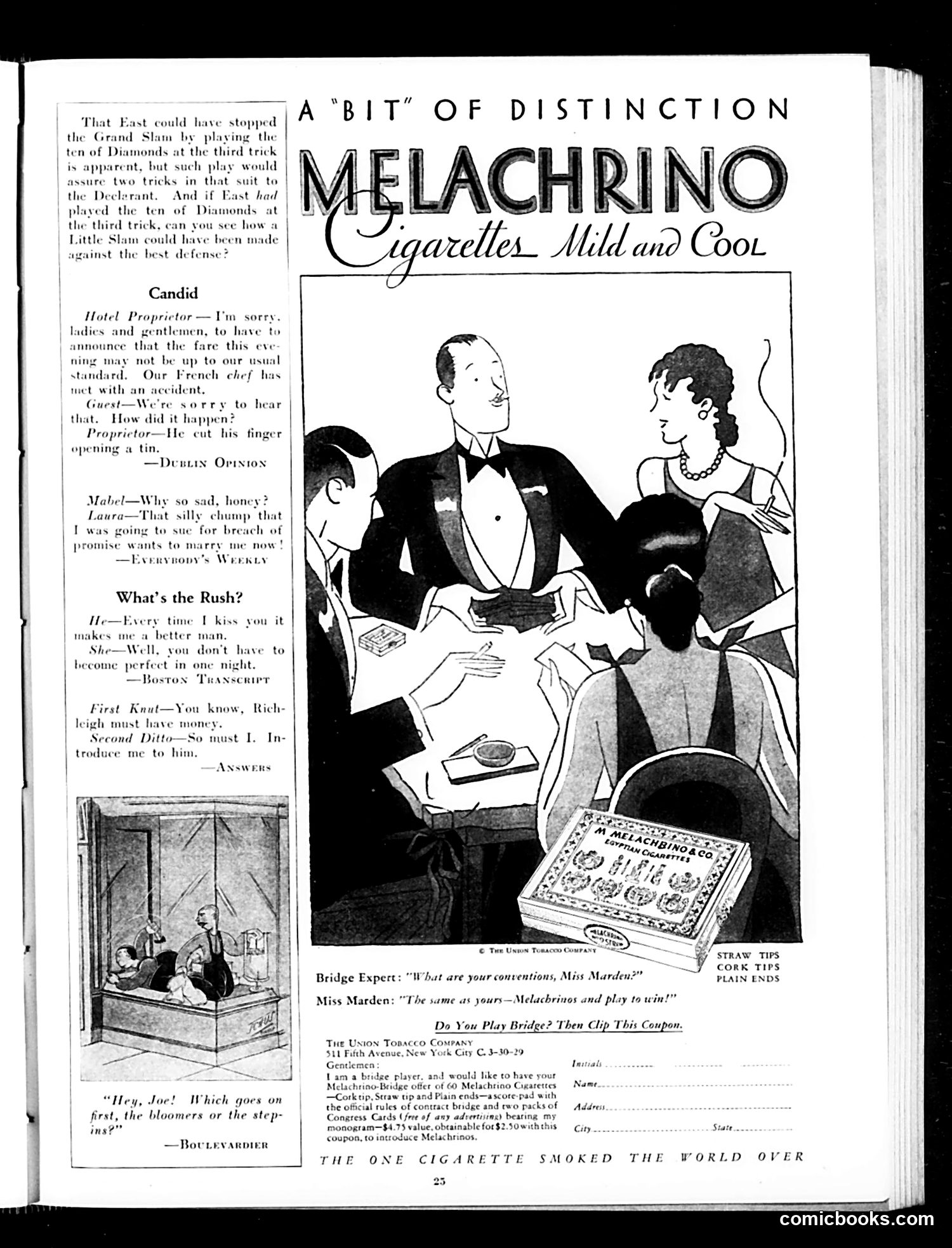
This page is primarily **advertising for Melachrino cigarettes** disguised as entertainment content. The small jokes ("Candid," "What's the Rush?," etc.) are filler material typical of Judge magazine. The main satirical point appears in the bridge-playing dialogue: a woman claims her "convention" for winning at bridge is smoking Melachrinos cigarettes—a humorous non-sequitur suggesting the product gives competitive advantage. This reflects **1920s advertising strategy**, where cigarettes were marketed as sophisticated, even enhancing performance or social status. The coupon offer bundles cigarettes with bridge instruction cards and playing cards, targeting educated, leisure-class readers who played bridge—positioning Melachrinos as a marker of refinement and good taste. The phrase "the one cigarette smoked the world over" reflects cigarette companies' global expansion ambitions during this era. No specific political figures or events are referenced; this is lifestyle advertising presented through satirical humor.
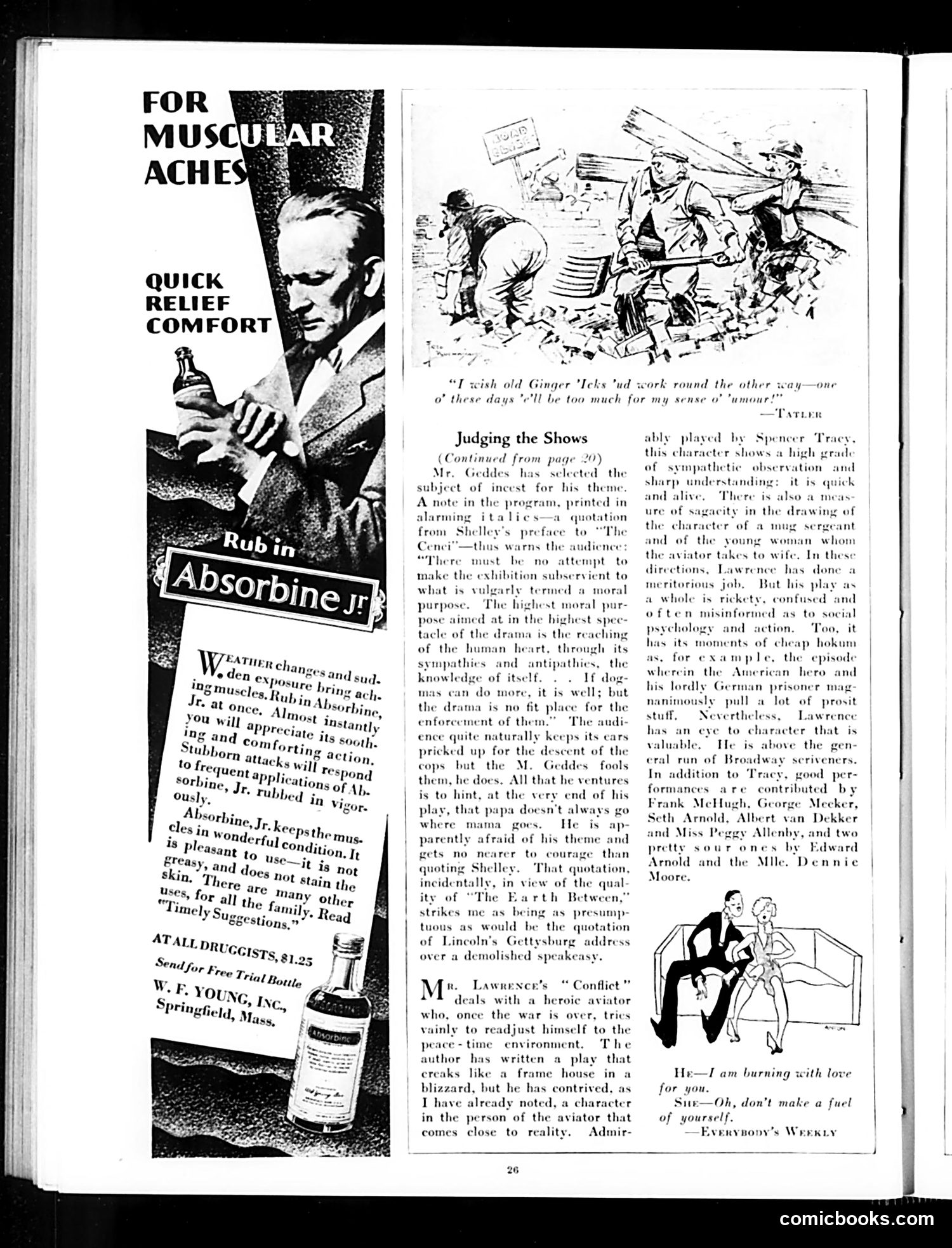
This page mixes advertising with theater criticism from Judge magazine's "Judging the Shows" column. **The Advertisement** (left): Promotes Absorbine Jr., a liniment for muscular aches, using a man holding the bottle. The copy emphasizes quick relief and comfort—standard early 20th-century patent medicine marketing. **The Theater Criticism** (right): Reviews two plays. The critic discusses a production of Shelley's *The Cenci* (about incest), finding the director's use of Shelley's preface pretentious—comparing it absurdly to quoting Lincoln's Gettysburg Address "over a demolished speakeasy" (referencing Prohibition-era speakeasy raids). The second review covers Lawrence's "Conflict," praising Spencer Tracy's performance as a post-WWI aviator struggling to readjust to civilian life, though criticizing the play's overall construction as creaky and confused. **The Cartoon** (bottom right): A simple gag about misunderstanding—a man says he's "burning with love," and the woman responds "don't make a fool of yourself," interpreting his romantic declaration literally/crudely.
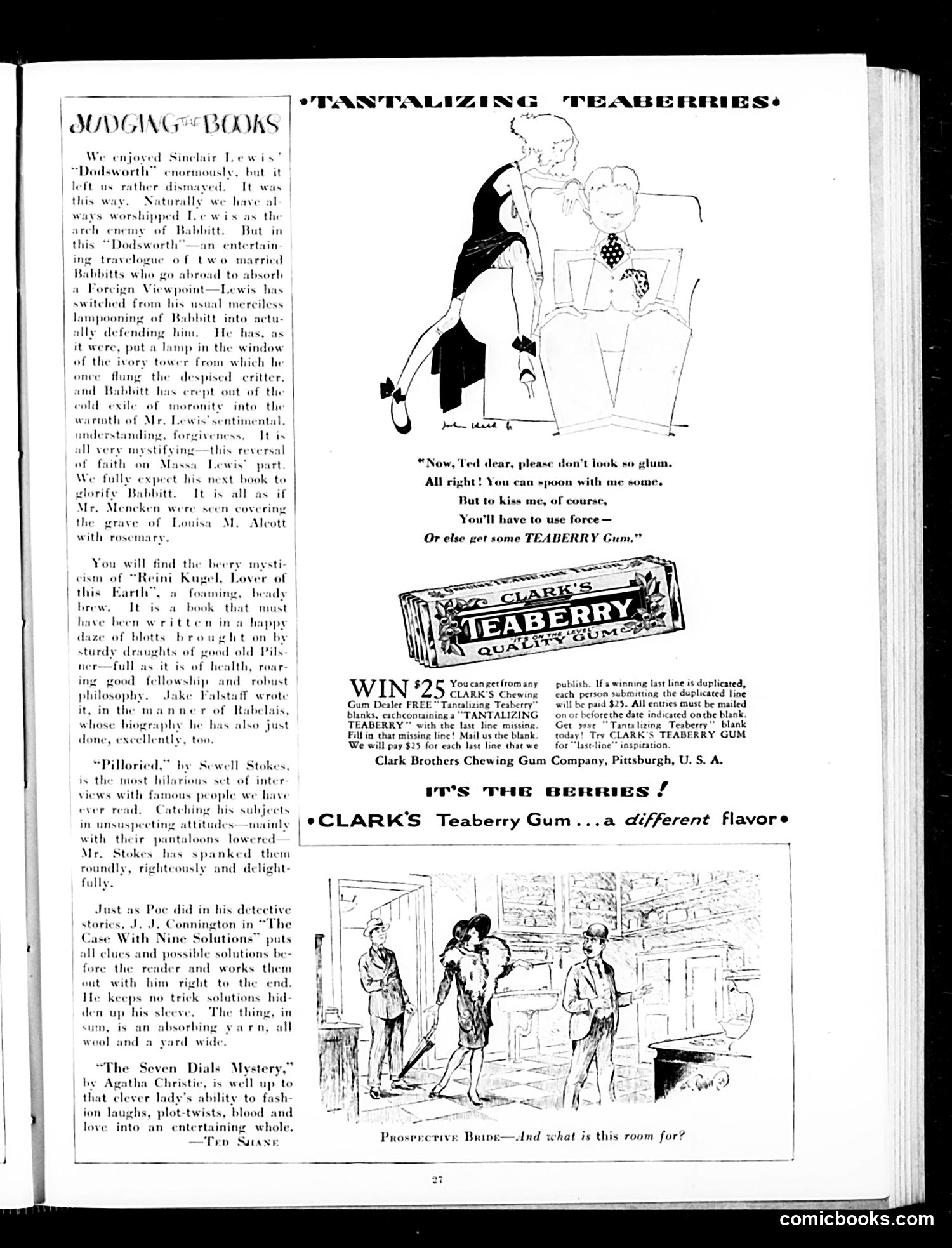
This page mixes book reviews with a gum advertisement. The top section critiques Sinclair Lewis's novel "Dodsworth," noting that Lewis—famous for satirizing middle-class conformists ("Babbitts")—surprisingly portrays his traveling Babbitt characters sympathetically. The reviewer calls this a betrayal of Lewis's usual stance, comparing it to H.L. Mencken mourning Louisa May Alcott (implying an unlikely reversal of values). The dominant feature is a **Clark's Teaberry Gum advertisement** disguised as a contest. The cartoon shows a couple where the woman pressures a reluctant man ("Ted") into kissing her, threatening to use "force" or he'll "get some TEABERRY Gum"—implying the gum's strong flavor makes kissing unpleasant. The ad offers $25 for readers completing missing caption lines, a common marketing gimmick of the era. The page primarily advertises gum while providing literary commentary; the satire is mild, relying on readers' familiarity with Lewis's reputation for sharp social criticism.
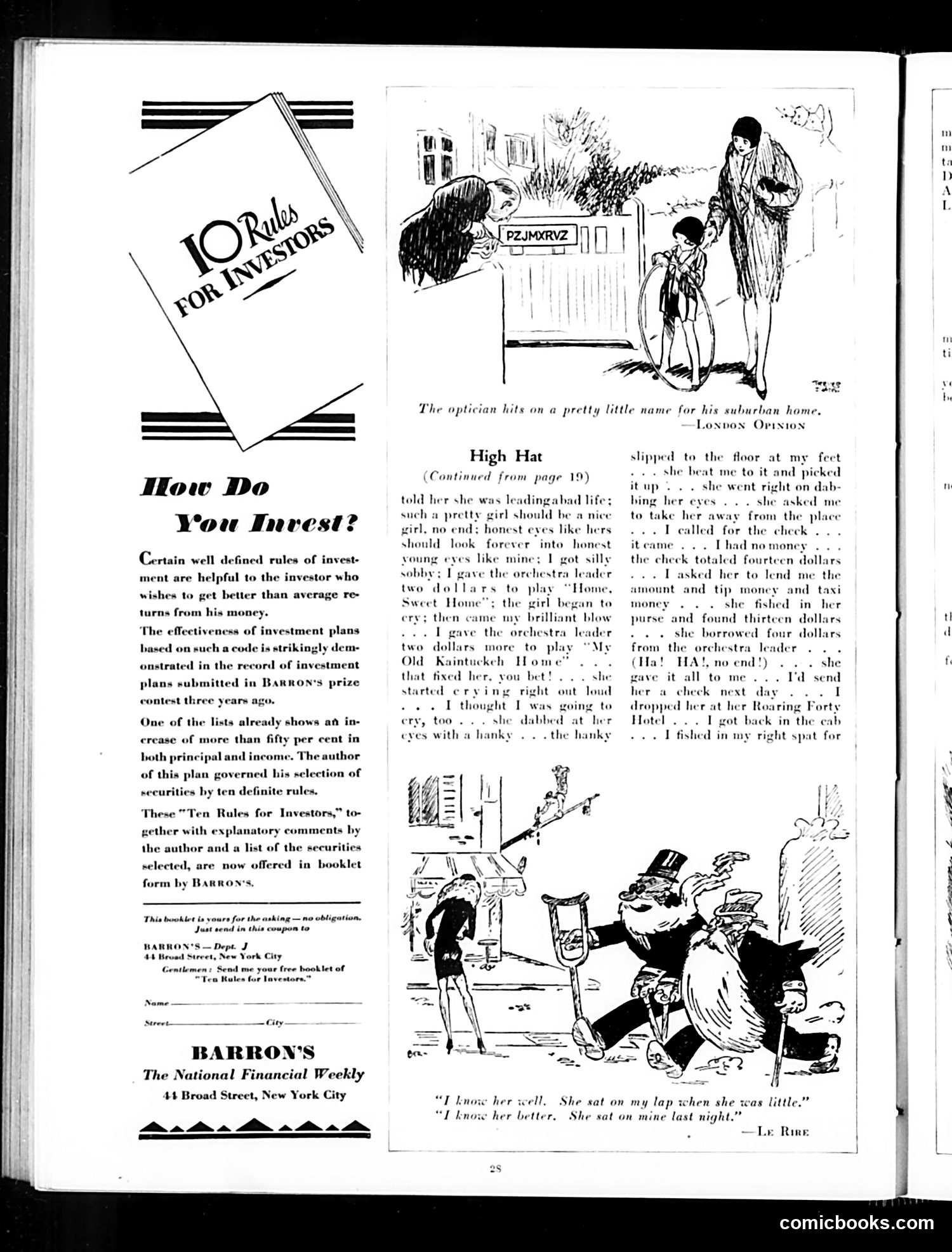
This page contains two distinct elements: **Left side:** A Barron's financial magazine advertisement promoting "Ten Rules for Investors"—a booklet offering investment guidance based on a prize-winning portfolio that reportedly gained 50% returns. It's a straightforward financial services ad with no satirical content. **Right side:** A humorous short story titled "High Hat" (continued from page 19) that satirizes sentimental romantic manipulation. A man attempts to seduce a young woman through emotional manipulation—playing tearful songs like "Home, Sweet Home" and "My Old Kentucky Home" to make her cry, then borrowing money from her to pay the cab fare home. The accompanying cartoon illustrates the comedic domestic scene. The closing quote ("I know her well...") suggests ironic commentary on male-female relationship dynamics and financial dependency. The satire targets overly theatrical romantic gestures and the financial awkwardness they create, presented as light humor typical of 1920s-era Judge magazine.
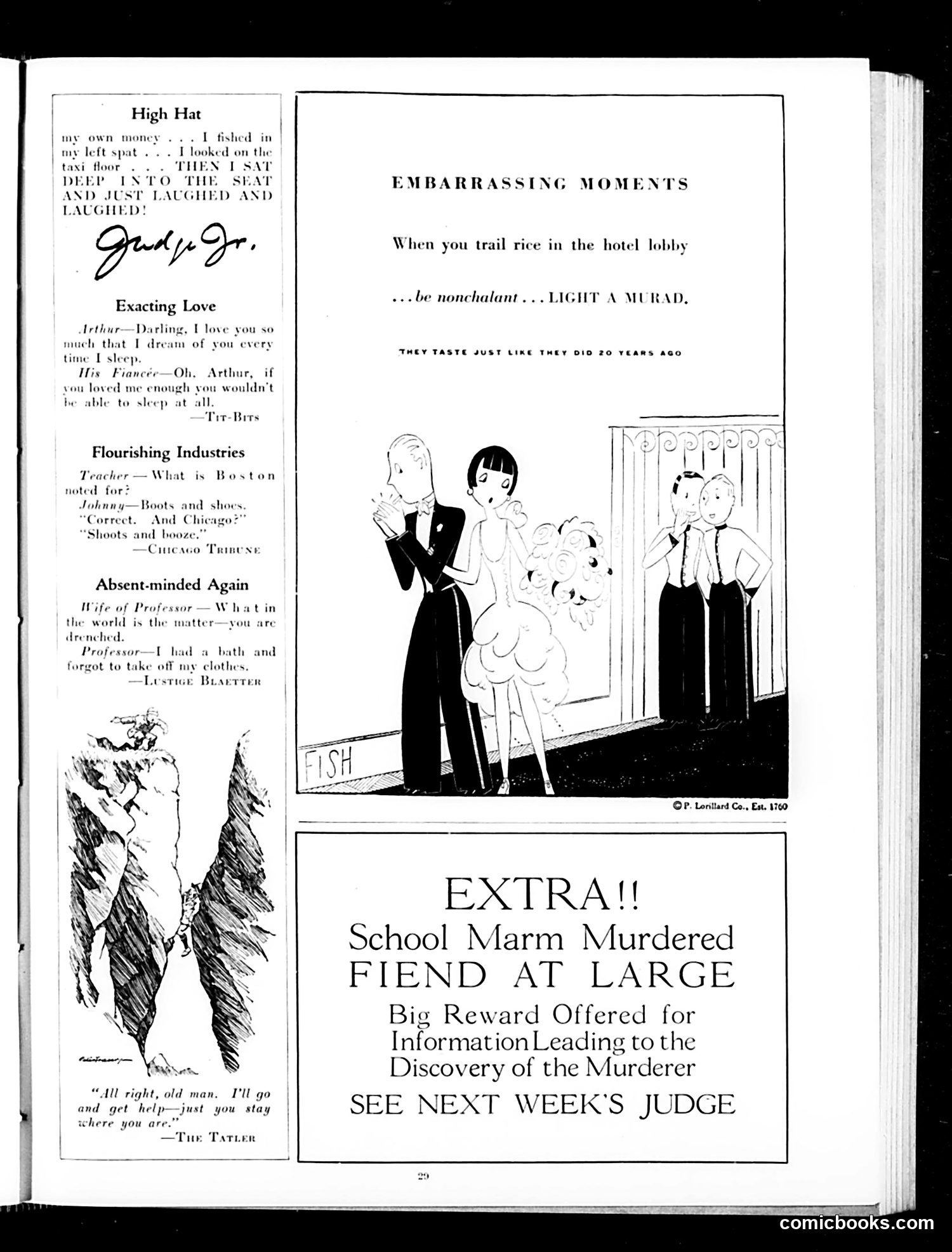
This page contains **humorous short jokes and satirical vignettes** typical of Judge magazine's style: **"Embarrassing Moments"** (center): A cartoon showing a woman trailing rice in a hotel lobby—a social embarrassment from wedding traditions. The joke: she's told to "light a Murad" (cigarette brand advertisement) to appear nonchalant. The cigarettes "taste just like they did 20 years ago"—a product endorsement disguised as humor. **Left column jokes** mock everyday absurdities: a man laughing at spilling money in a taxi, exaggerated romantic declarations, a Boston schoolboy noting the city is "noted for...boots and shoes...and shoots and booze" (Prohibition-era reference to illegal alcohol), and a professor bathing fully clothed. **"EXTRA!!" section** (bottom): A fake newspaper headline about a "School Marm Murdered"—likely satirizing sensationalist journalism and yellow press tactics common in the era. The page blends social commentary with advertising, typical of 1920s Judge content mixing satire, product placement, and gentle ridicule of contemporary customs.
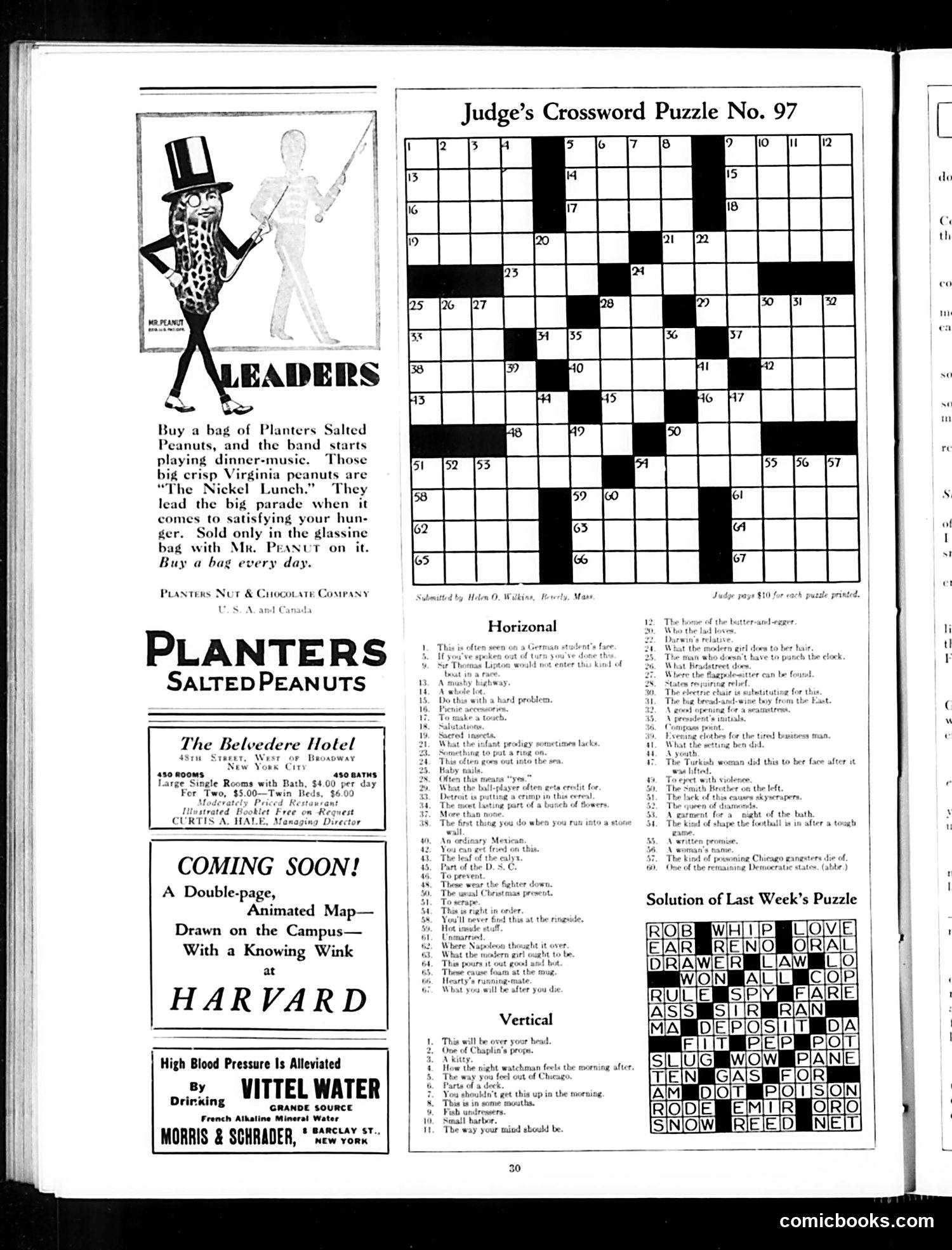
This page is primarily **advertising**, not editorial satire. The dominant content features a Planters Salted Peanuts advertisement with Mr. Peanut—the brand's iconic mascot in top hat and monocle—depicted as a dapper gentleman. The ad uses the slogan "The Nickel Lunch," marketing peanuts as an affordable, satisfying food during what appears to be the early 20th century. Below are ads for The Belvedere Hotel in New York, a Harvard-themed animated map announcement, and Vittel Water (a French mineral water claiming health benefits). The page reflects **early advertising culture** in satirical magazines, which generated revenue through branded content. The Mr. Peanut character epitomized genteel consumerism—associating a cheap snack with sophistication and class aspiration, a common marketing technique of the era. This represents how even humor magazines served as vehicles for commercial persuasion.
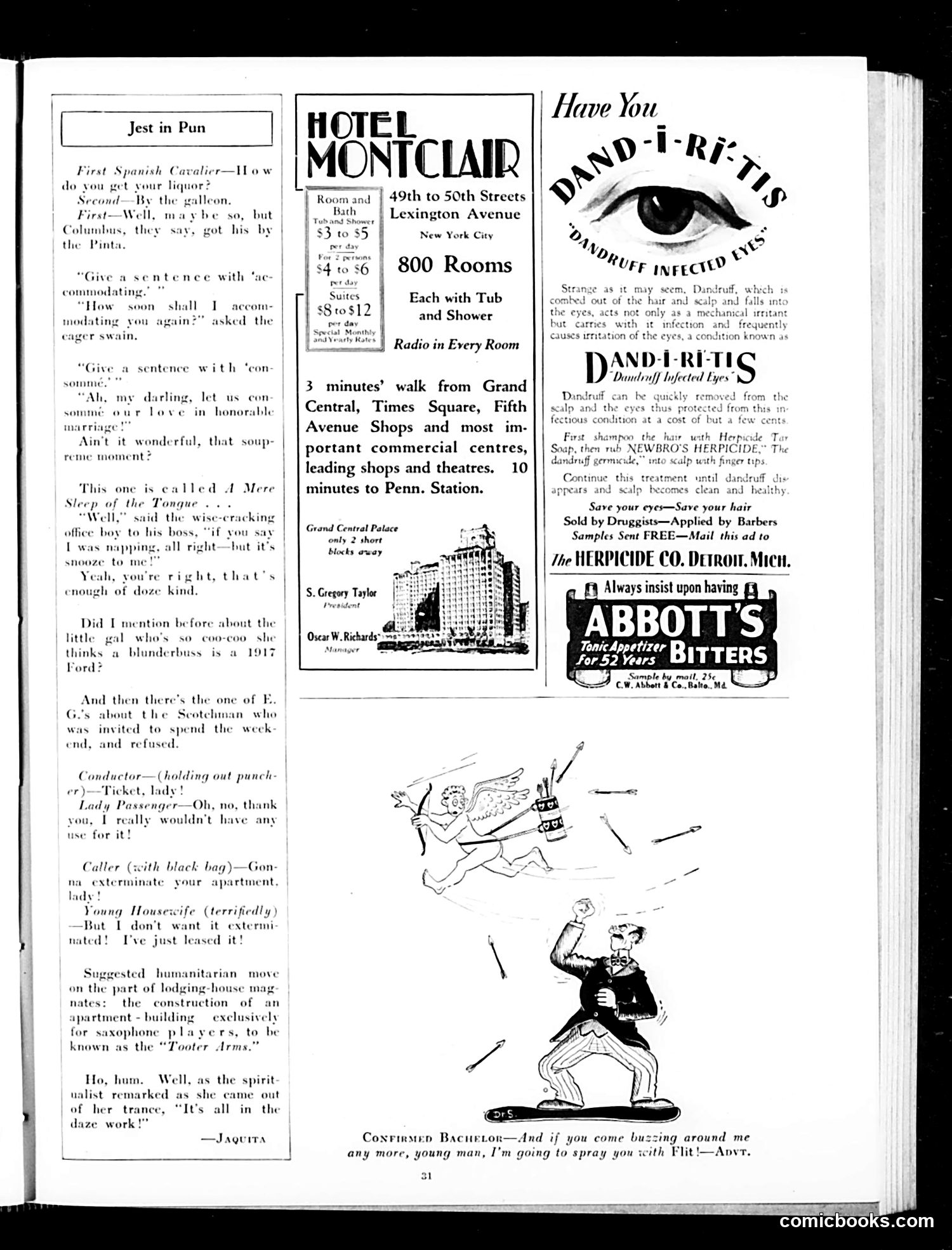
This page contains **humor and advertising** from Judge magazine. The "Jest in Pun" section offers lighthearted wordplay jokes typical of the era—puns about liquor ("Pinta"), soup ("consomme"), and apartment living. The cartoon at bottom shows a confirmed bachelor spraying an insect with "Flit" (an early insecticide brand), a visual joke threatening an unwanted suitor. The advertisements reflect period concerns: the Hotel Montclair ad emphasizes modern amenities (radio in every room), while the Dand-i-Ritis and Newbro's Herpicide ads address dandruff as both a hygiene and appearance issue—suggesting social stigma around the condition. Abbott's Bitters advertises a patent medicine (common then, now recognized as often ineffective or dangerous). The humor largely depends on early 20th-century social anxieties: apartment living, dating etiquette, and appearance standards—subjects that required comedic deflation in Judge's satirical tradition.
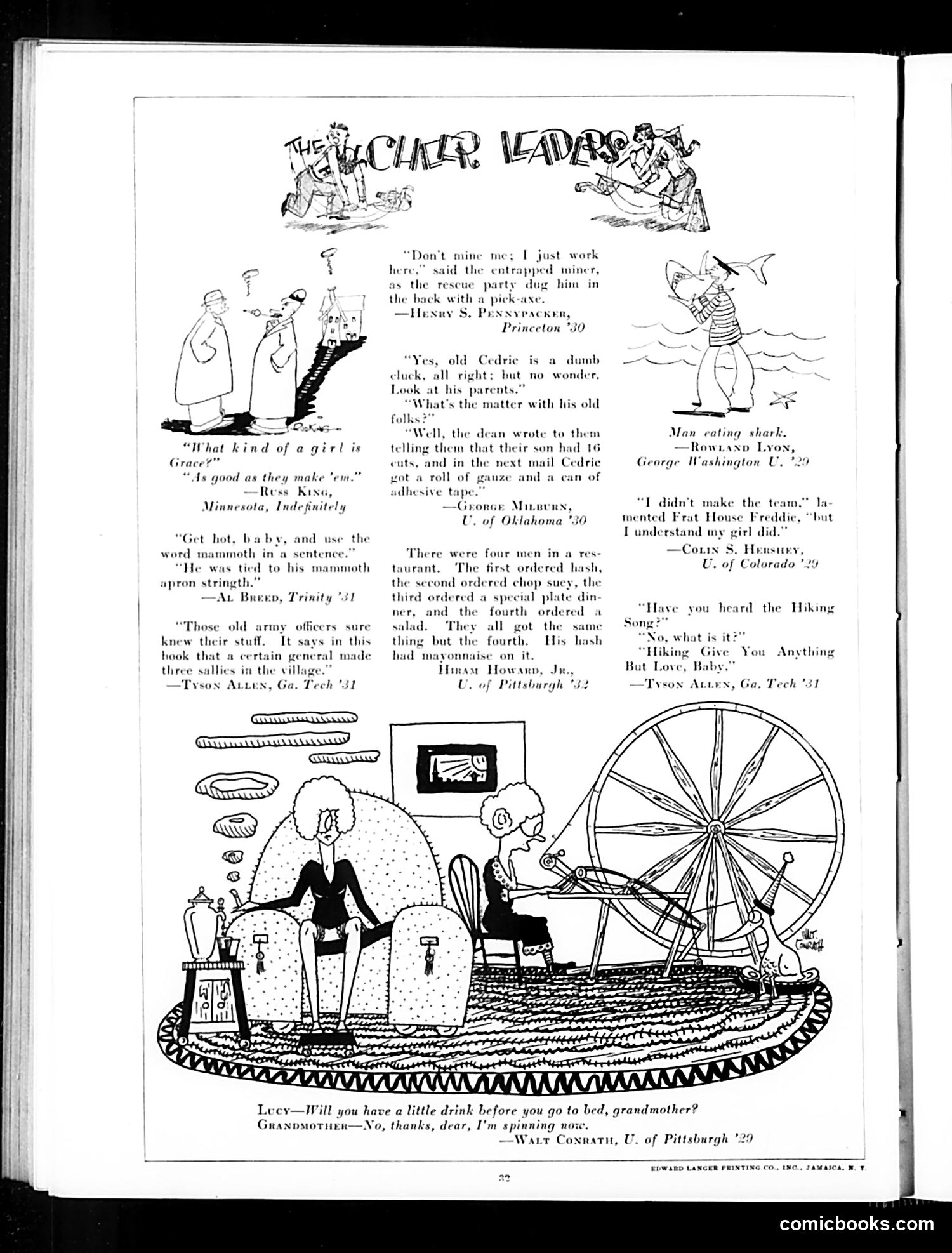
This page collects college-themed jokes and humorous quotes from students at American universities (circa 1929-1932), reflecting 1920s campus life and attitudes. The jokes reveal period concerns: parental strictness ("tied to his mammoth apron strings"), academic mediocrity ("Cedric is a dumb cluck"), disciplinary cuts and injuries, and gender dynamics ("didn't make the team...my girl did"—mocking male athletic failure). The large cartoon depicts idle leisure—a woman on a couch while another spins thread, with a ship's wheel visible—illustrating domestic entertainment before modern technology. The humor is genteel and relatively tame: wordplay on "sallies," observations about parental disappointment, and gentle ribbing of fraternity life. The bylines suggest these were student submissions, making the page a record of how college students found humor in their own experiences during the Jazz Age.
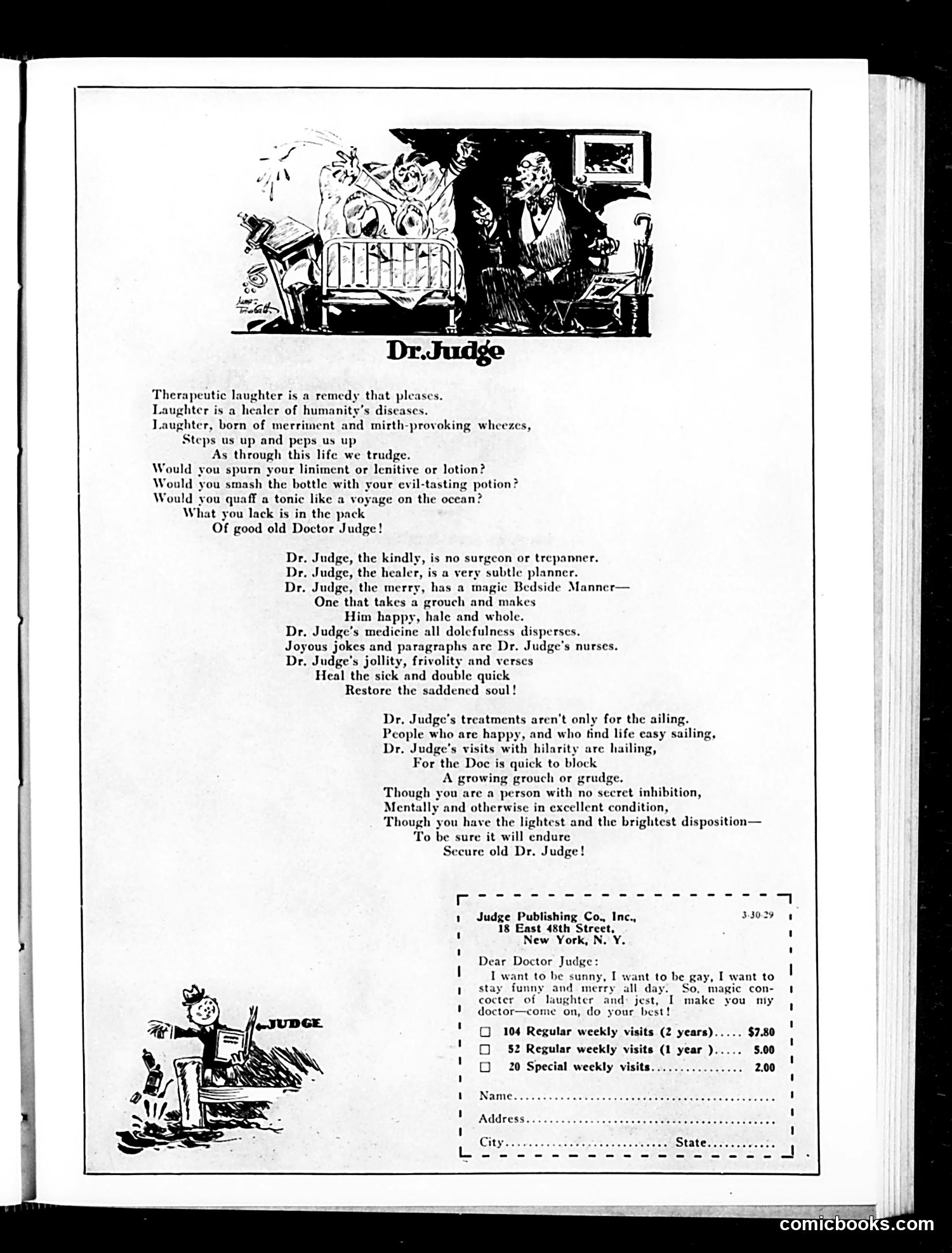
This is a **subscription advertisement** for *Judge* magazine itself, disguised as a humorous "medical" pitch. The page anthropomorphizes the magazine as "Dr. Judge"—a healer who prescribes laughter and humor as medicine for life's ailments. The cartoon shows a domestic scene with a baby in a crib and adults celebrating, illustrating the therapeutic effects of humor. The text uses mock-medical language ("liniment," "trepanner," "bedside manner") to argue that *Judge*'s jokes, paragraphs, and verses cure depression, grouch, and grudges—applicable to both the sick and the cheerful. The bottom section is a subscription order form offering three tiers: 104 weekly visits (2 years), 52 weekly visits (1 year), or 20 special weekly visits at different prices. The satire works by positioning comedy magazine consumption as preventative and curative "medicine"—a lighthearted sales pitch typical of early 20th-century American magazines.
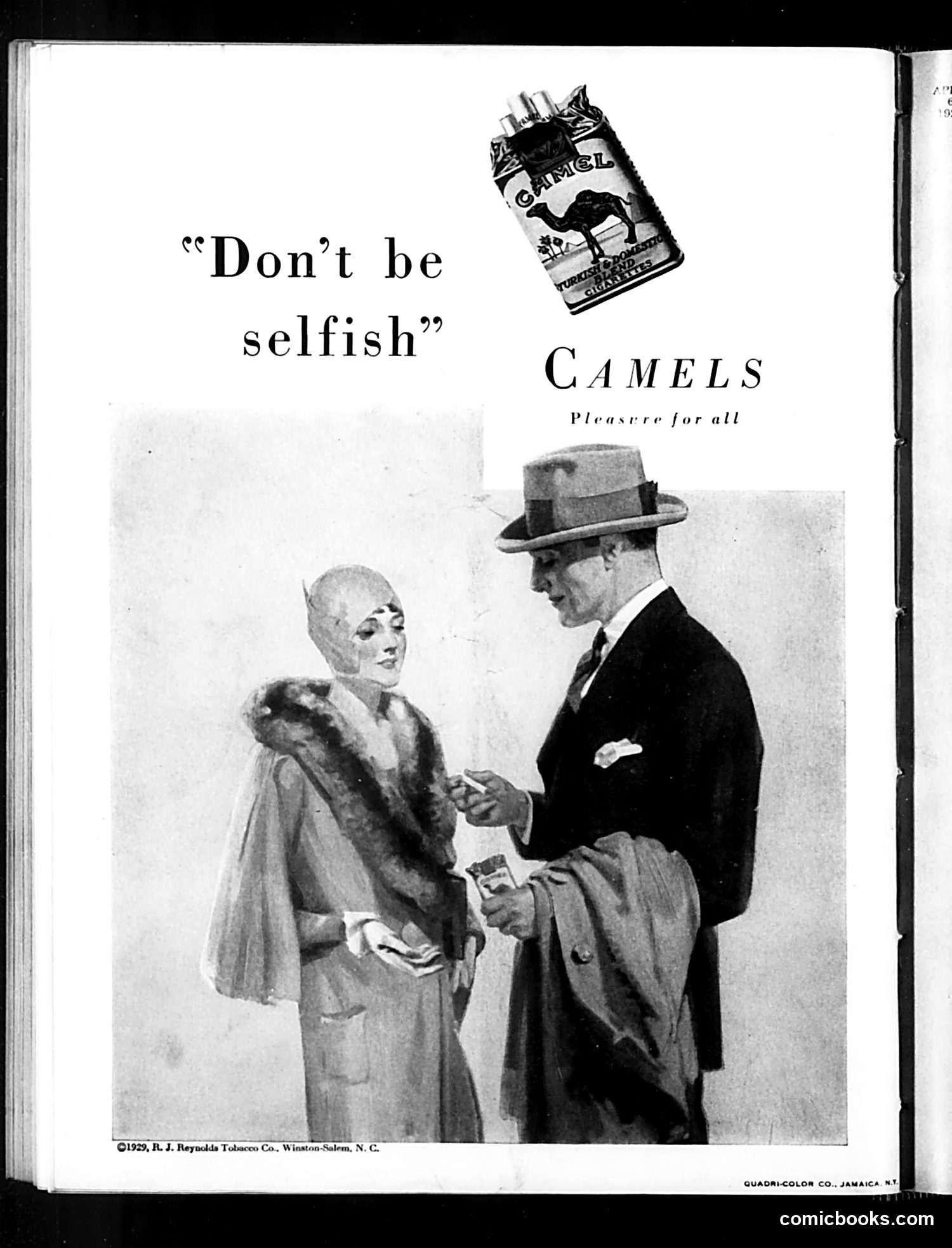
This is a **cigarette advertisement**, not political satire. The 1929 Camel ad uses a social appeal to promote smoking. The image shows a man offering a cigarette to a woman, with the slogan "Don't be selfish" — implying that refusing a cigarette is selfish behavior. The tagline "Pleasure for all" suggests smoking is a social, shareable activity. This reflects early 20th-century tobacco marketing that normalized smoking and associated it with sophistication and social graciousness. The ad targets both genders, depicting smoking as an acceptable social practice for women — relatively progressive for 1929, but ultimately designed to expand the cigarette market through peer pressure and social obligation. The copyright credit to R.J. Reynolds Tobacco Company confirms this is commercial advertising rather than editorial content.