
A complete issue · 36 pages · 1929
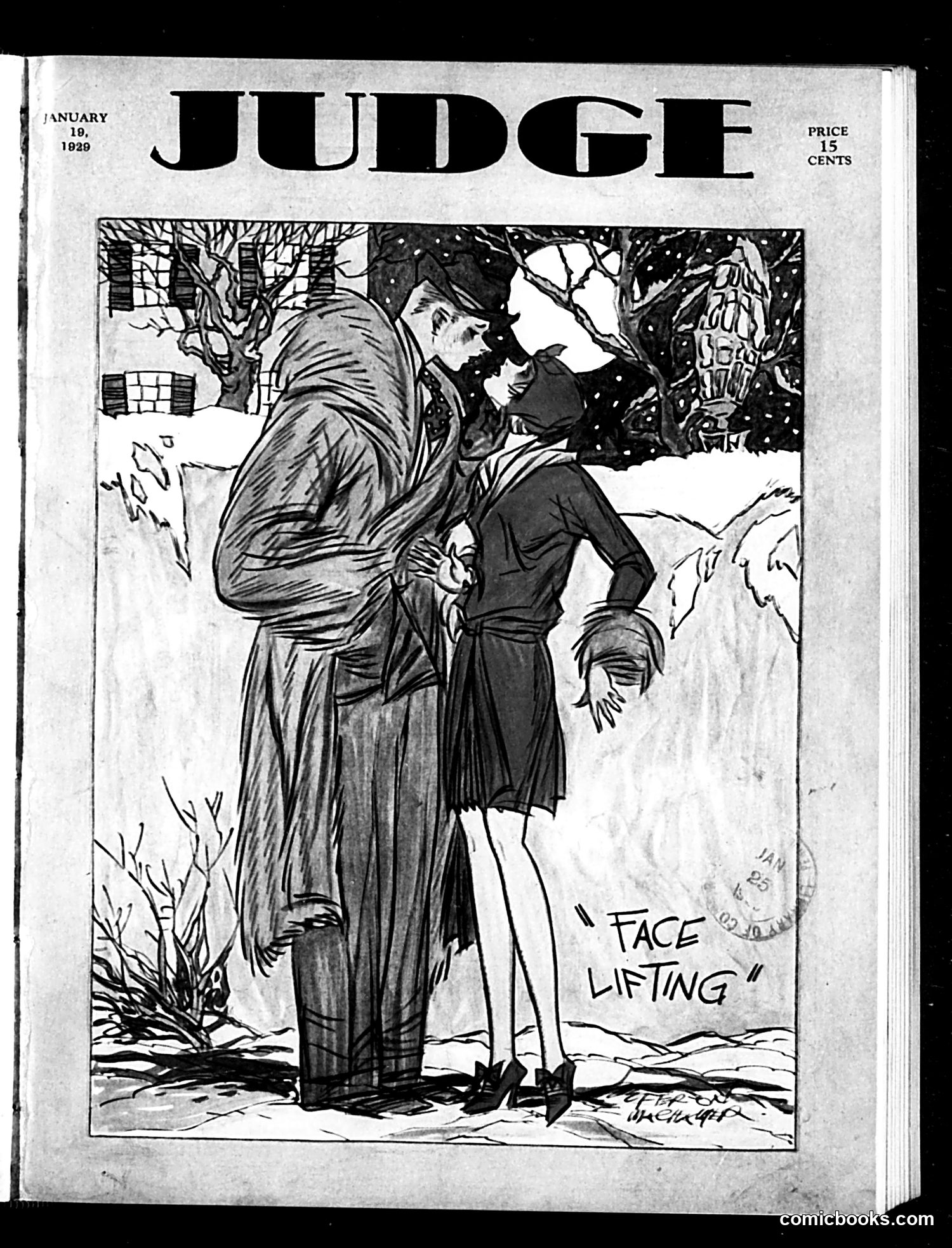
Judge — January 19, 1929
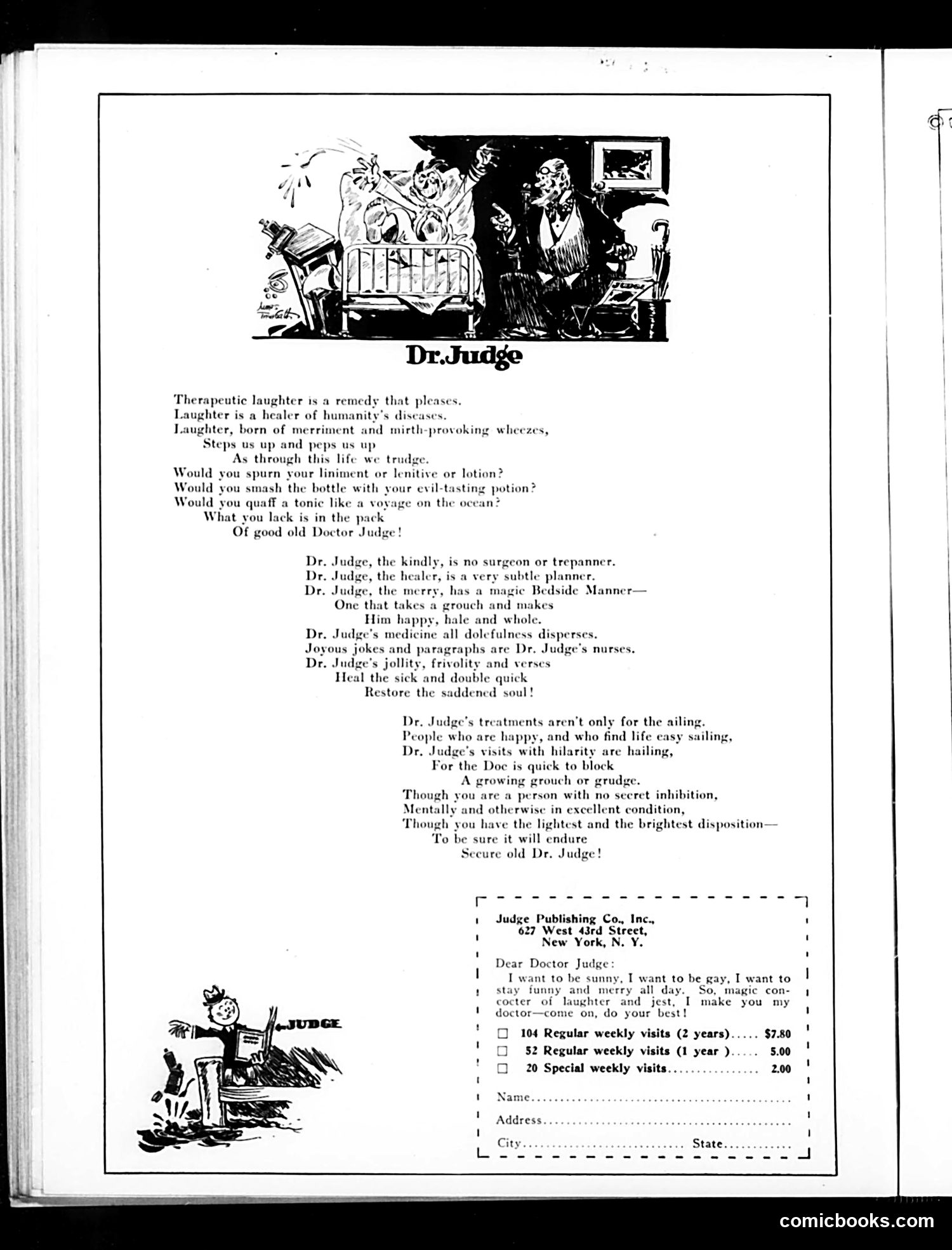
This page is primarily a **promotional advertisement** for "Judge" magazine itself, personified as "Dr. Judge"—a benevolent physician figure who treats society's ailments through humor and satire. The poem celebrates satirical comedy as therapeutic medicine: laughter heals "humanity's diseases." Dr. Judge is portrayed as a "kindly" healer whose "joyous jokes and paragraphs" serve as "nurses," and whose "jolly, frivolity and verses" restore mental and physical health to both the sick and the psychologically burdened. The bottom section includes a **subscription offer** for different visit packages (104, 52, or 20 weekly visits at varying prices), treating magazine subscriptions as medical treatments. The cartoons show Dr. Judge in clinical settings, reinforcing the metaphor of satire-as-medicine—a common early-20th-century marketing conceit for humor publications.
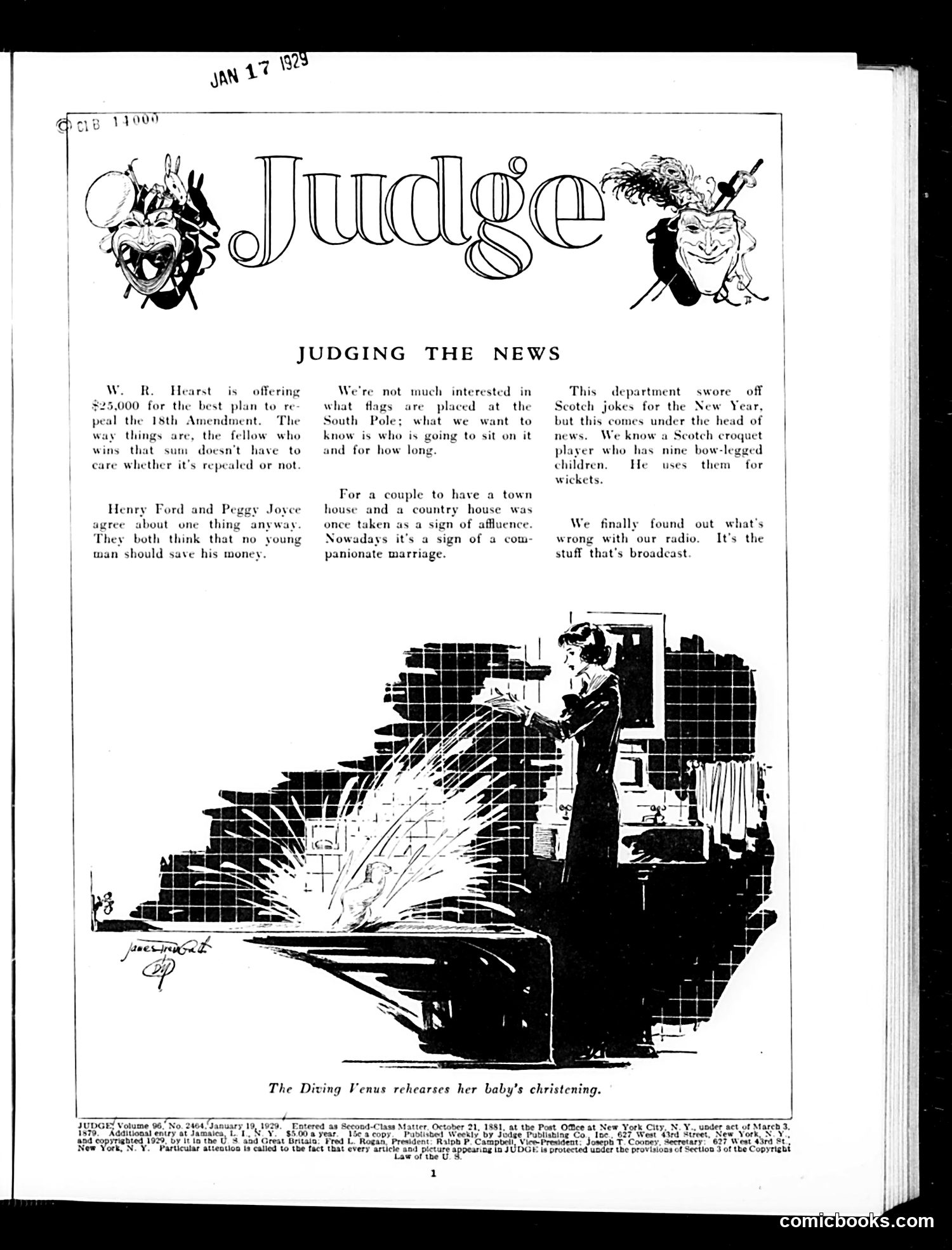
This page satirizes contemporary social attitudes through three brief commentaries under "Judging the News": 1. **W.R. Hearst's $50,000 offer** to repeal the 15th Amendment (voting rights) is mocked as pointless—whether repealed or not, wealthy people like Hearst won't care about the outcome. 2. **Henry Ford and Peggy Joyce** are criticized for promoting the idea that young men shouldn't save money, viewed as frivolous financial advice. 3. **A radio broadcast complaint**: The magazine jokes that they finally discovered what's "wrong" with radio—the actual broadcast content itself. The bottom cartoon depicts a woman (captioned "The Divan Venus rehearses her baby's christening") seemingly preparing to throw or destroy a large object, satirizing modern, irreverent attitudes toward traditional ceremonies.
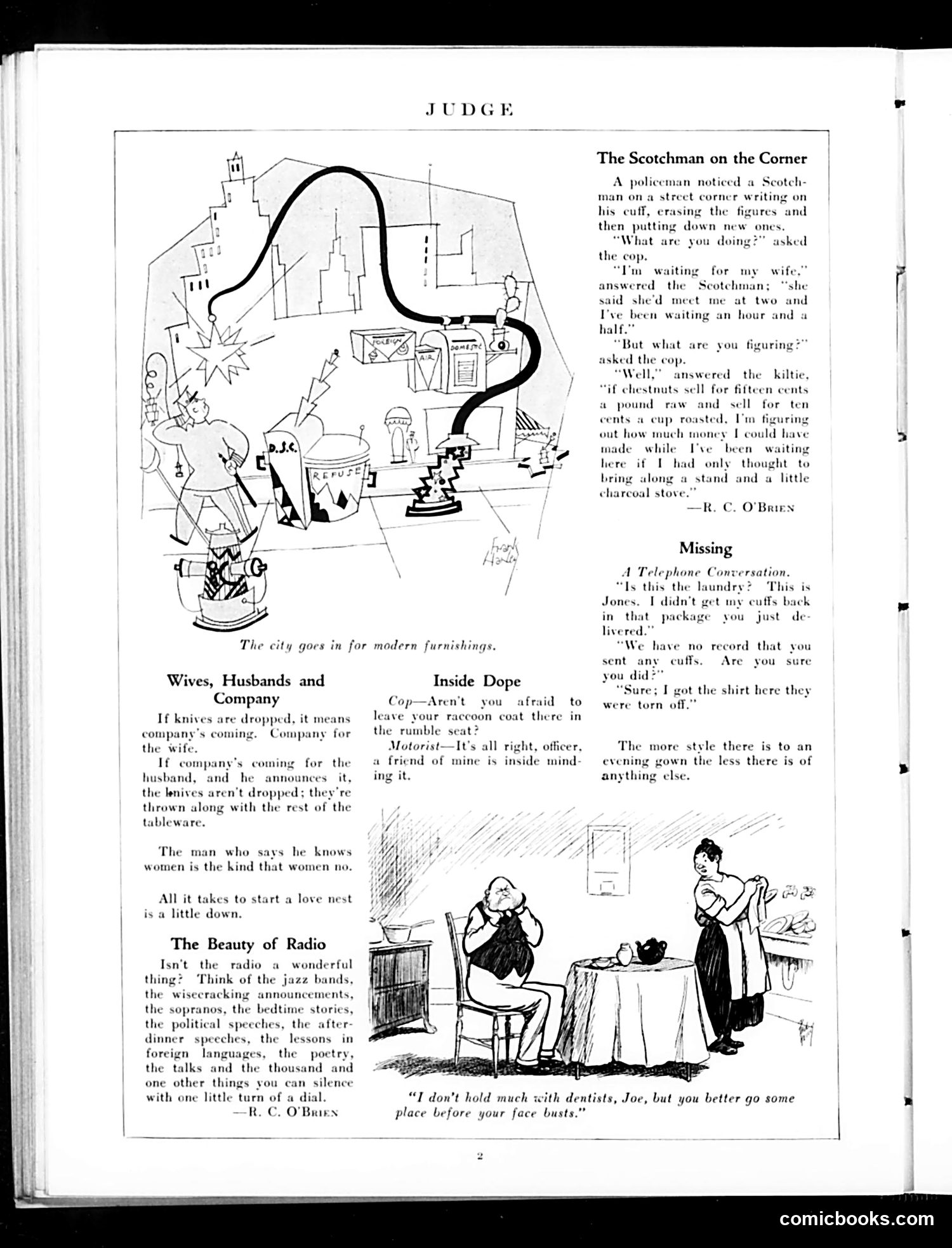
This page contains several humor pieces satirizing 1920s American domestic life and consumer culture: **"The Scotchman on the Corner"** depicts a Scottish immigrant doing street calculations—figuring potential profits from selling chestnuts and roasted items while waiting for his wife. The joke plays on Scottish stereotypes of frugality and commercial shrewdness. **"Wives, Husbands and Company"** mocks marital dynamics, suggesting wives drop their good behavior when company arrives, while husbands remain consistent. **"The Beauty of Radio"** praises radio as entertainment requiring no effort. **"Inside Dope"** and **"Missing"** are brief comedic anecdotes about laundry mix-ups and dental work—typical domestic humor. The bottom cartoon shows a woman advising a man ("Joe") to visit a dentist before a date, suggesting vanity and courtship anxieties of the era.
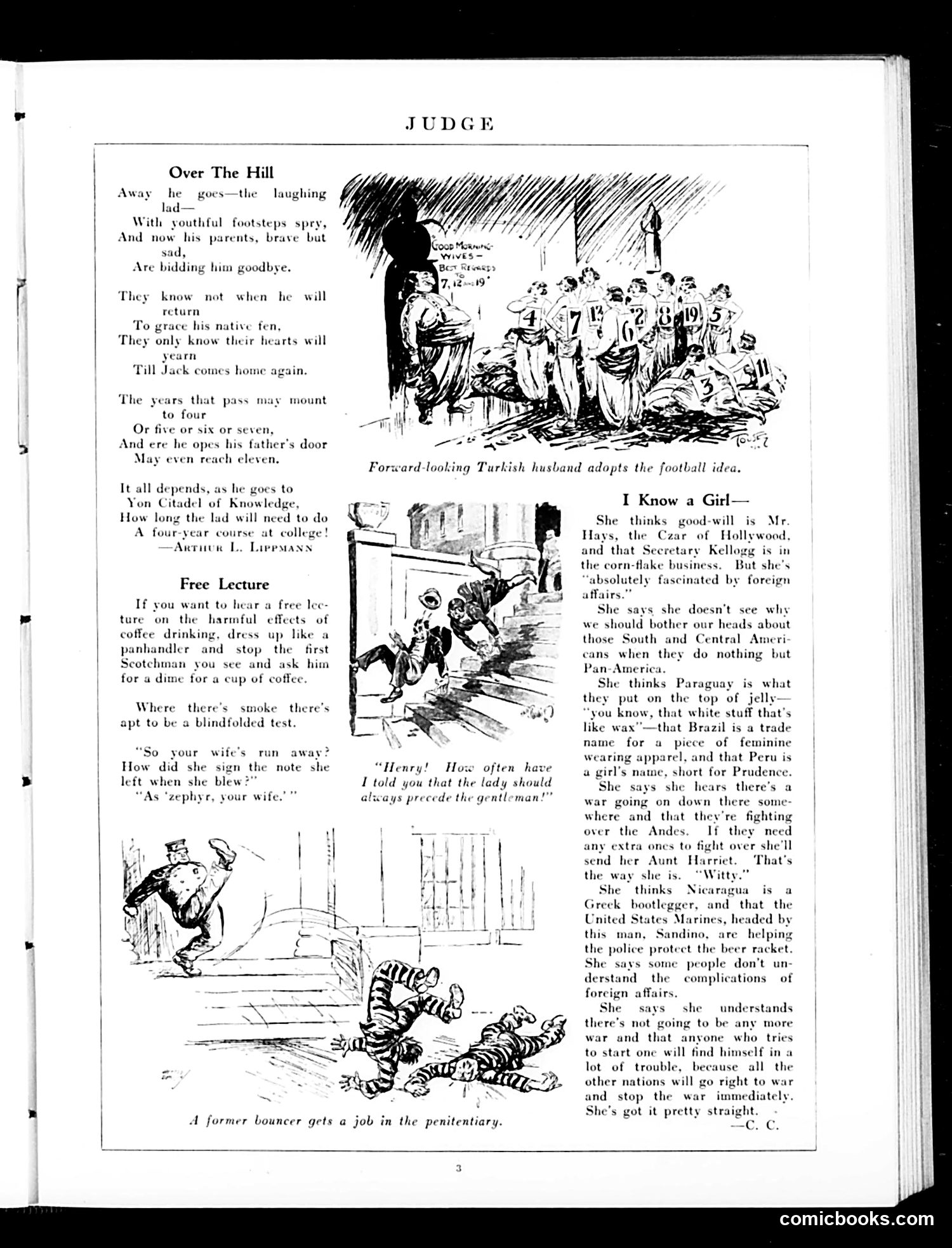
This page contains three distinct pieces of satire: 1. **"Over The Hill"**: A poem about soldiers departing for war, illustrated by a figure (likely Death or a reaper) watching young men march away. The satirical point critiques the lengthy service commitment—soldiers may not return for years, evoking WWI anxieties about prolonged military deployment. 2. **"Free Lecture"**: A humorous sketch mocking a panhandler's manipulation tactics, playing on period stereotypes about con artists. 3. **"I Know a Girl"**: Social satire about an ignorant woman who holds naive, contradictory views on foreign affairs—she confuses geography, misunderstands political situations (Paraguay, Peru, Nicaragua), and dismisses international conflicts as unimportant. The satire targets American isolationism and public ignorance about global events.
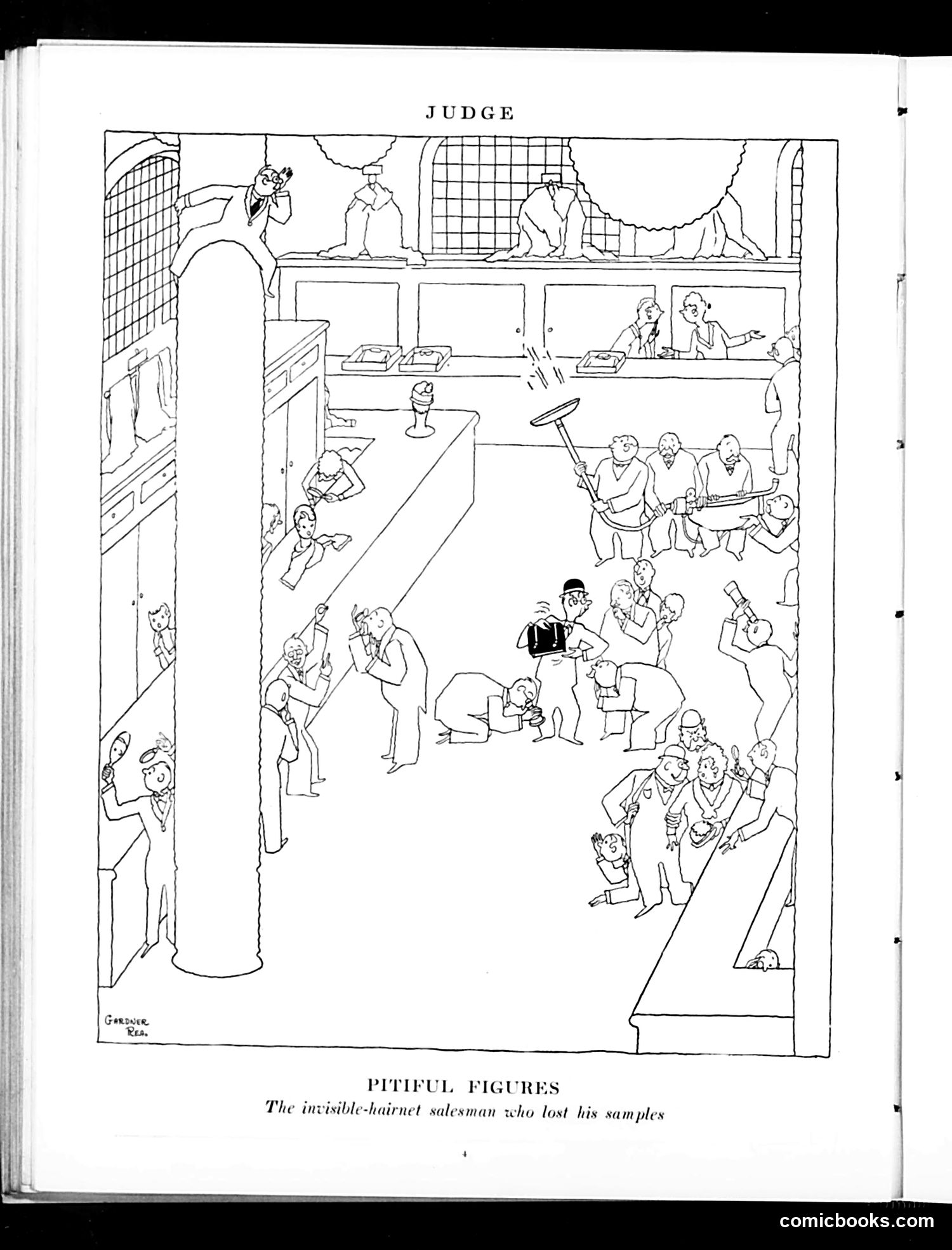
This is a courtroom scene titled "Pitiful Figures: The invisible-hairnet salesman who lost his samples." The cartoon satirizes a salesman's misfortune in a judicial setting. The scene depicts chaos in what appears to be a courtroom, with numerous figures engaged in seemingly chaotic activity around a central judge's bench. The "invisible-hairnet salesman" likely refers to someone selling a product so worthless or absurd—invisible hairnets—that losing his samples causes legal complications or becomes a matter for court proceedings. The humor derives from the absurdity: invisible products have no practical value, yet the salesman pursues legal recourse when losing them. This mocks both frivolous lawsuits and questionable sales practices common in the era. The crowded, disorderly courtroom emphasizes the ridiculous nature of the dispute.
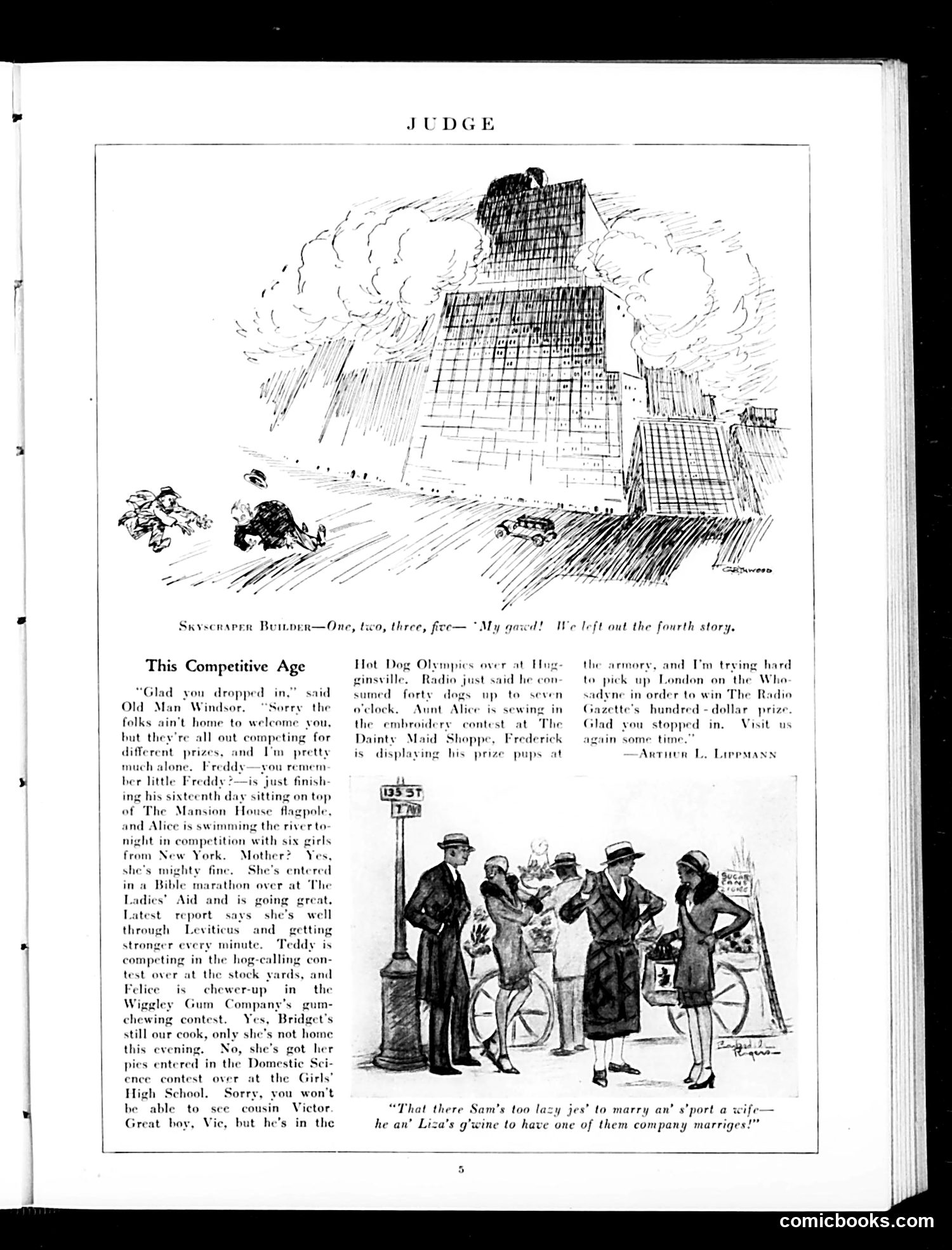
This page contains two separate pieces of social satire: **Top cartoon** ("Skyscraper Builder"): Depicts workers constructing a massive skyscraper, with the caption joking they "left out the fourth story." This likely satirizes either incomplete construction projects or the phrase "left out" having double meaning—perhaps critiquing rushed urban development or workers' competence during the building boom era. **Bottom section** mixes commentary on competitive activities (swimming, radio contests, cooking competitions) with a romantic caption about Sam being "too lazy" to marry, with Liza getting "company marriages" instead. This appears to satirize both the era's competitive social contests and dating/marriage customs, though the exact reference remains unclear without more historical context. Both pieces target contemporary American social trends with gentle mockery typical of Judge magazine's humor.
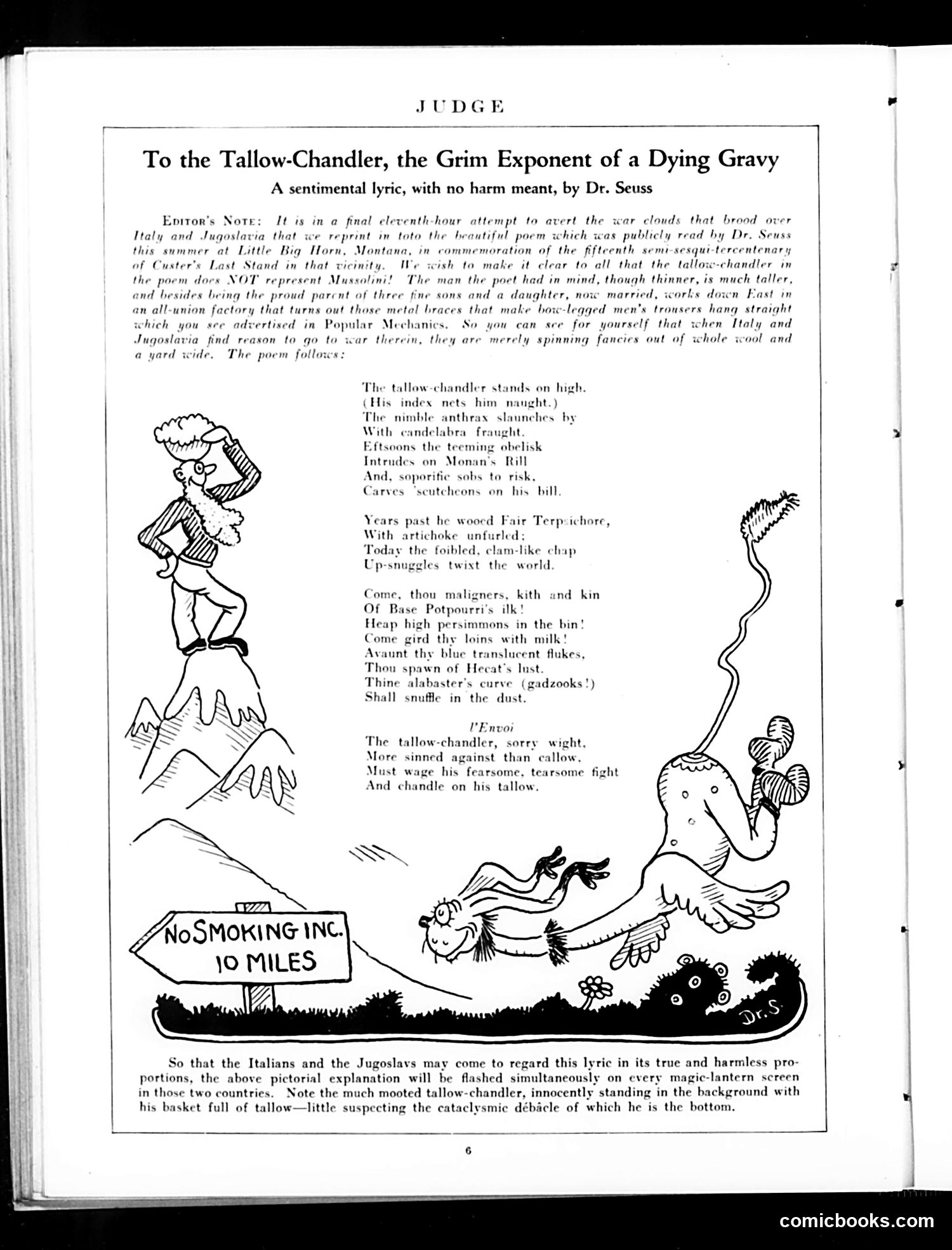
This 1930s Judge satire mocks diplomatic attempts to prevent war between Italy and Yugoslavia. Dr. Seuss wrote a deliberately nonsensical, pseudo-profound poem about a "tallow-chandler" (candle-maker)—a figure the editor's note insists does NOT represent Mussolini, while making clear through exaggerated denials that it obviously does. The satire works on multiple levels: the incomprehensible poem (full of made-up words like "eftsoons" and "gadzooks") ridicules flowery political rhetoric; the editor's elaborate disclaimers mock propaganda spin; and the whimsical cartoons underscore how absurd it is to think poetic recitations could prevent actual war. The joke targets both the futility of diplomatic gestures and the transparent propaganda of denying obvious meanings—suggesting that such efforts to avert conflict are mere fantasy.
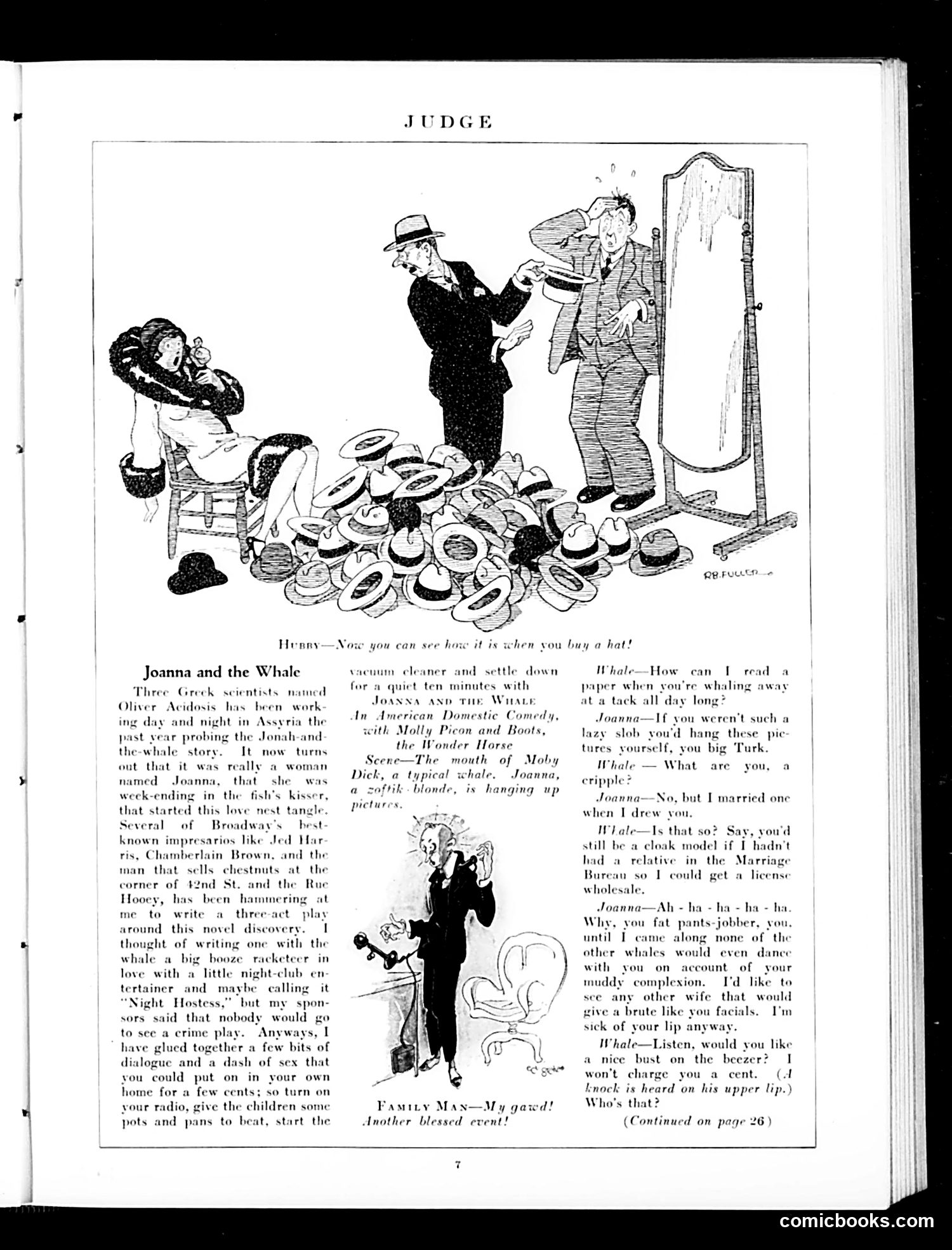
This is a comedic sketch satirizing domestic marital conflict by reimagining the Biblical story of Jonah and the whale as a quarrelsome marriage. The satire works through absurdist incongruity: a husband-whale and wife-Joanna bicker like a working-class couple in a tenement apartment, fighting over household chores and each spouse's perceived failings. The humor targets 1920s-30s urban marriage dynamics and gender relations. Joanna accuses her husband of laziness; he boasts of "rescuing" her from a modeling career through connections to the Marriage Bureau (satirizing arranged matchmaking). The dialogue uses Yiddish-inflected English ("zoftik," "pants-jobber"), suggesting Jewish immigrant working-class characters—a common Judge magazine subject. The sketch mocks both spousal bickering and the pretension of treating lowbrow domestic squabbles as worthy dramatic material for Broadway impresarios.
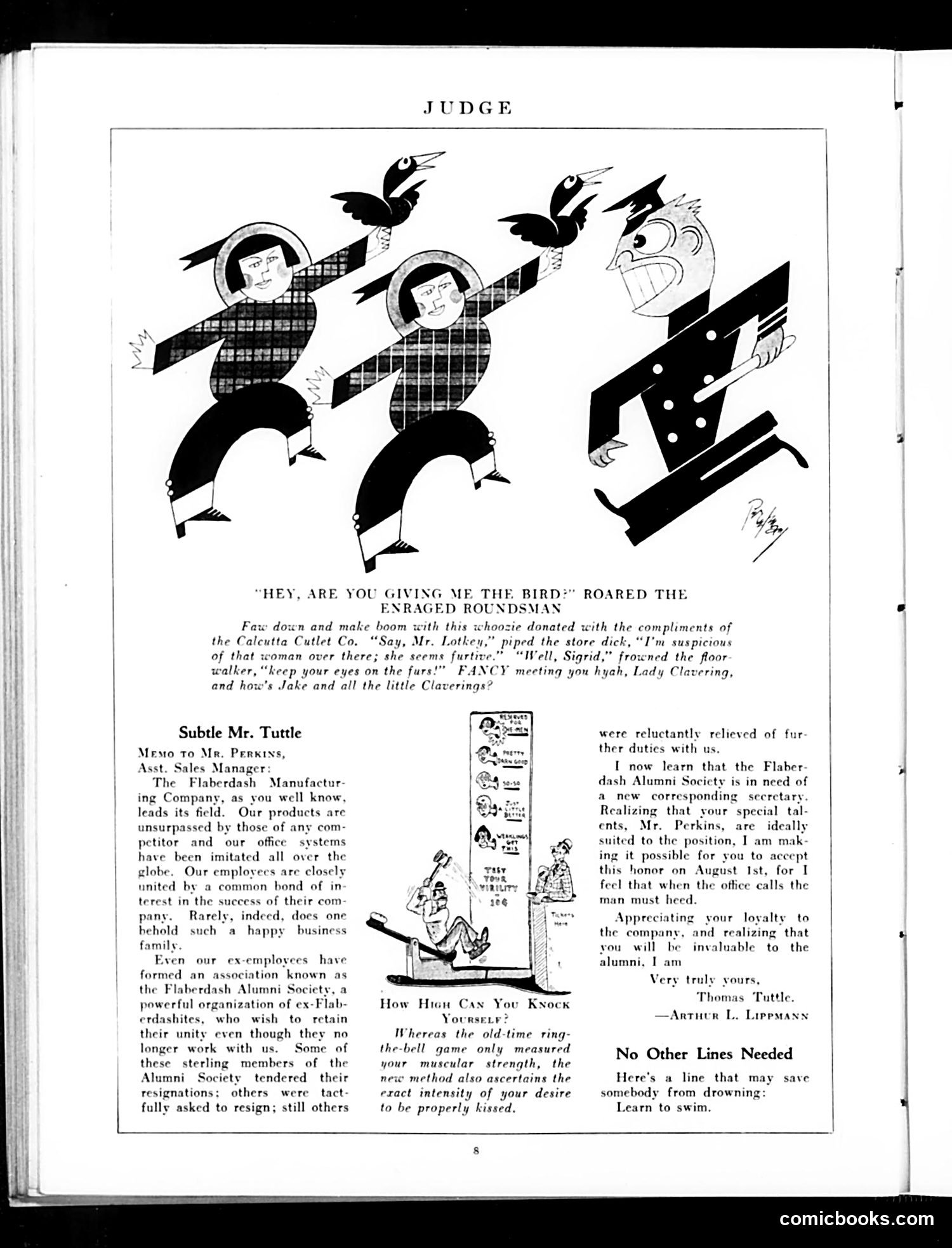
This Judge page contains three distinct satirical pieces: **Top cartoon**: Shows two women being chased by an angry man yelling "Hey, are you giving me the bird?" The joke plays on the phrase "giving the bird" (making a rude gesture). The scene appears to satirize street confrontations, with a store detective suspecting the women of theft ("keep your eyes on the furs!"). The humor relies on 1920s-era social anxieties about women's behavior and class anxiety. **"Subtle Mr. Tuttle"**: A corporate satire mocking hollow company loyalty. A boss memo praises employees as a "happy family" while simultaneously firing people ("tact-fully asked to resign"). The joke: he's now offering a fired manager a position in the "Alumni Society"—a thinly-veiled insult, making him organize other ex-employees. It's dark humor about corporate hypocrisy and how companies manipulate loyalty while disposing of workers. **Bottom items**: Brief jokes about strength-testing games and swimming safety. The overall page satirizes social pretense, corporate culture, and petty crime concerns of the era.
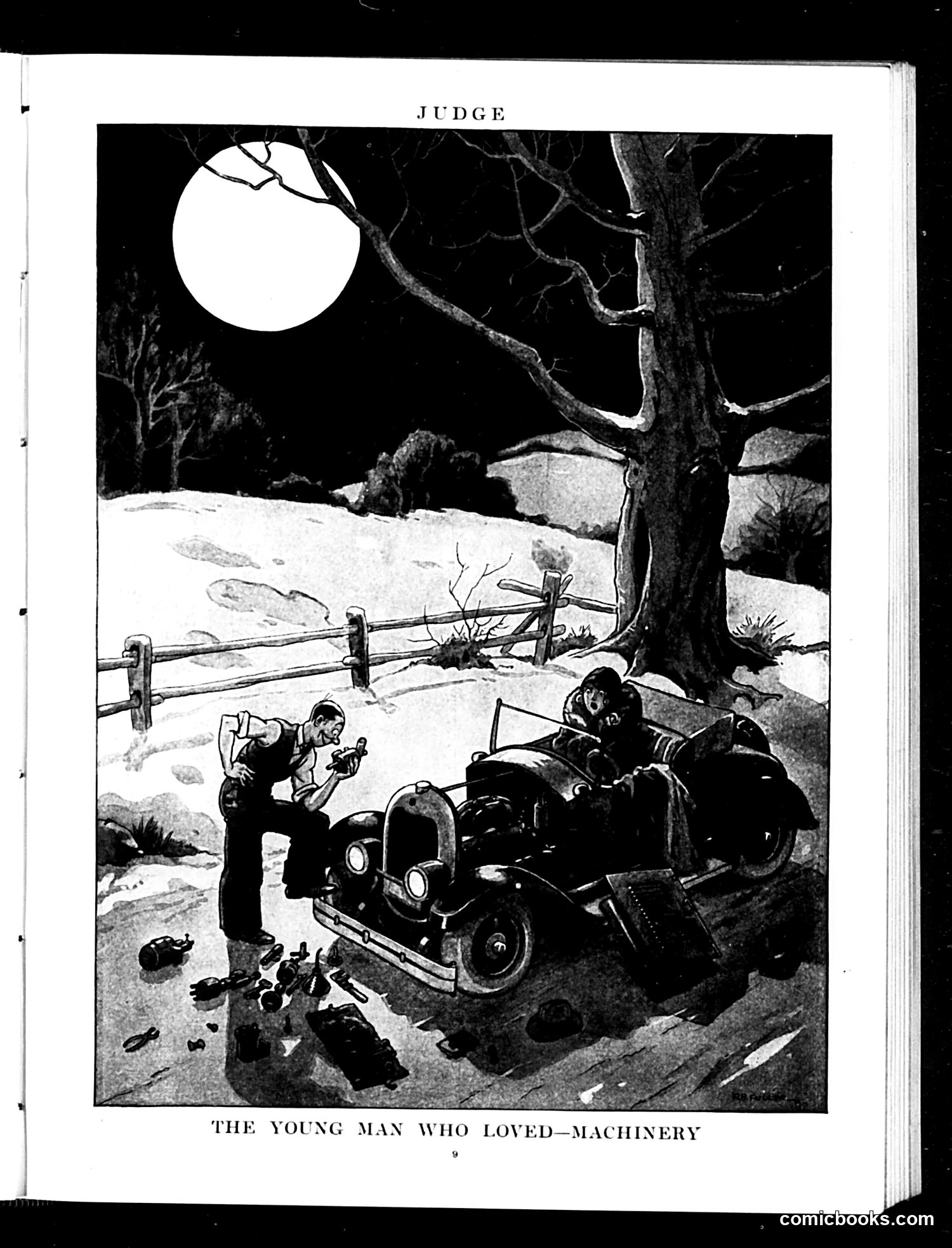
This appears to be a satirical illustration from *Judge* magazine depicting a young man examining or interacting with an automobile in a nighttime rural setting. The scene shows him gesturing toward a broken-down or damaged car beneath a bare tree and full moon, with a wooden fence visible in the background. The title's pun—"loved machinery"—suggests the satire targets either early automotive enthusiasm or perhaps romantic disappointment (the dash implying a twist). The image may mock the obsession with new automobiles, the mechanical failures common to early cars, or the foolishness of prioritizing vehicles over romance. Without additional context or the full article text, the specific satirical target remains unclear, though it likely comments on contemporary automotive culture or masculine priorities.
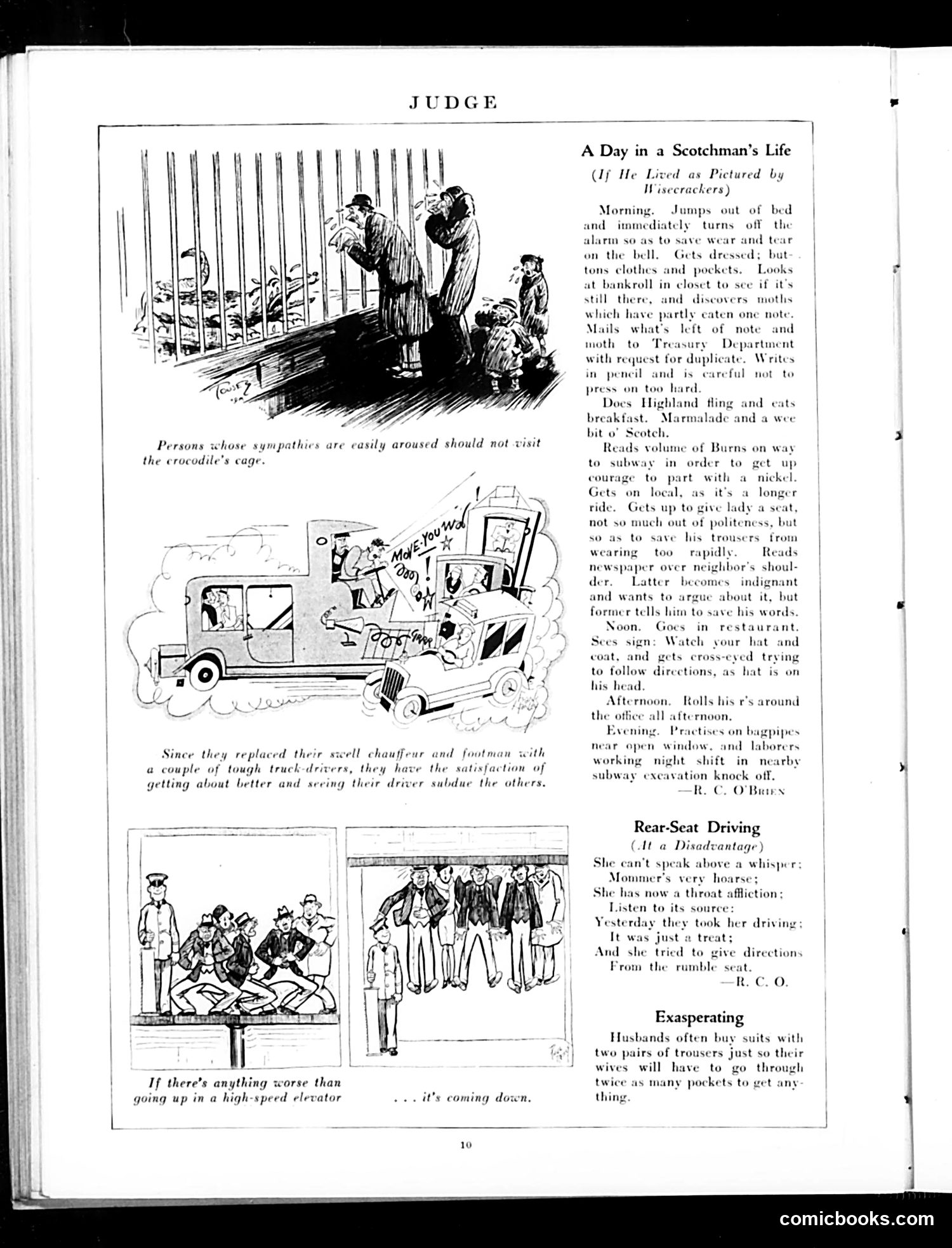
This page contains three humorous short pieces satirizing contemporary social observations, likely from the 1920s-30s based on style and references. **"A Day in a Scotchman's Life"** stereotypes Scottish people as obsessively frugal—turning off alarm clocks to save wear, checking bank deposits for moth damage, mailing damaged currency to the Treasury, needing courage to spend a nickel on the subway. The humor relies on exaggerated ethnic stereotyping common to the era. **"Rear-Seat Driving"** jokes about backseat passengers giving directions while sitting in the rumble seat (the external jump seat on older cars), with the added complication that the mother-in-law has a hoarse voice, making her instructions inaudible and ineffective. **"Exasperating"** presents a domestic joke: husbands buying suits with two pairs of trousers forces wives to search twice as many pockets when looking for items. The cartoons accompanying these pieces use simple line drawings. The page demonstrates Judge's style of combining satirical prose with illustrations to mock everyday social situations and ethnic stereotypes.
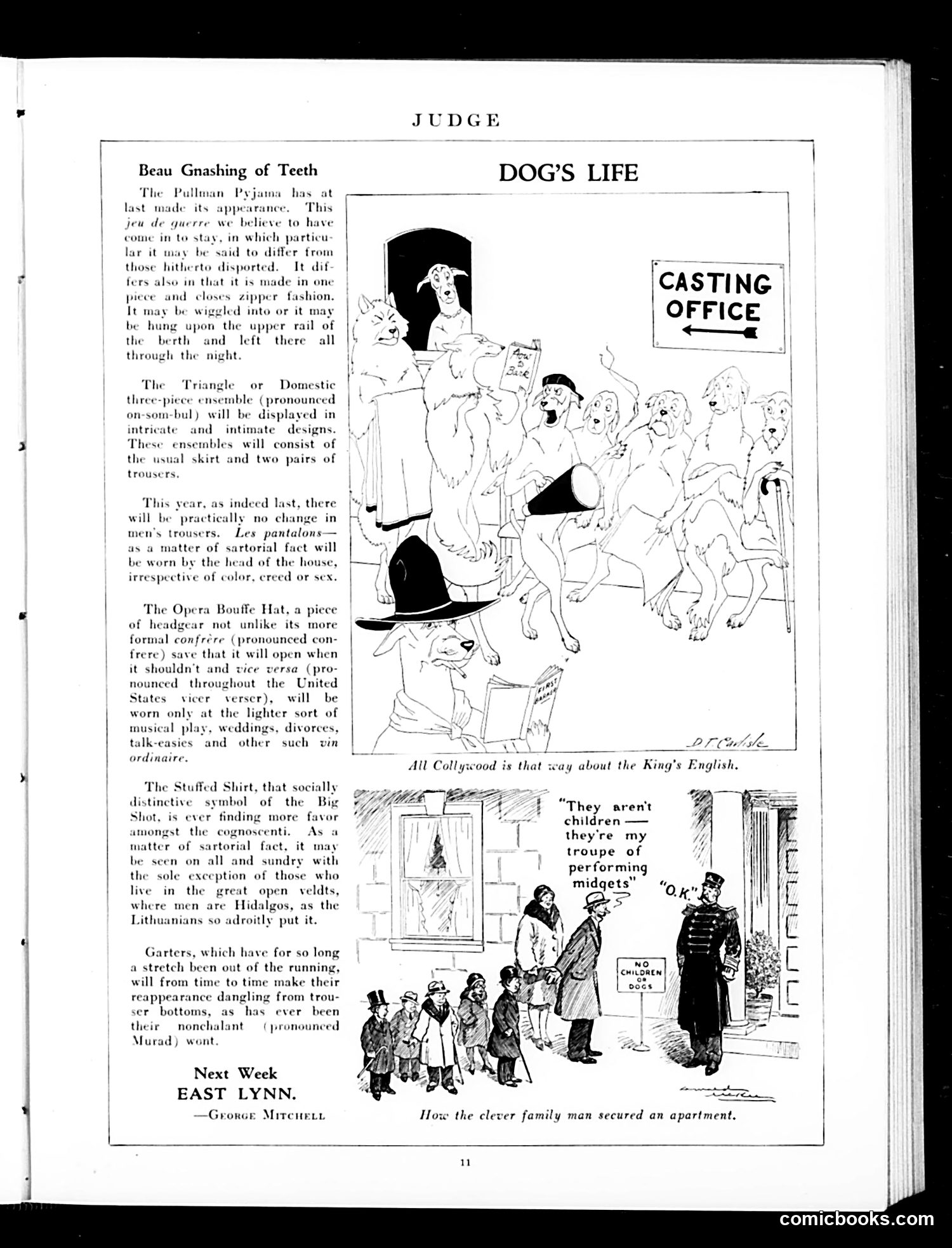
This page contains two distinct pieces of satirical content: **"Beau Gnashing of Teeth"** (left column) is a fashion commentary mocking men's formal wear trends. It uses French phrases ironically to describe supposedly sophisticated clothing—Pullman pajamas, the "Triangle" ensemble, opera hats, and stuffed shirts—with tongue-in-cheek descriptions of their impracticality. The satire targets pretentious fashion terminology and the absurdity of formal dress conventions. **"Dog's Life"** (right) shows two cartoons satirizing housing and employment. The top cartoon mocks a casting office where dogs audition, captioned "All Collywood is that way about the King's English." The bottom cartoon depicts a family man fraudulently securing an apartment by disguising children as a "troupe of performing midgets" to bypass housing discrimination against families. This exposes how landlords exploited housing shortages by refusing tenants with children—a genuine social problem of the era.
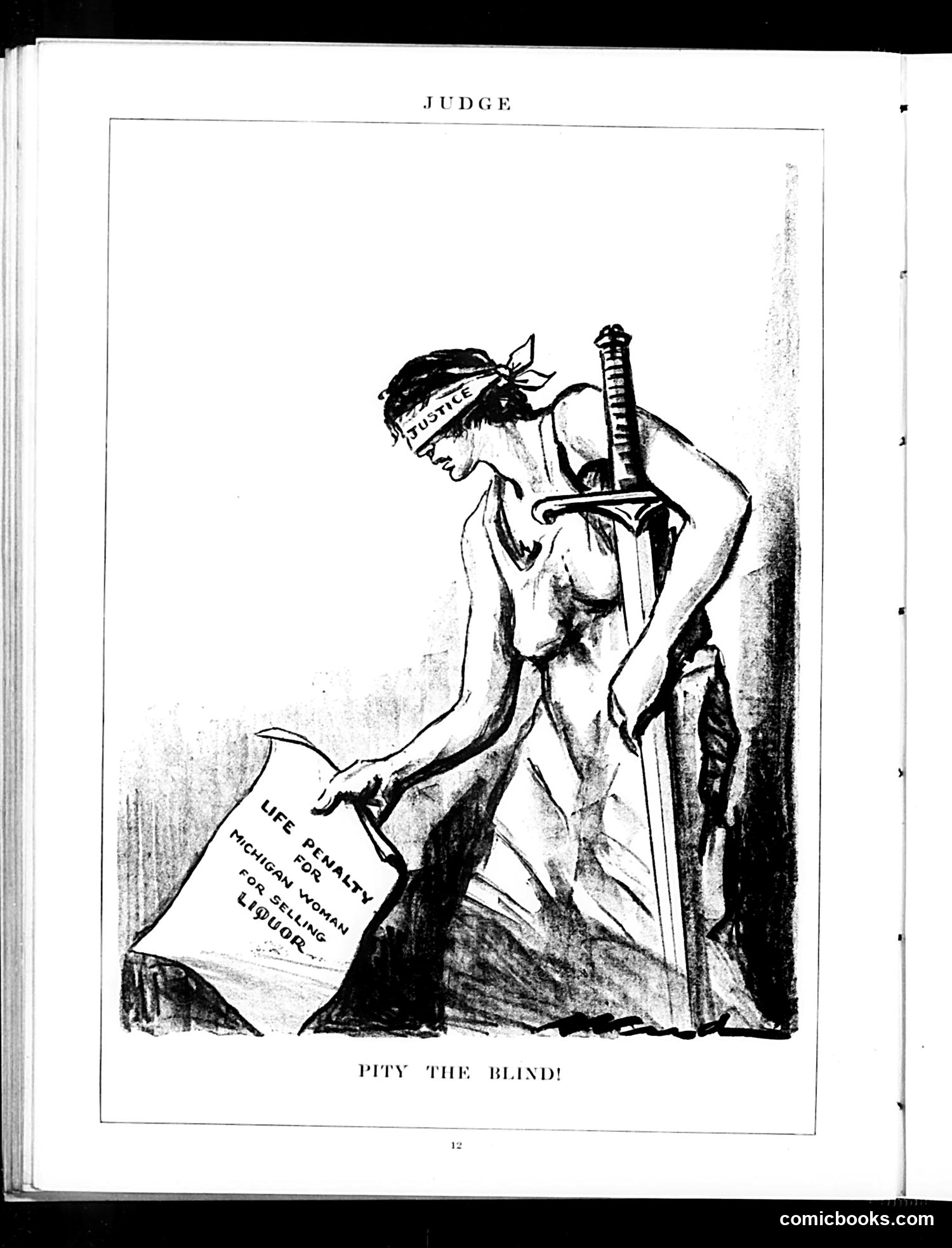
This satirical cartoon titled "PITY THE BLIND!" depicts Lady Justice, identifiable by her blindfold labeled "JUSTICE," wielding a sword. She's being handed a document reading "LIFE PENALTY FOR WOMAN SELLING LIQUOR" — apparently referencing prohibition-era laws. The satire's point appears to be criticizing the severity or perceived injustice of penalties for women involved in alcohol sales during Prohibition. The phrase "Pity the blind" suggests Justice is figuratively blind to reason or fairness in applying such harsh punishments. The cartoon likely critiques gender-based legal disparities or the excessive nature of prohibition enforcement, though the specific case or incident referenced is not identified in the visible text.
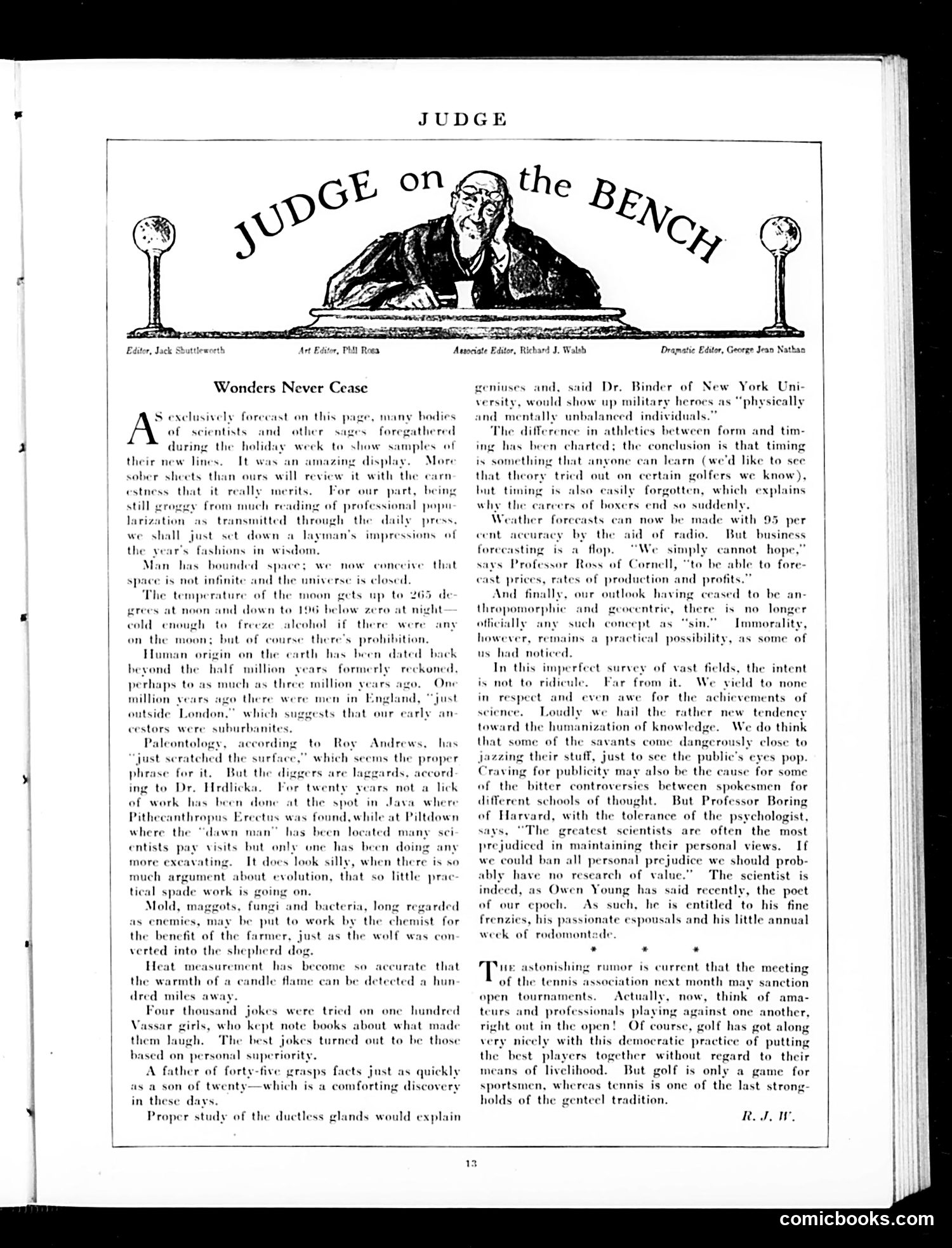
This page features Judge magazine's signature editorial column, "Judge on the Bench," presenting a humorous survey of recent scientific and intellectual developments. The column, titled "Wonders Never Cease," satirizes the era's scientific optimism by cataloging wildly disparate discoveries—from lunar temperatures to paleontological debates about human origins (referencing the famous Piltdown Man controversy). The author mocks both professional scientists and popular science journalism's breathless enthusiasm. The satire targets scientific pretension, particularly academics claiming to explain human behavior and genius through ductless glands and physical measurements. The column gently ridicules the gap between scientific certainty and practical application (weather forecasting fails despite radio technology). The piece also critiques scientists' self-aggrandizement—"jazzing their stuff, just to see the public's eyes pop"—suggesting publicity-seeking motivates some research over genuine inquiry. The illustration shows a traditional judge figure, indicating Judge's editorial authority on cultural commentary.
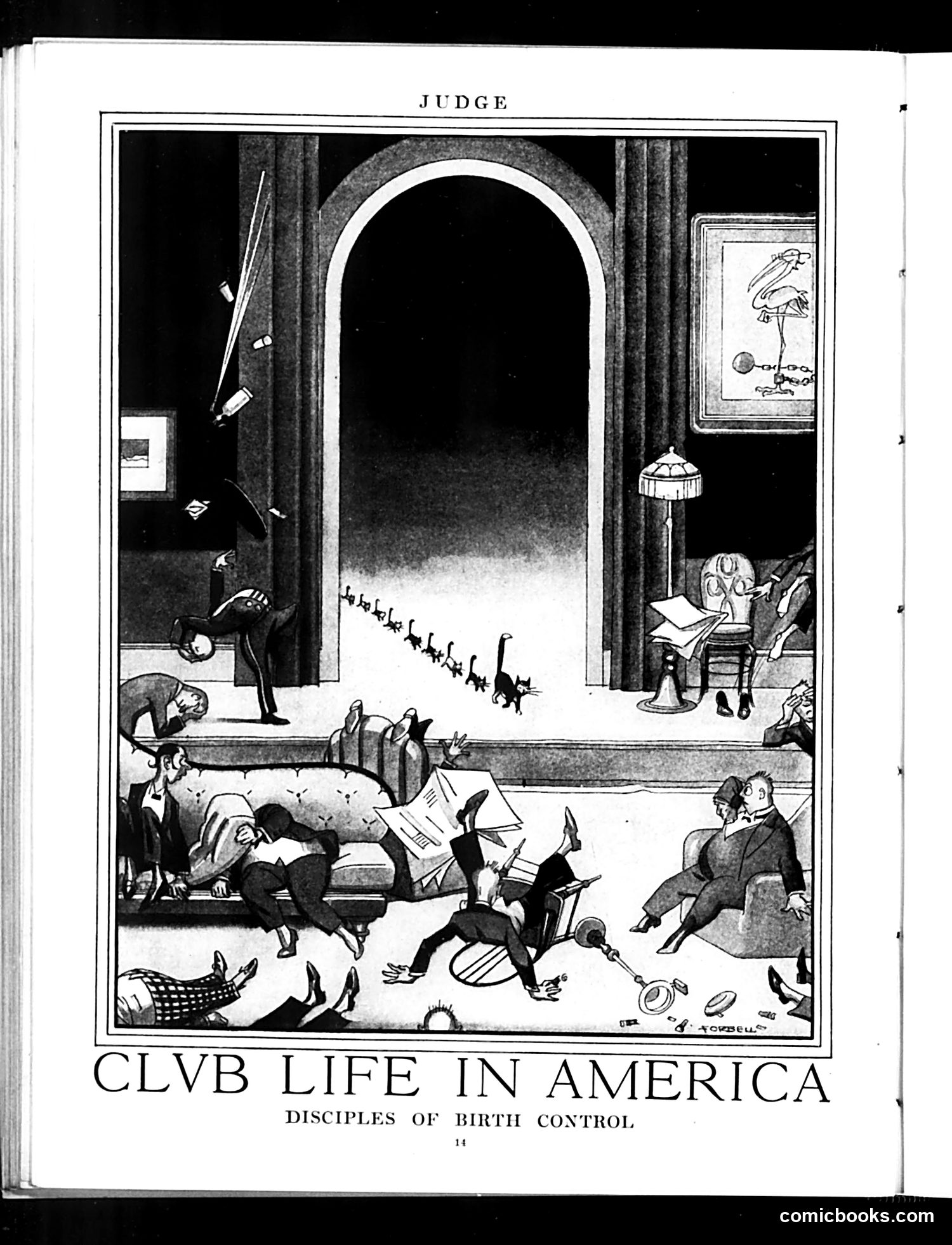
This satirical cartoon depicts a courtroom scene titled "Club Life in America: Disciples of Birth Control." The image shows chaos in what appears to be a judge's chamber—figures are scattered about in disarray, papers flying, suggesting disorder or scandal. The "birth control" reference likely alludes to the controversial contraception movement of the early 20th century, which faced legal and moral opposition. The "club life" framing suggests wealthy or elite social circles. The cartoon satirizes supporters of birth control as chaotic or disreputable, mocking them through the implied judicial condemnation shown in the courtroom setting. The overall message appears critical of birth control advocates, portraying them negatively to a Judge magazine audience. Without identifying specific caricatured individuals, the satire targets the movement itself as disruptive to American society.
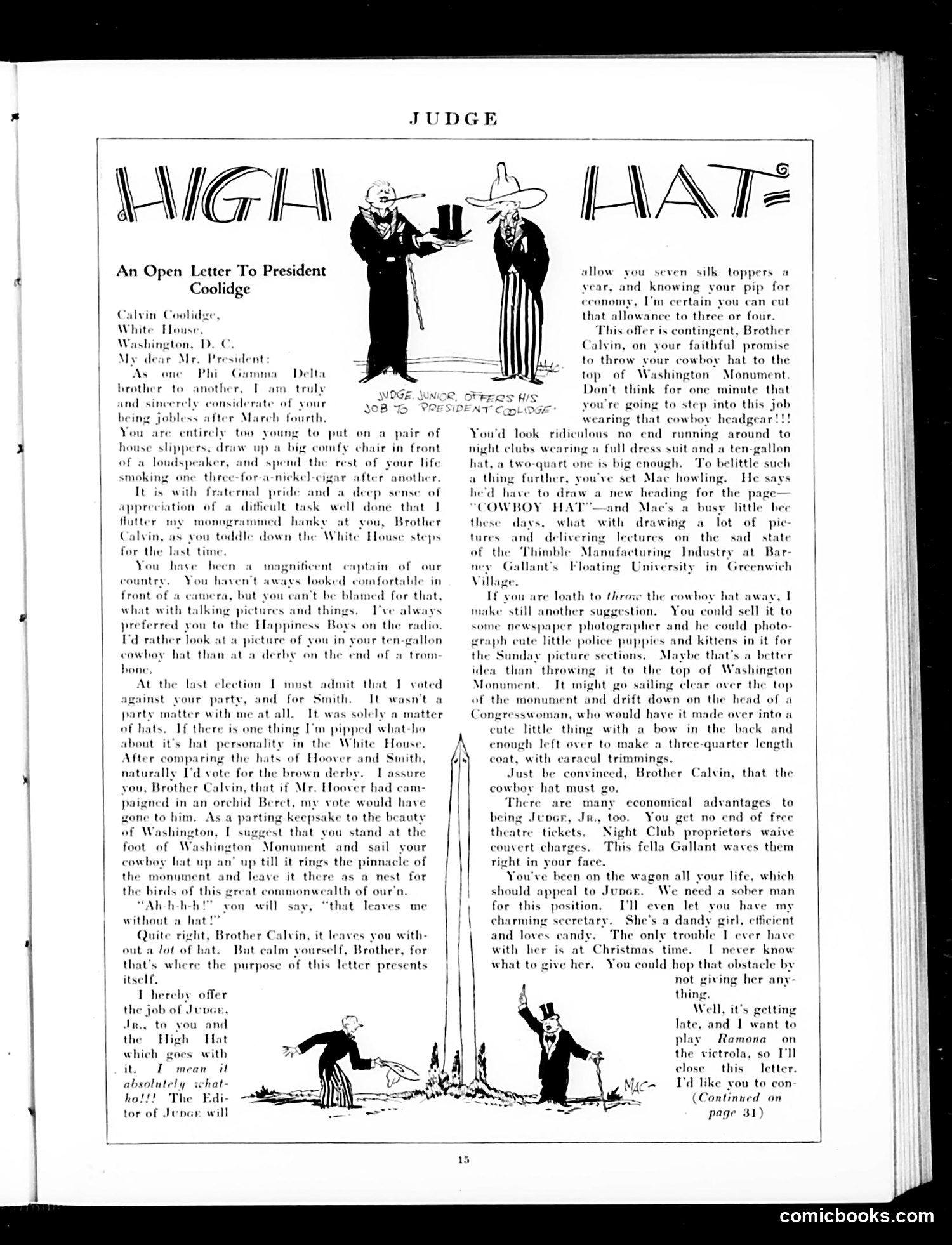
This is a satirical open letter to President Calvin Coolidge from the editor of *Judge* magazine, written as his presidency ends (likely 1929). The humor centers on Coolidge's famous taciturnity and his association with a ten-gallon cowboy hat—apparently a notable fashion quirk. The satire works on multiple levels: the writer, claiming fraternal fraternity bonds with Coolidge, mock-seriously urges him to retire gracefully rather than become a figurehead, and jokingly offers him a job as editor of *Jeuno* magazine—but only if he abandons the cowboy hat, which the writer claims would make Coolidge look ridiculous and cause headaches for the magazine's illustrator, Mac. The cartoons show Coolidge in formal dress alongside figures in top hats, emphasizing the contrast between his preferred cowboy style and Washington's formal expectations. The satire gently mocks both Coolidge's personal style and the stuffiness of political convention.
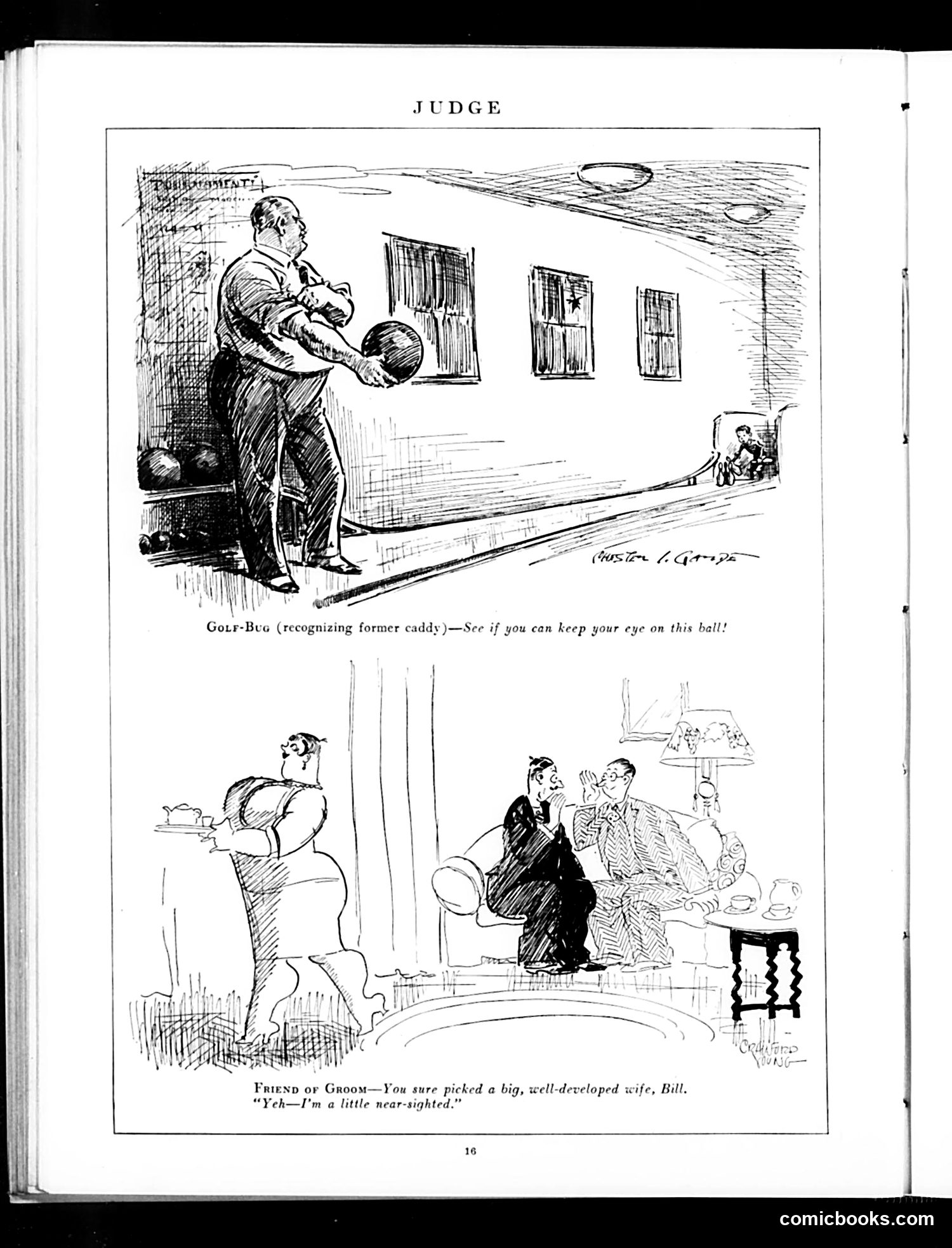
This page contains two separate cartoons satirizing gender and social awkwardness: **Top cartoon ("Golf-Bug"):** A judge in a corridor plays bowling, addressing a small figure in the distance. The joke references his former role as a caddy—he's treating judicial proceedings like a golf game, suggesting judges are careless or unprofessional. **Bottom cartoon:** A man introduces his new wife to guests at a dinner party. The humor relies on a crude physical stereotype: the husband admits he's "near-sighted," implying he chose a large woman without properly seeing her. The guests' expressions suggest surprise at his choice. Both cartoons use physical appearance as the basis for humor—common in early-20th-century American comedy. They mock male judgment (literal in the first, romantic in the second) through exaggerated character types typical of Judge's satirical style.
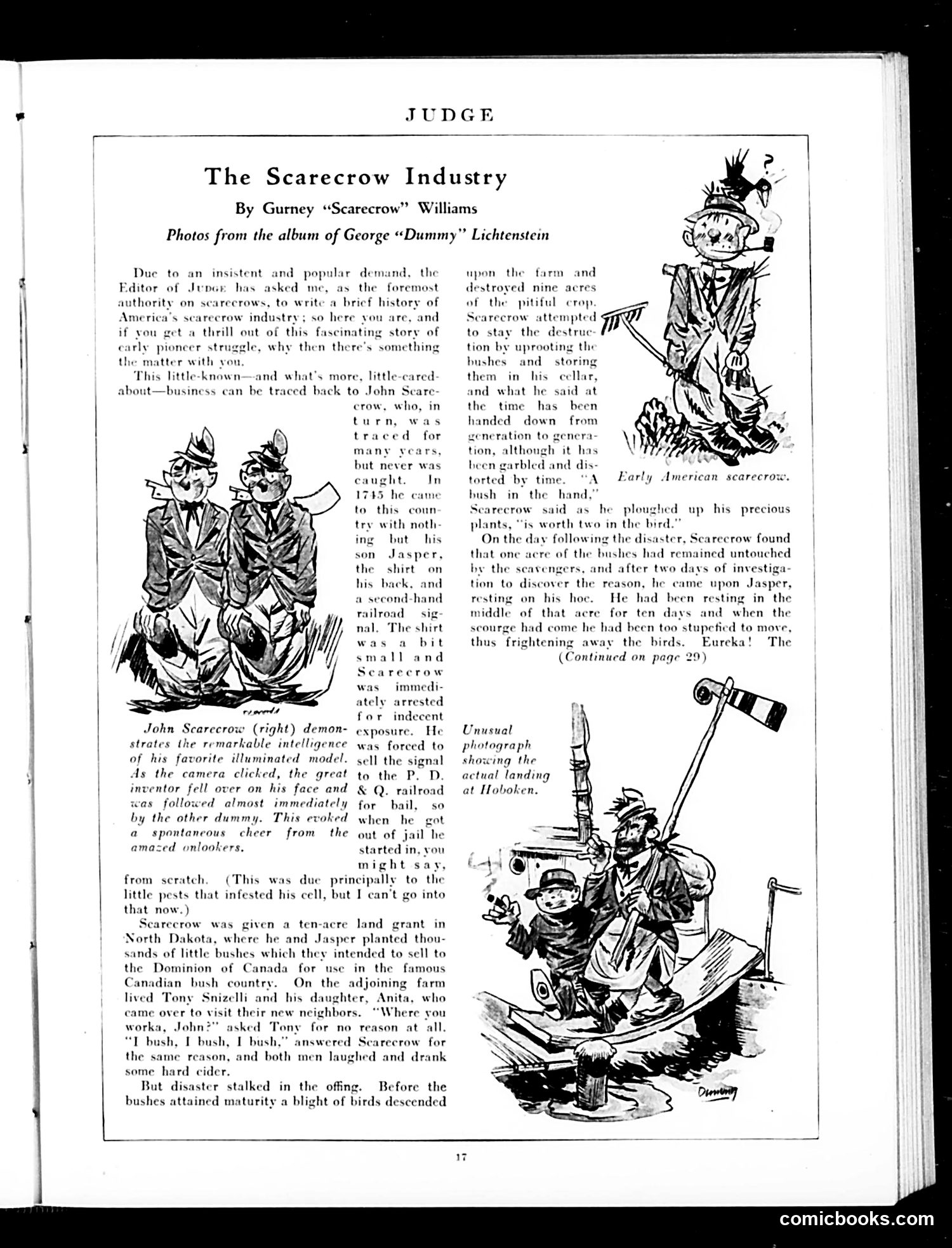
This humorous piece traces a mock-serious "history" of scarecrows in America, attributed to a character named Gurney "Scarecrow" Williams. The satire works through absurdist logic: it treats scarecrows as a significant American industry worthy of historical documentation, complete with a founding figure (John Scarecrow, traced to 1745) and family lineage. The joke hinges on inverting expectations—scarecrows are presented as consequential when they're actually humble farm tools. Visual gags include illustrations of early scarecrows and photos credited to George "Dummy" Lichtenstein (the nickname "Dummy" adding to the absurdist humor). The narrative includes slapstick elements: Scarecrow's son Jasper becomes too stupefied to move and inadvertently frightens birds; a character literally falls over. The story continues with North Dakota farming and complications involving neighboring farmers. This is typical Judge magazine fare: gentle, pun-laden satire mocking American self-importance through deliberately overwrought treatment of trivial subjects.
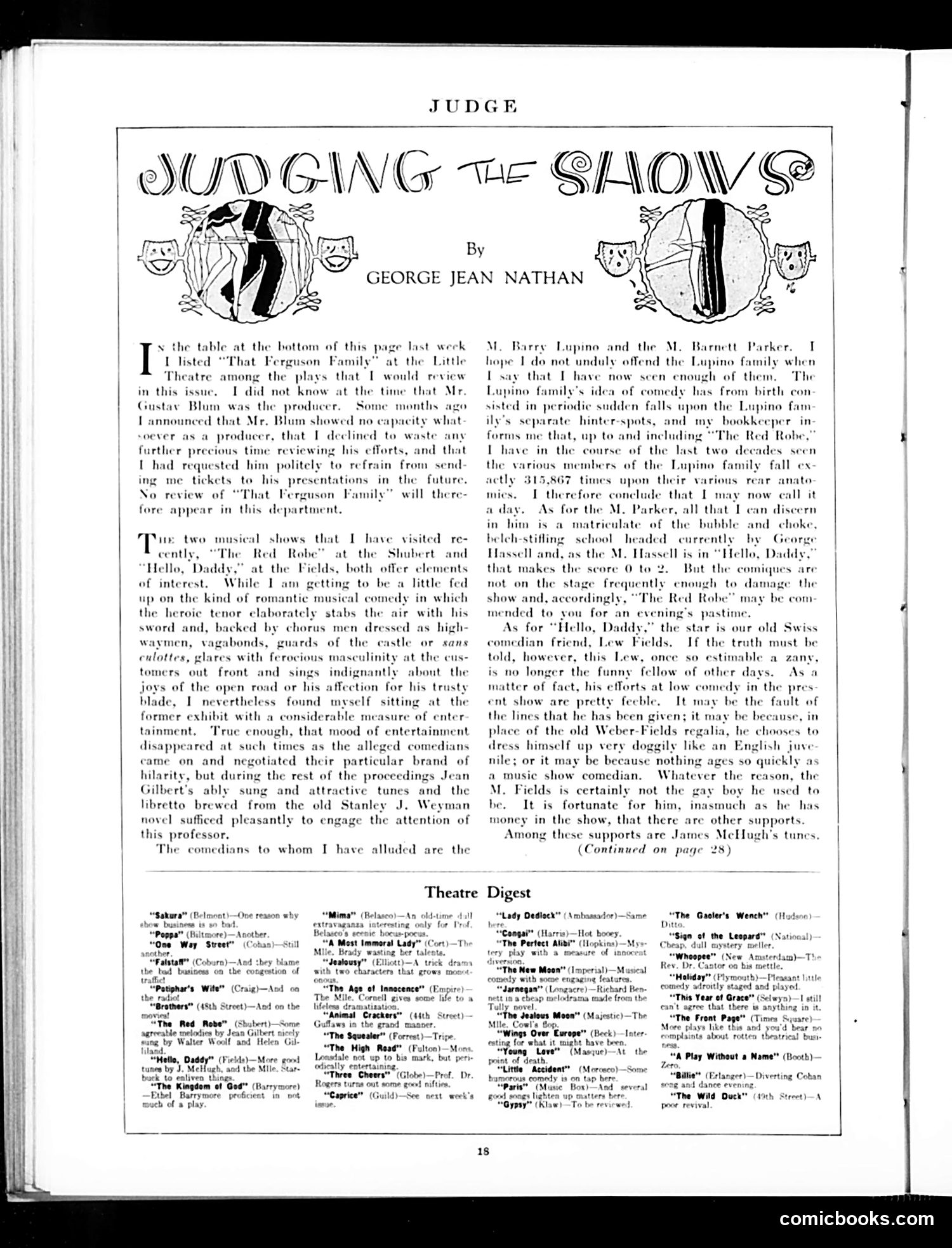
This page features theatre criticism by prominent drama critic George Jean Nathan. The content consists of three main elements: **The Cartoons**: Decorative art-deco style illustrations frame the title, featuring stylized theatrical masks and figures—typical Judge magazine embellishment. **Nathan's Reviews**: He discusses two musical comedies: "The Red Robe" (Shubert) and "Hello, Daddy" (Fields). His criticism centers on tired theatrical conventions—romantic tenors in elaborate sword-fighting scenes, predictable "sans-culottes" costuming, and formulaic comedy routines. **Key Satire**: Nathan mocks the Lupino family's comedic act, which apparently relies on physical slapstick (falling on their "rear anatomies" 315,867 times across two decades). He dismisses Lew Fields as a once-funny performer now past his prime, reduced to dressing like an English juvenile rather than relying on genuine comic talent. **The Point**: The satire critiques worn-out theatrical traditions and aging entertainers clinging to stale formulas rather than innovating.
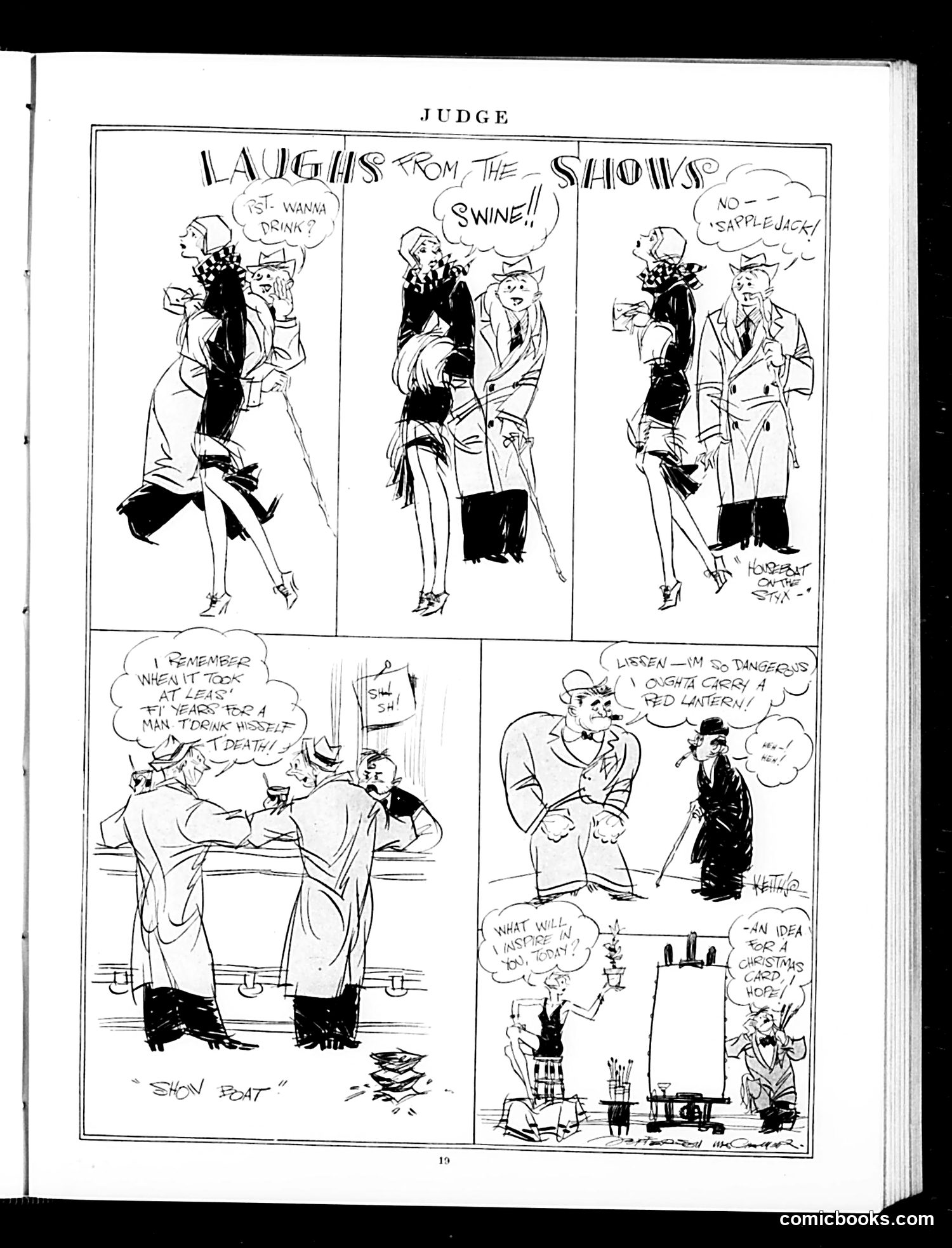
This page presents comic vignettes satirizing theatrical performances and audience behavior. The top three panels mock patrons making inappropriate remarks at shows—requesting drinks, calling out "swine," and heckling with "apple-jack" comments. The lower panels depict backstage and audience scenes: one shows men in formal wear discussing a performer's long career (referencing "21 years for a man, twice herself"), and another features what appears to be a theatrical producer or director with a small figure (possibly a child performer or the "red lantern" reference remains unclear) discussing Christmas hopes. The satire targets both rowdy theater audiences and the theatrical profession's dubious practices—excessive drinking, inappropriate conduct, and exploitation of performers. The overall tone mocks early-20th-century theater culture's behavioral standards and professional ethics.
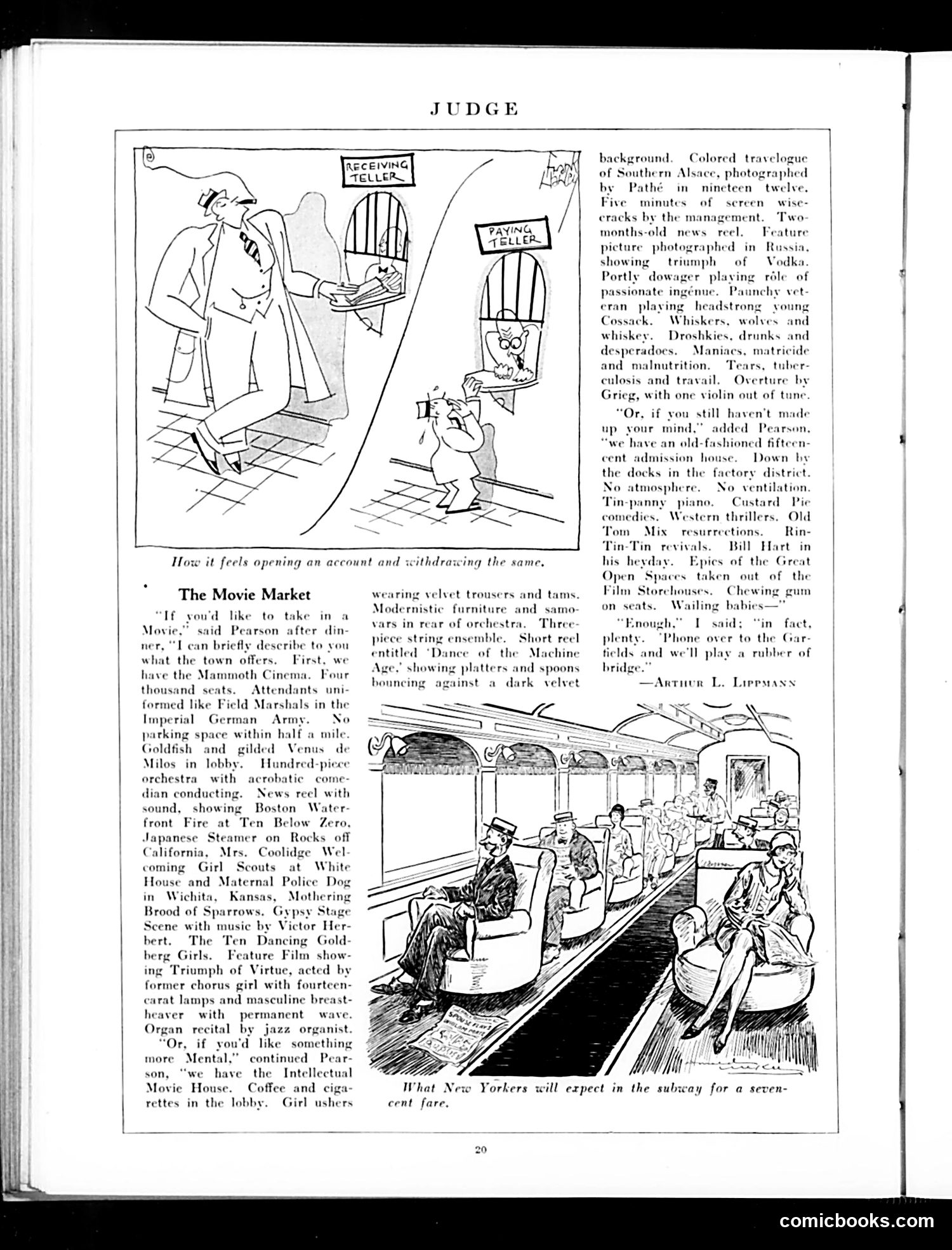
This page satirizes 1920s movie theater culture through two pieces: **Top cartoon:** Shows a bank teller opening and closing accounts—a visual pun on "opening an account and withdrawing the same," depicting the repetitive, mechanistic nature of banking transactions. **"The Movie Market" article:** A character named Pearson describes three theater tiers to a visitor, mocking cinema's class stratification: 1. **Mammoth Cinema**: Absurdly luxurious (4,000 seats, military-uniformed ushers, orchestras, acrobats)—satirizing pretentious "high" cinema 2. **Intellectual Movie House**: Mockingly "cultured" offerings (avant-garde shorts, Russian films about vodka, Grieg overtures) aimed at would-be sophisticates 3. **Dockside theater**: Cheap, rundown venue showing old comedies and Westerns The satire targets both cinema's artificial class divisions and Americans' desperate social climbing through entertainment consumption. The bottom cartoon jokes that New Yorkers expect underground subway travel—the *real* entertainment spectacle—for just seven cents.
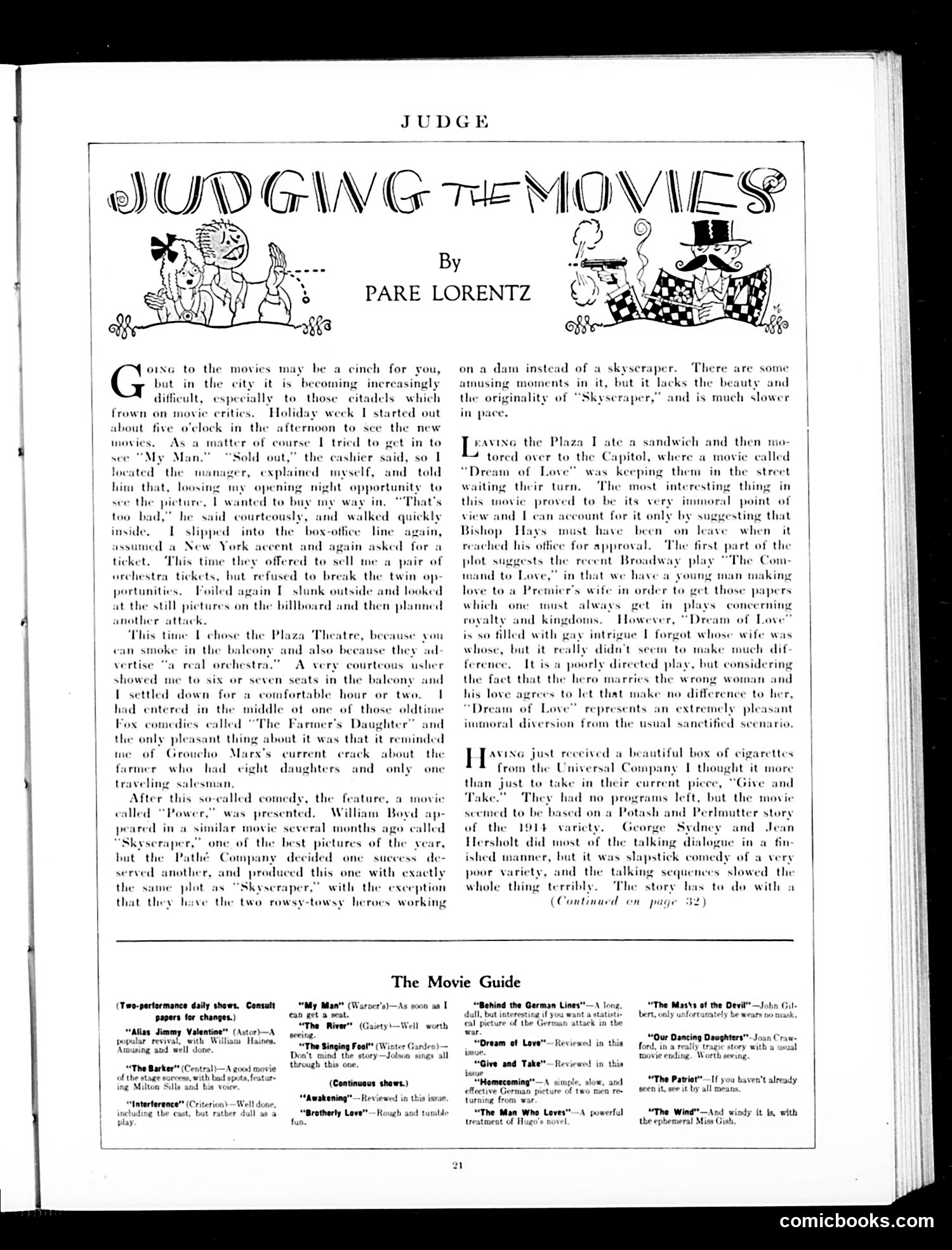
This is a **film review column by Pare Lorentz** from Judge magazine, a satirical publication. The piece humorously recounts the author's experience trying to see movies during busy holiday week in New York City. **Key references:** - **"My Man," "Power," "Dream of Love," "Give and Take"** — actual films from this era (appears to be late 1920s based on references to early talking pictures) - **William Boyd** — actor appearing in "Power" and "Skyscraper" - **Bishop Hays** — head of film censorship board; Lorentz sarcastically suggests he was absent when approving "Dream of Love's" immoral plot - **Groucho Marx** — contemporary comedian whose jokes Lorentz references **The satire:** Lorentz mocks both cinema-going inconveniences (sold-out shows, pushy crowds) and the mediocre films themselves—particularly derivative sequels and poorly-made talkies. The column satirizes Hollywood's formulaic storytelling and the nascent censorship system.
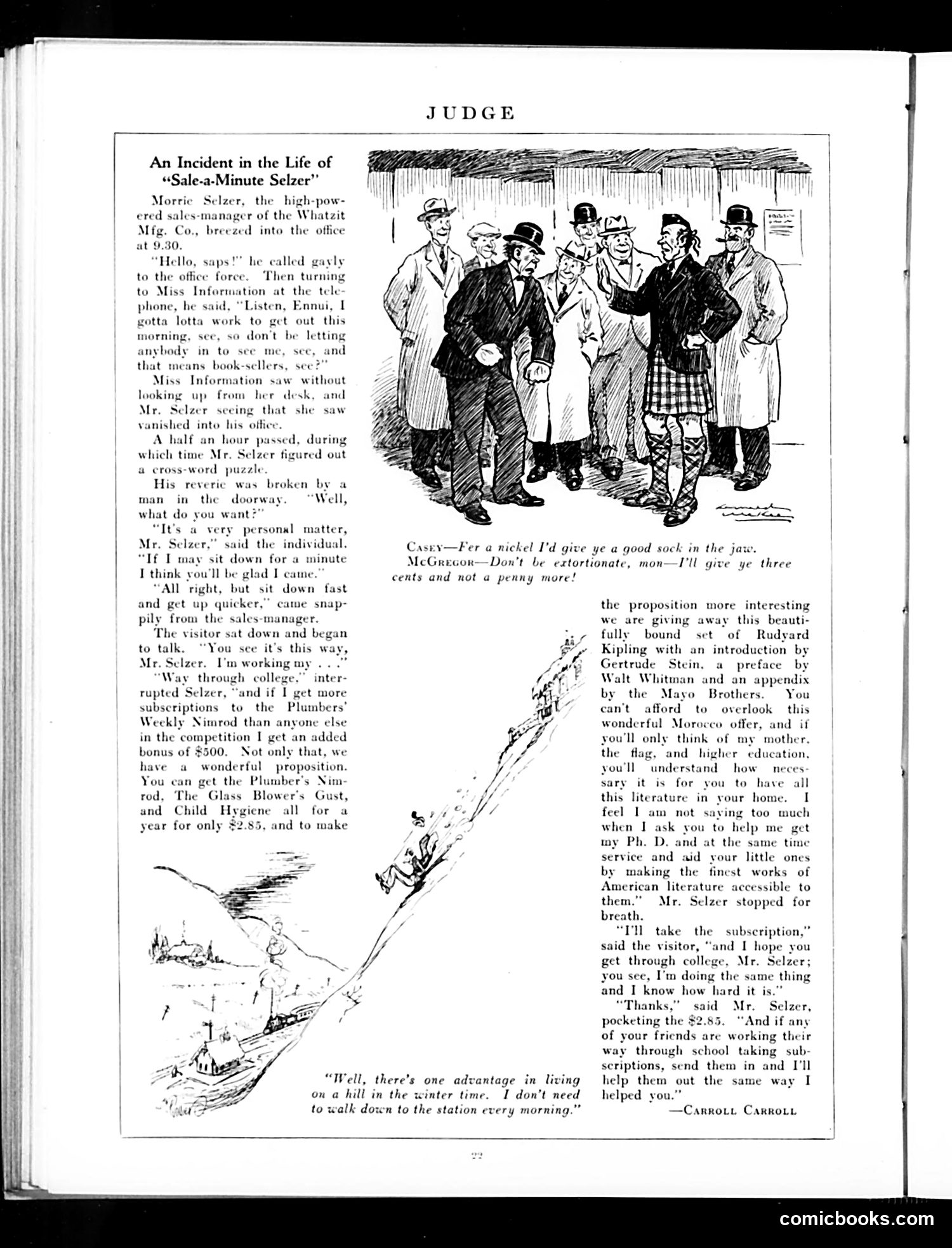
This satirical story mocks aggressive 1920s-era sales tactics and the "hard sell" mentality. Morrie Selzer is a stereotypical high-pressure sales manager who rudely dismisses everyone and focuses obsessively on work. The humor lies in the comeuppance: a college student visits seeking a subscription sale to fund his education. Selzer, initially dismissive, listens to an absurdly overwrought pitch combining professional jargon, emotional manipulation ("think of my mother, the flag"), and literary pretension (Rudyard Kipling with introductions by Gertrude Stein and Walt Whitman). The joke's payoff: the student reveals he's also working his way through school via subscriptions. Selzer buys, and both characters recognize their shared hustle. The satire targets not just high-pressure sales methods but also the commercialization of education and the desperation of working-class college students forced into door-to-door sales.
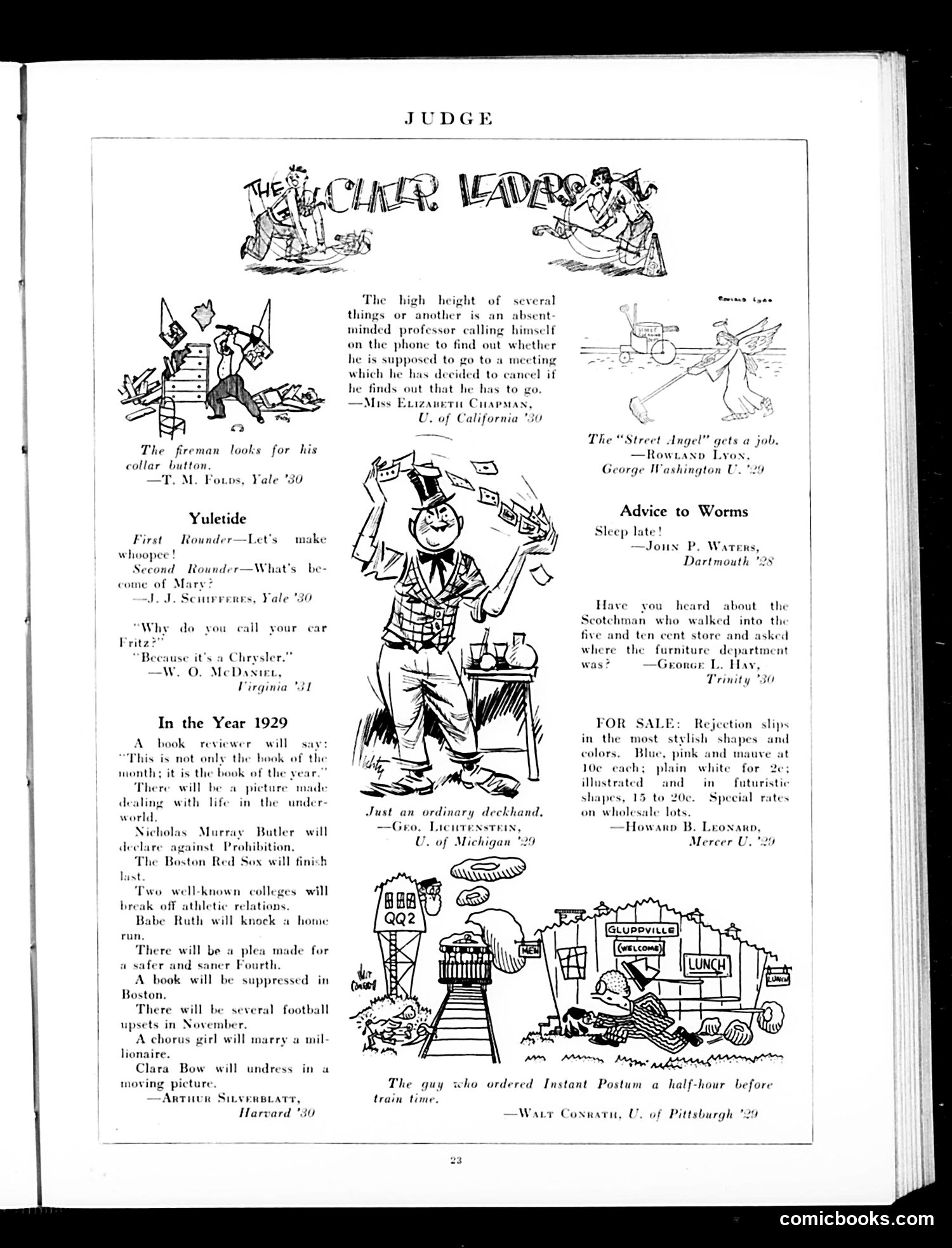
This page from Judge (circa 1929) collects humorous quips and cartoons submitted by college students, labeled with their universities. The jokes reflect 1920s college culture and contemporary concerns. **Key content:** The cartoons mock absent-minded professors, workplace mishaps, and period absurdities. "The Street Angel gets a job" references a popular 1928 film. The "Yuletide" exchanges joke about post-holiday awkwardness. "In the Year 1929" satirizes predictable news cycles—predicting Nicholas Murray Butler will oppose Prohibition, Babe Ruth will hit home runs, and Clara Bow will undress in movies (referencing the silent film star's notoriety). The "guy who ordered Instant Postum a half-hour before train time" mocks instant coffee's advertising claims of convenience. A "FOR SALE" joke offers rejection slips to aspiring writers, a meta-commentary on the magazine's submission culture. The humor is gentle, reflecting college wit rather than sharp political satire—typical of Judge's light entertainment approach during the Jazz Age.
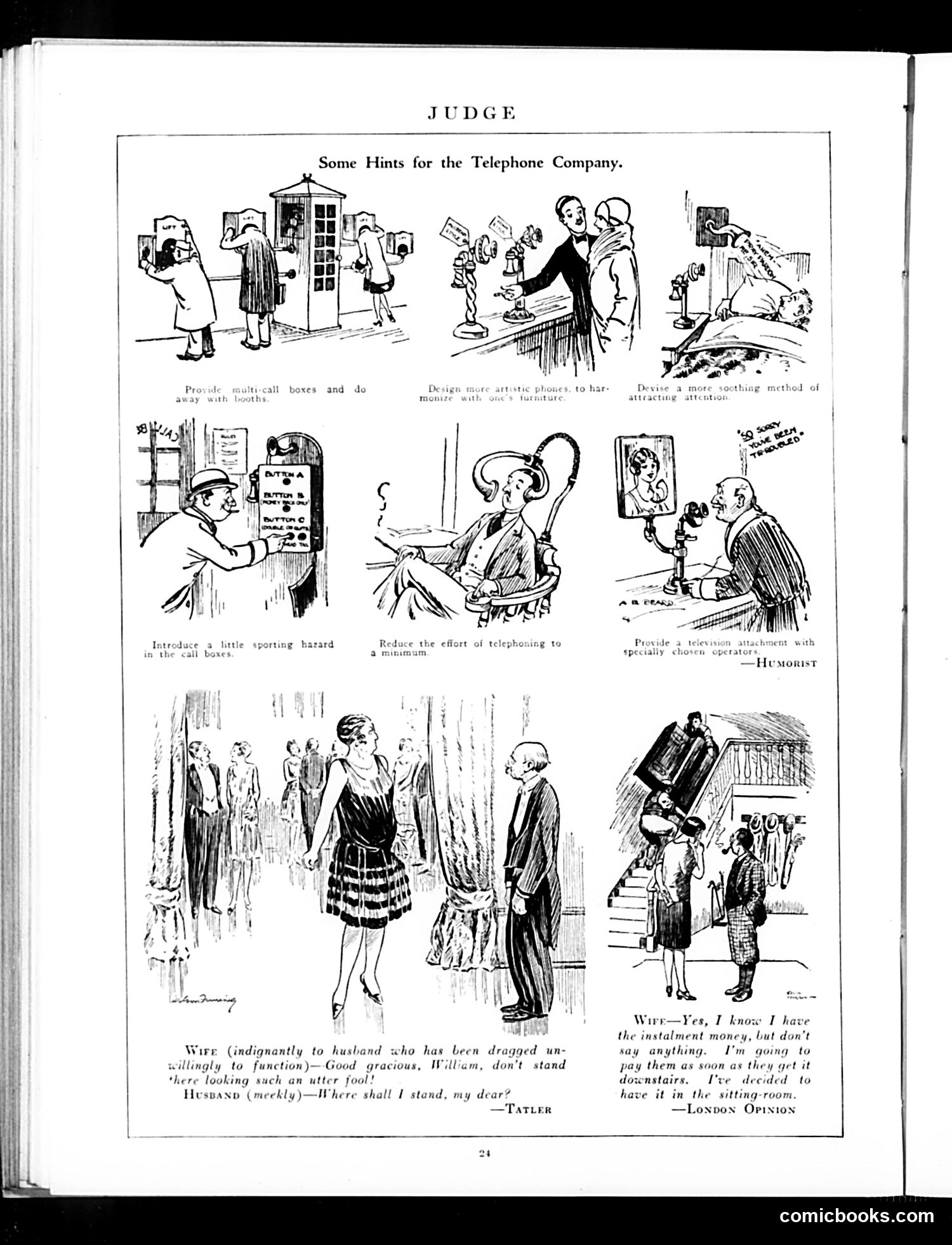
This page offers satirical suggestions to improve telephone service, presented as humorous cartoon vignettes mocking both the telephone company and contemporary social behavior. The cartoons ridicule various annoyances: people hogging phone booths, operators monopolizing calls, and users creating disturbances. The humor targets the telephone company's inefficiency while also satirizing customers' impatience and rudeness during this early telephone era. The two captioned scenes at bottom feature domestic comedy: a wife "dragging" a reluctant husband to a social function, and another wife hiding an expensive item (appearing to be a large appliance or furniture) in the sitting room, planning to conceal it from her husband until the installment payments are complete—suggesting anxiety about marital finances and consumer debt. The satire reflects early-20th-century concerns: newfangled telephone technology's growing pains, class anxieties about public behavior, and domestic tensions over household spending.
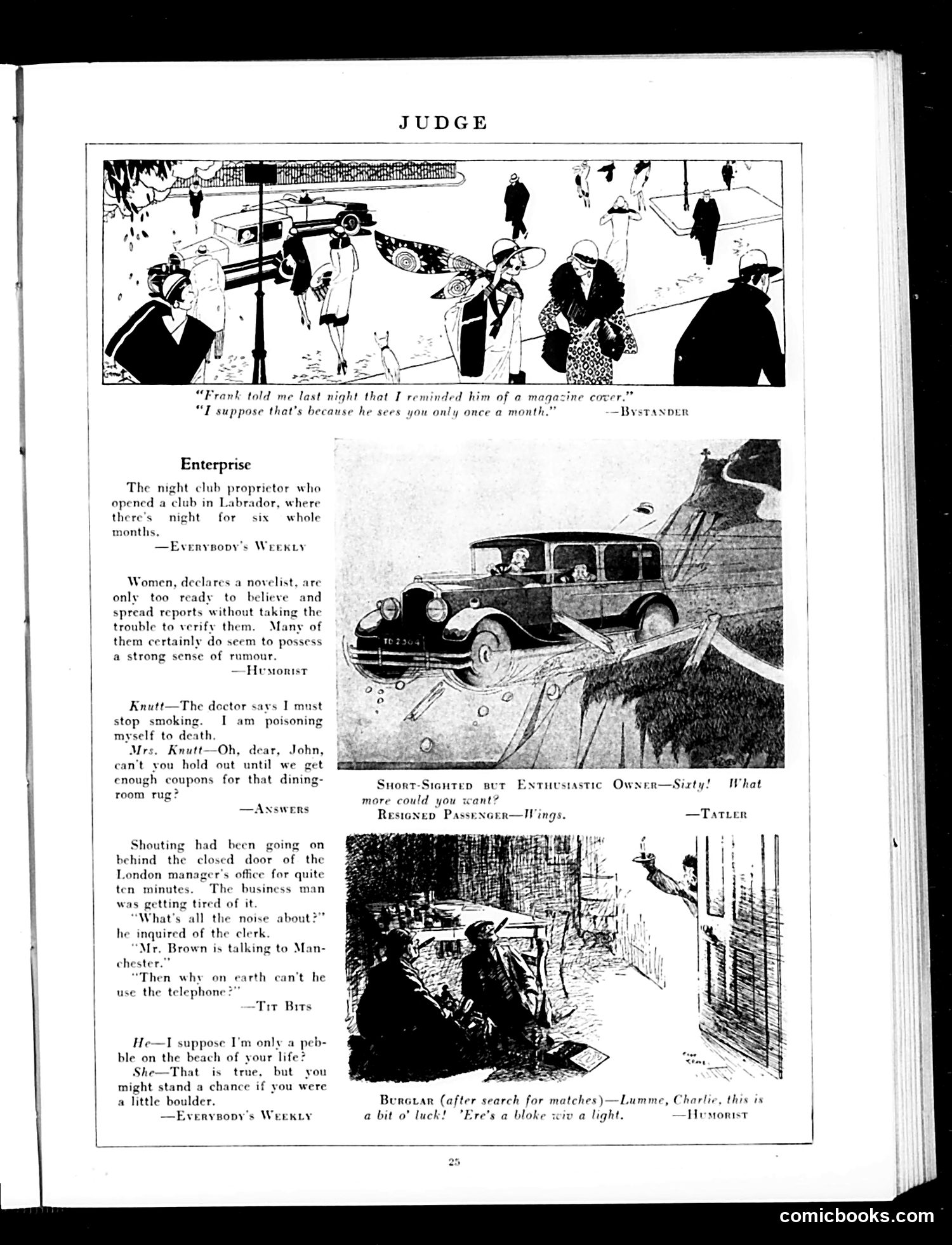
This page collects brief jokes and satirical cartoons typical of early 20th-century humor magazines. The content includes: **Top cartoon**: A visual gag about a woman being compared to a "magazine cover"—the joke being she's only seen once monthly, insulting her appearance or presence. **Text jokes** mock various social absurdities: a night club in perpetually-dark Labrador; women spreading unverified rumors; a wife withholding marital intimacy until her husband earns enough ration coupons (suggesting post-WWI austerity); workplace inefficiency; and flirtation dynamics. **Lower cartoons**: One depicts office noise from a manager shouting at someone in Manchester (likely via telephone, making the clerk's explanation absurd), and another shows a burglar finding a light-source—presented as "luck" despite the obvious danger. The humor relies on wordplay, domestic situations, and observational comedy about modern inconveniences—typical of Judge's satirical approach to everyday middle-class life and social pretensions.
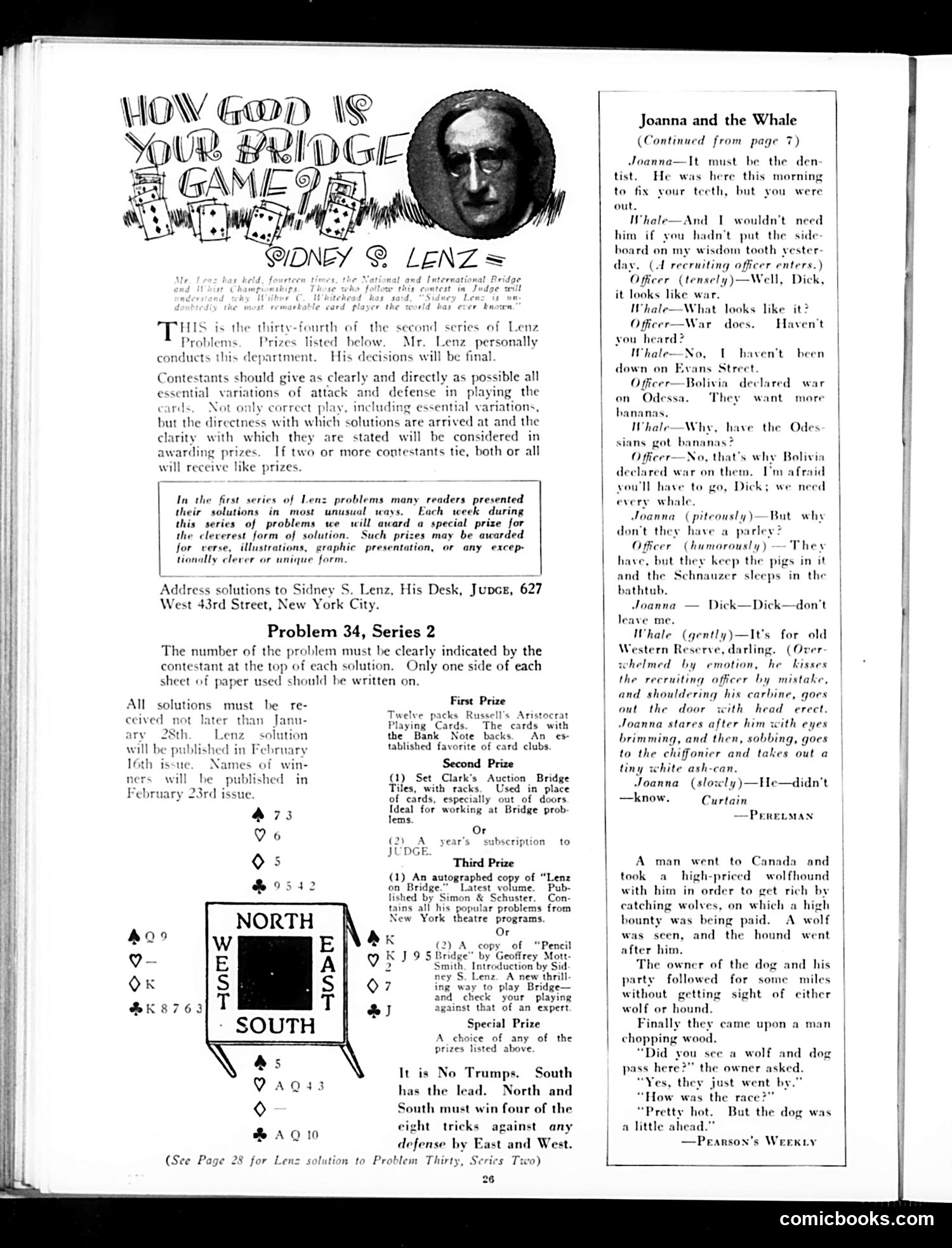
This page contains two distinct elements: **"How Good Is Your Bridge Game?"** (top left): A bridge card game problem by Sidney S. Lenz, a famous bridge expert. Judge magazine ran an ongoing series of bridge puzzles where readers submitted solutions competing for prizes (card decks, bridge tiles, autographed books). This was popular entertainment for the magazine's educated readership during the early 20th century. **"Joanna and the Whale"** (right side): A humorous serialized story fragment. The joke appears to be absurdist wartime satire—Bolivia inexplicably declares war on Odessa (a Russian port city) over bananas, prompting a whale character to enlist as a soldier. The humor lies in the ridiculous premise and the whale's earnest patriotic response to this nonsensical conflict. The emotional final scene where Joanna grieves is comedic bathos. Both features reflect Judge's mix of intellectual puzzles and satirical humor aimed at middle and upper-class readers.
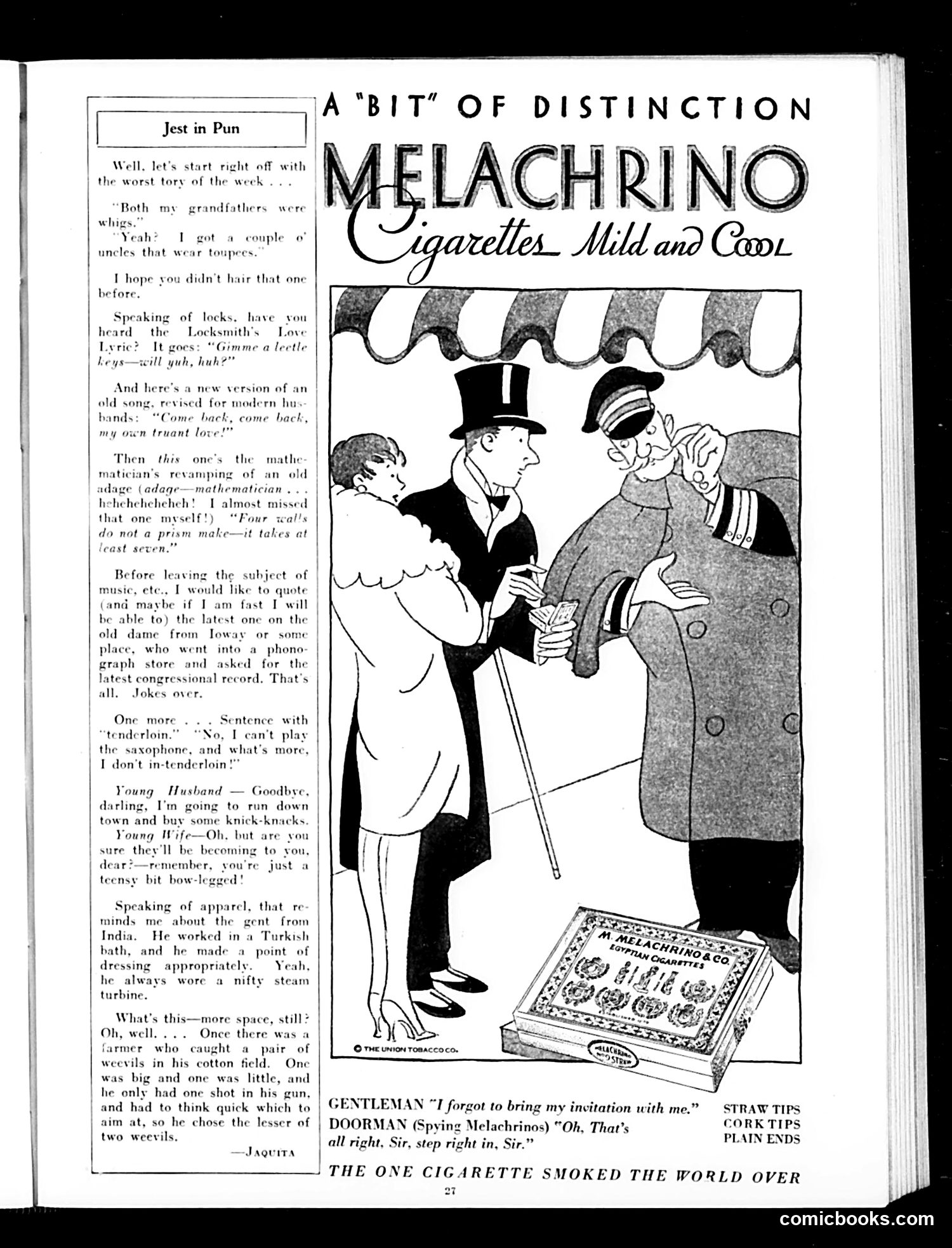
This page combines puns and jokes (left) with a cigarette advertisement (right). The main cartoon depicts a doorman admitting a gentleman without an invitation—a visual pun on the cigarette brand "Melachrinos." The doorman recognizes the cigarettes and treats them as a sufficient "invitation," suggesting the brand's prestige and worldwide recognition (as the tagline states). The left column contains humor typical of early 20th-century magazines: wordplay about grandfathers being "whigs" (the political party), puns on "locks" and "hair," and jokes about congressional records and Turkish baths. The humor relies on dated cultural references and linguistic wordplay that would have amused contemporary readers. The advertisement promotes Melachrinos cigarettes as universally known and socially prestigious—so recognizable they serve as social credentials. The cartoon reinforces brand identity through gentle, aspirational humor rather than hard selling.
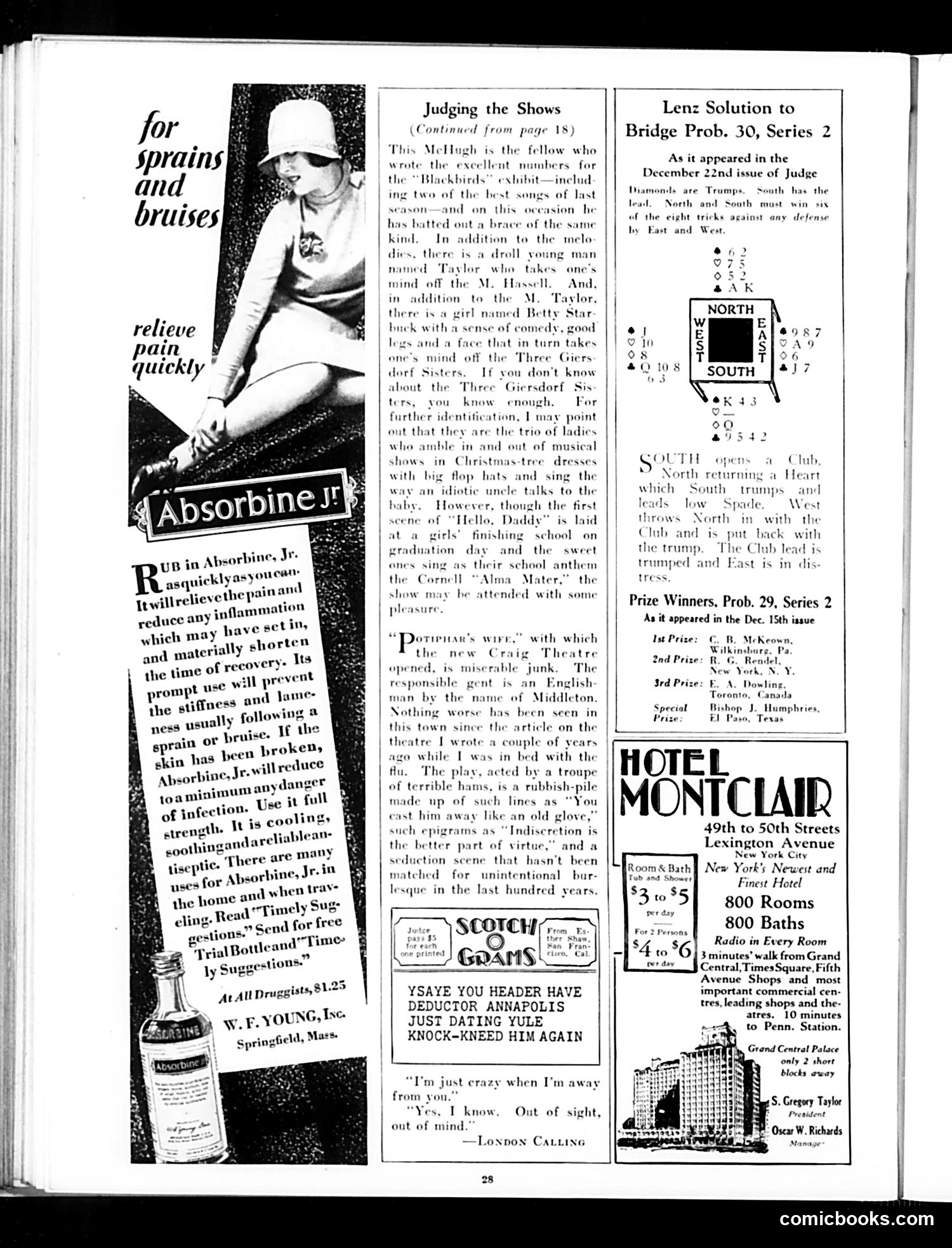
This page contains theatrical criticism and advertisements rather than political cartoons. The main content is a theater review by someone named McHugh discussing a show called "Blackbirds," praising the musical numbers and performers (Taylor, Betty Starbuck, and the "Three Giersdorf Sisters"). McHugh also reviews a play at the Craig Theatre called "Dopiah's Wife," written by an Englishman named Middleton, which he harshly criticizes as poorly acted and full of terrible dialogue and clichéd scenes. The left side features an advertisement for Absorbine Jr., a liniment for treating sprains and bruises—typical patent medicine marketing of the era. The right side includes bridge puzzle solutions and hotel/commercial advertisements. There is no discernible political satire on this particular page; it appears to be standard Judge magazine filler combining entertainment commentary with period advertising.
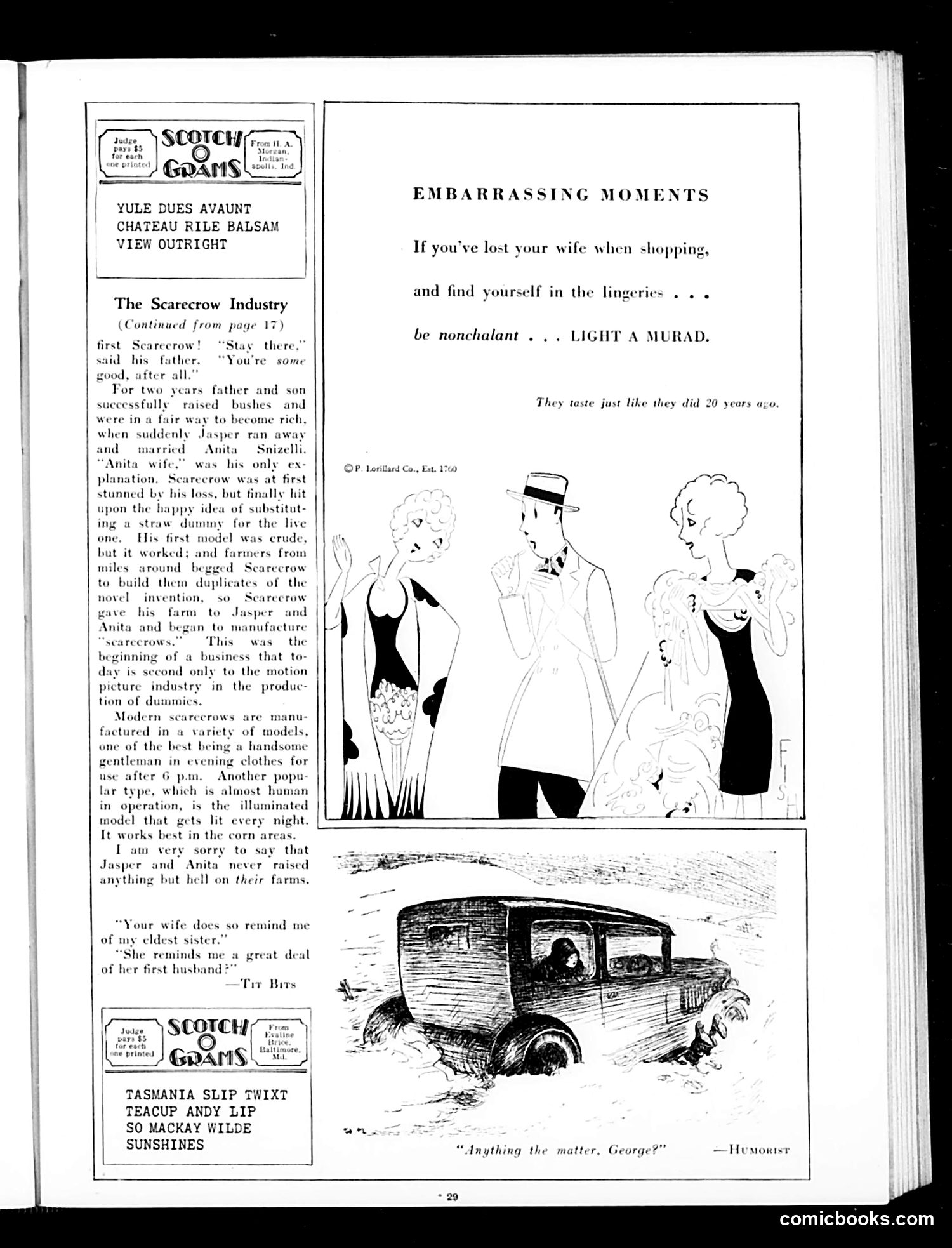
This page contains two distinct elements: **"The Scarecrow Industry"** (left column): A humorous serialized story about a man named Jasper who accidentally invents the scarecrow business when he substitutes a straw dummy for his runaway son. The satire mocks both agricultural innovation and the idea that commercial success can emerge from domestic failure—Jasper abandons farming but "never raised anything but hell," while his scarecrow business thrives. **"Embarrassing Moments"** (right): A cartoon and caption satirizing social awkwardness. The illustrated scenario shows a man awkwardly positioned near lingerie in a department store—the joke being he'll light a Murad cigarette to appear nonchalant and hide his embarrassment. The bottom cartoon shows a wrecked car with the caption "Anything the matter, George?"—implying marital tension. Both segments use humor to address masculine social anxiety: business failure/domestic chaos and public embarrassment. The Murad cigarette advertisement frames smoking as a solution to social discomfort.
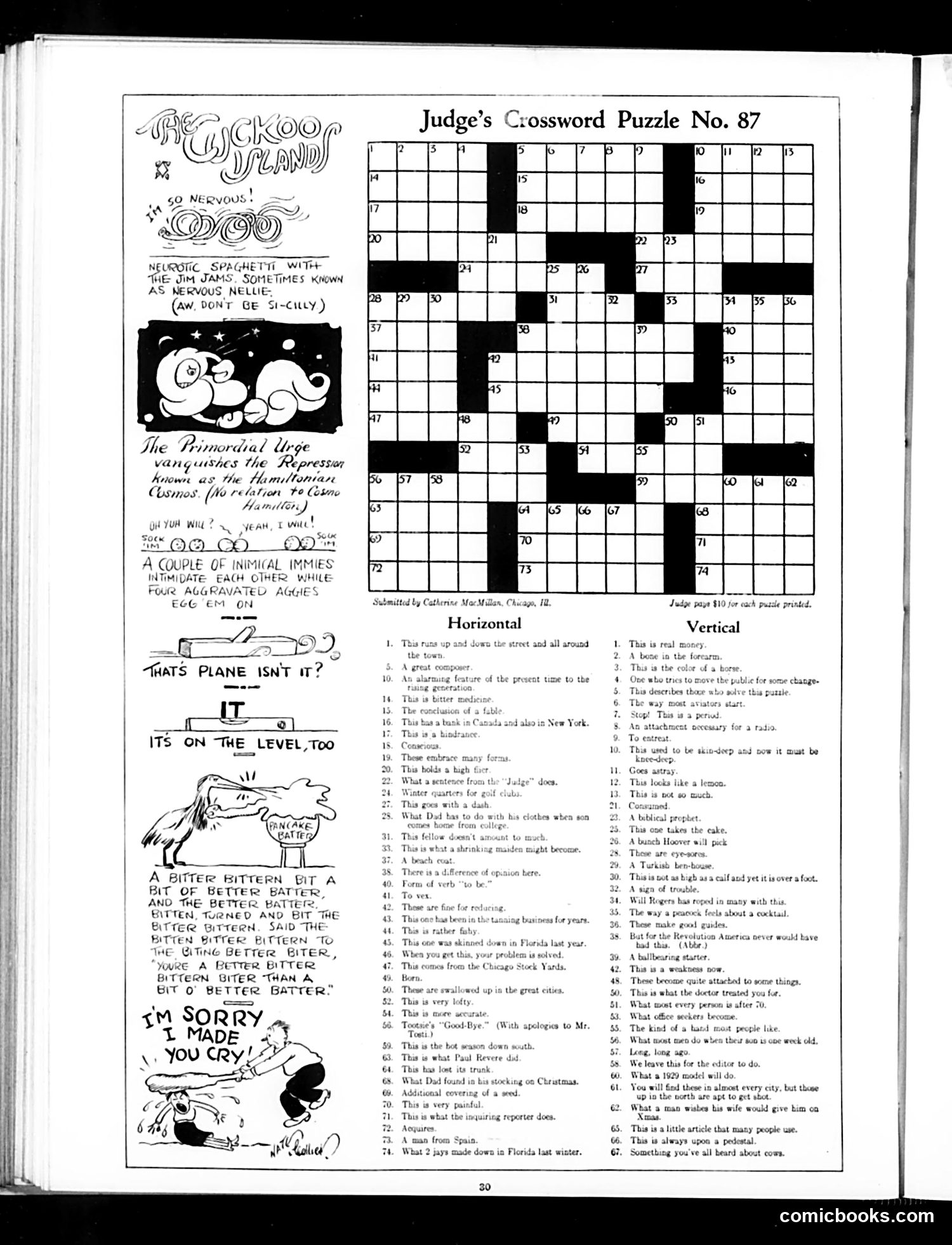
This page from Judge magazine presents a **crossword puzzle** (#87) accompanied by humorous cartoon vignettes and wordplay jokes typical of early-to-mid 20th century American satire. The cartoons mock pretentious psychological and artistic language of the era. "The Primordial Urge vanguishes the Repression" and references to "Hamiltonian Cosmos" satirize pseudo-intellectual Freudian terminology becoming fashionable. Other gags parody tongue-twisters ("A bitter bittern bit a bit of better batter") and feature absurdist scenarios with "immies" and "aggies" (unclear specific references, likely slang for types of people or marbles). The cartoon vignettes—showing arguing couples, mechanical planes, and animals—employ visual puns and exaggerated expressions common to Judge's house style. The overall tone mocks modern affectations, psychological pretension, and urban absurdities through deliberately corny wordplay and slapstick humor. This reflects Judge's established satirical approach to contemporary American social and cultural trends.
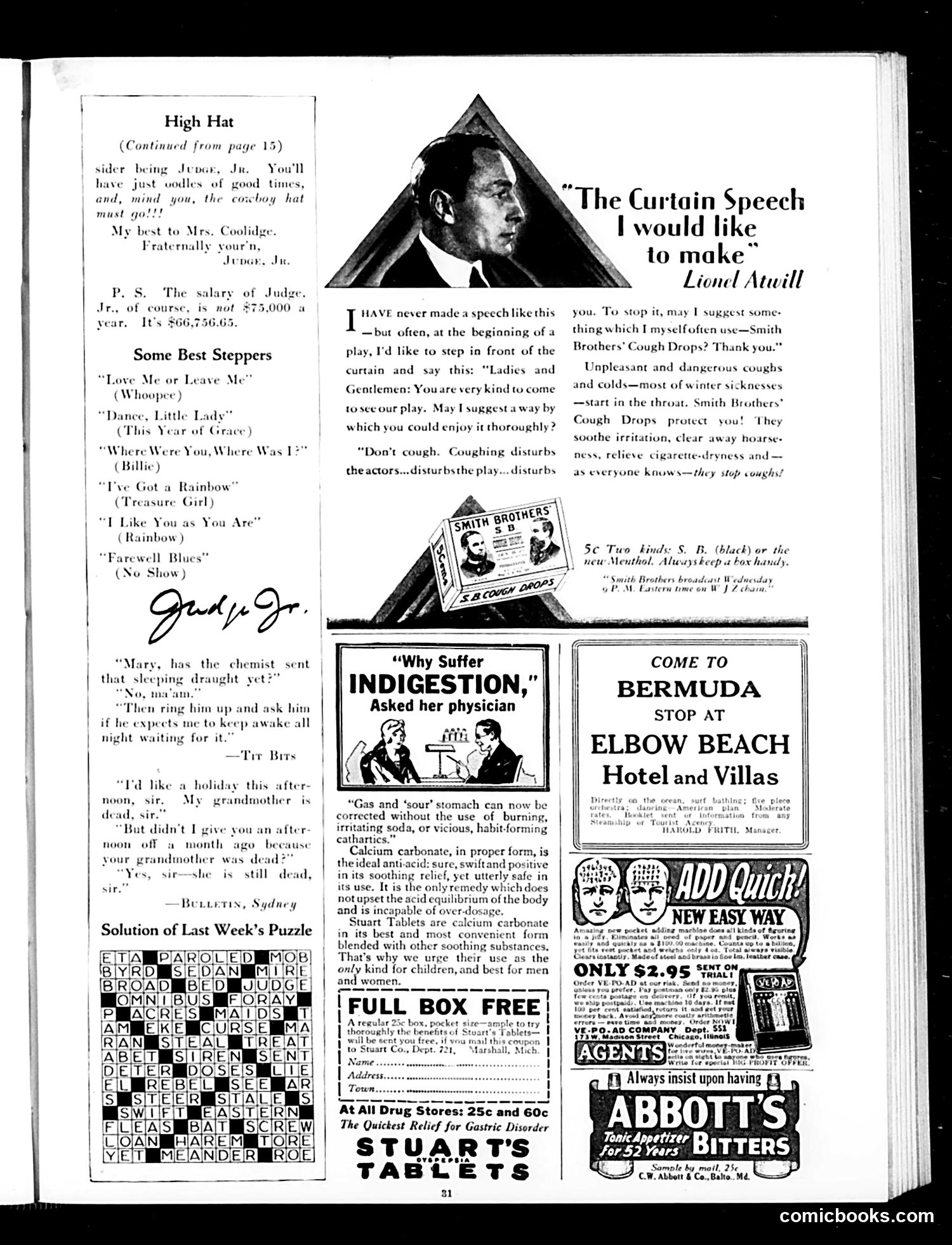
This is a celebrity endorsement piece featuring British-American actor **Lionel Atwill**, a prominent stage and film actor of the 1920s-30s. The satirical "curtain speech" humorously proposes that theatrical actors interrupt performances to ask audiences to use **Smith Brothers' Cough Drops**—framing disruptive coughing as a nuisance to performers. The joke operates on multiple levels: it mocks both theatrical conventions (actors addressing audiences directly) and the era's pervasive advertiser use of celebrities. By having Atwill present cough-drop promotion as a theatrical plea, the piece gently satirizes how entertainment figures were enlisted to hawk commercial products to captive audiences. The page is primarily **advertising-heavy**, featuring multiple patent medicine ads (indigestion remedies, cough drops, bitters) typical of Judge magazine's revenue model, interspersed with jokes and puzzles.
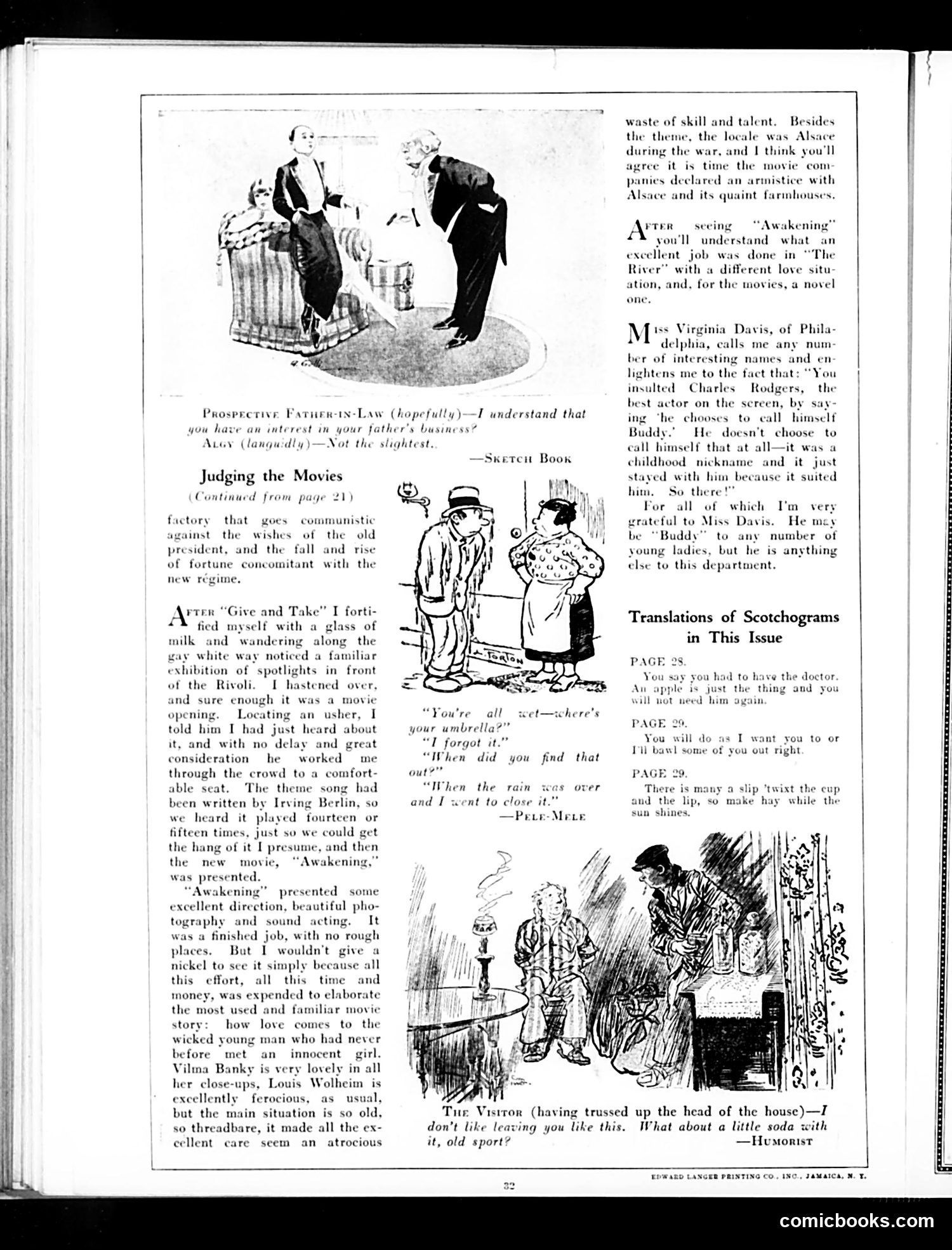
This Judge magazine page contains two satirical pieces: **"Judging the Movies"** critiques the film "Awakening" (1928). The reviewer praises its technical execution—direction, photography, and Irving Berlin's theme song—but condemns it as shallow entertainment. The complaint: the plot is a tired cliché about a "wicked young man" reformed by an "innocent girl," set in post-WWI Alsace. The satire targets Hollywood's formula filmmaking and its exhausted use of war-torn European settings for cheap romanticism. **The cartoon** shows a prospective son-in-law being asked if he's interested in his father's future business. His laconic "Not the slightest" response jokes about the father's apparent involvement in labor unrest or economic instability—the text mentions "communistic" factory troubles and the "fall and rise of fortune." The humor lies in the young man's disinterest in inheriting a mess. The page also includes reader corrections and translations of dialect humor ("Scotchograms").
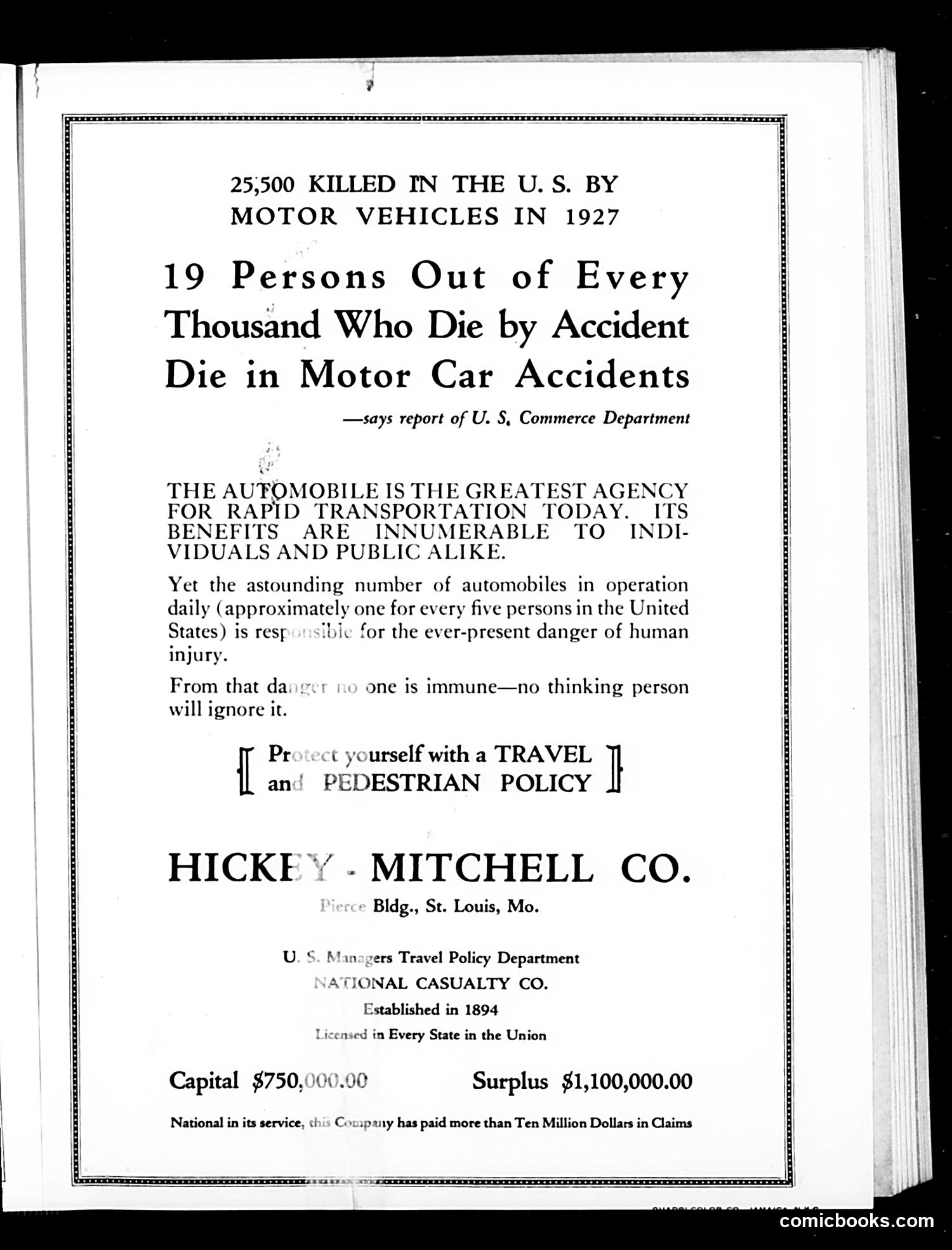
This is primarily a **full-page insurance advertisement**, not a satirical cartoon. Judge magazine is using its platform to sell travel and pedestrian insurance policies. The "satire" is implicit rather than visual: the ad opens with alarming 1927 motor vehicle death statistics (25,500 killed annually, affecting 1 in every 19 accidental deaths) to create fear, then pivots to selling protection. The advertisement acknowledges automobiles' benefits while emphasizing the danger—a rhetorical strategy designed to motivate readers to purchase coverage. The Hickey-Mitchell Company and National Casualty Co. use genuine Commerce Department data as a marketing tool, exploiting public anxiety about the rapidly expanding automobile industry to drive insurance sales. This reflects the era's nascent safety concerns about motor vehicles, which were still relatively novel and deadly.
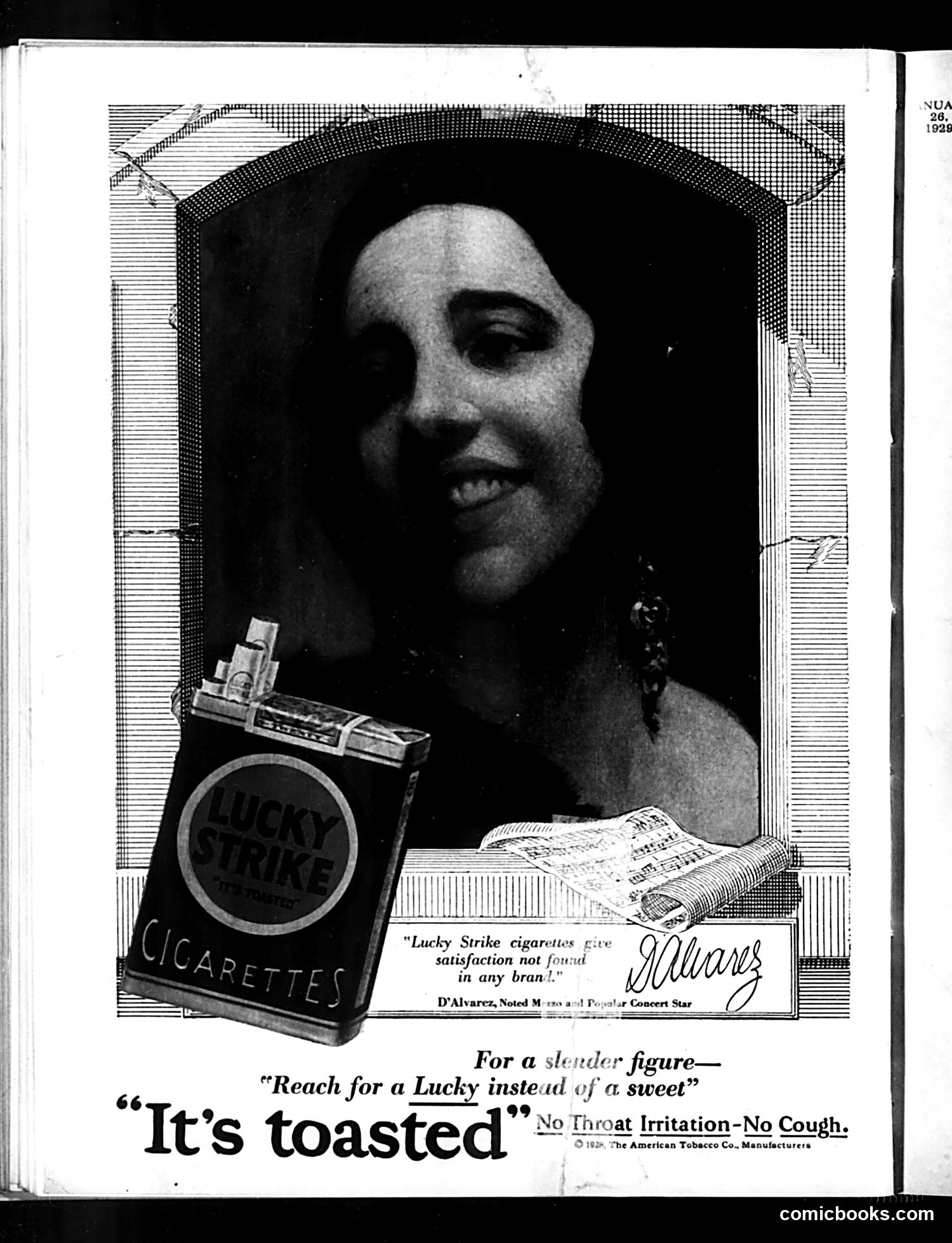
This is a Lucky Strike cigarette advertisement featuring D'Alvarez, identified as a "noted Mexican popular concert star." The ad uses a celebrity endorsement strategy, with D'Alvarez's testimonial claiming Lucky Strikes provide "satisfaction not found in any brand." The tagline "Reach for a Lucky instead of a sweet" targets weight-conscious consumers—particularly women—by positioning cigarettes as an appetite suppressant alternative to candy. This was a common marketing strategy in the 1920s-1930s, exploiting both smoking and diet anxieties. The "It's toasted" claim and "No Throat Irritation—No Cough" messaging addressed contemporary health concerns about smoking, using pseudo-scientific language typical of tobacco advertising before modern regulation. This is primarily commercial advertising rather than satirical content.