
Judge, 1929-01-19 · page 23 of 36
Judge — January 19, 1929 — page 23: what you’re looking at
What you’re looking at
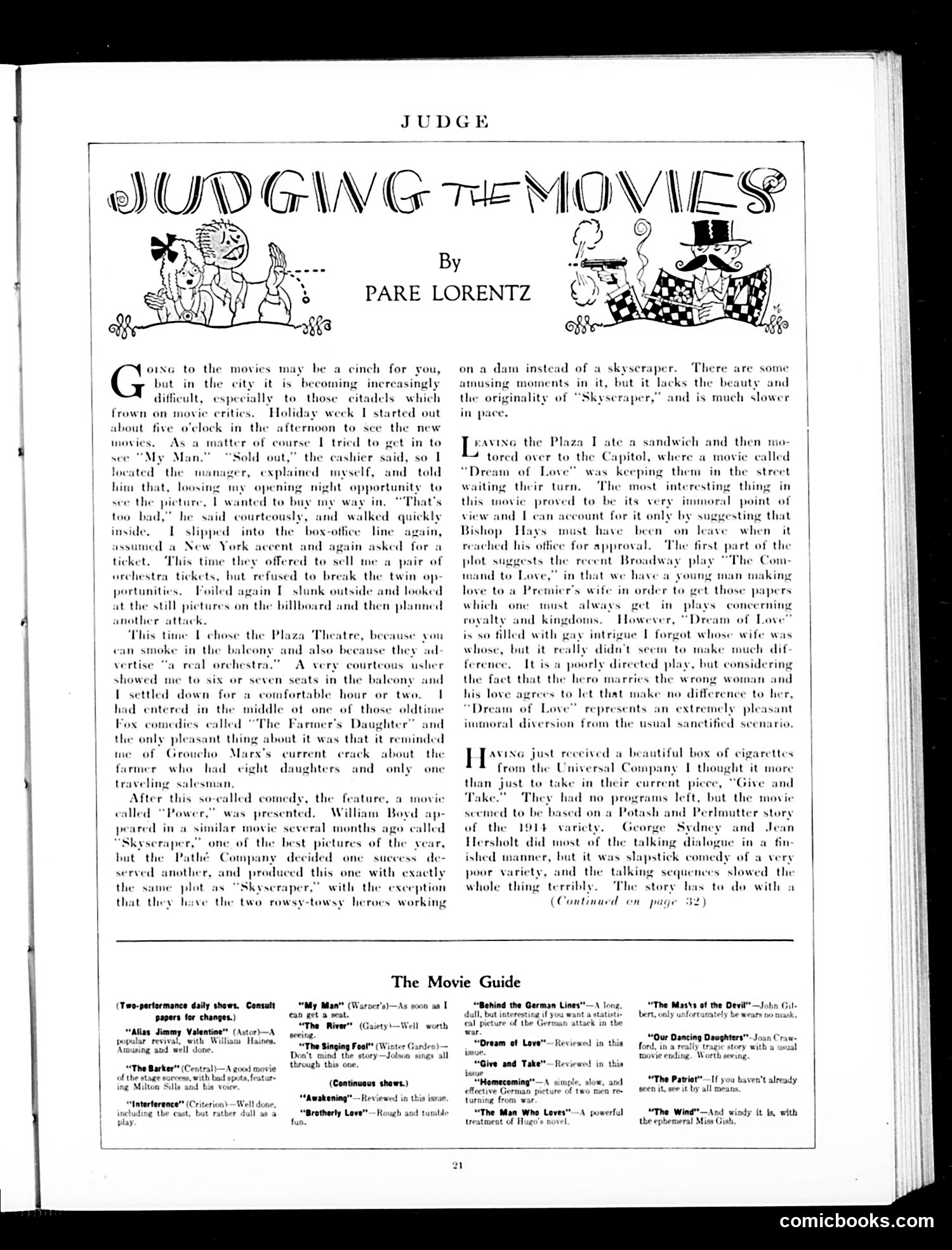
This is a **film review column by Pare Lorentz** from Judge magazine, a satirical publication. The piece humorously recounts the author's experience trying to see movies during busy holiday week in New York City. **Key references:** - **"My Man," "Power," "Dream of Love," "Give and Take"** — actual films from this era (appears to be late 1920s based on references to early talking pictures) - **William Boyd** — actor appearing in "Power" and "Skyscraper" - **Bishop Hays** — head of film censorship board; Lorentz sarcastically suggests he was absent when approving "Dream of Love's" immoral plot - **Groucho Marx** — contemporary comedian whose jokes Lorentz references **The satire:** Lorentz mocks both cinema-going inconveniences (sold-out shows, pushy crowds) and the mediocre films themselves—particularly derivative sequels and poorly-made talkies. The column satirizes Hollywood's formulaic storytelling and the nascent censorship system.
📄 Transcribed text from this page (OCR, searchable)
Machine-transcribed from the original scan — historical spelling and the odd misread are preserved.
aifa NG to the movies may be a cinch for you, but in the city it is becoming increasingly difficult, especially to those citadels which Holiday week I started out about five o'clock in the afternoon to see the new frown on movie critics. movies. As a matter of course I tried to get in to “My Man.” ld out,” the cashier said, so 1 located’ the manager, explained myself, and told him that, loosir ing night opportunity to see the picture, 1 wanted to buy my Phat’s too bad," he said courteously, and d quickly inside. 1 slipped into. the’ box-office line again, issumed a New York accent and again asked for a ticket. ‘This time they offered to sell me a pair of | orchestra tickets, but refused to break the twin op portunit in T slunk outside and looked it the still pictures on the billboard and then planned another attack, This time [chose the Plaza can smoke in the baleen vertise “a real orchestra my ope ‘Theatre, nd also because they ‘ad A very courte showed me to six or seven’ seats in the balcony and because you as usher | 1 settled down for a comfortable hour or two. | had entered in the middle ot one of those oldtime Fox comedies ealled “The Farmer's Daughter’ and d | me of Groucho Marx's current: crack about the farmer who had eight’ daughters and only one the only pleasant thing about it was that it reminc traveling salesman. | After this so-called comedy, the feature, a movie called “Power,” William Boyd ap- peared in a similar movie several months ago called “Skyscraper,” one of the best pictures of the vear, but the Pathé Company decided one success de- served another, and produced this one with exactly the same plot as “Skyscraper,” with the exception that they have the two rowsy-towsy heroes working was presented. on a dam instead of a skyscraper. There are some amusing moments in it, but it | cks the beauty and the or! ality of “Skyserape nd is much slower in pace. LE avine the Plaza I ate a sandwich and then mo- tored over to the Capitol, where a movie called “Dream of Love” waiting their turn. The most interesting thing in this movie proved to be its very immoral point of was keeping them in the street view and [ can account for it only by suggesting that Bishop Hays must have been on leave when it rt of the “The Com- man making reached his office for approval. ‘The first plot suggests the recent Broadway play mand to Love,” in that we have a youn love toa Premicr’s wife in order to get those papers which one must always get in’ plays concerning royalty and kingdoms. However, “Dream of Love” is so filled with gay intrigue 1 forgot whose wife was whose, but it really didn’t seem to make much dif ference. It is a poorly directed play, but considering the fact that the hero marries the wrong woman and his love agrees let that make no difference to her, “Dream of Love’ represents an extremely pleasant immoral diversion from the usual sanctified scenario. I [astxe just received a utiful box of cigarettes from the Universal Company I thought it mor than just to take in their current piece, “Give and They had no programs left, but the movie seemed to be based on a Potash and Perlmut of the 1914 variety, Ge Sydney Hersholt did most of the talking dialog ished manner, but it was slapstick comedy of a very poor variety, and the talking sequences slowed. the whole thing terribly. ‘The story has to do with a r story nd Jean in a fin (Continued on page 2) (Two-pertermance daily shows. Consult papers for changes.) “My Man” (Wars can get a seat. “The River’ (Gaiety'\—Well worth ereing. “The Singing Foo!” (Wister Garde Don't mind the story—Jolwa sings all through this one "s)—As soon as I (Continuous shows.) od in thi Rough and “Awakening” irotherty Love’ Criterion) —Well done The Movie Guide “Behind the German Lines*—A long. dall, but interes . ure of t bert, only u fo 10a Duseien Oowghtery ord, in a really tragic story movie ending. Worth sering. am ot Love” —Reviewal in this “Give and Take — Review in this “The Patriet”—Ii yo. ecen it, eee it by all means. ‘ _— wo't already effective German picture o men re turning from war “The Man Whe Lever" —A powerful treatment of Hug “The Wing"—\ the ephemeral M windy it is, with comicbooks.com