
Judge, 1929-01-19 · page 8 of 36
Judge — January 19, 1929 — page 8: what you’re looking at
What you’re looking at
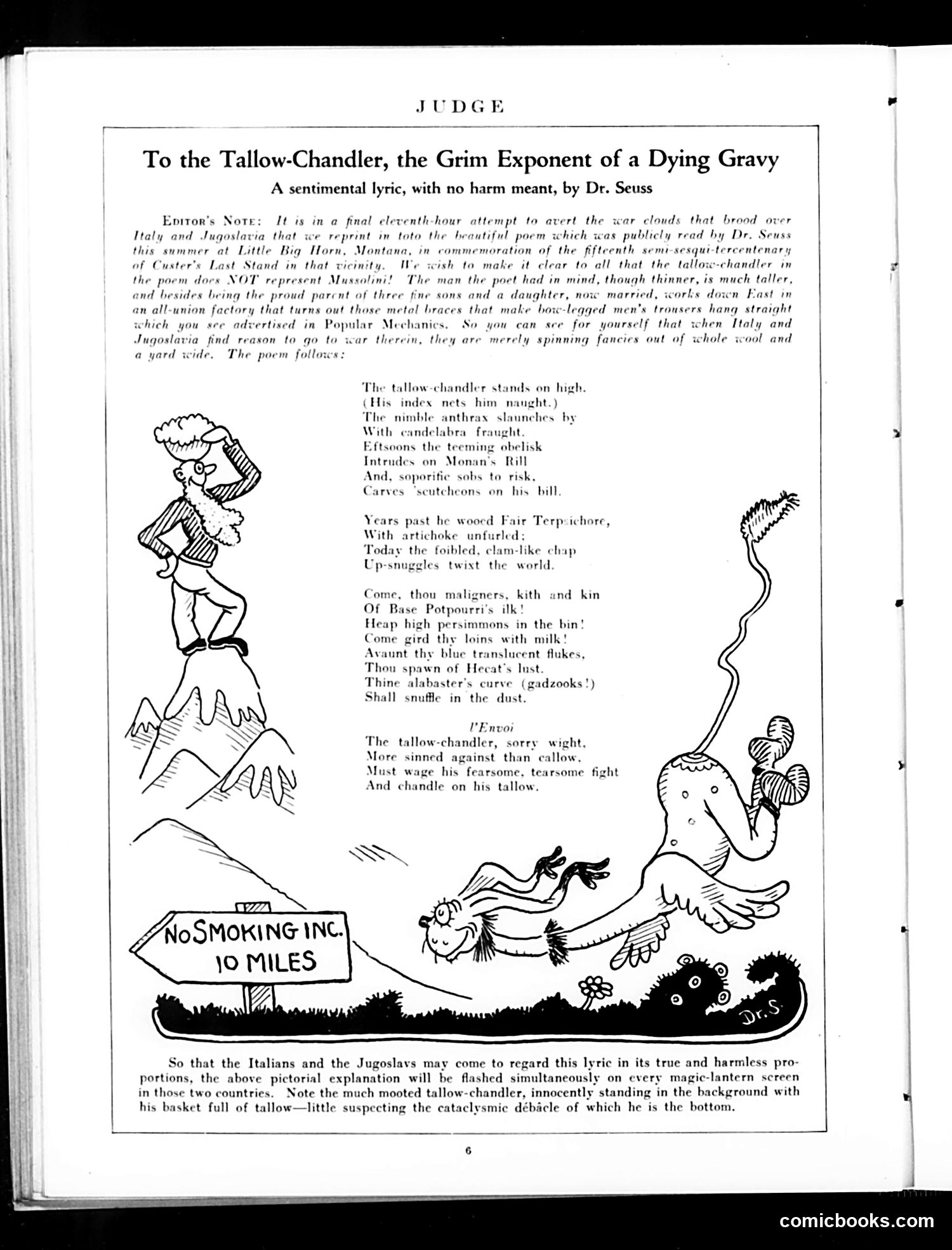
This 1930s Judge satire mocks diplomatic attempts to prevent war between Italy and Yugoslavia. Dr. Seuss wrote a deliberately nonsensical, pseudo-profound poem about a "tallow-chandler" (candle-maker)—a figure the editor's note insists does NOT represent Mussolini, while making clear through exaggerated denials that it obviously does. The satire works on multiple levels: the incomprehensible poem (full of made-up words like "eftsoons" and "gadzooks") ridicules flowery political rhetoric; the editor's elaborate disclaimers mock propaganda spin; and the whimsical cartoons underscore how absurd it is to think poetic recitations could prevent actual war. The joke targets both the futility of diplomatic gestures and the transparent propaganda of denying obvious meanings—suggesting that such efforts to avert conflict are mere fantasy.
📄 Transcribed text from this page (OCR, searchable)
Machine-transcribed from the original scan — historical spelling and the odd misread are preserved.
JUDGE To the Tallow-Chandler, the Grim Exponent of a Dying Gravy A sentimental lyric, with no harm meant, by Dr. Seuss Epitor’s Note: It is in a final cleventh-hour attempt to avert the war clouds that brood over Italy and Jugoslavia that we reprint in toto the beautiful poem which was publicly read by Dr. Seuss this summer at Little Biq Horn, Montana, in commemoration of the fifteenth semrsesqui-tercentenary of Custer’s Last Stand in that vicinity. We wish to make it clear to all that the tallow-chandler in the poem dors NOT represent Mussolini! The man the poet had in mind, though thinner, is much taller, and besides being the proud parent of three fine sons and a daughter, now married, works down East in an all-union factory that turns out those metal braces that make bow-leqged men's trousers hang straight which you see advertised in Popular Mechanics. So you can see for yourself that when Italy and Jugoslavia find reason to go to war therein, they are merely spinning fancies out of whole wool and a yard wide. The poem follows: The tallow-chandler stands on high. (His index nets him naught.) The nimble anthrax slaunches by With candelabra fr: t Eftsoons the teemin: plisk Intrudes on Monan’s Rill And, soporitic sobs to risk, Carves ‘scutcheons on his bill Years past he wooed Fair Terpsichore, With artichoke unfurled; Today the foibled, clam-like chap Up-snuggles twixt the world Come, thou maligners, kith and kin f Base Potpourri’s ilk! p high persimmons in the bin! Come gird thy loins with milk! Avaunt thy blue translucent flukes, Thou spawn of Hecat’s lust. Thine alabaster’s curve (gadzooks!) Shall snuffle in the dust. VEnvoi The tallow-chandler, sorry wight, More sinned against than callow, Must wage his fearsome, tearsome fight And chandle on his tallow. JNOSMOKING INC. JO MILES So that the Italians and the Jugoslavs may come to regard this lyric in its true and harmless pro- portions, the above pictorial explanation will be flashed simultaneously on every magic-lantern screen in those two countries. Note the much mooted tallow-chandler, innocently standing in the background with his basket full of tallow—little suspecting the cataclysmic débacle of which he is the bottom, comicbooks.com s