
A complete issue · 36 pages · 1928
Judge — January 21, 1928
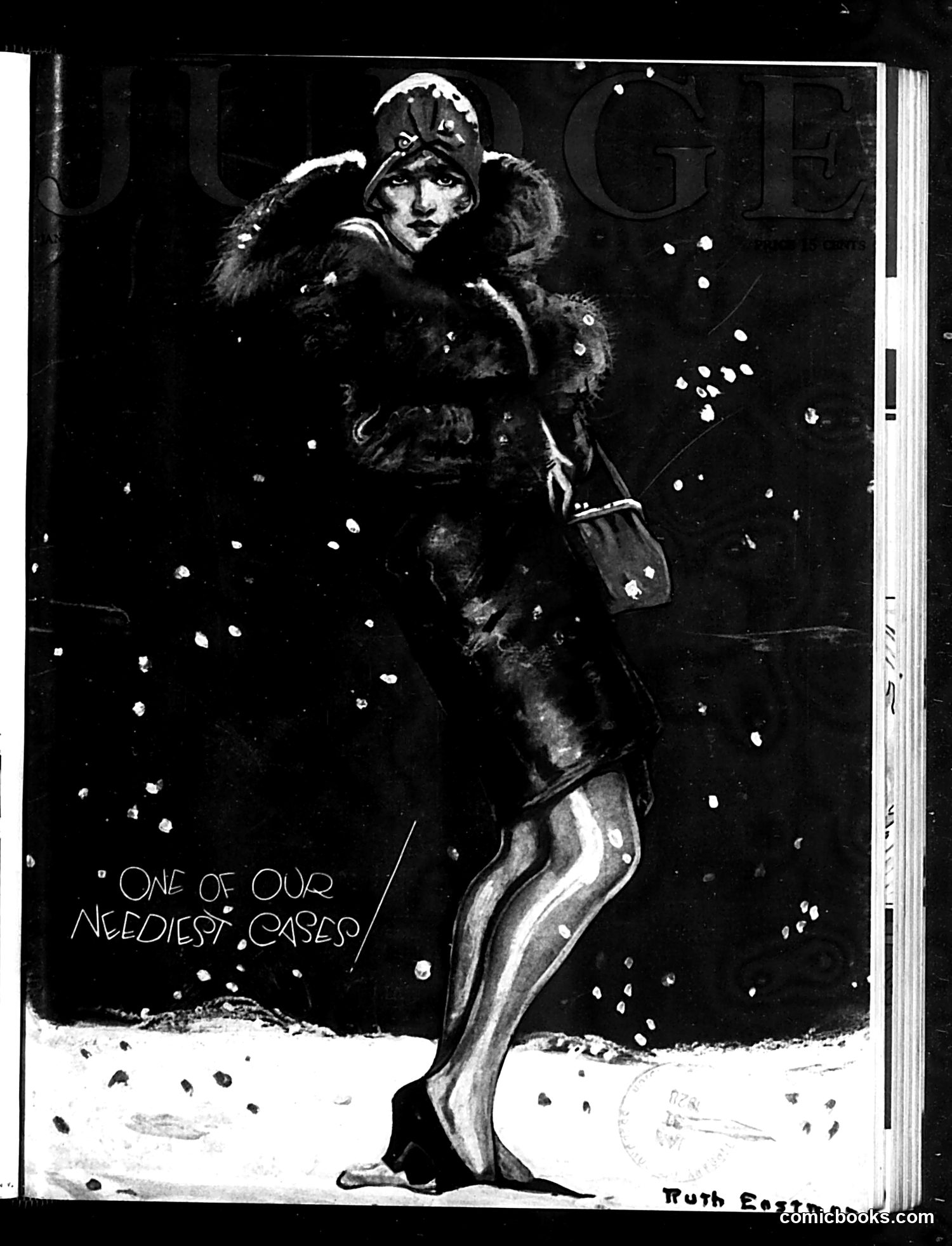
This Judge magazine page appears to be a fashion or social commentary illustration from the early 20th century. The image shows a stylishly dressed woman in winter attire—fur coat, decorative hat, and short skirt—standing in snow. The caption reads "ONE OF OUR NEEDIEST CASES," which appears ironic given her clearly wealthy appearance and fashionable clothing. The satire likely critiques either: wealthy women claiming poverty or hardship during economic difficulty; the absurdity of "poor little rich girl" complaints; or possibly commentary on the contrast between displayed wealth and actual charitable need during a recession or economic crisis. The artist's signature appears to be "Ruth E." The overall tone suggests mockery of pretentious or hypocritical claims about financial struggle among the affluent.
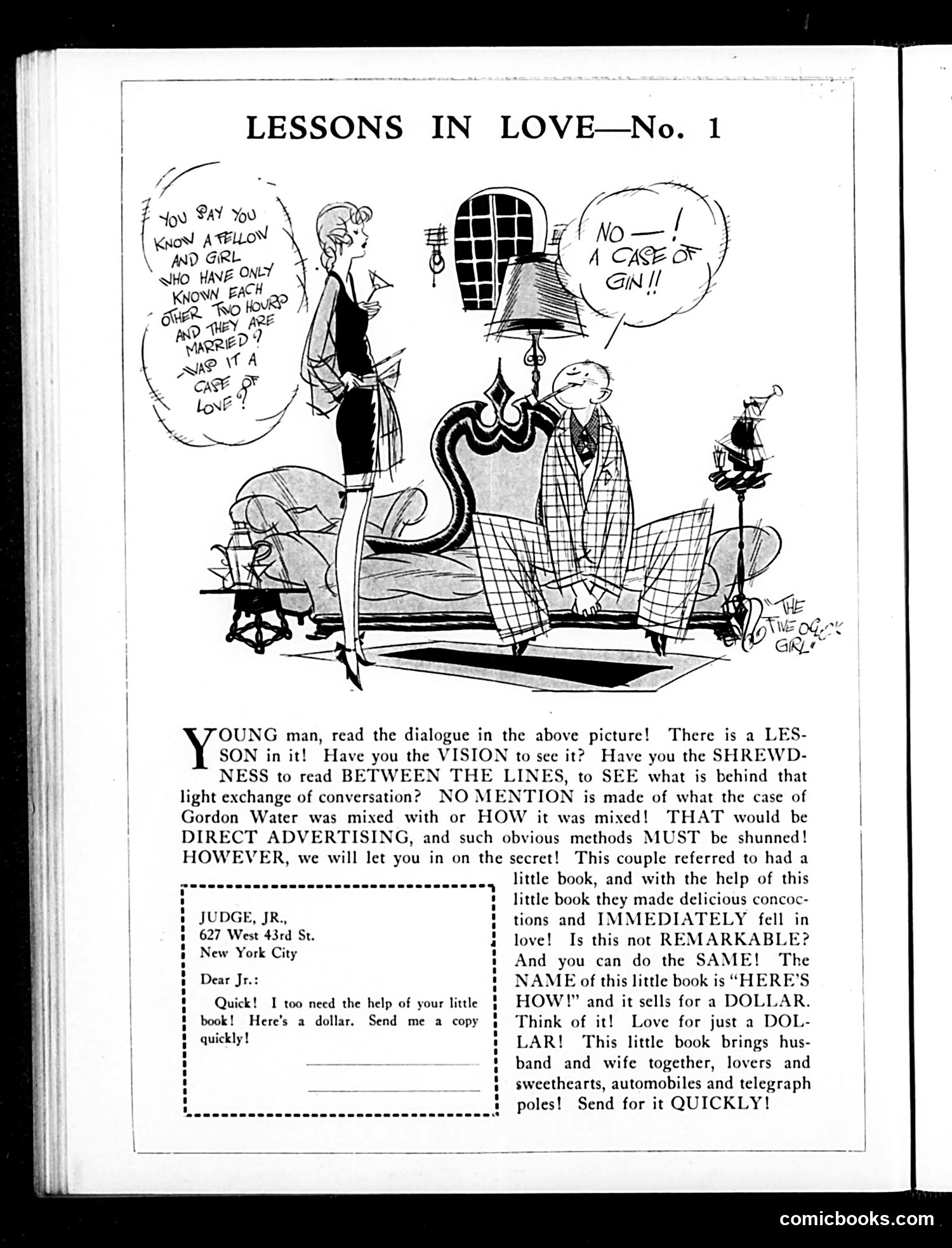
This page is primarily **advertising disguised as editorial content**—a technique the text itself criticizes as "direct advertising." The cartoon depicts a couple in an elaborate domestic scene. The woman asks about "a fellow and girl who have known each other two hours and are married"—establishing an absurdly quick romance. The man responds "No—a case of gin!!" The satire targets **Gordon Water** (likely a beverage product) by showing how the couple supposedly fell in love through this product. The accompanying text explicitly mocks this promotional method, noting that "NO MENTION is made of what the case of Gordon Water was mixed with or HOW it was mixed"—exposing the deceptive advertising technique. The pitch then sells a booklet called "HERE'S HOW" for a dollar, promising similar "romantic" results.
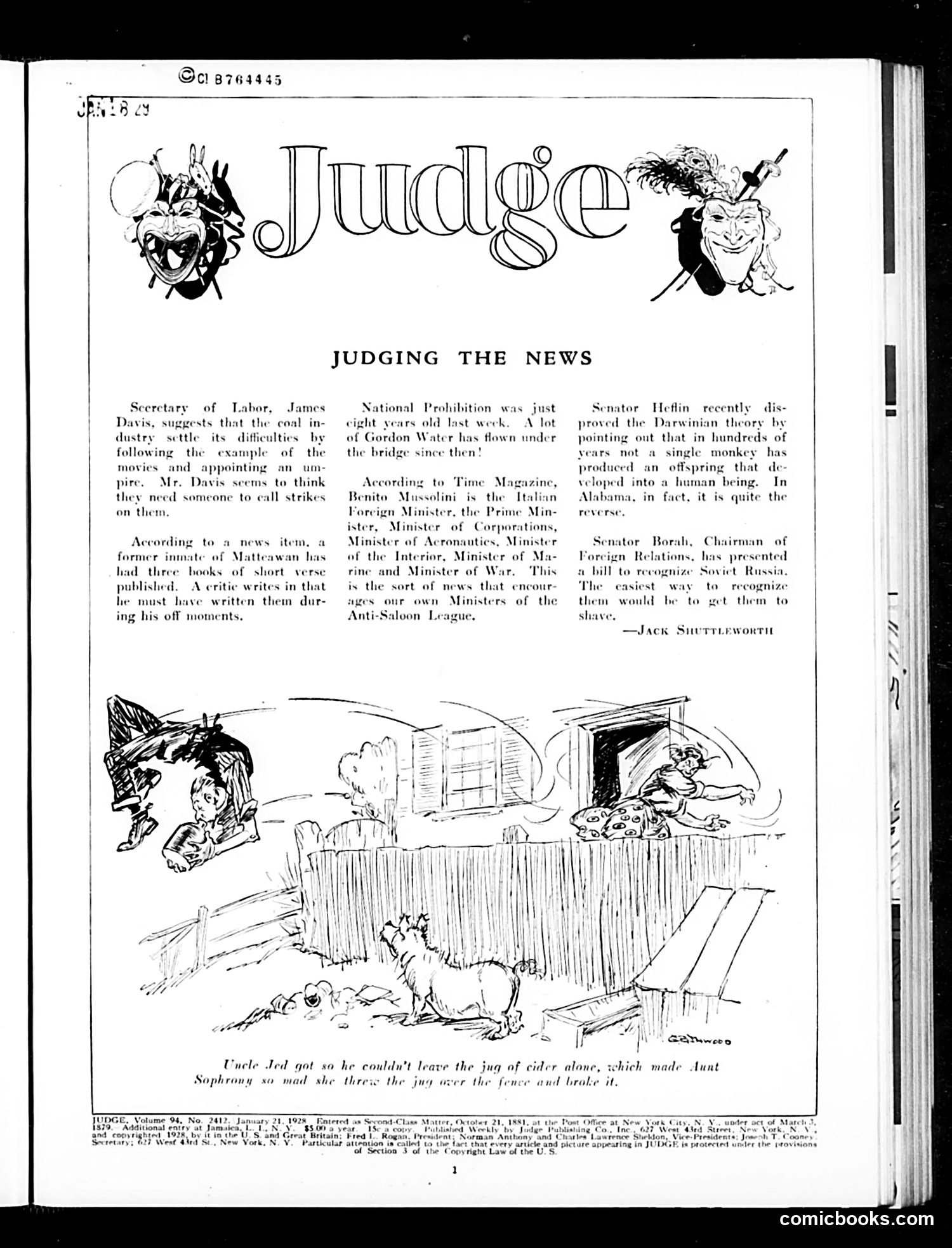
This page features satirical commentary on contemporary news items. The main cartoon depicts Uncle Ned unable to leave a jug of cider alone, which made Aunt Sophrony so angry she threw the jug over the fence and broke it—a humorous domestic scene about temptation and marital frustration. The "Judging the News" section mocks various political figures and policies: Secretary of Labor James Davis's suggestion that striking coal miners should call off strikes; Benito Mussolini's multiple ministerial roles in Italy; and Senator Borah's proposal to recognize Soviet Russia (sarcastically suggesting the "easiest way" would be to make them slaves). The satire targets government incompetence and foreign policy naiveté through joking commentary on contemporary events.
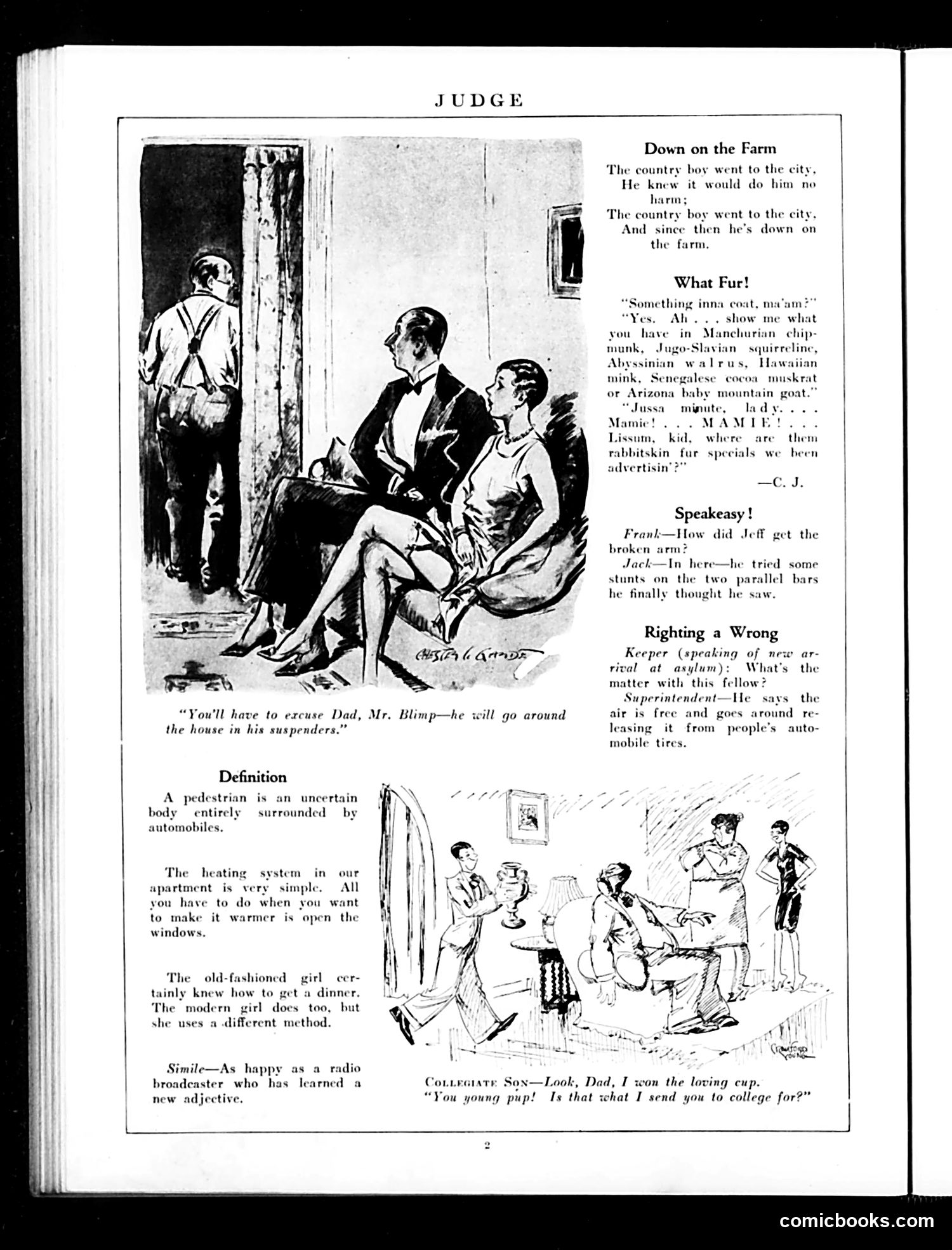
This page contains several unrelated humor pieces typical of Judge's satirical format: 1. **"Down on the Farm"**: A poem mocking a country boy who went to the city and now "he's down on the farm"—suggesting he failed and returned home. 2. **"What Fur!"**: Satirizes pretentious urban social climbers who name-drop exotic goods (Manchurian chipmunk, Abyssinian walrus, etc.) to appear sophisticated—likely poking fun at 1920s consumer culture and status-seeking. 3. **"Definition"**: A one-liner defining a pedestrian as "an uncertain body entirely surrounded by automobiles"—reflecting early 20th-century anxiety about automobile traffic dangers. 4. **"Collegiate Son"**: Shows a college boy winning a "loving cup" trophy and asking his father if that's what he sends him to college for—gentle mockery of frivolous collegiate priorities. The cartoons represent typical Judge humor: social commentary on modern life, class pretension, and changing urban culture.
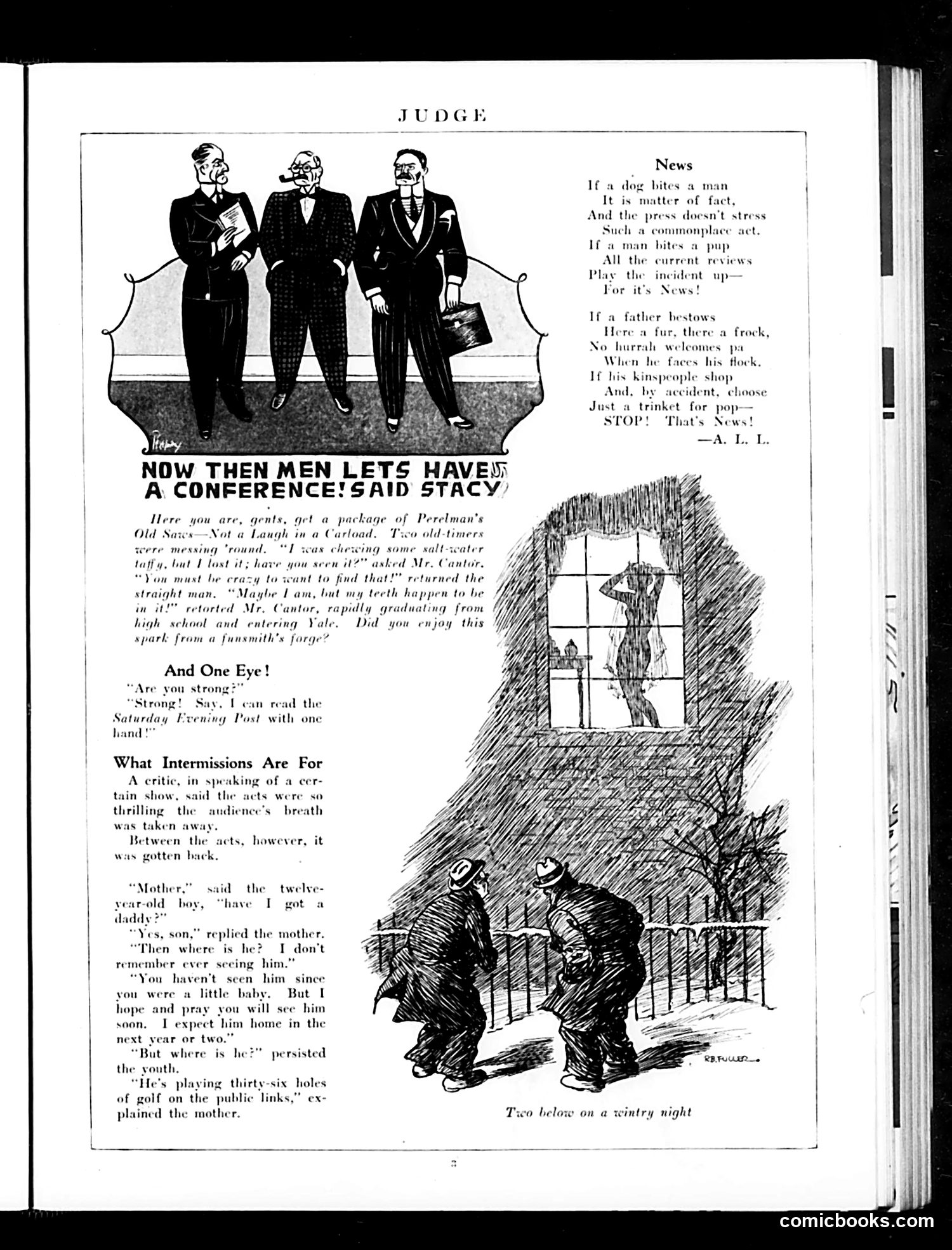
**Top Cartoon: "Now Then Men Lets Have a Conference! Said Stacy"** Three well-dressed men confer, likely political or business figures of the era. The caption references "Stacy" calling a conference. Without additional context, the specific identity of these figures is unclear, though their formal attire and body language suggest they represent authority figures or politicians engaged in backstroom dealings—a common Judge satirical subject. **Bottom Cartoon: "Two Below on a Wintry Night"** Two men huddle outside a building in winter, apparently homeless or destitute. This appears to satirize poverty or social hardship, contrasting sharply with the suited gentlemen above. **Right Column: "News" Poem** A humorous poem mocking journalism and sensationalism, suggesting newspapers overstate trivial events as "News."
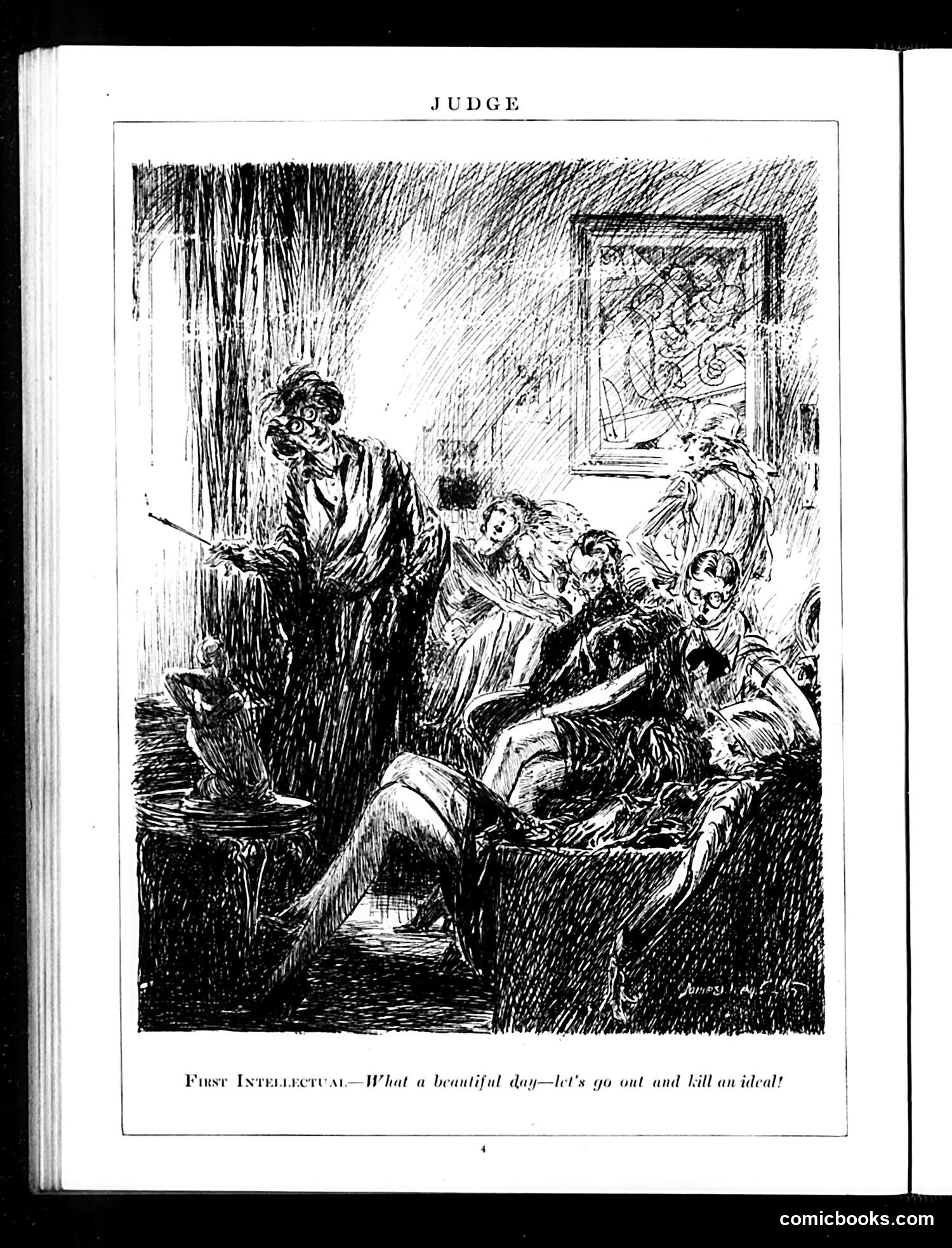
This cartoon is titled "Judge" and shows a courtroom scene with a judge presiding over what appears to be a trial. The caption reads: "First Intellectual.—What a beautiful day—let's go out and kill an ideal!" The satire appears to target intellectual pretension and hypocrisy. The "First Intellectual" character suggests going outside on a beautiful day not to enjoy nature or engage in meaningful activity, but specifically to "kill an ideal"—a darkly ironic statement that mocks how intellectuals claim to champion ideals while their actual behavior contradicts these principles. The courtroom setting may reinforce the theme of judgment and accountability. The cartoon satirizes a particular type of affected intellectual who speaks grandiosely about principles but fails to live by them—a common target of Judge magazine's social satire.
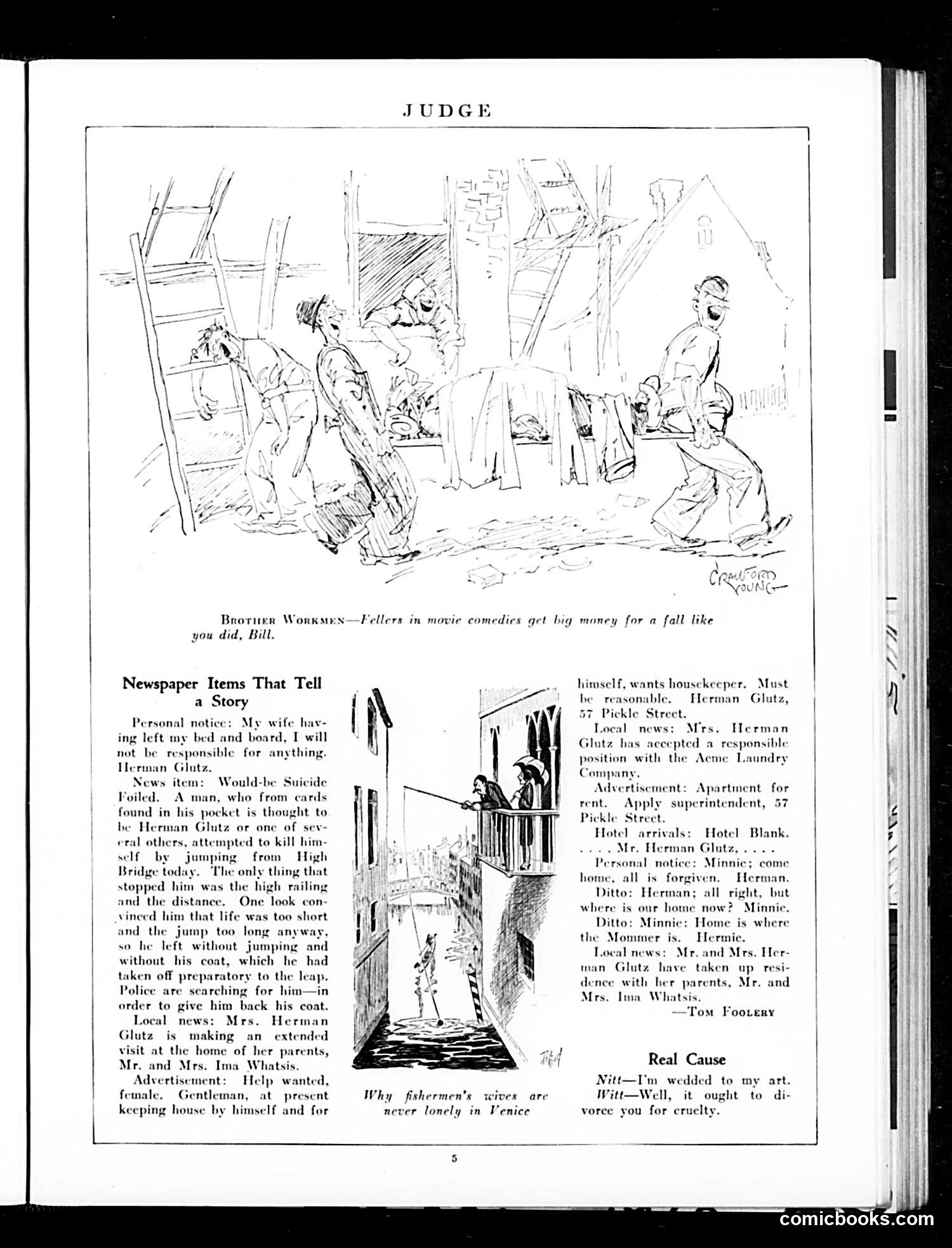
**Top Cartoon:** Shows performers falling during a movie comedy scene. The caption jokes that stunt performers ("Brother Workmen") earn high pay for physical falls—the humor targets the emerging film industry's dangerous stunt work. **"Newspaper Items That Tell a Story":** A darkly comic narrative about Herman Glutz, presented through classified ads and personal notices. Glutz abandons his wife, attempts suicide by jumping from High Bridge, is rescued, loses his coat, and the police search for him. Mrs. Glutz then visits her parents. The satire mocks newspaper culture itself—how random classified ads and notices, when read together, accidentally create a complete human tragedy. This reflects Judge's criticism of sensationalist journalism. **Bottom Jokes:** Unrelated one-liners about artistic temperament and marriage.
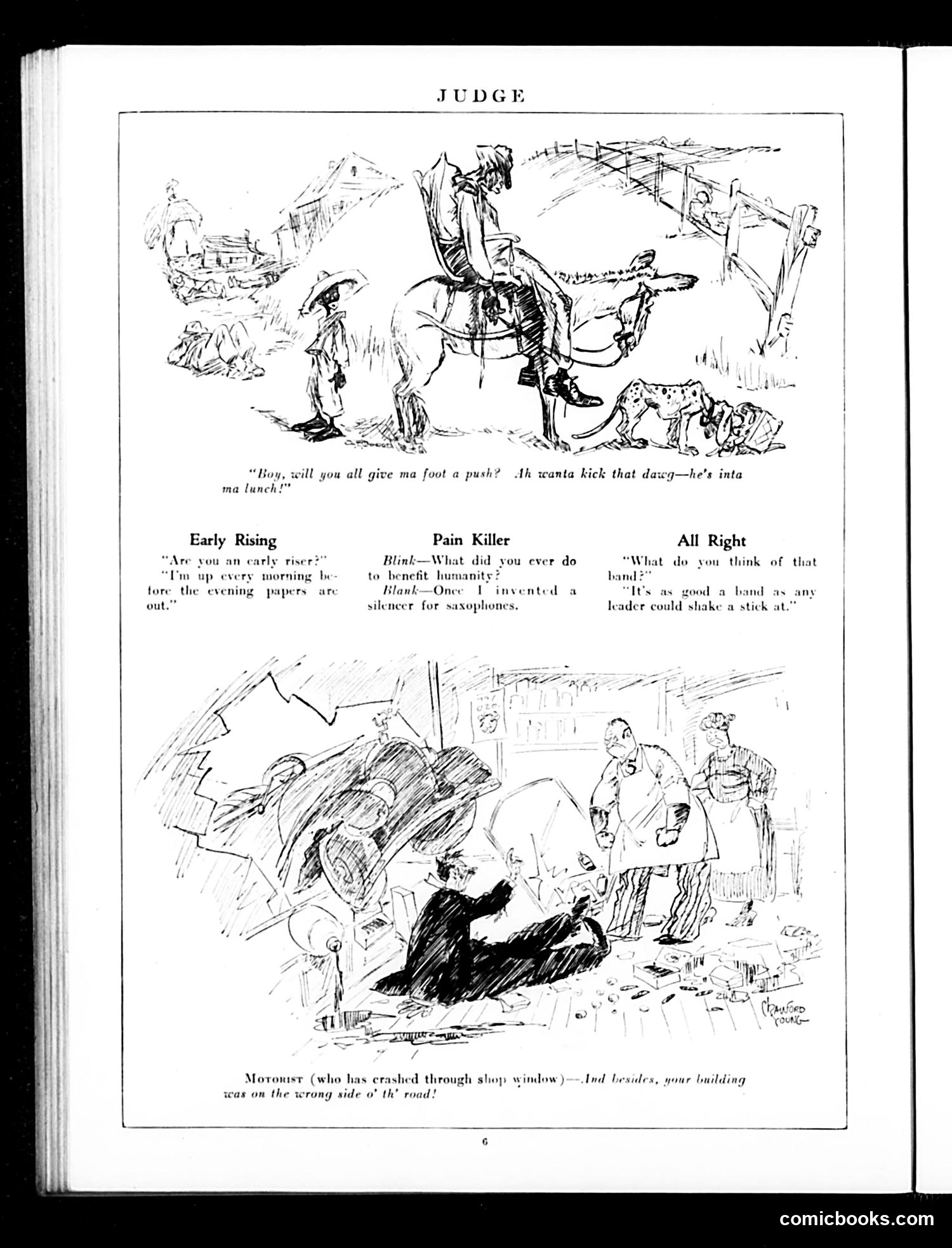
This page contains four separate satirical humor cartoons typical of early-to-mid 20th century Judge magazine: 1. **Top cartoon**: Rural/dialect humor featuring a boy asking for help pushing a dog away from his lunch—playing on stereotypical Southern or rural speech patterns for comic effect. 2. **"Early Rising"**: Mocks the self-help cliché about early rising's supposed benefits; the speaker brags about waking early just to read newspapers. 3. **"Pain Killer"**: Satirizes vague claims about humanitarian invention—a character's only contribution was inventing a "silencer for saxophones," mocking both inflated self-importance and perhaps contemporary complaints about jazz music's volume. 4. **"Motorist"**: Shows a motorist who crashed through a shop window blaming the building's location rather than accepting responsibility—satirizing how drivers deflect blame for accidents onto infrastructure. The humor relies on character types, dialect comedy, and absurdist logic typical of Judge's satirical style.
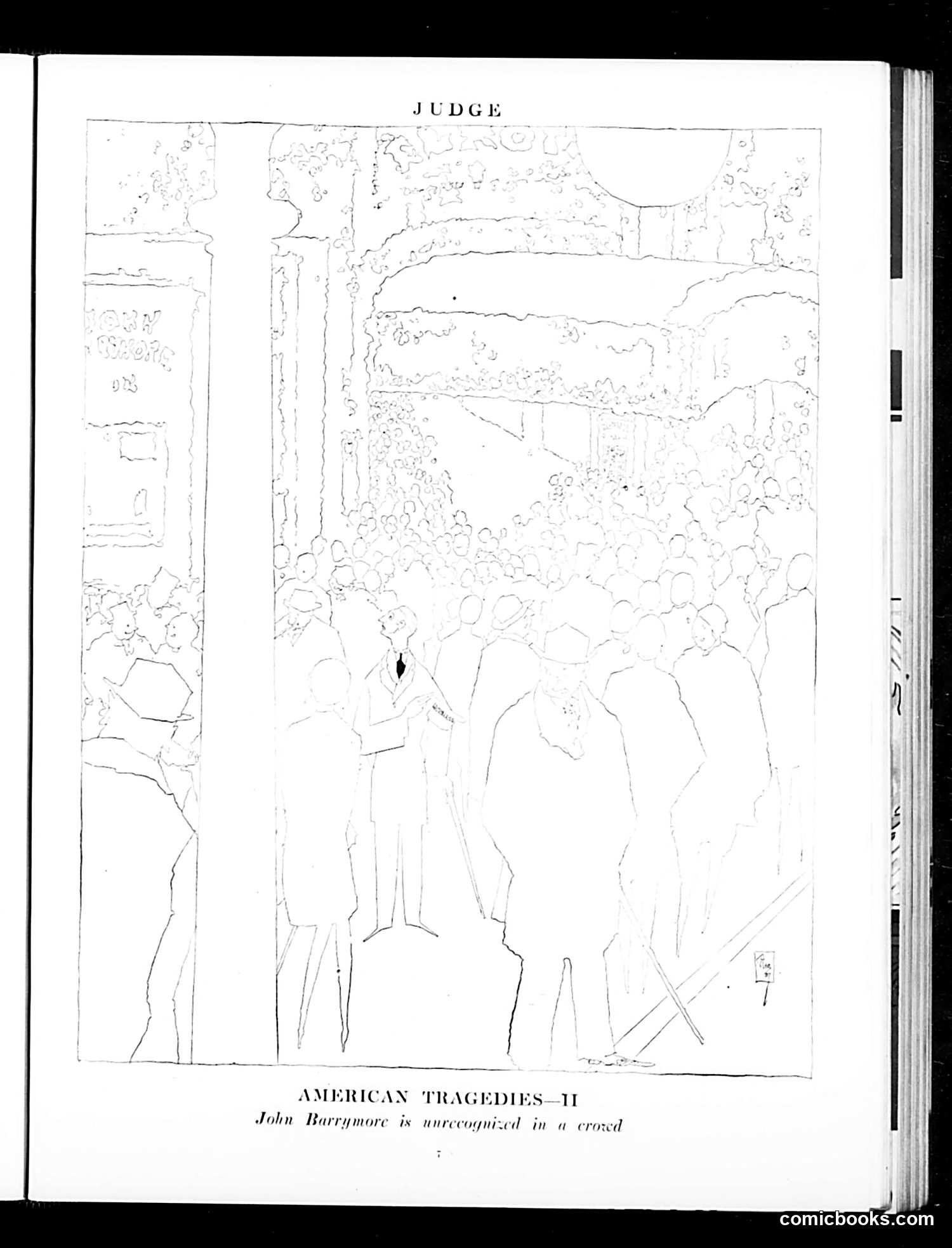
This is a satirical cartoon from *Judge* magazine titled "American Tragedies—II," depicting actor John Barrymore unrecognized in a crowd. The cartoon shows a crowded indoor scene (possibly a theater or public venue) with many figures, while a single figure in the center appears isolated or overlooked—presumably Barrymore. The satire plays on the irony that a famous stage and film actor of his era would go unnoticed among ordinary people. Barrymore was a prominent member of the celebrated Barrymore acting dynasty in the early 20th century. The "tragedy" is comedic: the tragic situation for a celebrated performer is not being recognized. This reflects *Judge's* typical use of exaggeration and irony to mock contemporary figures and social situations.
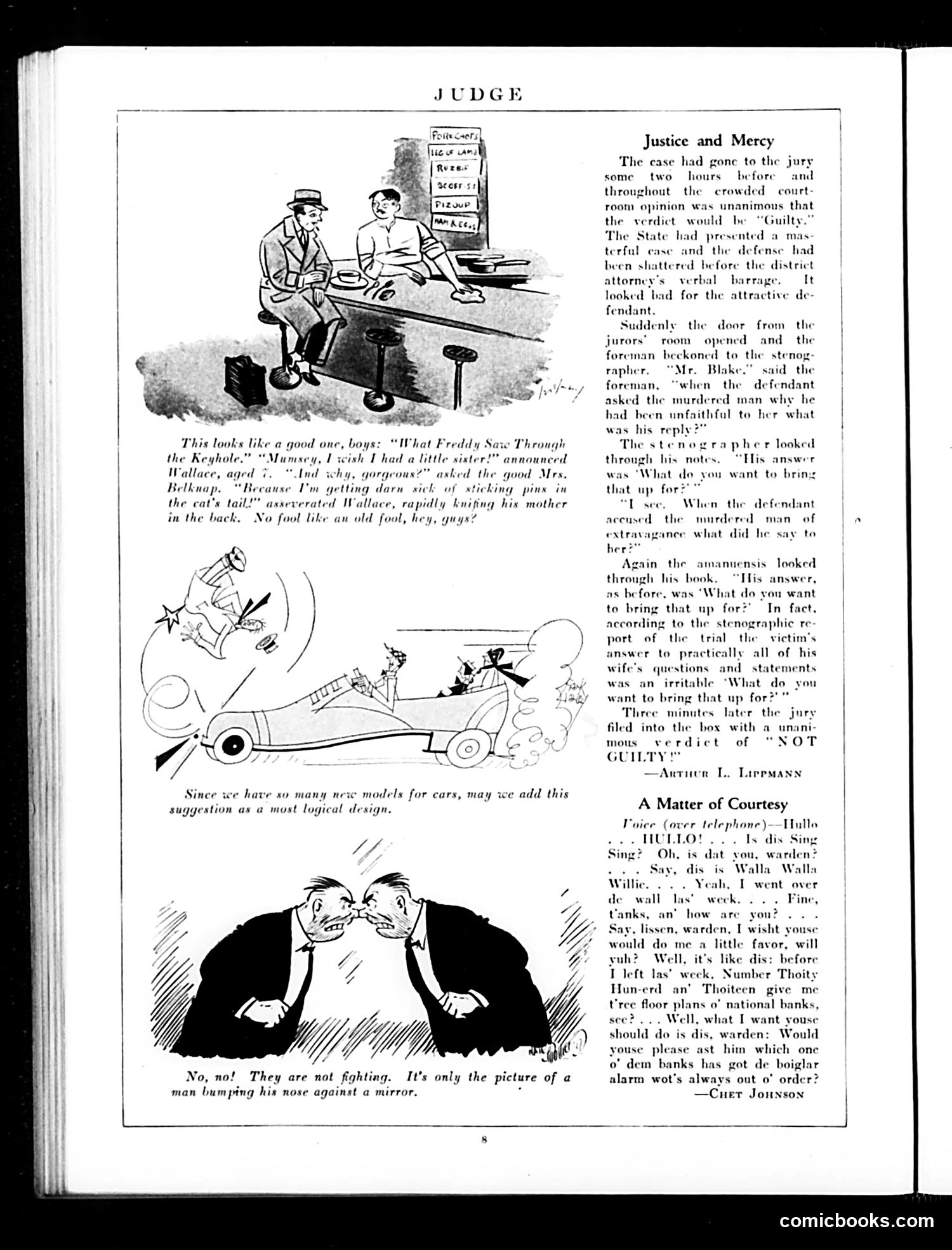
This page contains three satirical pieces typical of early 20th-century American humor: **"Justice and Mercy"** mocks the legal system's inconsistency. A defendant accused of murder is acquitted after the jury learns his standard, irritable response to his wife's complaints was merely "What do you want to bring that up for?"—suggesting his habitual rudeness, not guilt, explains the victim's accusations of infidelity. The satire targets how trivial or character-based details can sway juries toward unexpected leniency. **The car design cartoon** jokes about automotive innovation, suggesting a slapstick vehicle design as a "logical" option among new models. **"A Matter of Courtesy"** uses thick ethnic dialect (likely meant as working-class immigrant speech) in a humorous phone conversation where a prisoner requests his warden ask another inmate which bank has the most unreliable burglar alarm—implying the inmates are planning crimes post-release. The satire critiques prison security and rehabilitation failure. All three pieces reflect Judge's satirical focus on American legal, commercial, and social institutions.
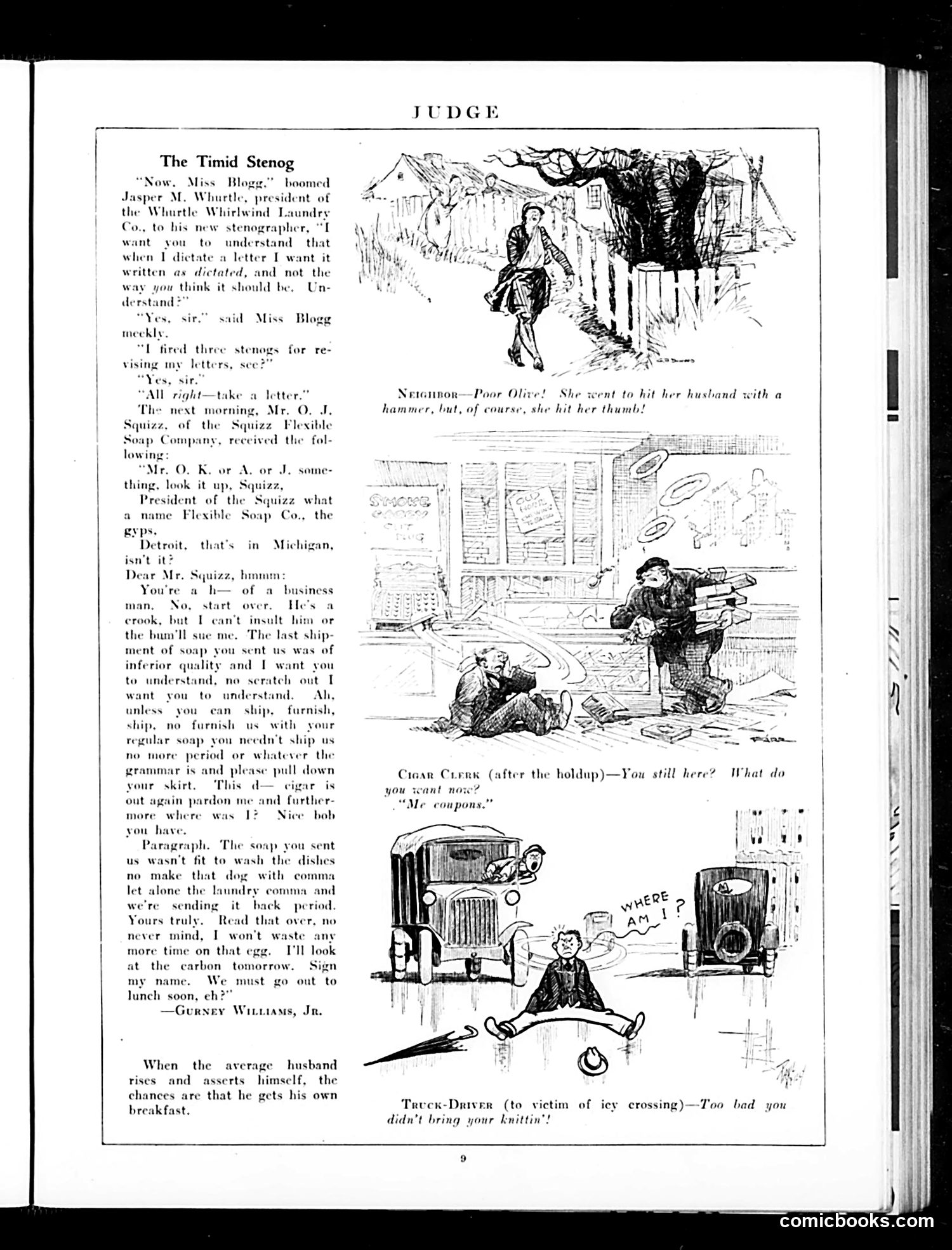
This page from *Judge* contains three satirical pieces mocking workplace incompetence and social situations of the era. **"The Timid Stenographer"** satirizes a pompous boss (Jasper M. Whurtle) whose dictation is so disorganized and digressive that his stenographer Miss Blogg cannot transcribe it coherently. The humor lies in his rambling—interrupting himself with irrelevant comments ("Nice bob you have"), corrections, and tangents—while demanding she write "as dictated." The resulting letter to a soap company is incoherent gibberish, exposing the executive's own incompetence masked by bluster. The three bottom cartoons are brief sight gags: one depicts a woman hitting her thumb instead of her husband with a hammer (domestic frustration humor); another shows a police officer interrogating a holdup victim who apparently remained at the scene; the third mocks a pedestrian who slipped on ice for not having knitting to pass the time. The overall theme targets pretentious businessmen and the absurdities of clerical work in early 20th-century offices.
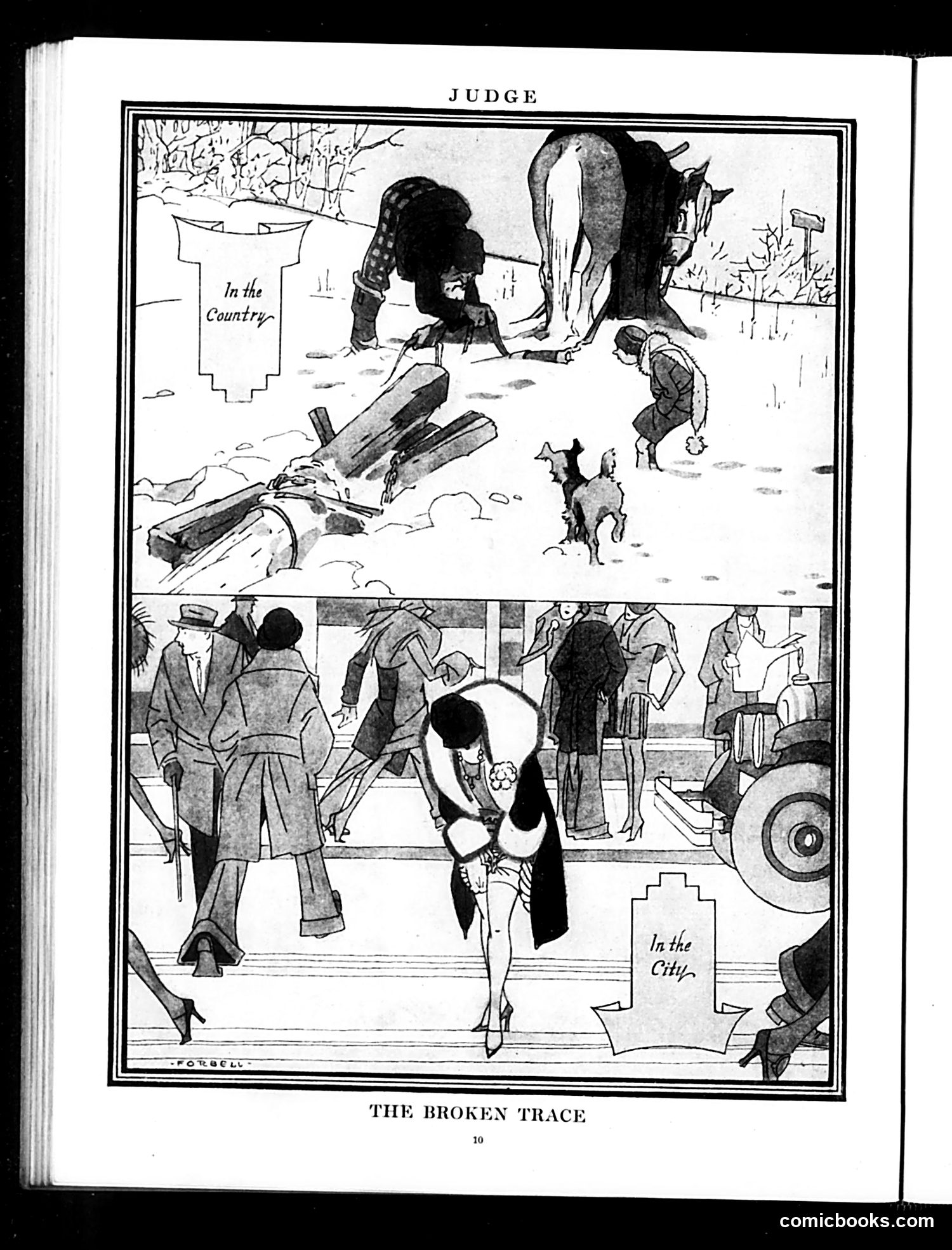
This satirical cartoon compares rural and urban behavior through a two-panel structure. The top panel ("In the Country") shows rustic characters engaged in what appears to be rural activity—possibly hunting or outdoor work with a cow. The bottom panel ("In the City") contrasts this with urban sophistication, depicting well-dressed city dwellers at what looks like a social gathering or fashionable event. The satire likely critiques the stark behavioral and social differences between country and city life in early 20th-century America. The "broken trace" (a broken harness strap) serves as a metaphor for the disconnect between these two worlds—rural simplicity versus urban refinement. The cartoon reflects contemporary tensions between traditional rural America and modernizing urban society.
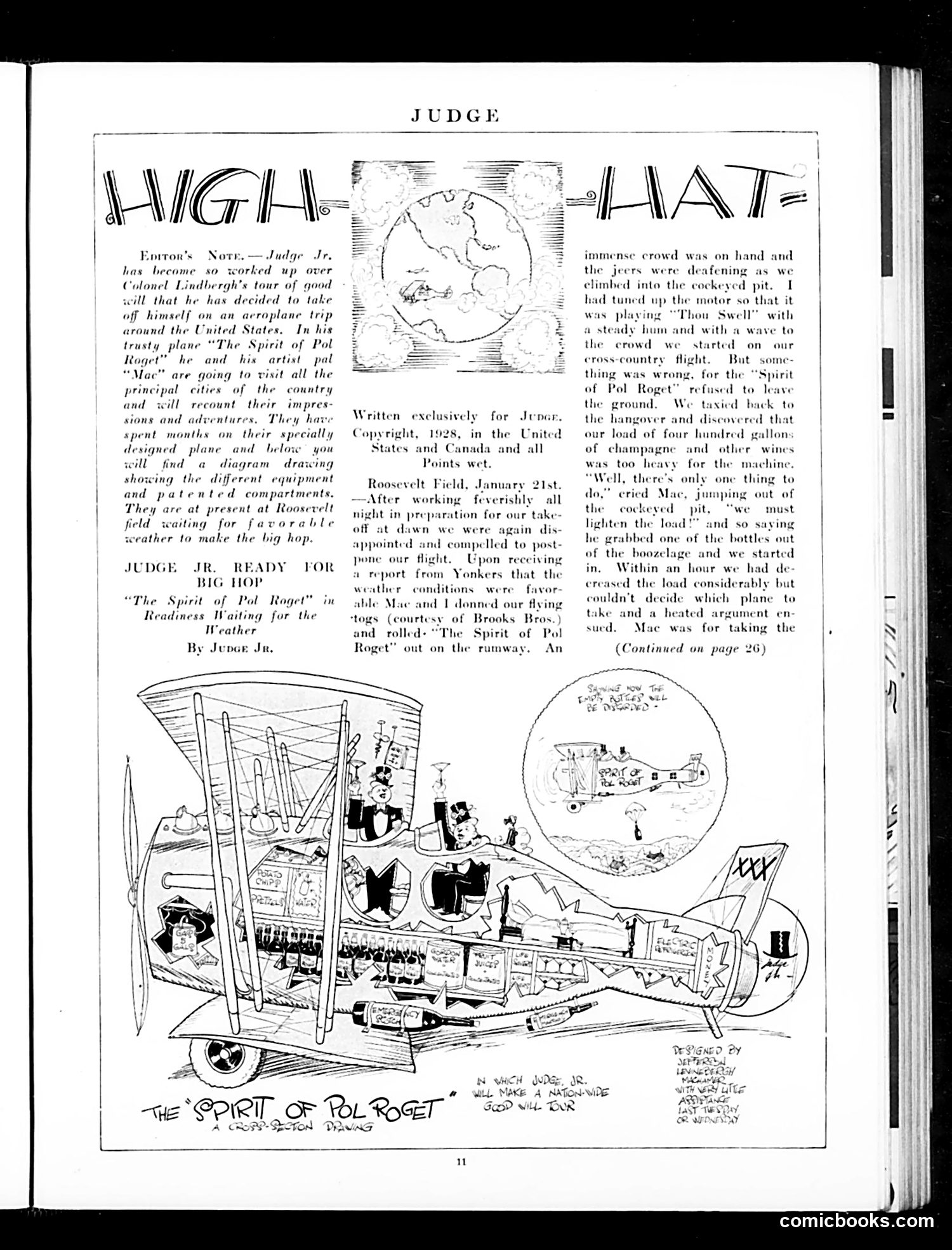
This 1928 Judge Jr. article satirizes Colonel Lindbergh's famous 1927 transatlantic flight "The Spirit of St. Louis" by imagining a parody tour. The piece mockingly describes "The Spirit of Pol Roget"—a deliberately misspelled reference—as a specially-designed aircraft for a cross-country journey. The satire targets the era's aviation enthusiasm and celebrity culture surrounding Lindbergh. The detailed cutaway diagram shows an absurdly over-equipped interior, played for comedic effect. The narrative joke centers on the plane being so loaded with champagne that it cannot take off, requiring the crew to drink their cargo to lighten the load—mocking both Prohibition-era hypocrisy and the frivolous excess of wealthy aviation enthusiasts. The humor relies on readers' familiarity with Lindbergh's actual achievement and contemporary debates about alcohol during Prohibition (which ended 1933).
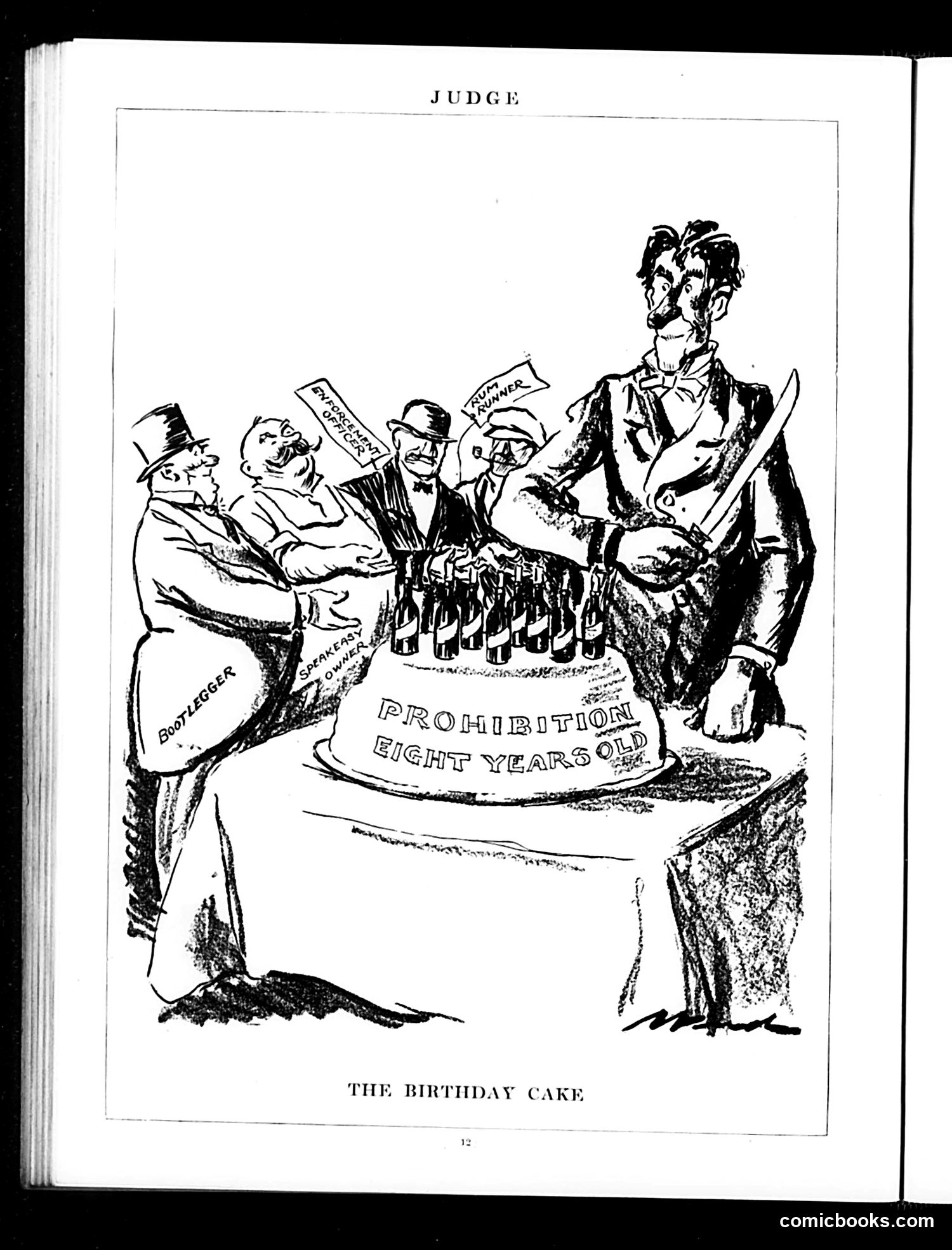
This cartoon satirizes Prohibition by depicting it as a birthday cake turning eight years old. A tall figure (likely representing a judge or authority) holds a sword over the cake while several caricatured men labeled "Bootlegger" and appearing to represent various interests (possibly criminals, politicians, or business figures) gather around it. The satire suggests that despite Prohibition's eighth anniversary, illegal alcohol production and distribution (bootlegging) thrives rather than diminishes. The "birthday" framing implies Prohibition was meant to be celebrated as a success, but the cartoon argues it has instead become corrupted and ineffective, with lawbreakers profiting while authorities struggle to enforce the ban. This reflects widespread public skepticism about Prohibition's effectiveness during the 1920s.
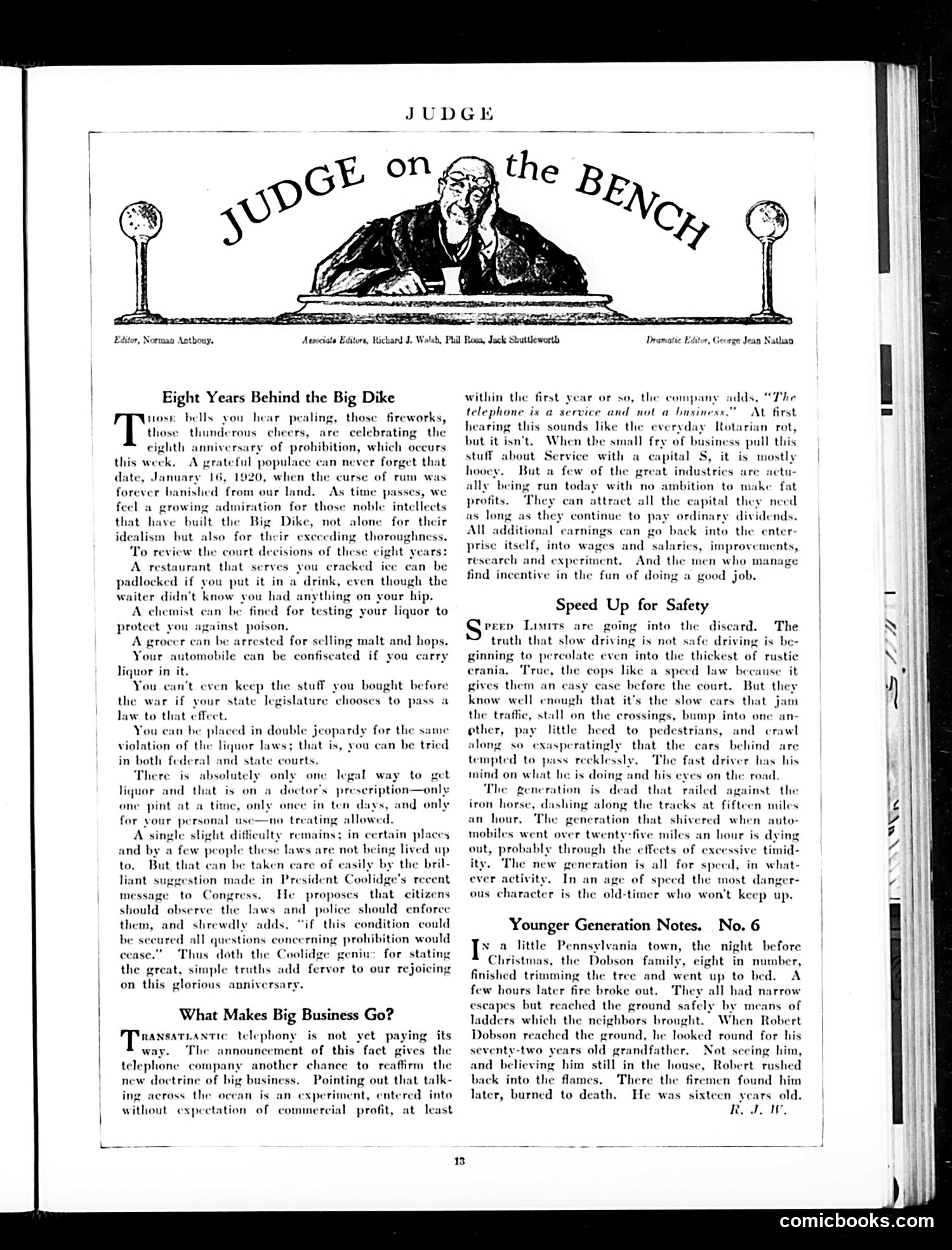
This page satirizes **Prohibition's eighth anniversary** (January 16, 1928, though the text incorrectly references 1920). The title "Big Dike" sarcastically compares Prohibition to a massive barrier holding back destructive forces. The main article mocks Prohibition's absurd enforcement through heavy irony. It catalogs ridiculous legal consequences—restaurants padlocked for serving ice, grocers arrested for selling hops, cars confiscated for transporting alcohol—presenting these as proof of the law's "thoroughness." The satire peaks mocking President Coolidge's suggestion that citizens simply obey laws and police enforce them, calling this obvious truism a "Coolidge genius." The cartoonist (likely criticizing Prohibition as unworkable and tyrannical) uses the celebratory framing ironically. What appears to praise Prohibition's "noble intellects" actually exposes how draconian and ineffective the law had become by 1928. The sidebar pieces on transatlantic telephony and speed limits continue Judge's commentary on modern progress and government policy.
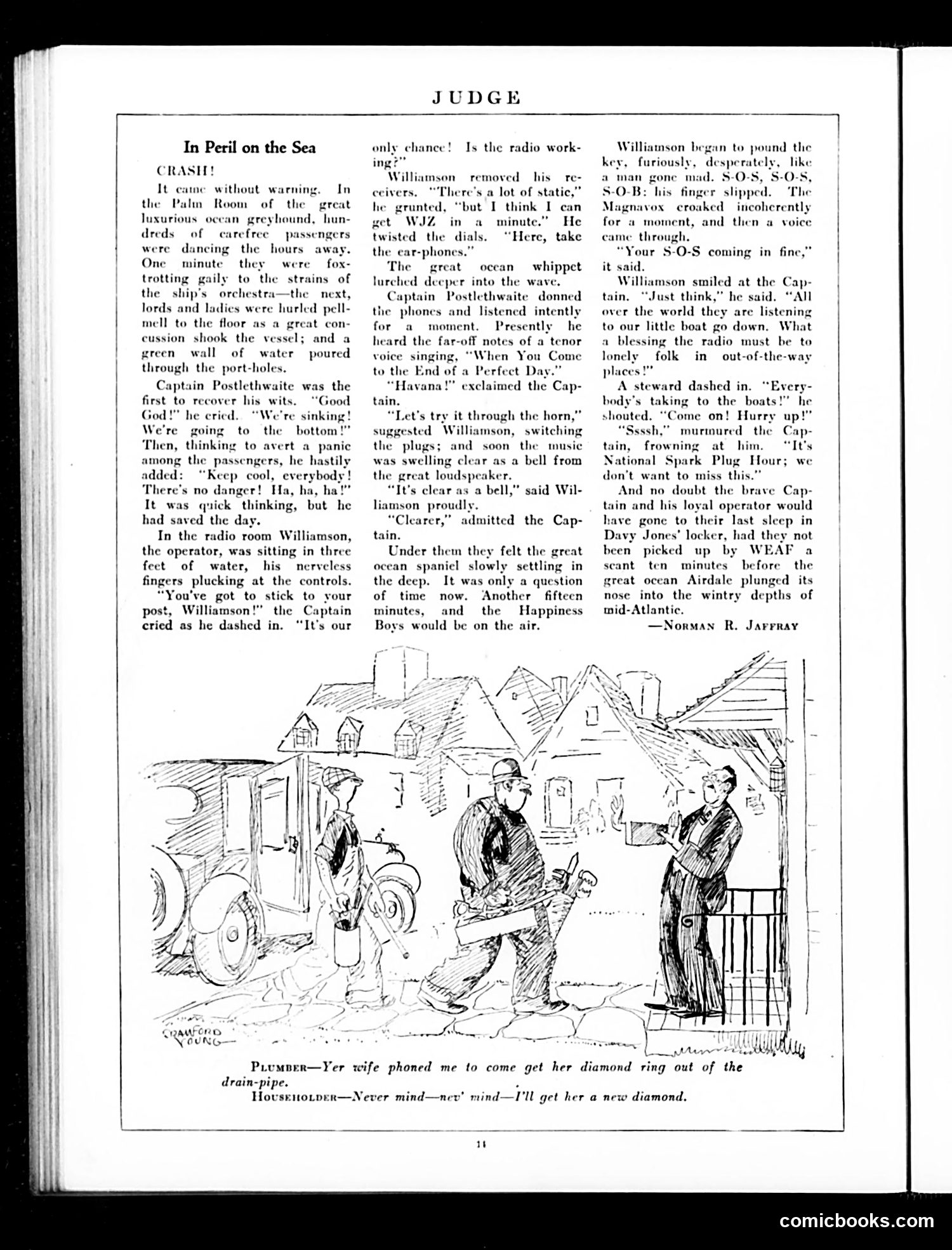
This story satirizes 1920s radio advertising excess during a maritime disaster. As a ship sinks, the captain and radio operator prioritize broadcasting over evacuation—first insisting on receiving a live performance from station WJZ, then refusing to interrupt "National Spark Plug Hour" even as passengers abandon ship. The joke mocks how aggressively commercialized radio had become, with sponsors' programming treated as more important than human survival. The cartoon below, titled "Plumber," delivers a simpler gag about casual infidelity and materialism: a plumber responds to being asked to retrieve a wife's diamond ring from a drain by offering to simply buy her a replacement—implying he's unconcerned with marital fidelity or that the wife isn't worth the effort. Both reflect 1920s concerns about modern consumer culture and its distorting values.
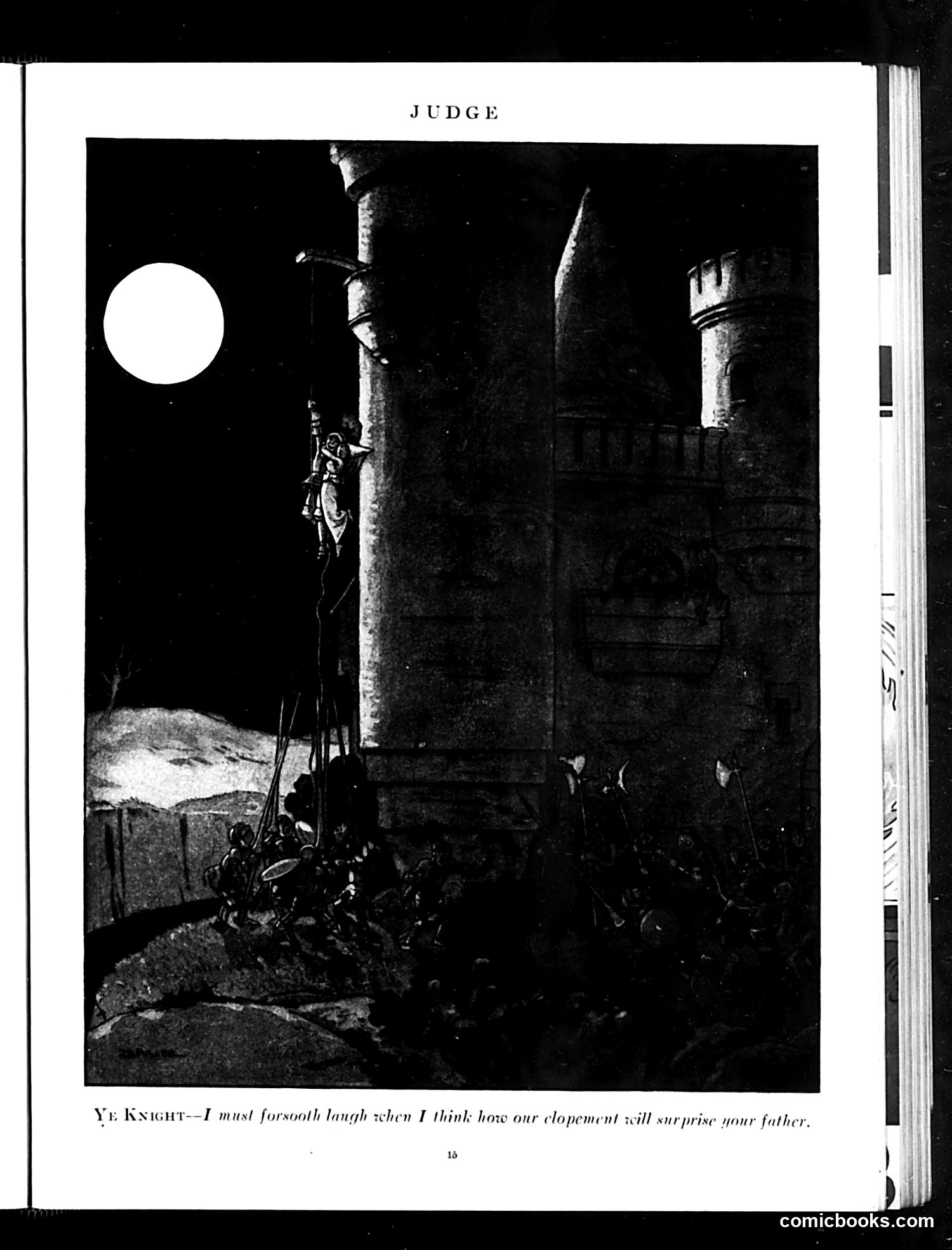
This appears to be a dramatic illustration titled "JUDGE" depicting a medieval or fantasy scene. A knight on horseback stands before a castle at night under a full moon, addressing a figure (likely a woman) on the castle wall. The caption reads: "Ye Knight—I must forsooth laugh when I think how our elopement will surprise your father." The satire likely mocks Victorian-era romantic melodrama by presenting it in exaggerated medieval language and setting. The humor appears to derive from the knight's callous amusement about deceiving the father through elopement—treating a serious transgression against paternal authority as a comedic prank. This reflects Judge magazine's typical satirizing of romantic conventions and social pretension of its era.
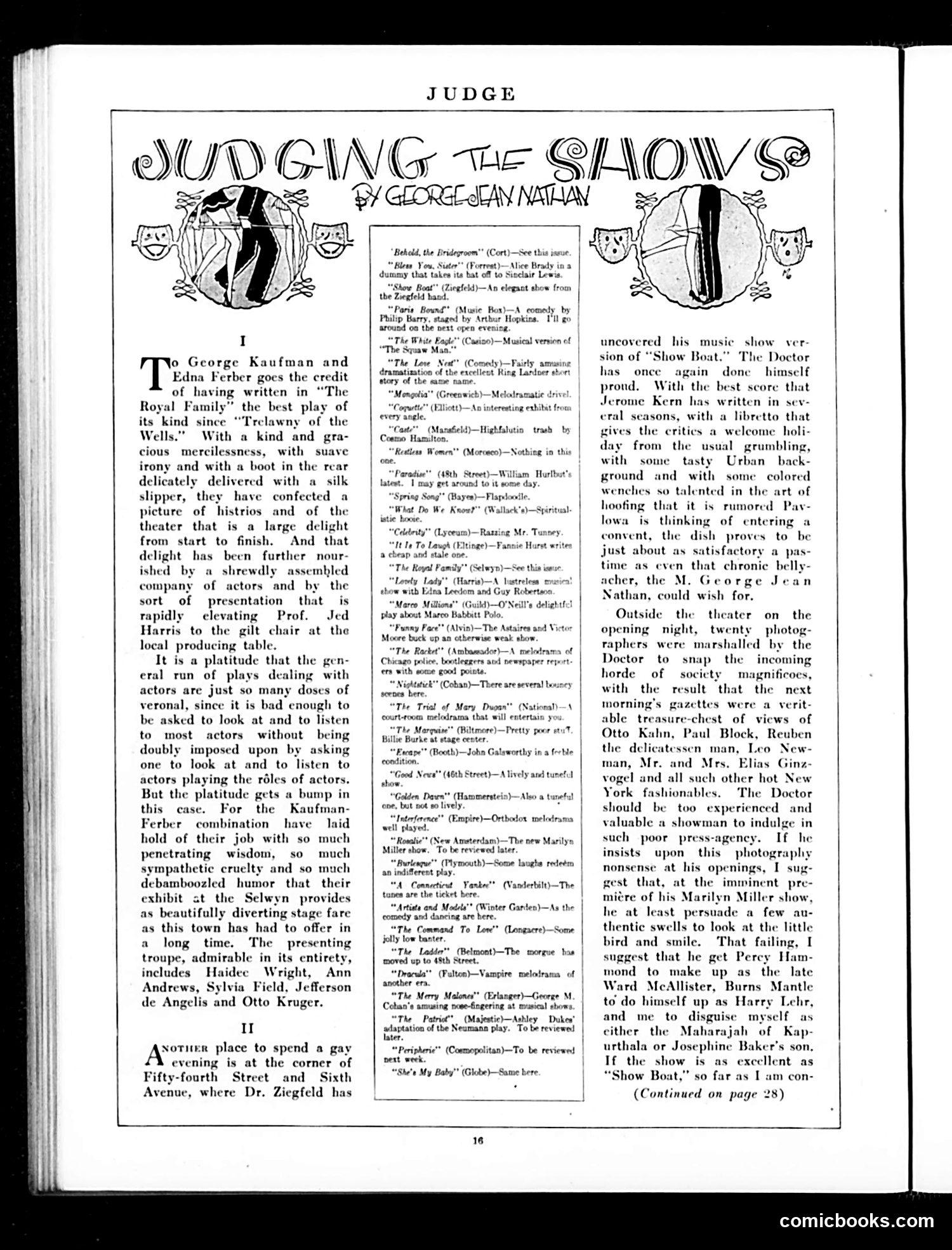
This page is a theater review column from Judge magazine, not a political cartoon. Nathan critiques Broadway productions of the era (likely mid-1920s based on references). The main review praises Kaufman and Ferber's *"The Royal Family,"* a comedy about theatrical life, calling it superior to typical actor-themed plays. Nathan credits producer Jed Harris and the cast (including Haidee Wright and Otto Kruger) for the show's success. The second section lists brief reviews of other current Broadway shows, ranging from musicals like *"Show Boat"* (praised) to various comedies and melodramas with mixed assessments. Nathan's tone is witty and sometimes dismissive—calling one show "highfalutin trash" and another "cheap and stale." This represents entertainment journalism of the Jazz Age theater scene, offering modern readers insight into 1920s Broadway tastes and production values.
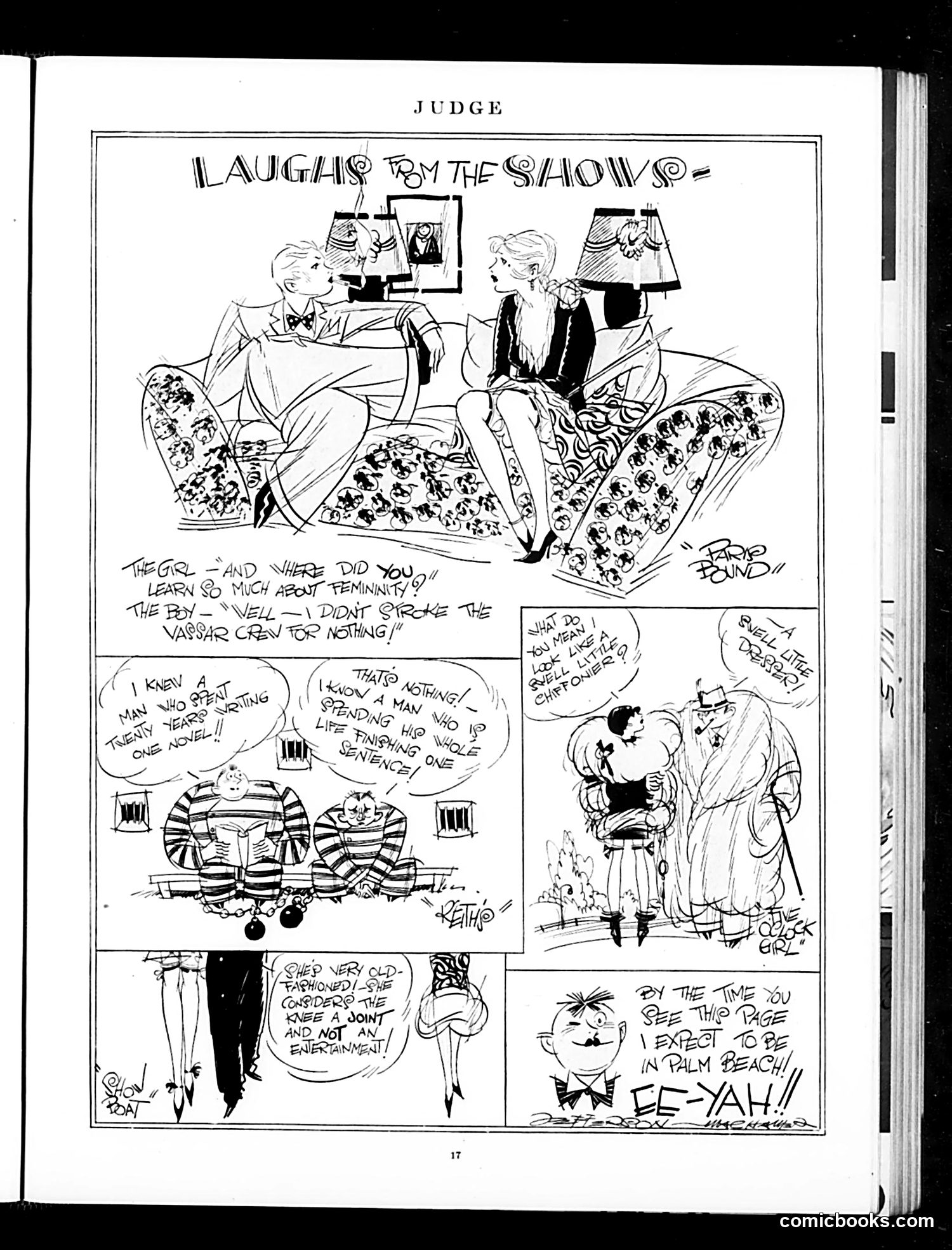
This Judge magazine page satirizes women's education and femininity, likely from the 1920s-30s. The top panel shows a socialite discussing what she learned at Vassar (an elite women's college) with a man—the joke being she learned nothing useful, only about "femininity." The lower panels mock educated women in prison settings, suggesting the satire equates intellectual women with criminals. One prisoner boasts of her "old novel," while another complains about "old-fashioned" courtroom proceedings. The final panel references Palm Beach, a wealthy resort destination. The overall thrust ridicules the contradiction between women attending prestigious colleges and their perceived frivolousness—a common anti-feminist trope suggesting higher education didn't make women serious or practical. The prison imagery implies something transgressive about educated women challenging traditional gender roles.
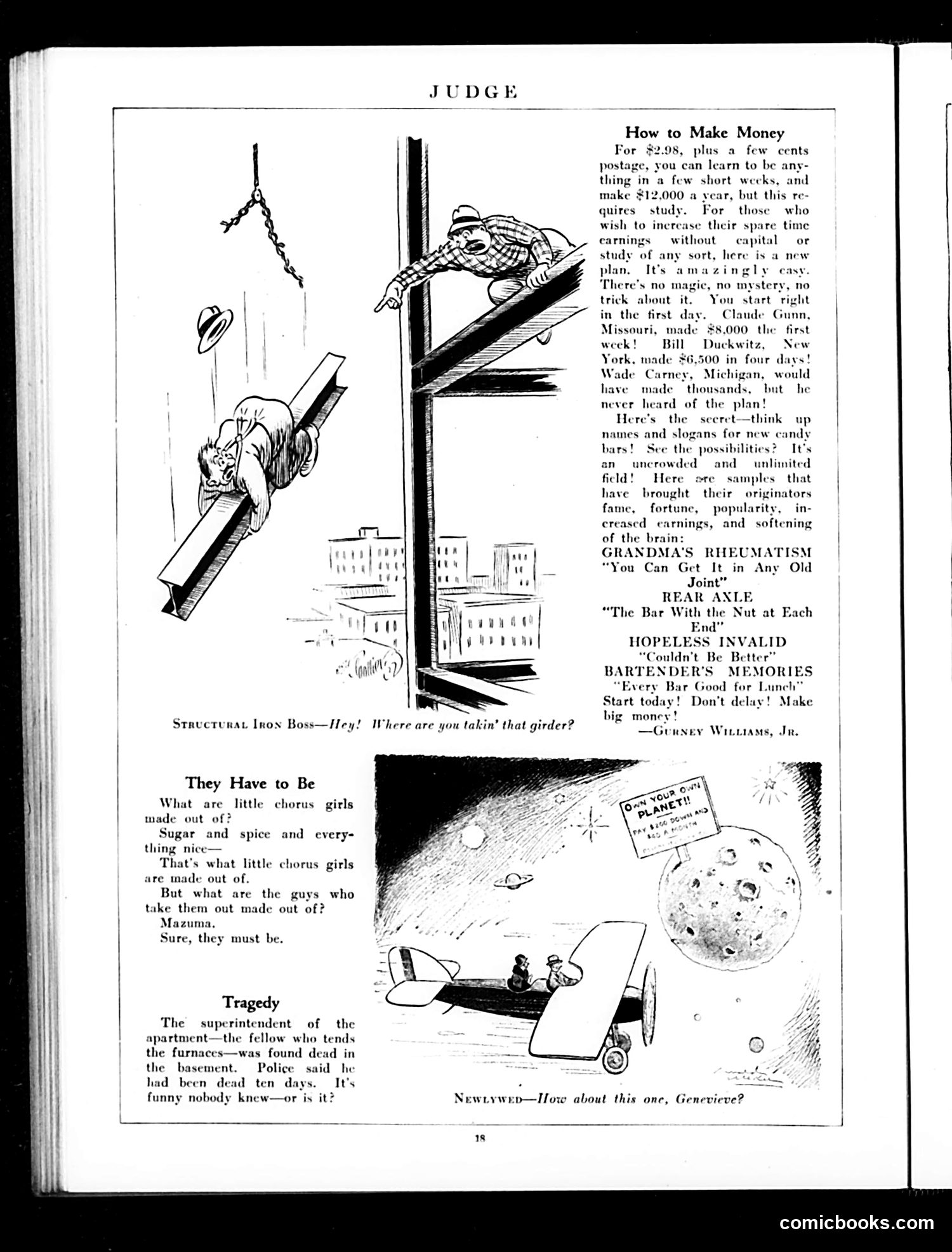
This page contains multiple satirical pieces typical of early 20th-century Judge magazine: **"How to Make Money"** mocks get-rich-quick schemes. It presents a fraudulent plan: inventing candy bar names and slogans allegedly earning thousands weekly. The fake testimonials (Claude Gunn, Bill Duckwitz, Wade Carney) parody typical scam advertising. The "samples" like "Grandma's Rheumatism" and "Hopeless Invalid" are deliberately absurd product names, satirizing both the implausibility of easy wealth and the ridiculous marketing of actual products. **"Structural Iron Boss"** is a brief visual gag about a worker losing his grip on a girder—workplace humor. **"They Have to Be"** uses a nursery rhyme structure to joke that chorus girls are made of "sugar and spice," while the men who date them must be made of "mazuma" (slang for money)—mocking male materialism and transactional dating. **"Tragedy"** darkly jokes about a superintendent found dead in the basement after ten days, with the punchline questioning why nobody noticed his absence.
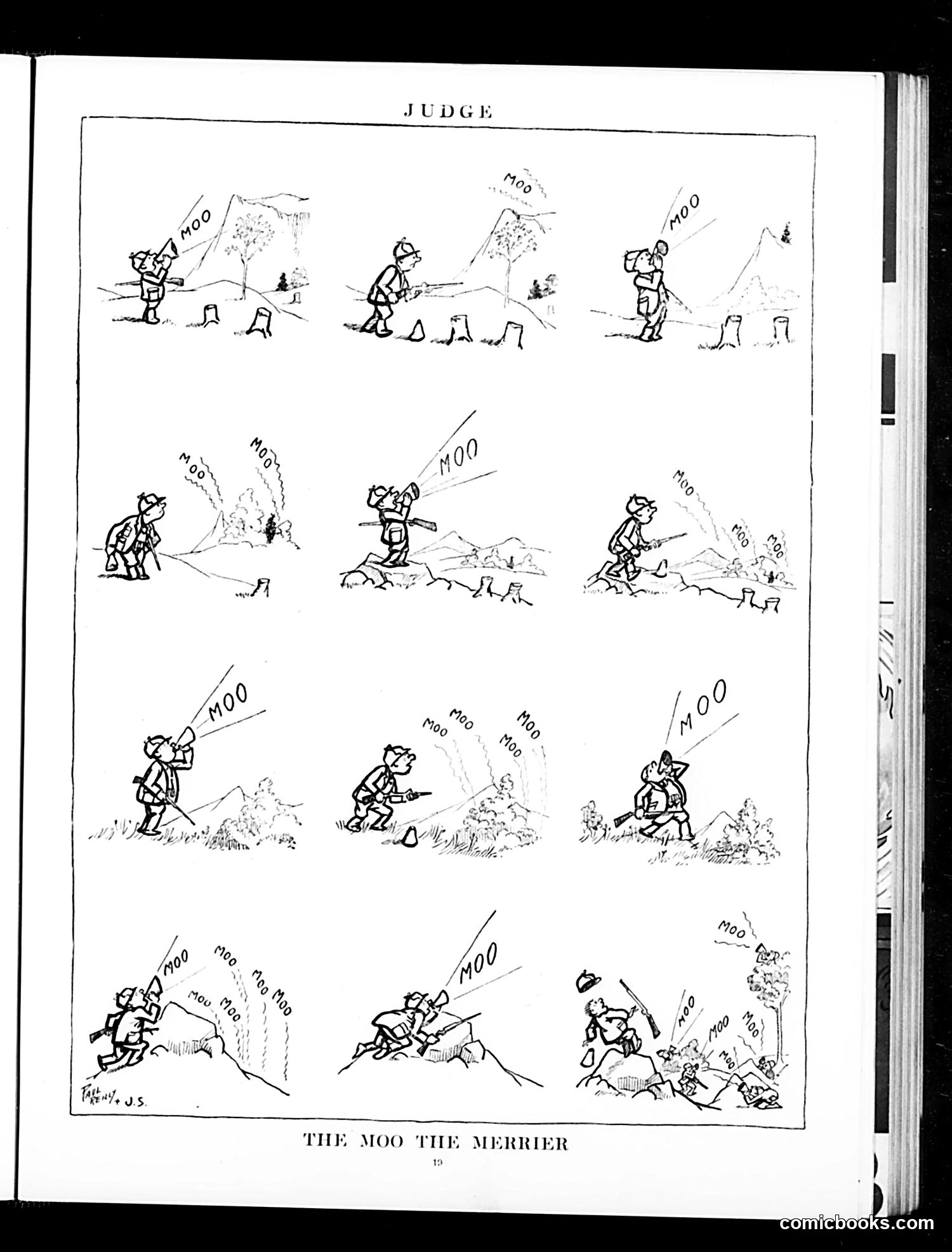
This is a humorous comic strip depicting a figure (appears to be a farmer or rural character) repeatedly attempting to herd or manage cattle, with the animals producing "MOO" sounds throughout each panel. The visual gag relies on a pun: "the more the merrier" becomes "the moo the merrier"—substituting cattle sounds for the word "more." The strip shows escalating chaos as the character struggles with increasingly numerous or uncooperative cows across twelve sequential panels. The joke is straightforward visual wordplay, likely appealing to Judge's readers through absurdist rural humor popular in early American satirical magazines. There's no apparent political commentary—this appears to be pure comedic entertainment rather than social or political satire.
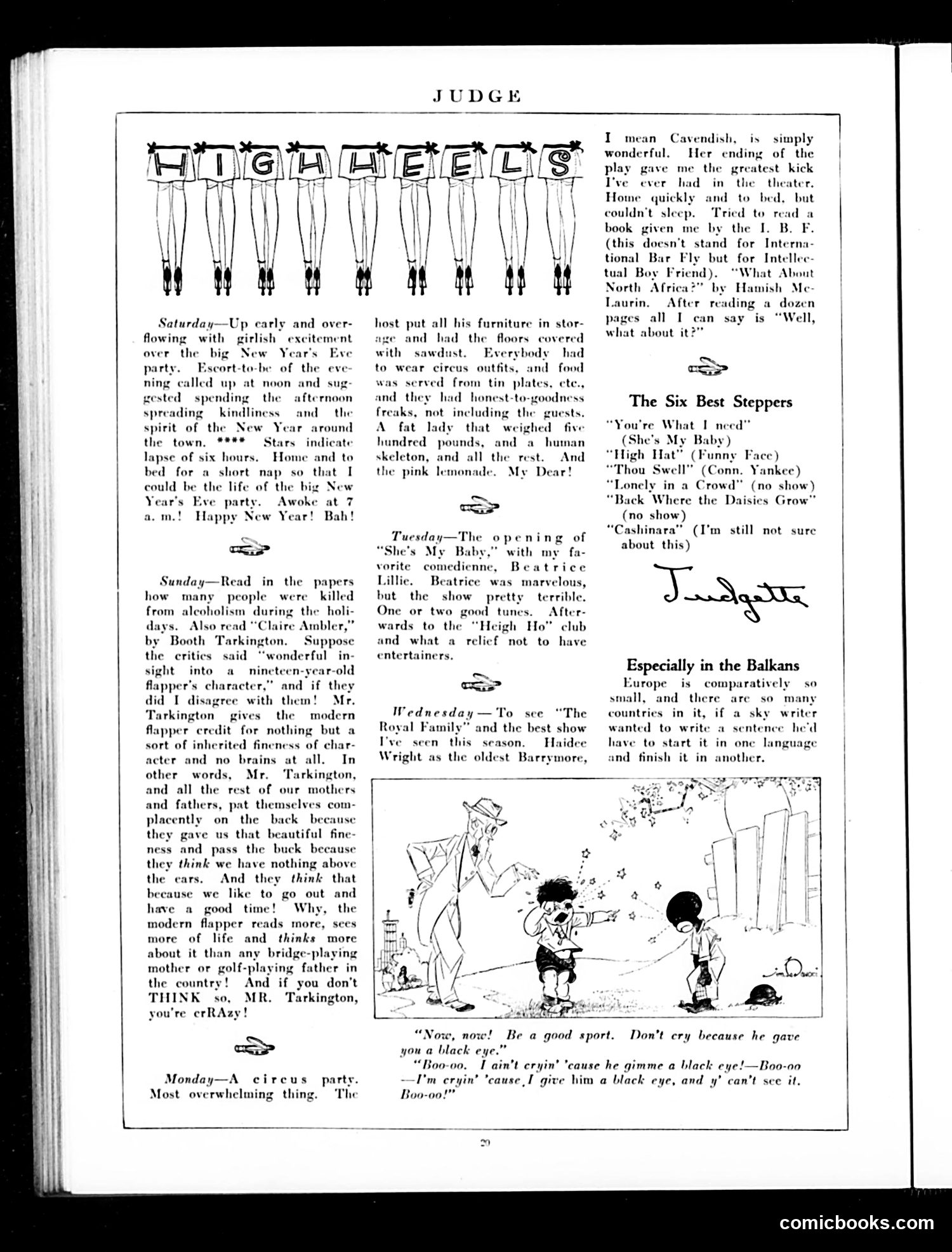
This is a diary-style humor column mocking a young "flapper" (1920s modern woman) through her week's social activities. The main satirical target is **Booth Tarkington's novel "Claire Ambler,"** which the diarist defends against the book's (and older generation's) dismissal of flappers as superficial. She argues modern young women actually read more and think more than their mothers, yet are unfairly stereotyped. The week's entries catalog typical flapper entertainment: New Year's parties, theater-going ("She's My Baby," "The Royal Family"), nightclubs, and circus parties. The humor derives from her breathless excitement over trivial social events and shallow cultural consumption, ironically *proving* the critics' point while she argues against it. The small cartoon below shows children fighting, with wordplay on "black eye"—the child cries not from receiving one but from *giving* one ineffectively. This is unrelated social humor typical of Judge's miscellaneous content. The page satirizes both flappers and their critics through performative contradiction.
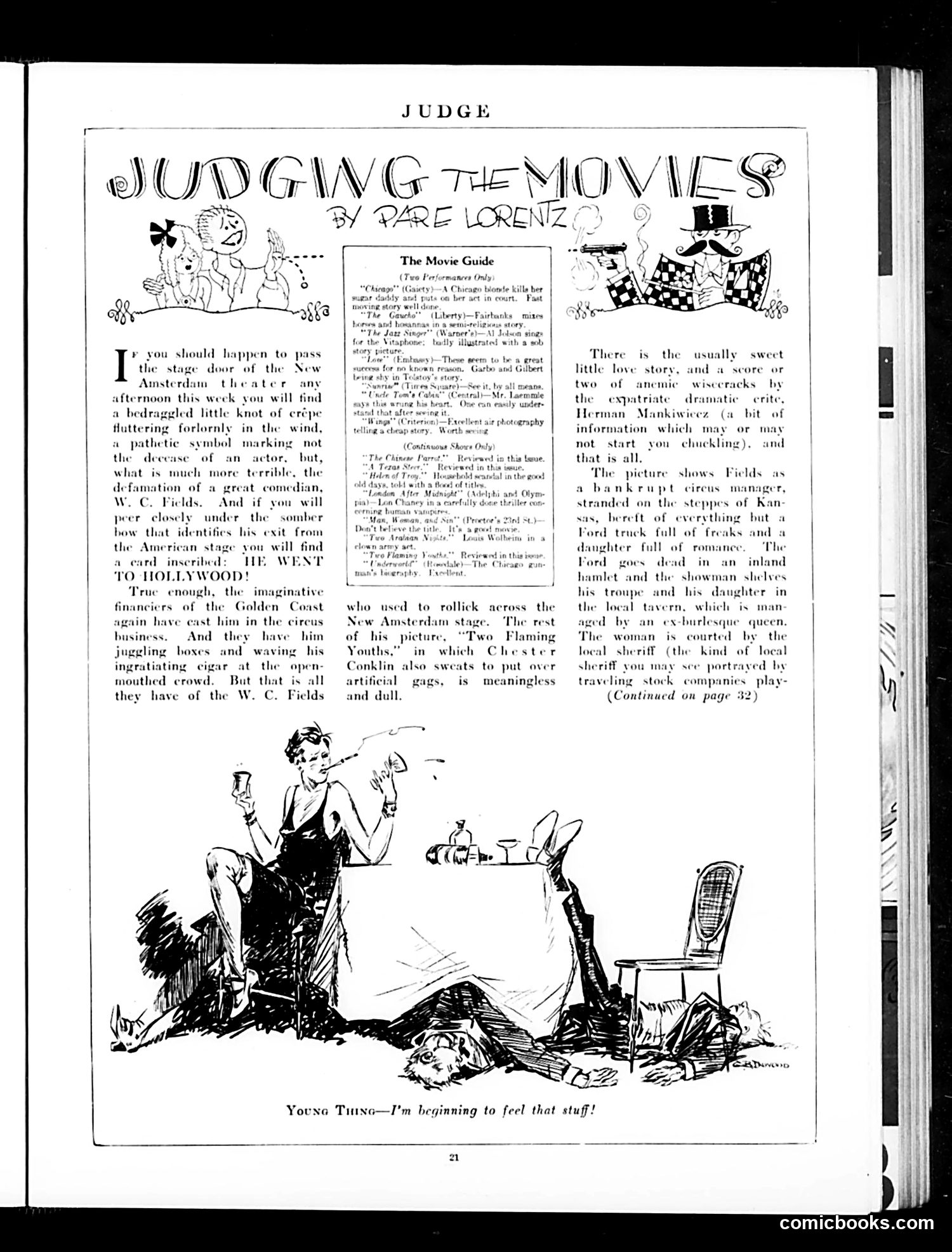
This is a film criticism column satirizing movie reviews and the film industry. The main cartoon depicts W.C. Fields, the famous comedian, now working in Hollywood after his Broadway career ended (symbolized by the mourning wreath at his theater exit). The text mocks the shallow nature of contemporary film criticism and movie plots. It describes a Fields picture about a circus manager stranded in Kansas with his troupe and daughter. The satire targets both the sentimental, predictable storylines ("usually sweet little love story") and the overwrought dramatic critics who treat such fluff seriously. The joke is that Fields—a great stage comedian—has been reduced to mechanical physical comedy (juggling boxes, waving cigars) rather than the sophisticated wit that made him famous. The cartoon's caption ("Young Thing—I'm beginning to feel that stuff!") jokes about the forced sentimentality audiences are expected to endure between gags. The criticism suggests Hollywood had diminished genuine theatrical talent into assembly-line mediocrity.
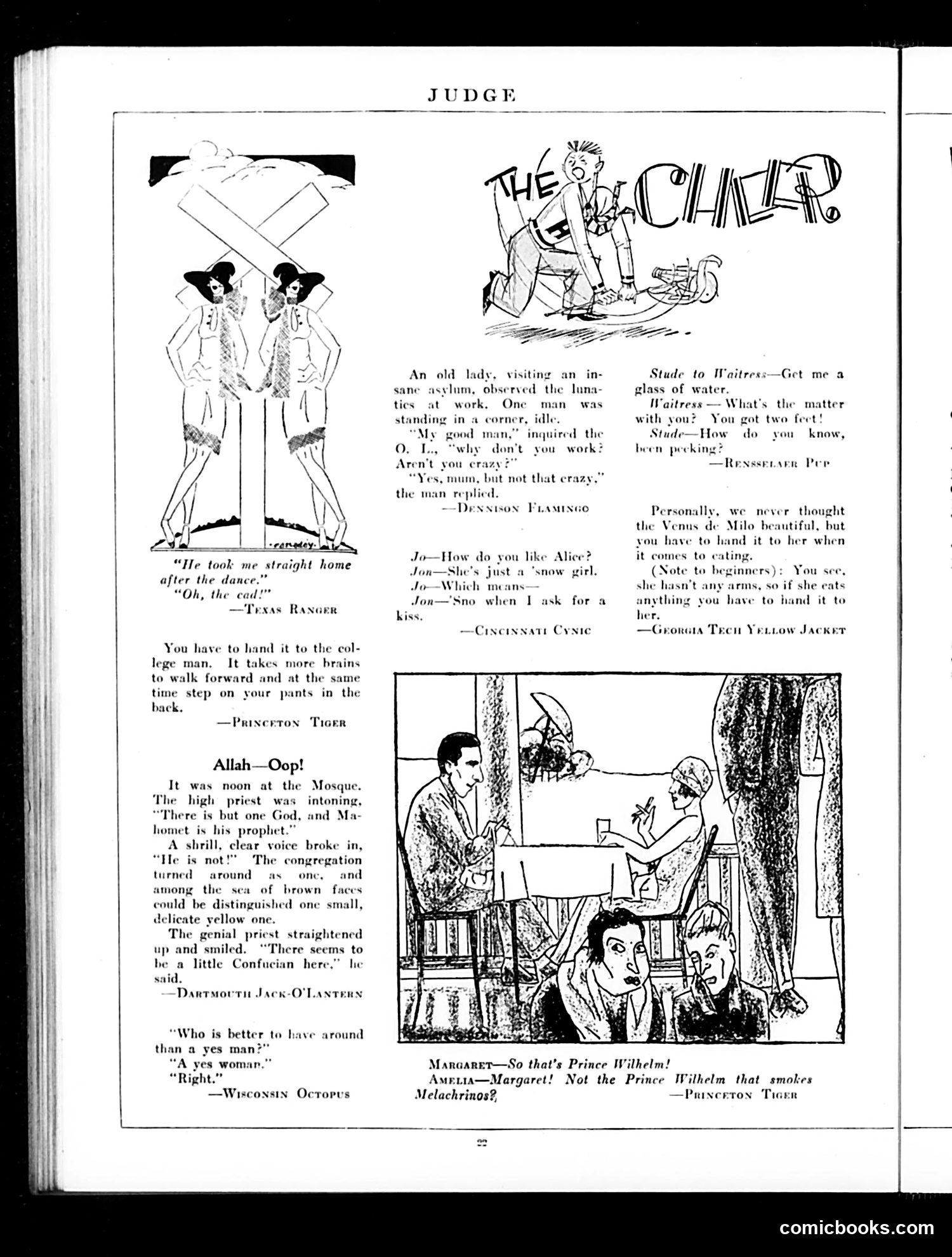
This page contains brief humorous anecdotes and jokes typical of early 20th-century American satirical magazines. **Key content:** The jokes mock college men's clumsiness, yes-men (and yes-women), asylum inmates, and courtship awkwardness. One piece, "Allah—Oop!", satirizes religious rigidity by depicting a mosque where a small person (likely Asian, given the "yellow" descriptor) interrupts Islamic prayers with "He is not!"—the priest responds tolerantly, calling them a "Confucian." **The final cartoon** references "Prince Wilhelm"—likely Prince Wilhelm II of Germany—and cigarette brand "Melachrinos," joking that the real Prince Wilhelm wouldn't smoke that brand. **Context for modern readers:** These are stock humor formats—dating mishaps, workplace frustrations, religious absurdity—that reflect early 1900s American attitudes toward race, gender, and international affairs. The casual racial descriptions and stereotypes reflect period norms. The Wilhelm reference suggests pre-WWI interest in European affairs.
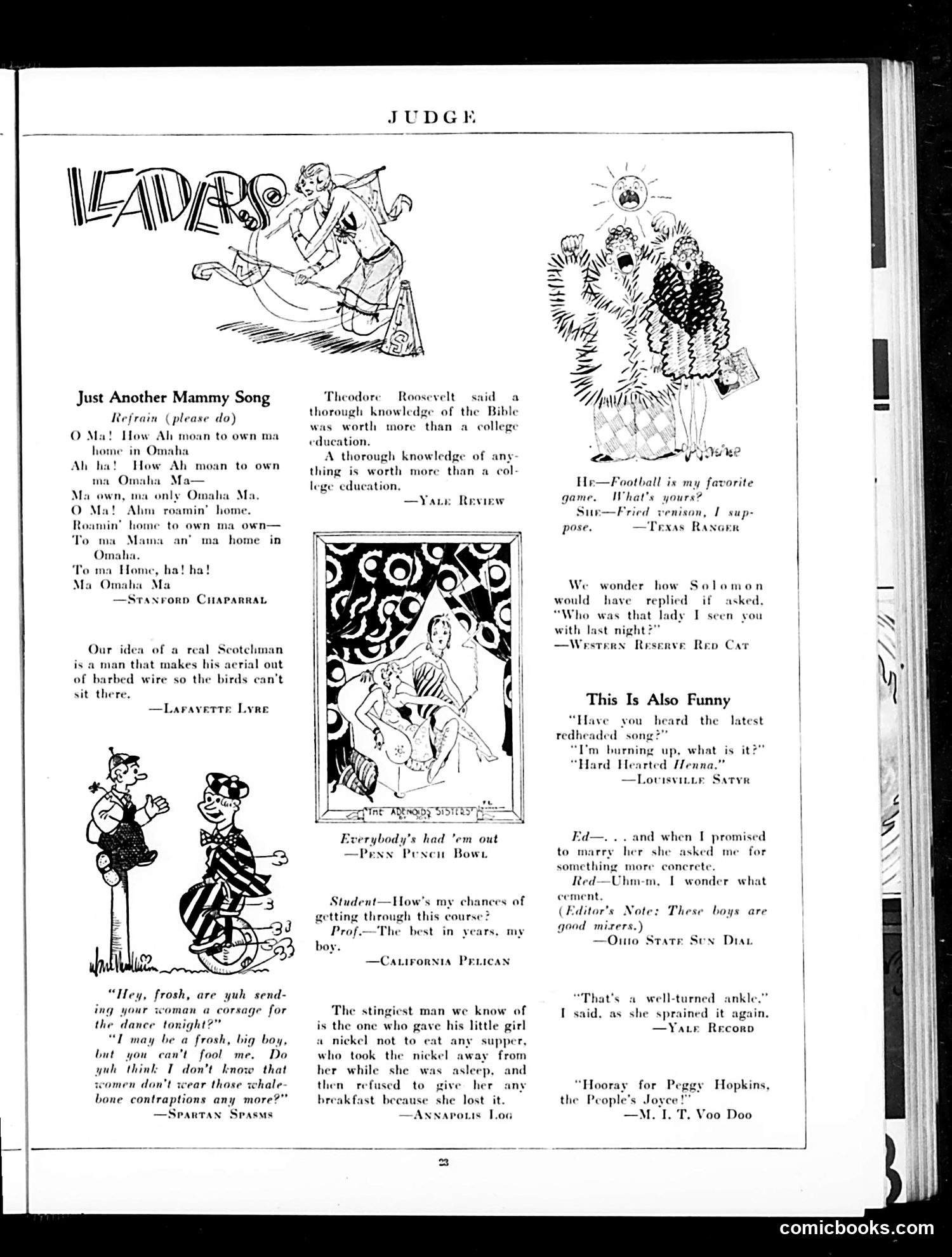
This page collects humorous quips and cartoons typical of 1920s satirical magazines. Key content includes: **"Just Another Mammy Song"**: A dialect song mocking African American vernacular and homesickness—reflecting the racial stereotypes prevalent in early 20th-century popular entertainment. **Theodore Roosevelt reference**: A quote praising practical knowledge over formal education, attributed to the former president. **College humor**: Multiple jokes about student life, including one mocking freshman naiveté about women's fashion ("whale bone contraptions"—corsets). **Social satire**: A notably cruel joke about a miserly father stealing his daughter's nickel and denying her breakfast. **"Peggy Hopkins" reference**: Likely referencing Joyce, a famous 1920s actress/socialite known for divorces and public scandals—calling her "the People's Joy" appears ironic. The page represents Judge's mix of mild social commentary, gendered humor, racial caricature, and college-culture jokes aimed at educated urban audiences.
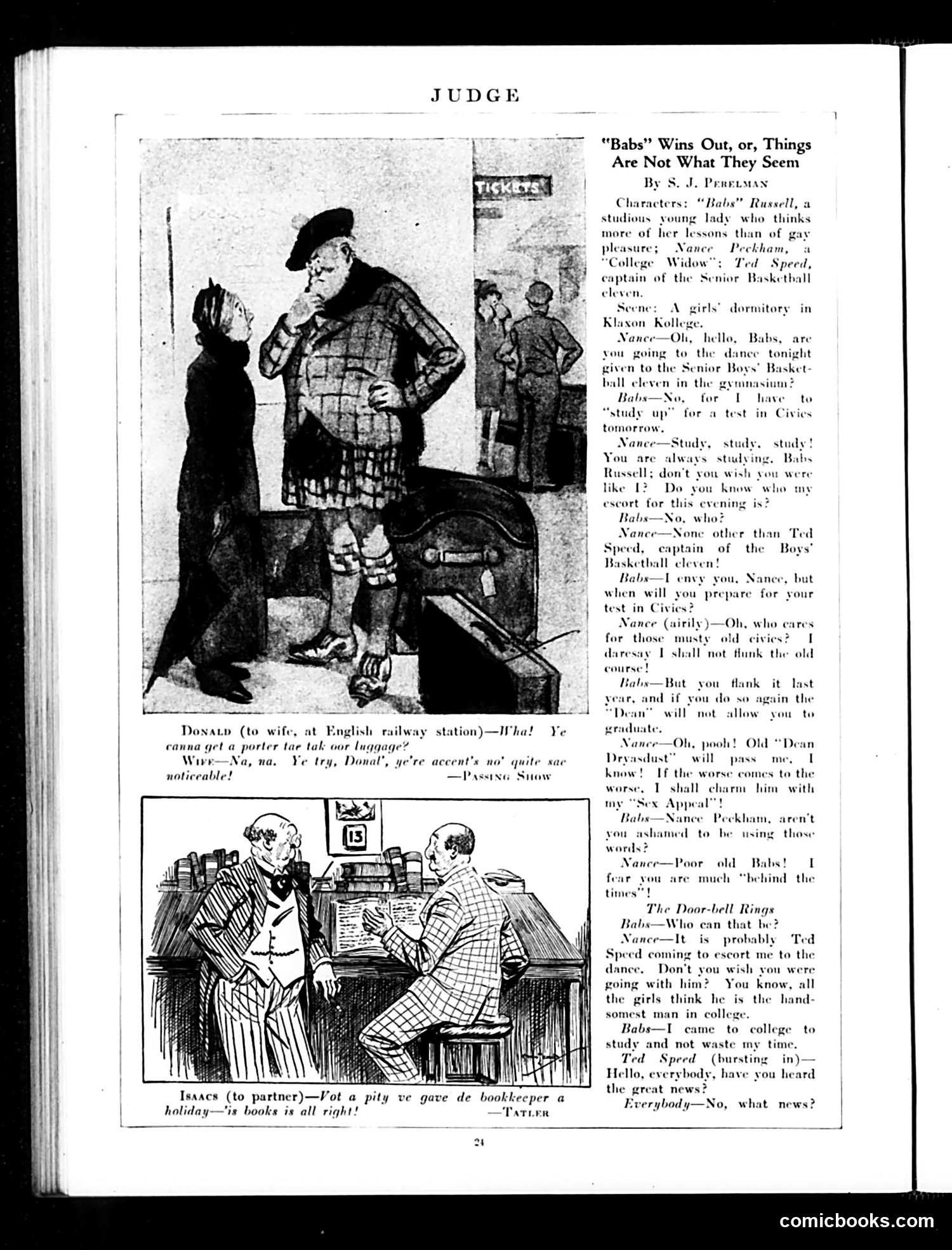
This is a multi-panel humor story about competing values among college women circa early 1900s. The protagonist "Babs" Russell is a studious student who prioritizes academics, while her roommate Nance Peckham represents the "College Widow" archetype—a woman who pursues social pleasures and dating over education. The satire contrasts their approaches: Nance flaunts her date with Ted Speed, the basketball captain (a desirable catch), while Babs refuses to skip studying for civics. Nance mocks Babs as old-fashioned and behind the times. The joke appears to be that despite Nance's social confidence and apparent superiority, Babs's dedication to education will ultimately prove wiser—the title "Wins Out" suggests her approach triumphs. The page also includes an unrelated Scottish dialect joke about a porter at an English railway station, typical of Judge's mixed-content format.
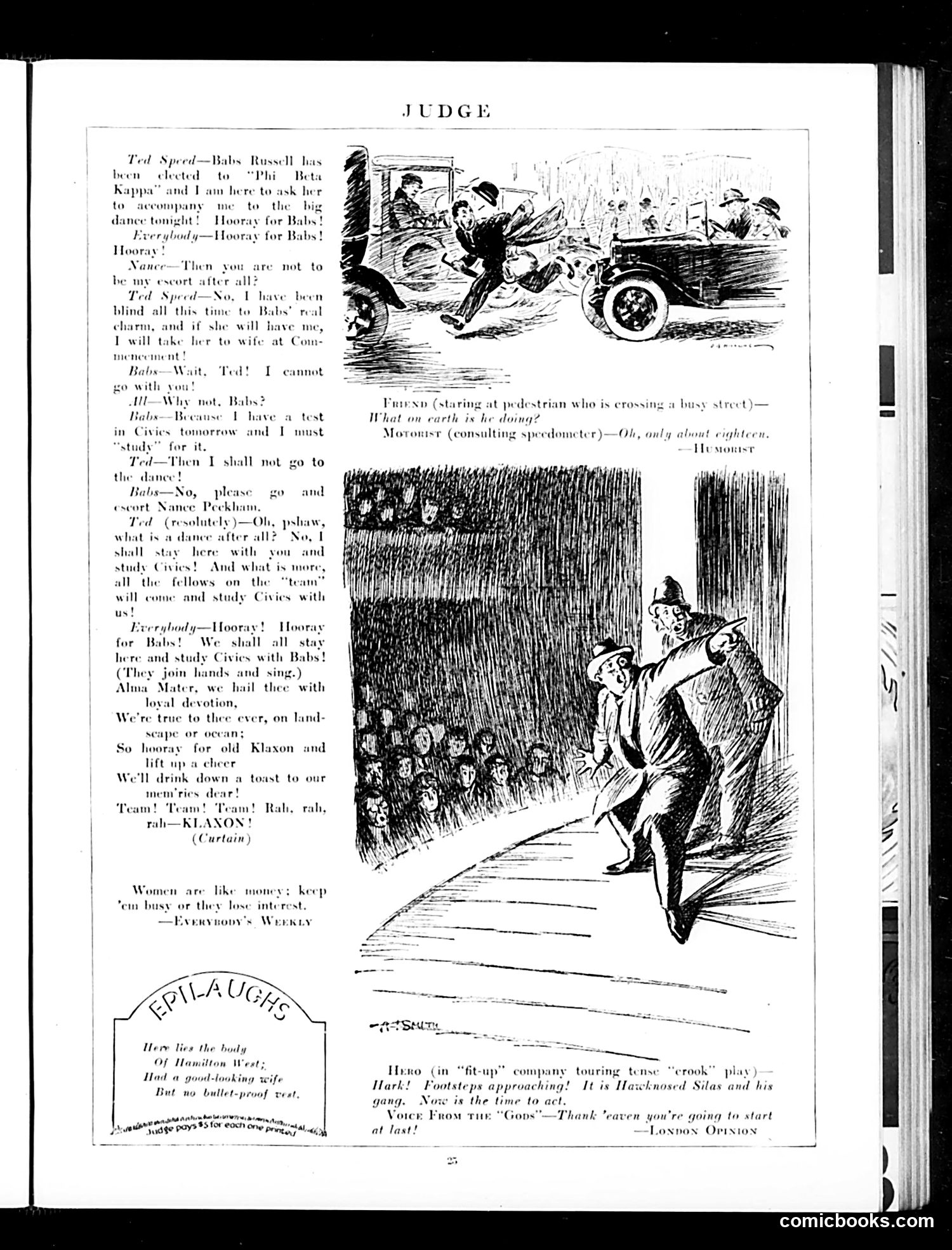
This page contains two satirical pieces targeting early 20th-century American social conventions: **Top Story ("Ted Speed"):** A comedic sketch mocking the priorities of college students, particularly women's education versus social life. When Babs Russell (who's achieved academic honors at "Phi Beta Kappa") chooses to study Civics rather than attend a dance, the joke satirizes how her suitor Ted and the entire social circle abandon the dance to study with her instead—suggesting the absurdity of sacrificing social life for academics, or conversely, how easily young people rationalize giving up obligations. **Bottom Cartoons:** Two brief gags. The first jokes about a motorist driving at only eighteen miles per hour (humorously slow). The second mocks amateur theater productions ("fit-up" companies), where an actor's overwrought dramatic moment ("Now is the time to act!") is undercut by audience impatience shouting from the wings to start the play already. The page's epigraph about women being "like money" reinforces period attitudes toward female behavior and value.
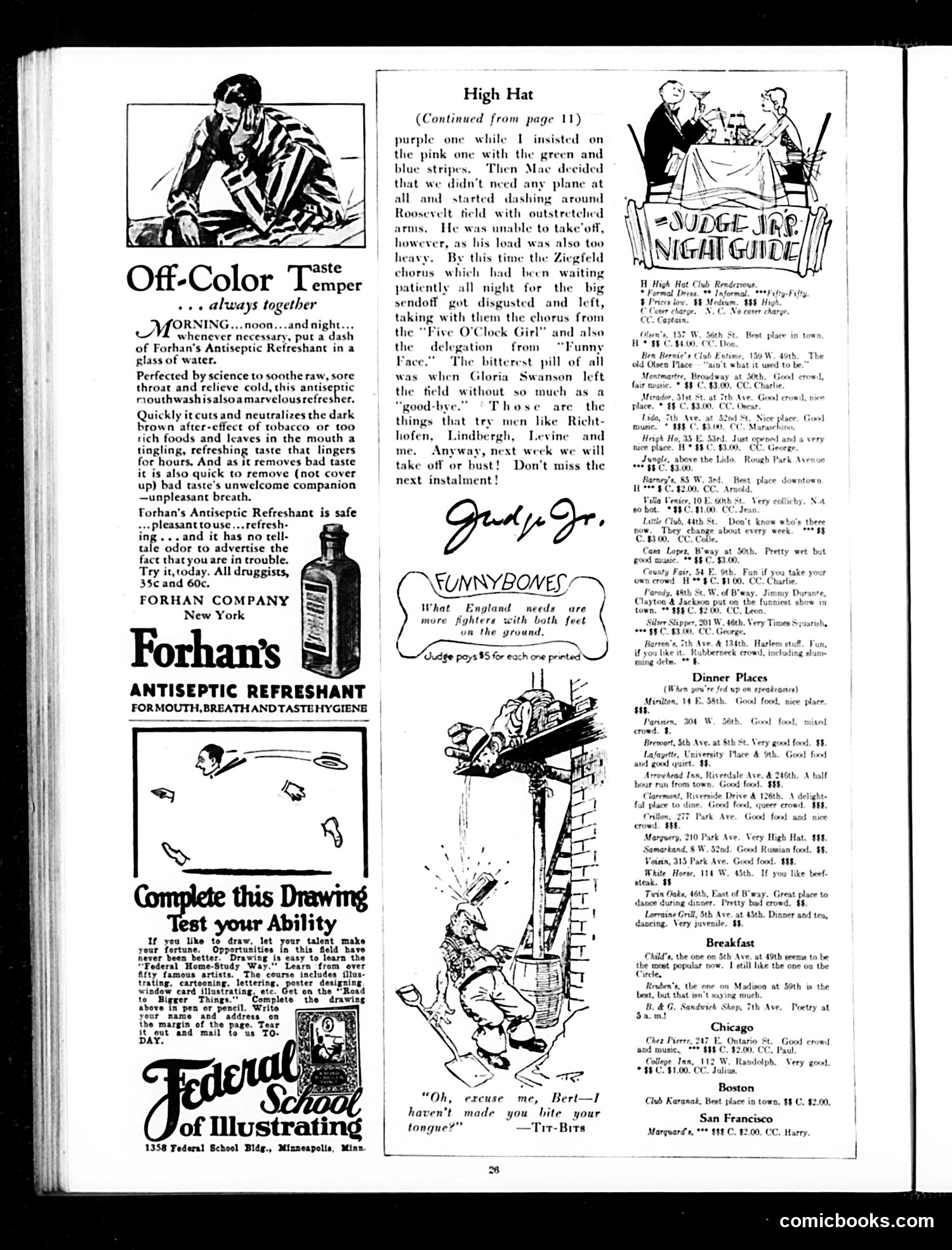
This page contains a serialized story titled "High Hat" (continued from page 11) about aviation enthusiasts attempting a dramatic flight, likely from the 1920s based on references to aviators like Lindbergh and Richtofen. The narrative humorously describes plans derailing when their aircraft proves too heavy to take off from Roosevelt Field, with various entertainment figures (including Gloria Swanson and Ziegfeld chorus girls) abandoning the venture in disgust. The satire targets the era's obsession with aviation spectacle and celebrity stunts. The joke mocks overambitious aviation attempts and the fickle nature of show-business participation in such ventures. The page also contains period advertisements (Forhan's mouthwash, Federal School of Illustrating) and a "Funny Bones" joke feature, plus extensive restaurant/nightclub listings for major cities—typical Judge magazine content bridging entertainment criticism with practical guidance for urban readers.
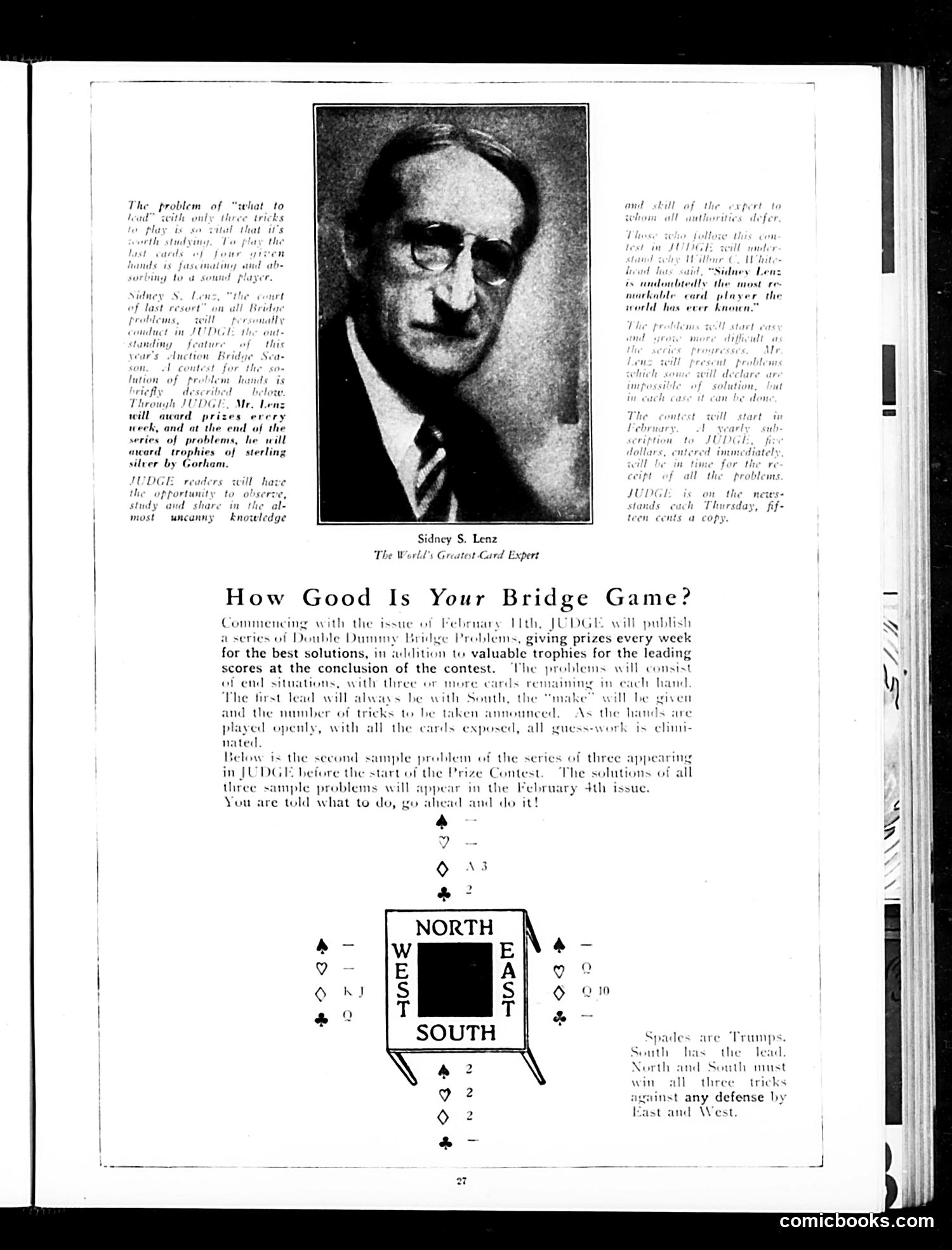
This page features Sidney S. Lenz, identified as "The World's Greatest Card Expert," promoting a bridge card game problem series in *Judge* magazine. The content is not satirical but rather a **puzzle/contest feature**. *Judge* announced a competition starting February 11th where readers would submit solutions to "Double Dummy Bridge Problems"—card game scenarios requiring skilled play. Winners received weekly prizes and sterling silver trophies from Gorham. The page shows the second sample problem: a bridge hand diagram where North and South must win all three tricks against any East-West defense, with spades as trumps and South leading. This reflects bridge's enormous popularity in early 20th-century America among educated, affluent audiences. Lenz was a genuine, famous bridge expert of the era. The feature positioned *Judge* as catering to its readers' intellectual leisure pursuits rather than mocking them.
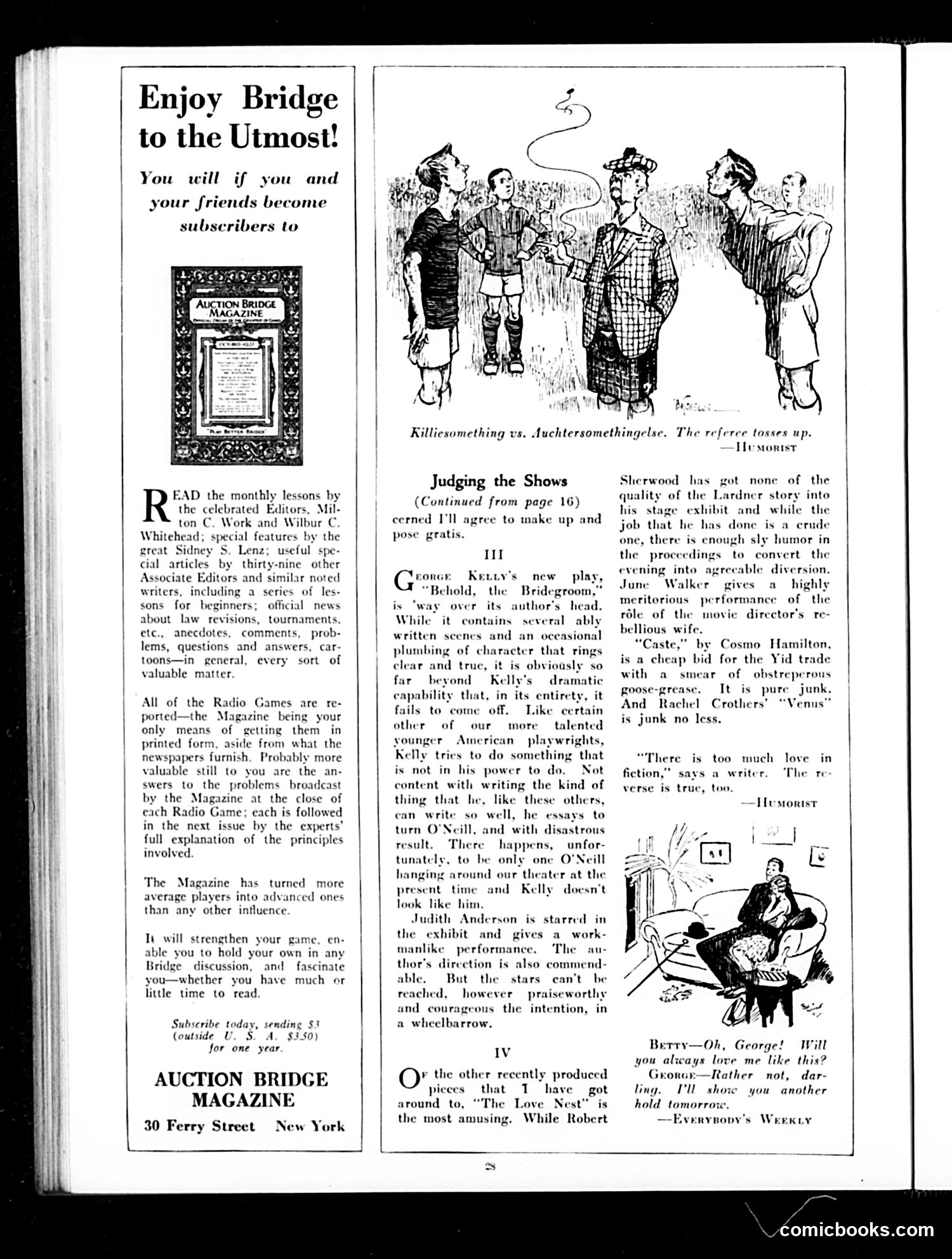
The left page is primarily an advertisement for *Auction Bridge Magazine*, a specialized publication teaching the card game bridge. It promises expert instruction from celebrated bridge authorities like Milton C. Work and Sidney S. Lenz, plus tournament news and problem-solving—appealing to players wanting to improve their skills. The right page contains theater reviews. The cartoon captioned "Killiesomething vs. Auchtersomethingelse" appears to be a humorous sketch about bridge, with Scottish-sounding names suggesting a joke about obscure or difficult bridge terminology. The reviews critique recent Broadway plays, including George Kelly's "Behold, the Bridegroom" (which the critic dismisses as beyond Kelly's dramatic abilities), and mentions Sherwood's play and Rachel Crothers' "Venus." The tone is dismissive, calling some works "junk." A small cartoon at bottom shows a domestic humor exchange about marital affection. This reflects 1920s theater culture and bridge's popularity as a sophisticated parlor game.
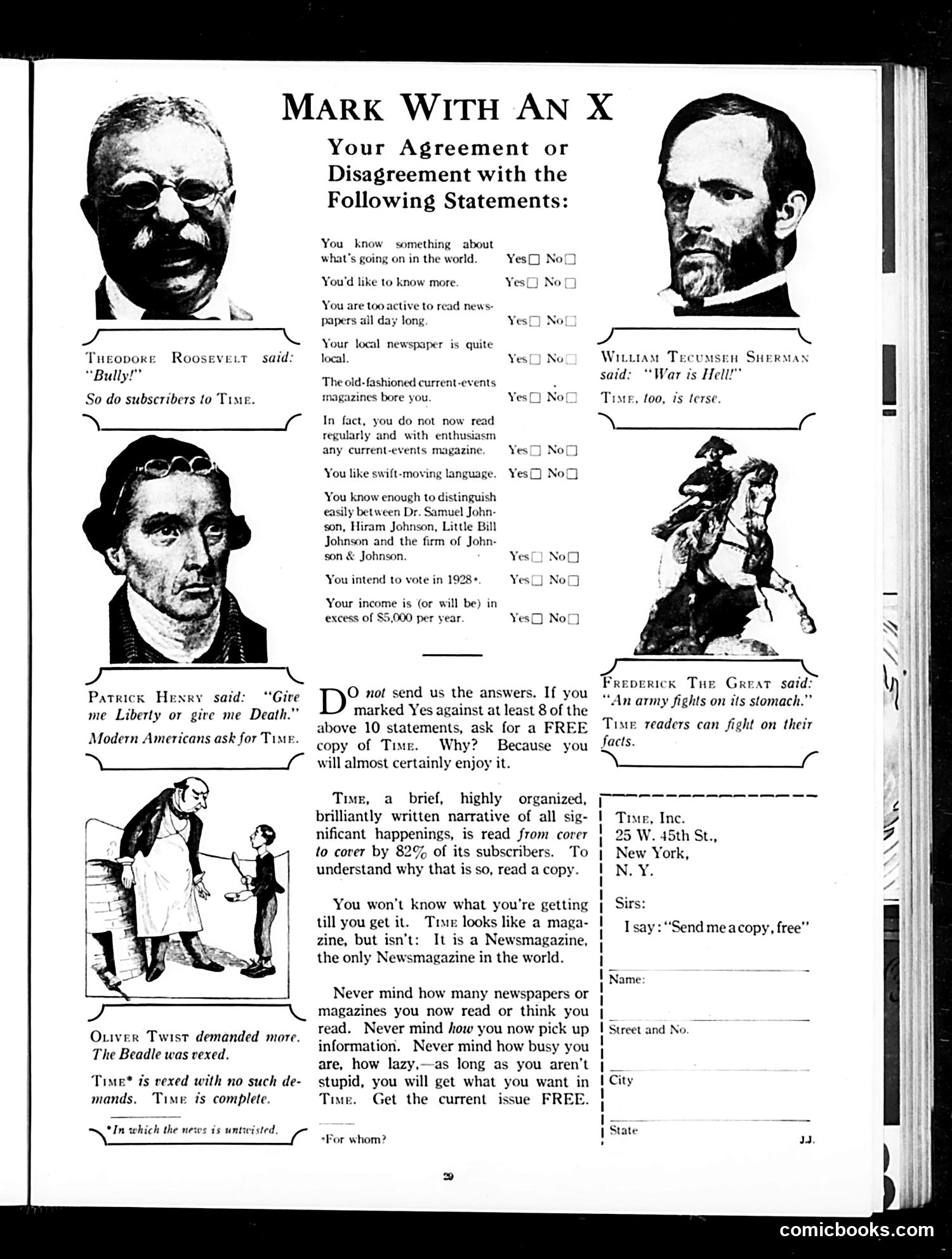
This is primarily a **subscription advertisement for TIME magazine**, disguised as satire. The page uses famous historical and literary figures to endorse the product: - **Theodore Roosevelt** ("Bully!") and **William Tecumseh Sherman** ("War is Hell!") frame the appeal—suggesting TIME delivers energetic, essential information. - **Patrick Henry**, **Frederick the Great**, and **Oliver Twist** reinforce the message through witty attributions about liberty, sustenance, and demanding more. The **questionnaire** is the hook: readers who answer "Yes" to 8+ statements (claiming they're informed, busy, educated, income-earners planning to vote in 1928) are encouraged to request a free copy. The satire targets **busy, educated Americans** who think they're well-informed but may not be—TIME promises to streamline news consumption. The ad emphasizes TIME's brevity and comprehensiveness: it's "read from cover to cover by 82% of subscribers," unlike newspapers. This reflects TIME's 1920s positioning as a revolutionary "newsmagazine" for modern, affluent readers.
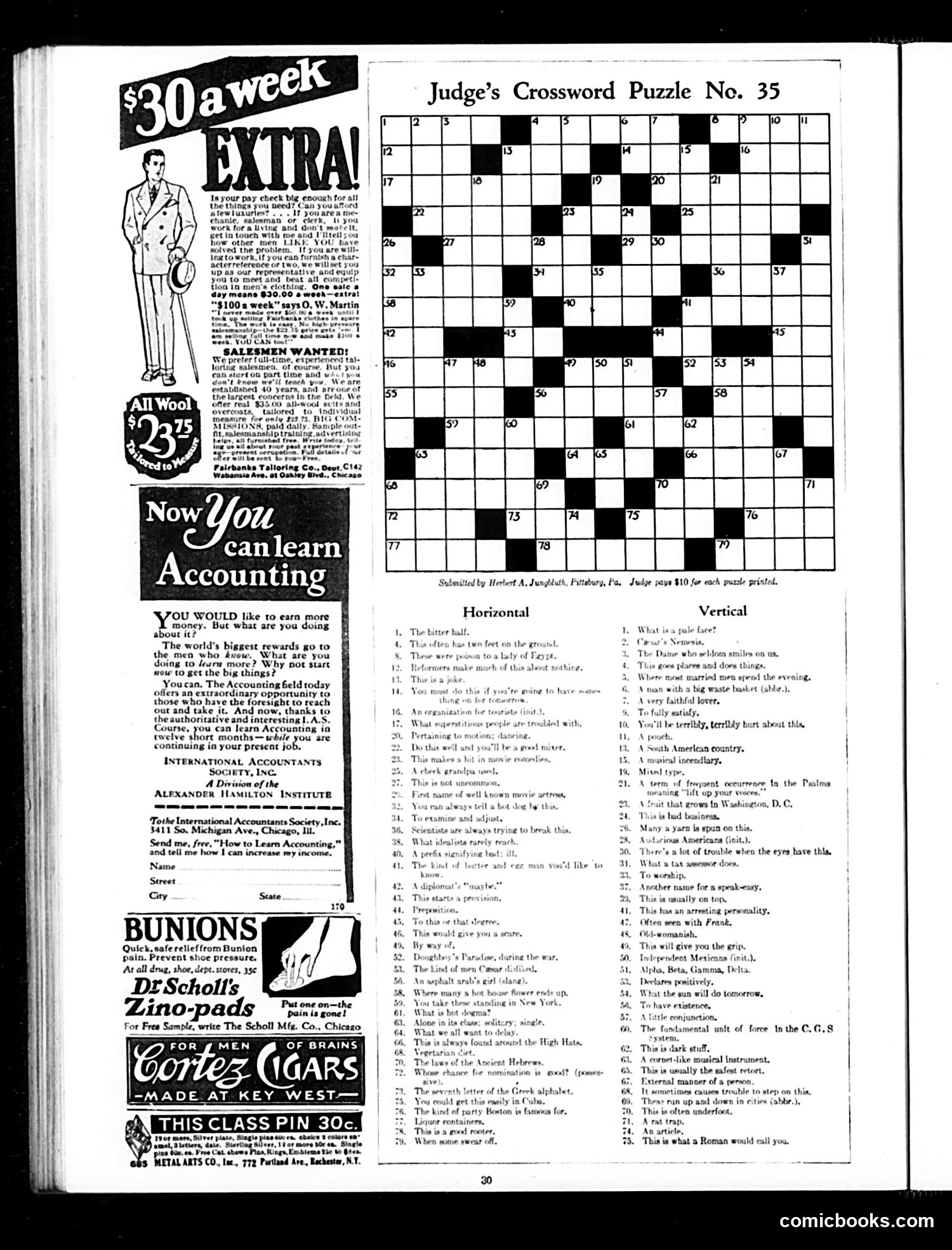
This page is primarily **advertising and a crossword puzzle**, not satirical content. The main elements are: **Advertisements:** - A "$30 a week EXTRA" job offer for salesmen in men's clothing - An "Accounting" correspondence course promising higher earnings - Dr. Scholl's Zino-pads (bunion treatment) - Cortez Cigars - A class pin offer **Content:** Judge's Crossword Puzzle No. 35 dominates the page, with horizontal and vertical clues typical of era crosswords—puns, wordplay, and cultural references ("A South American country," "Diplomatic 'maybe'"). **Historical Context:** The job advertisements reflect 1920s-30s economic anxieties—promises of quick wealth through sales or self-improvement courses were common during uncertain times. The products advertised (bunion pads, cigars, class pins) suggest middle-class American readers. This page demonstrates how **Judge magazine filled space with revenue-generating ads and puzzles** alongside its satirical content, typical of period publications.
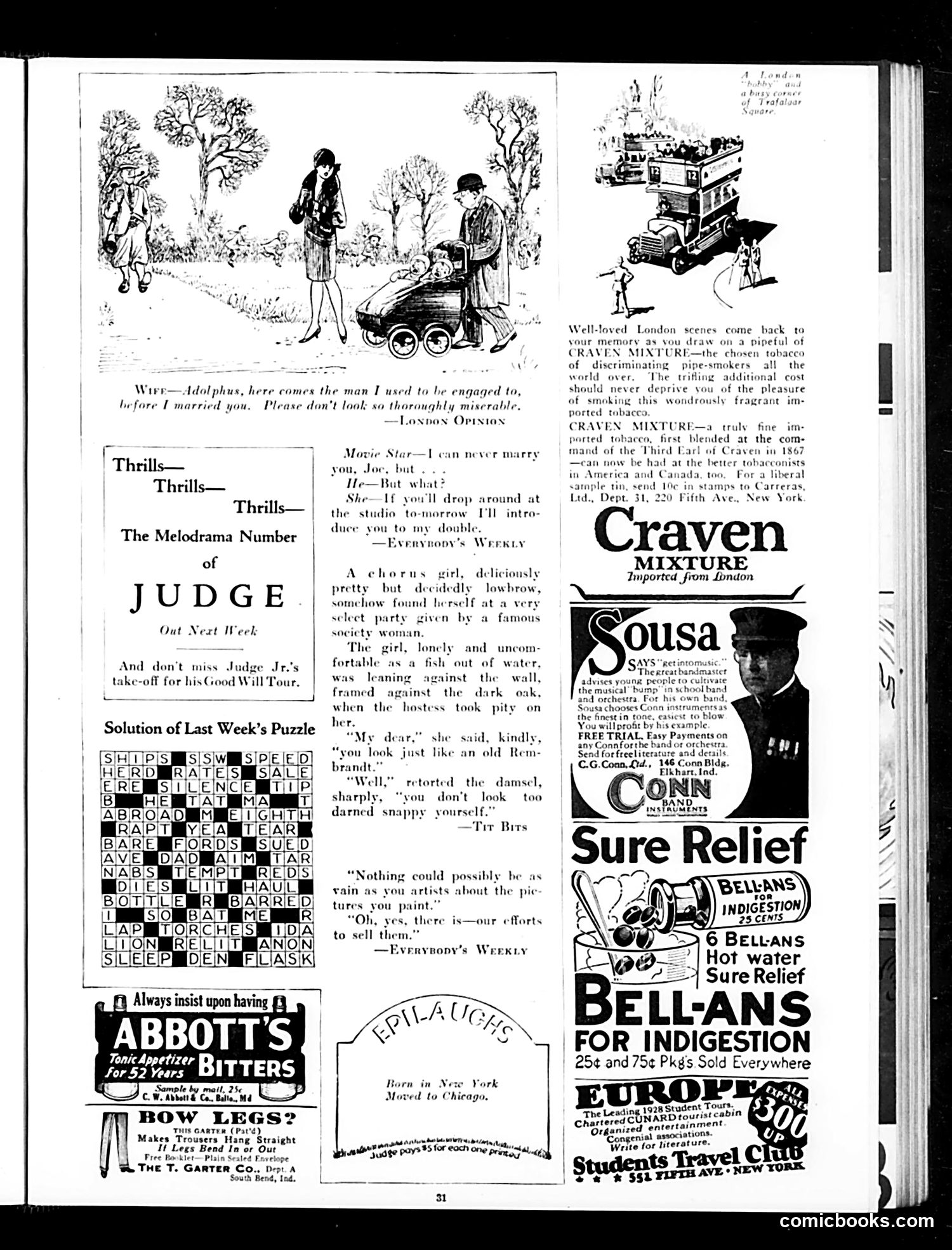
This page from *Judge* magazine is primarily **advertising** interspersed with short humor pieces and a crossword puzzle solution. The illustrated cartoon at top shows a domestic scene: a wife introducing her new husband to an ex-fiancé, with the caption satirizing her awkwardness—a common melodrama trope mocking sentimental Victorian situations. Below are brief comic anecdotes from various sources (*Everybody's Weekly*, *Tit Bits*) poking fun at social pretension: a chorus girl uncomfortable at a high-society party; artists' vanity about their work; a movie star joking about using a body double. The bulk of the page features period advertisements: **Craven Mixture** tobacco (imported from London); **Sousa** brand corn instruments; **Bell-ans** antacid tablets; **Abbott's Bitters** tonic; and other patent medicines and remedies. A prominent ad announces the following week's "Melodrama Number" of *Judge*. There are no significant political references. This is a typical early-20th-century magazine layout mixing light humor with commercial advertising for tonics, tobacco, and digestive aids.
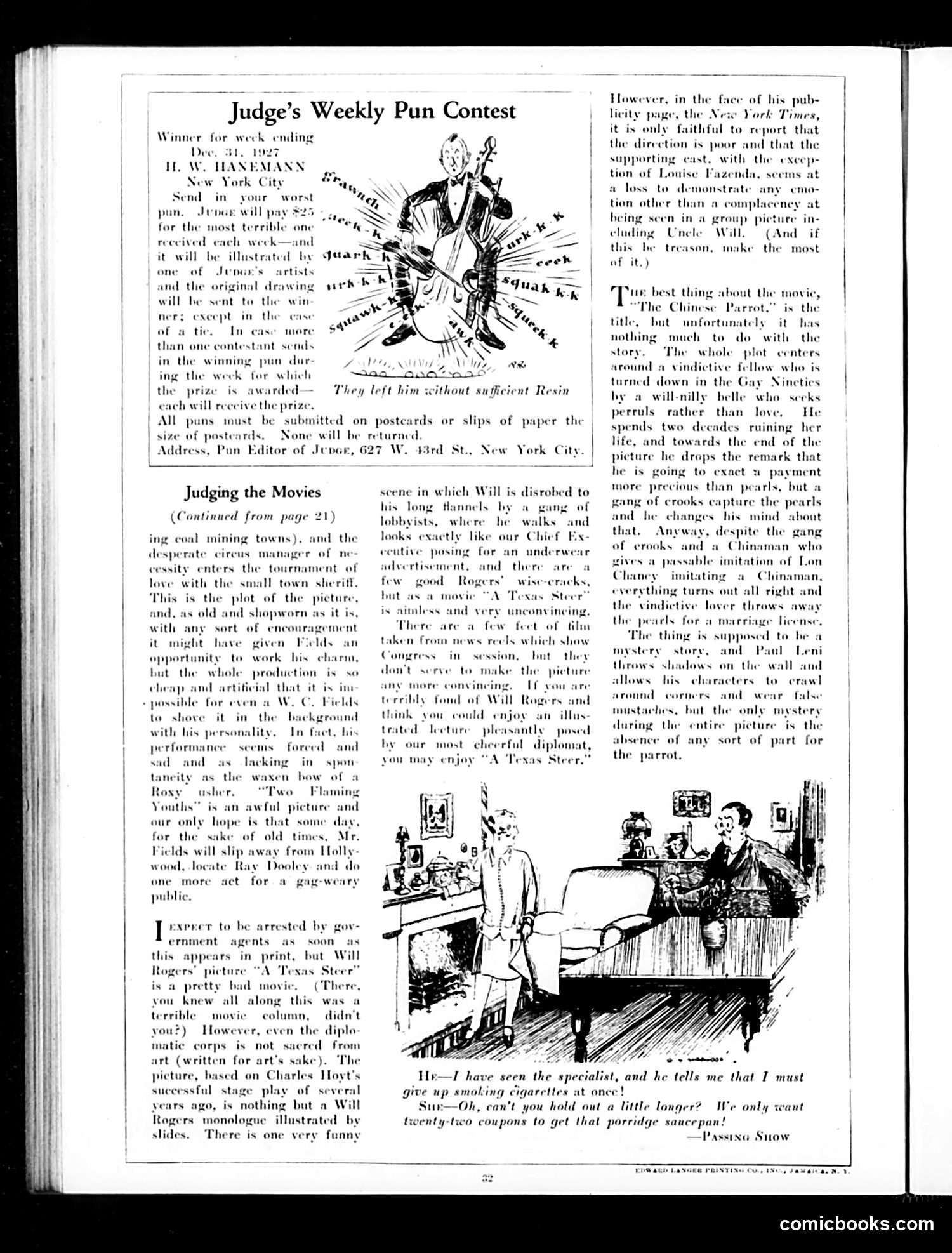
This page from *Judge* magazine (December 31, 1927) contains two main elements: **The Pun Contest:** A light editorial feature inviting readers to submit terrible puns for $25, with the winning entry illustrated by the magazine's artists. **Movie Reviews:** A film criticism column reviewing three 1927 movies. The reviewer harshly criticizes W.C. Fields films ("Two Flaming Youths" and "A Texas Steer"), describing them as cheap, poorly directed, and relying too heavily on Fields' personality rather than plot. The reviewer also dismisses "The Chinese Parrot" as having an unrelated title and convoluted plot, though it contains some decent comedic moments. The cartoon at bottom shows a domestic scene about cigarette smoking—a timely social issue of the 1920s—with a woman concerned about her husband's health. The satire is gentle, targeting Hollywood's formulaic productions and actors' limited range rather than sharp political commentary.
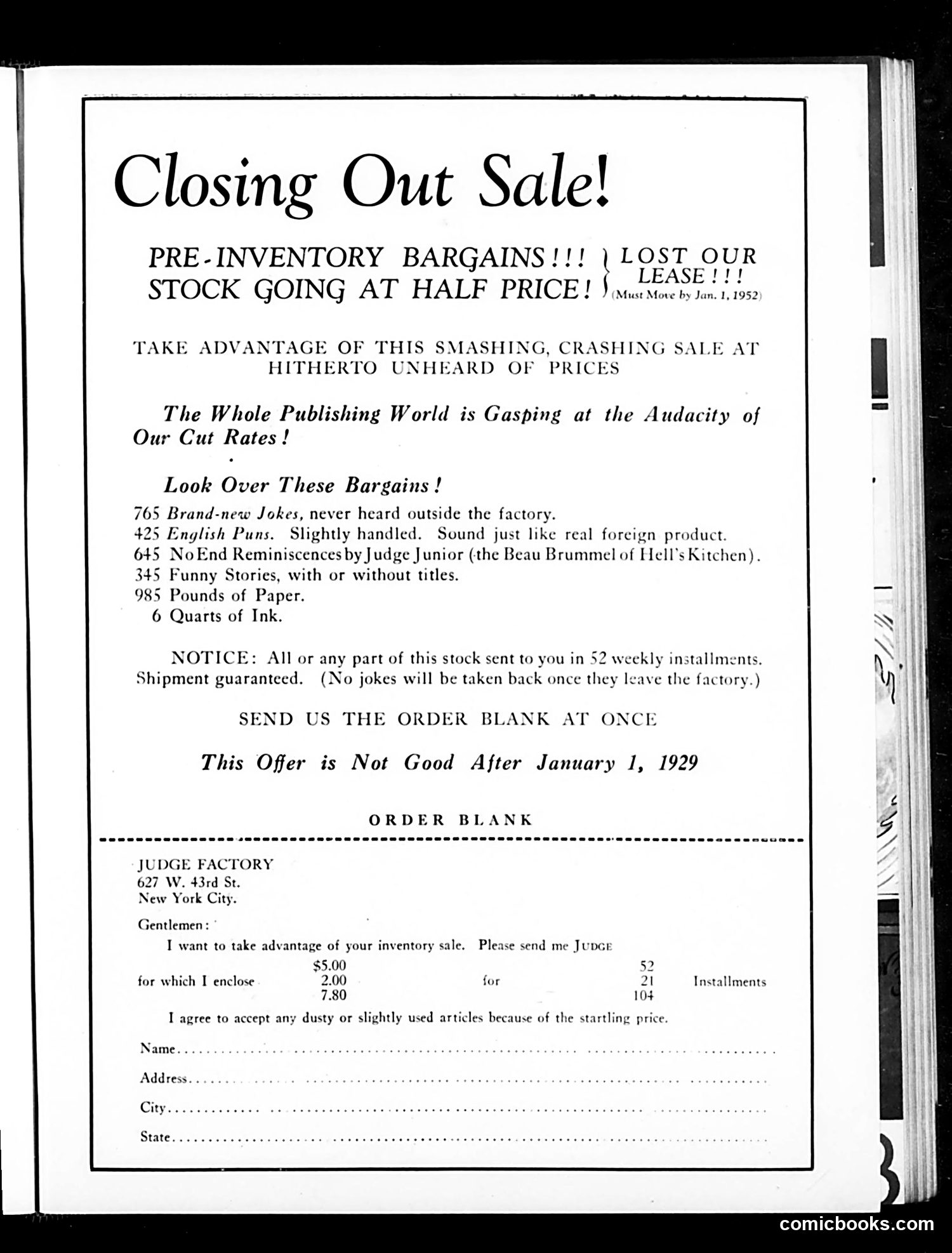
This is a **self-promotional advertisement** from *Judge* magazine itself, not a political cartoon. The magazine is humorously advertising a fake "closing out sale" of its own inventory—jokes, puns, stories, and supplies—at supposedly half price. The satire is **self-directed**: *Judge* jokes about the low quality of its own product, calling jokes "never heard outside the factory" (implying they're rejected material), puns that merely "sound just like real foreign product," and stories "with or without titles." The reference to "Beau Brummel of Hell's Kitchen" appears to mock one of their own contributors. The humor lies in the exaggerated sales-pitch language typical of closing-out businesses, applied to creative content. The notice that "no jokes will be taken back once they leave the factory" is a final joke about the permanence of published mediocrity. The offer expires January 1, 1929—a self-aware deadline gag.
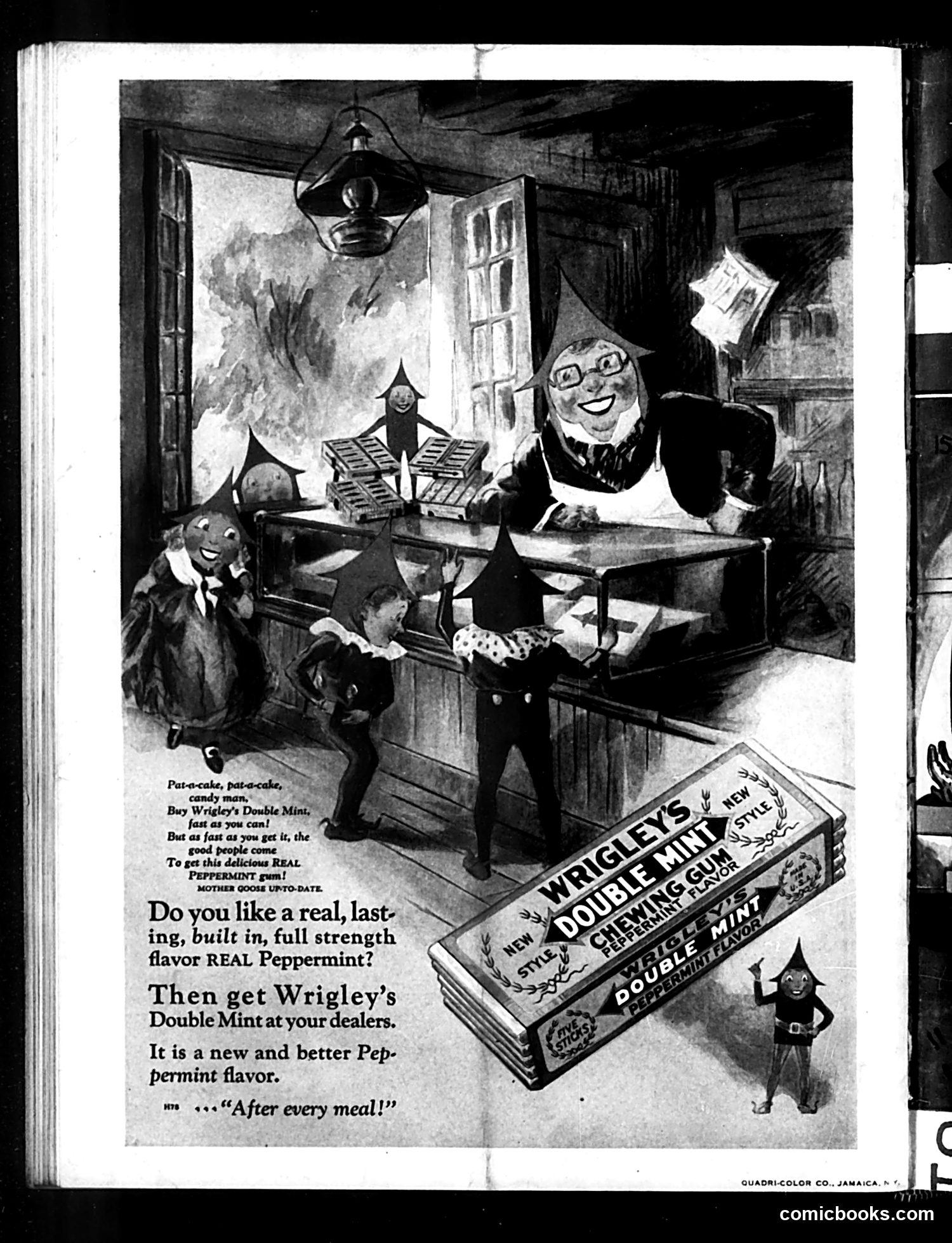
This is primarily a **Wrigley's Double Mint gum advertisement**, not political satire. The page features a whimsical illustration of what appears to be a witch or elderly woman with exaggerated features running a candy shop or sweet establishment, surrounded by imp-like or goblin characters. The fantastical setting—with its supernatural figures and magical atmosphere—creates playful, slightly spooky entertainment to market the gum to consumers. The text emphasizes the gum's "real" peppermint flavor and encourages purchase at dealers. The phrase "After every meal!" was a common advertising slogan of that era promoting chewing gum as a post-meal habit. **No political content or social commentary is evident.** This is straightforward commercial advertising using imaginative illustration and folklore-inspired imagery to appeal to consumers—likely from the 1920s-30s based on style.