
Judge, 1928-01-21 · page 15 of 36
Judge — January 21, 1928 — page 15: what you’re looking at
What you’re looking at
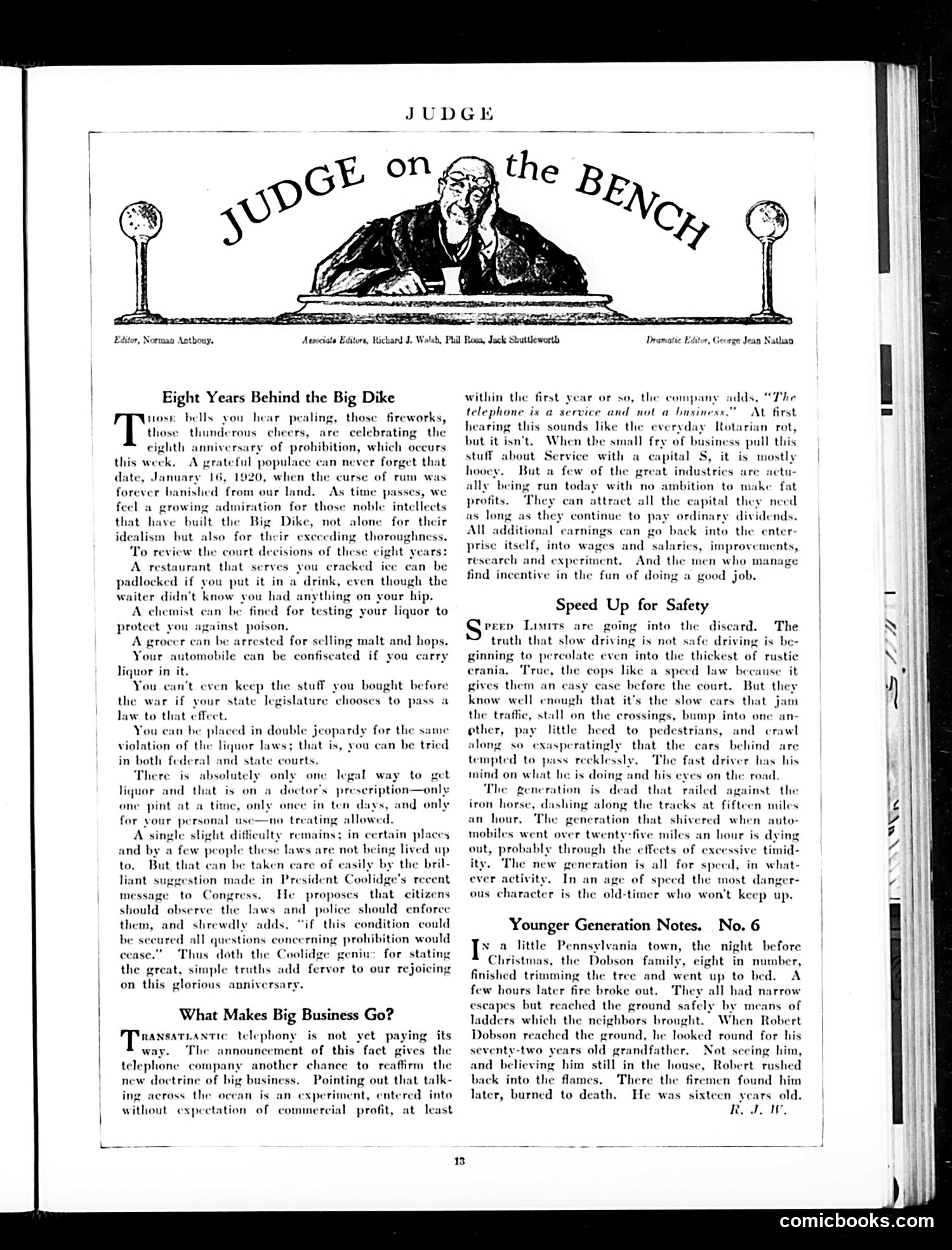
This page satirizes **Prohibition's eighth anniversary** (January 16, 1928, though the text incorrectly references 1920). The title "Big Dike" sarcastically compares Prohibition to a massive barrier holding back destructive forces. The main article mocks Prohibition's absurd enforcement through heavy irony. It catalogs ridiculous legal consequences—restaurants padlocked for serving ice, grocers arrested for selling hops, cars confiscated for transporting alcohol—presenting these as proof of the law's "thoroughness." The satire peaks mocking President Coolidge's suggestion that citizens simply obey laws and police enforce them, calling this obvious truism a "Coolidge genius." The cartoonist (likely criticizing Prohibition as unworkable and tyrannical) uses the celebratory framing ironically. What appears to praise Prohibition's "noble intellects" actually exposes how draconian and ineffective the law had become by 1928. The sidebar pieces on transatlantic telephony and speed limits continue Judge's commentary on modern progress and government policy.
📄 Transcribed text from this page (OCR, searchable)
Machine-transcribed from the original scan — historical spelling and the odd misread are preserved.
Editor, Norman Antboay. Eight Years Behind the Big Dike tose belly you hear pealing, those fireworks, those thunderous cheers, are celebrating the eighth anniversary of prohibition, which occurs this week. A grateful populace can never forget that date, January 16, 1920, when the curse of rum was forever banished from our land. As time passes, we feel a growing admiration for those noble intellects: that have built the Big Dike, not alone for their idealism but also for their excceding thoroughness. To review the court decisions of these eight years: A restaurant that serves you cracked ice padlocked if you put it in n be 1 drink, even though the waiter didn't know you had anything on your hip. A chemist can be fined for testing your liquor to protect you against poison. A grocer can be arrested for selling malt and hops. Your automobile can be confiscated if you carry liquor in it. You can’t even keep the stuff you bought before the war if your state legislature chooses to pass « law to that effect. You can be placed in double jeopardy for the sau violation of the liquor laws; that is, you can be tried in both federal and state courts. There is absolutely only one legal way to get liquor and that is on a doctor's prescription—only one pint at a time, only once in ten days, and only for your personal use—no treating allowed. A single slight difficulty remains; in certain places and by a few people these laws are not being lived up to. But that can be taken eare of easily by the bril- liant suggestion made in President Cooli message to proposes that citizens should observe the laws and police should enforce them, and shrewdly adds, “if this condition could cured all questions concerning prohibition would Thus doth the Coolidge geniu> for stating the great, simple truths add fervor to our rejoicing on this glorious anniversary. Congress. He What Makes Big Business Go? PT inansatianric telephony is not yet paying its way. The announcement of this fact gives the telephone company another chance to reaffirm the -w doctrine of big business. Pointing out that talk- across the ocean is an experiment, entered into without cxpectation of commercial profit, at least Dramatic Editor, George Jean Nathan within the first year or so, the company adds, “The telephone is a service and not a business.” At first hearing this sounds like the everyday Rotarian rot, but it isn't. When the small fry of business pull this stuff about Service with a cay S, it is mostly But a few of the g t industries actu- ally be run today with no ambition to m fat profits. ‘They can attract all the capital they need as long as they continue to pay ordinary dividends. All additional » back into the enter prise itself, into wages and salaries, improvements, research and experiment. And the men who manage find incentive in the fun of doing a good job. arnings can Speed Up for Safety Limits are going into the discard. The driving is be- truth that slow driving is not safi ginning to percolate even into the thickest of rustic crania, True, the cops like a speed law because it gives them an casy case before the court. But they know well cnough that it’s the slow cars that jam the traffic, stall on the crossings, bump into one an- other, pay little heed to pedestrians, and crawl along so exasperatingly that the cars behind are tempted to pass recklessly. The fast driver has his mind on what he is doing and his eyes on the road The generation is dead that railed against. the iron horse, dashing along the tracks at fifteen miles an hour. The generation that shivered when auto- mobiles went over twenty-five miles an hour is dying out, probably through the effects of excessive timid- ity. The new generation is all for speed, in what- ever activity. In an of speed the most danger- ous character is the old-timer who won't keep up. Younger Generation Notes. No. 6 Ix a little Pennsylvania town, the night before Christmas, the Dobson family, eight in number, finished trimming the tree and went up to bed. A few hours later fire broke out. They all had narrow escapes but reached the ground safely by means of ladders which the neighbors brought. When Robert Dobson reached the ground, he looked round for his seventy-two years old grandfather. and believing him still in the house, Robert rushed back into the flames. There the firemen found him later, burned to death. He was sixteen years old. Not seeing him, comicbooks.com