
A complete issue · 36 pages · 1927
Judge — December 3, 1927
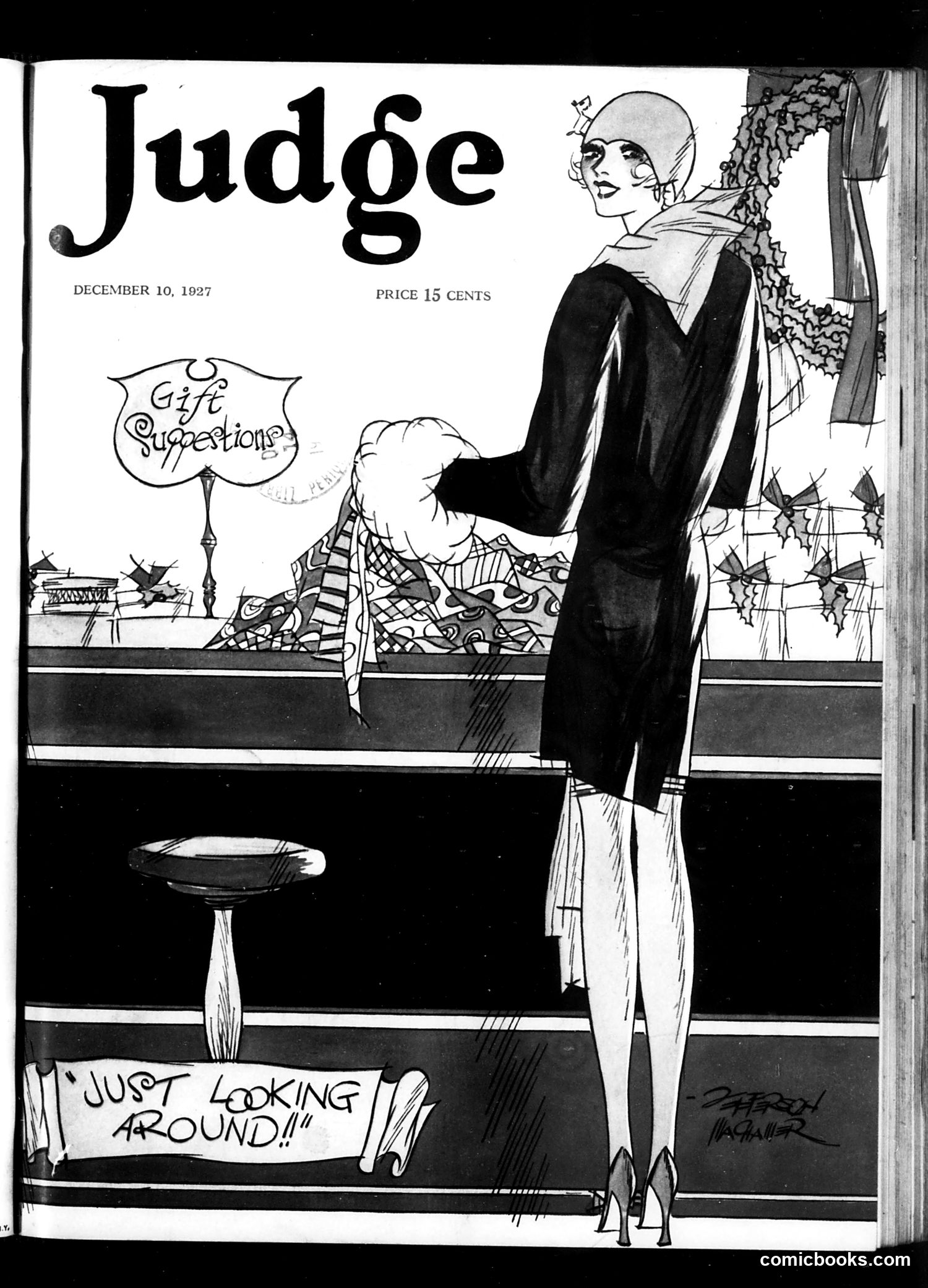
This is the cover of Judge magazine from December 10, 1927, priced at 15 cents. The cartoon depicts an elegantly dressed woman at a store window display labeled "Gift Suggestions," gesturing toward toys and other items. Her caption reads "Just looking around." The satire likely addresses **holiday shopping behavior** during the late 1920s—a period of economic prosperity before the 1929 crash. The woman's fashionable attire and casual browsing suggest the emerging consumer culture and the practice of window shopping. The artwork style is typical of Art Deco design popular in the era. The humor appears to target either the disconnect between browsing and purchasing, or perhaps satirizes women's shopping habits during the gift-giving season—a common theme in period humor magazines.
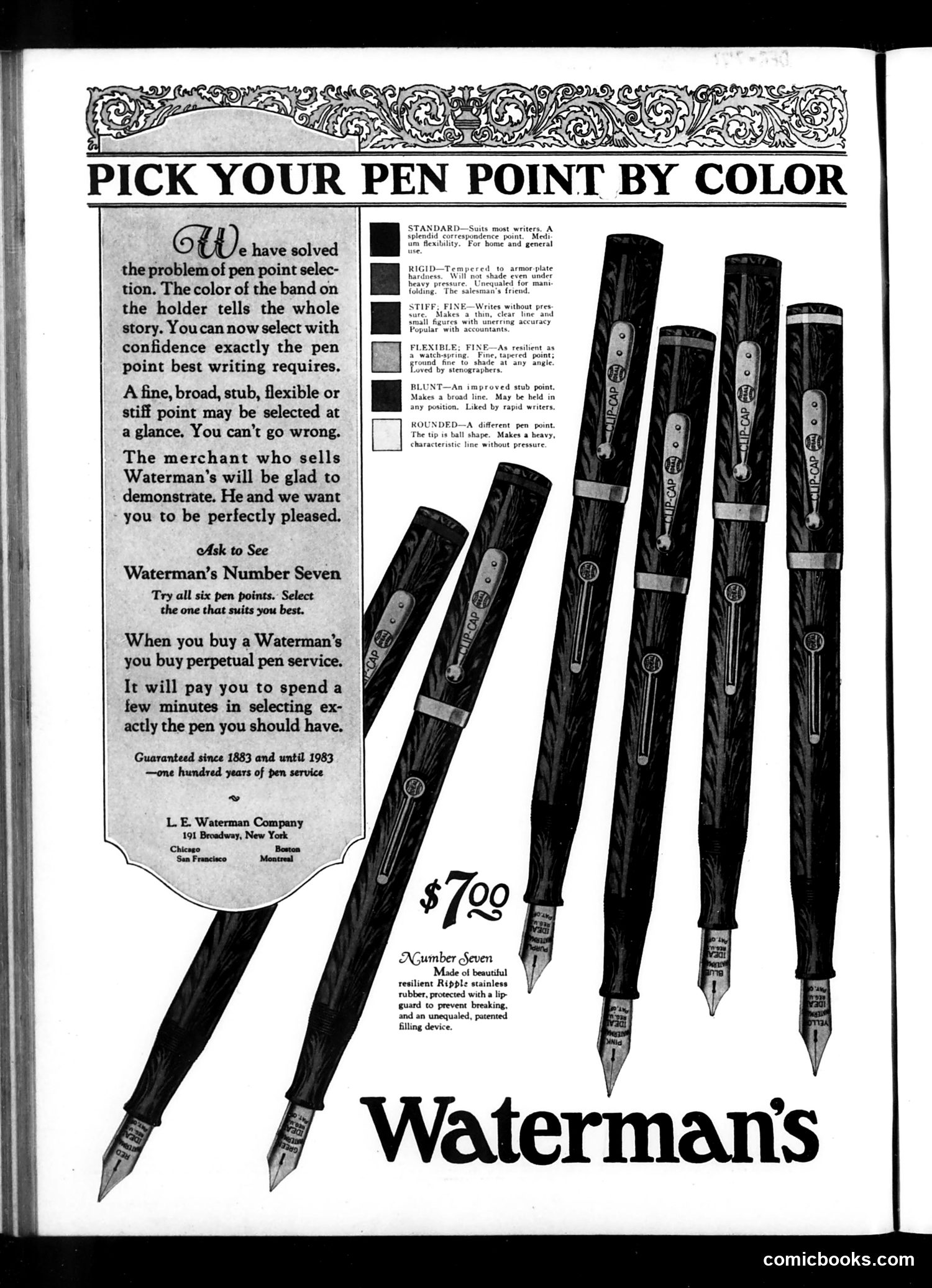
This page is **primarily an advertisement**, not satirical content. It's a Waterman's fountain pen ad from the L.E. Waterman Company (New York, Chicago, Boston, San Francisco) promoting their "Number Seven" model priced at $7.00. The ad uses a practical sales approach: it displays six pens with different colored bands representing various nib types (Standard, Rigid, Medium, Flexible Fine, Blunt, and Rounded). The marketing pitch emphasizes customer choice and satisfaction—selecting the right pen point for individual writing needs. The surrounding text appeals to merchants and consumers alike, highlighting the pen's durability ("Guaranteed since 1883") and encouraging customers to try all options before purchasing. There is no political satire or social commentary present on this page.
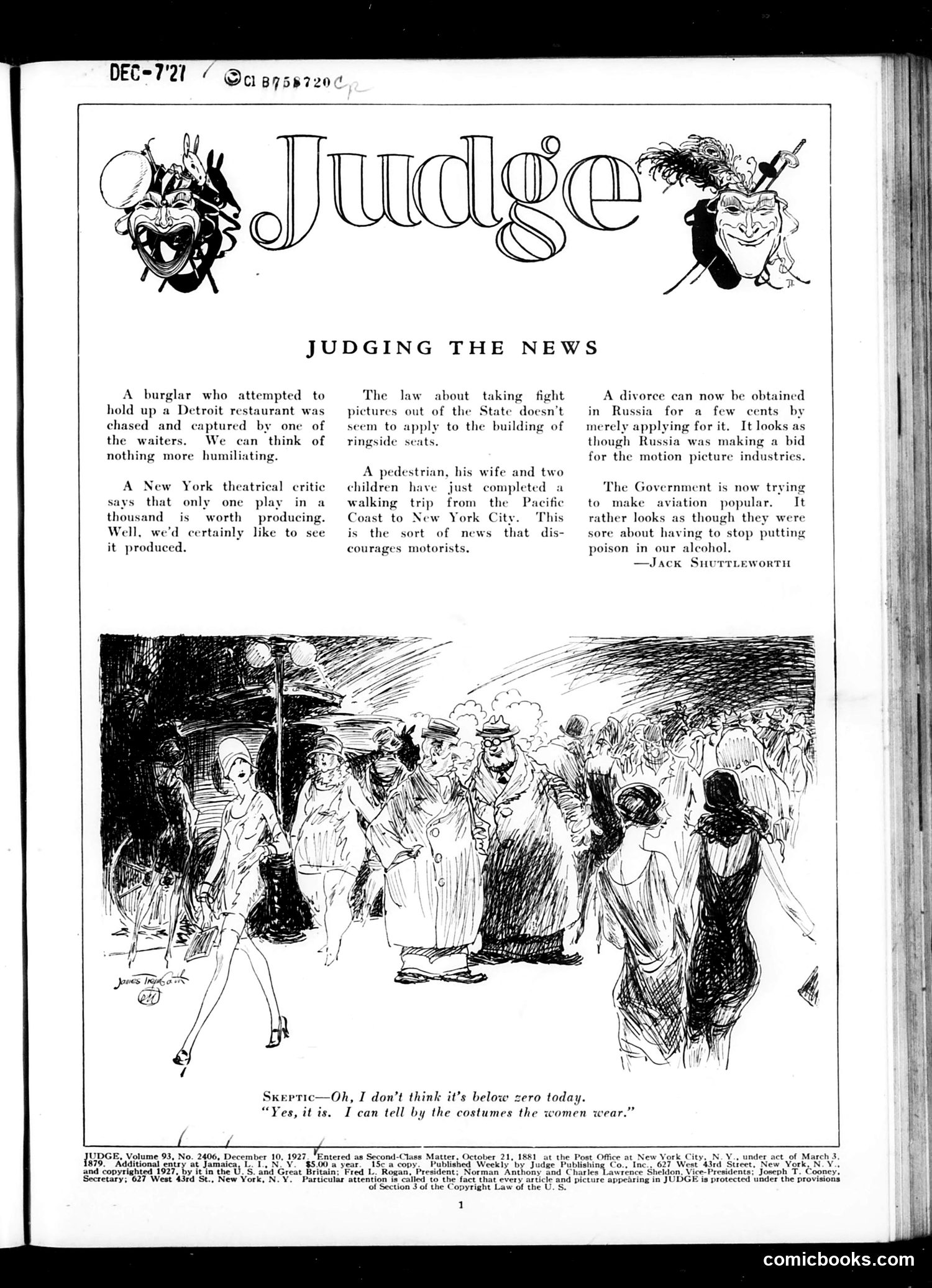
This page features "Judging the News," a satirical section commenting on contemporary events. The main cartoon depicts a street scene with women in various states of undress or revealing clothing, with the caption "Skeptic—Oh, I don't think it's below zero today. 'Yes, it is. I can tell by the costumes the women wear.'" The joke satirizes the trend of women wearing increasingly minimal clothing despite cold weather—likely referencing the "flapper" era's fashion revolution of the 1920s. The cartoon mocks both women's liberation from restrictive Victorian dress codes and the contradiction between fashion trends and practical winter necessity. The accompanying text snippets comment on other topics: theater production, a cross-country hiking trip, Russian divorce procedures, and aviation safety—all contemporary news items filtered through satirical commentary.
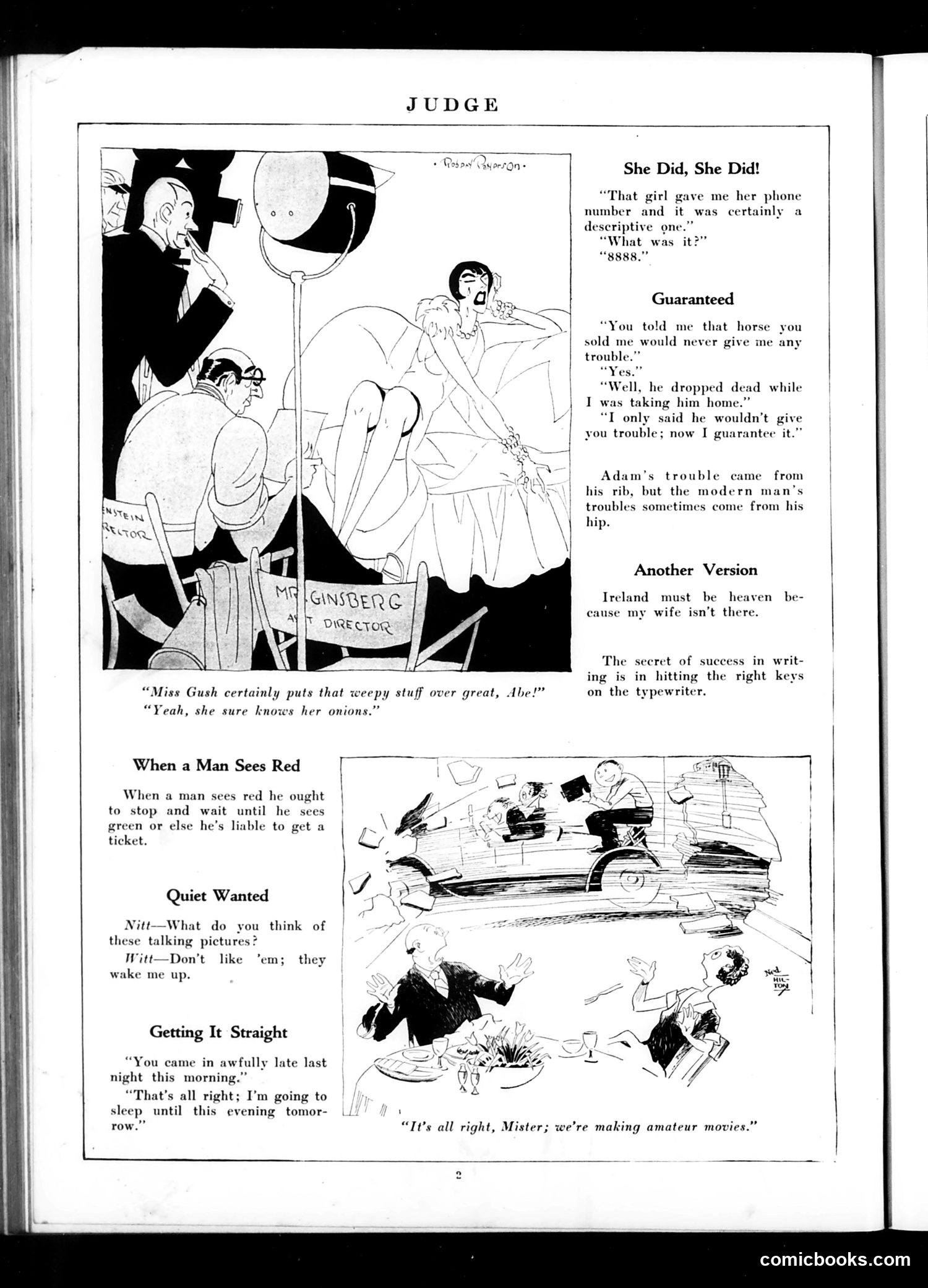
This page contains several brief humorous anecdotes and jokes typical of early 20th-century Judge magazine, rather than political cartoons. The humor ranges from domestic comedy to workplace situations: The top cartoon depicts a film production scene, likely satirizing early cinema's amateur quality ("we're making amateur movies"). The jokes below cover relatable scenarios: a woman giving a phone number (8888), a man blaming a faulty horse, and marital humor about Ireland and wives. "When a Man Sees Red" appears to reference traffic safety—drivers should wait for green lights rather than risk tickets. The other brief gags ("Quiet Wanted," "Getting It Straight") are standard domestic comedy about spouses' habits and late arrivals home. This represents Judge's typical mix of observational humor about modern life rather than pointed political satire.
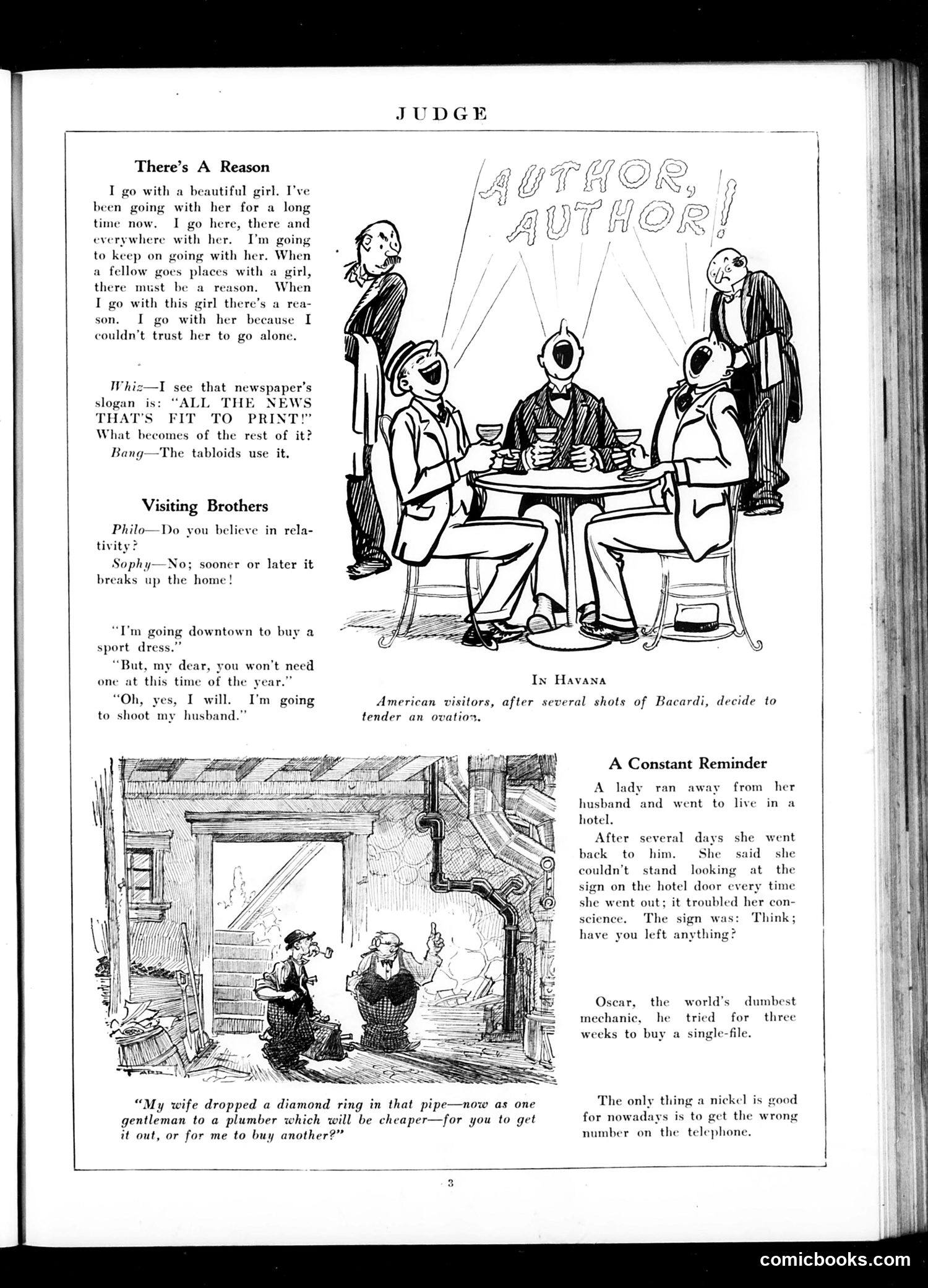
This page contains several unrelated humorous vignettes typical of Judge's satirical format: **"There's A Reason"** mocks a man's excuse for constantly accompanying his girlfriend—claiming he must supervise her for safety, though his real motivation appears to be distrust. The joke critiques both controlling behavior and newspaper sensationalism. **"Visiting Brothers"** satirizes marital discord, with a wife joking she'll "shoot my husband" while buying a dress, implying marital tension over spending. **"In Havana"** depicts American tourists drunk on Bacardi rum attempting to give a speech—mocking American tourists abroad and their alcohol consumption. **"A Constant Reminder"** and other brief jokes target domestic irritations and incompetence (a mechanic unable to find a file). The cartoons reflect early 20th-century attitudes toward gender relations, tourism, and domestic life.
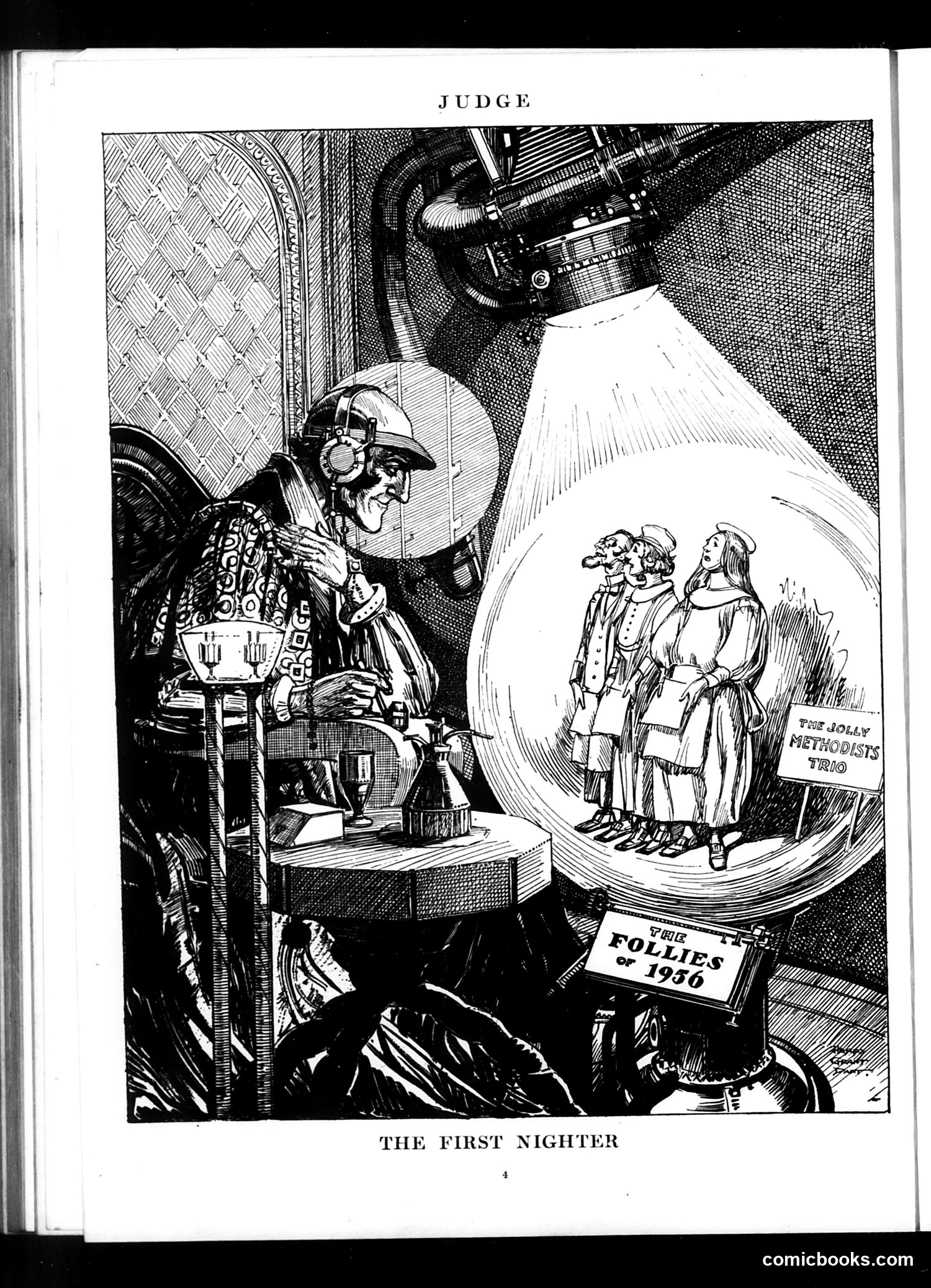
This 1956 theatrical satire depicts a stern judge character (left) as a powerful arbiter controlling theatrical entertainment through a spotlight. The "Follies of 1956" stage show features "The Jolly Metropolitans Trio," suggesting middle-class or conventional performers. The satire likely critiques judicial or censorship authority over Broadway productions during this era. The judge's imposing presence and control of the literal spotlight suggests the judiciary's (or possibly moral guardians') power to determine what entertainment reaches the public. The cartoon appears to comment on post-WWII American anxieties about propriety in theater, possibly referencing actual obscenity cases or censorship battles that characterized 1950s cultural debates. The theatrical framing emphasizes how judicial decisions shaped popular entertainment and public morality during the period.
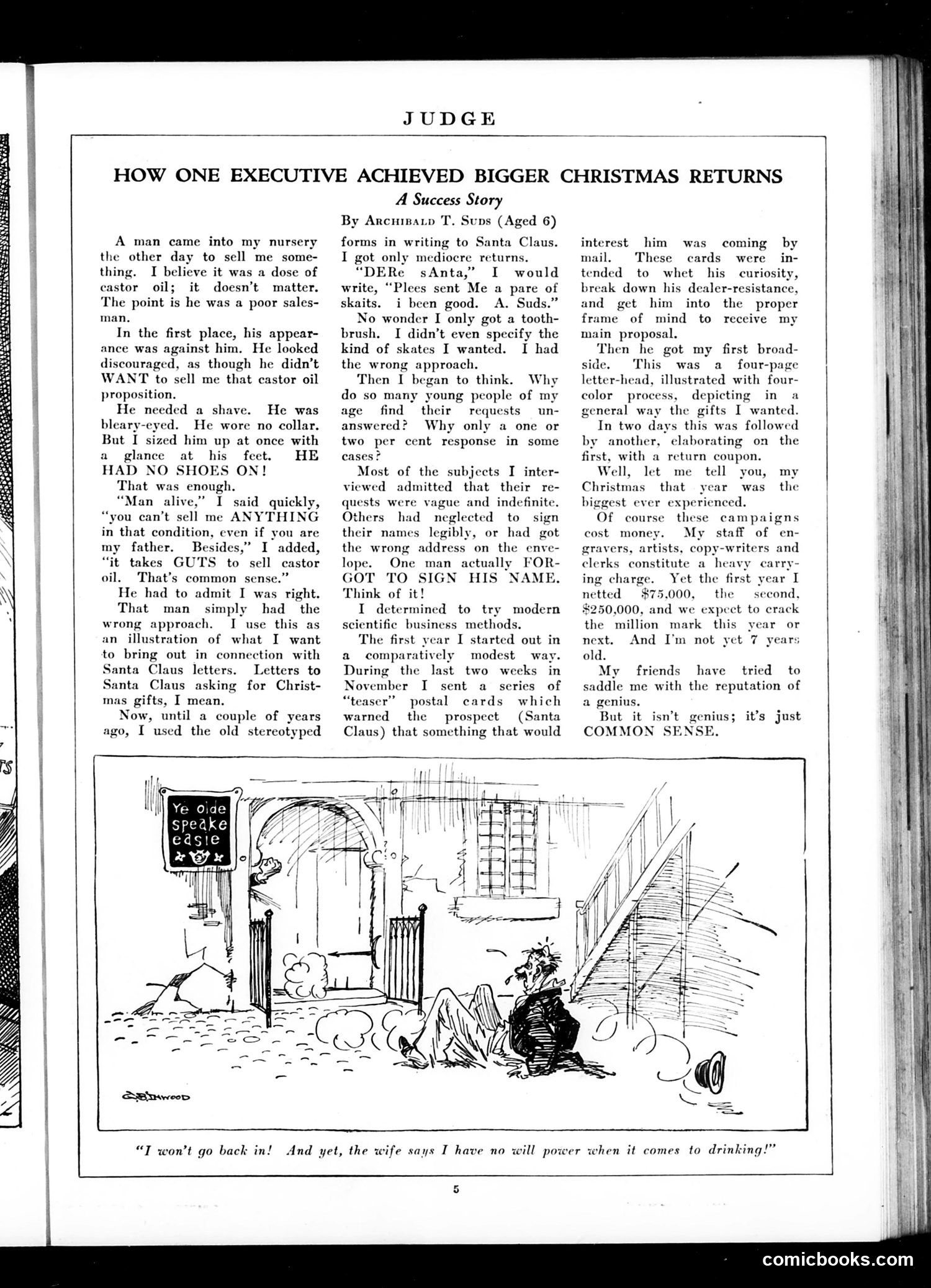
This page contains a business-themed article titled "How One Executive Achieved Bigger Christmas Returns: A Success Story" by Archibald T. Suds (Aged 6). The article satirizes poor salesmanship and ineffective business practices. The narrator describes a shabby castor-oil salesman with no sales skills, arguing that success requires modern "scientific business methods." The satire mocks vague customer requests, failure to obtain proper information, and inadequate follow-up—particularly regarding Santa Claus gift letters where customers forgot to sign their names. The accompanying cartoon depicts a man sitting dejectedly outside a business establishment in winter conditions, with a caption suggesting marital discord over his lack of willpower or success. The humor targets both incompetent salesmen and the absurdity of attributing business failure to common sense rather than actual strategy.
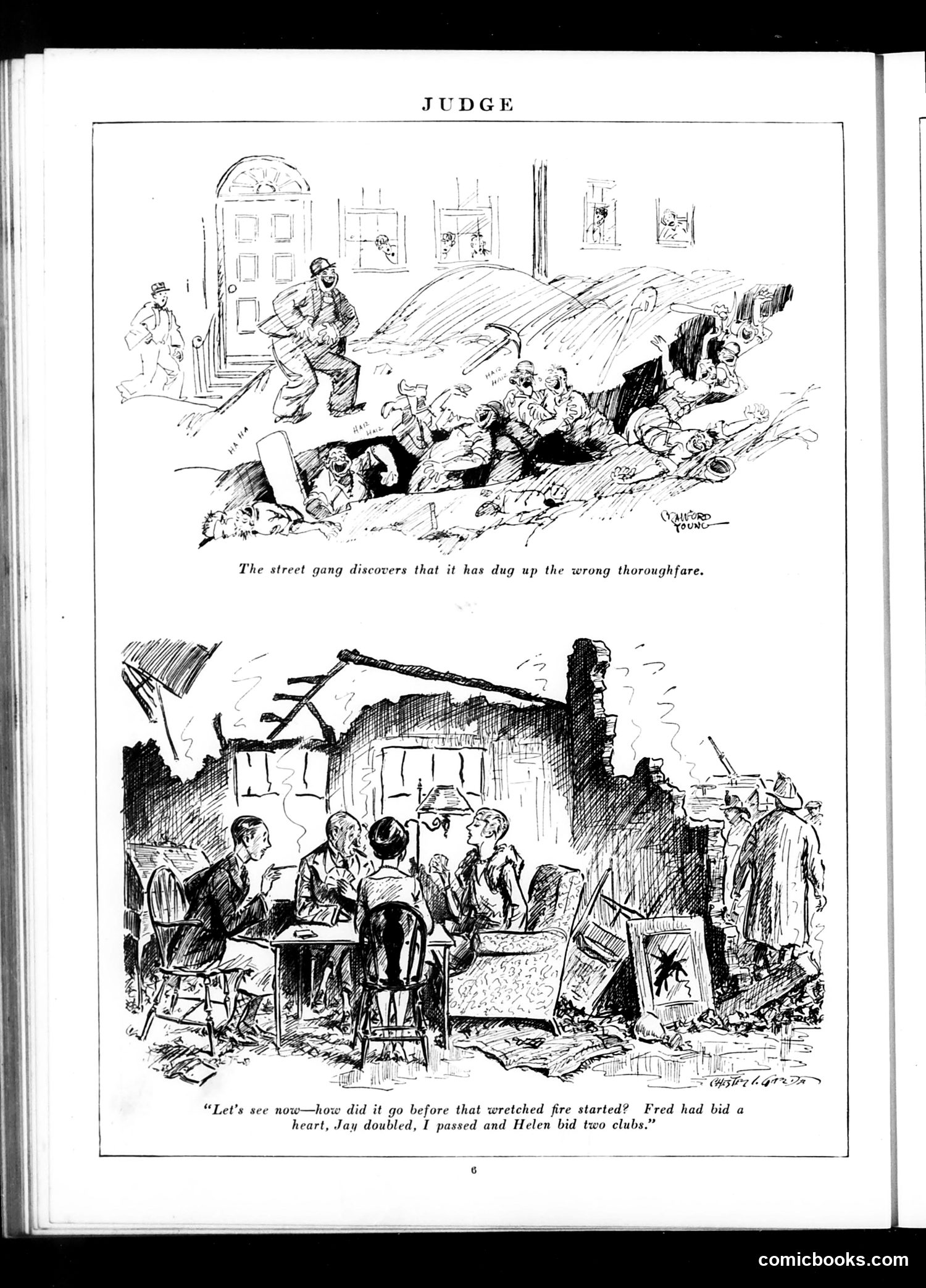
This page contains two cartoons satirizing early 20th-century urban life. The top cartoon mocks a street gang that excavates the wrong section of pavement during infrastructure work, creating chaos. The bottom cartoon depicts a more affluent scene: people playing bridge (a popular card game) in what appears to be a makeshift shelter after a fire. The humor lies in the contrast between disaster and normalcy—despite their building burning and living in ruins, these society figures obsess over reconstructing their bridge game's details ("Fred had bid a heart, Jay doubled..."). The satire targets the upper classes' detachment and priorities: maintaining social routines matters more than acknowledging their precarious circumstances. The detailed card-game dialogue emphasizes their absurd focus on trivial matters amid devastation.
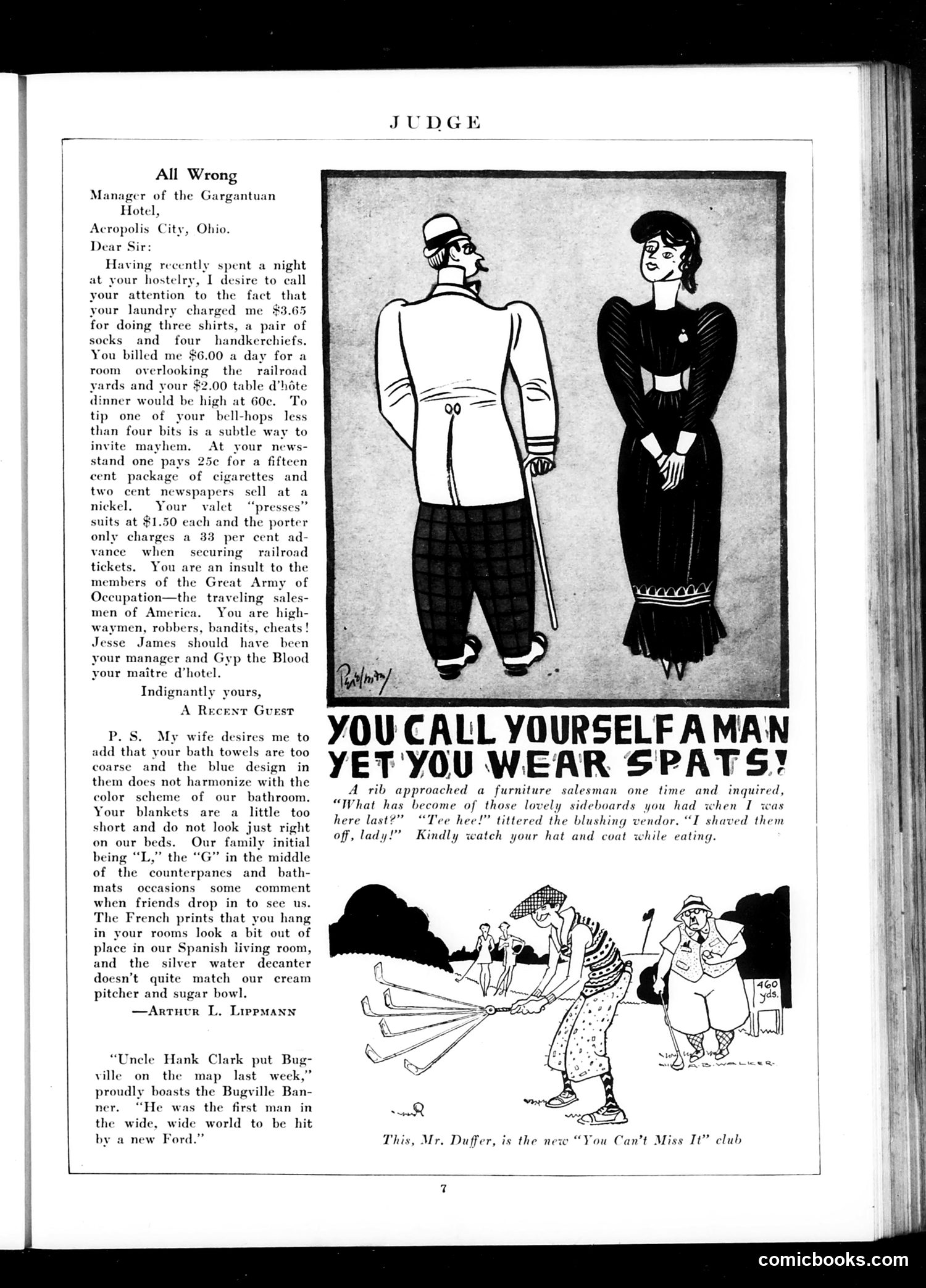
**Main Content:** Two distinct pieces satirizing American consumer culture and etiquette circa 1910s-1920s. **"All Wrong"** (left): A complaint letter to a hotel manager detailing egregious overcharges—$3.65 for laundry, inflated room/meal rates, price-gouging at the newsstand and valet services. The writer, signed "A Recent Guest," identifies himself as a traveling salesman and compares the hotel to highway robbery. A postscript from "Arthur L. Lippmann" adds petty complaints about towel coarseness and monogram mismatches, satirizing both the hotel's greed and wealthy guests' trivial snobbery. **"You Call Yourself a Man Yet You Wear Spats!"** (right): A cartoon mocking masculine pretense. The illustrated anecdote about a furniture salesman "shaving off" sideburns plays on the double meaning; the golf cartoon below ridicules men obsessing over appearance (hats, coats) while eating—criticizing masculine vanity masked as refinement. **Overall satire:** American commercialism exploiting travelers while simultaneously enforcing artificial social conventions around class status and masculinity.
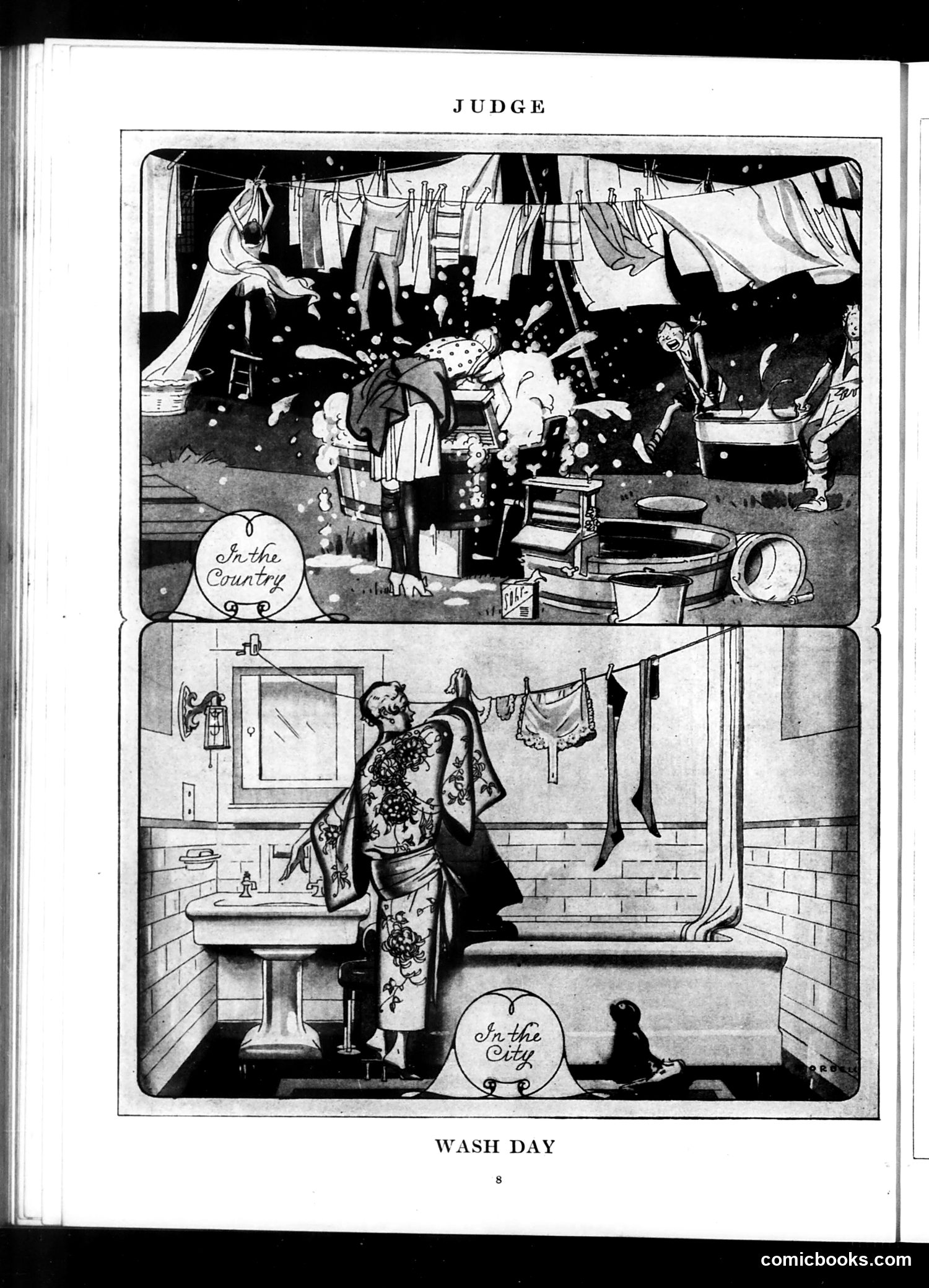
This two-panel cartoon contrasts domestic life "In the Country" versus "In the City." The top panel depicts chaotic rural laundry day: clothes hang everywhere, children play among soapsuds and buckets, and domestic animals roam freely—suggesting rustic disorder and labor-intensive washing. The bottom panel shows an urban bathroom with modern plumbing: a woman operates an indoor bathtub and sink with running water, clothes hanging neatly above. A cat observes calmly. The satire celebrates modern urban conveniences (indoor plumbing, running water) that simplified housework compared to traditional country methods. This likely reflects early-20th-century anxieties and pride about industrialization and urbanization, positioning city life as more efficient and civilized than rural existence. The implicit message: modern technology liberates women from backbreaking domestic labor.
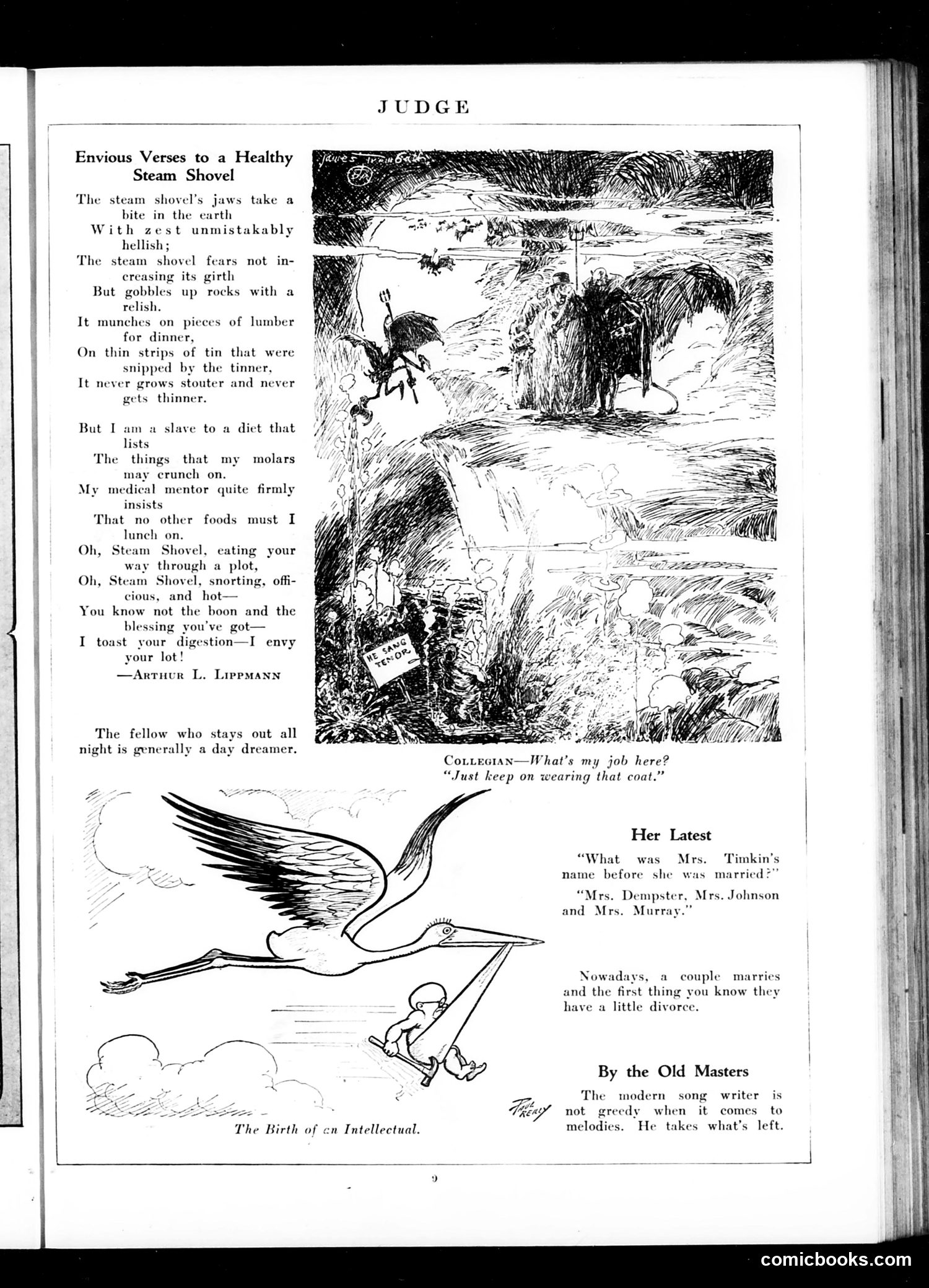
This page contains three distinct satirical pieces: **"Envious Verses to a Healthy Steam Shovel"** (by Arthur L. Lippmann): A humorous poem comparing a steam shovel's unrestricted diet to the speaker's medically-restricted one. The joke mocks both medical dietary advice of the era and envies the machine's freedom—a light social commentary on health fads and constraints. **"Her Latest"**: A one-liner joke about Mrs. Timkin's maiden name, playing on the assumption that married women take their husband's surname. The punchline reveals multiple previous marriages, satirizing easy divorce among the wealthy. **"The Birth of an Intellectual"** (illustration): A stork delivering a baby, a classical reference to reproduction myths. The accompanying text "By the Old Masters" jokes that modern songwriters lack originality—they simply reuse old melodies rather than create new ones, suggesting artistic laziness in contemporary music. The page reflects early 20th-century concerns: medical faddism, marital instability among the upper classes, and declining artistic standards.
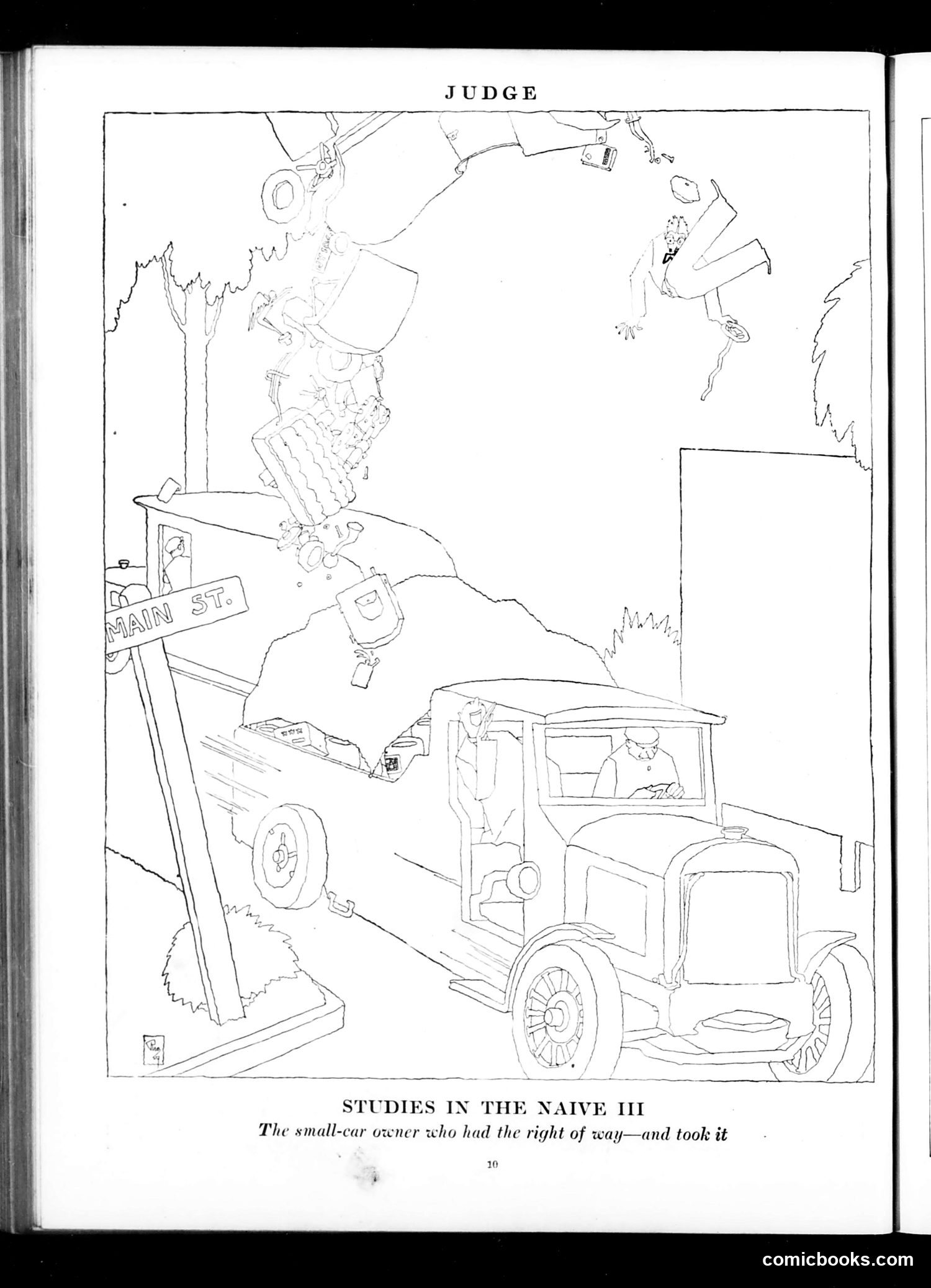
This cartoon satirizes a small-car owner exercising their legal right of way in traffic, apparently with disastrous consequences. The illustration shows a small automobile at an intersection with a "Main St." sign, confronting a larger truck. The caption's ironic phrase "who had the right of way—and took it" suggests the humor: while the small-car owner was technically correct legally, asserting this right proved foolish or dangerous in practice. The satire mocks naive idealism—the assumption that legal rights guarantee safe outcomes in real-world situations. The "Studies in the Naive" series likely examined people who rigidly followed rules without accounting for practical hazards, particularly relevant during the early automobile era when traffic rules were still developing and enforcing them depended on everyone's cooperation.
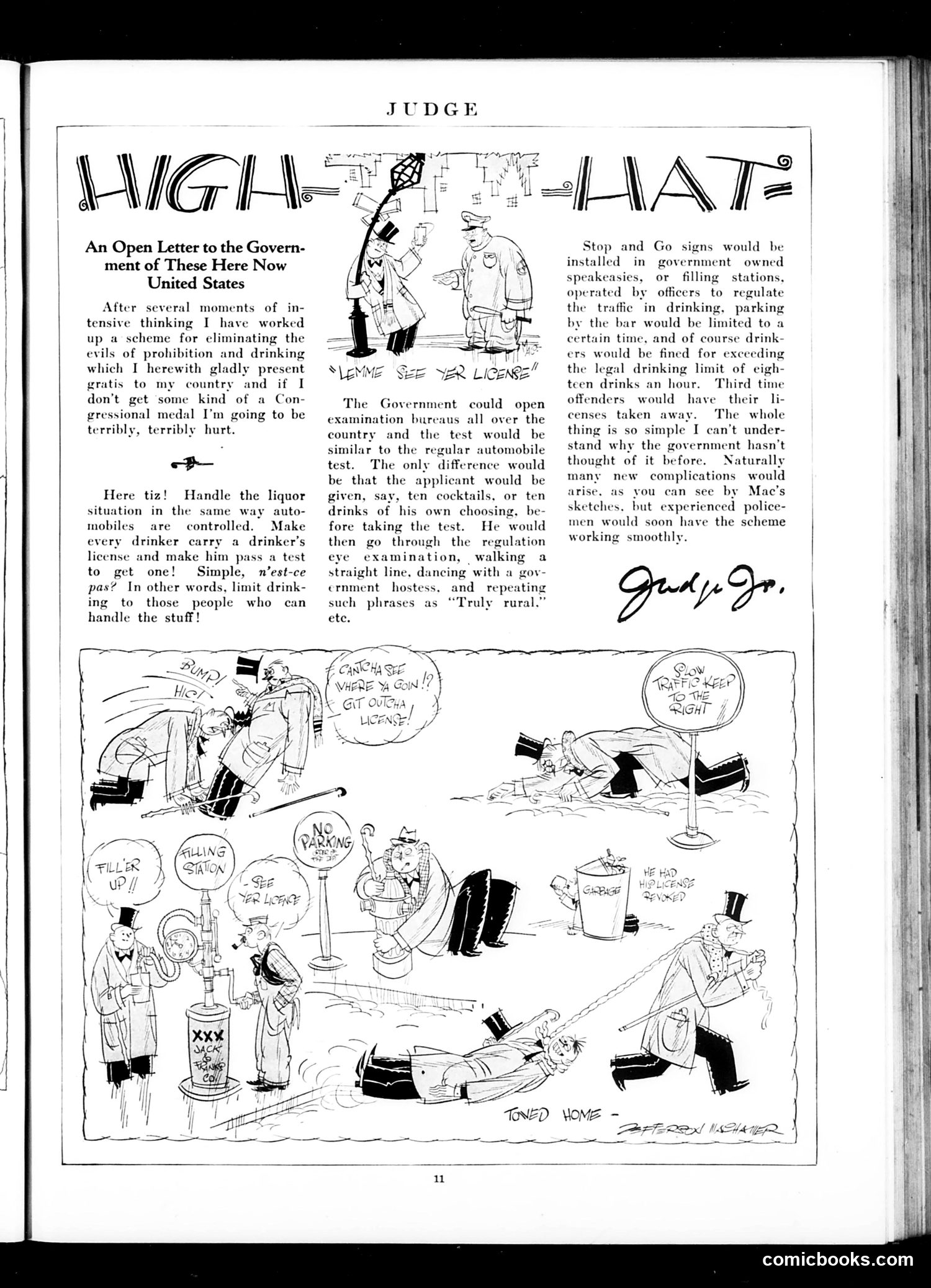
This Judge magazine page satirizes Prohibition-era drinking laws through mock-serious proposal: implement "drinker's licenses" modeled on automobile licensing. The scheme parodies government overreach by suggesting applicants consume ten cocktails before passing sobriety tests (straight-line walking, dancing with "government hostess," reciting phrases). Stop-and-Go signs would regulate bar parking; violators face fines for exceeding "eighteen drinks an hour." The cartoons below depict absurd enforcement consequences: drunken citizens collapsing, unable to navigate these regulations, police monitoring drinking zones. The satire critiques Prohibition's impracticality and heavy-handed enforcement while mocking both bureaucratic solutions and the pretense that drinking could be "controlled" like automobiles. The humor targets those supporting Prohibition's strict regulations—suggesting their logic, taken to extremes, becomes obviously ridiculous. Published during Prohibition (1920-1933), it reflects contemporary frustration with the amendment's enforcement.
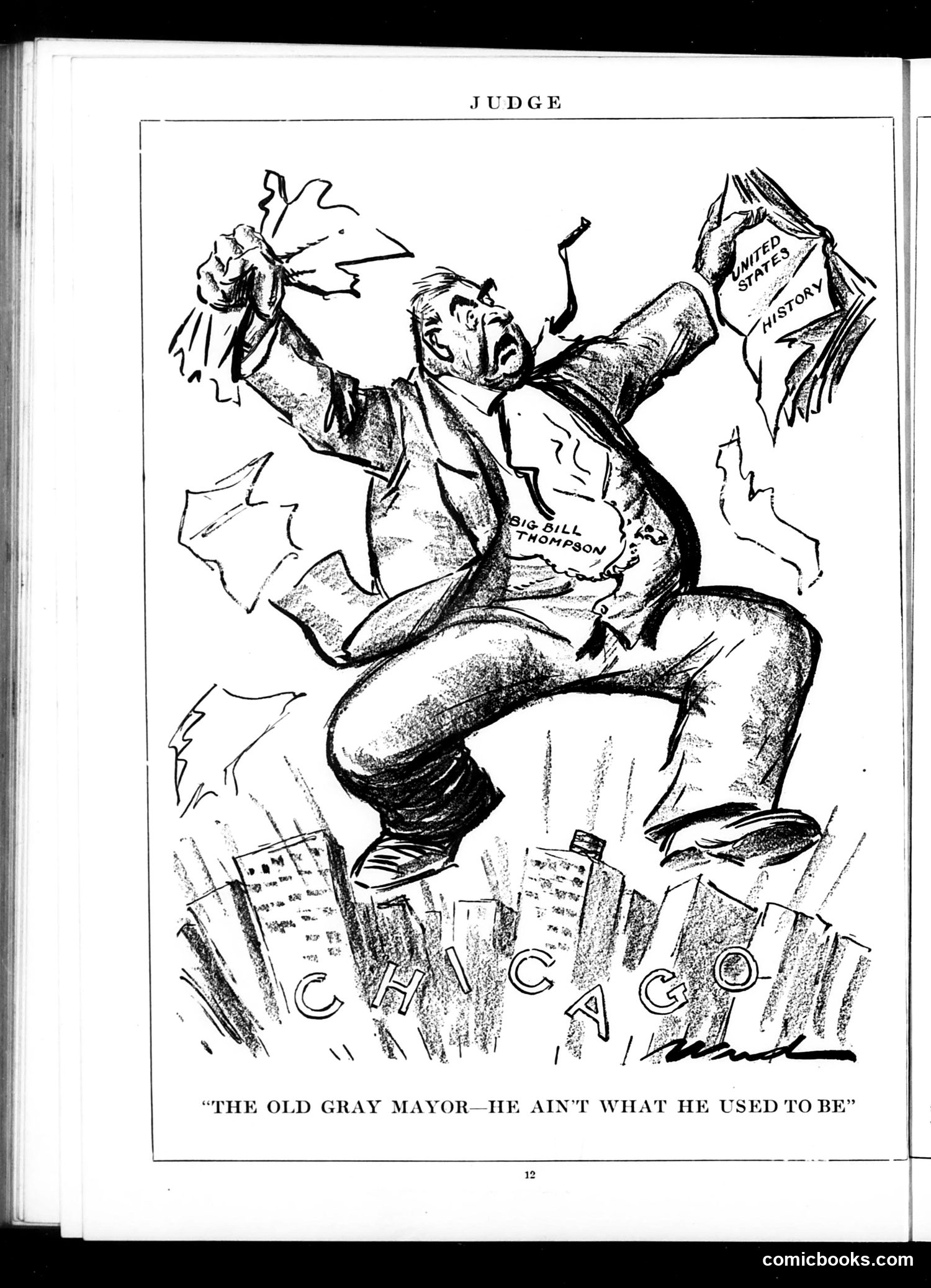
This political cartoon depicts a disheveled figure labeled "Big Bill Thompson" (visible on his clothing) juggling various objects while standing atop "Chicago" (shown as a foundation). He's juggling what appears to be the "United States History" book and other items, while lightning bolts suggest chaos and instability. The caption criticizes Thompson, suggesting his performance as mayor has declined. The cartoon satirizes his political competence and leadership, presenting him as erratic and struggling to manage Chicago's affairs. Thompson was famously controversial—this likely references specific scandals or policy failures during his mayoral tenure that the Judge readership would have recognized.
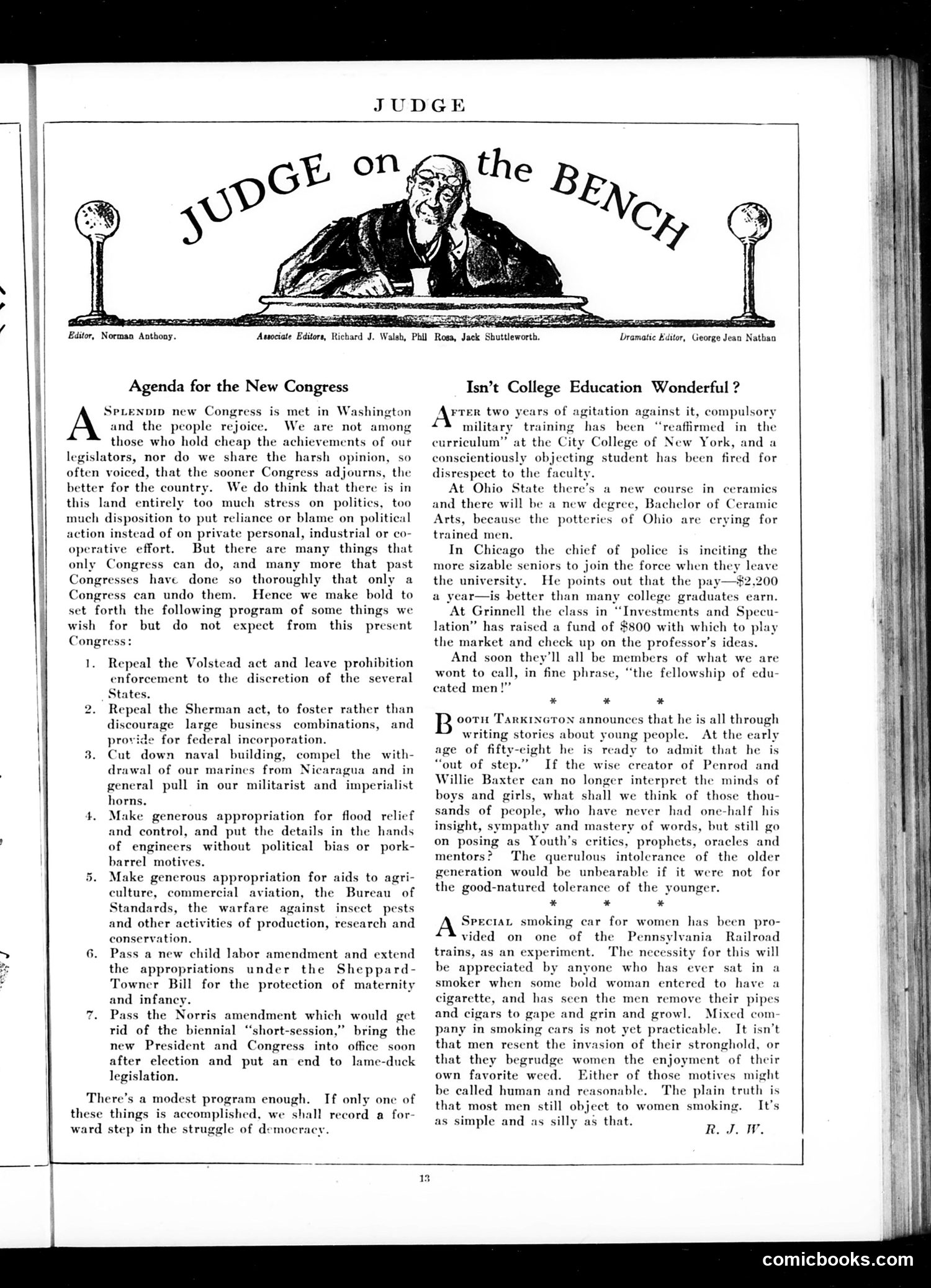
This page features Judge magazine's editorial agenda and social commentary. The masthead illustration shows a stern judge presiding, establishing the magazine's authority to critique. **"Agenda for the New Congress"** lists seven progressive policy proposals: repealing Prohibition and the Sherman Antitrust Act, reducing military/naval spending, flood relief funding, agricultural support, child labor protections, and campaign reform. **"Isn't College Education Wonderful?"** satirizes American higher education's perceived failures. It mocks military training requirements at CCNY, Ohio State's impractical "ceramic arts" degree, police recruitment targeting college seniors, and Grinnell students gambling with $800 playing the stock market—all presented as absurd examples of supposed "educated men." The satire culminates in criticism of older generations' dismissal of youth, prompted by author Booth Tarkington's retirement from writing about young people at fifty-eight. The overall tone is reform-minded criticism of institutional absurdity.
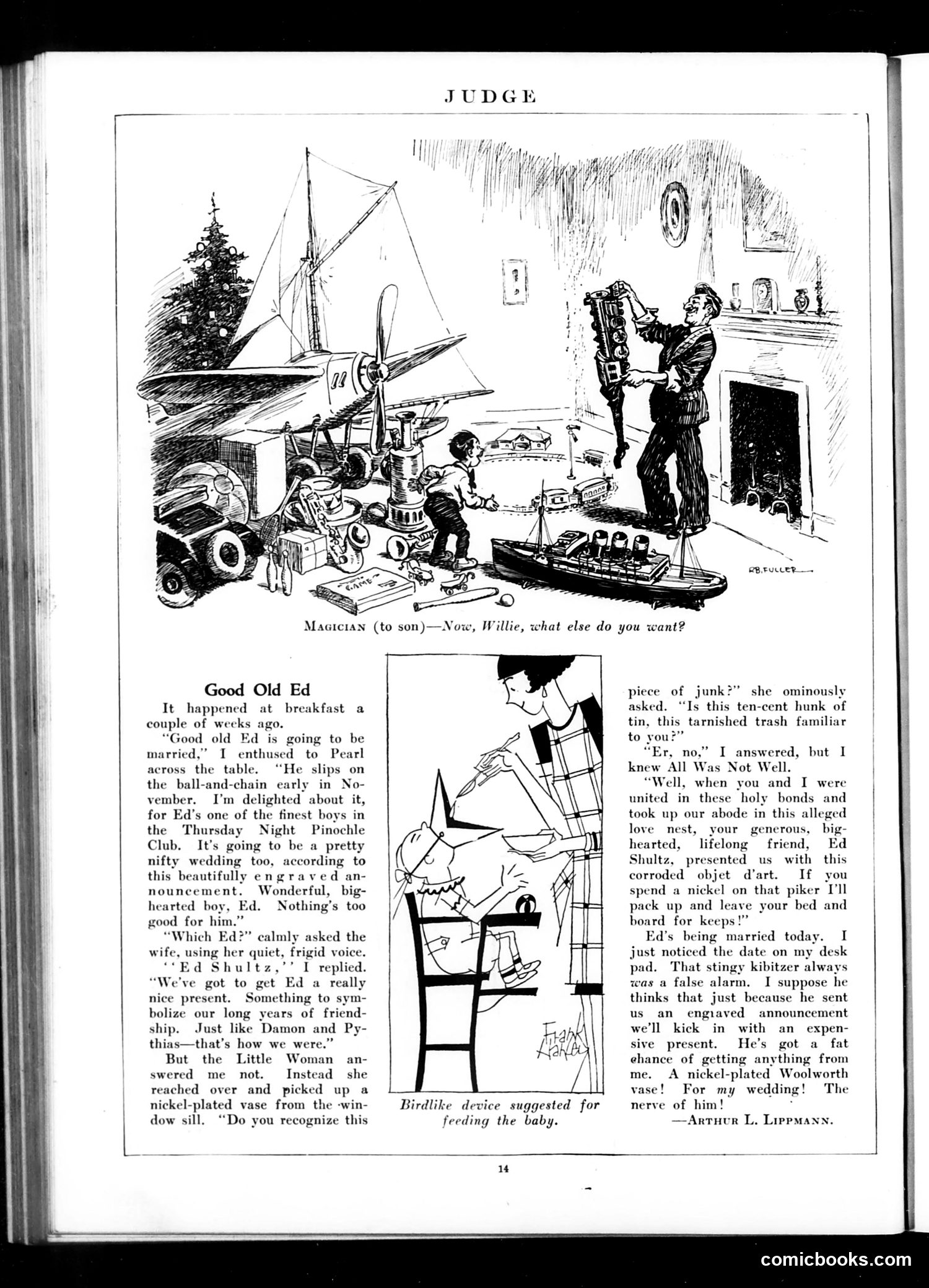
This humorous piece by Arthur L. Lippmann satirizes male friendship and wedding gift etiquette. The narrator enthusiastically plans to reciprocate a wedding gift for his friend Ed Shultz, unaware that Ed had given him a cheap, tacky nickel-plated vase years earlier as a wedding present. The wife's frigid reaction—reminding him of this insulting gift—immediately reverses his generous impulses. The joke's resolution reveals the narrator's pettiness: upon learning Ed has sent an expensive engraved announcement, the narrator resolves to give nothing, convinced Ed's gesture is merely self-interested. The satire targets masculine pride and the transactional nature of social obligation among middle-class men. The "Birdlike device" illustration appears unrelated—a standard filler cartoon common in Judge magazine.
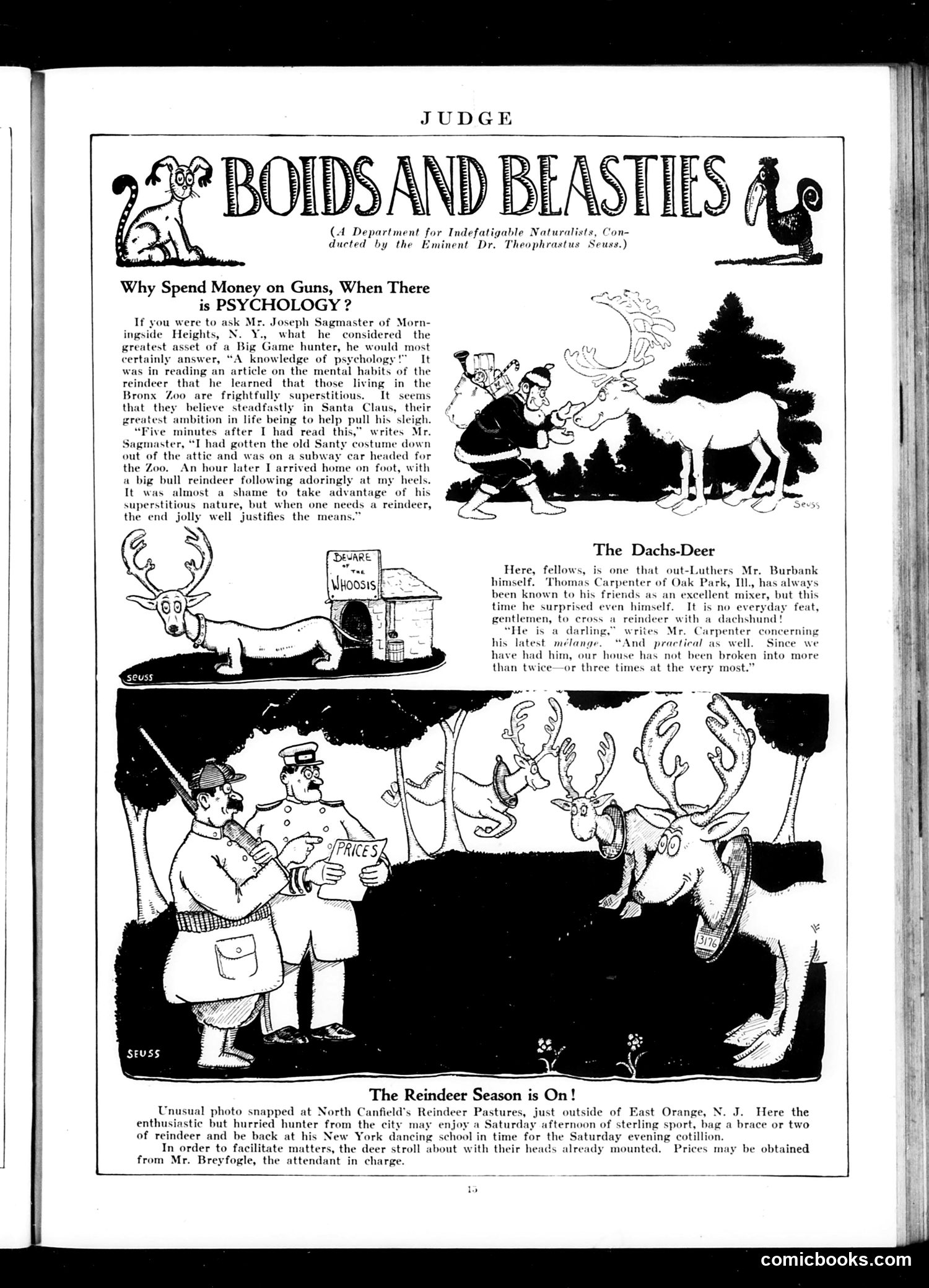
This satirical page mocks the hunting craze and psychology fad of the early 20th century. The main article ridicules a hunter named Joseph Sagmaster who uses "psychology" rather than guns to hunt reindeer. His absurd tactic: dressing as Santa Claus to exploit reindeer superstition (their belief in Santa), successfully luring one home. The "Boids and Beasties" column, credited to Dr. Seuss (Theodor Geisel), presents fake hybrid animals: a "Dachs-Deer" (dachshund-reindeer cross) supposedly useful as a burglar alarm, and a reindeer ranch offering mounted deer heads for hunters—delivered pre-mounted to save time before Saturday evening social events. The satire targets: wealthy Manhattan hunters seeking novelty and easy kills; the period's obsession with pseudoscientific psychology; and leisure-class vanity (prioritizing evening cotillions over legitimate sport). The cartoons ridicule both urban hunters and contemporary fads through absurdist humor.
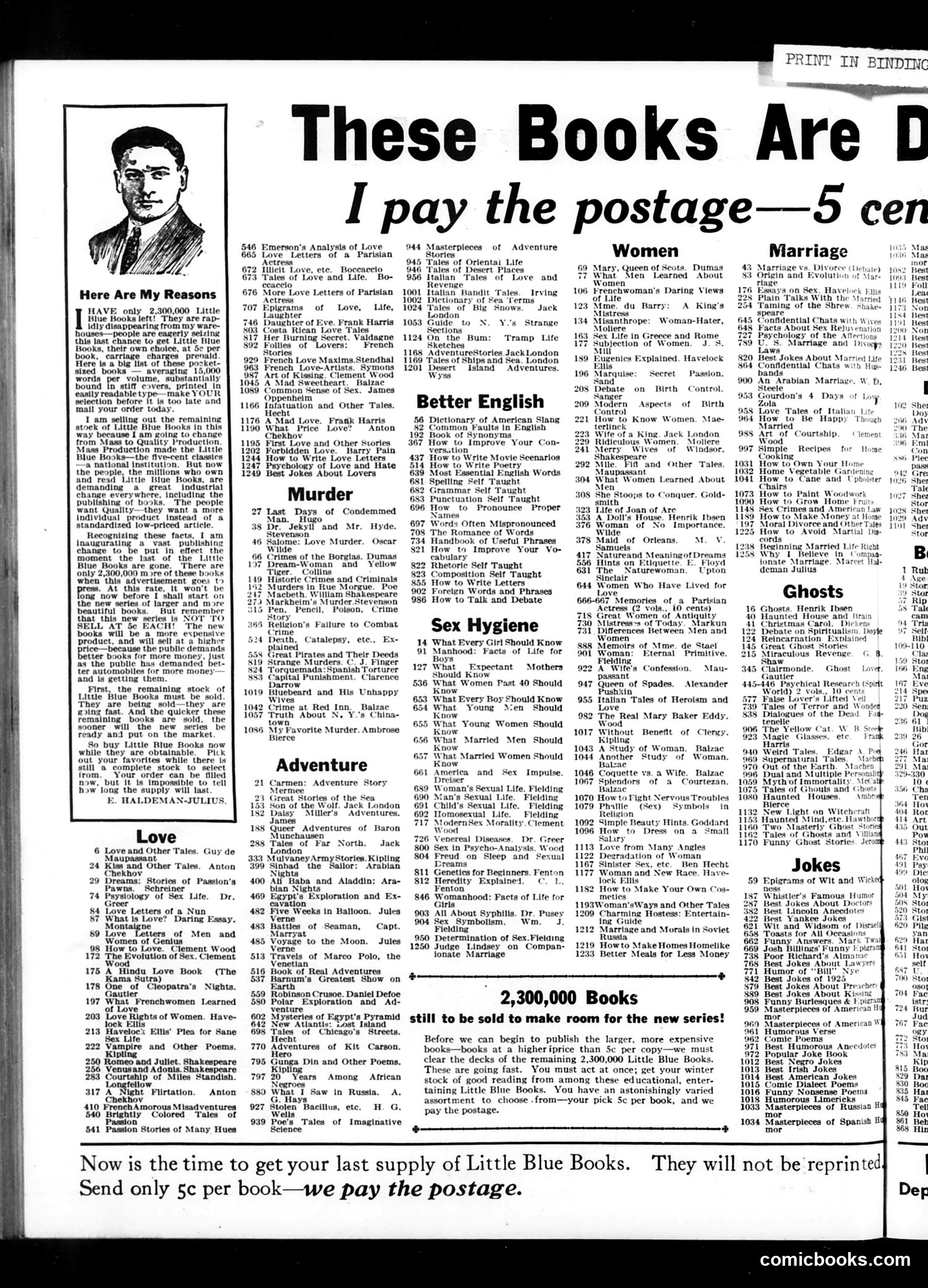
This is a **publisher's clearance advertisement**, not a political cartoon. E. Haldeman-Julius advertises his remaining 2,300,000 "Little Blue Books"—affordable pocket-sized paperbacks priced at 5 cents each, with postage paid. **The pitch:** Haldeman-Julius claims he's liquidating this mass-market line to transition to "Quality Production"—larger, more expensive books. The public now demands better products, he argues, just as they've demanded better automobiles. **The context:** This reflects 1920s consumer culture and the tension between mass-market affordability and aspirational "quality." The extensive catalog shows these were popular educational and literary texts covering romance, sex education, adventure, and classics—democratizing literature for working-class readers. **For modern readers:** This represents early mass-market publishing, before paperback standardization. The emphasis on "5¢ per book" and the sales urgency ("supply will last") reflects Depression-era economics and changing publishing markets.
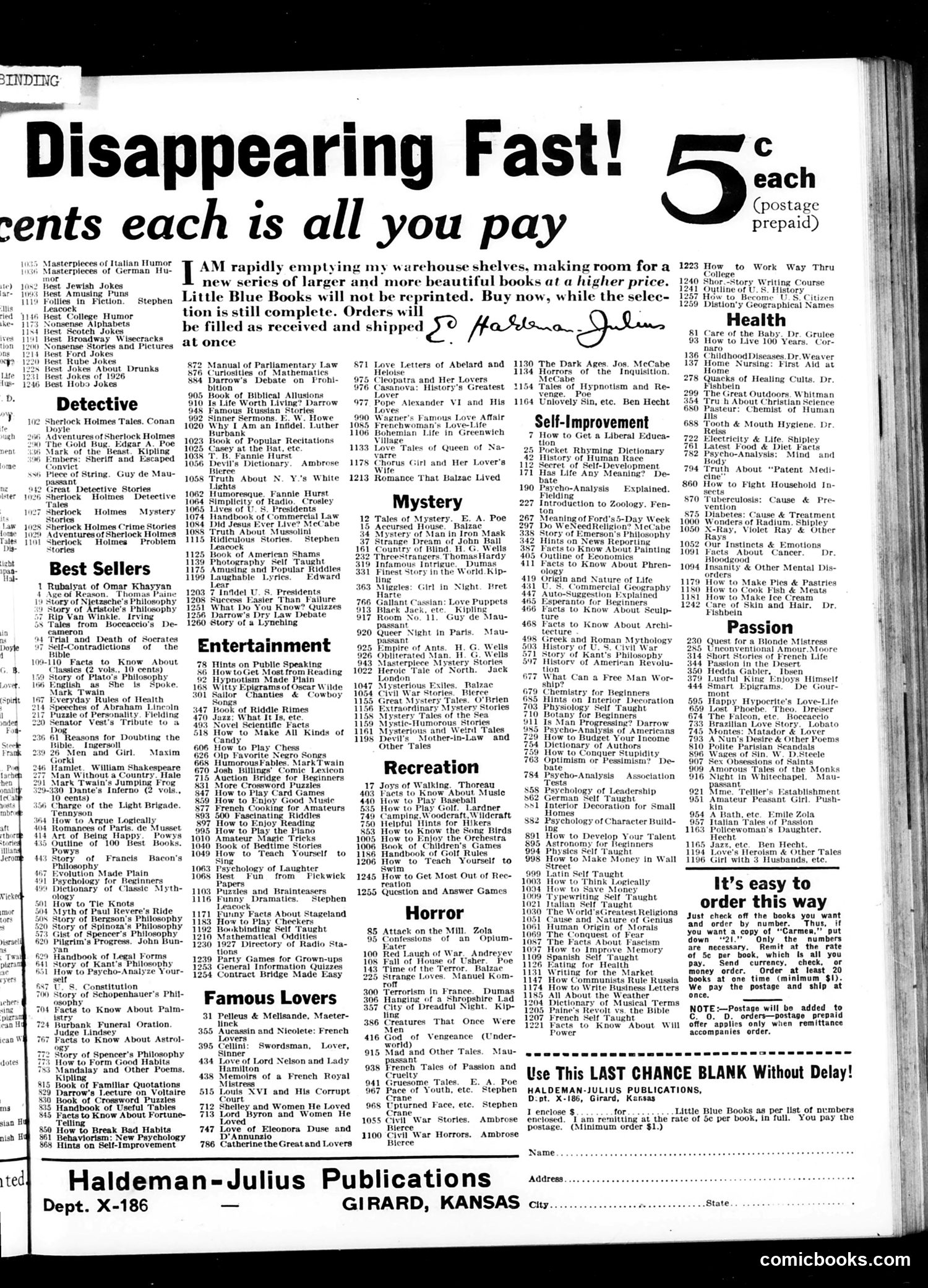
This is primarily a **mail-order book catalog**, not a satirical cartoon page. It advertises "Little Blue Books"—inexpensive reprints (5¢ each, postage prepaid) being cleared from warehouse shelves to make room for "a new series of larger and more beautiful books at a higher price." The page lists hundreds of titles across categories: Detective (Sherlock Holmes), Best Sellers, Entertainment, Famous Lovers, Mystery, Horror, Recreation, Self-Improvement, Health, and Passion. The catalog includes works by canonical authors (Poe, Wells, Balzac, Darrow) alongside practical guides (dental hygiene, business letters) and popular entertainment. The handwritten signature ("E. Haldeman-Julius") belongs to the publisher offering this clearance sale. The order blank at bottom directs customers to Haldeman-Julius Publications in Girard, Kansas. **For modern readers**: This shows how early 20th-century publishers democratized literature through cheap reprints—making Shakespeare affordable to working-class readers alongside self-help and sensational fiction.
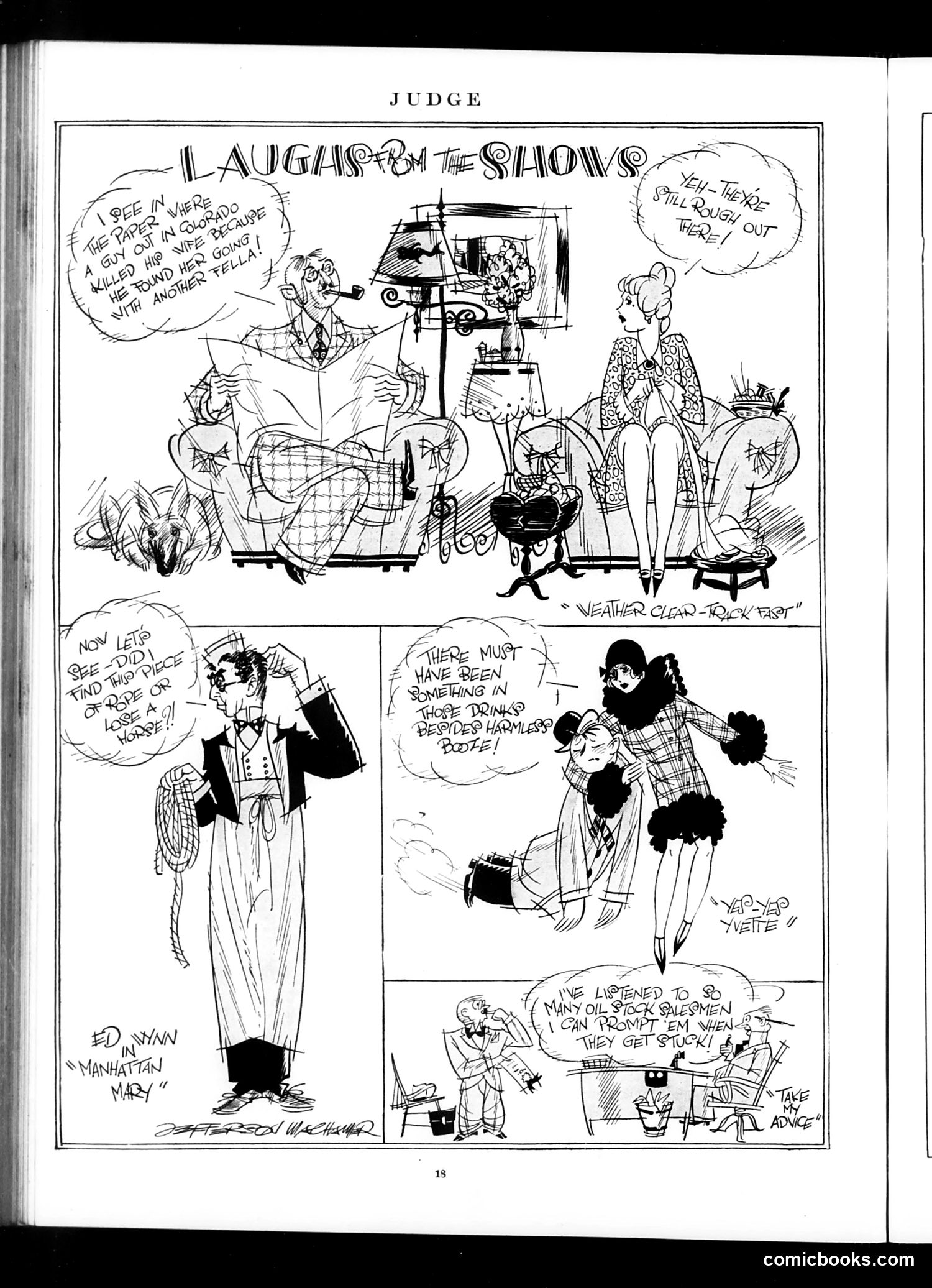
This page satirizes theater audiences and entertainment culture. The top panel shows two theatergoers discussing a film—one claims to have read the plot beforehand in papers, the other notes it's "still roughs out there," suggesting predictable or derivative movie plots. Below, a man in formal wear ("Ed in Manhattan Mary") appears flustered, likely representing a theater patron or reviewer. The final panel mocks oil stock salesmen who "get stuck" pitching investments to anyone who'll listen, with someone giving them "take my advice"—satirizing both aggressive salesmanship and gullible investors during what appears to be a stock-market era (likely 1920s-30s, given Judge's heyday). The overall humor targets entertainment mediocrity, pretentious audiences, and financial charlatans common to that period.
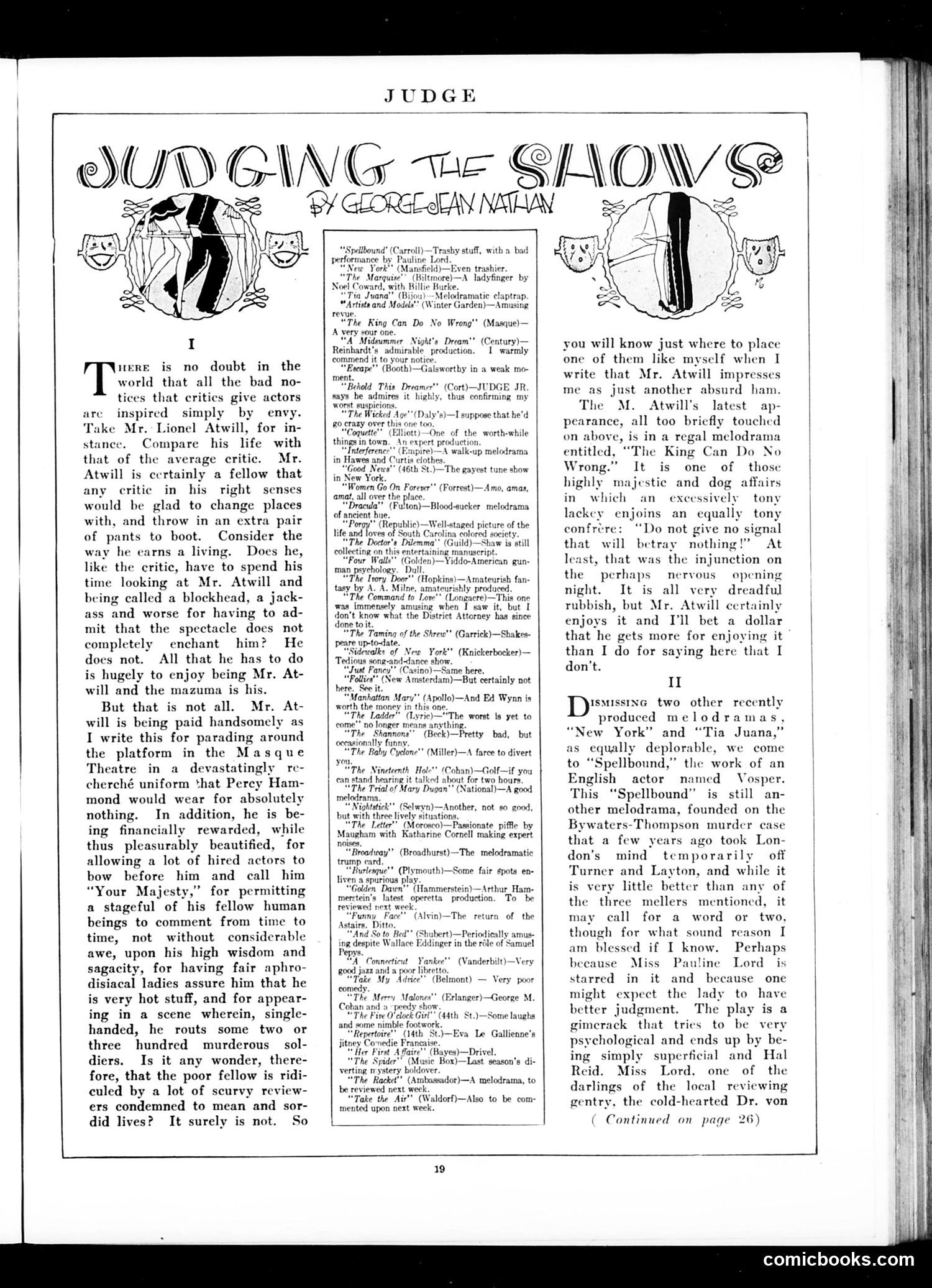
This page is a theater critic's essay defending actor **Lionel Atwill** against harsh reviews. The author argues critics attack actors out of **envy**—Atwill earns good money wearing a fancy uniform in "The King Can Do No Wrong" (at the Masque Theatre), while reviewers lead miserable lives condemning performances they resent. The essay is satirical: it mocks critics' bitterness by presenting their complaints as obviously motivated by jealousy rather than legitimate artistic judgment. Atwill's actual performance quality is irrelevant to the argument. The right column lists contemporary Broadway productions with brief, dismissive reviews—many called "trashy," "melodramatic," or "dull"—exemplifying the kind of harsh criticism the essay targets. This is **Nathan**, a famous theater critic of the 1920s, playfully turning his own critical voice against fellow reviewers.
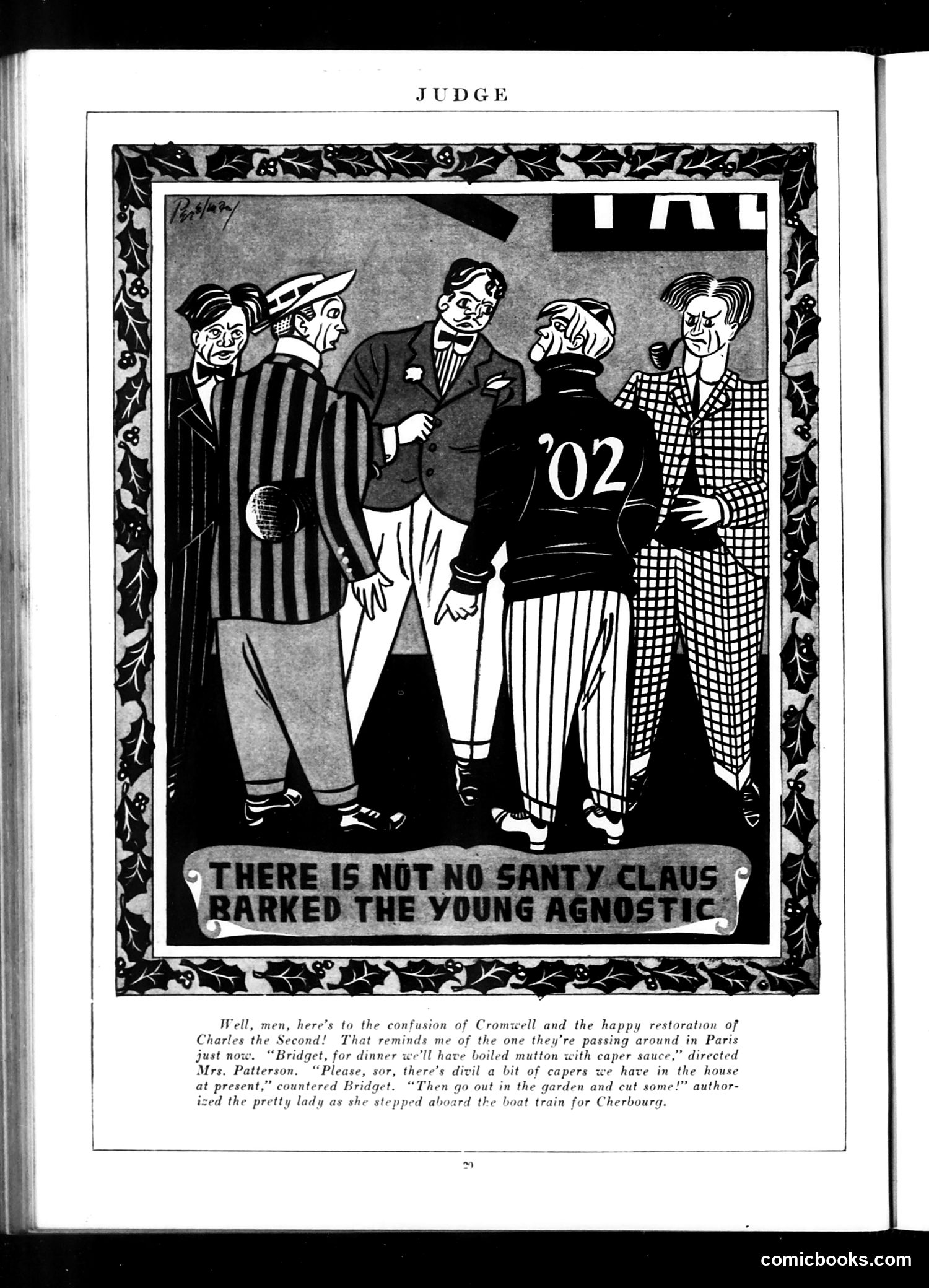
This satirical cartoon ridicules upper-class American women's pretension and disconnection from reality. The central figure wears a sports jersey numbered "02," suggesting she's a privileged athlete or socialite. The caption "There is Not No Santy Claus Barked the Young Agnostic" plays on double negatives and mocks youthful skepticism. The accompanying text tells a joke about Mrs. Patterson, who orders her Irish maid Bridget to harvest capers from the garden—apparently unaware that capers are a Mediterranean spice, not a garden plant. The humor targets wealthy women's ignorance of basic household management and servants' knowledge. The opening toast references English historical restoration, setting a tone of mockery toward those who romanticize the past while remaining clueless about present reality. The satire aims at upper-class women's pretensions and foolishness.
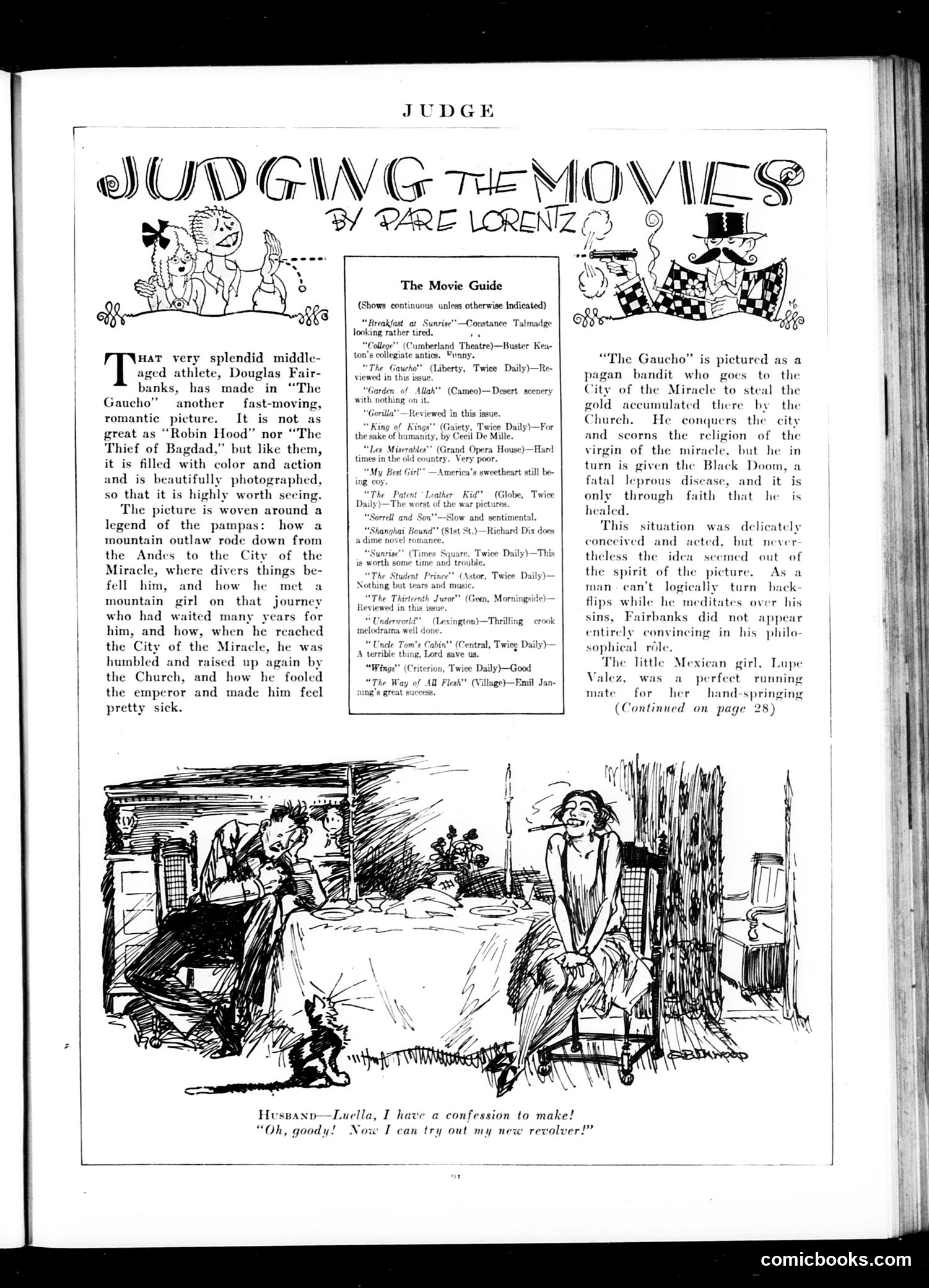
This page reviews current films, with the main cartoon illustrating a domestic scene. The sketch shows a husband about to confess something to his wife, who eagerly responds that she can now test her new revolver—darkly joking that she'll shoot him for his transgression. The humor relies on the period stereotype of the jealous, gun-wielding wife punishing infidelity or misbehavior. It's a common comedic trope of the era. The "Movie Guide" sidebar reviews contemporary films, including Douglas Fairbanks' *The Gaucho*—described as a romantic adventure about a bandit who steals from a religious city. The review notes the film's visual spectacle but suggests its philosophical elements (the bandit's redemption through faith) feel tonally inconsistent with Fairbanks' typical swashbuckling heroics. It also praises actress Lupe Valez's performance. This is entertainment journalism mixed with satirical commentary on both cinema and domestic relations.
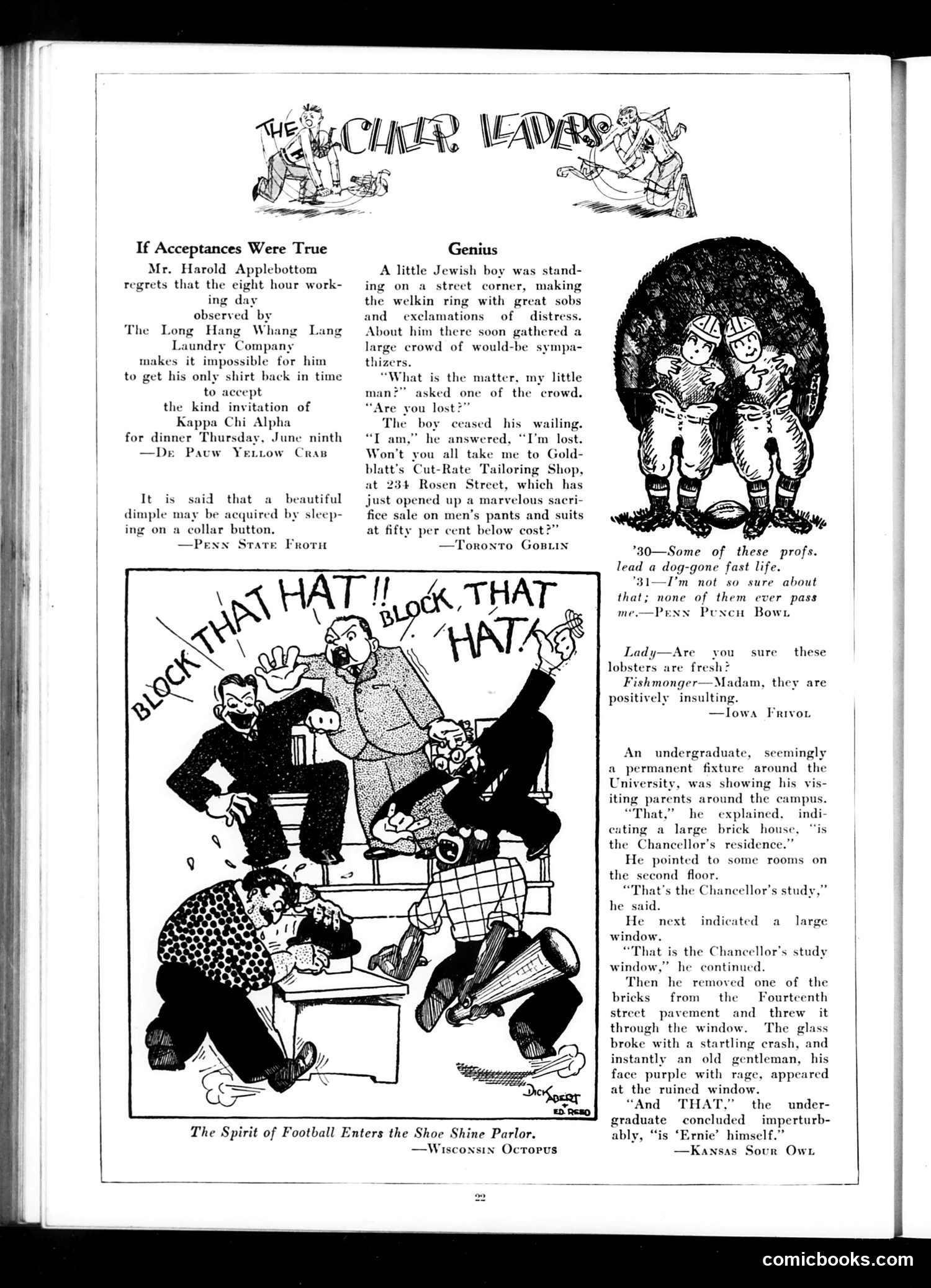
This page contains several short humor pieces typical of early 20th-century college and social satire: **Main Cartoon**: "The Spirit of Football Enters the Shoe Shine Parlor" depicts rowdy college students destroying a shoe shine shop while shouting "BLOCK THAT HAT!!" — satirizing the chaos and destructiveness associated with college football enthusiasm. **Short Jokes**: - A laundry company worker can't attend a fraternity dinner due to the eight-hour workday - A Jewish boy uses a sympathetic crowd gathered at his "lost" display as an audience for advertising a tailor shop's sale - Students joke about professors (implying they fail students who skip class) - A fishmonger insults a customer by calling fresh lobsters "positively insulting" - An undergraduate throws a brick through the Chancellor's window to show his parents where the Chancellor works **Overall Theme**: These pieces mock college life, ethnic entrepreneurship, institutional authority, and the destructive behavior of privileged students—typical Judge magazine content blending social observation with casual prejudice.
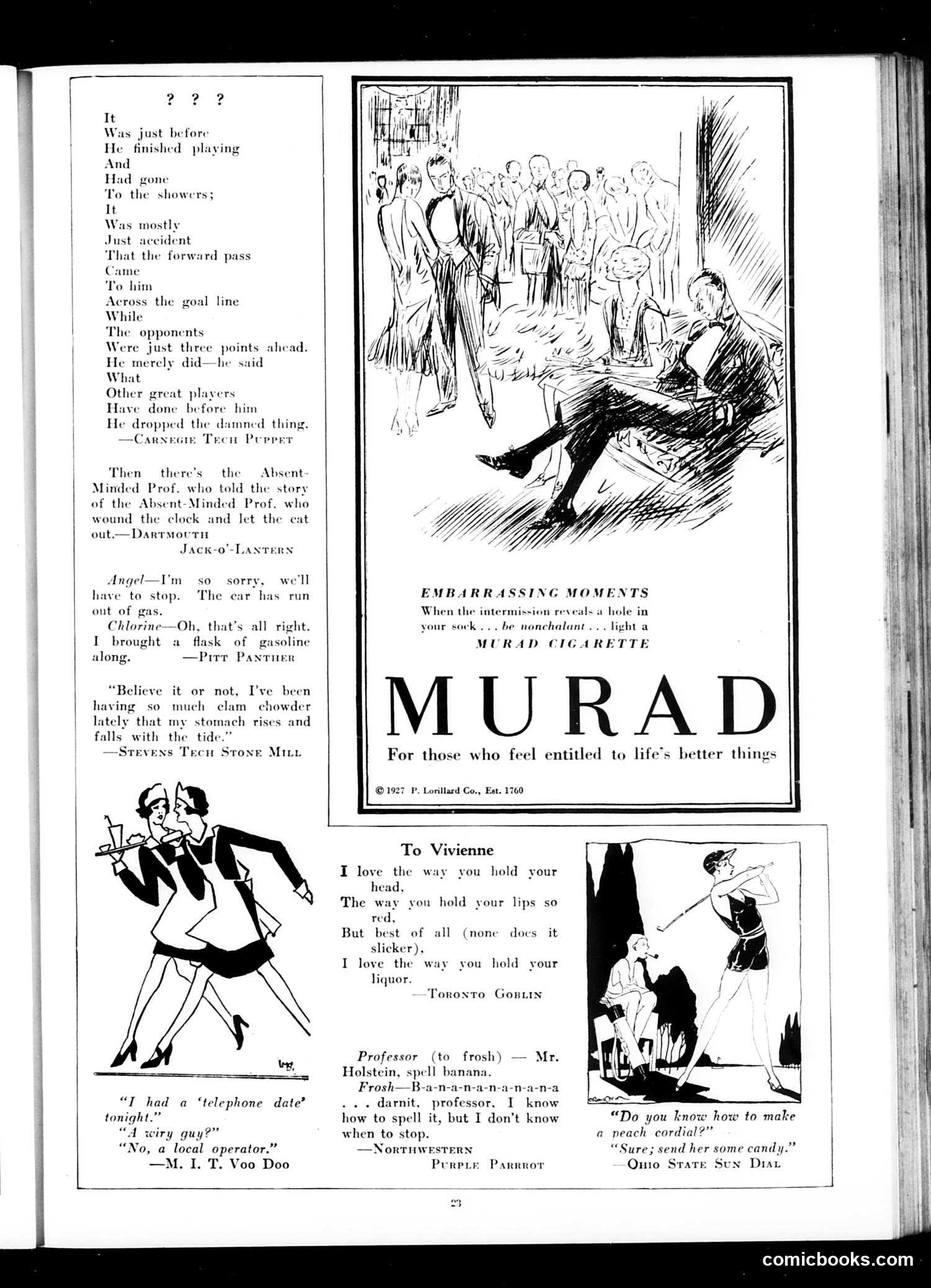
This page contains multiple humorous college/university-themed jokes and a cigarette advertisement. The content includes: **Main cartoons:** - A football mishap where a player drops an easy forward pass near the goal line - An "absent-minded professor" joke (a stock character representing academic absentmindedness) - College humor from various university publications (M.I.T., Northwestern, Ohio State) **The jokes' themes:** - Athletic incompetence and embarrassing mistakes - Academic forgetfulness - Prohibition-era references (concealing alcohol, "flask of gasoline") - Dating/courtship humor - Playful mockery of college life **Advertisement:** A full-page Murad cigarette ad exploiting the awkwardness theme ("Embarrassing Moments"), using social discomfort to sell cigarettes to aspirational audiences. The page reflects 1920s college culture humor—relatively innocent by modern standards, focused on relatable campus embarrassments and the era's casual attitudes toward alcohol and smoking.
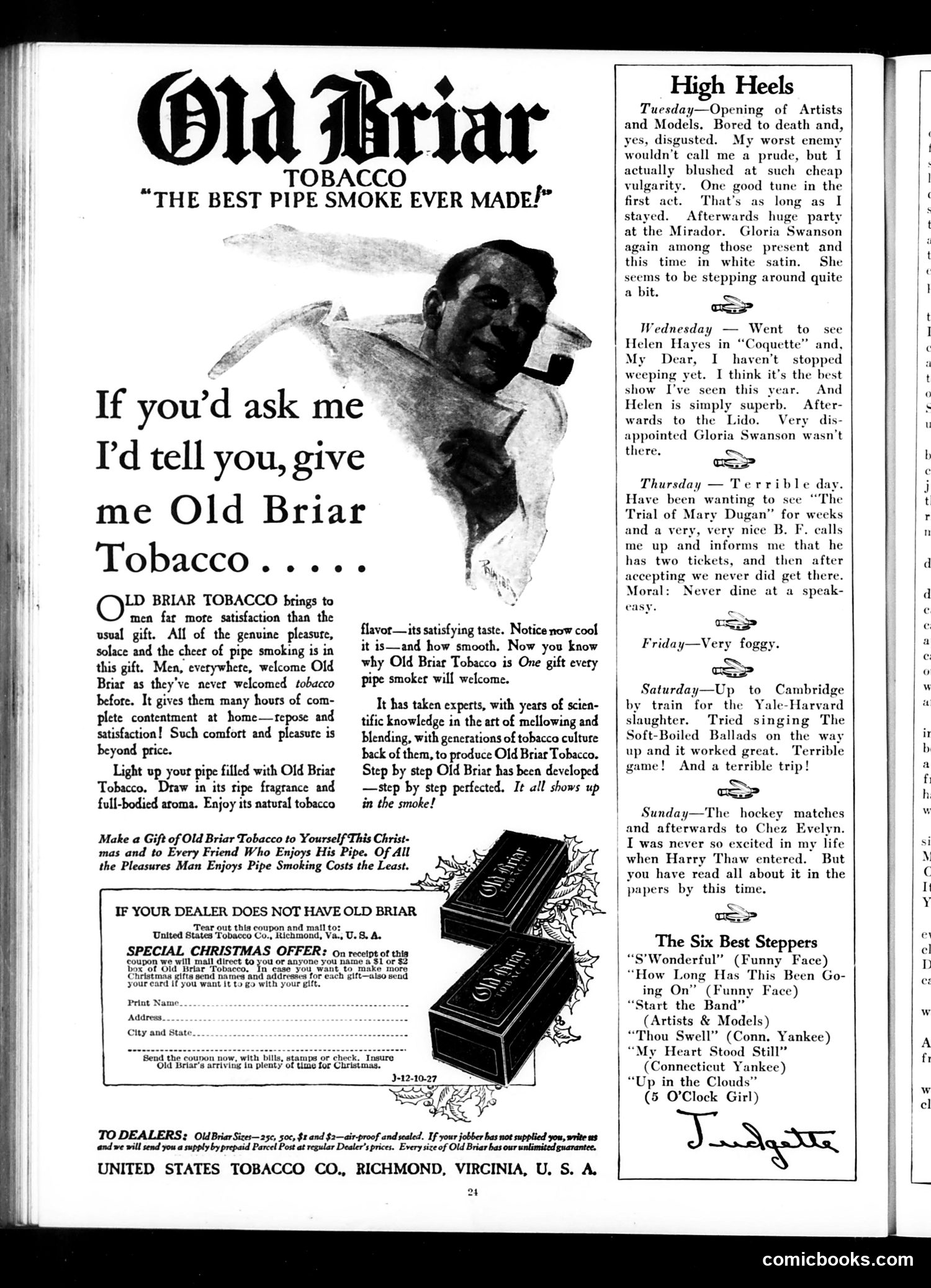
This page is primarily a **cigarette advertisement**, not political satire. The left side features an Old Briar Tobacco ad showing a man smoking a pipe, claiming it's "the best pipe smoke ever made." The ad emphasizes quality, expert blending, and positions the product as an ideal Christmas gift. The right column contains **"High Heels,"** a society gossip column documenting a wealthy person's week attending Broadway shows (including *Artists and Models*, Helen Hayes in *Coquette*, and *Trial of Mary Dugan*) and social events at venues like the Mirador and Lido speakeasy—a reference to Prohibition-era illegal bars. The column concludes with "The Six Best Steppers," listing popular Broadway musical numbers of the era. **Context for modern readers:** This represents 1920s entertainment culture and leisure among the affluent, alongside tobacco marketing practices that were entirely legal and considered respectable at the time.
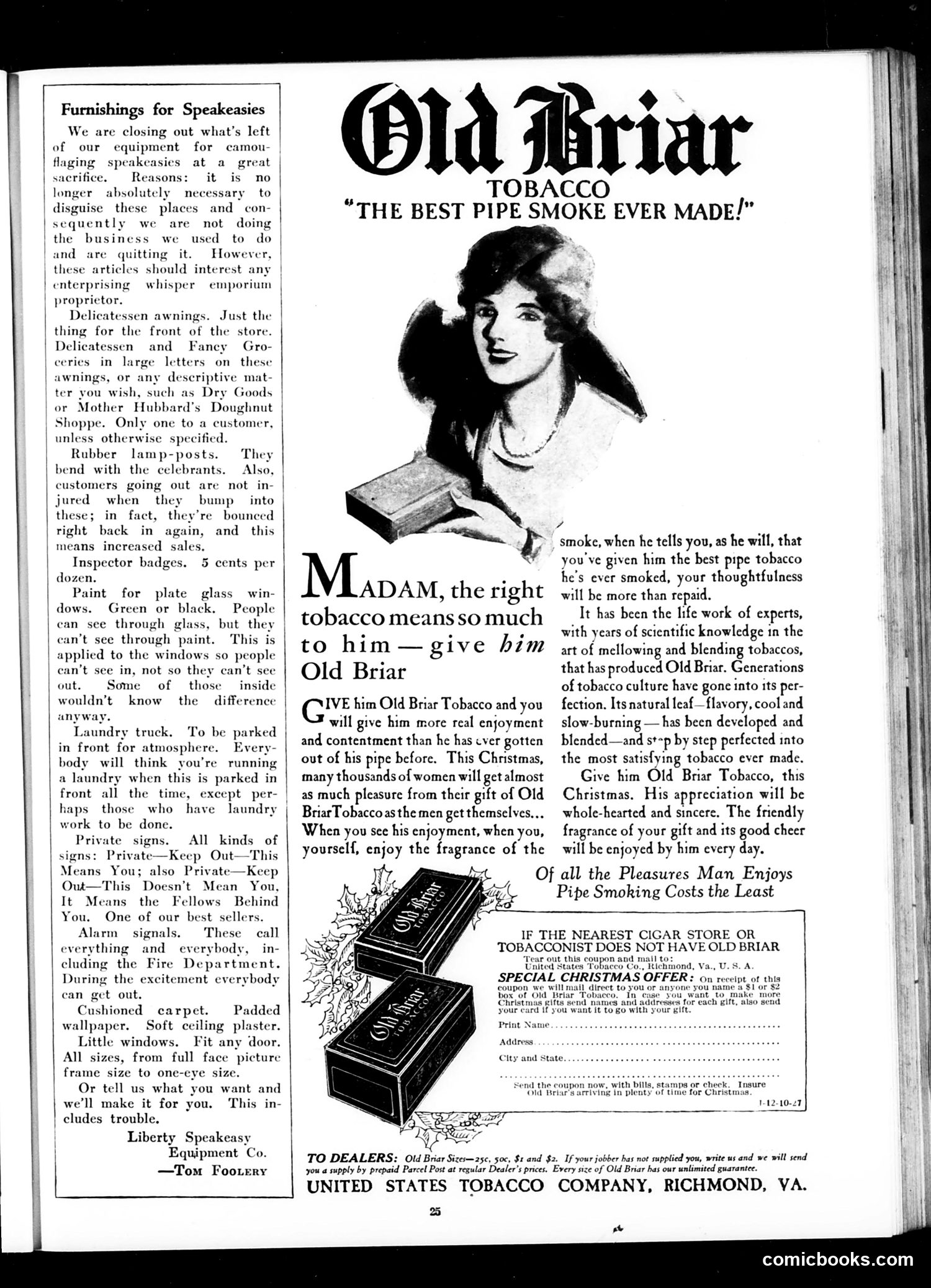
This page contains two distinct elements: **satirical commentary** (left) and **straight advertising** (right). The left column satirizes **Prohibition-era speakeasies**—illegal bars disguised as legitimate businesses. "Liberty Speakeasy Equipment Co." humorously catalogs camouflage supplies: fake delicatessen awnings, painted-over windows, rubber lamp-posts (so drunk patrons bounce back in), and alarm systems to alert occupants during police raids. The satire assumes readers understand speakeasies are common enough to need specialized equipment. This suggests the piece was written during Prohibition's later years (likely 1920s-early 1930s), when enforcement had become somewhat normalized and the practice widespread enough to mock. The right side is a straightforward **Old Briar Tobacco Christmas advertisement** targeting male gift-givers—no satire involved. Together, the page reflects a moment when American culture simultaneously tolerated (and joked about) illegal alcohol while openly marketing tobacco as wholesome.
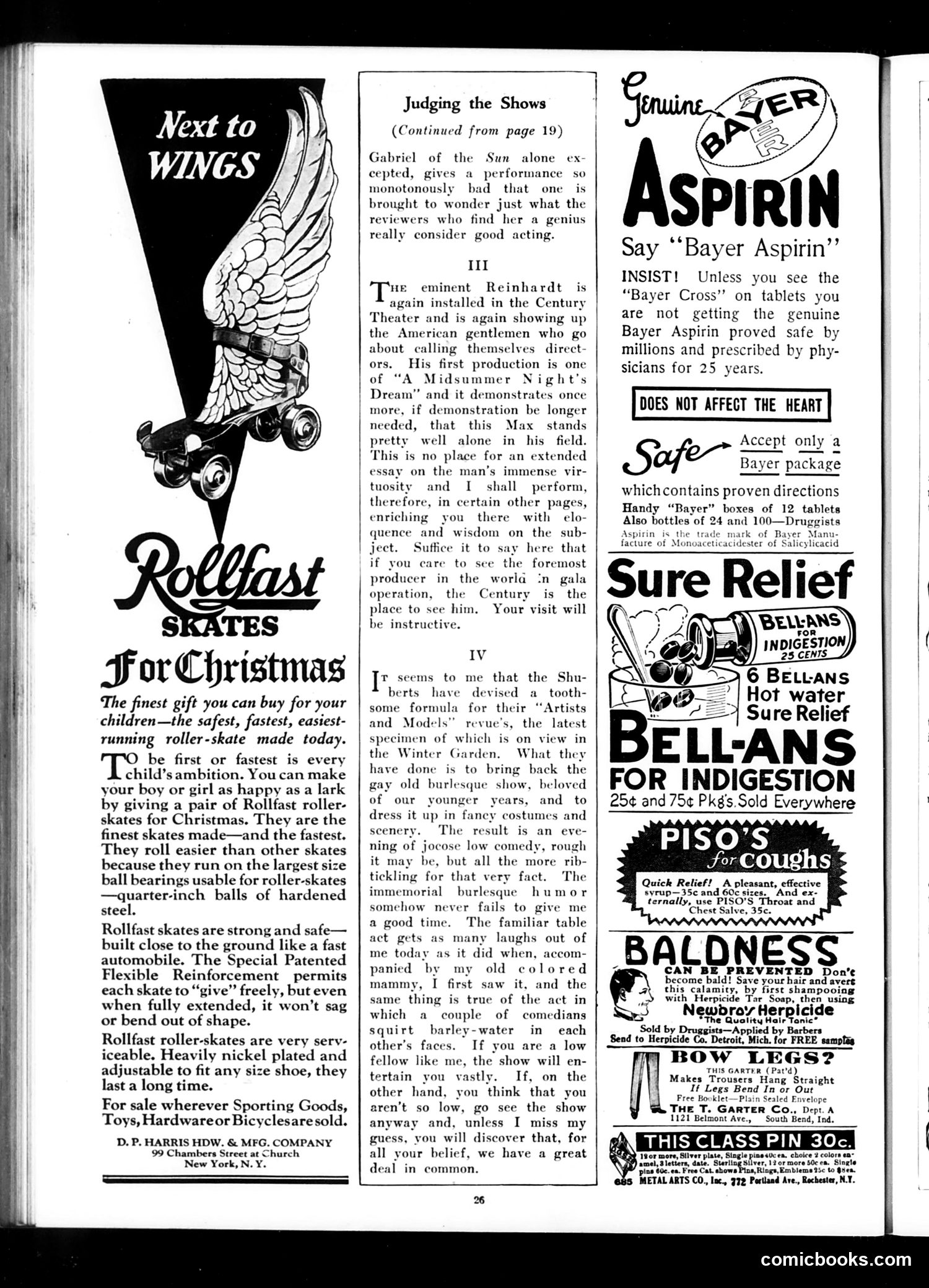
This is primarily an **advertising page** from Judge magazine, not a political cartoon. The content consists of: **Main advertisements:** - Rollfast roller skates (left column) - a Christmas gift pitch emphasizing safety and performance - Bayer Aspirin (top right) - asserting product authenticity against generic competitors - Bell-Ans antacid, Piso's cough syrup, and baldness remedies (right column) **Editorial content** (center, "Judging the Shows"): Brief theater reviews discussing performances by Gabriel of the Sun, Max Reinhardt's production of "A Midsummer Night's Dream" at the Century Theater, and the Shuberts' "Artists and Models" revue at the Winter Garden. The critic praises Reinhardt's directorial genius and defends burlesque comedy as unpretentious entertainment. **Historical context for modern readers:** This reflects early 20th-century consumer culture, with competing patent medicines and the emerging emphasis on brand authentication (Bayer's trademark warning).
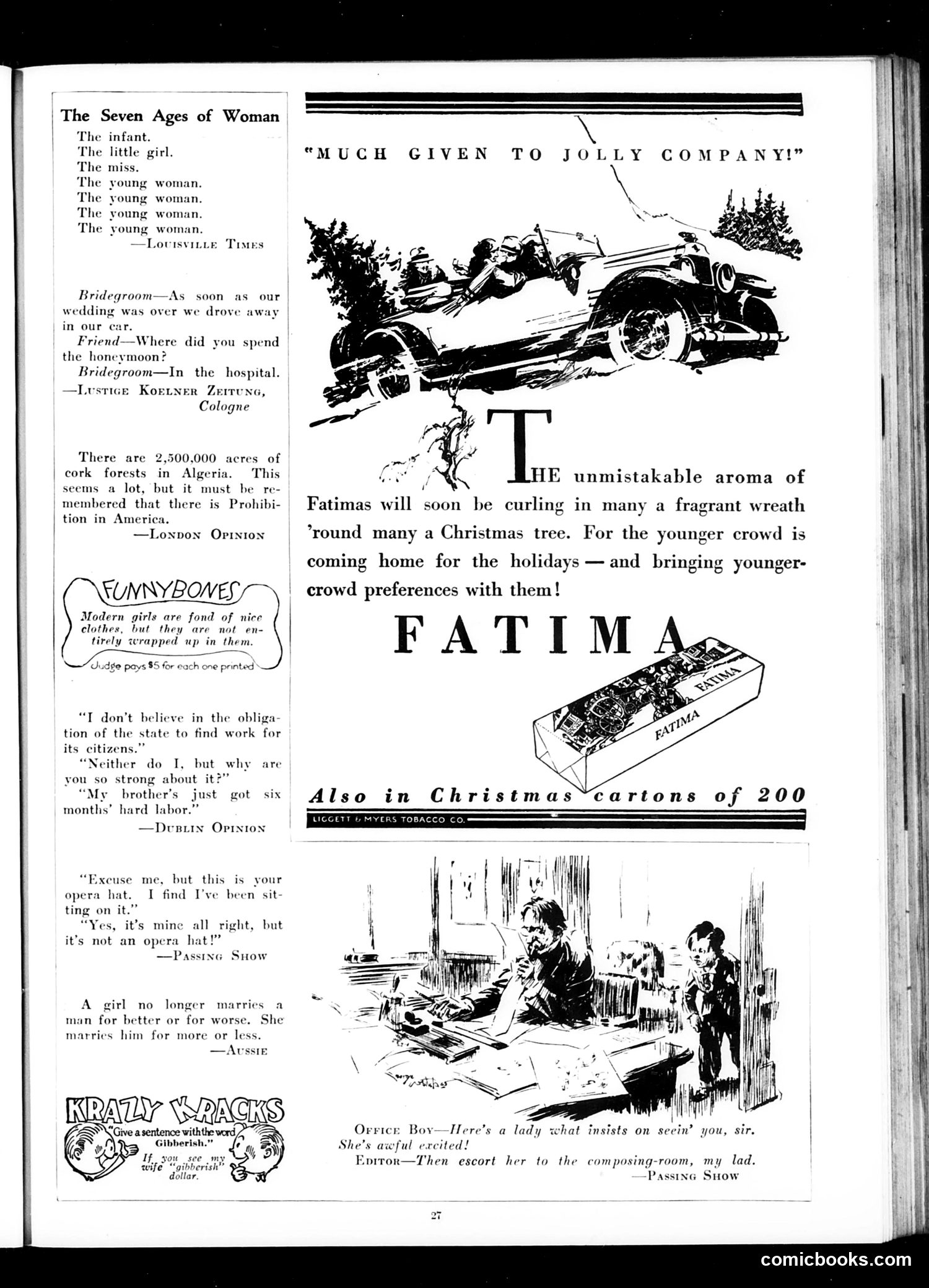
This page contains multiple satirical sections rather than a unified cartoon: **"Seven Ages of Woman"** lists female life stages repetitively as "young woman"—mocking how society reduces women's identity to a single role across decades. **The Bridegroom joke** satirizes newlywed recklessness: the couple crashes their car immediately after the wedding, landing in a hospital for their honeymoon. **"Funny Bones"** section offers quick gags, including one about cork forests in Algeria being plentiful despite American Prohibition—a topical reference to the alcohol ban (1920-1933). **The brother's "hard labor" joke** plays on dual meaning: the speaker opposes government job programs, but his brother received a prison sentence. **The opera hat incident** involves mistaken identity—someone sitting on what they thought was ordinary headwear. **The office boy sketch** depicts an editor dismissing an excited female visitor by sending her to the composing room (printing/production area)—implying she's just another distraction, not important. Throughout, the satire targets gender relations, marriage folly, and workplace dynamics of the era.
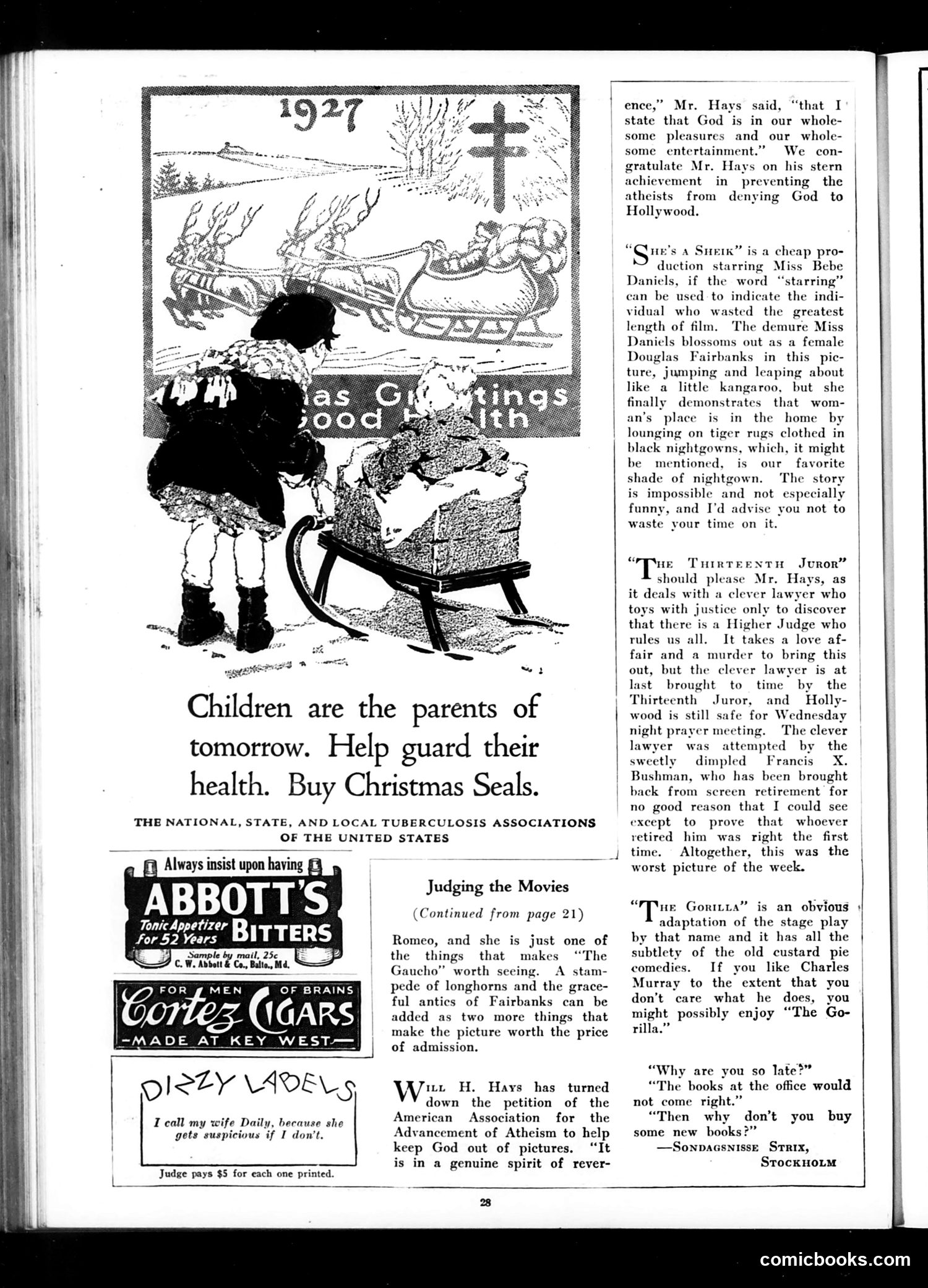
This page contains film criticism from Judge's "Judging the Movies" column. The reviews discuss current Hollywood releases with satirical commentary: **"The Gaucho"** (likely Fairbanks film) is praised for action sequences but criticized for thin plot. **"She's a Sheik"** starring Bebe Daniels is dismissed as cheap production where the lead actress "wasted the greatest length of film," with heavy-handed satire about women belonging in homes lounging in nightgowns. **"The Thirteenth Juror"** features Francis X. Bushman as a clever lawyer; the reviewer notes his return from retirement was unjustified and calls it the week's worst picture. **"The Gorilla"** is criticized as a stage adaptation lacking subtlety, "all custard pie comedies." The column also notes Will Hays (Hollywood's censorship chief) rejected the American Association for the Advancement of Atheism's petition to remove God from films—Judge congratulates him sarcastically for protecting religious content in entertainment.
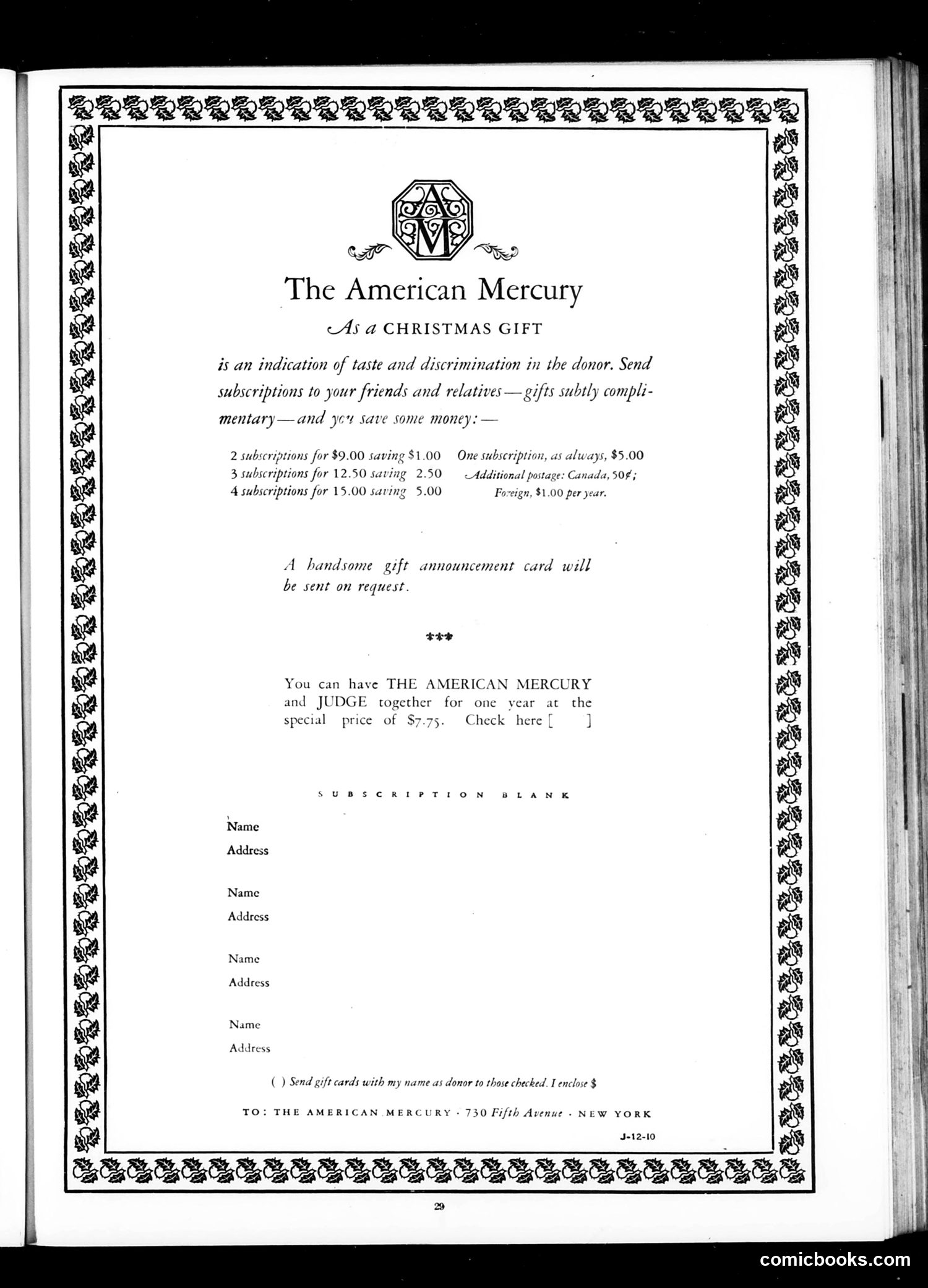
This is primarily an **advertisement**, not a political cartoon. It's a subscription promotion page from *Judge* magazine advertising *The American Mercury* as a Christmas gift option. The page pitches subscriptions as a refined, economical gift choice—framing them as indicators of the donor's "taste and discrimination." Multiple subscription packages are offered at discounted rates (2, 3, or 4 subscriptions), along with a bundled deal combining *The American Mercury* and *Judge* itself for $7.75 annually. The only "satirical" element is subtle: the implicit humor that giving magazine subscriptions—rather than physical gifts—demonstrates sophistication while saving money. This reflects early 20th-century middle-class gift-giving practices and advertising appeals to both frugality and cultural refinement. The page includes a subscription blank with spaces for recipient names and addresses, typical of such advertisements. No specific political figures or events are referenced; this is straightforward commercial promotion.
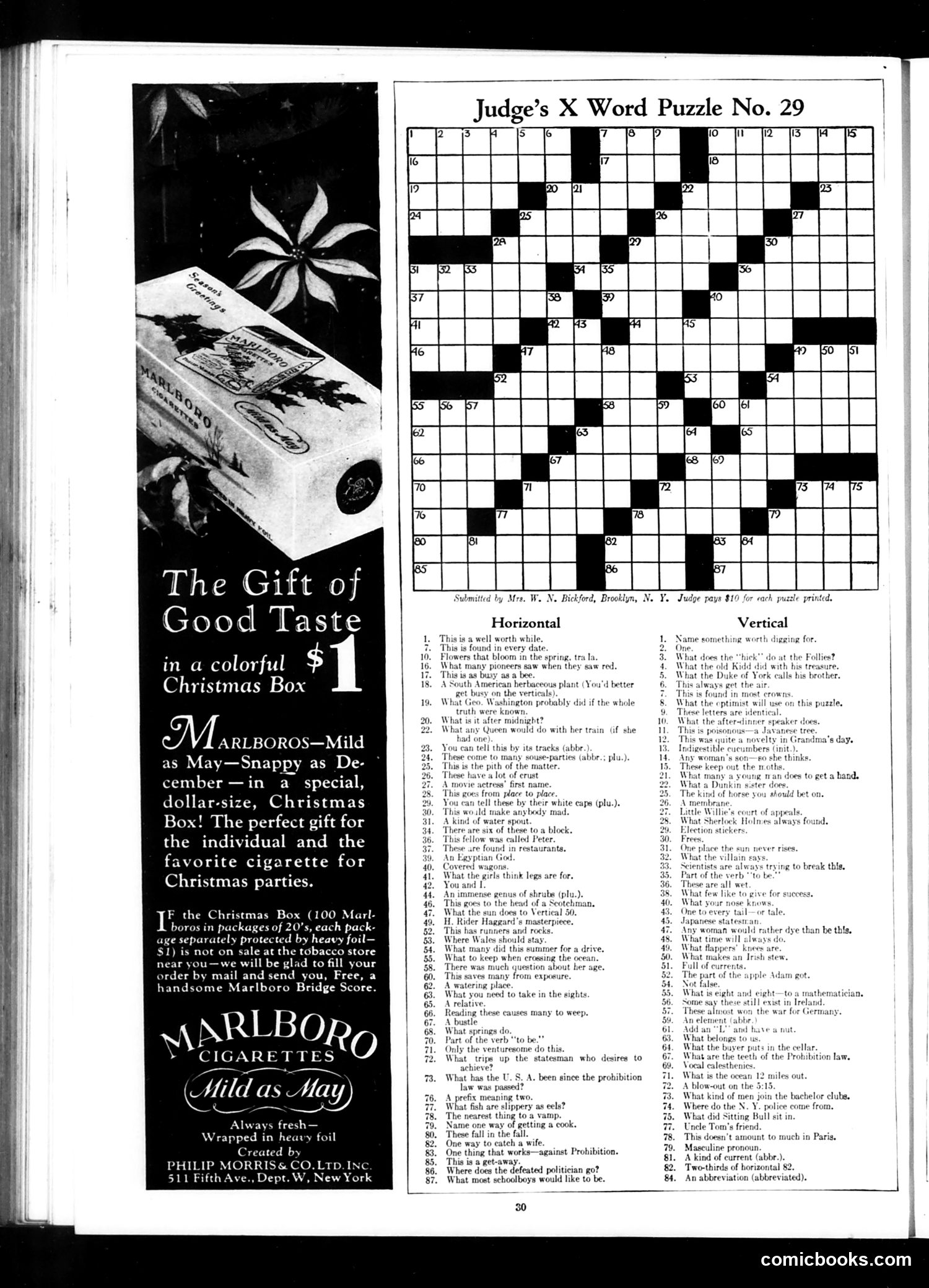
This page is primarily **advertising and a word puzzle**, not political satire. The main content is a Marlboro cigarette advertisement promoting a "$1 Christmas Box" containing 100 cigarettes in individual foil packets—marketed as an ideal gift for holiday parties. The ad emphasizes the product's freshness and convenience. The bulk of the page comprises "Judge's X Word Puzzle No. 29," a crossword puzzle with 87 clues (horizontal and vertical). The clues are typical wordplay and riddles of the era—some reference contemporary culture (prohibition, politicians, Haggard's novels), but this is standard crossword material rather than satire. The only illustration is a small black-and-white photograph showing cigarettes, flowers, and what appears to be a magazine, visually supporting the gift-giving theme. **Context for modern readers**: This reflects mid-20th-century cigarette marketing before health warnings, when tobacco companies freely advertised in magazines and positioned smoking as sophisticated and gift-worthy.
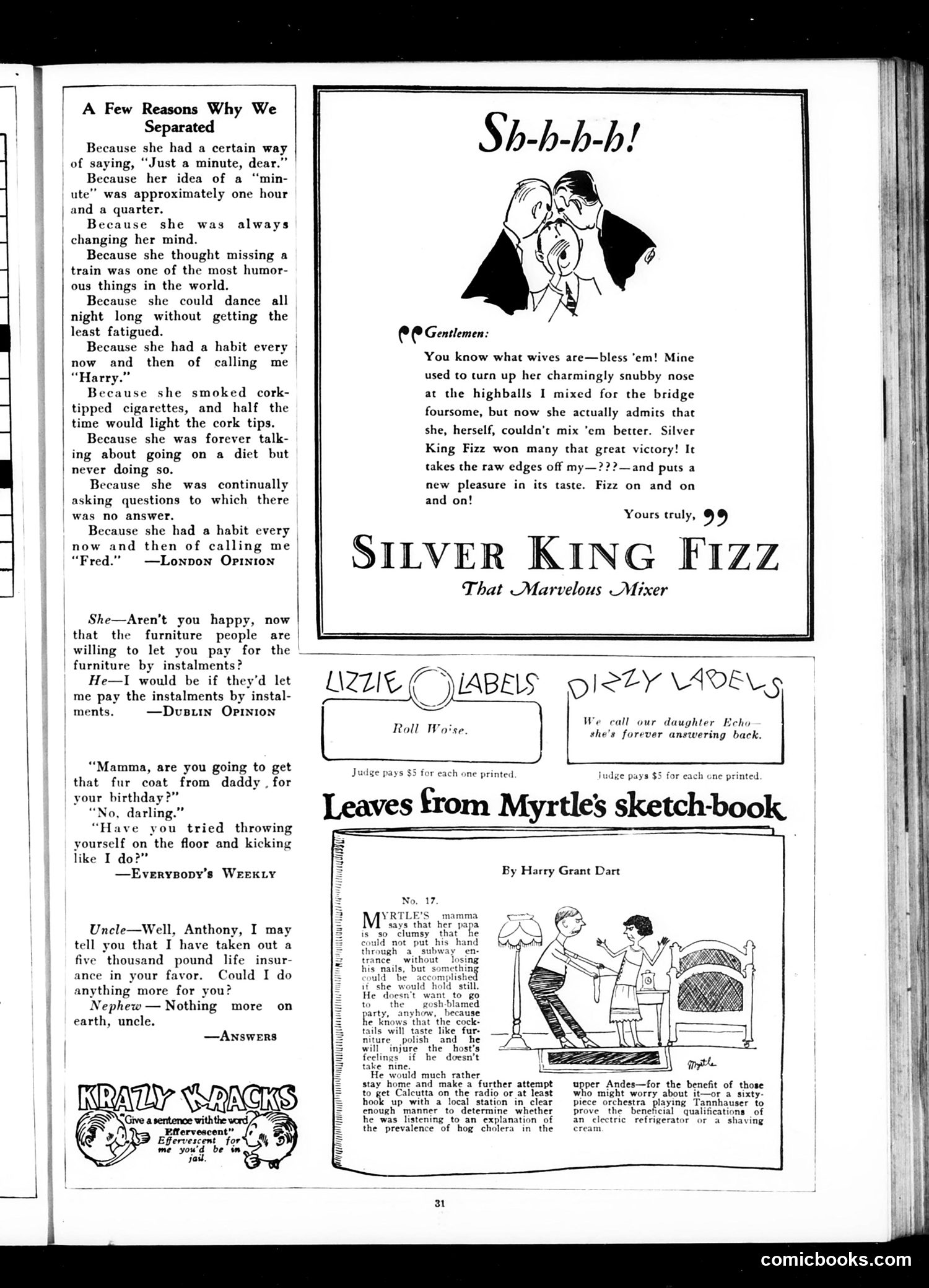
This page consists primarily of **humorous short jokes and advertisements** rather than political cartoons. **Satirical Content:** The left column presents marital complaints attributed to "London Opinion" and other publications, using wives' annoying habits as comedy fodder—changing minds, mishearing names, smoking cigarettes incorrectly, endless dieting talk. This reflects early 20th-century domestic humor mocking women's perceived flightiness. **Advertisement:** The Silver King Fizz ad uses a testimonial format where a husband credits the mixer for converting his disapproving wife into an admirer, satirizing both marital discord and advertising's exaggerated claims. **Comic Strip:** "Leaves from Myrtle's Sketchbook" by Harry Grant Dart depicts a socially anxious man who prefers tinkering with his radio to attending parties, fearing his homemade cocktails will taste like furniture polish. **Label Contest:** Small competitions offering payment for submitted names/captions. The page reflects 1920s-era humor about marriage dynamics, domestic life, and emerging consumer technology (radio), with gentle rather than pointed satire.
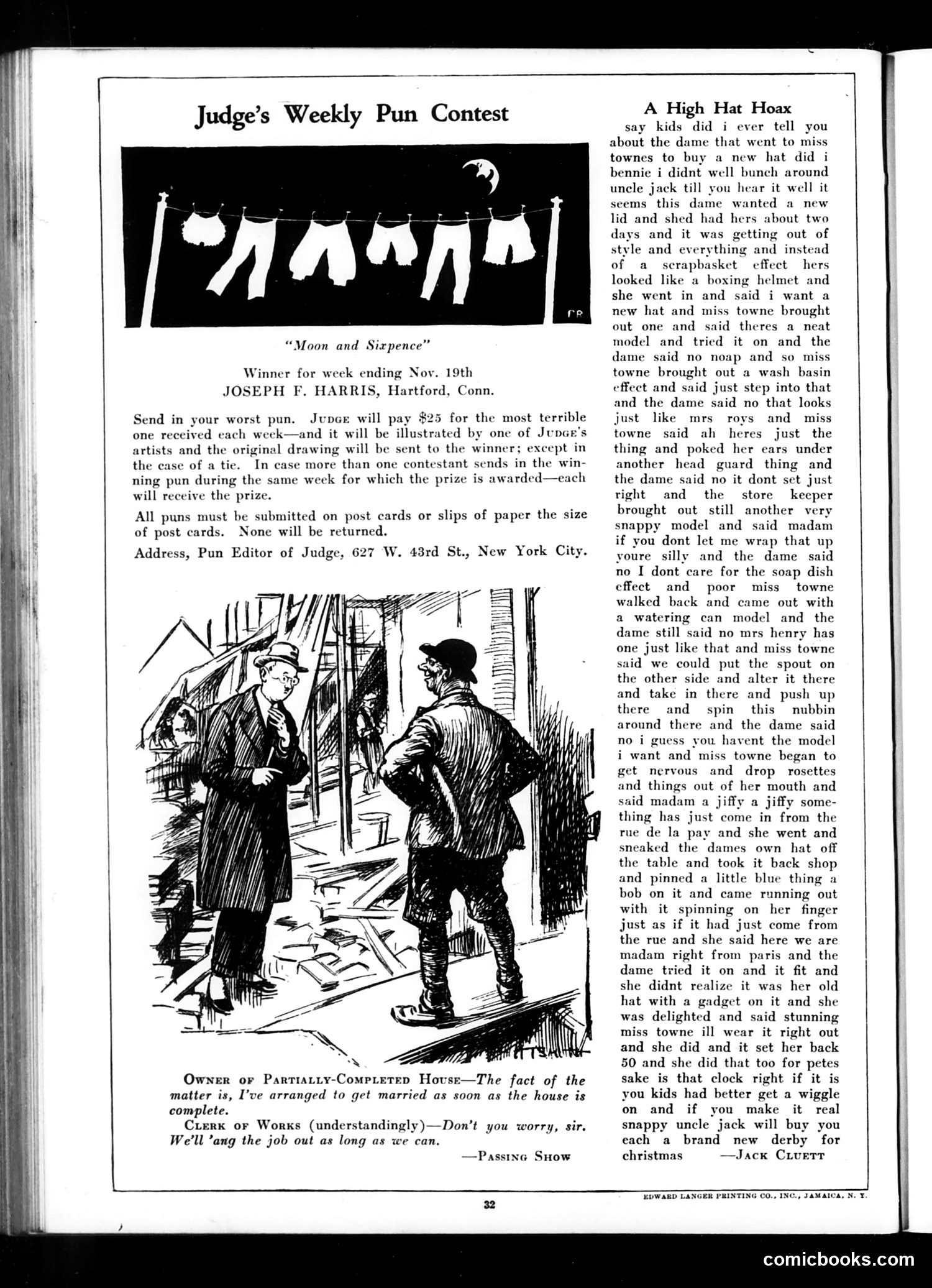
This page contains Judge's weekly pun contest announcement and two separate humor pieces: **The Pun Contest** solicits readers' worst puns for $25, with winning entries illustrated by Judge's artists. **"Moon and Sixpence"** (top cartoon) depicts laundry on a clothesline—a simple visual pun on the title. **"A High Hat Hoax"** (main story by Jack Cluett) is a rambling anecdote about a woman shopping for a fashionable hat at "Miss Towne's" shop. The milliner keeps bringing increasingly absurd models (boxing helmet, watering can, soap dish effect) to satisfy the customer. Finally, the shopkeeper simply adds a small blue "bob" decoration to the woman's *original* hat and convinces her it's a new Paris model—charging her $50. The joke: vanity and fashion snobbery make consumers easily duped. **Bottom cartoon** shows a house-owner explaining to a worker that he's arranged to marry once construction finishes; the worker replies they'll drag out the job indefinitely—a joke about contractors' delays. These are genteel, pre-1920s humor pieces typical of Judge's satirical approach to fashion, class, and everyday absurdities.
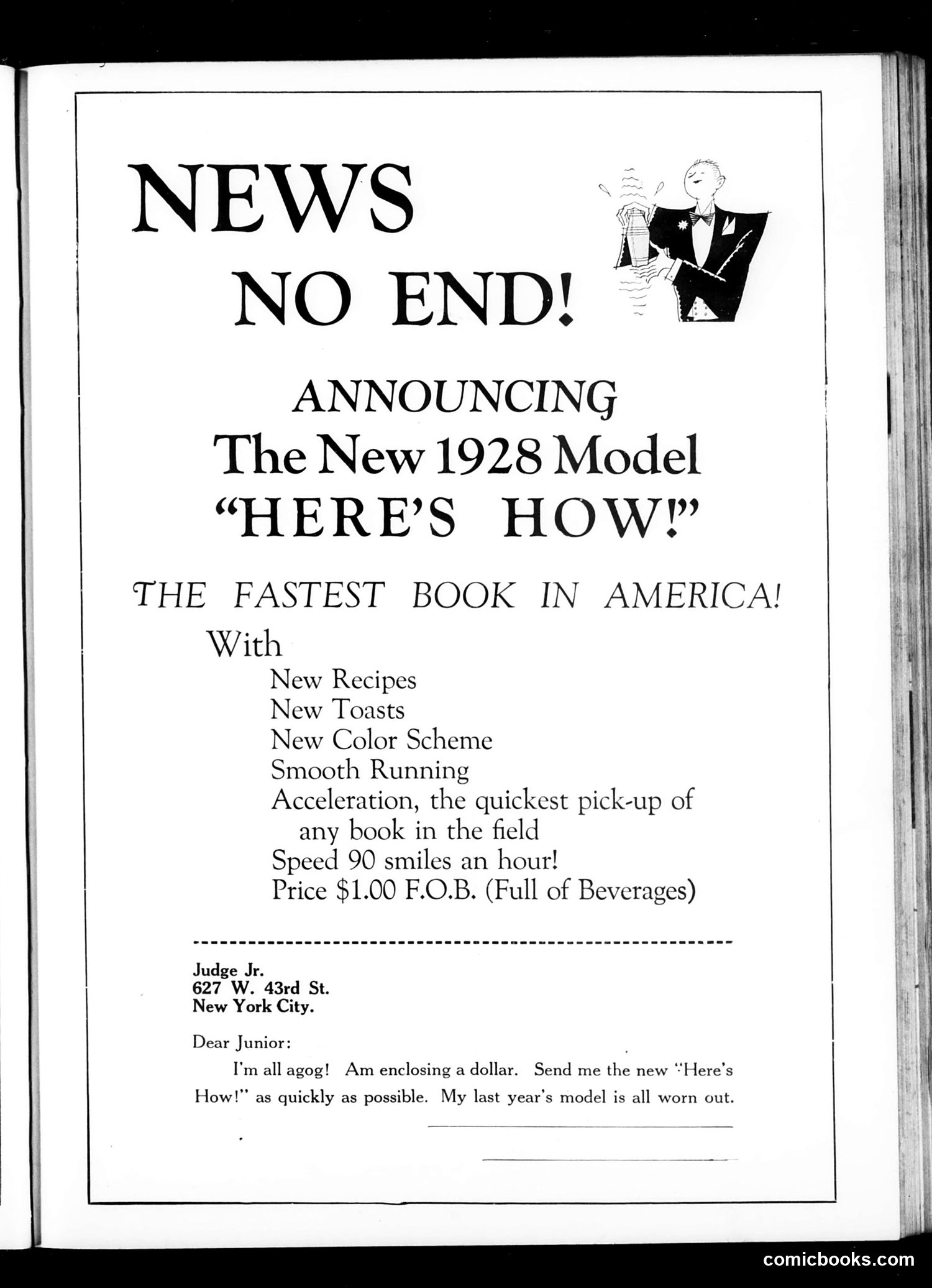
This is a satirical advertisement disguised as a car advertisement, mocking Prohibition-era drinking culture. "Here's How!" was an actual cocktail recipe book popular in the 1920s, and the joke treats it like an automobile model with "features" like speed, acceleration, and color schemes. The satire works by applying automotive marketing language ("1928 Model," "smooth running," "90 miles an hour") to a drinking guide, suggesting Americans were so obsessed with cocktails during Prohibition that they'd eagerly replace worn-out copies annually. The price notation "F.O.B. (Full of Beverages)" puns on shipping terminology while emphasizing alcohol content. The sample letter from a customer claiming his "last year's model is all worn out" further satirizes both consumerism and how central cocktail recipes had become to American social life despite—or because of—Prohibition's official ban on alcohol.
This appears to be a **Christmas advertisement** rather than political satire. The image shows a Chesterfield cigarette package arranged as a holiday display, surrounded by evergreen branches and a lit candle, with "Merry Christmas" text visible above the product name. The partially visible text at the bottom reads "The Season's Best," suggesting this is promoting Chesterfield cigarettes as an appropriate gift selection during the holiday season. This is a commercial advertisement from Judge magazine's pages, not a political cartoon. It reflects mid-20th century marketing practices when cigarettes were openly advertised in mainstream publications and positioned as desirable consumer gifts without the health warnings that would later become mandatory.