
A complete issue · 36 pages · 1927
Judge — September 24, 1927
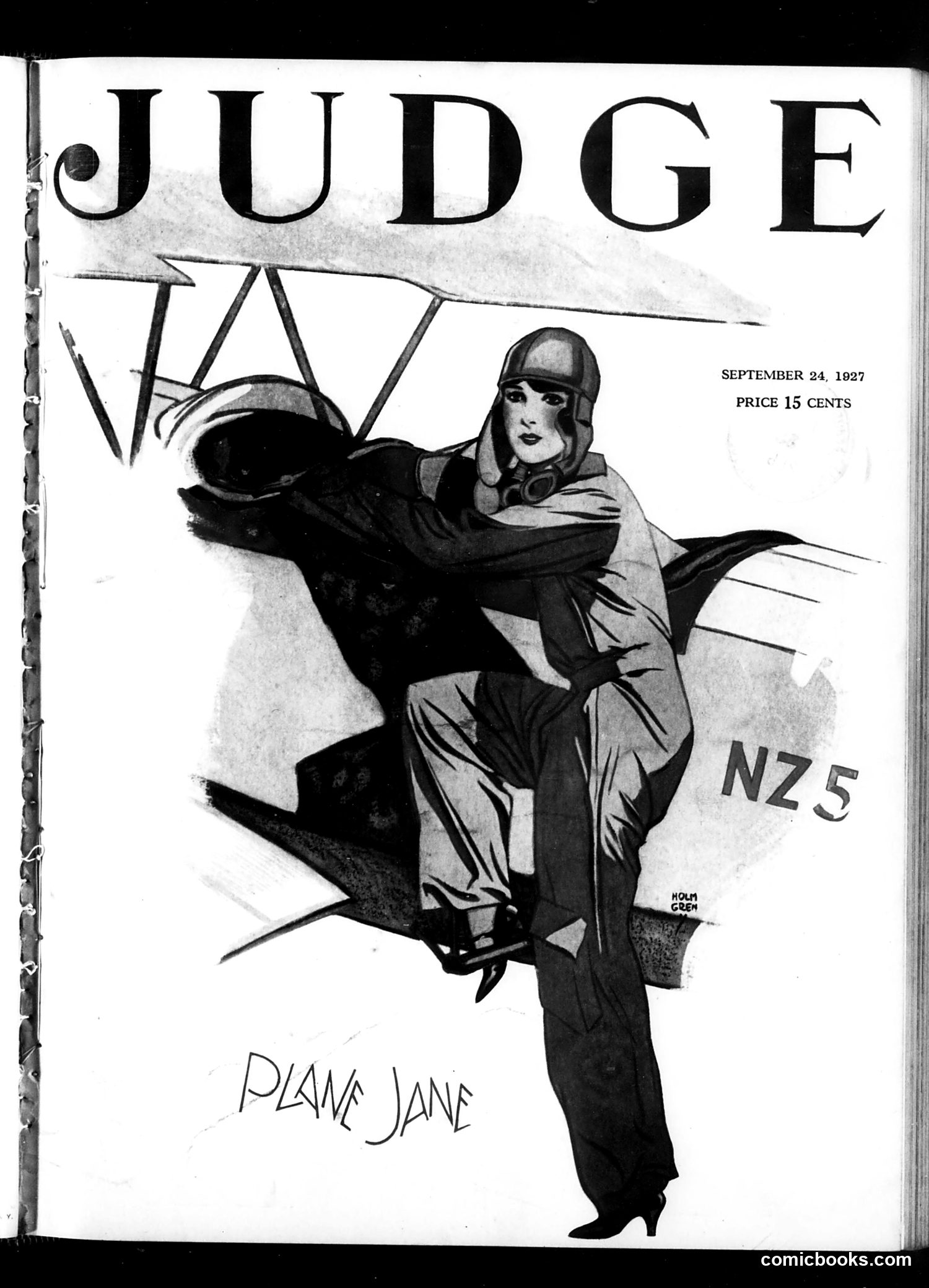
This September 24, 1927 Judge cover features "Plane Jane," a pun-based illustration of a female aviator. The woman is depicted in flying gear (leather jacket, helmet, goggles) posed dramatically with an aircraft marked "NZ5." The humor relies on wordplay: "Plane Jane" riffs on the common phrase "plain Jane" (an ordinary-looking woman), but substitutes "plane" to reference aviation. This satirizes the era's fascination with aviation as a modern novelty, while the female pilot represents the emerging "New Woman" of the 1920s—independent, adventurous, and challenging traditional gender roles. The illustration's art deco style and the magazine's 15-cent price reflect the Jazz Age aesthetic. The specific aviator referenced remains unclear from available text.
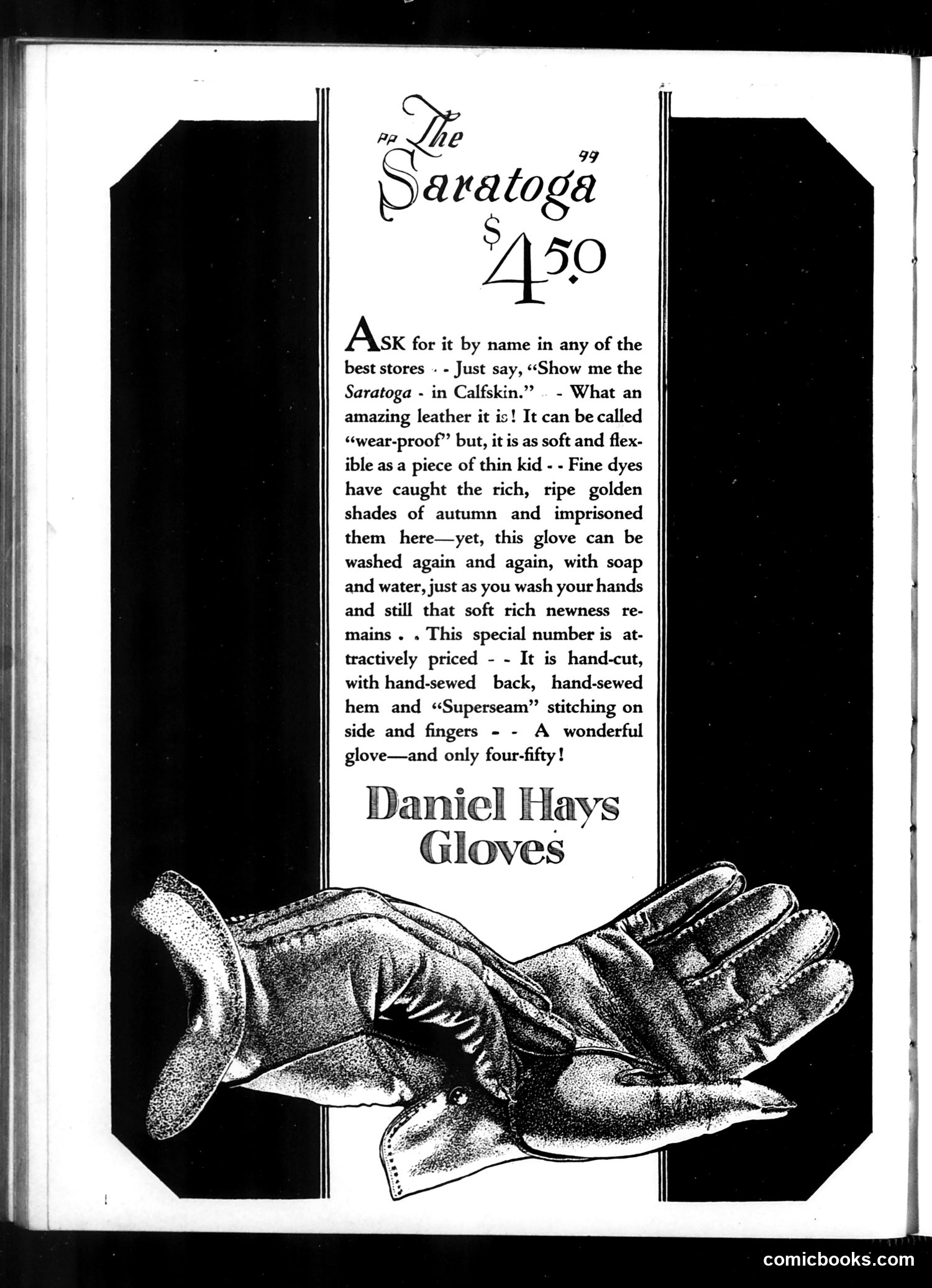
This page is primarily **advertising, not satire or political content**. It promotes "The Saratoga" — a calfskin glove priced at $4.50 by Daniel Hays Gloves. The advertisement emphasizes the product's qualities: durable "wear-proof" leather that remains soft and flexible, can be repeatedly washed without damage, and features fine autumn-gold coloring. The text highlights hand-crafted details (hand-cut, hand-sewn back, hem, and "Superseam" stitching). The illustration shows a pair of gloved hands modeling the product against a black background. There is no political satire or social commentary visible here — this is straightforward vintage advertising aimed at early 20th-century consumers seeking quality, affordable gloves.
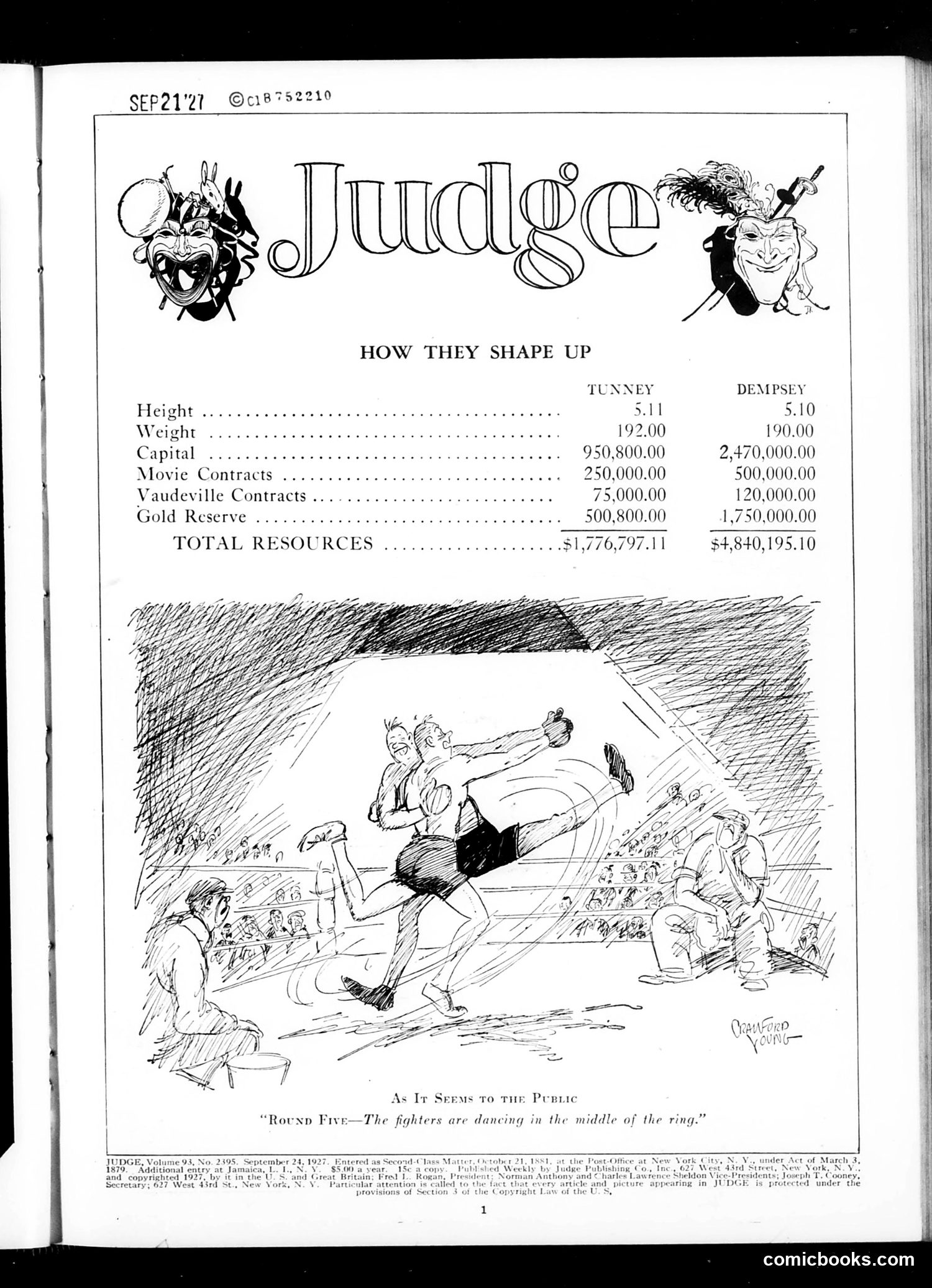
This 1927 satire compares two famous boxers—"Tunney" (Gene Tunney) and "Dempsey" (Jack Dempsey)—through their financial "shape up." The table contrasts their wealth and contracts, showing Tunney with approximately $1.7 million versus Dempsey's $4.8 million in total resources. The cartoon below depicts a boxing match labeled "Round Five," with the caption "'The fighters are dancing in the middle of the ring.'" The sketch satirizes the spectacle of professional boxing—suggesting the fighters are performing theatrically for the paying crowd rather than genuinely fighting. This likely references contemporary concerns about boxing's commercialization and whether high-profile matches were legitimate sporting contests or predetermined entertainment, especially given the enormous financial stakes listed above.
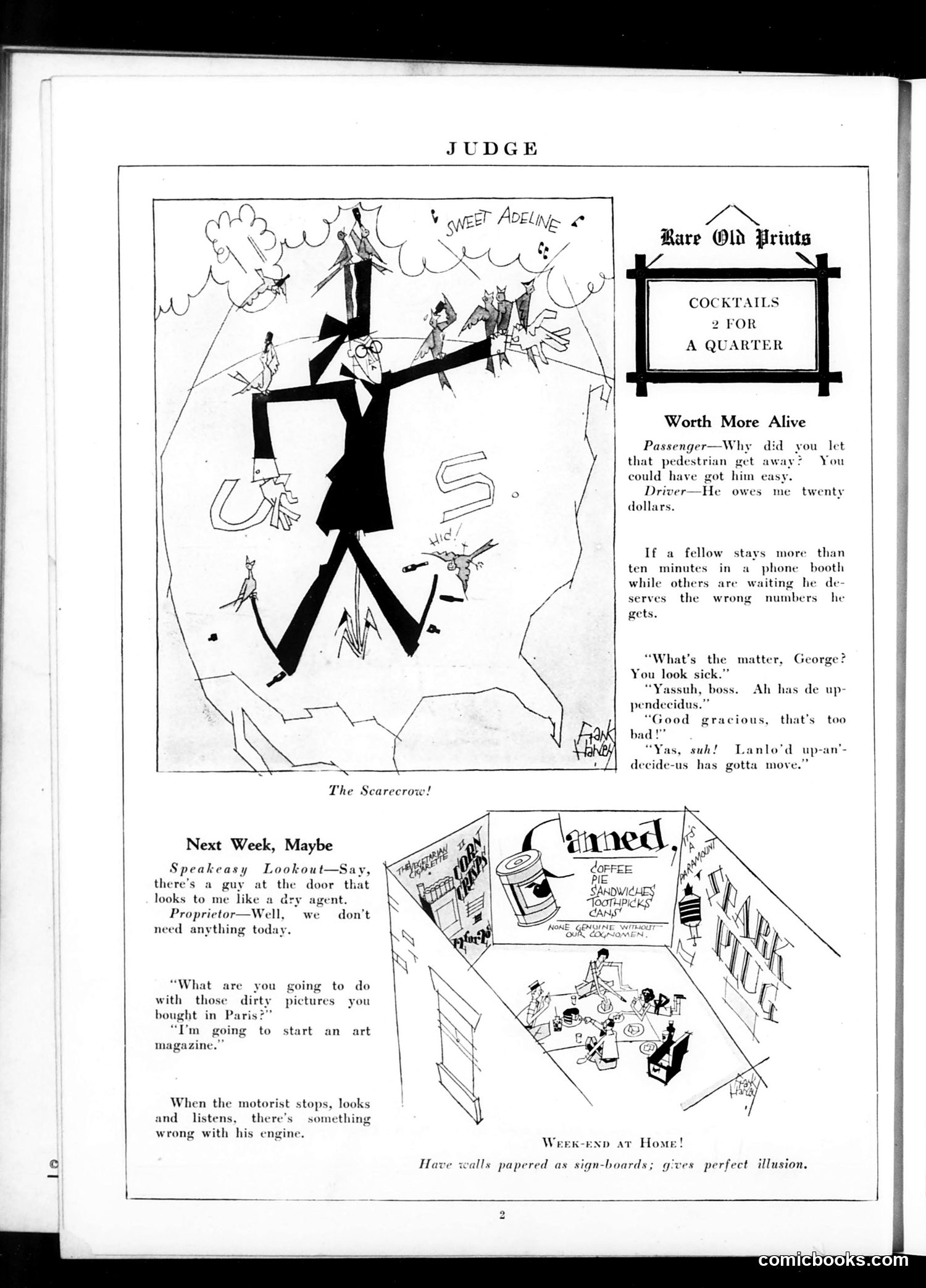
**"The Scarecrow"** cartoon depicts a large figure in formal attire with arms outstretched, surrounded by smaller people appearing to flee or scatter. The title suggests this represents something frightening or alarming to the public, though the specific political figure or event isn't identifiable from the image alone. The adjacent section, "Next Week, Maybe," contains humorous vignettes about everyday situations: a speakeasy, Paris art purchases, and automotive troubles—typical satirical commentary on 1920s urban life and leisure. The right sidebar advertises "Bare Old Prints" cocktails and includes society humor about pedestrians and phone booth etiquette. Without additional historical context or clearer visual identification, the specific political target of "The Scarecrow" remains unclear, though it appears to mock public anxiety about some contemporary figure or policy.
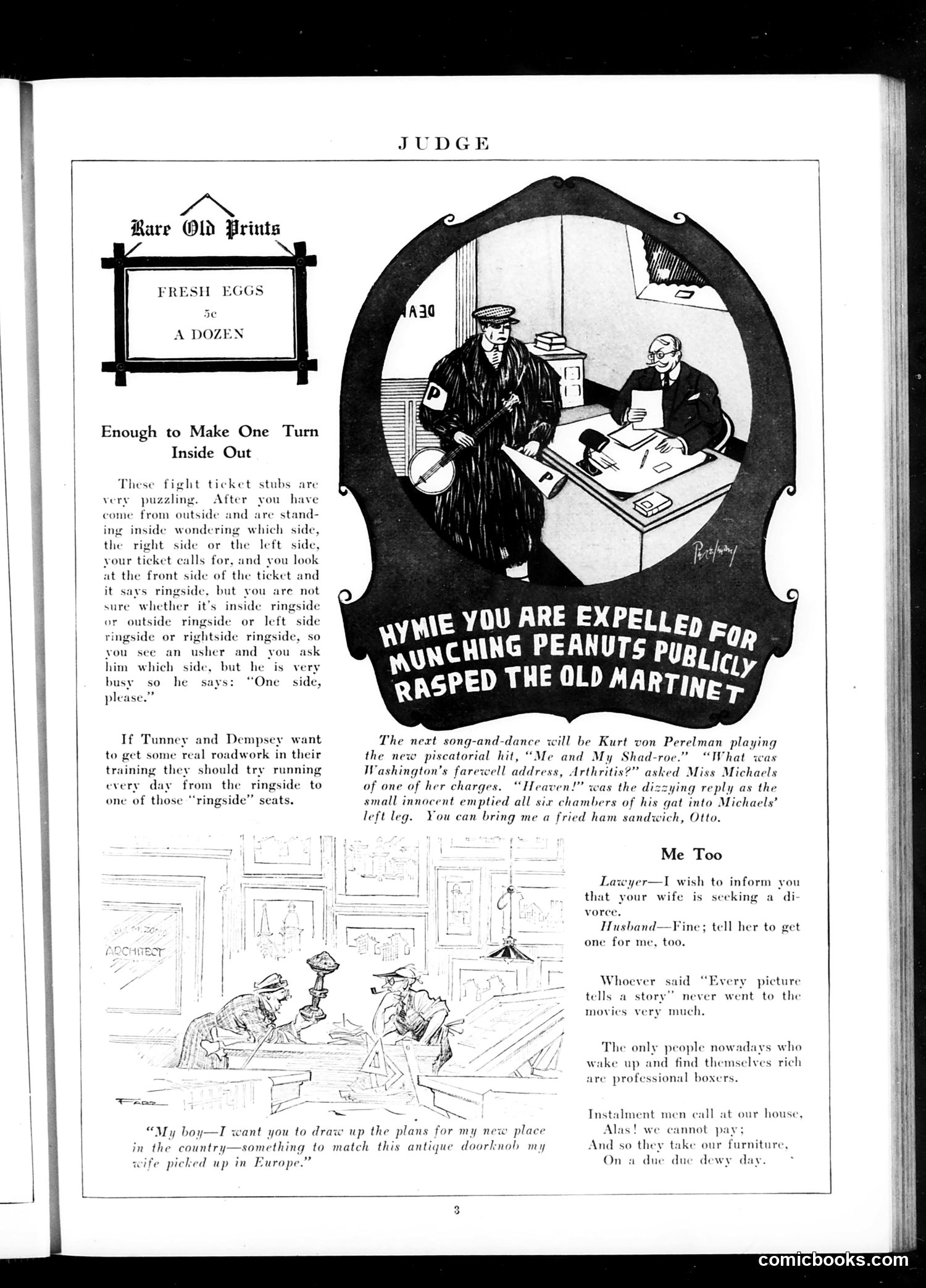
This page contains miscellaneous humor and advertisements rather than unified political cartoons. **Top Section:** "Rare Old Prints" advertises fresh eggs at 5¢ a dozen, with a joke about confusing ticket stubs' orientation. **Center:** A cartoon labeled "Hyme You Are Expelled For Munching Peanuts Publicly Rasped the Old Martinet" shows what appears to be a school or institutional disciplinary scene. The caption references Karl von Perelman performing in a new show. **Bottom Section:** "Me Too" contains unrelated short jokes about divorce, movies, and professional boxers. A separate cartoon depicts someone requesting architectural plans for a country house. The page is primarily filler content—jokes, advertisements, and miscellaneous cartoons—typical of Judge's satirical magazine format. Without additional historical context, the specific references remain unclear to modern readers.
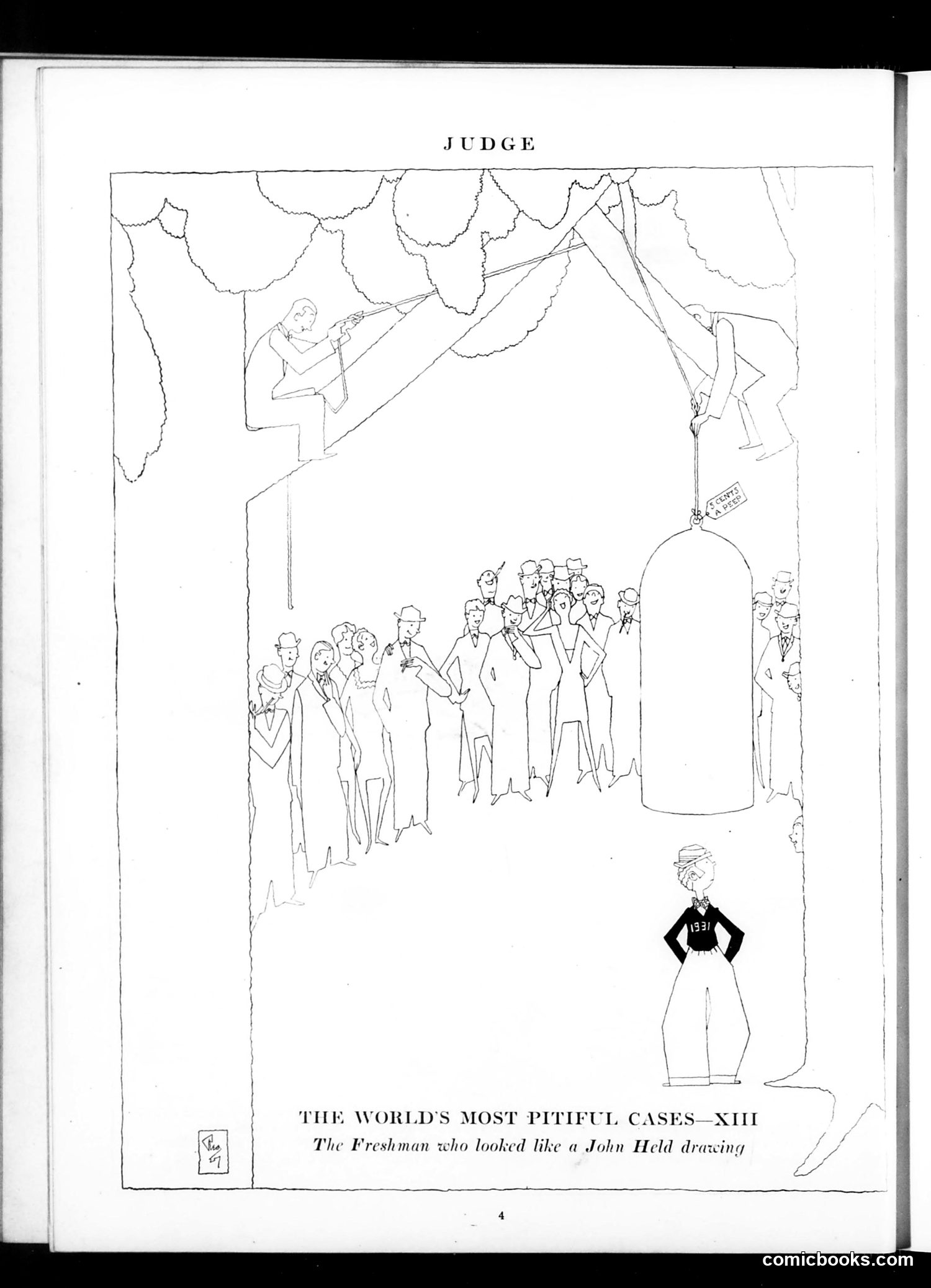
This is the thirteenth installment of "The World's Most Pitiful Cases" series. The caption reads: "The Freshman who looked like a John Held drawing." The cartoon satirizes 1920s college culture and the distinctive artistic style of illustrator John Held Jr., who was famous for depicting flappers and jazz-age youth. The scene shows a college freshman standing alone before an assembled group of judges in formal attire, apparently being judged on his appearance. The humor derives from the absurdist premise of formally evaluating someone merely for resembling Held's characteristic caricature style—exaggerated and somewhat grotesque depictions of modern youth. This represents period satire of both collegiate social hierarchies and the era's popular illustration trends.
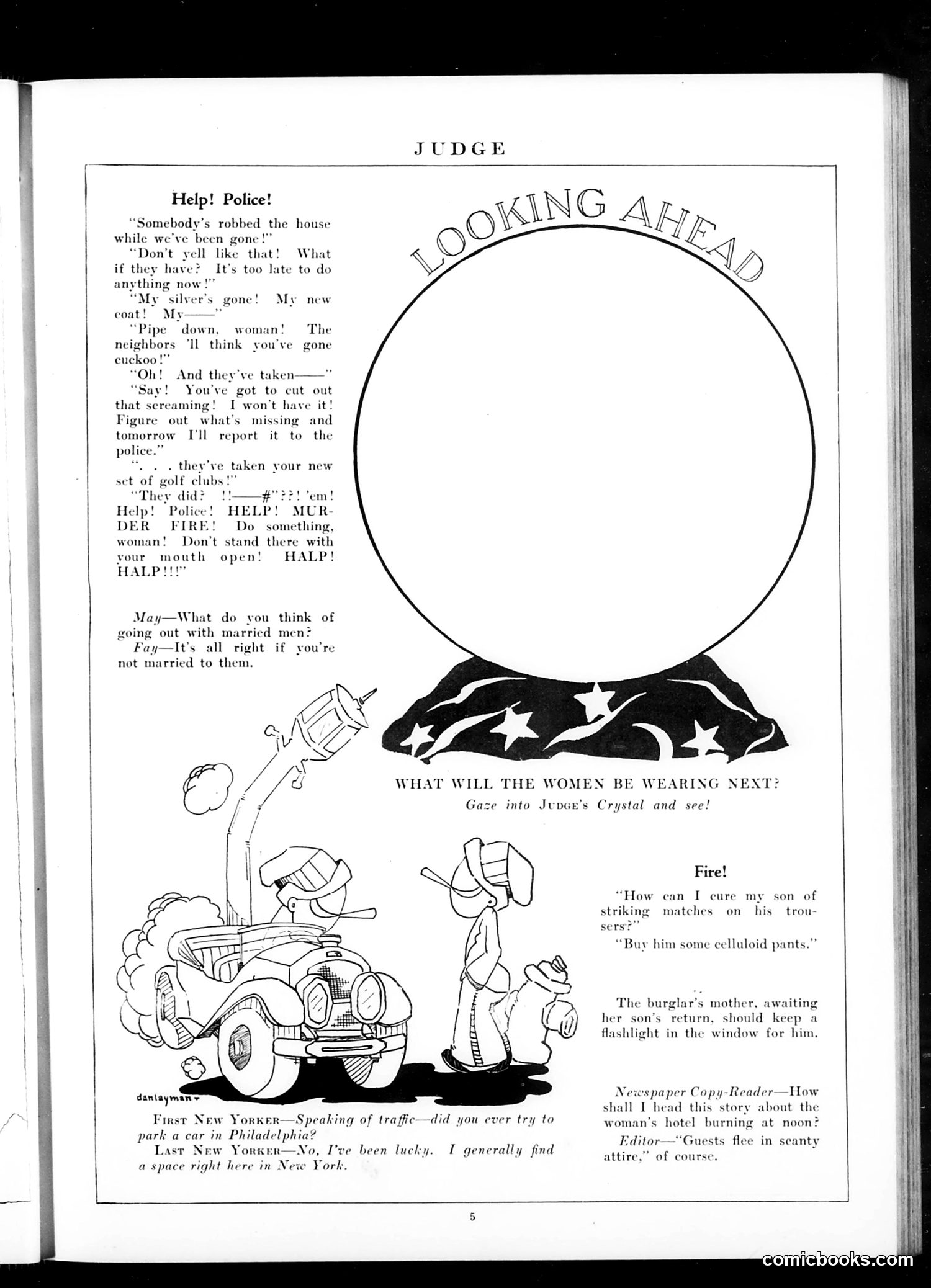
This page contains several satirical pieces mocking domestic life and social conventions of the era. The main cartoon depicts a chaotic car crash, illustrating the "First New Yorker" and "Last New Yorker" joke about parking difficulties in New York City—a timeless urban complaint. The "Help! Police!" section parodies domestic hysteria, showing a woman's escalating panic over robberies and missing items, satirizing both crime anxiety and consumerism (her concern about golf clubs). The "Looking Ahead" crystal ball cartoon appears to satirize women's fashion predictions. Smaller pieces mock marital attitudes ("going out with married men"), child discipline (striking matches on trousers), and newspaper sensationalism (the hotel fire story). The overall tone ridicules both working-class and upper-class anxieties of the period—crime, traffic, fashion, and family drama.
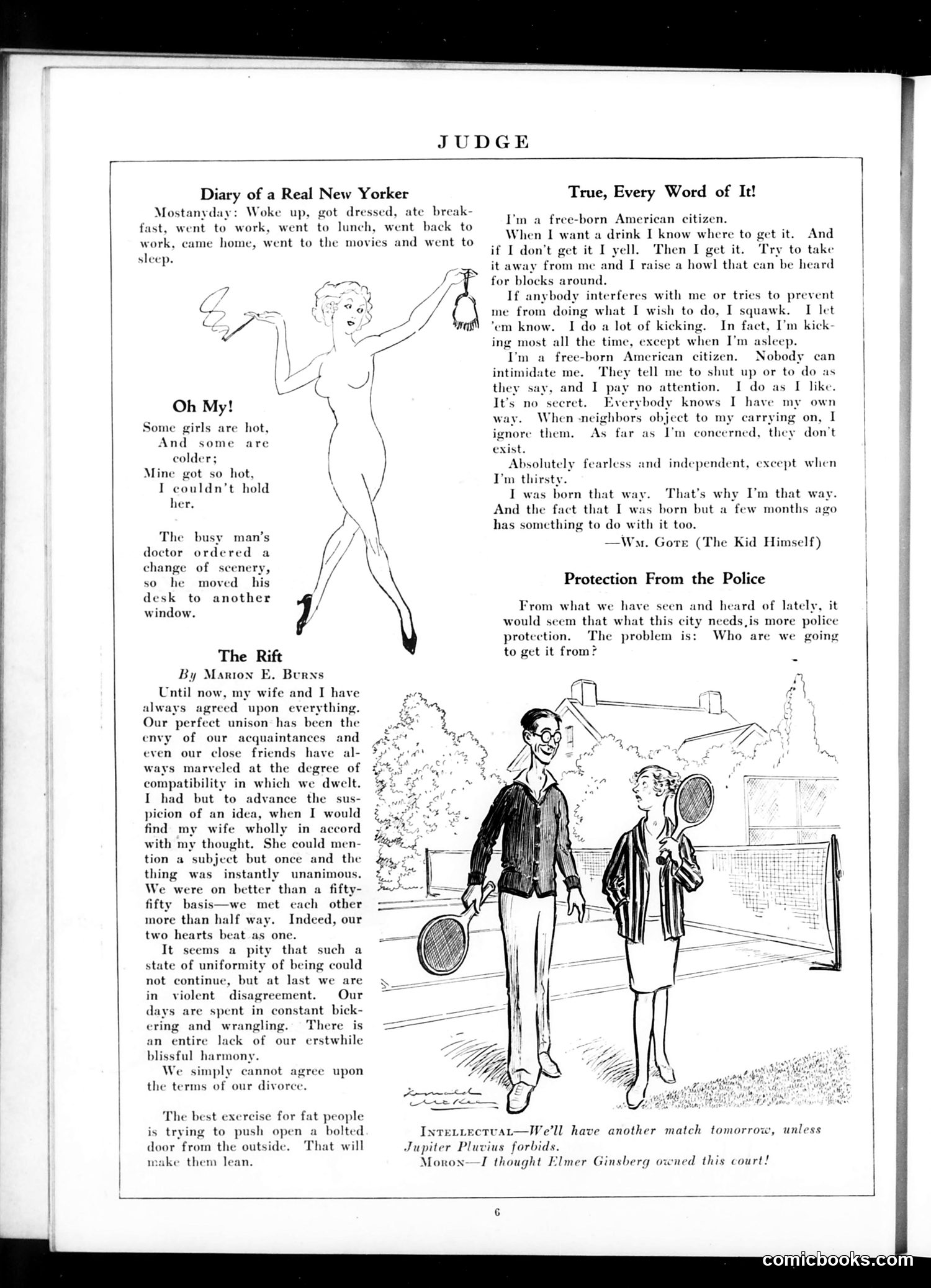
This page from the satirical magazine *Judge* contains several pieces mocking American social attitudes circa the early 20th century. **"True, Every Word of It!"** is a monologue by "The Kid Himself" (attributed to Wat Gorre) satirizing a bombastic, self-absorbed New Yorker who brags about being a "free-born American citizen" uncontrolled by anyone. The joke targets the speaker's boastfulness—he claims complete independence and fearlessness while admitting he's "only a few months old," undercutting his bluster with obvious immaturity. **"The Rift"** by Marion E. Burns humorously describes a married couple's sudden disagreement over divorce terms, breaking their previous perfect harmony. The satire mocks marital discord and domestic dispute absurdity. **"Protection from the Police"** cartoon shows two people playing tennis, with a caption suggesting the city needs better police protection—though the joke's specific target is unclear from the visible text. The punchline references "Elmer Ginsberg" owning "this court," likely a contemporary local reference now obscure. The page exemplifies *Judge*'s satirical approach to urban American life and social foibles.
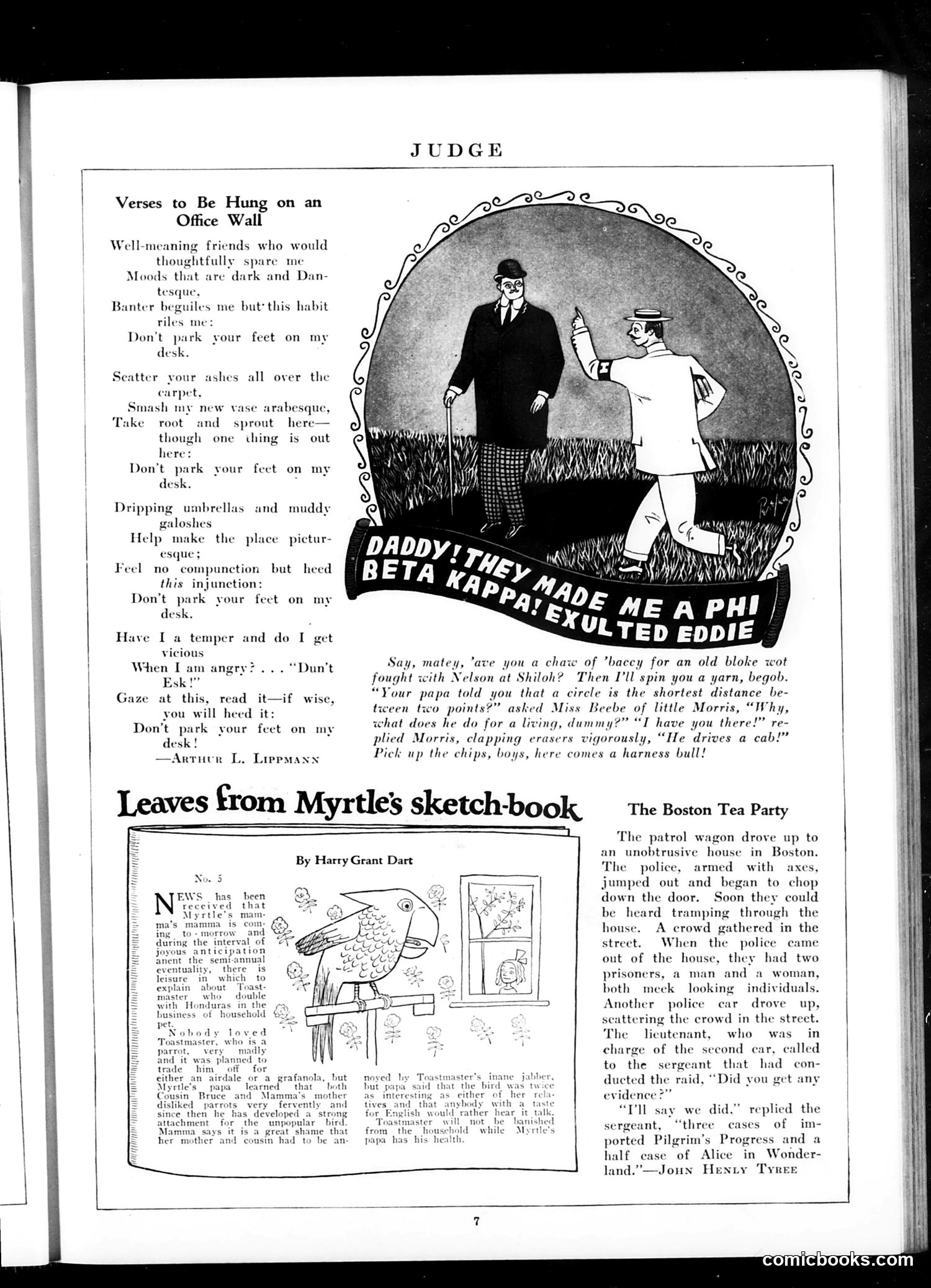
This page contains three distinct humor pieces: 1. **"Verses to Be Hung on an Office Wall"** (left): A poem by Arthur L. Lippmann humorously listing workplace annoyances—visitors parking feet on desks, scattering ashes, dripping umbrellas—addressing the common complaint of office workers whose spaces are invaded and disrespected by colleagues and visitors. 2. **"Daddy! They Made Me a Phi! Beta Kappa! Exulted Eddie"** (center): A cartoon showing a father and son in nature. The accompanying text suggests a humorous exchange between them about academic achievement versus practical life skills—satirizing parental pride in academic honors while questioning their real-world utility. 3. **"Leaves from Myrtle's Sketch-book"** (bottom left): An illustrated piece by Harry Grant Dart about a toastmaster and bird-watching anecdote. 4. **"The Boston Tea Party"** (right): Appears to be a short story, likely referencing the historical event ironically.
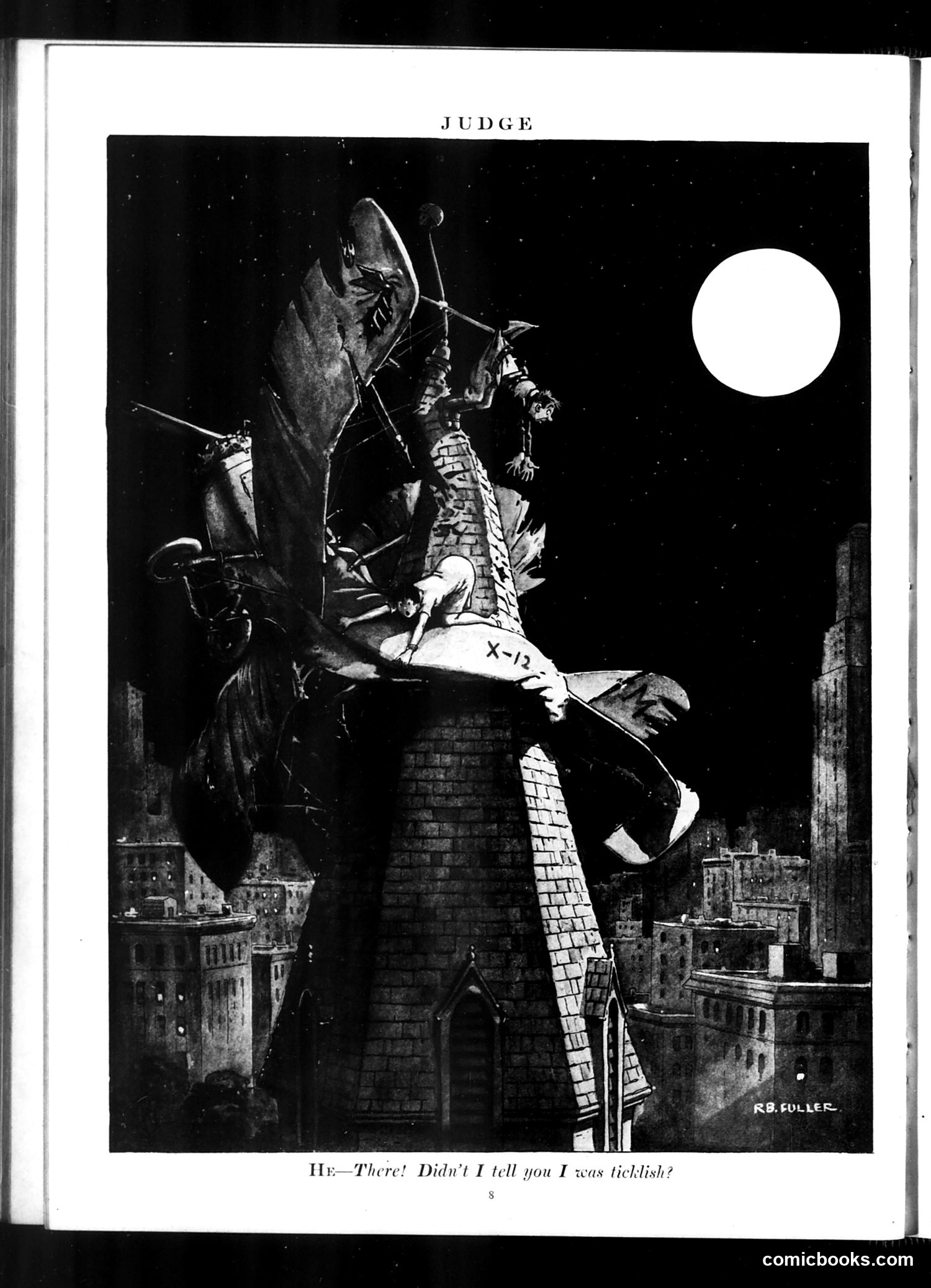
This black-and-white political cartoon depicts a giant figure (likely representing a powerful person or institution) perched atop a city building, tickling or poking at the full moon with a stick. The caption reads: "There! Didn't I tell you I was ticklish?" The satire appears to mock someone's arrogance or overreach—suggesting they're so powerful they can literally toy with celestial bodies. The "ticklish" personification of the moon implies the figure's actions have consequences they didn't anticipate. Without the publication date visible, the specific target remains unclear, though the image likely satirizes a contemporary political or business leader's hubris. The cityscape below emphasizes the figure's dominance over the urban landscape.
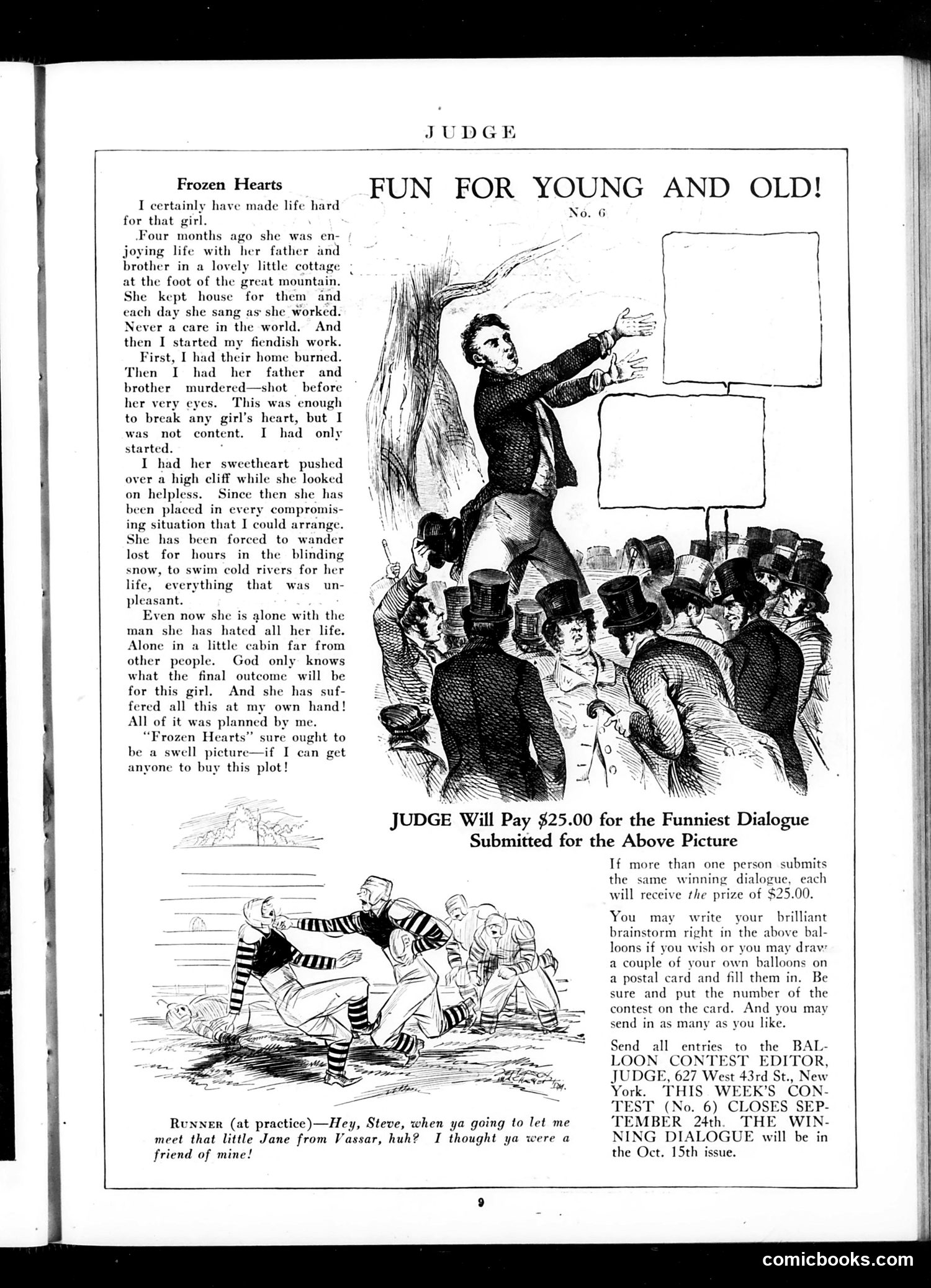
This page contains two distinct pieces: **"Frozen Hearts" (top left):** A villain's monologue boasting about deliberately destroying a young woman's life—burning her home, murdering her family, pushing her sweetheart off a cliff, and forcing her into compromising situations. The joke's twist: he's a theatrical producer pitching this melodramatic plot to studios, unable to sell such an overwrought, implausible story. It satirizes the excessive sentimentality and contrived suffering common in silent-film melodramas of the era. **"Fun for Young and Old" (main content):** A contest inviting readers to write witty dialogue for a cartoon showing a man at a football practice speaking with another player about meeting a girl from Vassar. Readers could submit captions or draw speech balloons, with Judge offering $25 for the funniest entry. This was typical early-20th-century reader-participation content.
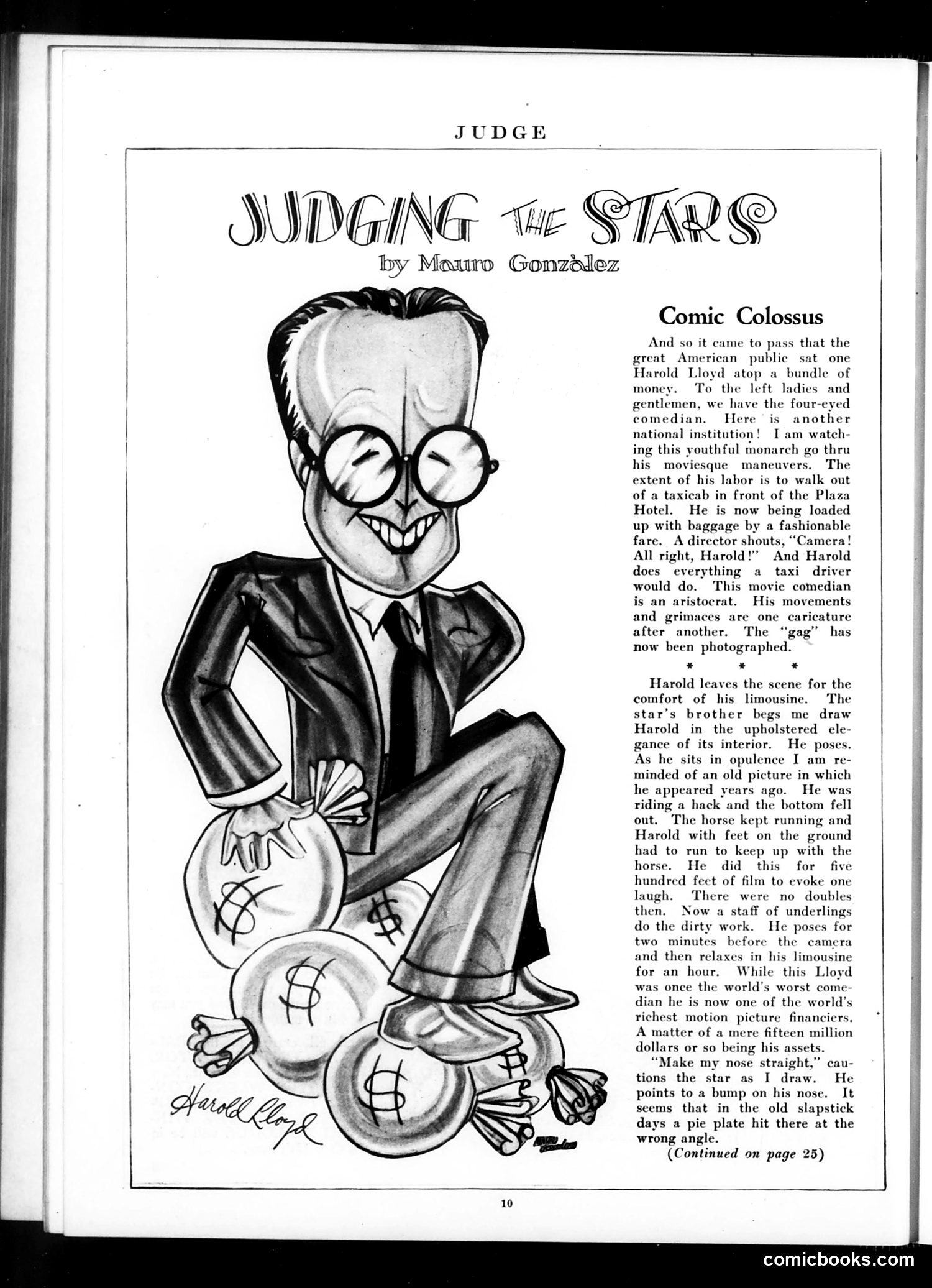
This is a satirical cartoon by Mauro Gonzalez mocking silent-film comedian **Harold Lloyd**. The caricature exaggerates his trademark thick-framed glasses and grinning expression. The satire contrasts Lloyd's current wealth and status with his humble earlier career. The text describes him as now a millionaire "aristocrat" who poses briefly for cameras, then relaxes in limousines—a stark reversal from his slapstick days when he personally performed dangerous stunts (like the described scene of running behind a horse for 500 feet) without stunt doubles, all for a single laugh. The joke: Lloyd's financial success has made him lazy and vain. He now worries about his appearance (requesting his nose be drawn straight after an old pie-plate injury), while employing underlings to do real work. The cartoon satirizes how Hollywood wealth transforms working comedians into pampered "institutions," disconnected from the physical labor that made them famous.
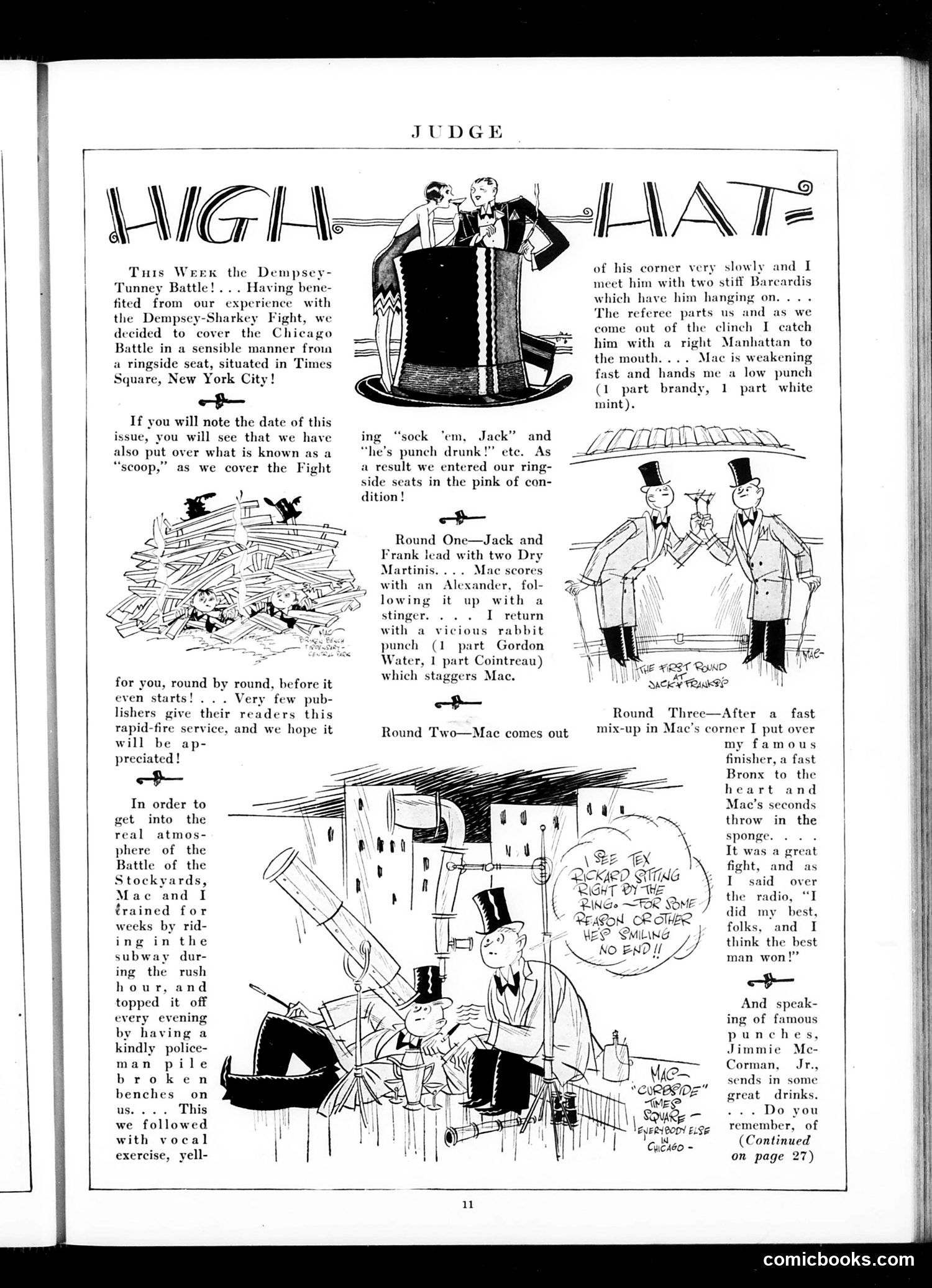
This is a humorous piece satirizing the famous **Dempsey-Tunney boxing match** (likely 1926-1927, based on the reference to covering it "before it even starts" as a "scoop"). The joke: The author claims to have attended the Chicago fight from a Times Square ringside seat, then describes the "battle" not between boxers but between **cocktails**—treating mixed drinks as fighters in a boxing match. Each "round" features different cocktails ("Jack and Frank" leading with Dry Martinis, "Mac" responding with Alexanders, etc.). **The satire works on two levels:** 1. **Media excess**: Judge mocks sports journalism's breathless, play-by-play coverage and publishers' claims of rapid service 2. **Prohibition era humor**: The elaborate cocktail recipes (Gordon Water, Cointreau, Bacardi) are coded references to illegal drinking during Prohibition, treating alcohol consumption as spectacle The cartoon illustrations show the author and companions in boxing rings with drinks, visually extending the metaphor. This is sophisticated satire targeting both sports media hype and Prohibition-era drinking culture.
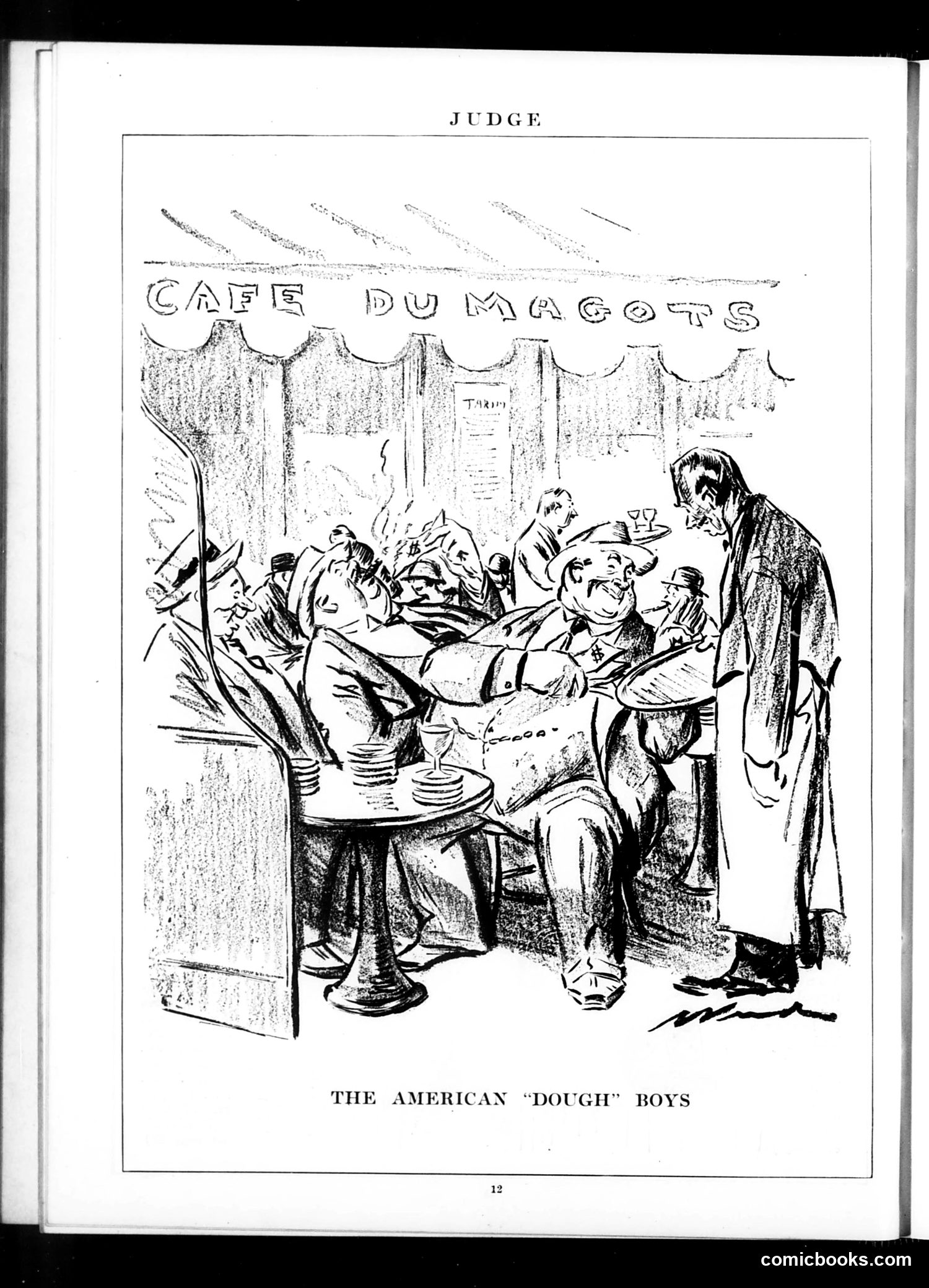
This cartoon satirizes American soldiers as "dough boys" — a WWI-era slang term for U.S. infantrymen. The scene depicts soldiers at a café (labeled "CAFÉ DU MAGOTS," a famous Parisian establishment), indulging in food and drink while being served by waiters. The satire likely critiques American soldiers abroad during or after WWI: either their perceived excess/hedonism while stationed in France, or commentary on how American soldiers were treated as wealthy spenders by local establishments. The pun on "dough" (money/slang for soldiers) plays on the soldiers' spending power and appetite. The caricatured style emphasizes their consumption and leisurely behavior, suggesting the cartoonist questions whether these soldiers' conduct abroad reflects well on America.
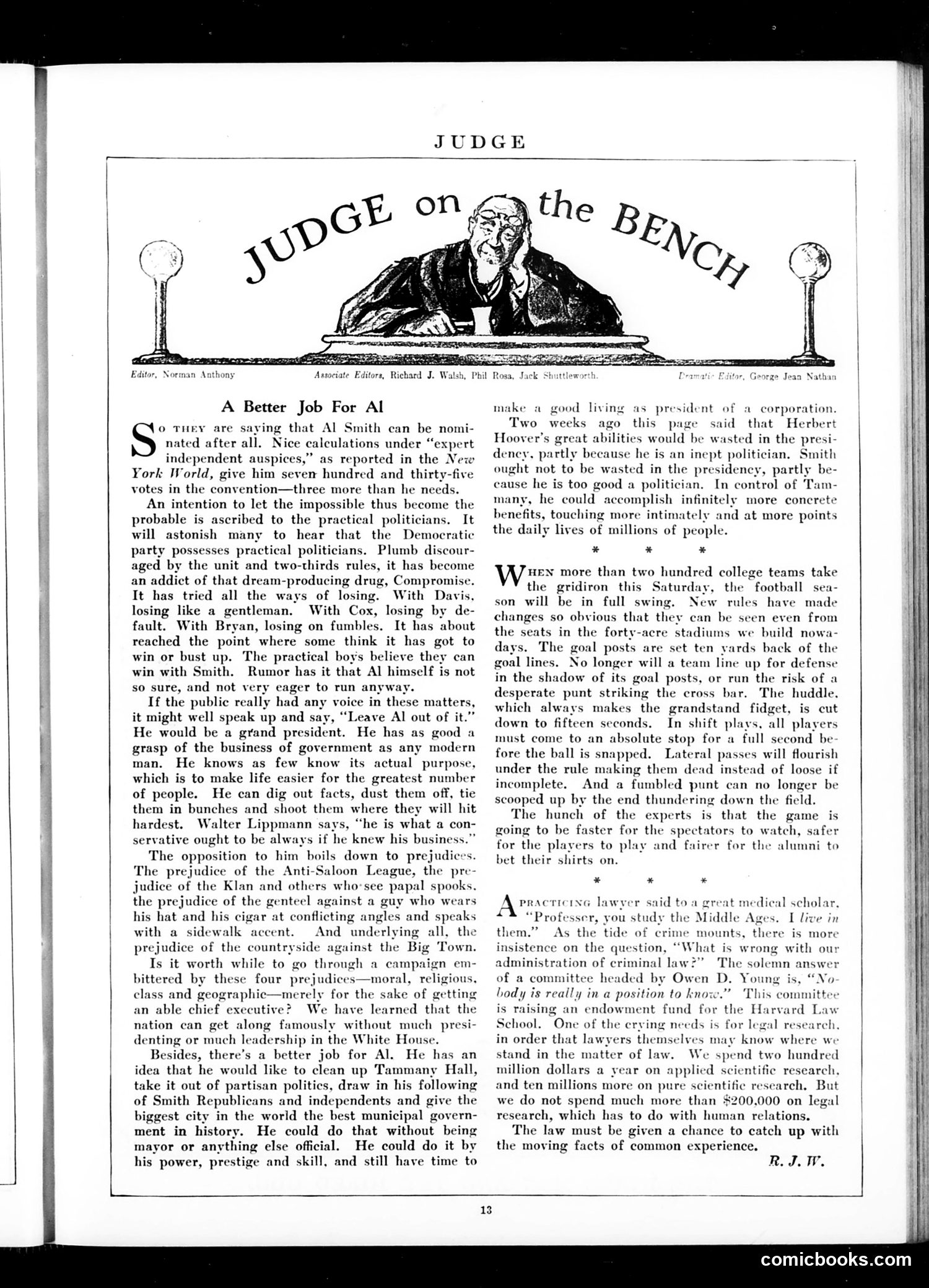
This page from *Judge* magazine contains editorial commentary on Al Smith, the Democratic politician and likely 1924 presidential candidate. The "Judge on the Bench" masthead indicates this represents the magazine's official position. The main article argues that Smith, while capable of becoming president, would be better suited to reforming Tammany Hall (the corrupt New York Democratic political machine) using his intelligence and political skill. The piece identifies the opposition to Smith as rooted in four prejudices: the Anti-Saloon League's moral objections, the Ku Klux Klan's religious prejudice, genteel class snobbery about his working-class accent and mannerisms, and rural America's distrust of big-city politicians. The secondary article discusses new college football rule changes regarding goal post placement. The illustration shows a stern judge figure presiding over the commentary below.
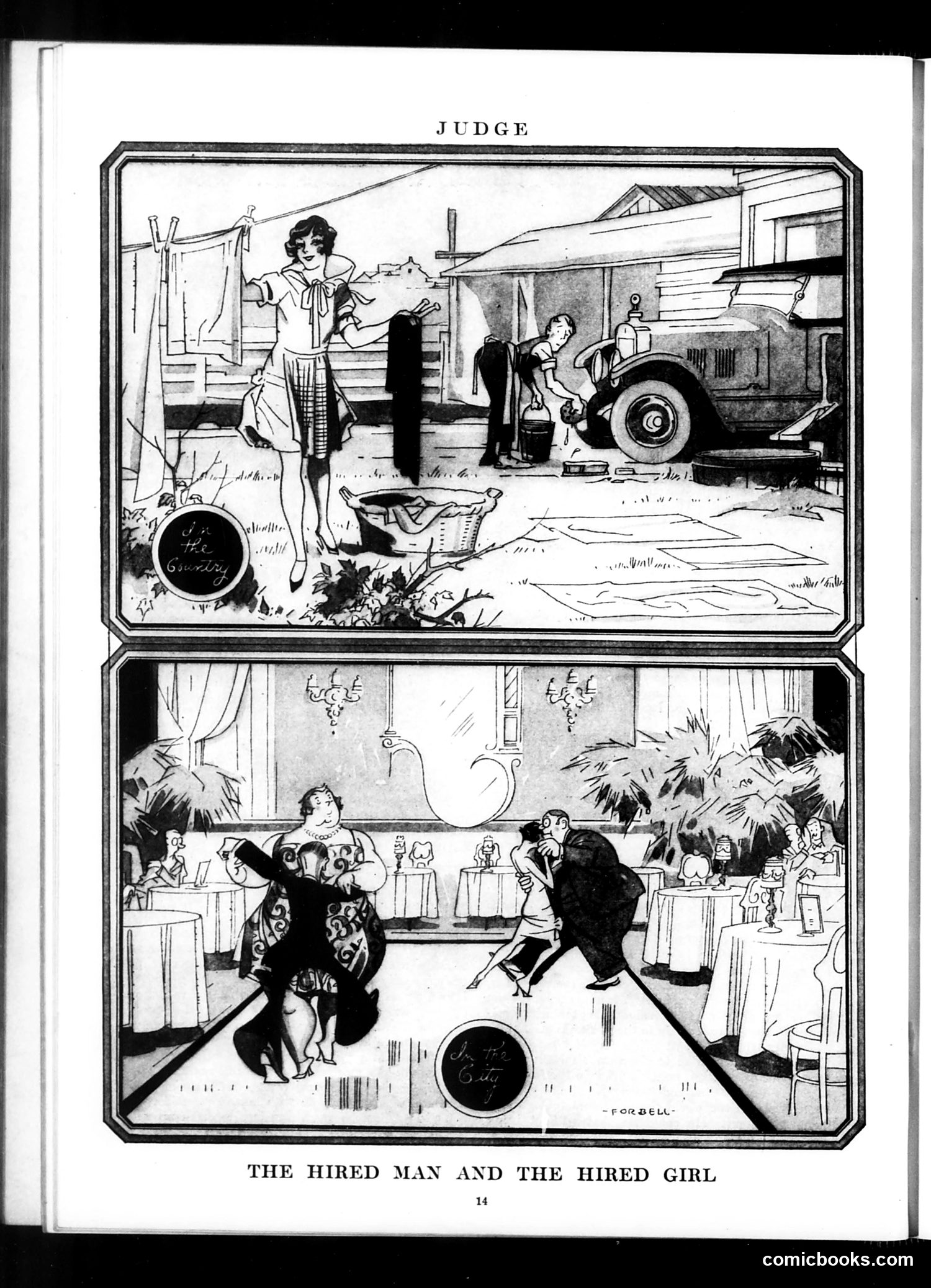
This two-panel Judge cartoon satirizes class and gender dynamics in early 20th-century domestic service. The top panel shows a working-class woman managing household chores outdoors—laundry, childcare, vehicle maintenance—performing multiple exhausting roles simultaneously. The bottom panel depicts an elegant dinner party where a man in formal attire appears to be the center of attention, enjoying leisure and social status. The satire contrasts the "hired girl's" grueling, invisible labor with the "hired man's" apparent comfort and social prominence. The joke suggests the ironic disparity: despite both being hired help, the man enjoys privileges and respect that the woman—despite doing far more work—never receives. It critiques the gendered exploitation of domestic workers and the social hierarchies that valorized male servants while treating female workers as drudges.
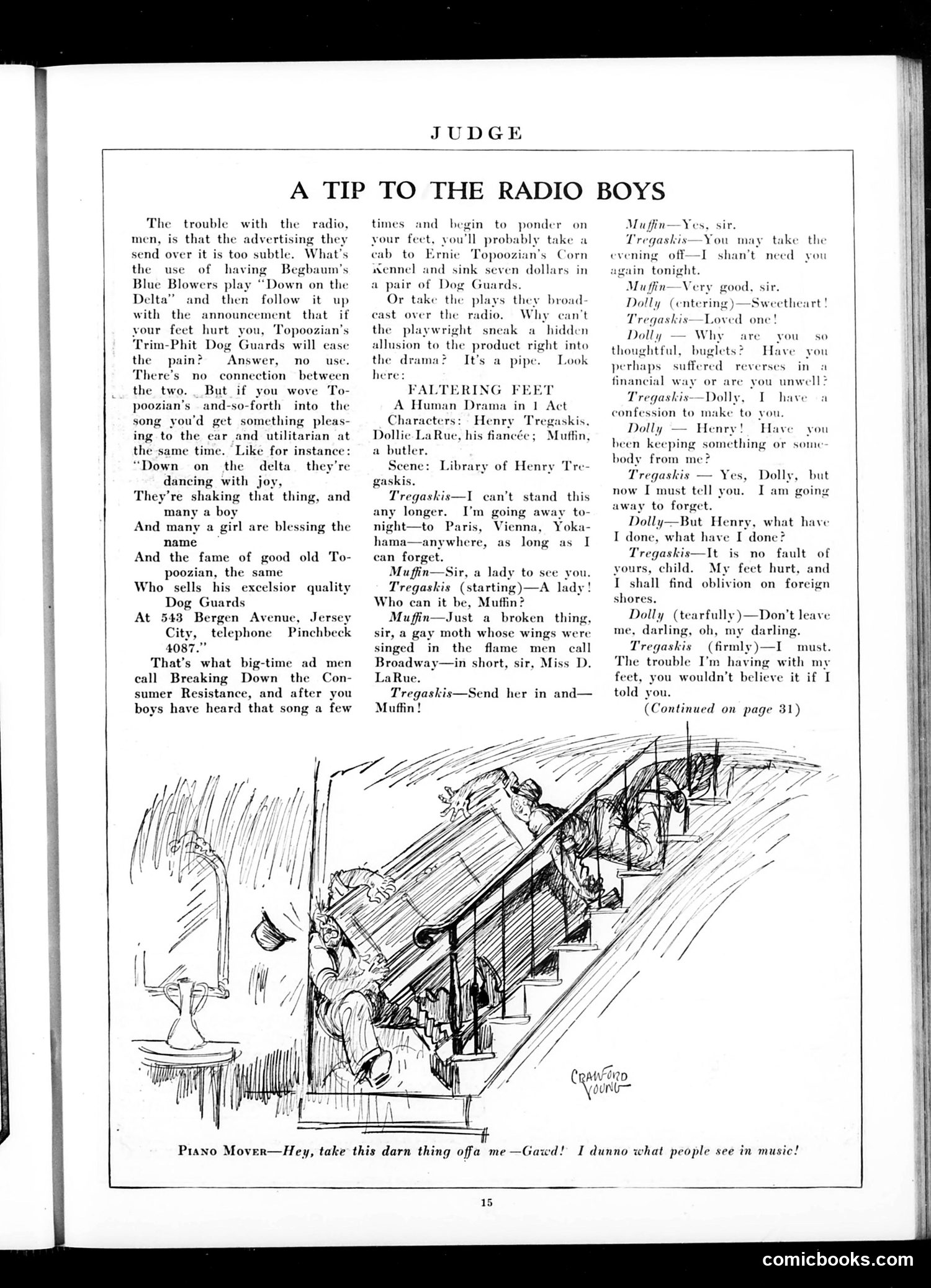
This 1920s Judge magazine page satirizes early radio advertising's ineffectiveness. The main article mocks how radio ads were subtle and disconnected from the programming—for example, playing a jazz song followed by an unrelated announcement about "Dog Guards" (shoe inserts) without integrating the product into the entertainment itself. The author humorously proposes that advertisers should weave product mentions directly into songs and dramatic broadcasts. To demonstrate, he provides a mock one-act play where the protagonist's entire romantic crisis—leaving his fiancée—stems absurdly from foot pain caused by poor shoe support, making the Dog Guards pitch integral to the plot. The bottom cartoon shows two workers struggling to move a piano, with one exasperatedly asking the other to remove it, concluding "I dunno what people see in music!"—a separate joke about classical music's perceived pretentiousness versus popular entertainment. The satire targets both radio advertising's primitive techniques and broader cultural anxieties about commercial manipulation.
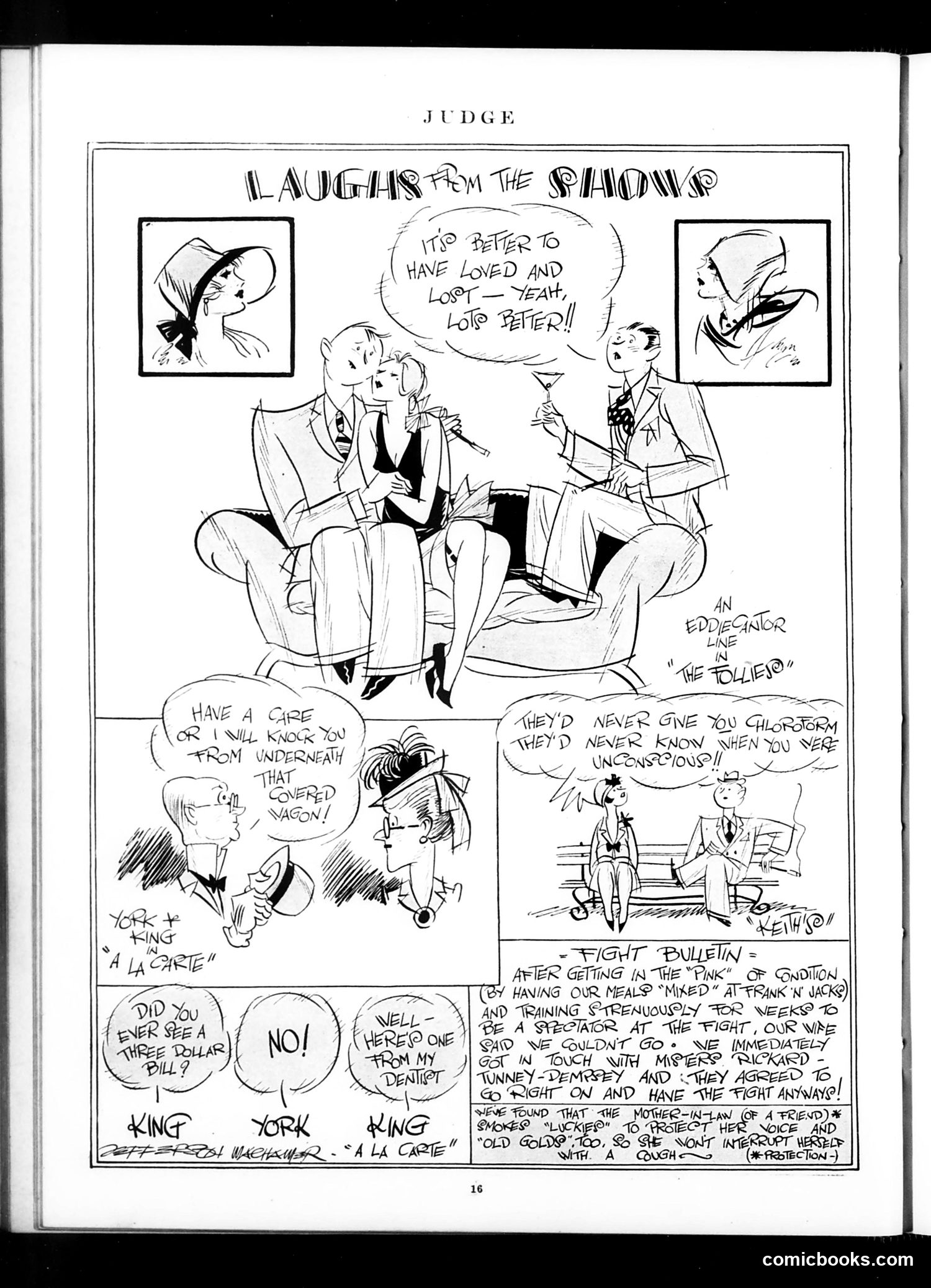
This page satirizes romantic and boxing culture of the 1920s. The top section mocks sentimental relationship philosophy through dialogue between well-dressed couples, with inset portraits of fashionable women. The humor derives from exaggerated romantic platitudes about love and loss. The lower section references a famous boxing match, mentioning fighters Tunney and Dempsey (Jack Dempsey vs. Gene Tunney's 1926-1927 fights). The "Fight Bulletin" satirizes how the fight was delayed due to negotiations—the cartoon jokes that fighters postponed their bout to have meals together at "Frank 'n' Jacks" restaurant and train together, treating their scheduled match as a friendly arrangement rather than serious competition. The satire critiques both overwrought romance and the commercial theatricality of professional boxing during this era.
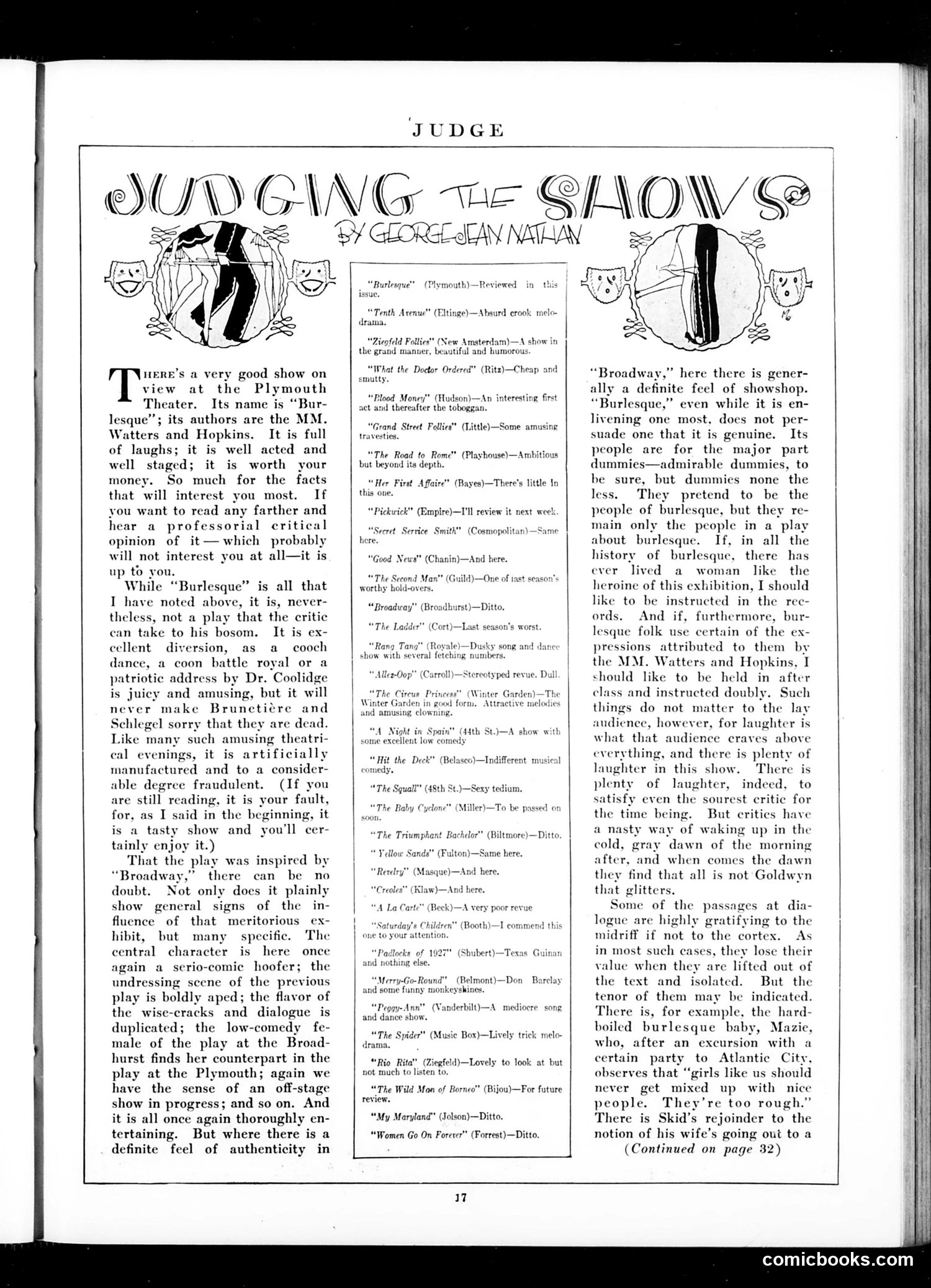
This page is a theater critic's review column from Judge magazine, not a political cartoon. The critic reviews the Broadway play "Burlesque" at the Plymouth Theater, written by Watters and Hopkins. **The main point:** While "Burlesque" is entertaining and well-acted, it lacks authenticity. The critic argues it's artificially manufactured—essentially an imitation of the successful play "Broadway" (running at the Hurst Theater). He compares it to "a cooch dance" or "patriotic address"—amusing but fundamentally fraudulent entertainment. **The critique's tone:** Nathan uses snobbish language, name-dropping European literary critics (Brunetière, Schlegel) to emphasize that while "Burlesque" succeeds as populist entertainment, it will never achieve serious artistic merit. The review exemplifies early 20th-century theater criticism's class-conscious dismissal of commercial entertainment as "dummies"—fake people in a fake world. The page also lists brief reviews of other Broadway shows.
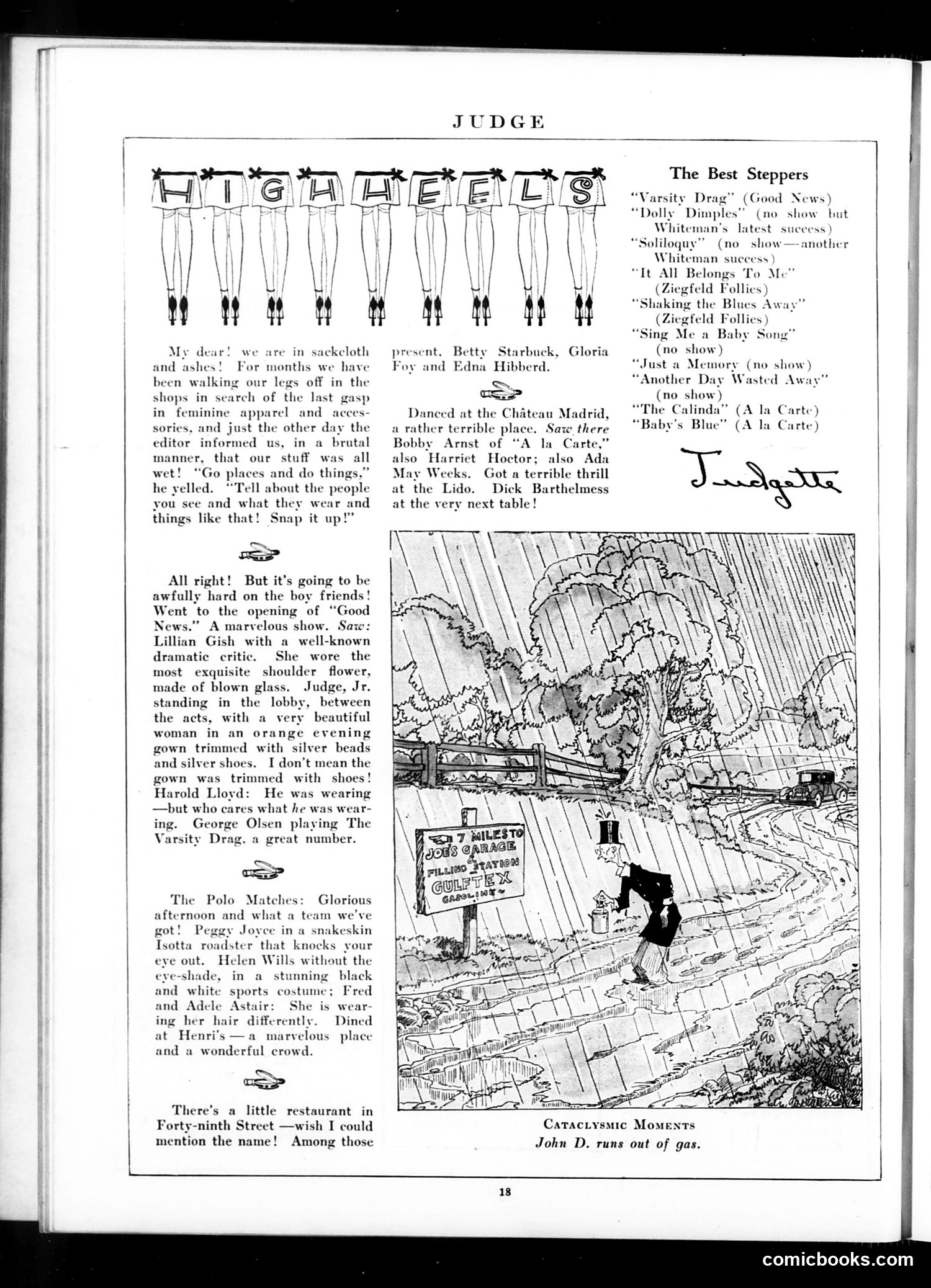
This is a society gossip column with satirical edge, typical of Judge's satirical coverage of 1920s high society. The unnamed columnist breathlessly reports on Broadway openings, polo matches, and fashionable restaurants, name-dropping celebrities like Lillian Gish, Helen Wills, Fred and Adele Astair, and Dick Barthelmess. The satire lies in the *triviality* of the reporting: the writer obsesses over what people wore (a blown-glass shoulder flower, snakeskin car upholstery, different hairstyles) while treating serious activities—theater, sports, dining—as mere backdrops for fashion observation. The editor's brutal demand to "go places and do things" and report on what people wear mocks both society journalism's superficiality and the era's consumer-obsessed culture. The accompanying cartoon "John D. runs out of gas" likely references John D. Rockefeller, the oil magnate, in dark irony about wealth and resource scarcity—a commentary on economic inequality during the Jazz Age.
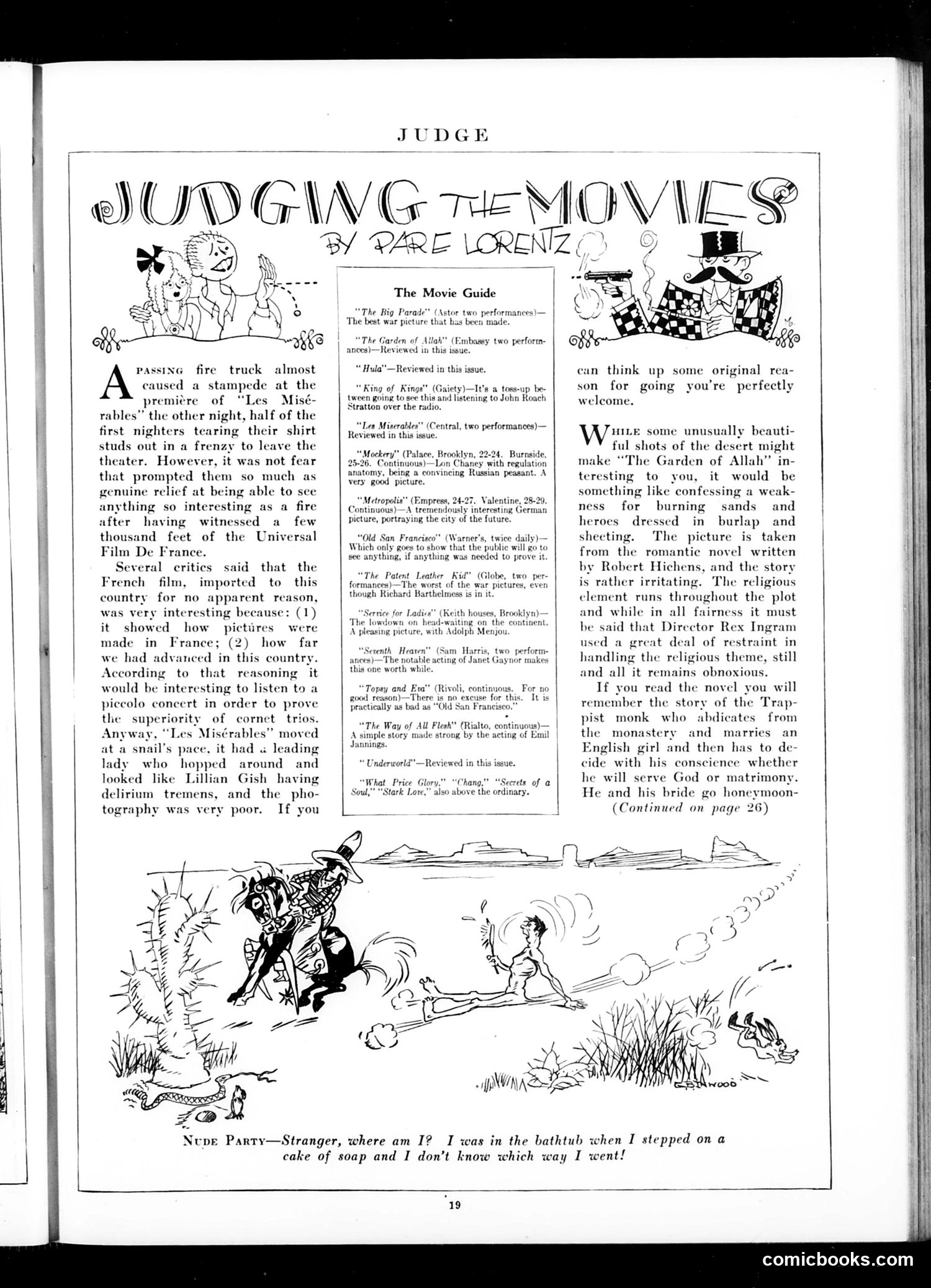
This page features film criticism by Pare Lorenz in Judge's "Movie Guide" section. The main text critiques "Les Misérables," a French import that Lorenz found tedious—notable mainly for demonstrating how much American filmmaking had advanced. He mocks the leading actress's performance, comparing her frantic movements to "delirium tremens," and criticizes the poor photography. The page includes a movie guide listing contemporary films (1920s releases like "The Big Parade," "Metropolis," "Old San Francisco") with brief reviews. The bottom cartoon depicts a slapstick domestic accident—a bathtub scene where someone stepped on soap—illustrating the era's lowbrow comedy humor. Overall, this represents Judge's satirical approach to 1920s popular culture, combining sophisticated film criticism with crude visual gags, reflecting the magazine's mixed-audience appeal.
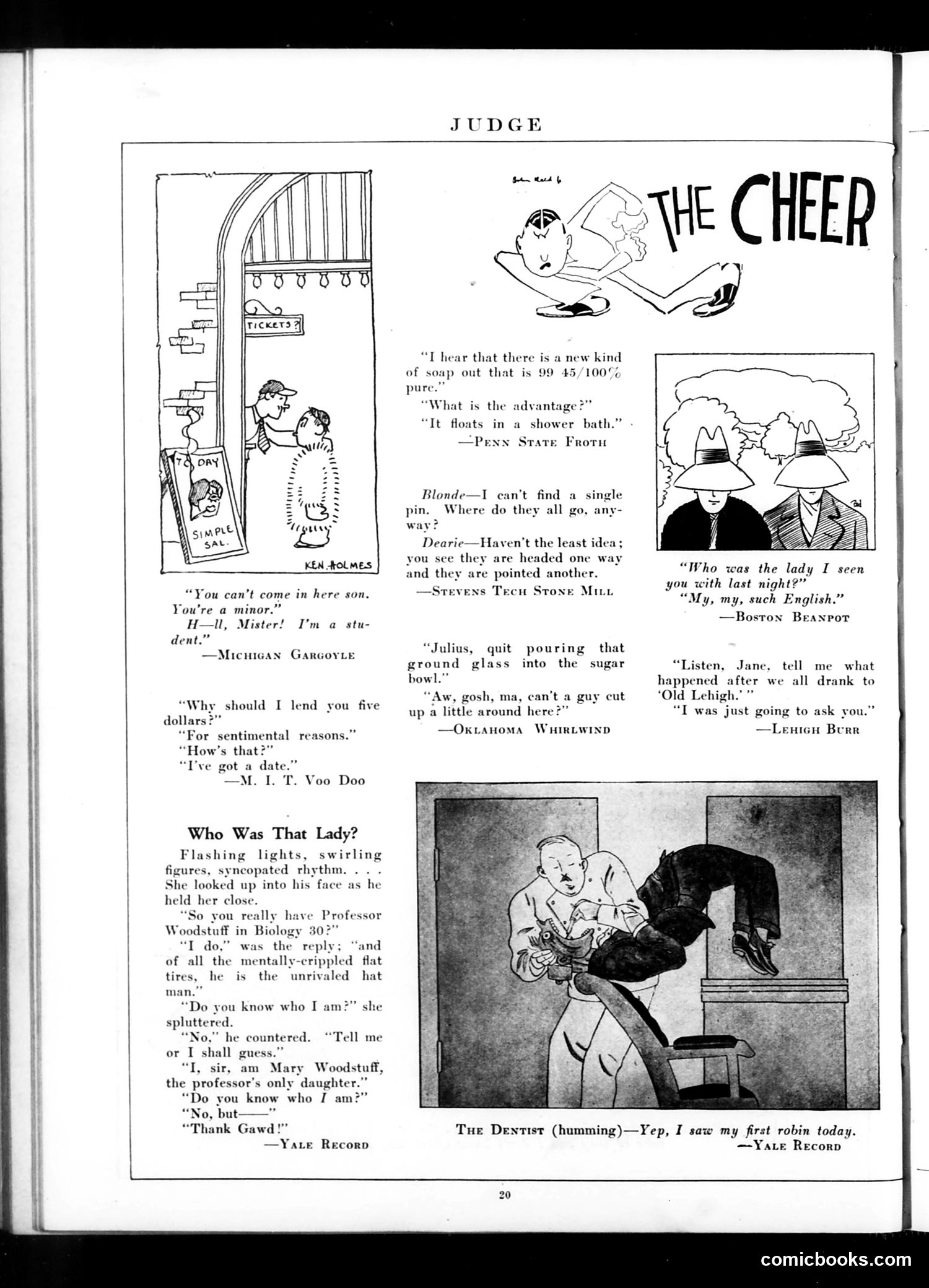
This page contains several brief humorous anecdotes typical of early 20th-century American humor magazines, plus one cartoon illustration. **The jokes** mock various social situations: a soap advertisement paradox, missing hairpins, a student sneaking into a restricted area, domestic poisoning (presented as casual), a young man's dating excuse, and lending money. These reflect period concerns about product claims, courtship, and domestic life. **"Who Was That Lady?"** is a longer narrative joke about a young man at a dance who doesn't recognize his dance partner's identity until she reveals herself as Professor Woodstuff's daughter. The humor relies on the social embarrassment of not knowing an important person's identity—a common theme in period humor. **"The Dentist"** cartoon shows a dentist examining a patient's mouth while humming about seeing the first robin of spring, a seasonal reference suggesting cheerful distraction from dental work. The overall tone is light, domestic satire aimed at an educated readership familiar with college life and social propriety. No clear political commentary is evident on this particular page.
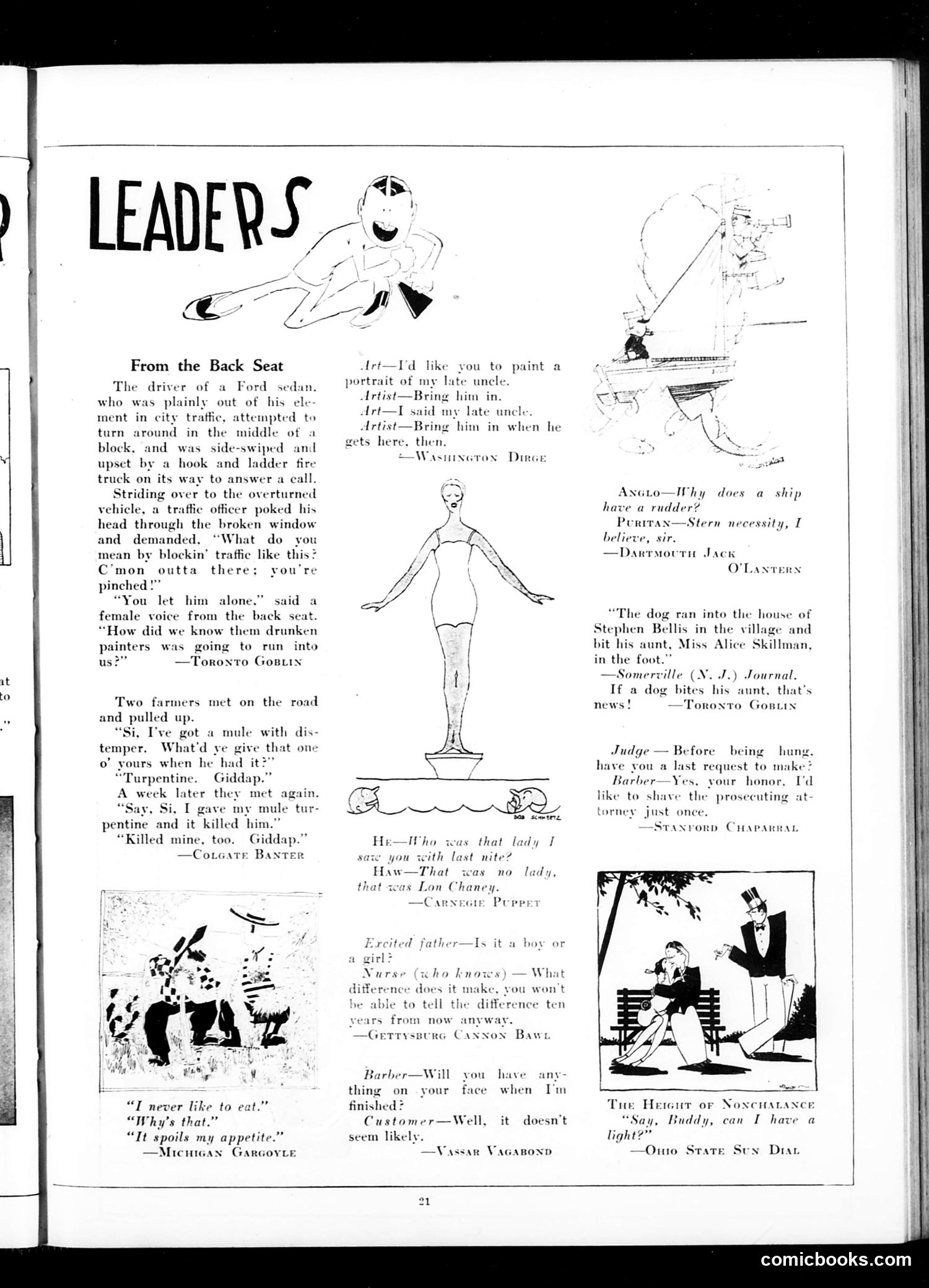
This page from *Judge* magazine collects humorous anecdotes and jokes organized around the theme of "Leaders"—people attempting to take charge in various situations, often with comic results. **Key content:** The "From the Back Seat" story satirizes incompetent drivers and backseat advice—a Ford driver causes a traffic accident, then a woman defends him, ironically blaming "drunken painters" (the fire truck). The humor lies in misplaced leadership and blame. Other jokes mock various authority figures: a traffic officer, an excitable father, a barber, a judge—all attempting to lead or make decisions with absurd outcomes. The cartoons feature simple line drawings depicting these scenarios. **Social context:** Early automotive-era humor frequently mocked inexperienced drivers. The jokes reflect 1920s-30s American sensibilities about social hierarchies, gender dynamics (the backseat woman), and everyday incompetence. The overall satire suggests that "leaders" are often ordinary people poorly suited to their roles—a gentle democratic critique.
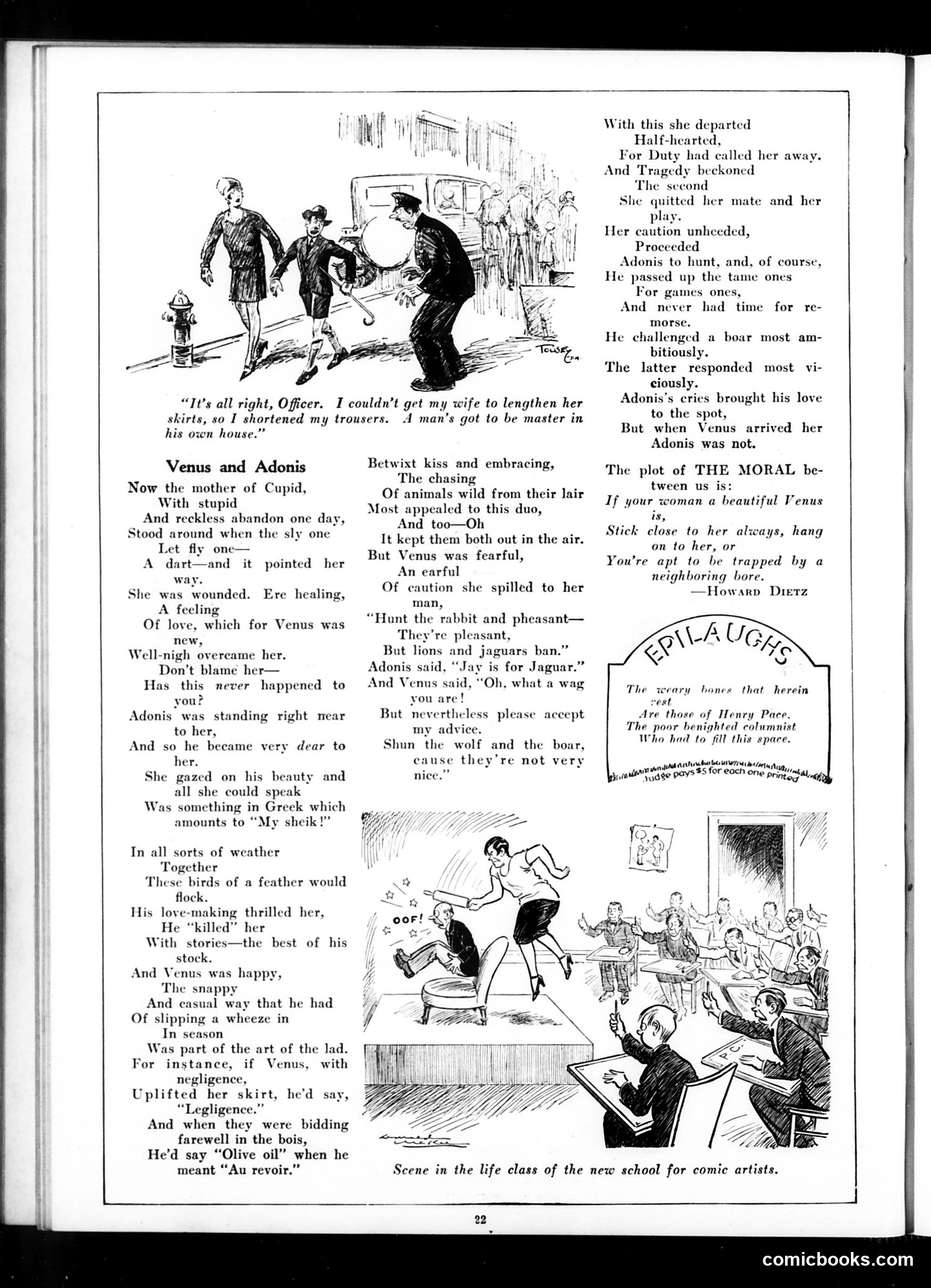
**Top Cartoon:** A police officer encounters a man in shortened trousers. The man jokes that since he couldn't convince his wife to lengthen her skirts (a reference to 1920s hemline debates), he shortened his own trousers instead—asserting male domestic authority. This satirizes both the "woman question" of fashion and marital power dynamics of the era. **"Venus and Adonis" Poem:** A lengthy humorous retelling of the classical myth, authored by Howard Dietz. It depicts Venus and Adonis's romance through modern, comedic dialogue featuring puns and slang ("sheik," "olive oil" for "au revoir"). The moral: men should stay close to beautiful women or risk being "trapped by a neighboring bore"—likely mocking contemporary gender anxieties and domestic advice literature. **Bottom Illustration:** Shows a "life class of the new school for comic artists," depicting students sketching a posed model—commentary on modern art education and cartooning pedagogy. The page blends classical literary reference with contemporary 1920s social commentary and marital humor.
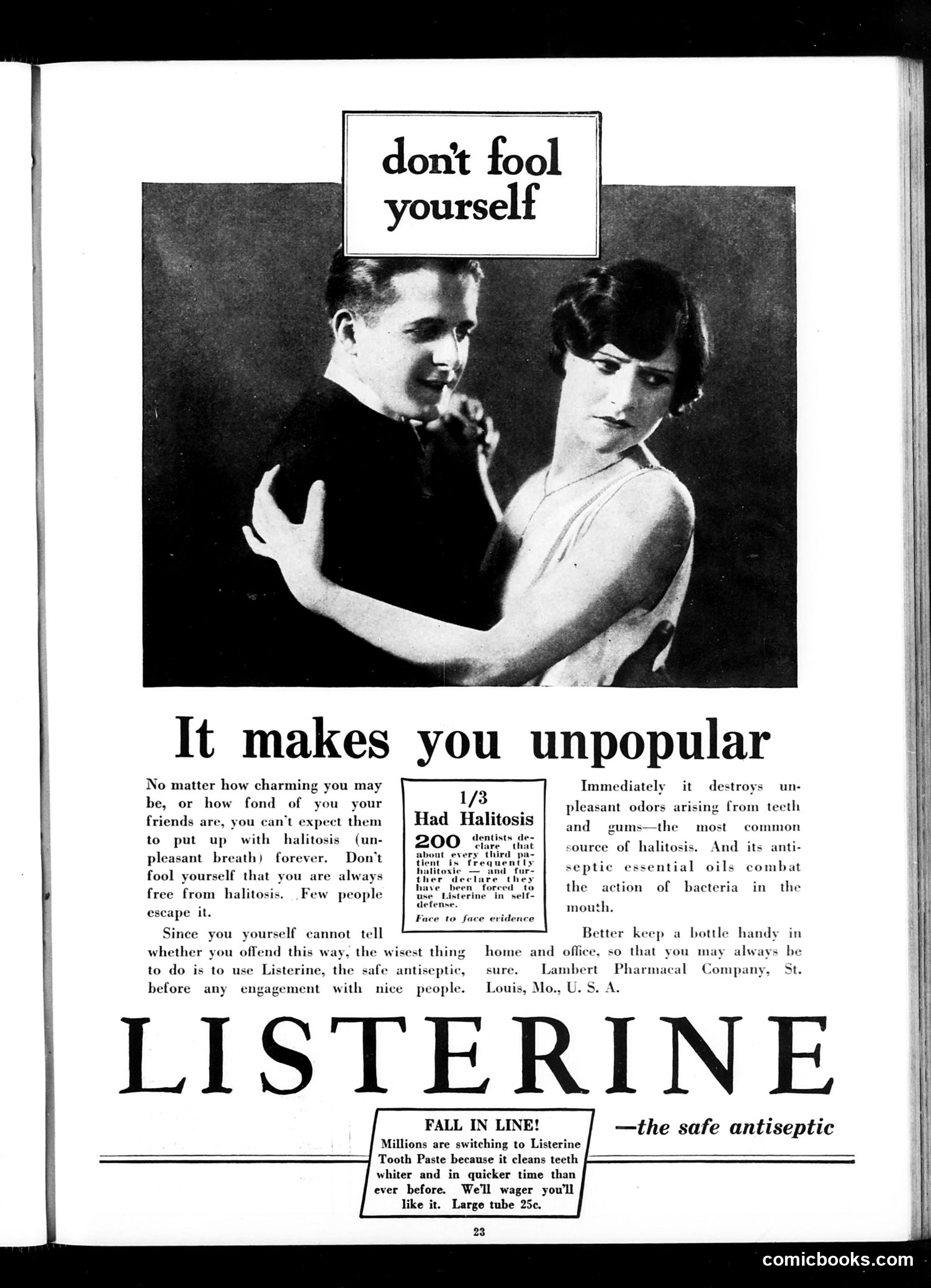
This is a **Listerine advertisement**, not political satire. The page uses social embarrassment as its marketing hook. The image shows a couple in an intimate moment, with the woman's expression suggesting discomfort or displeasure. The headline "don't fool yourself" warns that no matter how charming or well-liked you are, bad breath ("halitosis") will make you "unpopular." The ad exploits anxiety about social acceptability—a common advertising strategy of the era. It claims that 1 in 3 people suffer from halitosis and that it stems from teeth and gums. The solution: use Listerine mouthwash before social encounters. A secondary advertisement promotes Listerine Tooth Paste as whitening and faster-acting than competitors. The satire here is social rather than political: it mocks how easily people can be made to feel self-conscious about invisible personal hygiene issues, using embarrassment as a sales tactic.
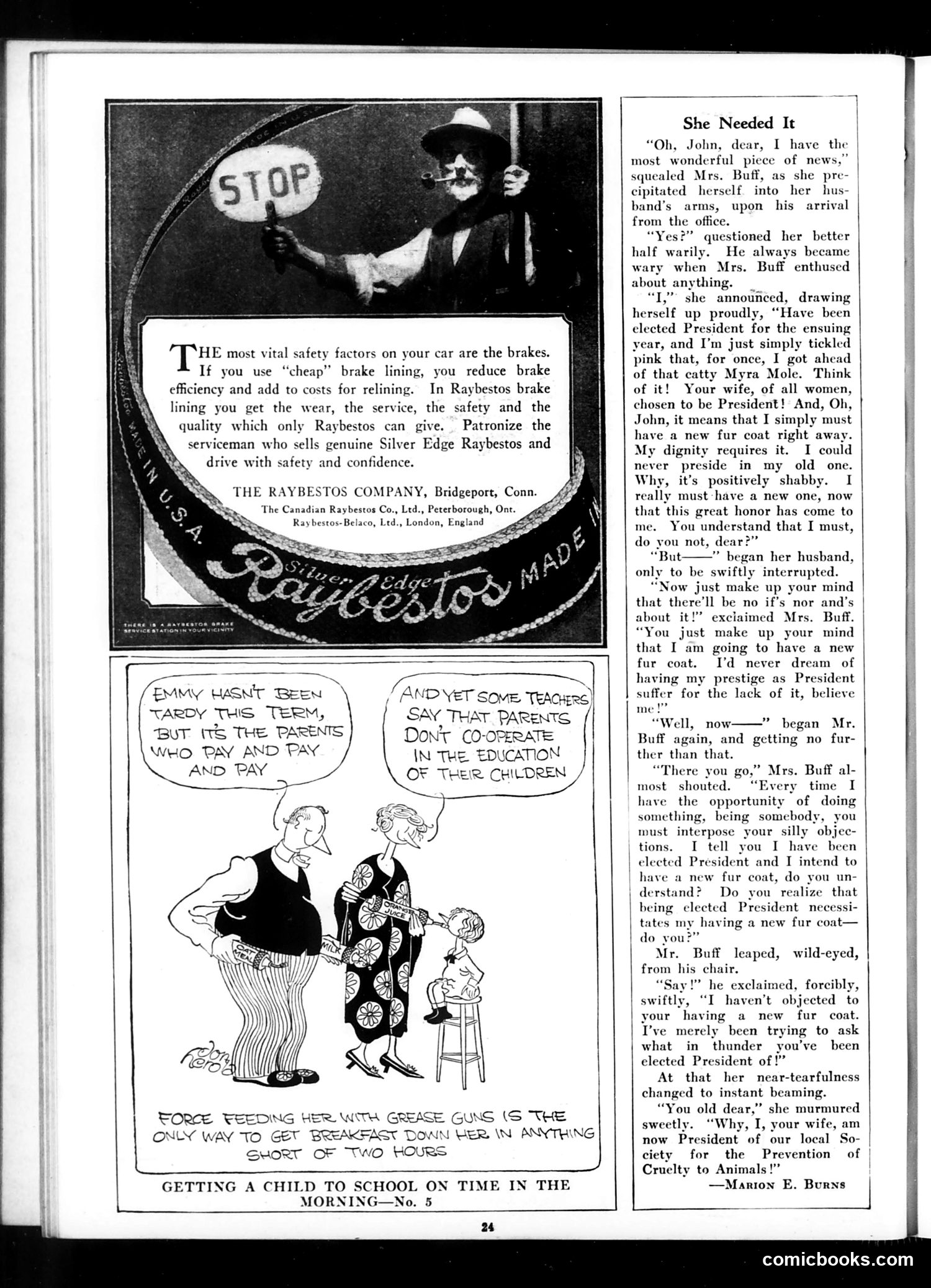
This satirical story mocks the frivolousness of women's club leadership and their consumerist priorities. Mrs. Buff, newly elected President of the local Society for the Prevention of Cruelty to Animals, immediately uses her position as justification to demand an expensive new fur coat from her husband—oblivious to the irony that she's now leading an animal-welfare organization. The humor targets several 1920s social anxieties: women's increasing participation in civic organizations, their perceived materialism, and the contradiction between stated values and actual behavior. Mrs. Buff's steamroller tactics in overriding her husband's objections also satirizes changing gender dynamics, portraying her as domineering and illogical. The cartoon above about getting children to school on time reinforces themes of domestic chaos and parental frustration common to Judge's humor.
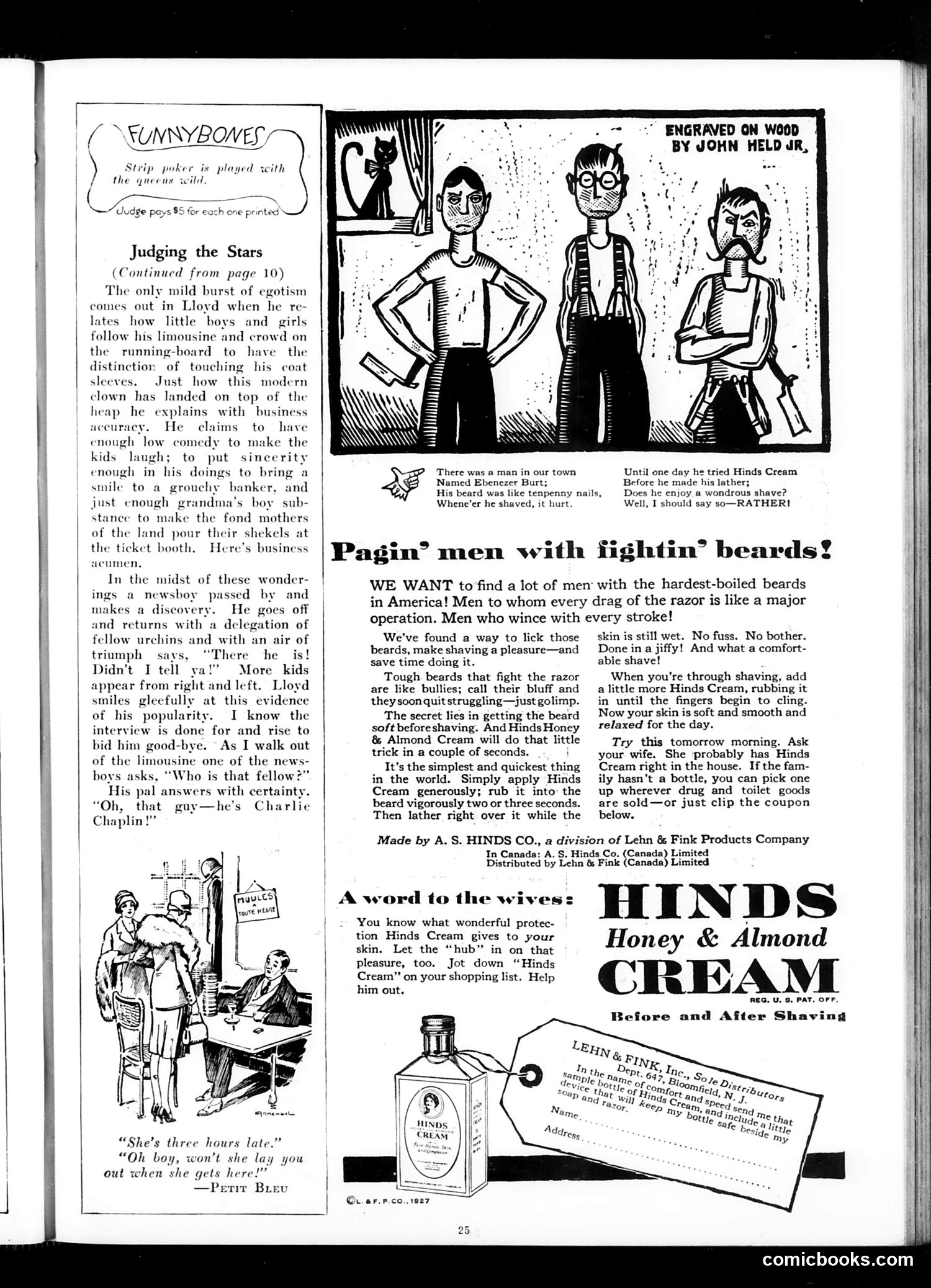
This page contains entertainment content and advertising from *Judge* magazine. The top section, "Judging the Stars," discusses Lloyd (likely Harold Lloyd, the silent film comedian). A newsboy mistakes Lloyd for Charlie Chaplin—a humorous mix-up highlighting both comedians' fame during the silent era. The joke relies on Chaplin's iconic status overshadowing even other major stars. The middle features a comic verse about a man named Ebenezer Burt whose coarse beard makes shaving painful—a setup for the advertisement below. The majority of the page is a full advertisement for **Hinds Honey & Almond Cream shaving product**. It uses exaggerated language ("hardest-boiled beards," "major operation") to market the cream as a solution for men with tough facial hair. The ad includes before-and-after illustrations and encourages wives to purchase it for their husbands. The wood engraving credited to John Held Jr. appears at top right, showing three men's faces—likely illustrating the shaving product concept.
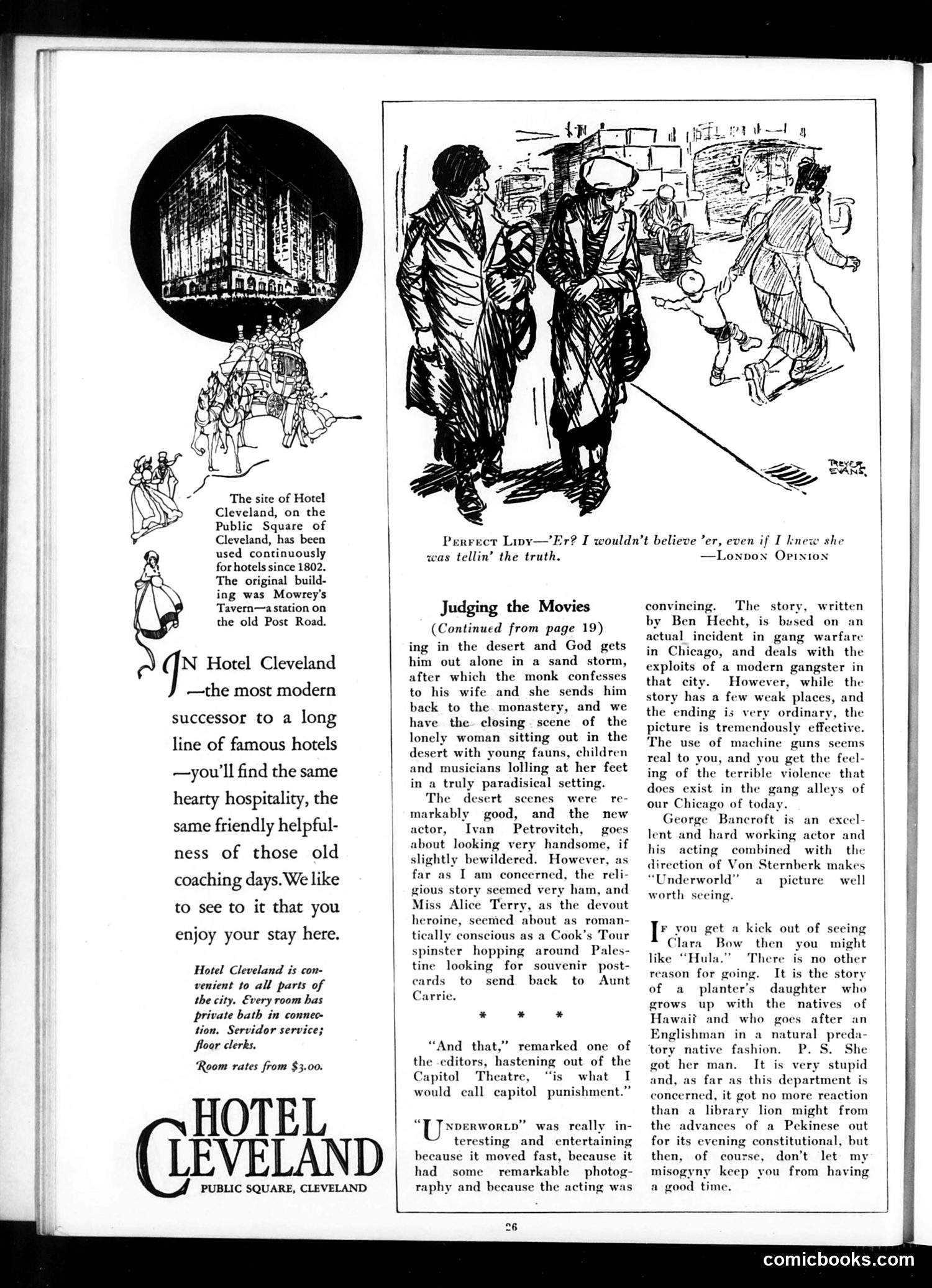
This page contains a **cartoon and movie reviews**, not political satire in the traditional sense. The top cartoon shows two men in coats and hats on a street; one says to the other, "Perfect Lady—'Er? I wouldn't believe 'er, even if I knew she was tellin' the truth." This is a **London Opinion** joke about trusting women's truthfulness—typical early-20th-century sexist humor mocking female credibility. The bulk of the page reviews recent films: a desert monastery drama with Ivan Petrovitch and Alice Terry (criticized as unconvincing), *Underworld* (praised for its authentic Chicago gang violence and George Bancroft's performance), and Clara Bow's *Hula* (dismissed as pointless). The critic uses harsh language ("very ham," "very stupid") typical of Judge's satirical reviewing style. The **Hotel Cleveland advertisement** occupies the left side, emphasizing its historical pedigree dating to 1802. This is primarily **entertainment journalism with period attitudes toward women**, rather than political commentary.
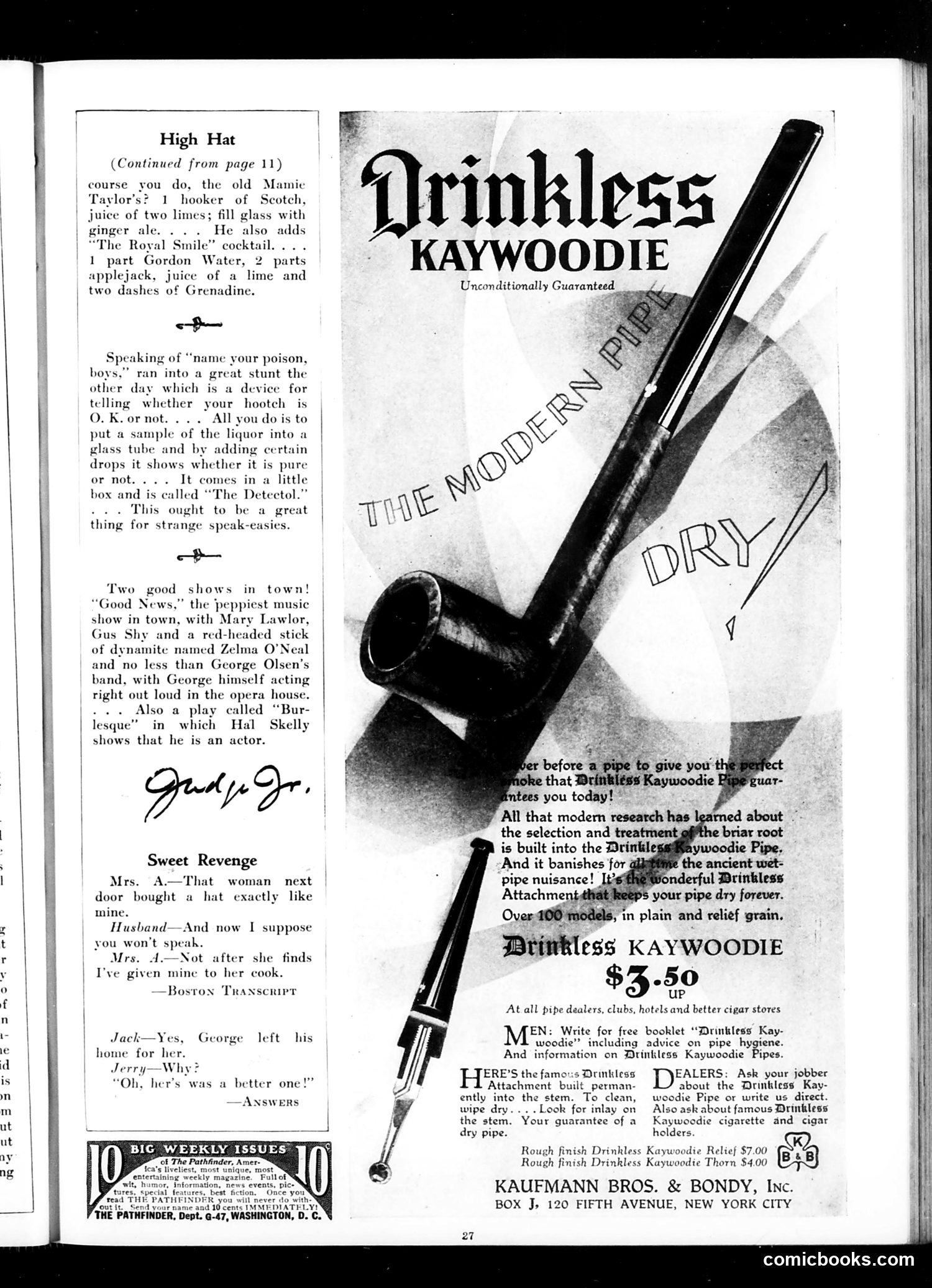
This page mixes editorial content with advertising during Prohibition (implied by references to "hootch" and "speak-easies"). **Left Column ("High Hat"):** A cocktail recipe column continues from a previous page, discussing mixed drinks and a novelty device called "The Detectol"—apparently a test kit to verify liquor purity during Prohibition when illegal alcohol quality was unreliable. The author then reviews two Broadway shows: "Good News" and "Burlesque," praising their performers. A brief humor section includes jokes about marital tension and hat jealousy. **Right Column:** A full-page advertisement for Drinkless Kaywoodie smoking pipes, emphasizing a patented moisture-absorbing attachment that keeps pipe smoke "dry." The ad positions this as modern technology solving a common pipe-smoker complaint. Priced at $3.50 and up, it targets affluent readers through upscale retail channels (clubs, hotels, cigar stores). The contrast reflects Judge's dual purpose: entertainment and revenue through luxury product advertising aimed at its affluent readership.
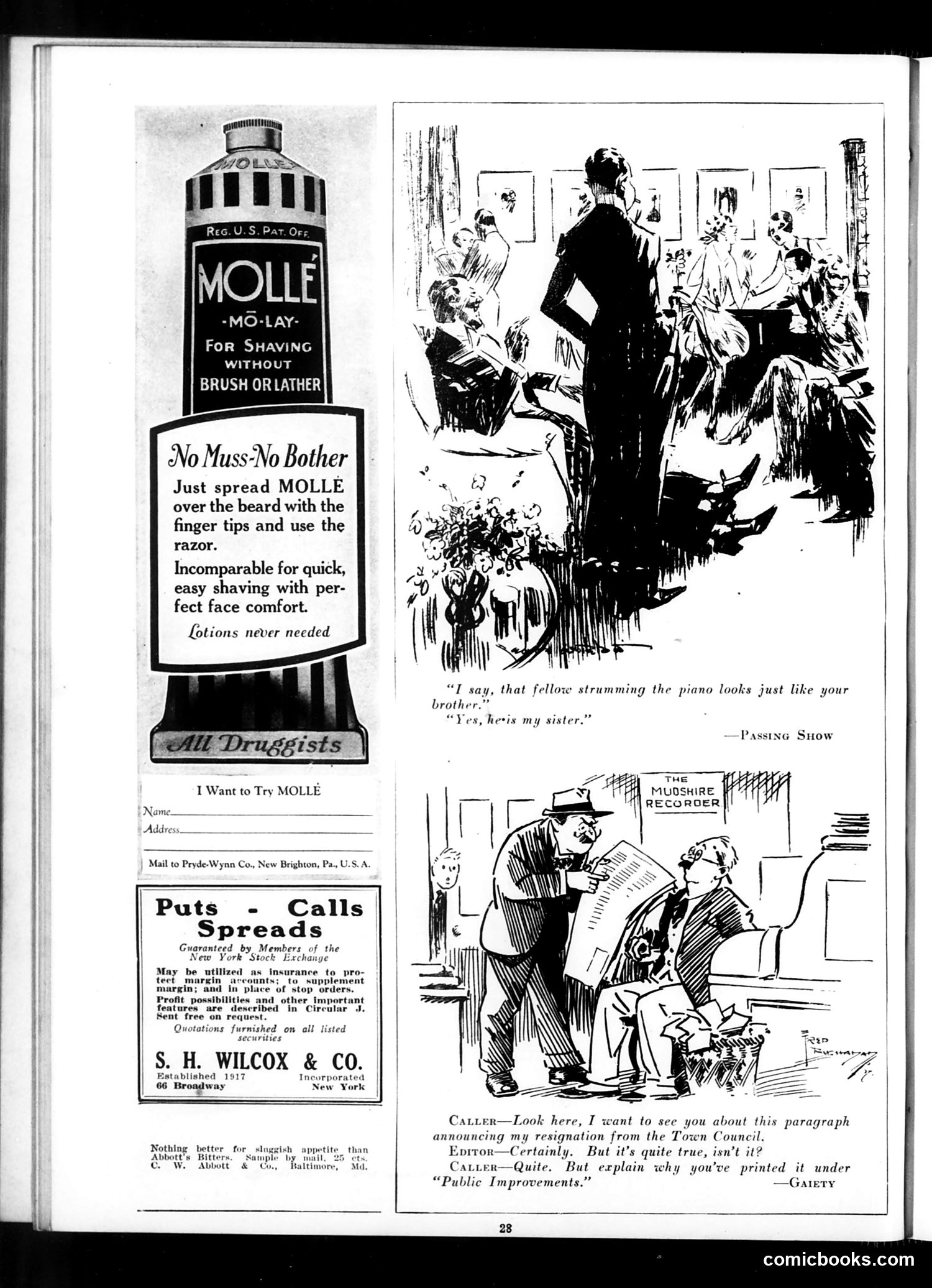
This page contains two distinct cartoons with satirical humor: **Top cartoon ("Passing Show"):** A social scene where someone remarks that a man playing piano resembles another person's brother. The punchline—"Yes, he's my sister"—plays on gender ambiguity or cross-dressing, a common source of humor in early 20th-century satire. The joke relies on the audience's expectation of conventional gender presentation. **Bottom cartoon ("Gaiety"):** A newspaper editor and caller discuss a resignation announcement. The satire targets municipal politics: the caller is embarrassed that his resignation from the town council was published under "Public Improvements," implying his departure constitutes an improvement to local government. This mocks corrupt or ineffectual politicians. The page also contains period advertisements for Molle shaving cream and S.H. Wilcox stock brokerage services, typical of Judge's revenue model.
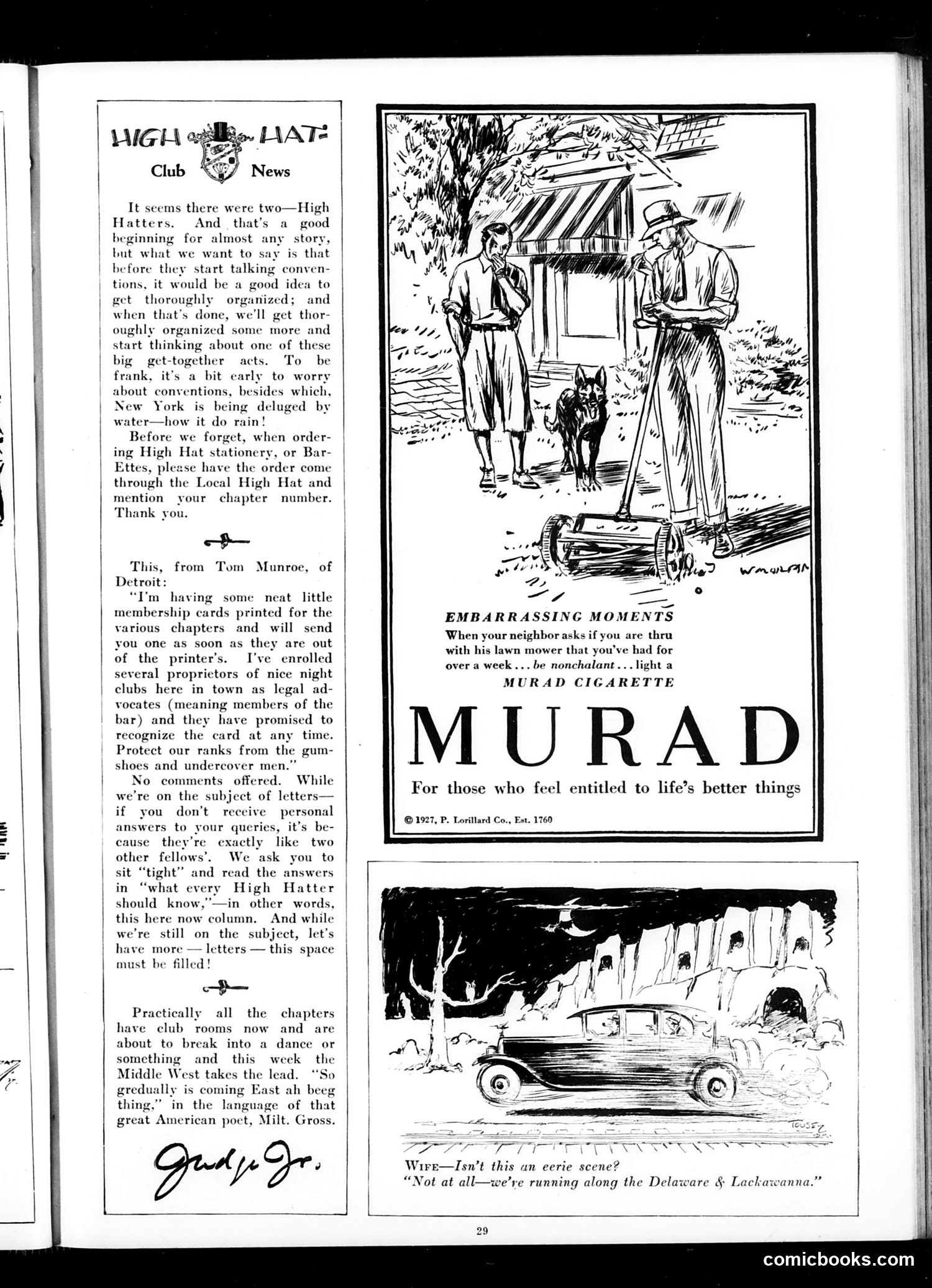
This page contains club news for the "High Hatters," an organization apparently for upscale social club members. The left column discusses organizing conventions and membership cards, with a note from Detroit member Tom Munroe about enrolling "legal advocates" (bar members) to recognize membership cards—a humorous reference to Prohibition-era speakeasies needing protection from "gumshoes and undercover men" (police/federal agents). The right side features two cartoons. The top depicts an "embarrassing moment" about borrowing a neighbor's lawn mower for a week—solved by nonchalantly lighting a Murad cigarette (an advertisement). The bottom cartoon shows a car driving through a spooky canyon scene; the wife asks if it's eerie, but the husband reassures her they're simply traveling along the Delaware & Lackawanna railroad route—a mundane explanation for what appears supernatural. The page is primarily social-club news and advertising, reflecting 1920s leisure culture and consumer products.
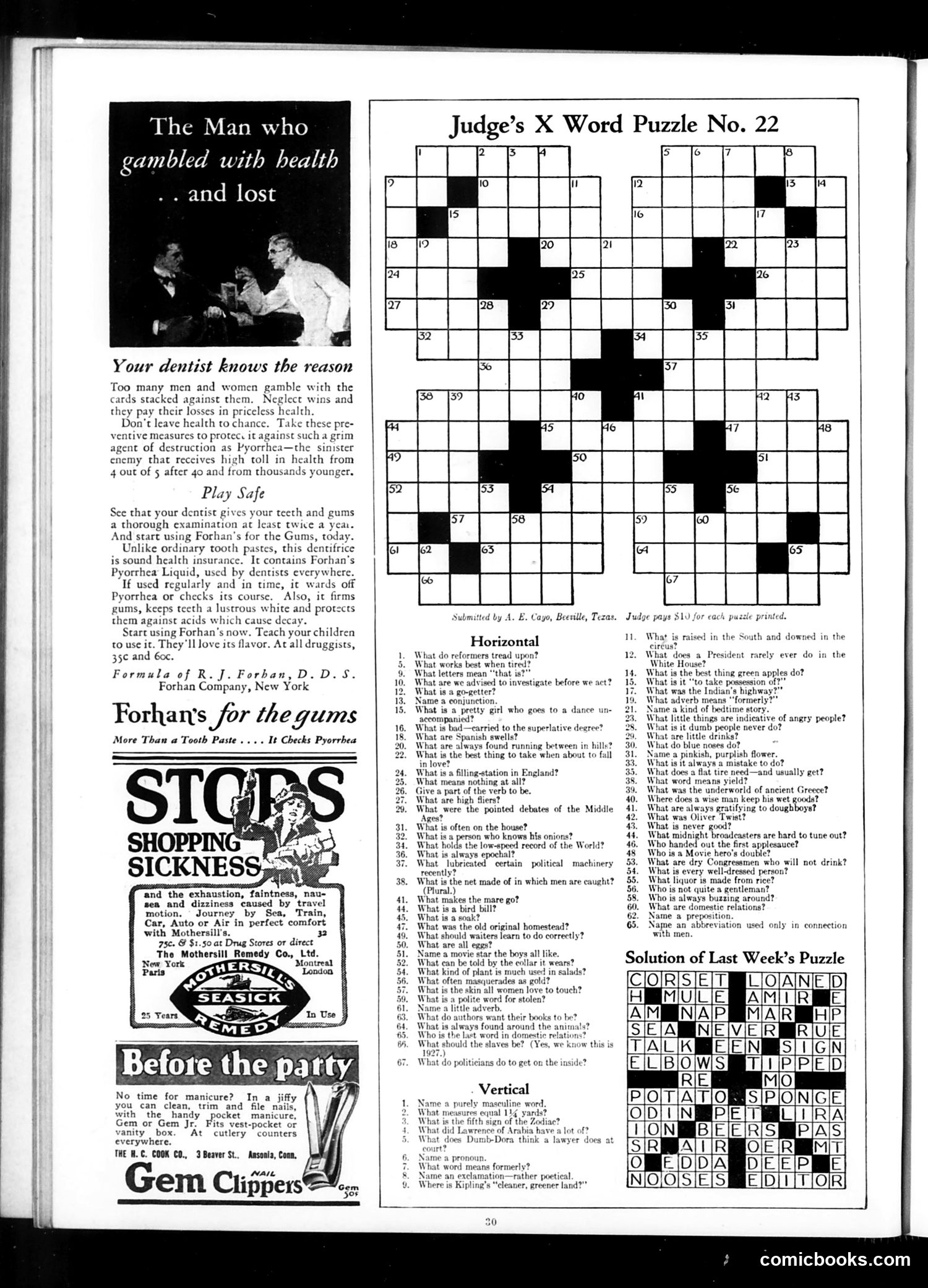
This page is primarily **advertising and a crossword puzzle**, not political satire. The dominant content includes: **Advertisements:** - **Forhan's toothpaste** (large ad): Promotes dental hygiene to prevent pyorrhea, a gum disease. The opening illustration shows a man who "gambled with health and lost"—a cautionary tale about neglecting teeth. - **Mothersill's remedy**: For motion sickness during travel - **Gem Clippers**: Pocket manicure tool - **Seasick Remedy**: Patent medicine ad **Central Content:** Judge's crossword puzzle #22 with 67 clues (horizontal and vertical), typical of puzzle magazines of this era. **Historical Context:** The Forhan's ad reflects early 20th-century concerns about pyorrhea, which was genuinely believed to cause serious health decline. The messaging uses fear-based health warnings typical of the period. The other advertisements show common consumer products marketed to middle-class readers worried about health and personal grooming. This page demonstrates Judge's dual function: satirical magazine and general entertainment/advertisement vehicle.
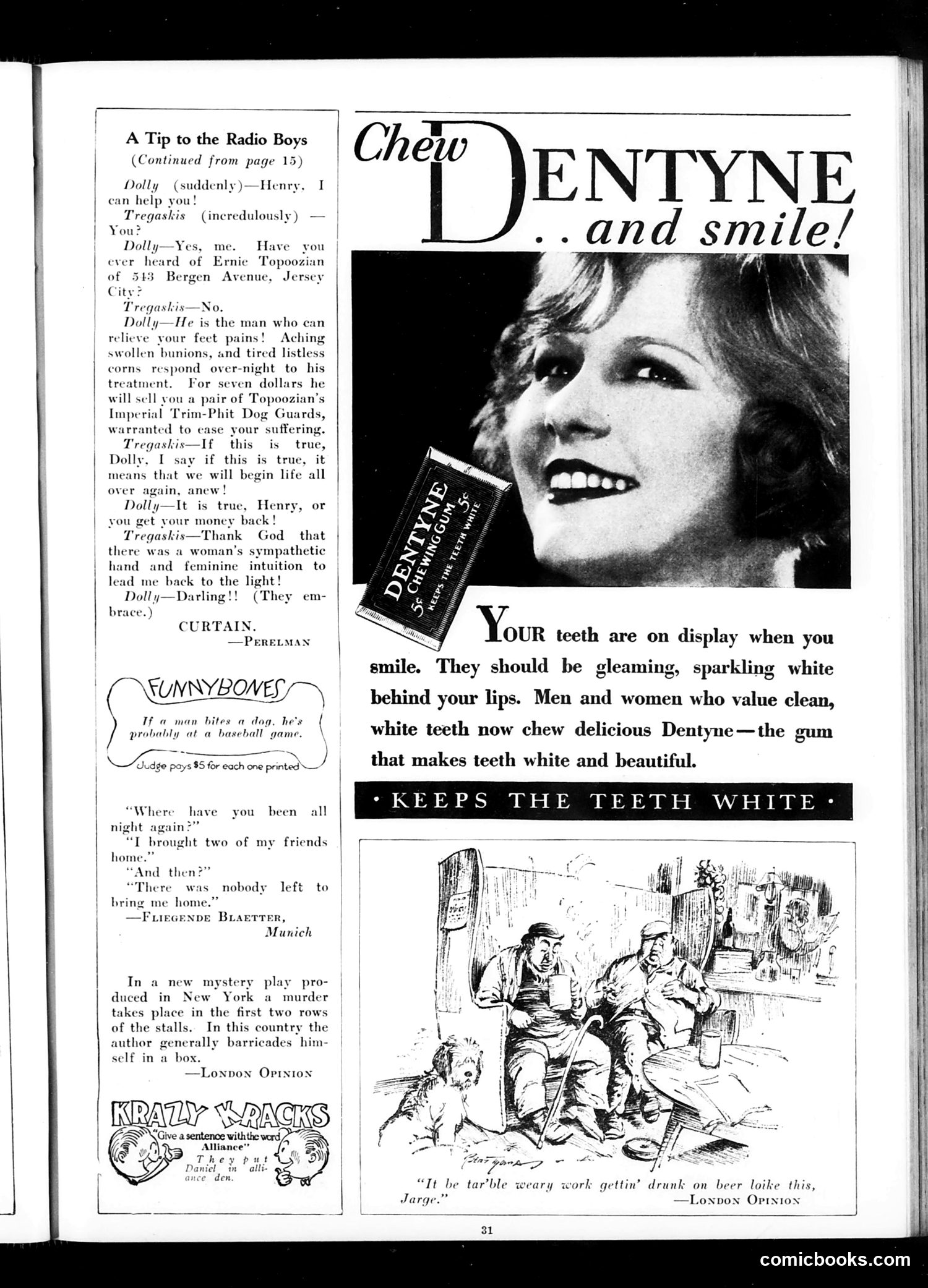
This page is primarily an **advertisement for Dentyne chewing gum** disguised as editorial content. The large photo of a smiling woman and the product box dominate the right side, with the tagline "Chew Dentyne...and smile!" and "KEEPS THE TEETH WHITE." The left side contains unrelated filler content typical of magazines from this era: - **"A Tip to the Radio Boys"**: A domestic comedy sketch by S.J. Perelman about foot pain relief (unrelated to the gum ad) - **"Funny Bones"**: Brief humorous anecdotes, including one about a man bringing friends home - **"Krazy Wacks"**: Another joke section - A cartoon at bottom showing two working-class men discussing drinking beer The scattered jokes and sketches serve no thematic purpose—they're simply space-fillers around the main advertisement. For modern readers, this reveals how early 20th-century magazines blurred advertising and editorial content, embedding commercial messages within entertainment to avoid reader resistance to obvious marketing.
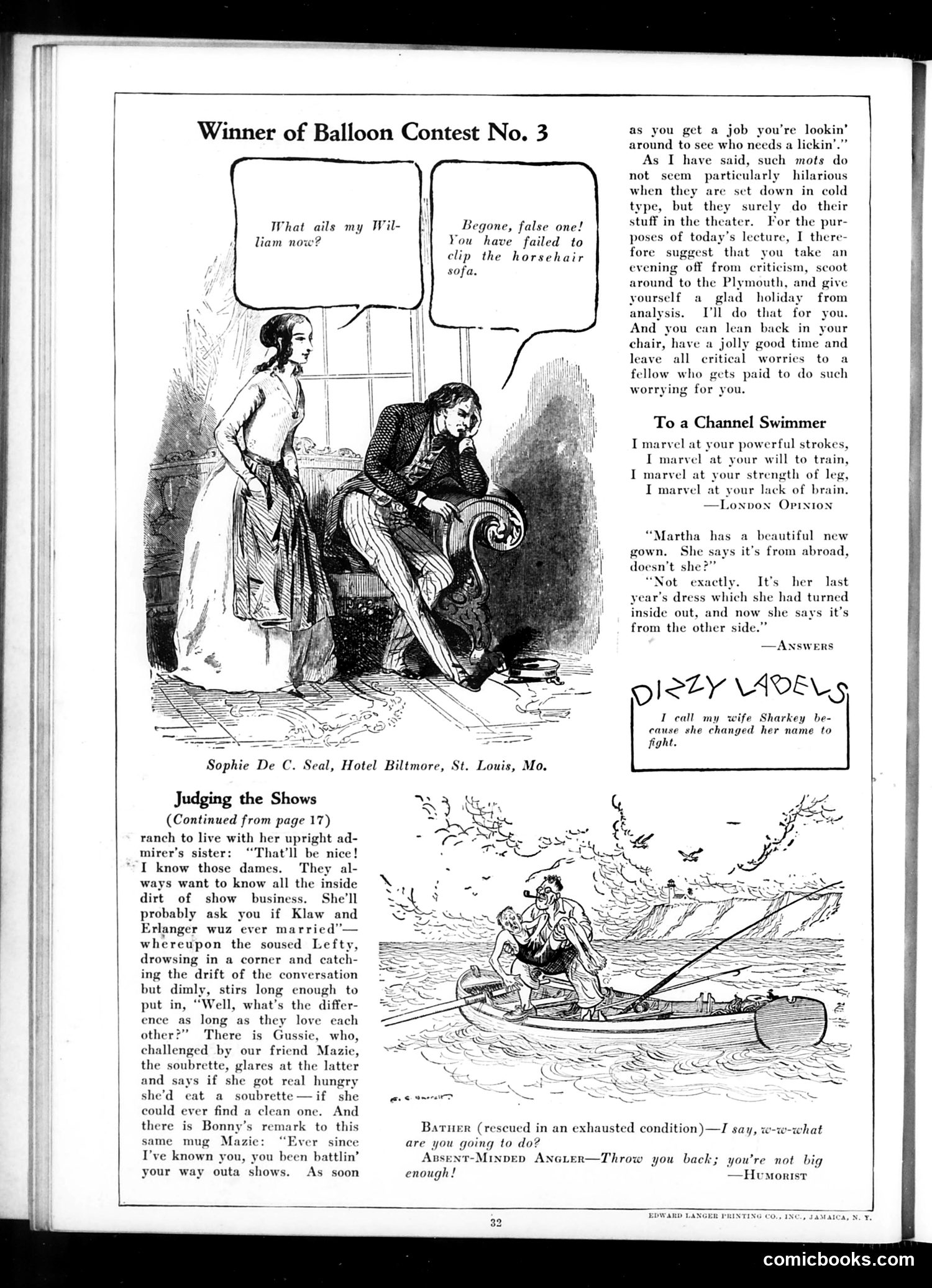
This page contains three unrelated humor pieces typical of early 20th-century satirical magazines: 1. **"Winner of Balloon Contest No. 3"**: A domestic scene where a wife complains her husband has failed to "clip the horsehair sofa"—likely a household maintenance task. The humor relies on marital friction and domestic incompetence. 2. **"To a Channel Swimmer"**: A poem mocking channel swimmers (likely referring to English Channel crossings, a popular feat). It sarcastically "marvels" at their physical prowess while insulting their intelligence—a common formula for period humor. 3. **"Judging the Shows"**: Theater gossip and anecdotes about show business characters, including references to Klaw and Erlanger (major theatrical producers/managers of the era). The humor concerns theatrical rivalries and showbiz personalities. 4. **"Dizzy Labels"**: Brief humorous definitions, including a joke about a wife named "Sharkey" who "changed her name to fight." 5. **Bottom illustration**: A fishing scene with banter between a rescued boater and an "absent-minded angler"—straightforward sight gag humor. The page reflects early 1900s concerns: domestic life, theatrical industry gossip, and recreational activities.
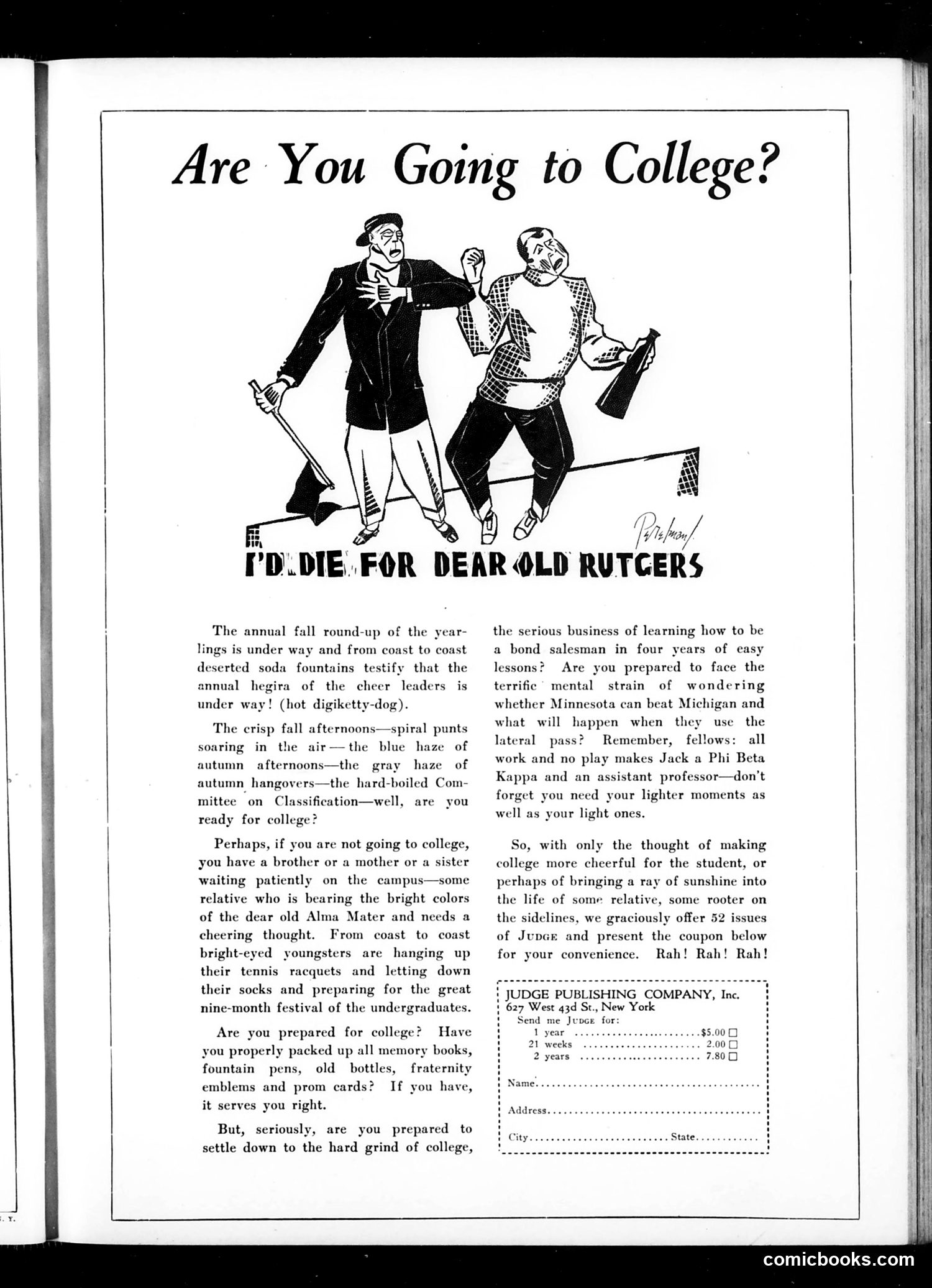
This page satirizes college culture through a humorous editorial promoting Judge magazine subscriptions to prospective students and their families. **The Cartoon:** The illustration shows two young men in distress—one in formal attire, one casual—appearing frantic about college preparation. The caption "I'D DIE FOR DEAR OLD RUTGERS" ironically undercuts their apparent anxiety, suggesting the overwrought emotional investment in college loyalty. **The Satire:** The article mocks several college traditions: the seasonal arrival of freshmen ("yearlings"), the obsession with football (Minnesota vs. Michigan), Greek life (Phi Beta Kappa references), and the idealized view of college as primarily social rather than academic. The writer cynically notes that college supposedly teaches students "how to be a bond salesman in four years of easy lessons"—suggesting higher education is mere credentialing rather than genuine intellectual development. **The Hook:** Judge offers subscriptions (52 issues yearly for $5) as the perfect gift for college-bound relatives, positioning the magazine as essential entertainment for the college experience. The tone blends satire with genuine marketing appeal.
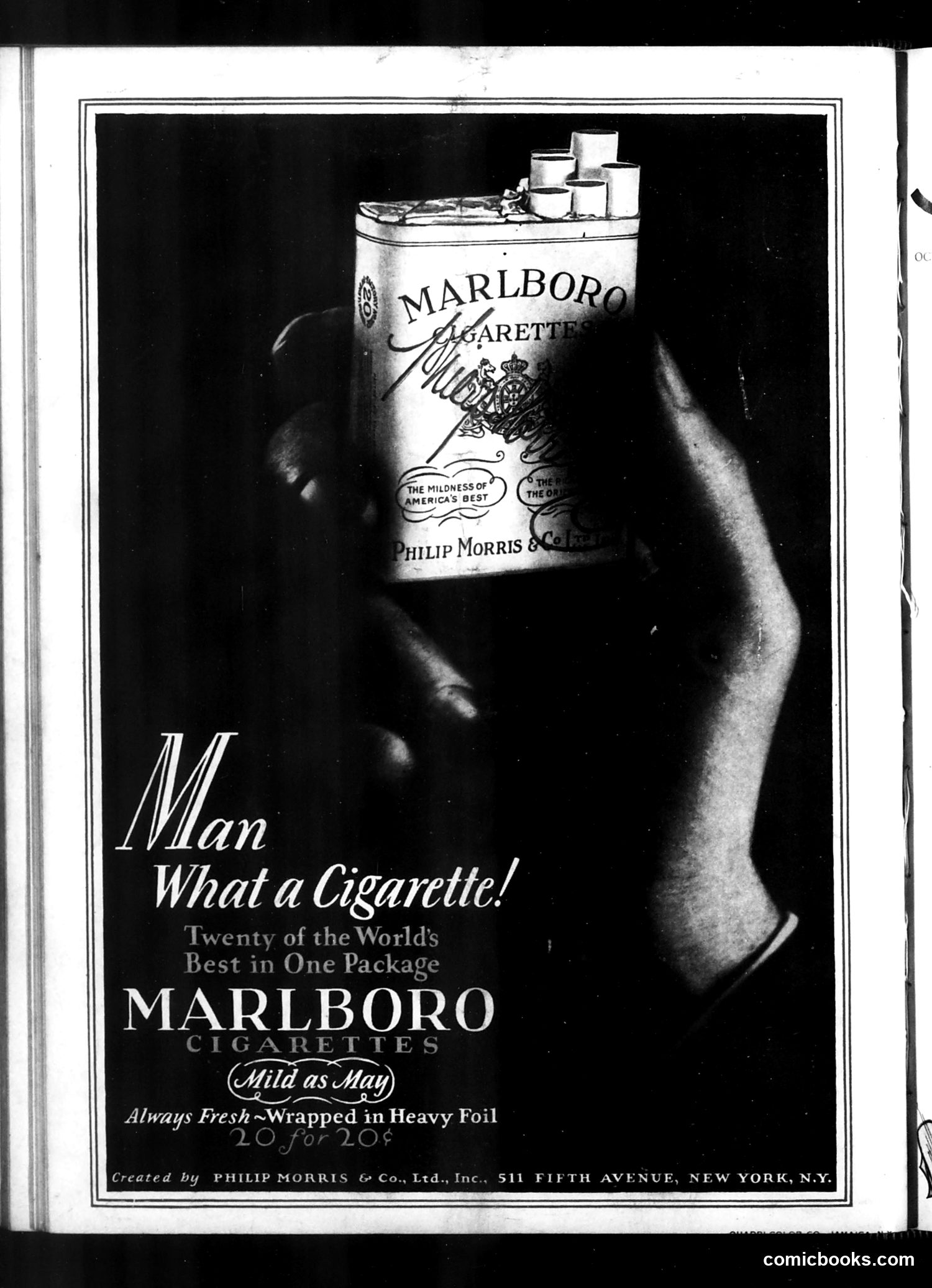
This is primarily a **cigarette advertisement**, not satirical content. It appears in *Judge* magazine, which regularly carried advertisements alongside humor. The ad features a man's hands and silhouetted face holding a Marlboro cigarette package, emphasizing the product's appeal to masculine consumers. Key selling points include: - "Twenty of the World's Best in One Package" - "Mild as May" (positioning as gentler than competitors) - "Always Fresh—Wrapped in Heavy Foil" (emphasizing preservation/quality) - Price: "20 for 20¢" The headline "Man What a Cigarette!" uses casual, enthusiastic language typical of mid-20th-century advertising designed to appeal to male buyers. **Note**: This predates Marlboro's famous 1950s-60s "Marlboro Man" campaign. There's no evident political satire on this page—it's straightforward commercial advertising from the cigarette industry's pre-regulation era.