
Judge, 1927-09-24 · page 19 of 36
Judge — September 24, 1927 — page 19: what you’re looking at
What you’re looking at
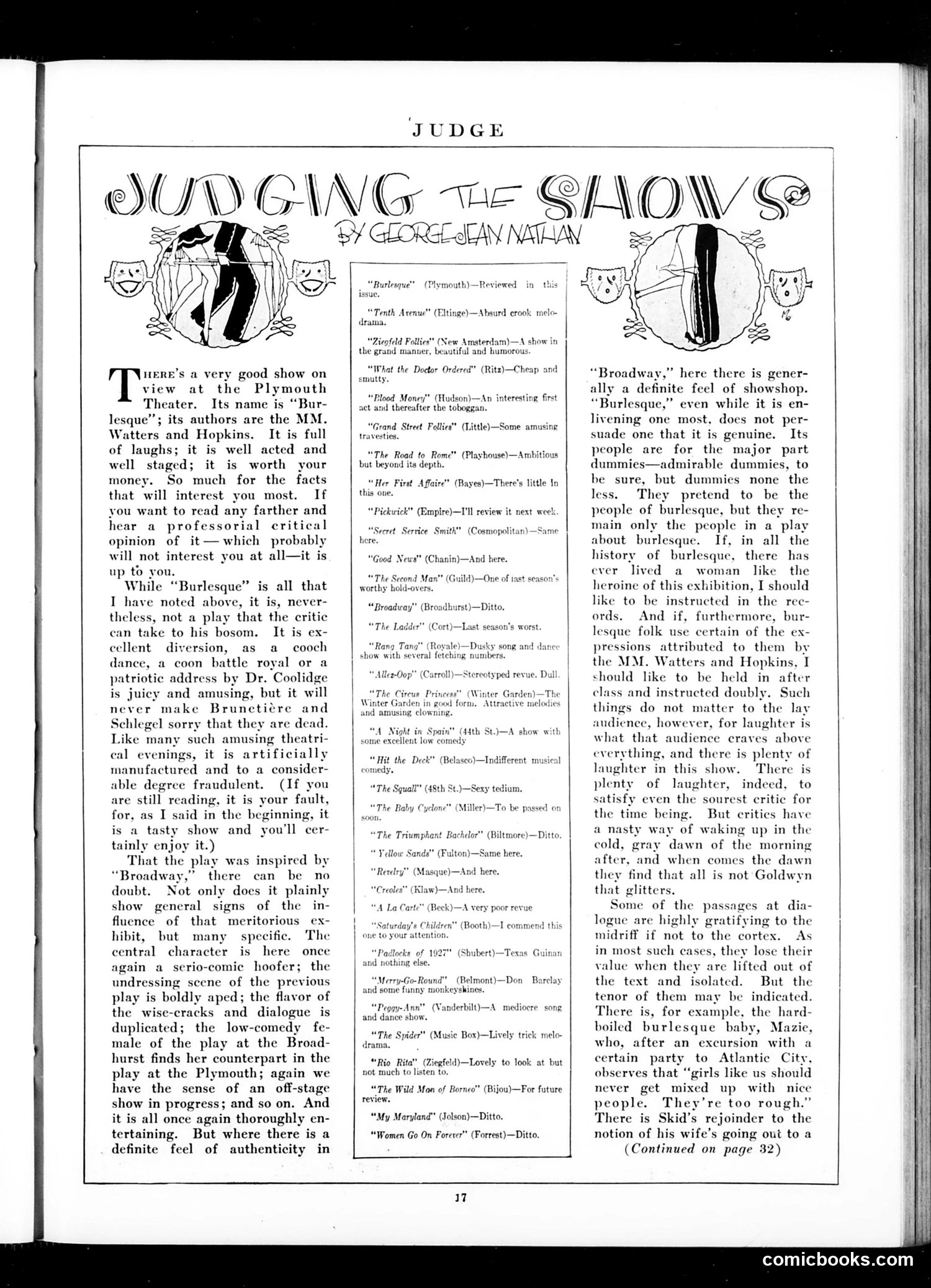
This page is a theater critic's review column from Judge magazine, not a political cartoon. The critic reviews the Broadway play "Burlesque" at the Plymouth Theater, written by Watters and Hopkins. **The main point:** While "Burlesque" is entertaining and well-acted, it lacks authenticity. The critic argues it's artificially manufactured—essentially an imitation of the successful play "Broadway" (running at the Hurst Theater). He compares it to "a cooch dance" or "patriotic address"—amusing but fundamentally fraudulent entertainment. **The critique's tone:** Nathan uses snobbish language, name-dropping European literary critics (Brunetière, Schlegel) to emphasize that while "Burlesque" succeeds as populist entertainment, it will never achieve serious artistic merit. The review exemplifies early 20th-century theater criticism's class-conscious dismissal of commercial entertainment as "dummies"—fake people in a fake world. The page also lists brief reviews of other Broadway shows.
📄 Transcribed text from this page (OCR, searchable)
Machine-transcribed from the original scan — historical spelling and the odd misread are preserved.
‘JUDGE e) LOK HERE’s a very good show on ew at the Plymouth Theater. Its name is “Bur- lesque”; its authors are the MM. Watters and Hopkins. It is full of laughs; it is well acted and well staged; it is worth your money. So much for the facts that will interest you most. If you want to read any farther and hear a professorial critical opinion of it—which probably will not interest you at all—it is up to you. While “Burlesque” is all that I have noted above, it is, never- theless, not a play that the critic can take to his bosom. It is ex- cellent diversion, as a cooch dance, a coon battle royal or a patriotic address by Dr. Coolidge is juicy and amusing, but it will never make Brunetiére and Schlegel sorry that they are dead. Like many such amusing theatri- cal evenings, it is artificially manufactured and to a consider- able degree fraudulent. (If you are still reading, it is your fault, for, as I said in the beginning, it is a tasty show and you'll cer- tainly enjoy it.) That the play was inspired by “Broadway,” there can be no doubt. Not only does it plainly show general signs of the in- fluence of that meritorious ex- hibit, but many specific. The central character is here once again a serio-comic hoofer; the undressing scene of the previous play is boldly aped; the flavor of the wise-cracks and dialogue is duplicated; the low-comedy fe- male of the play at the Broad- hurst finds her counterpart in the play at the Plymouth; again we have the sense of an off-stage show in progress; and so on. And it is all once again thoroughly en- tertaining. But where there is a definite feel of authenticity in WGI ING = hed SHOW Se Burlesque" (Plymouth) Reviewed Tenth Avenue” (Eltinge)—Absurd crook 1 drama, ieofeld Folti the grand manner, b (New Amsterdam)—A show in uutiful and humorou: hat the Doctor Ordered (Ritz)—Cheap and utty. “Blood Money" (Hudson)—An interesting first act and thereafter the toboggan. “Grand Street Follies (Little)—Some amusing travesties. “The Road to Rome (Playhouse)—Ambitious but beyond its depth. “Her First Affaire” this one. (Bayes)—There’s little In “Pickwick” (Empire)—I'll review it next weel: ret Serrice Smith" (Cosmopolitan “Good News" (Chanin)—And here. “The Second Man worthy hold-overs. Juild)—One of tast season’s “Broadway” (B t)—Ditto. D's worst “Rang Ta show with seve Royale)—Dusky song and | fetching numbers. ““Allea-Oop” (Carroll) —Stereotyped revue. Dull “The Circus P Winter G: and amus Winter Garden)—The 1 good form, Attractive melodies “A. Night in Spain” (44th St.)—A some excellent low comedy how with “Hit the Deck comedy. (Belasco)—Indifferent music “The Squall” (48th St Sexy tedium, he Baby Cyclone” Miller)—Te he Triumphant Bachelor" (Biltmore)—Ditto. low Sands” (Fulton) —Same here. (Masque)—And here. Klaw)—And he “A La Carte” (Beck)—A ve Saturday's Child one to your attention, * (Booth)—I ec f 1927" (Shubert)—Texas Guinan ferry-Go-Round” (Belmont)—Don Barclay and some funny monkeyshines. and dane ‘he Ann (Vanderbilt)—A mediocre song how. Spider" (Music Box)—Lively trick “Rio Rita” (Ziegfeld)—Lovely to look not much to listen to. “The Wild Man of Borneo” (Bijou)—For future review. “My Maryland” (Jolson)—Ditto. “Women Go On Forever” (Forrest)—Ditto. t but “Broadway,” here there is gener- ally a definite feel of showshop. “Burlesque,” even while it is en- livening one most, does not per- suade one that it is genuine. Its people are for the major part dummies—admirable dummies, to be sure, but dummies none the They pretend to be the people of burlesque, but they re- main only the people in a play about burlesque. If, in all the history of burlesque, there has ever lived a woman like the heroine of this exhibition, I should like to be instructed in the rec- ords. And if, furthermore, bur- lesque folk use certain of the ex- pressions attributed to them by | the MM. Watters and Hopkins, I should like to be held in after class and instructed doubly. Such things do not matter to the lay audience, however, for laughter is what that audience craves above everything, and there is plenty of laughter in this show. There is plenty of laughter, indeed, to satisfy even the sourest critic for the time being. But critics have a nasty way of waking up in the cold, gray dawn of the morning after, and when comes the dawn they find that all is not Goldwyn that glitters. Some of the passages at dia- logue are highly gratifying to the midriff if not to the cortex. As in most such cases, they lose their value when they are lifted out of the text and isolated. But the tenor of them may be indicated. There is, for example, the hard- boiled burlesque baby, Mazie, who, after an excursion with a certain party to Atlantic City, observes that “girls like us should never get mixed up with nice people. They’re too rough.” There is Skid’s rejoinder to the notion of his wife’s going out to a (Continued on page 32) less. comicbooks.com