
Judge, 1927-09-24 · page 17 of 36
Judge — September 24, 1927 — page 17: what you’re looking at
What you’re looking at
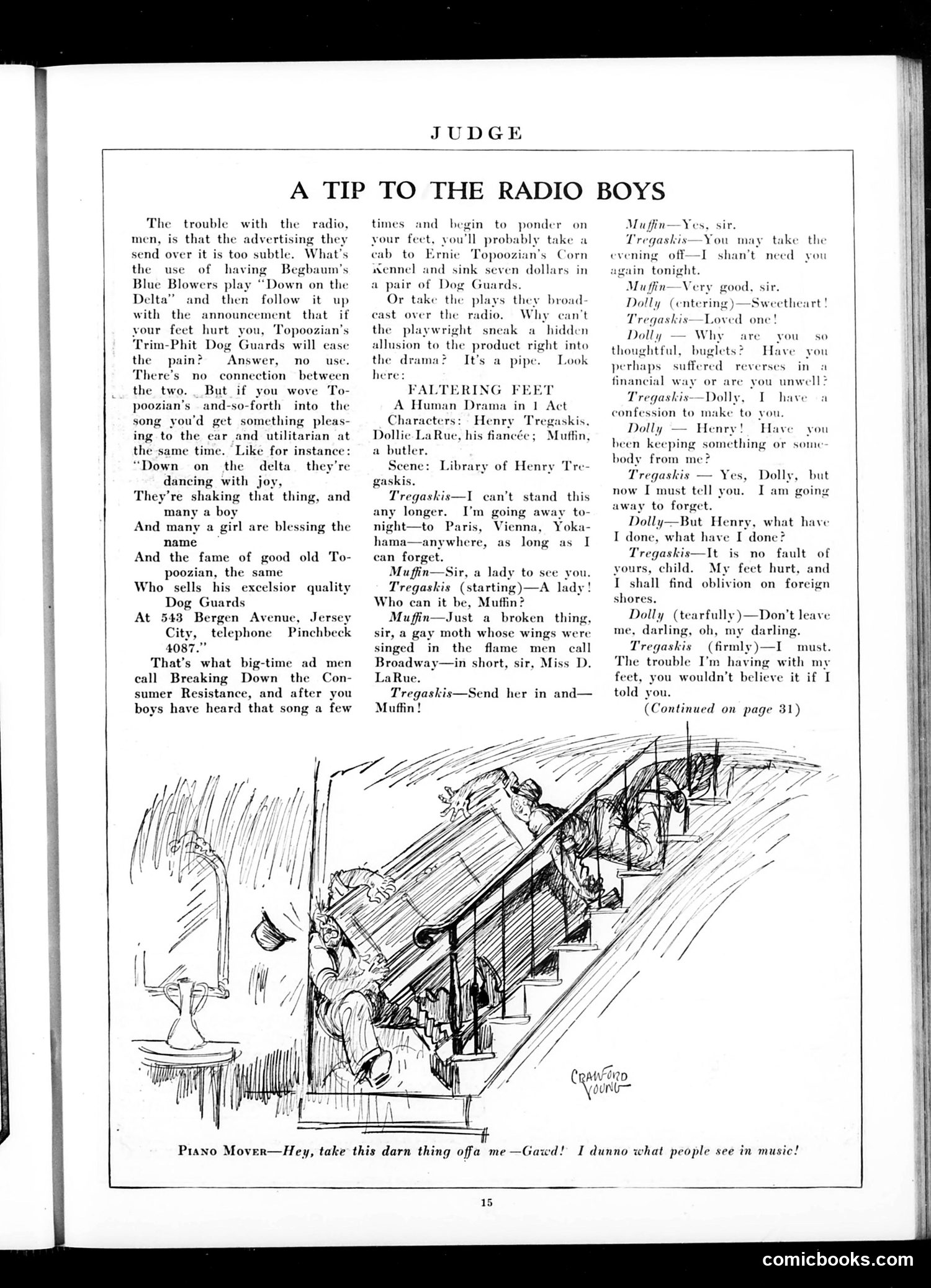
This 1920s Judge magazine page satirizes early radio advertising's ineffectiveness. The main article mocks how radio ads were subtle and disconnected from the programming—for example, playing a jazz song followed by an unrelated announcement about "Dog Guards" (shoe inserts) without integrating the product into the entertainment itself. The author humorously proposes that advertisers should weave product mentions directly into songs and dramatic broadcasts. To demonstrate, he provides a mock one-act play where the protagonist's entire romantic crisis—leaving his fiancée—stems absurdly from foot pain caused by poor shoe support, making the Dog Guards pitch integral to the plot. The bottom cartoon shows two workers struggling to move a piano, with one exasperatedly asking the other to remove it, concluding "I dunno what people see in music!"—a separate joke about classical music's perceived pretentiousness versus popular entertainment. The satire targets both radio advertising's primitive techniques and broader cultural anxieties about commercial manipulation.
📄 Transcribed text from this page (OCR, searchable)
Machine-transcribed from the original scan — historical spelling and the odd misread are preserved.
JUDGE A TIP TO THE RADIO BOYS The trouble with the radio, men, is that the advertising they send over it is too subtle. What’s the use of having Begbaum's Blue Blowers play “Down on the Delta” and then follow it up with the announcement that if your feet hurt you, Topo Trim-Phit Dog ‘ds will ed the pain? Answer, no use. There's no connection between the two. . But if you wove To- poozian’s and-so-forth into the song you'd get something pleas- ing to the ear and utilit the same time. Like for in : “Down on the delta they're dancing with joy, They’re shaking that thing, and many a boy And many a girl are blessing the name And the fame of good old To- poo , the same Who sells his excelsior quality Dog Guards At 543 Bergen Avenue, Jer: City, telephone Pinchbeck 4087.” That’s what big-time ad men call Breaking Down the Con- sumer Resistance, and after y boys have heard that song a few n’s Piano Mover—Hey, take this darn thing offa me —Gawd! times and begin to ponder on your feet, you'll probably take a cab to Ernie Topoozian's Corn axennel and sink seven dollars in a pair of Dog Guards. Or take the plays they broad cast over the radio. Why can't the playwright sneak a hidden allusion to the product right into the drama? It’s a pipe. Look here: FALTERING FEET A Human Drama in 1 Act Characters: : Henry Tregaskis. Dollie LaRue, his fiancée; Muffin, a butler. Scene: Library of Henry Tre- gaskis. Tregaski s—I can’t stand this any longer. I’m going ay to- night—to Paris, Vienna, Yoka- hamz anywhere, as long as I can forget. Muffin—Sir, a lady to see you, Tregaskis (starting)—A lady! Who can it be, Muffin? Muffin—Just a broken thing, sir, a gay moth whose wings were singed in the flame men Broadway—in short, sir, Miss D. LaRue. Tregaskis—Send her in and— Muffin! Crmvrro (0UNG- Muffin—Yes, sir. Tregaskis—You may take the evening off—I shan’t’ need you again tonight. Muffin—Very good, sir. Dolly (entering) —Sweetheart! Tregaskis—Loved onc! Dolly — Why are you so thoughtful, buglets? Have you perhaps suffered) reverses. in a financial way or are you unwell? askis-—Dolly, I have a confession to make to you. Dolly — Henry! Have you heen keeping something or som body from me? Tregaskis — Yes, Dolly, but now I must tell you. I am going away to forget. Dolly—But Henry, what have I done, what have I done? Tregaskis—It is no fault of yours, child. My feet hurt, and I shall find oblivion on foreign shores. Dolly (tearfully )—Don't leave me, darling, oh, my darling. Tregaskis (firmly)—I must. The trouble I'm having with my feet, you wouldn’t believe it if I told you. (Continued on page 31) I dunno what people see in music! comicbooks.com