A complete issue · 36 pages · 1927
Judge — March 26, 1927
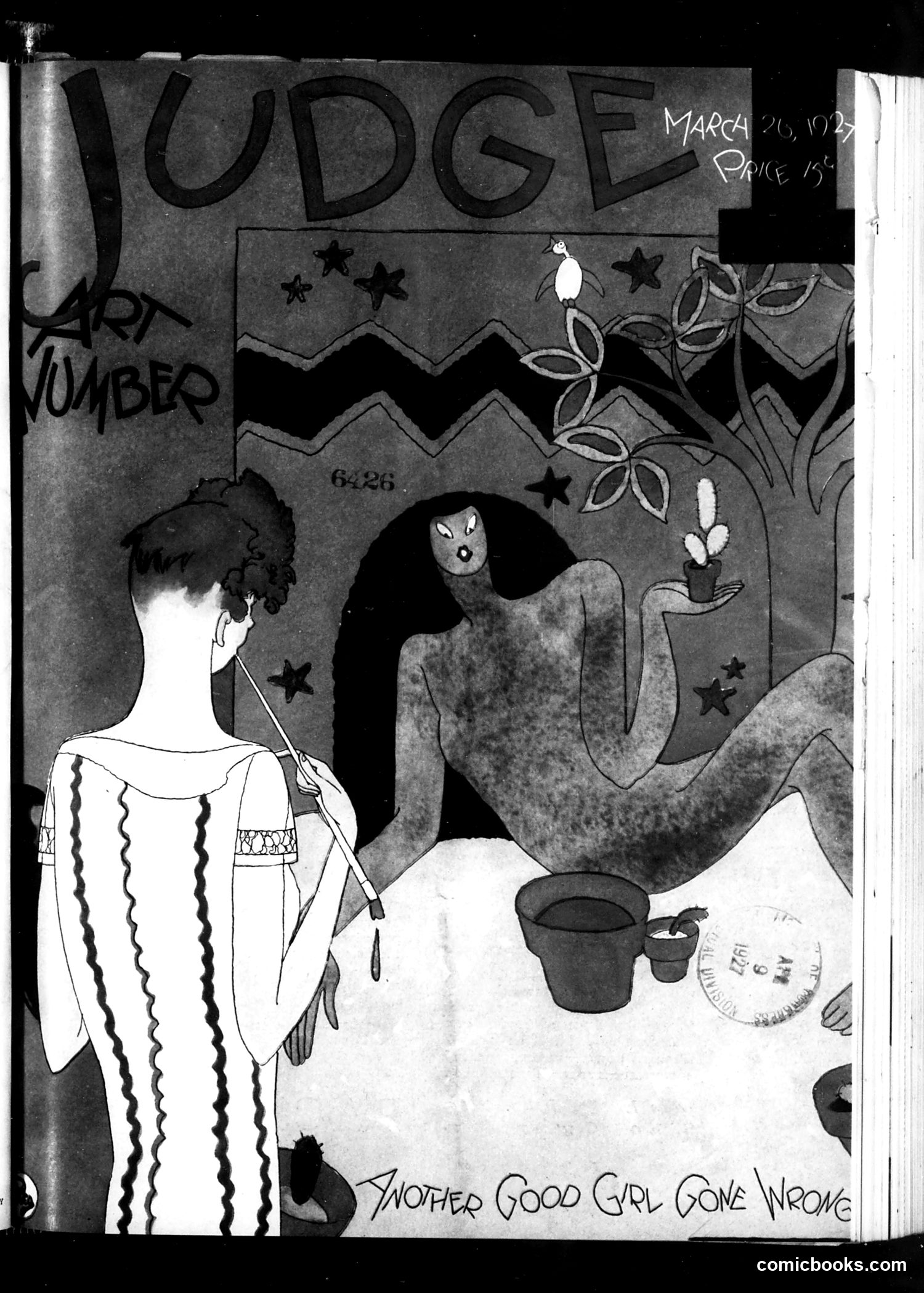
This satirical illustration titled "Another Good Girl Gone Wrong" depicts a woman viewing a large serpent-like creature in what appears to be a cave or dark chamber. The scene suggests a moral or cautionary tale about female transgression—a common Judge magazine theme from the 1920s. The woman, dressed in modest attire with decorative details, gazes at the creature while domestic items (pots, plants) surround the scene. The stars and surreal imagery emphasize the fantastical or nightmarish quality. The caption's "good girl gone wrong" phrasing reflects 1920s anxieties about changing female social roles and behavior during the Jazz Age. Judge frequently published moralistic satire targeting women's independence and new social freedoms, treating such changes as transgressive or foolish.
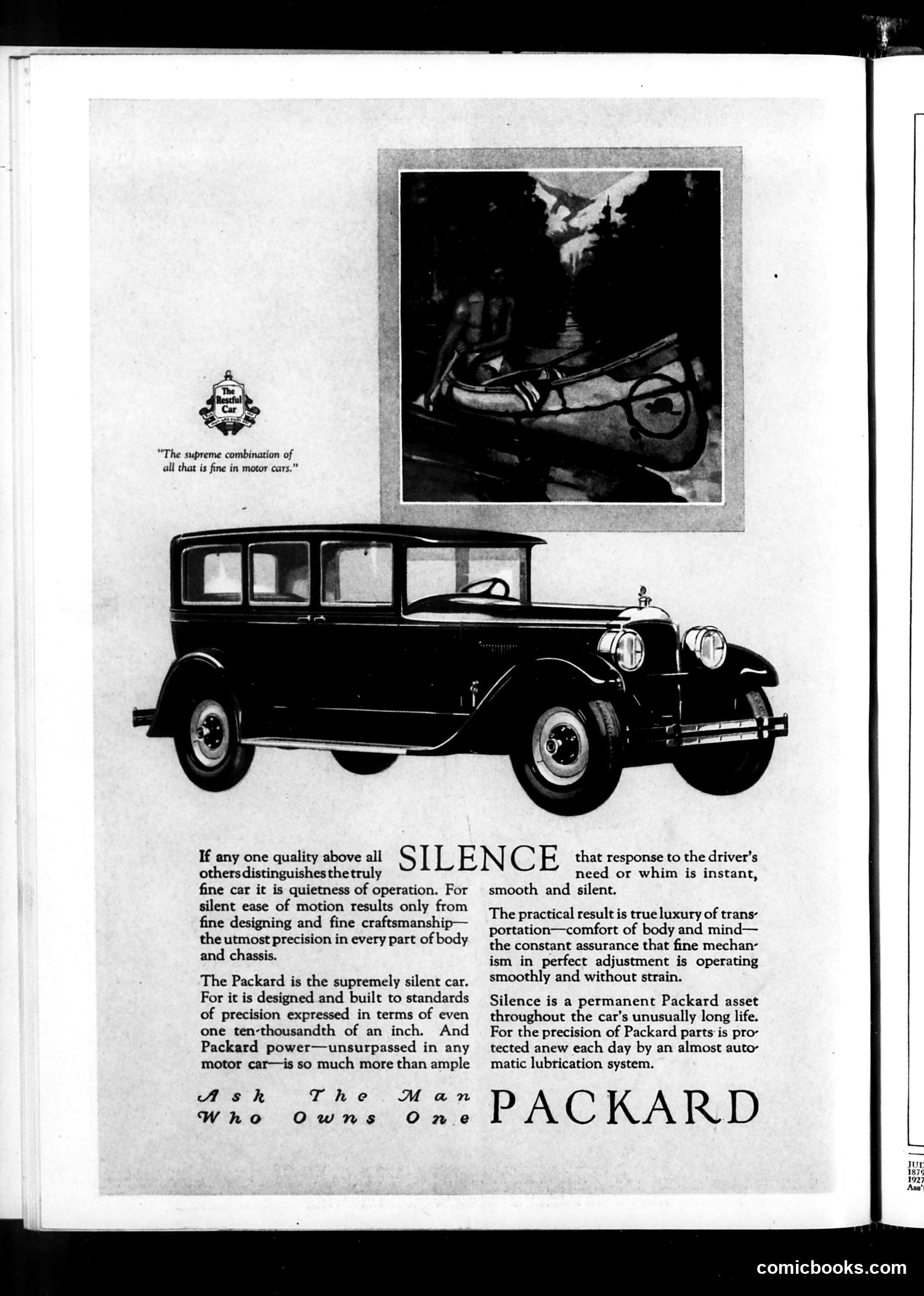
This is a **Packard automobile advertisement**, not a political cartoon. The page features a sleek 1920s sedan with accompanying promotional text emphasizing the car's engineering refinement. The advertisement's central argument is that "silence" distinguishes a truly fine automobile. It claims the Packard achieves superior quietness through precision design and craftsmanship, resulting in "smooth and silent" operation that provides "luxury of transportation—comfort of body and mind." The small photograph above the car appears to show automotive mechanical components, likely illustrating Packard's engineering precision. The tagline "Ask The Man Who Owns One" was a famous Packard slogan emphasizing owner satisfaction. This represents typical luxury car marketing of the 1920s era, targeting affluent buyers who valued refinement and reliability as status markers.
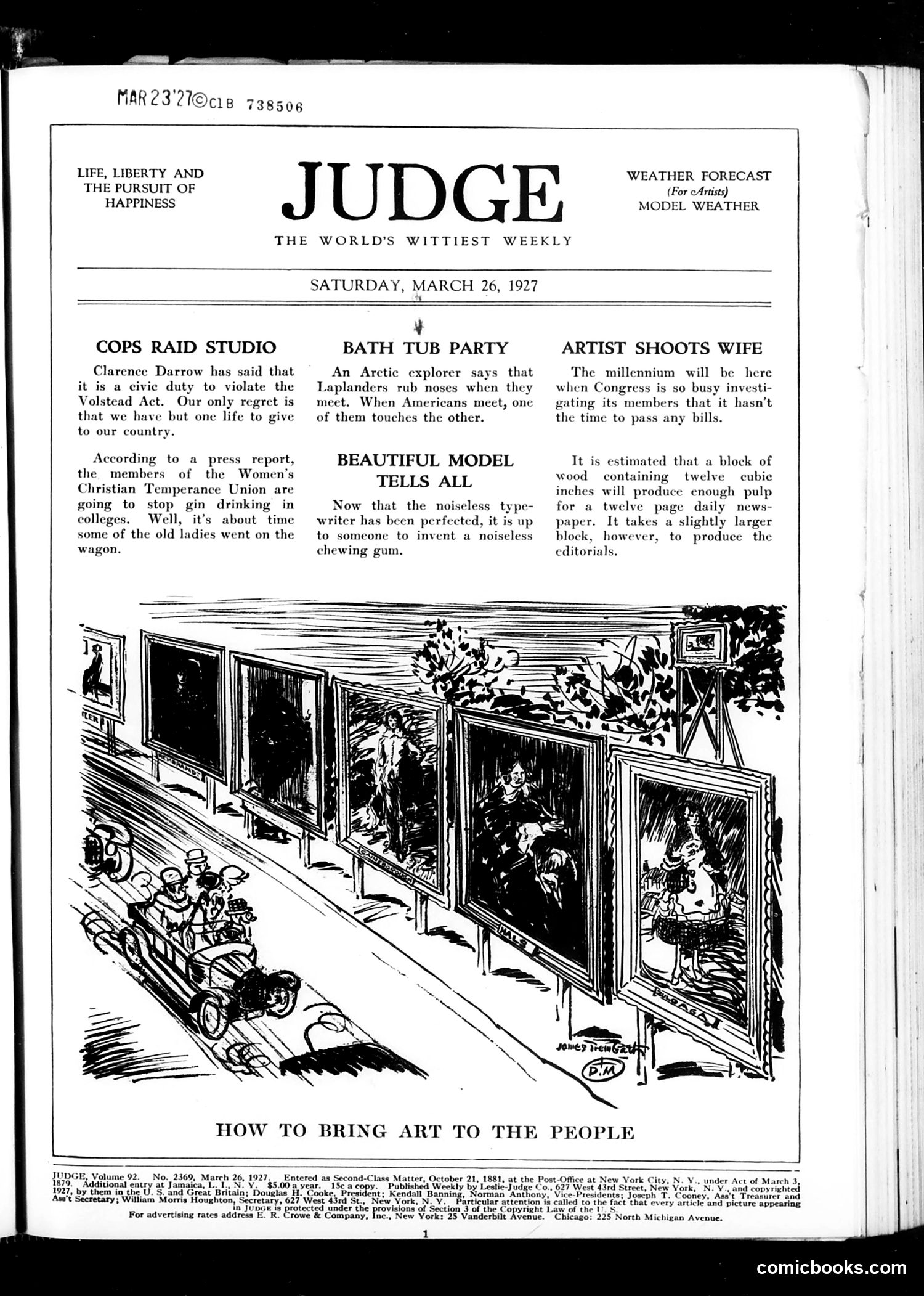
This cartoon satirizes the modernist art movement's attempt to make fine art accessible to ordinary citizens. The image shows an art gallery with paintings displayed in windows like a storefront, while a family in an old-fashioned automobile drives past as though window-shopping. The satire cuts two ways: it mocks both the pretentiousness of the art world (treating paintings as consumer goods) and the assumed indifference of the public (depicted as casual motorists). The joke suggests that bringing "art to the people" by simply putting it on display misses the point—neither the artists nor the public truly understands or engages with the other. This reflects 1920s anxieties about modernism's increasing abstraction and its disconnect from mainstream American culture.
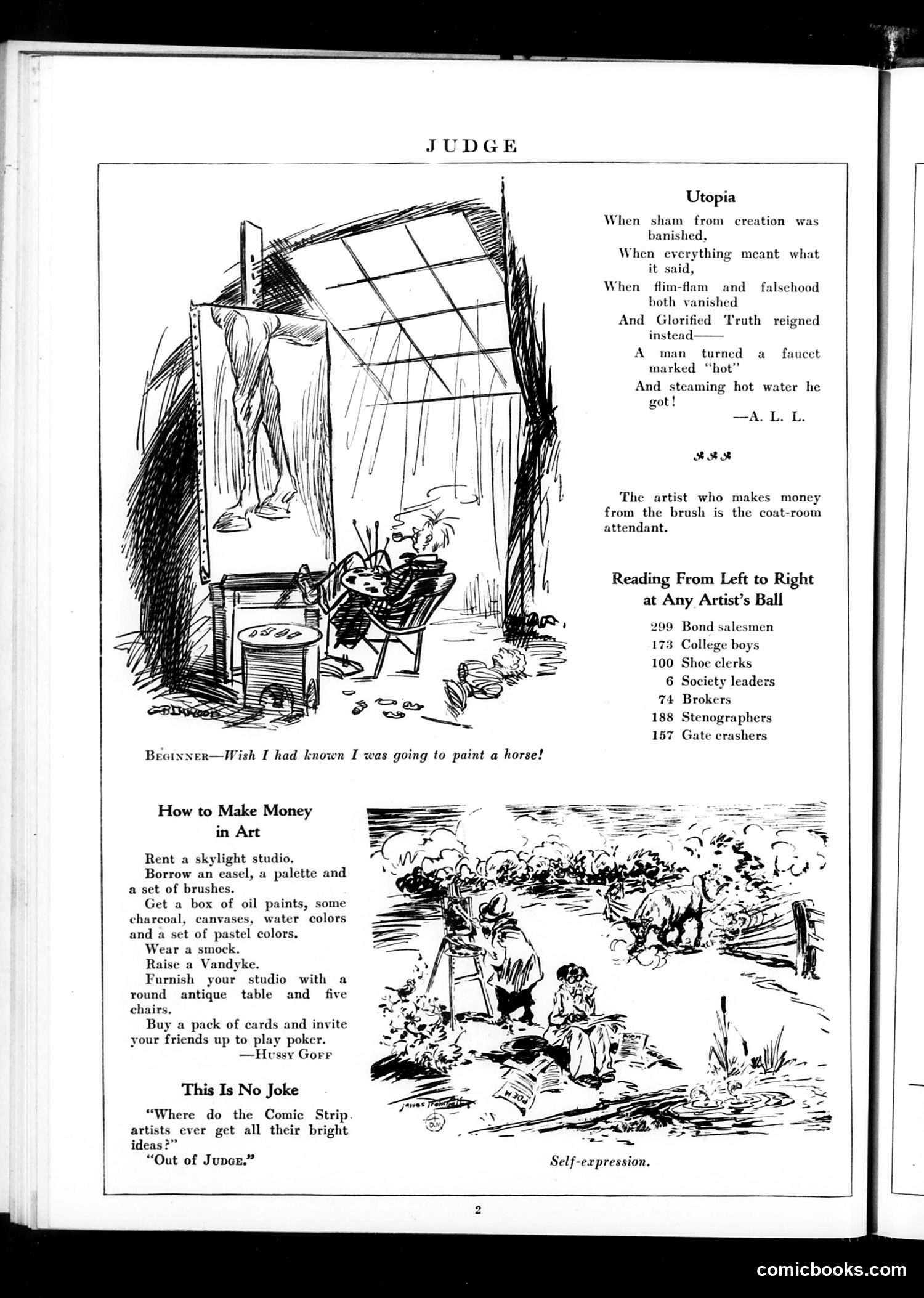
This page contains multiple satirical pieces targeting artistic pretension and bohemian culture: The main cartoon shows a struggling painter in a shabby studio, captioned "Wish I had known I was going to paint a horse!" — mocking artists who claim lofty intentions while producing mediocre work. "How to Make Money in Art" by Hessy Gorp satirizes the commercialization of art, listing absurd prerequisites (renting studios, wearing smocks, playing poker) rather than actual talent. The "Reading From Left to Right" section humorously categorizes artist's ball attendees by occupation, suggesting the event attracts con artists and social climbers rather than genuine artists. "Self-expression" (bottom illustration) depicts artists creating outdoors, likely critiquing romanticized notions of bohemian authenticity versus commercial reality. The overall satire targets early 20th-century art world pretension and the gap between artistic ideals and practical money-making.
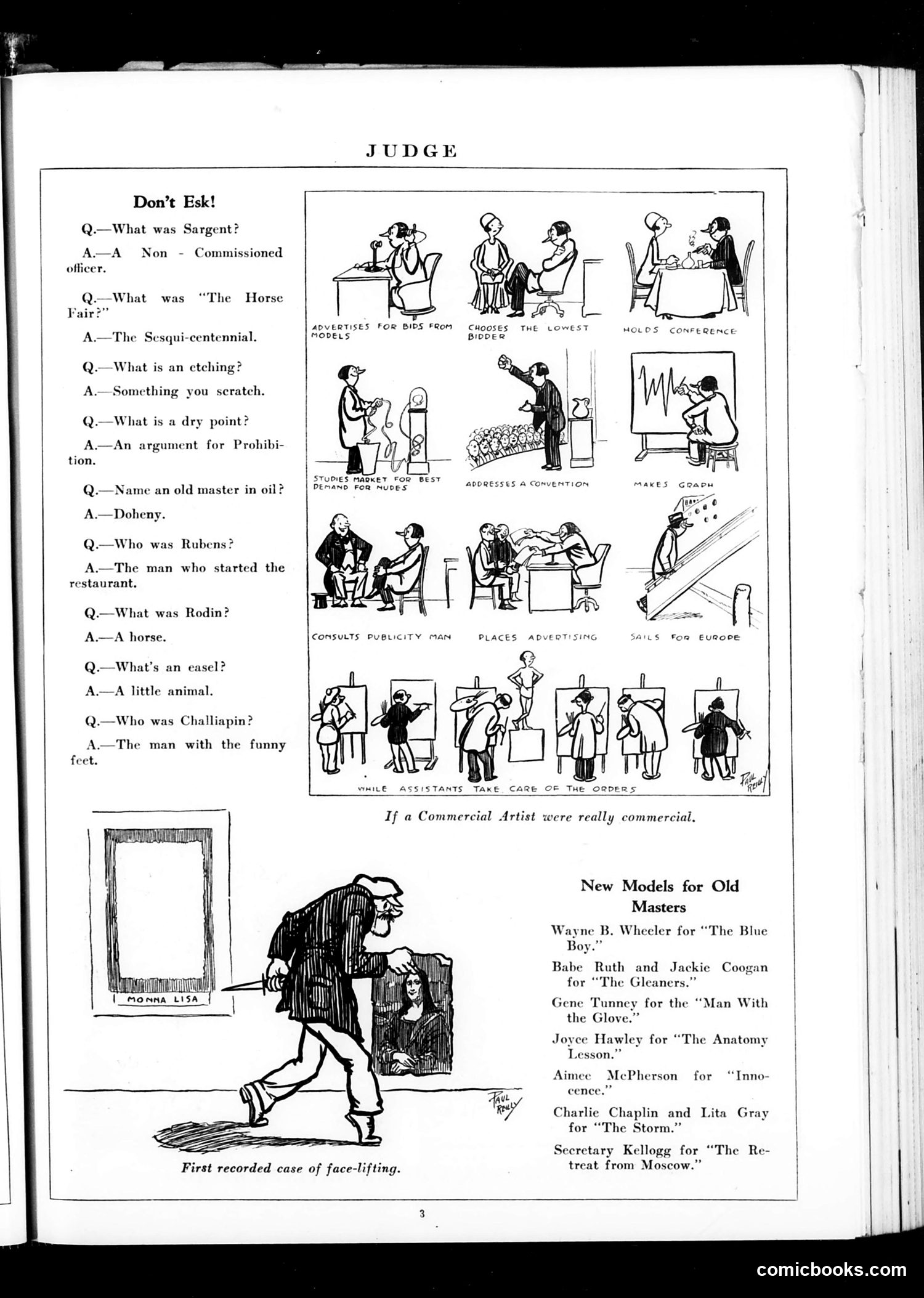
This *Judge* page combines humor and satire from the silent film era. The top section features a "Don't Ask!" Q&A mocking common knowledge gaps about art history, theater, and culture—answers like "A Non-Commissioned Officer" for Sargent and "The Sesqui-centennial" for "The Horse Fair" use wordplay to deflate pretension. The central cartoon series titled "If a Commercial Artist were really commercial" satirizes artists who abandon serious work for money, showing them pursuing advertising, endorsements, and mass-market commissions instead of fine art. The lower cartoon, "First recorded case of face-lifting," depicts an early reference to cosmetic surgery—likely mocking vanity or new beauty trends emerging in the 1920s. The page concludes with film credits for "New Models for Old Masters," indicating this issue featured accompanying films or theatrical shorts.
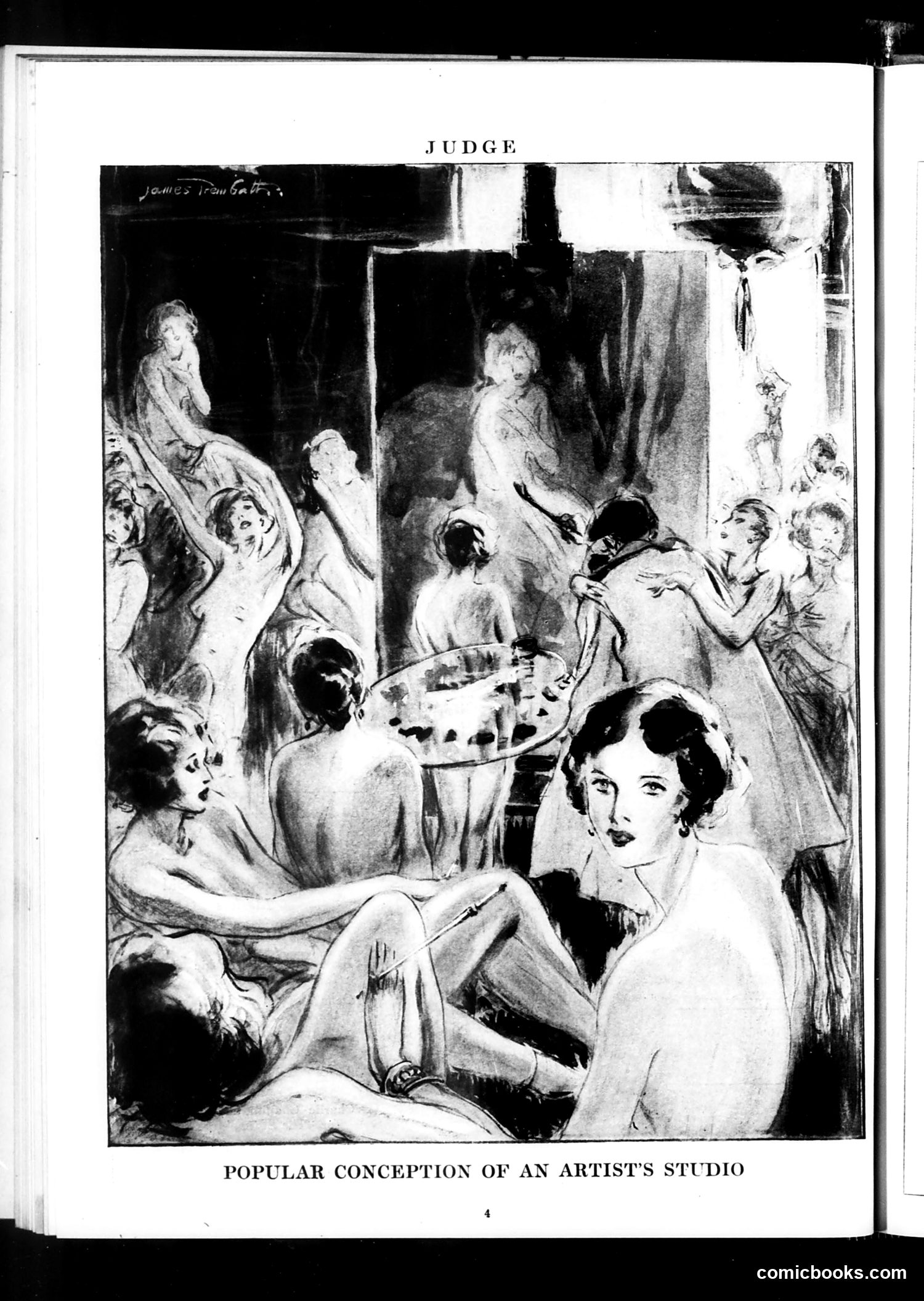
This appears to be a satirical illustration titled "Popular Conception of an Artist's Studio." The image depicts a bohemian studio scene crowded with nude and partially-clothed figures—models, artists, and visitors in various states of undress and activity. The satire targets bourgeois stereotypes about artist studios, which were often sensationalized in popular culture as dens of moral looseness and hedonism. The caption suggests this represents what "popular conception" imagined these spaces to be—implying the reality was likely far more mundane and professional. The cartoon mocks both the public's prurient fascination with artistic life and, possibly, the pretensions of artists themselves. This reflects late 19th/early 20th-century anxieties about bohemian culture and unconventional lifestyles challenging Victorian propriety.
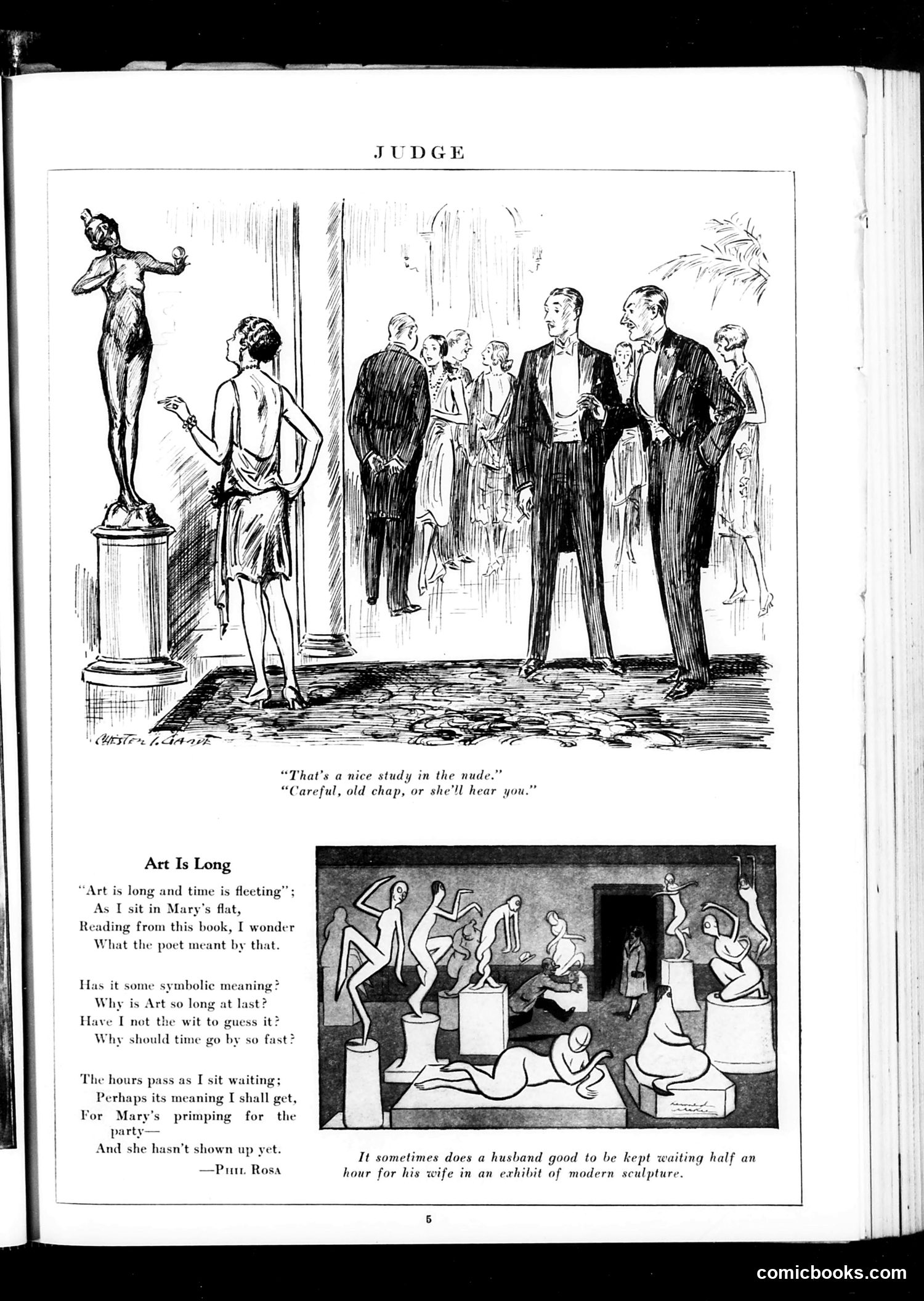
**Top Cartoon ("Judge"):** This appears to be a courtroom or formal setting satire. A nude classical statue of Justice stands on a pedestal while a well-dressed man examines it. Other formally-dressed figures observe in the background. The dialogue—"That's a nice study in the nude" / "Careful, old chap, or she'll hear you"—suggests humor about admiring the statue's nudity while feigning propriety. The joke likely mocks Victorian-era pretense about discussing nudity, even in artistic contexts. **"Art Is Long" Section:** Combines verse by Paul Rosa with an illustration of an art gallery or sculptor's studio showing nude male and female models posing while clothed patrons view the work. The caption jokes about husbands being kept waiting while wives attend modern art exhibitions, poking fun at contemporary art world pretensions and gender dynamics of the period.
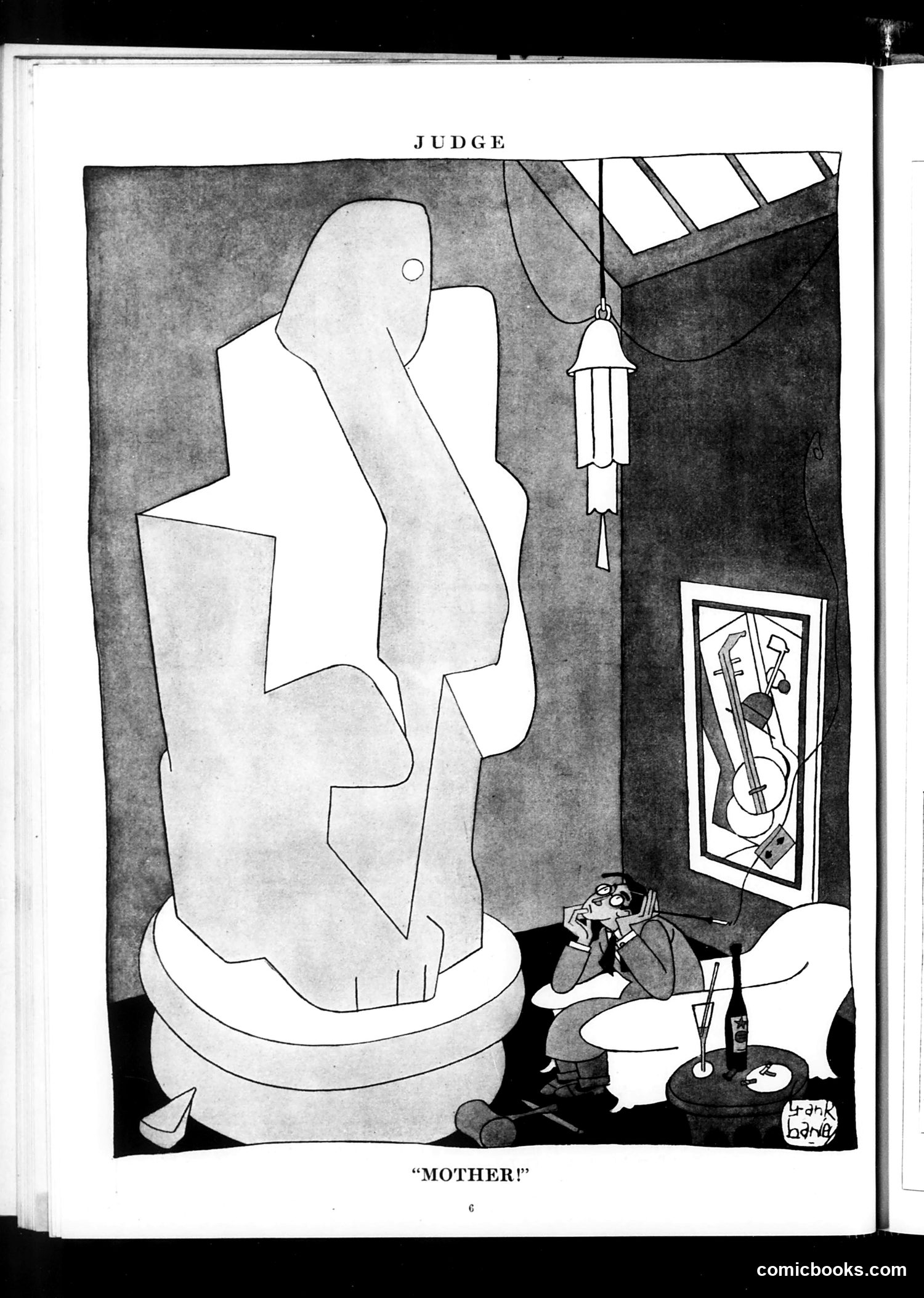
This cartoon depicts a man in an art gallery examining a large, abstract modernist sculpture labeled "MOTHER!" The sculpture is angular and fragmented—barely recognizable as human. The tiny figure's expression suggests bewilderment or concern as he gazes up at this monumental artwork. The satire targets early-20th-century modernist and abstract art movements, mocking the gap between artists' intentions and viewers' comprehension. By titling this incomprehensible geometric form "Mother," the cartoon ridicules how abstract artists assign weighty emotional or thematic meaning to work that appears to observers as pure nonsense. This reflects Judge's satirical stance against artistic pretension and the bewildering nature of avant-garde aesthetics to general audiences of the era.
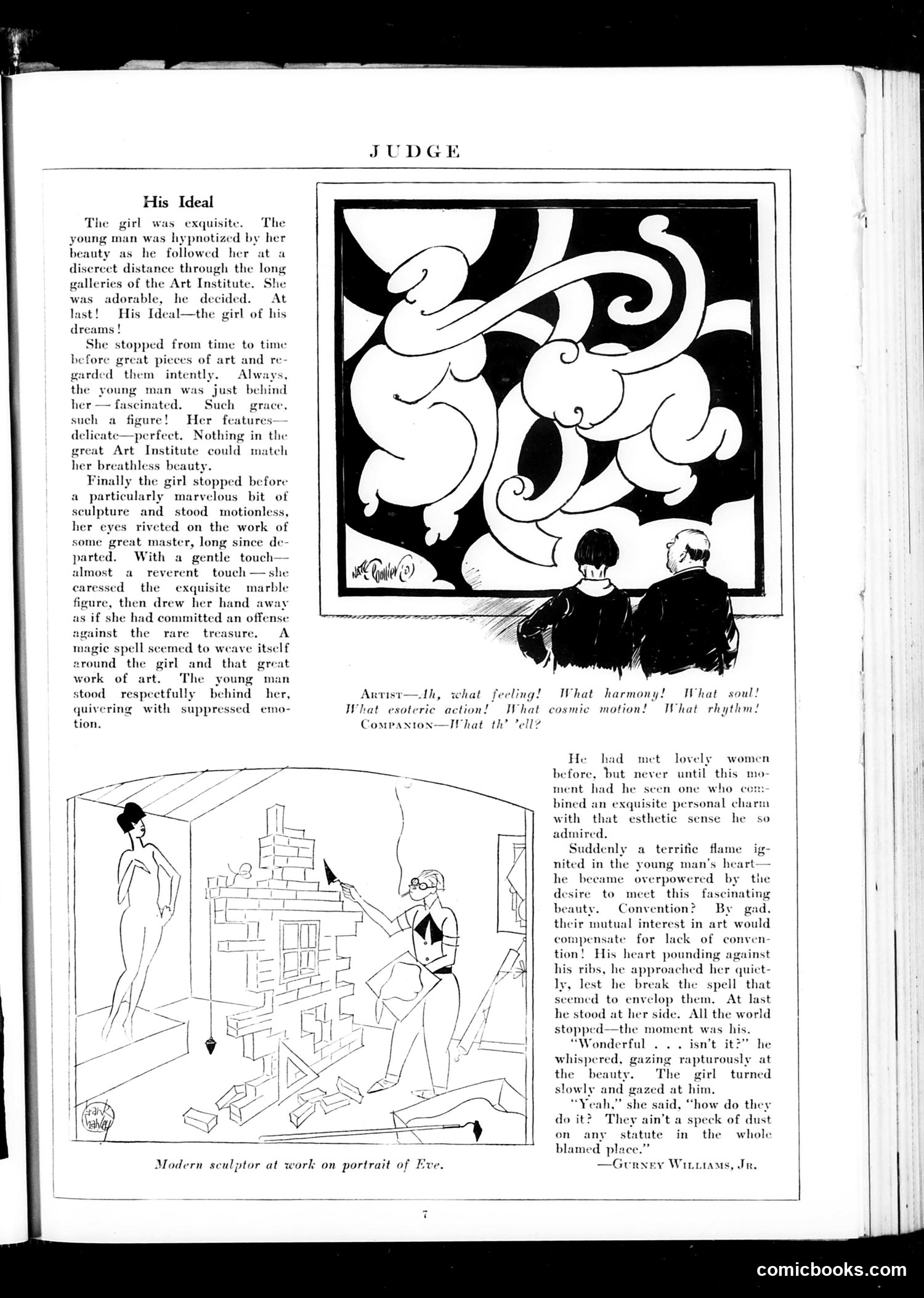
This is a romantic satire about class and aesthetic pretension. A young man becomes infatuated with a woman at an art museum, convinced she shares his refined artistic sensibility as she gazes reverently at sculptures. He works up courage to approach her, imagining their shared "esoteric" passion will overcome social convention. The joke: When he finally speaks to her, she reveals she's not an art lover at all—she's simply impressed that the statues are so clean ("They ain't a speck of dust"). The satire mocks both the young man's romantic delusions and the gap between working-class practicality and upper-class artistic pretension. His companion's dismissive "What th' 'ell?" underscores how absurd the whole scenario appears to ordinary people. The cartoons suggest that shared "culture" often masks fundamental class and educational differences in early 20th-century America.
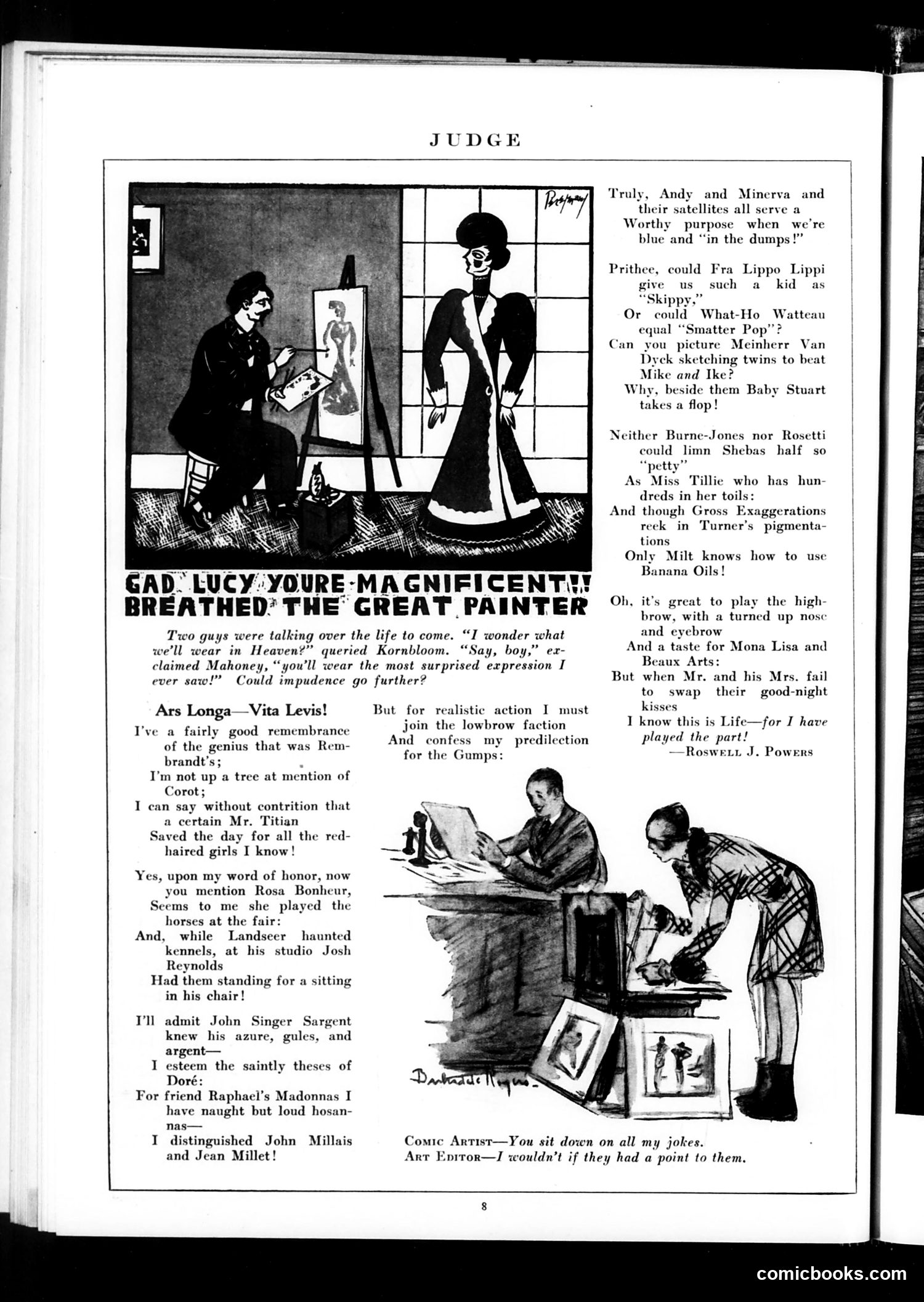
This page satirizes contemporary comic strip artists by comparing them favorably to Old Masters painters. The main article, "Ars Longa—Vita Levis!" ("Art is long, life is short"), argues that modern comic strip creators like **Milton Caniff** (known for "Banana Oils" expressions), the artists behind **"Andy and Minerva,"** **"Skippy,"** **"Smatter Pop,"** **"Mike and Ike,"** and **"The Gumps"** rival historical greats like Rembrandt, Titian, and Raphael in artistic skill and cultural importance. The cartoons above show a painter at work and a humorous exchange about Heaven's dress code—playing on the idea of artistic pretension. The bottom section parodies an art critic and cartoonist debating whether jokes need substance, suggesting ongoing tension between highbrow and lowbrow artistic appreciation. The satire defends popular comics as legitimate art forms worthy of serious consideration.
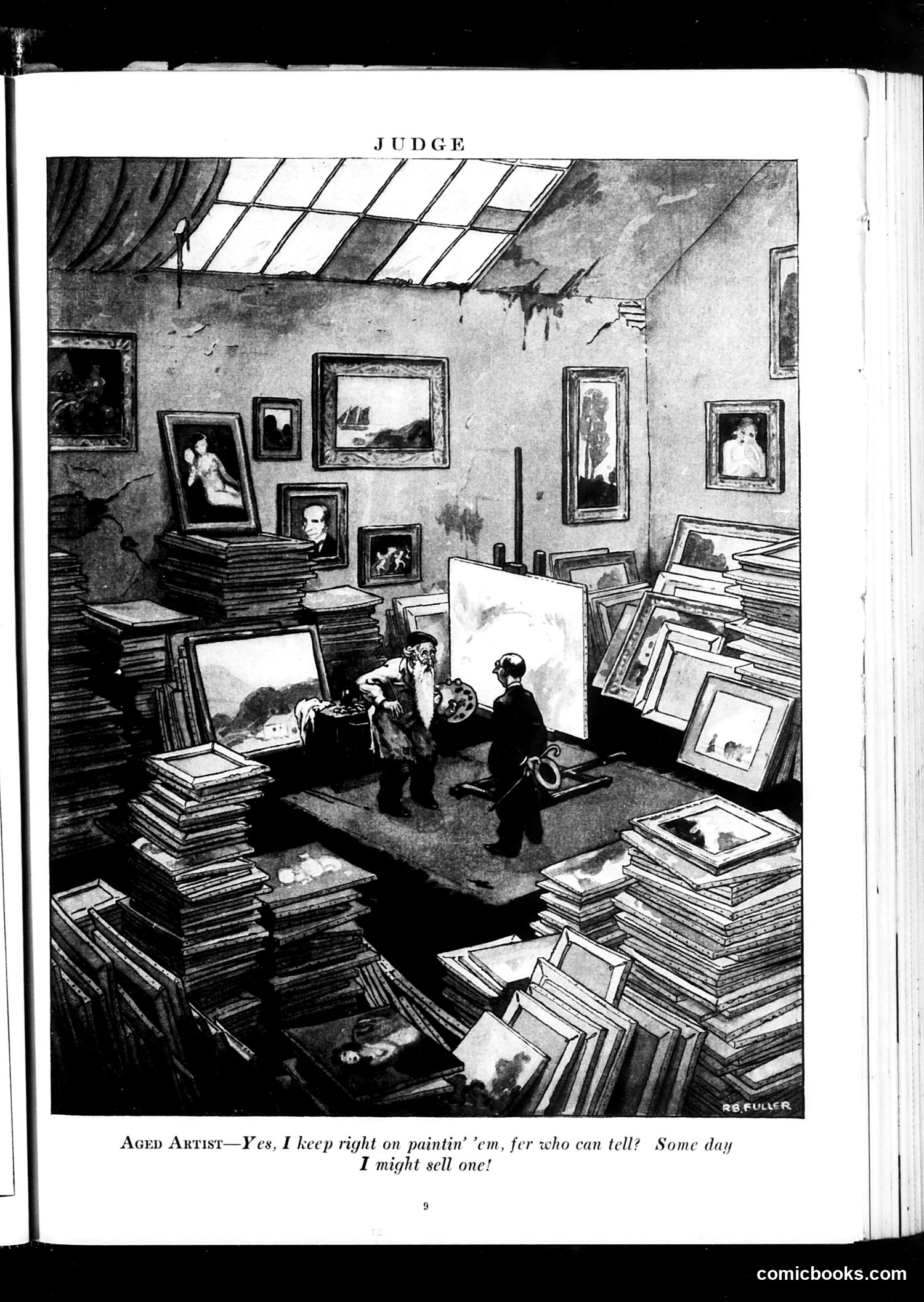
This cartoon depicts an elderly artist in a cluttered studio surrounded by stacks of paintings and frames. The humor satirizes the struggling artist's perpetual optimism despite apparent lack of commercial success. The joke plays on the gap between artistic persistence and economic reality: the aged painter continues producing work "for who can tell?" — meaning without knowing if he'll ever find buyers — yet maintains hope that "some day I might sell one." The cartoon mocks both the artist's unrealistic optimism and, by extension, the art market's indifference to creative work. The cramped, disorganized studio filled with unsold paintings emphasizes his lack of recognition or financial reward, making his continued effort appear either admirably stubborn or foolishly delusional—likely the satirical intent. The cartoonist is credited as "RG Fuller."
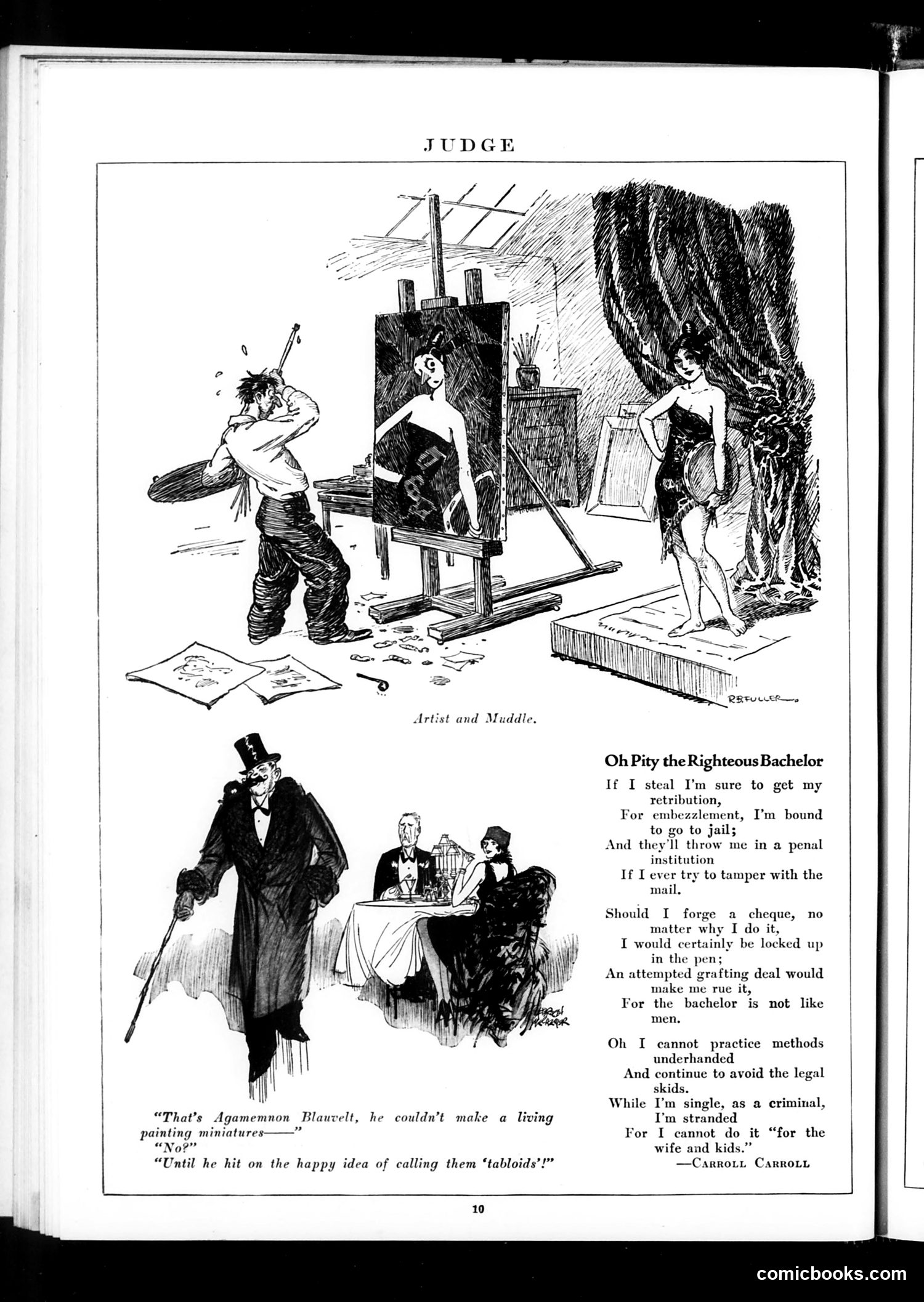
This page contains two satirical cartoons mocking artistic and social pretensions of the era. **"Artist and Muddle"** (top): Shows a struggling artist painting a woman's portrait while she poses. The caption jokes that the artist cannot succeed with legitimate "miniatures" but finds commercial success by rebranding them as "tabloids"—a pointed mockery of artists who compromise their craft for market appeal and sensationalism. **"Oh Pity the Righteous Bachelor"** (bottom): A poem satirizing the bachelor lifestyle. It humorously contrasts the bachelor's immunity from consequences ("not like men") with the married man's inability to commit crimes because he must support "wife and kids." The cartoon shows a well-dressed man being judged. The satire suggests bachelors face no social/legal accountability, while married men are constrained by familial responsibility—a commentary on class, morality, and domestic obligation in this era. Both cartoons mock contemporary social hypocrisies around art, commerce, and respectability.
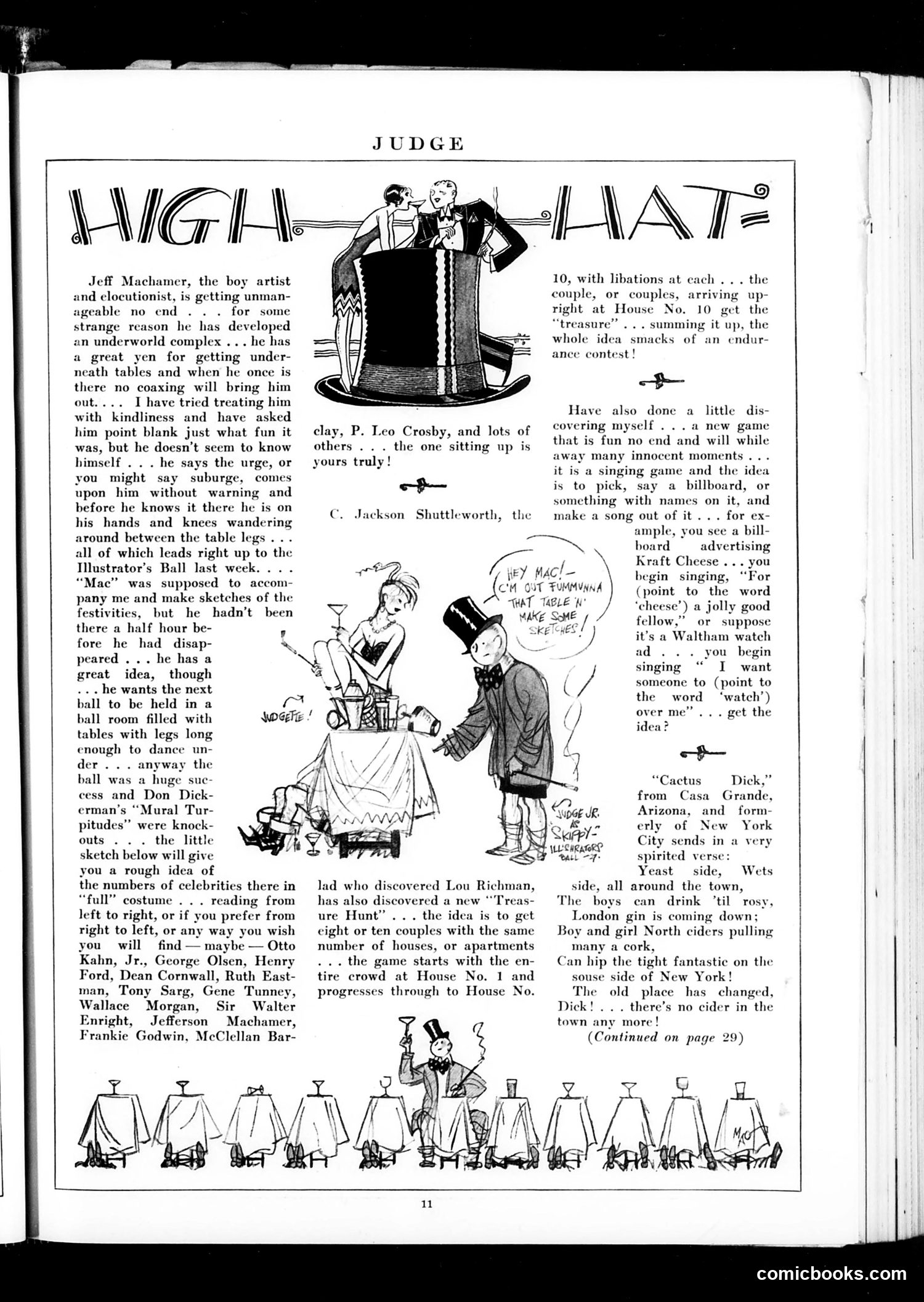
This is a social gossip column with accompanying cartoons about Manhattan's leisure class during the Jazz Age (likely 1920s). The writer describes artist Jeff Machamer's quirky obsession with crawling under tables—a humorous character sketch establishing him as eccentric. The main cartoon illustrates a "Mural Turpitudes" ball where Machamer sketched celebrities in "full costume" (meaning formal dress), with a visual gag showing a man's legs beneath a table. Named attendees include Henry Ford, Gene Tunney, and other prominent figures of the era. The column also describes two social games: a "Treasure Hunt" involving multiple houses and drinking, and a billboard-singing game where people spontaneously create songs from advertisement text (making "Kraft Cheese" or "Waltham watch" lyrics). A final verse laments Prohibition's effects—Arizona reader "Cactus Dick" nostalgically recalls when New York offered gin and cider, now illegal. The satire targets both Jazz Age excess and the impact of Prohibition laws.
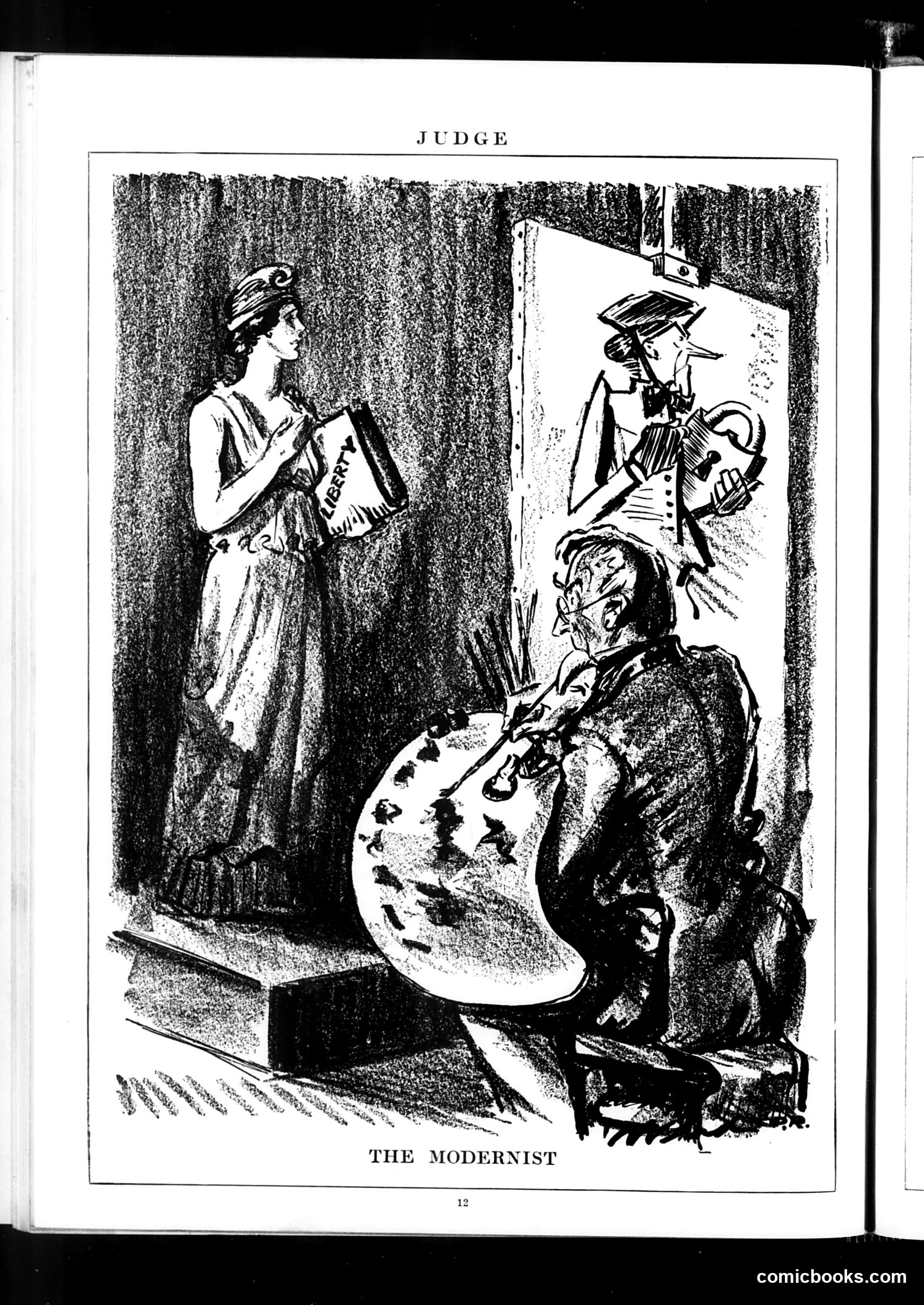
This cartoon satirizes modernist art and music. A woman on the left holds what appears to be a "Cubist" artwork or catalog, observing two male musicians. One plays an abstract, palette-shaped instrument covered in artistic marks; the other holds a similarly unconventional stringed instrument. Both musicians appear grotesque or caricatured. The satire targets early 20th-century modernism—specifically cubism and avant-garde music—as incomprehensible and ridiculous. The "modernist" label suggests these artistic movements are absurdly impractical or ugly compared to traditional aesthetics. Judge magazine, a conservative satirical publication, regularly mocked artistic and cultural innovations, positioning them as pretentious or meaningless rather than genuinely innovative.
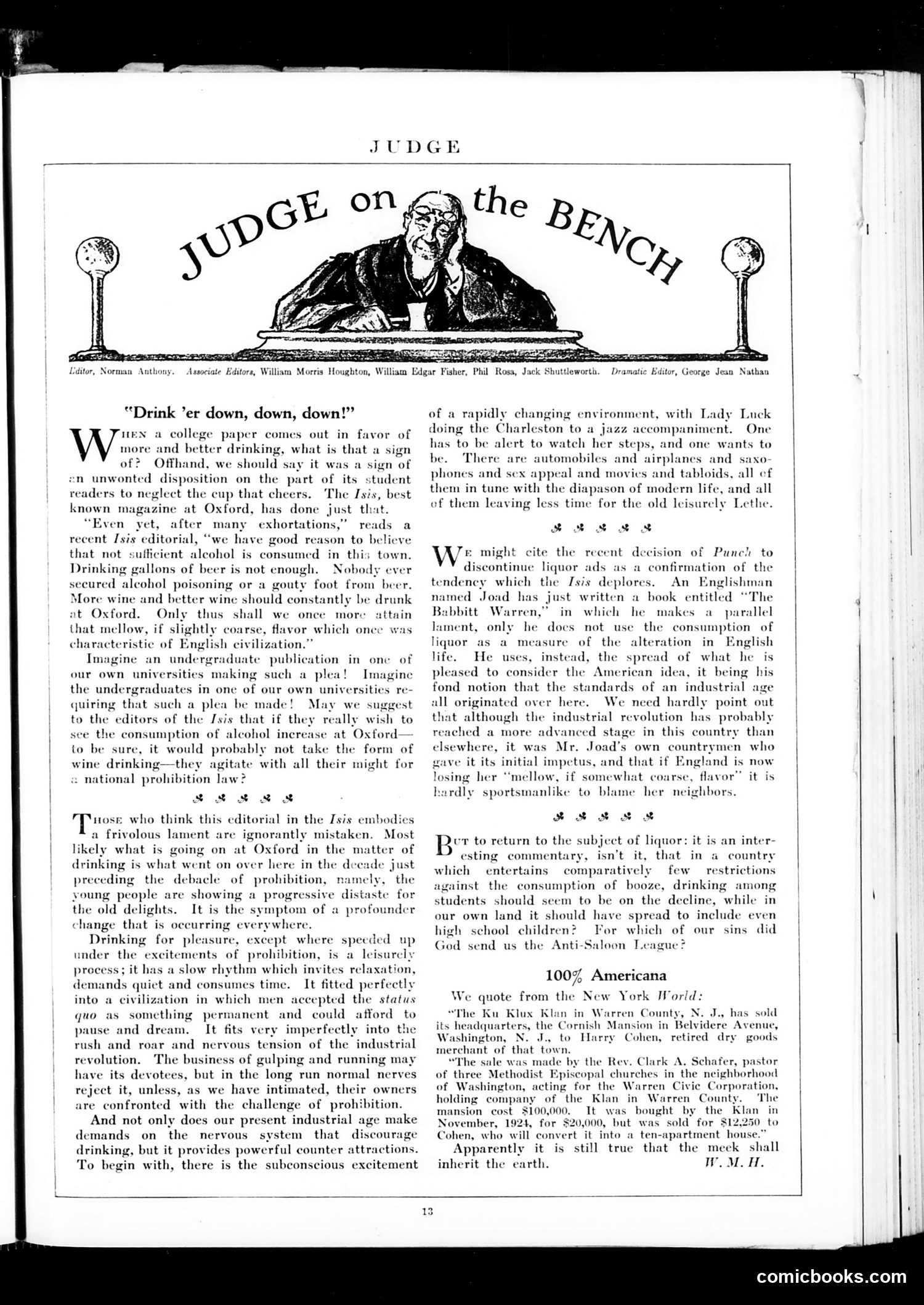
This page presents editorial commentary on declining alcohol consumption among young people, specifically referencing Oxford University's student magazine *Isis*, which had lamented insufficient drinking among undergraduates. **The Central Argument:** Judge defends the *Isis*'s concern but reframes it sociologically. The editors argue that young people's reduced interest in leisurely drinking reflects broader cultural shifts caused by industrialization and modern life's faster pace. Drinking demands "quiet and consumes time"—incompatible with contemporary anxieties and distractions (automobiles, jazz, movies, sex appeal). **The Satire:** Judge mocks both excessive concern about drinking AND the modern frenetic lifestyle that displaces it. The piece also references C.E.M. Joad's book *The "Rabbit Warren"* to show this trend is occurring in England too—a subtle dig at American cultural influence. **Key Context:** This appears written during Prohibition or its immediate aftermath, when debates about alcohol consumption were politically charged. Judge uses the Oxford drinking debate to comment on larger modernization anxieties of the 1920s.
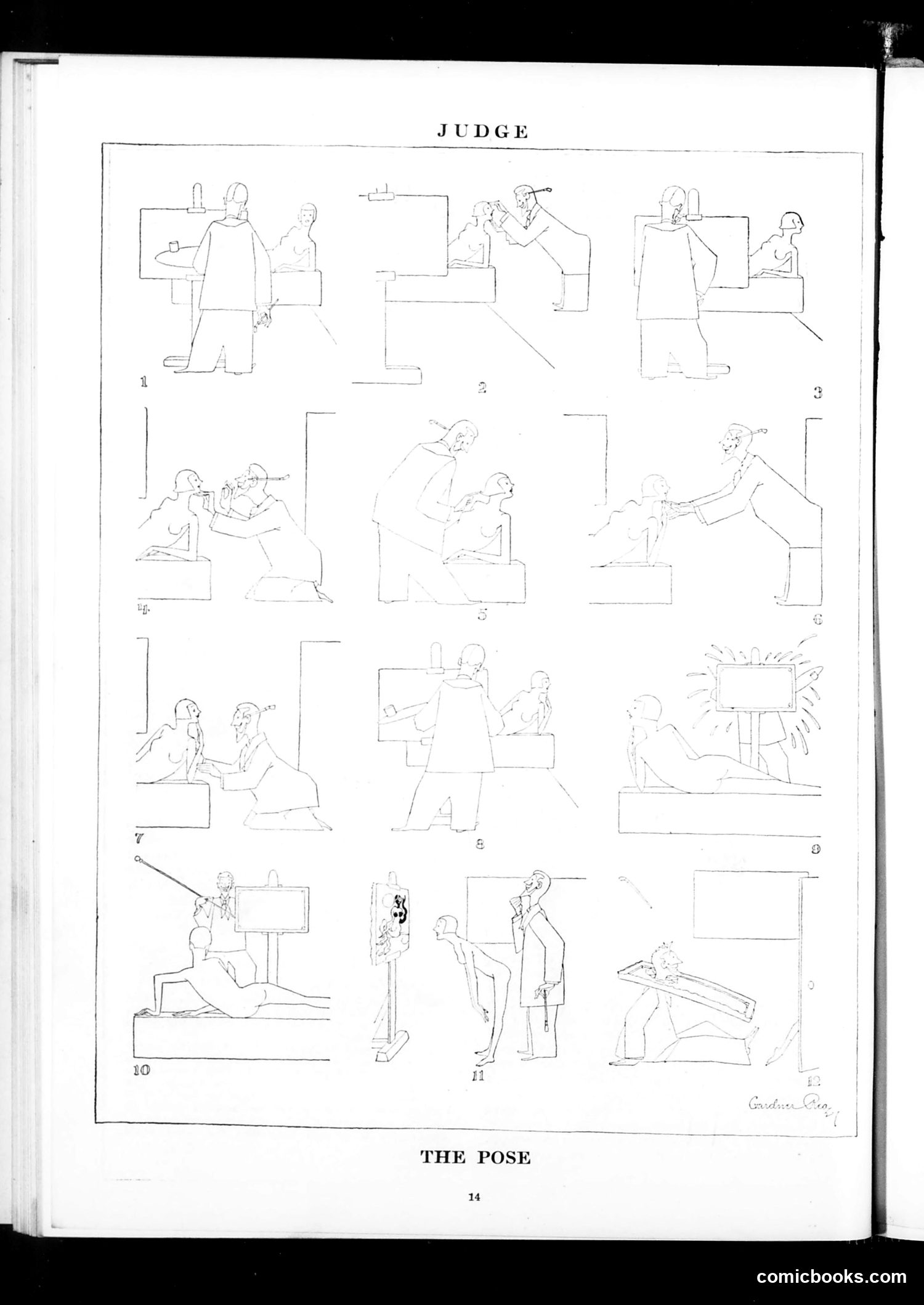
This page titled "The Pose" is a instructional diagram showing 12 numbered panels depicting various courtroom postures and physical attitudes. Each illustration demonstrates how a judge might position himself or herself in different situations - seated, standing, gesturing authoritatively, interacting with other courtroom figures. Rather than political satire, this appears to be a practical guide for artists or performers on how to convincingly portray judicial authority through body language and stance. The sequential illustrations suggest this may have been educational content teaching the visual conventions of depicting judicial dignity, sternness, and command—useful for illustrators, actors, or anyone needing to visually communicate judicial authority in the early 20th century.
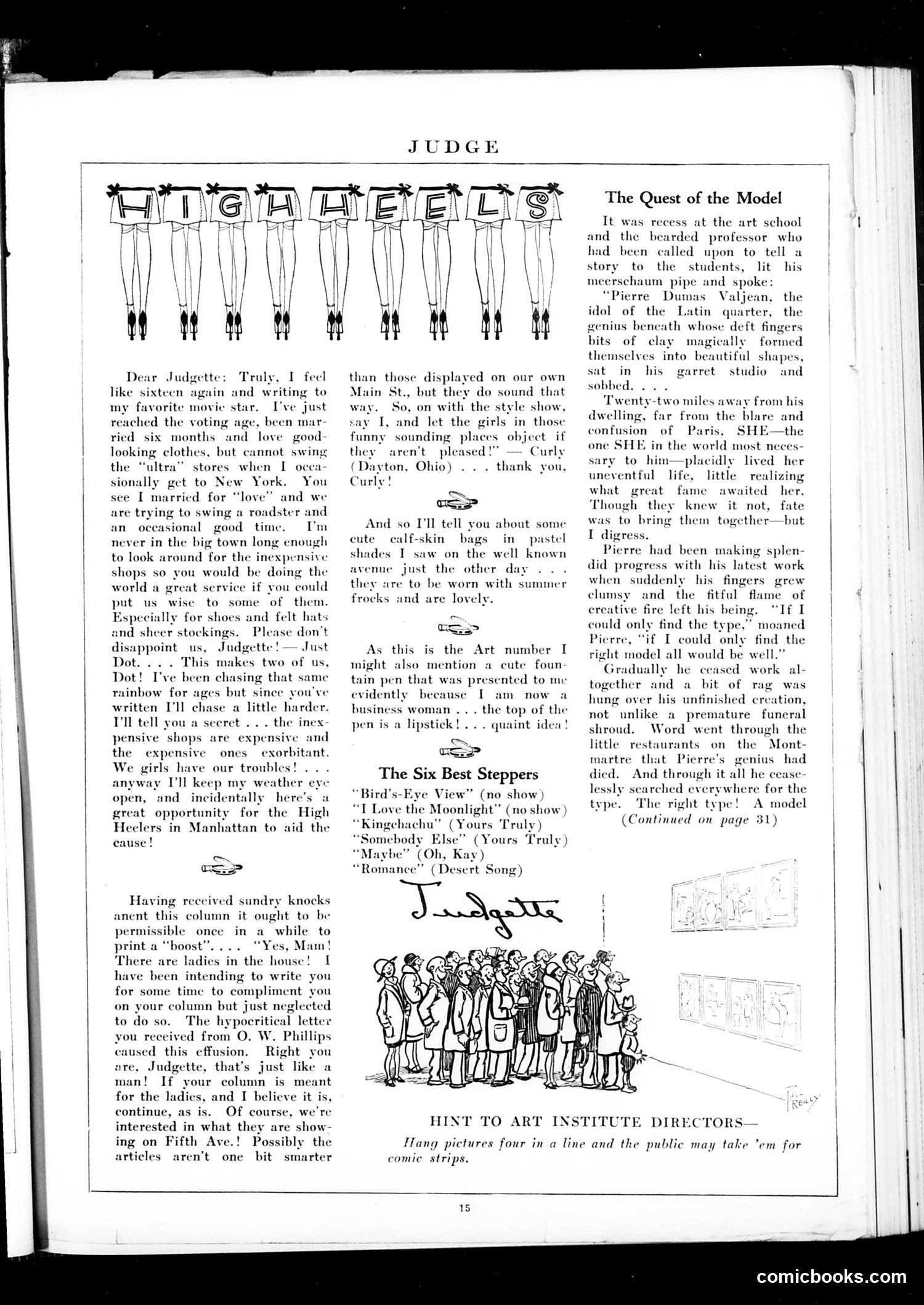
This page from *Judge* magazine contains advice columns and short fiction typical of early 20th-century women's magazines. **"Dear Judgette"** is an advice column where a newly married young woman seeks shopping tips for affordable clothing in New York City—she can't afford the expensive "ultra" stores. The column responds with sympathetic humor about women's financial struggles and shopping challenges. **"The Quest of the Model"** is a serialized romantic fiction excerpt (continuing on page 31) about an artist named Pierre Dumas Valjean in Paris's Latin Quarter. He's creatively blocked while working on a sculpture, desperately seeking the "right model" to inspire him. The dramatic, flowery prose parodies melodramatic artist-and-muse narratives popular in the era. **"The Six Best Steppers"** lists current popular songs, likely from Broadway shows. The page reflects early 20th-century concerns: women's economic independence, urban shopping culture, and romantic idealization of artistic life—presented through humor and serialized drama aimed at female readers.
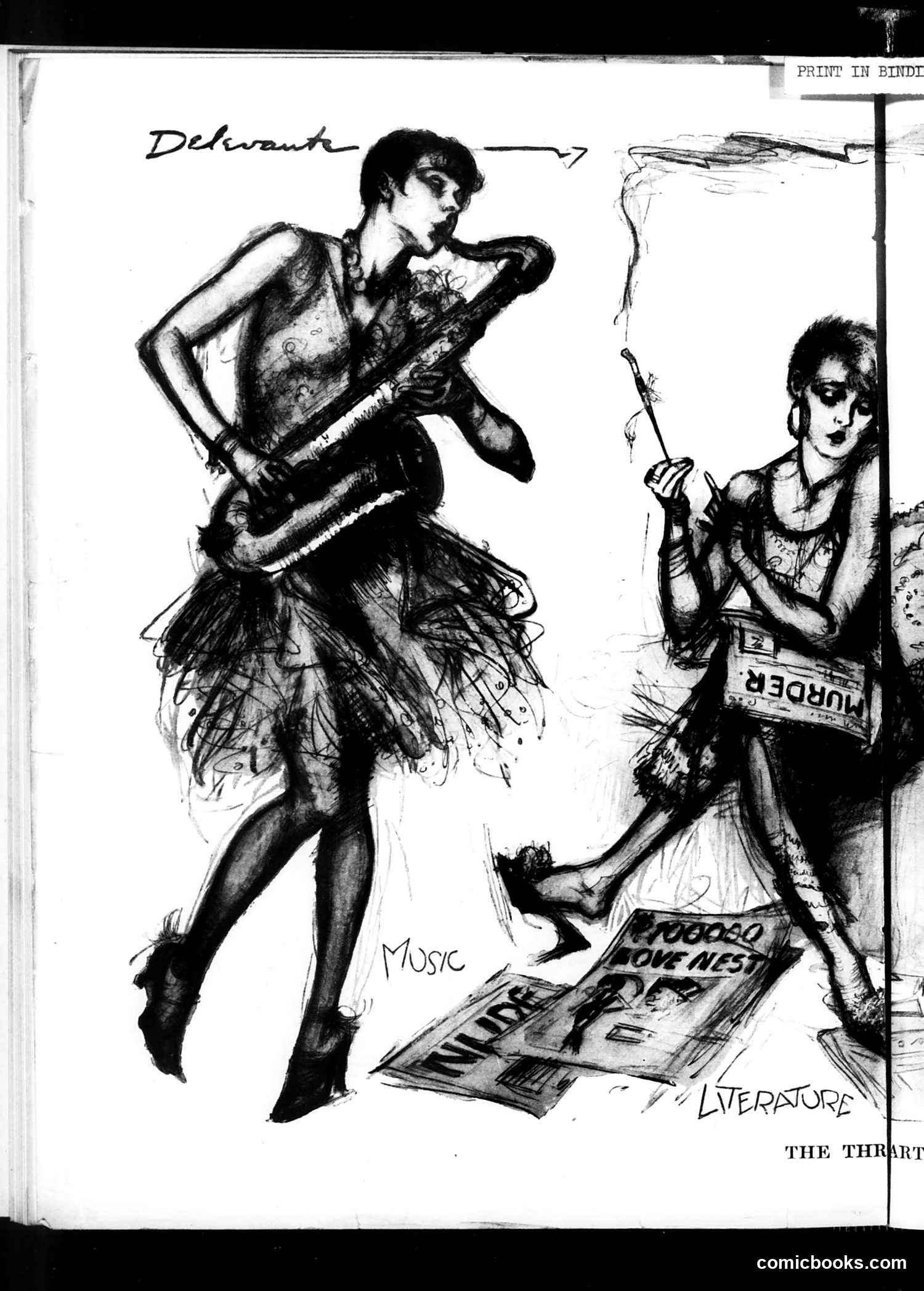
This appears to be a satirical illustration from *Judge* magazine depicting figures labeled with "Debunk," "Music," and "Literature." The image shows two stylized characters—one actively playing a guitar or similar instrument, the other appearing to read or reference publications on the ground. The cartoon likely satirizes the 1920s cultural debates between "highbrow" and "lowbrow" art forms. "Debunk" suggests exposing pretense, while the juxtaposition of "Music" and "Literature" may critique either the modernist artistic movement or tensions between traditional and popular culture. The figures' dynamic poses suggest conflict or competition between these cultural spheres. The OCR text is largely unreadable, making precise interpretation difficult. Without clearer text or dating information, the specific satirical target remains unclear, though the overall theme concerns cultural hierarchy and authenticity in arts discourse.
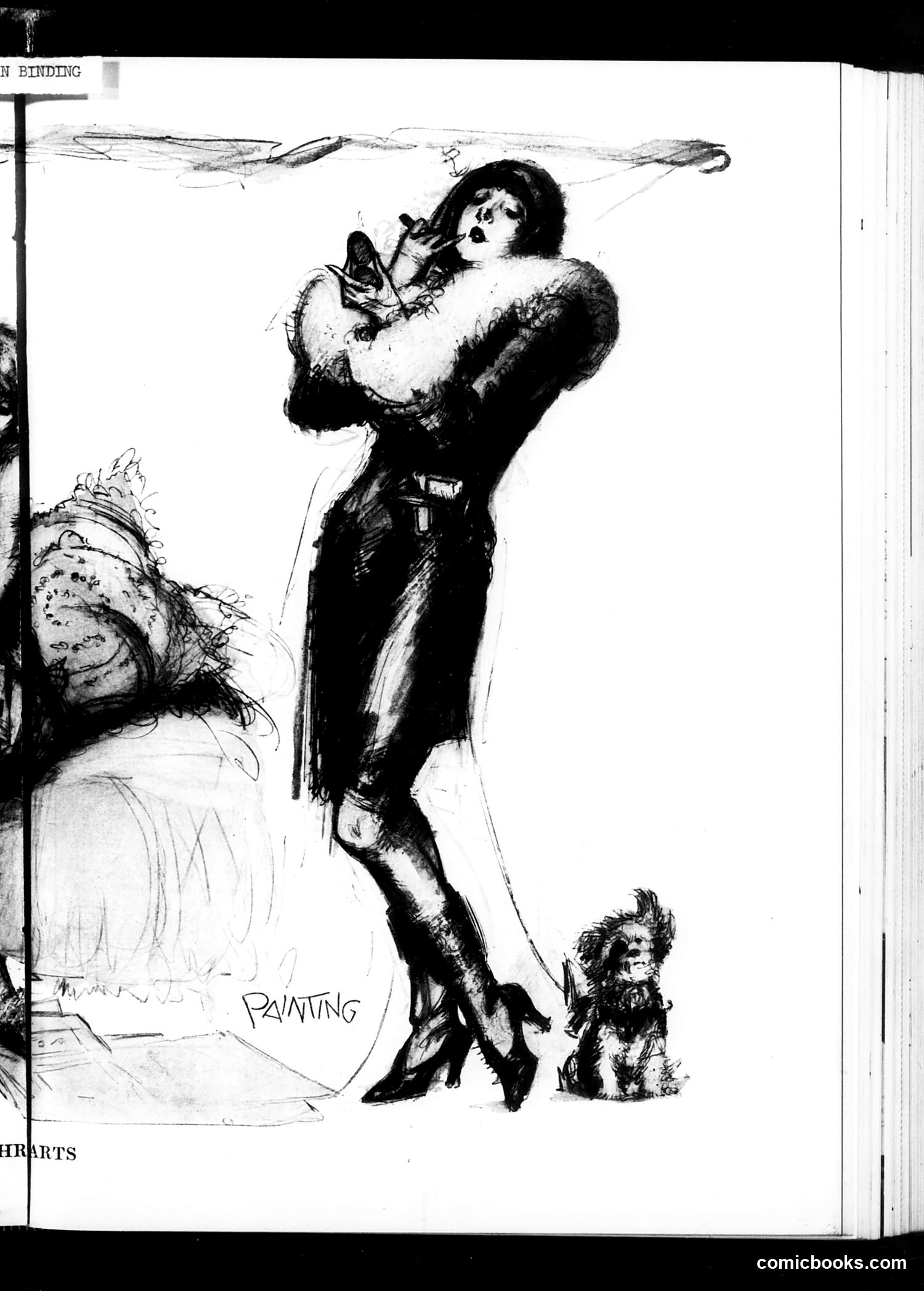
This appears to be a satirical illustration from Judge magazine depicting a woman in an elegant dark dress holding a small dog, looking upward in an exaggerated pose. The word "PAINTING" is labeled on the page. The satire likely critiques either: 1. Affectation or vanity in high society—the woman's dramatic pose and fashionable dress suggesting pretension 2. The subject matter of contemporary art or portraiture—perhaps mocking artistic trends that focused on depicting wealthy women with their pets The small dog at her feet and her refined appearance emphasize themes of leisure-class lifestyle. However, without additional context from Judge's publication date or surrounding articles, the specific target of satire remains unclear. The illustration style suggests early-to-mid 20th century.
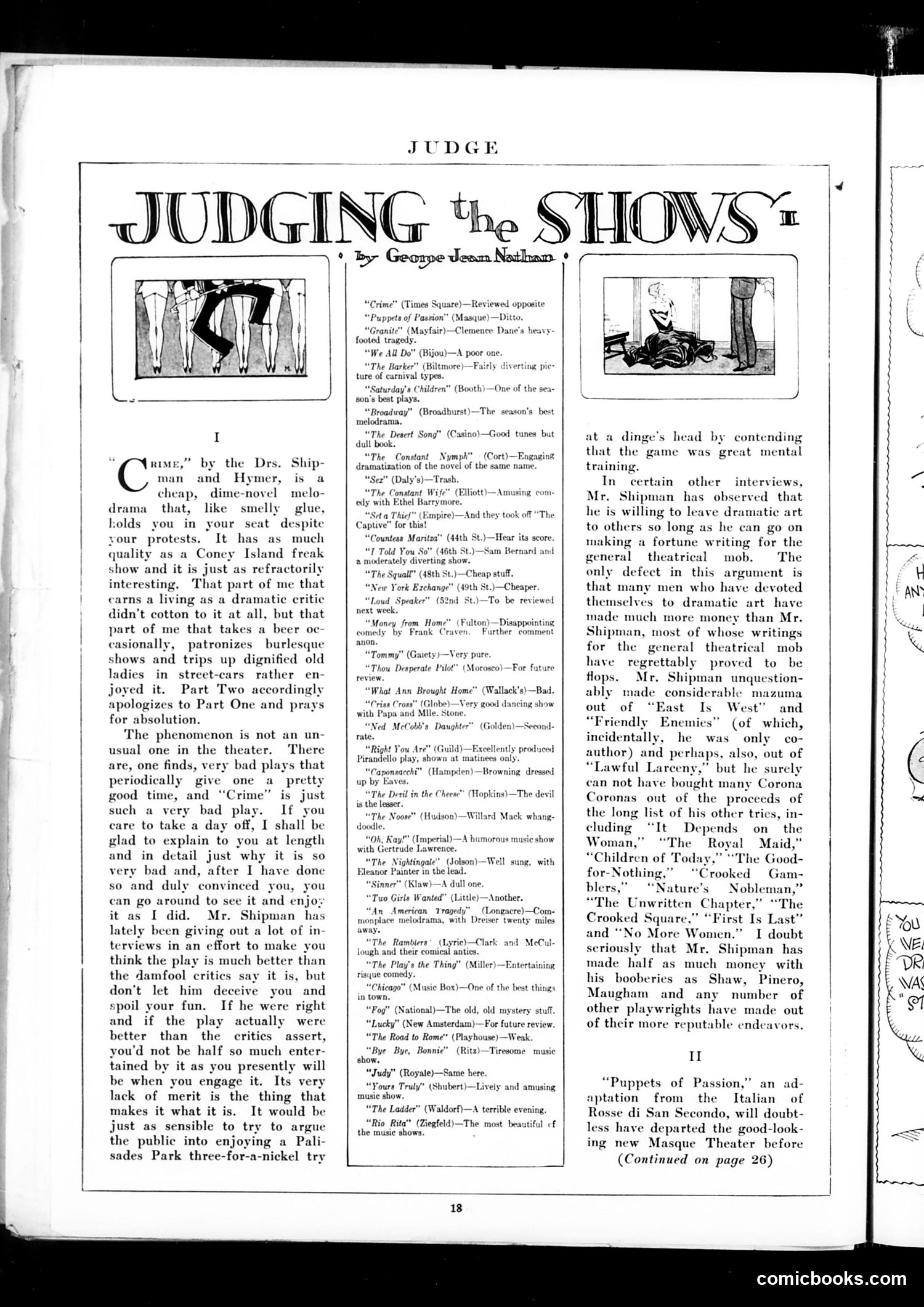
This page from *Judge* magazine contains a theater review column titled "Judging the Shows" by George Jean Nathan. The main content is **not a political cartoon** but rather a critical essay about theatrical productions. Nathan reviews the play "Crime" (by Shipman and Hymer), calling it a deliberately bad melodrama that's paradoxically entertaining precisely *because* it's poorly made. He argues audiences enjoy it despite—not because of—its quality, and that playwright Shipman's attempts to defend the play are misguided. The page includes a list of contemporary Broadway productions with brief dismissive or praising remarks, typical of entertainment journalism of the era (appears to be 1920s based on play titles and theaters). The satire targets theatrical pretension and the disconnect between critical assessment and popular enjoyment—suggesting some art is more fun when you stop taking it seriously.
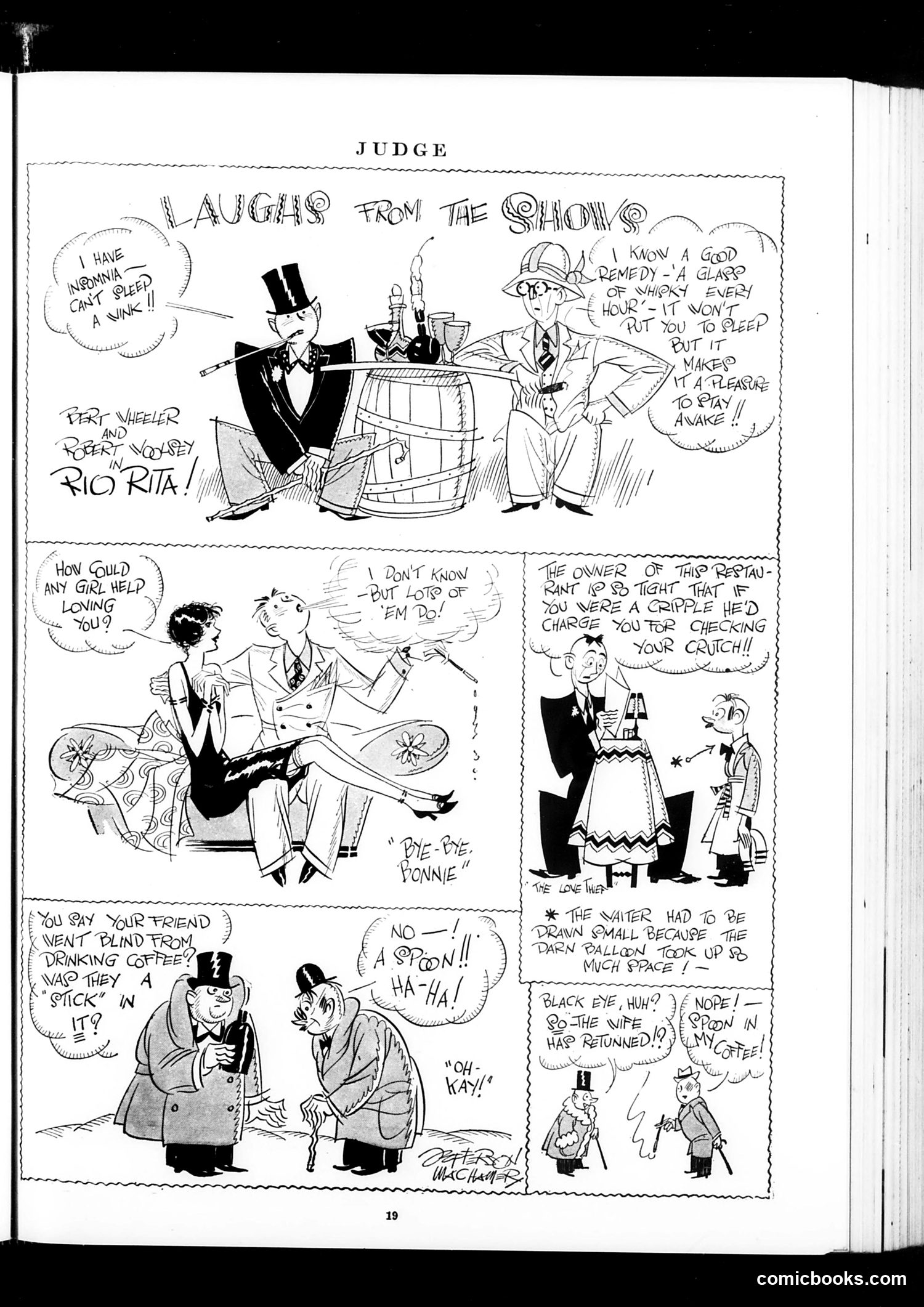
This page presents theatrical humor sketches, likely from early-to-mid 20th century vaudeville or stage comedy. The top panel features "Rio Rita," referencing a popular musical comedy of that era, with characters in formal dress around a barrel making jokes about remedies and staying awake. The remaining panels are brief comedic exchanges: one about a woman helping a man at a bar, another about a waiter drawing something small due to a balloon taking up space, and a final joke about a man whose friend went blind from drinking coffee, suggesting he got a black eye ("a stick in it") instead—playing on the double meaning of "blind." The humor is observational and relies on puns and physical comedy typical of period stage entertainment. The drawings are credited to what appears to be "Cesare Maccioni" or similar. This represents Judge magazine's coverage of popular entertainment humor of its time.
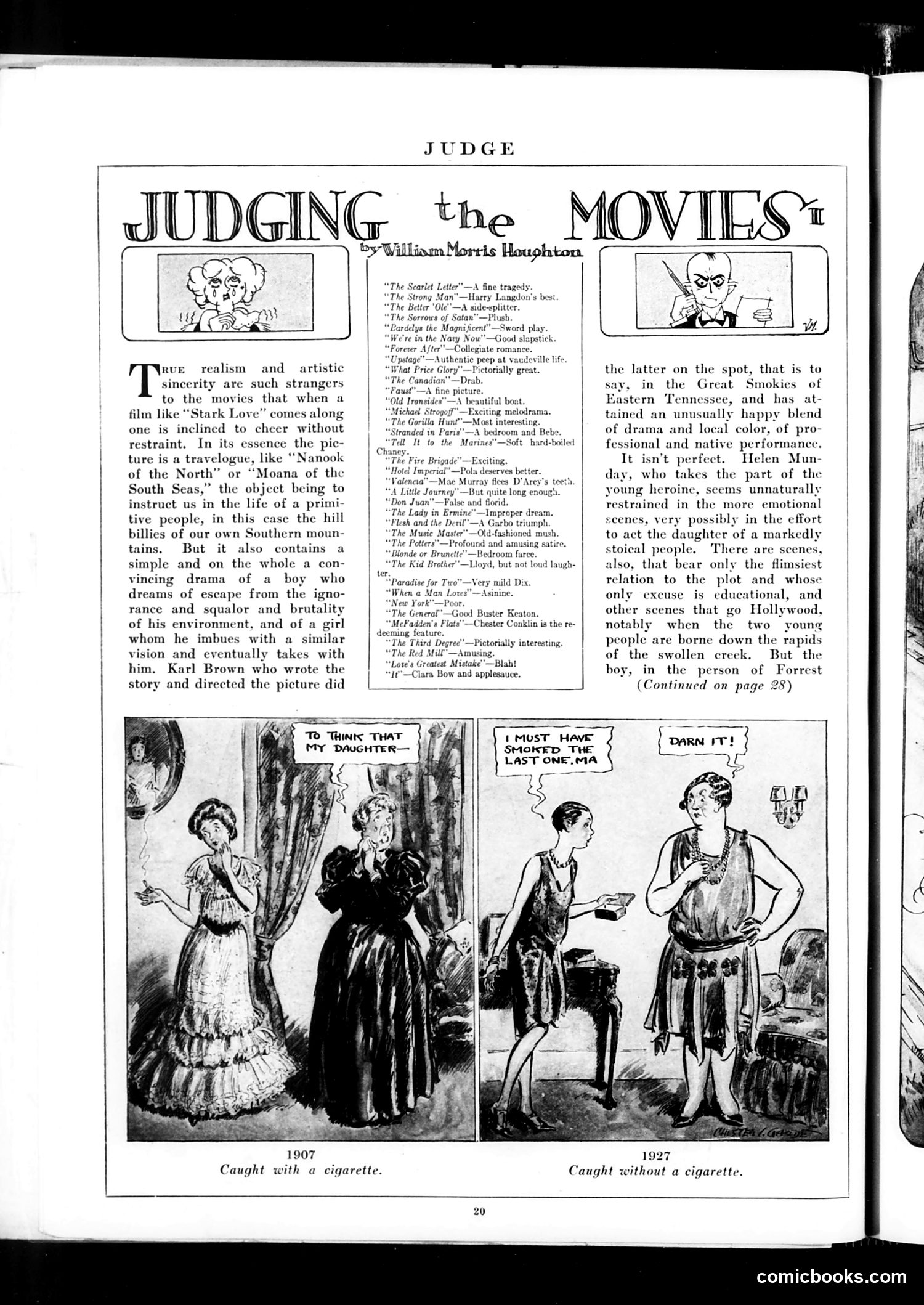
This page reviews "Stark Love," a 1927 film by Karl Brown set in the Appalachian mountains, praising its realistic depiction of rural life despite some theatrical compromises. The two cartoons below compare social attitudes toward women smoking across two decades. The **1907 cartoon** shows a woman being caught *with* a cigarette—treated as scandalous behavior requiring maternal correction. The **1927 cartoon** reverses this: a woman is caught *without* a cigarette and frantically searches for one, suggesting smoking has become normalized and even expected among modern women. This visual commentary satirizes the dramatic shift in female smoking habits and social acceptance during the Jazz Age. What was once taboo behavior for "respectable" women had become fashionable by the late 1920s—a marker of the New Woman's freedom and modernity. The joke relies on the absurdity of the reversal to highlight how rapidly social norms around gender and behavior had transformed in just two decades.
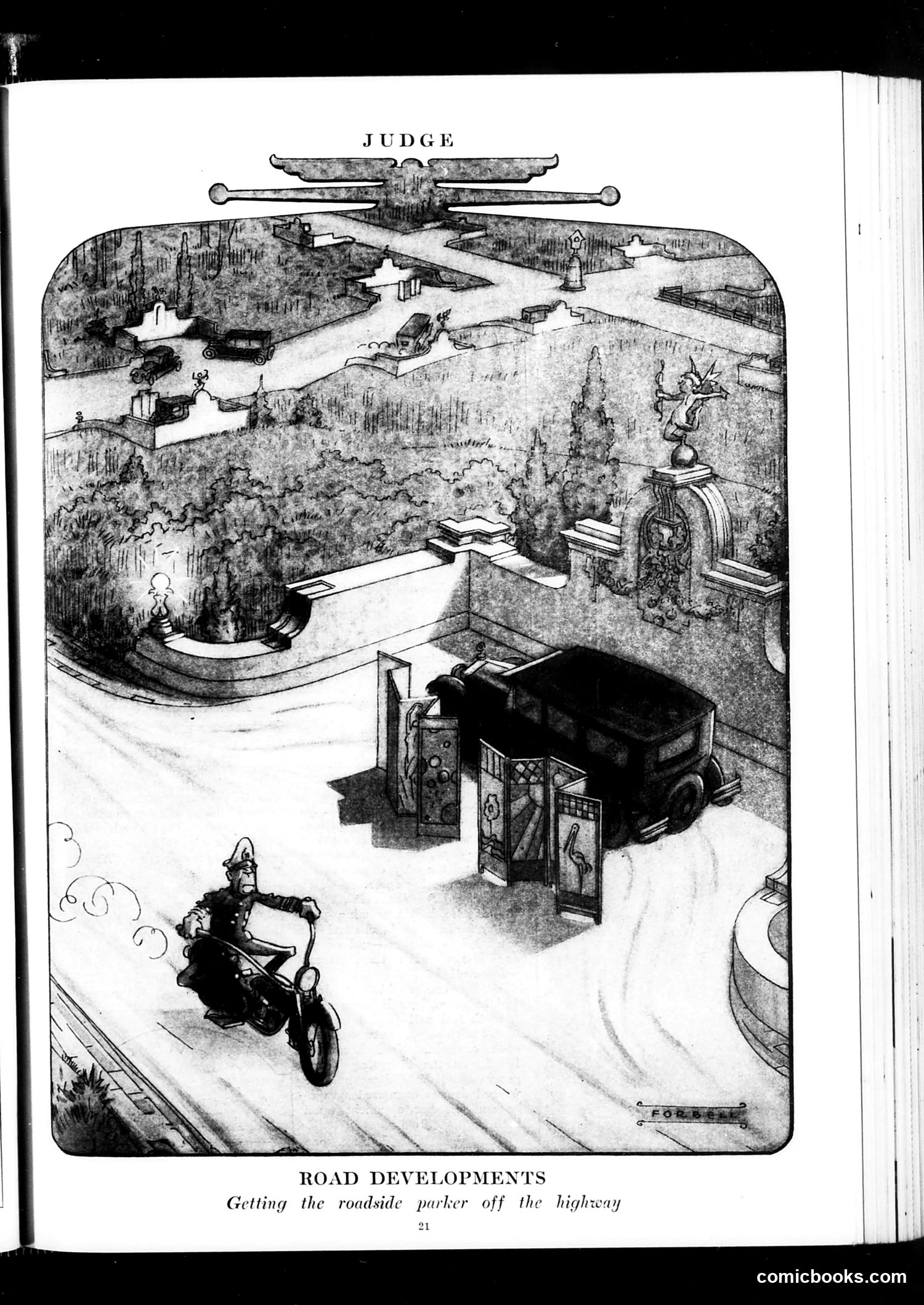
This satirical cartoon from Judge magazine critiques roadside parking along highways. The illustration shows a figure on a motorcycle appearing to chase or harass a parked car and its occupant beside the road. The caption "Getting the roadside parker off the highway" suggests the satire targets tensions between mobile traffic and stationary vehicles using roadsides for parking or rest stops. The cartoon likely reflects early-20th-century concerns about automobile congestion and road usage conflicts as car ownership increased. It appears to mock either aggressive drivers impatient with parked cars, or conversely, to ridicule people parking along busy highways as obstructions to traffic flow. The motorcycle figure's aggressive posture suggests the cartoon sides with unobstructed highway travel over roadside parking privileges.
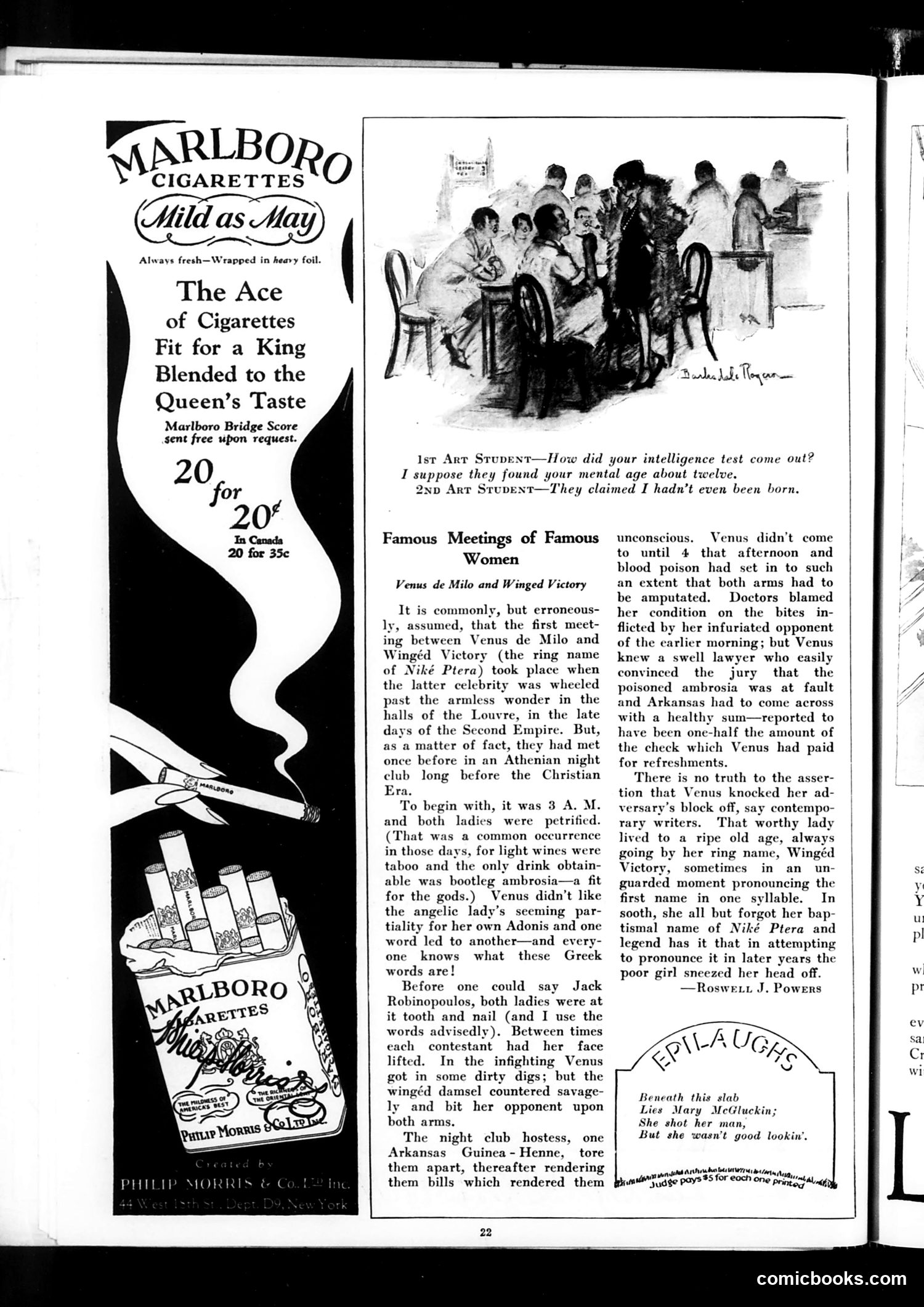
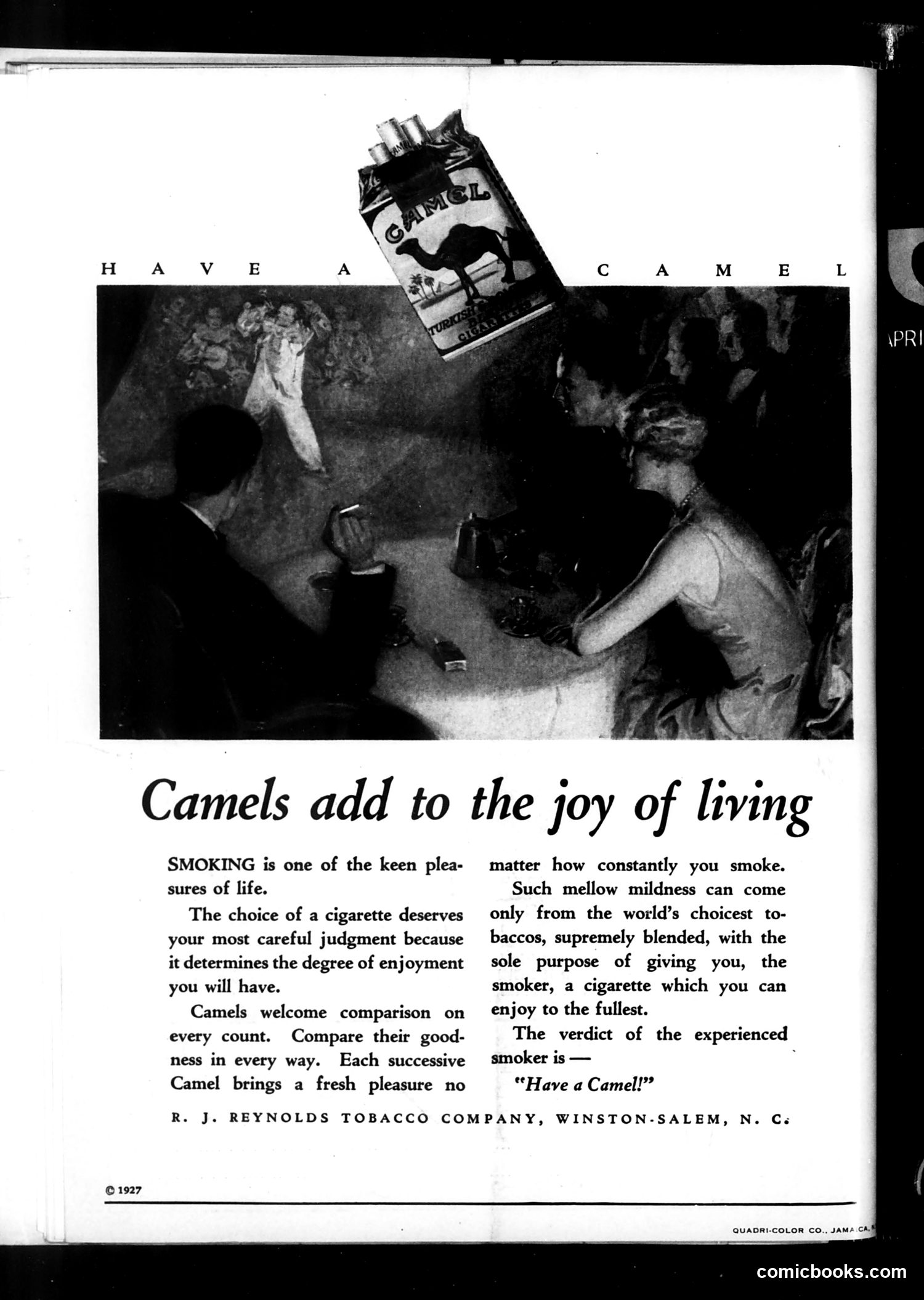
This page contains primarily **advertising** (Marlboro cigarettes) and **humorous fiction**, rather than political satire. The main content is "Famous Meetings of Famous Women," a comedic short story by Roswell J. Powers imagining an ancient bar fight between two classical sculptures: **Venus de Milo** and **Winged Victory** (the Nike of Samothrace). The satire is art-historical and literary, not political. The joke plays on anachronism—transplanting modern scenarios (nightclubs, bootleg alcohol during Prohibition, litigation) into ancient Greece. It gently mocks both the sculptures themselves (Venus's missing arms become a punchline about amputations from bites) and contemporary legal/insurance culture. The opening joke about art students' "intelligence tests" is unrelated observational humor. The epitaph at bottom is standard light verse filler common to Judge magazine. **No political figures or events are referenced.** This is entertainment content typical of 1920s-era satirical magazine filler.
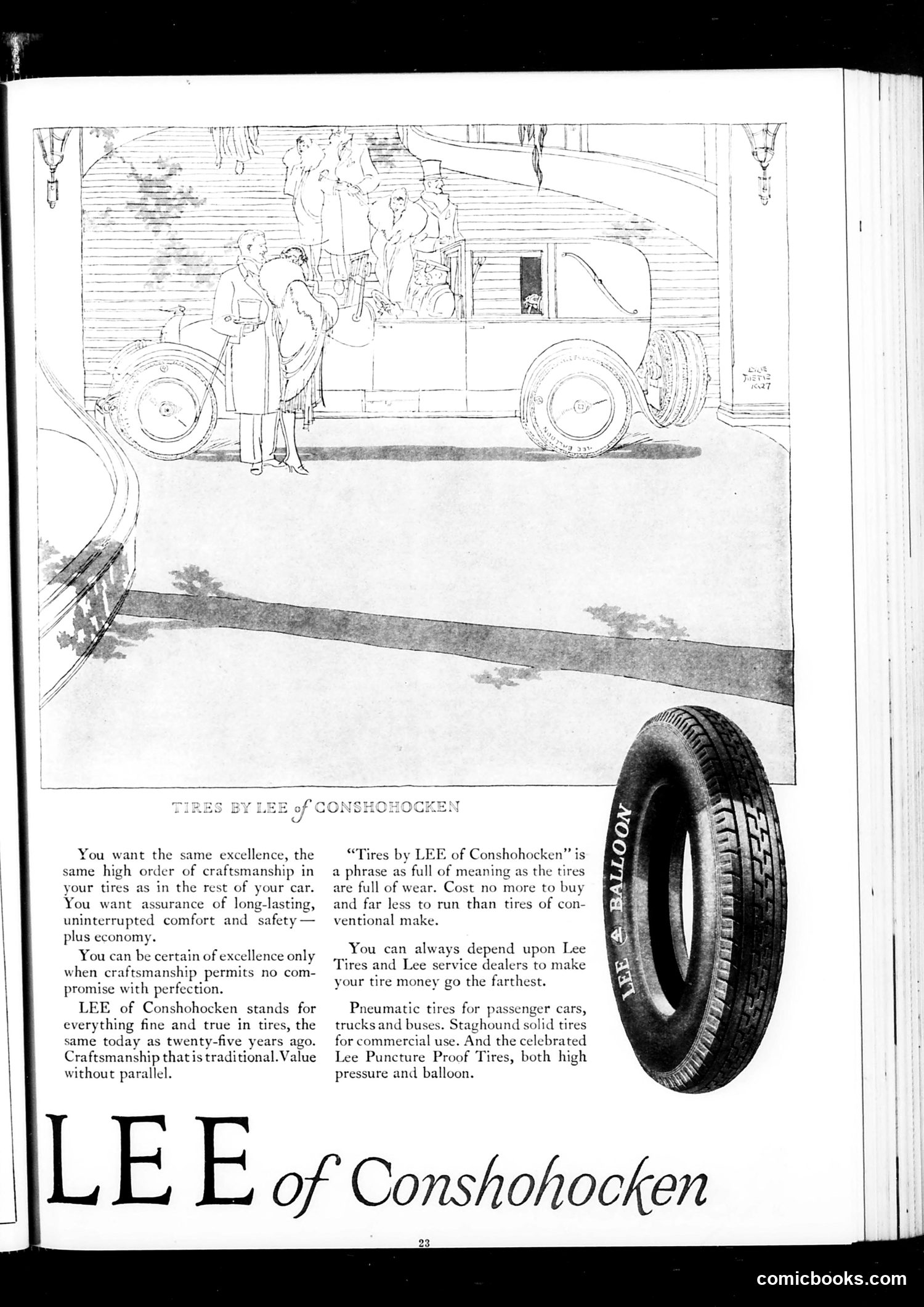
This is a **full-page advertisement**, not political satire. It promotes Lee of Conshohocken tires, a real manufacturer based in Pennsylvania. The illustration shows a 1920s-era commercial truck or bus with passengers boarding, positioned above a photograph of an actual tire. The ad emphasizes craftsmanship, durability, and economy—key selling points during the early automotive era. References to "Staghound solid tires" and "Lee Puncture Proof Tires" highlight specific product lines, while mentions of both "passenger cars" and commercial vehicles indicate broad market appeal. The message reflects typical 1920s advertising strategy: associating products with reliability, tradition ("twenty-five years"), and superior engineering to justify premium pricing. This represents Judge magazine's commercial content rather than its famous satirical cartoon work.
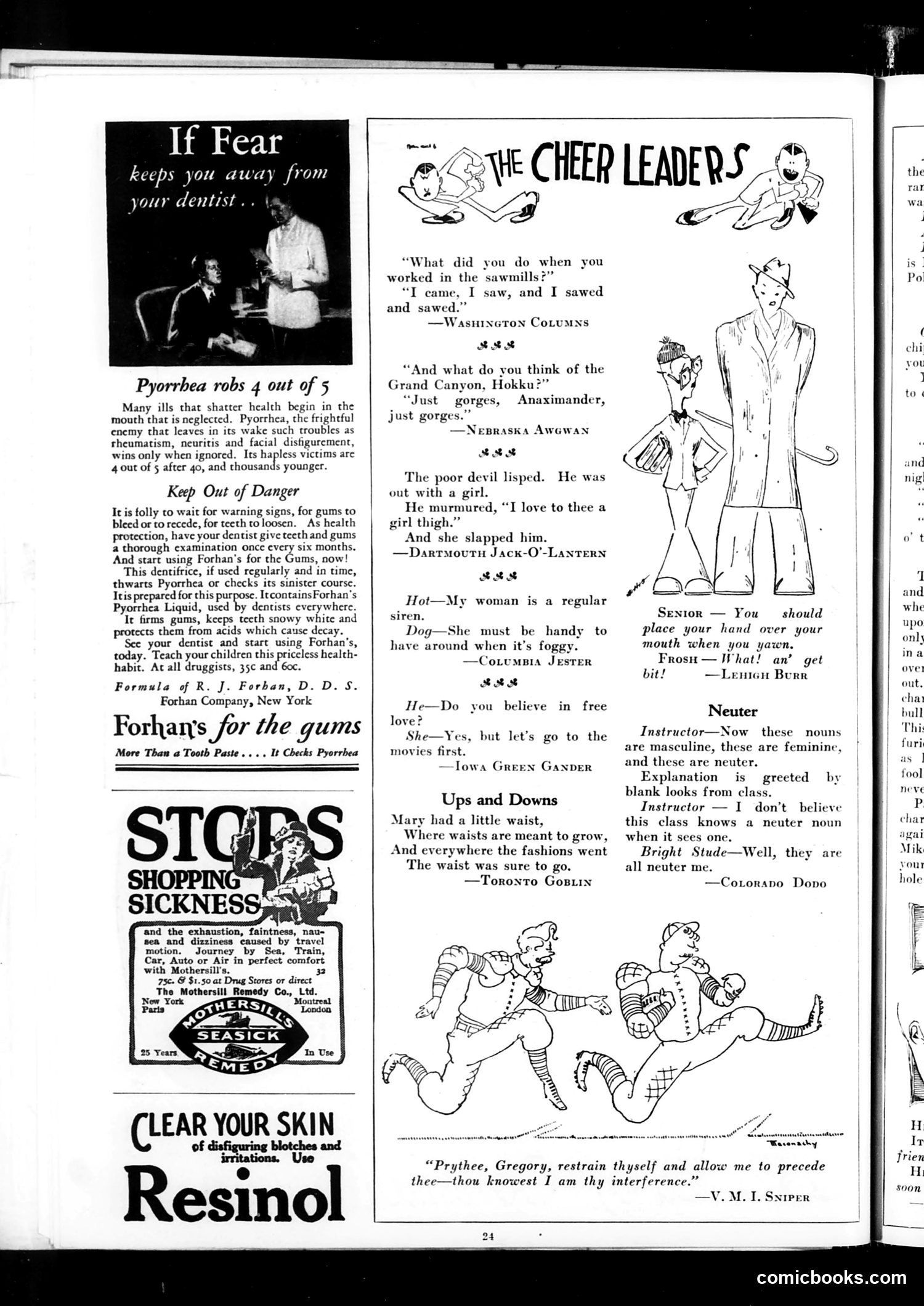
This page presents light satirical humor typical of Judge's "joke" section. The main cartoon, "The Cheer Leaders," depicts stylized figures in exaggerated poses—likely mocking the enthusiastic physical movements of cheerleaders, a growing phenomenon in early 20th-century American schools and sports. The accompanying jokes are puns and gentle social satire. Several target contemporary speech patterns and social anxieties: a girl's complaint about a boy's lisp during romance; fashion commentary on women's shrinking waists; classroom humor about grammar instruction; and the perennial male anxiety about "free love" (a contemporary social debate). The references to Native Americans ("Hokku," "Anaximander") and regional attributions ("Washington Columns," "Nebraska Augwan") suggest these are reprinted jokes collected from various newspapers, a common Judge practice. The advertising—for Forhan's toothpaste (warning about pyorrhea/gum disease) and Mothersill's motion sickness remedy—reflects period health anxieties and the rise of automobile travel.
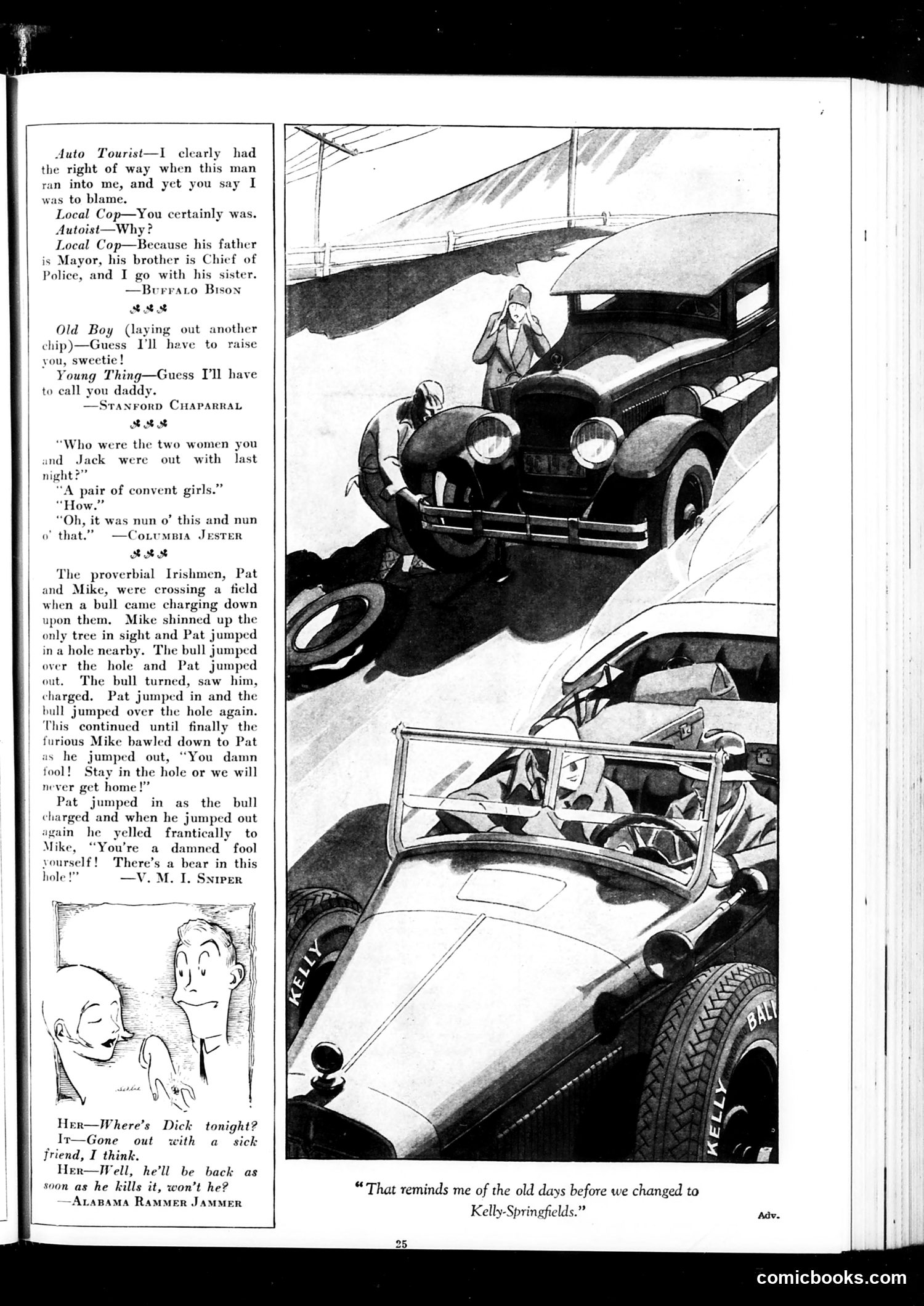
This page contains several short humor pieces typical of early-20th-century Judge magazine: **"Auto Tourist" sketch**: Satirizes small-town corruption. A tourist involved in a traffic accident is blamed despite having the right of way—the local cop confesses he's biased because the other driver's father is mayor, brother is police chief, and he's dating the sister. The joke mocks how local power structures override justice. **"Old Boy/Young Thing" joke**: A gambling or card game scene with flirtatious banter about raising stakes. **"Convent Girls" pun**: Wordplay on "nun"—the speaker deflects questions about two women by claiming they were "a pair of convent girls" and "nun o' this and nun o' that" (none of this/that). **Pat and Mike Irish story**: A slapstick tale of two Irishmen repeatedly jumping in/out of a hole while a bull charges, ending with Pat discovering a *bear* in the hole—explaining Mike's frantic warnings. **"Dick" innuendo**: A woman asks where her companion went; he's with "a sick friend." She jokes he'll return "as soon as he kills it"—dark humor about infidelity or deception. The final illustration advertises Kelly-Springfield tires.
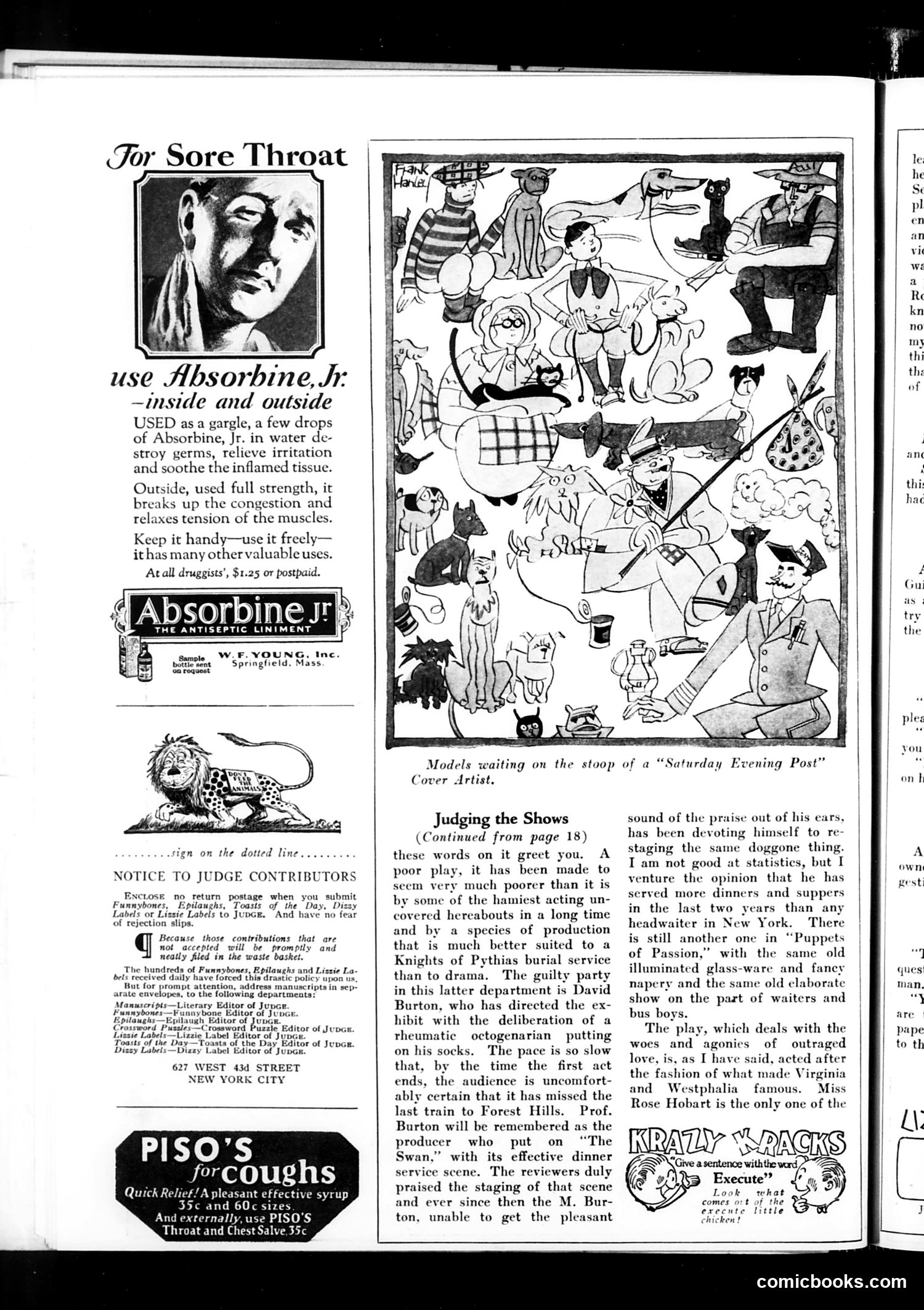
This page from *Judge* magazine is primarily **advertisements and editorial notices**, not political satire. The main cartoon shows models posing on a stoop, captioned as waiting for a *Saturday Evening Post* cover artist. This is a **gentle social satire** about the commercial illustration industry—mocking the somewhat artificial, posed quality of magazine cover models and suggesting the tedious waiting involved in being selected for commercial art work. The text below discusses theater reviews, particularly criticizing director David Burton for obsessively recreating elaborate dinner scenes in productions, having become fixated on praise for one such scene in "The Swan." The satire critiques theatrical excess and directorial ego. The rest of the page consists of **product advertisements** (Absorbine Jr. for sore throats, Piso's cough syrup) and a notice to *Judge* contributors about submission procedures. No specific political figures or contemporary events are referenced on this page.
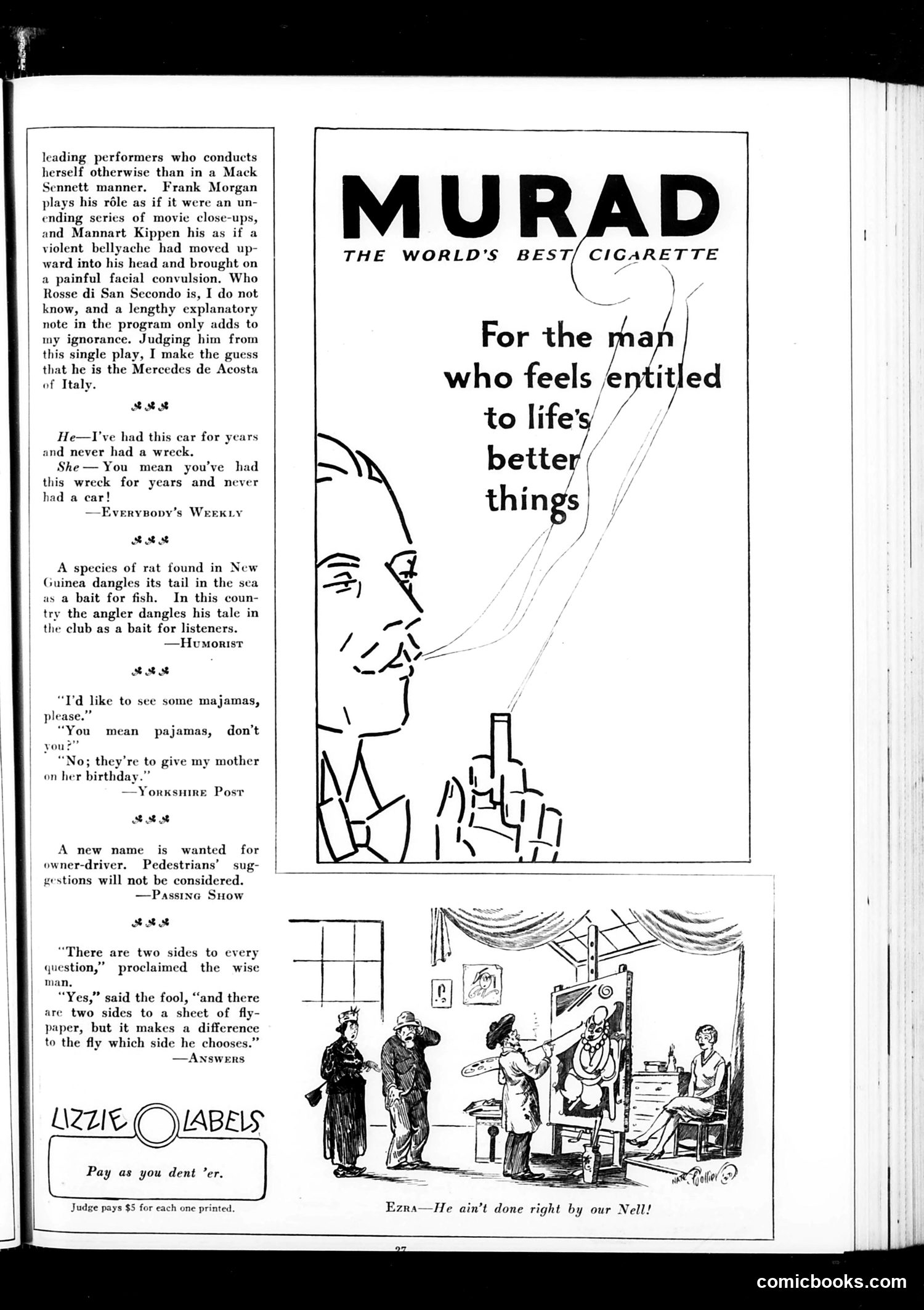
This page mixes theater criticism, jokes, and advertising typical of 1920s Judge magazine. **Upper content:** A theater review criticizes performers in what appears to be a contemporary play, mentioning actors Frank Morgan and Mannart Kippen with unflattering assessments of their acting styles. **Humor section:** Multiple short jokes appear, including one about a woman who's owned a car for years without incident versus a man who's had the same wreck repeatedly—playing on gender stereotypes about driving ability. Another jokes about "majamas" (mishearing "pajamas"), and one contrasts the "wise man" and "fool" discussing two sides of a question versus a fly-paper analogy. **Main advertisement:** A large Murad cigarette ad features an illustrated man's profile with smoke, marketing to aspirational consumers: "For the man who feels entitled to life's better things." **Bottom cartoon:** A domestic scene labeled "Ezra—He ain't done right by our Nell!" depicts what appears to be a confrontation, likely referencing a seduction or abandonment scenario—common melodramatic subject matter of the era.
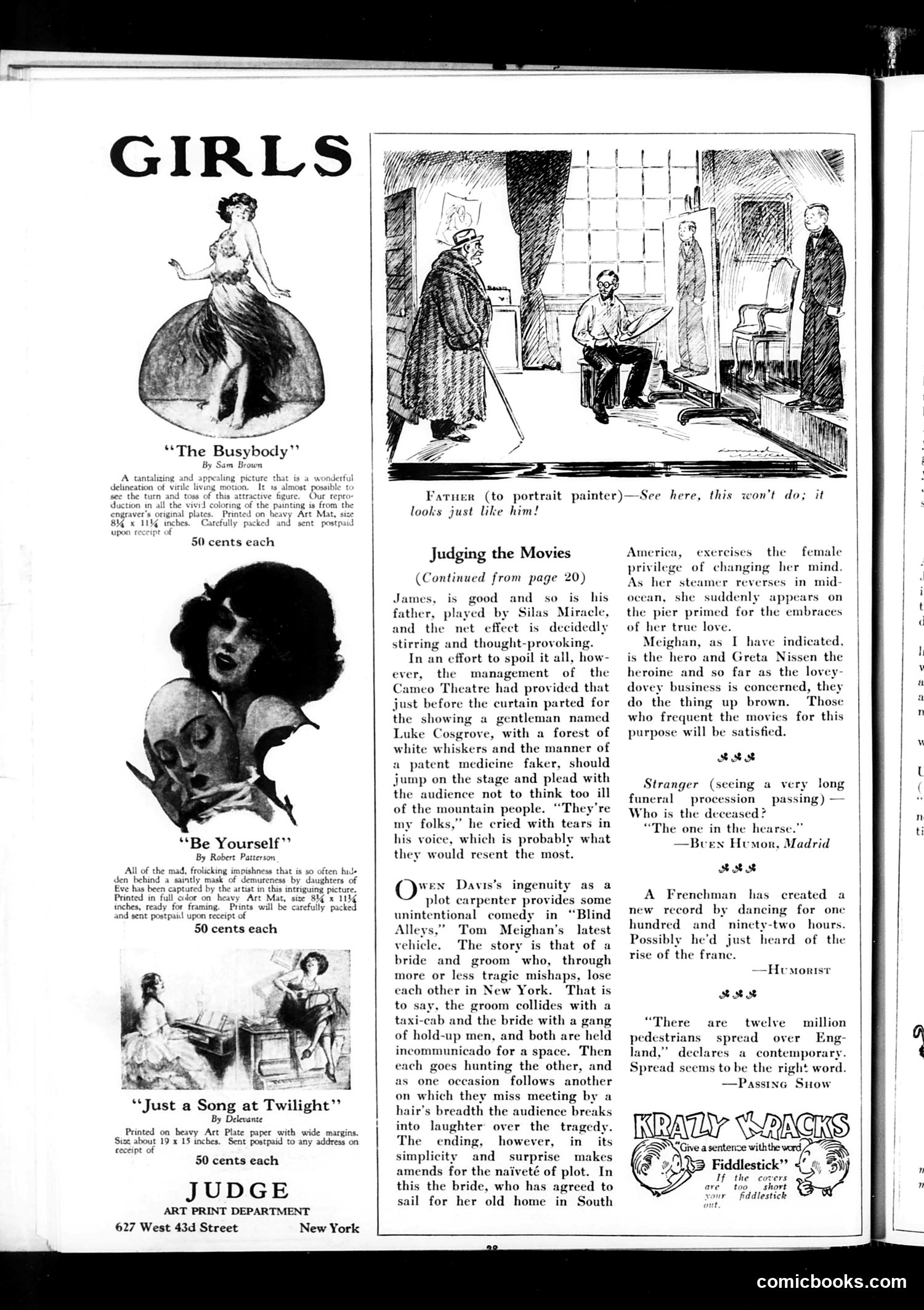
This page is primarily **advertising for art prints** rather than political satire. The left side displays four available prints ("The Busybody," "Be Yourself," "Just a Song at Twilight") sold through Judge's Art Print Department for 50 cents each—standard commercial offerings. The right side contains a **movie review column** ("Judging the Movies") discussing contemporary films, including ones starring Tom Meighan and Owen Davis adaptations. The commentary reflects 1920s film criticism standards. A small cartoon at the top shows a father criticizing a portrait painter's work, a genteel domestic joke about artistic likeness—typical light humor of the era. The page includes scattered **short humor bits** (credited to various publications like *Madrid*) making light observations about contemporary life: French dancing marathons, English pedestrian statistics, etc. These are filler content rather than political commentary. Overall, this is a **typical magazine interior page**—primarily commercial (art sales), with entertainment reviews and light social humor—rather than the satirical political cartooning Judge was known for.
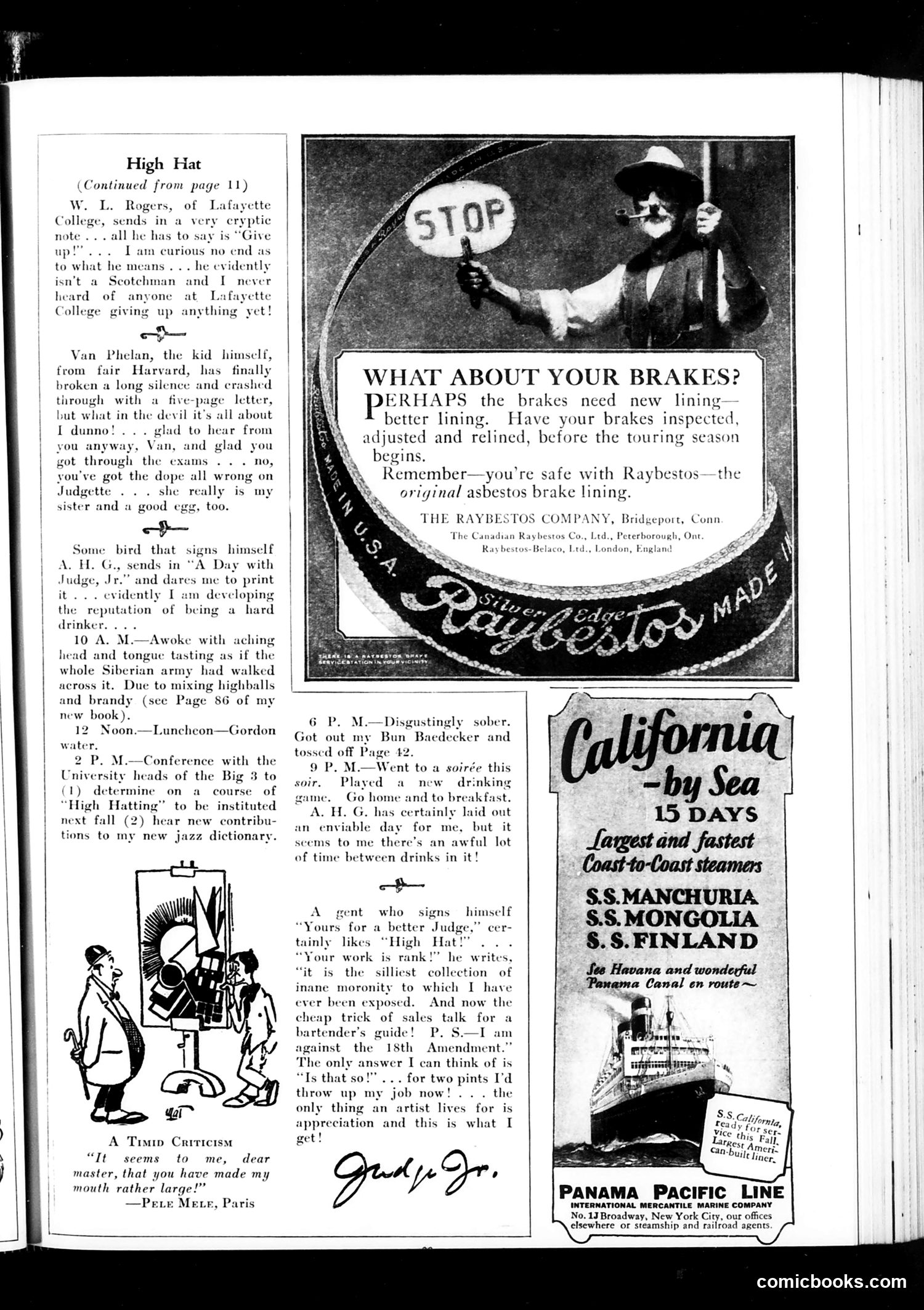
This page from *Judge* magazine consists primarily of **reader correspondence and advertisements** rather than political satire. The "High Hat" column publishes brief, cryptic letters from college readers (Lafayette, Harvard) commenting on the magazine's content. The humor is gentle and self-referential—readers playfully critique the editor's work or make oblique jokes. One notable letter from "A. H. G." satirizes **Prohibition-era drinking culture** by chronicling a day where the writer complains there's too much time between drinks, then boasts about opposing the 18th Amendment (Prohibition). This reflects 1920s anti-Prohibition sentiment. The cartoons shown are minimal—one small illustration accompanies a reader's joke about the editor's artistic style. The page is largely dominated by **period advertisements**: Raybestos brake linings (automobile safety), and a Panama Pacific Line cruise ship advertisement promoting California travel via sea. The content reflects *Judge*'s format as a humor magazine mixing reader contributions with commercial advertising rather than hard-hitting political cartooning.
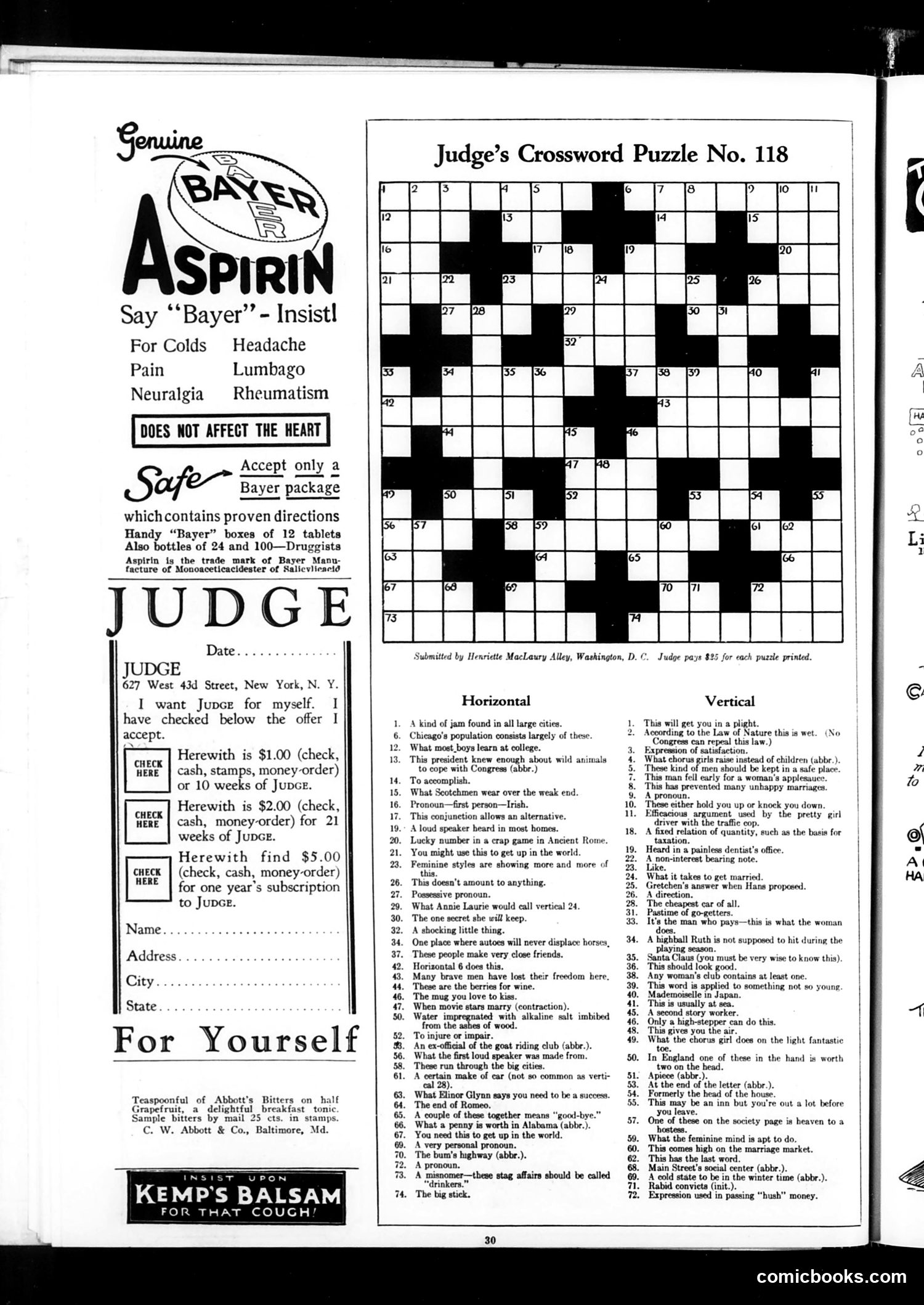
This page is primarily **advertising and a puzzle submission**, not political satire. The main content is a crossword puzzle contributed by Henriette MacLaury Alley of Washington, D.C., with Judge offering $25 payment for publication. The advertisements are historically significant: **Bayer Aspirin** emphasizes the brand name prominently, reflecting the early 20th-century marketing when "Aspirin" was a Bayer trademark (before losing exclusivity). The claim "Does Not Affect the Heart" addresses contemporary medical concerns about the drug's safety. Other ads—Abbott's Bitters, Kemp's Balsam cough remedy—represent patent medicines common in this era, many containing alcohol or unregulated ingredients. The puzzle clues reference **period-specific details**: references to "Congress" (likely Theodore Roosevelt), "Annie Laurie" (Scottish song), "Elinor Glynn" (risqué novelist), and "crap games in Ancient Rome" reflect early-20th-century popular culture and humor. This is primarily a **commercial page** showcasing Judge's reader engagement and advertising revenue model.
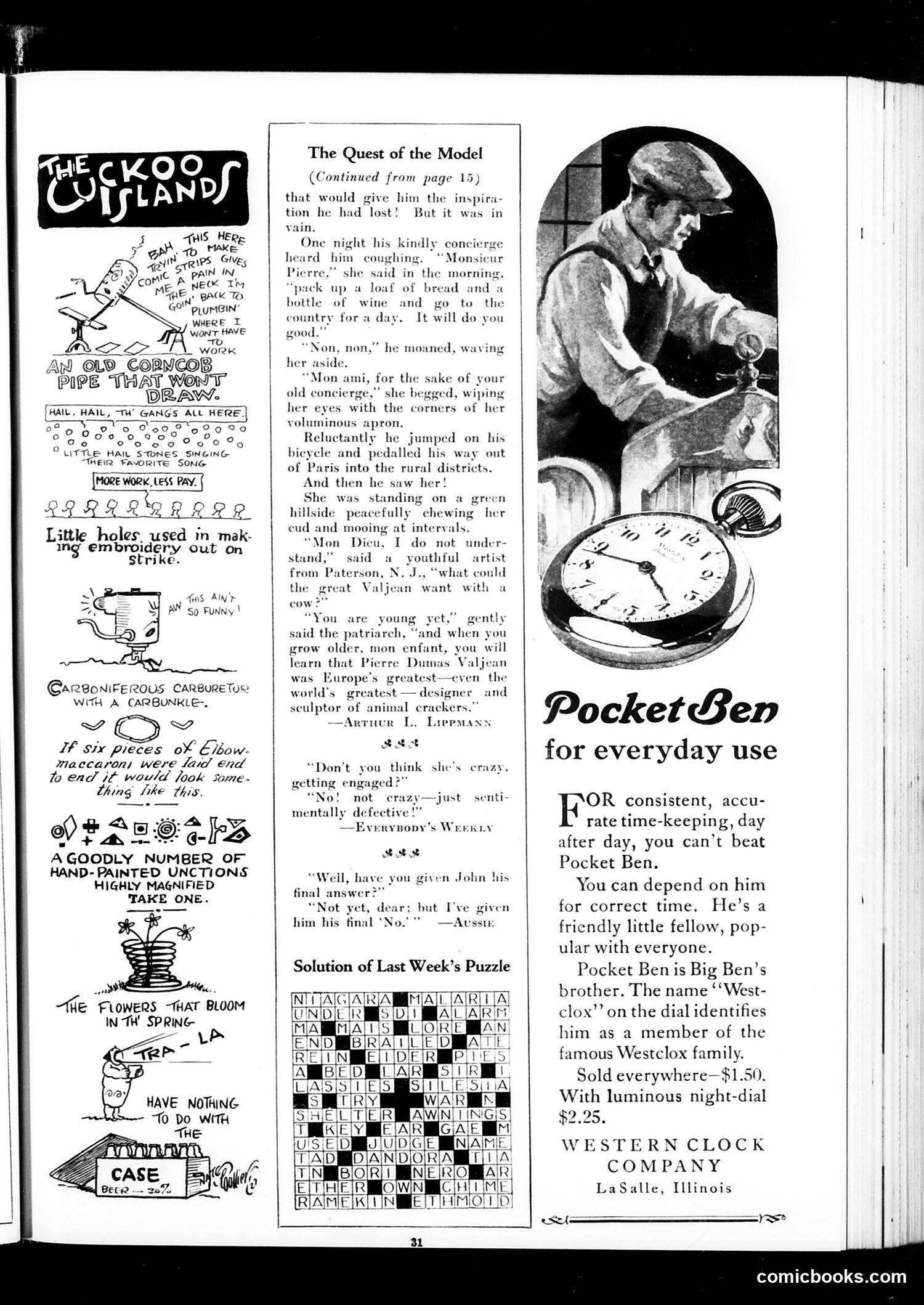
This page contains multiple unrelated comic sketches and advertisements typical of Judge's format. **Left side comics:** Brief sight gags with minimal political content—a man complaining about a broken pipe, wordplay about "carboniferous carburetor," and observations about macaroni and embroidery. These are simple visual jokes without clear satirical targets. **Center story: "The Quest of the Model"** (continued from previous page) is a humorous narrative about a struggling Parisian artist named Pierre. A kindly concierge suggests he leave the city to recover his inspiration. He discovers his muse isn't a woman but a cow in the countryside—a joke about artistic pretension and the absurdity of creative desperation. References to "Valjean" (likely *Les Misérables*) and "animal crackers" heighten the parody of artistic seriousness. **Right side:** A Pocket Ben watch advertisement. The page is primarily entertainment and advertising rather than political satire. The humor targets artistic affectation and romantic clichés rather than contemporary political events.
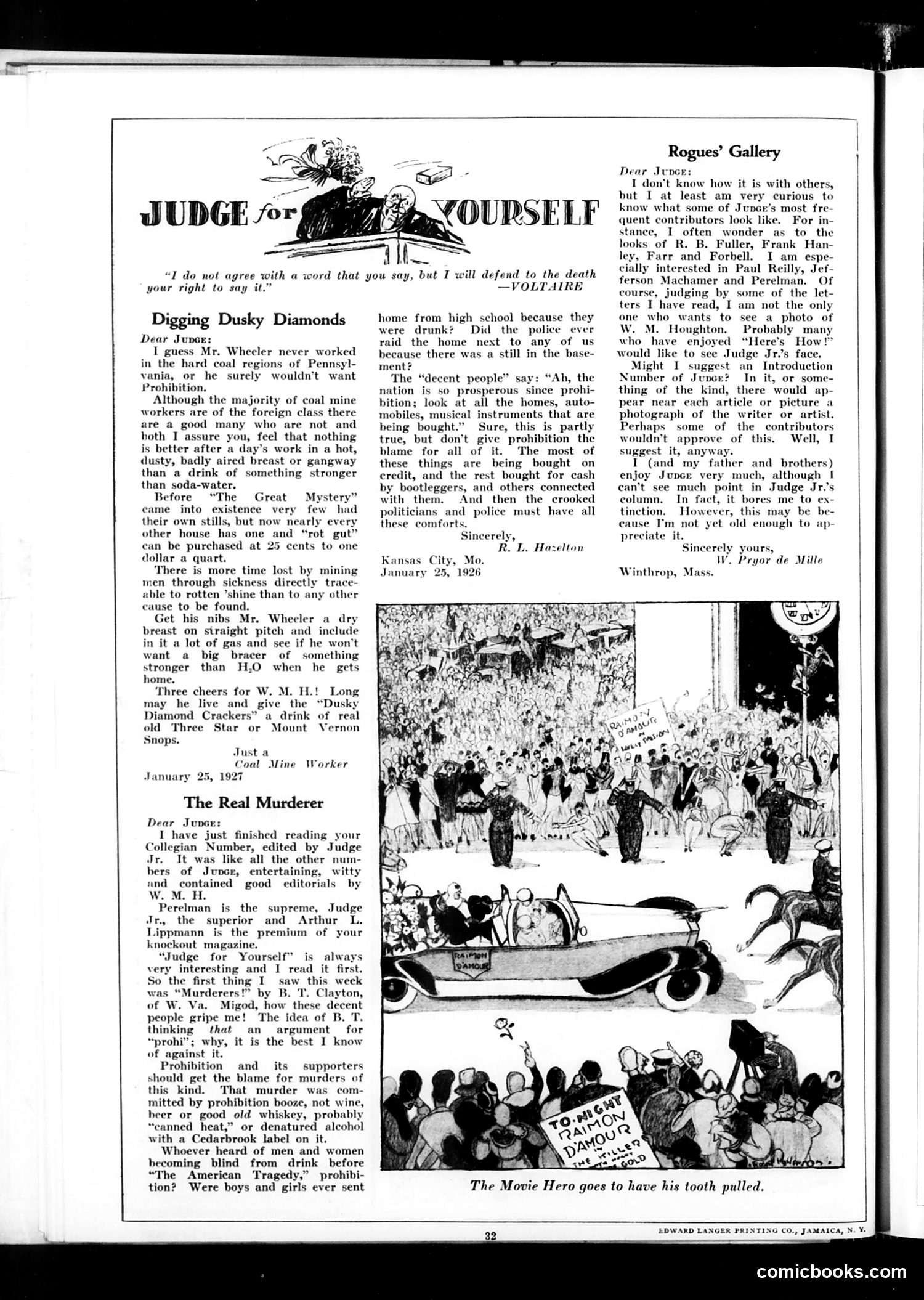
This is a letters-to-the-editor page from *Judge* magazine (January 1927) featuring three reader submissions addressing Prohibition-era social issues. **"Digging Dusky Diamonds"** argues that coal miners need alcohol after dangerous work and that Prohibition has worsened conditions by driving workers to dangerous homemade liquor ("rot gut"), causing health problems. **"The Real Murderer"** blames Prohibition itself—not alcohol—for crime and deaths. The writer contends that illegal bootleg spirits and denatured alcohol cause murders, blindness, and corruption, claiming these problems didn't exist before Prohibition. It frames the law as the actual culprit. **"Rogues' Gallery"** is simply a fan request: readers want photographs of *Judge*'s regular cartoonists and writers (named contributors like Perelman, Machamer, and W.M. Houghton), suggesting an "Introduction Number" featuring artist portraits. The page reflects 1920s Prohibition debates, with correspondents using *Judge*'s platform to argue that the alcohol ban created more problems than it solved.
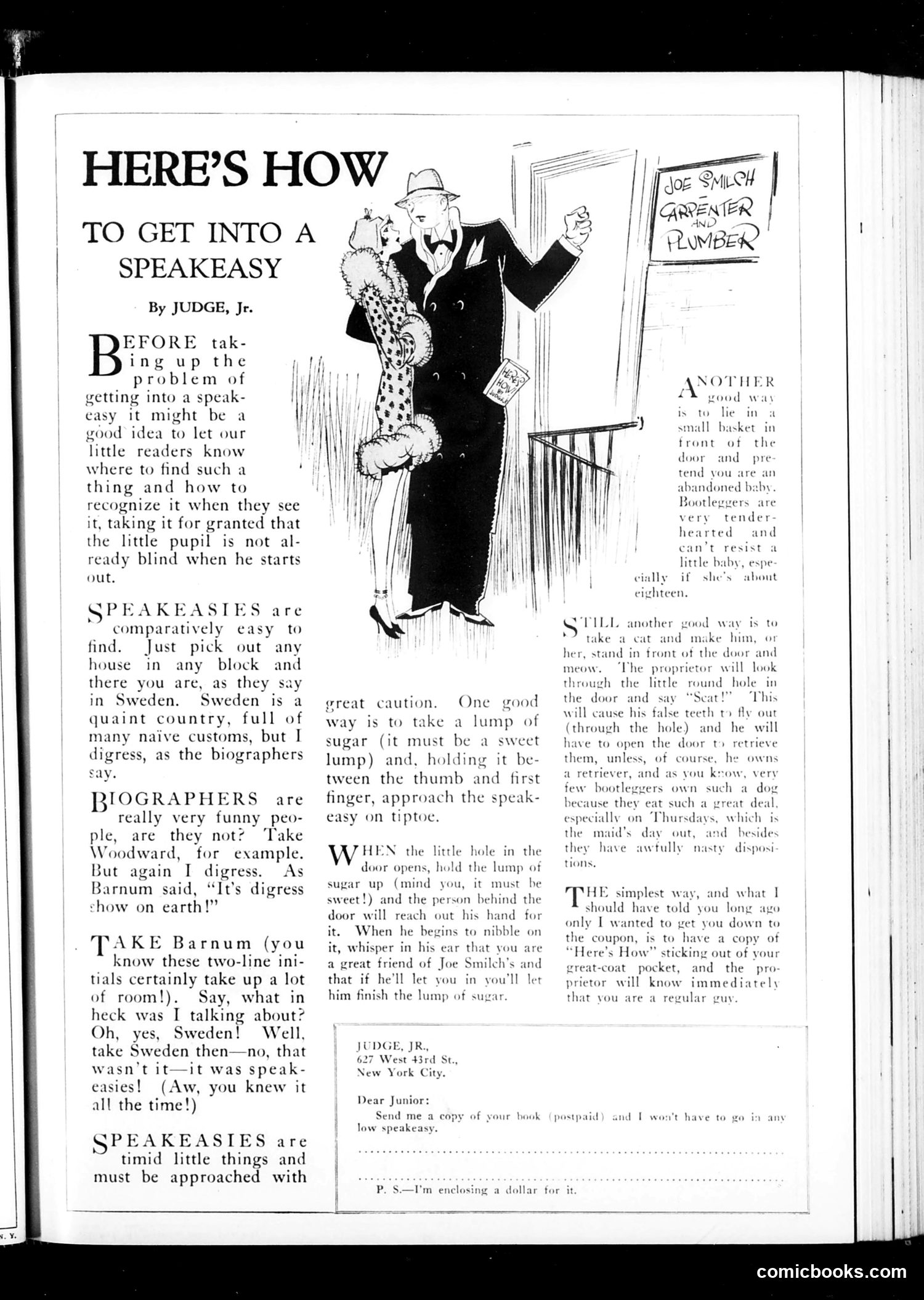
This Judge magazine piece satirizes the widespread but technically illegal speakeasies that flourished during Prohibition (1920-1933). The article humorously explains how to identify and enter these underground bars, which operated in ordinary houses throughout American cities. The satire works on multiple levels: it treats speakeasy access as a mundane problem requiring practical solutions (like luring proprietors with sugar lumps or abandoned babies), mocking both the absurdity of Prohibition enforcement and the public's casual normalization of lawbreaking. The rambling, digressive writing style adds comedic effect, parodying earnest advice columns. The central joke is that speakeasies were so common and obvious ("just pick out any house in any block") that treating their discovery as a puzzle requiring clever tactics is deliberately ridiculous. By framing illegal alcohol access as a casual how-to guide, Judge lampoons the failure of Prohibition to stop drinking—it merely made it comically conspiratorial.