
Judge, 1927-03-26 · page 20 of 36
Judge — March 26, 1927 — page 20: what you’re looking at
What you’re looking at
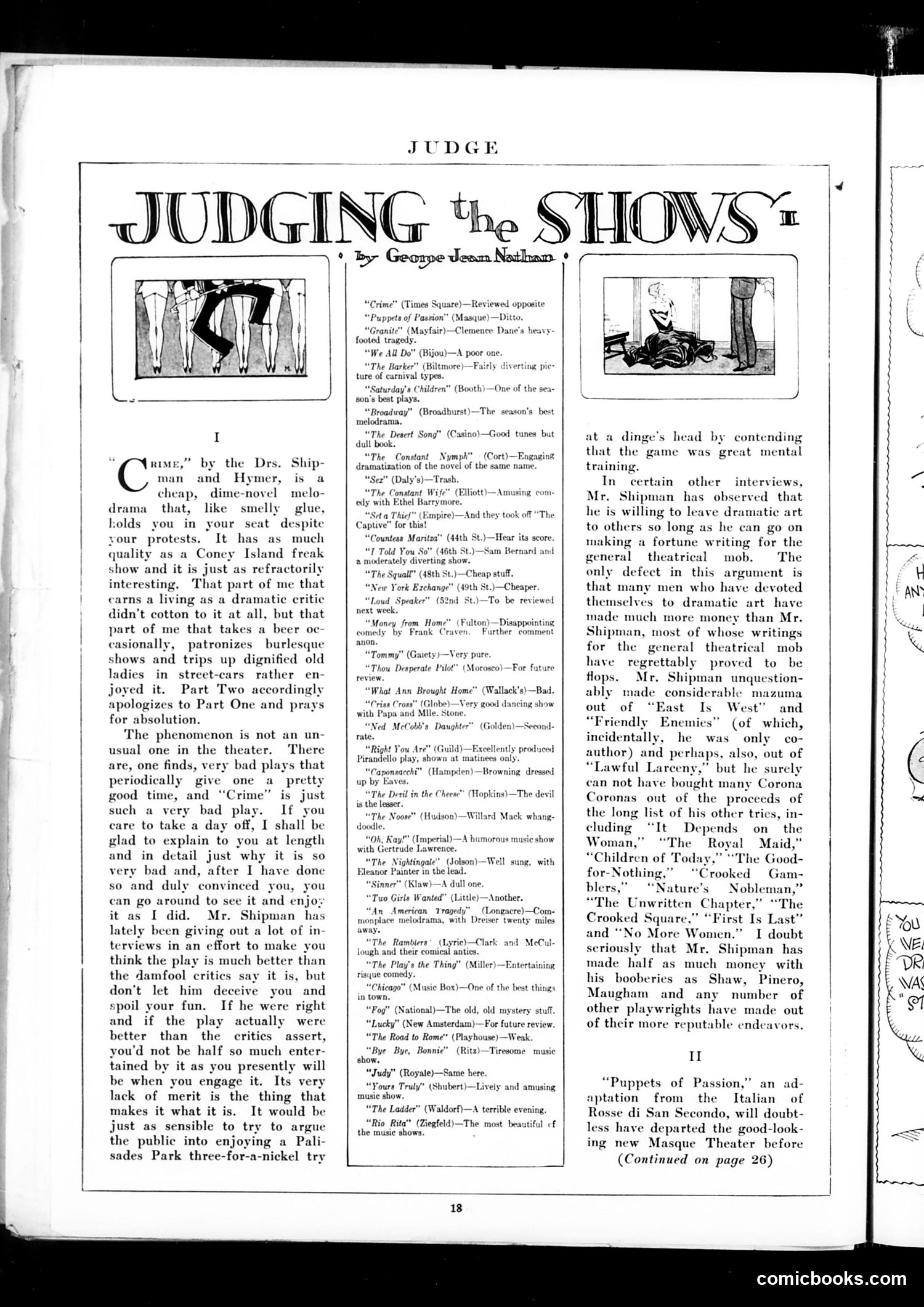
This page from *Judge* magazine contains a theater review column titled "Judging the Shows" by George Jean Nathan. The main content is **not a political cartoon** but rather a critical essay about theatrical productions. Nathan reviews the play "Crime" (by Shipman and Hymer), calling it a deliberately bad melodrama that's paradoxically entertaining precisely *because* it's poorly made. He argues audiences enjoy it despite—not because of—its quality, and that playwright Shipman's attempts to defend the play are misguided. The page includes a list of contemporary Broadway productions with brief dismissive or praising remarks, typical of entertainment journalism of the era (appears to be 1920s based on play titles and theaters). The satire targets theatrical pretension and the disconnect between critical assessment and popular enjoyment—suggesting some art is more fun when you stop taking it seriously.
📄 Transcribed text from this page (OCR, searchable)
Machine-transcribed from the original scan — historical spelling and the odd misread are preserved.
I a mime,” by the Drs. Ship- C man and Hymer, is a cheap, dime-novel melo- drama th like smelly glue, holds you in your seat despite your protests. It has as much quality as a Coney Island freak show and it is just as refractoril interesting. That part of me th carns a living as a dramatic critic didn’t cotton to it at all, but that part of me that takes a beer oc- casionally, patronizes burlesque shows and trips up dignified old ladies in street-cars rather en- joyed it. Part Two according] apologizes to Part One and pra for absolution. The phenomenon is not an un- usual one in the theater. There are, one finds, very bad that periodically give one a_ pretty good time, and “Crime” is just such a very bad play. If you care to take a day off, I shall be glad to explain to you at length and in detail just why it is so very bad and, after I have done so and duly convinced you, you can go around to see it and enjoy I did. Mr. Shipman has lately been giving out a lot of in terviews in an effort to make you think the play is much better than the damfool critics say it is, but don’t let him deceive you and spoil your fun. If he were right nd if the play actually were better than the critics assert, ou’d not be half so much enter- tained by it as you presently will be when you engage it. Its very lack of merit the thing that makes it what it is. It would be just as sensible to try to argue the public into enjoying a Pali- sades Park three-for-a-nickel try footed tragedy “We AU Do” (Bijou)—A poor one “The Barker” (Biltmore) —Fairly dive ture of carnival types. ng pie> turday's Children" (Booth)—One of the sea- ‘son's best plays. “Broadway” (Broadhurst)—The 's best melodrama. “The Desert Song” (Casino)—Good tunes but dull book. “The Constant Nymph” - (Cort)—Engaging dramatization of the novel of the same name. “Sez” (Daly's) —Trash. “The Constant Wife” (Elliott)—Amusing com- edy with Ethel Barrymore. Set a Thief” (Empire)—And they took of “The ptive” for this! ‘Countess Maritza” (44th St.)—Hear its score. “I Told You So” (46th St.)—Sam Bernard and 2 moderately diverting show. “The Squall” (48th St.)—Cheap stuff. se York Exchange” (49th St.)—Cheaper. “Loud Speaker” (52nd St.)\—To be reviewed next week. Money from Home" (Fulton)—Disappointing comedy by Fi Craven. Further comment anon. Tommy" (Gaiety) —Very pure “Thou Desperate Pilot” (Morosco)—For future review. What Ann Brought Home” (Wallack's)—Bad. (Globe) —Very good d with Papa and Mile. Stone. Ned MeCobb's Daugh rate. “Crise Cross” ing show nd * (Golden)—See 1) —Excel own at matinees ntly produced Pirandello pl “Caponsacehi up by Eaves “The Deril in the Cheese” (Hopkins)—The devil is the Less “The Noose” (Hudson)—Willard Mack whang- “Oh, Kay!” (Imperial) —A humorous mm with Gertrude Lawrence. “The Nightingale” (Jolson)—Well sung, with Eleanor Painter in the lead. law)—A dull one. Two Girls Wanted” (Little) —Another. ragedy” (Longacre)—Com- with Dreiser twenty. miles (Hampden) —Browning dressed ie show The Ramblers’ (Lyrie)—Clark and MeCul- lough and their comical antics. “The Play's the Thing” (Miller) Entertaining risque comedy. “Chicago” (Music Bor)—One of the best things in town. “Pog” ( “Lucky” (New Amsterdam)—For future review. “The Road to Rome” (Playhouse) —Weak “Bye Bye, Bonnie” (Ritz)—Tiresome music shor “Judy” (Royale)—Same here. “Yours Truly” (Shubert)—Lively and amusing music show “The Ladder” (Waldorf)—A terrible evening. “Rio Rita” (Ziegfeld) the music shows. ional)—The old, old mystery stuff. The most beautiful cf dinge’s head by that the g: training. In certain other interviews, Mr. Shipman has observed that he is willing to leave dramatic art to others so long as he can go on making a fortune writing for the general theatrical mob. The only defect in this argument. is that many men who have devoted themselves to dramatic art have made much more money than Mr. Shipman, most of whose writings for the general theatrical mob have regrettably proved to be flops. Mr. Shipman unquestion- ably made considerable mazuma out of “East Is West’ and “Friendly Enemies” (of which, incidentally, he was only co- author) and perhaps, also, out of “Lawful Larceny,” but he surely an not have bought many Corona Coronas out of the proceeds of the long list of his other tries, in- cluding “It Depends on the Woman,” “The Royal Maid,” “Children of Today,” ‘The Good- for-Nothing. “Crooked =Gam- blers,” ““Nature’s | Nobleman, “The Unwritten Chapter,” “TI Crooked Square,” “First Is Last” and “No More Women.” I doubt seriously that Mr. Shipman has made half as much money with his booberies as Shaw, Pinero, Maugham and any number of other playwrights have made out ontending me was great mental of their more reputable endeavors. nf “Puppets of Passion,” an ad- aptation from the Italian of Rosse di San Secondo, will doubt- less have departed the good-look- ing new Masque Theater before (Continued on page 26) 18 comicbooks.com