
A complete issue · 36 pages · 1927
Judge — February 5, 1927
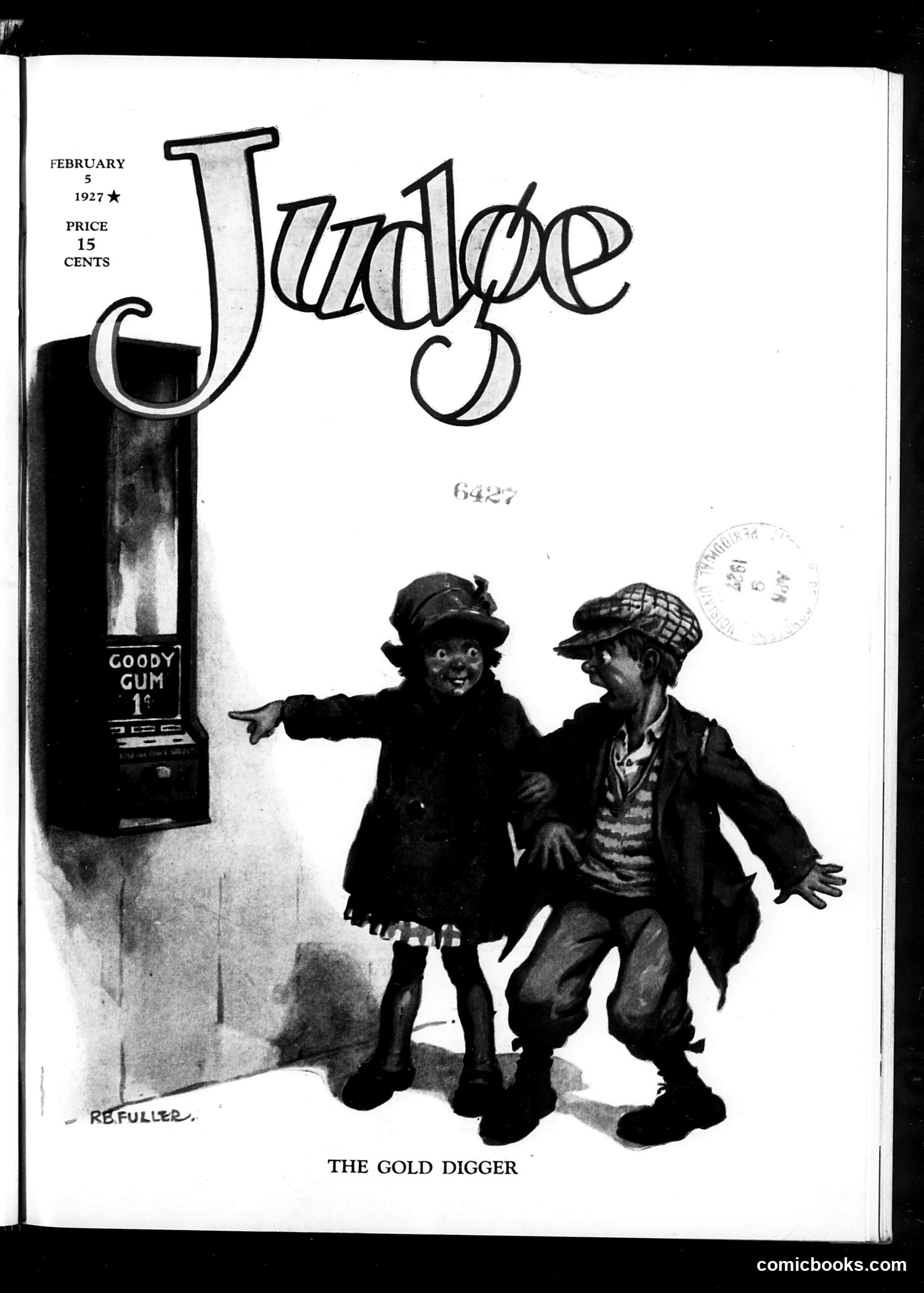
This cartoon depicts two urchins or street children examining a gum machine labeled "GOODY GUM 1¢". One child points at the machine while gesturing to his companion, suggesting they're plotting to extract money from it—hence "The Gold Digger" title. The satire likely plays on the contemporary slang term "gold digger," referring to women who pursued men for money. By applying this label to children attempting petty theft from a vending machine, the cartoon creates dark humor by equating childhood mischief with opportunistic fortune-hunting. The illustration's working-class aesthetic and focus on urban street children reflects 1920s concerns about poverty and juvenile delinquency in American cities.
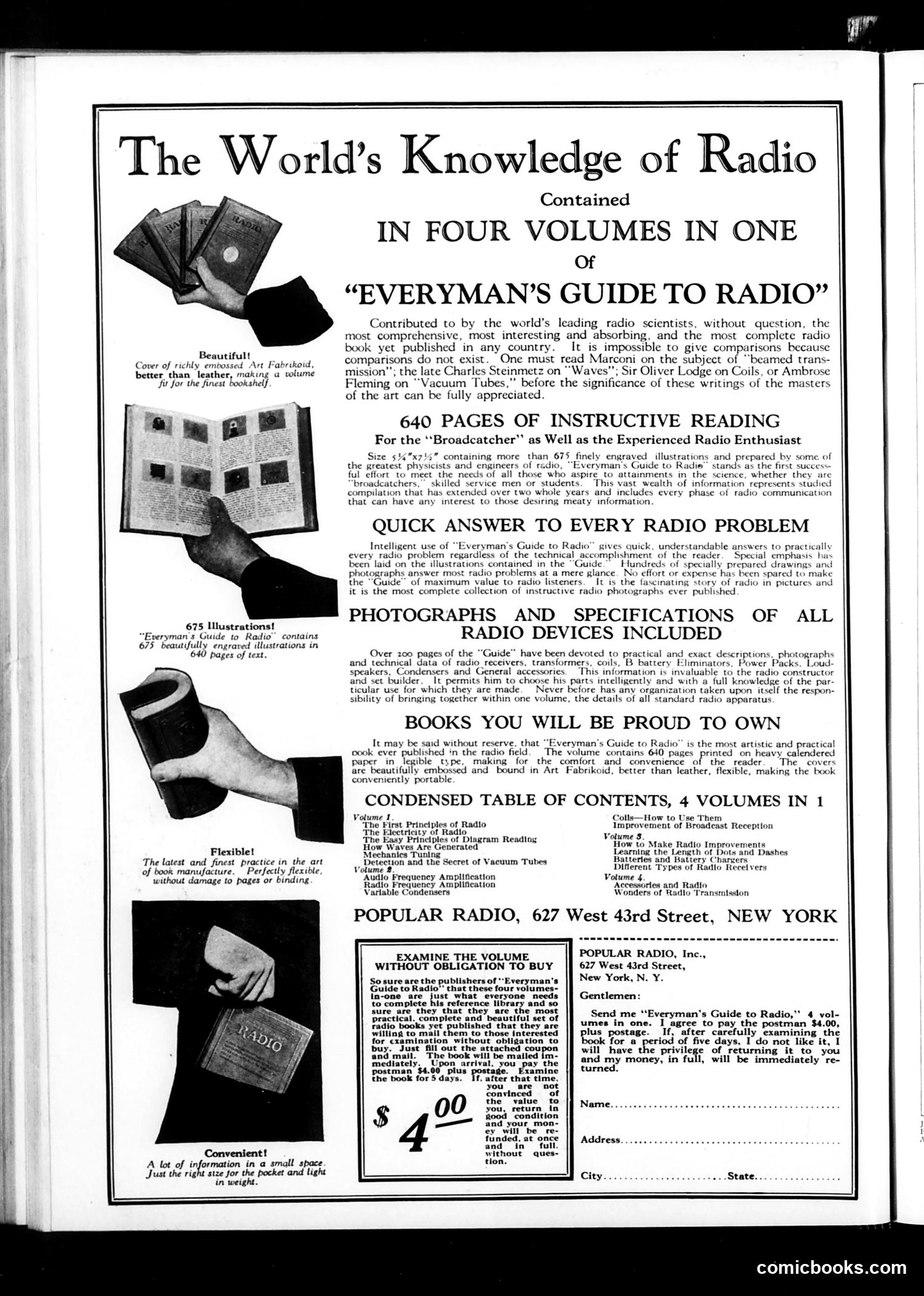
This page is **primarily an advertisement**, not a political cartoon. It promotes "Everyman's Guide to Radio," a comprehensive four-volume radio encyclopedia published by Popular Radio magazine. The page emphasizes the book's practical value through marketing language: 640 pages of instruction, 675 illustrations, photographs of radio devices, and answers to radio problems. The visual elements—images of the book's leather binding, its compact size, and sample radio equipment—serve to showcase the product's quality and usefulness. The only potentially humorous element is the tagline "Flexible!" describing the book's binding, paired with an image suggesting the volume's durability. Otherwise, this is straightforward 1920s-era commercial promotion for radio enthusiasts and professionals.
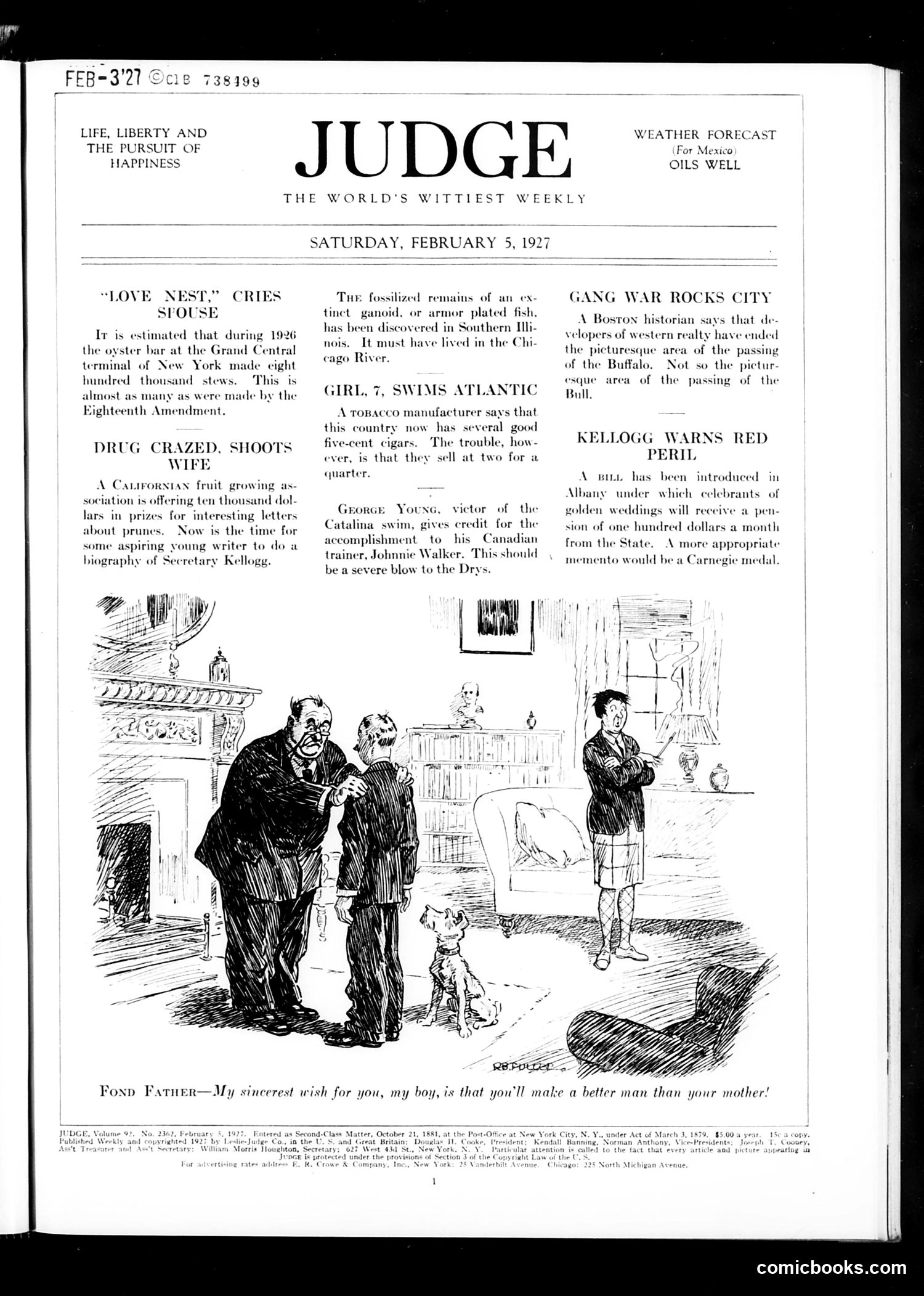
The main cartoon titled "Fond Father" depicts a working-class or immigrant father speaking to his young son, with the caption: "My sincere wish for you, my boy, is that you'll make a better man than your mother!" This appears to be satirizing gender relations and working-class family dynamics of the 1920s. The joke likely plays on the father's presumed low regard for his wife—suggesting he wishes his son will be better than she is, which is absurd since they're different genders. The satire critiques either misogyny or the class anxieties of the era regarding masculinity and social mobility. The page's other brief articles mock trivial social trends (expensive cigars, swimming records, legislation about wedding gifts), typical of *Judge*'s light satirical style.
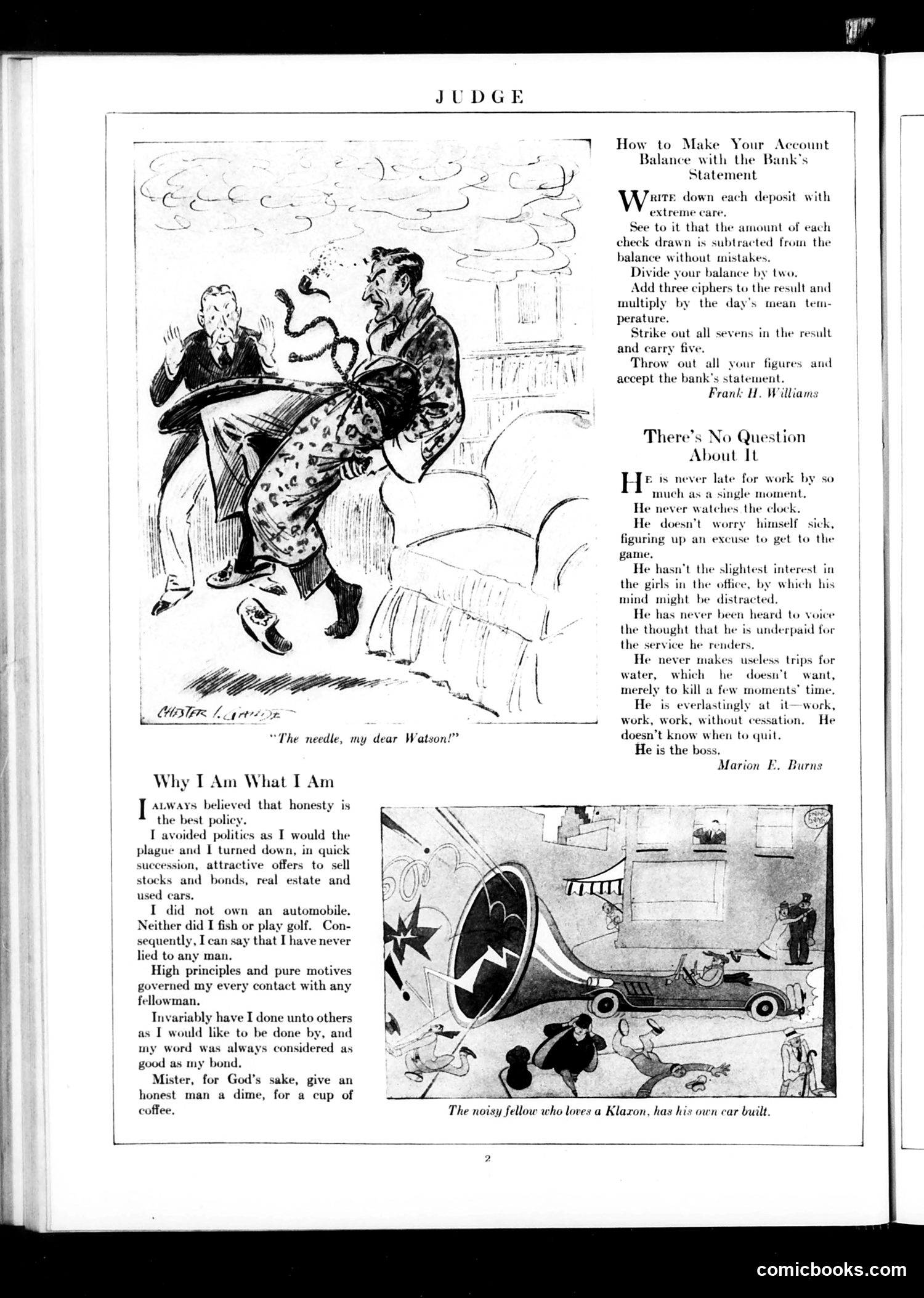
**Top cartoon** ("The needle, my dear Watson!"): Shows two men examining something with a magnifying glass, appearing to reference Sherlock Holmes's detective methods. The joke likely plays on "the needle" as both a sewing implement and slang for deception or a con—suggesting one character is trying to trick the other. **Middle section** presents three brief articles: instructions for bank reconciliation, a character profile titled "There's No Question About It" (describing an exceptionally dedicated worker), and "Why I Am What I Am" (a personal philosophy piece). **Bottom cartoon**: Depicts someone with a large homemade vehicle or contraption, captioned "The noisy fellow who loves a Klazon, has his own car built"—satirizing early automotive enthusiasts' tendency to create loud, improvised vehicles.
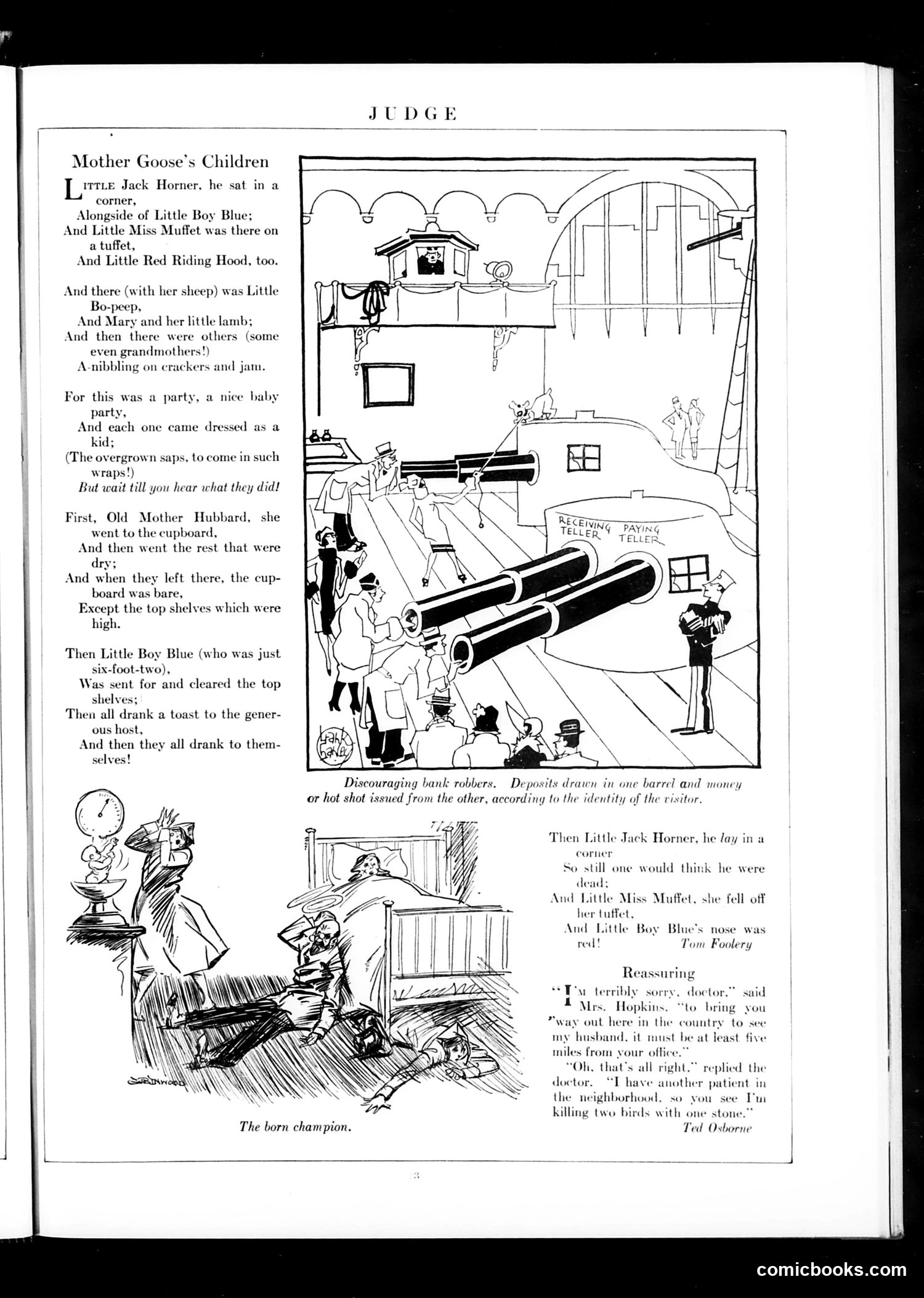
This page presents "Mother Goose's Children," a satirical poem illustrated with humorous drawings. The main cartoon depicts a chaotic children's party at a bank, where the joke involves bank robbery disguised as innocent play. The illustration shows children conducting "discourage[d] bank robbers" using toy cannons and playing at being "Receiving Teller" and "Paying Teller." The satire mocks both children's innocent game-playing and, implicitly, actual bank security vulnerabilities by suggesting a bank heist could occur amid such innocent activity. A smaller illustration titled "The born champion" shows children roughhousing, satirizing childhood violence and recklessness. The "Reassuring" dialogue jokes about a doctor conveniently having multiple patients, allowing him to ignore house calls. This reflects early 20th-century American anxieties about crime and incompetence in public institutions.
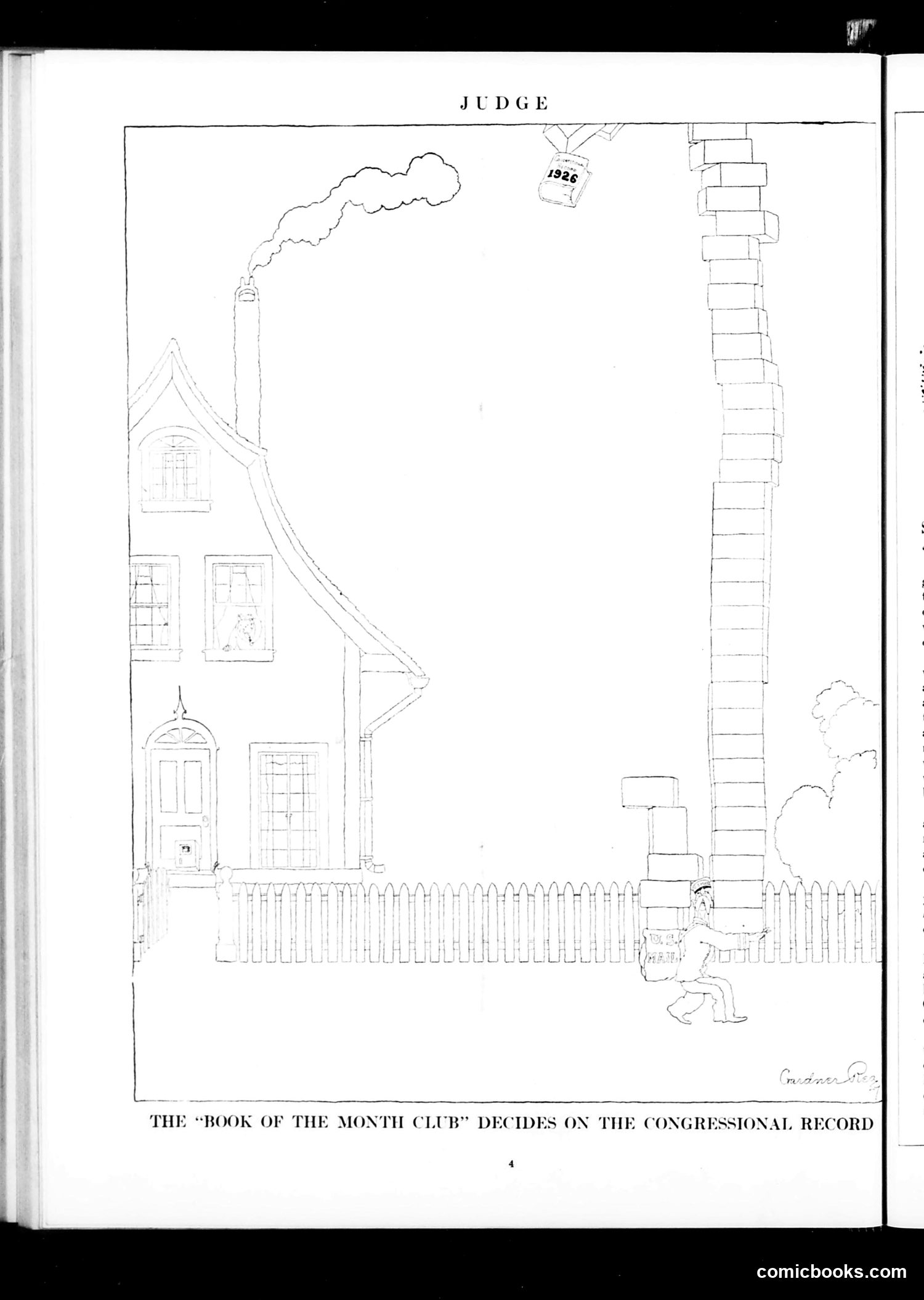
This political cartoon titled "The 'Book of the Month Club' Decides on the Congressional Record" satirizes Congressional proceedings through the metaphor of a book club selection process. The image depicts a church or institutional building with a tall chimney emitting smoke, surrounded by a white picket fence. A figure appears to be throwing or discarding something (likely representing Congressional documents) into a waste receptacle. The satire suggests that Congress's official record—the Congressional Record documenting legislative proceedings—is being treated casually or dismissed like unwanted reading material by a book club. This mocks either Congressional ineffectiveness, the irrelevance of legislative documentation, or the frivolous nature of political discourse during this period (dated 1926 in the image).
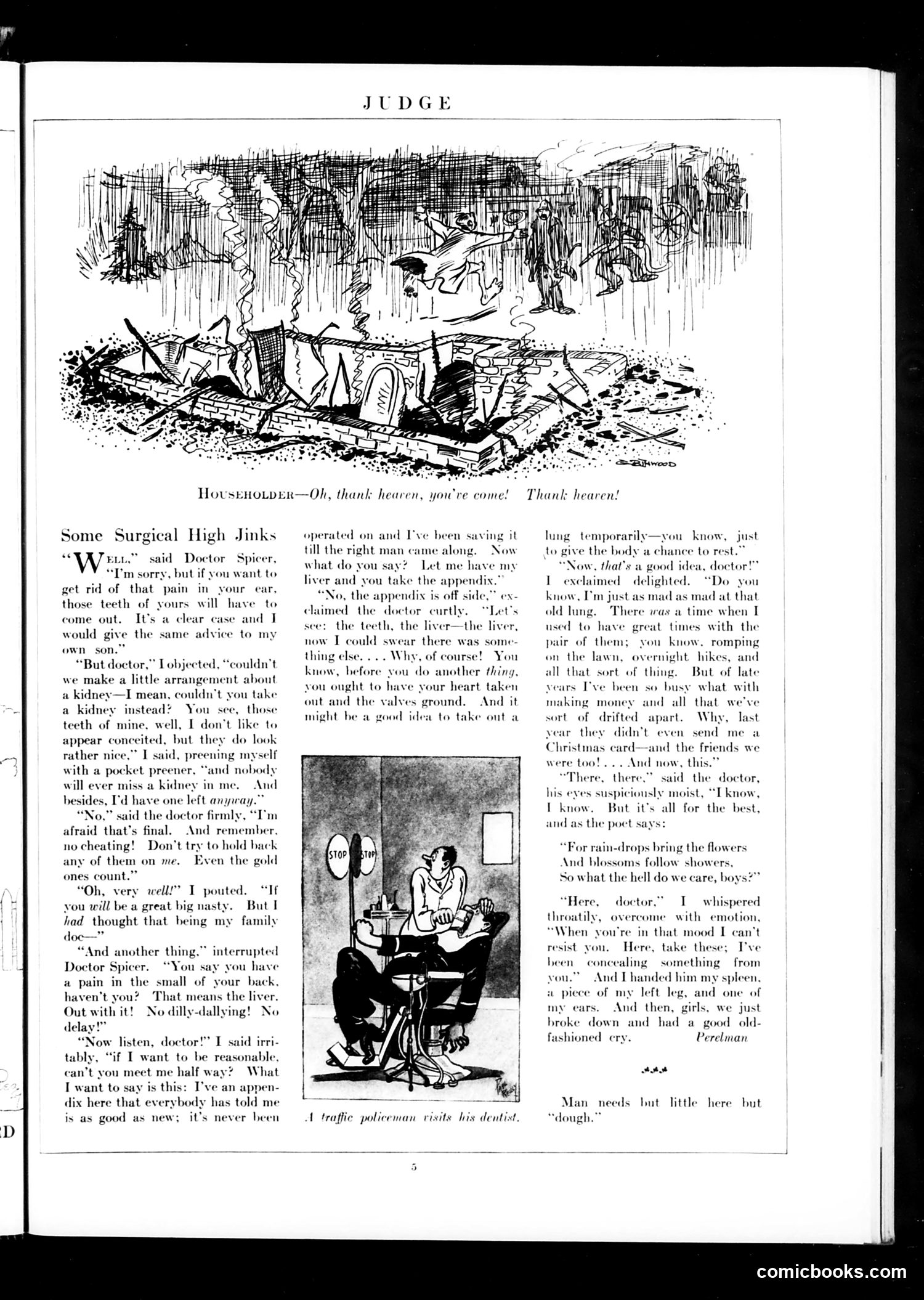
This page contains a humorous story titled "Some Surgical High Jinks" rather than a political cartoon. The narrative describes a doctor (Doctor Spicer) convincing a patient to have unnecessary surgery—removing teeth, liver, and appendix—under the guise of treating ear pain. The accompanying illustration shows a traffic policeman visiting a dentist, captioned "A traffic policeman visits his dentist." The satire targets medical overtreatment and unnecessary surgery, a common concern in early 20th-century healthcare. The joke exploits the irony of a law-enforcement officer (traffic policeman) seeking dental care, though the specific relevance is unclear from the text alone. The story mocks doctors who perform procedures patients don't actually need, reflecting broader public skepticism about medical professionalism of the era.
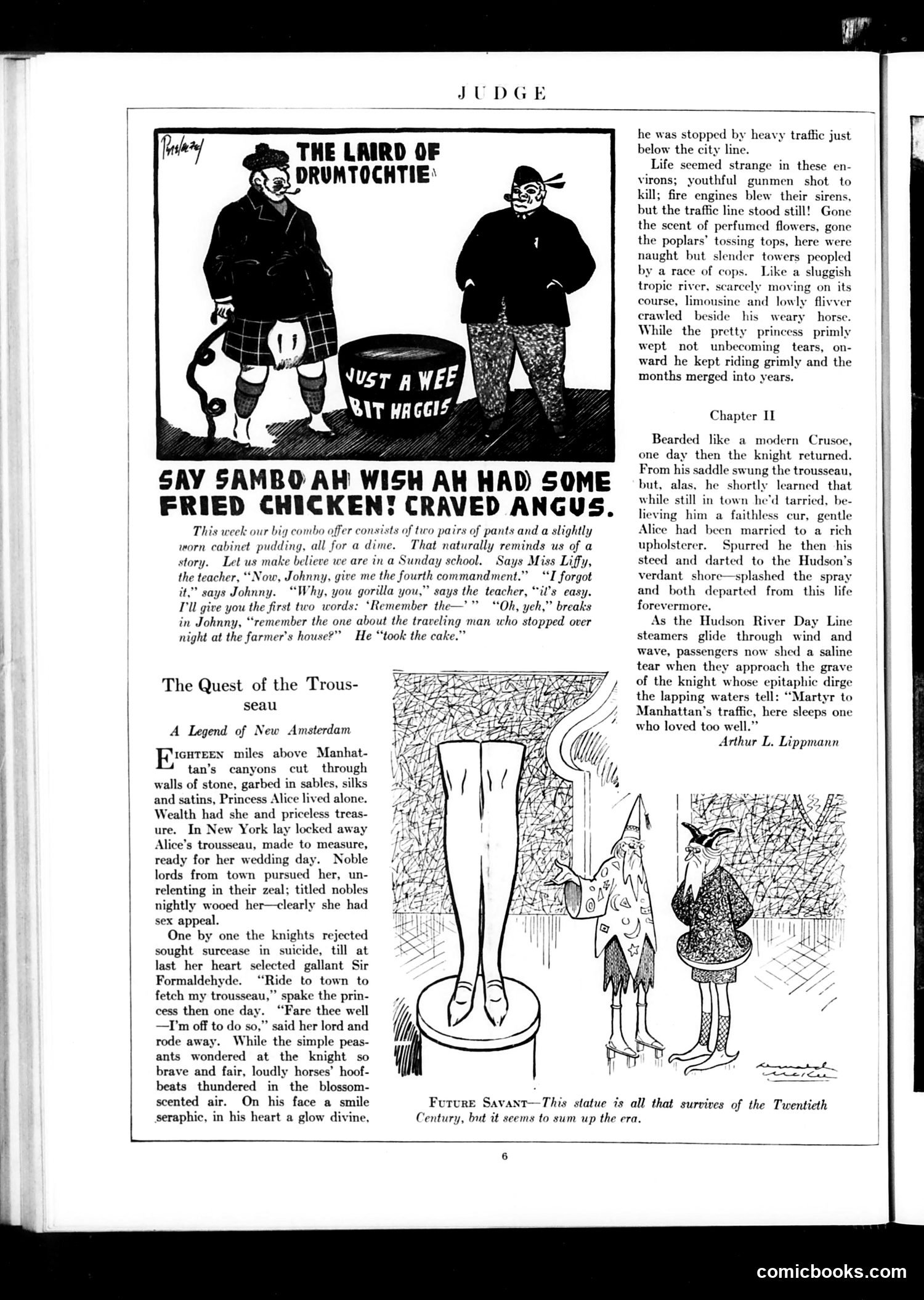
This page contains two distinct pieces of satire: **"The Laird of Drumtochtie"** (top cartoon): A Scottish character and companion stand beside a pot labeled "Just a Wee Bit Haggis." The accompanying text mocks Scottish dialect and culinary traditions through a Sunday school joke setup—crude humor typical of early 20th-century American magazines that relied on ethnic stereotyping. **"The Quest of the Trousseau"** (main feature): A mock-heroic narrative poem mocking both medieval romance literature and modern New York City. A knight rides to Manhattan to retrieve his bride's trousseau but encounters urban chaos—traffic, sirens, gunmen—instead of pastoral bliss. The satire targets the collision between romantic idealism and harsh urban reality, with the knight ultimately dying from traffic-related despair. The closing illustration suggests modernity itself is all that survives of the twentieth century—a critique of contemporary urban life as spiritually empty. Both pieces satirize contemporary American culture through literary parody and exaggeration.
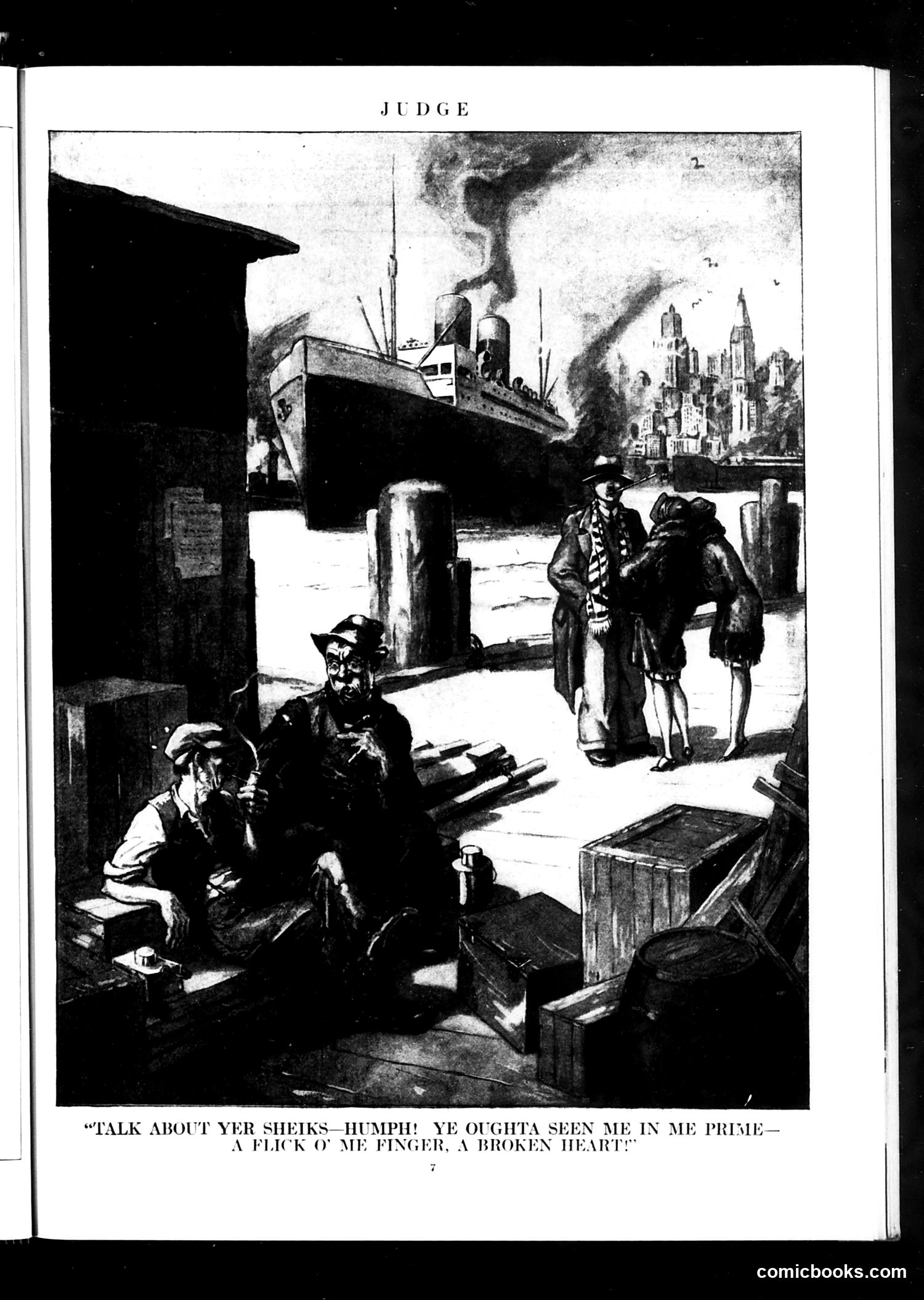
This Judge magazine cartoon satirizes aging and nostalgia. The page shows what appears to be an older working-class man (likely a dock worker or laborer, given the waterfront setting with ships and cargo) boasting to younger men about his romantic prowess in his youth. His dialect ("yer," "me prime," "flick o' me finger") marks him as Irish-American working class. The satire mocks the universal tendency of aging men to reminisce about past romantic conquests—the "sheiks" reference alludes to the 1920s glamour culture and movie stars. The irony is that this rough laborer claims the same casual romantic power as fashionable modern men, suggesting that vanity and self-aggrandizing memories transcend class and era. The waterfront industrial setting contrasts sharply with modern romantic ideals.
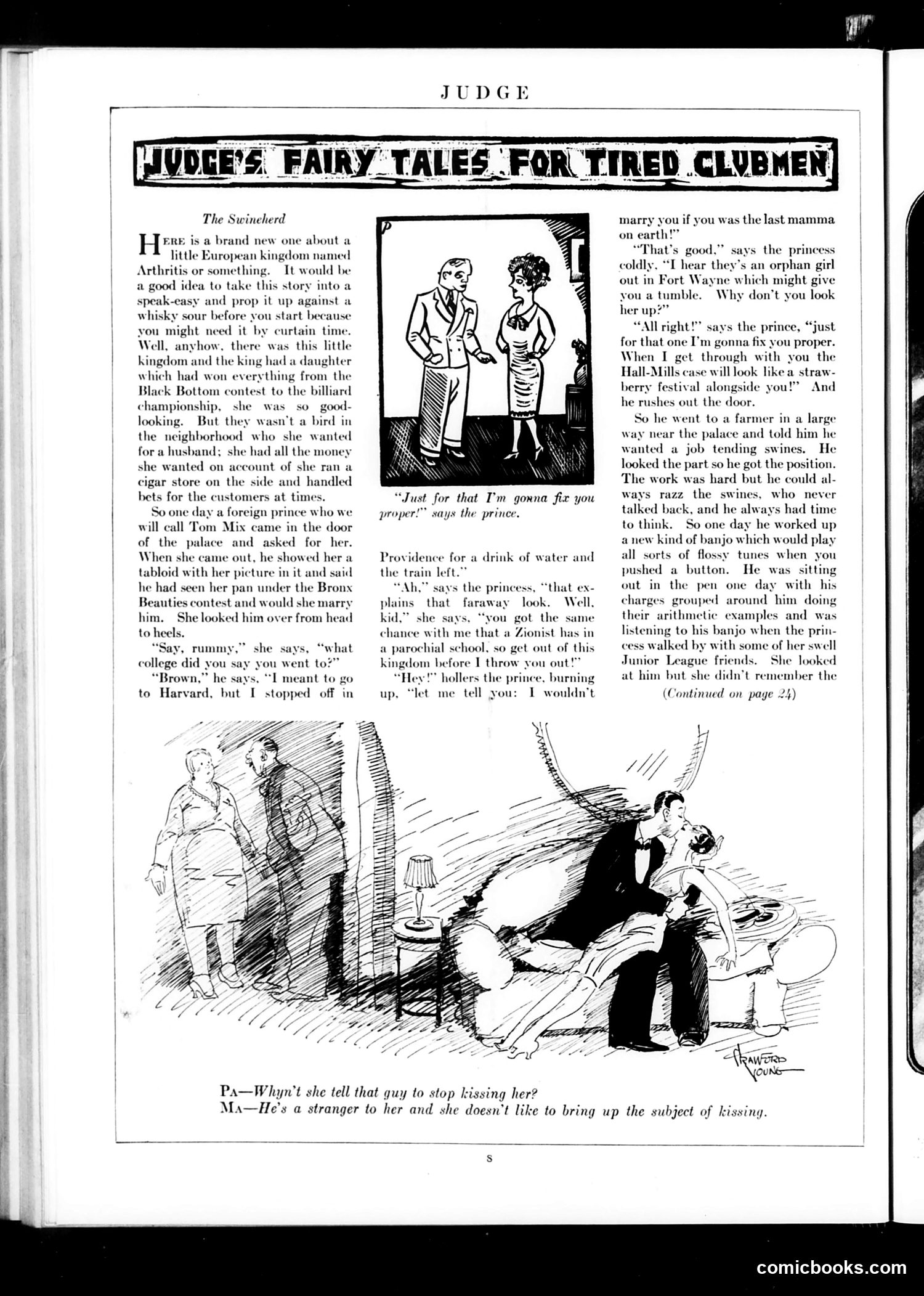
This is a humorous fairy-tale adaptation satirizing 1920s social pretension. A foreign prince seeks marriage with a wealthy princess who runs a cigar store and handles betting—suggesting nouveau riche vulgarity. When rejected, he disguises himself as a swineherd and constructs a musical banjo to win her favor, referencing Hans Christian Andersen's "The Swineherd" tale. The satire targets: - **Class mobility**: The "self-made" princess contradicts aristocratic expectations - **Gender roles**: A woman rejecting suitors based on her own judgment - **American references**: "Fort Wayne," the "Hall-Mills case" (a 1920s murder scandal), "Junior League" ground the European fairy tale in contemporary U.S. culture The bottom cartoon jokes about propriety and stranger-danger etiquette, offering light social commentary on acceptable behavior. The overall tone is urbane, irreverent comedy for Judge's sophisticated audience.
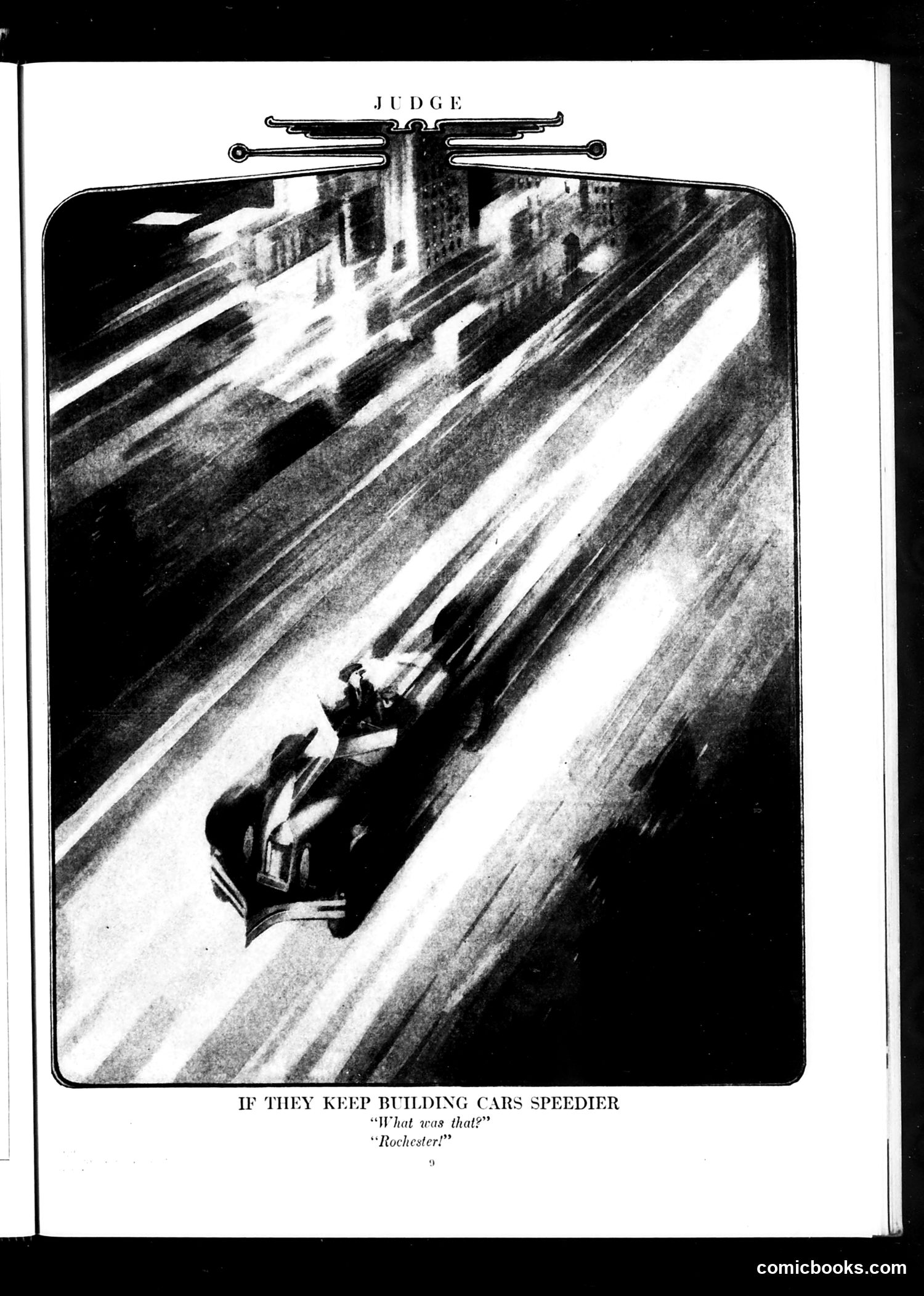
This is a satirical cartoon about automobile speed and safety. The image shows an aerial view of a car traveling at such high velocity down a road that it appears as merely a blur—the vehicle is almost indistinguishable amid streaking lines of motion. The caption's joke hinges on the dialogue: someone asks "What was that?" and another responds "Rochester!"—implying the car passed through Rochester so quickly that the observer could barely register it was a city at all. The title suggests Judge's concern about escalating car speeds: if manufacturers keep making faster vehicles, travel becomes dangerously rapid and cities become invisible to passengers. This reflects early-20th-century anxiety about automotive technology's acceleration and its social consequences.
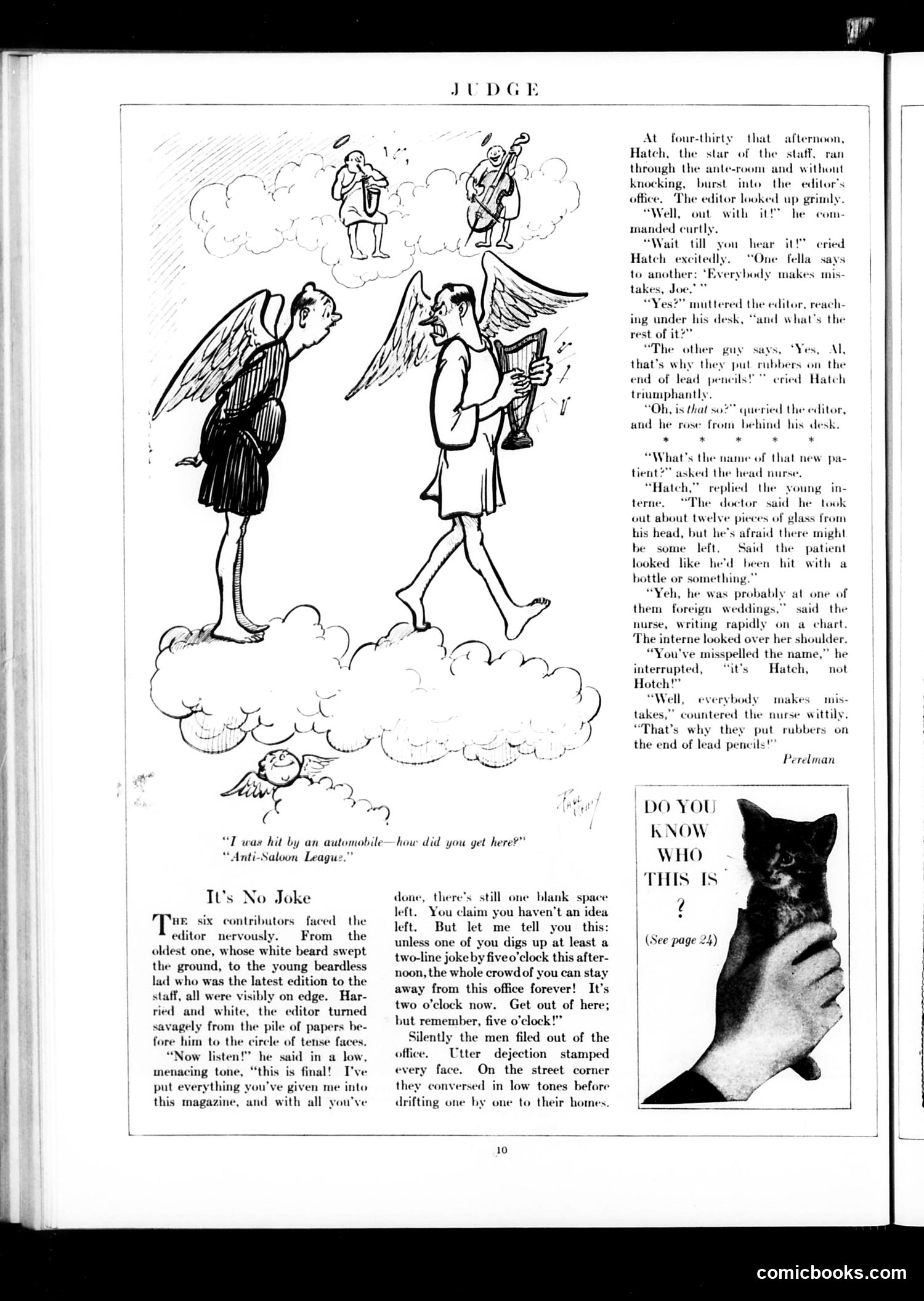
This page contains two humor pieces from *Judge* magazine, a satirical publication. **"It's No Joke"** depicts an editor demanding his staff produce a two-line joke by 5 p.m. or face termination. Staff member Hatch arrives with a joke: a patient asks "how did you get here?" after being hit by a car; the other replies "Anti-Saloon League"—a reference to the Prohibition-era organization. The joke mocks the Anti-Saloon League by implying their members cause accidents (likely a jab at their perceived self-righteousness or unpopularity). Below this, a brief anecdote about a hospital patient named Hatch (possibly the same character) describes him having glass removed from his head after being struck. A nurse misspells his name, and an intern corrects her, leading to a recycled punchline about pencil erasers. The satire reflects the pressure magazine editors faced to fill space with humor, and the sometimes-forced or recycled nature of such material.
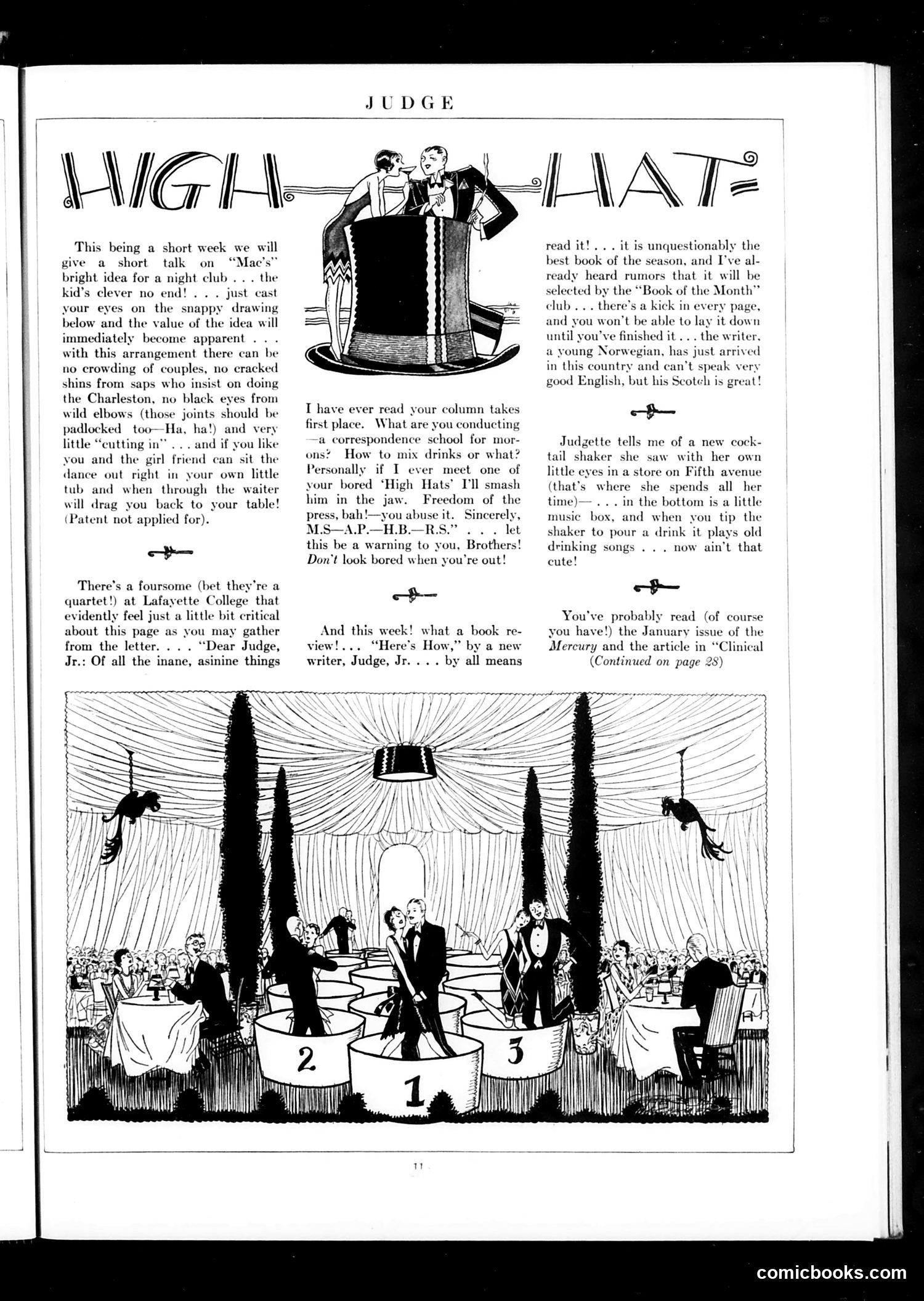
This page features Judge magazine's satirical commentary on 1920s social life and manners. The main cartoon depicts a nightclub design concept where couples sit in individual "tubs" numbered 1-3, with acrobats suspended above—a humorous solution to crowded dance floors and the physical chaos of the Charleston craze. The accompanying text includes mock letters criticizing the column's frivolous advice (mixing drinks, etiquette) and praising a new book "Here's How" by a Norwegian writer whose English is poor but whose "Scotch is great"—a pun on both the language and the liquor, relevant during Prohibition. The satire targets upper-class concerns about proper nightclub behavior while poking fun at both pretentious critics and the absurdity of elaborate solutions to modern social problems. The references assume reader familiarity with Jazz Age leisure culture and Prohibition-era cocktail obsession.
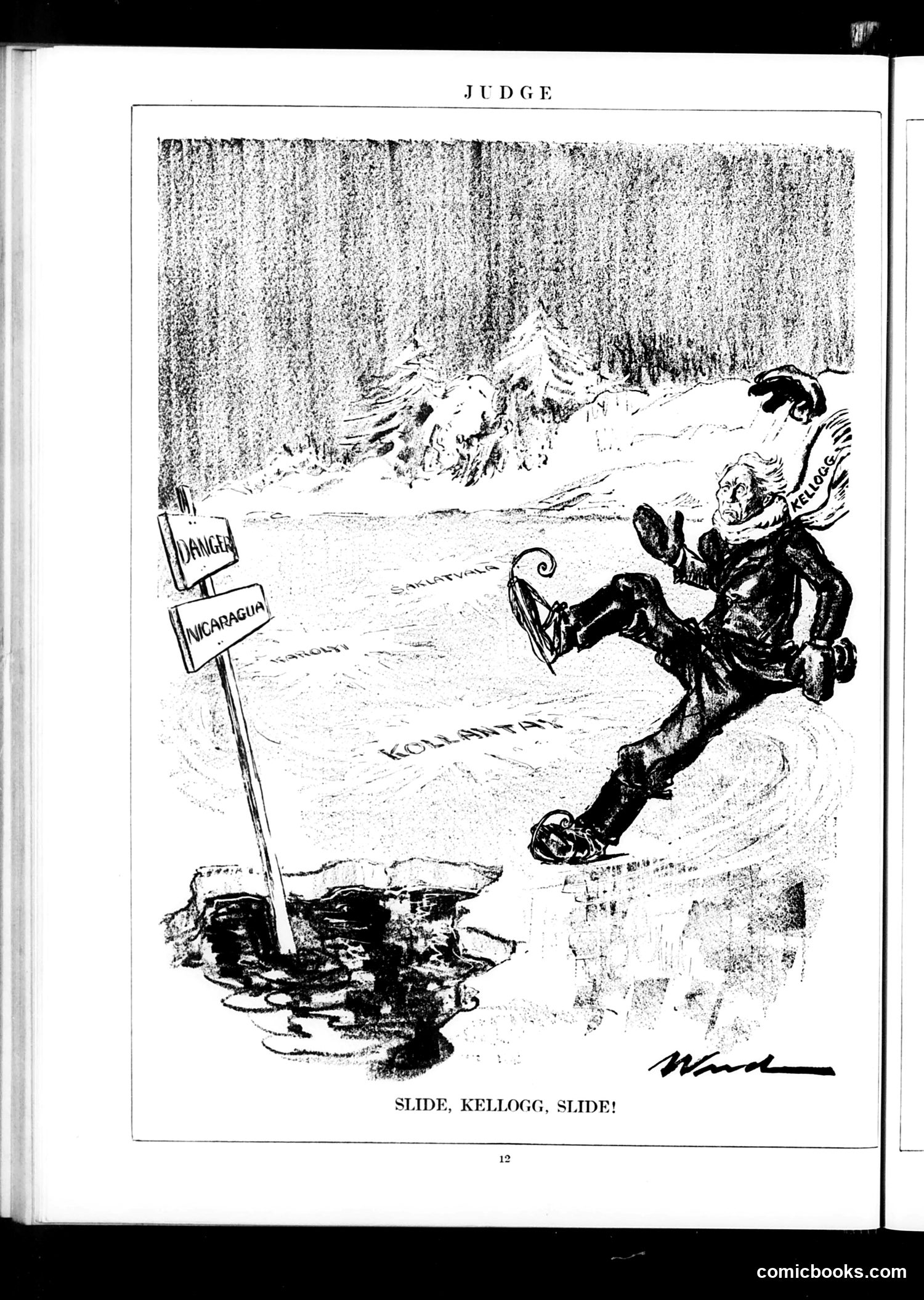
This political cartoon satirizes a figure labeled "Kellogg" (likely Secretary of State Frank B. Kellogg) who appears to be slipping or sliding dangerously on ice near warning signs reading "DANGER" and "NICARAGUA." The cartoon depicts him losing his footing in a precarious mountainous landscape, suggesting he's in political peril regarding U.S. involvement in Nicaragua. The title puns on "Slide, Kelly, Slide," a popular baseball song, mocking Kellogg's diplomatic misstep. The warning signs and treacherous terrain symbolize the risks of American intervention in Central American affairs—a contentious foreign policy issue of the 1920s-30s era when this likely appeared.
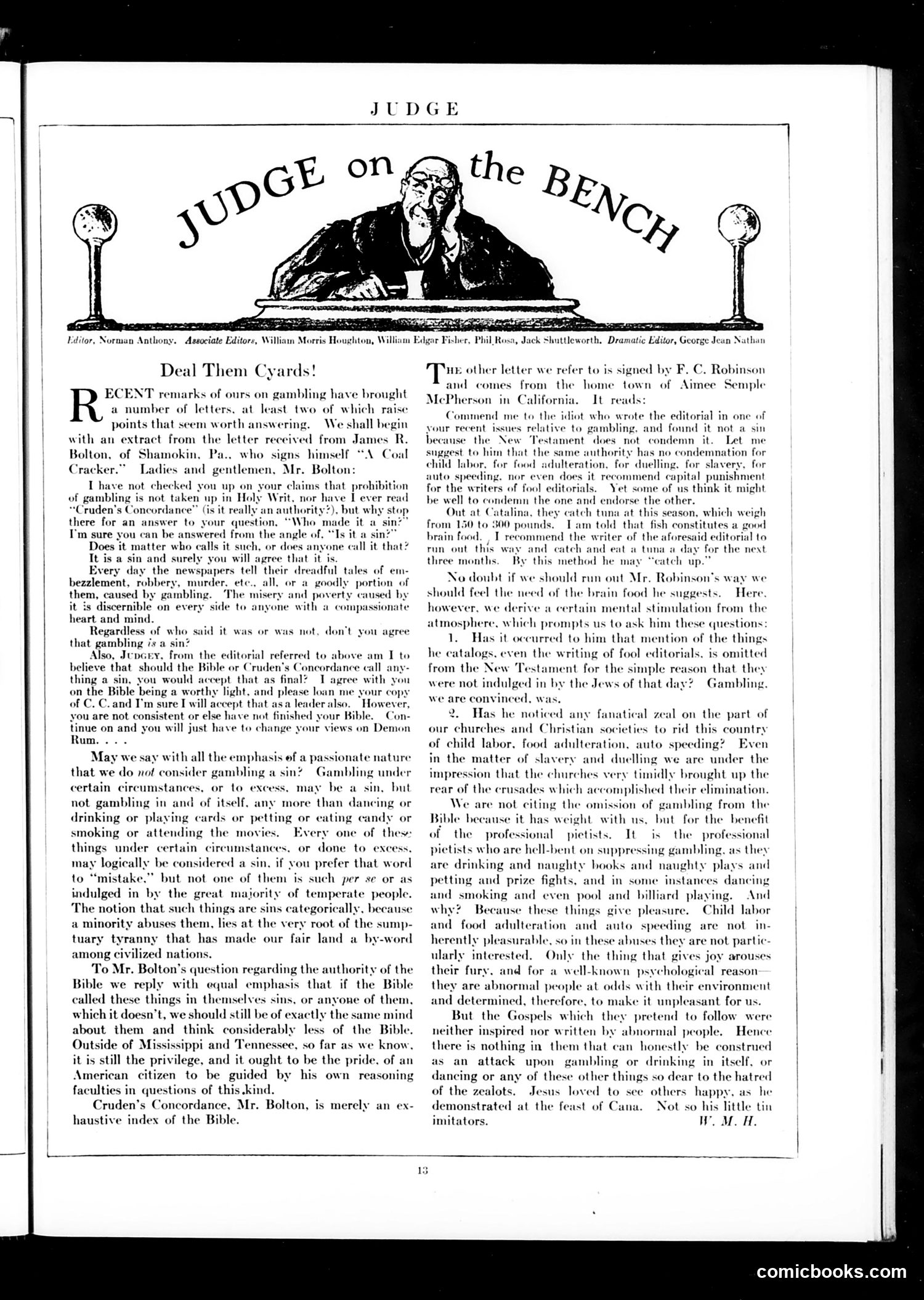
This page features Judge magazine's "Judge on the Bench" editorial column responding to reader letters about gambling. The masthead shows a contemplative judge figure overseeing the debate. Two correspondents challenge Judge's earlier position that gambling isn't inherently sinful. J.R. Bolton from Pennsylvania argues gambling causes poverty and crime, citing its absence from the Bible's condemnation list. F.C. Robinson from California (Aimee Semple McPherson's hometown) sarcastically notes the New Testament also doesn't explicitly condemn child labor or slavery, yet we oppose those—so shouldn't editorial consistency apply to gambling? Judge responds that gambling itself isn't sinful; only excess or misuse is. The editors assert Americans should use personal reasoning rather than accept blanket moral pronouncements. The debate reflects 1920s-30s tensions between traditional religious morality and modern secular individualism regarding personal conduct regulation.
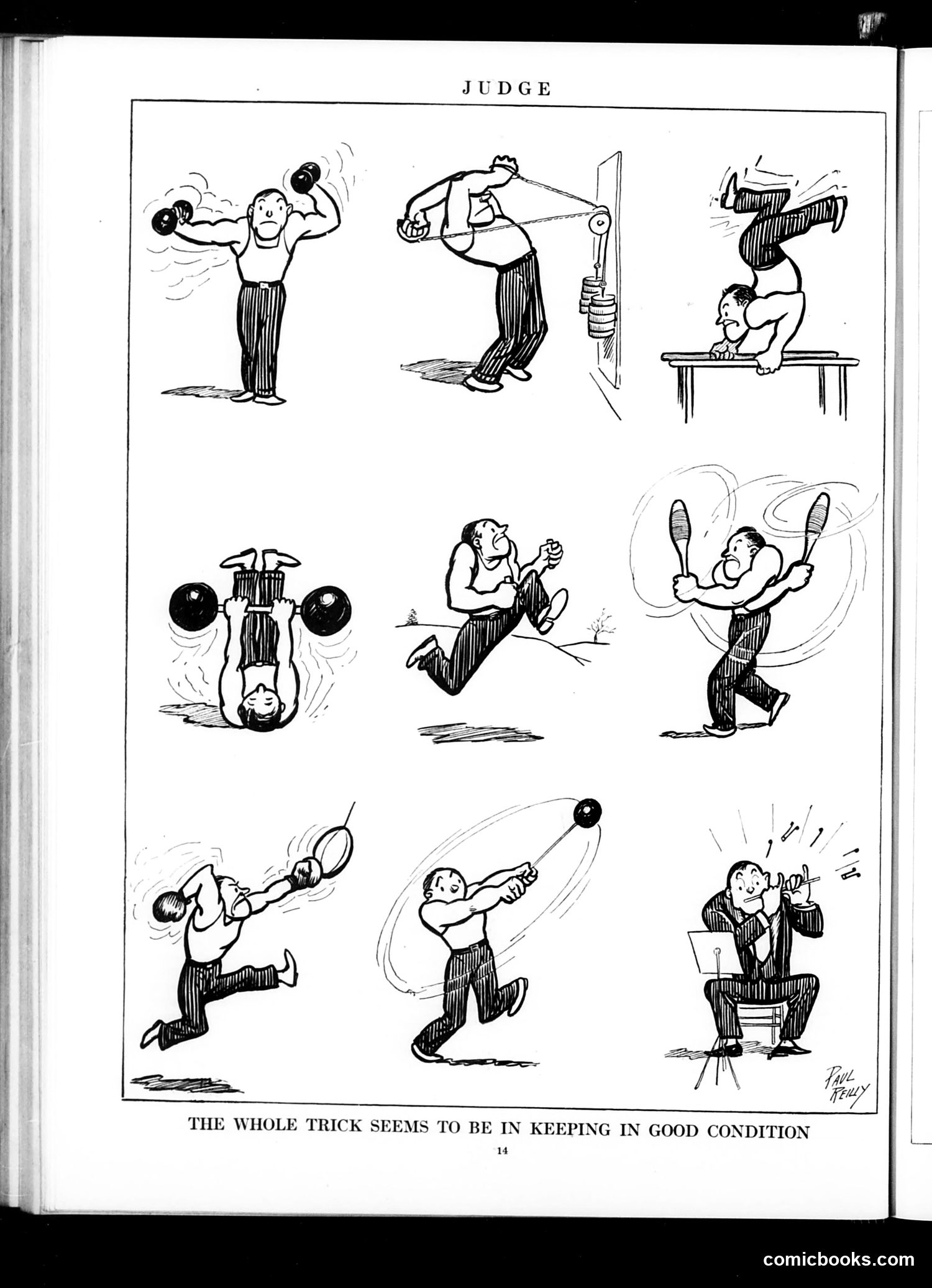
This page titled "Judge" presents nine cartoon panels depicting a figure (likely representing a judge or legal authority) performing various physical exercises and training activities—boxing, weightlifting, stretching, juggling, and other conditioning routines. The caption reads: "The Whole Trick Seems to Be in Keeping in Good Condition." The satire appears to mock judges (or the judiciary generally) by suggesting that their primary qualification is physical fitness rather than legal knowledge or judicial temperament. By reducing the judge's role to maintaining bodily conditioning through circus-like acts (juggling, acrobatics), the cartoonist suggests judges are performers or athletes rather than serious legal minds—a critique of judicial competence, impartiality, or the superficiality of the appointment/election process. The exact historical context remains unclear without a date.
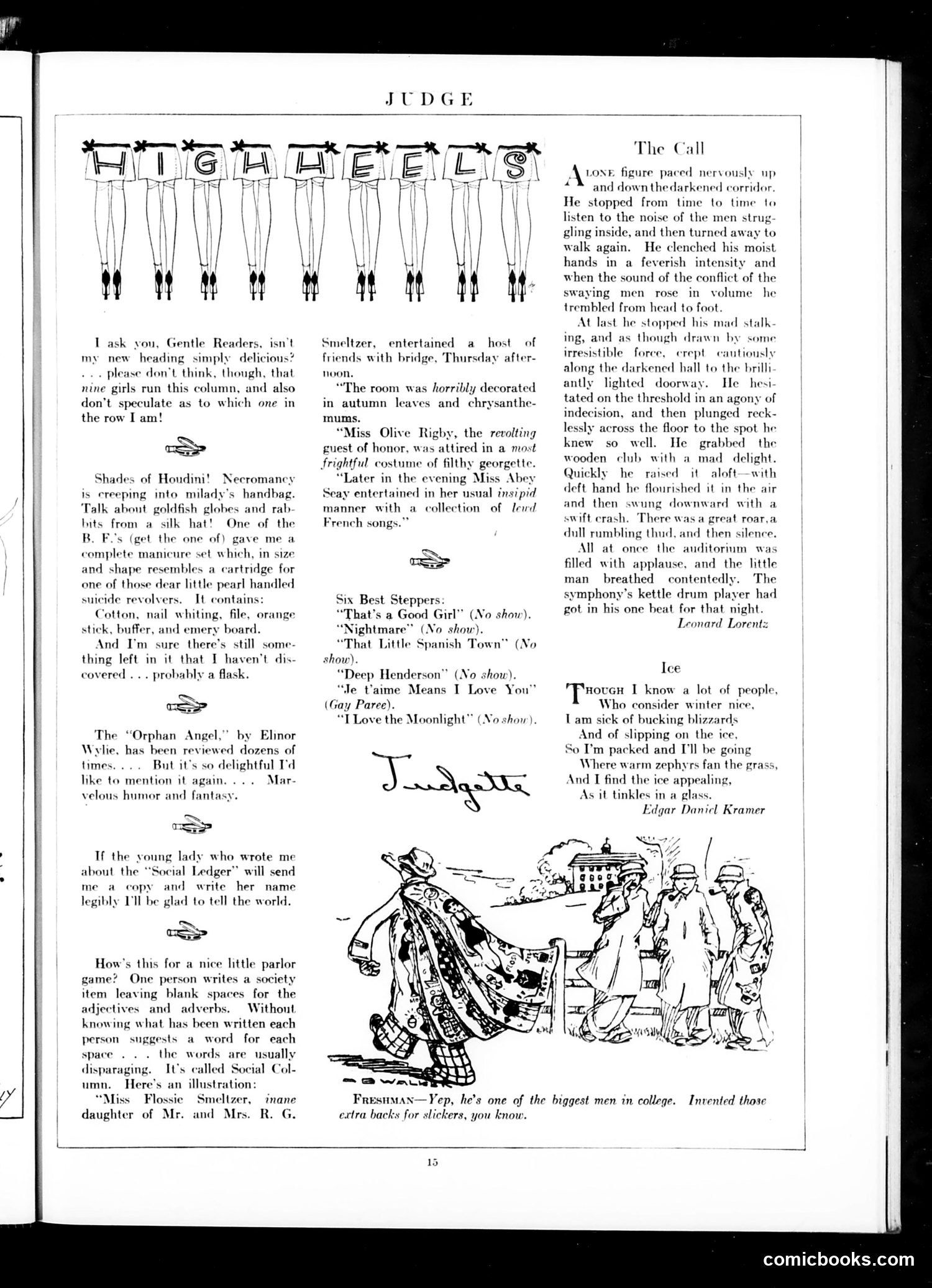
This is a humor column page mixing social satire with fiction and poetry. The main content includes: **"Highballs" Header:** A joke about the column's new masthead featuring nine illustrated women, with the author playfully refusing to identify which figure represents her—a common vanity trope of the era. **"Social Column" Game:** The satire targets society page writing by showing a parlor game where participants fill blanks with insulting adjectives/adverbs. The example mocks vapid society coverage, describing Miss Flossie Smeltzer's bridge party with deliberately derogatory language (guests are "revolting," rooms "horribly decorated," entertainment "lewd"). This lampoons the breathless, superficial tone of actual society columns. **"The Call":** A short story about a nervous man attending what seems to be a concert—the climactic "crash" and "roar" reveal he's the orchestra's kettle drum player finally getting his musical moment. **"Ice":** A light poem about preferring warm climates, ending with a pun on "ice" (frozen water vs. ice in drinks). The page reflects 1920s concerns with social pretension and gender roles.
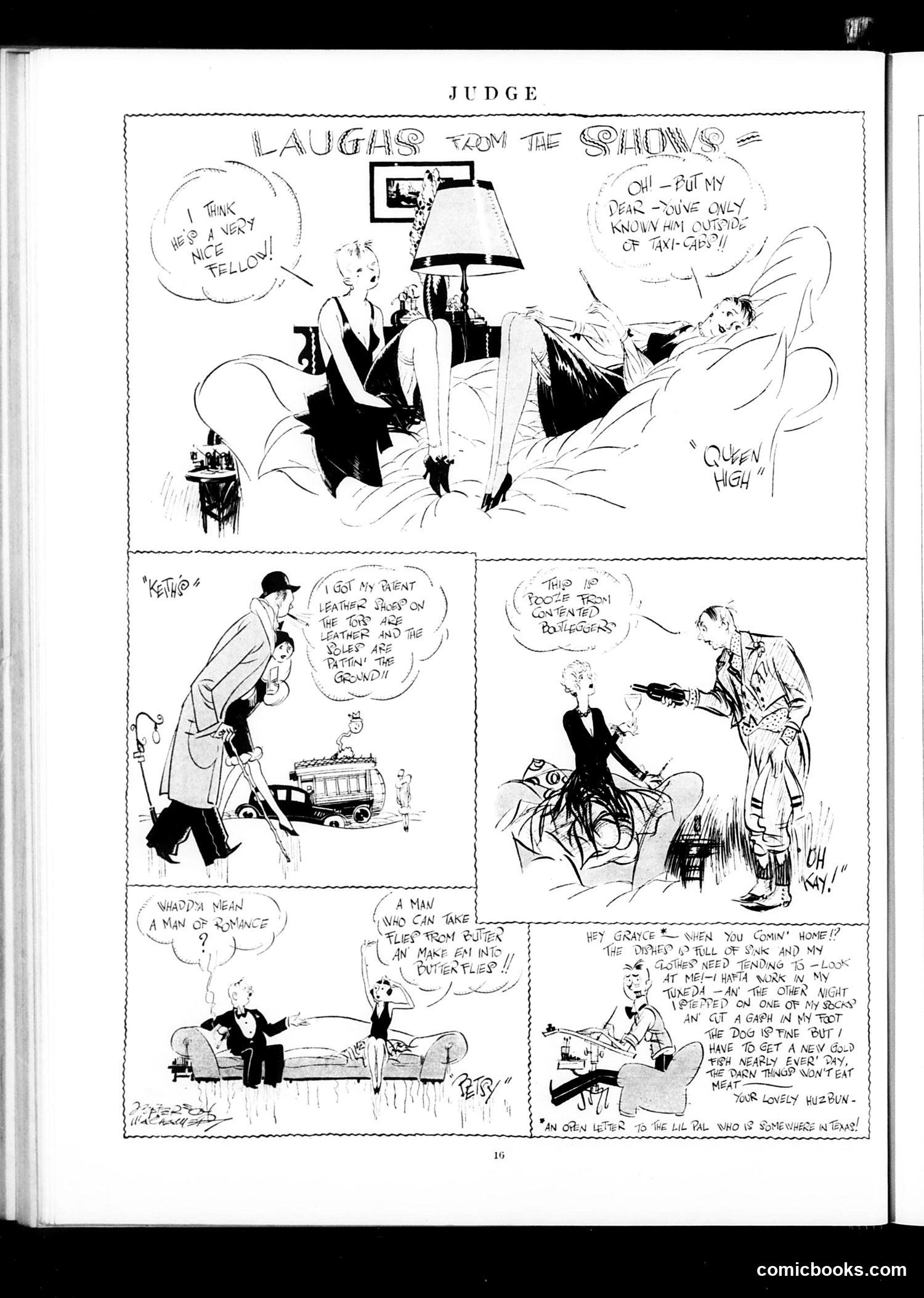
This is a satirical comic page featuring multiple vignettes poking fun at romantic and domestic situations, likely referencing popular theater or entertainment of the era. The top panel depicts a romantic bedroom scene, mocking theatrical pretense. The subsequent panels show various comedic scenarios: a man bragging about an expensive leather jacket to a child; a woman rejecting a man's romantic overtures; and a domestic quarrel where a woman complains about her husband stepping on the dog and damaging their furniture. The humor centers on deflating romanticized notions of courtship and marriage—contrasting theatrical "romance" with the mundane frustrations of actual domestic life. The final panel's bitter letter from "Your Lovely Husband" sarcastically describes the wife's nagging complaints, emphasizing the gap between romantic ideals and married reality. This reflects Judge magazine's consistent satirical stance critiquing bourgeois pretension and exposing the gap between social performance and everyday truth.
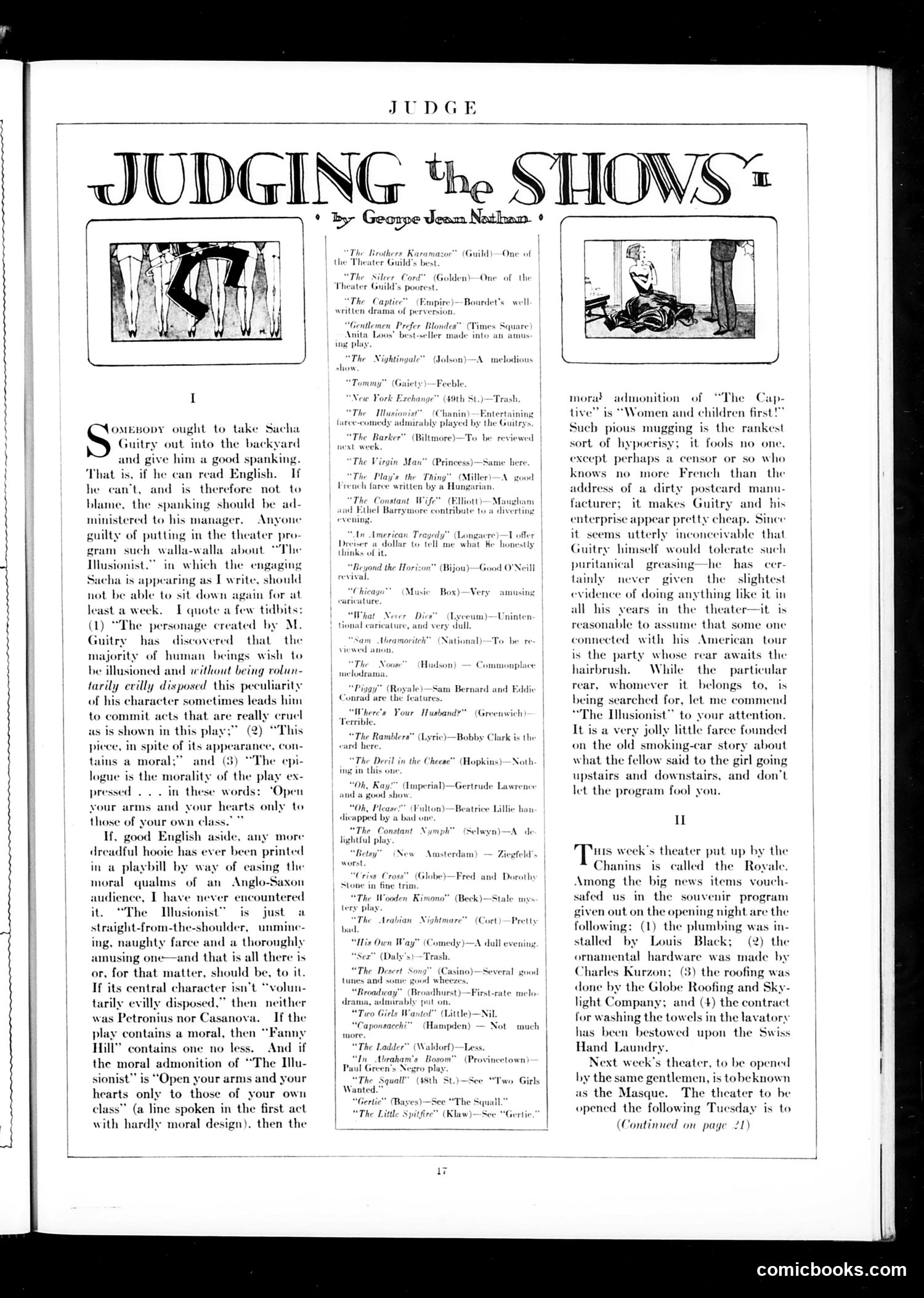
This is a theater critic's column reviewing Broadway productions. The main text is a **scathing critique of Sacha Guitry's play "The Illusionist,"** performed at the Chanin Theatre. Nathan attacks the pretentious playbill descriptions accompanying Guitry's farce, which claims the show contains deep moral lessons about class and human nature. Nathan argues this is nonsense—the play is simply "a naughty farce" with no serious intent, and adding high-minded moral justifications to marketing materials is ridiculous hypocrisy. He compares this to other "dreadful hooie" (nonsense) in theater advertising, sarcastically suggesting that if this shallow entertainment must claim a moral, then lighter comedies could equally pretend to wisdom. The rest of the page contains **brief capsule reviews** of other Broadway shows with Nathan's typically caustic assessments ("Trash," "dull," "commonplace"). This represents 1920s theater criticism's tradition of debunking pretension in entertainment.
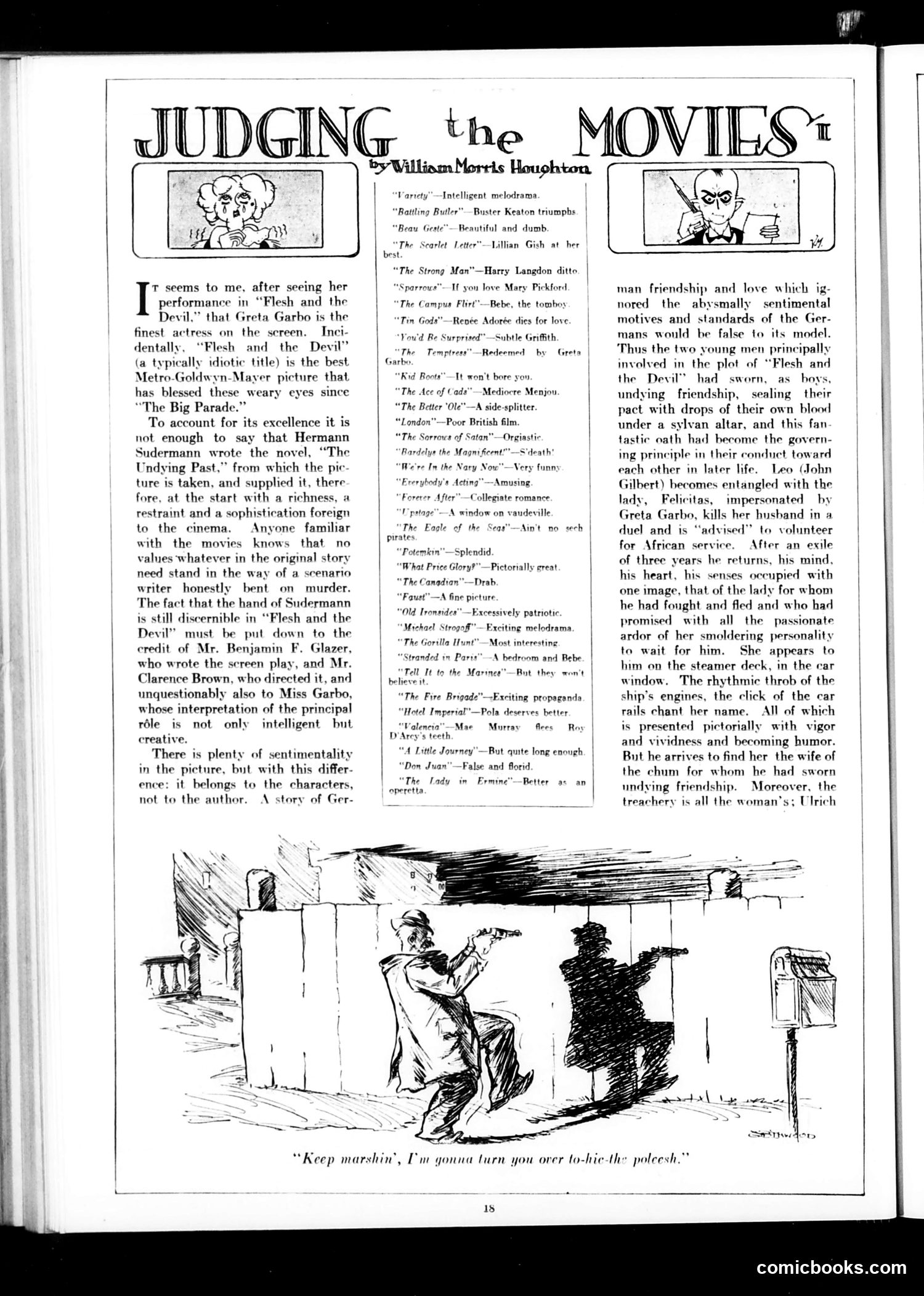
This is a film criticism column by William Morris Houghton reviewing contemporary movies, primarily praising Greta Garbo's performance in "Flesh and the Devil" (a 1926 Metro-Goldwyn-Mayer production). The column praises the film's adaptation of Hermann Sudermann's novel and credits screenwriter Benjamin F. Glazer and director Clarence Brown for preserving the source material's sophistication—unusual, the critic notes, since Hollywood typically discards literary value entirely. The accompanying cartoon illustrates a scene from the film: two men in a duel over a woman, with the caption "Keep marchin', I'm gonna turn you over to-hit the poles." This visualizes the plot's central conflict where John Gilbert's character fights for Garbo's character. The right column lists brief reviews of other current films, rating stars like Buster Keaton, Lillian Gish, and Mary Pickford. The tone throughout is sophisticated film criticism aimed at educated readers.
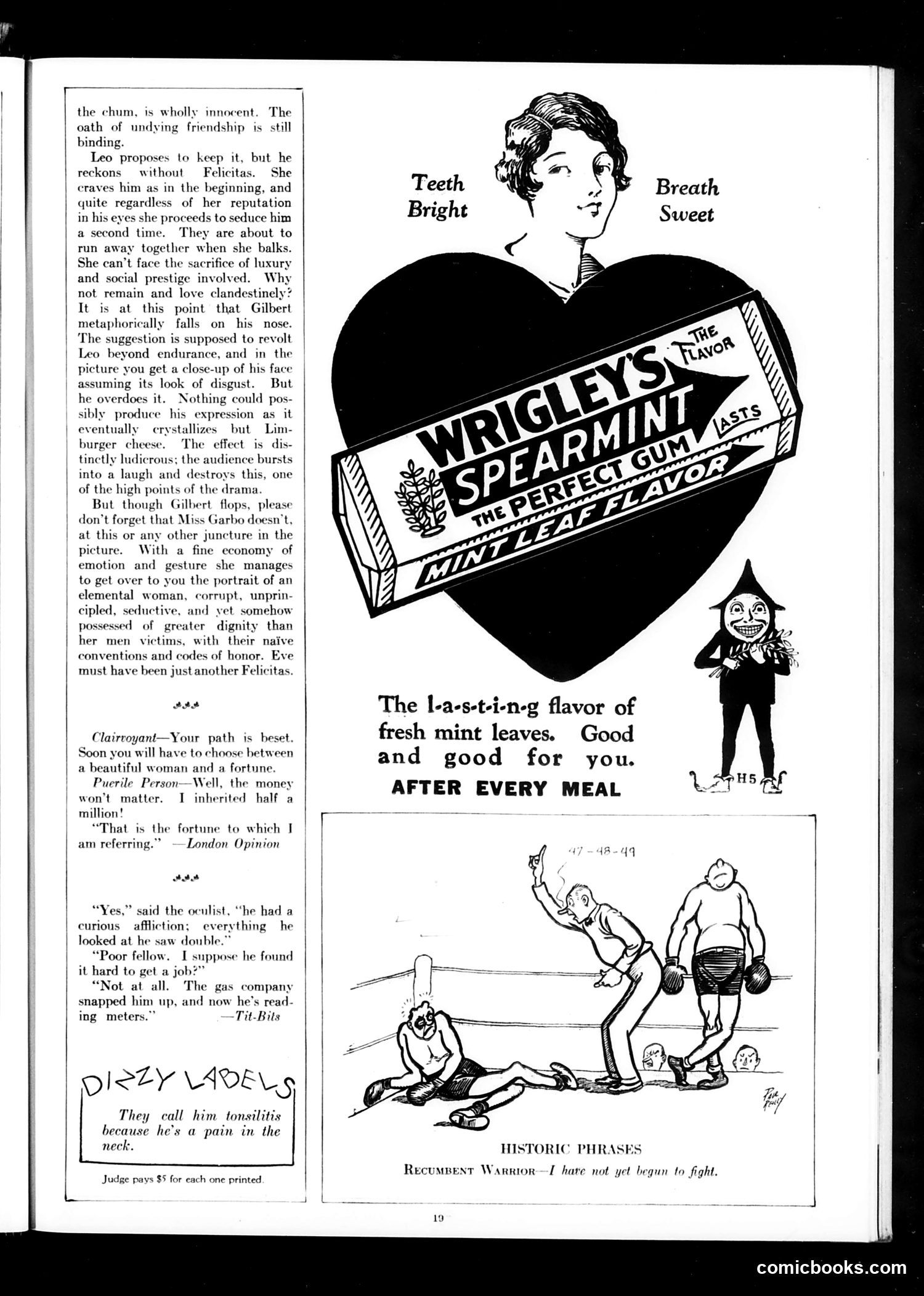
This page mixes entertainment content with advertising and humor. The main text discusses a film featuring Greta Garbo (identified as "Miss Garbo"), critiquing an actor named Gilbert's performance in a scene where he's supposed to register disgust but overdoes it—his expression becomes comically exaggerated, ruining the dramatic moment. The reviewer notes Garbo herself handles her role (playing a morally compromised woman named Felicitas) with superior skill. The page includes three unrelated joke sections: a fortune-teller gag, an optical illusion joke, and a pun about "tonsilitis." A Wrigley's Spearmint gum advertisement occupies the upper right with a woman and mint leaf imagery. At the bottom, "Historic Phrases" shows a boxing cartoon referencing the famous "I have not yet begun to fight" line, though the caption appears corrupted in the OCR.
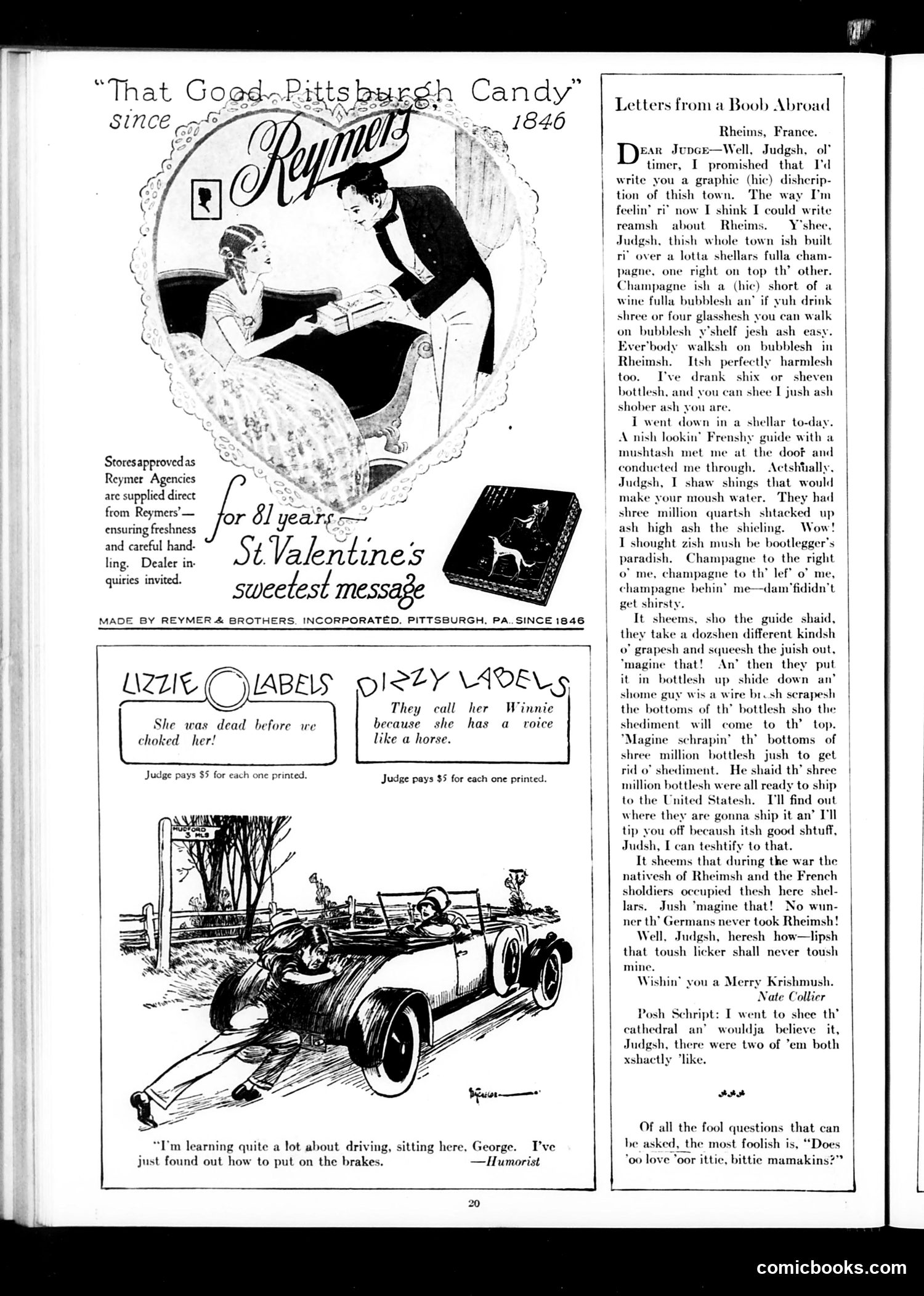
This page features humorous letters purporting to be from an American tourist in Rheims, France, written in exaggerated phonetic dialect suggesting drunkenness ("shee," "shober," "shirtsy"). The writer describes touring champagne cellars beneath the city and observes the production process—apparently a commentary on Prohibition-era American curiosity about European wine production. The satire targets American tourists abroad: their ignorance, their tendency toward inebriation, and their bewilderment at foreign customs. The repeated "hics" and slurred speech mock both the writer's intoxication and, implicitly, American drinking habits during Prohibition (likely early 1920s given the war references). The accompanying Reymer candy advertisement and other illustrations are unrelated advertising content typical of Judge magazine's revenue model. The overall comedic thrust: Americans abroad are foolish, easily tempted by alcohol, and culturally oblivious.
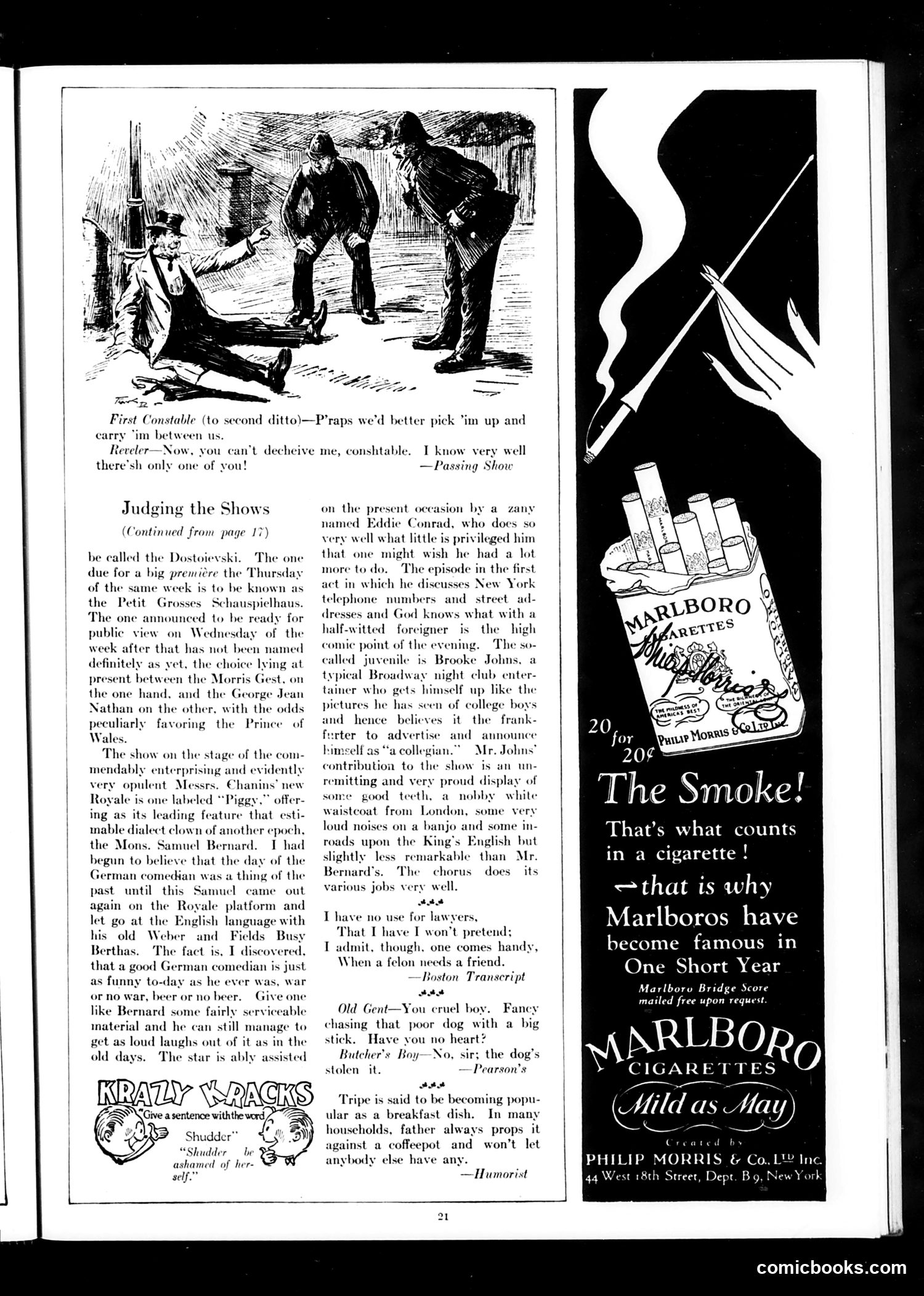
This page combines theatrical criticism with period humor and advertising. **The Main Cartoon** (top left) depicts two constables discussing an intoxicated man who claims there's "only one" of them present—a visual gag about drunken double vision. **"Judging the Shows"** reviews Broadway productions, mentioning Samuel Bernard, a German-dialect comedian whom the critic thought outdated but found still effective. The review covers supporting players and choruses in what appears to be a show called "Piggy" at the Royale Theatre. **The Sidebar Content** includes brief humorous quips about lawyers, children tormenting dogs, and tripe as breakfast food—typical period magazine filler. **The Advertisement** (right side) promotes Marlboro Cigarettes, emphasizing "the smoke" as the cigarette's key selling point. This vintage ad represents pre-regulation tobacco marketing when health concerns weren't disclosed. The page reflects 1920s theatrical culture, vaudeville tradition, and casual attitudes toward smoking and animal cruelty.
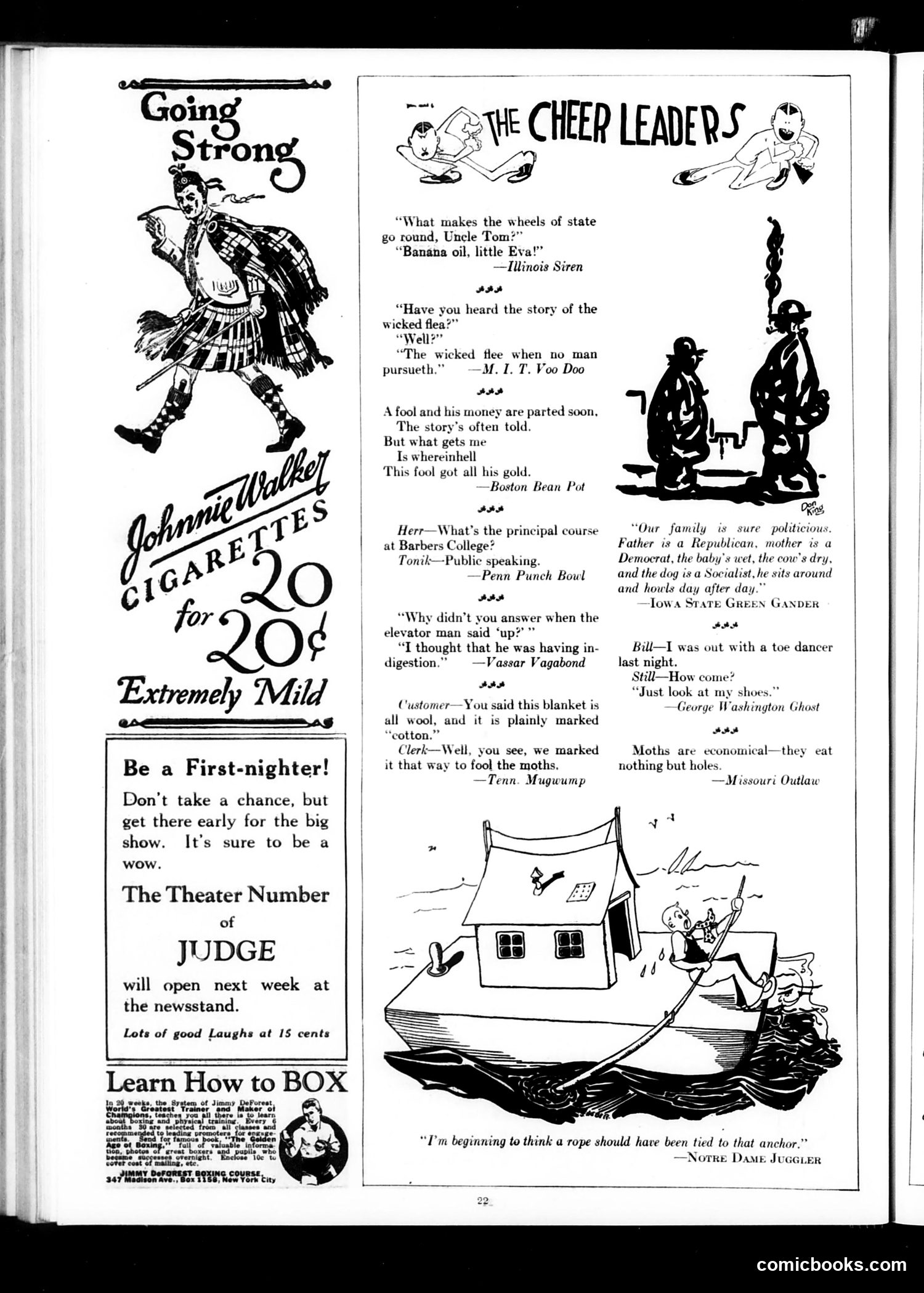
This is a humor page from *Judge* magazine featuring brief jokes and quips from various college publications and satirical sources. The content reflects early 20th-century collegiate and social humor. **Key elements:** The jokes parody common tropes: fake explanations ("banana oil" = nonsense), wordplay (the "wicked flee"), and consumer complaints. References to specific colleges (*M.I.T.*, Vassar, Penn) suggest this was shared among campus humor publications. **Social commentary:** - Political satire appears in the Iowa State reference mocking a divided household (Republican/Democrat parents, Socialist dog) - Gender humor targets women ("toe dancer," shoe damage) - Class commentary on consumerism (the blanket marked "cotton" to fool moths) **The cartoon below** depicts someone on a makeshift boat-house anchor, captioned with regret about lacking a rope—a visual punchline about poor planning. The page largely serves as filler content promoting *Judge*'s theatrical issue, mixing collegiate wit with gentle social observation typical of 1920s American humor magazines.
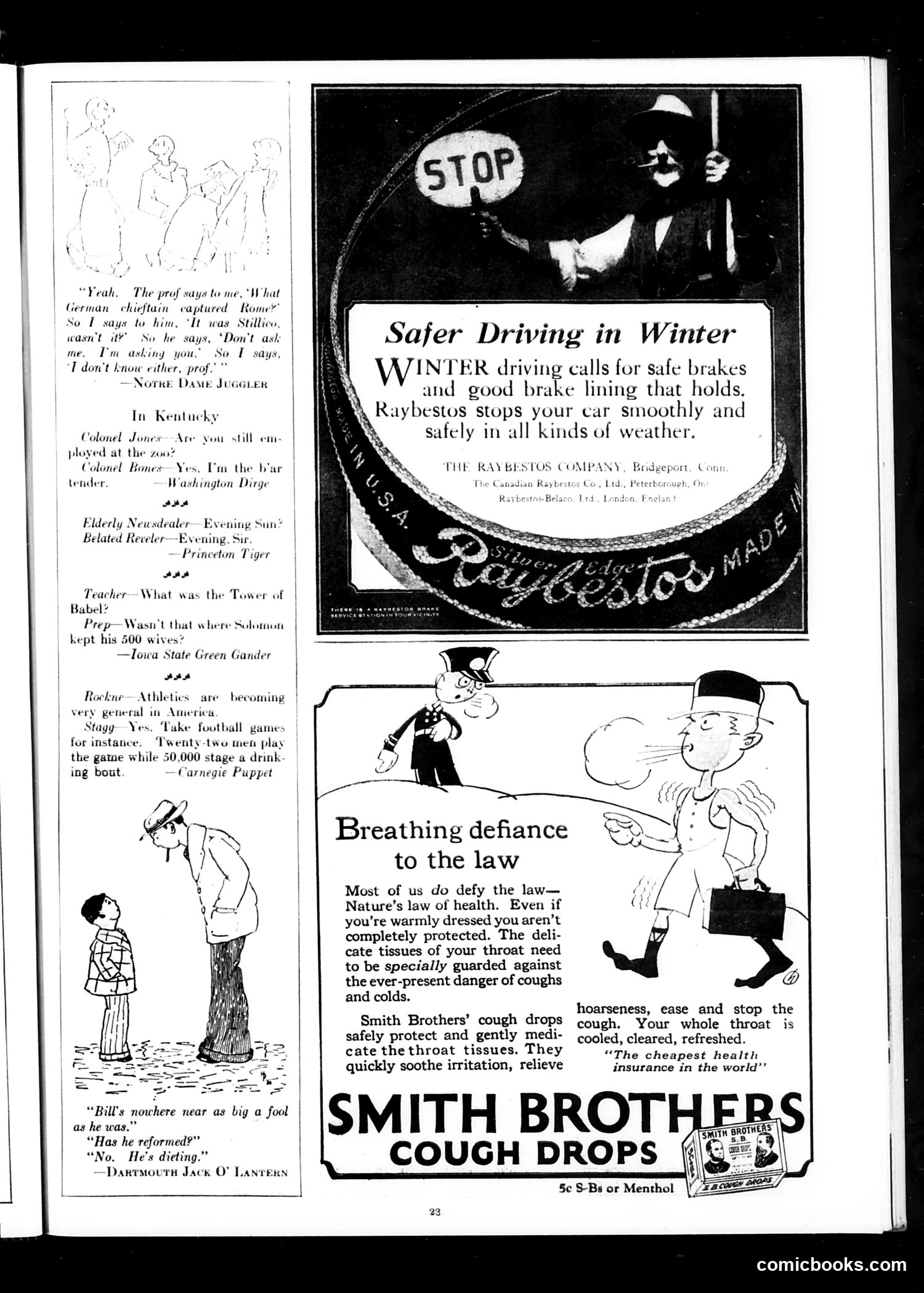
This page combines humor columns with vintage advertisements. **The Humor Section** (left) collects brief jokes from university publications and readers, typical of Judge's "Jests and Jabs" format. Topics include: a Notre Dame student's confusion about Roman history, a racial dialect joke about a zoo worker in Kentucky, and observations about athletics culture (referencing coach Amos Alonzo Stagg's complaint that football games serve mainly as drinking venues for spectators). The final joke plays on weight loss: a man appears reformed until revealed to be merely dieting. **The Advertisements** are period products: Raybestos brake linings (promoting winter driving safety) and Smith Brothers cough drops (with their characteristic bearded trademark visible). The Smith Brothers ad uses the phrase "breathing defiance to the law," humorously suggesting that ignoring Nature's health laws requires their product. The page reflects 1920s-era concerns: automobile safety, public health awareness, and college culture. The racial humor reflects attitudes typical of that era's mainstream publications.
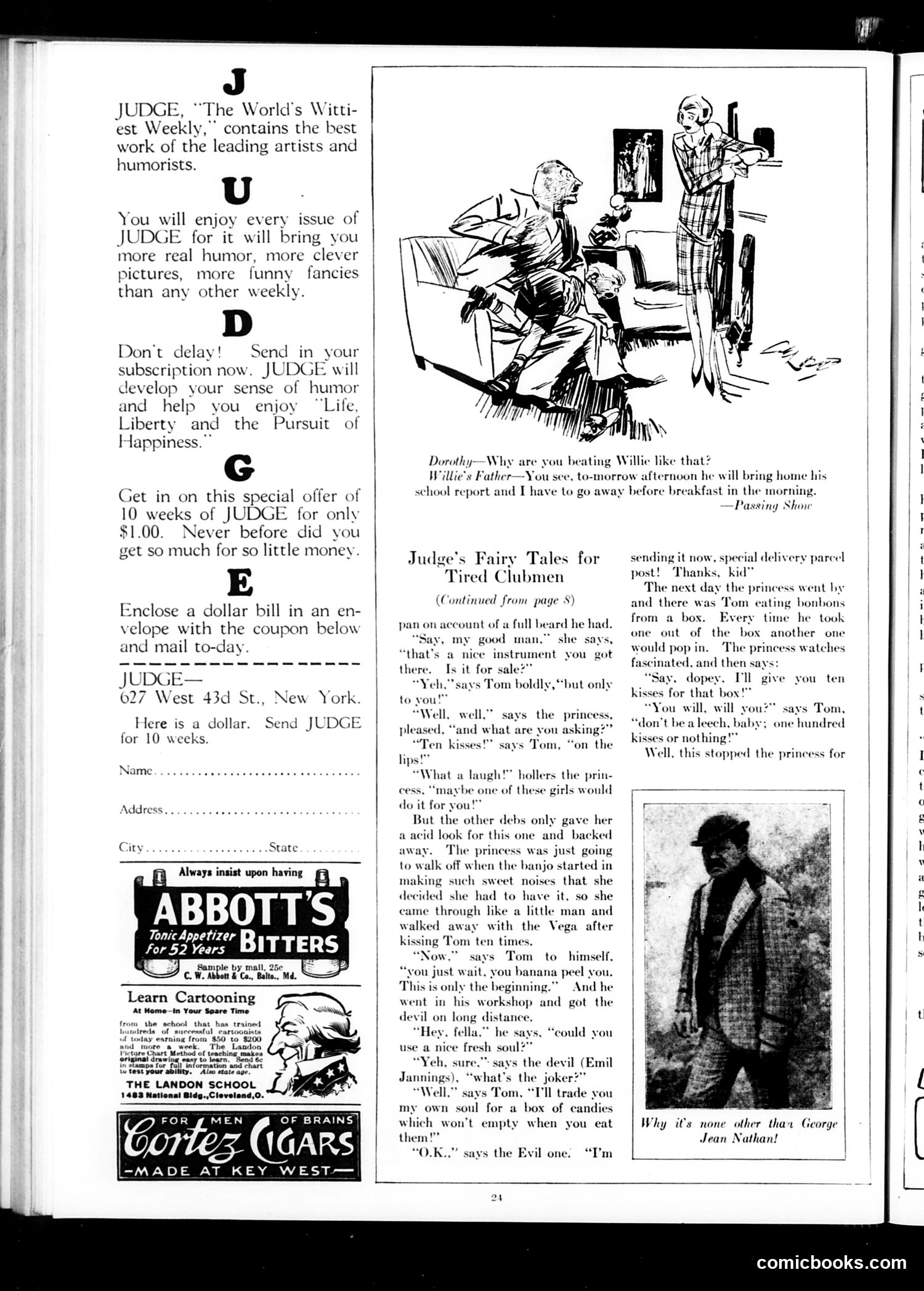
This page is primarily **advertising and subscription promotion** for Judge magazine itself, interspersed with period advertisements (Abbott's Bitters, cartooning courses, cigars). The main cartoon depicts a father preemptively beating his son Willie before the child brings home a poor school report—a dark humor joke about parental anxiety and corporal punishment common in early 20th-century America. The "Fairy Tales for Tired Clubmen" fiction excerpt (continued from page 8) tells a bawdy modern fairy tale where a peasant named Tom trades his soul to the devil for an endless box of candies, then uses it to seduce a princess with kisses. This satirizes both fairy tale conventions and contemporary "clubmen" culture—wealthy urban bachelors. The photograph at bottom right, captioned "Why it's none other than George Jean Nathan!" appears to be a humorous reveal, though without knowing Nathan's contemporary relevance, the specific joke remains unclear. Nathan was likely a recognizable public figure of the era. The overall tone is irreverent, adult-oriented humor targeting Judge's male, urban readership.
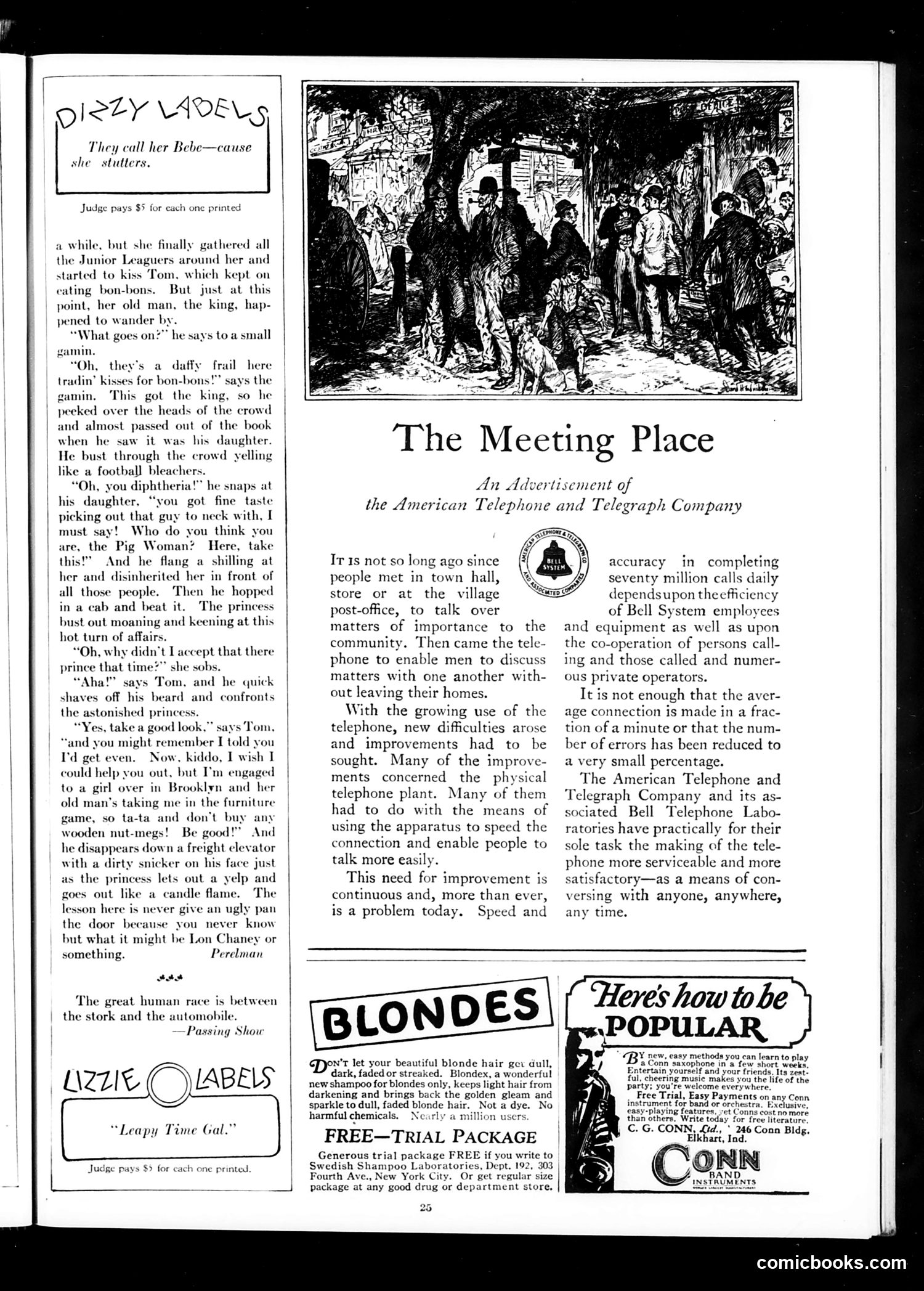
This page contains **two distinct pieces**: a satirical comic story and period advertisements. ## The Comic: "Dizzy Ladels" The main cartoon story, credited to Perelman, is a fairy-tale parody featuring a princess who trades kisses for bon-bons with a man named Tom. When her father (the king) discovers this, he disowns her. Tom then reveals himself as the disguised Lon Chaney (a famous character actor of the silent film era known for grotesque roles), revealing he's been playing a trick to get revenge for her earlier rejection. The moral: never judge someone by appearance, since you might hurt someone important later. This is **light romantic satire** mocking both sentimental fairy tales and modern courtship rituals among the wealthy set ("Junior Leaguers"). ## Supporting Content The page also includes: - "Lizzie Labels" — another humor submission - AT&T telephone advertisement emphasizing reliability and efficiency - Product advertisements for Blondes shampoo and Conn musical instruments The page represents typical 1920s Judge magazine content: frivolous social comedy mixed with commercial messaging.
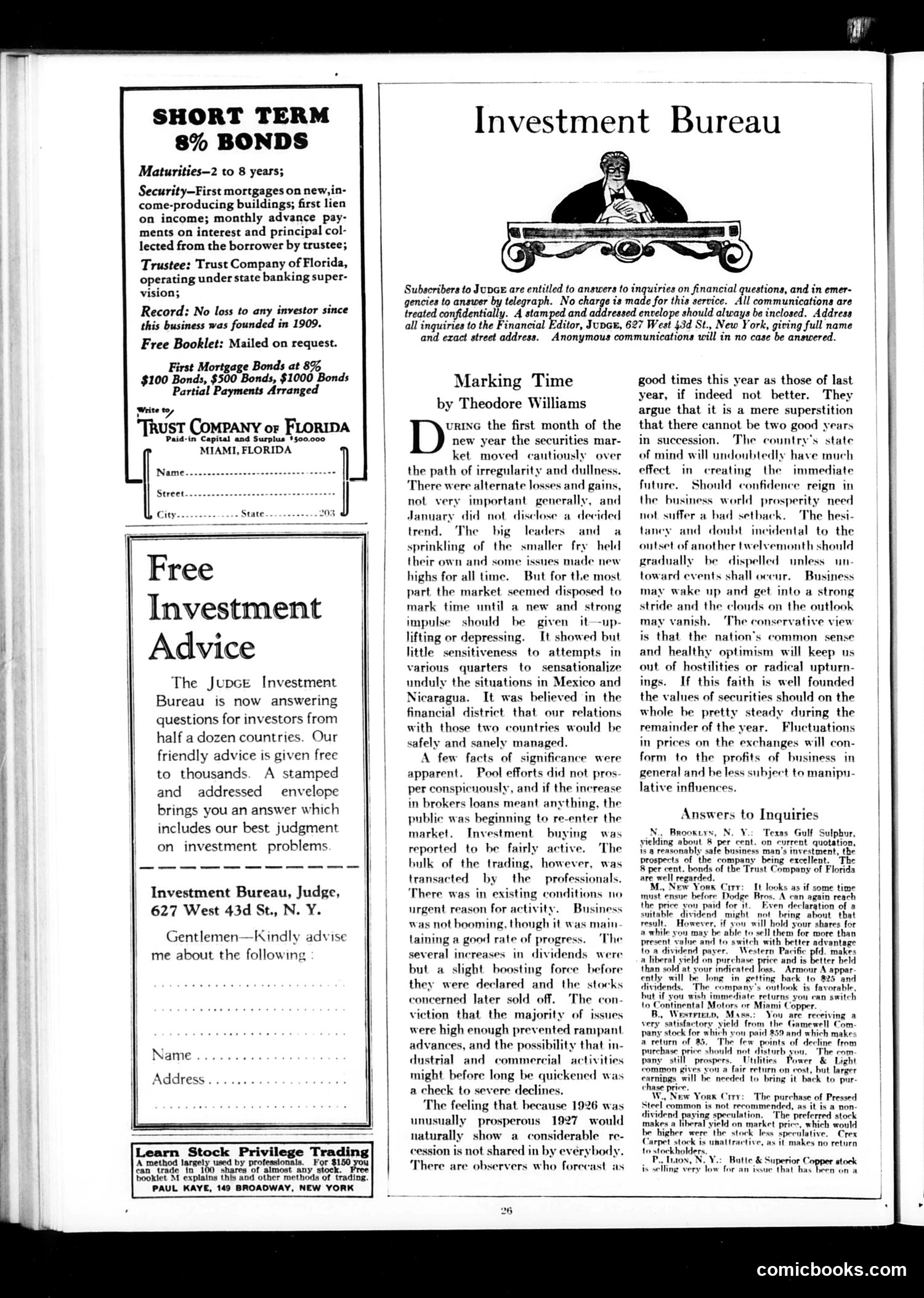
This is primarily a **financial advice and advertising page**, not a political cartoon. The page features: **Main Content:** - "Marking Time" by Theodore Williams: A financial commentary on early 1927 stock market behavior, noting cautious trading, alternating gains/losses, and lack of decisive trend - An "Investment Bureau" advice column offering free financial guidance to Judge subscribers **Advertisements:** - Trust Company of Florida bonds (8% return, 2-8 year maturity) - Judge's Investment Bureau promoting free investment advice - Stock trading instruction services **Context for Modern Readers:** This reflects the 1920s investment boom preceding the 1929 crash. The article's optimism about 1927 ("good times this year as those of last year") is historically poignant—written just before the market collapse. The page shows how mainstream publications actively promoted investment participation to ordinary readers during this speculative period.
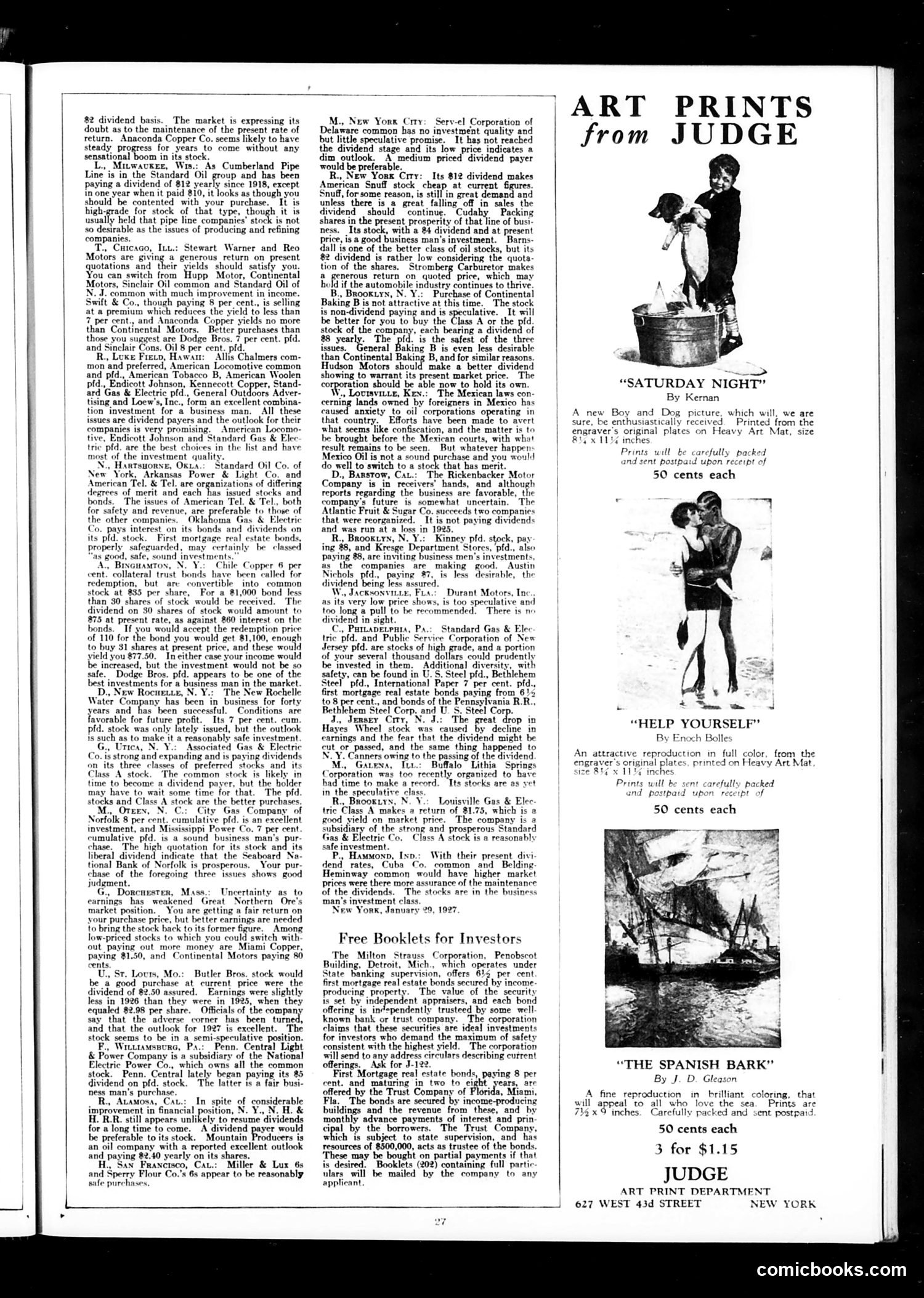
This page is primarily **financial advice**, not political satire. The left column contains investment recommendations from Judge magazine's financial column, responding to reader queries about stock purchases during the 1920s boom. The right side showcases **art prints for sale**—three reproductions: "Saturday Night" by Kernan, "Help Yourself" by Enoch Bolles, and "The Spanish Bark" by J.D. Graham, each priced at 50 cents (or 3 for $1.15). **Historical context**: This appears to be from January 1927, just before the 1929 stock market crash. The advisor recommends dividend-paying industrial stocks (motors, utilities, copper) as "safe" investments—advice that would prove disastrous within two years. The casual confidence in "steady progress" and "strong and prosperous" companies reflects the era's pre-crash optimism. Judge's dual role as satirical magazine and financial guide reflects how thoroughly 1920s popular media promoted stock investment to ordinary readers.
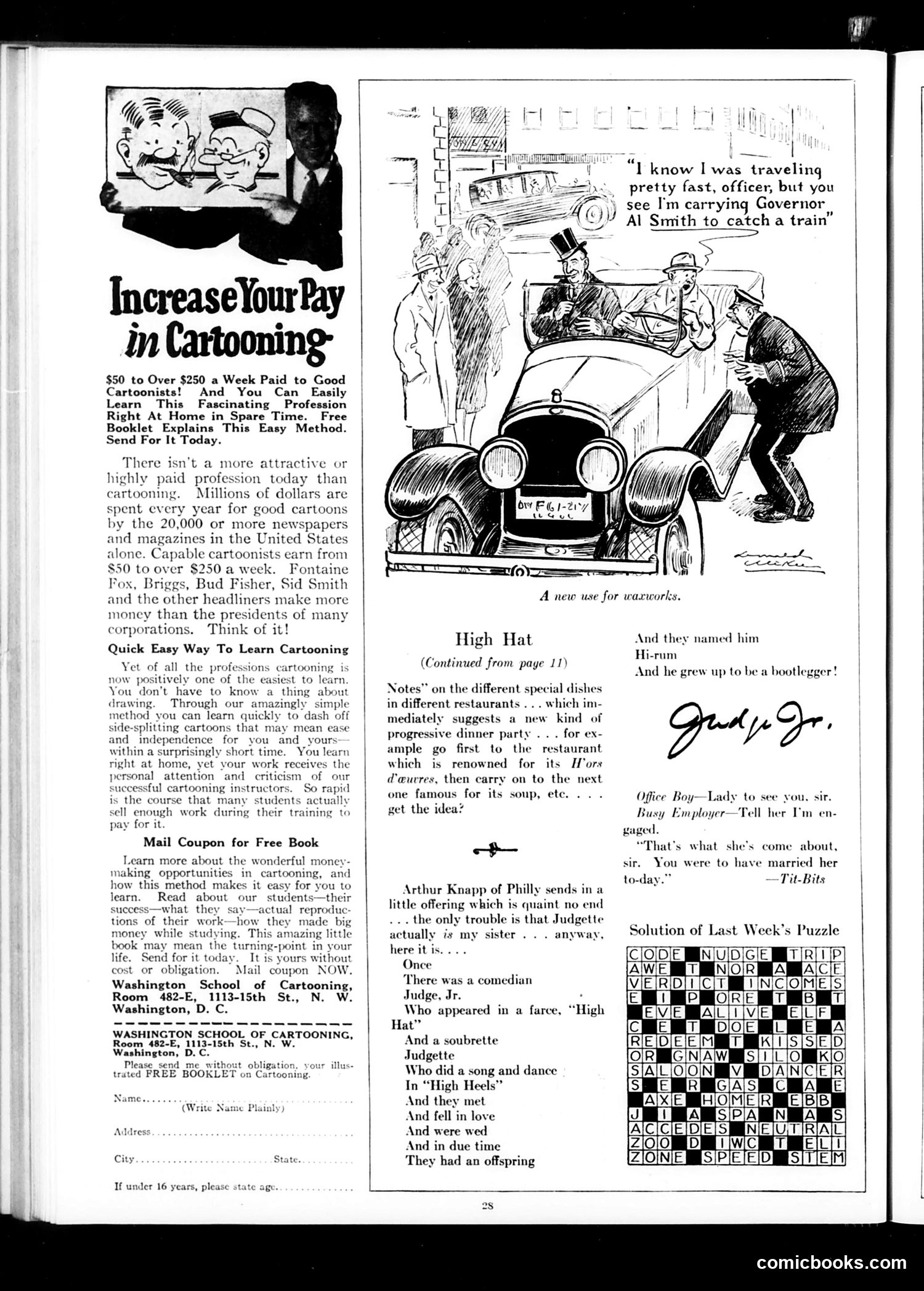
This page is primarily **advertising for a cartooning correspondence school**, with minimal satirical content. The main cartoon (titled "A new use for waxwork") shows a speeding car with a driver explaining to a police officer that he's rushing to catch Governor Al Smith. The joke relies on contemporary recognition: **Al Smith was a prominent New York politician** (likely governor or candidate in this era), making the reference to transporting him humorous through absurdity. The "High Hat" section contains a brief joke poem about a comedian and soubrette who marry and name their illegitimate child "Hi-rum," who becomes a bootlegger—a topical reference to **Prohibition-era organized crime** (bootleggers illegally produced alcohol). The joke's punch derives from the unfortunate name predicting the child's criminal future. The page's real purpose is recruiting cartooning students, naming famous cartoonists (Fontaine Fox, Bud Fisher, Sid Smith) to establish credibility, claiming earnings of $50-$250 weekly—substantial money for the period.
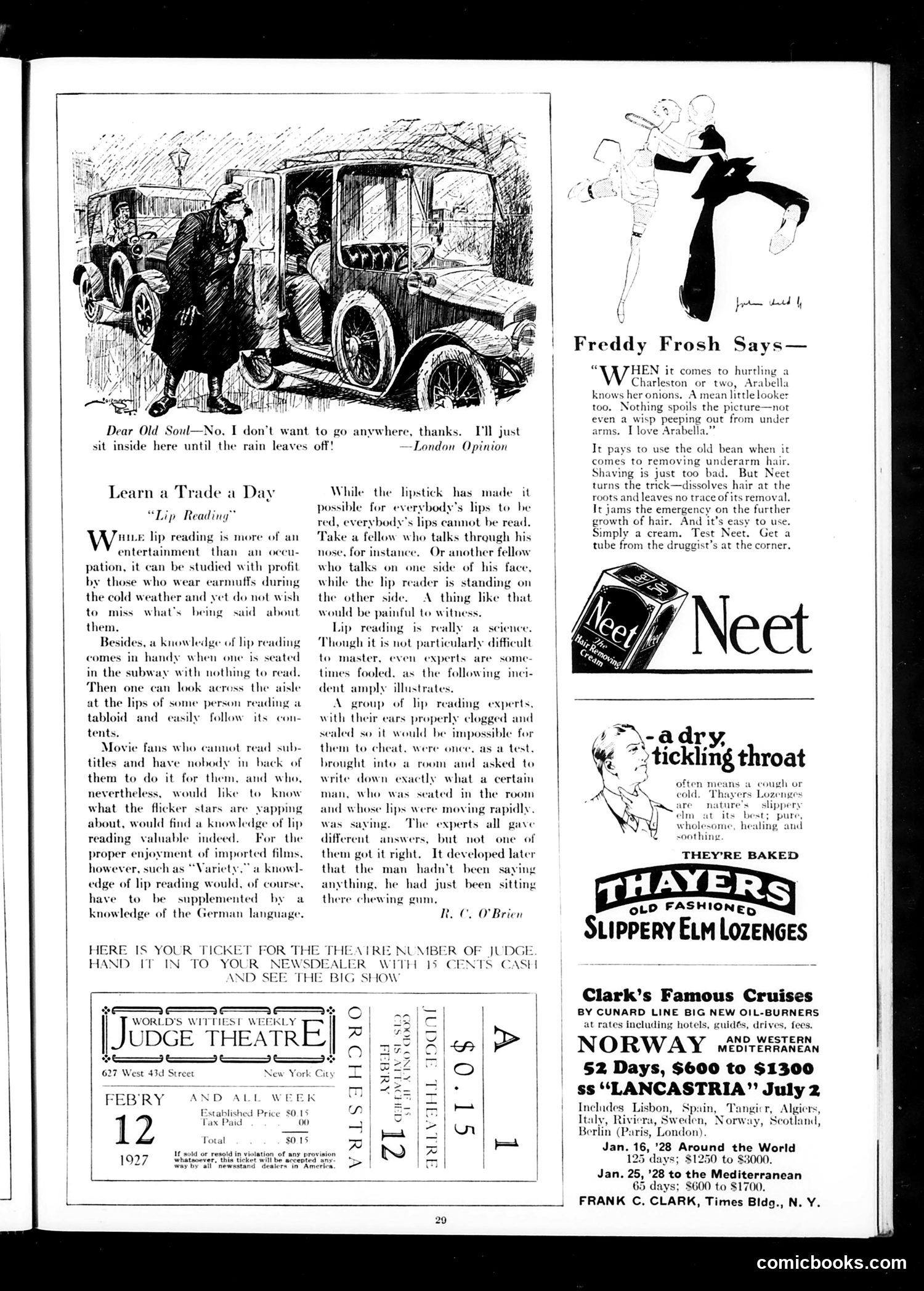
This page is primarily **advertising and entertainment content** rather than political satire. The main cartoon "Dear Old Soul" depicts someone refusing to leave a car during rain—a simple domestic humor piece with no political significance. "Learn a Trade a Day: Lip Reading" is a humorous instructional article about reading lips, illustrated with an anecdote about lip-reading experts who test a man in a sealed room. The punchline: he wasn't speaking—just chewing gum. This mocks pseudo-scientific demonstrations and expert overconfidence. "Freddy Frosh Says" references the Charleston (the 1920s dance craze) and a character named Arabella, reflecting Jazz Age youth culture and flapper interest in cosmetics and hairstyling. The remainder consists of product advertisements (Neet hair removal, Thayers lozenges) and travel/entertainment promotions (Judge Theatre tickets, cruise lines), typical of 1920s magazine publishing. No significant political content is present on this page.
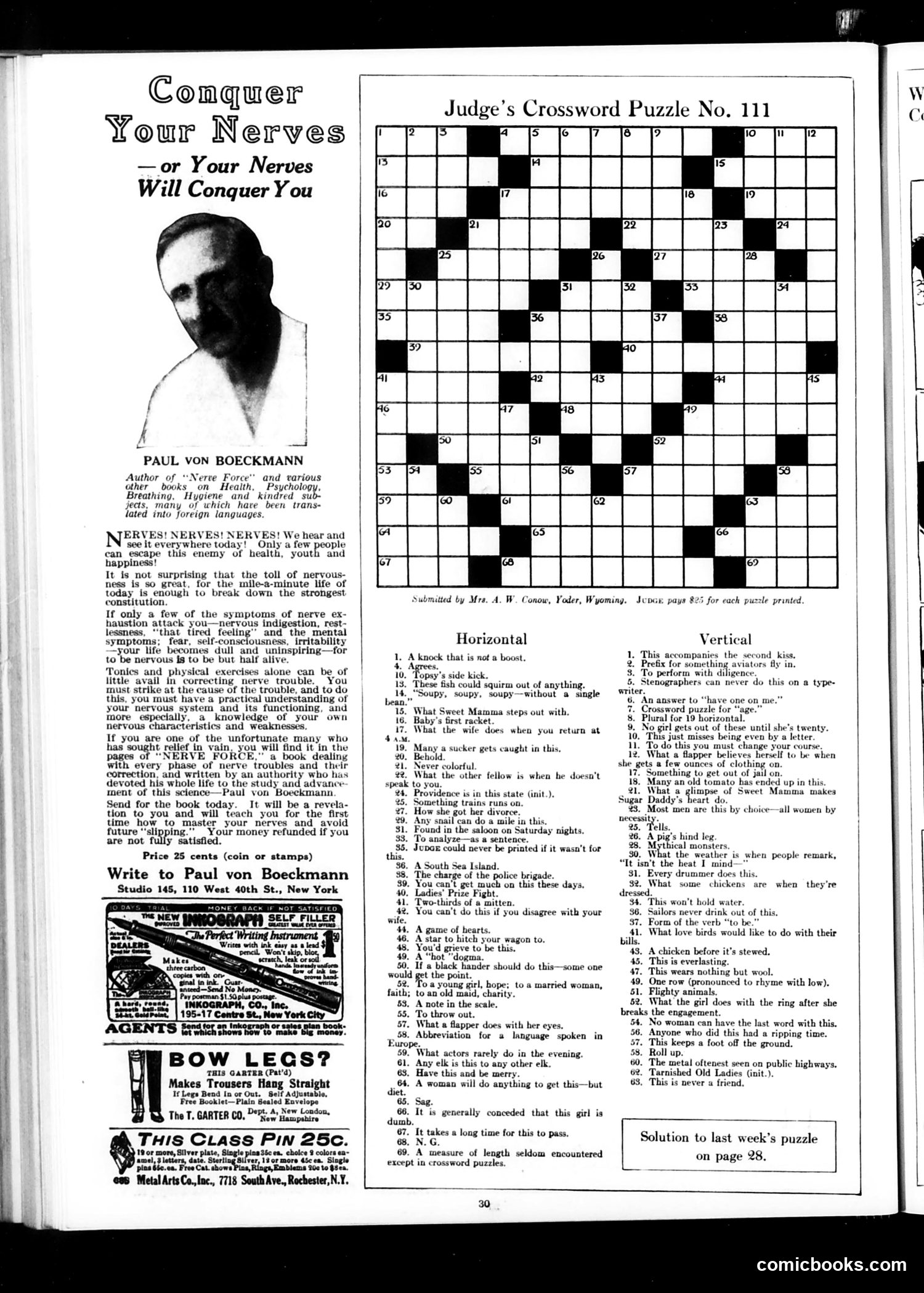
This page combines **self-help advertising** with a **crossword puzzle**—typical Judge content mixing editorial and commercial material. ## Main Content: **Left side**: An advertisement for Paul von Boeckmann's book "Nerve Force," targeting the early 20th-century anxiety about modern life's pace ("mile-a-minute life"). The pitch addresses "nervousness" as a widespread ailment requiring psychological understanding, not just tonics—reflecting emerging interest in mental health and psychology of that era. **Right side**: A crossword puzzle with clues reflecting period concerns and slang (references to "Sweet Mamma," flappers, divorce, police raids—suggesting Prohibition-era America). **Bottom ads**: Products for "bow legs" and class pins—typical small advertisements filling magazine space. The overall message reflects 1920s anxieties: rapid urbanization, changing social norms, and new psychological awareness positioned as solvable through self-help literature.
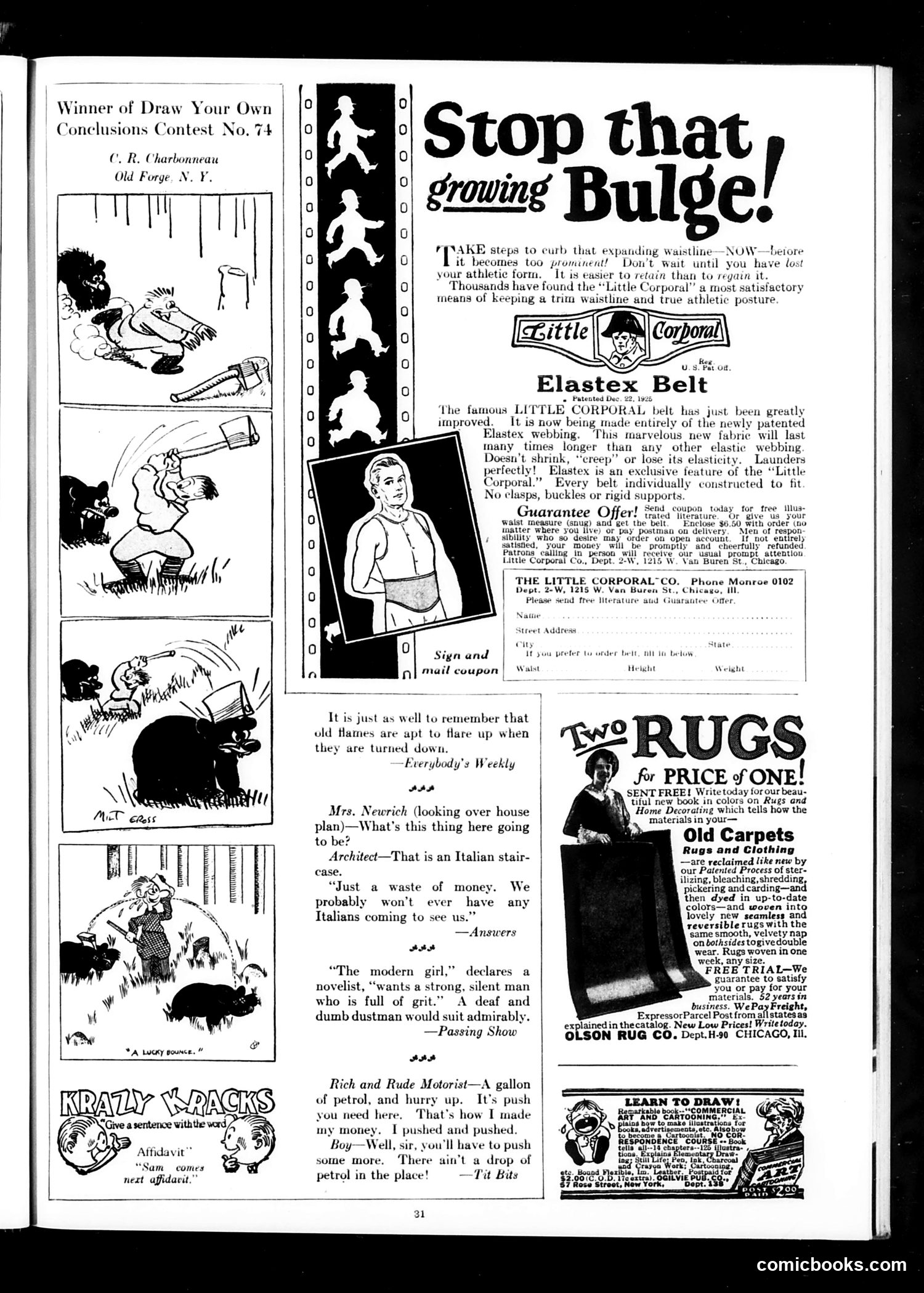
This page is primarily **advertising**, with minimal editorial content. The main feature is a large ad for the "Little Corporal" Elastex Belt, a men's girdle/waist-cinching device marketed to combat belly fat and maintain athletic posture. The copy warns men not to delay addressing weight gain, using the phrase "Stop that growing Bulge!"—likely a play on "Little Corporal," a nickname for Napoleon. The small cartoons and text snippets are filler content: - A contest winner's comic about a "Hairy source" (unclear reference) - "Krazy Wracks" wordplay joke - Brief humorous anecdotes about Italian staircases, modern girls wanting silent men, and a rude motorist The page reflects 1920s-era anxieties about male body image and masculine appearance, alongside era-typical casual xenophobia (the Italian staircase joke). Secondary ads promote carpet recycling and rug services. The overall content is typical early-20th-century magazine filler designed to attract advertising revenue.
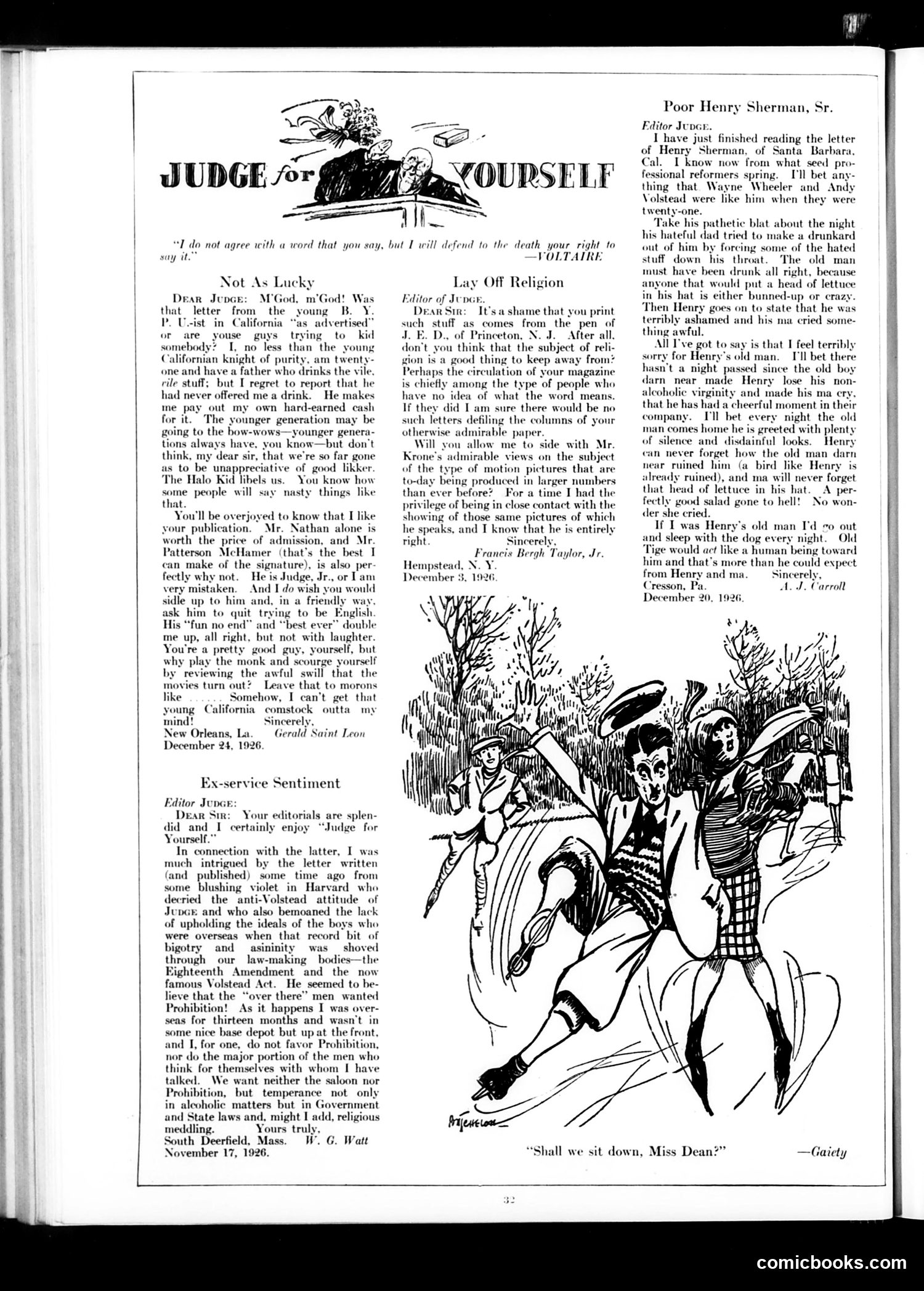
This page contains readers' letters to Judge magazine's advice column, plus one cartoon. The letters debate three hot-button 1920s issues: **Prohibition**: Readers defend drinking and criticize young temperance activists. One ex-soldier argues WWI veterans never wanted Prohibition forced upon them—they want temperance, not legal bans. **Religion in media**: A reader objects to Judge publishing anti-religious content, arguing the magazine shouldn't mock faith. **Youth morality**: Correspondents debate whether younger generations are truly more dissolute than their fathers. The accompanying cartoon (captioned "Shall we sit down, Miss Dean?") appears to satirize dating etiquette or flirtation, showing fashionably-dressed young people in what seems a suggestive scenario—likely mocking "modern" youth behavior that scandalized 1920s traditionalists. The page reflects the "culture wars" of the Jazz Age: established moralists battling new social freedoms around drinking, sexuality, and secularism.
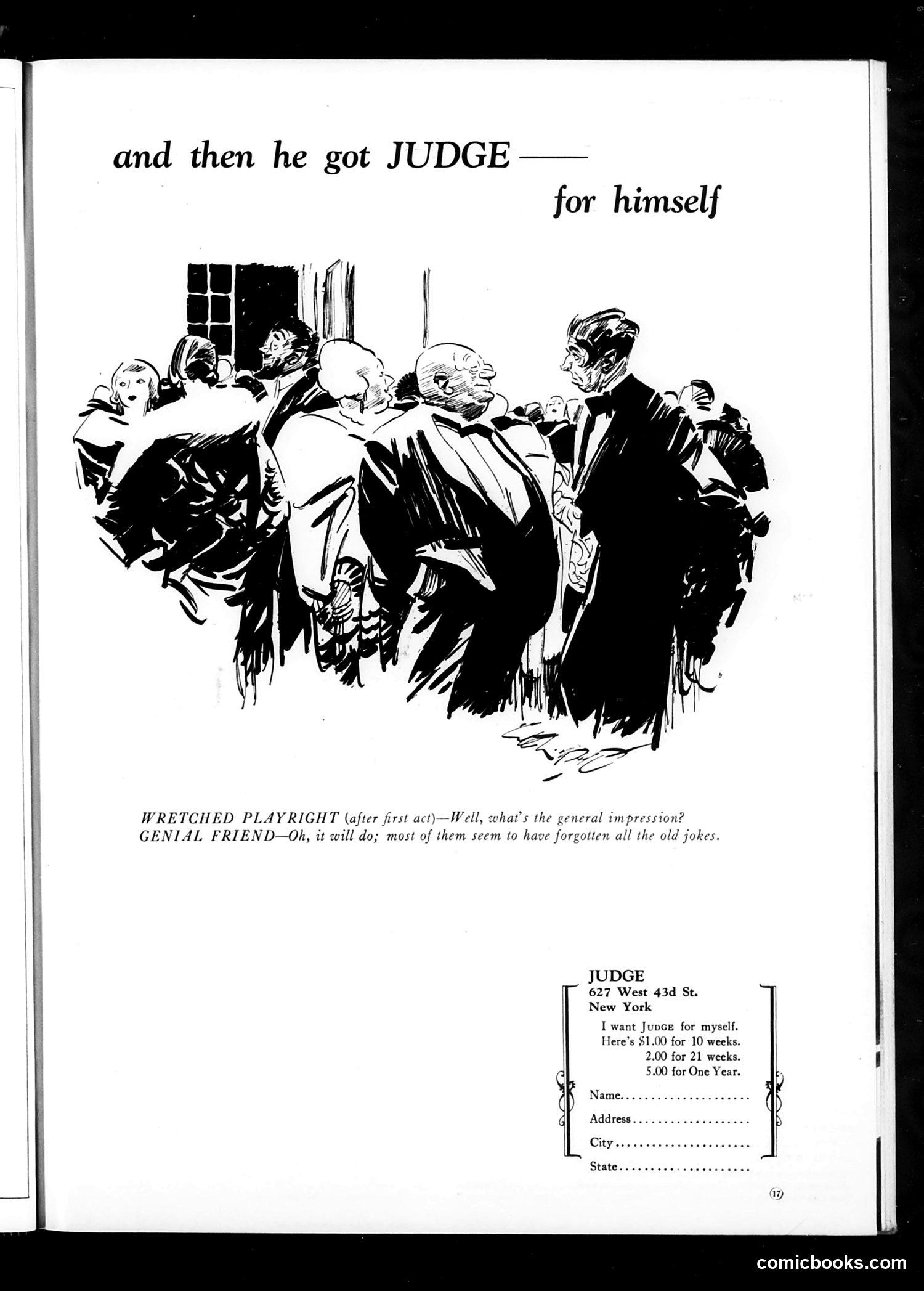
This page combines a subscription ad for *Judge* magazine with a satirical cartoon about theater. The illustration depicts a crowded social gathering, likely theater patrons or critics. The cartoon's joke contrasts two characters: a "wretched playwright" asking for feedback after his show's first act, and a "genial friend" reassuring him that the play will succeed because the audience has forgotten old jokes—implying the playwright is recycling stale material that audiences won't recognize as derivative. The satire mocks both mediocre theatrical writing and audiences' short memories, suggesting that unoriginal work can pass as fresh simply because viewers don't recall its sources. This was a common *Judge* theme: critiquing entertainment industry quality and cultural taste. The subscription box below advertises *Judge*'s weekly rates, positioned as superior commentary on such foolishness.
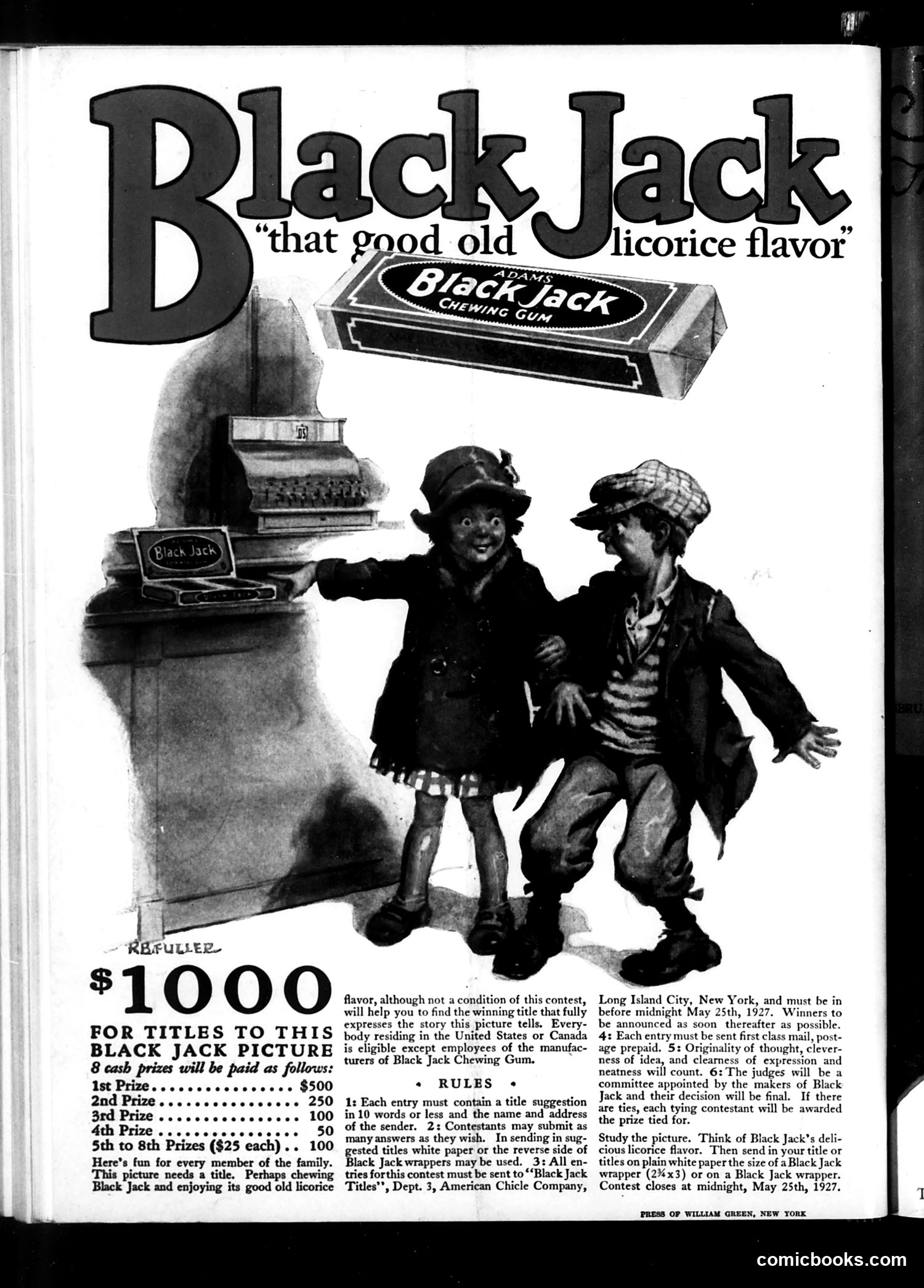
This is primarily a **advertising contest page**, not political satire. It promotes Black Jack Chewing Gum by inviting readers to title a picture. The image shows two children in ragged, working-class clothing discovering a large Black Jack gum wrapper—apparently meant to evoke wonder or delight at finding the product. The illustration appears designed to appeal to family audiences. The contest offers cash prizes ($500 first prize) for the best title "in 10 words or less" describing the picture's story. Eligibility is open to U.S. and Canadian residents (excluding gum manufacturers' employees), with entries due by May 25, 1927. The tagline emphasizes Black Jack's "good old licorice flavor" as the product's selling point. This represents straightforward early-20th-century advertising strategy: encourage consumer engagement and brand loyalty through interactive contests.