
A complete issue · 36 pages · 1926
Judge — November 27, 1926
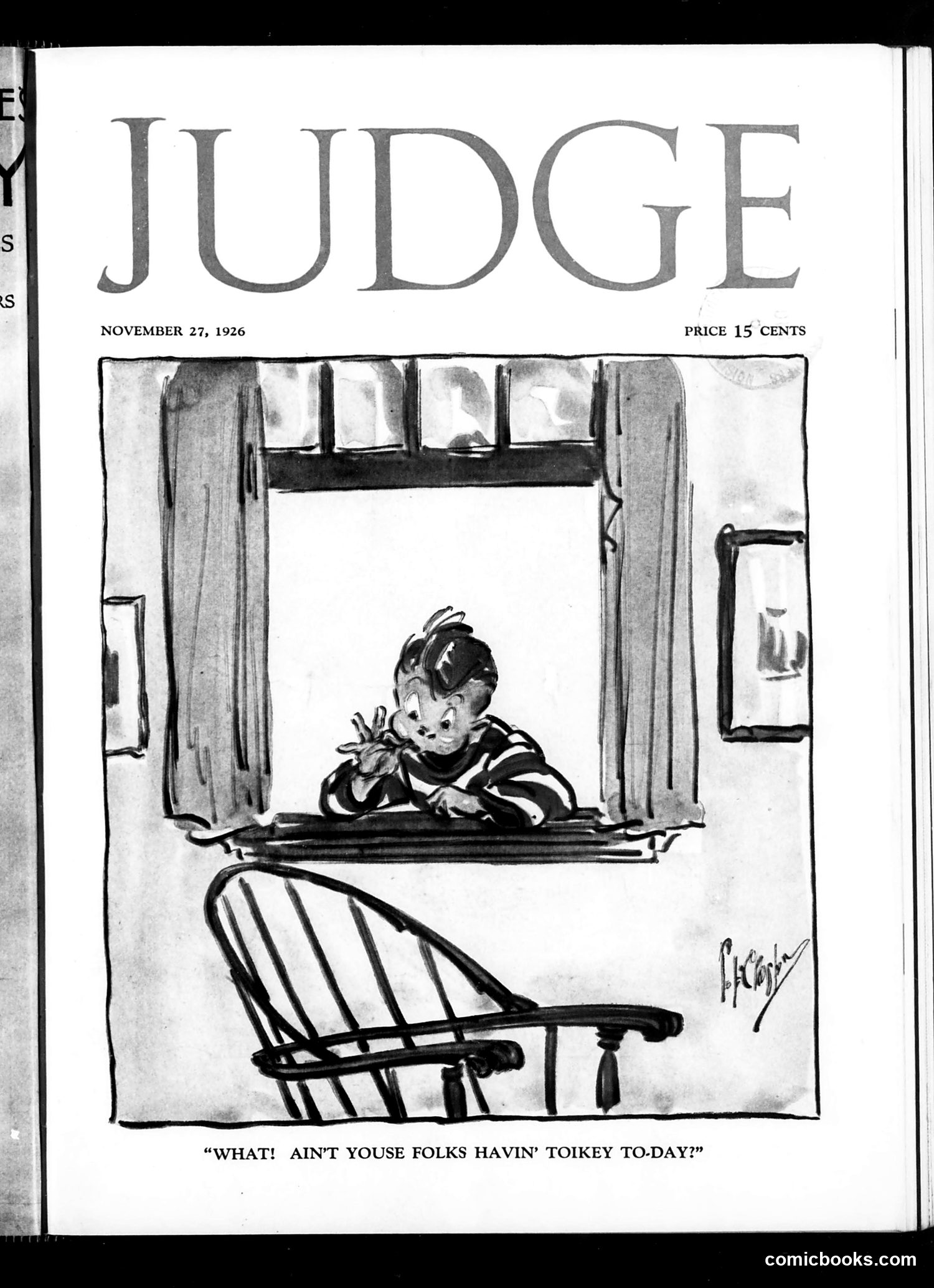
This cover cartoon depicts a child looking out a window with the caption "What! Ain't youse folks havin' toikey to-day?" The joke relies on dialect humor, presenting the child speaking in exaggerated working-class or immigrant vernacular ("youse folks," "toikey" for turkey). The satire likely targets economic disparity around Thanksgiving—the implication being that some families cannot afford turkey, a holiday staple. The child's surprised question from a presumably wealthier household emphasizes the gap between those who take holiday abundance for granted and those struggling financially. This reflects 1920s anxieties about class differences and economic inequality during the prosperous but unequally distributed Jazz Age wealth.
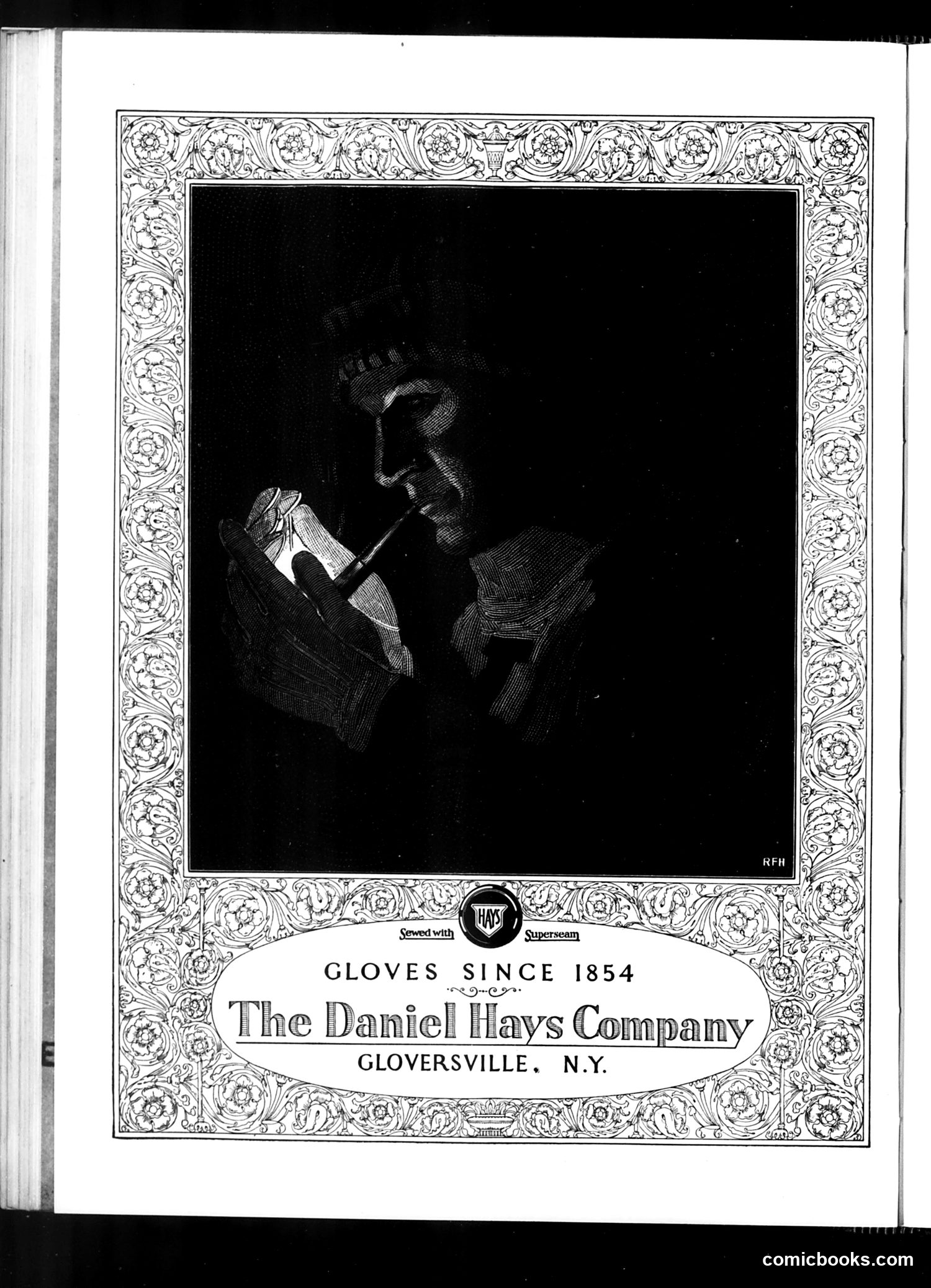
This page is primarily **advertising, not political satire**. It's a full-page advertisement for The Daniel Hays Company of Gloversville, New York, a glove manufacturer established in 1854. The image shows a man in profile, dramatically illuminated against darkness, examining or holding gloves near his face—likely meant to showcase the quality and craftsmanship of the product. The ornate decorative border frames the advertisement prominently. The "Superseam" branding and heritage dating claim ("Gloves Since 1854") suggest this is a prestige advertisement aimed at affluent readers of *Judge* magazine, emphasizing the company's long-standing reputation and superior manufacturing standards rather than delivering any political or social commentary.
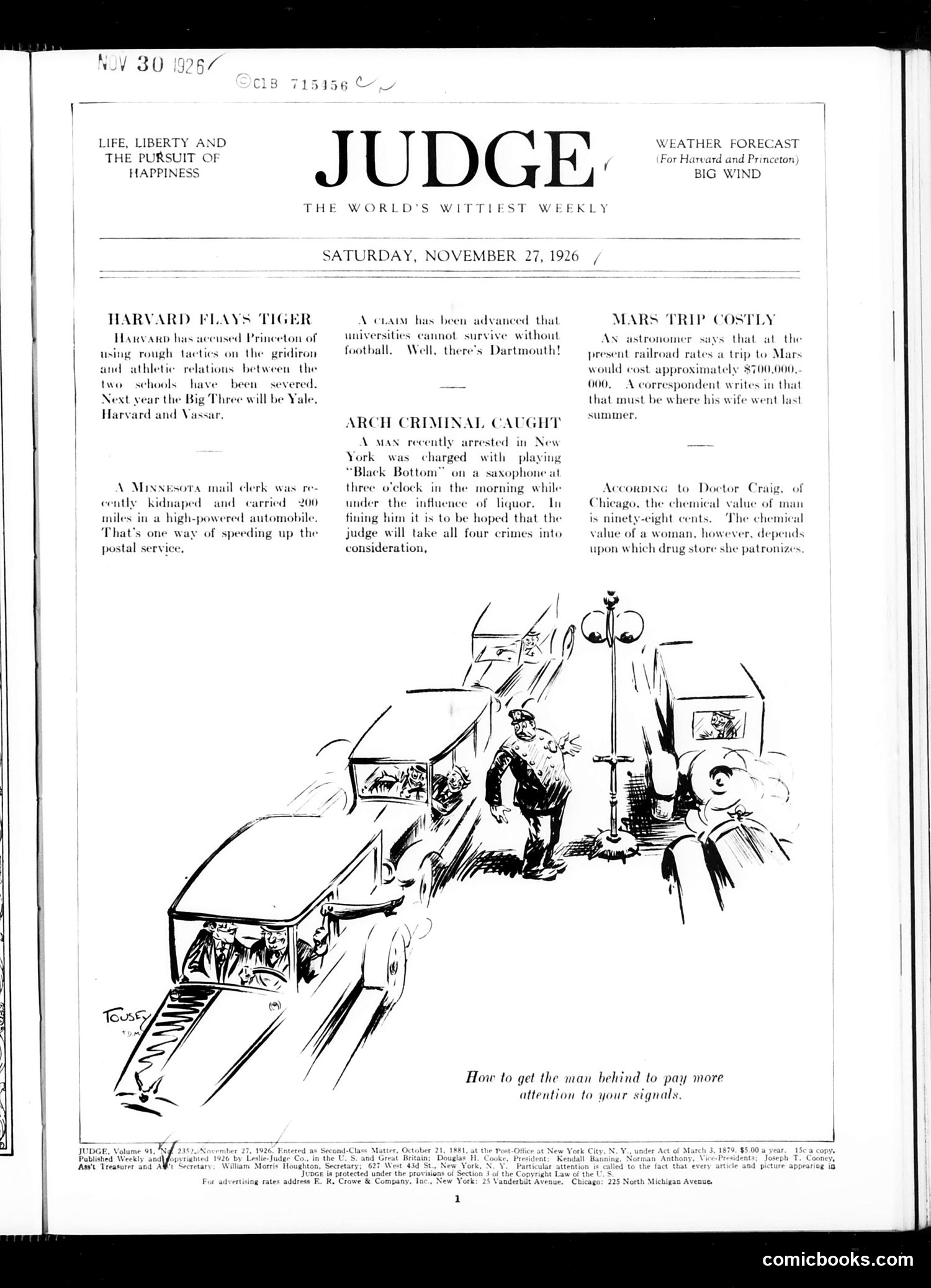
The main cartoon depicts a traffic safety joke. A driver signals with an exaggerated mechanical arm-and-hand contraption at a street corner, with the caption: "How to get the man behind to pay more attention to your signals." The satire mocks both poor driver communication and inattentive motorists. The elaborate, comical signaling device represents frustration with drivers who ignore standard hand signals—a genuine safety problem in the 1920s before standardized turn signals existed on vehicles. The accompanying text discusses unrelated topics: Harvard-Princeton football rivalry, a criminal arrest in New York, a proposed Mars space mission's cost, and a Chicago doctor's chemical analysis comparing men's and women's value. These represent typical Judge magazine content—satirizing news, academia, and social commentary.
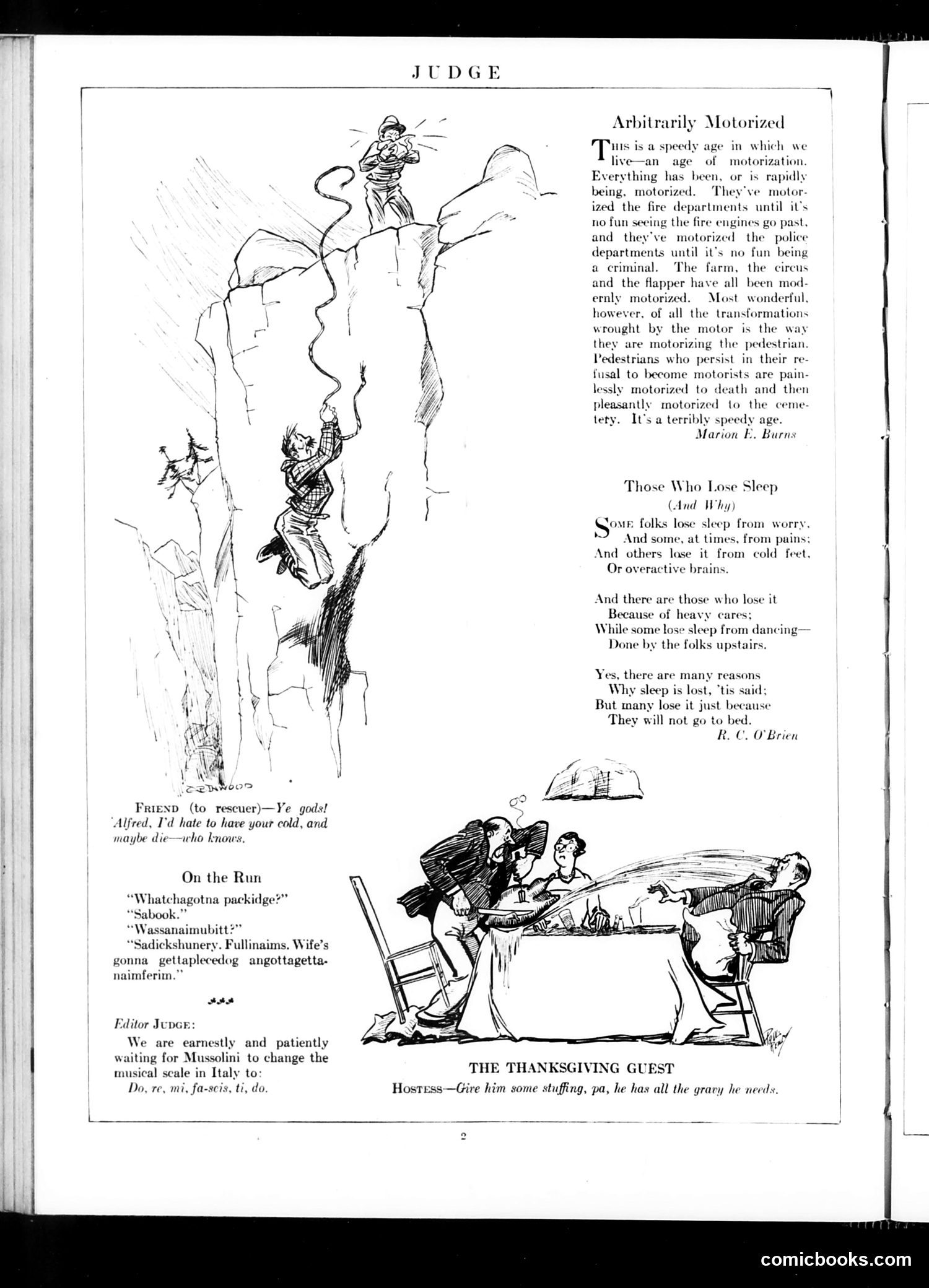
This page contains several satirical pieces from Judge magazine: **"Arbitrarily Motorized"** by Marion E. Burns critiques the rapid, indiscriminate adoption of motorized transportation. The accompanying sketch shows people being thrown about by a wildly driven vehicle, illustrating the chaos of the "motor age." Burns sarcastically notes that while fire departments and police have modernized, the real problem is pedestrians being "painlessly motorized to death"—a dark joke about traffic fatalities. **"Those Who Lose Sleep"** explores insomnia's causes: worry, pain, cold feet, and overactive minds. The poem by R.C. O'Brien humorously notes some simply refuse bedtime. **"The Thanksgiving Guest"** depicts a humorous domestic scene where a hostess urges her guest to eat well, suggesting he needs "stuffing" (filling out) since he has "all the gravy he needs"—implying he's thin or impoverished. The page satirizes early 20th-century American life: motorization anxiety, modern ailments, and class-conscious hospitality humor.
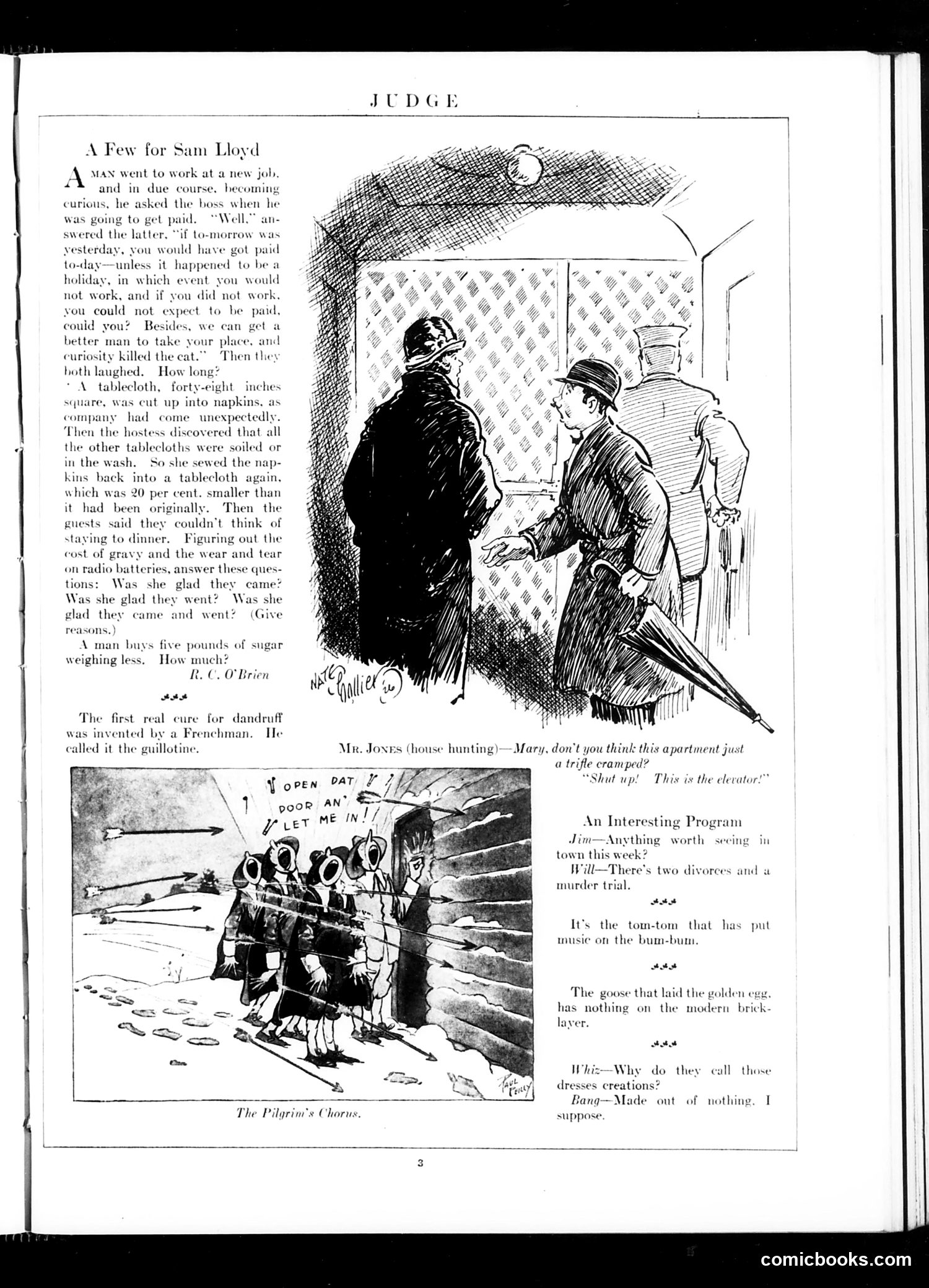
This page contains humor pieces rather than political cartoons: **"A Few for Sam Lloyd"** (top): A workplace anecdote about a man asking his boss about pay during a holiday. The humor relies on wordplay and logic puzzles typical of Sam Lloyd, a famous puzzle creator. **Main cartoon (center)**: Shows Mr. Jones house-hunting with a realtor. The joke: Jones asks if the apartment is "cramped," and the realtor responds sarcastically that it has "the elevator"—implying the space is so small, residents must use the building's elevator to move around their own apartment. This satirizes cramped urban housing conditions. **"The Pilgrim's Chorus"** (bottom): Appears to be a humorous illustration with multiple figures at a doorway, though its specific satire is unclear from the visible text. **"An Interesting Program"** (right): Brief humorous observations about contemporary social topics.
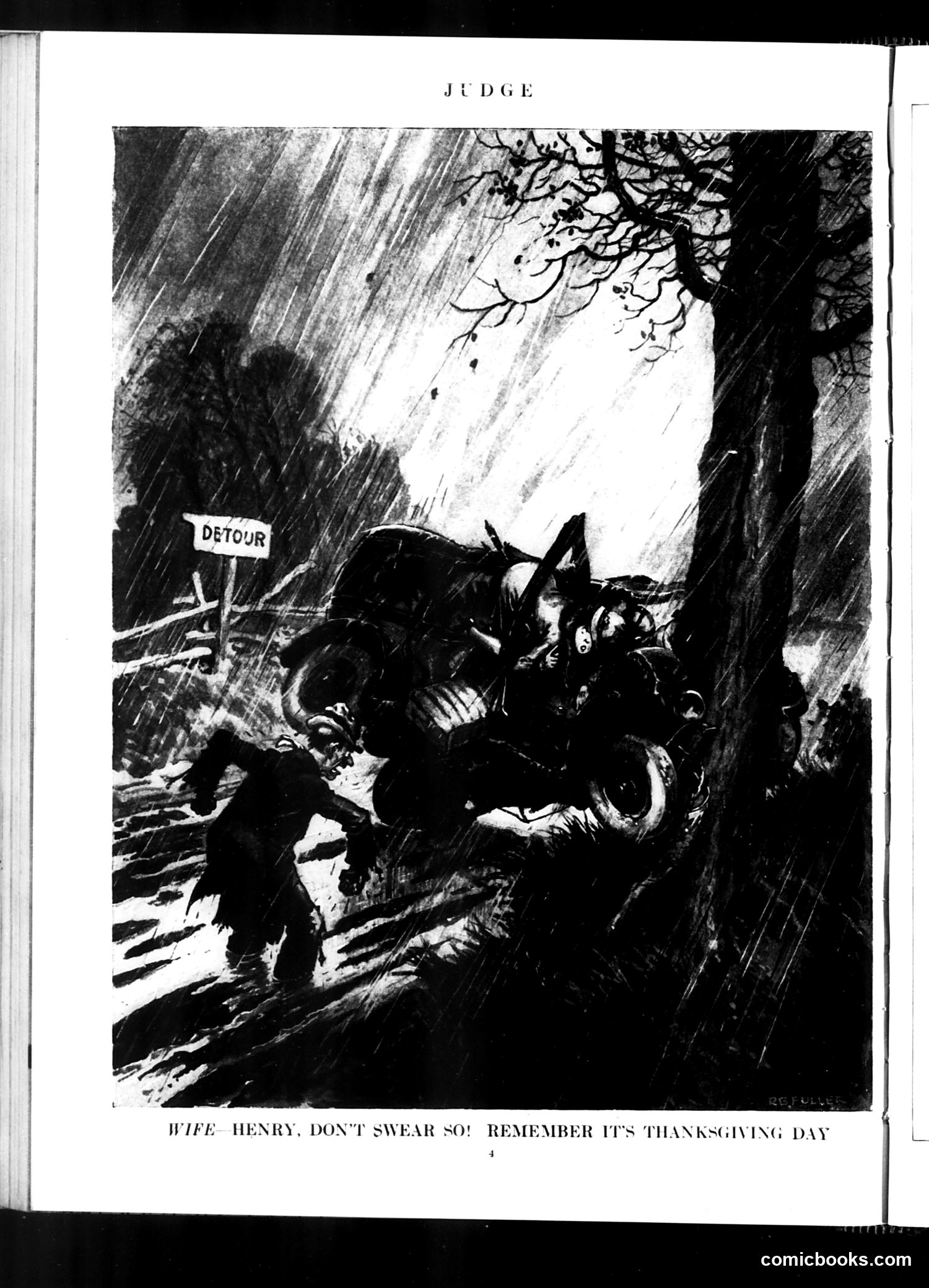
This cartoon depicts a domestic scene during heavy rain on Thanksgiving. A man (Henry) appears to have encountered trouble with his horse and wagon on a muddy road marked with a "DETOUR" sign. The wife is remonstrating with him, urging restraint in his language given the holiday's sacred nature. The humor relies on the contrast between Henry's frustration at practical misfortune and his wife's insistence on maintaining Thanksgiving's spiritual propriety. It satirizes middle-class propriety and the tension between everyday exasperation and holiday decorum—a relatable domestic comedy rather than political satire. The muddy, difficult conditions emphasize why Henry might be tempted to swear despite the occasion.
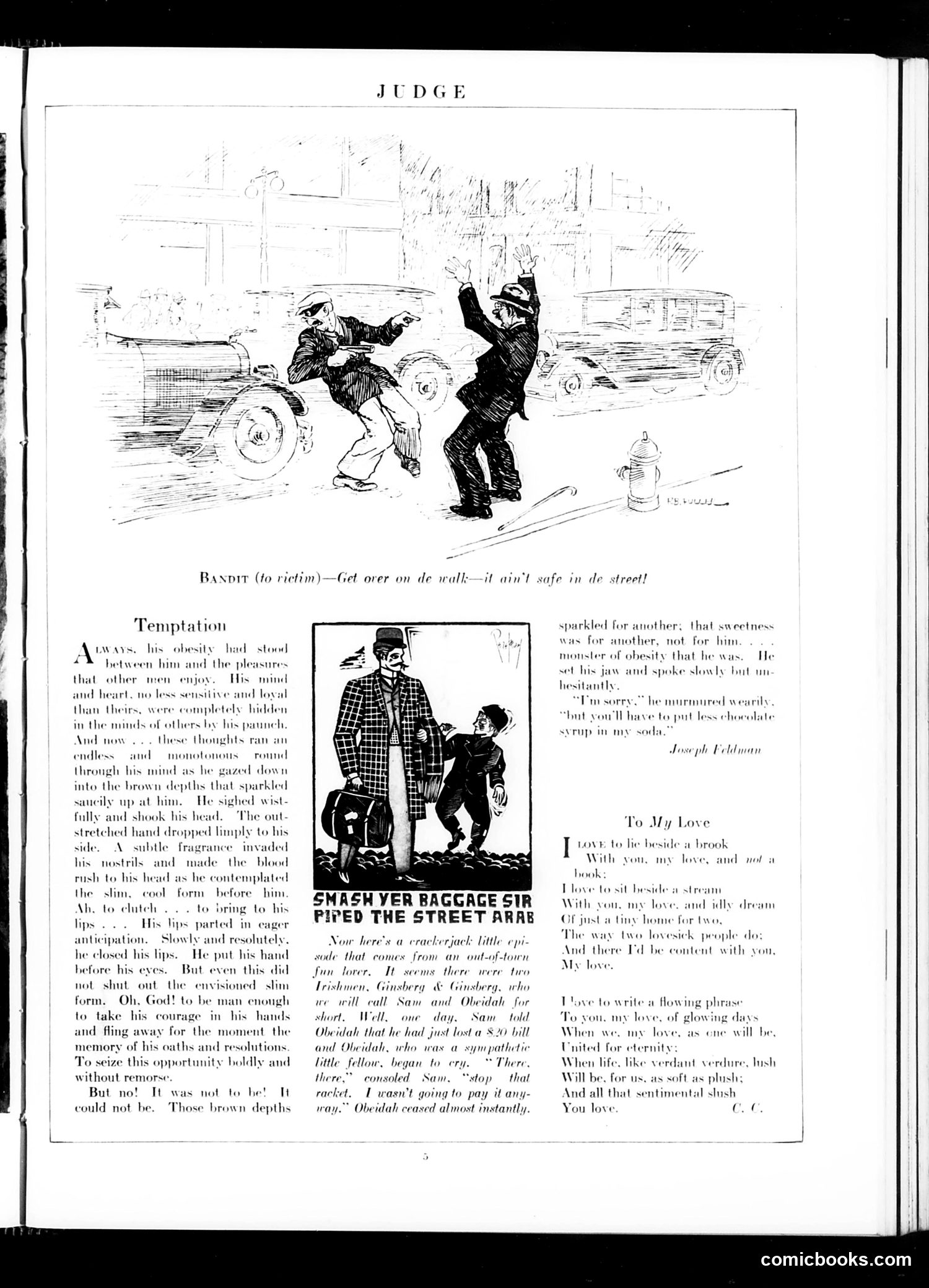
**Top Cartoon ("Bandit")**: Shows a street confrontation where a bandit demands money from a victim while a police officer appears to intervene. The caption reads: "Get over on de walk—it ain't safe in de street!" This is satirizing urban crime and police ineffectiveness—the joke being that the street itself is unsafe, implying lawlessness pervades the entire public space, not just certain areas. **Lower Content**: The page contains a story titled "Temptation" about a man struggling with obesity and self-control, followed by romantic poetry ("To My Love"). The "Smash Yer Baggage Sir" illustration appears to be a separate humorous anecdote about baggage handlers, likely mocking working-class behavior or railroad service incompetence. The content mixes social satire with sentimental literature typical of Judge magazine.
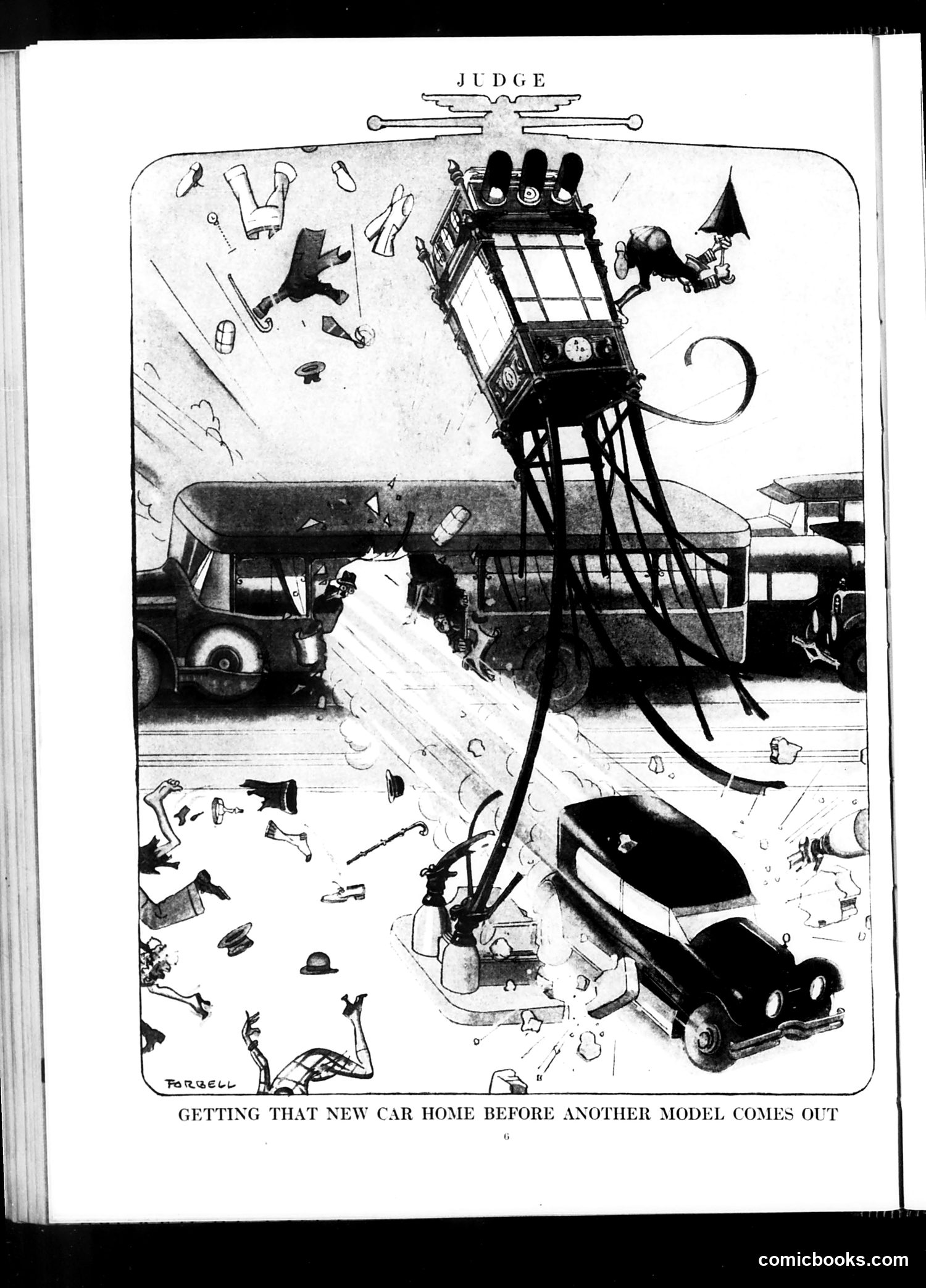
This satirical cartoon, signed by Cesare Forbell, mocks the rapid pace of automotive innovation and obsolescence in early 20th-century America. The chaotic scene depicts an elaborate, precarious contraption being used to transport a newly purchased car—suggesting the vehicle is so fragile or hastily assembled that normal transport won't work. The joke critiques how quickly automobile manufacturers released new models, making recent purchases feel instantly outdated. The machinery, wild activity, and falling tools emphasize the absurdity of the situation. By exaggerating the difficulty of simply getting a car home before it becomes obsolete, the cartoon satirizes both consumer anxiety about keeping up with technological progress and the automobile industry's aggressive marketing of "improved" models.
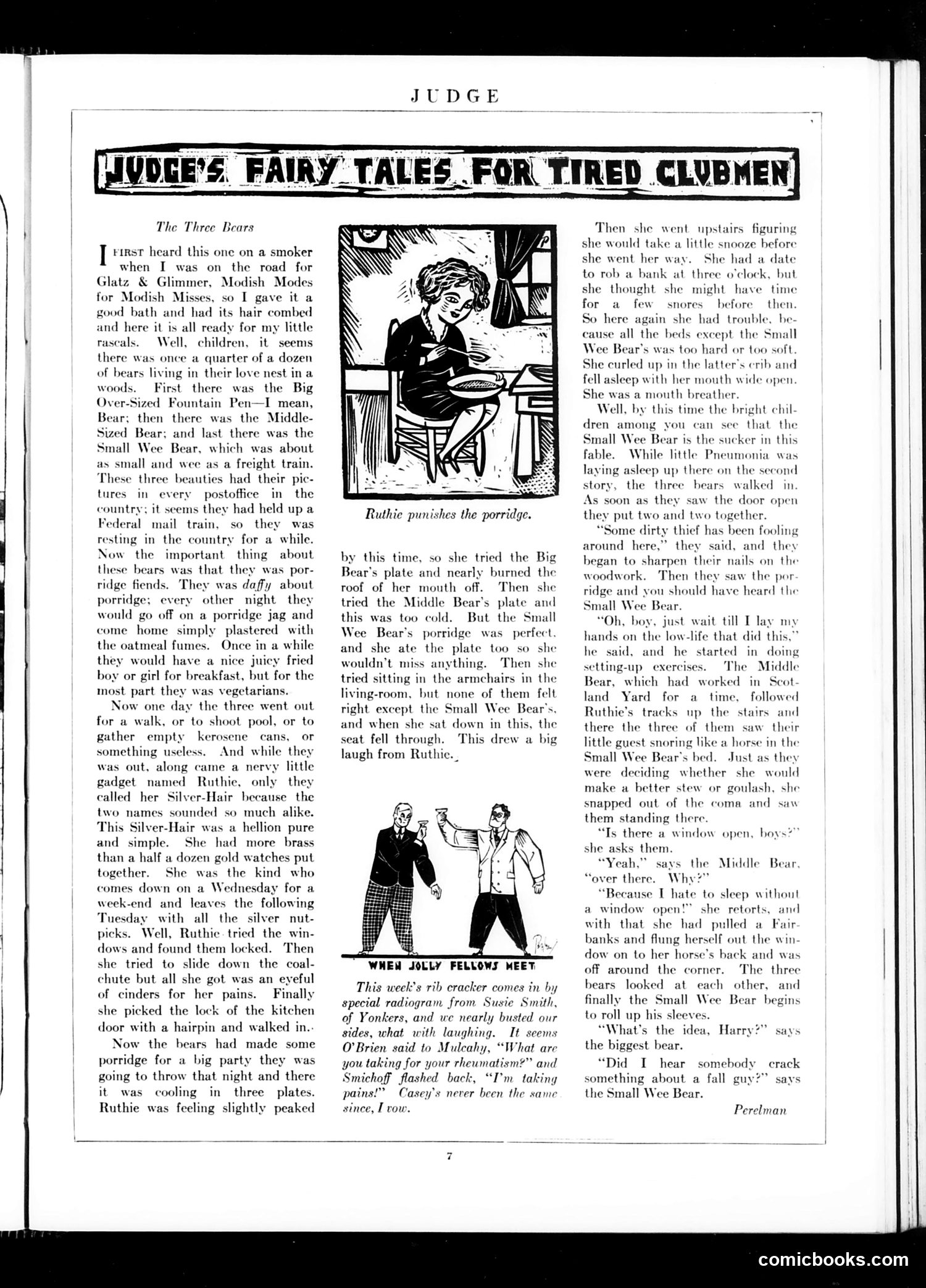
This is a humorous retelling of Goldilocks and the Three Bears for adult readers. The joke establishes the bears as criminals—they've robbed a Federal mail train and are hiding in the country. "Silver-Hair" (Ruthie) is a brazen burglar who breaks into their home while they're out. The satire plays on the traditional children's tale by making all characters morally questionable: the bears are thieves, Ruthie is a burglar with a bank robbery scheduled. The humor comes from treating a innocent fairy tale as crime narrative, with Ruthie's casual villainy (breaking locks, eating their food, napping in their beds) presented as comic audacity rather than wrongdoing. The final punchline hints that Pneumonia will be her comeuppance—she'll catch cold sleeping with her mouth open. The story mocks both sentimental children's literature and the era's actual criminal underworld by conflating them.
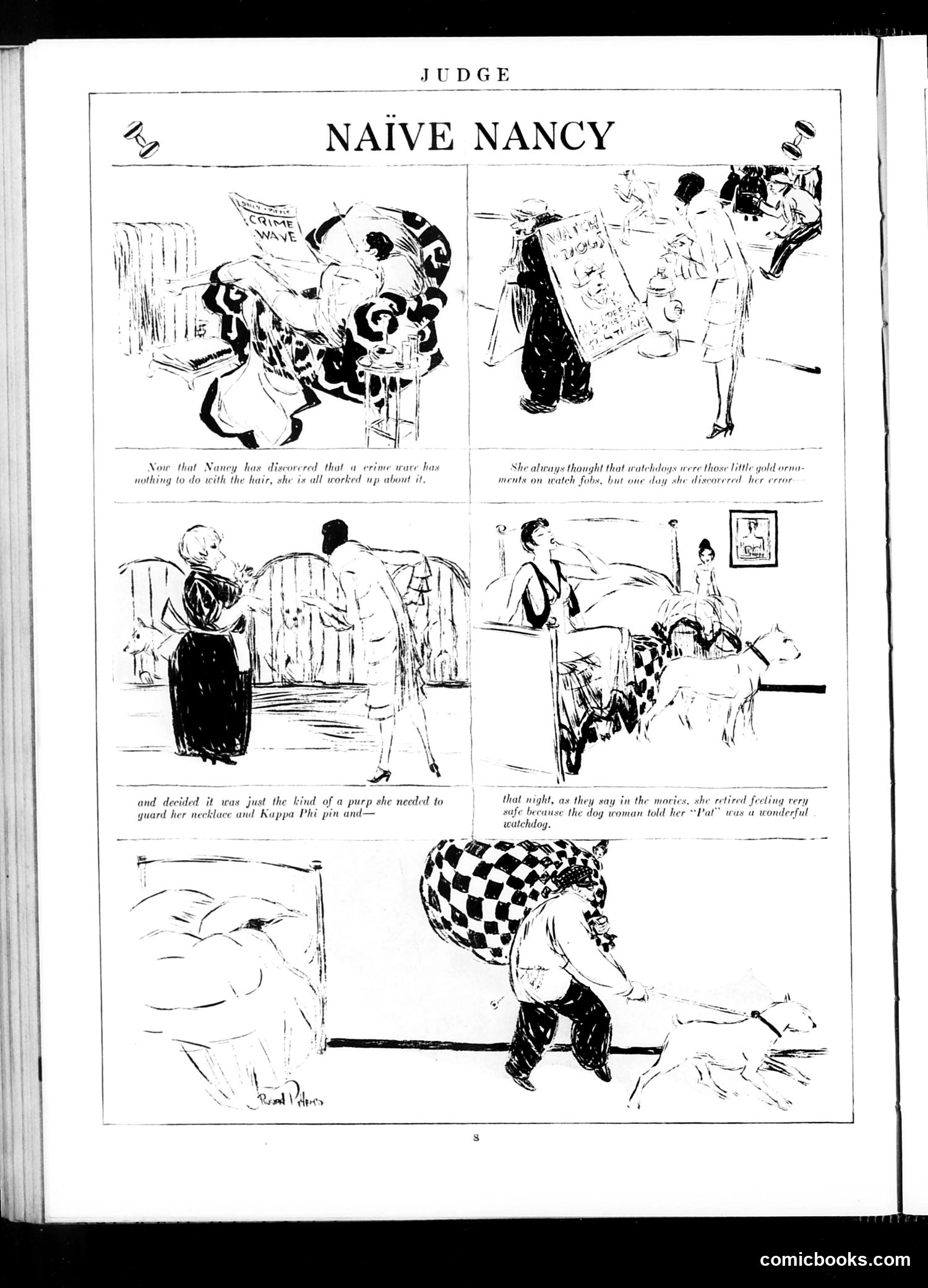
This is a humorous comic strip about a character named Nancy who is comically ignorant about common expressions and concepts. **The jokes:** 1. Nancy discovers a "crime wave" has nothing to do with hair, then becomes worried about actual crime. 2. She mistakenly believes "watchdogs" are literal dogs (rather than metaphorical guardians), and is relieved when a dog named "Pat" is assigned to protect her valuables. 3. The final panel shows Nancy sleeping peacefully, having placed actual faith in the dog as security. **The satire:** The strip mocks naive, sheltered women (likely upper-class, given references to jewelry and sorority pins) who take figurative language literally and lack practical understanding of the world. The humor derives from her innocent misinterpretations of common idioms and her resulting absurd actions—treating a pet dog as genuine home security.
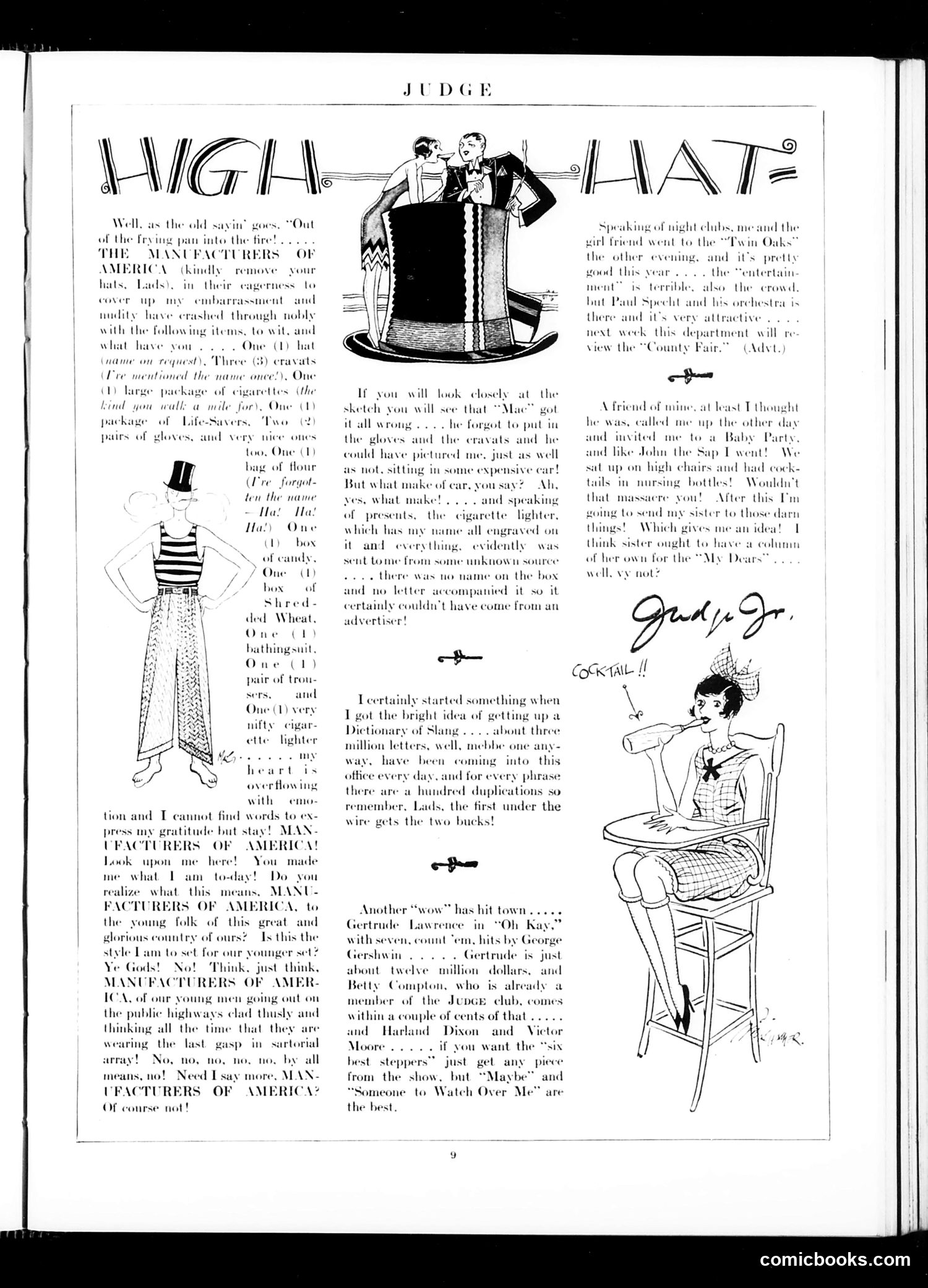
This page satirizes American manufacturers' aggressive advertising practices in the 1920s. The main cartoon depicts a man overwhelmed with unsolicited gifts from manufacturers—hats, cigarettes, cravats, candy, and a cigarette lighter—sent to promote their brands. The satire's point: manufacturers are creating an absurd culture where young men are essentially walking advertisements, dressed head-to-toe in branded merchandise. The writer sarcastically addresses "Manufacturers of America," questioning whether this is the proper "style" for youth, suggesting the practice is undignified and ridiculous. The accompanying text discusses various entertainment and social topics (nightclubs, Broadway shows featuring Gertrude Lawrence and George Gershwin), plus complaints about a "Dictionary of Slang" contest receiving duplicate entries. The cartoon critiques consumerism and corporate branding as intrusive and dehumanizing—concerns surprisingly modern for the Jazz Age era.
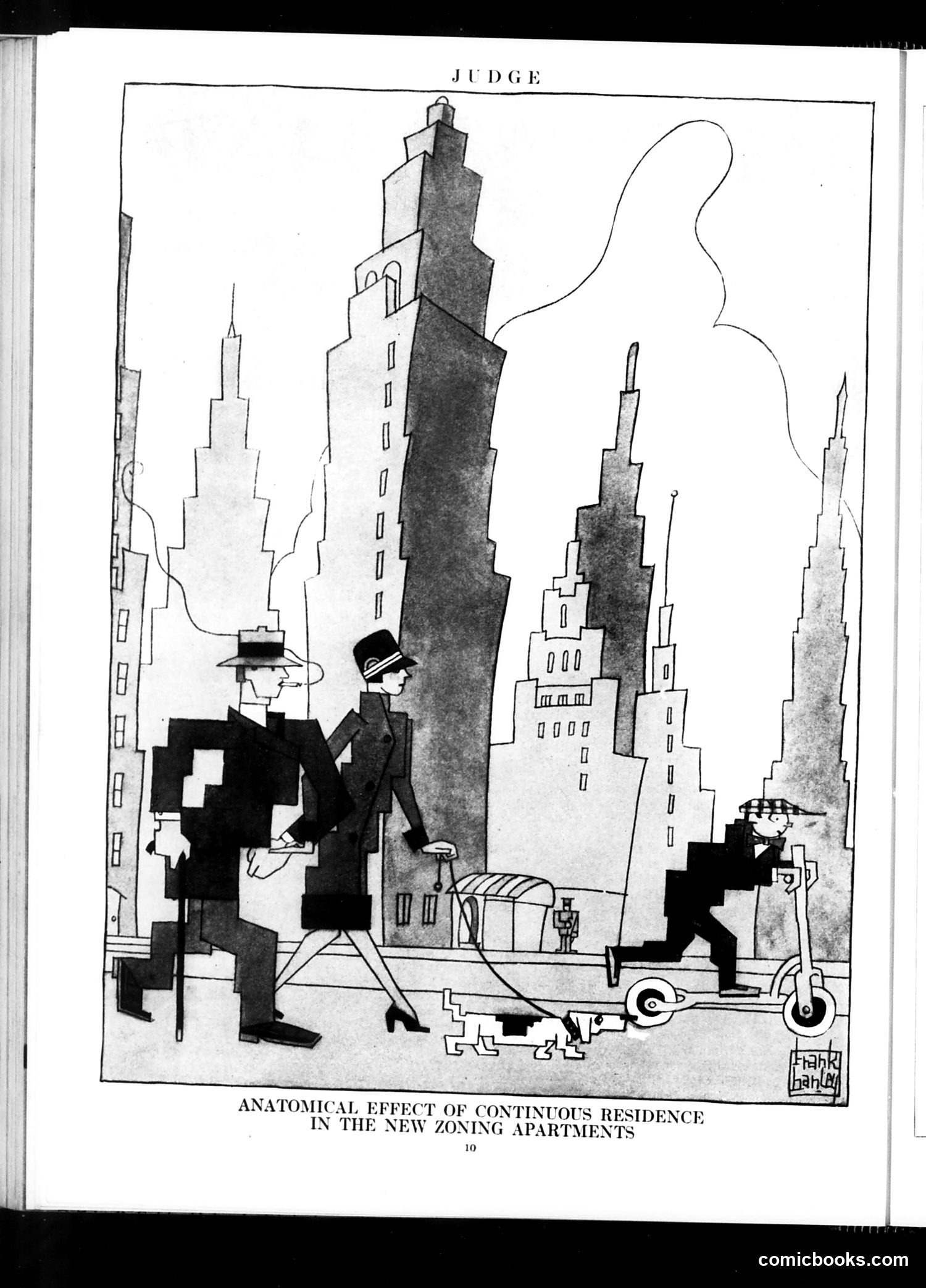
This Judge magazine cartoon satirizes the physical deformities supposedly caused by living in New York City's new high-rise apartment buildings. The exaggerated figures show people with distorted, elongated bodies—stretched vertically like the skyscrapers surrounding them. One figure appears impossibly thin and tall, while others display warped proportions. The satire mocks two concerns: the cramped, vertical nature of modern apartment living and anxieties about urban density. By literally depicting residents as anatomically reshaped by their environment, the cartoonist humorously suggests that the new zoning regulations and resulting architecture fundamentally alter human beings. The toy-like scooter and children emphasize the absurdity of this "effect."
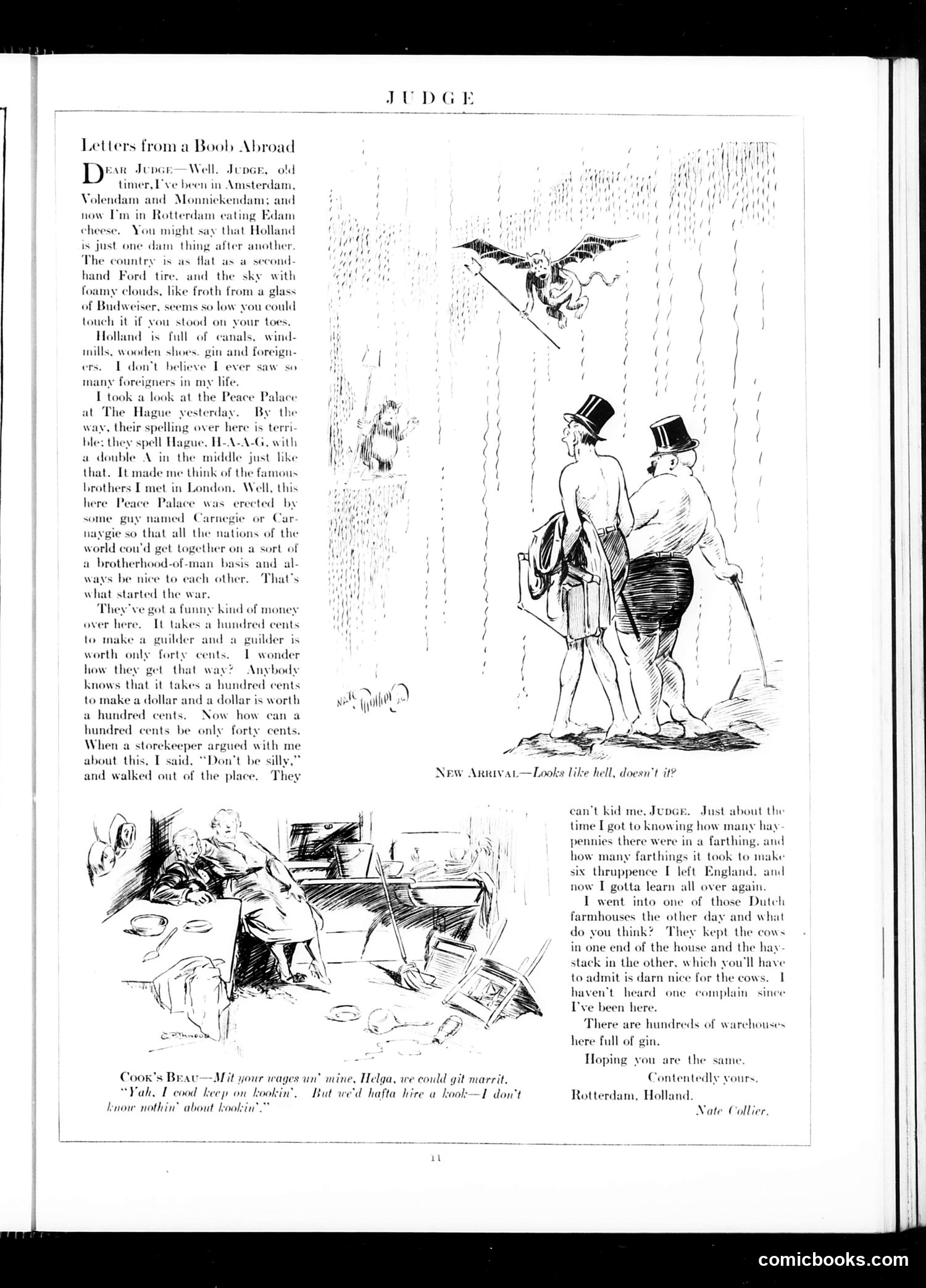
This page satirizes American tourists abroad through a letter from "Nate Collier" visiting Holland. The humor targets: **The Boob Tourist**: The writer complains about Holland being flat, confuses Dutch currency exchange rates (claiming 100 cents = 40 cents), and smugly dismisses Dutch spelling conventions as illogical while remaining oblivious to his own ignorance. **Post-WWI Context**: References to the Peace Palace at The Hague (established 1913) and mention of "what started the war" suggest this is post-WWI, mocking naive American optimism about international peace efforts. **Class/Cultural Mockery**: The accompanying sketches mock both tourists (two men in top hats in rain) and working-class encounters (the "Cook's Beau" sketch about marriage prospects). The satire's central joke: American tourists abroad are provincial and intellectually lazy—unable to grasp foreign systems while convinced of American superiority. Judge magazine regularly used this "boob abroad" format to ridicule American arrogance and cultural insularity.
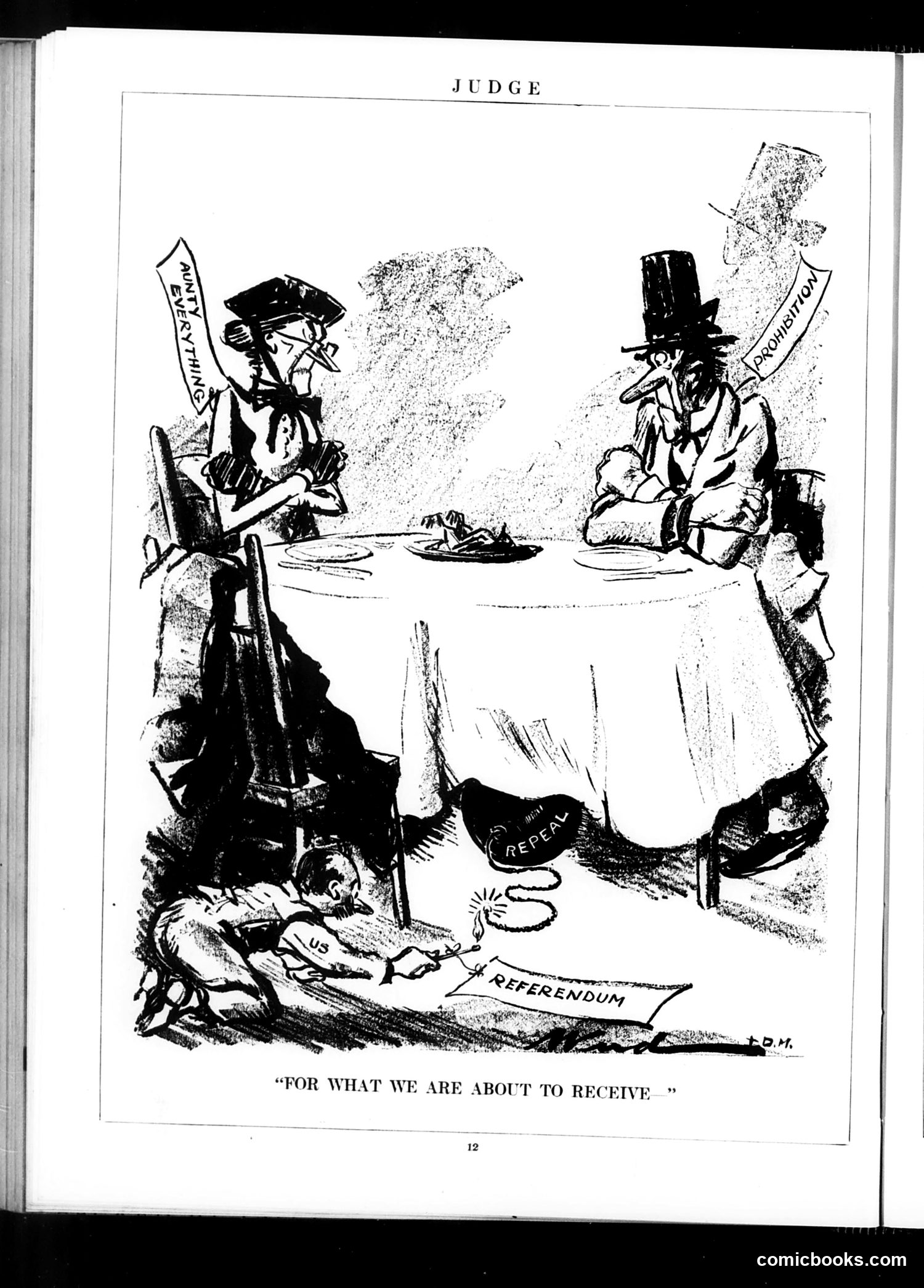
This political cartoon depicts two figures seated at a dinner table with Uncle Sam lying beneath it. One figure holds a banner labeled "Amendment," the other holds "Prohibition." Both have ribbons reading "Repeal" extending upward. The cartoon satirizes a debate over Prohibition repeal during what appears to be the Prohibition era (1920-1933). The two figures represent opposing political forces negotiating over whether to repeal Prohibition through constitutional amendment. Uncle Sam, positioned submissively under the table, represents the American public who will suffer consequences of whatever decision is made. The caption "For What We Are About to Receive" suggests dark irony—that Americans should prepare themselves for the outcome of this political dispute over their fate.
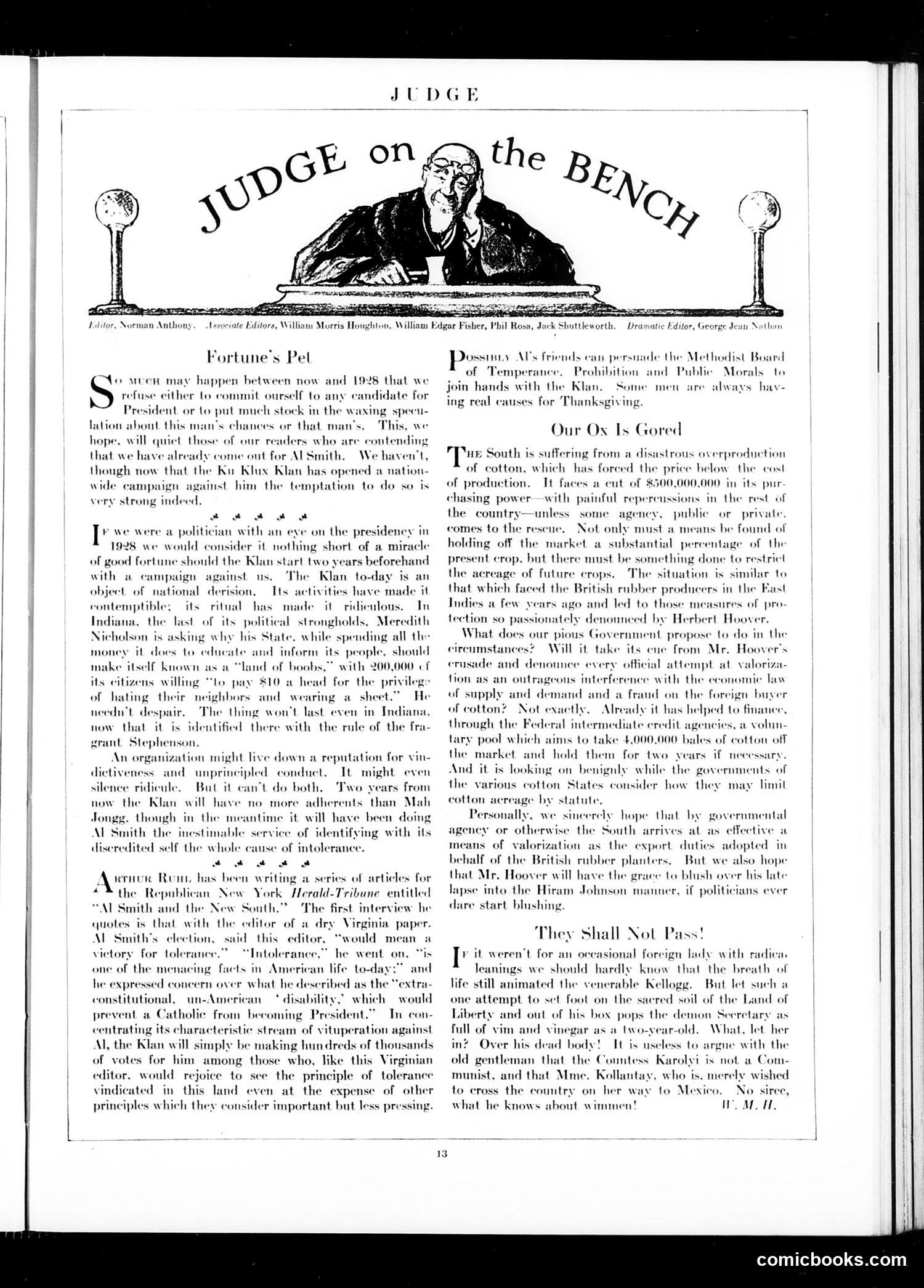
This page from Judge presents editorial commentary on 1920s American politics, centered on Al Smith's potential 1928 presidential candidacy. ## Key Content: **"Fortune's Pet"** argues the Klan's opposition to Smith (a Catholic) actually *helps* him by associating intolerance with the Klan's discredited reputation. The piece suggests the Klan's unpopularity—especially in Indiana under leader Meredith Nicholson—will ultimately bolster Smith's support among tolerant voters. **"Our Ox Is Gored"** criticizes the government's response to Southern cotton overproduction. It notes the irony that while the Hoover administration previously condemned British rubber market controls, it now faces pressure to implement similar cotton restrictions to prevent economic collapse in the South. ## Historical Context: The Klan's 1920s resurgence and Smith's Catholic faith were major political issues. The page sarcastically suggests Smith benefits from the Klan's unpopularity—those valuing tolerance would support him despite other disagreements. The cotton crisis reflects post-WWI agricultural depression affecting the Southern economy.
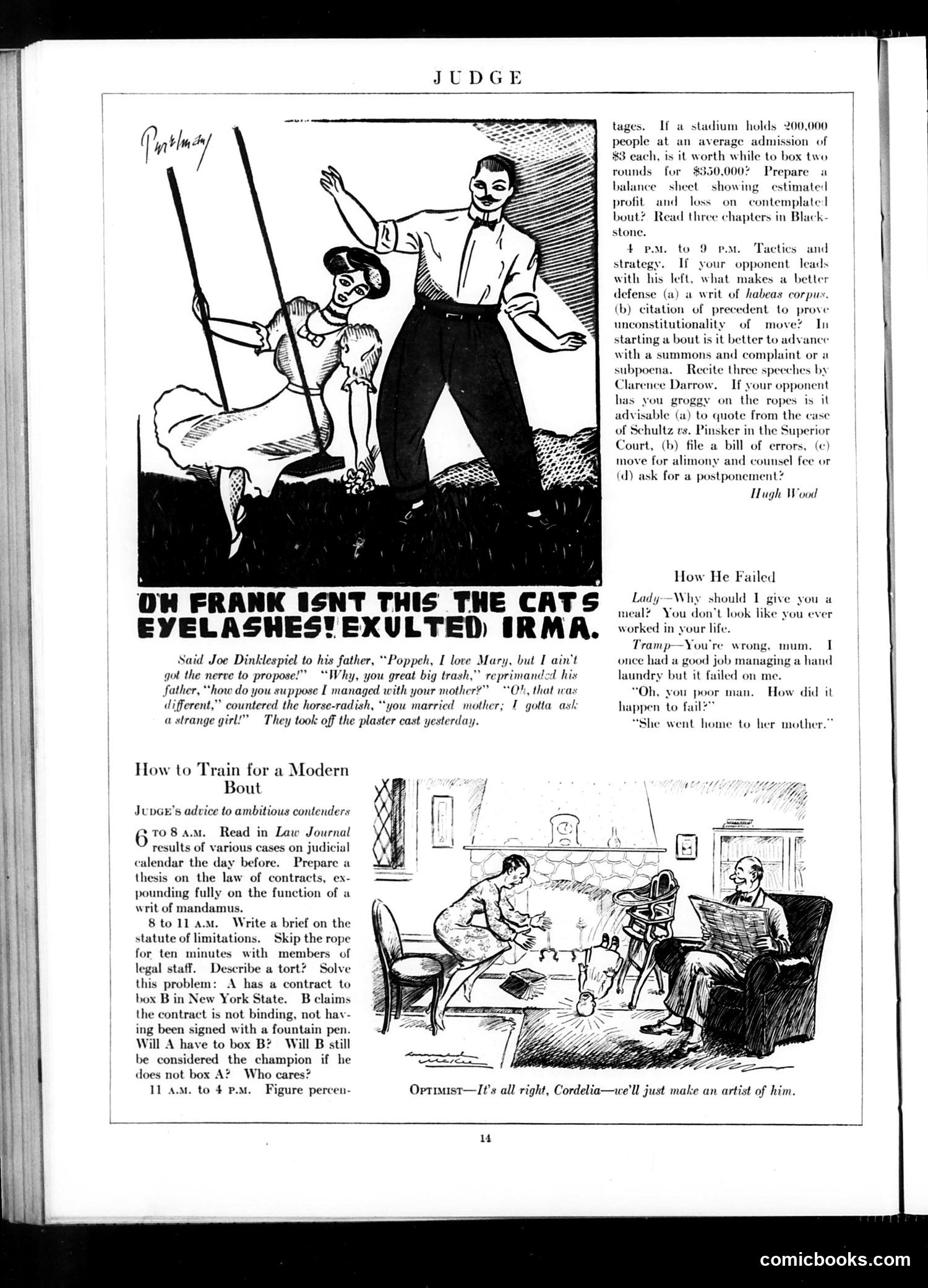
This page contains two main satirical pieces mocking the legal profession's encroachment into everyday American life. **"How to Train for a Modern Bout"** ridicules lawyers by proposing an absurd boxing training regimen that replaces physical preparation with legal study—reading law journals, writing contract briefs, and debating procedural questions instead of actual boxing practice. The joke satirizes how American litigation culture has become so pervasive that even athletes would need legal expertise. **"How He Failed"** offers a short comedic dialogue where a tramp claims his failure at managing a hand laundry resulted from his wife leaving him for her mother—suggesting domestic incompetence rather than business failure. The top cartoon, "Oh Frank Isn't This the Cat's Eyelashes," appears to be an unrelated joke about exaggerated cosmetics, with accompanying dialogue about marriage and family dynamics. Together, these pieces reflect Judge magazine's satirical stance against over-legalization of American society and social pretension of the era.
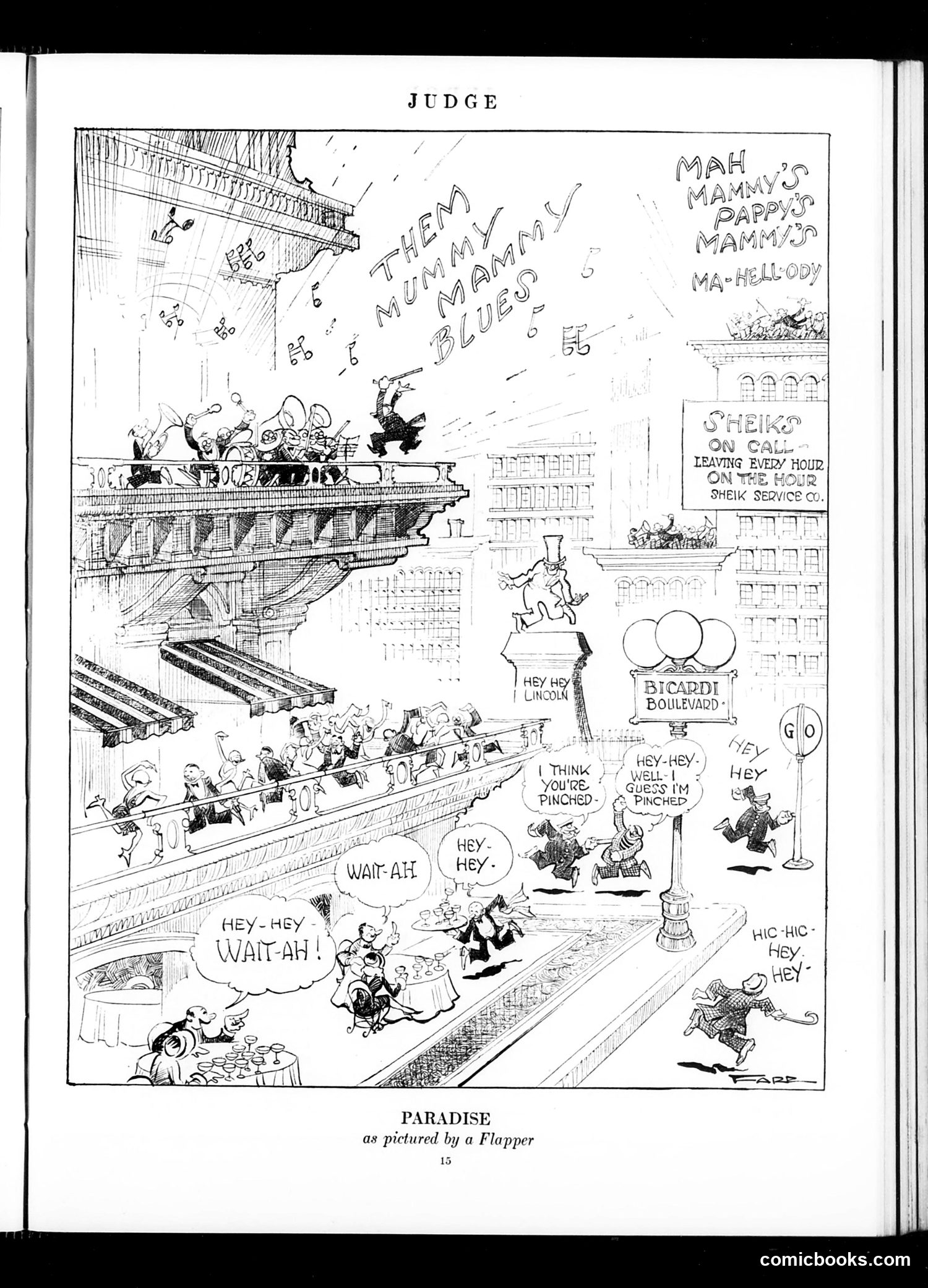
This Judge cartoon satirizes 1920s "flapper" culture and urban leisure. The title "Paradise as pictured by a Flapper" depicts an idealized Jazz Age scene featuring: **Key elements:** - A luxurious hotel or resort with musicians playing "Them Mummany Blues" on upper levels - References to fashionable destinations: "Sheik" (popular romantic term), "Bicardi Boulevard" (cocktails/Prohibition-era drinking) - Multiple "Hey-hey" exclamations suggesting revelry and excitement - A boat or barge filled with well-dressed partygoers - Advertisement-style plaques for pleasure destinations **The satire:** The cartoon mocks the flapper lifestyle—young women pursuing jazz, dancing, cocktails, romance, and leisure in defiance of conservative values. The chaotic, pleasure-focused scene suggests frivolity and moral looseness that older generations found scandalous. "Paradise" ironically portrays what society viewed as reckless excess as desirable fun. The artist critiques both the lifestyle itself and perhaps the flapper's unconcerned attitude toward disapproval.
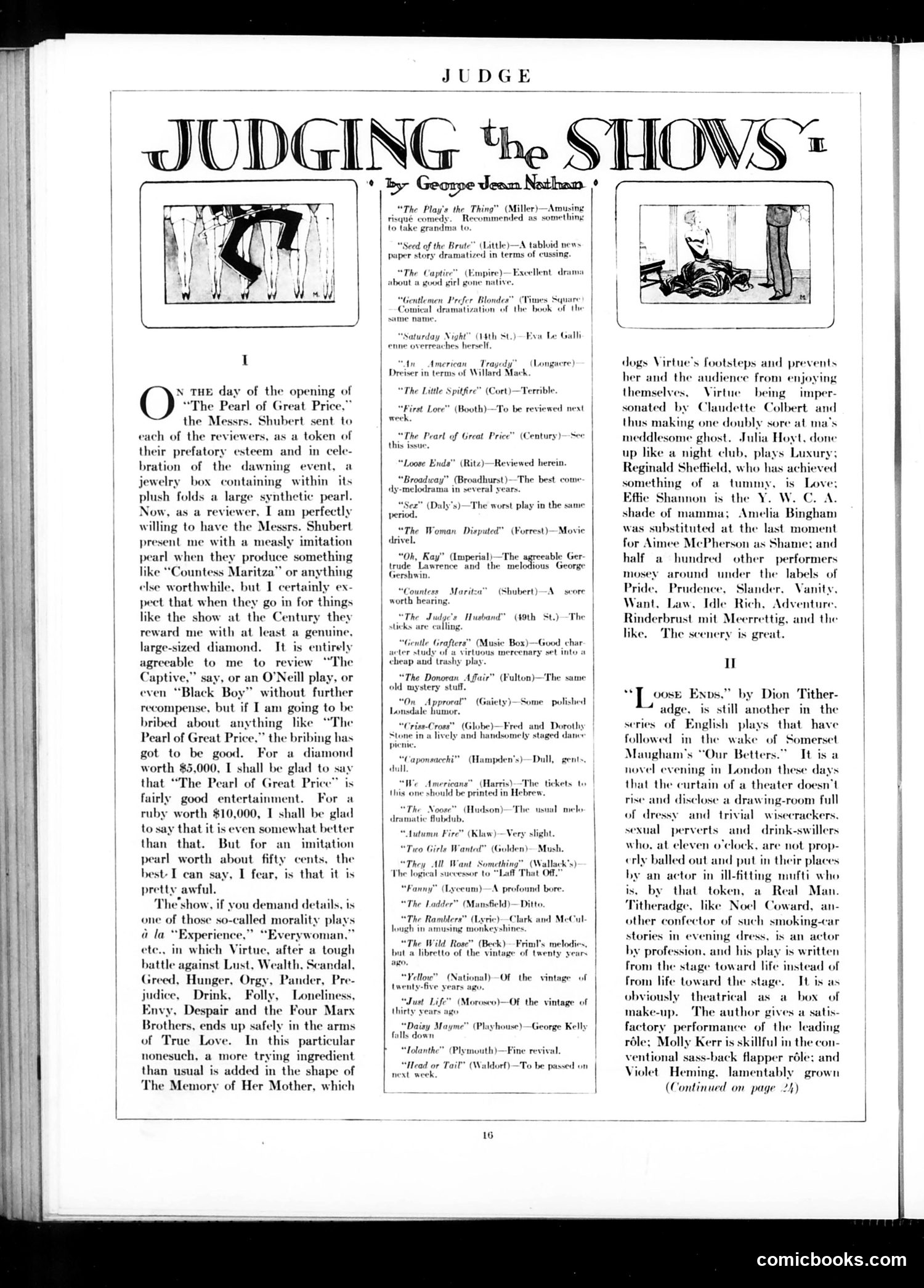
This page contains theater reviews by George Jean Nathan, a prominent drama critic of the 1920s. The key satire appears in the opening section: Nathan mocks the Shubert brothers (major theatrical producers) for sending reviewers imitation pearl jewelry as a bribe to praise their opening show, "The Pearl of Great Price." He sarcastically argues that if they're going to bribe critics, the gift should match the show's quality—a genuine diamond for good theater, a ruby for decent work, but only a worthless fake pearl for mediocre entertainment like this one, which he dismisses as "pretty awful." The show itself is a conventional morality play where Virtue triumphs over various vices (Lust, Hunger, Despair, etc.)—a tired theatrical formula even then. The satire targets both theatrical bribery practices and the cynicism of theater reviewing, while the rest of the page contains his capsule reviews of current Broadway productions.
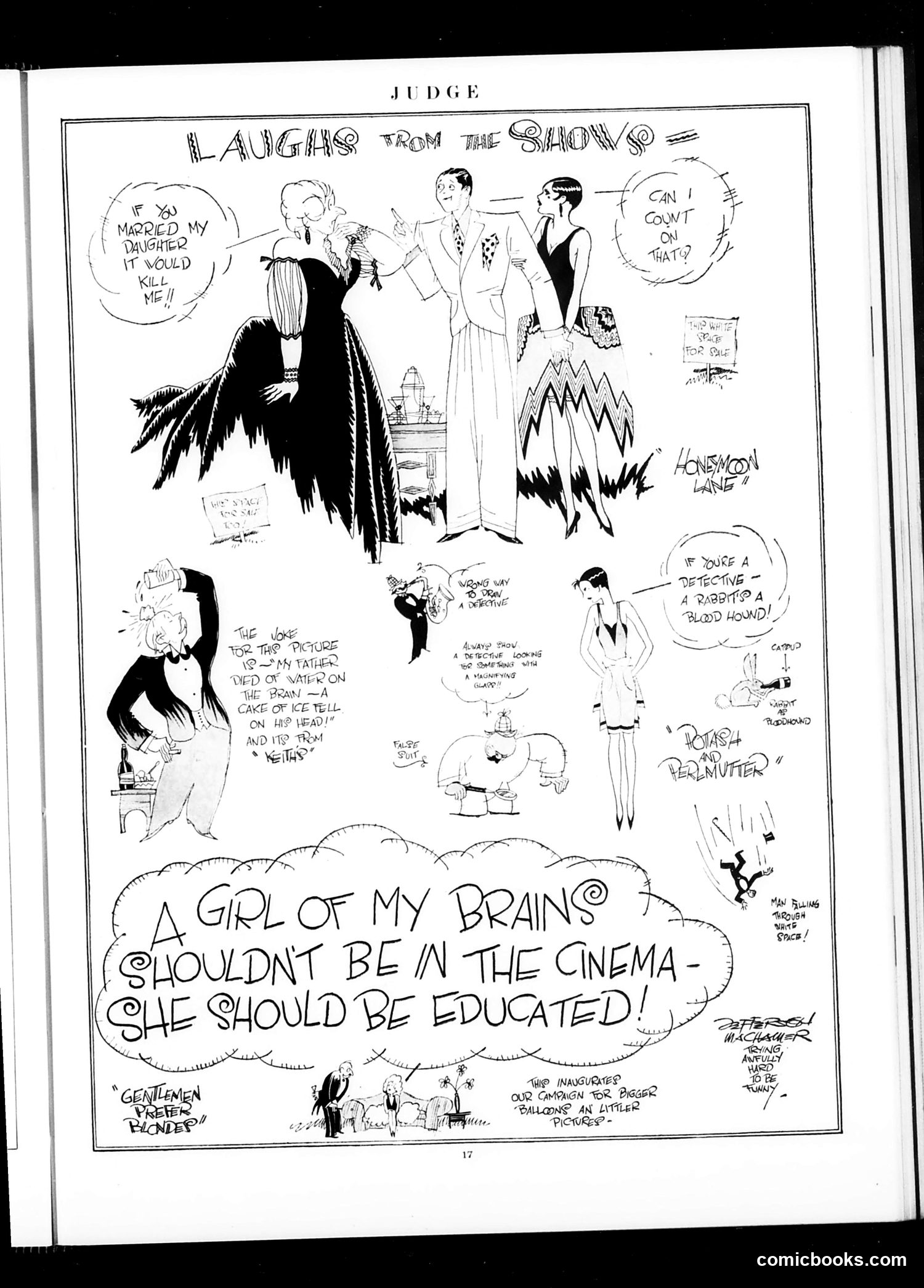
This page satirizes early 20th-century theatrical and social attitudes through exaggerated character sketches. The central cloud proclaims the core joke: "A girl of my brains shouldn't be in the cinema—she should be educated!"—mocking men who claim to value women's intellect while opposing their participation in entertainment or public life. The surrounding vignettes ridicule various male attitudes: a father who'd rather kill himself than marry off his daughter; men making absurd theatrical demands ("If you're a detective—rabbit a blood hound!"); and the pompous pronouncement by "gentlemen" that pictures are "picturesque" rather than intellectually worthwhile. The satire targets hypocrisy: conservative gatekeepers claim women need education, not entertainment, yet simultaneously dismiss cinema itself as beneath intelligent consideration. It's gender-based gatekeeping dressed up as respectability—a critique of how women faced contradictory restrictions on their choices and opportunities during this era.
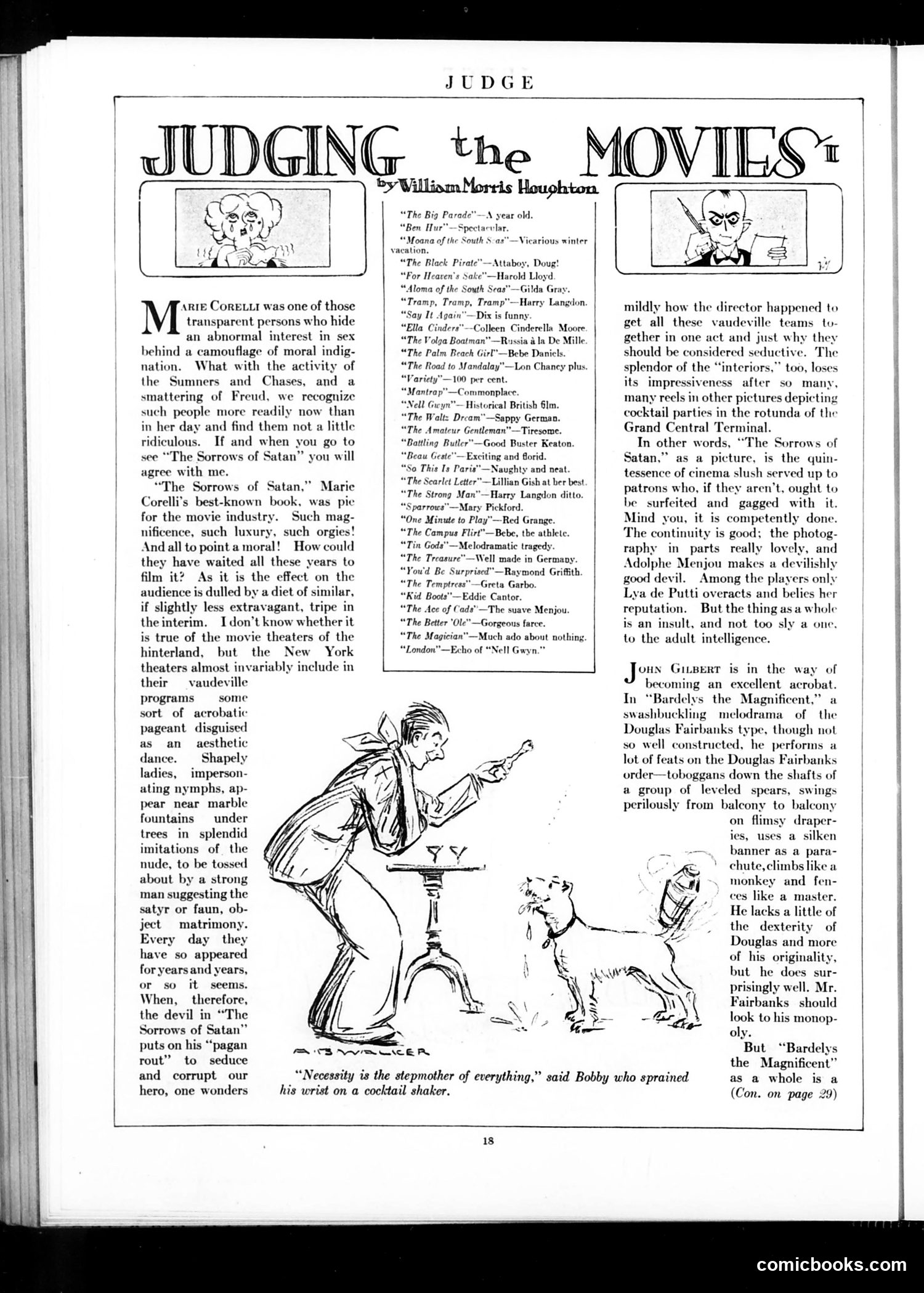
This page reviews 1920s silent films, with the main critique targeting "The Sorrows of Satan," adapted from Marie Corelli's novel. The author argues the film epitomizes shallow cinema: it combines luxury, orgies, and moral messaging while relying on tired theatrical tropes—scantily-clad women performing as "nymphs" with strong men, presented as aesthetic dance but essentially the same vaudeville padding audiences had seen repeatedly. The satirical point: despite competent direction and Adolphe Menjou's "devilishly good" performance, the picture insults adult intelligence by serving "cinema slush"—formulaic spectacle masquerading as sophistication. The author mocks how elaborate "interior" sets and cocktail-party scenes across multiple films have become numbingly repetitive. The bottom section lists contemporary films with brief reviews (mostly dismissive), suggesting Judge's broader frustration with 1920s cinema's reliance on luxury and scandal over substance.
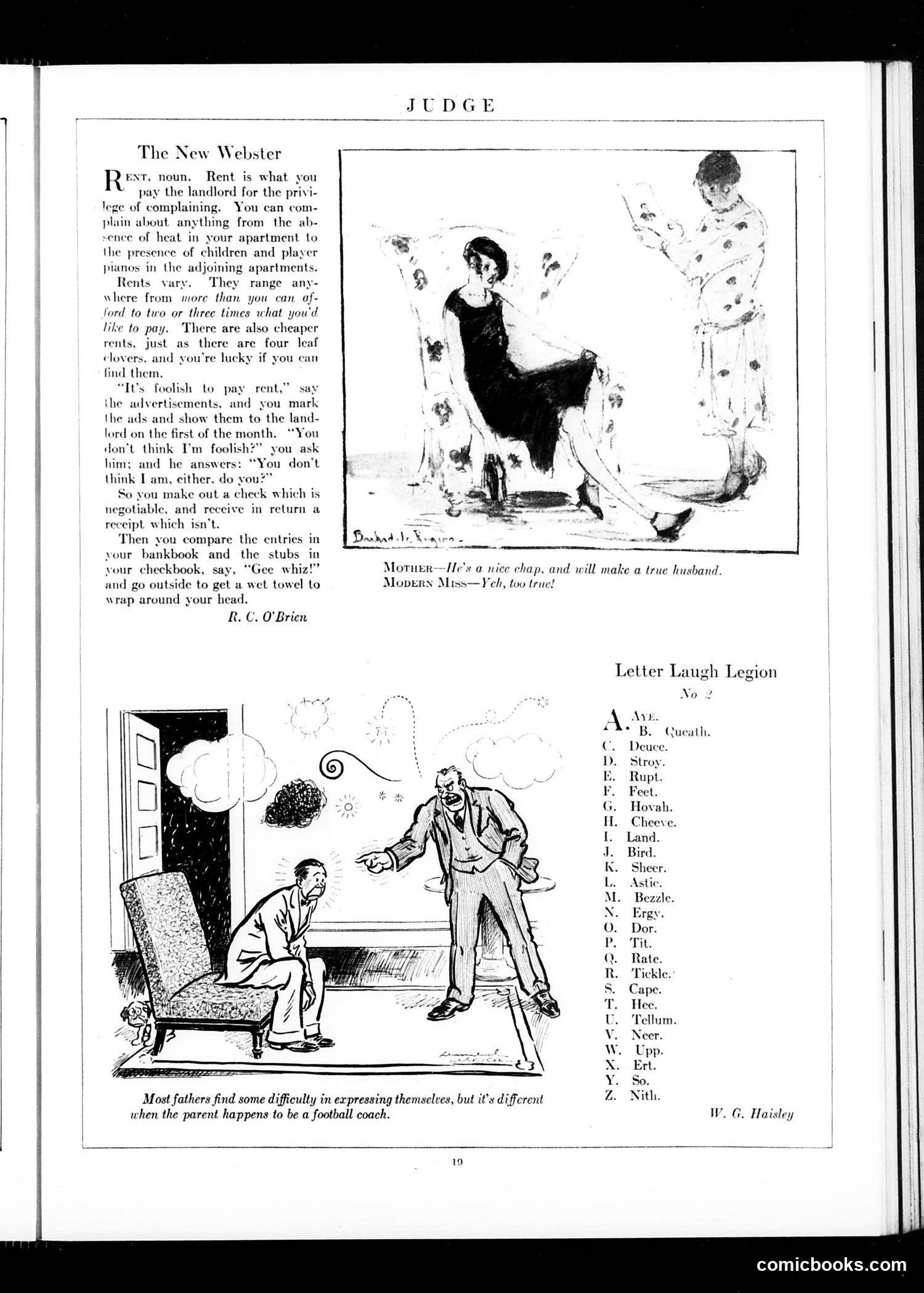
This page contains two distinct humor pieces: **"The New Webster"** (top) is a satirical dictionary entry by R.C. O'Brien defining "Rent" for urban apartment dwellers. It mocks the futility of complaining to landlords about inadequate heat, noise from children and player pianos, and exorbitant prices—yet tenants remain trapped because cheaper rents are as mythical as four-leaf clovers. The joke reflects early 20th-century tenant frustrations with unresponsive landlords. **The cartoon below** (by W.G. Haisley) depicts a father struggling to articulate himself while a football coach gestures animatedly. The caption jokes that fathers generally have difficulty expressing emotions, but a football coach-father finds it easy—implying coaches are naturally verbose or emotionally demonstrative. **"Letter Laugh Legion"** is a word-puzzle feature where each letter of the alphabet corresponds to a syllable that, when combined with "augh," creates a humorous word (e.g., A="Ave"+"augh"="average").
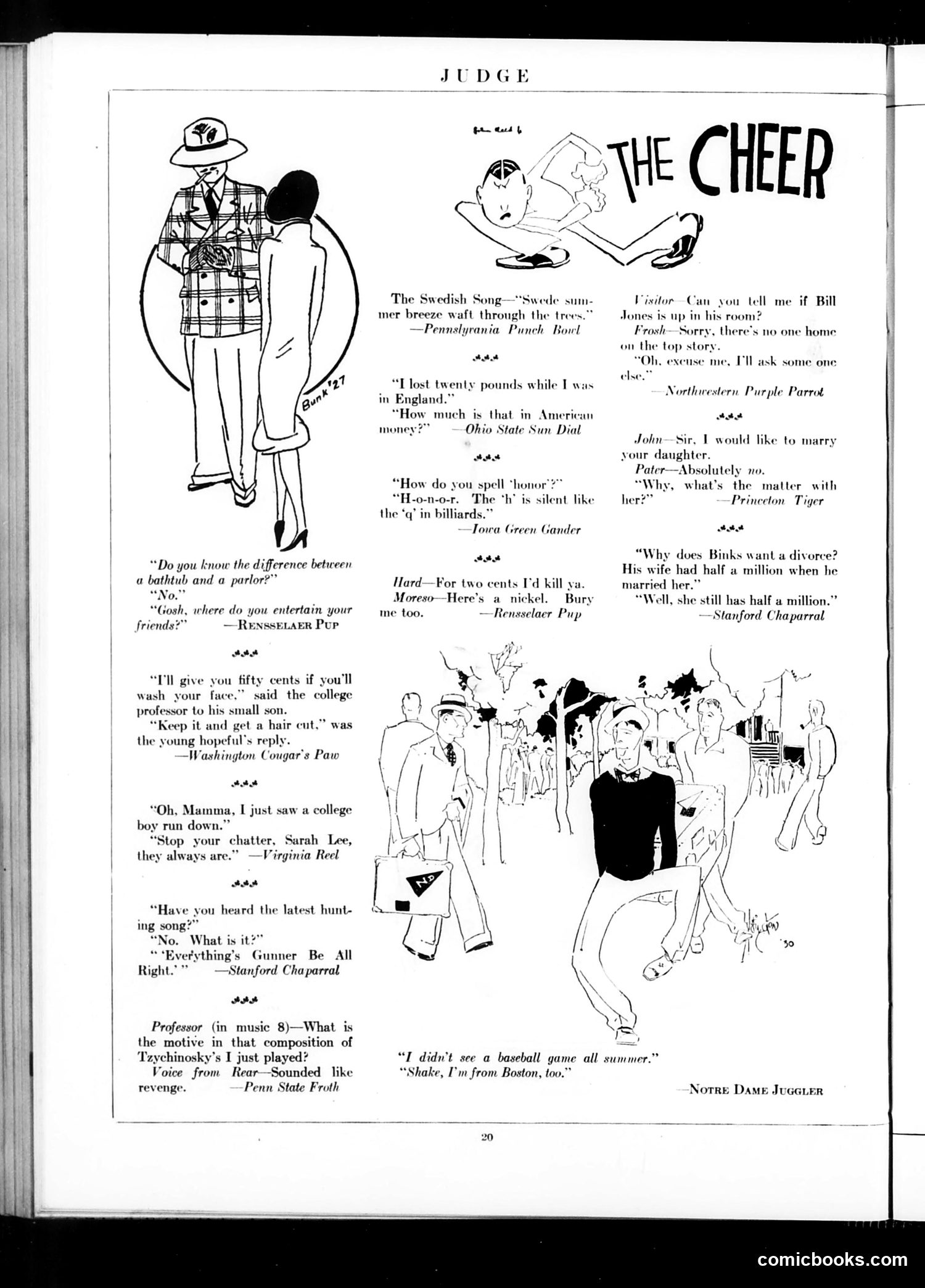
This page from *Judge* magazine collects brief comedic quips and jokes, mostly from college humor publications (Penn State, Stanford, Notre Dame, etc.). The humor relies on wordplay and social observations typical of early-20th-century college culture. Key jokes include: - **Spelling/pronunciation gags**: "honor" with silent 'h' compared to silent 'q' in billiards (nonsensical) - **College life**: Freshmen confusion, professors and their sons, campus social hierarchy - **Gender/marriage humor**: Jokes about courtship and divorce—apparently satirizing wealthy marriages where women retain money - **Regional/immigrant humor**: References to Swedish accents and Boston dialect reflect period attitudes toward foreigners and regional Americans The top illustration shows a uniformed officer (possibly military or campus authority) with a woman—likely mocking campus romance or disciplinary encounters. The overall tone is lighthearted undergraduate humor with mild social satire, reflecting 1920s college magazine conventions.
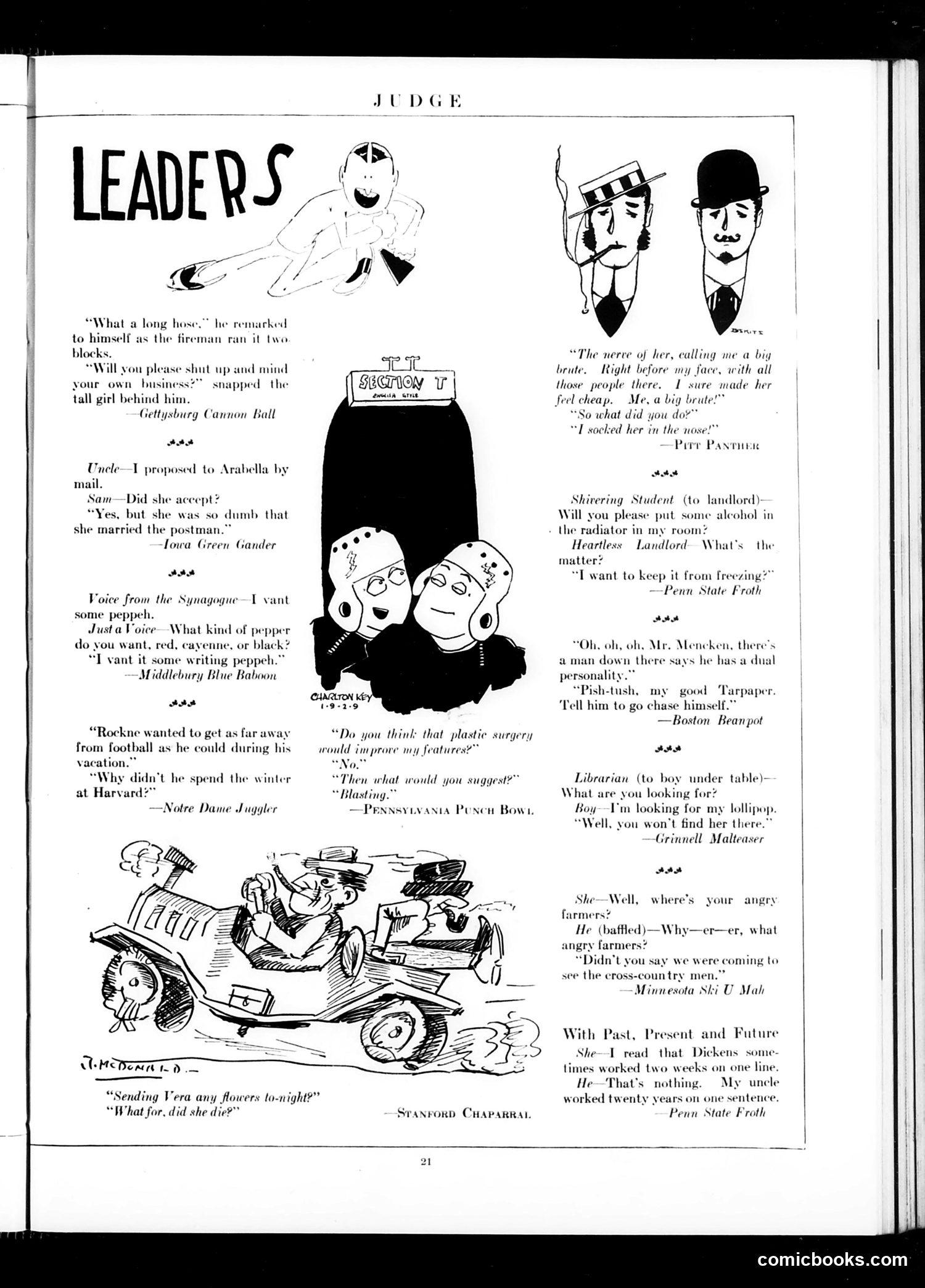
This page collects brief humorous anecdotes and jokes from college humor magazines (Notre Dame Juggler, Penn State Froth, etc.), typical of Judge's "Leaders" section. The humor relies on now-dated references and stereotypes: a Jewish dialect joke about "writing pepper"; a jab at Notre Dame football coach Rockne; a quip about H.L. Mencken (a famous cultural critic); and various domestic/romantic scenarios. The cartoons illustrate these jokes visually—most notably the middle illustration showing two women in 1920s-30s style, captioned about "plastic surgery" and "blasting" (suggesting violent facial reconstruction as a joke). The satire targets college life, gender relations (women portrayed as foolish), ethnic groups, and contemporary figures. The content reflects period attitudes that would be considered offensive today. The page demonstrates how Judge mixed collegiate humor, caricature, and social commentary for educated, primarily male readers.
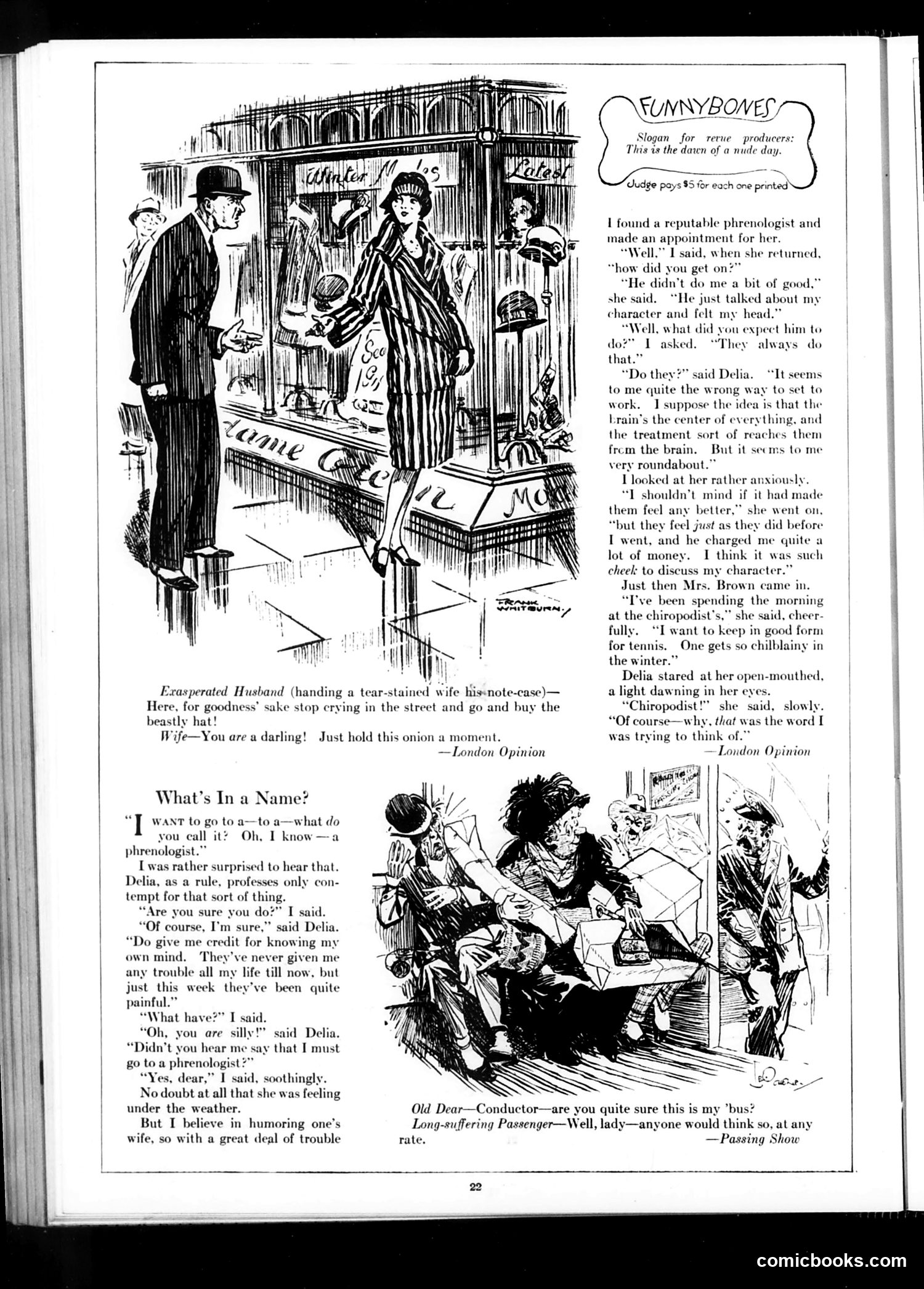
This Judge magazine page contains three separate humor pieces: **Top cartoon:** A husband gives his wife money for a hat while she holds an onion to cry with—the joke being she's faking tears to manipulate him into buying her something. **"What's In a Name?"** (main story): A wife tells her husband she wants to visit a "phrenologist" (a pseudoscientist who read character from skull bumps). She actually meant "chiropodist" (a foot doctor), confusing the terms because her feet hurt. The satire mocks both phrenology as a fraudulent practice and the wife's pretense of knowing what she's talking about while admitting ignorance. **Bottom cartoon:** An elderly woman questions a bus conductor about whether this is her bus; a frustrated passenger sarcastically agrees, implying the woman has been causing trouble and delay. The page satirizes popular pseudosciences (phrenology), marital manipulation, and social annoyances of the era. All three pieces use everyday domestic or public situations for humor.
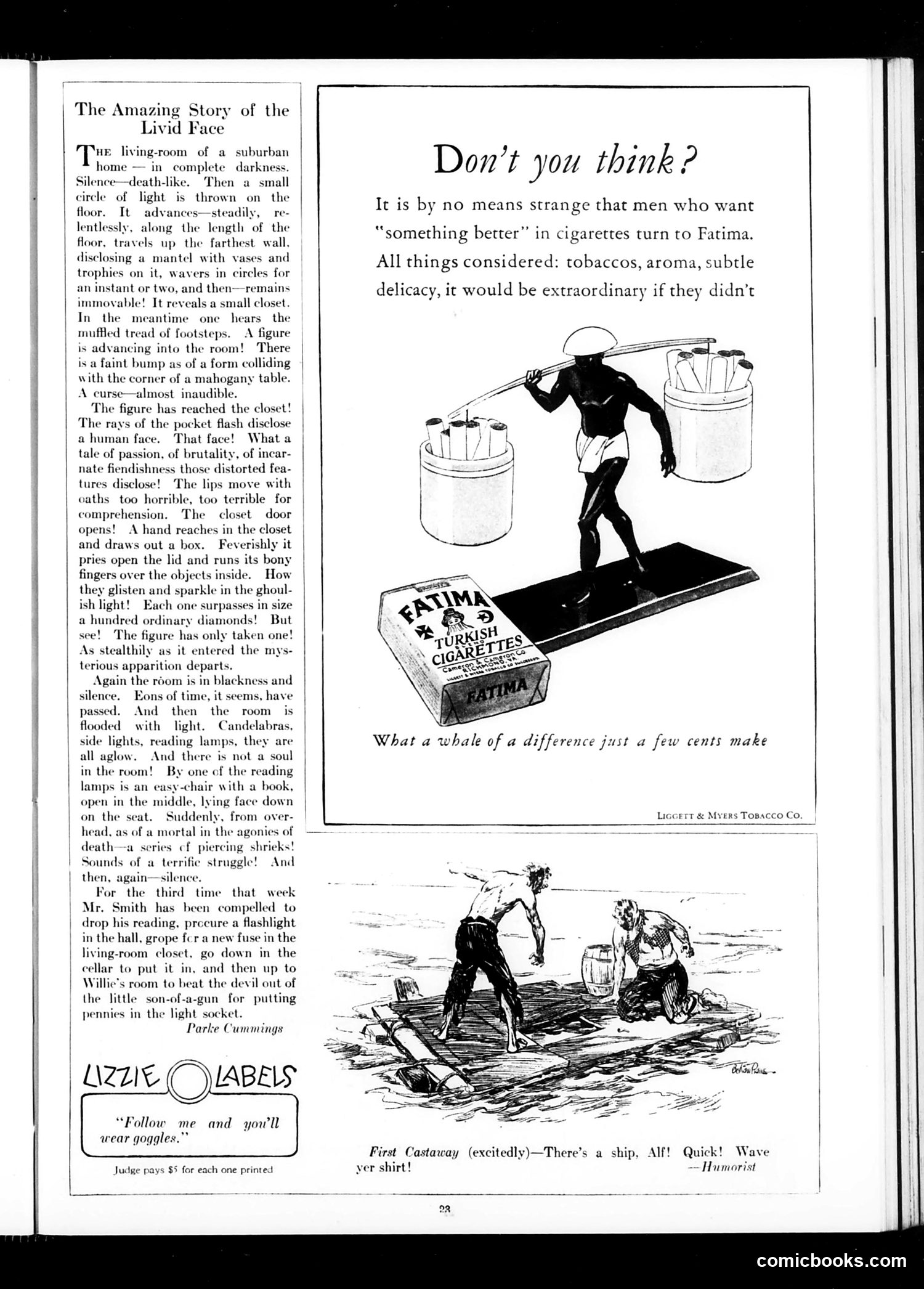
This page contains **two separate pieces of satirical content**: ## "The Amazing Story of the Livid Face" A humorous short story by Parke Cummings describing a suburban father's repeated nighttime panic. He discovers an intruder ransacking his closet—only to learn it's his young son repeatedly putting pennies in the light socket to knock out the fuses. The "livid face" refers to the father's enraged expression. The satire mocks domestic life and parental frustration with mischievous children. ## Fatima Cigarette Advertisement The facing advertisement uses rhetorical appeals ("Don't you think?") to market Fatima brand cigarettes, claiming their superior quality justifies their cost. This was standard early 20th-century tobacco advertising. ## "First Castaway" Cartoon A brief joke about shipwrecked sailors spotting rescue, with one character excitedly telling his companion to wave their shirt—the humor likely playing on desperation or miscommunication. The page reflects Judge magazine's mix of humor writing, advertising, and single-panel gags typical of the era.
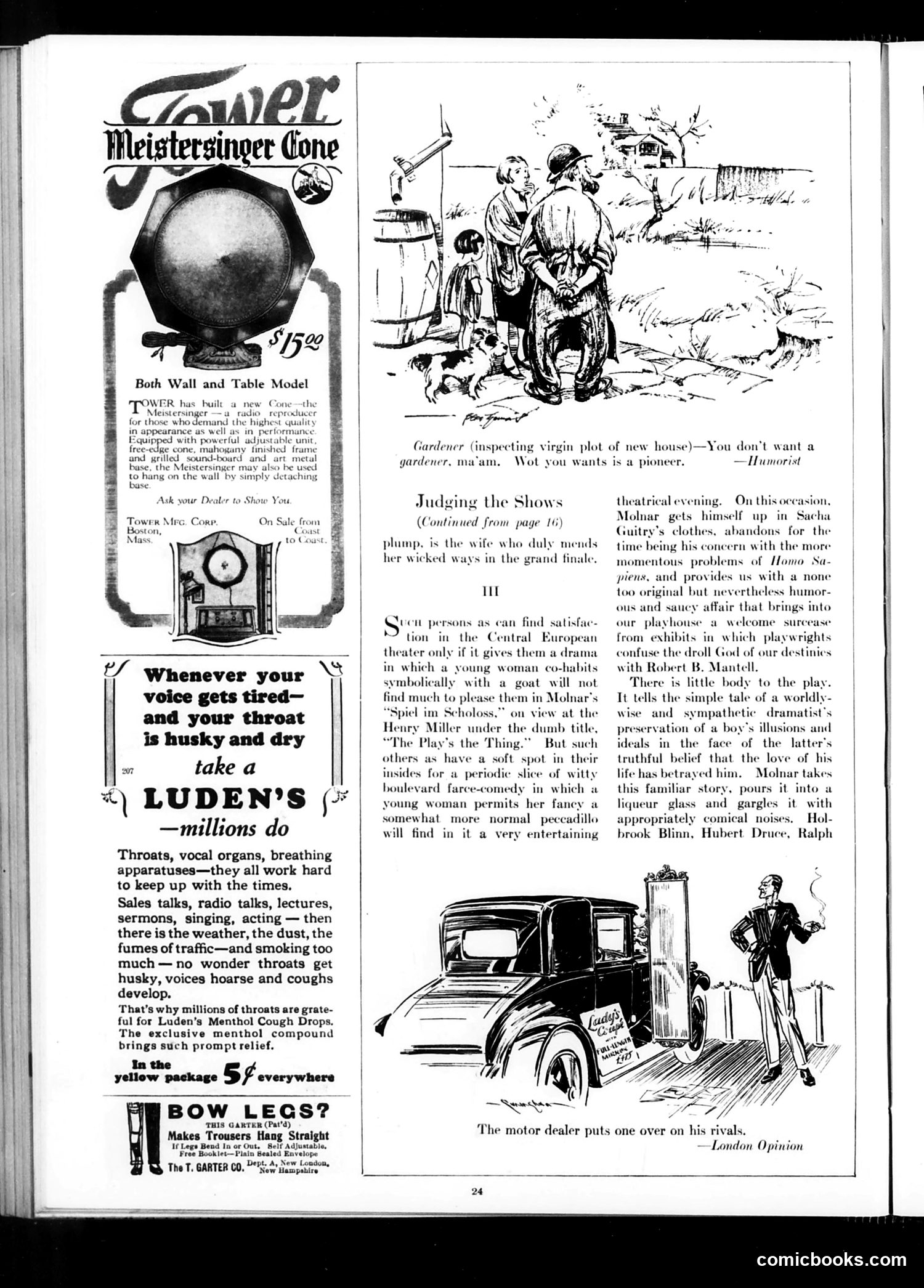
This page contains primarily **advertisements** and a brief theater review, with two small cartoons. The main cartoon at top shows a **gardener and homeowner**: the gardener dismisses the woman's concerns about needing an experienced gardener, saying she needs a "pioneer" instead—satirizing the pretentiousness of new homeowners who overestimate what's needed. Below is a **motor dealer cartoon**: a salesman stands beside a car with "Lady" written on it, apparently having outsold a rival by appealing to female customers—a joke about gender-targeted marketing in the auto industry. The **theater review** discusses Molnár's play, praising its light boulevard comedy while mocking audiences who demand only high-minded drama (the goat reference mocks overly serious European theater). The advertisements include **Luden's cough drops** (targeting voice professionals stressed by modern urban life), a **Tower radio cone**, and a **bow-legs garter**—all common period products addressing everyday physical complaints.
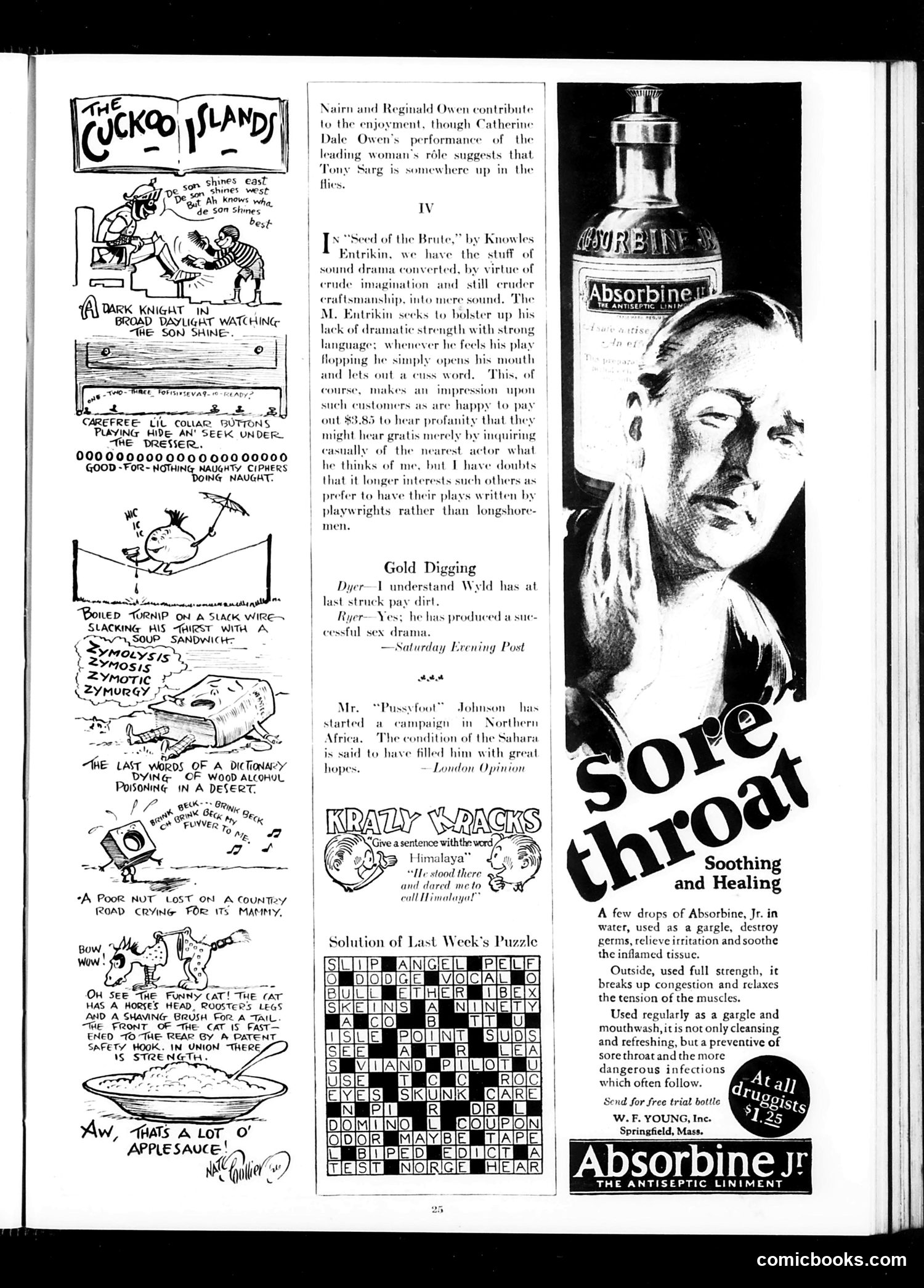
**Left side:** "The Cuckoo Islands" is a humor comic strip featuring absurdist gags—children playing, nonsense wordplay (zymosis, symbiosis), and visual puns. The jokes rely on innocent silliness and linguistic confusion rather than topical satire. One gag mocks a "poor nut" with a composite animal body held together by a "patent safety hook"—a visual metaphor about poorly constructed things or ideas. **Center:** Theater reviews critique contemporary plays. "Seed of the Brute" is criticized for relying on profanity rather than genuine dramatic skill; the reviewer dismisses both the playwright and actors. A brief note jokes about "Pussyfoot" Johnson (likely the temperance activist) starting a campaign in Northern Africa. **Right side:** Advertisement for Absorbine Jr., a medicinal liniment promoted for sore throats and infections—typical of period patent medicine advertising. The page reflects 1920s popular entertainment and consumer culture, mixing light humor with contemporary theatrical criticism.
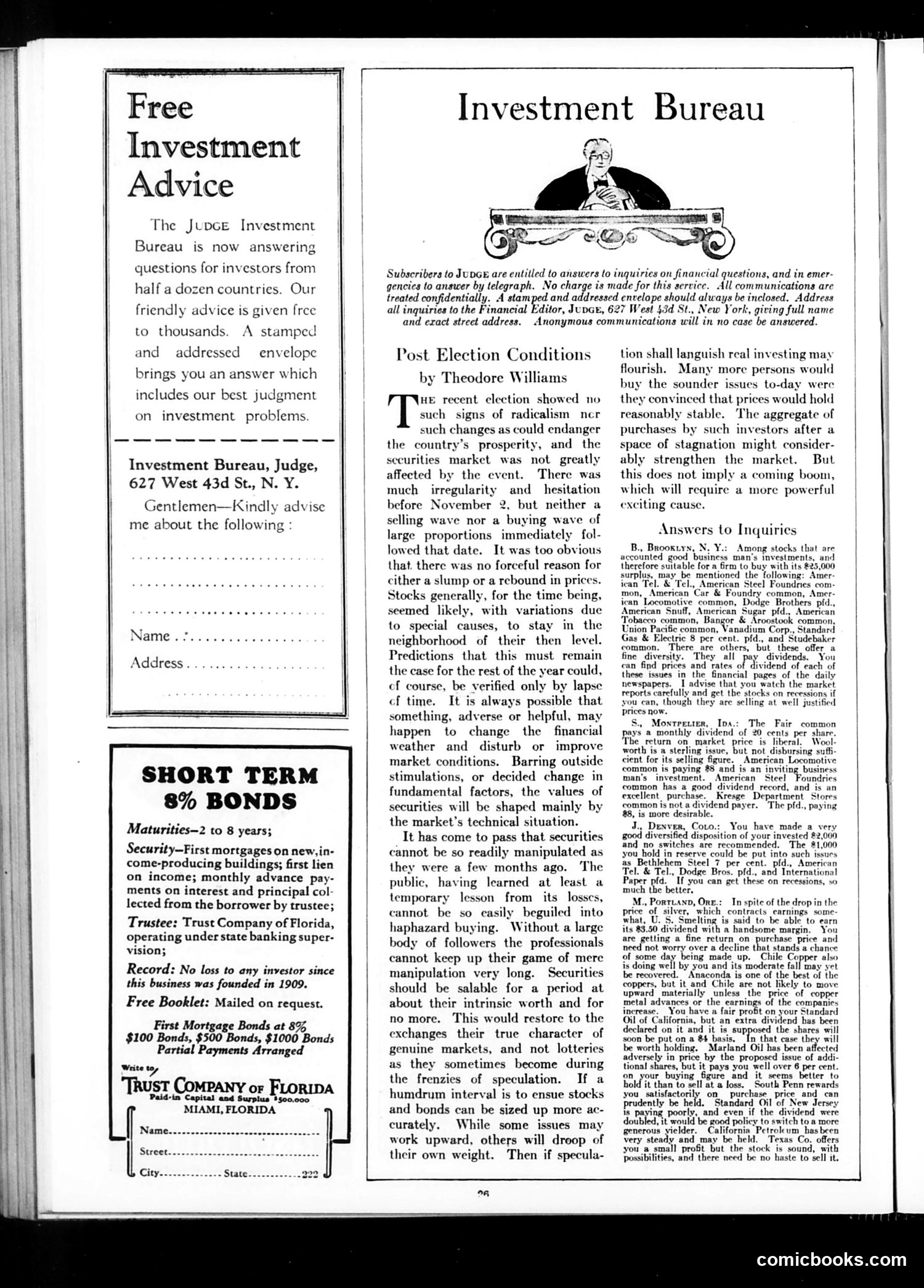
This page combines investment advice with financial commentary, not traditional political satire. The main article, "Post Election Conditions" by Theodore Williams, discusses market stability following a recent election (date unclear from visible text). Williams argues the election showed "no signs of radicalism" and the securities market wasn't greatly affected. He predicts stocks will remain relatively stable, noting that public investors have learned caution from recent losses, making it harder for market manipulators to artificially inflate prices through speculation. The surrounding advertisements—offering 8% bonds and free investment advice—reflect the magazine's commercial purpose. This appears to be a financial/business page rather than satirical political commentary. The "Judge Investment Bureau" itself is Judge magazine's legitimate advisory service, operating transparently with stamped envelopes and confidentiality policies.
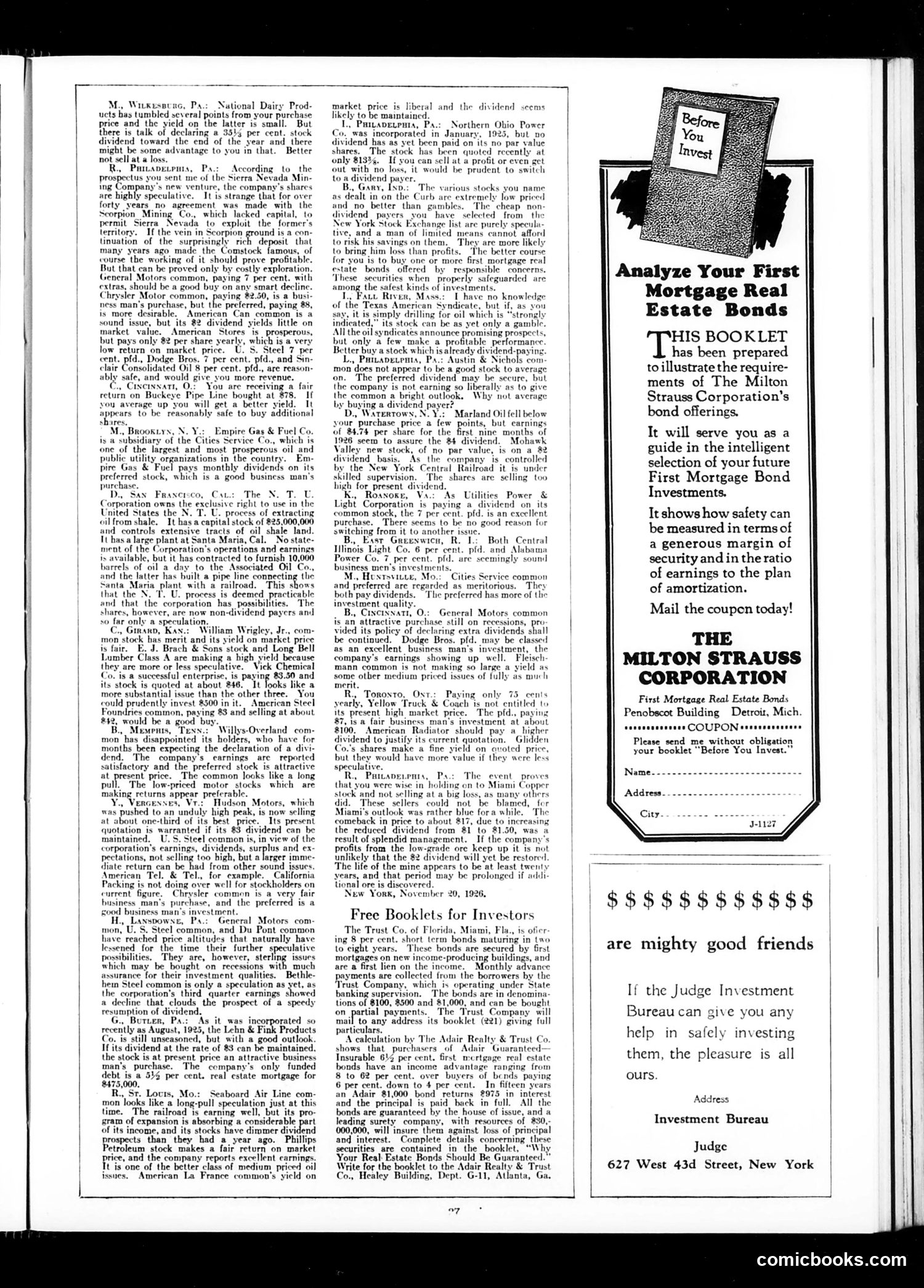
The content consists primarily of a financial advice column answering reader questions about stock investments (National Dairy Products, General Motors, U.S. Steel, etc.), typical of Judge magazine's business coverage during the 1920s economic boom. The only visual element appears to be a **Milton Strauss Corporation advertisement** for "First Mortgage Real Estate Bonds"—promoting a financial product with a coupon to mail in for more information. There is **no political cartoon or satirical content visible**. The page reflects the era's investment culture and optimism before the 1929 stock market crash. The date notation "J-11-27" suggests November 1927 publication.
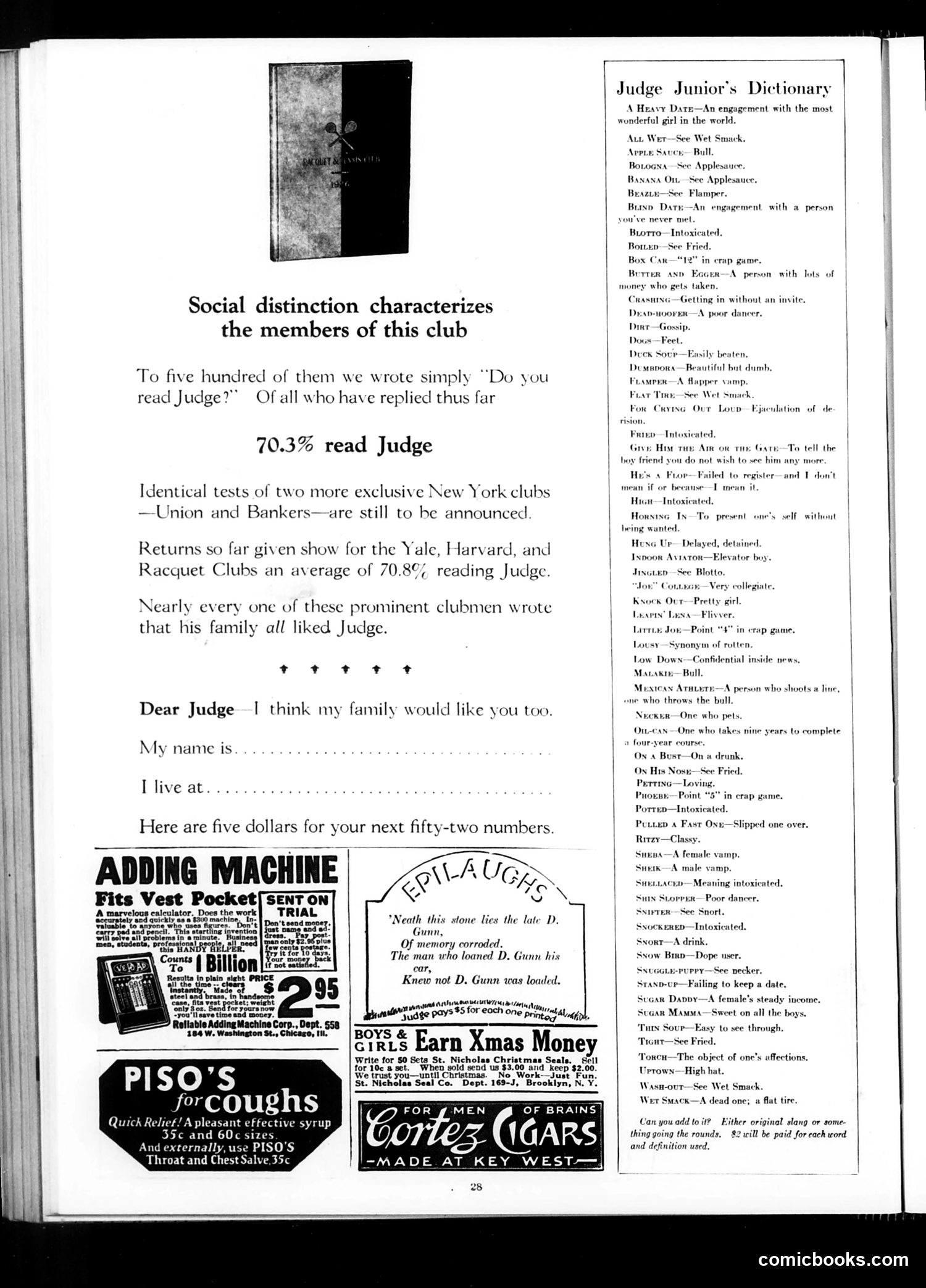
This page primarily promotes **Judge magazine itself** rather than containing political cartoons. The main content is a circulation-building campaign targeting exclusive New York clubs (Yale, Harvard, Racquet, Union, and Bankers clubs). **The satire:** Judge claims 70.3% of clubmen read the magazine, using this statistic to establish social prestige—the implication being that reading Judge marks one as part of an elite social circle. The "Dear Judge" section invites readers to subscribe, reinforcing the magazine's aspirational appeal to wealthy, clubbound men. **Judge Junior's Dictionary** on the right is slang terminology, mostly relating to drinking and flirtation ("wet smack," "blotto," "lit"), reflecting 1920s-era slang and Jazz Age culture. The remaining content is period advertisements (adding machines, Piso's cough syrup) and minor items. The "Epitaph" joke about D. Gunn being "loaded" (drunk) is the only cartoon humor visible, playing on the double meaning of the word.
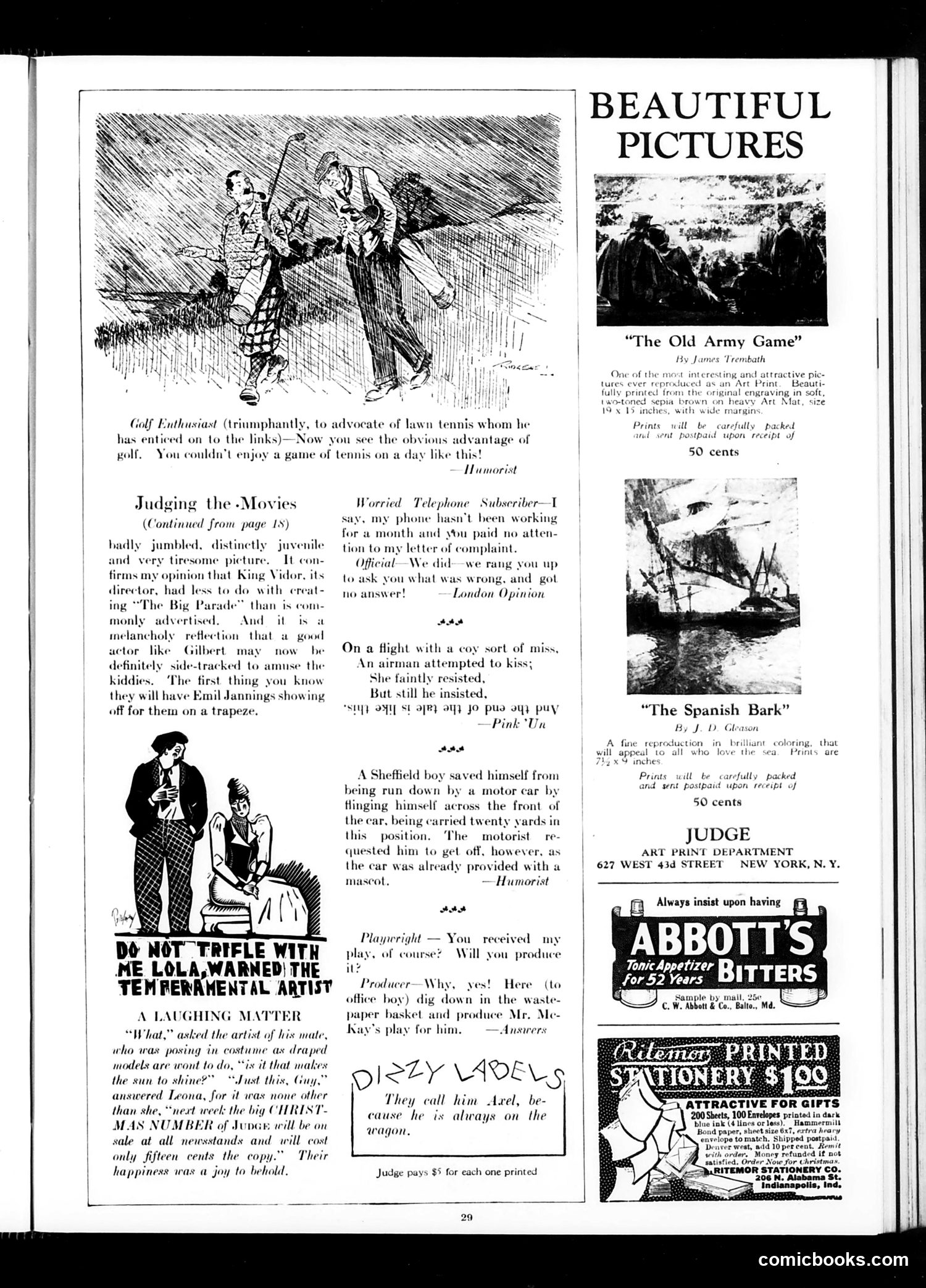
This page from *Judge* magazine contains several satirical humor pieces typical of early 20th-century American comedy: **"Golf Enthusiast"**: A golfer smugly demonstrates golf's superiority to tennis to a skeptical friend—the joke being the poor weather makes both sports equally miserable. **"Judging the Movies"**: Film criticism mocking silent cinema's juvenile appeal and wooden acting, suggesting even serious actors like Emil Jannings resort to vaudeville antics to entertain audiences. **"Do Not Trifle with Me, Lola"**: A sketch about a temperamental artist-model whose romantic complaint is deflated when she reveals she's just promoting *Judge*'s Christmas issue. **Other brief jokes**: Include complaints about telephone service, an airman's kissing attempt, a boy's narrow escape from a car, and a playwright's ruined manuscript. The page also advertises art prints and commercial products (Abbott's Bitters, stationery). The humor relies on everyday situations and social absurdities rather than specific political references.
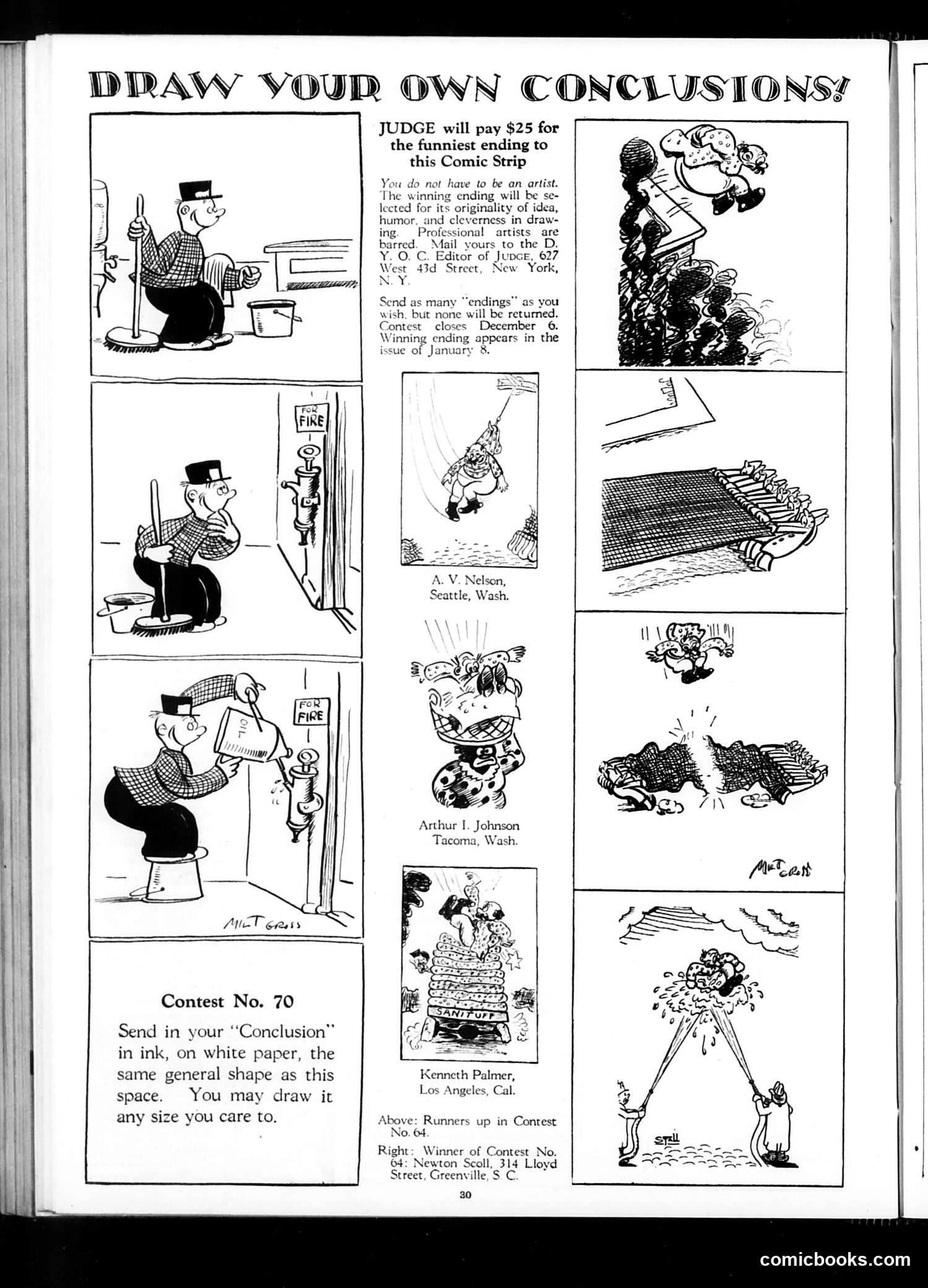
This page announces **Contest No. 70**, a reader-participation contest where Judge magazine invites amateur cartoonists to complete an unfinished comic strip. The setup shows a man with a plunger repeatedly trying to use a fire extinguisher—apparently confusing it with the plunger—creating an escalating comedic situation. Readers submit their own humorous "endings" to this sequence; Judge pays $25 for the funniest. The contest explicitly bars professional artists, making it accessible to ordinary readers. The page also displays runners-up and the winner from a previous contest (No. 64), showcasing various humorous cartoon conclusions. This was a common early-20th-century magazine feature—using reader submissions as cheap content while encouraging audience engagement and loyalty to the publication.
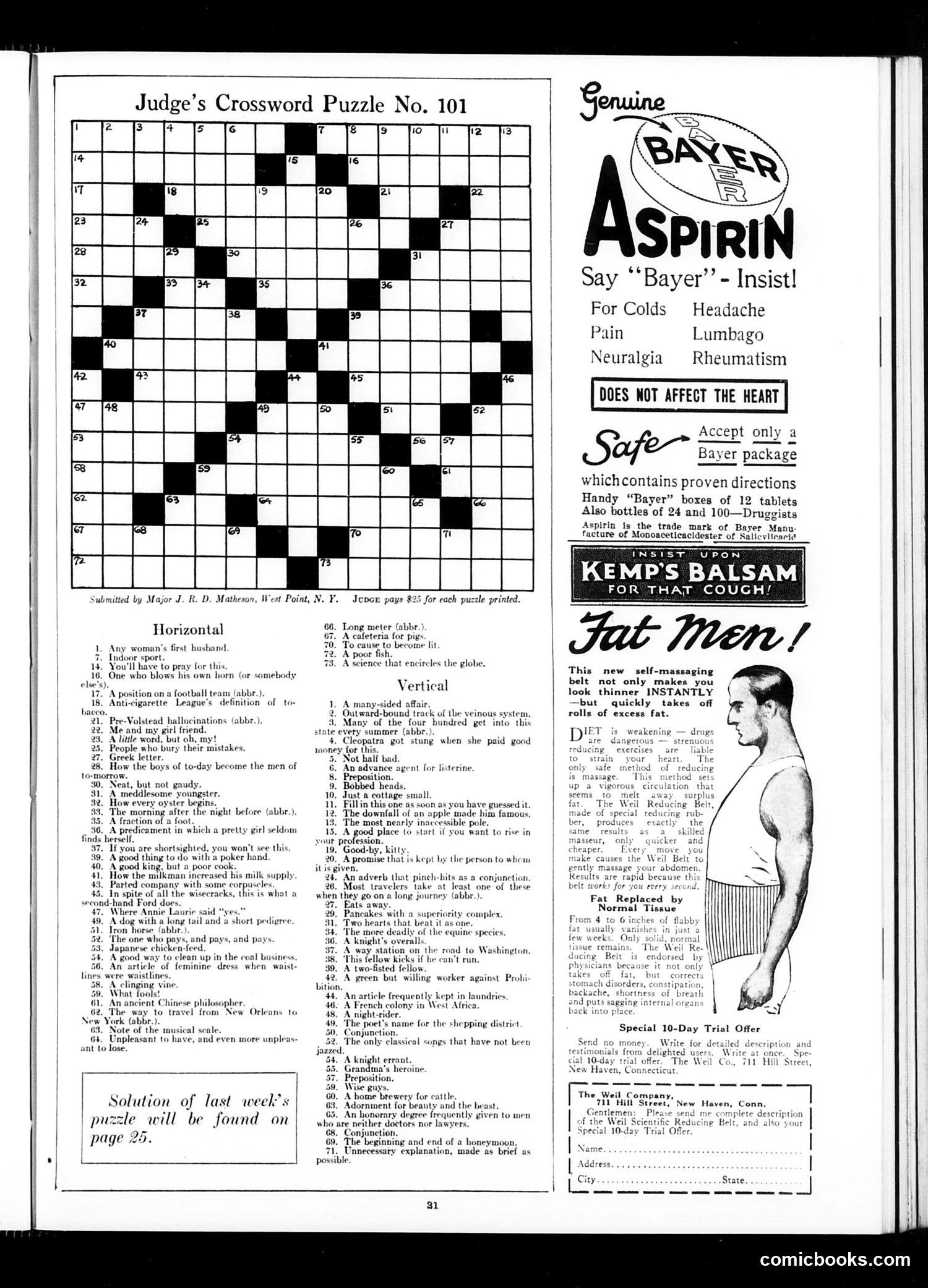
This page is primarily a crossword puzzle with advertisements rather than satirical cartoons. The puzzle itself contains wordplay typical of 1920s-era humor—clues reference contemporary social issues like Prohibition ("Pre-Volstead hallucination"), changing gender roles ("Bobbed heads"), and modern conveniences ("second-hand Ford"). The advertisements reveal period concerns: Bayer Aspirin emphasizes it "does not affect the heart" (addressing safety anxieties about new drugs), and a "Fat Men!" weight-loss product called the "Weil Reducing Belt" promises rapid fat reduction. These ads reflect 1920s consumer culture and body-image preoccupations. The crossword clues occasionally contain mild social commentary—references to "the boys of to-day become the men of to-morrow" and poker games suggest generational and leisure-time themes relevant to post-WWI American society. This is primarily content filler rather than Judge's signature satirical artwork.
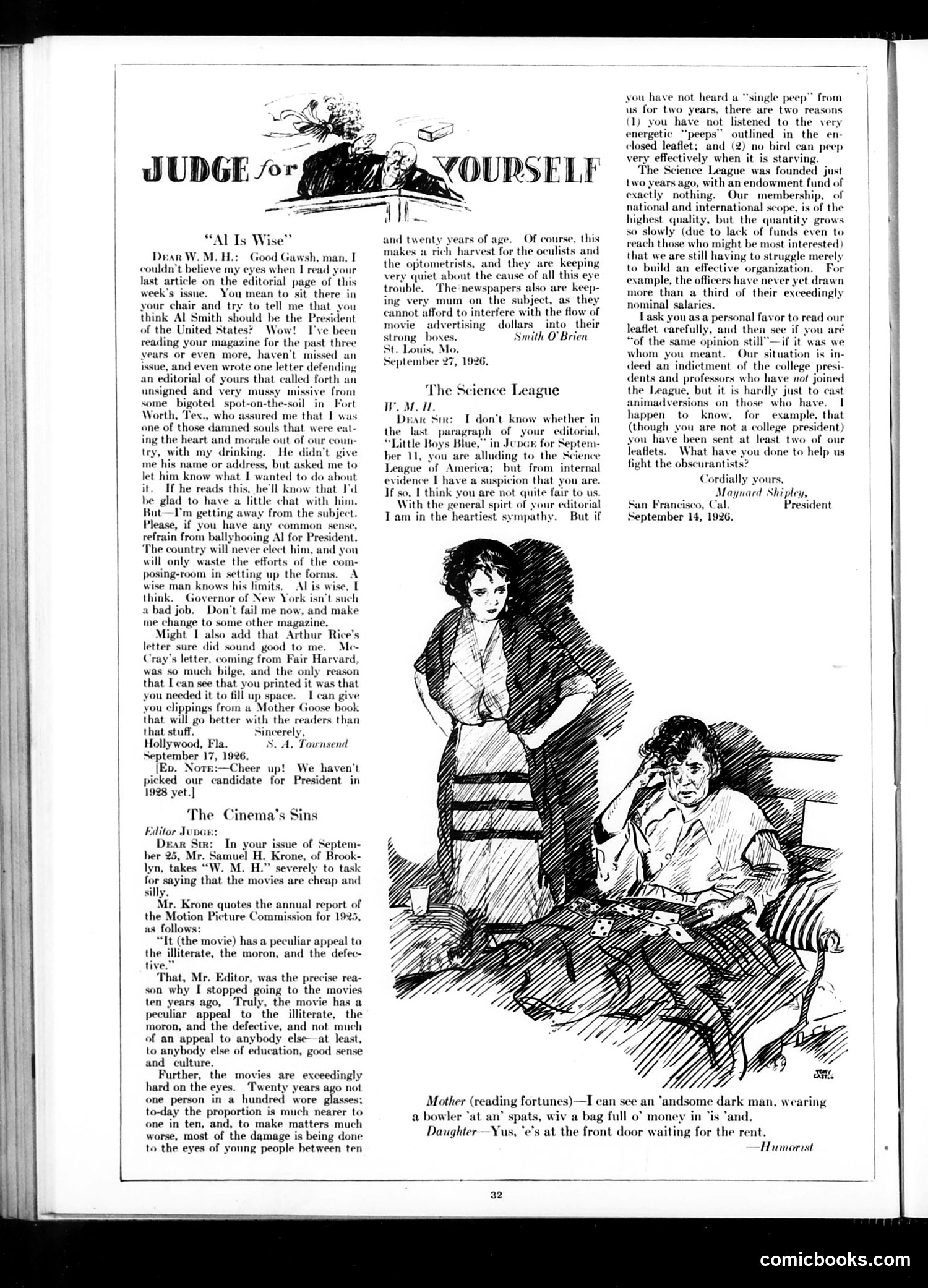
This page contains three reader letters to the editor addressing political and social issues: **"Al Is Wise"** critiques Judge's editorial supporting Al Smith for President in 1928. The writer opposes Smith's candidacy, arguing the country won't elect him and urging the magazine to stop advocating for him. (Al Smith was a prominent Democratic politician and four-time New York Governor.) **"The Cinema's Sins"** attacks movies as intellectually degrading and harmful to eyesight. The writer quotes a Motion Picture Commission report stating films appeal to "the illiterate, the moron, and the defective," and blames the industry and newspapers for suppressing discussion of vision damage among young people. **"The Science League"** (partially visible) appears to respond to criticism of the organization. The illustration shows a fortune teller reading palms—likely commenting on the unpredictability of elections or fate. These letters reflect 1920s anxieties about mass media, immigration politics (Smith was Catholic), and modernization.
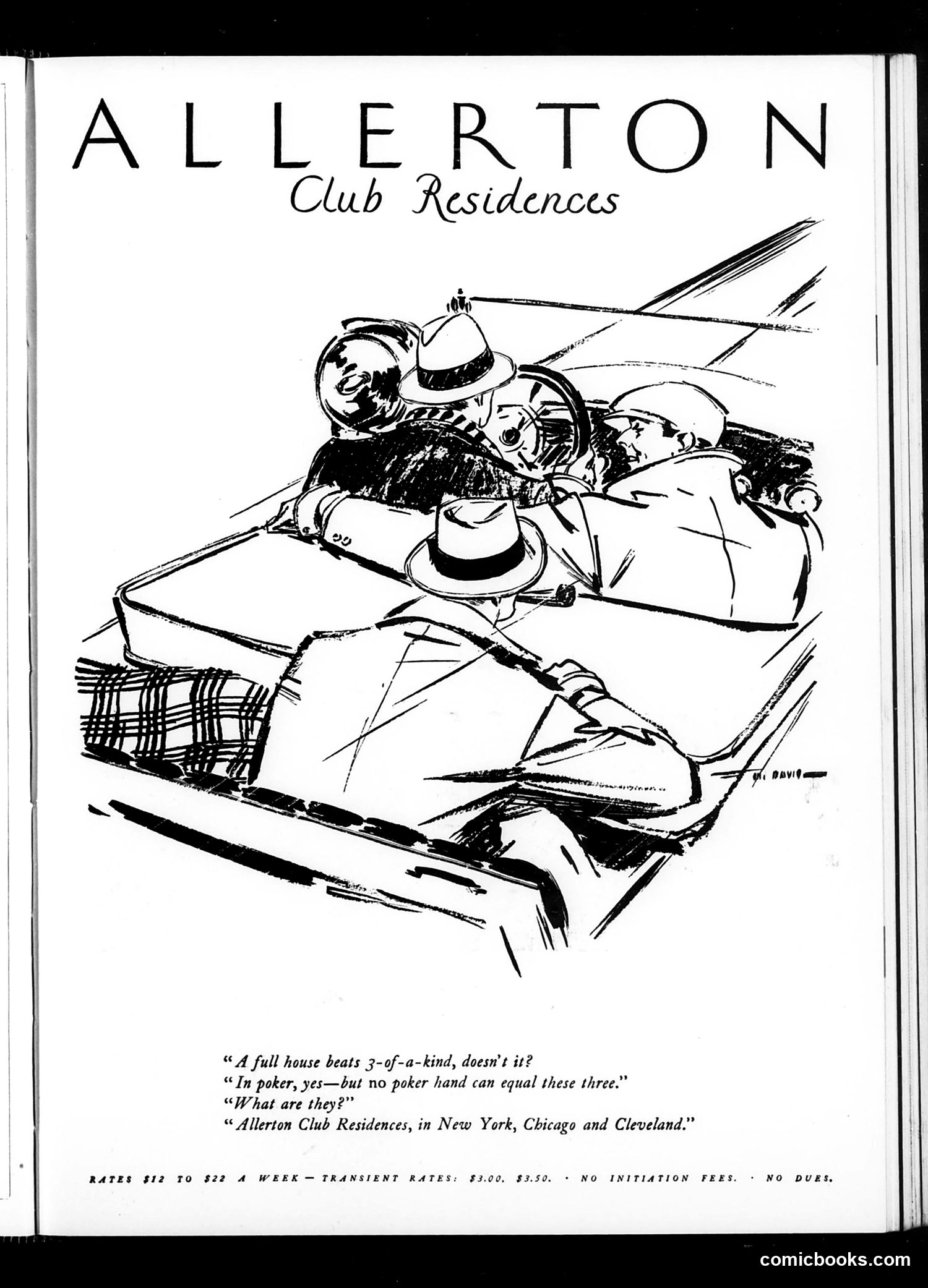
This is primarily a **hotel/residential advertisement** rather than political satire. The illustration shows three men in casual attire (hats, coats) lounging with luggage, depicted as desirable "catches." The ad uses a **poker metaphor**: a "full house" (the best poker hand) supposedly cannot beat "these three"—referring to Allerton Club locations in New York, Chicago, and Cleveland. The joke positions these residences as the ultimate prize or most valuable option. The appeal targets traveling businessmen or transient visitors seeking affordable lodging ($12-$22 weekly; $3-$3.50 nightly). The emphasis on "NO INITIATION FEES" and "NO DUES" suggests these were competitor advantages—other clubs apparently charged membership costs that Allerton avoided. This reflects early-20th-century urban culture where men's clubs and residential hotels served as bachelor accommodations and social spaces.
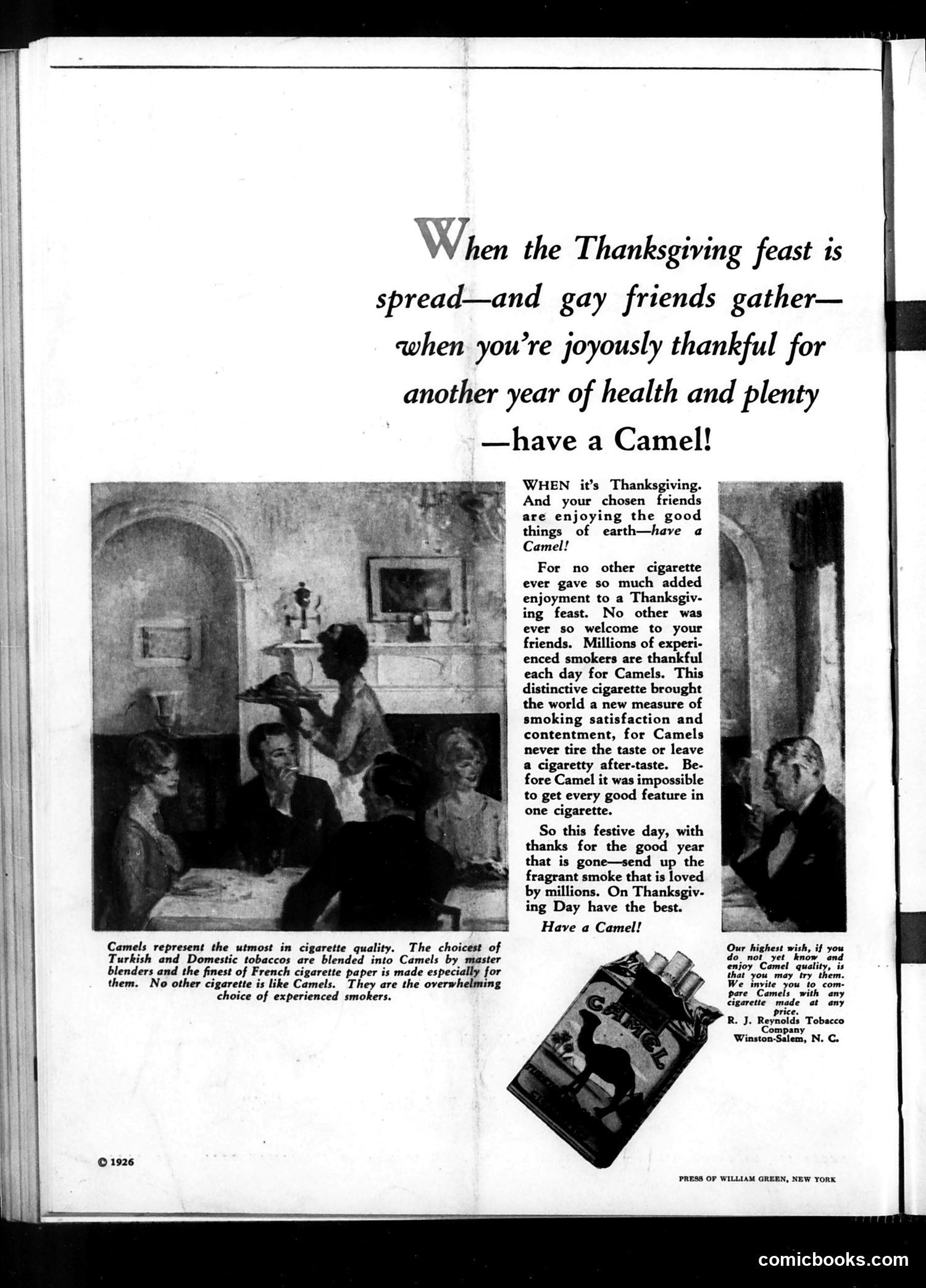
This is a **Camel cigarette advertisement**, not satire or political commentary. Published in 1926 by R.J. Reynolds Tobacco Company, it uses Thanksgiving as a lifestyle hook to market cigarettes. The page shows a domestic scene of well-dressed people gathered for the holiday feast, with the central message that smoking Camels enhances the festive experience. The ad emphasizes quality ("choicest of Turkish and Domestic tobaccos") and claims Camels are "the overwhelming choice of experienced smokers." This reflects pre-regulation advertising practices when cigarette promotion faced no restrictions and could freely associate smoking with health, social status, and family celebration. Modern readers would likely find it jarring that cigarettes were marketed as a wholesome Thanksgiving activity. The "*Judge*" magazine context—as a satirical publication—is coincidental; this particular page is straightforward advertising, not editorial commentary mocking the product or smoking culture.