
Judge, 1926-11-27 · page 18 of 36
Judge — November 27, 1926 — page 18: what you’re looking at
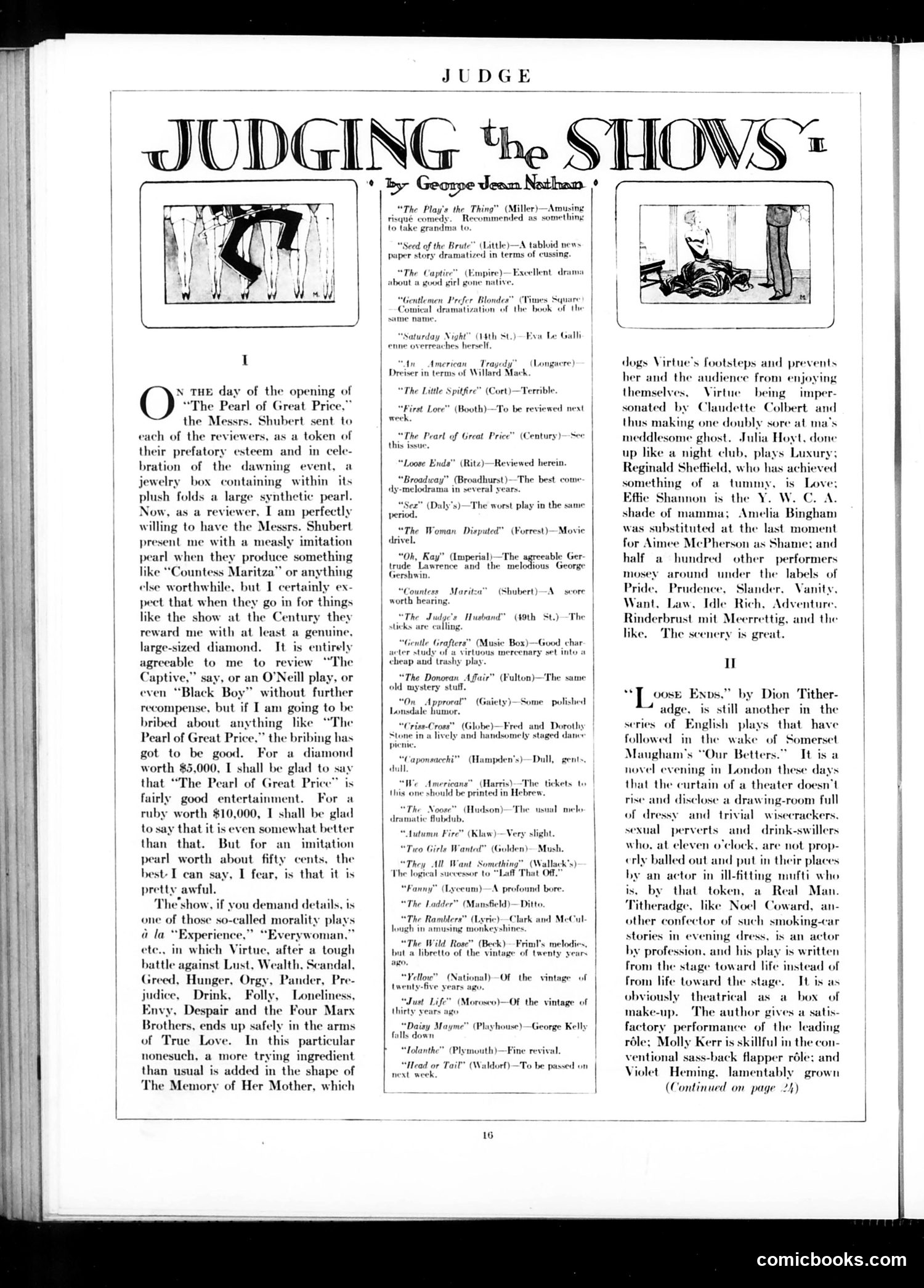
What you’re looking at
This page contains theater reviews by George Jean Nathan, a prominent drama critic of the 1920s. The key satire appears in the opening section: Nathan mocks the Shubert brothers (major theatrical producers) for sending reviewers imitation pearl jewelry as a bribe to praise their opening show, "The Pearl of Great Price." He sarcastically argues that if they're going to bribe critics, the gift should match the show's quality—a genuine diamond for good theater, a ruby for decent work, but only a worthless fake pearl for mediocre entertainment like this one, which he dismisses as "pretty awful." The show itself is a conventional morality play where Virtue triumphs over various vices (Lust, Hunger, Despair, etc.)—a tired theatrical formula even then. The satire targets both theatrical bribery practices and the cynicism of theater reviewing, while the rest of the page contains his capsule reviews of current Broadway productions.
📄 Transcribed text from this page (OCR, searchable)
Machine-transcribed from the original scan — historical spelling and the odd misread are preserved.
N THE day of the opening of O “The Pearl of Great Pric the Messrs. Shubert sent to each of the reviewers, as a token of their prefatory esteem and in cele- bration of the dawning event, a jewelry box containing within its plush folds a large synthetic pearl. Now, as a reviewer, I am perfectly willing to have the Messrs. Shubert present me with a measly imitation pearl when they produce something like “Countess Maritza” or anything else worthwhile, but 1 certainly ex- pect that when they go in for things like the show at the Century: they reward me with at least a genuine, large-sized diamond. It. is entirely agreeable to me to review “The Captive,” say, or an O'Neill play, or even “Black Boy” without further recompense, but if I am going to be bribed about anything like “The Pearl of Great Price.”’ the bribing has got to be good. For a diamond worth $5,000, I shall be glad to say that “The Pearl of Great Pric: fairly good entertainment. For a ruby worth $10,000, I shall be glad to say that it is even somewhat better than that. But for an imitation pearl worth about fifty cents, the best: T can say, I fear, is that it is pretty awful. The'show, if you demand details, is one of those so-called morality plays @ la “Experience,” “Everywoman,” ete., in which Virtue, after a tough battle against Lust, We: 5 ed, Hunger, Orgy, Pander, Pre- judice, Drink, Folly, Loneliness, Envy, Despair and the Four Marx Brothers, ends up safely in the arms of True Love. In this particular nonesuch, a more trying ingredient than usual is added in the shape of The Memory of Her Mother, which JUDGE JUDGING ‘be SHOWS by Geonpe Jeam Nathan 6 “The Play's the Thino” (M risqué comedy. Recomme grandma to. ler)—Amusing as something “Seed of the B paper story dramatized in terms of « “The Captive” (Empire) —Exeellent drama | about a good girl gone native, index” es Square af the book of th “Gentlemen Prefer C dramatizat sam me “Saturday Night” (4th St.) Eva Le Gall enne overreaches herself rican Trayedy’ sof Willard Mack Longacre) “The Little Spitfire” (Cort) —Terrible. “First Lore” (Be week. fo be reviewed next “The Peart of Great Price” (Century)—See this issue, “Loose Enda" (Ritz)—Reviewed herein, “Broadw (Broadhurst)—The best come: dy-melodrama in several years. “Sez” (Daly’s)—The worst play in the same period. “The Woman Disputed” (Forrest)—Movie drivel. “Oh, Kay” (Lmperial)—The agreeable Ger: trude Lawrence and the melodious Gr Gershwin, “Countess Maritza” (Shubert) —A score worth hearing. 's Husband” (49th St.) —The ng: | nile Grafters” (Music Box)—Good char study of a virtuous mercenary set into a | cheap and trashy: play. | “The Donovan Affair” (Fulton)—The same old mystery stuff. “On Approral* (Gaiety)—Some polished Lonsdale humor. and De ina lively and h ly staged Caponsacchi” (Hampden's)—Dull, gents dull tickets to “We Americans” (Harris)—Th this one should be printed in Hebrew. “The Noose” (Hudson)—The usual melo dra flubdub. “Autumn Fire Klaw)—Very slight. “Two Girls Wanted” (Golden) Mush, “They Al Want Something” The logical successor to “Laff T anny” (Lyceum) —A profound bore: “The Ladder” (Mansfi “The Ramble “The Wild Rose bat libretto of the vint Ditto. Clark and MeCul- of twenty ¥ “Yellow” (National) —Of the vintage of | twenty-fiv Re. “Just Life” (Moroseo)—OF the vintage of thirty years ago: {Daisy Mayme” (Playhouse) —George Kelly | falls down’ “Lolanthe” (Plymouth)—Fine revival. “Head or Tail” (Waldorf) —To be passed on next wee 16 dogs Virtue’s footsteps and prevents her and the audience from enjoying themselves. Virtue being imper- sonated by Claudette Colbert and thus making one doubly sore at ma’s meddlesome ghost. Julia Hoyt, done up like a night club, plays Luxury; Reginald Shettield, who has achieved something of a tummy, is Love; Effie Shannon is the Y. W. C. A. shade of mamma; Amelia Bingham was substituted at the last moment for Aimee McPherson as Shame; and half a hundred other performers mosey around under the labels of Pride, Prudence lander. Vanity, Want. Law, Idle Rich, Adventure. Rinderbrust mit Meerrettig, and the like. The scenery is great. II oosE Enps.” by Dion Tither- adge, is still another in the f English plays that have followed in the wake of Somerset Maugham’s “Our Betters.” It is a novel evening in London these days that the curtain of a theater doesn’t rise and disclose a drawing-room full 1 wisecrackers, sexual perverts and drink-swillers series of dressy and triv at eleven o'clock, are not prop- y balled out and put in their places hy an actor in ill-fitting mufti who is, by that token, a Real Man. Titheradge, like Noel Coward, ether ‘confector’of such smoking-car soties in evening’dress; $8 aii, actor by profession. and his play is written from the stage toward life instead of from life toward the stage. Tt is as obviously theatrical as a box of make-up. The author gives a satis- factory performance of the leading role; Molly Kerr is skillful in the con- ventional ack flapper réle; and Violet Heming, lamentably grown (Continued on page 24) ; | | | comicbooks.com