
A complete issue · 36 pages · 1926
Judge — October 16, 1926
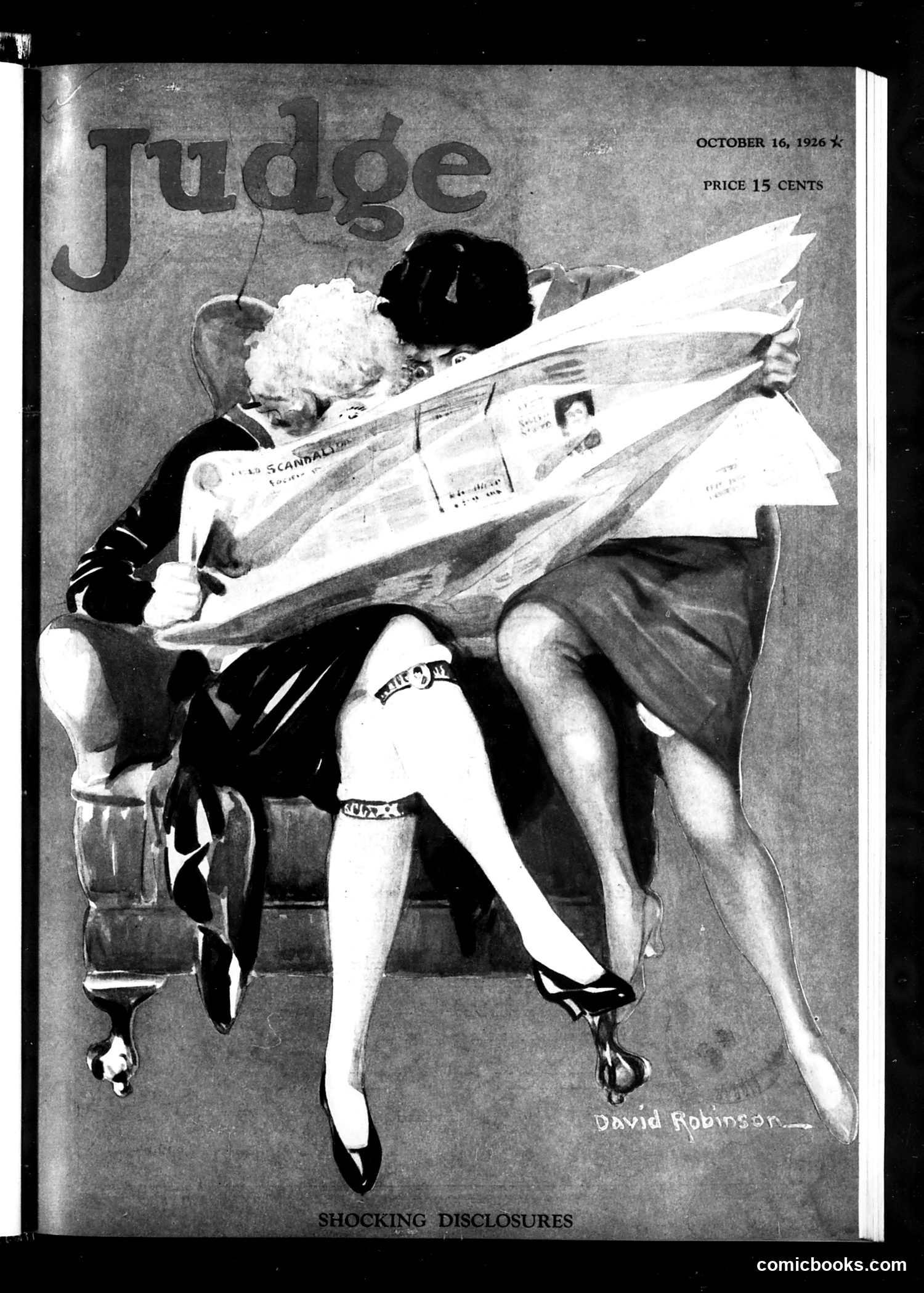
This cover illustration by David Robinson depicts two figures reading newspapers with the headline "SHOCKING DISCLOSURES" visible. The cartoon appears to be satirizing public scandal or gossip—a common Judge magazine theme. The stylized art deco figures and their expressions suggest they're reacting with exaggerated shock to sensational newspaper stories, likely mocking both the media's tendency toward sensationalism and the public's appetite for scandal. The 1920s context matters: this was the Jazz Age era of tabloid journalism, when papers competed aggressively with lurid headlines. The satire critiques either media irresponsibility, public credulity, or both. Without additional context identifying specific scandals referenced, the broader point appears to be commentary on how newspapers and readers consume and spread shocking revelations.
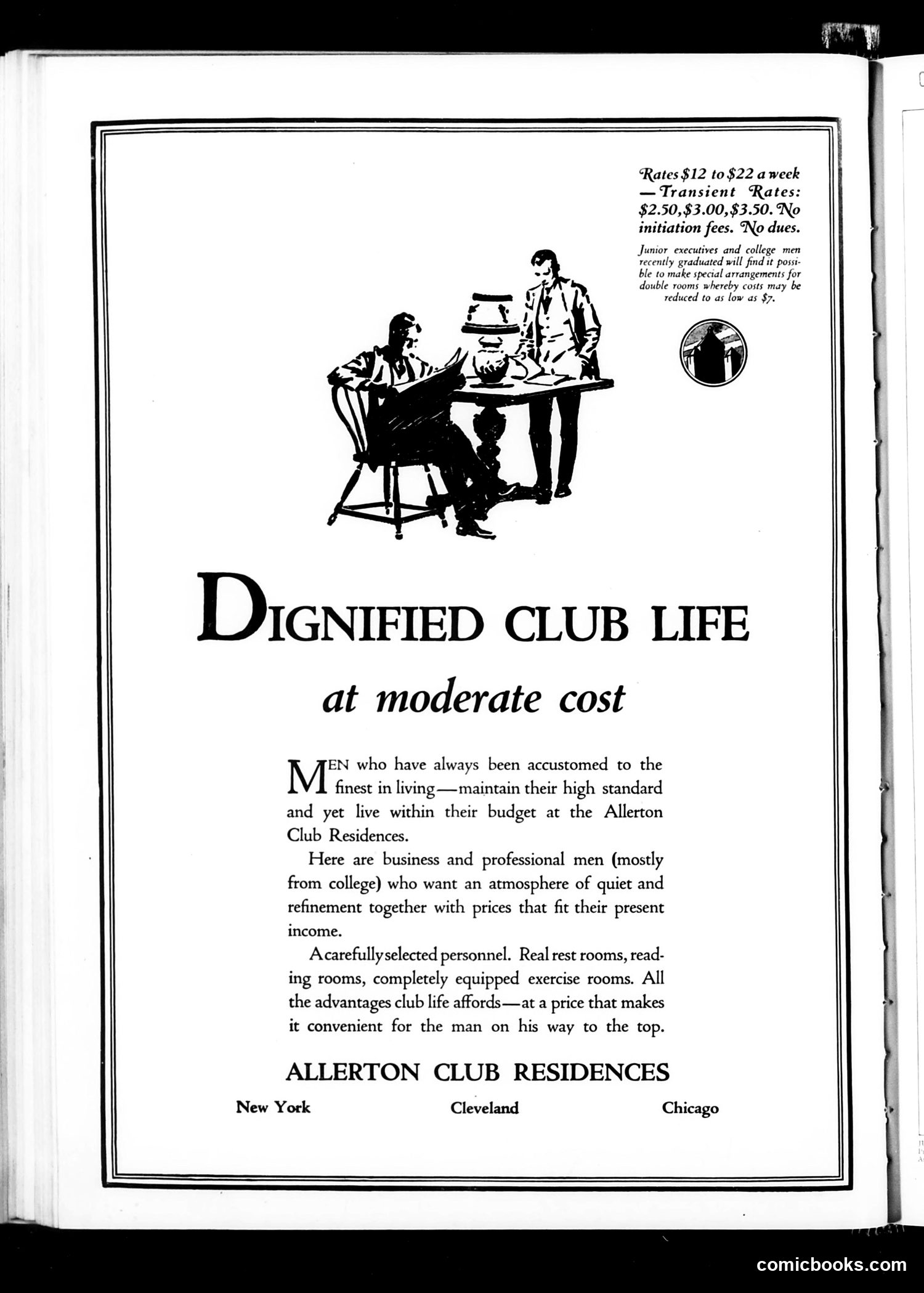
This page is primarily **advertising, not satire**. It promotes the Allerton Club Residences in New York, Cleveland, and Chicago as affordable luxury housing for professional men. The illustration depicts two businessmen—one seated reviewing documents, another standing—suggesting a respectable, productive atmosphere. The advertisement's pitch is straightforward: men of means seeking refinement on a budget could maintain their social status affordably here. Key selling points include "carefully selected personnel," rest rooms, reading rooms, and exercise facilities—marketed as enabling ambitious men's advancement ("on his way to the top"). At $12-22 weekly with modest transient rates ($2.50-$5), this represents early-20th-century urban residential club culture targeting upwardly-mobile professionals who wanted community and respectability without extravagant cost.
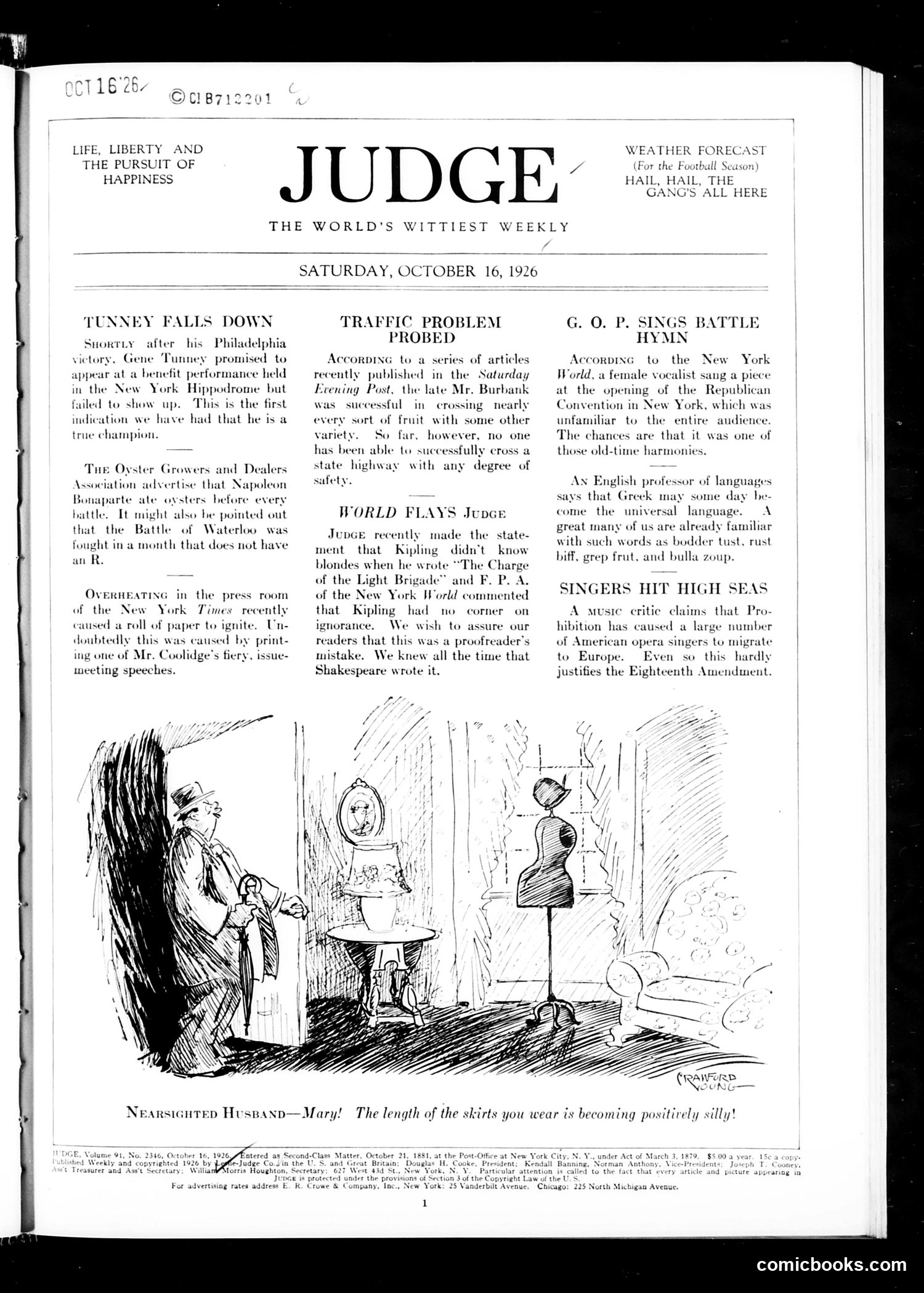
The main cartoon titled "Nearsighted Husband" depicts a domestic scene where a husband criticizes his wife's skirt length as "positively silly." The satire targets 1920s fashion debates: shorter skirts were a controversial symbol of modern women's liberation and changing social norms. The "nearsighted" husband literally cannot see properly, suggesting men opposing the fashion trend were similarly blind to women's evolving independence. The page's other sections mock contemporary issues: Gene Tunney's boxing victory, traffic safety concerns, a dispute over who wrote Shakespeare, and American opera singers emigrating to Europe. These represent typical 1926 headlines and cultural anxieties about modernity, sports, and American cultural status abroad.
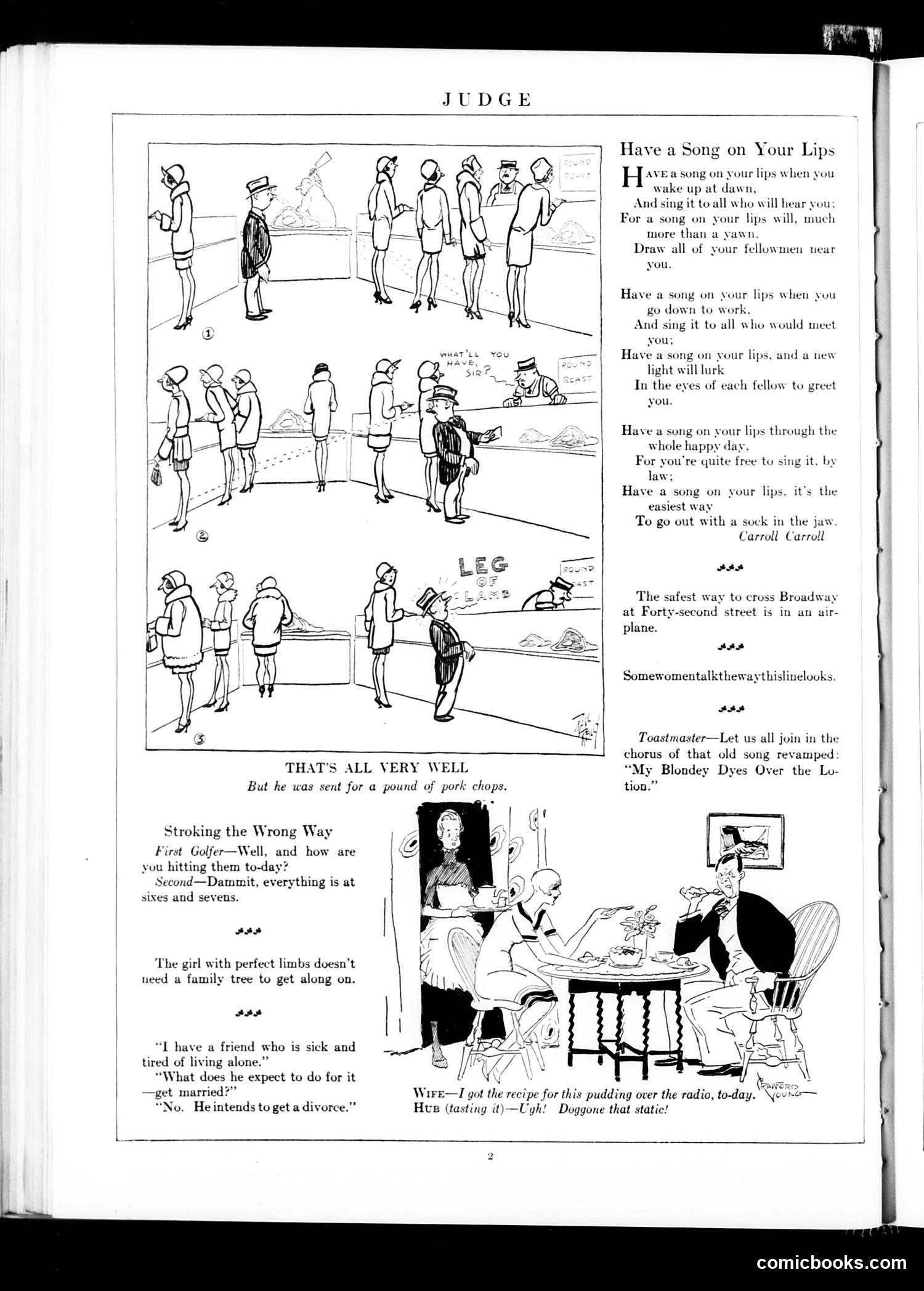
This page contains several humor pieces typical of early 20th-century satirical magazines: **"That's All Very Well"** - A three-panel comic showing someone being sent for pork chops, likely satirizing miscommunication or domestic absurdity. **"Have a Song on Your Lips"** - Inspirational verse (attributed to Carroll Carroll) encouraging cheerfulness as a life philosophy, reflecting period self-help sentiment. **"Stroking the Wrong Way"** - Golf humor between two players, with the second golfer hitting poorly. Includes unrelated quips about perfect women and marriage expectations. **"Wife—I got the recipe..."** - A domestic scene where a wife interrupts her husband's radio listening to complain about a pudding recipe broadcast, satirizing early radio culture and marital dynamics. The page reflects preoccupations with golf, marriage, and emerging mass media.
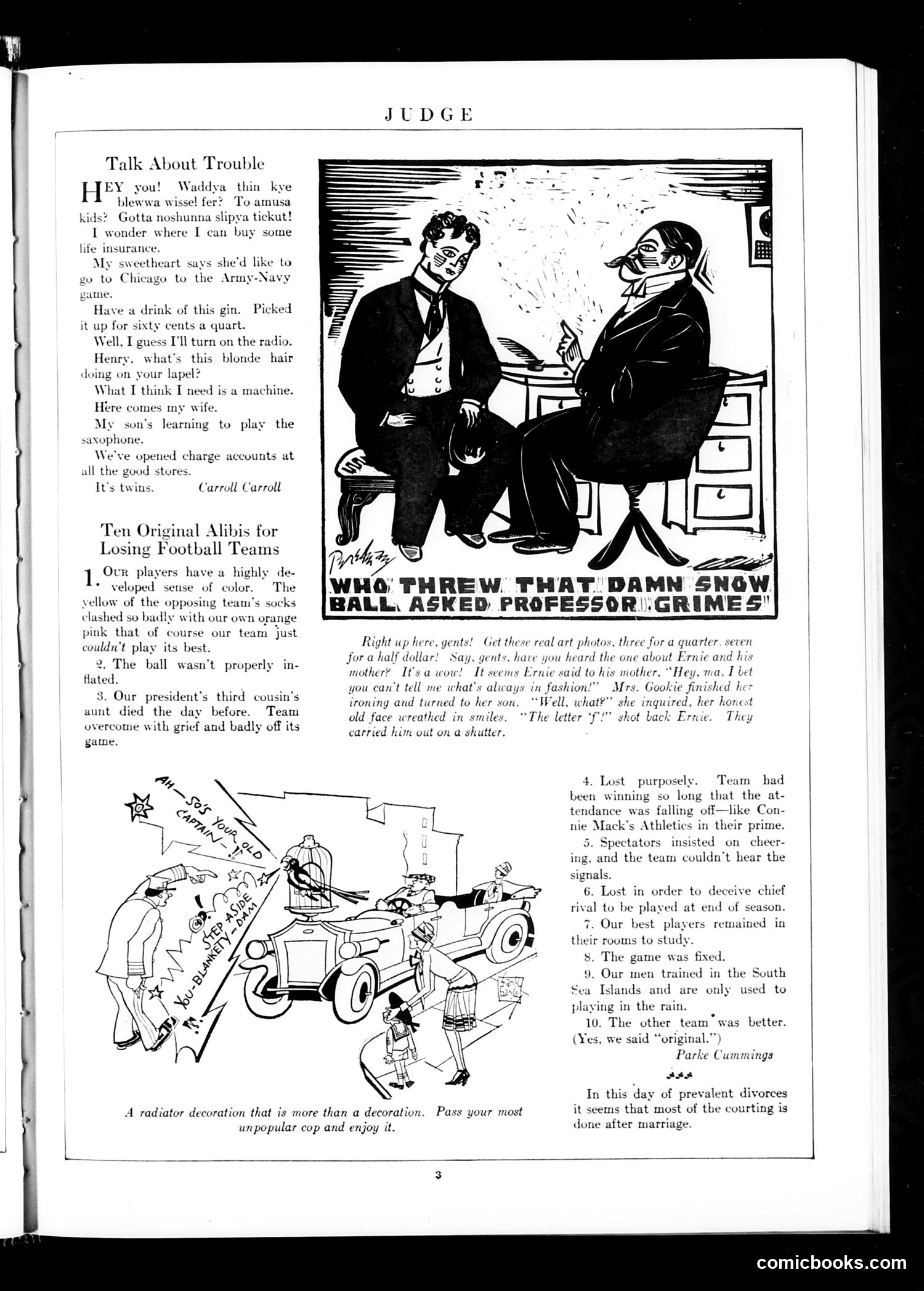
This page from *Judge* magazine contains two distinct sections: **"Talk About Trouble" (top):** A humorous monologue by Carroll Carroll about everyday domestic complaints—a wife wanting to see the Army-Navy game, gin prices, a blonde woman on his lapel, his son learning saxophone, and charge accounts at stores. It's gentle domestic satire about consumer frustrations and middle-class life. **"Ten Original Alibis for Losing Football Teams" (bottom):** A numbered list of absurd excuses for football team failures, from color blindness to game-fixing. The accompanying cartoon shows a radiator being "decorated" as a humorous visual pun about team performance explanations. The page is primarily humor and satire about everyday American life rather than political commentary. The cartoons and text mock ordinary middle-class concerns and sports culture.
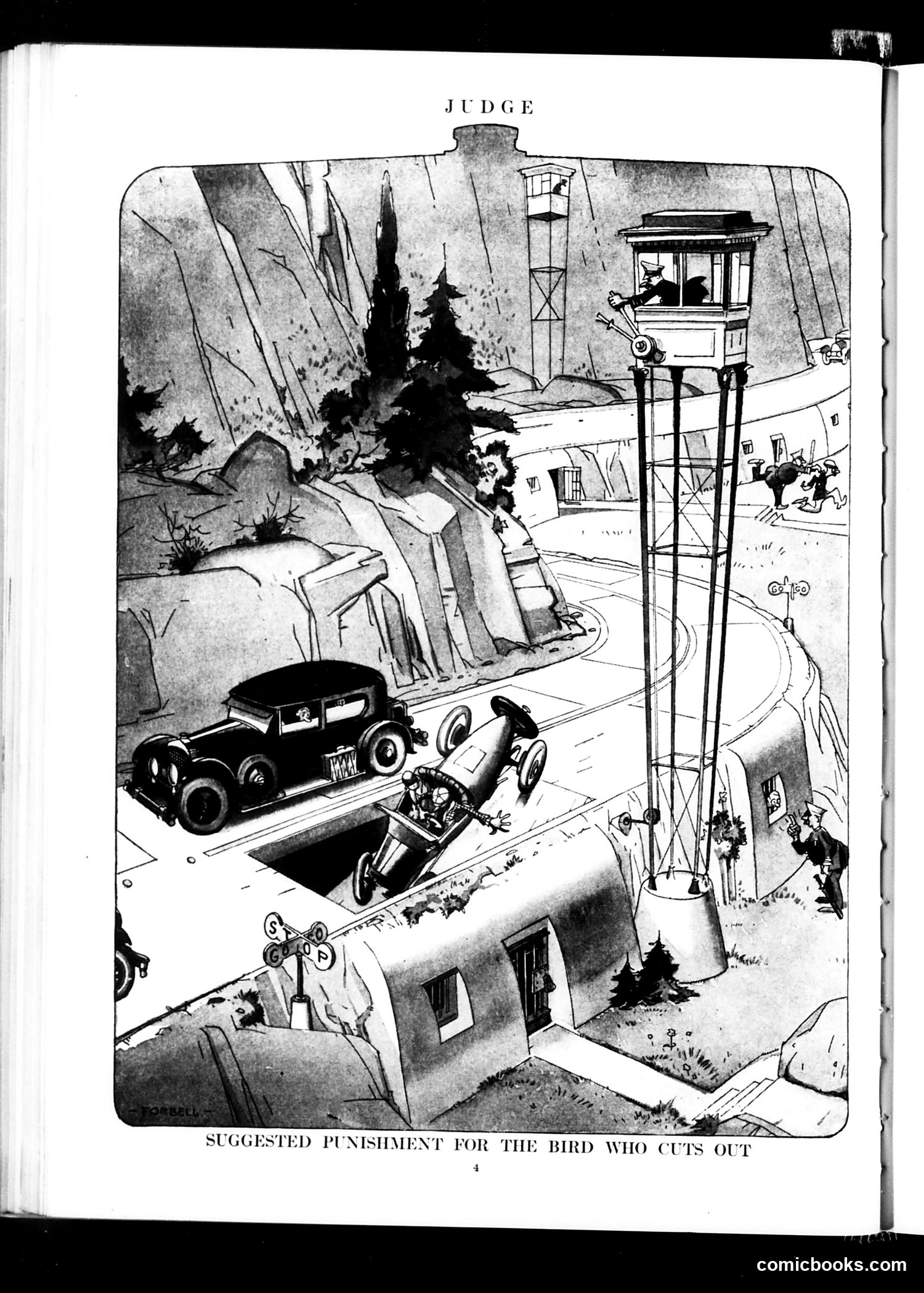
This cartoon satirizes reckless driving, titled "Suggested Punishment for the Bird Who Cuts Out." The humor plays on the era's slang term "bird" (a foolish person) combined with "cuts out" (drives recklessly or dangerously). The illustration shows an underground traffic court presided over by a judge in an elevated booth, where a speeding motorcyclist is being tried. A conventional automobile sits parked above, appearing to be the "good driver." The suggestion is absurdly literal: punish the reckless driver by placing them in a deep pit or underground chamber—removing them from regular traffic. This reflects early 20th-century concerns about automobile safety and dangerous driving habits, using exaggerated visual comedy to critique traffic violators.
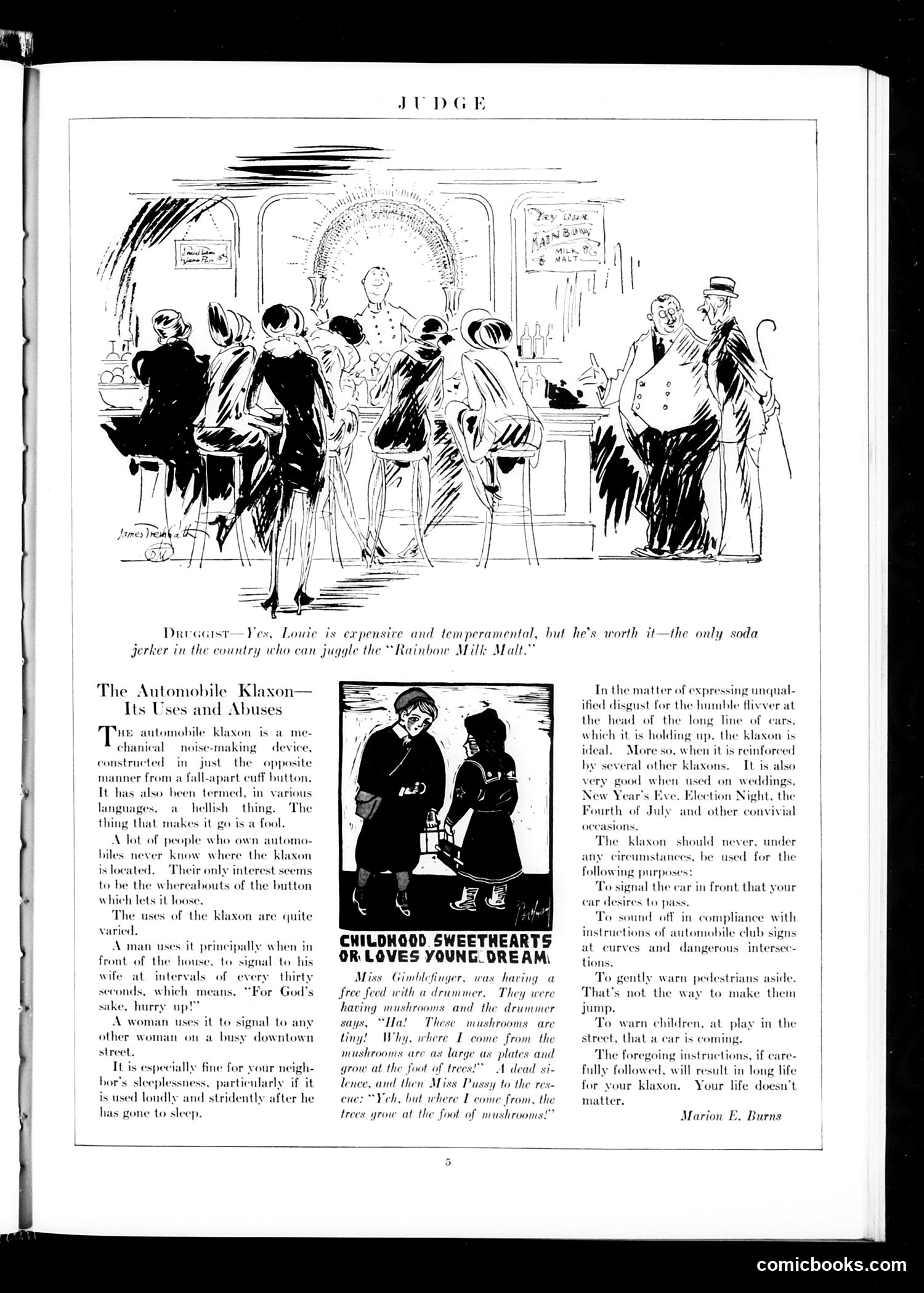
**Top Cartoon - "Judge":** This cartoon depicts a soda fountain scene where a druggist compliments an expensive, temperamental soda jerker named Louis, calling him "the only soda jerker in the country who can juggle the 'Rainbow Milk Malt.'" The satire mocks the era's tendency to treat skilled service workers as celebrities worthy of praise for specialized tricks. **Main Article - "The Automobile Klaxon: Its Uses and Abuses":** This piece satirizes the automobile horn's misuse by drivers, particularly women using it to signal neighbors during social visits or to warn pedestrians. The accompanying illustration shows a couple demonstrating this behavior. The article provides humorous "proper" uses for car horns while criticizing improper deployment in residential areas—reflecting early 20th-century conflicts between new automobile technology and established social norms.
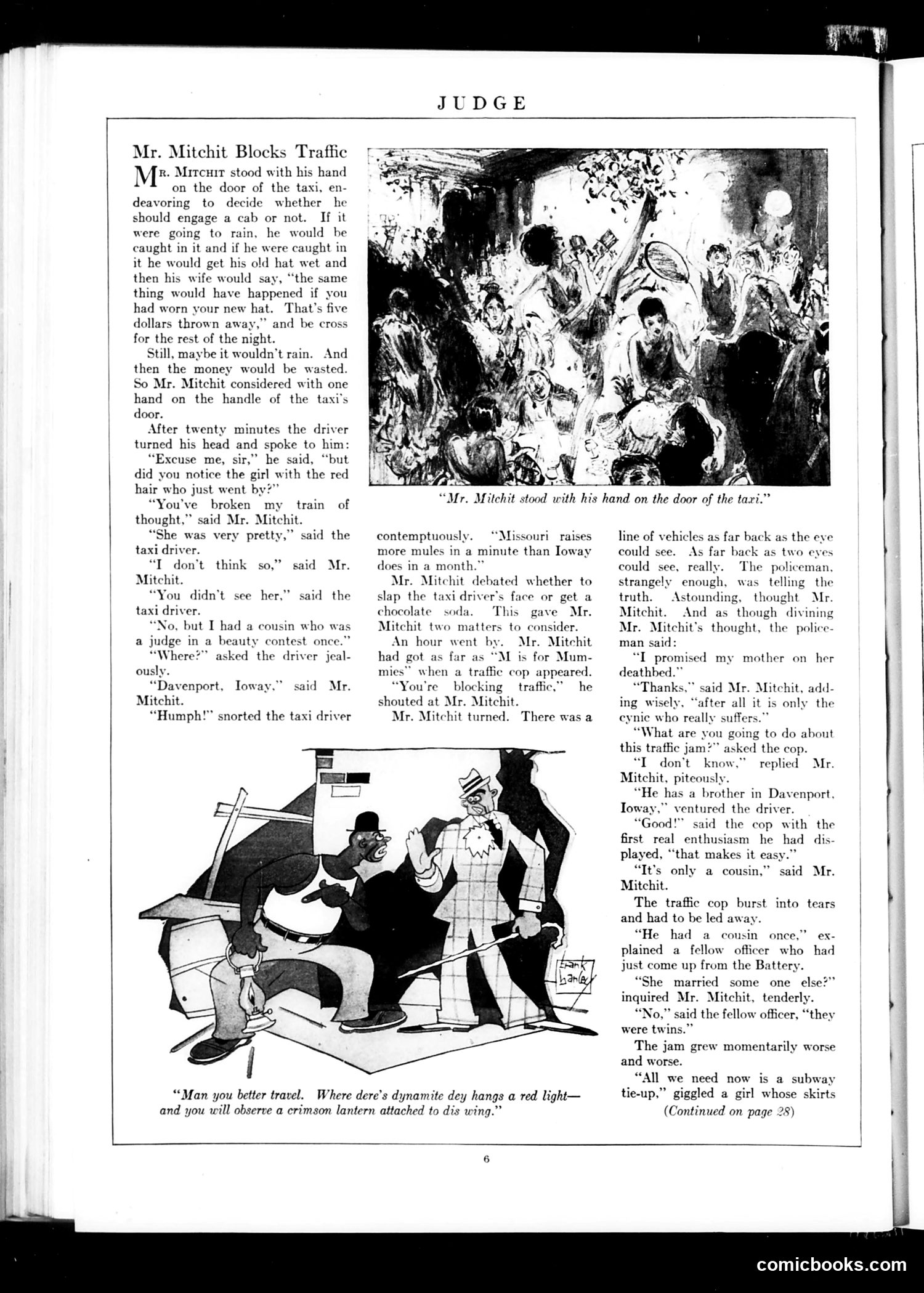
This is a satirical story about indecision causing public chaos. Mr. Mitchit, standing at a taxi door for twenty minutes unable to decide whether to take a cab (worried about rain ruining his hat or wasting money if it doesn't rain), becomes so absorbed in deliberation that he blocks an entire line of traffic stretching blocks back. When a traffic cop confronts him, Mitchit can't even decide whether to apologize or get chocolate instead. The joke escalates absurdly: mentioning Mitchit's cousin in Davenport, Iowa triggers emotional responses from both the cop and another officer, eventually reducing the cop to tears. The satire targets indecisive people who cause problems through paralysis by analysis—overthinking trivial personal matters while creating massive public inconvenience. It's a gentle mockery of the neurotic, anxious personality type, suggesting that obsessive worry about minor consequences (a wet hat) creates disproportionate real problems.
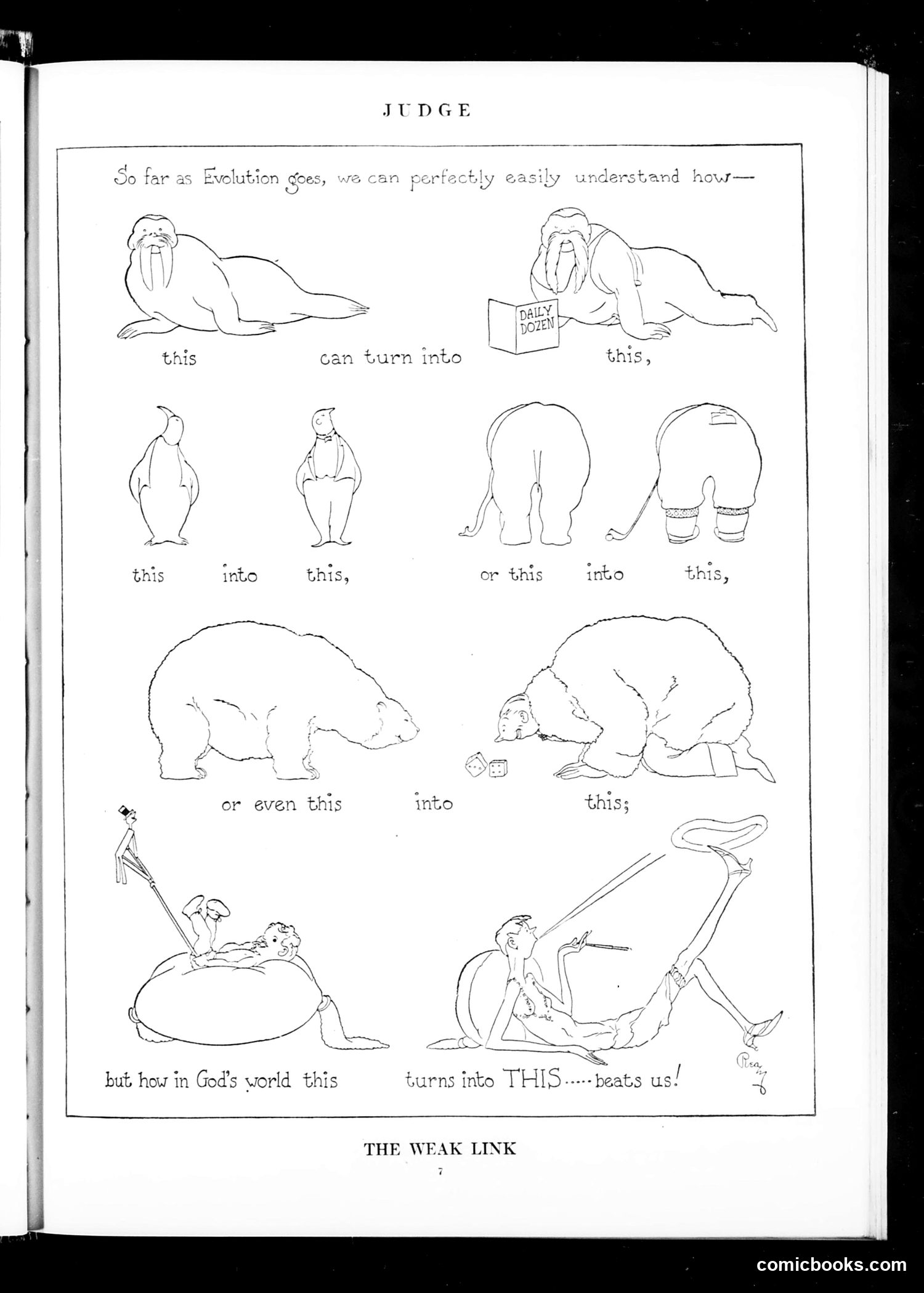
This satirical cartoon mocks evolutionary theory by presenting an absurd "missing link" chain. It traces plausible animal-to-animal evolution (walrus to penguin to bear to primate forms), but then concludes with a mystified jump: humans somehow evolved into the final figure—depicted as an obese, slovenly man of apparently low intelligence and morality, shown engaged in crude behavior. The cartoon's point is reactionary social criticism disguised as evolutionary skepticism. It suggests that if evolution were true, humans should represent evolutionary *progress*, yet modern man (or specifically, a working-class or immigrant man) appears *degenerate*. The title "The Weak Link" puns on the missing link concept while implying contemporary humanity is evolution's failure—a common eugenic-era argument attacking those deemed "unfit" or socially inferior.
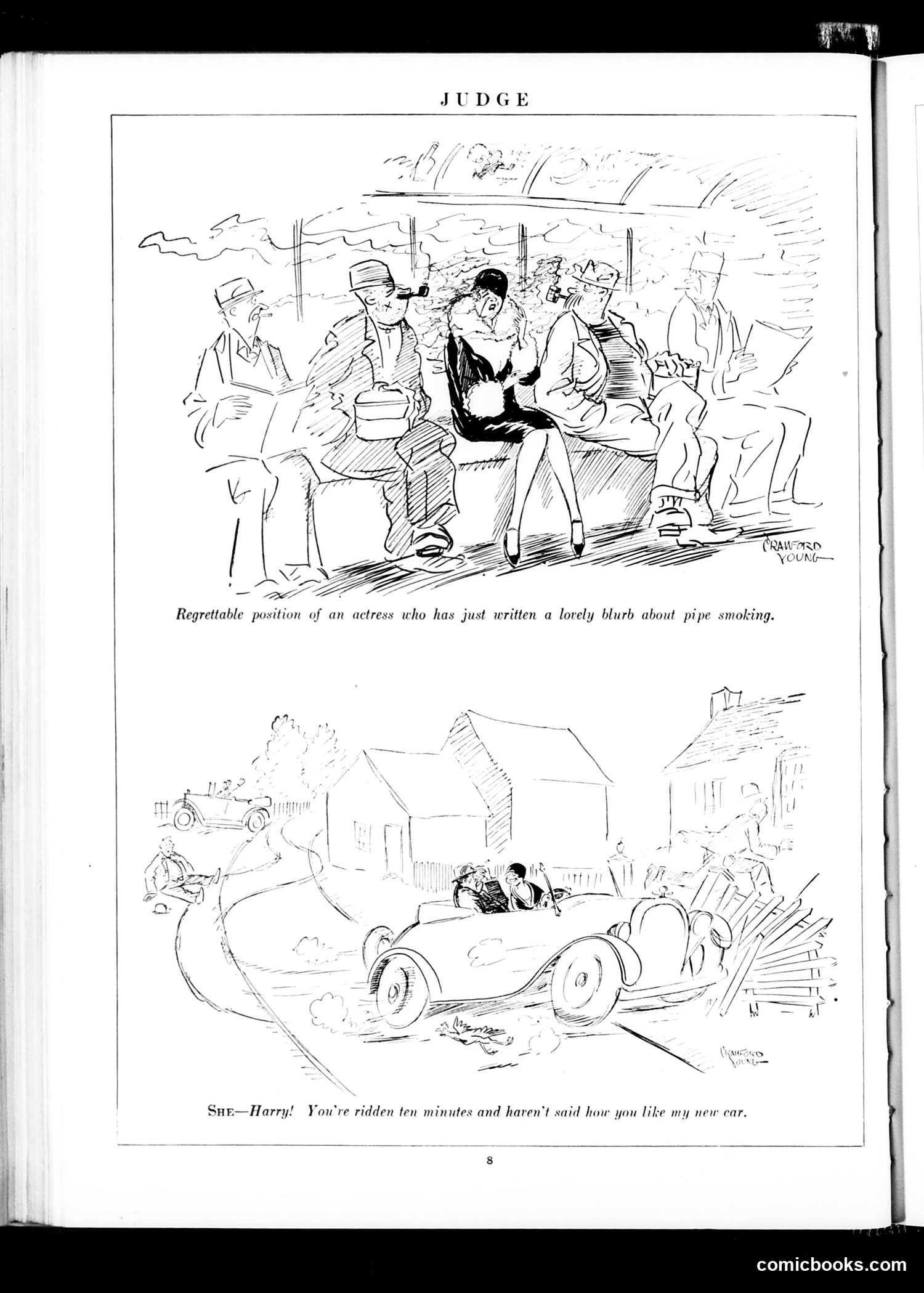
This page contains two cartoon panels satirizing early 20th-century social behavior, signed by what appears to be "Cesare Young." **Top cartoon:** Shows an actress surrounded by men at what appears to be a social gathering. The caption mocks her for writing "a lovely blurb about pipe smoking"—satirizing actors who endorse products in advertisements, particularly the awkwardness when their endorsements contradict their public image or seem forced. **Bottom cartoon:** Depicts a couple in a new automobile. The woman complains that her male companion has ridden (driven) for ten minutes without complimenting her new car—mocking the vanity of car owners seeking validation and the emerging dating ritual of automobile rides as social courtship. Both comics target contemporary vanities: commercial endorsements and consumer materialism, particularly around newly popular automobiles.
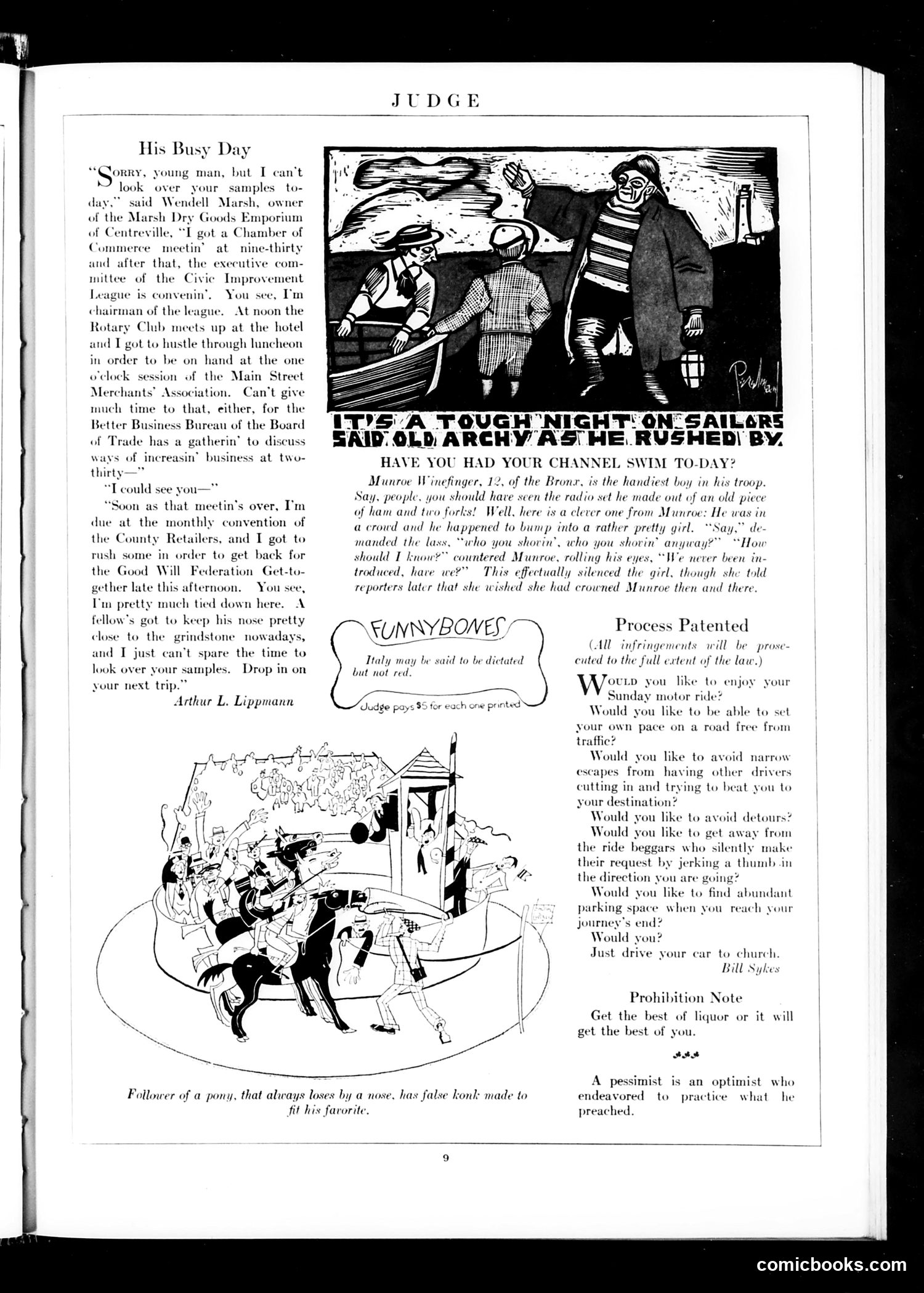
The main cartoon satirizes the overscheduled American businessman of the early 20th century. Wendell Marsh, owner of a dry goods store, cannot meet with a traveling salesman because he's trapped in an endless cycle of civic and business meetings: Chamber of Commerce, Rotary Club, Merchants' Association, Better Business Bureau, County Retailers convention, and Good Will Federation gathering—all in a single day. The satire targets the proliferation of business organizations and civic clubs that promised to "increase business" while actually consuming businessmen's time. This reflects anxiety about bureaucratic proliferation and the corporate culture's demands on individual entrepreneurs. The joke: Marsh is so committed to these organizations designed to help business that he cannot actually conduct business. The accompanying illustrations mock other urban preoccupations—a boy's radio-building prowess and driving traffic problems—reflecting 1920s modernity anxieties.
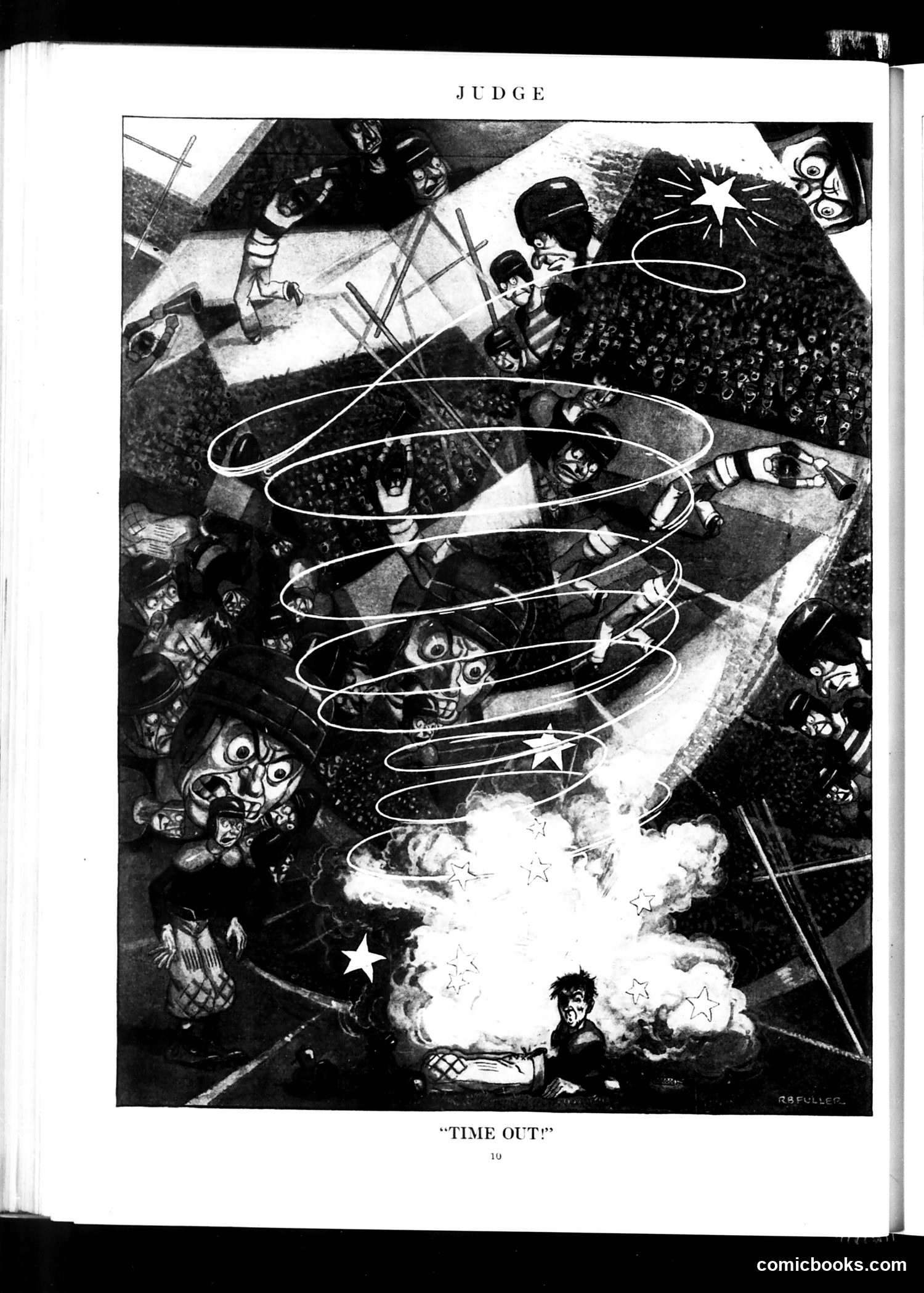
This political cartoon depicts a chaotic overhead scene of what appears to be a courtroom or judicial proceeding. The title "Time Out!" suggests a pause or interruption in proceedings. The image shows multiple figures arranged in a circular composition with spiraling lines creating visual movement and confusion. Several characters display exaggerated facial expressions suggesting agitation or distress. White clouds with stars appear at the bottom, possibly indicating an explosion or dramatic disruption. The specific identities of the figures and the exact political situation referenced are unclear from the image alone. However, the satirical intent appears to mock judicial proceedings or legal chaos—perhaps commenting on a notable trial or court case of the era when this appeared in Judge magazine. Without additional context about the publication date or accompanying text, the precise target of the satire cannot be determined.
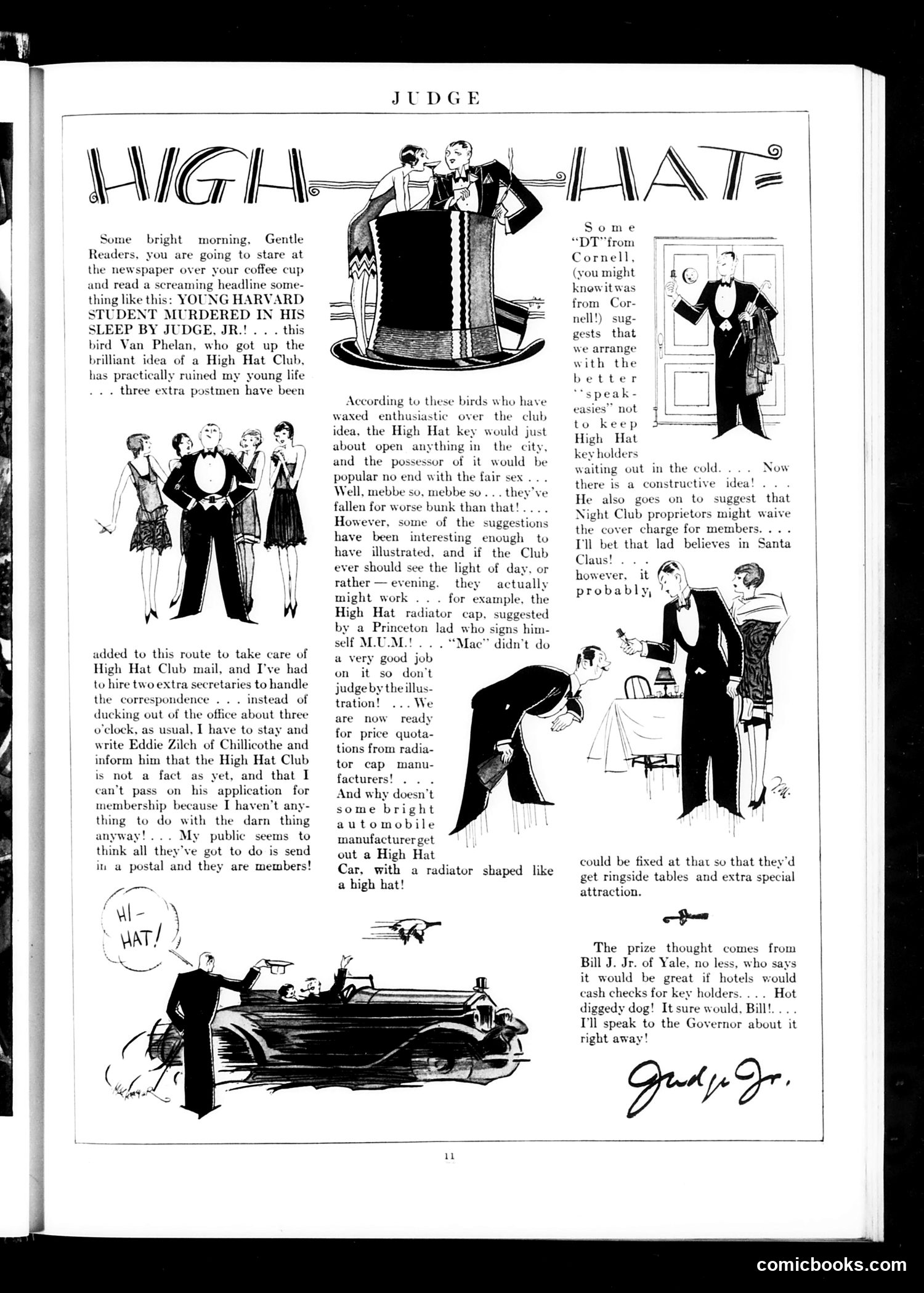
This "Judge" column mocks the fictional "High Hat Club," a proposed exclusive organization. The author—appearing to be the magazine's judge/editor figure—complains that announcing the club's hypothetical existence has generated overwhelming membership applications and administrative burden, despite the club not actually existing yet. The satire targets: 1. **Elite club culture**: The absurd perks suggested (universal city access, romantic appeal, speakeasy privileges, hotel check-cashing) mock how exclusive clubs promise status and special treatment. 2. **College boy enthusiasm**: Suggestions come from Princeton and Yale students, satirizing upper-class collegiate ambitions and naïveté about exclusivity. 3. **Aspirational fantasy**: The joke is that ordinary people desperately want membership in something that doesn't exist, believing membership confers social power—revealing how easily people chase status symbols. The column's humor derives from the gap between the club's non-existence and the public's desperate, mail-flooding enthusiasm for joining it.
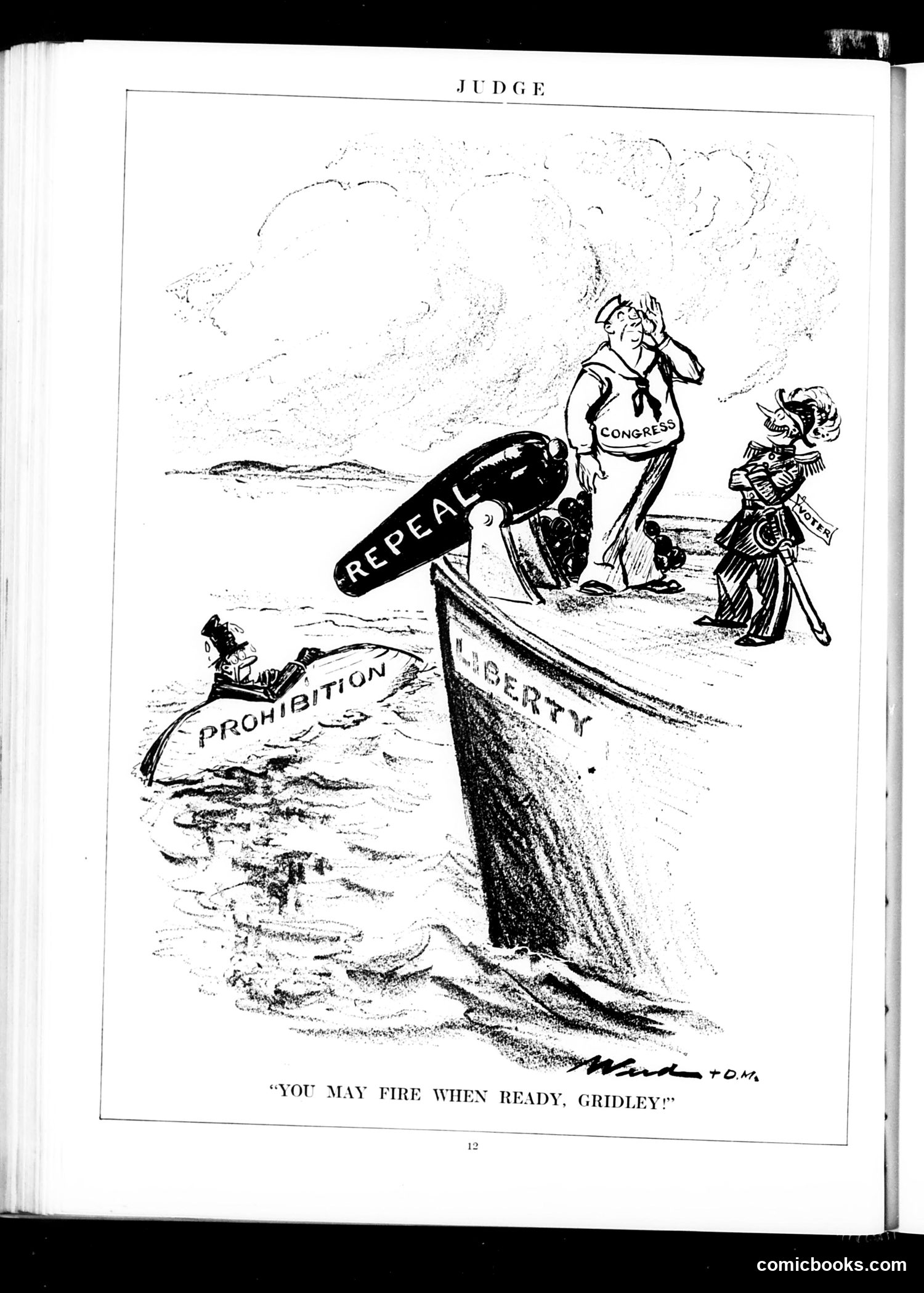
This satirical cartoon depicts the Prohibition debate in early 20th-century America. The central figure labeled "Congress" aims a cannon labeled "Repeal" at Lady Liberty, who stands on a pedestal labeled "Liberty." A small figure labeled "Prohibition" drowns in rough waters below, while Uncle Sam (in military dress, right) observes. The cartoon criticizes Congress's consideration of repealing Prohibition, suggesting this action threatens American liberty itself. The famous quote "You may fire when ready, Gridley!" (from the Spanish-American War) invokes patriotic language to frame the repeal vote as a consequential national moment. The drowning Prohibition figure suggests reformers' disappointment at the amendment's potential collapse. The satire ultimately opposes repeal, viewing it as destructive to the nation's moral foundation and freedoms.
This editorial page satirizes President Calvin Coolidge through comparison with George Washington. The text praises a Bruce Barton interview with Coolidge in *Scribner's* magazine, noting Barton's skill at appealing to "middle-class" sensibilities. The satire centers on Coolidge's boyhood ambition to be a storekeeper and his hero-worship of Washington—also allegedly a meticulous accountant obsessed with property counting. The piece ironically suggests these bookkeeping traits qualify both men for the presidency and budget management. The humor lies in reducing presidential greatness to mere accounting ability: Coolidge's mundane ambition and Washington's ledger-keeping become qualifications for high office. The article mocks both the interview's crafted nature (written by an "advertising man") and Coolidge's limited intellectual horizons by treating bean-counting as presidential virtue.
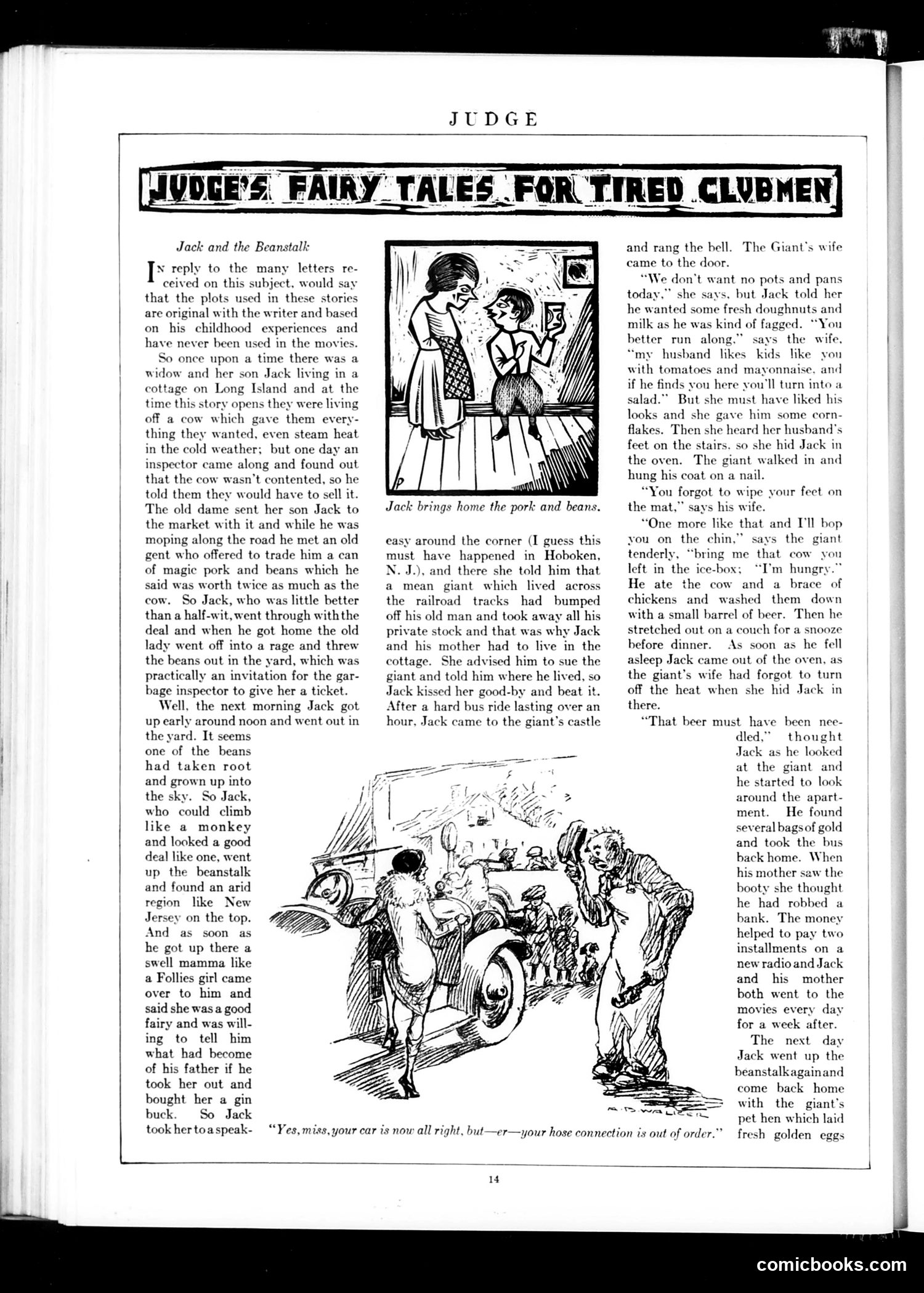
This is a humorous retelling of the classic fairy tale set in contemporary 1920s America, specifically Long Island and New Jersey. The satire works by transplanting a traditional children's story into modern, mundane settings to mock both the tale itself and contemporary American life. Key satirical elements include: Jack's mother as a working-class widow; the "magic pork and beans" (a commercial product); Jack meeting a "swell mamma like a Follies girl" (a showgirl) at a speakeasy in Hoboken; the giant's casual domestic abuse ("One more like that and I'll bop you"); and the resolution where Jack's newfound wealth buys a radio and pays installment plans—capturing Depression-era financial struggles and consumerism. The frame story credits the writer as basing these tales on "childhood experiences" while claiming originality, humorously suggesting how modern life has replaced genuine fairy-tale magic with consumer goods and urban vice.
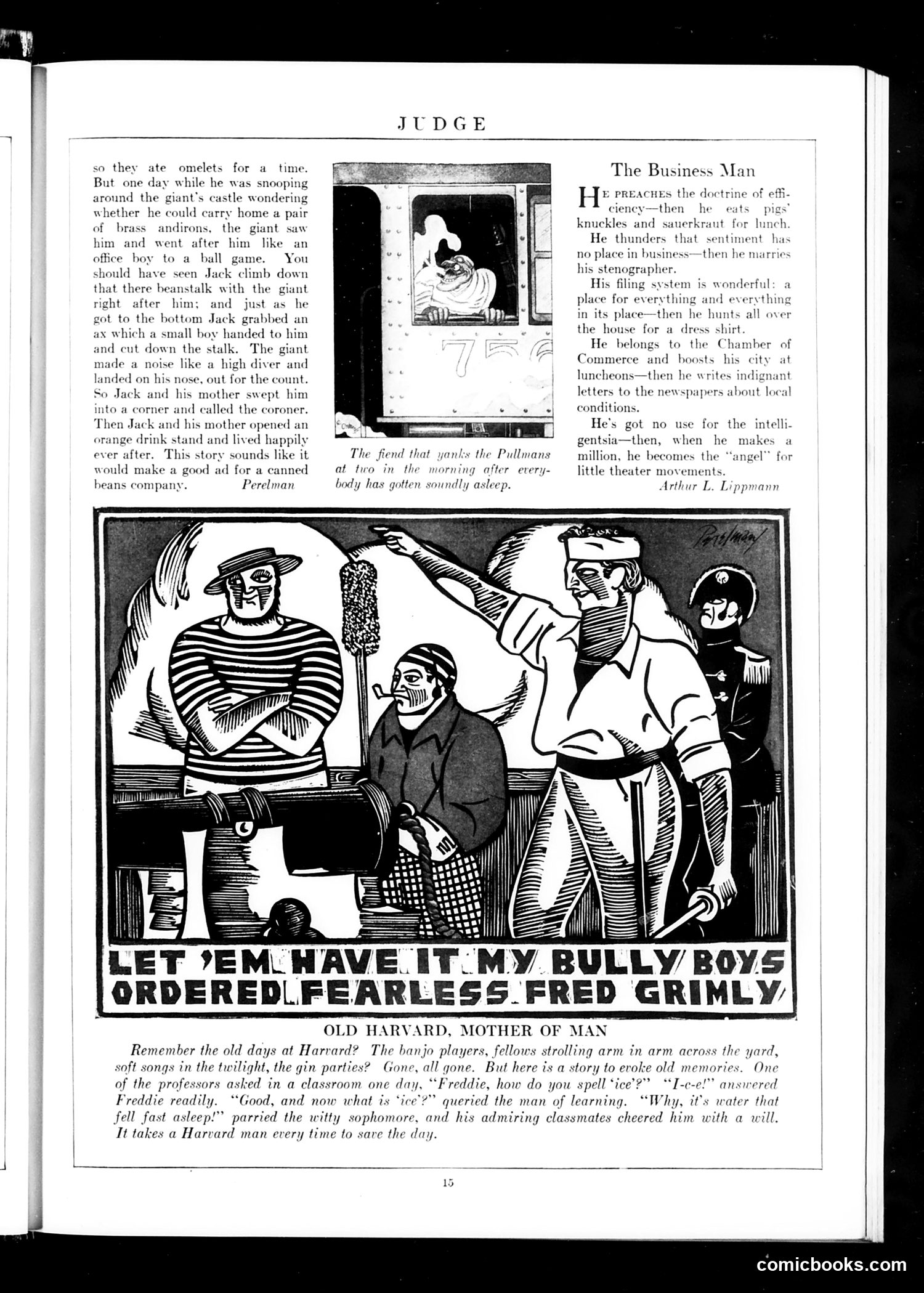
This page contains three distinct pieces from Judge magazine: 1. **"The Business Man"** (top right): A satirical character sketch by Arthur L. Lippmann mocking the hypocrisy of American businessmen. The joke is that he preaches efficiency but is disorganized; denounces sentiment yet makes emotional decisions (marrying his secretary); boasts of city progress while complaining to newspapers; dismisses intellectuals until wealth lets him become a theater patron. The satire exposes contradiction between public principles and private behavior. 2. **"Old Harvard, Mother of Man"** (bottom): A nostalgic sketch about Harvard University traditions—banjo players, gin parties, campus romance. The humor centers on a classroom anecdote where a student cleverly deflects a spelling question with a joke about water ("ice" melts). It celebrates the clever wit valued in elite college culture. 3. **"Let 'Em Have It"** (center): A dramatic woodcut-style illustration appearing to depict tough street characters or "bully boys," though context is unclear without seeing the accompanying story. The page reflects early 20th-century Judge magazine's focus on social satire and class commentary.
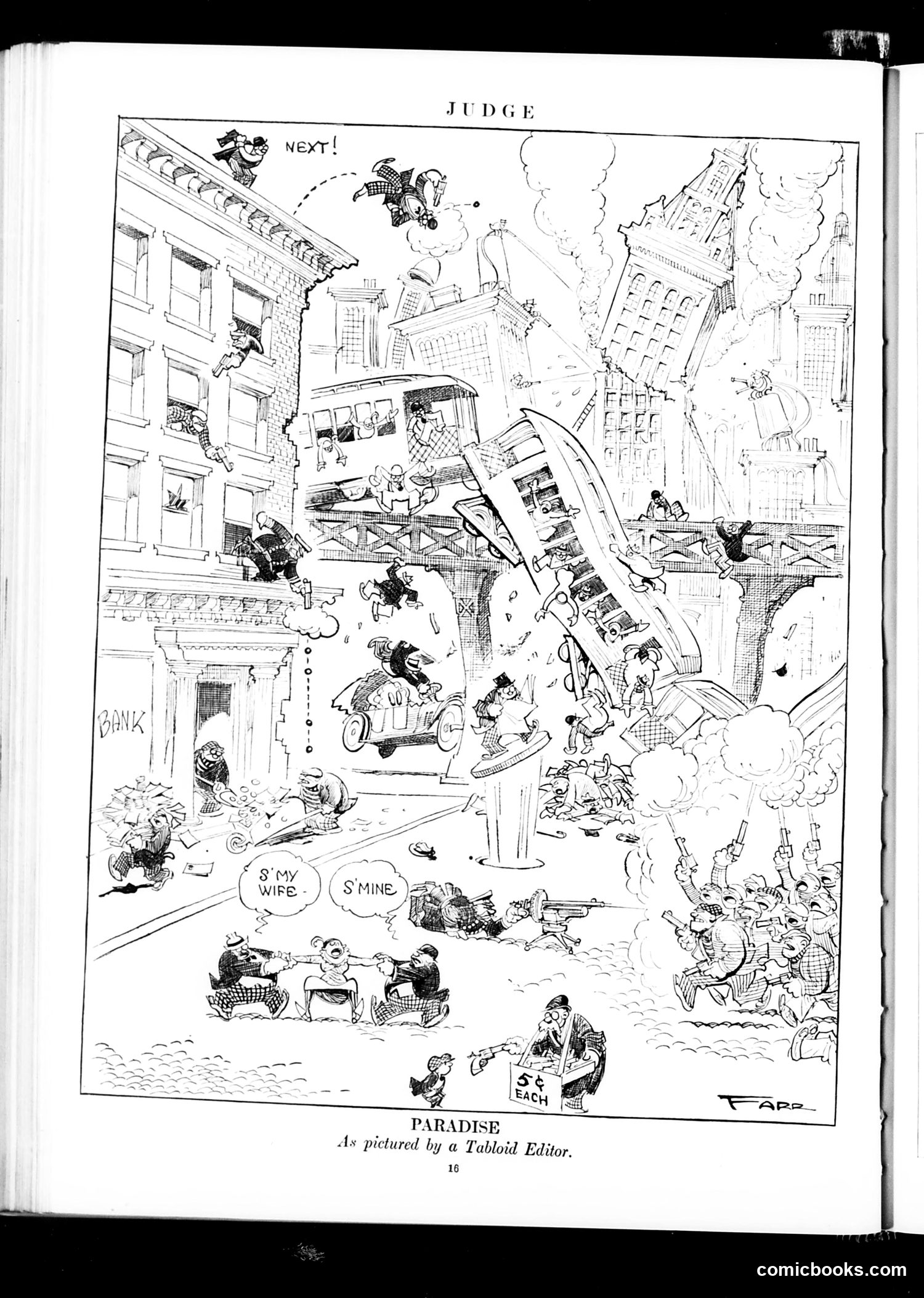
This satirical cartoon mocks tabloid journalism's sensationalism. The "paradise" depicted is a chaotic urban disaster scene—buildings collapsing, cars crashing, explosions, and mayhem everywhere. In the foreground, two figures labeled "S'MY" and "S'MINE" quarrel over territory while chaos erupts around them. A character at bottom right holds a sign reading "5¢ EACH," suggesting he's selling papers of this destruction. The joke: tabloid editors view sensational tragedy and conflict as ideal—their commercial "paradise"—because disasters sell newspapers. By showing editors literally celebrating amid urban catastrophe, the cartoon satirizes how tabloid journalism profits from and sensationalizes human suffering and crime rather than serving the public interest.
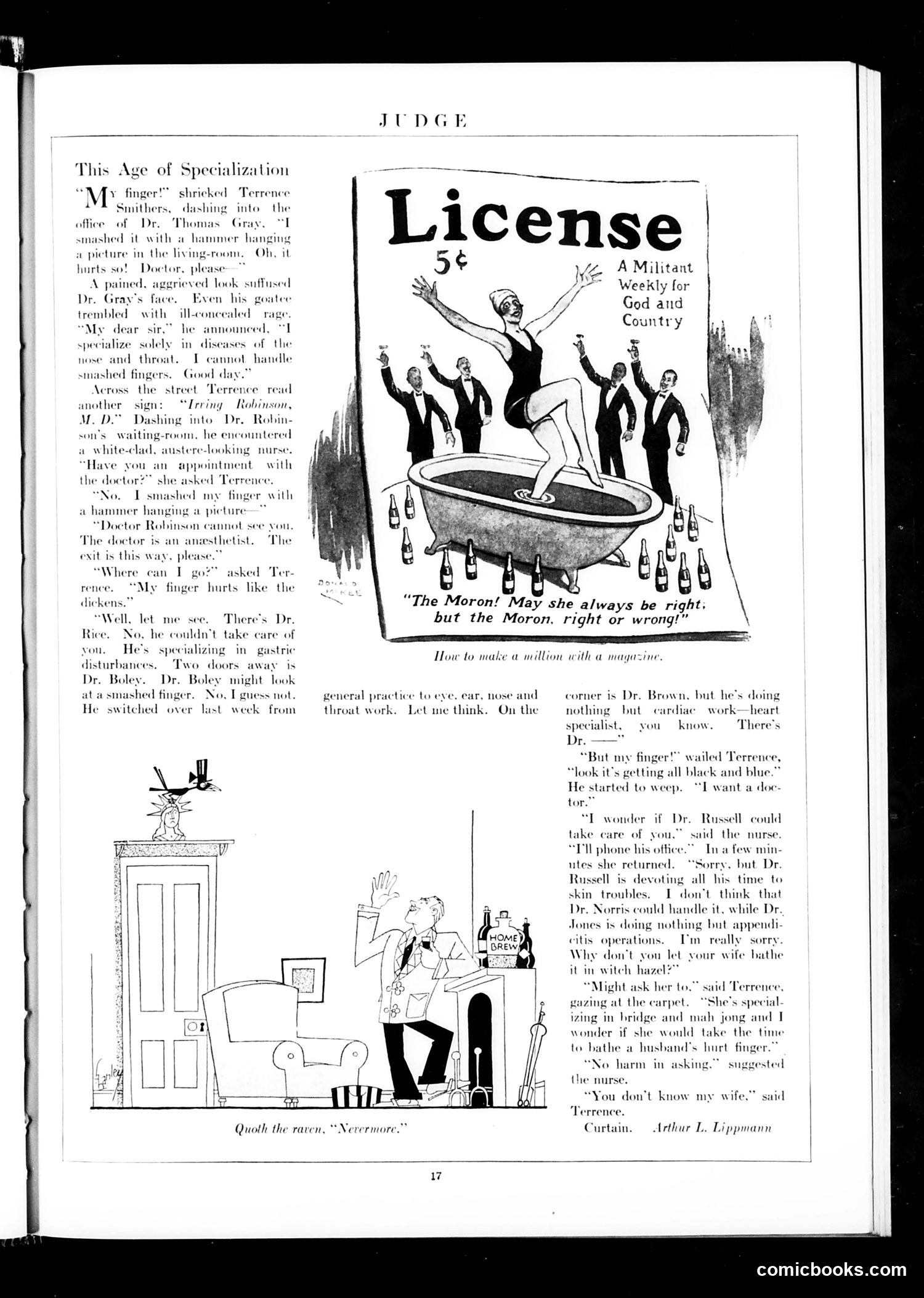
This satirical story mocks the early 20th-century trend toward medical specialization. A man (Terrence Smithers) injures his finger and attempts to find a doctor, but encounters a absurd parade of physicians—each practicing only a narrow specialty: nose-and-throat, anesthesiology, gastric disturbances, cardiology, skin troubles, appendicitis. None will treat a simple smashed finger. The joke critiques how excessive specialization has become impractical and unhelpful for ordinary people with common problems. The punchline underscores the broader social satire: Terrence's wife has similarly specialized herself away into bridge and mah-jong, making her equally unavailable for domestic duties. The cartoon suggests that modern specialization, while intellectually impressive, creates absurd real-world inefficiency and abandons the generalist approach needed for everyday life.
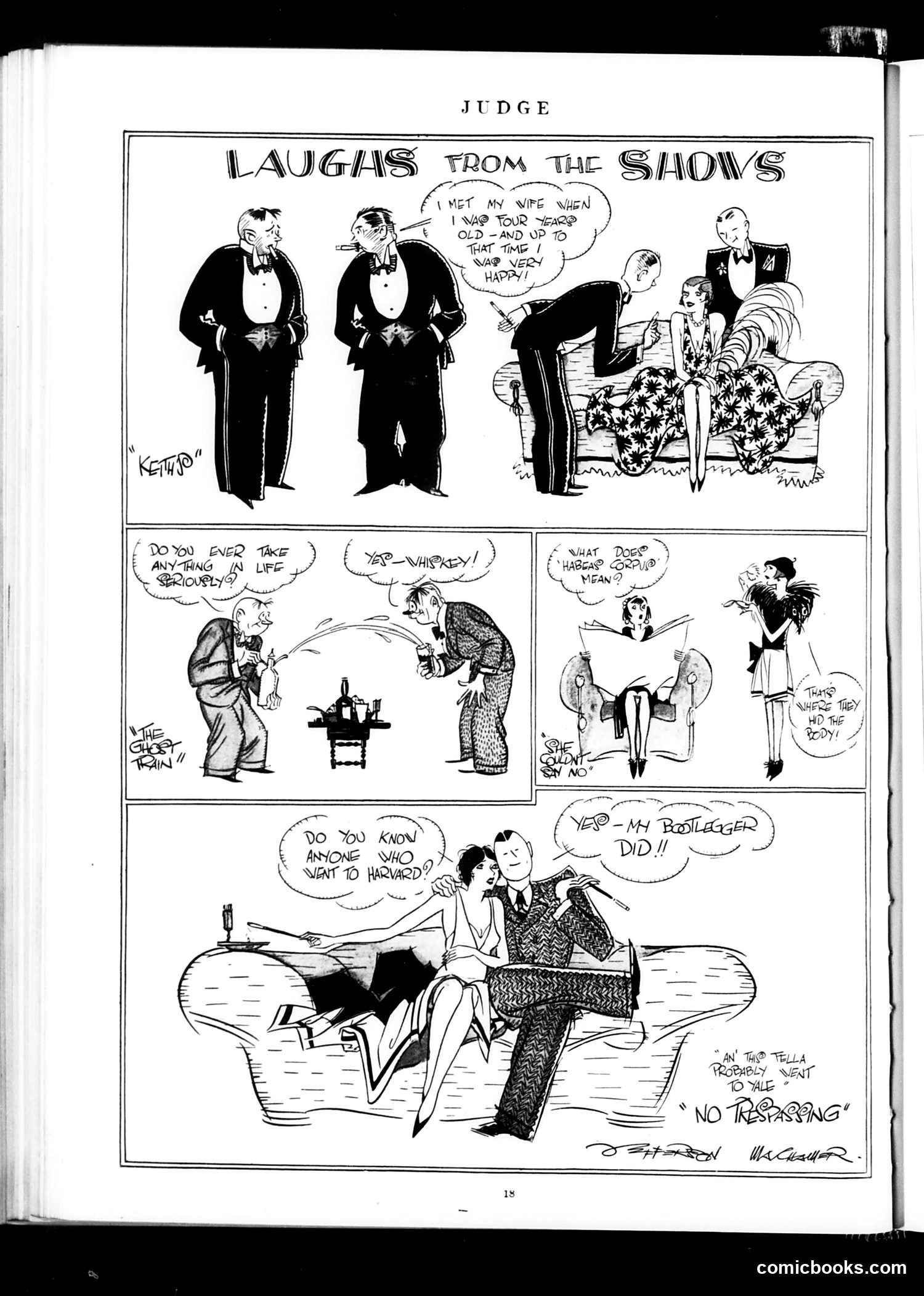
This page collects brief gags supposedly drawn from theatrical performances. The top panel shows men in formal wear at what appears to be a social gathering, with one recounting meeting his wife when "I was thirty years old—and up to that time I was very happy," a joke about marriage dampening male contentment. The subsequent panels contain typical Jazz Age humor: jokes about drinking ("Do you ever take anything in your coffee?" / "Yes—whiskey!"), a woman's silent response to a marriage proposal, and a final scene of a couple in a canoe where the man boasts his bootlegger (illegal alcohol supplier) "did it!" The satire targets 1920s social themes: marriage anxieties, Prohibition-era drinking culture, and gender dynamics. The "No Trespassing" sign on the canoe suggests intimacy or private spaces. The artwork is credited to what appears to be "McCullough" or similar. This represents typical Judge magazine content—topical, mildly risqué humor aimed at urban, educated readers familiar with contemporary social conventions and legal restrictions.
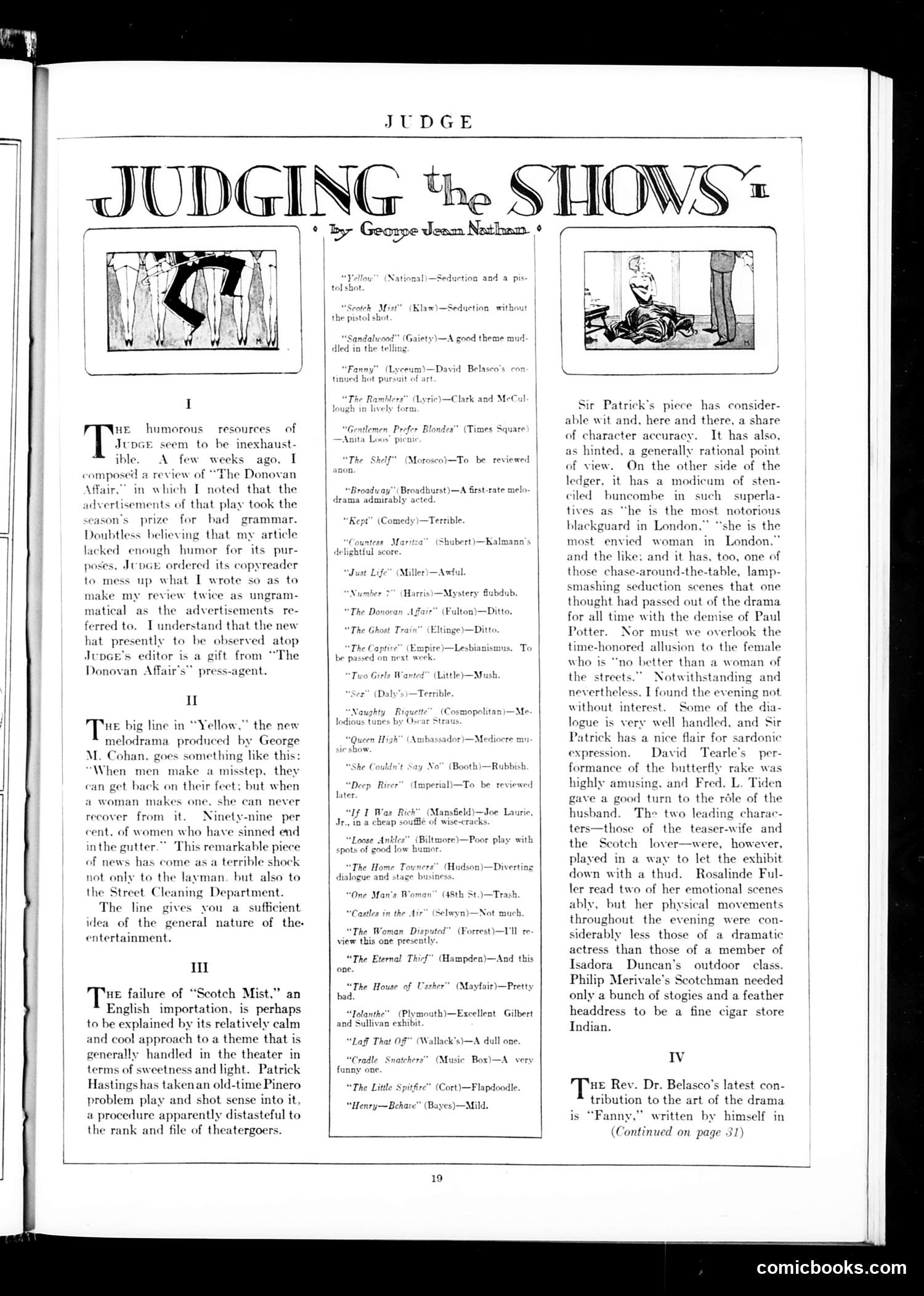
This is a theater review column by George Jean Nathan critiquing current Broadway productions. The page lists approximately 30 shows with brief, often dismissive judgments—most rated "Terrible," "Awful," "Rubbish," or "Trash." Nathan focuses on "Scotch Mist," an English import he finds disappointingly restrained compared to typical melodrama. He praises its wit and rationality but criticizes its dated theatrical devices: exaggerated character descriptions, predictable seduction scenes reminiscent of the now-outdated Paul Potter, and weak lead performances from Rosalinde Fuller. The opening sections joke about Judge magazine's editorial incompetence—the editor supposedly "messed up" Nathan's grammar-focused review to make it worse, and the publication's copy-reader was apparently a gift from a play's press agent. This reflects 1920s Broadway culture and Nathan's influential but acerbic critical voice.
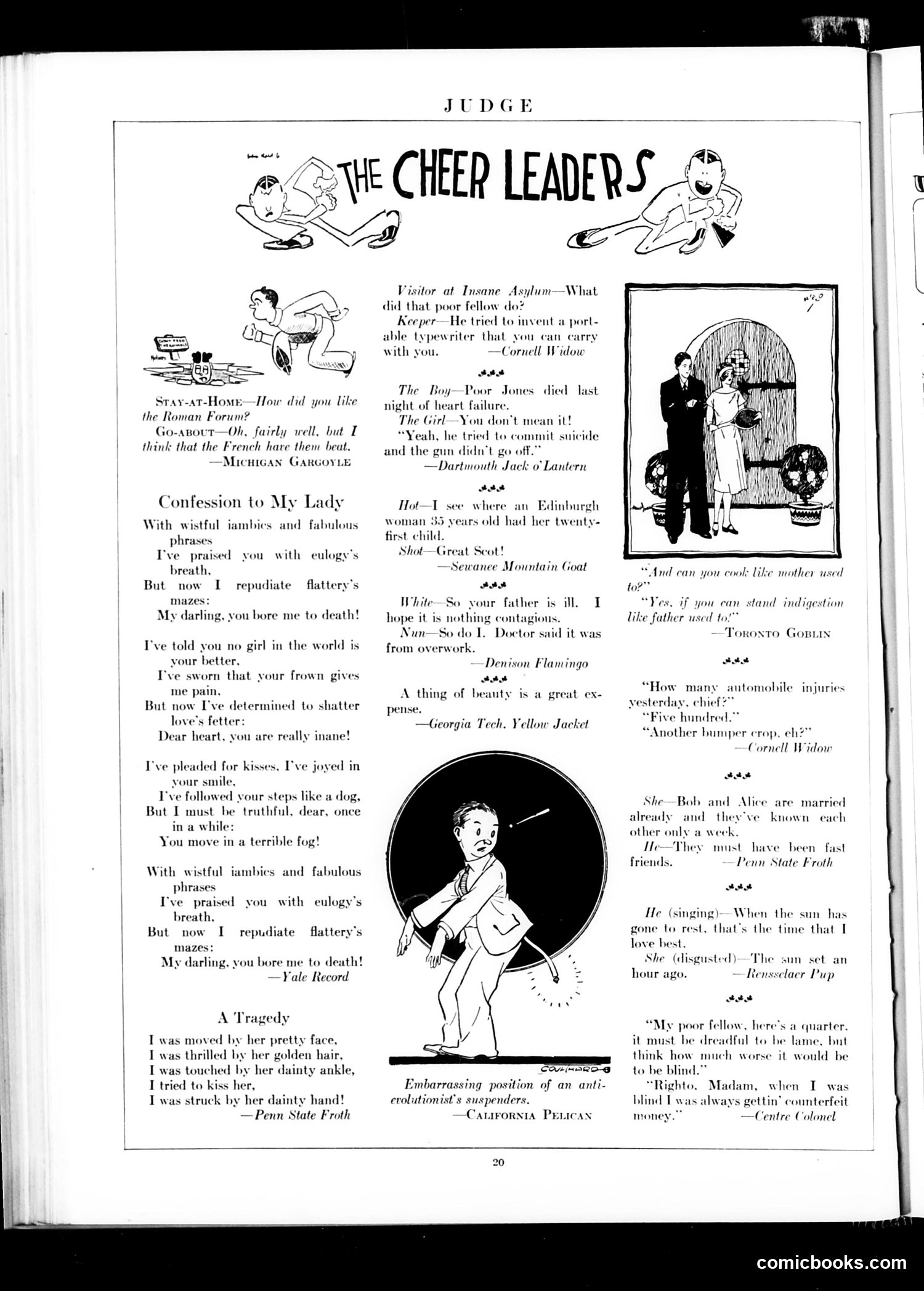
This page collects humorous verses and quips from various college publications, satirizing romantic and social pretensions of the era. The main content mocks affected courtship rituals: a lover confesses he's been flattering his girlfriend with flowery language but now admits she's actually boring and intellectually vapid ("You move in a terrible fog"). A parallel poem expresses similar disillusionment. Other jokes target college-boy types—one fool tries inventing a portable typewriter and ends up institutionalized; another romanticizes a woman only to get physically rebuffed. There's also gentle mockery of overstated masculine hardship (a beggar claims counterfeiting money was worse than blindness). The cartoons depict naive or foolish young men in social situations. The overall tone suggests Judge's intended audience was educated, urbane readers amused by deflating the romantic pretenses and perceived intellectual mediocrity of college students and young adults.
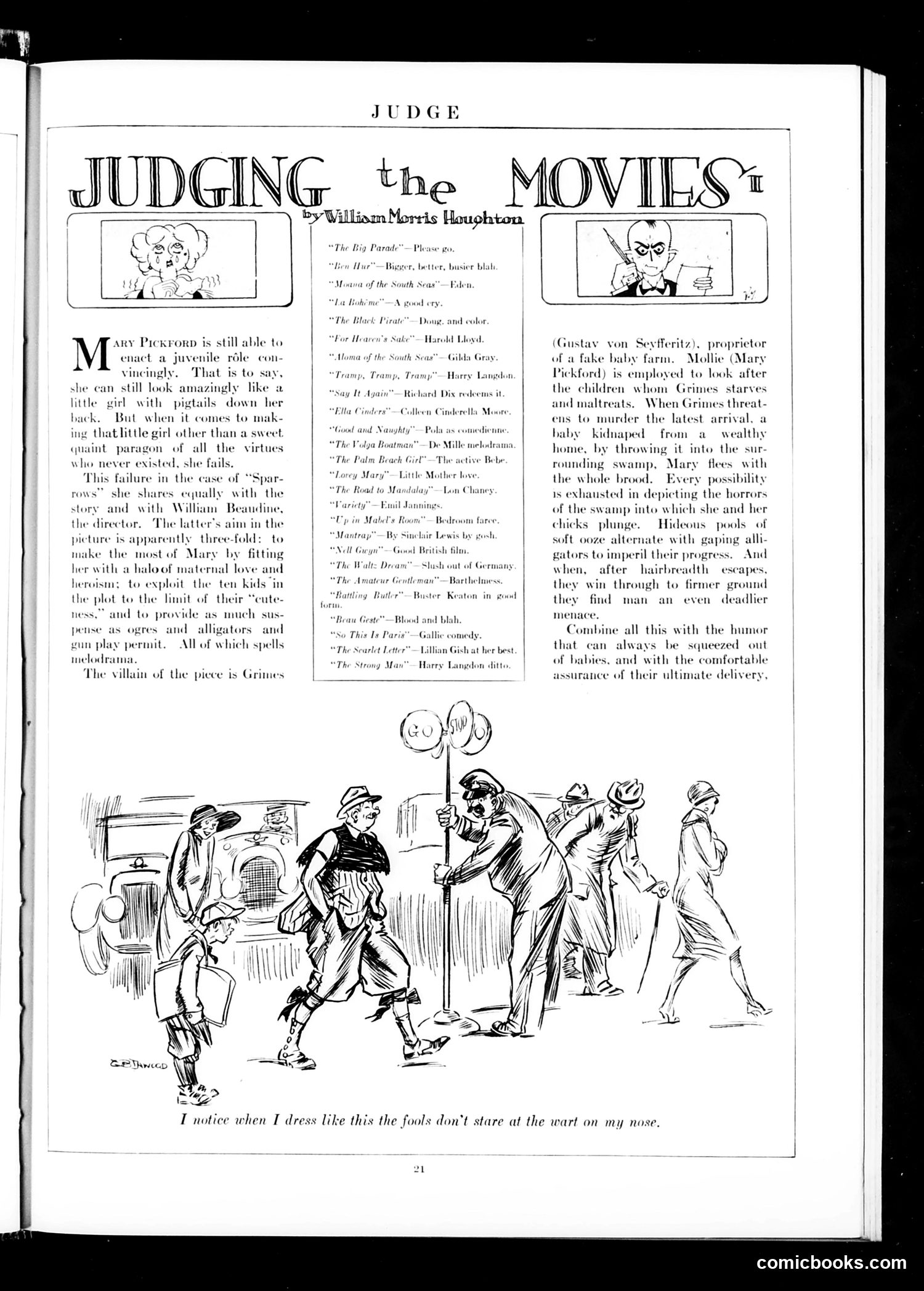
This page reviews contemporary 1920s films, with the main critique focusing on Mary Pickford's film "Sparrows." The reviewer argues that while Pickford convincingly plays a child (she's known for pigtails and youthful roles), director William Beaudine fails to create a believable character—instead presenting an unrealistic "quaint paragon of virtue." The plot involves Pickford protecting babies from Gustav von Seyfferitz, who runs a corrupt baby farm and threatens to drown an infant. She escapes with the children into a swamp filled with alligators and quicksand. The satire mocks the film's heavy-handed melodrama: despite serious threats (infanticide, swamp horrors), the movie relies on sentimental humor about babies to ensure viewer confidence in a happy ending. The page also lists other contemporary films briefly reviewed, including works by Harold Lloyd, Harry Langdon, and Buster Keaton. The cartoon below illustrates the satirical point about absurdly dramatic scenarios presented as entertainment.
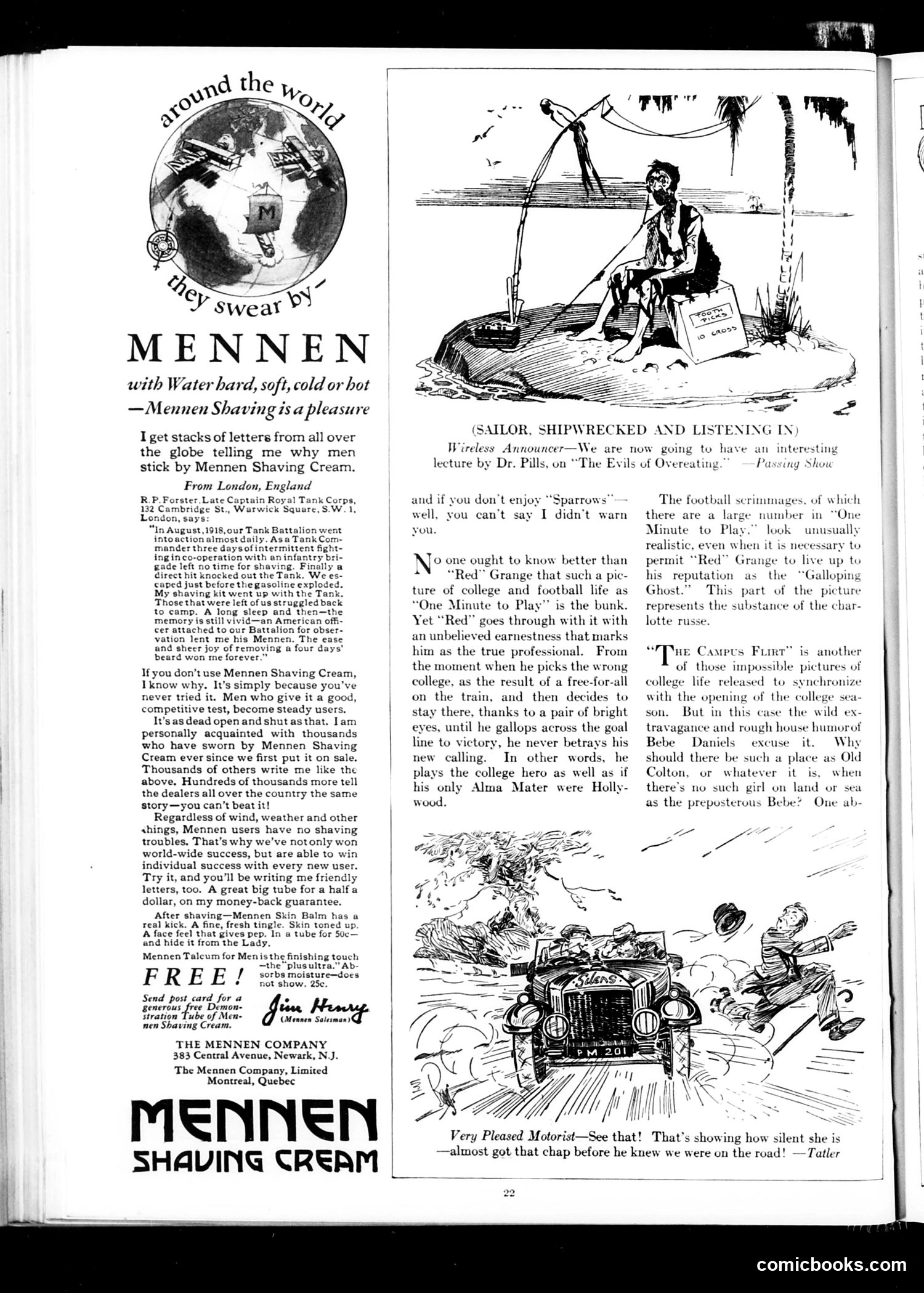
This page is primarily a **Mennen Shaving Cream advertisement** with entertainment commentary on the right side. The ad features a testimonial letter from a British Tank Corps officer recounting WWI service, emphasizing Mennen's reliability under difficult conditions. The marketing pitch promises the product works regardless of circumstances and offers a money-back guarantee. The right-side content reviews college-themed films, particularly discussing "Red" Grange (the famous 1920s football player, appearing to reference his film career). The reviewer critiques "One Minute to Play" as unrealistic college/football fiction, yet praises Grange's professional performance. There's also mention of "The Campus Flirt," another college-themed movie. The cartoon captioned "Very Pleased Motorist" depicts a car passing a shipwrecked sailor listening to wireless radio—a humorous contrast of modern motorist convenience versus isolation. **Context for modern readers**: This reflects 1920s celebrity crossovers (athletes becoming actors), college sports' cultural dominance, and early radio's novelty as mass entertainment.
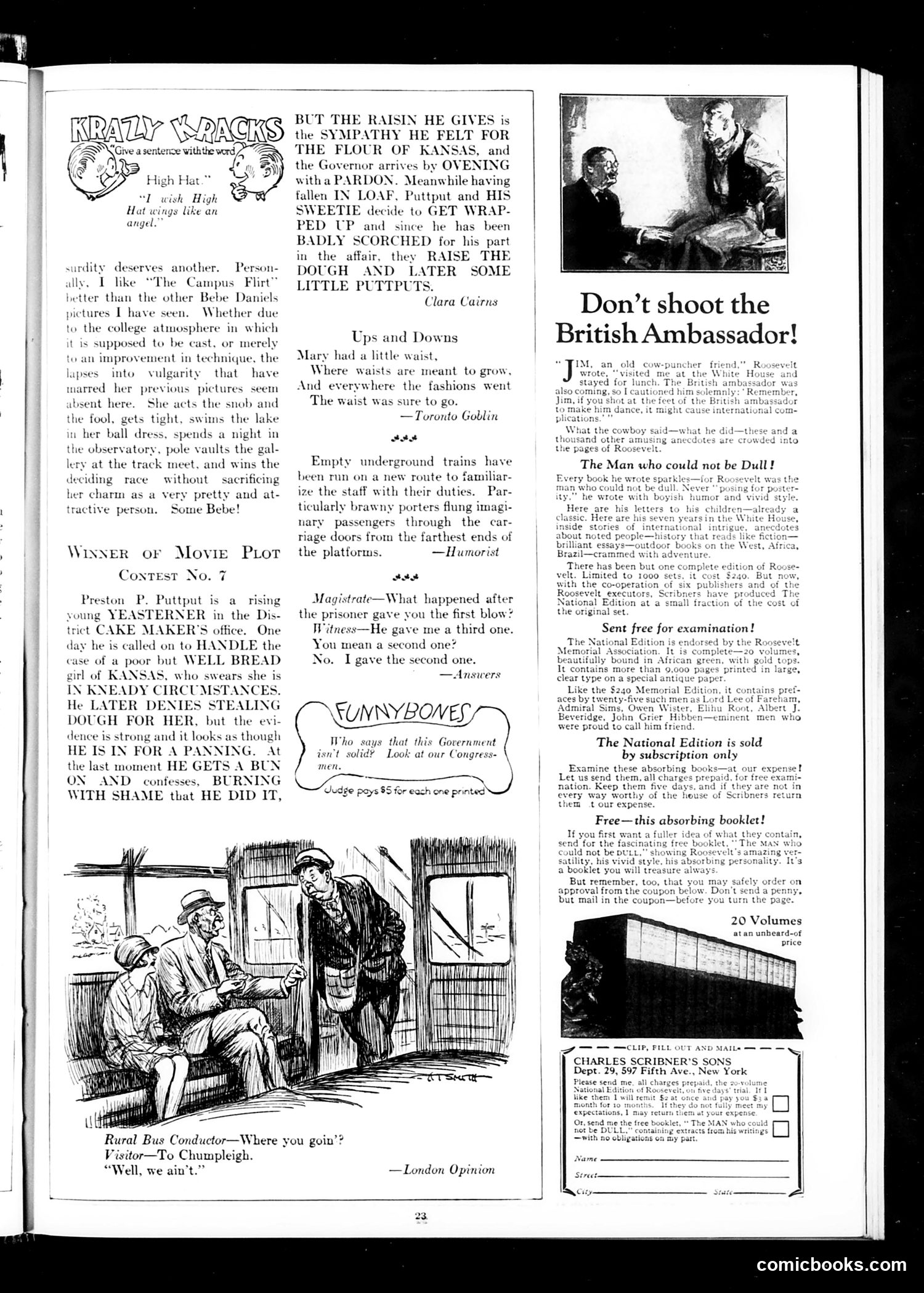
This page contains multiple unrelated satirical pieces typical of Judge magazine's format. **"Krazy Kracks"** (top left): A wordplay joke section with simple puns, unrelated to political content. **"Winner of Movie Plot Contest No. 7"**: A humorous film synopsis using bread/baking puns (YEASTERNER, CAKE MAKER, WELL BREAD, FLOUR, LOAF, DOUGH, BURNED/SCORCHED). The narrative parodies sentimental melodramas where a governor's pardon saves the day. The humor relies entirely on forced food-related wordplay rather than political commentary. **"Rural Bus Conductor"** (bottom): A British joke about directions, with no political content—simply absurdist humor. **Various short quips** include observations on fashion, underground trains, and courtroom exchanges—gentle social satire without specific political targets. **Right side**: Advertising for Roosevelt's National Edition (a biography series) and Charles Scribner's Sons publishing materials. Overall, this appears to be a **humor and entertainment page** rather than political commentary. The satire is mild, general, and focused on wordplay and social observations rather than current events or specific political figures.
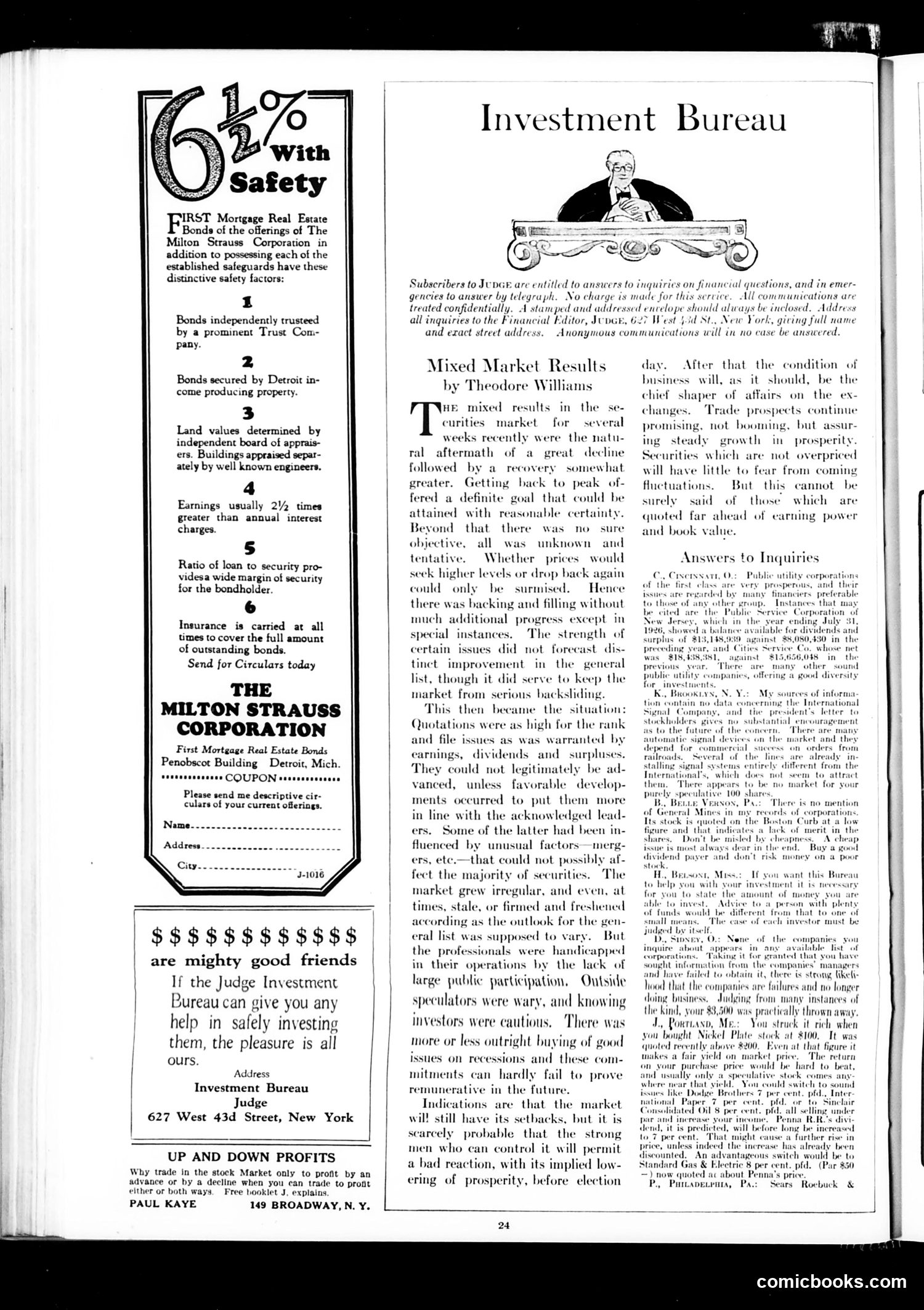
This is primarily a financial advertising page from an early 20th-century *Judge* magazine. The dominant content features investment pitches rather than political satire. The main advertisements promote the Milton Strauss Corporation's real estate bonds (emphasizing safety through multiple oversight mechanisms) and Judge magazine's own "Investment Bureau"—a service offering financial advice to subscribers, treating inquiries confidentially. The only substantive editorial content is Theodore Williams's "Mixed Market Results," a brief market analysis discussing recent securities volatility. Williams notes that stock prices have recovered from a decline but lack clear direction, with uncertainty preventing major upward movement. He suggests good stocks bought during downturns will eventually prove profitable, and hints that powerful market participants won't allow serious downturns before an election (likely referencing the political climate's economic sensitivity). The page reflects the era's investment-focused advertising culture and *Judge*'s position as a magazine serving affluent readers interested in financial matters.
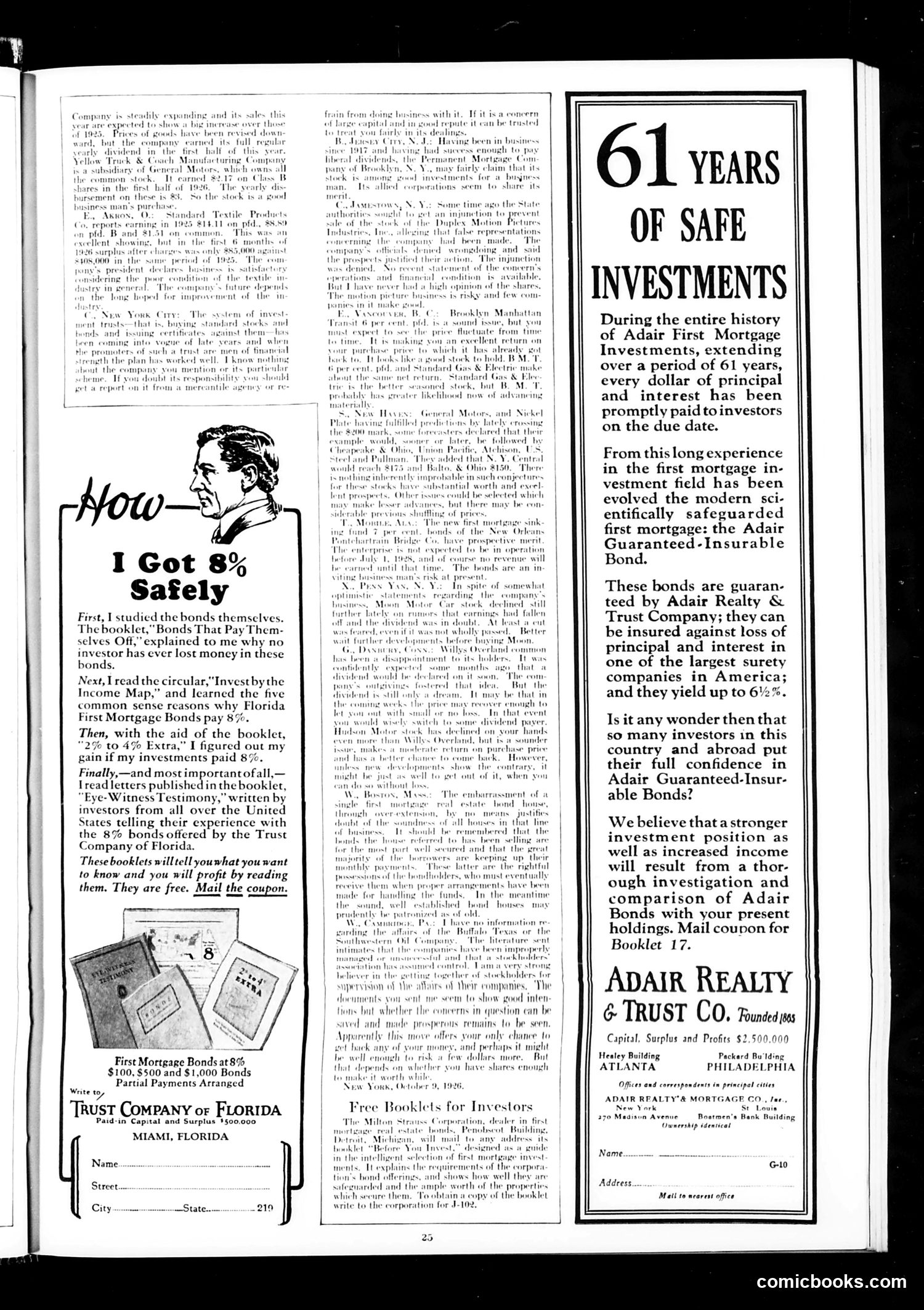
This page is primarily **advertising** mixed with financial advice columns. The main content includes: **Left side**: An advertisement for **Trust Company of Florida**, promoting 8% mortgage bonds. A man's profile appears with testimonial-style text ("How I Got 8% Safely"), claiming he studied bonds and investor letters before investing confidently. This is classic early-20th-century investment marketing using social proof. **Right side**: An advertisement for **Adair Realty & Trust Co.** (Atlanta/Philadelphia), touting "61 Years of Safe Investments" and their "Guaranteed-Insurable Bond." **Center**: Financial column advice about various stocks and investment trusts—typical 1926 market commentary. **The satire/context**: This page exemplifies the pre-1929 stock market boom, when investment schemes proliferated with confident promises of safety and steady returns. The testimonials and "study the bonds yourself" framing mirror modern investment marketing tactics. Within three years, the 1929 crash would devastate many holders of such bonds—making these confident guarantees darkly ironic in retrospect.
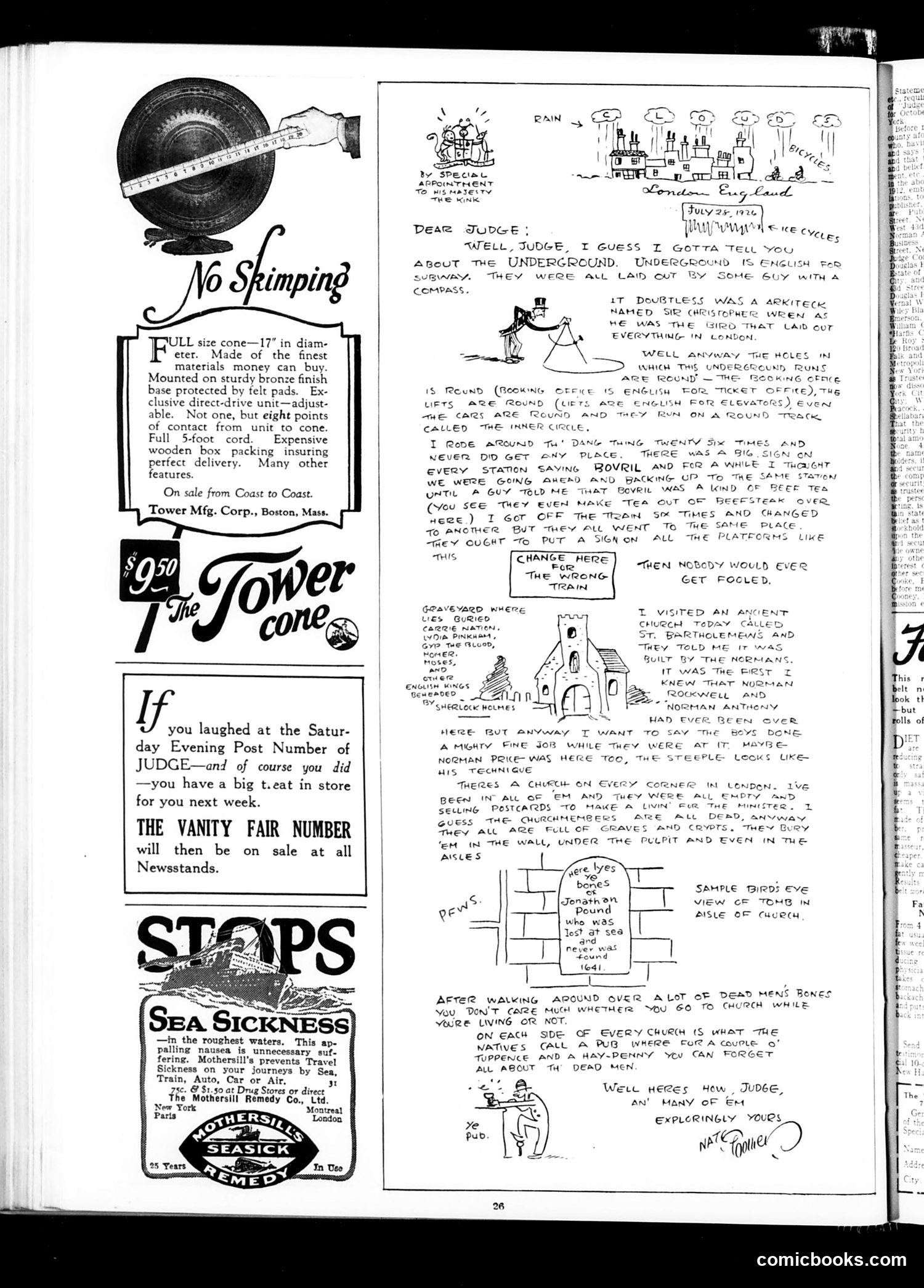
This page combines **advertisements** (Tower cone, Mothersill's seasickness remedy, Vanity Fair promotion) with a **humorous illustrated letter** about the London Underground. The main content is a handwritten letter from a visitor to London describing his bewildering experiences with the Underground subway system. The satire targets British inefficiency and confusing design: the subway's circular layout (with round tunnels, round booking offices, round lifts, round cars on the "Inner Circle" line) causes him to ride in circles without reaching his destination. He satirizes British culture broadly—the ubiquitous "Bovril" advertising, empty churches on every corner selling postcards, and pubs filled with dead men's remains in the walls. The humor is gentle expatriate comedy: an American marveling at strange British customs and infrastructure. The cartoonist (signed "Walt Pardee") uses exaggerated frustration and elaborate architectural diagrams to mock both London's circular design and British eccentricity, while the letter's tone remains affectionately bewildered rather than hostile.
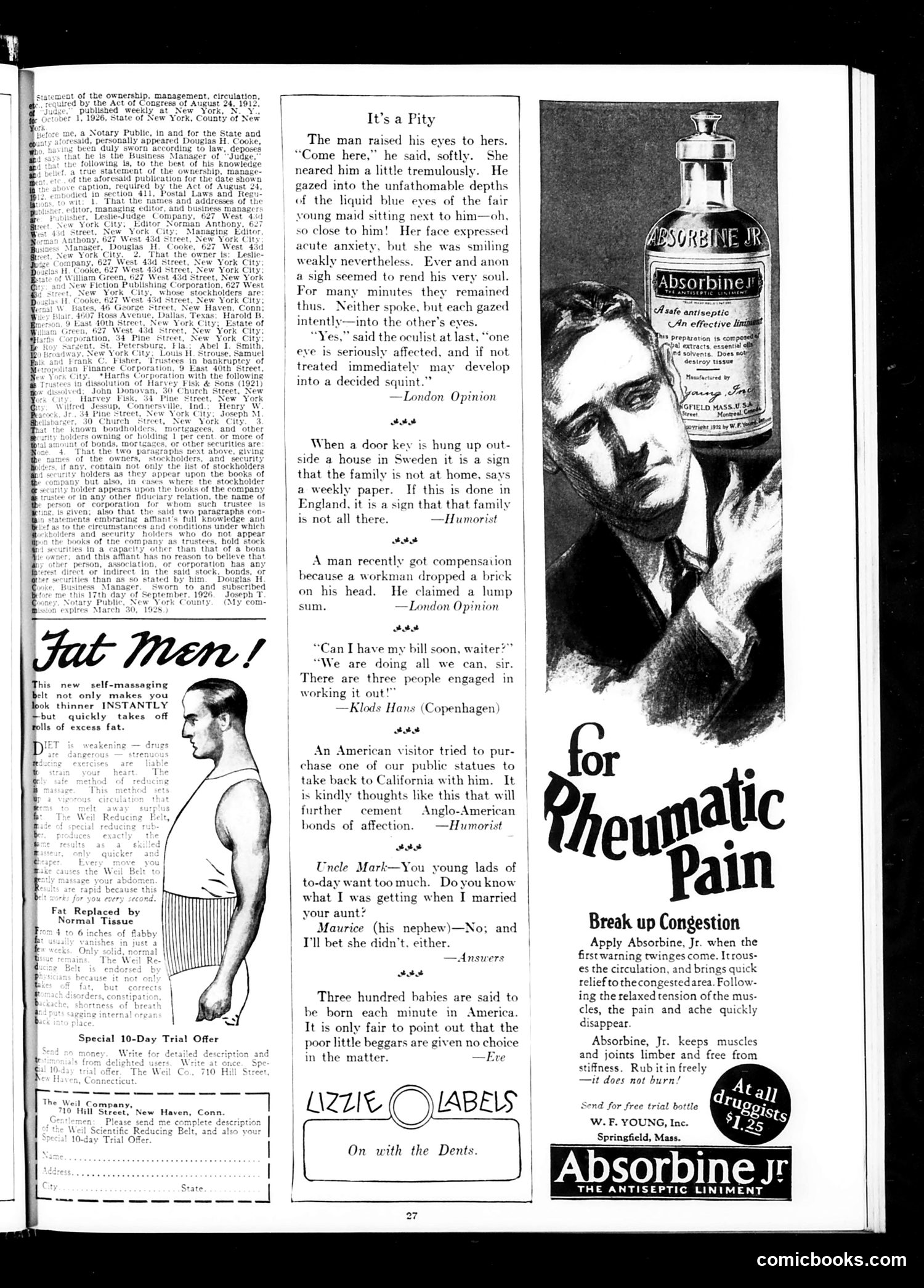
This page from Judge (1926) is primarily **advertisements interspersed with brief humorous anecdotes** rather than political cartoons. The main content includes: **"It's a Pity"** — A romantic short story about a man and woman gazing at each other, interrupted by an oculist's diagnosis that one eye needs immediate treatment to prevent a "decided squint." The joke: romantic tension deflated by medical reality. **Brief satirical items** credited to various sources (London Opinion, Humorist, etc.): - Swedish vs. English customs about hanging door keys - Compensation for a brick-dropping incident - Anglo-American relations commentary - Family banter about marriage costs **Advertisements** dominate: a "Fat Men!" self-massaging belt, and prominently, **Absorbine Jr.** liniment for rheumatic pain and muscle congestion. The page reflects Judge's typical format—mixing light humor with consumer advertising. No specific political figures or events are referenced; the satire targets universal human situations and Anglo-American cultural differences in genteel, understated fashion typical of 1920s magazine humor.
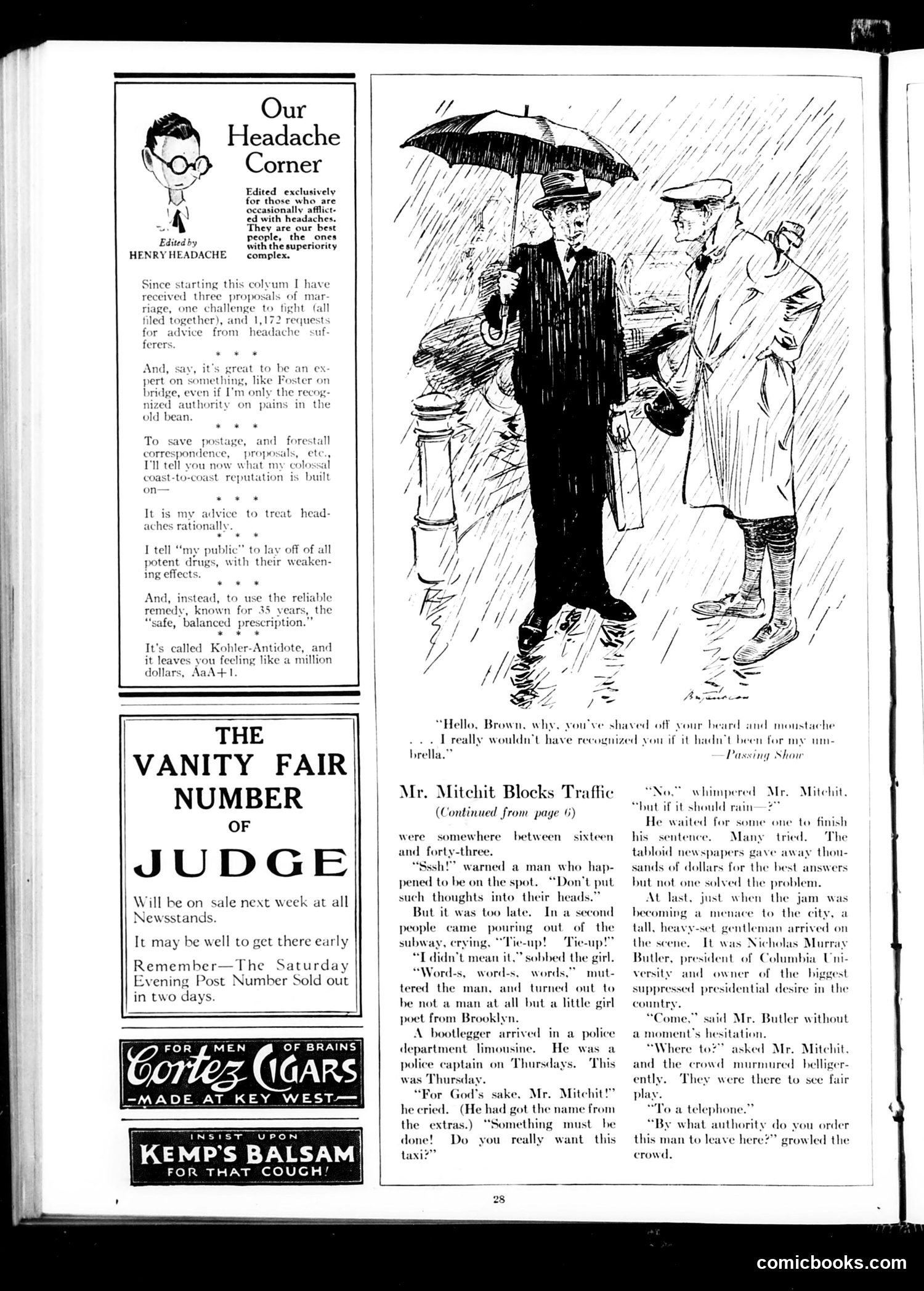
This page contains two distinct pieces: a "Headache Corner" advice column (left) and a humorous story (right) about a man named Mr. Mitchit who somehow creates traffic chaos in what appears to be New York City. The main cartoon satirizes bureaucratic absurdity and civic inefficiency. When Mitchit causes a subway backup, various authority figures arrive but prove useless: a bootlegger posing as a police captain, newspapers offering cash rewards for solutions, and finally Nicholas Murray Butler (real Columbia University president), who solves the crisis by simply ordering Mitchit to use a telephone. The joke critiques how institutions—press, police, academia—often tackle simple problems with overcomplicated responses, while common sense (just move along) gets overlooked until someone with presumed authority speaks. The setup parodies how New York's crowded streets could descend into chaos over minor incidents, and how citizens would demand government intervention.
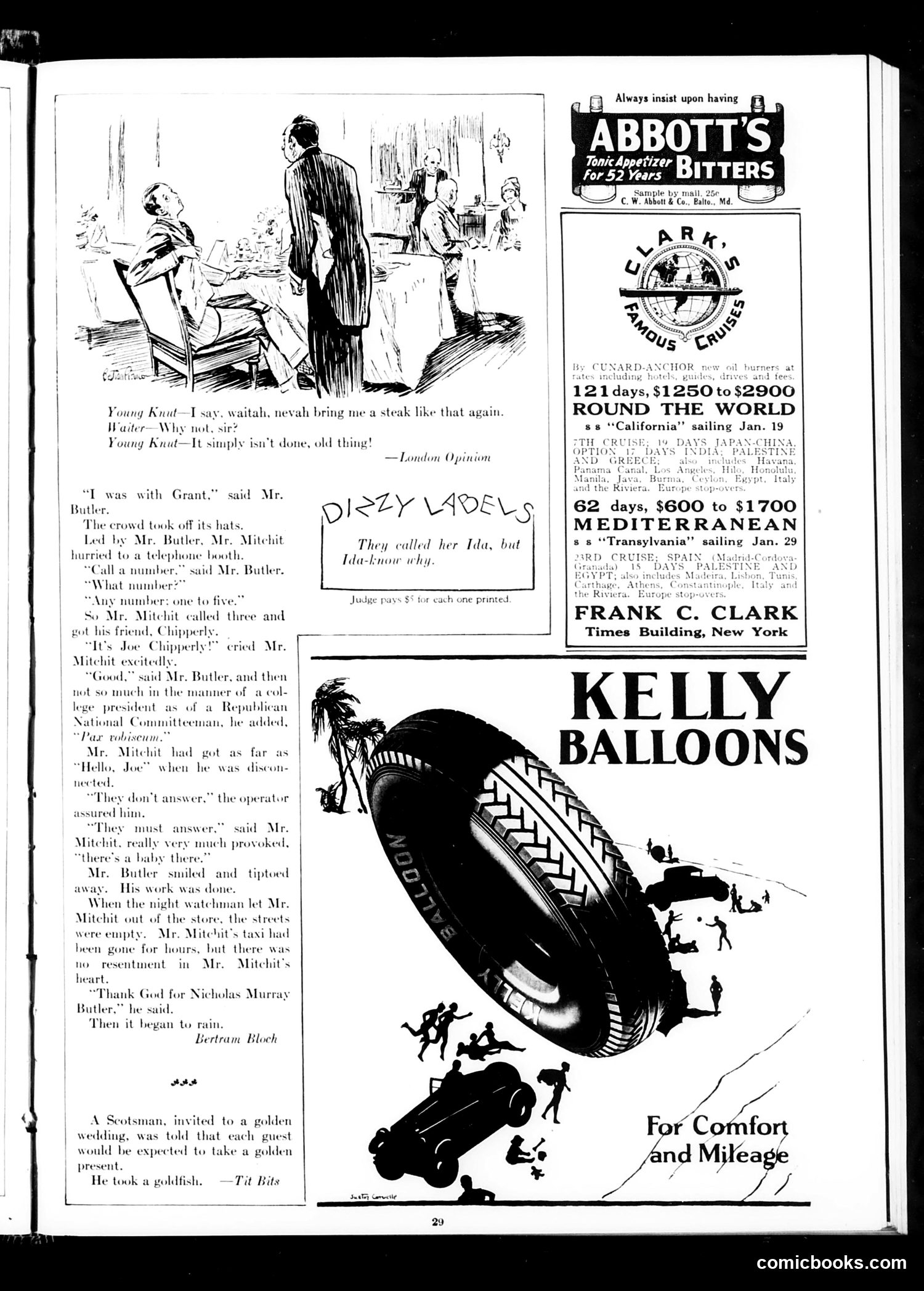
This page contains several distinct elements: **Main Cartoon Story** (by Bertram Bloch): A humorous narrative about a man named Mitchit who, after hearing someone "was with Grant" (likely President Ulysses S. Grant), becomes obsessed with calling random phone numbers trying to reach this person. A Mr. Butler—described pointedly as acting "not so much in the manner of a college president as of a Republican National Committeeman"—manipulates Mitchit's gullibility. The satire mocks both naive social-climbing (being impressed by Grant connections) and political operatives' cynical manipulation of gullible people. **Additional Content**: - Brief joke items from other publications (London Opinion, Tit Bits) - "Dizzy Aidels" caption about a woman named Ida - Period advertisements for Abbott's Bitters, cruise lines, and Kelly Balloons The page is primarily humor content with advertising. The main cartoon's political edge targets Republican operatives and social pretension among the affluent.
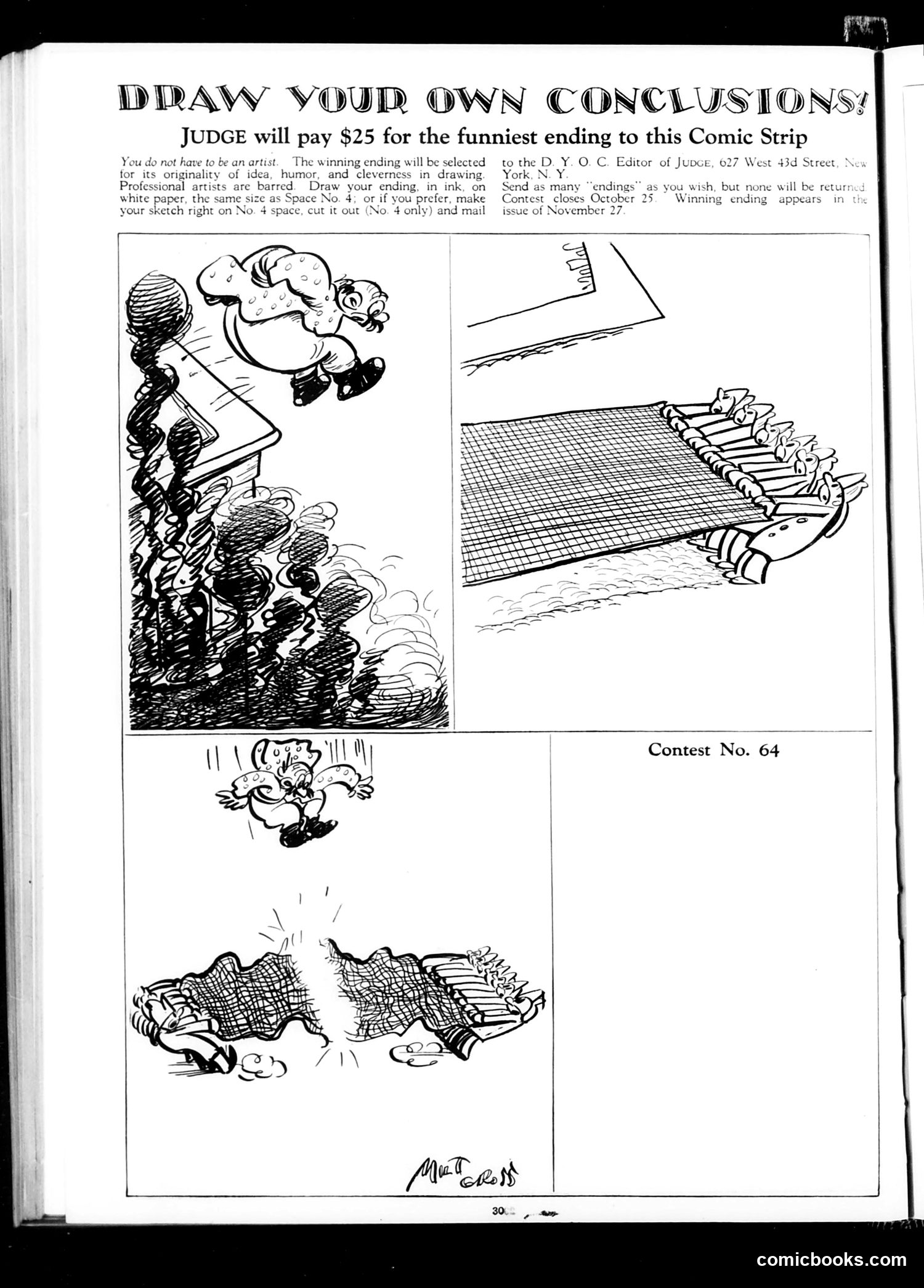
This is a reader-participation contest page from *Judge* magazine (Contest No. 64). Rather than presenting finished political cartoons, it invites readers to complete an unfinished comic strip for a $25 prize. The visible panels show: a figure being launched upward by an explosion, a volleyball net with legs protruding from it, a distressed character, and two torn pieces of what appears to be a woven object colliding. The contest rules explicitly state that "professional artists are barred," indicating *Judge* wanted amateur contributions. The humor relies on readers' creativity to devise absurd or witty conclusions to these surreal scenarios—typical of early-to-mid 20th century magazine humor contests. Without the intended punchlines, the specific satirical targets remain unclear, though the visual gags suggest slapstick comedy rather than political commentary.
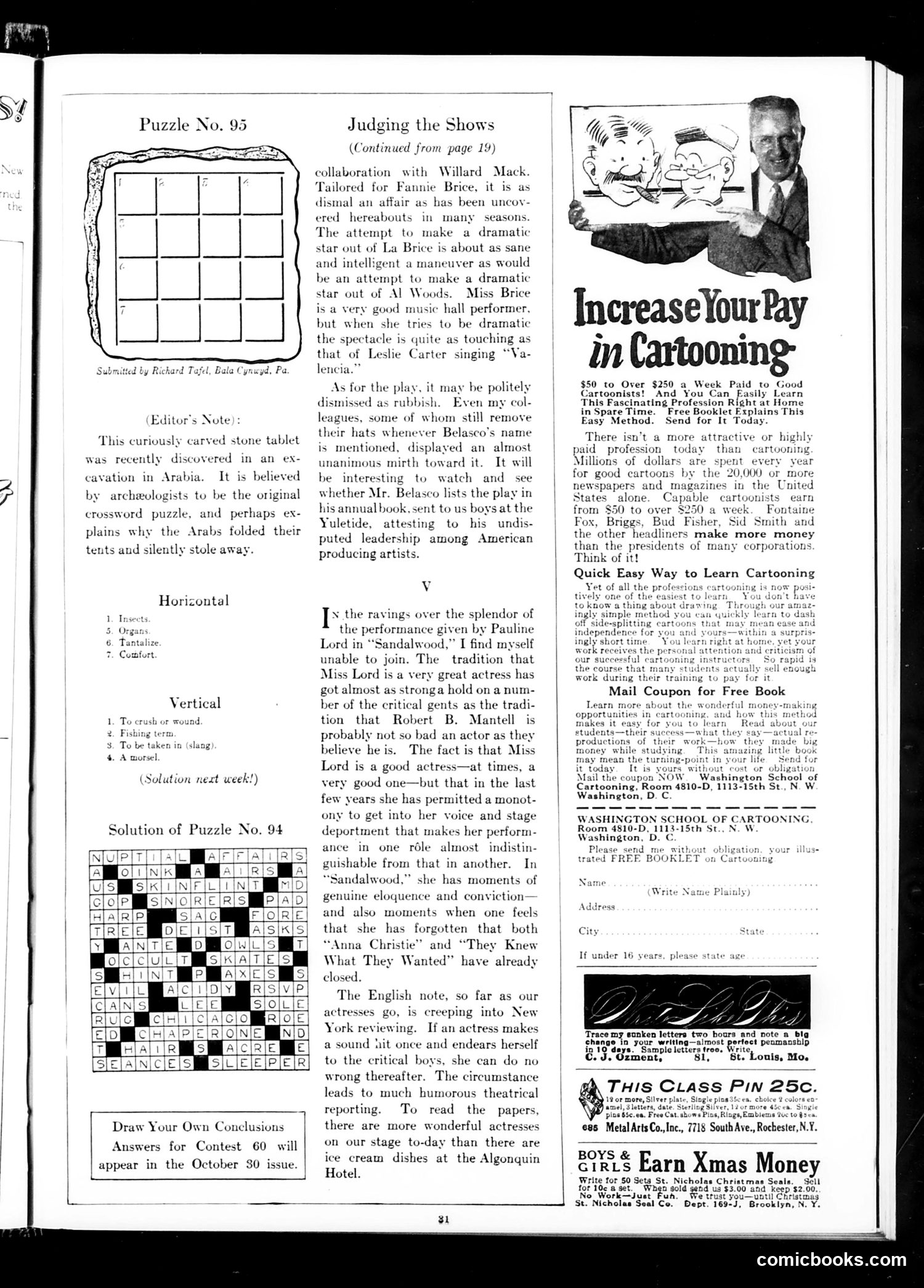
**Main Article ("Judging the Shows"):** Theater critic reviews recent Broadway productions. He dismisses a play starring Fannie Brice (a vaudeville performer attempting dramatic roles) as "rubbish," suggesting casting her in serious drama is as absurd as casting Al Woods. He similarly critiques actress Pauline Lord's recent performance in "Sandalwood," arguing that critical consensus has created an exaggerated reputation—she's competent but monotonous. The piece mocks how New York theater critics inflate actresses' abilities after one success, comparing contemporary praise to "ice cream dishes at the Algonquin Hotel" (implying excessive abundance). **Puzzle and Editor's Note:** A farcical footnote claims an Arabian stone tablet is the "original crossword puzzle," explaining why "the Arabs folded their tents and silently stole away"—a joke implying they invented and abandoned crosswords. **Advertisements:** The page features recruitment ads for cartooning lessons and money-making schemes, typical of 1920s-era magazine filler. The issue primarily discusses theater criticism rather than political satire.
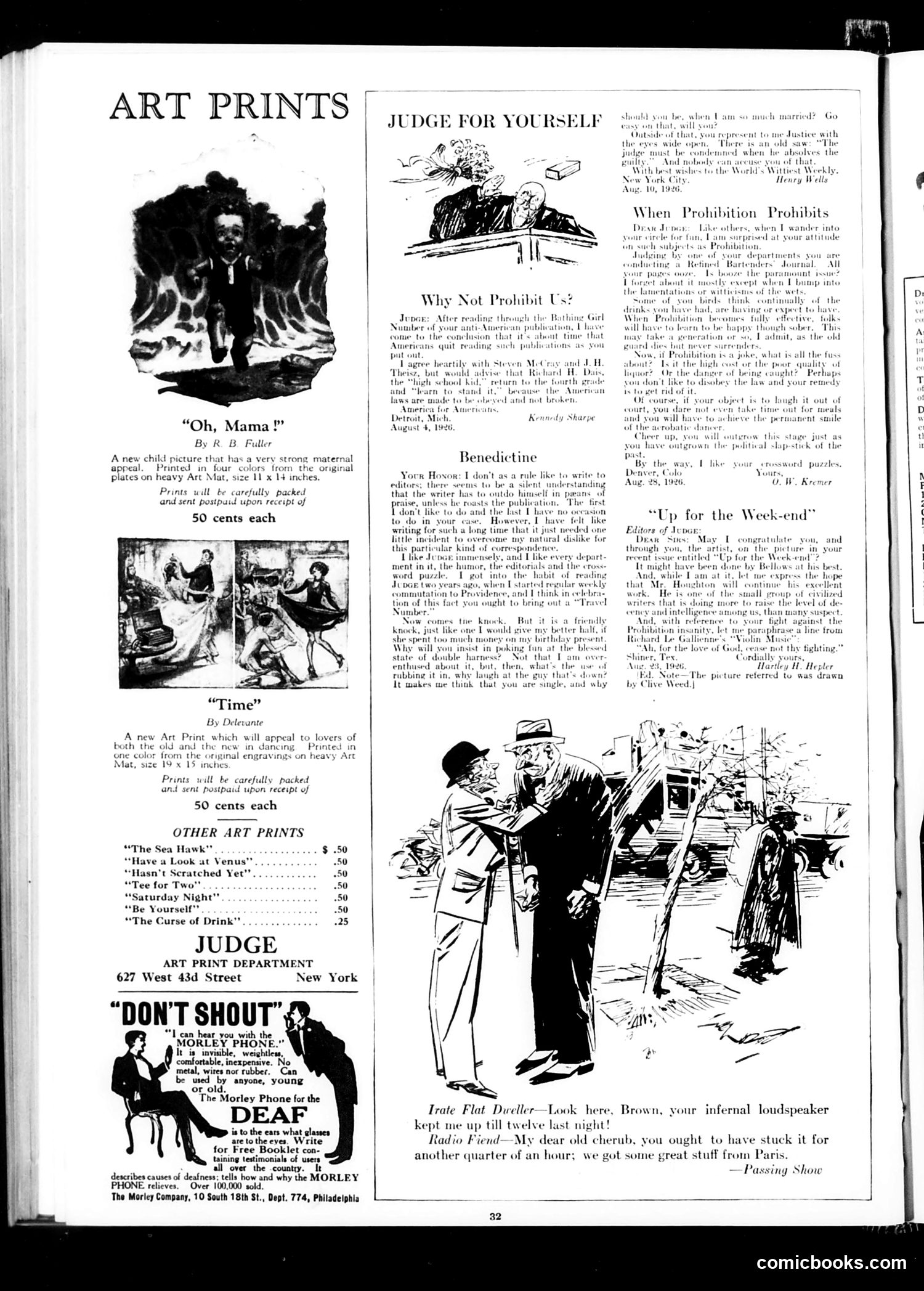
This page from Judge magazine (circa 1926, based on visible dates) contains satirical commentary on Prohibition-era America alongside art print advertisements. The main cartoon "Judge for Yourself" features a judge presiding over cases, with reader letters addressing social issues. Key satirical elements include: - **"When Prohibition Prohibits"**: Mocks Prohibition enforcement's absurdity—readers complain about poor-quality alcohol and legal entrapment despite the alcohol ban. - **"Why Not Prohibit Us?"**: Questions selective enforcement; suggests if dangerous substances warrant prohibition, why not other things? - **"Up for the Week-end"**: References illicit weekend activities during Prohibition, likely involving illegal drinking. The cartoon "Irate Flat Dweller" depicts a neighbor complaint about a loud radio kept on until midnight, with someone defending Paris radio broadcasts—reflecting 1920s anxieties about new technology and urban living. The page is primarily **advertising Judge's art prints and a hearing aid product** (Morley Phone), with reader letters filling the editorial space—typical Judge format mixing commerce with light social satire.
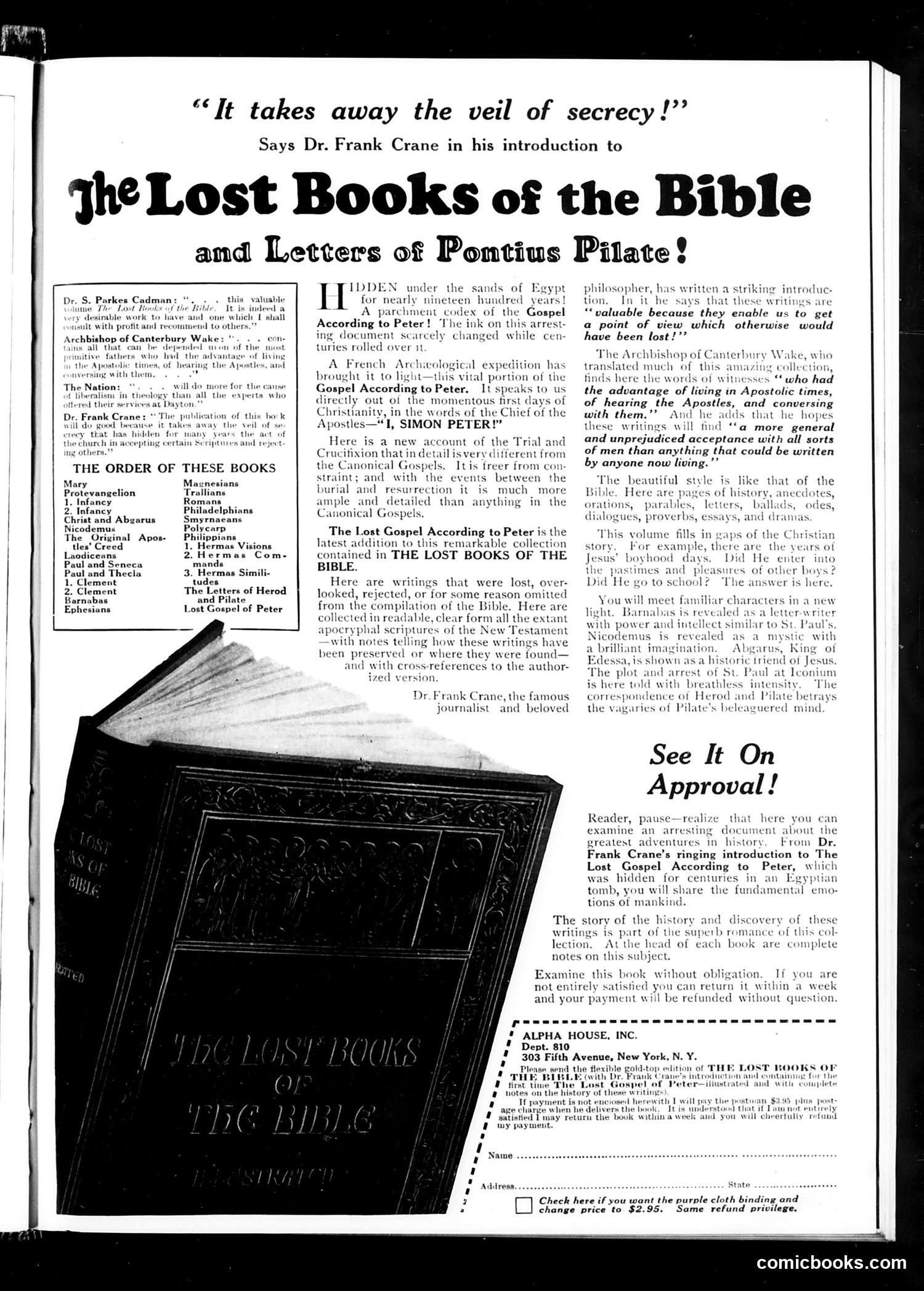
This is primarily **advertising**, not satire. It promotes "The Lost Books of the Bible and Letters of Pontius Pilate"—a real 1926 collection of apocryphal Christian texts. The page uses endorsements from respected religious figures (Dr. Frank Crane, Archbishop of Canterbury Wake, Dr. S. Parkes Cadman) to legitimize the book. Their quotes emphasize that these "lost" writings provide missing perspectives on Jesus and the apostles—particularly a "Gospel According to Peter" and letters allegedly from Pontius Pilate. The sales pitch targets readers curious about hidden or suppressed Christian history, promising answers to questions the canonical Bible doesn't address (Jesus's boyhood, etc.). The phrase "It takes away the veil of secrecy!" suggests these texts reveal secrets the established church may have concealed. The layout includes an order form and list of included texts, typical of mail-order advertising from this era. There's no evident satire here—this is straightforward (if somewhat sensationalized) religious publishing promotion.
This is a straightforward **cigarette advertisement**, not satirical content. It promotes Lucky Strike cigarettes, emphasizing their "toasted" process as a distinctive feature that allegedly enhances flavor. The ornate decorative border suggests this ran in *Judge* magazine during the early-to-mid 20th century, when cigarette advertising was commonplace and unregulated in American publications. The slogan "It's Toasted" was Lucky Strike's actual marketing claim from that era. There is no political cartoon, caricature, or satire present—just a product advertisement using period design aesthetics to convey quality and sophistication to readers.